NVQ Level 6 Diploma in OSH
Develop and implement effective communication systems for health and safety information
Make important information reach the right people in a usable form, with evidence that it was understood and acted on.
Understanding Develop and implement effective communication systems for health and safety information
Health and safety communication is a risk-control system, not a broadcast function. It must get accurate, current, relevant and understandable information to people who need to act on it, in time to control exposure. It also needs a reliable return route: workers, representatives, contractors and others must be able to raise concerns, challenge unclear instruction and receive a response. A document sent, a notice displayed or a read receipt recorded is not, by itself, evidence that the safety message was understood or applied.
Why this matters at work
Communication is often a barrier in a chain of controls. It can prevent exposure by transferring a change in law, a manufacturer's limit, a risk-assessment finding, an inspection defect, a permit condition or a lesson before work starts. It can recover a situation by stopping work, isolating equipment, calling competent help, accounting for people or supplying emergency services with reliable information. Its effectiveness depends on the whole system, not the wording alone.
Failures arise from late, inaccurate, ambiguous, inaccessible, excessive, conflicting or unverified messages. Human factors matter: people under time pressure scan, infer, rely on previous habits and may not receive digital messages during field work. Long documents, generic alerts, unfamiliar terminology, poor translation, competing supervisors and unreadable displays can all cause a correct source to fail at the point of use.
How organisations manage this in practice
Third, pilot in representative work, verify in the field, correct barriers, train and support managers, then roll out with clear ownership. Management review should examine material risk, performance, feedback, overdue actions, resource, legislative change, incident learning, contractor performance, digital resilience and effectiveness. Treat repeated communication failure as a management-system issue, not merely a worker-attention problem.
For the supplied NVQ context, evidence should show a connected competence story: identify and evaluate information; design systems for information entering, moving within and leaving the organisation; implement proportionate communication; control effectiveness; involve appropriate people; evaluate outcomes; and improve the system. The work product alone is rarely enough. Explain why the approach was chosen, who was involved, what risk or duty it addressed, what happened and what you learned.
Start with the work decision the message must support, the affected groups and the time available. Choose usable routes for operators, maintenance, contractors, agency supervisors and incoming shifts. Identify the current source and remove conflicting instructions at the point of use. Ask recipients to explain the required action and verify it in the task. A delivery receipt measures transmission, while a task check tests understanding and implementation. Give unresolved questions a named technical owner and provide a route for urgent concerns to return. For a high-consequence alert, identify the asset and location, the action or prohibition, current isolation status, competent contact and condition for return. Match that message with physical tags or quarantine and remove obsolete point-of-use information. The incoming supervisor must cross-check the record against the task. Include groups outside the normal email list and record unresolved recipients. This makes the communication a working barrier: an asset cannot quietly return to use because one supervisor was absent or a different instruction remained beside the machine.
How can I turn study guidance into authentic workplace evidence?
Use the worked example below to understand the decision chain. Build your portfolio from your own authorised workplace activity, preserve its provenance and discuss evidence suitability with your assessor.
A handover message that reaches the right people
Illustrative example. A team redesigns a maintenance handover after instructions repeatedly miss the incoming shift.
Decision. Identify the audiences and accessibility needs, trial the message and check understanding and action.
Evidence to check. Authorised originals, the learner’s contribution, feedback and evidence of a changed control.
Hold or escalation point. A delivered message is not proof of understanding; a worked example is not portfolio evidence.
Follow-up. Use authentic work within the learner’s role and agree suitability and confidentiality with the assessor.
How can I show that changed information reached the next shift?
Route an authorised change through version control, briefing, teach-back and a check of actual use. Portfolio evidence must identify the learner’s contribution and its limits.
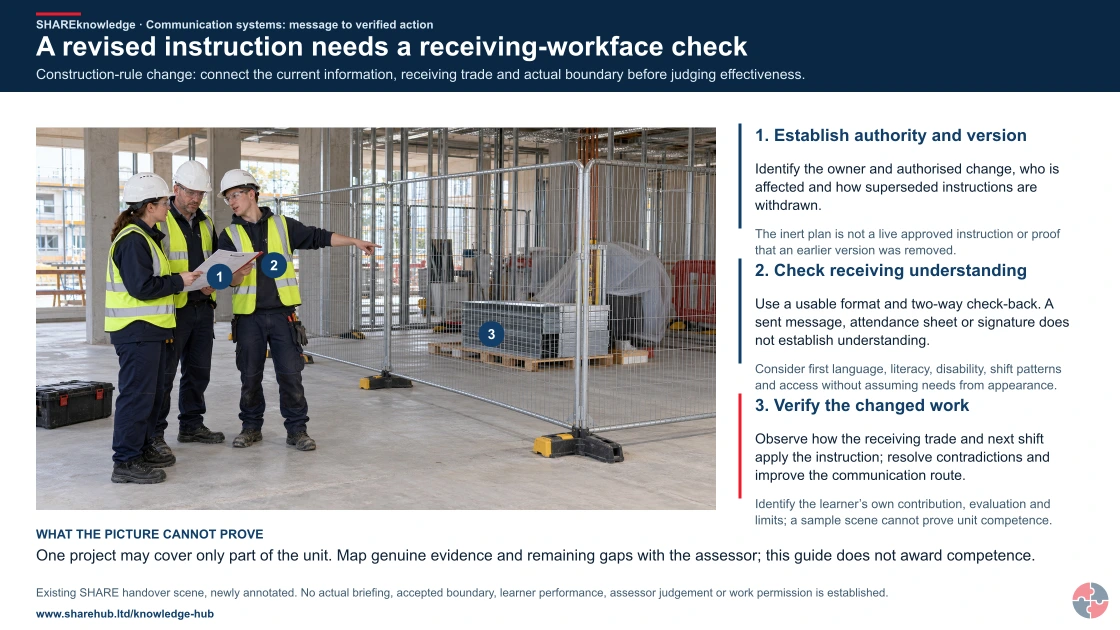
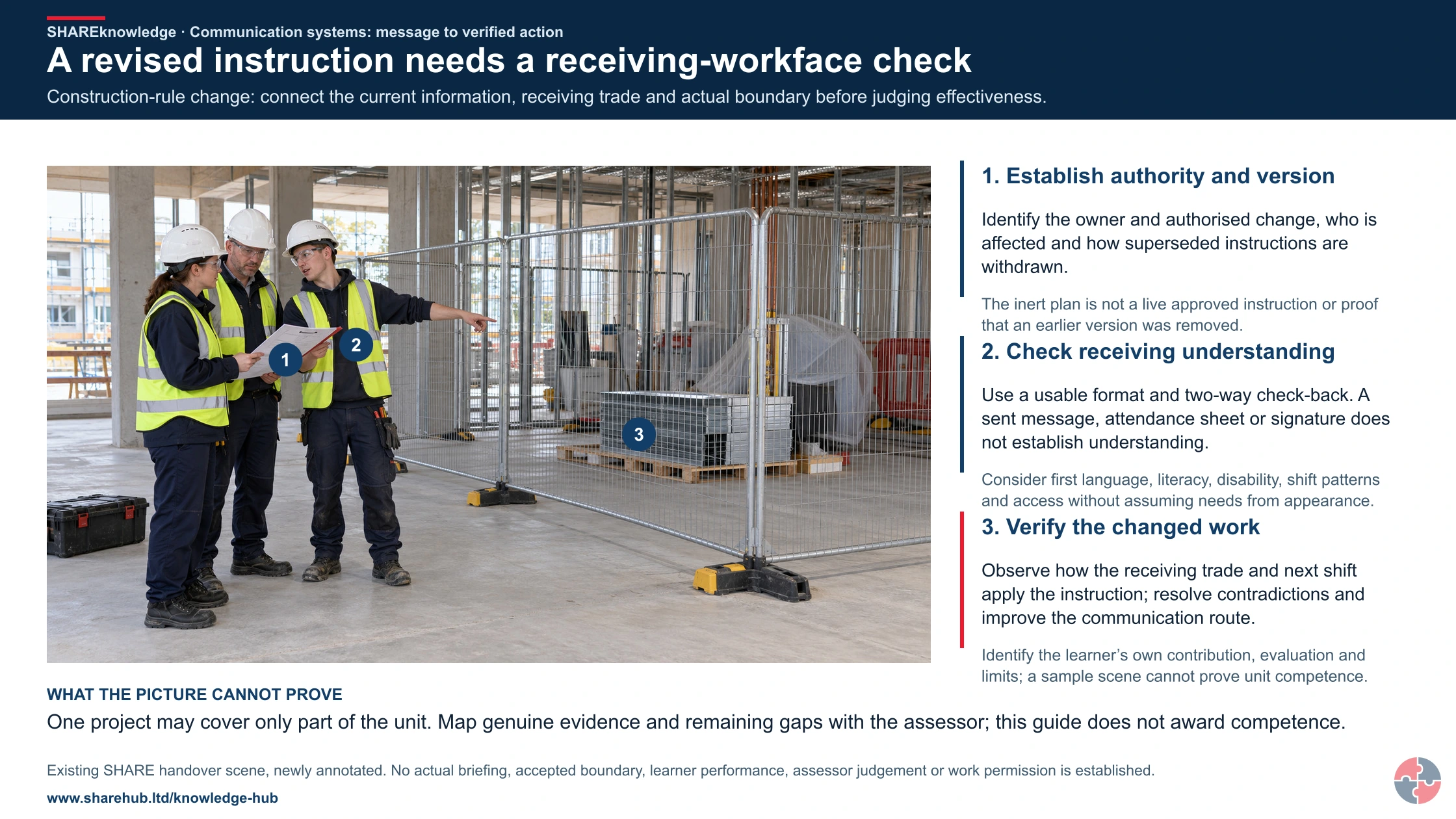
A revised instruction needs a receiving-workface check
Full written explanation
Construction-rule change: connect the current information, receiving trade and actual boundary before judging effectiveness.
- Establish authority and version. Identify the owner and authorised change, who is affected and how superseded instructions are withdrawn.
- Check receiving understanding. Use a usable format and two-way check-back. A sent message, attendance sheet or signature does not establish understanding.
- Verify the changed work. Observe how the receiving trade and next shift apply the instruction; resolve contradictions and improve the communication route.
Change the pathway
- Keep the change controlled. The inert plan is not a live approved instruction or proof that an earlier version was removed.
- Include the actual audience. Consider first language, literacy, disability, shift patterns and access without assuming needs from appearance.
- Keep personal evidence authentic. Identify the learner’s own contribution, evaluation and limits; a sample scene cannot prove unit competence.
Evidence check: One project may cover only part of the unit. Map genuine evidence and remaining gaps with the assessor; this guide does not award competence.
Full criterion map and genuine-evidence requirements
Primary references: HSE: safety-critical communication (GB) · HSE: involving the receiving workforce (GB)
Open the complete HD image (new tab)Download image
Full criterion map and genuine-evidence requirements
Primary references: HSE: safety-critical communication (GB) · HSE: involving the receiving workforce (GB)
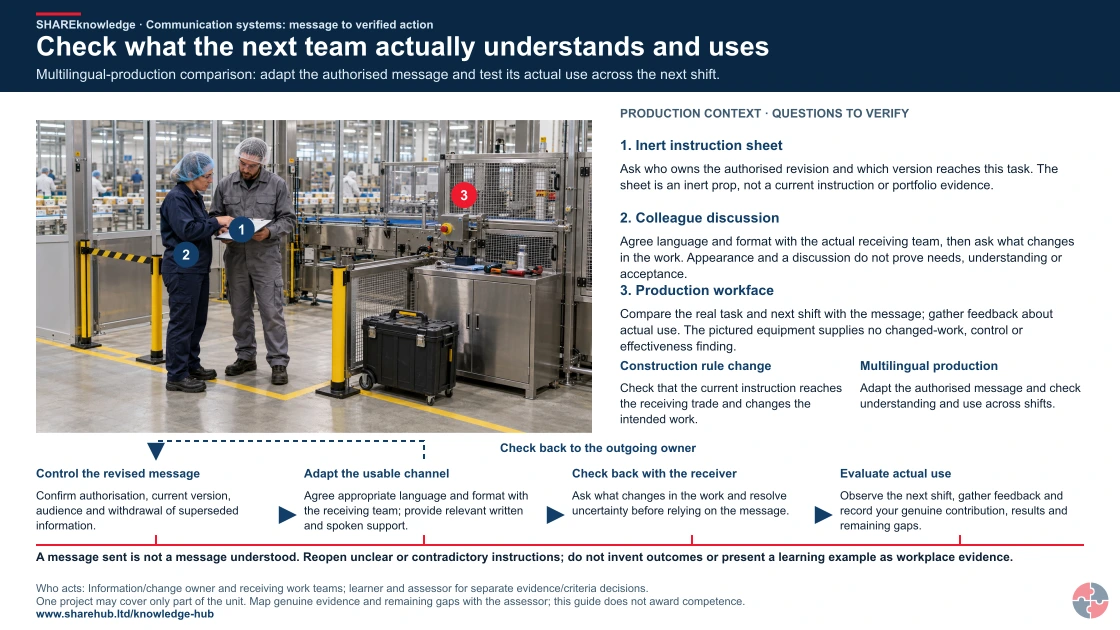
Check what the next team actually understands and uses
Full written explanation
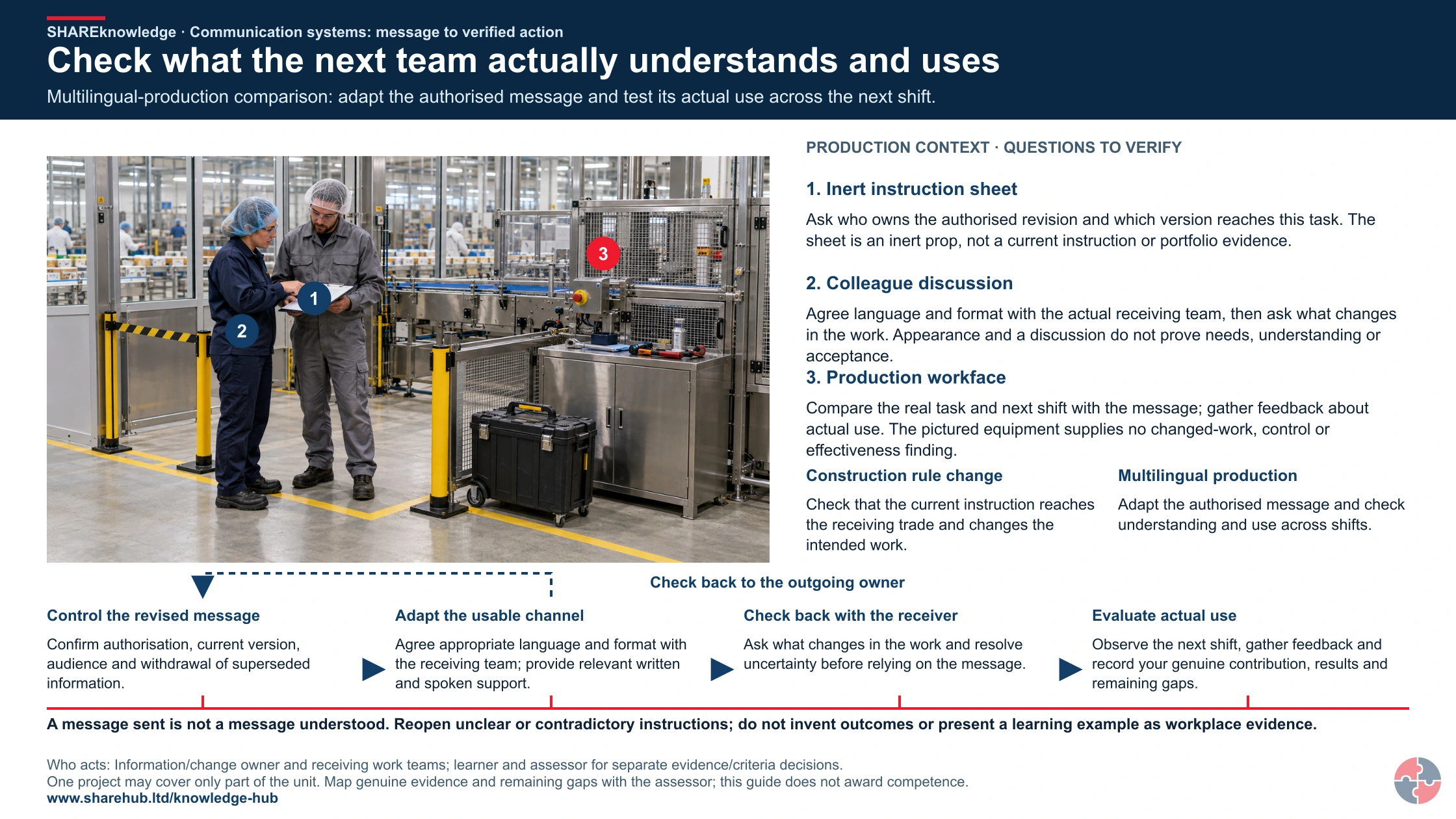
An illustrative production-workplace discussion connects an inert sheet, normal colleagues and packing equipment to questions about controlled information, usable channels and actual workface use. Picture key: 1 identifies the inert instruction sheet; 2 identifies the colleague discussion; 3 identifies the production workface. A complete single left-to-right band shows four full checks: control the revised message; adapt the usable channel; check back with the receiver; evaluate actual use. Three short forward arrows retain their genuine order. A separately labelled dashed second-to-first relation, Check back to the outgoing owner, retains the return to the information owner. Every check also has an unarrowed association with the common unresolved-message and evidence hold. The independent check headings are unnumbered. Full responsible roles, evidence limits and construction-rule-change and multilingual-production cases accompany the explanation. The scene establishes no actual approved revision, current version, withdrawn instruction, sender or receiver role, individual language, literacy, disability or access need, understanding, teach-back, next-shift performance, successful trial, changed work, control adequacy or permission. The inert sheet and conversation are not workplace portfolio evidence, an assessment decision or proof of unit competence. Agree format with the actual audience and evaluate genuine work without inventing results. Personal contribution, partial-unit coverage, exact criterion mapping and assessor, IQA and awarding-body decisions remain separate. Use the complete J/616/9532 unit guidance, assessor-issued plan, source qualifications and confidentiality arrangements; the image supplies no operating method, qualification acceptance or legal finding.
Multilingual-production comparison: adapt the authorised message and test its actual use across the next shift.
- Control the revised message. Confirm authorisation, current version, audience and withdrawal of superseded information.
- Adapt the usable channel. Agree appropriate language and format with the receiving team; provide relevant written and spoken support.
- Check back with the receiver. Ask what changes in the work and resolve uncertainty before relying on the message.
- Evaluate actual use. Observe the next shift, gather feedback and record your genuine contribution, results and remaining gaps.
When the evidence does not fit: A message sent is not a message understood. Reopen unclear or contradictory instructions; do not invent outcomes or present a learning example as workplace evidence.
Who acts: Information/change owner and receiving work teams; learner and assessor for separate evidence/criteria decisions.
Changed workplace
Construction rule change: Check that the current instruction reaches the receiving trade and changes the intended work.
Multilingual production: Adapt the authorised message and check understanding and use across shifts.
Evidence check: One project may cover only part of the unit. Map genuine evidence and remaining gaps with the assessor; this guide does not award competence.
Full criterion map and genuine-evidence requirements
Primary references: HSE: safety-critical communication (GB) · HSE: involving the receiving workforce (GB)
Open the complete HD image (new tab)Download image
Full criterion map and genuine-evidence requirements
Primary references: HSE: safety-critical communication (GB) · HSE: involving the receiving workforce (GB)

Authority and version
Establish who owns the change and withdraw superseded instructions through the controlled process.
Understanding and use
Brief the affected people, use check-back and verify how the next shift applies the change.
Personal evidence
Identify what you personally developed, implemented and evaluated; map any remaining criteria gaps with the assessor.
This is a evidence-planning example, not a completed portfolio, an assessment decision or evidence of whole-unit competence.
How can I demonstrate my workplace practice for unit 3?
Make important information reach the right people in a usable form, with evidence that it was understood and acted on. Unit reference: J/616/9532.
Plan a real activity with your assessor and identify the decisions, work products and witnesses that can show your own competence. The following suggestions are options to adapt, not mandatory document lists or model answers to submit.
What practical work should the evidence demonstrate?
Treat communication as an information-control system. A supplier update entering the business may affect maintenance instructions, a supervisor briefing and a contractor handover. Map these interfaces so you can explain why the right person received the current information at the right time.
Receipt is not understanding. Ask a worker to explain what they will do differently, observe the activity or use a short scenario to test comprehension. If language, literacy, disability, shift patterns or access to devices affect the audience, adapt the format and retain evidence of that choice.
Digital systems need ownership, version control, retrieval and protection of sensitive information. Compare the usefulness of a controlled procedure with an instant message: the latter may support an urgent alert but is not automatically a reliable long-term instruction or audit record.
What workplace project could I use to develop evidence?
A maintenance contractor changes its isolation method during a shutdown. Map incoming supplier information, internal authorisation and outgoing instructions to contractors. Trial a supervisor briefing with teach-back, update the controlled procedure and check whether people use the correct version on the next shift. Your evidence should show the whole information route, not just an email being sent.
This is an illustrative project, not an account to copy or a required template. Choose an activity you genuinely undertook and agree its scope with your assessor. If you advise rather than hold operational authority, evidence the recommendations, consultation and follow-up that were yours, alongside the decisions taken by authorised colleagues.
One project may cover only part of the unit. Check the full criterion map and plan additional genuine activities, knowledge evidence and professional development wherever the project leaves gaps. Do not treat an illustrative sample as proof of whole-unit coverage.
Build an evidence trail
- Explain the workplace, your role, the starting problem and the limits of your authority. Identify the activity dates and who can confirm your contribution.
- Keep the information you used, the options considered and your reasons for the decision. Identify specialist advice and distinguish what you knew from what you assumed.
- Show consultation and implementation: who agreed the action, what you personally delivered and how resources, ownership and deadlines were arranged.
- Include a follow-up check and an honest account of the result. Explain remaining gaps and what you would change; do not create outcomes that did not occur.
Prepare the evidence index
For unit 3, give each item an identifier, date, version, author, your contribution, relevant criterion references and exact page or paragraph locations. Record how authenticity can be checked. Cross-reference a genuinely relevant item to other units rather than creating duplicate copies, but explain separately how it supports each criterion.
Obtain permission before sharing workplace records. Redact names, commercial details and health information while preserving enough context for assessment. Arrange secure assessor access or an authenticated witness account where copying is inappropriate. Never upload identifiable incident or medical records to a public page or an unapproved AI tool.
How can I plan workplace evidence against each criterion?
The reference numbers below help you plan work and locate evidence. The activities, evidence suggestions and questions are original SHARE learning guidance, not the official criterion wording or a promise of acceptance. Use your assessor-issued assessment plan and the awarding-body specification for the exact requirements.
Open the ProQual qualification specificationOutcome 1: Find and judge useful information
1.1 · Research one relevant change, distinguish proposals from requirements already in force and decide whether the organisation needs action.
Evidence you could select
Source log and applicability assessment. Keep the relevant extract and explain your personal contribution rather than submitting an unexplained file.
Discuss with your assessor
Why is this information credible and relevant? Refer to a specific decision, the information available at the time and what happened afterwards.
1.2 · Follow one safety-critical message from supplier to supervisor to contractor and look for delays or version conflicts.
Evidence you could select
Information-flow map and findings. Keep the relevant extract and explain your personal contribution rather than submitting an unexplained file.
Discuss with your assessor
Where could failure affect work? Refer to a specific decision, the information available at the time and what happened afterwards.
Outcome 2: Build reliable information routes
2.1 · Create an incoming-information register linking suppliers, monitoring findings and alerts to owners who must assess them.
Evidence you could select
Register and routing procedure. Keep the relevant extract and explain your personal contribution rather than submitting an unexplained file.
Discuss with your assessor
Who decides whether action is needed? Refer to a specific decision, the information available at the time and what happened afterwards.
2.2 · Deliver the same operational change through suitable shift briefings, written instructions and digital updates.
Evidence you could select
Briefing materials and understanding checks. Keep the relevant extract and explain your personal contribution rather than submitting an unexplained file.
Discuss with your assessor
Why was more than one channel needed? Refer to a specific decision, the information available at the time and what happened afterwards.
2.3 · Send a relevant safety update to a contractor or client and obtain a meaningful response.
Evidence you could select
Authorised correspondence and acknowledgement. Keep the relevant extract and explain your personal contribution rather than submitting an unexplained file.
Discuss with your assessor
How did you protect sensitive information? Refer to a specific decision, the information available at the time and what happened afterwards.
2.4 · Retain retrievable versions of supplier instructions and safety data linked to the equipment or material actually used.
Evidence you could select
Controlled records and retrieval test. Keep the relevant extract and explain your personal contribution rather than submitting an unexplained file.
Discuss with your assessor
How did you prevent outdated instructions? Refer to a specific decision, the information available at the time and what happened afterwards.
2.5 · Assign message owners, response times, escalation routes and review checks for your system.
Evidence you could select
Communication matrix and monitoring log. Keep the relevant extract and explain your personal contribution rather than submitting an unexplained file.
Discuss with your assessor
What happens when nobody responds? Refer to a specific decision, the information available at the time and what happened afterwards.
2.6 · Make policy expectations visible in job planning and supervisor conversations, then check staff understanding.
Evidence you could select
Planning records and workforce feedback. Keep the relevant extract and explain your personal contribution rather than submitting an unexplained file.
Discuss with your assessor
How is this more than a noticeboard exercise? Refer to a specific decision, the information available at the time and what happened afterwards.
Outcome 3: Control outgoing information
3.1 · Trace an applicable reporting obligation through decision, authorised submission and retained confirmation; do not invent a reportable event.
Evidence you could select
Reporting protocol or genuine submission record. Keep the relevant extract and explain your personal contribution rather than submitting an unexplained file.
Discuss with your assessor
Who confirms applicability and deadlines? Refer to a specific decision, the information available at the time and what happened afterwards.
3.2 · Prepare an authorised, non-confidential learning brief for an appropriate external audience.
Evidence you could select
Shared brief and permission record. Keep the relevant extract and explain your personal contribution rather than submitting an unexplained file.
Discuss with your assessor
Why was this audience appropriate? Refer to a specific decision, the information available at the time and what happened afterwards.
3.3 · Check the information supplied about a service, product or waste movement against what recipients need to manage risk.
Evidence you could select
Handover pack and recipient feedback. Keep the relevant extract and explain your personal contribution rather than submitting an unexplained file.
Discuss with your assessor
What must travel with the work or material? Refer to a specific decision, the information available at the time and what happened afterwards.
3.4 · Test whether a contractor receives current site rules before starting and understands key restrictions.
Evidence you could select
Induction pack and comprehension evidence. Keep the relevant extract and explain your personal contribution rather than submitting an unexplained file.
Discuss with your assessor
How did you check understanding rather than receipt? Refer to a specific decision, the information available at the time and what happened afterwards.
Outcome 4: Evaluate the system and your choices
4.1 · Compare the system before and after your change using delivery, understanding and field-use evidence.
Evidence you could select
Evaluation with findings and limitations. Keep the relevant extract and explain your personal contribution rather than submitting an unexplained file.
Discuss with your assessor
What improved and what still failed? Refer to a specific decision, the information available at the time and what happened afterwards.
4.2 · Compare written, spoken and digital messages using a real audience; address access, retention and feedback.
Evidence you could select
Channel comparison and worked examples. Keep the relevant extract and explain your personal contribution rather than submitting an unexplained file.
Discuss with your assessor
When is an email insufficient? Refer to a specific decision, the information available at the time and what happened afterwards.
4.3 · Explain how supplier changes, reporting duties, new guidance and contractor interfaces affect your communication plan.
Evidence you could select
External-change impact review. Keep the relevant extract and explain your personal contribution rather than submitting an unexplained file.
Discuss with your assessor
What triggers a new message or revised procedure? Refer to a specific decision, the information available at the time and what happened afterwards.
5.1 · Evidence your professional development
Use a learning episode related to this unit: identify a gap in your capability, set a realistic objective, record the activity and explain how you applied the learning. Discuss an ethical decision, an inclusion issue and a contribution to professional discussion. Finish with a dated review of progress and the next priority. A list of courses attended is not a reflective development record.
Evidence options: a competence self-review, dated development plan, reflective CPD entry, an ethical or inclusive-practice example and a record of professional exchange. Cross-reference the same genuine portfolio across units where appropriate, adding a unit-specific reflection.
Which background reading supports this unit?
Use the linked SHARE topics to strengthen your understanding, then explain the decisions you made in your own organisation. Reading alone is not evidence that you performed the work.
What should I check before submitting evidence to my assessor?
Check that the evidence is authentic, relevant to the registered criteria and clear about your own decisions, actions and results. Resolve gaps with your assessor and protect personal or confidential information before submission.
- Performance: show work you actually did, not just what a practitioner ought to do. Explain your contribution to team-produced documents.
- Reasoning: answer explain, analyse, evaluate and justify questions with decisions, alternatives and limitations, not copied definitions.
- Coverage: map every reference to a precise piece of evidence. Discuss gaps early, including missing authority, specialist tasks or no genuine incident or external request.
- Authenticity and sufficiency: ask what observation, questioning or witness evidence the assessor needs. A job title, course certificate or large upload alone is not proof of competence.
- Exercises: label drills and simulated records accurately. Their acceptability depends on the assessment requirements and assessor agreement; never present them as genuine emergencies or incidents.
- Outcome: the assessor decides whether the evidence meets the requirements, subject to centre and awarding-body quality assurance. These learning pages do not award competence or replace assessment.