NVQ Level 6 Diploma in OSH
Develop and maintain individual and organisational competence in health and safety matters
Show how you identified capability gaps, arranged appropriate learning and supervision, and checked whether people could perform safely afterwards.
Understanding Develop and maintain individual and organisational competence in health and safety matters
Show how you identified capability gaps, arranged appropriate learning and supervision, and checked whether people could perform safely afterwards.
Why this matters at work
Plan for rare but high-consequence tasks. A control-room operator, rescue team member, permit authority, lifting coordinator or emergency commander may need simulation and practice even when normal work gives little opportunity to exercise the skill. Review whether work allocation maintains adequate experience across the team and whether a single expert creates a resilience risk. Succession, cross-training and specialist support can be justified where loss of a capability would expose people to serious harm.
Placement decisions must take account of the person's existing competence and the work environment. A newly qualified employee, agency worker, apprentice, worker returning after absence, person changing role or worker new to the UK may need different induction, language support, supervised practice and pace of exposure. HSE emphasises additional supervision for people who are inexperienced, new to the job or whose first language is not English. This is a risk-control decision, not a personal judgement.
How organisations manage this in practice
Management of change must include a competence impact assessment before introducing new plant, substances, software, layout, shift system, outsourcing, acquisition, contractor model, role design, staffing reduction or emergency arrangement. Identify who needs new knowledge, authorisation, supervision, technical advice, interface information or practice; where existing competence will no longer be sufficient; and whether the change creates a temporary period of heightened risk. Implement controls before or alongside the change, not after the first error.
HSE states that effective health and safety management requires competence across every level of the workforce, including employers, managers, supervisors, employees and contractors. The management system should identify safety-critical roles, set the standard of competence, ensure suitable access to expertise, and test whether capability remains adequate after organisational or technical change. Risk profile drives depth: simple low-risk office work generally needs a lighter system than a multi-site logistics operation, a foundry or a petrochemical facility.
Assure competence through more than record checks. Use field observation, task sampling, interviews, work-product review, incident and near-miss analysis, drill performance, feedback from supervisors and workers, audit, technical assurance, health data where relevant and change reviews. Test both the person and the system: whether controls are understood, equipment is usable, procedures match work, supervision is adequate, escalation works and resources permit safe performance.
How can I turn study guidance into authentic workplace evidence?
Use the worked example below to understand the decision chain. Build your portfolio from your own authorised workplace activity, preserve its provenance and discuss evidence suitability with your assessor.
Attendance, performance and permission differ
Illustrative example. A operator completes training but cannot yet demonstrate a critical task safely.
Decision. Assess actual task performance, define supervision and keep any authorisation bounded.
Evidence to check. Competence gap, observed assessment, assessor authority and review after change.
Hold or escalation point. Course attendance alone does not establish competence or permission for every task.
Follow-up. Choose authentic organisational evidence and explain the learner’s contribution without exposing unnecessary personal data.
How can I compare role requirements with observed capability?
Capability evidence needs to match the lifting-operation role and conditions. Training and practice feed the decision; an unverified requirement remains a gap.

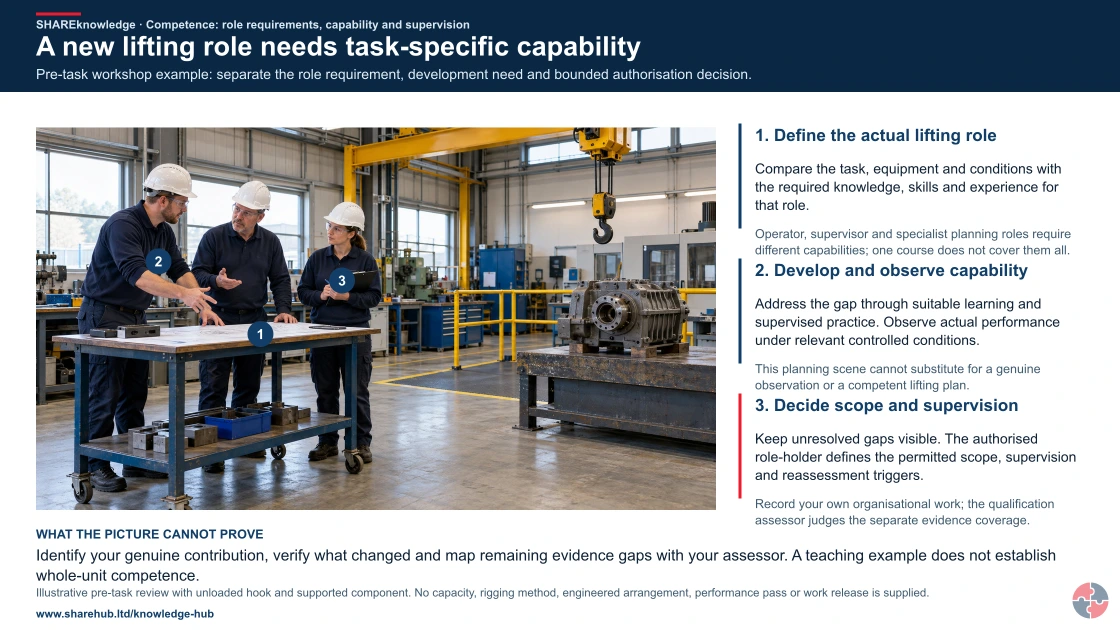
A new lifting role needs task-specific capability
Full written explanation
Pre-task workshop example: separate the role requirement, development need and bounded authorisation decision.
- Define the actual lifting role. Compare the task, equipment and conditions with the required knowledge, skills and experience for that role.
- Develop and observe capability. Address the gap through suitable learning and supervised practice. Observe actual performance under relevant controlled conditions.
- Decide scope and supervision. Keep unresolved gaps visible. The authorised role-holder defines the permitted scope, supervision and reassessment triggers.
Change the pathway
- Separate the lifting roles. Operator, supervisor and specialist planning roles require different capabilities; one course does not cover them all.
- A discussion is not a performance test. This planning scene cannot substitute for a genuine observation or a competent lifting plan.
- Keep workplace and NVQ decisions distinct. Record your own organisational work; the qualification assessor judges the separate evidence coverage.
Evidence check: Identify your genuine contribution, verify what changed and map remaining evidence gaps with your assessor. A teaching example does not establish whole-unit competence.
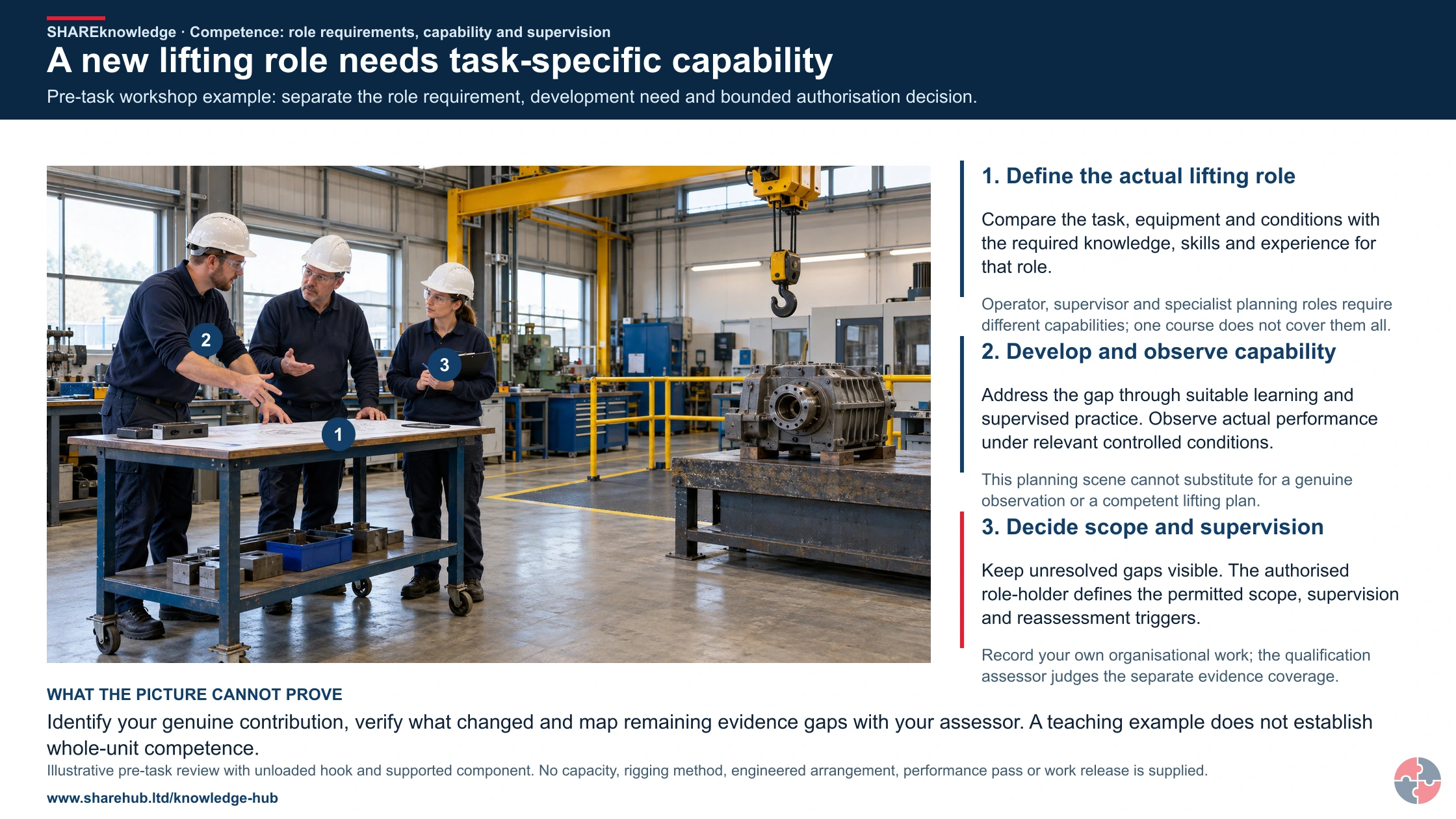
Role-specific capability, supervision, application and evidence limits
Primary references: HSE: task-relevant competence (GB) · HSE: competent planning and organising of lifting operations (GB)
Open the complete HD image (new tab)Download image
Role-specific capability, supervision, application and evidence limits
Primary references: HSE: task-relevant competence (GB) · HSE: competent planning and organising of lifting operations (GB)
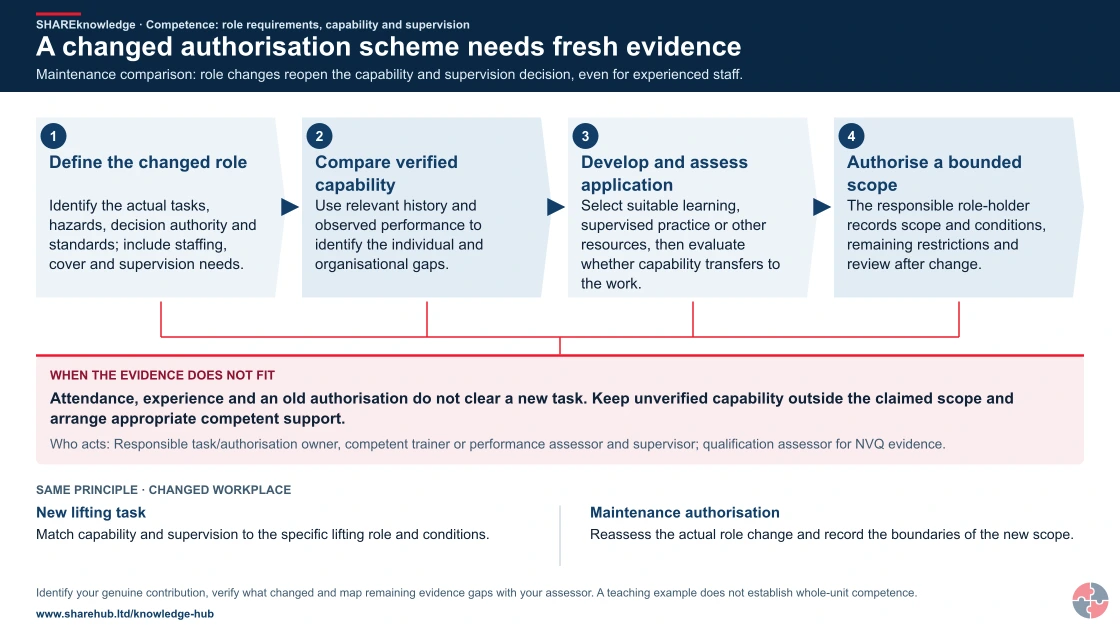
A changed authorisation scheme needs fresh evidence
Full written explanation
Maintenance comparison: role changes reopen the capability and supervision decision, even for experienced staff.
- Define the changed role. Identify the actual tasks, hazards, decision authority and standards; include staffing, cover and supervision needs.
- Compare verified capability. Use relevant history and observed performance to identify the individual and organisational gaps.
- Develop and assess application. Select suitable learning, supervised practice or other resources, then evaluate whether capability transfers to the work.
- Authorise a bounded scope. The responsible role-holder records scope and conditions, remaining restrictions and review after change.
When the evidence does not fit: Attendance, experience and an old authorisation do not clear a new task. Keep unverified capability outside the claimed scope and arrange appropriate competent support.
Who acts: Responsible task/authorisation owner, competent trainer or performance assessor and supervisor; qualification assessor for NVQ evidence.
Changed workplace
New lifting task: Match capability and supervision to the specific lifting role and conditions.
Maintenance authorisation: Reassess the actual role change and record the boundaries of the new scope.
Evidence check: Identify your genuine contribution, verify what changed and map remaining evidence gaps with your assessor. A teaching example does not establish whole-unit competence.
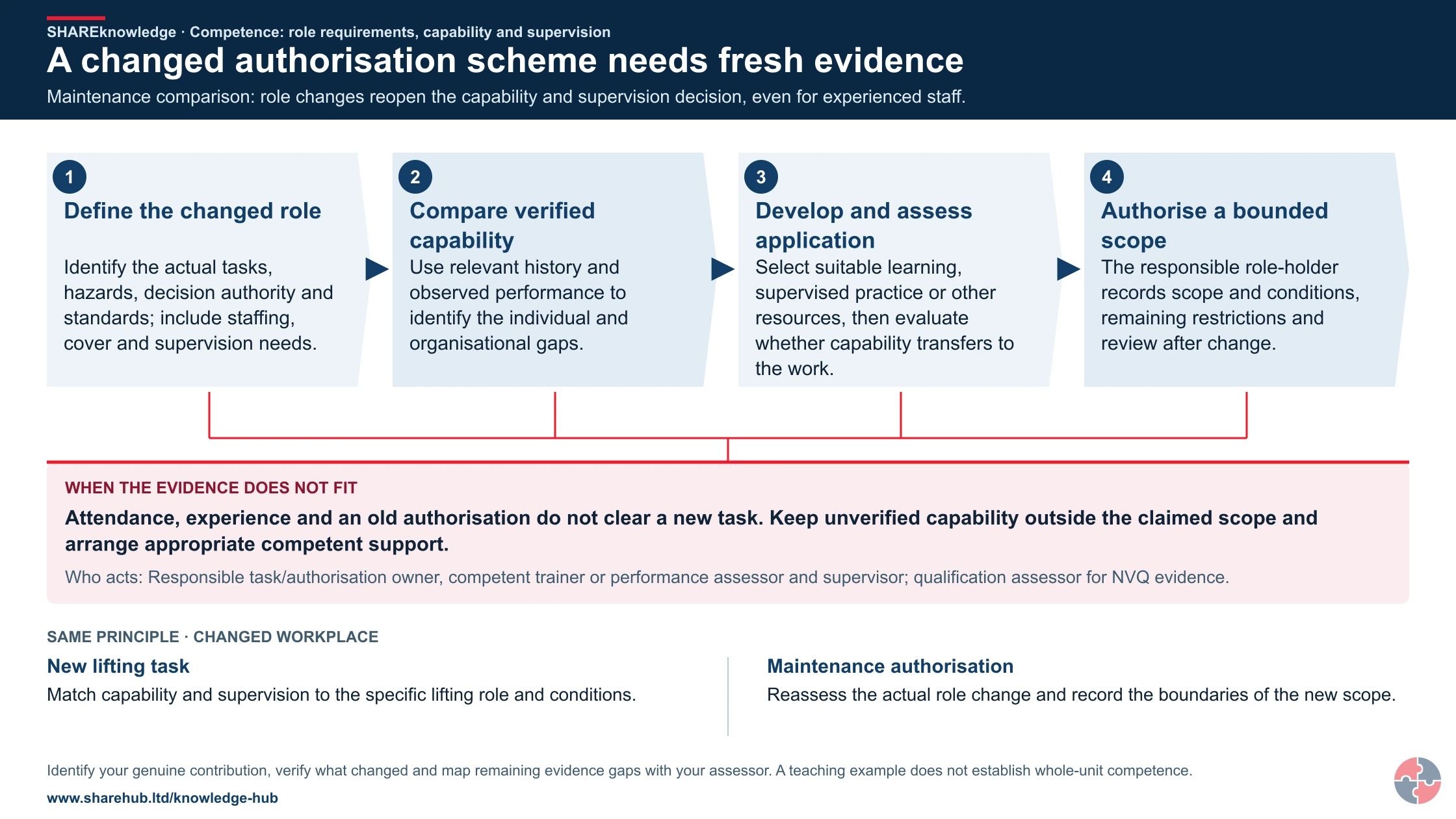
Role-specific capability, supervision, application and evidence limits
Primary references: HSE: task-relevant competence (GB) · HSE: competent planning and organising of lifting operations (GB)
Open the complete HD image (new tab)Download image
Role-specific capability, supervision, application and evidence limits
Primary references: HSE: task-relevant competence (GB) · HSE: competent planning and organising of lifting operations (GB)

Define capability
State the actual task/role standard and compare it with verified evidence.
Develop and observe
Address gaps through suitable training, supervised practice and observation of performance.
Decide and review
Record the authorised scope, unresolved gaps and reassessment triggers; map the learner’s contribution with the assessor.
This is a evidence-planning example, not a completed portfolio, an assessment decision or evidence of whole-unit competence.
How can I demonstrate my workplace practice for unit 4?
Show how you identified capability gaps, arranged appropriate learning and supervision, and checked whether people could perform safely afterwards. Unit reference: R/616/9534.
Plan a real activity with your assessor and identify the decisions, work products and witnesses that can show your own competence. The following suggestions are options to adapt, not mandatory document lists or model answers to submit.
What practical work should the evidence demonstrate?
Competence combines relevant knowledge, skills, experience and the ability to recognise limitations. Separate the operator's task, the supervisor's decisions and the specialist's role. Organisational competence also depends on staffing, cover, supervision and arrangements that let capable people work effectively.
A needs analysis should compare a defined performance expectation with observed capability. Avoid starting with a catalogue of courses. A gap might require coached practice, redesigned work, recruitment or competent supervision rather than another classroom session.
Evaluate at more than one point: did the learner understand, demonstrate the skill and apply it under normal working conditions? Record what you changed when learning did not transfer. A training certificate supports the history of learning but does not replace a job-specific performance check.
What workplace project could I use to develop evidence?
A workshop introduces a new lifting operation. Break the activity into planning, inspection, use and supervision roles, then compare required capability with existing staff evidence. Deliver or coordinate targeted learning, arrange supervised practice and observe performance against agreed standards. A certificate alone does not show that the new job can be done safely.
This is an illustrative project, not an account to copy or a required template. Choose an activity you genuinely undertook and agree its scope with your assessor. If you advise rather than hold operational authority, evidence the recommendations, consultation and follow-up that were yours, alongside the decisions taken by authorised colleagues.
One project may cover only part of the unit. Check the full criterion map and plan additional genuine activities, knowledge evidence and professional development wherever the project leaves gaps. Do not treat an illustrative sample as proof of whole-unit coverage.
Build an evidence trail
- Explain the workplace, your role, the starting problem and the limits of your authority. Identify the activity dates and who can confirm your contribution.
- Keep the information you used, the options considered and your reasons for the decision. Identify specialist advice and distinguish what you knew from what you assumed.
- Show consultation and implementation: who agreed the action, what you personally delivered and how resources, ownership and deadlines were arranged.
- Include a follow-up check and an honest account of the result. Explain remaining gaps and what you would change; do not create outcomes that did not occur.
Prepare the evidence index
For unit 4, give each item an identifier, date, version, author, your contribution, relevant criterion references and exact page or paragraph locations. Record how authenticity can be checked. Cross-reference a genuinely relevant item to other units rather than creating duplicate copies, but explain separately how it supports each criterion.
Obtain permission before sharing workplace records. Redact names, commercial details and health information while preserving enough context for assessment. Arrange secure assessor access or an authenticated witness account where copying is inappropriate. Never upload identifiable incident or medical records to a public page or an unapproved AI tool.
How can I plan workplace evidence against each criterion?
The reference numbers below help you plan work and locate evidence. The activities, evidence suggestions and questions are original SHARE learning guidance, not the official criterion wording or a promise of acceptance. Use your assessor-issued assessment plan and the awarding-body specification for the exact requirements.
Open the ProQual qualification specificationOutcome 1: Identify capability gaps in real work
1.1 · Observe a job from planning to completion and separate the decisions made by operators, supervisors and specialists.
Evidence you could select
Task breakdown and role analysis. Keep the relevant extract and explain your personal contribution rather than submitting an unexplained file.
Discuss with your assessor
Which decisions require specialist judgement? Refer to a specific decision, the information available at the time and what happened afterwards.
1.2 · Define safe-performance expectations for each role rather than assigning the same course to everyone.
Evidence you could select
Role-based competence matrix. Keep the relevant extract and explain your personal contribution rather than submitting an unexplained file.
Discuss with your assessor
What must each person actually be able to do? Refer to a specific decision, the information available at the time and what happened afterwards.
1.3 · Compare individual observations and records with the organisation's collective capacity, including cover for absence.
Evidence you could select
Gap analysis and evidence references. Keep the relevant extract and explain your personal contribution rather than submitting an unexplained file.
Discuss with your assessor
Where is the system dependent on one person? Refer to a specific decision, the information available at the time and what happened afterwards.
1.4 · Agree actions such as recruitment, coaching, training or restricted duties to close identified gaps.
Evidence you could select
Improvement plan with owners and dates. Keep the relevant extract and explain your personal contribution rather than submitting an unexplained file.
Discuss with your assessor
How did you manage risk while gaps remained? Refer to a specific decision, the information available at the time and what happened afterwards.
Outcome 2: Deliver learning and verify performance
2.1 · Set observable performance standards for a specific activity, including when the person should stop and seek help.
Evidence you could select
Competence standard and assessor checklist. Keep the relevant extract and explain your personal contribution rather than submitting an unexplained file.
Discuss with your assessor
How will safe performance be recognised? Refer to a specific decision, the information available at the time and what happened afterwards.
2.2 · Design a short learning programme around the gap, available time and resources; include practice and evaluation.
Evidence you could select
Session plan, materials and agreed budget. Keep the relevant extract and explain your personal contribution rather than submitting an unexplained file.
Discuss with your assessor
Why does the design fit this audience? Refer to a specific decision, the information available at the time and what happened afterwards.
2.3 · Personally deliver suitable training to individuals and groups; show your own contribution to any joint delivery. Coordination alone does not demonstrate delivery.
Evidence you could select
Your delivery observation, session materials and learner feedback. Keep the relevant extract and explain your personal contribution rather than submitting an unexplained file.
Discuss with your assessor
How did you adapt and check your own delivery? Refer to a specific decision, the information available at the time and what happened afterwards.
2.4 · Check performance on the job after learning and use results to revise support, not just collect satisfaction scores.
Evidence you could select
Follow-up observations and corrective actions. Keep the relevant extract and explain your personal contribution rather than submitting an unexplained file.
Discuss with your assessor
Did learning transfer to normal work? Refer to a specific decision, the information available at the time and what happened afterwards.
Outcome 3: Explain competence and learning choices
3.1 · Explain a situation where individual skill was adequate but staffing or supervision made the organisation ineffective.
Evidence you could select
Reflective case analysis. Keep the relevant extract and explain your personal contribution rather than submitting an unexplained file.
Discuss with your assessor
Why is collective capability different? Refer to a specific decision, the information available at the time and what happened afterwards.
3.2 · Relate the competence matrix to departments, reporting routes and operational responsibilities.
Evidence you could select
Role map and supporting explanation. Keep the relevant extract and explain your personal contribution rather than submitting an unexplained file.
Discuss with your assessor
Who owns competence decisions? Refer to a specific decision, the information available at the time and what happened afterwards.
3.3 · Compare task observation, job analysis and worker consultation for identifying capability requirements.
Evidence you could select
Method comparison using your project. Keep the relevant extract and explain your personal contribution rather than submitting an unexplained file.
Discuss with your assessor
What did each method miss? Refer to a specific decision, the information available at the time and what happened afterwards.
3.4 · Discuss a real example showing the difference between attending training, holding a qualification and performing competently.
Evidence you could select
Evidence comparison and reflection. Keep the relevant extract and explain your personal contribution rather than submitting an unexplained file.
Discuss with your assessor
What further assurance was needed? Refer to a specific decision, the information available at the time and what happened afterwards.
3.5 · Explain your choice of demonstration, practice, questioning and feedback; compare alternatives and test validity.
Evidence you could select
Learning-design rationale and evaluation tools. Keep the relevant extract and explain your personal contribution rather than submitting an unexplained file.
Discuss with your assessor
How do assessment methods check the intended skill? Refer to a specific decision, the information available at the time and what happened afterwards.
3.6 · Explain how applicable requirements and controlled records influence authorisation, refreshers and competence checks.
Evidence you could select
Requirement map and document controls. Keep the relevant extract and explain your personal contribution rather than submitting an unexplained file.
Discuss with your assessor
How would a change trigger reassessment? Refer to a specific decision, the information available at the time and what happened afterwards.
4.1 · Evidence your professional development
Use a learning episode related to this unit: identify a gap in your capability, set a realistic objective, record the activity and explain how you applied the learning. Discuss an ethical decision, an inclusion issue and a contribution to professional discussion. Finish with a dated review of progress and the next priority. A list of courses attended is not a reflective development record.
Evidence options: a competence self-review, dated development plan, reflective CPD entry, an ethical or inclusive-practice example and a record of professional exchange. Cross-reference the same genuine portfolio across units where appropriate, adding a unit-specific reflection.
Which background reading supports this unit?
Use the linked SHARE topics to strengthen your understanding, then explain the decisions you made in your own organisation. Reading alone is not evidence that you performed the work.
What should I check before submitting evidence to my assessor?
Check that the evidence is authentic, relevant to the registered criteria and clear about your own decisions, actions and results. Resolve gaps with your assessor and protect personal or confidential information before submission.
- Performance: show work you actually did, not just what a practitioner ought to do. Explain your contribution to team-produced documents.
- Reasoning: answer explain, analyse, evaluate and justify questions with decisions, alternatives and limitations, not copied definitions.
- Coverage: map every reference to a precise piece of evidence. Discuss gaps early, including missing authority, specialist tasks or no genuine incident or external request.
- Authenticity and sufficiency: ask what observation, questioning or witness evidence the assessor needs. A job title, course certificate or large upload alone is not proof of competence.
- Exercises: label drills and simulated records accurately. Their acceptability depends on the assessment requirements and assessor agreement; never present them as genuine emergencies or incidents.
- Outcome: the assessor decides whether the evidence meets the requirements, subject to centre and awarding-body quality assurance. These learning pages do not award competence or replace assessment.