SHARE Knowledge Hub
Arson and flammable material risks
Secure external waste and flammable stocks, control ignition and keep escape routes clear. Apply the correct national fire law and DSEAR where dangerous substances are present. For fire, smoke or immediate danger, raise the alarm, evacuate and call 999.
Understanding Arson and flammable material risks
Secure external waste and flammable stocks, control ignition and keep escape routes clear. Apply the correct national fire law and DSEAR where dangerous substances are present. For fire, smoke or immediate danger, raise the alarm, evacuate and call 999.
Why this matters at work
Common harm mechanisms are thermal burns, respiratory-tract injury, carbon-monoxide and other toxic-gas poisoning, oxygen depletion, loss of visibility, panic, falls, crush, explosion overpressure, fragments, structural collapse and chemical/environmental exposure. Firefighters and responders also face re-ignition, hidden fire, damaged cylinders and contaminated runoff.
Return to service tests each impaired function and the combined cause-and-effect under normal, alarm and power-loss states. Verify communication recipients and safe reset, restore temporarily changed procedures and explain residual restrictions. A reset panel, restored CCTV image or signed work order alone does not release all affected operations. Preserve the failure record, investigate the common dependency and revise maintenance and change controls.
How organisations manage this in practice
Assess releases and vapours as well as ignition sources, including hot work, electrical equipment, static or deliberate ignition where credible. Prefer eliminating or reducing hazardous inventory and open handling, then reliable engineering and organisational controls. Apply the appropriate GB or NI dangerous substances regime and relevant premises fire framework. Settings, quantities and separation requirements depend on the substance, installation and applicable guidance, not a generic answer. Record who checks stock, prevents unauthorised access and manages temporary changes. Maintain detection, protection, escape and emergency information and manage impairments explicitly. Verify actual storage and transfer during representative work rather than rely on a stock list or warning sign.
Preventative barriers reduce the chance of ignition or escalation: source elimination, stock reduction, separation, secure storage, perimeter and access control, surveillance, ignition control and housekeeping. Protective and recovery barriers reduce consequences after ignition: compartmentation, detection, alarm, suppression, smoke control, means of escape, emergency response, fire-service facilities, environmental containment and continuity arrangements.
Audit from outside in and across time. Walk the boundary, waste areas, roof access, loading bays, stores, escape routes, plant rooms and low-use spaces by day and after dark. Review local incidents, access data, closing checks, flammable inventory, DSEAR controls, alarm/suppression status, drills and action closure.
Verification should test the full source-to-consequence path. Reconcile purchasing, use and waste against the physical inventory; inspect containers, pipework, flexible connections, vents, drains and security; confirm local exhaust and general ventilation performance; prove interlocks, alarms and emergency stops; review hot work and contractor interfaces; and examine abnormal operations such as delivery, sampling, decanting, maintenance and spill recovery. Any unexplained stock, unlabelled container, failed ventilation, incompatible storage or uncontrolled ignition source is a decision point, not a housekeeping note.
Where does this fire-risk guidance apply?
Use this for workplace premises, external areas and tasks where deliberate ignition or flammable materials could create fire; confirm the nation, activity and substances before applying a legal requirement.
It is awareness and management guidance, not a site fire risk assessment, security plan, DSEAR assessment, emergency plan or permission to fight a fire. A fire risk assessment must reflect the actual building, people, activities, escape arrangements and foreseeable deliberate ignition. DSEAR requires a separate dangerous-substances decision when applicable; it is not triggered by every ordinary combustible item.
Use the closing check before the specialist reference
For an ordinary closing check, examine the opportunity for deliberate ignition as well as the combustible material. Accessible bins, loose packaging, failed locks and blocked responder routes can combine into a credible scenario. Apply the site fire assessment and the correct national fire-law context.
Best-practice guide: Arson and flammable material risks

Use the closing check before the specialist reference
For an ordinary closing check, examine the opportunity for deliberate ignition as well as the combustible material. Accessible bins, loose packaging, failed locks and blocked responder routes can combine into a credible scenario. Secure external waste and flammable stocks, control ignition and keep escape routes clear.
Turn arson and flammable material risks knowledge into a decision
Secure external waste and flammable stocks, control ignition and keep escape routes clear. Apply the correct national fire law and DSEAR where dangerous substances are present. Site plan and bin-compound inspection, before/after position photographs, lock defect ticket and duty-manager close-out.
Accessible bin compound
Move bins to the agreed secured compound; clear loose waste; report a failed lock. Photograph corrected position, log lock repair and transfer open action to duty manager.
Warning signs and how they can cause harm
Bins, skips or pallets against the building: A deliberate or accidental fire can spread through doors, windows, vents, walls or roofs. Combustibles in escape routes: Fire or smoke can block evacuation and reduce available escape time. Unlabelled or open flammable containers: Vapour release, spills and incompatible use can cause fire or explosion.
Choose controls for arson and flammable material risks
Eliminate: Remove the fuel, ignition source or activity where reasonably practicable. Reduce: Reduce quantity, duration, exposure and opportunity. Isolate: Separate fuel from ignition and people from hazardous areas. Control: Use engineering and process controls to prevent ignition or limit fire growth. PPE: Protect people during residual handling, spill response or defined emergency roles. Read the full control table for qualifications, ownership and verification. Use the actual task and applicable jurisdiction; existing technical approval remains unchanged.
Use the full arson and flammable material risks lesson
Use the full topic for the decision points, practical examples, detailed control tables and source scope. HSE guidance applies to Great Britain; use HSENI for the Northern Ireland route and the source’s stated jurisdiction. A simplified guide does not change the page’s technical-review or approval status.

Read all six steps as text
1. Use the closing check before the specialist reference
For an ordinary closing check, examine the opportunity for deliberate ignition as well as the combustible material.
- Avoid / redesign: Remove the fuel, ignition source or activity where reasonably practicable.
- Control the task: Separate fuel from ignition and people from hazardous areas.
- Verify before release: Procurement records, waste plan, change review and before/after inspection.
For an ordinary closing check, examine the opportunity for deliberate ignition as well as the combustible material. Accessible bins, loose packaging, failed locks and blocked responder routes can combine into a credible scenario. Secure external waste and flammable stocks, control ignition and keep escape routes clear.
Apply it: Which part of this plan would you check at the workface before authorising the task?
2. Turn arson and flammable material risks knowledge into a decision
Use the evidence to improve the actual work arrangement.
- Change at source: Remove the fuel, ignition source or activity where reasonably practicable.
- Make it observable: Procurement records, waste plan, change review and before/after inspection.
- Keep useful evidence: Site plan and bin-compound inspection, before/after position photographs, lock defect ticket and duty-manager close-out.
Secure external waste and flammable stocks, control ignition and keep escape routes clear. Apply the correct national fire law and DSEAR where dangerous substances are present. Site plan and bin-compound inspection, before/after position photographs, lock defect ticket and duty-manager close-out.
Apply it: What evidence would show that the change improves this task, rather than only completing a record?
3. Accessible bin compound
Example: a practical application of the existing topic lesson.
- Setting: Move unsecured waste before closing a public leisure centre.
- Act: Check bin route, lock, lighting and safe separation from openings and escape routes against the site assessment.
- Hold / review: Hold closure sign-off for bins against the building; call security/police for credible deliberate ignition threat, without confrontation.
Move bins to the agreed secured compound; clear loose waste; report a failed lock. Photograph corrected position, log lock repair and transfer open action to duty manager.
Apply it: At which point would you hold this example, and what evidence would allow it to proceed?
4. Warning signs and how they can cause harm
Connect the task, the route to the person and the control that can fail.
- Bins, skips or pallets against the building: A deliberate or accidental fire can spread through doors, windows, vents, walls or roofs.
- Combustibles in escape routes: Fire or smoke can block evacuation and reduce available escape time.
- Unlabelled or open flammable containers: Vapour release, spills and incompatible use can cause fire or explosion.
Bins, skips or pallets against the building: A deliberate or accidental fire can spread through doors, windows, vents, walls or roofs. Combustibles in escape routes: Fire or smoke can block evacuation and reduce available escape time. Unlabelled or open flammable containers: Vapour release, spills and incompatible use can cause fire or explosion.
Apply it: Who could be exposed, including other trades, cleaners, maintainers and people nearby?
5. Choose controls for arson and flammable material risks
Start with the stronger practicable options and verify their effect.
- Eliminate: Remove the fuel, ignition source or activity where reasonably practicable.
- Reduce: Reduce quantity, duration, exposure and opportunity.
- Isolate: Separate fuel from ignition and people from hazardous areas.
- Control: Use engineering and process controls to prevent ignition or limit fire growth.
- PPE: Protect people during residual handling, spill response or defined emergency roles.
Eliminate: Remove the fuel, ignition source or activity where reasonably practicable. Reduce: Reduce quantity, duration, exposure and opportunity. Isolate: Separate fuel from ignition and people from hazardous areas. Control: Use engineering and process controls to prevent ignition or limit fire growth. PPE: Protect people during residual handling, spill response or defined emergency roles. Read the full control table for qualifications, ownership and verification. Use the actual task and applicable jurisdiction; existing technical approval remains unchanged.
Apply it: Which stronger option can be used here, and who will verify it before accepting the remaining risk?
6. Use the full arson and flammable material risks lesson
Follow the official sources below and retain the task-specific evidence.
- Official guidance: HSE DSEAR background (Current web guidance)
- Official guidance: DSEAR Regulations (Northern Ireland) 2003 (2003, as amended)
- Task decision: Site plan and bin-compound inspection, before/after position photographs, lock defect ticket and duty-manager close-out.
Use the full topic for the decision points, practical examples, detailed control tables and source scope. HSE guidance applies to Great Britain; use HSENI for the Northern Ireland route and the source’s stated jurisdiction. A simplified guide does not change the page’s technical-review or approval status.
Apply it: Which official source and full-topic section will you use to resolve the next decision?
Keep dangerous-substance release and specialist major-hazard decisions separate from routine premises precautions. Record an unresolved lock or waste-location defect with an owner and temporary arrangement; a ticked closing sheet should show the actual condition rather than a familiar signature.
A bin compound cannot be secured
Illustrative example. A leisure-centre closing team finds loose cardboard and a failed lock at bins near the sports-hall wall.
Decision. Move/control waste using the agreed site arrangement and escalate the failed security control before closing sign-off.
Evidence to check. Check openings, escape/responder access, bin location, available secure storage and the authorised temporary arrangement.
Hold or escalation point. Do not sign off an unresolved exposure merely because the building interior is clear.
Follow-up. Recheck the repaired lock and waste arrangement after the next busy event.
What should each role decide first?
Workers report fuel and access failures, supervisors remove the immediate opportunity, and the premises manager verifies the assessment, owners and emergency arrangements.
Worker or cleaner
Report unsecured waste, damaged locks, suspicious ignition activity, blocked exits, leaking containers or unplanned hot work. Do not approach a suspected fire-setter or enter smoke.
Security or closing team
Check the agreed perimeter, bin compound, external doors, vulnerable recesses and alarm route; record defects and transfer them to the duty manager.
Supervisor or permit issuer
Hold hot work, transfers or events when fuel, ignition, ventilation, separation or escape controls are missing; coordinate contractors and recheck the area at hand-back.
Premises manager or assessor
Review fire and, where relevant, DSEAR assessments; select proportionate controls, assign repairs, brief shifts and verify actions in the actual workplace.
What are the key points for arson and flammable material risks?
The key points are that deliberate ignition needs opportunity, flammable materials need strict control, and fire risk changes when storage, people or work activities change.
Arson prevention is fuel and opportunity control
A locked building can still be vulnerable if bins, pallets, waste, vehicles or flammable containers are accessible outside and close to the building.
Fire load affects speed and severity
The amount, type, position and arrangement of combustible material can influence how quickly fire develops and how much smoke is produced.
Flammable vapours and explosive atmospheres need DSEAR thinking
Where flammable liquids, gases, aerosols, mists or combustible dusts are present, the assessment must consider release, ventilation, ignition control and mitigation.
Out-of-hours conditions matter
Many controls that look reasonable during the day fail at night, weekends or shutdown when staffing, security, waste collection and emergency response are different.
Protection does not replace prevention
Detection, alarms, extinguishers and sprinklers help after a fire starts; they do not justify poor housekeeping, unsafe storage or weak security.
Evidence must be physical as well as documentary
A policy saying bins are kept away from the building is only useful if inspection shows the bins, skips and waste are actually controlled.
What are arson and flammable material risks?
They are the connected risks of deliberate fire-setting, exposed fuel, uncontrolled ignition sources and materials that can burn, ignite, flash or explode.
Arson risk is the risk that someone deliberately starts a fire, or uses accessible combustible or flammable material to make a fire worse. It is not limited to criminal intent against the business. Opportunistic vandalism, antisocial behaviour, disgruntled individuals, insecure vacant areas and poor public-access control can all create foreseeable arson conditions.
Flammable material risk is wider than storage of petrol or solvents. It includes flammable liquids, gases, aerosols, vapours, mists, combustible dusts, LPG cylinders, paints, adhesives, cleaning products, packaging, foam, textiles, waste, oily rags, batteries and process residues. The fire risk depends on quantity, form, temperature, ventilation, container integrity, ignition sources and how close materials are to people and escape routes.
The practical management task is to break the pathway from fuel and ignition to harm. That means reducing fire load, securing potential arson targets, separating ignition sources from fuel, controlling dangerous substances, maintaining escape routes, detecting fire early, warning people, planning emergency action and checking that the controls work in real conditions.
| Element | What it means | Why it matters |
|---|---|---|
| Arson opportunity | Accessible fuel, poor security, weak lighting, public access or unused areas that can be exploited. | Deliberate ignition can occur outside normal work processes and may start near exits or external walls. |
| Fire load | The quantity and heat-release potential of combustible material in an area. | High fire load can speed fire growth, increase smoke and overwhelm escape or protection assumptions. |
| Flammable material | Material that can ignite readily or produce flammable vapour, gas, mist or dust. | It can create rapid fire, flash fire, explosion or escalation. |
| Ignition source | Heat, sparks, flame, smoking materials, electrical faults, hot surfaces, static or mechanical friction. | Fire control requires physical separation and control of ignition, not just signs. |
| People at risk | Employees, visitors, contractors, public, sleeping occupants, disabled people and neighbours. | The same fire may be low risk in an empty yard and high risk near sleeping accommodation or crowded premises. |
| Management evidence | Inspections, testing, maintenance, training, action close-out and review. | Fire safety fails when the assessment is not reflected in the actual workplace. |
When is ordinary fire-risk control different from DSEAR?
All premises need appropriate fire precautions; DSEAR adds a dangerous-substances assessment where substances at work could cause fire, explosion or similar energetic events.
Ordinary fire prevention and DSEAR are related questions


Read this visual as text
- PREMISES FIRE RISK: Review deliberate ignition opportunity, combustible storage, spread routes and people who may need to escape.
- DANGEROUS SUBSTANCES: Assess flammable liquids, gases, vapours or combustible dust and the relevant process conditions.
- RESPONSE AND RECOVERY: Raise the alarm, evacuate and hand over to responders; later evidence collection follows scene safety.
Is This a DSEAR Question
Two linked parts · 6 questions. Open Part 2 to complete the route.

Continue to questions 4–6 · Part 2 of 2


Read this visual as text
- Start: A product, process, delivery or temporary event changes the material or quantity on site.
- Question 1: Are material, quantity, use and supplier information known? Decision owner: Fire-risk owner / competent dangerous-substance assessor.
- YES: The required evidence or condition is confirmed. CONTINUE → QUESTION 2.
- NO / UNKNOWN — HOLD: Hold an unknown product or changed delivery pending reliable information. HOLD → REPEAT QUESTION 1 AFTER CORRECTION.
- Question 2: What fire or explosion question applies? Decision owner: Fire-risk owner / competent dangerous-substance assessor.
- Ordinary combustible load: Update the fire-risk assessment, storage and fuel controls. CONTINUE → QUESTION 3.
- Dangerous substance at work: Use competent GB or NI dangerous-substance assessment. CONTINUE → QUESTION 3.
- Unknown / mixed: Resolve both premises-fire and process hazards before release. HOLD → OWNER RESOLVES BEFORE RESUMING.
- Question 3: Has elimination or reduction of substance or quantity been considered? Decision owner: Fire-risk owner / competent dangerous-substance assessor.
- YES: The required evidence or condition is confirmed. CONTINUE → QUESTION 4.
- NO / UNKNOWN — HOLD: Compare safer practical arrangements first. HOLD → REPEAT QUESTION 3 AFTER CORRECTION.
- Question 4: Are release routes, ignition sources, ventilation and storage assessed? Decision owner: Fire-risk owner / competent dangerous-substance assessor.
- YES: The required evidence or condition is confirmed. CONTINUE → QUESTION 5.
- NO / UNKNOWN — HOLD: Do not declare a zone or equipment suitability without competent assessment. HOLD → REPEAT QUESTION 4 AFTER CORRECTION.
- Question 5: Are capacity, escape and emergency controls verified? Decision owner: Fire-risk owner / competent dangerous-substance assessor.
- YES: The required evidence or condition is confirmed. CONTINUE → QUESTION 6.
- NO / UNKNOWN — HOLD: Keep work or receipt held for a failed critical control. HOLD → REPEAT QUESTION 5 AFTER CORRECTION.
- Question 6: Record scope and release Decision owner: Fire-risk owner / competent dangerous-substance assessor.
- ACTION: Name the owner, jurisdiction, approved conditions and change trigger. OUTCOME → RECORD AND HAND OVER.
- Outcome: Documented fire/DSEAR scope decision, approved controls and owner, or a controlled hold.
- Stop and escalation boundary: Do not start for unknown composition, failed store capacity, uncontrolled release or unassessed ignition. Do not declare a zone without competent assessment.
| Situation | First assessment | Escalation |
|---|---|---|
| Bins, packaging and accessible combustibles | Fire risk assessment: opportunity, fuel, spread, detection and escape. | Secure and separate fuel; reassess if storage or access changes. |
| Solvents, LPG, aerosols or flammable vapour | Fire risk assessment plus applicability and suitable assessment under the relevant GB or NI DSEAR regulations. | Competent review of quantity, release, ventilation, ignition, storage and possible explosive atmosphere. |
| Process generating combustible dust | Assess the substance and process under DSEAR where it could form an explosive atmosphere. | Specialist controls and area classification where justified, not automatic zoning everywhere. |
| Large hazardous inventory | Check the relevant GB or NI COMAH 2015 regime, establishment scope and dangerous-substance thresholds; do not infer applicability from a large stock alone. | Escalate to a competent major-accident specialist if a threshold may be met. The separate Northern Ireland COMAH regulations apply there. |
How should arson risk be assessed?
Arson risk should be assessed by looking at motive, opportunity, accessible fuel, vulnerable locations, security weaknesses and out-of-hours arrangements.
A useful arson assessment is practical and physical. Walk the outside of the premises at the times when it is most vulnerable. Look at bins, skips, pallets, smoking areas, stored stock, delivery bays, roof access, letterboxes, unused rooms, boundary fences, external lighting and sight lines. Ask what someone could set fire to quickly, how close it is to the building and whether fire could enter through doors, windows, vents, canopies, external cladding or open loading bays.
Arson controls should protect life safety first. A deliberate fire may be started in a route, under stairs, by an entrance, beside external walls or where smoke can enter the building before people understand what has happened. This means arson prevention must connect with escape routes, detection, alarm, night-time staffing and emergency response.
| Arson factor | What to look for | Why it matters | Control examples |
|---|---|---|---|
| Accessible fuel | Bins, skips, pallets, packaging, waste, furniture, stored stock and vehicles close to the building. | Readily available fuel makes deliberate ignition easier and can spread fire to the premises. | Move away from walls, lock compounds, reduce waste, use metal containers and increase collection frequency. |
| Poor security | Broken gates, unsecured yards, open loading bays, accessible roofs, weak locks or unused areas. | Unauthorised people can enter, start fires or move fuel to vulnerable points. | Access control, repairs, lighting, CCTV, patrols and secure unused rooms. |
| Public access | Premises open to visitors, leisure users, customers, residents, pupils or event crowds. | High footfall increases opportunity and may expose more people if a fire develops. | Supervision, clear storage, staff vigilance, incident reporting and controlled back-of-house access. |
| Out-of-hours vulnerability | Waste left out overnight, poor lighting, unoccupied buildings and delayed alarm response. | Fires can grow for longer before discovery. | Monitored alarm, secure bin stores, close-down checks and keyholder response. |
| Disgruntled individuals or conflict | Dismissed staff, disputes, antisocial behaviour, repeated vandalism or threats. | Motive may be elevated and access rights may need review. | Remove access rights promptly, record incidents and coordinate with security or police where appropriate. |
| Fire entry points | Letterboxes, vents, open windows, external stores, canopies and combustible external attachments. | A small external fire can enter the building or compromise escape. | Secure letterboxes, keep vents clear of fuel, close openings and check external wall hazards. |
How should flammable materials be understood and controlled?
Flammable materials should be understood by their form, quantity, vapour or dust behaviour, storage condition, ignition controls and people at risk.
Flammable materials can be obvious, such as petrol, solvents, paints, thinners, LPG and aerosols, or less obvious, such as cleaning products, adhesives, oily rags, dusts, packaging, foam, batteries and process residues. Liquids can give off vapour; gases can leak and travel; aerosols can rupture in heat; dusts can form explosive atmospheres; oxidisers can intensify combustion; and combustible solids can rapidly increase the fire load.
Good control begins by minimising quantity. Only keep what is needed for the task or shift in the work area, keep containers closed, use suitable storage, separate incompatibles, provide ventilation where needed, prevent leaks and spills, and keep ignition sources away. In higher-risk settings, DSEAR assessment may require zoning, suitable equipment, earthing and bonding, gas detection, explosion relief, emergency isolation or specialist fire protection.
| Material type | How it behaves | Typical workplace examples | Control focus |
|---|---|---|---|
| Flammable liquids | Can give off vapour that ignites or explodes when mixed with air. | Petrol, thinners, solvents, paints, inks, adhesives, cleaning fluids and fuels. | Minimum quantities, closed containers, cabinets, ventilation, spill control and ignition separation. |
| Flammable gases | Can leak, travel and form explosive mixtures. | LPG, acetylene, hydrogen, fuel gases and welding gases. | Cylinder security, valve protection, ventilation, leak checks, segregation and emergency isolation. |
| Aerosols | Pressurised containers may rupture or burn fiercely when heated. | Sprays, cleaners, lubricants, paints and personal-care products in retail or stores. | Cool storage, quantity control, segregation, no heat exposure and damaged-can removal. |
| Combustible dusts | Fine dust can ignite, flash or explode, especially if dispersed in air. | Wood dust, flour, sugar, powders, metal dusts and process dust accumulations. | Housekeeping, extraction, DSEAR assessment, ignition control and explosion protection where needed. |
| Combustible solids | Can add fire load and produce smoke even if not classed as flammable. | Cardboard, paper, foam, textiles, plastic, pallets, furniture and waste. | Stock control, storage layout, route clearance, separation and waste removal. |
| Oily rags and contaminated absorbents | May smoulder, self-heat or ignite if poorly stored. | Rags, wipes, spill absorbents and filters contaminated with oil, solvent or resin. | Metal lidded bins, prompt disposal, compatibility checks and close-down inspections. |
| Batteries and charging equipment | Can create ignition, thermal runaway or difficult-to-control fire. | Lithium-ion batteries, e-bike charging, tool batteries, plant batteries and chargers. | Approved charging areas, separation, supervision, damaged-battery rules and emergency planning. |
How can fire grow and expose people to harm?
Fire harms people through heat, flame, smoke, toxic gases, loss of visibility, blocked escape routes, explosion and structural or building-system failure.
The fire triangle is a useful starting point: fuel, oxygen and ignition. A workplace fire assessment has to go further. It should consider how quickly a fire could develop, whether smoke could enter escape routes, whether heat could involve neighbouring materials, whether fire could spread externally, whether doors and compartments would hold, and whether people would be warned with enough time to escape.
Arson and flammable material risks are particularly sensitive to location. A small fire in an isolated external bin may be limited. The same bin under a canopy, beside a plastic cladding panel, near a final exit or below sleeping accommodation can become a life-safety event. Flammable vapours can also move away from the release point before ignition, so the ignition source may not be where the spill occurred.
| Pathway | How it develops | What it can cause | Practical control |
|---|---|---|---|
| External fire spread | Bins, skips, pallets or vehicles burn close to walls, doors, windows, vents or canopies. | Fire entering the building, smoke spread and loss of escape routes. | Separation, secure compounds, external inspection and no storage near openings. |
| Rapid internal fire growth | High fire load, vertical storage, foam, plastics or packaging ignite. | Fast heat release, dense smoke and reduced escape time. | Storage limits, dedicated rooms, protected routes and housekeeping checks. |
| Vapour flash fire | Flammable liquid releases vapour that reaches an ignition source. | Flash fire, burns, escalation and possible explosion. | Closed handling, ventilation, spill control, ignition exclusion and DSEAR assessment. |
| Dust explosion | Combustible dust becomes airborne and ignites. | Explosion, secondary explosions and structural damage. | Dust control, extraction, cleaning and explosion mitigation where required. |
| Hot-work fire | Sparks or heat ignite hidden or nearby combustible material. | Delayed fire after workers leave and spread through cavities or storage. | Permit-to-work, isolation, clearance, fire watch and post-work inspection. |
| Escape-route involvement | Fire or smoke affects stairs, corridors, final exits or external routes. | People may be trapped or delayed during evacuation. | Keep routes sterile, protect final exits and review external bin/skips near routes. |
How should this topic be assessed in a fire risk assessment?
The assessment should identify how fire could start, how it could grow, who could be harmed, which controls exist and what evidence proves those controls work.
A strong fire risk assessment starts with the real premises. It should inspect external areas, waste routes, storage rooms, plant rooms, kitchens, workshops, charging areas, delivery bays, public areas, escape routes and temporary work areas. It should consider normal operation, peak storage, events, cleaning, deliveries, shutdown, refurbishment, night working and out-of-hours security.
For flammable materials, the fire risk assessment should connect with DSEAR where dangerous substances are present. The assessor should not duplicate every technical calculation, but the fire risk assessment must recognise where dangerous substance controls affect life safety, escape, emergency response and fire spread.
| Step | What to do | Specific application |
|---|---|---|
| 1. Define the premises and use | Identify areas, activities, occupancy, vulnerable people, public access, shifts, events and shared duties. | Different risk exists in a leisure venue, warehouse, school, workshop, sleeping premises or construction site. |
| 2. Identify fuel and ignition | List combustible and flammable materials and all credible ignition sources. | Include external waste, bins, skips, LPG, solvents, aerosols, hot work, electrical equipment and charging. |
| 3. Identify arson opportunity | Look at security, lighting, access, unused areas, waste storage, public access and conflict history. | Ask how easily a person could start a fire and whether fire could affect escape or enter the building. |
| 4. Evaluate controls | Check prevention, protection, detection, alarm, escape, emergency response and management arrangements. | Do not assume controls from drawings; inspect doors, routes, stores, alarms, bins and real behaviours. |
| 5. Prioritise actions | Rank actions by life risk, likelihood, fire growth, legal significance and ease of interim control. | Move fuel away from buildings and routes immediately where there is obvious arson or escape risk. |
| 6. Record and communicate | Record significant findings, owners, timescales and interim controls. | Tell workers, contractors, security and shared occupiers what has changed and why. |
| 7. Monitor and review | Check completion, repeat inspections and review after change, fire, near miss, enforcement or drill learning. | Use evidence, not intention, to decide whether risk has reduced. |
How can the hierarchy of controls reduce arson risk and combustible-material exposure?
ERICPD helps control fire risk by removing or reducing fuel and ignition first, then adding engineering, procedural, PPE and behavioural controls.
The hierarchy prevents fire safety from becoming a list of extinguishers and signs. For arson and flammable material risks, the strongest controls are often simple physical decisions: remove waste, reduce stock, lock stores, keep bins away from buildings, use fire-resisting storage, design safe charging areas, prevent unauthorised access and avoid hot work near combustibles.
PPE is rarely a primary fire-prevention control for ordinary premises because the aim is to stop fire starting and protect escape. PPE may be relevant for workers handling flammable materials, spill response or emergency roles, but it should not compensate for poor storage, uncontrolled ignition or weak evacuation arrangements.
At a public venue, a cardboard-bin compound beside a wall presents both available fuel and deliberate ignition opportunity. The manager first removes unnecessary waste and arranges prompt collection; a less combustible storage method or location can substitute for exposed loose stacks. A secure detached enclosure, separation from openings, controlled access and suitable detection are physical or engineering controls. The fire-risk assessor checks the actual building, exit routes, occupancy and any flammable-liquid store separately; the general arson assessment does not replace DSEAR where dangerous substances are present. ERICPD Eliminate/Reduce/Isolate/Control map to source removal, safer storage and physical separation. Staff rounds and contractor instructions are administrative layers, not the barrier itself.
The premises lead checks locks, clearances, detector status and waste volumes before closing, then reviews incidents and false alarms. Firefighter PPE or employee training cannot justify leaving a fuel stack against a building. ERICPD Discipline means keeping the enclosure effective and learning from access breaches. If a lock fails, waste exceeds the designed capacity, an exit is obstructed or fuel is brought into an unassessed area, remove or secure it and hold the affected arrangement until the responsible person reviews the fire and emergency plan.
How can the ERICPD hierarchy of controls reduce arson risk and combustible-material exposure?

| ERICPD level | How it applies | Practical examples | Evidence to check |
|---|---|---|---|
| Eliminate | Remove the fuel, ignition source or activity where reasonably practicable. | Stop storing waste near buildings, remove redundant stock, avoid hot work, replace solvent-based products where possible. | Procurement records, waste plan, change review and before/after inspection. |
| Reduce | Reduce quantity, duration, exposure and opportunity. | Keep only shift quantities of flammable liquids, reduce packaging, schedule waste collection and minimise LPG cylinders. | Inventory, housekeeping checks, storage limits and supervisor review. |
| Isolate | Separate fuel from ignition and people from hazardous areas. | Flammable stores, bin compounds, locked yards, fire-resisting rooms, segregation of cylinders and protected escape routes. | Store inspection, access-control checks, compartmentation review and route inspections. |
| Control | Use engineering and process controls to prevent ignition or limit fire growth. | Ventilation, extraction, electrical suitability, fire detection, sprinklers, alarms, spill control and hot-work permits. | Maintenance records, DSEAR evidence, permit audits and alarm tests. |
| PPE | Protect people during residual handling, spill response or defined emergency roles. | Gloves, eye protection, flame-resistant clothing or task-specific equipment where justified. | PPE assessment, training and issue records. |
| Discipline | Use rules, supervision, inspection, training and review to keep controls working. | No smoking, no blocked routes, no dry storage drift, close-down checks, defect reporting and action tracking. | Inspection results, drill learning, training matrix and action close-out. |
How can the ISO 45001 hierarchy of controls reduce arson risk and combustible-material exposure?

| ERICPD level | How it applies | Practical examples | Evidence to check |
|---|---|---|---|
| Eliminate | Remove the fuel, ignition source or activity where reasonably practicable. | Stop storing waste near buildings, remove redundant stock, avoid hot work, replace solvent-based products where possible. | Procurement records, waste plan, change review and before/after inspection. |
| Reduce | Reduce quantity, duration, exposure and opportunity. | Keep only shift quantities of flammable liquids, reduce packaging, schedule waste collection and minimise LPG cylinders. | Inventory, housekeeping checks, storage limits and supervisor review. |
| Isolate | Separate fuel from ignition and people from hazardous areas. | Flammable stores, bin compounds, locked yards, fire-resisting rooms, segregation of cylinders and protected escape routes. | Store inspection, access-control checks, compartmentation review and route inspections. |
| Control | Use engineering and process controls to prevent ignition or limit fire growth. | Ventilation, extraction, electrical suitability, fire detection, sprinklers, alarms, spill control and hot-work permits. | Maintenance records, DSEAR evidence, permit audits and alarm tests. |
| PPE | Protect people during residual handling, spill response or defined emergency roles. | Gloves, eye protection, flame-resistant clothing or task-specific equipment where justified. | PPE assessment, training and issue records. |
| Discipline | Use rules, supervision, inspection, training and review to keep controls working. | No smoking, no blocked routes, no dry storage drift, close-down checks, defect reporting and action tracking. | Inspection results, drill learning, training matrix and action close-out. |
What does good storage and housekeeping look like?
Good storage keeps fire load controlled, escape routes clear, flammable materials secure and combustible waste away from buildings and ignition sources.
Housekeeping is not cosmetic. It is a fire-control barrier. Packaging, cardboard, pallets, textiles, foam, waste, stock and displays can all increase fire load. Poor storage can block sprinklers, stop smoke control working as assumed, hide ignition sources, obstruct extinguishers, wedge fire doors and compromise escape routes.
Flammable liquids and gases need more discipline than general storage. They should be identified, labelled, kept closed, stored in suitable containers or cabinets, separated from ignition sources and incompatible materials, ventilated where required and kept to the minimum quantity needed. Damaged containers, decanting, unlabelled bottles and flammable waste should be treated as control failures.
| Area | What good looks like | Common failure | Inspection question |
|---|---|---|---|
| External bins and skips | Stored securely away from walls, doors, windows, canopies and escape routes. | Bins left against buildings overnight or moved by members of the public. | Could a bin fire spread into the premises or affect escape? |
| Combustible storage | Limited quantities, tidy layout, dedicated storage areas and no storage in escape routes. | Stock, decorations or furniture stored in corridors, stairs or plant rooms. | Would this material accelerate fire or block evacuation? |
| Flammable liquid containers | Closed, labelled, compatible, secure and stored in suitable cabinets or stores. | Open tins, unlabelled bottles, excessive stock or poor spill control. | Is the quantity justified and are containers suitable? |
| LPG and gas cylinders | Secured upright, protected from heat, segregated and kept to minimum required stock. | Spare cylinders indoors, damaged hoses or cylinders near exits. | Could cylinders become involved in fire or block emergency access? |
| Waste and contaminated rags | Removed frequently and kept in suitable closed containers. | Oily rags, wipes or cardboard left at end of shift. | Is there a close-down check and safe disposal route? |
| Charging areas | Designated, ventilated where needed, away from combustibles and supervised according to risk. | Ad hoc charging on desks, in stores, corridors or near packaging. | Could a battery or charger fire spread before detection? |
How does security support arson prevention?
Security reduces arson opportunity by controlling access, fuel availability, vulnerable locations and the time a fire can grow before detection.
Fire safety and security should not be managed in separate worlds. A security inspection that ignores bins, skips, external storage and unused rooms misses arson opportunity. A fire inspection that ignores access control, lighting, vandalism and out-of-hours response misses why a deliberate fire may be foreseeable.
Security controls must still support safe escape. Locking doors, gates or shutters can reduce unauthorised access, but must not trap occupants, block final exits or prevent emergency response. The best controls combine secure external fuel management with maintained escape routes and monitored detection.
| Security area | What to control | Fire safety link |
|---|---|---|
| Perimeter and access | Fences, gates, doors, windows, roof access, loading bays and unused areas. | Reduces unauthorised access to fuel and vulnerable ignition locations. |
| Lighting and visibility | External yards, entrances, bin stores, car parks and concealed corners. | Makes opportunistic ignition less attractive and easier to detect. |
| CCTV and monitoring | High-risk external areas, waste stores, yards and vulnerable entrances. | Supports early detection, deterrence and incident investigation. |
| Access rights | Keys, fobs, codes, contractor passes and former worker access. | Prevents unauthorised entry after disputes, dismissal or contract completion. |
| Close-down checks | End-of-day waste, stores, equipment, doors, windows, alarms and heaters. | Finds conditions that create night-time arson or accidental fire risk. |
| Shared premises cooperation | Landlords, neighbours, waste contractors, security providers and managing agents. | Controls must work across boundaries where fire could spread from another occupier. |
What emergency arrangements are needed for this topic?
Emergency arrangements should warn people, support evacuation, account for people, control escalation and guide emergency responders.
Emergency planning should reflect the specific fire scenarios. A small office with external bins needs clear alarm, evacuation and waste controls. A leisure site with public users needs staff roles, crowd movement, assisted evacuation and changing-room checks. A site with flammable liquids or LPG may also need isolation, spill response, exclusion zones, firewater, environmental protection and liaison with the fire and rescue service.
Drills should not become rituals. They should test realistic conditions: public occupancy, contractors, temporary staff, disabled people, night shifts, busy events, blocked route assumptions and communication between front-of-house, security and managers. Learning from drills should be recorded and acted on.
| Emergency element | What to define | Evidence to check |
|---|---|---|
| Alarm and detection | How fire is detected, how warning is given and whether out-of-hours alarm response is reliable. | Alarm tests, detector maintenance, monitoring contract and response records. |
| Evacuation | Routes, exits, assembly points, assisted evacuation, public instructions and route checks. | Evacuation plan, route inspections, PEEP arrangements where relevant and drill reports. |
| Incident command | Who takes charge, who calls emergency services and who provides site information. | Emergency roles, contact list, training records and scenario exercises. |
| Flammable material isolation | How fuel, gas, electricity, process equipment or deliveries are isolated where safe. | Isolation procedure, labelled controls, training and test records. |
| Firefighting equipment | Extinguishers, hose reels, hydrants, fixed systems, access and staff limits. | Maintenance records, inspections and staff training boundaries. |
| Environmental protection | Runoff, contaminated water, drains, bunds and spill control where flammable substances are present. | Drain plans, spill kits, emergency plans and liaison records. |
| Post-incident learning | How the organisation captures causes, control failures, actions and communication. | Investigation report, action tracker, lessons briefing and risk assessment review. |
What can ordinary premises learn from major accidents?
The transferable lesson is to control inventory, changes, ignition and emergency interfaces; the specialist COMAH regime is not a default requirement for ordinary premises.
Buncefield and other large incidents show that an uncontrolled release can escalate when containment, detection, ignition control and emergency planning fail together. For a leisure centre, the useful question is whether a changed LPG, solvent or fuel arrangement has outgrown its original assessment. Large-scale tank and major-accident controls must only be adopted when the actual installation warrants them. HSG176 is about bulk flammable-liquid tanks; HSG191 in the retained pack cites COMAH 1999 and is superseded as legal guidance by current COMAH 2015 material.
Which legal duties apply in each UK nation?
Non-domestic fire-safety law differs between England and Wales, Scotland and Northern Ireland; dangerous-substances duties also have separate GB and NI regulations.
| Where | Fire-safety basis | Dangerous substances and evidence |
|---|---|---|
| England | Regulatory Reform (Fire Safety) Order 2005: the responsible person must assess fire risk and implement precautions. Section 156 requires the full assessment and fire-safety arrangements to be recorded, and responsible persons to identify, share information and cooperate with one another. | GB DSEAR 2002 applies where dangerous substances at work meet its scope. Keep the assessment, action, maintenance, training and emergency records appropriate to the premises. Official source |
| Wales | The Fire Safety Order 2005 also applies in Wales. Section 156, commenced in Wales on 1 October 2023, requires full assessment and arrangements to be recorded and relevant responsible persons to share information and cooperate; use Welsh Government guidance. | GB DSEAR 2002 applies where in scope. Check Welsh guidance and the actual premises for the appropriate fire-safety arrangements. Official source |
| Scotland | Fire (Scotland) Act 2005 Part 3 and Fire Safety (Scotland) Regulations 2006; dutyholders assess and control risk under the Scottish regime. | GB DSEAR 2002 where applicable. Use Scottish non-domestic fire guidance for local application. Official source |
| Northern Ireland | Fire and Rescue Services (Northern Ireland) Order 2006 and Fire Safety Regulations (Northern Ireland) 2010; identify the appropriate person and fire safety duties. | Dangerous Substances and Explosive Atmospheres Regulations (Northern Ireland) 2003 where applicable; use HSENI and NIFRS routes. Official source |
Arson is also a criminal matter, but this guide does not interpret criminal liability. A security report or insurance recommendation is not a substitute for statutory fire-safety compliance. COMAH is a separate threshold-based major-accident regime: the GB COMAH Regulations 2015 and the Control of Major Accident Hazards Regulations (Northern Ireland) 2015 must not be conflated. Check establishment scope, substances and thresholds with a competent specialist. Voluntary standards do not replace national fire law or DSEAR.
Close the yard without blocking escape
This original yard comparison links a fuel source to the people and routes it could affect. It is a learning layout, not a scaled site plan or a universal storage-distance rule.
Before the closing review
- Public boundary → loose packaging: accessible fuel creates an ignition opportunity.
- Waste storage → building opening: examine how fire could affect the opening and occupied area.
- Delivery stack → exit route: stored goods narrow the route away from the door.
- Locked access → responders: check whether security arrangements obstruct agreed emergency access.
Assessed arrangement
- Remove loose fuel: the closing lead verifies waste collection and housekeeping.
- Secure suitable storage: the fire-risk assessor and site owner determine location and separation for the actual premises.
- Keep escape usable: the supervisor checks doors and the whole route with storage in its final position.
- Preserve responder access: the responsible site lead confirms the access and security arrangements in the emergency plan.
Unknown container or a threat? Do not assume the contents or confront a person. Report the concern, keep people clear and use alarm and emergency arrangements when needed. A dangerous-substances assessment may be required alongside the premises fire-risk assessment.
Record the defect, temporary action, owner and verified closure. Security must not create a new escape obstruction. Use the guidance for the relevant UK nation; the linked Home Office premises guide has its own jurisdictional scope.
What should be checked before opening, during use and at close?
A routine walk-round should make fuel, access, ignition, escape and defects visible; a change in those conditions is a hold point, not a tick-box pass.
Closing the External Yard
Two linked parts · 6 questions. Open Part 2 to complete the route.

Continue to questions 4–6 · Part 2 of 2


Read this visual as text
- Start: A leisure-centre closing team finds waste, a damaged bin-compound lock or suspicious activity.
- Question 1: Is there smoke, fire or a credible immediate ignition threat? Decision owner: Fire-risk owner / competent dangerous-substance assessor.
- YES — STOP / REFER: Raise the alarm, evacuate and call 999 as required; do not confront a suspect. STOP / REFER → APPROPRIATE RESPONSE.
- NO: No such warning is identified; continue the remaining checks. CONTINUE → QUESTION 2.
- UNKNOWN — PROTECT FIRST: Protect people and hold the affected work. Obtain the responsible specialist’s assessment; do not assume the warning is absent. HOLD → OWNER RESOLVES BEFORE RESUMING.
- Question 2: Are bins and loose combustible waste in the assessed secured location? Decision owner: Fire-risk owner / competent dangerous-substance assessor.
- YES: The required evidence or condition is confirmed. CONTINUE → QUESTION 3.
- NO / UNKNOWN — HOLD: Move fuel only if safe and restore the agreed compound or temporary protection. HOLD → REPEAT QUESTION 2 AFTER CORRECTION.
- Question 3: Are exits, escape routes and fire-service access clear? Decision owner: Fire-risk owner / competent dangerous-substance assessor.
- YES: The required evidence or condition is confirmed. CONTINUE → QUESTION 4.
- NO / UNKNOWN — HOLD: Correct the obstruction or hold the affected closure decision. HOLD → REPEAT QUESTION 3 AFTER CORRECTION.
- Question 4: Are locks, boundaries and relevant security controls serviceable? Decision owner: Fire-risk owner / competent dangerous-substance assessor.
- YES: The required evidence or condition is confirmed. CONTINUE → QUESTION 5.
- NO / UNKNOWN — HOLD: Escalate a failed control and agree an owned interim arrangement. HOLD → REPEAT QUESTION 4 AFTER CORRECTION.
- Question 5: Does the duty manager own every unresolved defect? Decision owner: Fire-risk owner / competent dangerous-substance assessor.
- YES: The required evidence or condition is confirmed. CONTINUE → QUESTION 6.
- NO / UNKNOWN — HOLD: Do not sign off an unowned critical failure. HOLD → REPEAT QUESTION 5 AFTER CORRECTION.
- Question 6: Record closure and handover Decision owner: Fire-risk owner / competent dangerous-substance assessor.
- ACTION: Record checks, restrictions, owner and the next reassessment. OUTCOME → RECORD AND HAND OVER.
- Outcome: Safe evacuation and emergency handover, or documented closure with defect owner and reassessment.
- Stop and escalation boundary: Do not confront a suspect, enter smoke, sign off a failed critical control or leave an unowned temporary arrangement.
| Stage | Check and action | Record or hand-off |
|---|---|---|
| Before opening or task start | Check escape and alarm availability; external waste and access; quantities, containers, ventilation and ignition sources; contractor and event changes. Hold unsafe storage or failed critical protection. | Opening check, permit or event plan, defect owner and temporary measure. |
| During use | Watch for overflowed bins, propped doors, leaks, vapour, suspicious activity, disabled alarm, blocked route or unplanned hot work. Isolate/evacuate and escalate as the risk requires. | Shift log, security report, incident call and action tracker. |
| At close and hand-back | Remove waste to secured location, close stores and containers, check hot-work watch and contractor hand-back, reset security and confirm defects are transferred. | Closing record, permit closure, waste collection and named manager acceptance. |
How should arson and flammable material risks appear in a risk register?
They should appear as specific fire scenarios with fuel, ignition, people at risk, controls, owners and assurance evidence.
A weak risk register says 'fire'. A useful register describes the credible scenario: external bin fire spreading to a building, solvent vapour ignited during transfer, hot work igniting hidden combustibles, LPG cylinders involved in fire, storage blocking sprinklers, or arson affecting an escape route. Each scenario should identify the barriers that prevent fire, detect fire, protect people and support recovery.
The register should also record who owns the controls. Waste contracts, security checks, flammable stores, DSEAR actions, alarm tests, fire door repairs, hot-work permits and emergency drills often sit with different managers. The risk register should bring those responsibilities together so gaps do not hide between departments.
| Scenario | People at risk | Preventing controls | Response or mitigation | Evidence to check |
|---|---|---|---|---|
| External waste or skip fire spreads to premises | Occupants, public, neighbours and responders. | Waste separation, locked compounds, collection frequency, lighting and security patrols. | Detection, evacuation, fire and rescue service call, boundary protection. | Waste inspection, photographs, security logs and close-down check. |
| Flammable liquid vapour ignites | Workers, contractors and people nearby. | Minimum quantities, closed containers, ventilation, ignition exclusion and DSEAR assessment. | Spill response, alarm, isolation, evacuation and firefighting media. | DSEAR assessment, store inspection, training and permit records. |
| Hot work ignites combustibles | Workers, contractors, occupants and neighbours. | Permit-to-work, area clearance, isolation, fire watch and supervision. | Alarm, evacuation, fire watch escalation and post-work inspection. | Permit file, induction, fire watch record and audit findings. |
| Storage blocks escape or fire protection | Occupants and visitors using routes. | Storage rules, inspections, protected routes and housekeeping. | Evacuation support and immediate removal of obstruction. | Route inspections, action tracker and supervisor checks. |
| Public area arson opportunity | Customers, children, vulnerable users, workers and security staff. | Controlled back-of-house access, supervision, waste control and secure flammable stores. | Staff response, alarm, evacuation and incident reporting. | Incident log, CCTV review, training and inspection records. |
| Dangerous substance escalation | Workers, emergency responders and off-site receptors. | Inventory limits, segregation, bunding, ventilation, ignition control and emergency planning. | Isolation, firefighting strategy, runoff control and liaison. | Chemical inventory, emergency plan, drill and maintenance evidence. |
How do controls change across real site tasks?
The same fire principles lead to different checks for accessible waste, flammable stocks, temporary events, hot work and an incident; adapt these examples to the site assessment.
Fuel, access and escape need different controls
Full written explanation
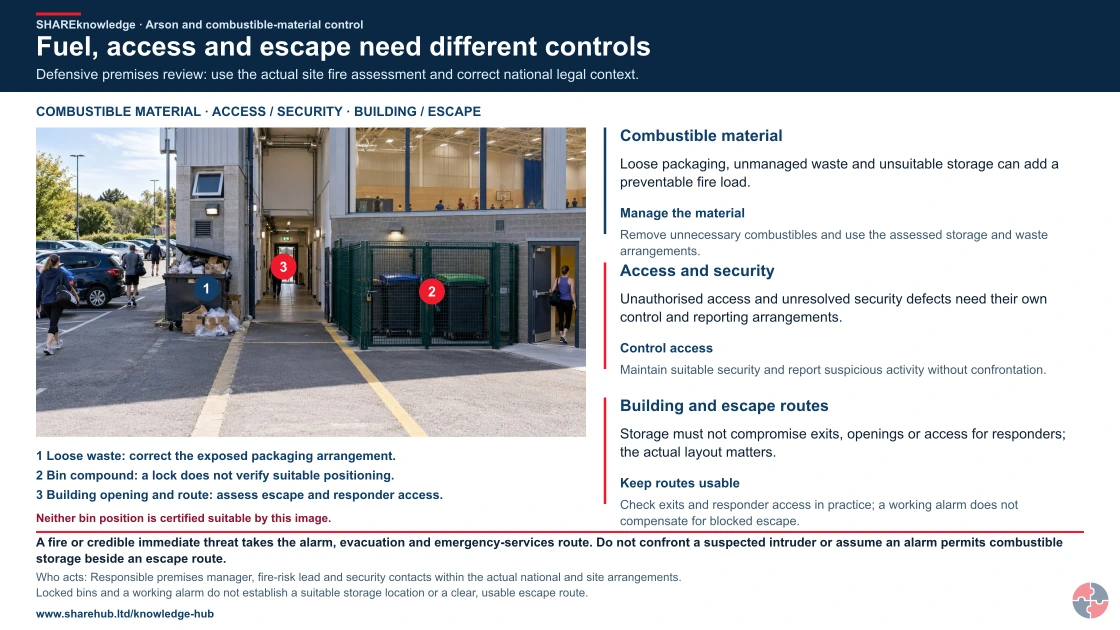
An illustrative UK school or community sports-building exterior shows accessible overflowing waste and loose packaging, a separate locked mesh bin compound, occupied building openings and an access passage. One numbered key identifies the loose waste, compound and building opening/route. The exposed packaging arrangement needs correction under the actual premises assessment. The lock does not certify a suitable waste position, separation or escape route; neither bin position is approved by the image. A complete parallel comparison separates combustible material and assessed waste/storage arrangements; unauthorised access/security and suitable access controls; building/escape/responder interfaces and usable routes. These are different prevention questions, not stages of a fire or instructions for an intruder. A working alarm does not compensate for a blocked route, and security must not trap occupants. The visible opening is not certified as a compliant final exit, and no universal clearance distance, storage quantity or safe layout is supplied. The actual premises, people, site fire assessment and correct national context determine the arrangements. Fire or a credible immediate threat bypasses routine review to the existing emergency route. No fire-setting, ignition, confrontation or security-bypass action is shown.
Defensive premises review: use the actual site fire assessment and correct national legal context.
- Combustible material. Loose packaging, unmanaged waste and unsuitable storage can add a preventable fire load.
- Access and security. Unauthorised access and unresolved security defects need their own control and reporting arrangements.
- Building and escape routes. Storage must not compromise exits, openings or access for responders; the actual layout matters.
Change the pathway
- Manage the material. Remove unnecessary combustibles and use the assessed storage and waste arrangements.
- Control access. Maintain suitable security and report suspicious activity without confrontation.
- Keep routes usable. Check exits and responder access in practice; a working alarm does not compensate for blocked escape.
Evidence check: Locked bins and a working alarm do not establish a suitable storage location or a clear, usable escape route.
Primary references: GOV.UK workplace fire safety — actual premises and separately identified national routes · London Fire Brigade reducing arson risk — retained defensive premises context
Open the complete HD image (new tab)Download image
Primary references: GOV.UK workplace fire safety — actual premises and separately identified national routes · London Fire Brigade reducing arson risk — retained defensive premises context
Reduce the opportunity and verify the closing checks
Full written explanation
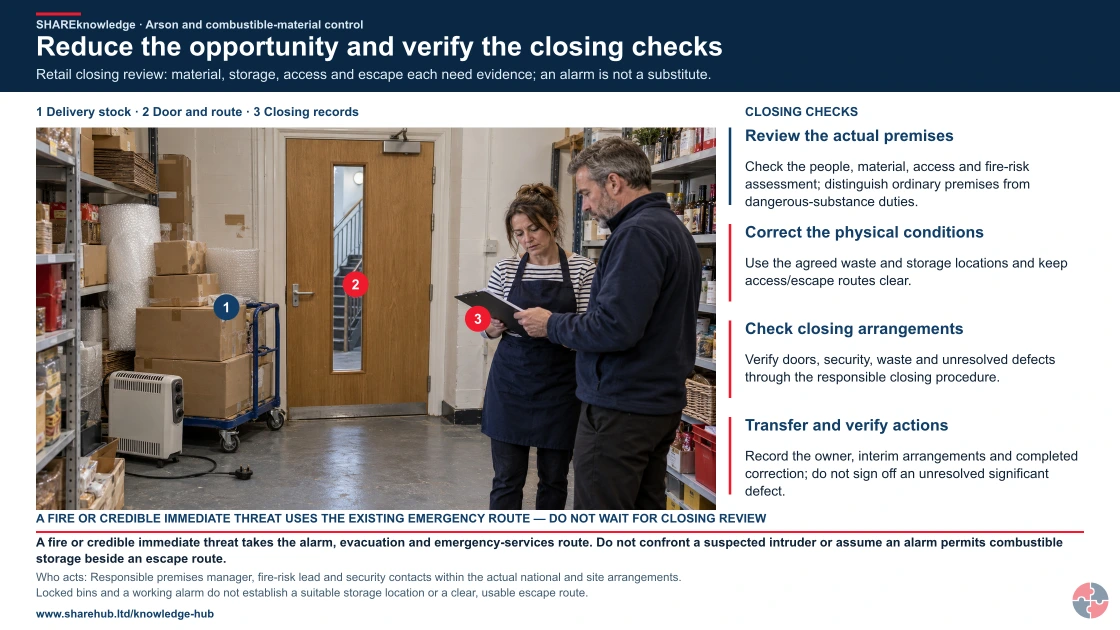
An illustrative UK retail stockroom shows delivery packaging beside a door to a stair route and normal staff reviewing inert closing records. One literal picture key identifies delivery stock, the door/route and closing papers. A portable heater in the scene is unplugged; the image supplies no heat, operation or suitability finding. The door is not declared to be a compliant final exit. Four unnumbered checks keep the source relationship complete: review the actual premises and distinguish ordinary fire precautions from dangerous-substance duties; correct physical conditions under agreed storage/waste/access arrangements; check doors, security, waste and unresolved defects through the responsible closing process; then transfer and verify actions without signing off an unresolved significant defect. A tidy-looking stockroom, lock, signature or alarm cannot establish that storage and escape are suitable. Routine closing review is independent of the existing immediate-fire/threat response, and no worker is asked to confront an intruder. The scene gives no ignition demonstration, unlawful action, lock/alarm/firefighting recipe, storage quantity, separation distance, major-hazard threshold, legal interpretation or occupancy/work permission. National premises law, dangerous-substance and COMAH scope remain different questions.
Retail closing review: material, storage, access and escape each need evidence; an alarm is not a substitute.
- Review the actual premises. Check the people, material, access and fire-risk assessment; distinguish ordinary premises from dangerous-substance duties.
- Correct the physical conditions. Use the agreed waste and storage locations and keep access/escape routes clear.
- Check closing arrangements. Verify doors, security, waste and unresolved defects through the responsible closing procedure.
- Transfer and verify actions. Record the owner, interim arrangements and completed correction; do not sign off an unresolved significant defect.
When the evidence does not fit: A fire or credible immediate threat takes the alarm, evacuation and emergency-services route. Do not confront a suspected intruder or assume an alarm permits combustible storage beside an escape route.
Who acts: Responsible premises manager, fire-risk lead and security contacts within the actual national and site arrangements.
Changed workplace
School waste collection: Use the assessed waste location, access controls and collection arrangements; resolve changes before closing.
Retail rear exit: Move deliveries from the escape route and verify the agreed storage and security arrangements.
Evidence check: Locked bins and a working alarm do not establish a suitable storage location or a clear, usable escape route.
Primary references: GOV.UK workplace fire safety — actual premises and separately identified national routes · London Fire Brigade reducing arson risk — retained defensive premises context
Open the complete HD image (new tab)Download image
Primary references: GOV.UK workplace fire safety — actual premises and separately identified national routes · London Fire Brigade reducing arson risk — retained defensive premises context
Remove accessible fuel and protect escape


Read this visual as text
- The external yard review connects public access, combustible storage, openings and escape. Assess the bin location and security for the actual site; do not substitute an invented universal clearance distance.
- REMOVE LOOSE FUEL
- CONTROL ACCESS
- KEEP EXITS CLEAR
Illustrative yard closing review. Trace accessible fuel to nearby openings and people, then check escape and responder access. Assess storage position and security for the actual site; no universal separation distance is established by this image. The paired yard review explains the source, pathway, action and owner.
Accessible bin compound
Task material and setting: Move unsecured waste before closing a public leisure centre.
People and prerequisites: Paper/cardboard bins by a sports-hall wall; cleaners, visitors and security; public car park.
Before: Check bin route, lock, lighting and safe separation from openings and escape routes against the site assessment.
During: Move bins to the agreed secured compound; clear loose waste; report a failed lock.
Hold or stop: Hold closure sign-off for bins against the building; call security/police for credible deliberate ignition threat, without confrontation.
Completion and hand back: Photograph corrected position, log lock repair and transfer open action to duty manager.
Evidence: Site plan and bin-compound inspection, before/after position photographs, lock defect ticket and duty-manager close-out.
Changed cleaner store
Task material and setting: Receive a larger delivery of aerosol and solvent products.
People and prerequisites: Aerosols/solvents and electrical equipment; storekeeper, cleaners and adjacent users; indoor store.
Before: Check SDS, inventory, suitable storage and any GB or NI DSEAR assessment needed for the changed quantity.
During: Keep only assessed quantities in use, close containers, segregate incompatibles and control ignition/ventilation.
Hold or stop: Hold receipt/use if storage capacity or assessment is inadequate; stop for leak or strong vapour and isolate safely.
Completion and hand back: Update inventory, supplier information, store inspection and revised assessment.
Evidence: Current SDS and stock inventory, approved cabinet or store capacity check, revised DSEAR screening and store sign-off.
Temporary outdoor event
Task material and setting: Set up LPG cooking beside public circulation and waste.
People and prerequisites: LPG cylinders, catering unit, packaging; event staff and public; seasonal outdoor area.
Before: Approve event layout, cylinder security, separation, contractor competence, escape and emergency access.
During: Keep cylinders upright and protected, manage waste and check hoses and ignition arrangements under the approved plan.
Hold or stop: Hold opening if layout blocks egress or cylinders are unprotected; stop for gas smell or suspected leak, evacuate and call emergency services as planned.
Completion and hand back: Record setup check, contractor hand-back, cylinder removal and event learning.
Evidence: Approved event layout, cylinder and hose check, contractor briefing, opening authorisation and removal record.
Plant-room hot work
Task material and setting: Repair a bracket where cable routes and stored materials create hidden fire paths.
People and prerequisites: Welding/cutting gear, combustible penetrations; maintainers, occupants and contractors; occupied plant area.
Before: Check alternative method, permit, isolation, nearby/hidden combustibles, alarm impairment and fire-watch requirements.
During: Control sparks and exposed fuel, follow the permit, maintain communications and inspect both sides of penetrations.
Hold or stop: Do not start with unverified hidden spaces; stop for changing conditions, failed isolation or smoke.
Completion and hand back: Complete the fire watch and hand-back inspection, restore systems and close permit.
Evidence: Signed permit, isolation and hidden-space checks, fire-watch completion, restoration and hand-back sign-off.
Suspicious fire attempt
Task material and setting: Respond to a scorched door and disturbed waste before opening.
People and prerequisites: Possible ignition evidence and smoke residue; security, cleaners and visitors; external rear entrance.
Before: Know the alarm and evacuation route, emergency contacts and CCTV retention process.
During: Keep people away, raise alarm and call 999 if fire or immediate danger; do not pursue a suspect.
Hold or stop: Stop entry into smoke or unsafe area; do not disturb potential evidence except to protect life.
Completion and hand back: Give emergency services facts, preserve CCTV and scene when safe, document response and authorise reopening.
Evidence: Alarm and 999 event times, witness observations and CCTV retention reference only when safe and under responder direction; documented re-entry release.
Abnormal solvent release
Task material and setting: React to a leaking container near an electrical switch.
People and prerequisites: Unknown quantity of flammable liquid/vapour; cleaners and public; service corridor.
Before: Keep SDS, spill/emergency plan and trained response route available.
During: Keep people out, avoid creating an ignition source, raise alarm and follow evacuation plan; trained responders only if assessed safe.
Hold or stop: Stop for vapour, unknown extent, alarm or failed ventilation; call 999 for fire or imminent danger.
Completion and hand back: Record affected people, response and cleanup; competent review before reoccupation.
Evidence: SDS, exclusion and call log, trained response record, ventilation/isolation status and competent reoccupation decision.
Contractor and waste interface
Task material and setting: Coordinate waste collection during a temporary event load-in.
People and prerequisites: Packaging, bins, vehicle ignition and temporary cables; contractors and visitors; shared yard.
Before: Agree routes, times, waste capacity and owner for each interface.
During: Keep waste and vehicles clear of exits and vulnerable openings; inspect after deliveries.
Hold or stop: Hold event opening if escape or fire-service access is blocked.
Completion and hand back: Record contractor briefing, route inspection, waste removal and hand-back.
Evidence: Contractor and event briefings, route inspection photographs, waste collection confirmation and named opening release.
How could Riverside Leisure Ltd manage arson and flammable material risks?

Riverside Leisure Ltd could manage this topic by connecting fire risk assessment, public access, external waste, seasonal events, storage, security and emergency drills into one live system.
Riverside Leisure Ltd workplace example
Riverside Leisure Ltd operates a leisure centre with a cafe, gym, swimming pool, events hall, plant rooms, cleaning stores, external bin compound, public car park and seasonal outdoor activities. Its arson and flammable material risk is not one single hazard. It is the combination of public access, external waste, cleaning chemicals, LPG for events, maintenance contractors, battery charging, cooking equipment, combustible decorations and busy evacuation conditions.
The site manager owns the fire risk assessment and action tracker. The facilities supervisor owns weekly external checks of bins, skips, lighting, gates, plant rooms, fire doors, alarm points and escape routes. The cafe manager controls cooking oils, packaging, LPG if used for outdoor catering and end-of-day waste. The procurement process requires safety data sheets and storage review before new flammable products, decorations, aerosols or event materials are brought onto site.
Riverside uses a risk register with named scenarios: bin fire near the sports hall wall, solvent or aerosol storage in a cleaner's cupboard, hot work during pool plant maintenance, lithium battery charging in the maintenance store and public-access arson in toilets or changing rooms. Each scenario has controls, evidence and review triggers. After vandalism, waste build-up, a fire alarm activation or an event layout change, the assessment is reviewed rather than waiting for the annual date.
| Management element | How Riverside applies it | Evidence, oversight and improvement |
|---|---|---|
| Assessing and analysing | Maps public areas, back-of-house spaces, external waste, flammable stores, kitchens, plant rooms, charging points and event layouts. | Fire risk assessment, site plan, risk register, inspection checklist and seasonal event review. |
| Implementing controls | Keeps bins in a locked compound away from the building, controls cleaners' stores, limits LPG and aerosols, separates charging areas and keeps routes clear. | Photographic inspections, store checks, waste contract, security logs and action close-out. |
| Training and communication | Gives all staff fire awareness, supervisors scenario-based checks, event staff crowd and evacuation briefings, and contractors hot-work controls. | Training matrix, induction records, toolbox talks, permit files and drill observations. |
| Contractor management | Requires RAMS and permits for hot work, electrical work, plant-room work or anything affecting alarms, routes, doors or fire stopping. | Contractor approval, permit-to-work, fire watch records and hand-back inspection. |
| Monitoring and auditing | Checks external waste daily in high season, conducts weekly fire inspections and reviews alarm activations, defects and security incidents monthly. | Inspection trends, alarm log, defect tracker, management review and independent fire risk assessor feedback. |
| Learning and improvement | Uses vandalism reports, near misses, drill learning, event feedback and insurer observations to improve storage, lighting, access control and staff briefings. | Lessons-learned log, updated procedures, budget requests and completed action evidence. |
How can a forecourt example support an arson and ignition-risk review?
Locate the fuel-handling equipment and consider access and ignition interfaces. The scene is an assessment context, not a complete site-security or fire-risk assessment.
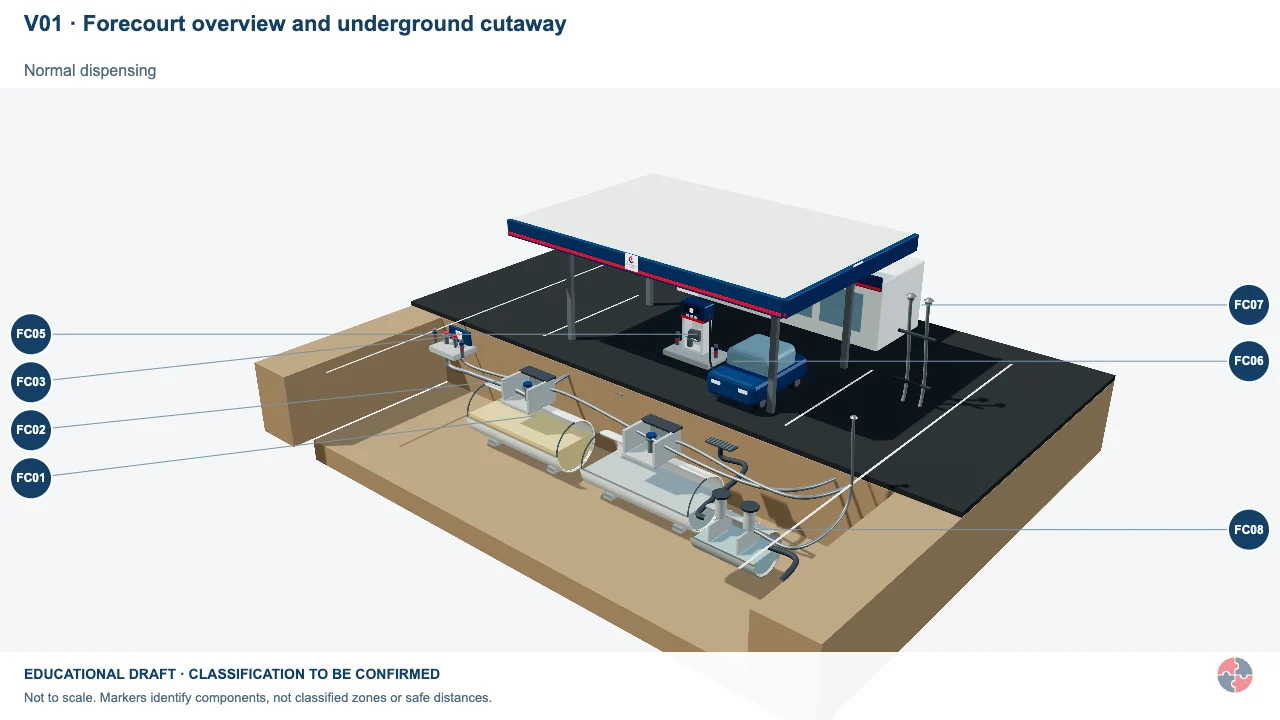

Forecourt overview and underground cutaway
A familiar forecourt contains connected systems above and below ground. Locate each source before considering where an explosive atmosphere could form.
Activity focus: Switch to delivery to inspect the added connection and changed activity.
Optional forecourt model example: identify where a delivery changes ignition opportunities, connections and responder access. This illustrative overview and cutaway does not establish hazardous-area classification, actual underground conditions or site fire compliance. Use the real installation records and competent assessment.
Educational illustration, not to scale. Coloured zones are teaching examples, not a site-specific hazardous-area classification.
What happens after suspected arson, fire or a near miss?
Protect life first: raise the alarm, evacuate, call 999 for a fire or immediate threat and give emergency services the location, material and people information. Preserve evidence only when safe.
After a Fire or Near Miss
Two linked parts · 6 questions. Open Part 2 to complete the route.

Continue to questions 4–6 · Part 2 of 2


Read this visual as text
- Start: An ignition, leak or failed control affects a store, rear entrance, hot-work area or event.
- Question 1: Are people safe and accounted for? Decision owner: Fire-risk owner / competent dangerous-substance assessor.
- YES: The required evidence or condition is confirmed. CONTINUE → QUESTION 2.
- NO / UNKNOWN — HOLD: Prioritise evacuation, first aid and responder information. HOLD → REPEAT QUESTION 1 AFTER CORRECTION.
- Question 2: Has the controlling authority permitted safe scene access? Decision owner: Fire-risk owner / competent dangerous-substance assessor.
- YES: The required evidence or condition is confirmed. CONTINUE → QUESTION 3.
- NO / UNKNOWN — HOLD: No re-entry for photographs or disturbance against police or fire-service direction. HOLD → REPEAT QUESTION 2 AFTER CORRECTION.
- Question 3: Are CCTV, event facts and fragile evidence preserved safely? Decision owner: Fire-risk owner / competent dangerous-substance assessor.
- YES: The required evidence or condition is confirmed. CONTINUE → QUESTION 4.
- NO / UNKNOWN — HOLD: Arrange preservation without exposing people or altering the scene. HOLD → REPEAT QUESTION 3 AFTER CORRECTION.
- Question 4: Are alarm, escape, utilities, structure and material conditions verified? Decision owner: Fire-risk owner / competent dangerous-substance assessor.
- YES: The required evidence or condition is confirmed. CONTINUE → QUESTION 5.
- NO / UNKNOWN — HOLD: Keep closed for impaired protection, damage or unresolved vapour. HOLD → REPEAT QUESTION 4 AFTER CORRECTION.
- Question 5: Have fire/DSEAR changes and relevant reporting decisions been reviewed? Decision owner: Fire-risk owner / competent dangerous-substance assessor.
- YES: The required evidence or condition is confirmed. CONTINUE → QUESTION 6.
- NO / UNKNOWN — HOLD: Reassess changed quantity, process and failed controls; coordinate the proper external routes. HOLD → REPEAT QUESTION 5 AFTER CORRECTION.
- Question 6: Has the dutyholder accepted recovery and briefed affected people? Decision owner: Fire-risk owner / competent dangerous-substance assessor.
- YES: The required evidence or condition is confirmed. OUTCOME → RECORD AND HAND OVER.
- NO / UNKNOWN — HOLD: No reopening until competent evidence and operational conditions agree. HOLD → REPEAT QUESTION 6 AFTER CORRECTION.
- Outcome: Documented recovery, approvals, briefing and action closure; otherwise hold the area closed.
- Stop and escalation boundary: No re-entry for photographs, no scene disturbance against police direction, no restart with impaired alarms or unresolved vapour, damage or escape issues.
Do not confront a suspected offender, re-enter smoke, move dangerous containers, or delay evacuation for photographs. Follow the site plan and fire-service direction. Once safe, retain CCTV before overwrite, note witnesses and times, avoid unnecessary disturbance of the scene, and record defects or control failures. Coordinate any police, insurer and regulator reporting decision with the appropriate dutyholder; this guide makes no automatic reportability claim.
Reoccupation needs confirmation that fire damage, alarms, escape routes, utilities, contaminated materials and temporary controls have been assessed by competent people. Review the fire risk assessment and any DSEAR assessment affected by the incident, allocate actions and brief the next shift.
What training is needed for arson and flammable material risk control?
Training should match the person's role, from general fire awareness to supervisor checks, specialist DSEAR knowledge and emergency leadership.
Training should make the topic visible in day-to-day decisions. Workers should understand why bins are not left by exits, why flammable liquids are not decanted into unlabelled bottles, why charging is controlled, why hot work needs permission and why a blocked route is a serious defect. Supervisors should be trained to inspect, challenge, record and close actions.
Higher-risk sites need deeper competence. If DSEAR applies, people assessing or authorising work need to understand dangerous substances, release scenarios, ventilation, ignition control, hazardous areas, compatible storage, emergency arrangements and when specialist advice is needed.
| Role and learning | Practice on the actual task | Competence evidence and record | Assessor and reassessment trigger |
|---|---|---|---|
| All workers: spot and report fire opportunities | Check bins, doors, escape routes, ignition sources and flammable containers; raise the alarm and leave on a fire. | Observed opening/close check and correct alarm route. | Supervisor rechecks after a site change, near miss or failed check. |
| Supervisors: control daily storage | Walk a real waste and flammable-storage route, correct an unsafe condition and verify close-out. | Observed inspection, action record and effective close-out. | Fire-risk lead rechecks after new stock, layout or incident. |
| Fire-risk assessors: assess the premises | Assess deliberate ignition, people at risk, compartmentation, escape and the site fire plan. | Competent assessment with findings and tested actions. | Dutyholder commissions review after material change or fire. |
| DSEAR specialists: assess dangerous substances | Decide whether DSEAR applies; assess release, vapour, ignition, ventilation and hazardous areas for the actual process. | Competent substance assessment and documented control decision. | Technical peer rechecks after product, quantity or process change. |
| Dutyholders and emergency leads: assure readiness | Assign storage, security, alarm, evacuation and contractor controls; exercise a credible event. | Action closure, drill observations and maintained systems. | Accountable lead reviews after drill, failure or site change. |
Record observed task decisions, assessor and reassessment trigger; attendance alone does not establish competence.
How can management-system themes support arson and flammable material risks?
ISO 45001 can help make arson and flammable material control systematic by linking leadership, planning, operation, monitoring and improvement.
ISO 45001 does not replace fire safety legislation, DSEAR or competent fire risk assessment. Its value is management discipline. It helps an organisation define ownership, competence, operational control, change management, monitoring, audits, incident learning and improvement so that fire precautions remain live after the assessment is issued.
For this topic, the management system should stop drift. Drift is when storage expands, waste builds up, a new event layout appears, a contractor opens a route, a door is wedged, a bin compound lock breaks or flammable stock increases without anyone revisiting the fire assumptions.
| Management-system theme | What this means | How it supports this topic |
|---|---|---|
| Context of the organisation | Map occupancy, public access, external fuel, storage and out-of-hours conditions. | Recognise premises use, public access, dangerous substances, neighbouring occupiers, insurers and enforcing authorities as relevant context. |
| Leadership and worker participation | Assign fire-action owners and let workers report waste, access and ignition failures. | Set clear ownership for fire risk assessment actions, housekeeping, security, storage and worker reporting. |
| Planning | Review fuel, ignition, people at risk and dangerous-substance changes before release. | Identify fire hazards, legal duties, arson scenarios, DSEAR needs, people at risk and improvement objectives. |
| Support | Provide assessed equipment, fire information, training and emergency resources. | Provide competence, awareness, communication, documented information, signage, emergency resources and contractor briefings. |
| Operation | Control waste, flammable stores, hot work, contractors and temporary event layouts. | Control storage, waste, hot work, contractors, maintenance, events, dangerous substances, charging and change. |
| Performance evaluation | Check real storage conditions, alarm defects, drills and overdue actions. | Monitor inspections, alarm activations, drill learning, fire door defects, storage checks, DSEAR actions and action close-out. |
| Improvement | Verify incident actions and change failed storage or security arrangements. | Investigate fires, near misses, vandalism, false alarms, defects and audit findings, then strengthen controls. |
Related standards are tools for competent design, management and response, not universal statutory duties. Check the current edition, building type and system scope before specifying or citing one.
| Standard | Relevant use | Limit |
|---|---|---|
| ISO 45001:2018 | Occupational health and safety system: ownership, competence, operational control, monitoring and improvement. | Not a premises fire assessment or proof that legal duties are met. |
| BS 9999:2017 | Code of practice for fire safety in building design, management and use. | Building and use limitations apply; competent design review is needed. |
| BS 5839-1:2025 | Code of practice for non-domestic fire detection and alarm systems. | Does not itself mandate an alarm or replace the fire strategy. |
| ISO 22320:2018 | Guidelines for coordinated incident management and information sharing. | Does not override emergency-service command or the site emergency plan. |
How does this support NEBOSH Fire Safety Certificate study?
For Fire Safety Certificate study, this topic sits in the practical assessment of fire hazards, fire prevention, dangerous substances and management control.
A learner should be able to explain this topic without relying on a memorised checklist. A strong answer starts with the fire mechanism: fuel, ignition, oxygen, fire growth, smoke spread and people at risk. It then applies that mechanism to arson opportunity, external waste, flammable storage, hot work, housekeeping, DSEAR and emergency arrangements.
Scenario-based questions may describe a warehouse, shop, school, leisure site, construction project, shared premises or small industrial unit. Look for changes in storage, blocked routes, public access, insecure yards, combustible waste, contractors, temporary electrics, flammable liquids or poor close-down checks. The best answers explain not only what is wrong, but why it matters and what evidence would prove improvement.
| Study area | What to know | How to apply it in a scenario |
|---|---|---|
| Fire hazard recognition | Fuel, ignition, oxygen, fire load, smoke spread and fire growth. | Explain how an ordinary weakness such as external waste can become a life-safety risk. |
| Arson prevention | Security, lighting, access control, external waste, unused areas and close-down checks. | Identify how deliberate ignition opportunity is created and how it should be reduced. |
| Flammable materials | Liquids, gases, vapours, aerosols, combustible dusts, LPG and storage principles. | Recognise when DSEAR thinking is needed and what controls should appear. |
| Fire risk assessment | Significant findings, people at risk, prevention, protection, emergency arrangements and review. | Turn observations into prioritised actions with owners and evidence. |
| Management and assurance | Training, inspections, maintenance, contractor control, drills and review triggers. | Describe how a manager proves the controls work over time. |
What are the warning signs that this topic is not controlled?
Warning signs include waste near buildings, insecure storage, unmanaged flammable products, poor housekeeping, weak contractor control and repeated fire safety defects.
The warning signs are often visible before a fire. Bins migrate towards doors, stores fill with cardboard, extinguishers are hidden, flammable products are bought locally without review, batteries charge in corridors, fire doors are wedged and old furniture appears in escape routes. These are not small housekeeping irritations; they are evidence that the fire risk assessment no longer reflects the workplace.
Each warning sign should trigger action proportional to the risk. A single box in a route may need immediate removal. Repeated waste build-up may need a contract change, supervisor ownership and management review. Uncontrolled flammable liquids may need DSEAR assessment, storage redesign and procurement control.
| Warning sign | How it can cause harm | What to do |
|---|---|---|
| Bins, skips or pallets against the building | A deliberate or accidental fire can spread through doors, windows, vents, walls or roofs. | Move, secure and inspect external waste and review the waste contract. |
| Combustibles in escape routes | Fire or smoke can block evacuation and reduce available escape time. | Remove immediately and reinforce storage rules. |
| Unlabelled or open flammable containers | Vapour release, spills and incompatible use can cause fire or explosion. | Stop use, identify contents, store correctly and review purchasing. |
| Hot work without permit or fire watch | Sparks or heat can ignite hidden combustibles after work finishes. | Use permit controls, clearance, fire watch and post-work inspection. |
| Broken locks, poor lighting or vandalism | Arson opportunity increases and fires may start out of hours. | Repair, improve security, review access and consider monitoring. |
| Fire doors wedged or damaged | Smoke and fire can spread faster than the evacuation strategy assumes. | Repair, train, inspect and escalate repeat failures. |
| No evidence of DSEAR review | Dangerous substances may be present without ignition or explosion controls. | Complete competent DSEAR assessment and track actions. |
| Actions stay open after inspections | Known fire risks remain live and may become normalised. | Escalate overdue actions and verify completion physically. |
What does the evidence prove, and what does it not?
A signed checklist is evidence of a check, not proof that bins stayed secure or a store remained safe after conditions changed.
Verify physical conditions against logs: photographs of the external compound, lock repair, inventory and SDS, alarm and maintenance records, contractor permits and closing checks. CCTV may show access but cannot prove ignition cause on its own. A low incident count is not proof of low risk. A DSEAR area classification, if needed, must come from a competent assessment, not an assumption that all flammable products create a zone.
Use HSG168 only for construction contexts and HSG176 for its tank-storage scope. HSG51 is the more relevant HSE guide for flammable liquids in containers up to 1,000 litres. Any exact distance, cabinet quantity, inspection interval or equipment specification needs a site-specific assessment and current applicable guidance; this page does not set universal numbers.
Standards named on this page are background context. Confirm the current edition, scope and exact requirements from an authorised copy before applying them. The open official sources below support the specific public-law and regulator guidance claims they are cited for.
What do the acronyms and key terms mean?
Acronyms should be explained so new readers can follow fire safety, DSEAR and emergency planning language.
| Acronym | Full wording | Meaning in this topic |
|---|---|---|
| DSEAR | Dangerous Substances and Explosive Atmospheres Regulations. | UK regulations controlling fire, explosion and similar risks from dangerous substances. |
| FRA | Fire risk assessment. | The assessment used to identify fire hazards, people at risk and precautions. |
| LPG | Liquefied petroleum gas. | A flammable gas often stored in cylinders for heating, catering, plant or events. |
| SDS | Safety data sheet. | Supplier document giving hazard, storage, handling and emergency information for substances and mixtures. |
| LEV | Local exhaust ventilation. | Extraction used to remove vapours, fumes or dusts at source in some processes. |
| COMAH | Control of Major Accident Hazards Regulations. | Applies to qualifying sites with dangerous substances above thresholds. |
| PEEP | Personal emergency evacuation plan. | Plan for people who may need assistance to evacuate safely. |
| FSC | NEBOSH Fire Safety Certificate. | A fire safety qualification where this topic supports hazard recognition and control learning. |