SHARE Knowledge Hub
Ammonia Poisoning
Ammonia gas, pressurised liquid and strong solutions can rapidly burn eyes, skin and airways. On a leak, warn others, withdraw by a safe route and leave isolation to designated responders using safe controls. For an eye splash, start clean-water irrigation immediately for at least 20 minutes while urgent medical help is arranged.
Understanding Ammonia Poisoning
Ammonia gas, pressurised liquid and strong solutions can rapidly burn eyes, skin and airways. On a leak, warn others, withdraw by a safe route and leave isolation to designated responders using safe controls. For an eye splash, start clean-water irrigation immediately for at least 20 minutes while urgent medical help is arranged.
Why this matters at work
Consider feed, return, bypass, relief paths, trapped liquid, pressure, blockage and the exposure during first break. Resolve uncertain indications through competent assessment; do not strike, heat or loosen equipment to find out what is inside. Confirm access, communications, trained response and appropriate protection before authorised work. After maintenance, verify reinstatement, leak integrity, valves, detection, ventilation and relevant safety functions under the plant procedure. Record limitations and defects and obtain operational handback. A routine maintenance description does not reduce the potential consequence or allow the contractor and host responsibilities to be left implicit.
Ammonia can injure the respiratory tract, eyes and skin; concentrated liquid or cold release adds contact hazards. Warning signs can include burning eyes or nose, cough, throat irritation and chest tightness. Hoarseness, difficulty swallowing, noisy breathing, severe breathlessness, confusion or collapse suggest serious injury. Significant effects can develop or worsen after the initial event, so apparent improvement is not automatic clearance.
How organisations manage this in practice
Prevent or reduce release through suitable design, inventory reduction, reliable containment, isolation and controlled intervention. Assess corrosion, vibration, impact, trapped liquid, dead legs and connection errors. Specify what ventilation, detection, shutdown, operating limits and emergency arrangements must achieve. PPE and respiratory protection require the known hazard, atmosphere and task; routine equipment is not automatic rescue protection. Define inspection, maintenance, competence, stop conditions and how changes are authorised. Obtain competent refrigeration, pressure system, hygiene and process safety advice as relevant. Record assumptions and verify the selected controls during representative operation and intervention. Review after a release, symptoms, equipment change or evidence that protection is degraded.
Assess airflow, occupied areas, high or low points and potential dead zones. Ventilation should control the intended release without spreading contamination, and source isolation may be decisive where a fan cannot handle the release. Link detection to the approved cause and effect, communication, shutdown and evacuation or shelter decisions. Use plant specific competent design and applicable information for settings; this answer supplies no universal alarm value or clearance concentration. Test the relevant chain and dependencies and manage any detector or ventilation impairment explicitly. Portable readings support defined trained assessment but do not authorise an unprotected approach or establish safety for an unknown atmosphere.
Provide reliable product identities, concentration, timing, symptoms and safe first aid information to responders from records or labels available without exposure. Emergency ventilation, disposal and re entry require the planned competent response; an open window or fading smell is not evidence of clearance. Record everyone potentially affected and preserve the cleaning sequence for investigation. Review procurement, decanting, storage, residual products, contractor instructions and whether the method prevents incompatible use. Verify the corrected process and any equipment before service resumes. Clinical assessment and the worker’s fitness decision remain separate from acceptance that the room and cleaning task are safe.
Which ammonia work and exposure routes does this guide cover?
This page covers workplace ammonia gas, liquefied anhydrous ammonia and aqueous solutions, including routine use, pressurised systems and credible releases.
Ammonia usually causes direct irritant or corrosive injury at the point of contact; “poisoning” here is not a claim of systemic absorption in every case. Product concentration, physical state, pressure, route, ventilation and co-exposures change the decision. This page is not a chemical-rescue plan, clinical protocol, supplier declaration or plant design standard.
Choose solution use or pressurised-plant response
State whether the material is gas, pressurised liquid or an aqueous solution, and identify its concentration and task. A cleaner-use assessment does not authorise refrigeration intervention. A plant alarm or release follows designated emergency arrangements rather than a worker approaching to investigate.
Best-practice guide: Ammonia Poisoning
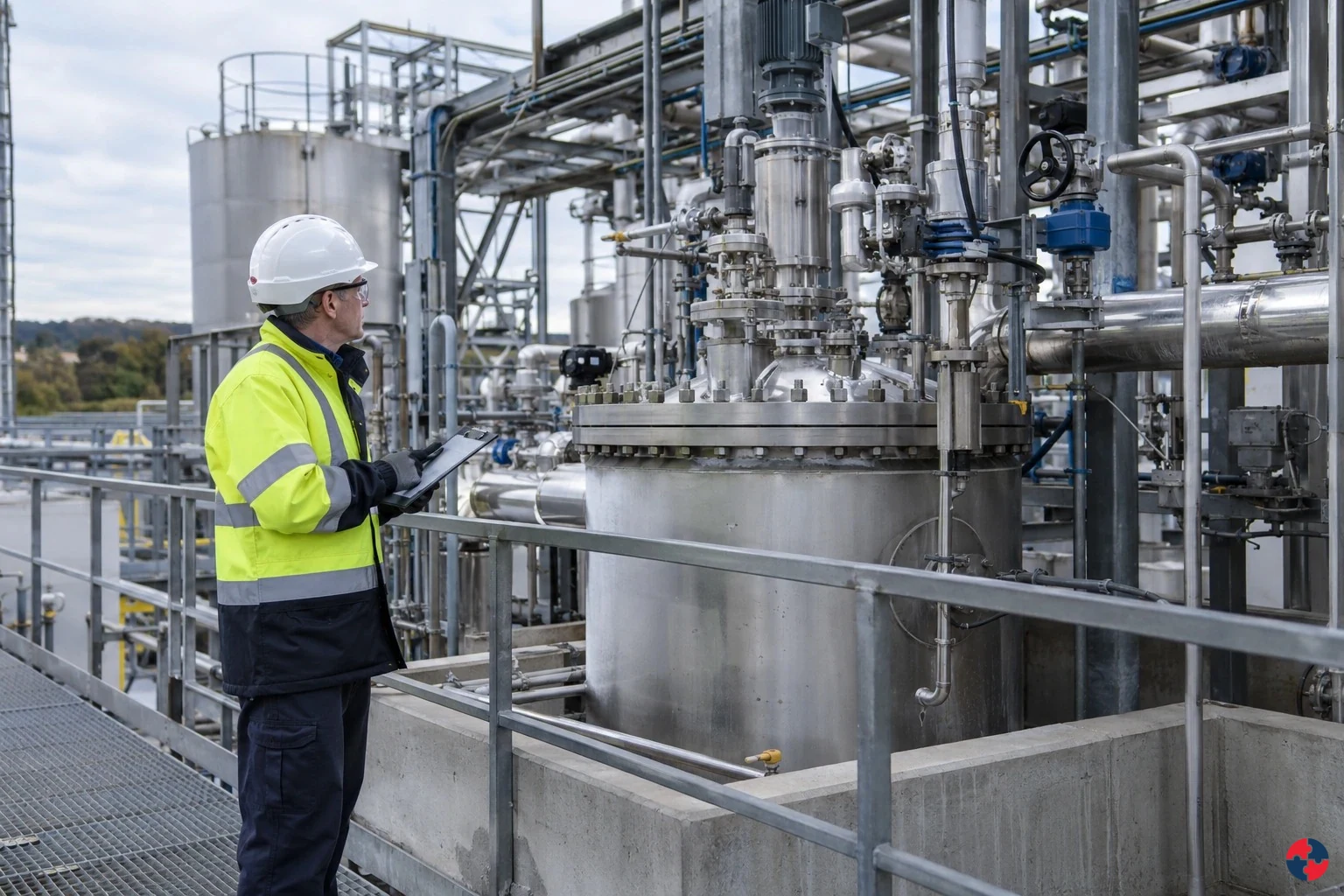
Choose solution use or pressurised-plant response
State whether the material is gas, pressurised liquid or an aqueous solution, and identify its concentration and task. A cleaner-use assessment does not authorise refrigeration intervention. Ammonia gas, pressurised liquid and strong solutions can rapidly burn eyes, skin and airways.
Turn ammonia poisoning knowledge into a decision
Ammonia gas, pressurised liquid and strong solutions can rapidly burn eyes, skin and airways. On a leak, warn others, withdraw by a safe route and leave isolation to designated responders using safe controls. Product register, COSHH assessment, user check and defect/symptom report.
Routine use of an ammonia-containing cleaner
Use only the approved amount and application method, keep the container closed and report irritation or spray drift. Close and label stock, clean and inspect the area, report defects and hand back when the method is controlled.
How ammonia causes harm
Alkaline corrosive action: Ammonia forms alkaline ammonium hydroxide when it dissolves in water. Upper-airway irritation: Low or moderate exposure stimulates eyes, nose and throat. Bronchospasm: Airways can tighten in response to irritation.
Choose controls for ammonia poisoning
Eliminate: Remove ammonia from the task or process where reasonably practicable. Reduce: Reduce the amount, concentration, pressure, frequency or number of people exposed. Isolate: Separate ammonia from people and separate people from release zones. Control: Use engineering and procedural controls to prevent, detect and manage releases. PPE: Use suitable protection for residual contact or emergency risk. Read the full control table for qualifications, ownership and verification. Use the actual task and applicable jurisdiction; existing technical approval remains unchanged.
Use the full ammonia poisoning lesson
Use the full topic for the decision points, practical examples, detailed control tables and source scope. HSE guidance applies to Great Britain; use HSENI for the Northern Ireland route and the source’s stated jurisdiction. A simplified guide does not change the page’s technical-review or approval status.

Read all six steps as text
1. Choose solution use or pressurised-plant response
State whether the material is gas, pressurised liquid or an aqueous solution, and identify its concentration and task.
- Avoid / redesign: Remove ammonia from the task or process where reasonably practicable.
- Control the task: Separate ammonia from people and separate people from release zones.
- Verify before release: Not always possible for efficient industrial refrigeration or process chemistry.
State whether the material is gas, pressurised liquid or an aqueous solution, and identify its concentration and task. A cleaner-use assessment does not authorise refrigeration intervention. Ammonia gas, pressurised liquid and strong solutions can rapidly burn eyes, skin and airways.
Apply it: Which part of this plan would you check at the workface before authorising the task?
2. Turn ammonia poisoning knowledge into a decision
Use the evidence to improve the actual work arrangement.
- Change at source: Remove ammonia from the task or process where reasonably practicable.
- Make it observable: Not always possible for efficient industrial refrigeration or process chemistry.
- Keep useful evidence: Product register, COSHH assessment, user check and defect/symptom report.
Ammonia gas, pressurised liquid and strong solutions can rapidly burn eyes, skin and airways. On a leak, warn others, withdraw by a safe route and leave isolation to designated responders using safe controls. Product register, COSHH assessment, user check and defect/symptom report.
Apply it: What evidence would show that the change improves this task, rather than only completing a record?
3. Routine use of an ammonia-containing cleaner
Example: a practical application of the existing topic lesson.
- Setting: the process operator cleaners use an identified ammonia-containing product in a workshop welfare area; the outcome is a cleaned surface without avoidable vapour or splash exposure.
- Act: Check concentration, compatible container, dilution method, ventilation, eye/skin protection and eyewash access; consider a less hazardous method.
- Hold / review: Unknown concentration, failed ventilation, a proposed bleach mix or symptoms: do not start or continue.
Use only the approved amount and application method, keep the container closed and report irritation or spray drift. Close and label stock, clean and inspect the area, report defects and hand back when the method is controlled.
Apply it: At which point would you hold this example, and what evidence would allow it to proceed?
4. How ammonia causes harm
Connect the task, the route to the person and the control that can fail.
- Alkaline corrosive action: Ammonia forms alkaline ammonium hydroxide when it dissolves in water.
- Upper-airway irritation: Low or moderate exposure stimulates eyes, nose and throat.
- Bronchospasm: Airways can tighten in response to irritation.
Alkaline corrosive action: Ammonia forms alkaline ammonium hydroxide when it dissolves in water. Upper-airway irritation: Low or moderate exposure stimulates eyes, nose and throat. Bronchospasm: Airways can tighten in response to irritation.
Apply it: Who could be exposed, including other trades, cleaners, maintainers and people nearby?
5. Choose controls for ammonia poisoning
Start with the stronger practicable options and verify their effect.
- Eliminate: Remove ammonia from the task or process where reasonably practicable.
- Reduce: Reduce the amount, concentration, pressure, frequency or number of people exposed.
- Isolate: Separate ammonia from people and separate people from release zones.
- Control: Use engineering and procedural controls to prevent, detect and manage releases.
- PPE: Use suitable protection for residual contact or emergency risk.
Eliminate: Remove ammonia from the task or process where reasonably practicable. Reduce: Reduce the amount, concentration, pressure, frequency or number of people exposed. Isolate: Separate ammonia from people and separate people from release zones. Control: Use engineering and procedural controls to prevent, detect and manage releases. PPE: Use suitable protection for residual contact or emergency risk. Read the full control table for qualifications, ownership and verification. Use the actual task and applicable jurisdiction; existing technical approval remains unchanged.
Apply it: Which stronger option can be used here, and who will verify it before accepting the remaining risk?
6. Use the full ammonia poisoning lesson
Follow the official sources below and retain the task-specific evidence.
- Official guidance: NHS poisoning (Live page)
- Official guidance: nidirect poisoning guidance (Live page)
- Task decision: Product register, COSHH assessment, user check and defect/symptom report.
Use the full topic for the decision points, practical examples, detailed control tables and source scope. HSE guidance applies to Great Britain; use HSENI for the Northern Ireland route and the source’s stated jurisdiction. A simplified guide does not change the page’s technical-review or approval status.
Apply it: Which official source and full-topic section will you use to resolve the next decision?
Before specialist work, agree the exact line, isolation, detector status, emergency roles and independent restoration checks. Keep a detector fault visible in the operating decision. Historical HSG97 learning can illustrate failure mechanisms; it is not a current prosecution account or a plant design specification.
Detector fault before refrigeration intervention
Illustrative example. A contractor is ready to open part of the ammonia refrigeration system, but a credited detector has an unresolved fault.
Decision. Hold the intrusive work and refer the detector impairment and isolation readiness to the designated plant authority.
Evidence to check. Record plant identity, physical state, isolation boundary, competent roles and verified detector/restoration evidence.
Hold or escalation point. No opening or approach based on absence of smell or a faulted detector showing no alarm.
Follow-up. The authorised owner accepts the restoration and hand-back evidence before normal operation resumes.
Who acts at each stage of ammonia work?
Users check the defined task and stop on loss of control; supervisors isolate people and coordinate work; specialists own plant and exposure decisions; clinicians own treatment.
| Role | Action | Boundary or record |
|---|---|---|
| Worker or cleaner | Check product, method, ventilation and washing access; report odour, irritation, leaks or failed controls. | No sniff test, unknown container use, chemical mixing or release-area entry. |
| Supervisor or host | Hold unsafe work, protect bystanders, coordinate contractor work and call emergency services as needed. | Own headcount, area control, permit interfaces and restart authority. |
| Purchaser/storekeeper | Verify product identity, concentration, SDS, compatibility and approved transfer route before receipt. | Do not substitute an ammonia product by name alone. |
| Refrigeration/pressure specialist | Assess design, isolation, WSE applicability, detection, ventilation, maintenance and hand-back. | Pressure examination does not prove toxic exposure is controlled. |
| COSHH/hygiene assessor | Assess actual routes, EH40 periods, monitoring, controls and surveillance need. | WEL is not an emergency entry or eye/skin criterion. |
| First aider/emergency lead | Activate plan, start safe washing for contact and arrange urgent medical handover. | No unprotected rescue, valve operation through a cloud, neutralisation or workplace clinical clearance. |
What are the key facts about ammonia poisoning?
Ammonia can rapidly injure eyes and airways. For an eye splash, start clean-water irrigation immediately for at least 20 minutes and keep rinsing while arranging urgent medical help; for a release, warn others and withdraw, leaving isolation to designated responders.
This is general workplace guidance, not medical, legal or HR advice. Suspected significant ammonia exposure, breathing difficulty, eye injury, chemical burns, collapse or symptoms after a release should be assessed by a medical professional.
What symptoms matter first?
- Burning eyes, watering eyes, nose or throat irritation, coughing, chest tightness, wheezing or breathlessness.
- Skin pain, redness, blistering or cold-burn type injury after contact with liquid anhydrous ammonia.
- Symptoms that continue, worsen or return after leaving the area, especially cough, breathing restriction or eye pain.
What should happen immediately?
- Stop the task, raise the alarm and move people upwind or away from the release if it is safe to do so.
- Do not enter an ammonia cloud or plant room without the correct emergency arrangements and respiratory protection.
- Use a safe eyewash or shower and evacuate by the site plan. Only designated competent responders may operate emergency isolation or enter a release area, and only from verified safe controls.
When is medical assessment needed?
- Any breathing difficulty, persistent cough, chest tightness, wheeze, throat swelling sensation or suspected high-dose inhalation.
- Any eye splash, persistent eye pain, blurred vision or chemical burn to skin.
- Any exposure in a confined, poorly ventilated or refrigeration plant area, or symptoms affecting more than one person.
Ammonia seeks moisture
Ammonia dissolves in the moisture of the eyes, nose, throat and lungs and forms alkaline ammonium hydroxide, which is why irritation can be rapid and intense.
Odour is an early warning, not a control
Ammonia has a strong smell, but smell must not replace gas detection, ventilation, inspection, maintenance and emergency planning.
The lungs can deteriorate after exposure
A worker may leave the area and still develop worsening cough, breathlessness or chest tightness later, especially after heavier inhalation.
Liquid anhydrous ammonia can freeze and burn
Liquefied ammonia escaping under pressure can cause cold burns as well as chemical alkali burns to skin and eyes.
Refrigeration plant needs specialist control
Ammonia refrigeration risk is strongly linked to pressure integrity, valve condition, plant-room ventilation, detection, alarms, emergency shutdown and competent maintenance.
EH40 applies to airborne exposure
Anhydrous ammonia is listed in EH40 with both long-term and short-term workplace exposure limits that should be checked against the current HSE edition.
What is ammonia poisoning at work?
It is harmful contact with ammonia gas, pressurised liquid or solution, most often causing rapid irritation or corrosive injury to eyes, skin and airways.
Ammonia is a colourless, sharp-smelling gas. Anhydrous ammonia may be held as liquid under pressure in refrigeration or process plant; aqueous ammonia or ammonium hydroxide is ammonia in water. The latter is not automatically low risk: concentration and application method matter. Released liquefied gas may also cause cold injury. Inhalation, eye or skin contact and ingestion of solution have different consequences. Systemic absorption after eye or skin contact is not the main concern; rapid local injury is.
| Form | Task clue | High-consequence route |
|---|---|---|
| Anhydrous gas | Plant-room leak or pipework release. | Inhalation can rapidly injure airways; substantial exposure can affect deeper lung. |
| Liquefied anhydrous ammonia | Pressurised refrigeration or transfer line. | Jet or splash may cause chemical and cryogenic burns as well as inhalation. |
| Aqueous ammonia solution | Cleaner, dosing product or chemical delivery. | Concentrated solution can burn eyes/skin; ingestion can burn the digestive tract. |
| Mixed-cleaner atmosphere | Ammonia product mixed with bleach. | Different toxic irritant gases may form; do not assume this is ammonia alone. |
Where might ammonia exposure happen at work?
Ammonia exposure can happen wherever ammonia is stored, generated, used, transferred, released or cleaned up.
Solution use and refrigeration are different tasks


Read this visual as text
- CLEANING SOLUTION: Check the actual formulation, method, splash and ventilation controls. Do not mix products.
- REFRIGERATION SYSTEM: Consider pressurised inventory, trapped material, detection, escape and specialist isolation.
- EXPOSURE EVENT: Protect people and obtain appropriate clinical help; a repair task does not take priority over an exposed person.
The highest-consequence workplace scenarios usually involve anhydrous ammonia under pressure, especially industrial refrigeration systems. Cold stores, food processing plants, ice rinks and process plants may have ammonia compressors, receivers, evaporators, condensers, valves, pipework and plant rooms where a leak can spread quickly if detection, ventilation and isolation are weak.
Lower-volume ammonia solutions can still cause harm, particularly where they are decanted, mixed, sprayed, used in enclosed areas or stored in unlabelled containers. Cleaning work can create additional risk if chemicals are mixed incorrectly or if people assume a domestic-smelling product is low risk. Agricultural and waste environments may also involve ammonia from fertilisers, slurry, animal housing or decomposition.
| Workplace or task | Typical ammonia source | Why exposure can occur | Higher-risk conditions |
|---|---|---|---|
| Industrial refrigeration | Anhydrous ammonia refrigerant in compressors, receivers, evaporators, valves and pipework. | Leaks, maintenance, charging, purging, line breaking, seal failure or pressure relief. | Plant rooms, poor ventilation, alarm failure, isolation errors and lone work. |
| Food production and cold storage | Ammonia refrigeration serving chilled and frozen processes. | Workers may be near plant rooms, evaporators, cold spaces or maintenance activity. | Contractor interfaces, temporary repairs, poor access control and unfamiliar workers. |
| Water and wastewater treatment | Ammonia solutions or ammonia-related dosing chemicals. | Decanting, dosing, splash exposure or releases from storage and pipework. | Manual handling of containers, poor bunding, eyewash gaps and poor labelling. |
| Cleaning and hygiene tasks | Ammonia-based cleaners or alkaline cleaning products. | Spraying, wiping, poor dilution, splashes or incompatible chemical use. | Small rooms, poor ventilation, public areas and untrained users. |
| Agriculture and fertiliser handling | Ammonia, ammonium compounds, fertilisers, slurry or animal housing emissions. | Storage, spreading, decomposition, maintenance or poor ventilation. | Tanks, pits, enclosed buildings and seasonal work with temporary labour. |
| Laboratories and chemical manufacture | Ammonia gas cylinders, solutions, reactions or process intermediates. | Sampling, reaction upset, cylinder change, transfer or fume-cupboard failure. | Scale-up, unfamiliar experiments and emergency response without planning. |
How does ammonia enter or affect the body?
Ammonia mainly affects the body by inhalation and direct contact with moist tissues such as the eyes, skin and respiratory tract.
Inhalation is the main workplace concern for gas and vapour releases. Ammonia is water-soluble, so it often causes strong upper-airway warning irritation, but high concentrations can overwhelm that warning and damage deeper lung tissue. A person may cough, wheeze or feel chest tightness, and serious exposure may cause delayed pulmonary oedema.
Eye contact is also critical. Ammonia can cause severe alkaline eye burns, and immediate irrigation is essential. Skin contact may cause irritation, chemical burns and, for liquefied anhydrous ammonia, cold burns because the liquid boils rapidly as it escapes. Ingestion is less common at work, but it can occur through poor hygiene, unlabelled containers or accidental swallowing of solutions.
| Route | How exposure happens | Typical harm | Practical controls |
|---|---|---|---|
| Inhalation | Breathing ammonia gas, vapour or aerosol from leaks, plant rooms, decanting, cleaning or spills. | Nose and throat irritation, coughing, bronchospasm, chemical pneumonitis and delayed lung injury. | Containment, gas detection, ventilation, alarms, evacuation and suitable RPE for trained emergency roles. |
| Eye contact | Splashing ammonia solution or exposure to high ammonia vapour. | Watering, pain, corneal injury, chemical burns and possible permanent damage. | Closed transfer, splash protection, eyewash, emergency showers and prompt irrigation. |
| Skin contact | Liquid solution, contaminated gloves or liquid anhydrous ammonia contact. | Irritation, alkaline burns, blistering and cold burns from liquefied ammonia. | Compatible gloves, face protection, protective clothing, emergency shower and contaminated-clothing rules. |
| Ingestion | Accidental swallowing from contaminated hands, poor hygiene or decanted product in unsuitable containers. | Burns to mouth, throat and digestive tract. | No food or drink in chemical areas, labelling, hygiene, storage rules and worker training. |
| Secondary exposure | Untrained workers entering a release area or helping contaminated colleagues without protection. | Additional inhalation or contact injury. | Emergency plans, isolation, exclusion zones, trained responders and clear communication. |
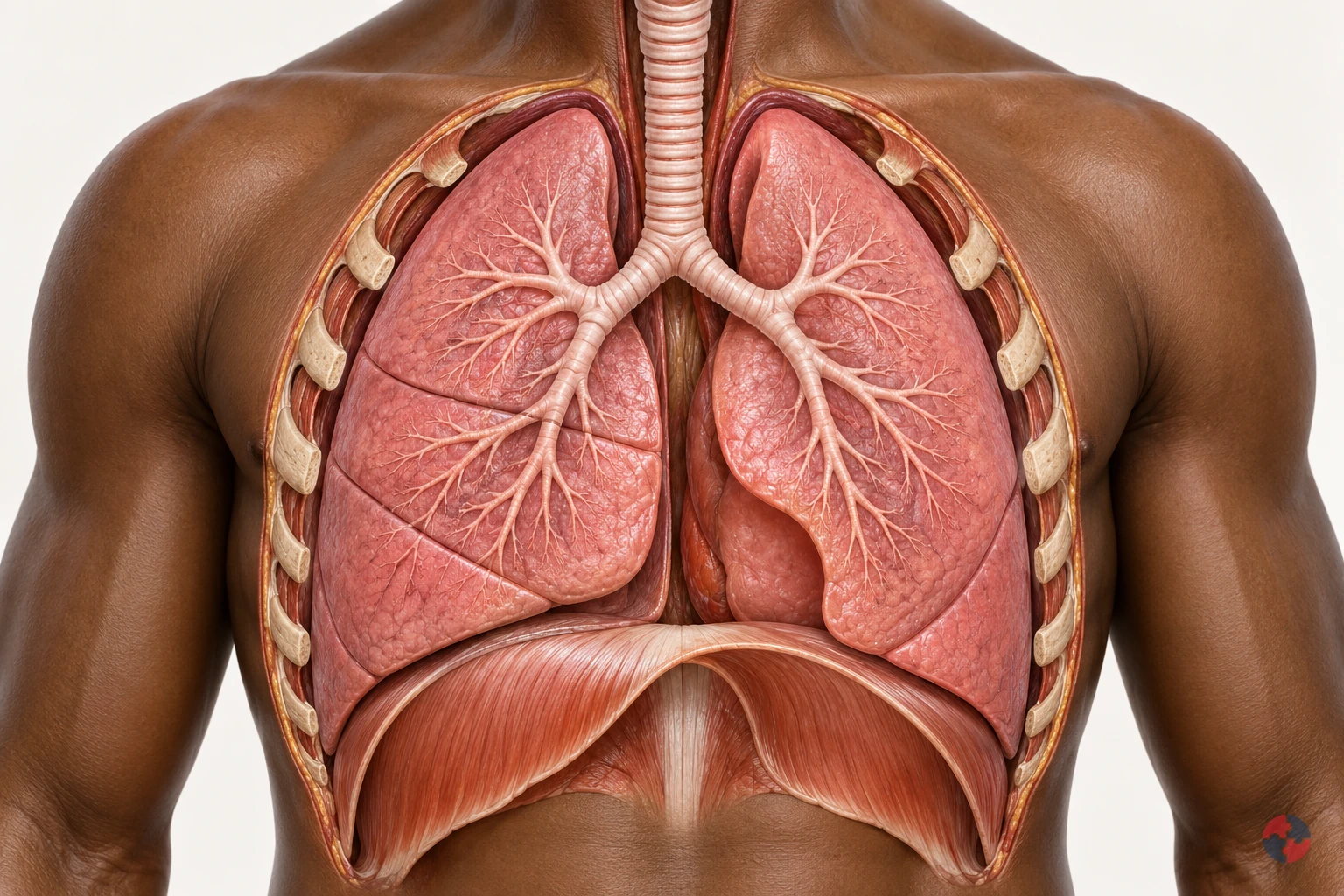

How do the lungs work, and how can workplace exposures affect breathing?
Interactive anatomy · Respiratory tract and lungs · Updated 2026-10-23
Read all anatomy and process explanations without the viewer
Simplified education, not diagnosis, a lung-function or oxygen-saturation test, an exposure calculator or a fitness-to-work assessment. No breath-holding challenge, breathing-rate score or personal health-data collection. Ordinary particle filters do not protect against every gas or oxygen deficiency. COPD and coal-dust topics may reuse normal anatomy only until separate mechanisms are reviewed.
Nose and mouth
Air enters and leaves here. The nose and mouth connect the outside air with the respiratory passages. Air moves through these openings on both the inward and outward breath. Follow the route towards the windpipe before looking at the smaller branches. The illustrated flow is air, a mixture of gases, rather than pure oxygen passing directly into blood. Frimley Health NHS Foundation Trust: How your lungs work · Central and North West London NHS Foundation Trust: How do we breathe?
Trachea
The windpipe carries air into the chest. The trachea, commonly called the windpipe, carries air down towards the chest. It divides into the two main bronchi that supply the lungs. Locate this shared passage before following either branch. Its role is to conduct air towards the gas-exchange regions and provide an outward route for the next exhalation. Frimley Health NHS Foundation Trust: How your lungs work
Bronchi
A main branch carries air into each lung. The two main bronchi take air from the windpipe into the right and left lungs. They divide into progressively smaller branches, distributing the breath through the lungs. Use the split as a landmark before following one highlighted route. These are air passages, distinct from the blood vessels that run through the same organs. Frimley Health NHS Foundation Trust: How your lungs work · University Hospitals of North Midlands NHS Trust: My lung surgery: about your lungs
Bronchioles
Smaller branches distribute air. Bronchioles are smaller branches of the airway system inside the lungs. Their branching routes lead towards clusters of alveoli, where the breath reaches the gas-exchange surface. Follow one branch to its end, using the others as context. This simplified route represents part of a much larger network supplying the lungs together. Frimley Health NHS Foundation Trust: How your lungs work
Alveoli
Tiny air sacs provide a gas-exchange surface. Alveoli are tiny air sacs at the ends of the small airway routes. Their close relationship with surrounding capillaries allows oxygen to pass towards blood and carbon dioxide towards alveolar air. Connect the highlighted cluster with the enlarged gas-exchange view. The enlargement changes the scale so the air space and neighbouring blood vessel can be distinguished. Frimley Health NHS Foundation Trust: How your lungs work · Central and North West London NHS Foundation Trust: How do we breathe?
Air–blood barrier
A thin boundary separates air from blood. The thin alveolar and capillary walls separate air in the sac from blood in its neighbouring vessel. Oxygen and carbon dioxide cross this boundary in opposite directions. Locate the tissue between the two spaces in the enlarged view. Blood cells remain in the vessel; the model does not represent an open connection through which air and blood mix. Central and North West London NHS Foundation Trust: How do we breathe?
Pulmonary capillaries
Small blood vessels pass beside the air sacs. Pulmonary capillaries are small blood vessels beside the alveoli. Blood moving through them receives oxygen and releases carbon dioxide across the thin exchange boundary, then continues through the circulation. Follow the labelled gas routes separately from the blood cells. These cells stay inside the capillary rather than moving into the air sac. Central and North West London NHS Foundation Trust: How do we breathe?
Diaphragm
This muscle helps make room for a breath. The diaphragm is a broad, dome-shaped breathing muscle beneath the lungs. It contracts and flattens downwards during inhalation, helping increase the space in the chest. During a quiet exhalation it relaxes towards its dome shape. Compare it with the rib cage: their changing positions help move air without the lung tissue acting as a contracting muscle. Cambridge University Hospitals NHS Foundation Trust: Breathing techniques to ease breathlessness: muscles involved
Rib cage and breathing muscles
Chest movement changes the space around the lungs. The rib cage protects the chest organs and moves with the breathing muscles. Expansion upwards and outwards helps increase chest space during inhalation; relaxation reduces that space during a quiet exhalation. Compare this movement with the diaphragm below the lungs. Together these structures provide the mechanics that allow air to move through the airways. Central and North West London NHS Foundation Trust: How do we breathe? · Cambridge University Hospitals NHS Foundation Trust: Breathing techniques to ease breathlessness: muscles involved
Pleura
Two thin layers surround the lungs and line the chest. The pleura has two thin layers around the lungs and inside the chest wall. A small amount of fluid between them allows the surfaces to slide with less friction as breathing changes the chest space. Locate this outer covering separately from the internal air sacs; it is not the thin air–blood exchange boundary. Blackpool Teaching Hospitals NHS Foundation Trust: Pleural clinic
Open the complete process transcript
The process, step by step
1 · Make space
Breathing in begins with a change in the space inside the chest. The diaphragm, a dome-shaped muscle beneath the lungs, contracts and moves downwards. Muscles around the ribs help lift the chest upwards and outwards. As the lungs expand with this changing space, air can enter through the airways. Locate the diaphragm and rib cage together rather than treating the lungs as muscles that pull themselves open. The model separates the movement into a teaching step so you can follow its purpose. In the body, chest movement, airflow and blood circulation are connected parts of a continuing process. Central and North West London NHS Foundation Trust: How do we breathe? · Cambridge University Hospitals NHS Foundation Trust: Breathing techniques to ease breathlessness: muscles involved
What to watch: Locate the diaphragm beneath the lungs and the rib cage around them; compare their positions with the space occupied by the lungs.
Why it matters: Changing the chest space draws air into the lung passages. The breathing muscles supply the movement, while the lungs expand with the chest to receive the next breath.
Explore this step: Select the diaphragm and rib cage in turn, then explain how their movement helps air enter without the lungs contracting like muscles.
2 · Move air
Air entering through the nose or mouth travels down the trachea, or windpipe, towards the chest. The trachea divides into the two main bronchi, with one route supplying each lung. Follow this continuous passage in the whole-chest view before moving into the smaller branches. The moving air is a mixture of gases, including oxygen; it is not a stream of pure oxygen travelling straight into the blood. These larger airways carry the breath towards the places where gas exchange happens. The same connected passages also provide the outward route when air is breathed out. Frimley Health NHS Foundation Trust: How your lungs work
What to watch: Start at the nose and mouth, follow the trachea downwards and find the split into the right and left main bronchi.
Why it matters: The larger passages distribute air to both lungs and connect the outside air with the smaller branches inside. Gas exchange takes place further along the route, rather than within the windpipe.
Explore this step: Trace the route to each lung and distinguish the tubes carrying air from the separate vessels carrying blood.
3 · Reach the air sacs
Inside each lung, the bronchi divide into smaller branches called bronchioles. These passages distribute air towards clusters of tiny air sacs, the alveoli. Follow one branch in the close-up and connect its end with an air-sac cluster, using the other branches as surrounding context. These routes distribute the breath throughout the lungs rather than supplying only one working air sac. A real lung contains many branching routes and air sacs operating together. This distribution brings air close to a large network of small blood vessels, preparing for the exchange shown in the next view. Frimley Health NHS Foundation Trust: How your lungs work
What to watch: Follow one smaller airway to the cluster of air sacs at its end, keeping the other branches as surrounding context.
Why it matters: Branching delivers air throughout the lungs instead of to one large chamber. The many air sacs bring the inhaled gases close to blood vessels where oxygen and carbon dioxide can cross.
Explore this step: Trace one complete branch to its air sacs, then explain how the many branches distribute air throughout the lungs.
4 · Change scale
The lesson now changes from a branching airway to an enlarged air–blood interface. An alveolus contains air; beside it runs a capillary containing blood. Their very thin walls form the boundary across which gases can move. Locate the air space, the separating tissue and the inside of the vessel before following any gas symbols. The magnified view represents a tiny part of the same lung, not a separate organ or a hole that joins air and blood into one space. The enlargement helps explain how the two systems can exchange gases while keeping their contents separate. Central and North West London NHS Foundation Trust: How do we breathe?
What to watch: Find the air inside the enlarged alveolus, the thin separating boundary and the neighbouring capillary with blood cells inside it.
Why it matters: A close boundary allows gases to cross between alveolar air and capillary blood. Keeping the two spaces separate lets ventilation and circulation cooperate without blood cells entering the air sac.
Explore this step: Identify the air space and blood-vessel space, then point to the boundary each gas must cross between them.
5 · Exchange gases
At the air–blood boundary, oxygen moves from the alveolar air into the capillary blood. At the same time, carbon dioxide carried back from the body moves from the blood into the air sac. The two gases cross in opposite directions; blood cells stay within the vessel. Follow each labelled symbol separately so that exchanging gases is not confused with mixing the air and blood together. Blood then carries oxygen onwards towards the heart and the body’s tissues. The teaching symbols simplify continuous gas movement, and their size, colour and speed do not represent a measurement. Central and North West London NHS Foundation Trust: How do we breathe?
What to watch: Follow the O₂ symbol towards the capillary and the CO₂ symbol towards the air sac, while locating the blood cells within the vessel.
Why it matters: Oxygen can be carried onwards for use by the body, while carbon dioxide returns to the airways for removal. Both transfers connect the breath with the continuing circulation of blood.
Explore this step: Trace the two gas routes in opposite directions and explain why a blood cell should remain inside the capillary.
6 · Breathe out
During a quiet breath out, the diaphragm and other breathing muscles relax. The diaphragm returns towards its dome shape, chest space decreases and air moves back along the airways to the nose or mouth. This outgoing air carries carbon dioxide that crossed from the blood into the alveoli. Trace the route in reverse without reversing the direction of blood circulation: oxygen-carrying blood continues towards the heart while another breath prepares to enter. The model presents a single cycle to explain the relationship. It does not show breathing as a series of separate events in which circulation stops between steps. Central and North West London NHS Foundation Trust: How do we breathe? · Cambridge University Hospitals NHS Foundation Trust: Breathing techniques to ease breathlessness: muscles involved
What to watch: Compare the diaphragm and chest with the inhalation step, then follow the outward airway route from the lungs to the nose or mouth.
Why it matters: Exhalation removes air containing carbon dioxide from gas exchange. Meanwhile, blood circulation continues carrying oxygen onwards, linking this breathing cycle with the needs of the rest of the body.
Explore this step: Trace the outward air route and the onward blood route separately, then describe why they are connected processes with different pathways.
Read the practice situations and all answer explanations
Sources and how the model is made
The opening images are AI-generated anatomical illustrations. The interactive 3D models and labelled SVG diagrams use original procedural artwork. These teaching images are not medical scans or diagnostic tools. Source references support the learner explanations and do not grant artwork rights.
- Frimley Health NHS Foundation Trust: How your lungs work — Normal airway branching, air sacs and capillary gas exchange; factual text only.
- Central and North West London NHS Foundation Trust: How do we breathe? — Thin alveolar/capillary walls, opposing gas transfer, circulation and chest mechanics. No illustrations or exercises copied.
- Cambridge University Hospitals NHS Foundation Trust: Breathing techniques to ease breathlessness: muscles involved — Diaphragm movement and breathing-muscle context only; this module does not prescribe breathing exercises.
- HSE: Health risks from welding — Welding-related airway irritation, possible deeper injury and irritant asthma; not a universal pattern for every gas.
- HSE: Asthma: an overview — Sensitisation, later triggering and work aggravation. Legacy labelling language and statistics are not reused.
- HSE: Advice for employers: occupational asthma — Exposure prevention, controls and health surveillance only; legacy legislation wording is not reused.
- NHS: Silicosis — Silica-associated inflammation/fibrosis, varying latency, irreversible damage and possible progression after exposure stops.
- HSE: Why is asbestos dangerous? — Asbestosis, mesothelioma and pleural disease are distinct; long disease latency.
- HSE: Construction dust: cutting paving blocks, kerbs and flags — Task design, source suppression/extraction, suitable RPE and checking controls; not a generic dust safe-dose rule.
- NHS: Shortness of breath — Emergency recognition of severe breathing difficulty and 999; emergency advice is outside the activity.
- NHS: Asthma — Narrowed/swollen airways, symptoms and clinical diagnosis; no medication doses or treatment plan reproduced.
- University Hospitals of North Midlands NHS Trust: My lung surgery: about your lungs — Right/left lung lobe counts and airway anatomy; no source image copied.
- Blackpool Teaching Hospitals NHS Foundation Trust: Pleural clinic — Pleural layers and the small lubricating fluid layer outside lung tissue; no procedural teaching included.
- HSE: Asphyxiation hazards in welding and allied processes — Oxygen-deficient spaces and need for independent air supply; no unprotected entry or rescue.
- HSE: Respiratory protective equipment at work — RPE selection must match the contaminant and conditions; filtering protection is not a supply of oxygen.
- HSE: Flour dust and risks to bakers — Flour sensitisation and practical reduction of dusty handling; exposure-limit numbers are not reused.
- Health and Safety Executive: Asbestos essentials — Task planning, training and competent asbestos work arrangements for the maintenance exposure example; not permission to disturb unknown material or a licence/classification decision.
- Health and Safety Executive: Welding fume: protect your workers — Alternative joining, fume reduction, LEV, suitable RPE and maintained controls for the welding-fume example. No unprotected exposure or rescue procedure.
What is the damage mechanism of ammonia poisoning?
Ammonia damages tissue because it dissolves in moisture and creates an alkaline chemical burn.
Gas refrigeration and solution handling need distinct plans
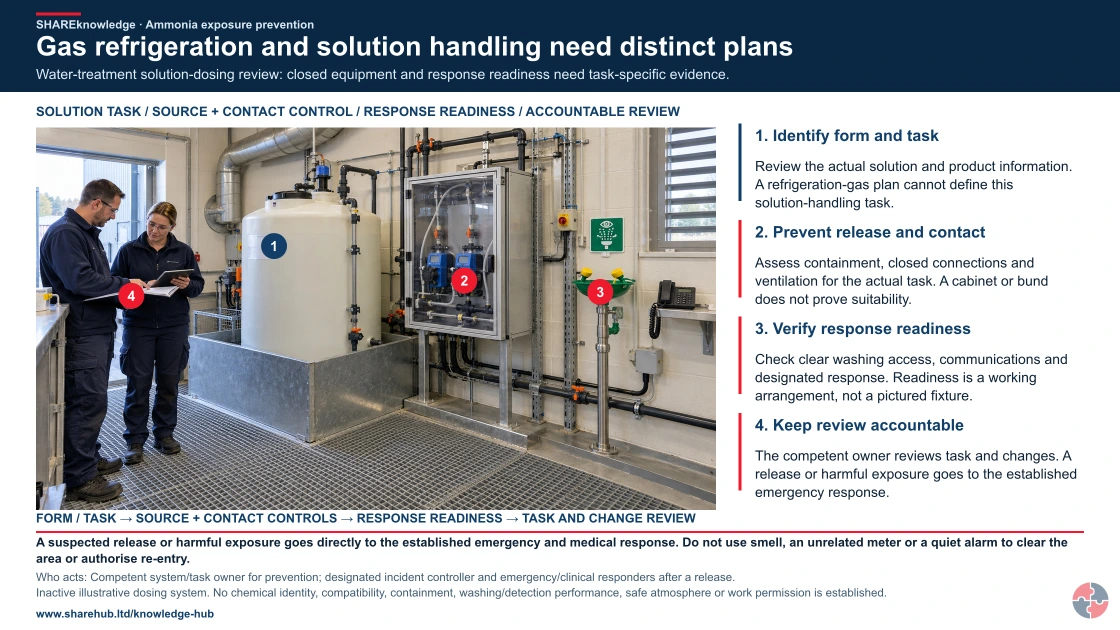
Full written explanation
An illustrative UK water-treatment solution-dosing area shows the task and its control questions. A closed day-tank in secondary containment, continuous connections and a shut transparent-front metering-pump cabinet show the actual physical task context. Accessible dry emergency-washing equipment and communications readiness remain in the clear walkway; normal colleagues review inert product/task information separately from handling. A single numbered key connects each picture feature to its explanation: identify the actual form/product/task, prevent source release and contact, verify designated response readiness, and retain an accountable task/change review. The picture cannot identify ammonia or its concentration, prove compatibility, containment, ventilation, alarm/interlock or washing performance, or make a dose/isolation/transfer plan. Pressurised refrigeration and aqueous solution handling are different task contexts. A suspected release or harmful exposure bypasses normal planning to the full existing emergency/clinical response; no clinician, casualty, washing action or source intervention is depicted. No anatomy, tissue harm, symptom diagnosis, rescue, PPE selection, washing duration, numeric criterion, chemical opening/mixing/dosing/isolation recipe, safe-air finding, recovery or re-entry/work permission is added. Use the full clinical/emergency guidance and applicable GB/NI qualifications.
Water-treatment solution-dosing review: closed equipment and response readiness need task-specific evidence.
- Identify form and task. Distinguish pressurised refrigeration from the actual ammonia solution and concentration used in a transfer task.
- Control the source and contact. Use suitable containment, compatibility and ventilation; address inhalation, eye and skin contact as appropriate.
- Prepare the response. Verify alarm, withdrawal, emergency washing, communication and designated specialist-response arrangements.
- Check the defined work. The competent owner verifies the normal task and change controls; incident command controls recovery after a release.
When the evidence does not fit: A suspected release or harmful exposure goes directly to the established emergency and medical response. Do not use smell, an unrelated meter or a quiet alarm to clear the area or authorise re-entry.
Who acts: Competent system/task owner for prevention; designated incident controller and emergency/clinical responders after a release.
Changed workplace
Food cold store: Keep staff away from a suspected refrigeration release; source intervention belongs to the designated response.
Water-treatment dosing: Assess the actual solution, splash controls and emergency-washing access; a gas-system plan does not automatically cover the task.
Evidence check: The photograph cannot establish ammonia concentration, atmosphere clearance, working alarms or the suitability of emergency equipment.
Primary references: HSE COSHH — prevent/control exposure at source for the actual task · HSE COSHH emergencies — planned equipment, trained roles and communication · UKHSA ammonia — chemical form and exposure context; clinical instructions retained in the full source
Open the complete HD image (new tab)Download image
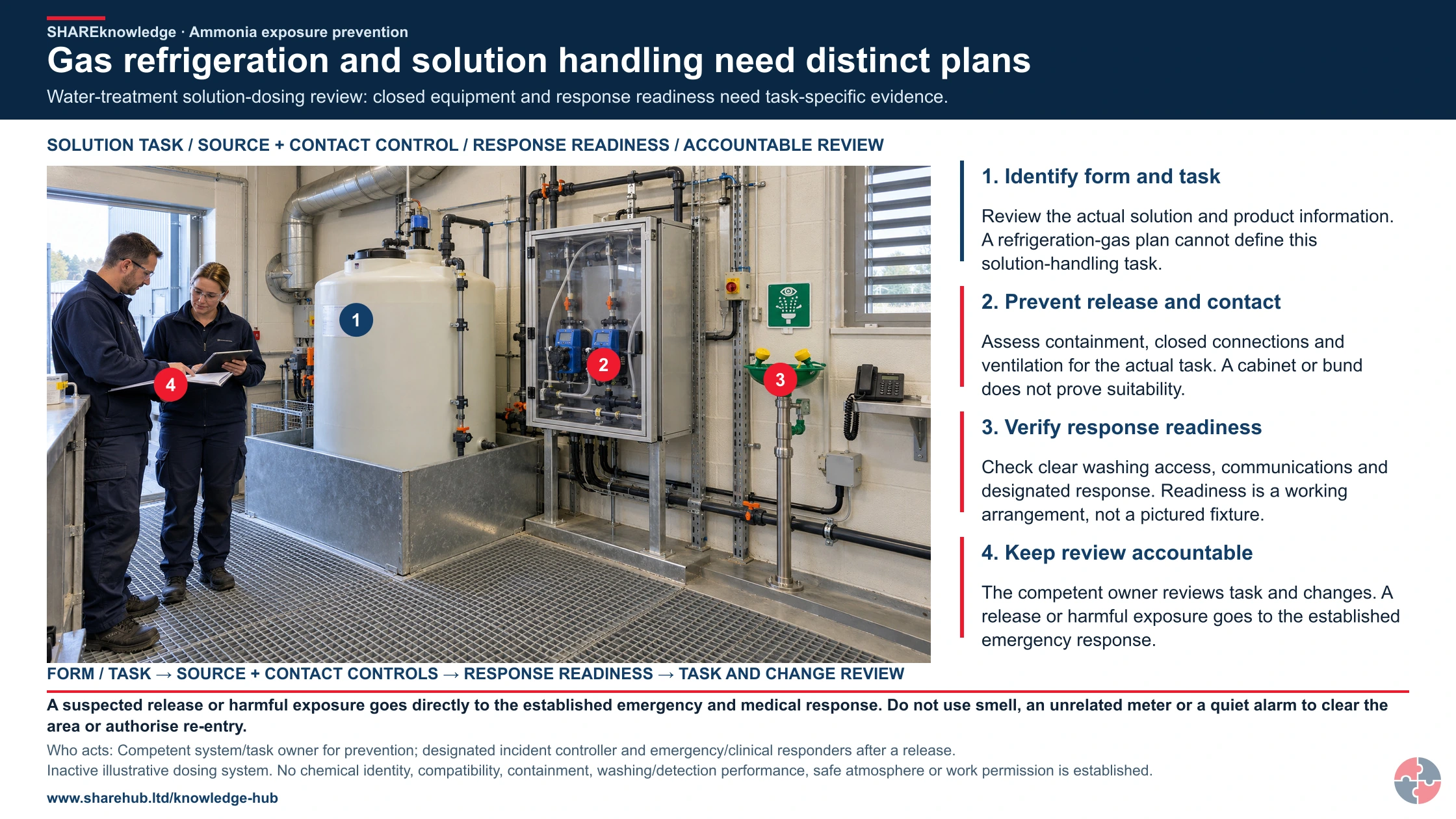
Primary references: HSE COSHH — prevent/control exposure at source for the actual task · HSE COSHH emergencies — planned equipment, trained roles and communication · UKHSA ammonia — chemical form and exposure context; clinical instructions retained in the full source
The technical point is simple but important: ammonia reacts with water in the body to form ammonium hydroxide, an alkaline substance that can disrupt cell membranes, damage proteins and injure tissue. Because the eyes and airways are moist, they are immediate target organs. This is why a small leak may cause eye watering and throat irritation before anyone understands the engineering fault.
At higher exposure, the injury can move from irritation to swelling, bronchospasm, tissue burns and lung inflammation. Severe exposure may damage the lower respiratory tract and cause fluid accumulation in the lungs. Existing asthma, chronic lung disease, poor fitness for emergency duties or delayed removal from exposure can increase the seriousness of the outcome.
| Damage mechanism element | Explanation | Workplace meaning |
|---|---|---|
| Alkaline corrosive action | Ammonia forms alkaline ammonium hydroxide when it dissolves in water. | Moist tissues such as eyes, throat and lungs are vulnerable even during short exposure. |
| Upper-airway irritation | Low or moderate exposure stimulates eyes, nose and throat. | Reports of strong smell, watering eyes or coughing are control warnings, not comfort complaints. |
| Bronchospasm | Airways can tighten in response to irritation. | Workers may wheeze or feel chest tightness, especially if they have asthma or reactive airways. |
| Pulmonary injury | High exposure can inflame and damage deeper lung tissue. | Symptoms may worsen later; observation and medical assessment may be needed after significant exposure. |
| Eye burns | Alkali injury can damage the cornea and surrounding tissues. | Immediate eyewash access and trained response are essential where splash risk exists. |
| Cold and chemical burns | Liquefied anhydrous ammonia can freeze tissue while also causing alkaline burns. | Pressurised systems need competent isolation and emergency shower arrangements. |
What are the symptoms of ammonia poisoning?
Symptoms range from immediate irritation to severe breathing difficulty, chemical burns and delayed lung injury.
Ammonia symptoms should be interpreted in context. One worker with watering eyes during a cleaning task may indicate poor dilution, spraying or ventilation. Several workers coughing near a refrigeration plant room may indicate a release, alarm issue or ventilation problem. A worker with persistent eye pain after a splash needs more than a note in the accident book.
Managers should avoid assuming that symptoms are minor because ammonia has a familiar smell. Strong warning properties can help people leave early, but they do not make the substance safe. The job of the management system is to prevent exposure, not to rely on people tolerating irritation.
| Exposure severity | Typical symptoms | What this may mean | Workplace response |
|---|---|---|---|
| Early or low-level irritation | Smell, watering eyes, runny nose, throat irritation, coughing or headache. | Airborne exposure may be occurring and controls may be inadequate. | Stop the task, withdraw by the safe route and warn others. Hold the area under the incident plan; a competent person must check controls before restart. |
| Moderate exposure | Persistent cough, chest tightness, wheeze, breathlessness, eye pain or skin redness. | Airway, eye or skin tissue may be injured. | Remove from exposure, use first-aid arrangements and seek medical assessment where symptoms persist or are significant. |
| Severe inhalation exposure | Severe breathlessness, choking, throat swelling sensation, blue lips, collapse or confusion. | Potential serious respiratory injury or oxygenation problem. | Emergency response, evacuation, trained rescue arrangements and medical assessment. |
| Eye splash | Severe pain, redness, watering, blurred vision or difficulty opening the eye. | Possible alkali burn to the eye. | Immediate irrigation and medical assessment. |
| Skin or liquid contact | Pain, redness, blistering, whitening, numbness or cold-burn type injury. | Chemical and/or cold injury. | Remove contaminated clothing, use emergency shower and arrange medical assessment. |
| Delayed effects | Cough, chest tightness or breathlessness worsening after leaving the area. | Delayed lung inflammation may be developing. | Do not ignore delayed symptoms after significant exposure. |
What should happen after an ammonia release or suspected exposure?
After a suspected ammonia release, alert others and withdraw by a safe route; only designated competent responders may use verified safe isolation controls. For an eye splash, reach a safe eyewash and start continuous clean-water irrigation immediately for at least 20 minutes while urgent medical help is arranged.
Suspected Release
Two linked parts · 6 questions. Open Part 2 to complete the route.

Continue to questions 4–6 · Part 2 of 2


Read this visual as text
- Start: An alarm, credible leak, sharp odour or symptoms suggest ammonia release.
- Question 1: Alarm and withdraw Decision owner: Incident controller / competent ammonia-system owner.
- ACTION: Stop work, warn others and leave by a safe route; do not investigate by entering. CONTINUE → QUESTION 2.
- Question 2: Are untrained people excluded and other tasks warned? Decision owner: Incident controller / competent ammonia-system owner.
- YES: The required evidence or condition is confirmed. CONTINUE → QUESTION 3.
- NO / UNKNOWN — HOLD: Maintain the boundary and activate the emergency plan. HOLD → REPEAT QUESTION 2 AFTER CORRECTION.
- Question 3: Account for people and call help Decision owner: Incident controller / competent ammonia-system owner.
- ACTION: Call 999 for casualties or suspected harmful exposure; brief responders from safety. CONTINUE → QUESTION 4.
- Question 4: Is any shutdown or isolation from verified safe controls authorised? Decision owner: Incident controller / competent ammonia-system owner.
- YES: The required evidence or condition is confirmed. CONTINUE → QUESTION 5.
- NO / UNKNOWN — HOLD: Only designated competent responders act under the plan; no unprotected rescue. HOLD → REPEAT QUESTION 4 AFTER CORRECTION.
- Question 5: Has specialist assessment established the safe area condition? Decision owner: Incident controller / competent ammonia-system owner.
- YES: The required evidence or condition is confirmed. CONTINUE → QUESTION 6.
- NO / UNKNOWN — HOLD: Do not use smell or an averaged exposure limit as an entry test. HOLD → REPEAT QUESTION 5 AFTER CORRECTION.
- Question 6: Is formal technical and operational hand-back accepted? Decision owner: Incident controller / competent ammonia-system owner.
- YES: The required evidence or condition is confirmed. OUTCOME → RECORD AND HAND OVER.
- NO / UNKNOWN — HOLD: Keep re-entry and restart held while recovery evidence is incomplete. HOLD → REPEAT QUESTION 6 AFTER CORRECTION.
- Outcome: People accounted for and emergency services handed the facts; later technical clearance and restart decision.
- Stop and escalation boundary: Never investigate by entering a suspected release area, rescue without protection or use EH40 averages as an entry test.
What follows an ammonia eye or skin splash?
Two linked parts · 5 questions. Open Part 2 to complete the route.

Continue to questions 4–5 · Part 2 of 2


Read this visual as text
- Start: A worker may have ammonia solution or liquefied ammonia on an eye or skin.
- Question 1: Can the worker and helpers reach washing without entering contamination? Decision owner: Incident controller / competent ammonia-system owner.
- YES: The required evidence or condition is confirmed. CONTINUE → QUESTION 2.
- NO / UNKNOWN — HOLD: Use the trained emergency plan; do not create another exposure. HOLD → REPEAT QUESTION 1 AFTER CORRECTION.
- Question 2: Is the exposure to an eye or skin? Decision owner: First aider / clinical service.
- Eye: Begin clean-water irrigation immediately for at least 20 minutes; keep rinsing while help is arranged. CONTINUE → QUESTION 3.
- Skin: Remove contaminated clothing only when safe, wash with lukewarm water and soap, and obtain medical advice. CONTINUE → QUESTION 3.
- Uncertain / multiple routes: Tell the call handler and follow trained first-aid advice without delaying safe rinsing. CONTINUE → QUESTION 3.
- Question 3: Is there a chemical burn to an eye or skin, or serious illness? Decision owner: Emergency services.
- YES — STOP / REFER: Call 999 while irrigation and safe first aid continue. STOP / REFER → APPROPRIATE RESPONSE.
- NO: No such warning is identified; continue the remaining checks. CONTINUE → QUESTION 4.
- UNKNOWN — PROTECT FIRST: Protect people and hold the affected work. Obtain the responsible specialist’s assessment; do not assume the warning is absent. HOLD → OWNER RESOLVES BEFORE RESUMING.
- Question 4: Hand over facts Decision owner: Incident controller / competent ammonia-system owner.
- ACTION: Provide product, concentration, time and actions if safely known; do not neutralise chemically or wait for paperwork. CONTINUE → QUESTION 5.
- Question 5: Is the task held pending cause and control review? Decision owner: Incident controller / competent ammonia-system owner.
- YES: The required evidence or condition is confirmed. OUTCOME → RECORD AND HAND OVER.
- NO / UNKNOWN — HOLD: Do not send the person back to the original exposure; arrange separate scene recovery. HOLD → REPEAT QUESTION 5 AFTER CORRECTION.
- Outcome: Urgent clinical handover; scene controlled and cause investigated before restart.
- Stop and escalation boundary: Do not delay washing for paperwork, neutralise chemically, assume mild initial pain means no damage or send the person back to work.
Activate the site alarm and emergency plan, keep others out and call 999 for a suspected harmful exposure, severe breathing symptoms, collapse or chemical eye/skin burn. Seek immediate medical advice after possible harmful inhalation, ingestion or contact. If harm is uncertain, use NHS 111 promptly in Great Britain; in Northern Ireland seek prompt GP or out-of-hours advice, and go to an emergency department if timely advice is unavailable for a potentially hazardous substance. Severe symptoms or a strong chemical eye splash require 999. Do not drive yourself for emergency care. For an eye splash, get to a safe eyewash without exposing helpers, hold the eye open and immediately run plenty of clean, not hot water over it with a gentle flow for at least 20 minutes. Keep rinsing while 999 help is arranged for strong chemical exposure, remove a contact lens if it is safe, and follow the call handler; do not delay to find an SDS or let the person drive. NHS eye-injury advice gives at least 20 minutes and continued rinsing while awaiting help, while UKHSA ammonia general information gives at least 10 to 15 minutes; this page uses the longer NHS public instruction, not an averaged duration or a workplace treatment protocol. For skin contact, remove contaminated clothing safely without pulling it over the head, wash with lukewarm water and soap as UKHSA advises, and seek medical advice. For inhalation, leave the area safely and seek medical advice; do not use eyewash instructions as an inhalation response. Remove contaminated clothing only when it can be done safely; do not use neutralising chemicals. No unprotected rescue or entry into a plant room or cloud. A worker who seems better still needs clinical advice after a significant exposure because airway injury can worsen. Give responders the product, concentration, route and timing if known, without delaying help.
| Situation | Immediate route | Do not do |
|---|---|---|
| Leak, alarm, odour with symptoms | Warn, withdraw, exclude people, activate site response and call 999 for suspected harmful release or casualties. | Do not enter to find the leak or close a valve through the cloud. |
| Chemical in eye or on skin | For eye contact, reach safe eyewash and immediately irrigate with plenty of clean, not hot water for at least 20 minutes; keep rinsing while 999 help is arranged for a strong chemical splash. For skin contact, remove contaminated clothing safely, wash with lukewarm water and soap, and seek medical advice. | Do not delay irrigation for paperwork, neutralise the chemical, stop rinsing while awaiting help, or let the exposed person drive. |
| Breathing difficulty, collapse or significant inhalation | Call 999; follow dispatcher and trained first-aid arrangements. | Do not wait for delayed symptoms or allow self-driving. |
| Harm uncertain after minor possible contact | In GB call NHS 111 promptly; in NI seek GP or out-of-hours advice promptly, or go to ED if advice is unavailable for a potentially hazardous exposure. Give exact product and route. | Do not use odour or apparent recovery as clearance. |
| Responder handover | Provide location, product/SDS, concentration, pressure state, route, time and observed signs. | Do not risk entry to collect paperwork. |
How do controls change across real ammonia tasks?
Seven Crownway Fuels Ltd cases show routine use, changed supply, contractor line-breaking, a failed warning system, unknown material, a splash and a major release.
An uncertain isolation holds the line break


Read this visual as text
- The host and specialist contractor verify the defined ammonia refrigeration work before any line is opened. An ambiguous indication is a hold point, not permission to try a valve or loosen a connection.
- IDENTIFY THE LINE
- VERIFY THE SAFE STATE
- HOLD IF UNCERTAIN
Illustrative ammonia-system line-check discussion. The image does not establish the actual chemical, isolation or safe state. The host and specialist contractor must reconcile the plant identity and scheme evidence before intervention; an unexplained indication keeps the line break on hold.
These are teaching cases, not permits, rescue instructions or a substitute for product-specific assessment.
1. Routine use of an ammonia-containing cleaner
Task material and setting: Crownway Fuels Ltd cleaners use an identified ammonia-containing product in a workshop welfare area; the outcome is a cleaned surface without avoidable vapour or splash exposure.
People and prerequisites: Cleaners and adjacent workers may be affected. A trained user has the exact product label, SDS, approved dilution/method and working ventilation.
Before: Check concentration, compatible container, dilution method, ventilation, eye/skin protection and eyewash access; consider a less hazardous method.
During: Use only the approved amount and application method, keep the container closed and report irritation or spray drift.
Hold or stop: Unknown concentration, failed ventilation, a proposed bleach mix or symptoms: do not start or continue.
Completion and hand back: Close and label stock, clean and inspect the area, report defects and hand back when the method is controlled.
Evidence: Product register, COSHH assessment, user check and defect/symptom report.
2. Changed ammonia solution delivery
Task material and setting: A supplier proposes a stronger ammonia solution for a Crownway dosing system; the outcome is an approved or rejected change before receipt.
People and prerequisites: Purchasing, stores, operators and delivery drivers may be affected. The proposed product identity, concentration, packaging and SDS are available.
Before: Compare with the current product; check compatibility, transfer route, spill containment, ventilation, eyewash, training and emergency arrangements.
During: Accept only the specified product and container after the assessor and site owner approve the change.
Hold or stop: Unlabelled delivery, wrong concentration, unknown hose compatibility or no assessed transfer method: reject or hold.
Completion and hand back: Update inventory, labels, COSHH assessment and delivery instructions; brief users before first use.
Evidence: Change approval, supplier SDS, goods-receipt check and updated assessment.
3. Contractor opens an ammonia refrigeration line
Task material and setting: A specialist contractor plans intrusive work on Crownway refrigeration pipework; the outcome is a proved isolation and safe hand-back, not a release.
People and prerequisites: Contractors, host operations, cleaners and bystanders may be affected. Host and contractor agree plant scope, competence, emergency route and permit authority.
Before: Confirm drawings, inventory, pressure state, isolations, lock-off, depressurisation/purge method, detection, ventilation and rescue limits under a task-specific plan.
During: Open the line only after independent checks required by the site method; keep the work zone controlled and coordinate scope changes.
Hold or stop: Ambiguous valve, pressure, residual ammonia, alarm or host-contractor handover: no line break and no improvised opening.
Completion and hand back: Leak-test and verify integrity, restore controls, close the permit and authorise restart through the host.
Evidence: Permit, isolation proof, contractor competence, test results and restart sign-off.
4. Detector or ventilation fault in a plant room
Task material and setting: Crownway discovers that an ammonia detector is unavailable while the refrigeration plant is running; the outcome is a controlled hold and repaired warning system.
People and prerequisites: Plant users and nearby workers may be affected. The facility manager knows the alarm logic, manual checks and alternative operating options.
Before: Check what protection is lost, whether operation can safely continue and who has authority to isolate or suspend plant.
During: Restrict access and use only a formally assessed temporary arrangement if competent specialists authorise it.
Hold or stop: Unverified detection, failed ventilation, odour, symptoms or no credible temporary control: stop affected operation and evacuate as the plan requires.
Completion and hand back: Repair and test the system, verify response logic and record the restart decision.
Evidence: Defect log, risk review, test certificate and restart authorisation.
5. Unknown container beside bleach
Task material and setting: An unlabelled liquid is found in a cleaning store beside bleach; the outcome is identification without mixing, sniff-testing or use.
People and prerequisites: Cleaners, stores staff and others nearby may be affected. A supervisor can quarantine the item and trace stock records.
Before: Keep the container closed; check purchase and inventory records and ask a competent person or supplier to identify it.
During: Do not decant, mix or use the liquid while identity and compatibility are uncertain.
Hold or stop: Odour, leaking container, symptoms or evidence of mixing: leave, warn others and activate the site incident plan.
Completion and hand back: Dispose or relabel only through the approved route, update stock controls and check nearby products.
Evidence: Quarantine record, identity evidence, incident/defect report and stock review.
6. Solution splash to a worker eye
Task material and setting: A hose disconnection splashes identified ammonia solution towards an operator eye; the outcome is immediate washing and urgent medical handover.
People and prerequisites: The operator and helpers may be affected. Eyewash, emergency call route and product label are accessible without entering a contaminated area.
Before: Stop transfer and summon help; protect helpers from contact and move the worker to safe washing facilities.
During: At a safe eyewash, start continuous clean-water eye irrigation immediately for at least 20 minutes; keep rinsing while calling 999 for strong chemical eye exposure. Follow the call handler and trained first-aid plan.
Hold or stop: Do not delay or stop irrigation for paperwork, apply a neutraliser, send the worker to drive, or assume mild initial pain means no injury.
Completion and hand back: Hand over the product, concentration, timing and first-aid facts; hold the transfer until cause and controls are verified.
Evidence: Emergency timeline, product identity, incident record and corrective-action closure.
7. Plant-room release and evacuation
Task material and setting: An alarm and sharp odour suggest ammonia escape from Crownway refrigeration; the outcome is people clear, emergency services informed and no untrained rescue.
People and prerequisites: Plant staff, contractors, adjacent teams and possible neighbours may be affected. The site has an alarm, evacuation plan, designated isolation roles and responder liaison.
Before: Know safe exits, muster and the exclusion route before an event; maintain detector, ventilation and designated remote isolation under the site design.
During: Stop work, raise alarm, withdraw by the safe route, prevent entry and call 999 for suspected harmful release or casualties.
Hold or stop: No plant-room entry, unprotected rescue, reliance on odour level, or manual valve closure through a suspected cloud.
Completion and hand back: Only designated competent responders manage isolation and re-entry from safe controls under the site plan; investigate and verify controls before hand-back.
Evidence: Alarm log, personnel account, emergency handover, incident investigation and restart authority.
How can the hierarchy of controls reduce ammonia exposure and poisoning risk?
Ammonia poisoning is prevented by eliminating avoidable exposure, reducing inventory, enclosing systems, controlling releases and training people for normal and emergency conditions.
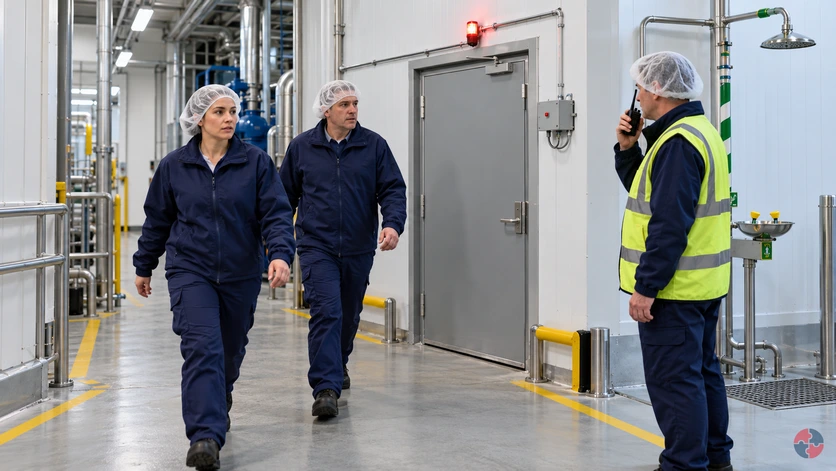
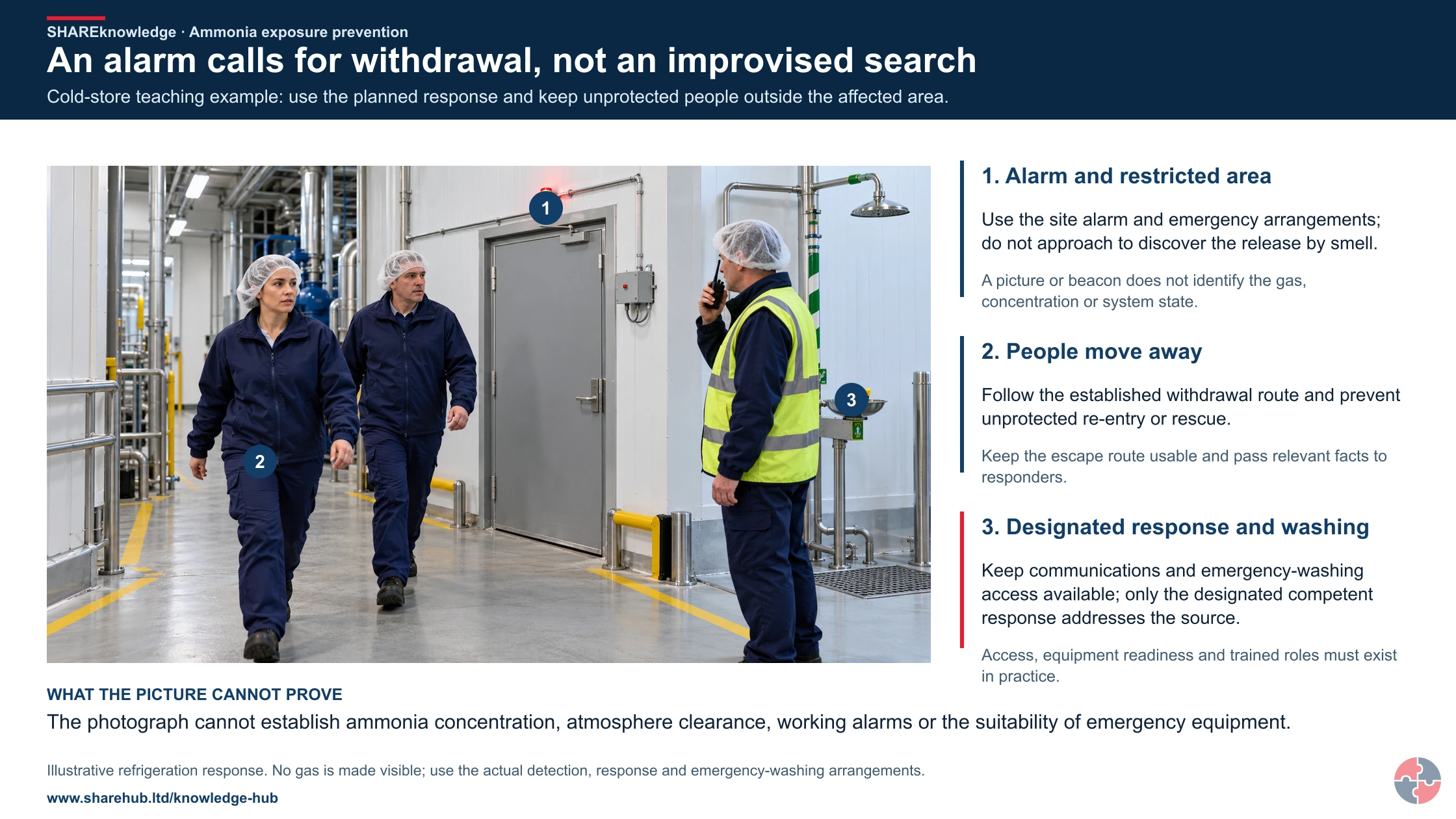
An alarm calls for withdrawal, not an improvised search
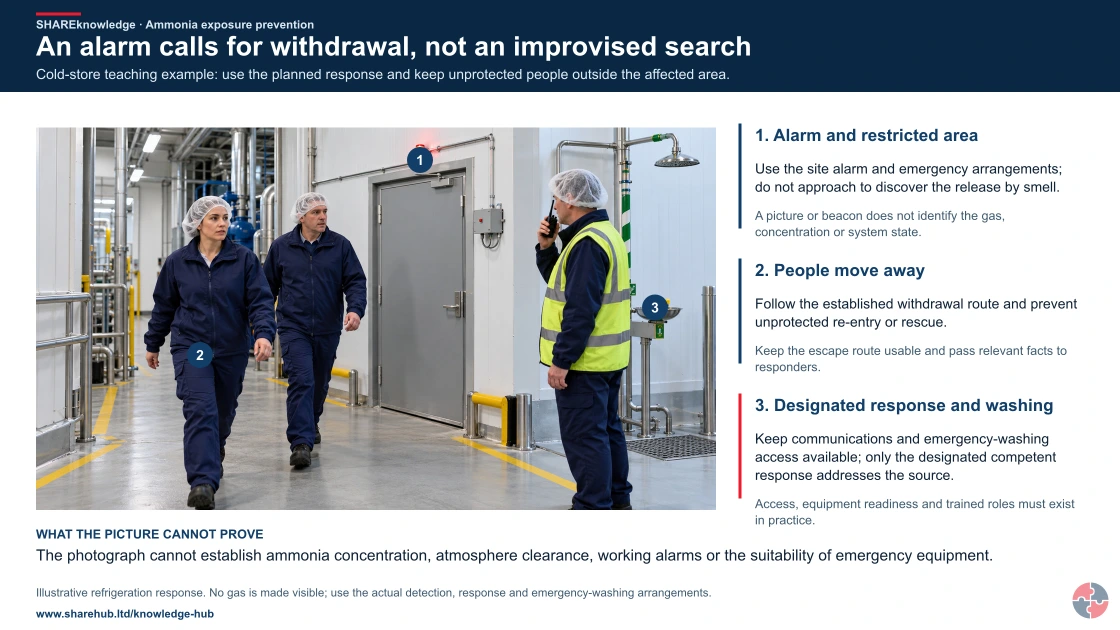
Full written explanation
Cold-store teaching example: use the planned response and keep unprotected people outside the affected area.
- Alarm and restricted area. Use the site alarm and emergency arrangements; do not approach to discover the release by smell.
- People move away. Follow the established withdrawal route and prevent unprotected re-entry or rescue.
- Designated response and washing. Keep communications and emergency-washing access available; only the designated competent response addresses the source.
Change the pathway
- Know what is present. A picture or beacon does not identify the gas, concentration or system state.
- Protect the route. Keep the escape route usable and pass relevant facts to responders.
- Verify readiness. Access, equipment readiness and trained roles must exist in practice.
Evidence check: The photograph cannot establish ammonia concentration, atmosphere clearance, working alarms or the suitability of emergency equipment.
Primary references: HSE COSHH — prevent/control exposure at source for the actual task · HSE COSHH emergencies — planned equipment, trained roles and communication · UKHSA ammonia — chemical form and exposure context; clinical instructions retained in the full source
Open the complete HD image (new tab)Download image
Primary references: HSE COSHH — prevent/control exposure at source for the actual task · HSE COSHH emergencies — planned equipment, trained roles and communication · UKHSA ammonia — chemical form and exposure context; clinical instructions retained in the full source
Changed Product or Task
Two linked parts · 6 questions. Open Part 2 to complete the route.

Continue to questions 4–6 · Part 2 of 2


Read this visual as text
- Start: A new ammonia solution concentration, supplier, container, transfer or spray method is proposed.
- Question 1: Are exact product, concentration, supplier and container identified? Decision owner: Incident controller / competent ammonia-system owner.
- YES: The required evidence or condition is confirmed. CONTINUE → QUESTION 2.
- NO / UNKNOWN — HOLD: Hold or quarantine an unknown product. HOLD → REPEAT QUESTION 1 AFTER CORRECTION.
- Question 2: Has current supplier information been checked for the actual task? Decision owner: Incident controller / competent ammonia-system owner.
- YES: The required evidence or condition is confirmed. CONTINUE → QUESTION 3.
- NO / UNKNOWN — HOLD: Resolve changes in transfer, spraying, storage or refrigeration duty. HOLD → REPEAT QUESTION 2 AFTER CORRECTION.
- Question 3: Are compatibility and containment suitable? Decision owner: Incident controller / competent ammonia-system owner.
- YES: The required evidence or condition is confirmed. CONTINUE → QUESTION 4.
- NO / UNKNOWN — HOLD: Reject an incompatible proposal; do not mix with bleach or other cleaners. HOLD → REPEAT QUESTION 3 AFTER CORRECTION.
- Question 4: Are ventilation, splash controls and emergency washing ready? Decision owner: Incident controller / competent ammonia-system owner.
- YES: The required evidence or condition is confirmed. CONTINUE → QUESTION 5.
- NO / UNKNOWN — HOLD: Keep use held until the competent assessor accepts the protections. HOLD → REPEAT QUESTION 4 AFTER CORRECTION.
- Question 5: Are users briefed and task release recorded? Decision owner: Incident controller / competent ammonia-system owner.
- YES: The required evidence or condition is confirmed. CONTINUE → QUESTION 6.
- NO / UNKNOWN — HOLD: Update the inventory, assessment and stop conditions before use. HOLD → REPEAT QUESTION 5 AFTER CORRECTION.
- Question 6: Review first use and change Decision owner: Incident controller / competent ammonia-system owner.
- ACTION: Check actual performance and reassess any unexpected release or symptoms. OUTCOME → RECORD AND HAND OVER.
- Outcome: Approved controlled method, or a documented hold/rejection and updated inventory.
- Stop and escalation boundary: No use when identity, concentration, method or control is unknown; no mixing with bleach or other cleaners.
The hierarchy matters. A small bottle of dilute cleaner, a refrigerant receiver and a bulk ammonia delivery are very different risk profiles, but the logic is the same: remove the need for ammonia where possible, minimise the amount present, keep it contained, detect and ventilate releases, and make sure people know when to withdraw.
Personal protective equipment has an important place, especially during planned handling, emergency response and maintenance, but it should not be the default answer to a poorly designed system. For ammonia refrigeration, prevention depends heavily on mechanical integrity, competent refrigeration engineering, pressure-system inspection, alarm response, plant-room ventilation and disciplined permit control.
For a refrigeration plant, first test whether the cooling duty can be met without ammonia or with a lower-hazard configuration whose overall risks are assessed. That is elimination or substitution within ERICPD Eliminate/Reduce. If ammonia remains, a competent refrigeration designer specifies the charge, containment, isolation points, detector coverage, ventilation and alarm response for the actual room and occupancy. These are engineered Isolate/Control measures, not simply instructions. Commissioning must demonstrate the sensors, power-failure response, ventilation and isolation interfaces; maintenance verifies calibration, seals and changes. A bottle of dilute cleaner is a different task and must not inherit the plant scenario or its assumptions.
Access rules, planned maintenance, permit controls, competent contractors and drills are administrative safeguards; PPE is selected for the planned residual task and cannot authorise unplanned rescue. ERICPD Discipline is the ongoing test, inspection, training and learning that keeps containment credible. The operator checks detector health and visible plant condition before work; the facilities manager owns defect closure. If a leak is suspected, an alarm sounds, ventilation is unavailable or isolation status is uncertain, withdraw and activate the site emergency plan. Restart follows specialist verification of the plant and occupied area, not odour disappearance or an ordinary shift check.
How can the ERICPD hierarchy of controls reduce ammonia exposure and poisoning risk?

| ERICPD level | What it means for ammonia | Practical workplace examples | Key limitations |
|---|---|---|---|
| Eliminate | Remove ammonia from the task or process where reasonably practicable. | Use non-ammonia cleaning products, avoid manual decanting, design out routine venting or select alternative systems for lower-risk applications. | Not always possible for efficient industrial refrigeration or process chemistry. |
| Reduce | Reduce the amount, concentration, pressure, frequency or number of people exposed. | Minimise ammonia inventory, use lower-concentration products, schedule maintenance out of hours, reduce line-breaking and limit access to plant rooms. | Reduced inventory still needs strong containment and emergency planning. |
| Isolate | Separate ammonia from people and separate people from release zones. | Enclosed plant rooms, remote valves, physical barriers, locked chemical stores, segregated deliveries and exclusion zones during maintenance. | Isolation fails if doors are propped open, alarms are ignored or contractors enter without control. |
| Control | Use engineering and procedural controls to prevent, detect and manage releases. | Gas detection, mechanical ventilation, emergency shutdown, pressure relief, maintenance, written schemes, permit-to-work, flushing, purging and leak testing. | Controls need testing, ownership, competence and clear action levels. |
| PPE | Use suitable protection for residual contact or emergency risk. | Chemical goggles or face shield, compatible gloves, protective clothing, safety footwear, RPE or breathing apparatus for trained emergency roles. | PPE can fail through poor fit, wrong cartridge, breakthrough, contamination or lack of training. |
| Discipline | Make safe behaviour and evidence part of normal operations. | Training, supervision, drills, alarm response, defect reporting, contractor control, stop-work authority and investigation learning. | Rules without practical supervision and leadership attention become paperwork controls. |
How can the ISO 45001 hierarchy of controls reduce ammonia exposure and poisoning risk?

| ESEAP control level | What it means for ammonia | Practical workplace examples | Key limitations |
|---|---|---|---|
| Elimination / Substitution | Remove ammonia from the task or process where reasonably practicable. | Use non-ammonia cleaning products, avoid manual decanting, design out routine venting or select alternative systems for lower-risk applications. | Not always possible for efficient industrial refrigeration or process chemistry. |
| Substitution / Administrative controls | Reduce the amount, concentration, pressure, frequency or number of people exposed. | Minimise ammonia inventory, use lower-concentration products, schedule maintenance out of hours, reduce line-breaking and limit access to plant rooms. | Reduced inventory still needs strong containment and emergency planning. |
| Engineering controls / Administrative controls | Separate ammonia from people and separate people from release zones. | Enclosed plant rooms, remote valves, physical barriers, locked chemical stores, segregated deliveries and exclusion zones during maintenance. | Isolation fails if doors are propped open, alarms are ignored or contractors enter without control. |
| Engineering controls / Administrative controls | Use engineering and procedural controls to prevent, detect and manage releases. | Gas detection, mechanical ventilation, emergency shutdown, pressure relief, maintenance, written schemes, permit-to-work, flushing, purging and leak testing. | Controls need testing, ownership, competence and clear action levels. |
| PPE | Use suitable protection for residual contact or emergency risk. | Chemical goggles or face shield, compatible gloves, protective clothing, safety footwear, RPE or breathing apparatus for trained emergency roles. | PPE can fail through poor fit, wrong cartridge, breakthrough, contamination or lack of training. |
| Administrative controls | Make safe behaviour and evidence part of normal operations. | Training, supervision, drills, alarm response, defect reporting, contractor control, stop-work authority and investigation learning. | Rules without practical supervision and leadership attention become paperwork controls. |
What checks are needed before, during and after ammonia work?
Confirm the material and release routes before work, watch the controls during work, and hand back only after containment and emergency readiness are verified.
| Stage | Check | Hold point | Evidence |
|---|---|---|---|
| Before purchase or change | Identify concentration/form, safer option, SDS, delivery route, compatibility and emergency needs. | Unknown product or unassessed process: no release to users. | Product/change approval. |
| Before routine use | Check container/line, ventilation, detection, splash protection and washing access. | Defect, blocked washing point or missing controls: no start. | Pre-use check and briefing. |
| Before intrusive work | Host and contractor prove scope, isolation, pressure state, purge method and emergency route. | Ambiguous valve or residual ammonia: no line break. | Permit and isolation proof. |
| During work | Keep containment, ventilation and bystander controls effective; watch symptoms and alarms. | Leak, odour with symptoms, detector failure or task change: stop and withdraw. | Alarm/defect or exposure report. |
| Completion and restart | Close containers and lines, clean area, test integrity, restore alarms and account for people. | No hand-back on an unverified repair or verbal assurance. | Test, maintenance, permit and restart record. |
How should COSHH and EH40 be applied to ammonia?
Assess the actual gas, liquid or solution task under the applicable COSHH law; EH40 limits compare averaged airborne exposure, not emergency or contact safety.
EH40 lists anhydrous ammonia at 25 ppm (18 mg/m3) over 8 hours and 35 ppm (25 mg/m3) over 15 minutes. HSE states these are GB airborne workplace exposure limits; HSENI states the EH40 list is legally binding under NI COSHH. A competent assessor must use the correct substance, sampling method and averaging period. A reading below either limit does not clear an eye splash, short leak peak, unknown atmosphere, cryogenic contact or ingestion. Alarm set-points, ventilation and emergency entry criteria require their own competent design; do not derive them mechanically from an 8-hour WEL. If a product is aqueous ammonia, verify its ingredients and applicable exposure assessment rather than treating the bottle as pure anhydrous gas.
| Reference | Value and period | Decision and limit |
|---|---|---|
| EH40 long-term WEL | 25 ppm; 18 mg/m3; 8-hour time-weighted average. | Use for assessed airborne work exposure, not leak entry. |
| EH40 short-term WEL | 35 ppm; 25 mg/m3; 15-minute time-weighted average. | Check short tasks and peaks with a competent sampling plan; not an instantaneous alarm threshold. |
| Contact or incident | No WEL value settles eye/skin splash or unknown atmosphere. | Follow emergency plan and urgent medical route. |
| Worked decision | A detector alarm trips during a line-break even if the prior shift 8-hour average was below 25 ppm. | Stop, withdraw and investigate: the average cannot authorise continuing the release. |
Unknown isolation means no line break
This is an evidence map for a competent ammonia-system team. It is not a valve sequence or a permit to open pipework. Solution use and pressurised refrigeration remain separate tasks.
Defined system boundary
- Identify the exact plant, line and proposed intervention.
- Reconcile the plant identification with the current controlled information and the actual location.
- Identify connected sources and retained material or energy within the agreed work boundary.
Evidence required by the scheme
- Record the isolation scheme and the authorised people responsible.
- Record how the required isolation and safe state have been proved under that scheme.
- Resolve trapped inventory, interacting work and any changed conditions before release.
Decision and recheck
- The authorised release owner checks the evidence for this intervention.
- Any unexplained indication, mismatch or missing evidence keeps the work on hold.
- A change of task, boundary or plant state triggers recheck; a previous permit is not fresh evidence.
Hold: the line number on a work order does not match the plant identifier at the intended opening. The team holds the line break and refers the discrepancy to the scheme owner. Nobody tests the assumption by loosening a connection.
The photograph illustrates a line-check discussion; it cannot prove identity, containment or isolation. For an actual release or exposure use the emergency route.
What makes ammonia refrigeration a separate high-consequence task?
Refrigeration adds stored pressure, a possible flashing-liquid release, specialist isolation and plant-room interfaces to the corrosive exposure hazard.
The host and specialist contractor must agree exactly which line, valves and stored volume are involved before intrusive work. Prove isolation and pressure state by the approved method; plan depressurisation, purging, monitoring and restart without inventing a universal valve sequence. Maintain detection, ventilation and emergency actions, including how a remote or safe isolation is performed. Check whether the particular pressure system requires a written scheme of examination and competent-person examination. In GB, PSSR 2000 principally addresses stored-energy failure; in NI, PSSR (NI) 2004 similarly separates pressure danger from hazardous fluid properties. Neither proves ammonia toxicity is controlled: COSHH and emergency arrangements remain necessary. DSEAR may also require a separate fire/explosion assessment because ammonia can be flammable in relevant conditions.
| Question | Required decision | Evidence |
|---|---|---|
| Toxic release | COSHH task and emergency assessment, containment, detection and ventilation. | Assessment, detector/ventilation tests, drills. |
| Stored pressure | Check PSSR scope and written scheme; use competent examination and maintenance. | WSE, examination report, defect closure. |
| Fire/explosion | Assess ammonia dangerous-substance risk under GB or NI DSEAR where relevant. | DSEAR assessment and design basis. |
| Intrusive contractor work | Host and contractor agree isolation, residual pressure, permit, communication and restart. | Permit, independent proof and hand-back. |
How are monitoring, maintenance and health surveillance decided?
Detector tests, ventilation checks and worker reports confirm controls; exposure sampling and health surveillance are separate, risk-based decisions.
Use HSE EH40, HSENI approval for NI, HSE pressure-systems guidance for their distinct exposure and plant-integrity decisions; a detector reading is not a rescue clearance.
Fixed detectors warn against a release only when location, calibration, power, alarm logic and response are credible for the installation. Sampling against EH40 may be needed to assess defined tasks; it cannot certify rescue entry or liquid-contact safety. PSSR examinations follow the written scheme where applicable and do not replace routine maintenance. HSE and HSENI set selective health-surveillance criteria: an associated adverse effect must be detectable early, and workplace conditions must make it likely. Seek competent occupational-health advice; routine lung-function or other testing is not automatic for every ammonia cleaner or plant operator. For identifiable symptom, surveillance and incident records, collect only what is needed, restrict access, document an Article 6 UK GDPR lawful basis and a separate Article 9 special-category condition, and check any Data Protection Act 2018 Schedule 1 and appropriate-policy-document requirement. Do not assume worker consent is always suitable in employment; share necessary facts with emergency responders without delaying care.
| Control | Check | Boundary |
|---|---|---|
| Gas detection and ventilation | Test location, calibration, alarm response, ventilation function and defect closure. | A quiet alarm or running fan alone does not prove control. |
| Air exposure sampling | Competent assessor checks actual task and EH40 8-hour/15-minute periods. | Does not represent an unknown peak or eye/skin route. |
| Pressure system | WSE examination where in scope, plus maintenance and repair checks. | PSSR report is not a toxic-exposure certificate. |
| Health surveillance | Apply HSE/HSENI criteria with occupational-health input and act on findings. | Not universal screening or a substitute for prevention. |
Which GB and Northern Ireland duties apply to ammonia work?
Great Britain and Northern Ireland have separate general-safety, COSHH, pressure-system and DSEAR instruments; product-supply information is not a workplace assessment.
Use the amended law for the site. COSHH addresses hazardous ammonia exposure and emergency arrangements. PSSR addresses qualifying pressure-system stored-energy risk, with a written scheme and examination where required; it does not replace COSHH. DSEAR adds dangerous-substance fire/explosion duties where the installation risk calls for them. Supplier classification, labels, SDS and equipment conformity provide inputs, not approval to use or maintain the particular plant. The NI pressure regulations are 2004, not GB 2000. For identifiable worker symptom, surveillance and incident information, document a UK GDPR Article 6 lawful basis plus a separate Article 9 special-category condition, check any Data Protection Act 2018 Schedule 1 and appropriate-policy-document requirement, limit collection and access, and do not assume consent is always the suitable employment basis.
| Question | Great Britain | Northern Ireland |
|---|---|---|
| General duties | Health and Safety at Work etc Act 1974; Management Regulations 1999. | Health and Safety at Work (NI) Order 1978; Management Regulations (NI) 2000. GB source NI source |
| Ammonia exposure | COSHH Regulations 2002; EH40 anhydrous-ammonia WEL. | COSHH Regulations (NI) 2003; HSENI says EH40 list is binding. GB source NI source |
| Qualifying pressure plant | Pressure Systems Safety Regulations 2000. | Pressure Systems Safety Regulations (NI) 2004. GB source NI source |
| Dangerous-substance risk | DSEAR 2002 where relevant. | DSEAR (NI) 2003 where relevant. GB source NI source |
| Supply information | Use current SDS, label and equipment instructions as inputs to task assessment. | Check the NI supply/conformity route separately; do not assume GB rules transfer unchanged. Official source |
| Worker health records | UK GDPR Articles 6 and 9; check DPA 2018 Schedule 1 and any required appropriate policy document. | UK GDPR Articles 6 and 9; check DPA 2018 Schedule 1 and any required appropriate policy document. Official source |
How should ammonia appear in a workplace risk register?
Ammonia should appear in the risk register as a specific exposure and release hazard with named controls, owners and assurance evidence.
A weak risk register says only 'chemical exposure' or 'ammonia'. A useful one describes the credible exposure route, the people affected, the existing barriers, the emergency controls and how each barrier is tested. For ammonia refrigeration, the register should also link to pressure-system inspection, plant-room ventilation, detection, contractor competence and maintenance backlog.
The register should include both routine and abnormal situations: cleaning, decanting, cylinder change, ammonia charging, oil draining, maintenance, purging, leak response, alarm investigation, plant-room entry and emergency evacuation.
| Risk register entry | What to record | Assurance question |
|---|---|---|
| Routine use of ammonia solution | Product concentration, task, route of exposure, ventilation, splash controls, storage and users. | Are dilution, PPE, eyewash and training actually in place where the work happens? |
| Refrigeration plant release | Inventory, plant room, detectors, ventilation, isolation, alarms, emergency shutdown and affected areas. | Can the site prove detection, ventilation and evacuation arrangements work today? |
| Maintenance and line breaking | Permit controls, isolation, depressurisation, purging, contractor competence and hand-back. | Would an engineer and supervisor describe the same safe sequence? |
| Emergency response | Evacuation route, upwind muster, emergency services information, RPE roles, shower and eyewash. | Have realistic drills tested both worker evacuation and specialist response? |
| Health exposure concern | Reported symptoms, task, exposure history, medical assessment, investigation and control review. | Did the investigation remove the cause or only record the symptom? |
| Change management | New plant, product, concentration, pipework, alarm setting, ventilation or contractor change. | Was the COSHH, PSSR and emergency-planning impact reviewed before change went live? |
How could Crownway Fuels Ltd manage ammonia risk?

In this worked example, Crownway links product controls, an ammonia refrigeration installation and emergency decisions to named owners and evidence.
Crownway Fuels Ltd has a temperature-controlled product-test area as well as a workshop cleaning store. This is an illustrative operating assumption, not a claim that a fuel business normally needs ammonia refrigeration. The facilities manager identifies the plant, responsible specialist and any qualifying pressure-system written scheme. The safety adviser maintains the ammonia COSHH assessments and emergency plan. Purchasing blocks unassessed product changes; supervisors check actual task conditions and respond to alarms or irritation reports.
Before intrusive plant work, the host and contractor agree the exact line, isolation, pressure state, permit boundaries, emergency route and restart authority. A detected leak leads to withdrawal and the site plan, not an improvised plant-room investigation. Checks and review intervals are set from the plant design, risk assessment, written scheme where applicable and manufacturer instructions, then adjusted for defects or changes.
| Owner | Decision | Evidence |
|---|---|---|
| Purchasing and user | Confirm product identity, concentration, storage and task method before use. | Inventory, supplier SDS and COSHH assessment. |
| Facilities and specialist | Confirm refrigeration integrity, detector and ventilation operation, and PSSR scope. | Plant register, test records and written scheme/examination where required. |
| Host and contractor | Prove task-specific isolation and controlled line break; agree hand-back. | Permit, isolation proof, leak test and restart sign-off. |
| Supervisor and safety adviser | Respond to symptoms, alarm or loss of control; investigate before restart. | Incident timeline, headcount, corrective actions and review. |
What training is needed for ammonia work?
People need the level of competence required for their task and emergency role; general users do not become plant-room responders.
All affected people should recognise the relevant alarm, safe exit, reporting route and prohibition on untrained re-entry. Product users need the specific concentration, method, controls and washing arrangements. Supervisors and permit issuers need competence to hold work when controls fail. Refrigeration engineers and any designated responders need specialist authorisation and practical exercises matched to the installation. Where tight-fitting RPE is selected, arrange suitable fit testing and training; no respirator makes an unknown release safe for an untrained person. Set refresher and exercise intervals from risk, changes, equipment and observed performance rather than an invented universal timetable.
| Role and learning | Practice on the actual task | Competence evidence and record | Assessor and reassessment trigger |
|---|---|---|---|
| Workers and product users: escape and report | Recognise ammonia alarm or irritation; stop, withdraw, warn others and do not re-enter. | Observed escape, alarm and product-identification scenario. | Supervisor rechecks after route, product or alarm change. |
| Supervisors: isolate affected work safely | Check exclusion, accounted persons and authorised responder handover; never send unprotected rescue. | Drill, communication log and documented restart authority. | Competent manager rechecks after release, drill failure or plant change. |
| Refrigeration and maintenance specialists | Verify isolation, pressure-system controls, detection, ventilation and written scheme where applicable. | Observed permit/isolation, maintenance and examination evidence. | Competent refrigeration/pressure lead rechecks after modification or defect. |
| Emergency responders and first aiders | Practise authorised response, clean-water eye irrigation and healthcare handover within training. | Observed drill, equipment checks and product/SDS handover. | Response lead rechecks after incident, exercise or guidance change. |
| Managers and occupational-health advisers | Ensure COSHH, pressure and fire duties are scoped; assess monitoring and follow-up case by case. | Approved risk assessment, competent advice and verified corrective action. | Accountable lead reopens after new process, symptoms or repeat leak. |
Record the demonstrated decision, assessor and limits of authority. Reassess after changes to the task, substance, equipment or response plan, or after an incident; no universal certificate period is assumed.
Which standards help, and what do they not prove?
BS EN 378 can inform refrigeration design and operation; ISO 45001 can structure management assurance, but neither replaces site COSHH, PSSR, DSEAR or product instructions.
Use the current applicable part of BS EN 378 for the refrigerating system, its location, occupancy, detection and operation, with a competent refrigeration designer. Do not lift charge, alarm or ventilation values from an old part or another installation. ISO 45001 is a voluntary OH&S management framework whose current edition and amendments require an authorised copy; it can organise change control, worker consultation, contractor oversight and emergency learning. Certification does not demonstrate a specific ammonia system is safe.
How does ammonia control align with ISO 45001?
ISO 45001 can help structure ammonia control by linking leadership, planning, support, operation, performance evaluation and improvement.
| Management-system theme | How it supports ammonia control |
|---|---|
| Context of the organisation | Recognise ammonia as a site-specific occupational health, chemical and operational risk, especially where refrigeration or process plant is present. |
| Leadership and worker participation | Set clear ownership for plant integrity, COSHH, emergency response and worker reporting of odour or symptoms. |
| Planning | Identify ammonia hazards, legal duties, exposure scenarios, risk controls, objectives and improvement actions. |
| Support | Provide competence, awareness, communication, documented information, SDS access and emergency resources. |
| Operation | Control routine use, maintenance, contractor work, permit-to-work, plant-room access, procurement and change management. |
| Performance evaluation | Monitor detector tests, WEL evidence, maintenance backlog, drill outcomes, symptoms, incidents and audit findings. |
| Improvement | Investigate leaks, symptoms, alarm failures and audit findings, then improve engineering controls, procedures and training. |
What can be learned from HSE’s historical ammonia assessment example?
HSG97’s 2004 frozen-pea refrigeration example illustrates why an alarm needs evacuation arrangements, drills and isolation from a safe place.
HSE HSG97 (2004), page 32, uses a frozen-pea processor’s ammonia refrigeration assessment to illustrate maintenance, prompt leak reporting, detector alarms, protected pipework and competent maintenance. Its emergency arrangements include clear escape routes, evacuation practice, isolation from a safe place and a drench shower. This is a historical learning example, not an enforcement notice or a current plant specification. Compare it with this site: can people recognise an alarm, leave by a safe route, account for colleagues, keep untrained people out and hand information to responders? Can authorised specialists isolate without entering a dangerous area? The ventilation question below is a current site-planning question supported by HSE emergency guidance, rather than a finding attributed to this historical example. Check current requirements and the actual plant design before transferring a control.
| Failure mode | Local question | Evidence |
|---|---|---|
| Alarm without action | Does every affected role know the withdrawal route? | Drill and headcount record. |
| Ventilation not linked to incident | Is the release response designed and tested? | Design basis, tests and defect close-out. |
| Isolation requires exposure | Can authorised people limit a leak from a safe location? | Approved isolation plan and exercise. |
What are the warning signs that ammonia risk is not managed?
Warning signs include repeated odour reports, irritation, poor plant condition, weak contractor control and uncertainty about emergency response.
A workplace can look tidy and still have weak ammonia control. The warning signs are often small and practical: a plant-room alarm that people have stopped trusting, eyewash bottles out of date, a refrigeration contractor working without operations knowing, workers joking about the smell, or supervisors treating coughing as a nuisance rather than exposure evidence.
Each warning sign can become harm. Poor ventilation allows vapour to build up. Deferred maintenance allows leaks to worsen. Missing eyewash increases eye damage after a splash. Weak handover means a line can be opened while still charged. Unclear emergency roles mean people enter a dangerous area when they should withdraw.
| Warning sign | How it can cause harm | What to do |
|---|---|---|
| Repeated smell or irritation reports | Workers may be repeatedly exposed to low-level ammonia or an early leak. | Investigate the source, review ventilation and update the COSHH assessment. |
| Alarm activations treated as normal | People may delay evacuation or miss a real release. | Review alarm set points, false-alarm causes, maintenance and response training. |
| Overdue refrigeration maintenance | Leaks, corrosion, vibration or valve failures may go unresolved. | Escalate backlog, prioritise safety-critical defects and review competent-person input. |
| Poor eyewash or shower provision | Eye or skin injury may be worse after splashes or contact. | Install, inspect and test emergency decontamination facilities. |
| Unclear contractor control | Intrusive ammonia work may happen without isolation, purging or emergency coordination. | Strengthen permit-to-work, RAMS review and hand-back. |
| Workers unsure about evacuation | People may investigate a release or walk through contaminated areas. | Run realistic drills and brief simple withdrawal rules. |
| No link between symptoms and controls | Headaches, coughing or eye watering may be recorded without fixing the cause. | Trend reports and require control review after symptoms. |
Standards named on this page are background context. Confirm the current edition, scope and exact requirements from an authorised copy before applying them. The open official sources below support the specific public-law and regulator guidance claims they are cited for.
What do the acronyms and key terms mean?
The same acronym may describe a different GB or Northern Ireland instrument, and exposure limits are averages, not emergency-entry thresholds.
| Term | Meaning | Decision boundary |
|---|---|---|
| Anhydrous ammonia | Ammonia without water, often compressed or liquefied. | A release can combine corrosive contact and pressure hazards. |
| Aqueous ammonia | Ammonia dissolved in water. | Concentration and splash route matter; use the exact product SDS. |
| COSHH | Control of Substances Hazardous to Health. | GB 2002 and NI 2003 regulations are separate instruments. |
| EH40 / WEL | HSE workplace exposure-limit publication / airborne workplace exposure limit. | Anhydrous ammonia has 8-hour and 15-minute averages; not a leak or contact safety threshold. |
| LTEL / STEL | Long-term / short-term exposure limit. | For EH40 ammonia, these use 8-hour / 15-minute averaging periods. |
| PSSR | Pressure Systems Safety Regulations. | GB 2000 and NI 2004 regimes address qualifying stored-energy danger, not toxicity alone. |
| DSEAR | Dangerous Substances and Explosive Atmospheres Regulations. | Assess fire/explosion risk where relevant under the applicable GB or NI instrument. |
| RPE / SDS | Respiratory protective equipment / safety data sheet. | Task-specific protection and supplier information do not replace site assessment. |