
Crown Fuels and process safety / Reaction and combustible-dust hazards
Crown Fuels and process safety · SH-FUEL-12Reaction and combustible-dust hazards
Free online training · Approximate learning time: 80–130 minutes · Self-paced
Use inert demonstrators to understand heat escalation and explosion propagation.
Full public teaching and readers are free without an account. A free learner account is required for saved LMS progress and recorded assessment. Completion and any course-completion certificate depend on the configured LMS conditions.
Who this course is for
Learners building process-safety awareness, including operators, supervisors and maintenance staff; no chemistry or dust-handling authorisation is conferred.
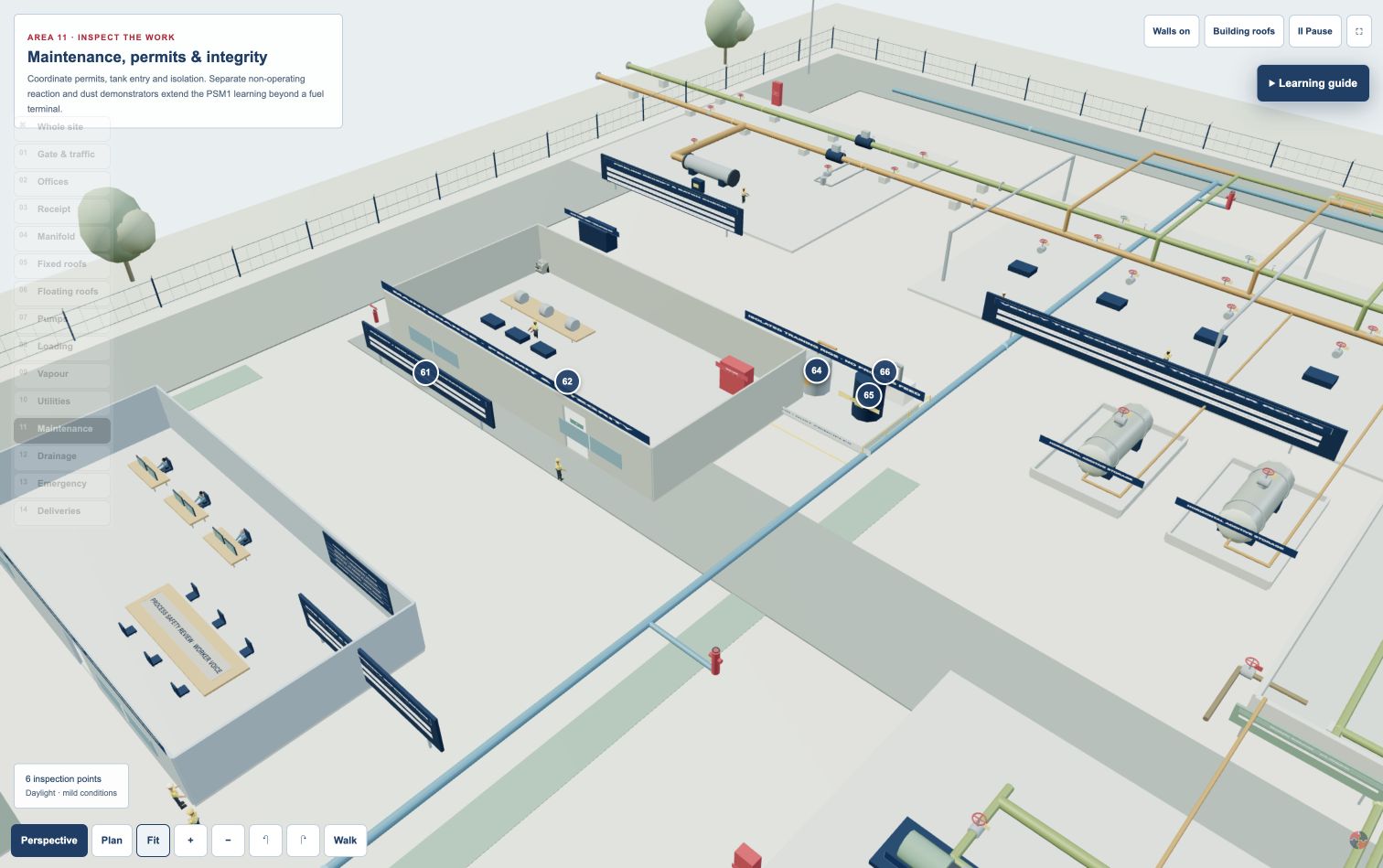
Crown Fuels stores and distributes finished fuel. It is not a chemical batch plant or a powder-production operation. The separate reactor and dust displays are inert, non-operating learning demonstrators used to explain hazards that differ from terminal fuel-release scenarios. This course builds the reasoning behind thermal runaway, reaction change, dust clouds and explosion propagation, then asks what information and competent design are needed before real processes can operate. All scenarios are theoretical: do not reproduce reactions, disperse dust, test ignition or alter protective systems.
Only separate inert, non-operating training demonstrators illustrate reaction and dust hazards; Crown Fuels is not a batch-reactor or powder-production site.
Learning outcomes
- Explain how reaction heat accumulation and dust-cloud formation produce different escalation mechanisms.
- Identify why changes in scale, composition, equipment or protection require data and competent reassessment.
- Distinguish prevention, relief, suppression and isolation duties without treating a model component as proven protection.
Course outline
Recognise separate process hazard mechanisms
- Distinguish the mechanism before choosing a safeguardSeparate fuel release, chemical reaction and combustible-dust scenarios.
- Understand heat accumulation and loss of controlExplain why cooling loss can create escalation rather than a simple temperature deviation.
Understand process-energy control
- Treat reaction changes as changes to the safety basisIdentify what must be reassessed before altering chemistry, scale or protection.
- Control dust clouds and prevent propagationExplain the separate roles of housekeeping, containment and explosion protection.
- Separate inert reactor: heat generation can outrun coolingA runaway is an accelerating heat-balance failure; prevention and protection must be designed from the actual chemistry and credible deviations.
- Separate inert reactor: a recipe change needs new evidenceA substance-information document supports assessment; it cannot replace process-specific reaction data and controlled change.
Recognise combustible-dust escalation
- Separate inert dust exhibit: deposits can fuel an explosionPrevent release and accumulation, control ignition and assess explosion protection; never teach the mechanism by creating a live dust cloud.
Understand dust clouds and propagation
- Separate inert dust exhibit: relief and isolation do different jobsAlways state what a barrier does and where it acts; pressure relief is not automatic isolation of connected equipment.
Transfer learning without inventing terminal operations
- Keep the safety basis intact across two demonstratorsCompare reaction and dust controls while preserving the fictional training boundary.
- Turn the learning into a verified workplace actionChoose a bounded action, owner, task-specific evidence and escalation trigger within your role.
Activities, model practice and assessment
Work through 4 required applied activities and 3 model-practice pauses, with explanatory feedback and independent lesson decisions. Complete 4 distinct model mission sequences across those pauses. Use the actual fictional Crown Fuels model or its equivalent accessible route to complete the required decision sequences; launching the model alone does not complete practice.
The 20-question assessment requires at least 80% plus every designated critical safety answer. Complete the required activities, practice and lesson checks. Points and badges cannot offset a critical safety error.
Use the LMS for confirmed save/resume and recorded results. Any certificate follows its configured passed-completion and grade conditions.
Open the public interactive practice copy; public practice is separate from the LMS record.
Sources and learning provenance
Original fictional cases are paired with public SHAREhub teaching and structured topic records. Use the applicable jurisdiction and primary guidance for live work.
- Dangerous Substances and Explosive Atmospheres Regulations 2002: HSE overview
- Plant modification / Change procedures: Technical Measures
- Chemical reaction hazards and thermal runaway (INDG254 rev1)
- Reaction / Product testing: Technical Measures
- Safe handling of combustible dusts (HSG103)
Topic sections, source identities and versions
| Public topic | Chunk and version | Jurisdiction and sources |
|---|---|---|
| reaction-hazards-and-runaway-reactions · reaction-lifecycle | reaction-hazards-and-runaway-reactions--reaction-lifecycle 2.2 | Great Britain, Northern Ireland reaction-indg254, reaction-reaction-testing, reaction-control-systems, reaction-waste |
| batch-reactor-safety · agitation-cooling | batch-reactor-safety--agitation-cooling 20261016-letter-review-1 | Great Britain, Northern Ireland src-reactor-design, src-control-systems, src-reactor-operations |
| management-of-change-in-process-safety · screen | management-of-change-in-process-safety--screen 2.0 | Great Britain, Northern Ireland hse-moc |
| dust-explosion-controls-and-housekeeping · mechanism | dust-explosion-controls-and-housekeeping--mechanism 20261016-letter-review-1 | Great Britain, Northern Ireland dust-explosion-controls-and-housekeeping-src-001 |
| dust-explosion-hazards · pentagon | dust-explosion-hazards--pentagon 20261016-letter-review-1 | Great Britain dust-explosion-hazards-src-001 |
| explosion-prevention-relief-isolation-and-suppression · isolation | explosion-prevention-relief-isolation-and-suppression--isolation 2.2 | Great Britain, Northern Ireland hse-relief, hse-dust |
| batch-reactor-safety · change-learning | batch-reactor-safety--change-learning 20261016-letter-review-1 | Great Britain, Northern Ireland src-reaction-testing, src-sampling, src-reactor-operations, src-seveso, src-hsg254 |
| reaction-hazards-and-runaway-reactions · assurance | reaction-hazards-and-runaway-reactions--assurance 2.2 | Great Britain, Northern Ireland reaction-hsg254, reaction-indg254, reaction-reaction-testing, reaction-control-systems, reaction-relief |
Course SH-FUEL-12 · version 2026.10.20.1. .
Questions about this course
Is this training free?
Full public teaching and readers are free without an account. A free learner account is required for saved LMS progress and recorded assessment. Completion and any course-completion certificate depend on the configured LMS conditions.
How long should I allow?
Approximately 80–130 minutes, including teaching, lesson checks, required activities, model or accessible practice and one assessment attempt. Individual pace, review and retries vary. Save and resume in the LMS.
Can I learn without a 3D-capable browser?
Yes. The complete HTML reader provides the teaching. Required model practice has an equivalent accessible decision route in the interactive course. Use the LMS route for recorded learning.
What is required to pass?
Complete the required learning, activities, practice and lesson decisions. The 20-question final assessment requires at least 80% plus every designated critical safety answer. Points cannot compensate for a critical safety error. Follow the feedback before retrying.
Does this authorise fuel operations?
Only separate inert, non-operating training demonstrators illustrate reaction and dust hazards; Crown Fuels is not a batch-reactor or powder-production site. This independent course does not award a NEBOSH qualification or replace competent task assessment, practical training or site authorisation.