
Chilled pie production and food safety / Safer production work: knives, heat, cold and ergonomics
Chilled pie production and food safety · SH-PIE-07Safer production work: knives, heat, cold and ergonomics
Free online training · Approximate learning time: 120–200 minutes · Self-paced
Design the work so ordinary production does not depend on people enduring harm
Full public teaching and readers are free without an account. A free learner account is required for saved LMS progress and recorded assessment. Completion and any course-completion certificate depend on the configured LMS conditions.
Who this course is for
Preparation workers, cooks, rack handlers, packers, cold-store staff and production supervisors.
Follow a pie through raw trimming, hot transfer, rack handling, repetitive packing and chilled movement. Original cases show how layout, equipment, workload, communication and recovery influence injury and ill health. Compare source controls with measures that depend on individual coping, then practise a justified hold and restart.
Great Britain awareness for raw preparation, cooking, packing and cold-store staff. Recognise and control ordinary task hazards, report symptoms and request suitable help. No clinical diagnosis, first-aid certification, equipment modification or permission to undertake specialist work.
Learning outcomes
- Explain blade, hot-liquid, hot-surface, thermal, repetitive-work and noise harm pathways.
- Select task and workstation improvements before relying on reminders or PPE alone.
- Respond to symptoms or failed controls without asking workers to diagnose illness or continue unsafe work.
Course outline
Set up the cutting task
- Make the safe cut possible before lifting the knifeCheck tool, support, movement path and storage against the actual trimming task.
- Contain the hot filling before opening the routeCompare engineered transfer control with relying on somebody to catch a spill.
Contain heat and communicate rack status
- Give a hot rack an unambiguous place and statusExplain why appearance and gloves cannot replace a reliable hot-rack handling system.
- Dizziness beside the oven is a stop signalConnect heat exposure, clothing, workload and appropriate support.
Respond to heat strain
- Redesign the repetitive packing taskAssess force, posture, pace, recovery and worker fit as a connected system.
- Keep hands effective and warnings usable in cold noisy workRecognise interacting cold, handling and noise risks without inventing exposure readings.
- Knife injury during raw meat trimmingExplain the decision using the observed condition, the harm route and the evidence needed for release.
- Hot filling spills during kettle dischargeExplain the decision using the observed condition, the harm route and the evidence needed for release.
- Hot racks mistaken for cool racksExplain the decision using the observed condition, the harm route and the evidence needed for release.
- Heat strain beneath hygiene clothingExplain the decision using the observed condition, the harm route and the evidence needed for release.
Redesign repetitive and cold work
- Repetitive hand packing in a cold lineExplain the decision using the observed condition, the harm route and the evidence needed for release.
- Cold exposure reduces dexterityExplain the decision using the observed condition, the harm route and the evidence needed for release.
- Pneumatic and chiller noise accumulatesExplain the decision using the observed condition, the harm route and the evidence needed for release.
Verify a workable shift plan
- A busy shift is not a different safety standardCoordinate decisions across preparation, hot work areas and chilled packing.
- Take a verified action into the workplaceConnect one actual task to an owner, evidence and a clear release or escalation decision.
Activities, model practice and assessment
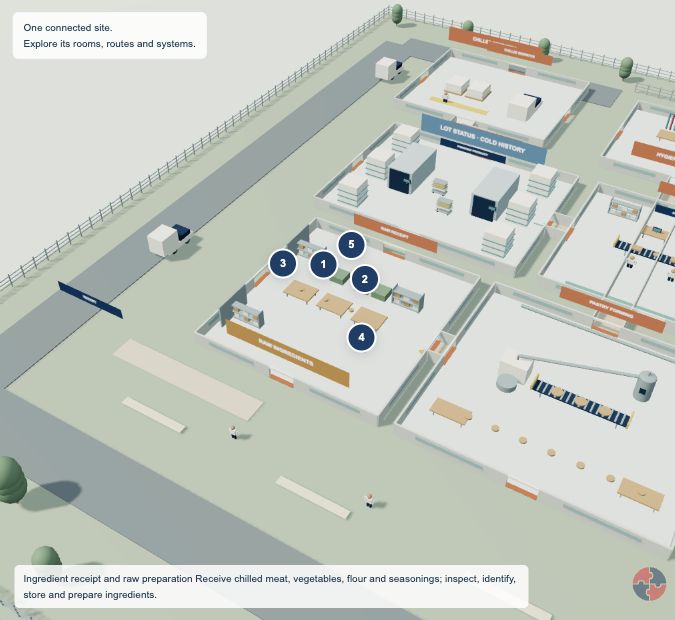
Work through 5 required applied activities and 3 model-practice pauses, with explanatory feedback and independent lesson decisions. Complete 7 distinct model mission sequences across those pauses. Use the actual fictional pie factory model or its equivalent accessible route to complete the required decision sequences; launching the model alone does not complete practice.
The 20-question assessment requires at least 80% plus every designated critical safety answer. Complete the required activities, practice and lesson checks. Points and badges cannot offset a critical safety error.
Use the LMS for confirmed save/resume and recorded results. Any certificate follows its configured passed-completion and grade conditions.
Open the public interactive practice copy; public practice is separate from the LMS record.
Sources and learning provenance
Original fictional cases are paired with public SHAREhub teaching and structured topic records. Use the applicable jurisdiction and primary guidance for live work.
- HSE: safe use of knives
- HSE: heat stress
- HSE: chilled and frozen food workrooms
- HSE: occupational health in food manufacture
- HSE: upper-limb disorders
- HSE: food preparation risk-assessment example
Topic sections, source identities and versions
| Public topic | Chunk and version | Jurisdiction and sources |
|---|---|---|
| knife-safety · before-cut | knife-safety--before-cut 20261019-K-repair-1 | Great Britain, Northern Ireland knife-safety-ppis, knife-safety-ni-puwer, knife-safety-kitchen, knife-safety-hand, knife-safety-food, knife-safety-maint |
| thermal-environments-heat-stress-and-cold-stress · controls-hierarchy | thermal-environments-heat-stress-and-cold-stress--controls-hierarchy 2.4 | GB, NI source-hse_heat, an-th11, an-th7, source-hseni_temperature |
| thermal-environments-heat-stress-and-cold-stress · stop-triggers | thermal-environments-heat-stress-and-cold-stress--stop-triggers 2.4 | GB, NI source-hse_heat, an-th7, an-th4, an-th3, an-th6, source-nidirect_heat, source-nidirect_hypothermia |
| work-related-upper-limb-disorders-and-ergonomic-workstation-design · workstation-design | work-related-upper-limb-disorders-and-ergonomic-workstation-design--workstation-design 4.0 | Great Britain, Northern Ireland source-geis4, source-art_posture, source-hse_uld, source-art, source-hse_maintenance, source-gb_puwer, source-ni_puwer, source-art_factors, source-art_duration |
| noise-at-work · controls | noise-at-work--controls 2.4 | Great Britain, Northern Ireland source-hse_noise_construction_controls, source-hseni_noise_induced_hearing_loss, source-hse_five_level_control_hierarchy, ear-s7, source-hse_noise_reduction, share-hierarchy-iosh |
| manual-handling · assessment-boundaries | manual-handling--assessment-boundaries 2.0 | Great Britain, Northern Ireland hse-manual, hse-l23, hse-mac, hse-toolkit, hse-toolfaq, hse-filters, hseni-manual |
| noise-at-work · assessment | noise-at-work--assessment 2.4 | Great Britain, Northern Ireland source-hse_noise_risk_assessment, source-hse_noise_employer_duties |
Course SH-PIE-07 · version 2026.10.20.1. .
Questions about this course
Is this training free?
Full public teaching and readers are free without an account. A free learner account is required for saved LMS progress and recorded assessment. Completion and any course-completion certificate depend on the configured LMS conditions.
How long should I allow?
Approximately 120–200 minutes, including teaching, lesson checks, required activities, model or accessible practice and one assessment attempt. Individual pace, review and retries vary. Save and resume in the LMS.
Can I learn without a 3D-capable browser?
Yes. The complete HTML reader provides the teaching. Required model practice has an equivalent accessible decision route in the interactive course. Use the LMS route for recorded learning.
What is required to pass?
Complete the required learning, activities, practice and lesson decisions. The 20-question final assessment requires at least 80% plus every designated critical safety answer. Points cannot compensate for a critical safety error. Follow the feedback before retrying.
Does this authorise factory operations?
Great Britain awareness for raw preparation, cooking, packing and cold-store staff. Recognise and control ordinary task hazards, report symptoms and request suitable help. No clinical diagnosis, first-aid certification, equipment modification or permission to undertake specialist work. This independent course does not award an external qualification or replace competent task assessment, practical training or site authorisation.
Which manual handling assessments will you learn to use?
TILEO helps you review the wider task; MAC supports appropriate lifting, carrying and team handling of inanimate loads; RAPP supports appropriate pushing and pulling.
These aids support the activity assessment. Repetitive upper-limb work may need ART; variable or complex tasks may need other HSE tools or a fuller competent assessment. Mechanical lifting, stored energy, equipment safety and health decisions retain their separate controls. A low factor score, a downloaded report or completion of this course does not approve the work.
This additional teaching takes about 2–5 minutes, in addition to the course estimate. Optional reading and workplace assessment take additional time.
Learn how to select the method, use separate reports for mixed tasks, add a company logo and keep editable Word or PDF records. After a saved pass, the course offers a direct route to the assessment tools. Workplace assessment and practical competence remain separate from course completion.