
Chilled pie production and food safety / Cleaning chemicals, hygiene verification and skin protection
Chilled pie production and food safety · SH-PIE-06Cleaning chemicals, hygiene verification and skin protection
Free online training · Approximate learning time: 120–190 minutes · Self-paced
Control worker exposure and consumer contamination through the same handback
Full public teaching and readers are free without an account. A free learner account is required for saved LMS progress and recorded assessment. Completion and any course-completion certificate depend on the configured LMS conditions.
Who this course is for
Hygiene teams, production operators, supervisors and coordinators of competent maintenance and food-safety advice.
Cleaning can prevent food contamination while creating chemical, skin and electrical hazards if its method is poorly controlled. Use original washdown cases to connect product identification, application, segregation, chemical removal, skin protection and equipment readiness. The work ends with evidence-based handback rather than a tick on a cleaning sheet.
Great Britain awareness for food-production hygiene, operators and supervisors. Covers recognition, prevention, protective holds and handback; no chemical formulation, electrical repair, emergency gas investigation or clinical diagnosis. Actual product instructions and the validated food-safety plan govern the work.
Learning outcomes
- Use product and task information to identify exposure, incompatibility and affected people or food.
- Distinguish visible cleaning, effective disinfection and verification of relevant chemical removal.
- Coordinate a hold and authorised handback when chemicals, skin protection or washdown equipment are uncertain.
Course outline
Understand the actual cleaning task
- Assess the task, not just the bottleConnect supplier information with the actual application, people and controls.
- Keep incompatible products and their routes apartChoose prevention and immediate withdrawal when mixing may release hazardous gas.
Prevent incompatible mixing and airborne exposure
- Do not send the disinfectant into the next workstationCompare application methods and control cleaning/production interfaces.
- Release a clean line on evidence, not appearanceDistinguish soil removal, disinfection and task-specific chemical-removal verification.
Verify food-contact hygiene handback
- Protect skin while maintaining food hygieneReduce wet and chemical contact and respond to early skin concerns.
- Washdown does not override electrical boundariesRecognise when damage or unsuitable equipment prevents safe cleaning.
- Incompatible cleaning chemicals mixedExplain the decision using the observed condition, the harm route and the evidence needed for release.
- Disinfectant aerosol reaches nearby workersExplain the decision using the observed condition, the harm route and the evidence needed for release.
- Cleaning residue left on food-contact partsExplain the decision using the observed condition, the harm route and the evidence needed for release.
Protect skin and electrical boundaries
- Wet work and glove contamination damage skinExplain the decision using the observed condition, the harm route and the evidence needed for release.
- Washdown reaches damaged electrical equipmentExplain the decision using the observed condition, the harm route and the evidence needed for release.
Coordinate a safe production release
- The line is clean, but is it ready for food?Coordinate worker safety, hygiene and mechanical readiness before release.
- Take a verified action into the workplaceConnect one actual task to an owner, evidence and a clear release or escalation decision.
Activities, model practice and assessment
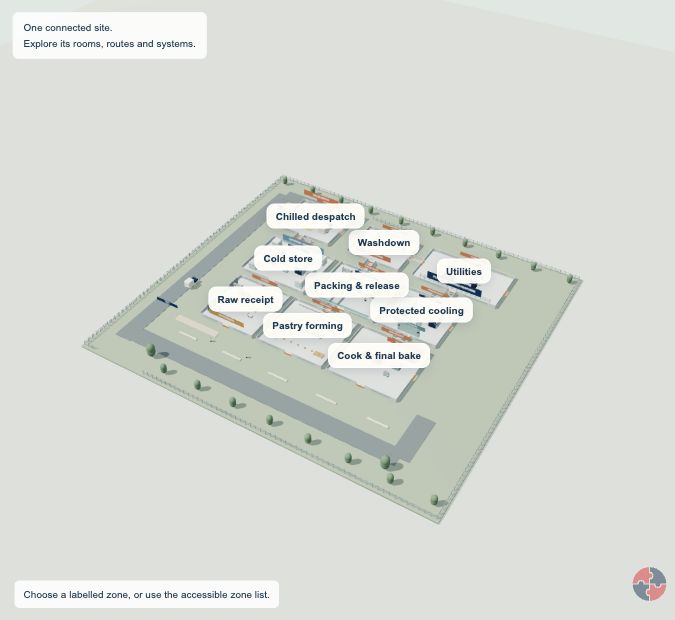
Work through 5 required applied activities and 3 model-practice pauses, with explanatory feedback and independent lesson decisions. Complete 5 distinct model mission sequences across those pauses. Use the actual fictional pie factory model or its equivalent accessible route to complete the required decision sequences; launching the model alone does not complete practice.
The 20-question assessment requires at least 80% plus every designated critical safety answer. Complete the required activities, practice and lesson checks. Points and badges cannot offset a critical safety error.
Use the LMS for confirmed save/resume and recorded results. Any certificate follows its configured passed-completion and grade conditions.
Open the public interactive practice copy; public practice is separate from the LMS record.
Sources and learning provenance
Original fictional cases are paired with public SHAREhub teaching and structured topic records. Use the applicable jurisdiction and primary guidance for live work.
- HSE: disinfectants in food and drink
- HSE: COSHH and cleaners
- HSE: cleaning and contact dermatitis
- FSA: safe catering, cleaning and disinfection
- FSA: review of allergen cleaning, results
- HSE: electrical maintenance and isolation
Topic sections, source identities and versions
| Public topic | Chunk and version | Jurisdiction and sources |
|---|---|---|
| coshh-control-measures-and-health-surveillance · assessment | coshh-control-measures-and-health-surveillance--assessment 20261016-letter-review-1 | Great Britain, Northern Ireland source-coshh-hse-assess, source-coshh-hse-control, source-coshh-ni-coshh, source-coshh-ni-surv |
| chemical-compatibility-and-inadvertent-mixing · controls | chemical-compatibility-and-inadvertent-mixing--controls 20261016-letter-review-1 | Great Britain, Northern Ireland source-mix-hse-waste, source-mix-hse-sds, source-mix-hse-comah, source-mix-hseni-coshh, source-mix-hse-hierarchy, share-activity-chemical-compatibility-and-inadvertent-mixing-cleaning-products-1, share-hierarchy-iosh |
| food-safety · controls | food-safety--controls 20261016-letter-review-1 | England, Wales, Northern Ireland, Scotland food-business-guidance-hazard-analysis-and-critical-control-point-haccp, food-business-guidance-allergen-guidance-for-food-businesses, foodstandards-running-a-food-business-food-hygiene |
| skin-health · glove-selection | skin-health--glove-selection | Great Britain skin-health--gloves, skin-health--engineering-gloves |
| electrical-control-measures-safe-systems-and-inspection · controls | electrical-control-measures-safe-systems-and-inspection--controls 2.2 | Great Britain, Northern Ireland hse-intro, hse-hsg85, hse-rights-06, www-hse-gov-uk-electricity-maintenance-isolate-htm, share-hierarchy-iosh |
Course SH-PIE-06 · version 2026.10.20.1. .
Questions about this course
Is this training free?
Full public teaching and readers are free without an account. A free learner account is required for saved LMS progress and recorded assessment. Completion and any course-completion certificate depend on the configured LMS conditions.
How long should I allow?
Approximately 120–190 minutes, including teaching, lesson checks, required activities, model or accessible practice and one assessment attempt. Individual pace, review and retries vary. Save and resume in the LMS.
Can I learn without a 3D-capable browser?
Yes. The complete HTML reader provides the teaching. Required model practice has an equivalent accessible decision route in the interactive course. Use the LMS route for recorded learning.
What is required to pass?
Complete the required learning, activities, practice and lesson decisions. The 20-question final assessment requires at least 80% plus every designated critical safety answer. Points cannot compensate for a critical safety error. Follow the feedback before retrying.
Does this authorise factory operations?
Great Britain awareness for food-production hygiene, operators and supervisors. Covers recognition, prevention, protective holds and handback; no chemical formulation, electrical repair, emergency gas investigation or clinical diagnosis. Actual product instructions and the validated food-safety plan govern the work. This independent course does not award an external qualification or replace competent task assessment, practical training or site authorisation.