SHARE Knowledge Hub
Vibration Risk Assessment and Health Controls
A vibration risk assessment connects the actual tool or vehicle, each person’s exposure time and conditions to a control decision. Hand-arm vibration (HAV) can damage circulation and nerves; whole-body vibration (WBV) and shocks can contribute to back pain. Assess the two exposures separately, reduce risk at source and respond early to symptoms while keeping clinical information confidential.
Understanding Vibration Risk Assessment and Health Controls
A vibration risk assessment connects the actual tool or vehicle, each person’s exposure time and conditions to a control decision. Hand-arm vibration (HAV) can damage circulation and nerves; whole-body vibration (WBV) and shocks can contribute to back pain. Assess the two exposures separately, reduce risk at source and respond early to symptoms while keeping clinical information confidential.
Why this matters at work
If an exposure limit has been exceeded, reduce exposure immediately, investigate the cause and change the system to prevent recurrence. Record actual tasks, available exposure evidence, control decisions and who implemented them. Review the estimating and supervision arrangements that allowed the original plan to become inaccurate. A monitoring device is evidence for the assessment, not an automatic permission system. It needs correct tool identification and interpretation, and it does not replace reducing risk at source or responding to a worker's symptoms.
Whole-body vibration and shocks are associated with back pain among drivers of mobile machines and work vehicles, especially on rough ground. Risk is influenced by magnitude, duration, repeated jolts, posture, seat adjustment, vehicle condition, speed and task. Heavy lifting, climbing, prolonged sitting, twisting to view attachments and previous back problems can contribute. Assessment should therefore address the complete driving and material-handling job rather than treating a seat measurement as the whole cause.
How organisations manage this in practice
Assurance combines assessment quality, engineering progress, field practice and health outcomes. Leading indicators include task inventory coverage, percentage of high-risk work eliminated, verified low-vibration procurement, maintenance, route repairs, supervisor observations, surveillance enrolment and closure of OH-driven control reviews. Lagging indicators include ELV exceedances, symptom referrals, diagnoses, abnormal vibration defects and severe jolts. Preventive checks and repairs measure activity; defects, shocks and exceedances found by those checks measure failed-control outcomes. Pair both, and distinguish a surveillance referral from a confirmed diagnosis. Improved reporting can increase recorded signals while prevention improves.
This is the operational assessment and health-control companion to the broader Vibration at Work chapter. It is for employers, accountable managers, assessors, occupational-health providers, supervisors, procurement and maintenance teams, safety representatives, workers, contractors and assurance personnel. It provides the decision chain from exposure-group identification through representative estimation, uncertainty review, control planning, surveillance, referral, fitness advice, adjustments, reporting and management review.
Measure changes that relate to exposure and health, not simply the number of toolbox talks delivered. Compare task methods, actual trigger times, representative magnitudes, equipment condition and reported symptoms before and after a change. Check that lower-vibration equipment is used in practice and has not made the work much slower. For whole-body vibration, include road condition, shocks, seats, travel duration and speed. Involve workers because they can identify workarounds and maintenance problems hidden in purchasing records.
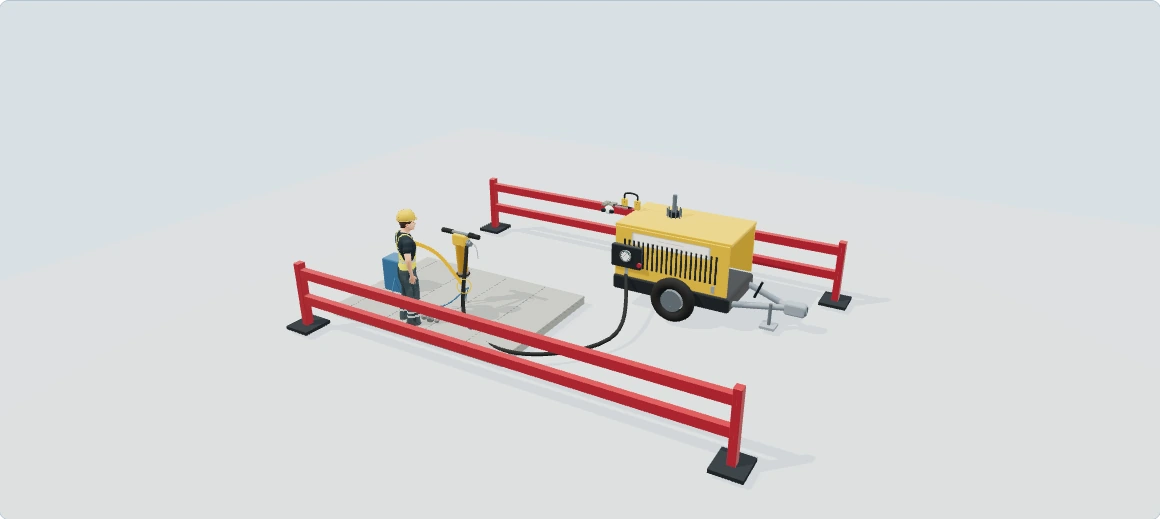

Pneumatic breaking: vibration, stored air and the people nearby
Explore how this equipment can harm its users and other people, then follow the practical measures that interrupt each pathway. This is a hazards and good-practice lesson; the separate checklist remains the pre-use/safety-check activity.
Hazards and good practice: learn what can hurt people during use, change and maintenance. Pre-use and safety checks stay in the separate checklist.
Checksheets and risk assessments
Equipment checksheets
Risk assessment forms
- Hand-arm vibration task/exposure assessment · Word
- Task and personal noise-exposure assessment · Word
Risk assessment examples
Forms and tools
Full written walkthrough — all 8 steps
1. Remove or redesign the breaking task
What is happening: The breaker, hose and compressor form one work system; the tool is shown stationary.
How harm can occur: Breaking can expose the operator to vibration, flying material, dust and high effort.
Best practice to apply: Consider design changes, prefabrication or a suitable mechanised/remote method before selecting a hand-held tool.
Why this works: Removing hand-held breaking can prevent transmission through the hands instead of only rationing exposure.
Vibration at Work · What is hand-arm vibration and whole-body vibration?2. Trace vibration into the hands
What is happening: The handle is the interface where mechanical vibration reaches the user during contact.
How harm can occur: Repeated exposure can damage blood vessels, nerves, muscles and joints; early symptoms may be overlooked.
Best practice to apply: Select a suitable productive lower-vibration method and tool, then assess the actual hand-contact exposure.
Why this works: Lower transmission and shorter productive contact reduce the exposure pathway; the animation is not a vibration measurement.
Vibration at Work · How can hand-arm vibration affect blood flow, sensation and everyday hand function?3. Understand trigger time and the full day
What is happening: Actual contact with a vibrating tool differs from the length of the booking or shift.
How harm can occur: Under-counted bursts and other tools can leave cumulative exposure unmanaged.
Best practice to apply: Observe representative work, include every relevant tool and task, and use suitable data and work-pattern information.
Why this works: A whole-day picture prevents a short-looking individual job concealing a larger combined exposure.
Vibration at Work · How do HAV trigger time and points work?4. Keep the tool working efficiently
What is happening: Bit condition, lubrication, handle isolation and the material affect the effort and time required.
How harm can occur: A blunt bit or defective mounting can increase vibration, force and duration.
Best practice to apply: Maintain the tool and consumables for the material; stop for abnormal vibration and verify repairs before return.
Why this works: An efficient maintained tool avoids prolonged contact and avoids treating job rotation as the main control.
Vibration at Work · What is hand-arm vibration and whole-body vibration?5. Control compressed-air release
What is happening: The hose and coupling contain energy independently of the operator's trigger position.
How harm can occur: A failed connection or released hose can whip, strike or inject material; trapped air may remain after shutdown.
Best practice to apply: Use the specified hose, connections and restraint arrangements; isolate and release stored pressure by the actual procedure before disconnection.
Why this works: Removing the energy before opening the connection addresses the release mechanism directly.
Vibration at Work · How is a defensible vibration assessment made?6. Protect the surrounding work area
What is happening: The compressor and breaking point also affect people who are not holding the tool.
How harm can occur: Noise, exhaust, dust, flying fragments and trailing hoses can harm nearby trades and passers-by.
Best practice to apply: Provide suitable ventilation, source controls, separation, route management and substance-specific precautions.
Why this works: The task boundary must include bystanders and the compressor, not only the tool user's hands.
Vibration at Work · What is hand-arm vibration and whole-body vibration?7. Act on symptoms and changed work
What is happening: Changes in grip, difficulty, numbness or tingling need a response rather than normalisation.
How harm can occur: Continued exposure can worsen injury and make a worker less able to control the task.
Best practice to apply: Report symptoms promptly and use occupational-health and exposure-review arrangements; do not diagnose HAVS from this model.
Why this works: Early reporting can trigger preventive changes before more harm occurs; gloves are not a substitute for vibration control.
Vibration at Work · When is health surveillance needed?8. Separate servicing from production
What is happening: Maintenance can expose stored air, hot parts and components held under load.
How harm can occur: Unexpected operation or energy release can injure the fitter and the next user.
Best practice to apply: Use competent task-specific shutdown, isolation and maintenance; update the equipment/exposure information after material changes.
Why this works: A repair needs a verified return to work, not only a closed defect record.
Vibration at Work · What evidence should management sample?
Illustrative awareness learning. Geometry, colours and movement do not establish safe distances, capacity, exposure, isolation or work permission. Use the actual assessment, equipment information and competent arrangements.
The wider workplace has its own account and subscription access. Exploring this lesson does not grant access, record course completion or authorise work.
UK guidance for further reading
HSE: Pneumatic breakingHow can I practise this topic in 3D?

Powered impact use and final wheel torquing

A damaged breaker is used for excessive trigger time
All related inspection points 4 across 2 locations
Garage workshop 2 inspection points
Construction site 2 inspection points
Practice in the SHAREhub environment. Browser practice is separate from workplace competence and formal learning records.
What does this page assess?
It covers workplace risk assessment and health-control decisions for HAV entering the hands and arms and WBV entering through a supporting seat or the feet.
HAV and WBV use different exposure methods and daily values. Do not add a hand-tool points total to a vehicle exposure. The assessment should also notice interacting risks such as force, posture, manual handling, cold, noise and dust, but those hazards need their own controls. This page does not diagnose hand-arm vibration syndrome (HAVS), carpal tunnel syndrome or back conditions, approve an individual for work, or supply site exposure data.
- Define the exposure Identify each worker, vibrating task, equipment, condition and health warning; keep HAV and WBV separate.
- Estimate with uncertainty Use representative magnitude and actual duration, combining all HAV contributions in the day.
- Choose and prove controls Avoid the task where feasible; verify substitution, engineering and residual work limits in real use.
- Act on health signals Hold uncertain or likely excessive exposure and route symptoms confidentially to competent occupational health.
Which health effects and warning signals matter?
HAV may damage circulation, nerves and hand function and can cause HAVS or vibration-related carpal tunnel syndrome; WBV and shocks can contribute to back pain alongside posture and manual handling.
Workers should report tingling, numbness, finger blanching, pain, reduced grip or dexterity, and back symptoms linked to driving or jolts. Symptoms alone do not prove the cause, but they are evidence that demands a work and health response. Continuing exposure while awaiting a routine questionnaire can worsen harm. The supervisor should control current exposure and refer through the agreed occupational-health route, not attempt diagnosis. See HSE.
| Signal | Immediate management question |
|---|---|
| Tingling, numbness or white fingers | What HAV exposure continues and what interim restriction is needed? Source |
| Lost grip or fine-hand function | Can the worker and task remain safe pending health advice? Source |
| Back pain after jolts | Which route, vehicle, seat, posture or handling factor failed? Source: HSE L141 whole-body vibration |
| Several similar reports | Do group controls and assessment assumptions need urgent review? Source |
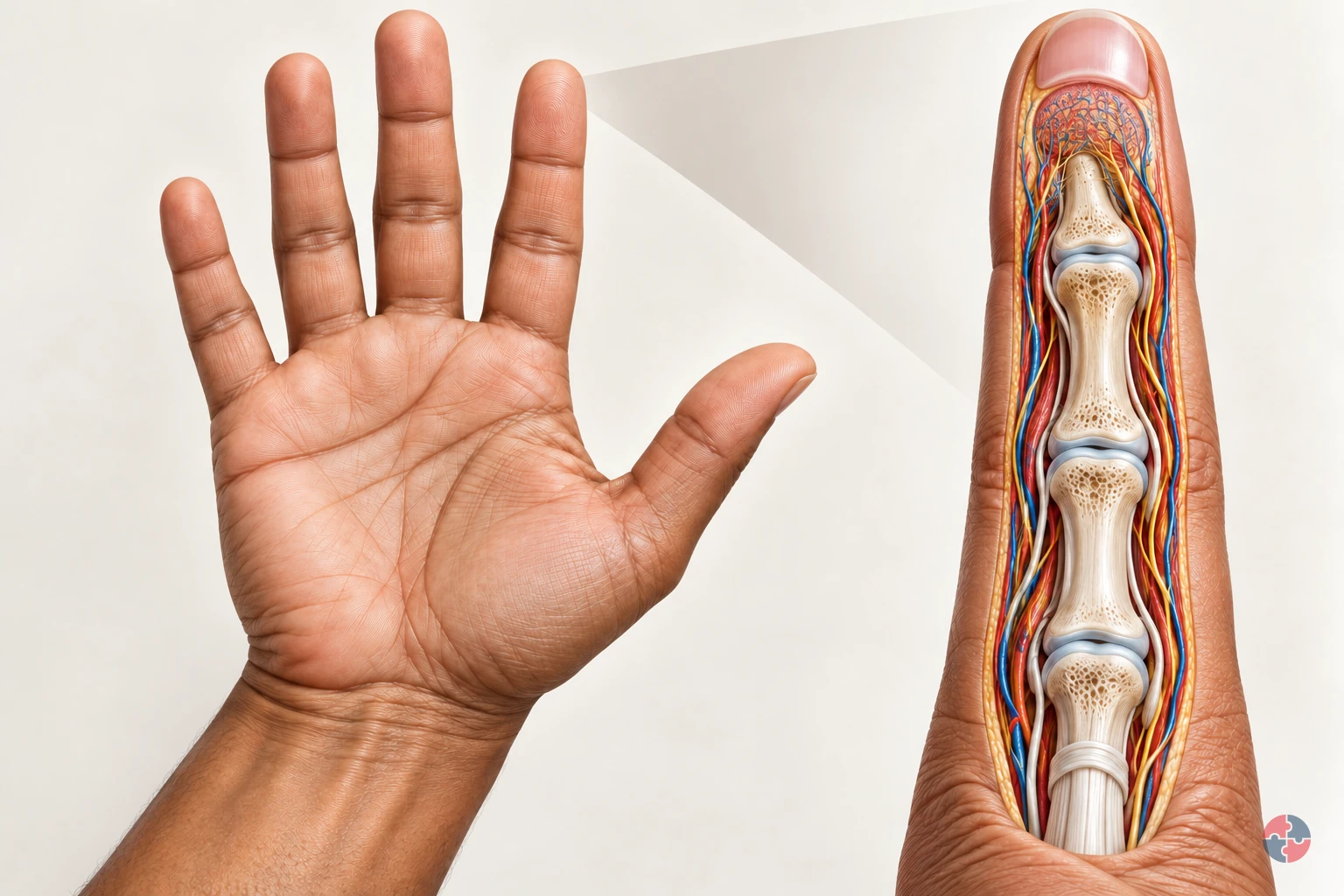
How can hand-arm vibration affect blood flow, sensation and everyday hand function?
Interactive anatomy · Hand-arm vibration: circulation, sensation and function · Updated 2026-10-23
Read all anatomy and process explanations without the viewer
Normal function and example health effects, not a personal exposure calculator or clinical assessment. Whole-body vibration and back effects require a separate lesson. Trigger-time or safe-remaining-time calculations Symptom diagnosis, disease staging or fitness-for-work clearance Hand-colour based risk scores or glove-based clearance Personal health questionnaires, employer surveillance records or dexterity tests Warmth may alter episode context; it cannot erase lasting effects or return a cured state.
Hand surface
The hand combines blood supply, sensation, movement and support. The hand combines tissue support, blood supply, sensation and movement in the same small space. Use the skin outline, nail and joints as landmarks when opening the enlarged finger cutaways. The separated layers help identify different functions; they do not imply that vessels, nerves or tendons are normally detached from their neighbouring tissues. Health and Safety Executive: Hand-arm vibration: A guide for employees, INDG296
Digital artery
Small arteries carry blood towards finger tissues. Digital arteries carry blood towards the tissues of the fingers as part of the wider circulation. Trace the supply route into the enlarged finger before following the smaller vessels and the separate return route. The model enlarges the artery and uses symbols to make the direction clear; it does not measure the person’s blood flow. Manchester University NHS Foundation Trust: Blood Vessels
Small-vessel network
Smaller vessels distribute blood through the tissues. The small-vessel network distributes the blood supply through the finger tissues, supporting their need for oxygen and nutrients. Locate the branches between the larger supply and return routes. The pattern is a simplified teaching layout, not a scan of an individual’s vessels, and its size and colours are used to distinguish circulation from the nearby sensory pathway. Manchester University NHS Foundation Trust: Blood Vessels
Venous return
Veins return blood from the hand. Veins provide the return route for blood leaving the finger tissues, connecting the hand back towards the wider circulation. Follow the return arrow after tracing the arterial supply and smaller vessels. Supply and return form connected parts of the circulation; the blood does not stop permanently at the fingertip or become a sensory nerve signal. Manchester University NHS Foundation Trust: Blood Vessels
Sensory nerve
Sensory nerves carry information such as touch. Sensory nerves carry information such as touch from the hand towards the central nervous system. In the enlarged finger, follow the nerve separately from the blood vessels. The moving message is a symbol for communication, not a spark or liquid inside a tube. This pathway helps explain sensation without testing or diagnosing an individual’s nerve function. NHS: Peripheral neuropathy
Fingertip sensation
Feeling small objects helps with precise tasks. Fingertip sensation helps a person detect contact and handle small objects precisely. The sensory information works alongside the separate muscle and tendon system that moves the fingers. Use the small-object illustration to connect this function with an ordinary task. It is an explanation of why feeling matters, not a dexterity test or an assessment of a worker’s symptoms. Health and Safety Executive: Worried about your hands? · Health and Safety Executive: Hand-arm vibration: Guidance on Regulations L140, second edition
Muscle and tendon
Muscles and tendons work together to grip and move. Muscles generate a pull that tendons transmit to the finger bones, allowing the joints to bend and the hand to close around an object. Trace the muscle–tendon relationship separately from nerves and vessels. The tendon carries mechanical force; the sensory nerve carries information, and the blood supply supports the living tissues involved. Gloucestershire Hospitals NHS Foundation Trust: Flexor Tendon Injuries
Joint
A joint allows neighbouring bones to move relative to one another. A joint is where neighbouring bones meet and can move relative to each other. Finger joints allow the hand to bend around a handle as muscles pull through tendons. Use their positions to orient the enlarged finger view and distinguish movement from the circulation and sensory pathways. This contextual structure does not depict a particular arthritis or establish an injury diagnosis. Health and Safety Executive: Hand-arm vibration: Guidance on Regulations L140, second edition · NHS: Arthritis
Tool contact
Vibration can enter the hand through a powered tool or vibrating workpiece. The source is outside the body. In the task view, an articulated hand wraps around a powered-drill handle. Tool and hand move together at the contact. Exposure depends on the actual equipment and how it is used; the visible movement is a teaching demonstration. Health and Safety Executive: Construction vibration questions · Health and Safety Executive: Hand-arm vibration: A guide for employees, INDG296
Cold-trigger context
Cold can trigger blanching episodes in people with vibration-related vascular effects. Cold is a context outside the hand. Warming may affect an episode; it does not prove lasting effects have gone away. Health and Safety Executive: Worried about your hands? · Health and Safety Executive: Hand-arm vibration: Guidance on Regulations L140, second edition
Median-nerve cross-link
Carpal tunnel syndrome is a separate nerve-compression condition. It can also be associated with vibration exposure. The carpal-tunnel lesson explains the median nerve at the wrist separately. Health and Safety Executive: Hand-arm vibration: A guide for employees, INDG296 · NHS: Carpal tunnel syndrome
Open the complete process transcript
The process, step by step
Follow circulation
The hand needs a continuing blood supply to support its tissues. Arteries bring blood towards the fingers, smaller vessels distribute it through the tissues, and veins provide a return route towards the body. Start with the whole hand, locate the highlighted index finger and use the enlarged view to trace this supply-and-return arrangement. The skin, nail and joints help orient the cutaway. The vessels and flow symbols are enlarged for teaching rather than showing a person’s actual vessel sizes or circulation rate. Keep this route separate from the sensory nerve, which carries information rather than blood. Manchester University NHS Foundation Trust: Blood Vessels
What to watch: Find the highlighted index finger, then locate the artery, small-vessel network and venous return in the enlarged circulation view.
Why it matters: Circulation delivers the oxygen and nutrients that tissues need to function. The return route completes the local pathway, connecting the finger with the wider circulation rather than ending at the fingertip.
Explore this step: Trace the supply and return in order, using the nail and joints to keep your orientation in the enlarged finger.
Follow touch
Touch information from the finger travels along sensory nerves towards the central nervous system. This information helps a person feel contact and handle small objects, alongside the separate nerves and muscles that control movement. In the enlarged finger, locate the sensory pathway and compare its symbolic messages with the circulation route from the previous step. A nerve signal is communication, not blood flowing through another vessel. The fingertip and small-object illustration connect this internal pathway with a familiar task. They demonstrate why sensation matters for precise work; they do not test an individual’s nerve function or dexterity. NHS: Peripheral neuropathy
What to watch: Locate the fingertip sensory area and follow the sensory nerve in the enlarged cutaway, keeping it distinct from the blood vessels.
Why it matters: Sensation helps a person recognise contact and guide precise handling. It works alongside movement, but its information pathway has a different role from the blood supply and the muscle–tendon system.
Explore this step: Compare the sensory and circulation layers, then describe what each pathway carries and why both matter when holding a small object.
Locate the source
In the task view, the fingers bend around the drill handle and the thumb closes on the other side to form a grip. Muscles and tendons create finger movement; the contact between hand and handle provides a route by which vibration from powered equipment can enter the hand and arm. Locate the trigger and chuck to connect the body view with the external source. The illustrated hand and handle move together so this contact is clear. Their slowed, enlarged movement explains the pathway only; it does not calculate tool vibration, grip force, daily exposure or a safe operating time. Health and Safety Executive: Hand-arm vibration: A guide for employees, INDG296
What to watch: Find the fingers and opposing thumb around the handle, then locate the trigger and chuck to identify the powered tool as the source.
Why it matters: Grip allows the hand to guide equipment, but contact also links the external source to body tissues. This source-to-hand relationship explains why the actual tool and working method matter when assessing exposure.
Explore this step: Trace the contact from handle to fingers and thumb, and distinguish the visible teaching movement from an exposure measurement.
Separate the effects
Return to the healthy circulation and sensory layers before comparing the separate vibration-related examples. Blood vessels supply the tissues, whereas sensory nerves carry information about touch and other sensations. Vibration-related vascular and neurological effects can affect these functions differently and may occur independently. They are not compulsory stages that every person passes through in one sequence. Use the normal layer to identify the structure and its job, then compare only the corresponding example. A change in the illustration explains a possible mechanism; it does not diagnose a cause, determine severity or predict the outcome for a particular worker. Health and Safety Executive: Hand-arm vibration: Guidance on Regulations L140, second edition
What to watch: Compare the artery and sensory nerve with their own normal layers, using the labelled finger structures to keep the two functions separate.
Why it matters: Separating these functions makes the examples easier to understand and avoids treating one symptom pattern as proof of another. Normal circulation and sensation provide different reference points for the two explanations.
Explore this step: State the normal job of each structure, then compare one example at a time without placing the effects in a compulsory order.
Change the work
The prevention step takes attention back to the work that creates exposure. Consider whether the process can avoid hand-held vibration, then examine suitable lower-vibration equipment, maintenance and the way exposure is planned across the task. These choices act on the source and the contact route shown earlier. Warmth and suitable clothing address cold conditions, but gloves should not be treated as reliable vibration protection. Use the task illustration to consider where a change in equipment or work organisation would act. Discussing prevention does not represent the repair of nerves or blood vessels. The model does not establish whether a particular workplace arrangement is adequate. Health and Safety Executive: How employers can protect workers from hand-arm vibration · Health and Safety Executive: Construction vibration questions
What to watch: Return to the hand–handle contact and the surrounding task, and consider where a change in equipment or work organisation would act.
Why it matters: Changing the work can reduce the vibration that reaches the hand. Linking a control to the source and contact route helps explain its purpose, separately from the medical assessment of any existing symptoms.
Explore this step: Identify which part of the source-to-hand pathway a proposed work control would change. The model does not provide an interactive control comparison.
Mechanisms and their limits
Vascular example: reduced finger circulation Vibration-related vascular effects can include episodes of reduced finger blood flow. Cold may trigger blanching. Flow returning can be painful. Fewer arrows and patterned episode frames illustrate reduced flow; they are not a measured severity scale. Finger appearance varies. Colour alone cannot establish HAVS or occupational causation. No artery is shown full of debris, and warming does not mean the condition is cured. Health and Safety Executive: Worried about your hands? · Health and Safety Executive: Hand-arm vibration: Guidance on Regulations L140, second edition · NHS: Raynaud’s
HSE: protect workers from hand-arm vibration
HSE: recognise and report hand symptoms
Sensory example: altered feeling Numbness, tingling and reduced feeling may occur without a blanching episode. The sensory comparison keeps the skin appearance unchanged and alters only the labelled signal. The nerve is not depicted as severed. This is a functional illustration, not a scan. Absence of white fingers does not exclude vibration-related health effects. Other conditions can also cause similar symptoms. Health and Safety Executive: Worried about your hands? · Health and Safety Executive: Hand-arm vibration: Guidance on Regulations L140, second edition · NHS: Peripheral neuropathy
HSE: symptoms and early reporting
Everyday function: grip and fine tasks Reduced sensation or strength can make handling small objects and working with tools harder. This example connects several possible effects to everyday function. A small-object illustration is not a clinical dexterity test or a disease stage. Symptoms differ between people. The viewer does not decide fitness for work or continued tool use. Health and Safety Executive: Worried about your hands? · Health and Safety Executive: Hand-arm vibration: Guidance on Regulations L140, second edition · Health and Safety Executive: Hand-arm vibration: A guide for employees, INDG296
HSE: control exposure and arrange appropriate assessment
Vascular example: reduced finger circulation — follow the anatomy
Look at: The small blood vessels supplying the fingers.
What changes: Vessels can narrow during an attack, reducing blood flow to the fingertips.
Why it matters: Fingers may turn white and feel cold; returning circulation can be painful.
What to do: Reduce vibration at source, keep hands warm and report early symptoms.
Repeated breaker use and a later cold-triggered episode
Road maintenance: a worker regularly uses a concrete breaker, then later experiences a cold/wet episode affecting finger circulation. Explicit time jump across repeated vibration exposure and a later cold trigger. Vascular disease does not develop during 32 seconds of tool use. Cold-triggered colour change is not a diagnostic test or proof of occupational cause. Warmth does not reverse established injury.
Identify the vibration source The breaker transmits vibration through the handle to the hands. Review whether the work can be done another way and whether suitable lower-vibration equipment is available. Health and Safety Executive: Worried about your hands? · Health and Safety Executive: How employers can protect workers from hand-arm vibration
Repeated exposure, then a later cold context The timeline jumps across repeated work to a later cold/wet episode. Tool vibration and cold are different factors, not two names for the same injury. Health and Safety Executive: Worried about your hands? · Health and Safety Executive: How employers can protect workers from hand-arm vibration
Possible circulation effects An illustrative narrowed finger-vessel pattern explains impaired blood supply during an episode. Labels and texture carry meaning; a skin colour or flow animation cannot diagnose HAVS. Health and Safety Executive: Worried about your hands? · Health and Safety Executive: Hand-arm vibration: Guidance on Regulations L140, second edition · NHS: Raynaud’s
Act early on exposure and symptoms Report symptoms promptly and arrange appropriate occupational-health advice. Review method, tool selection, maintenance and exposure management; keeping warm is supportive, not a substitute for vibration controls. Health and Safety Executive: Worried about your hands? · Health and Safety Executive: How employers can protect workers from hand-arm vibration
Sensory example: altered feeling — follow the anatomy
Look at: The sensory nerves running into the fingers.
What changes: Repeated vibration can damage nerves and alter the signals they carry.
Why it matters: Tingling or numbness can affect touch, even without white fingers.
What to do: Use lower-vibration methods, limit exposure and report changes in sensation.
Needle-scaler work and later reduced fingertip sensation
Fabrication maintenance: repeated hand-held needle-scaler use is followed by a separate example of altered sensation. Explicit time jump: cumulative nerve effects and later symptoms are not real-time results from this 32-second task illustration. Numbness can have several causes and can occur without white-finger episodes. This is not whole-body vibration or a self-administered sensitivity test.
Notice repeated hand-tool exposure A needle scaler is used for repeated surface preparation. Consider alternative processes and suitable equipment before treating the tool vibration as unavoidable. Health and Safety Executive: Worried about your hands? · Health and Safety Executive: How employers can protect workers from hand-arm vibration
A separate cumulative exposure period The timeline moves across repeated exposures. Sustained vibration can affect sensory structures; no personal exposure value, trigger time or nerve-damage dose is calculated. Health and Safety Executive: Worried about your hands? · Health and Safety Executive: Hand-arm vibration: Guidance on Regulations L140, second edition
Sensory signals may be affected The nerve example changes the labelled touch-signal path towards the fingertip. Tingling or reduced sensation does not require the vascular layer to turn white or a tendon to tear. Health and Safety Executive: Worried about your hands? · Health and Safety Executive: Hand-arm vibration: Guidance on Regulations L140, second edition · NHS: Peripheral neuropathy
Report and reduce the source Arrange early reporting and suitable assessment, and review the task, maintained tools and exposure management. The controls change future work demands; they do not animate damaged nerves back to normal. Health and Safety Executive: Worried about your hands? · Health and Safety Executive: How employers can protect workers from hand-arm vibration
Everyday function: grip and fine tasks — follow the anatomy
Look at: The fingertips, nerves and muscles used for a controlled grip.
What changes: Loss of sensation and strength can make fine hand movements harder.
Why it matters: Small objects, fasteners and safe tool handling may become more difficult.
What to do: Change the work to reduce exposure and seek occupational-health advice promptly.
From vibrating workshop tools to difficulty with small fasteners
A repair worker with repeated vibration exposure later notices difficulty handling screws and other small items. Explicit time jump from a work-exposure history to a later functional example. No speed or dexterity score is used to diagnose disease. This card shows what health effects can mean in daily work, not a third universal lesion or a test that clears someone to use a tool.
Understand the worker’s actual tasks Grinders and other hand-held tools may be used across maintenance jobs. Review the combined work pattern rather than judging one short demonstration. Health and Safety Executive: Worried about your hands? · Health and Safety Executive: How employers can protect workers from hand-arm vibration
Move forward to a reported difficulty The timeline jumps to a later task involving small fasteners. The worker describes reduced feeling or grip; the learner is not asked to prove symptoms through a timed challenge. Health and Safety Executive: Worried about your hands? · Health and Safety Executive: Hand-arm vibration: A guide for employees, INDG296
Explain function without inventing a lesion Changes in sensation or hand strength can make small objects harder to manipulate. Nerve, tendon, muscle and joint labels stay distinct; the picture cannot identify the individual cause. Health and Safety Executive: Worried about your hands? · Health and Safety Executive: Hand-arm vibration: A guide for employees, INDG296
Take the report seriously Arrange appropriate occupational-health advice and review tasks and equipment. Suitable aids and exposure reduction support safer work; there is no automatic fitness decision, cure animation or glove-based clearance. Health and Safety Executive: Worried about your hands? · Health and Safety Executive: How employers can protect workers from hand-arm vibration
Read the practice situations and all answer explanations
HV-Q1: What is the appropriate response?
A tool user reports tingling but has not noticed white fingers.
Exclude HAVS because there is no blanching. — Sensory effects can occur without circulation changes. The absence of blanching does not exclude a problem.
Report the symptoms promptly and arrange appropriate assessment. — Yes. Report early and obtain appropriate assessment. Review the exposure controls instead of waiting for visible changes.
Use the hand image to diagnose a disease stage. — The viewer cannot diagnose or stage disease. Similar symptoms may have other causes.
Health and Safety Executive: Worried about your hands? · Health and Safety Executive: Hand-arm vibration: Guidance on Regulations L140, second edition · Health and Safety Executive: Hand-arm vibration: A guide for employees, INDG296HV-Q2: Which review is needed?
A contractor proposes anti-vibration gloves as the only control.
Approve the gloves because they remove vibration risk. — Gloves are not an effective replacement for controlling vibration exposure.
Consider avoiding vibration, suitable lower-vibration equipment, maintenance and exposure management; gloves may help warmth. — Correct. Address the source and work method. Suitable gloves may keep hands warm but must not be relied on for vibration protection.
Use warm fingers as proof the exposure is safe. — Warmth is not an exposure measurement and cannot provide clearance to work.
Health and Safety Executive: How employers can protect workers from hand-arm vibration · Health and Safety Executive: Construction vibration questionsHV-Q3: How should exposure be assessed?
Two different vibrating tools were used in a shift.
Choose a hand colour to calculate safe remaining minutes. — Hand appearance cannot calculate exposure or a safe time. This viewer produces no exposure result.
Use reliable exposure information and an appropriate separate assessment method. — Yes. Consider the relevant tools and processes, using suitable vibration and use-time information in a separate assessment.
Count only the tool used for longest. — More than one tool or process can contribute. Do not discard the other exposure.
Health and Safety Executive: How employers can protect workers from hand-arm vibration · Health and Safety Executive: Construction vibration questionsSources and how the model is made
The opening images are AI-generated anatomical illustrations. The interactive 3D models and labelled SVG diagrams use original procedural artwork. These teaching images are not medical scans or diagnostic tools. Source references support the learner explanations and do not grant artwork rights.
- Health and Safety Executive: Worried about your hands? — Sensory, vascular and functional symptoms, cold context, potential lasting effects and prompt reporting. No tool-time thresholds transferred.
- Health and Safety Executive: How employers can protect workers from hand-arm vibration — Avoid/reduce vibration, appropriate equipment, maintenance, work planning and health surveillance. Gloves are for warmth, not reliable vibration protection.
- Health and Safety Executive: Hand-arm vibration: Guidance on Regulations L140, second edition — Pages 43–44: vascular, neurological and musculoskeletal effects may occur independently; episodes, cold triggers and functional impact. No clinical staging/test procedure copied.
- Health and Safety Executive: Construction vibration questions — Gloves do not effectively control vibration; assessment includes relevant exposure from multiple tools/processes and suitable information.
- Health and Safety Executive: Hand-arm vibration: A guide for employees, INDG296 — Exposure from tools/workpieces, systems affected, separate CTS and reporting/control principles. No exercise prescription or copied illustration.
- NHS: Raynaud’s — Circulation episode context, varying skin appearance and alternative causes. Does not diagnose vibration causation. Printed review date July 2026 requires recheck.
- NHS: Peripheral neuropathy — Normal sensory/motor nerve roles and multiple possible causes of symptoms only. No general neuropathy prognosis transferred to HAVS; printed review date October 2025 overdue.
- Manchester University NHS Foundation Trust: Blood Vessels — Supply through arteries and smaller vessels, venous return; factual normal-circulation context only.
- Gloucestershire Hospitals NHS Foundation Trust: Flexor Tendon Injuries — Normal muscle–tendon connection and finger movement only. No repair/treatment guidance reused.
- NHS: Arthritis — Context for joints and movement only. The module does not illustrate or diagnose a specific arthritis.
- NHS: Carpal tunnel syndrome — Separate median-nerve compression example; no substitution for the distinct HAVS components.
What makes a vibration risk assessment suitable and sufficient?
Identify exposed people and tasks, estimate daily exposure from representative magnitude and duration, compare with the correct values, select controls, record actions and review effectiveness.
Start with observation and worker consultation, not paperwork alone. Describe equipment, material, process, work pattern, environment, maintenance, symptoms and groups who may be more vulnerable. Decide whether exposure can be avoided. Where it remains, make a reasonable estimate good enough to distinguish low, action-level and limit-level decisions. Record uncertainty and the evidence needed to resolve it. See legislation.gov.uk.
| Step | Output |
|---|---|
| Identify | People, tasks, sources, conditions and health signals. Source |
| Estimate | Representative HAV or WBV daily exposure and uncertainty. Source |
| Decide | exposure action value (EAV) / exposure limit value (ELV) status, risk-control and health route. Source |
| Act and verify | Named actions, field checks, exposure/health feedback and review. Source |
Connect exposure assessment, work control and confidential health advice
A useful vibration system joins three responsibilities: assess the exposure, control the work and obtain appropriate occupational health advice. Each needs clear evidence and a route for change; individual medical information stays confidential.

Assess exposure and uncertainty
List the actual tools and tasks, representative magnitude sources, trigger times and cumulative HAV exposure. Use a separate assessment for WBV. Record uncertainty so it can be resolved, rather than converting a weak estimate into a precise safe-time promise.
Give supervisors a practical plan
Specify elimination or lower-vibration methods, tool and consumable condition, maintenance, task changes and realistic time controls. Explain what the supervisor must check and when work must stop for reassessment.
Use a confidential health route
Provide appropriate health surveillance where indicated and a prompt route to report symptoms. Clinical assessment and individual advice belong with competent occupational health professionals; an exposure calculator or symptom traffic light is not a diagnosis or fitness decision.
Return only what the work decision needs
Occupational health can advise on relevant restrictions, adjustments and review needs. Give supervisors the information necessary to organise safe work without circulating clinical details. Reassess exposure and controls after changes; do not wait for a health finding to fix an uncontrolled task.
Do not use anatomy illustrations, absence of symptoms or a surveillance appointment as proof that current exposure is controlled.
Can an initial screening assessment be enough?
Yes, where observation and reliable information clearly support a proportionate decision; measurement is not automatically required, but the conclusion must remain defensible.
HSE provides rough HAV screening groupings and recommended initial values to prioritise work, but generic tool times are not permission to operate. For WBV, severe jolts, rough routes and known vehicle/task information may identify controls without measurement. Move to a more detailed assessment when the EAV/ELV decision, control choice or health risk remains uncertain. Use a conservative estimate rather than an unsupported low value.
Which exposure evidence can be used?
Use information that represents the actual equipment, task and conditions: HSE or industry data, suitable supplier information, comparable workplace data or competent measurement where other evidence is insufficient.
Check tool model, accessory, material, condition, operator technique and work rate. For WBV, check vehicle, load, route, ground, speed, tyre/suspension/seat condition and shocks. Manufacturer laboratory emission can help compare products but may understate workplace vibration. Record source, date, scope, uncertainty and why it represents this work.
| Evidence source | Acceptance question |
|---|---|
| HSE or sector data | Does the listed tool/vehicle and task match? |
| Manufacturer/supplier data | Is it in-use information or only a standard emission test? |
| Comparable workplace data | Are material, maintenance and method equivalent? |
| Measurement | Was it competent, representative and interpreted with uncertainty? |
How should exposure duration be established?
Observe enough representative work to estimate the time the worker is actually exposed to vibration; do not substitute shift length, booking time or machine availability.
For HAV, trigger or contact time is when the hands are actually exposed to vibration from the operating tool or process. Repeated short operations can be sampled and multiplied by a typical workload. Include every HAV source in that person’s day, across departments or contractors where relevant. For WBV, establish representative driving/operating periods and severe shock events, not simply engine hours. Consider peaks and longer days, not only an average that hides high exposure.
| Weak duration | Better evidence |
|---|---|
| Eight-hour shift | Observed trigger/exposure time by task. |
| Tool signed out all day | Sample cycles or time log checked against work output. |
| Vehicle engine hours | Actual operating/driving pattern and route conditions. |
| Planned time | Actual use plus credible variability and changed work. |
What do the action and limit values mean?
The exposure action value (EAV) triggers a programme of organisational and technical controls; the exposure limit value (ELV) must not be exceeded. Both are daily A(8) exposures, not raw tool or seat readings.
The values are the same in the separate GB and NI vibration regulations. HAV: EAV 2.5 m/s² A(8), equal to 100 HSE points; ELV 5 m/s² A(8), equal to 400 points. WBV: EAV 0.5 m/s² A(8); ELV 1.15 m/s² A(8). Reduce risk to as low as reasonably practicable rather than aiming just below the ELV. The expired transition periods in older material do not provide a current exception. See legislation.gov.uk.
How is a multi-tool HAV day calculated?
Enter a representative vibration magnitude and actual trigger time for every HAV tool or process, then combine the partial exposures using HSE’s calculator or points system.
Illustration: a 5 m/s² drill used for one actual trigger hour contributes about 50 points; a 10 m/s² breaker used for 30 minutes contributes about 100 points. The combined day is about 150 points, above the 100-point EAV but below the 400-point ELV. This requires a planned control programme and further reduction; it is not a 250-point allowance for more work. Different real-use magnitudes or times change the result.
| Illustrative task | Partial points | Decision |
|---|---|---|
| Drill: 5 m/s² for 1 hour | About 50 points. | Include with every other HAV source. Source: HSE |
| Breaker: 10 m/s² for 0.5 hour | About 100 points. | High contribution needing source control. Source: HSE |
| Combined day | About 150 points. | Above EAV: implement and verify control programme. Source: HSE |
How is a WBV assessment different?
Assess daily vibration in the dominant axis and consider shocks, route, vehicle and other back-pain factors; do not use HAV points or a hand-tool timer.
A non-specialist can often identify and reduce WBV risk by observing badly prepared surfaces, off-road work, repeated jolts, long static posture, awkward controls and manual handling. Use representative vehicle/task information and the longest credible daily duration where work varies. Measurement may be needed when the exposure category or control benefit remains uncertain, but a low A(8) estimate does not excuse severe avoidable shocks. See HSE.
| Factor | Assessment evidence |
|---|---|
| Ground and route | Ruts, potholes, transitions, headlands and trip pattern. Source |
| Vehicle and seat | Suitability, suspension, tyres, load, adjustment and maintenance. Source |
| Driver/task | Speed, posture, access, lifting and time. Source |
| Health feedback | Back symptoms and trends by vehicle/task group. Source |
Check the consultant’s daily-axis evidence
Ask for separate daily x-, y- and z-axis assessments using the relevant frequency weightings and multiplying factors: 1.4 for each horizontal axis and 1.0 vertically, as specified in L141 Schedule 2. Combine all daily operating periods within each axis, then select the greatest daily result. The largest raw seat reading alone is not the daily exposure. The report should state axes, weightings, factors, durations, combined daily results, uncertainty and treatment of shocks. A competent assessor owns the method; a low A(8) does not excuse avoidable severe jolts.
What can tags, watches and exposure meters prove?
They can support time or exposure estimation only within their validated function; a tag, timer or wrist device does not automatically measure the vibration entering the hand or prove legal compliance.
HSE says electronic HAV systems can vary by up to about 20% on the same task and continual daily monitoring is usually unnecessary. Validate the magnitude loaded into a time logger and include a margin for variability. A true personal vibration exposure meter has instrumentation requirements distinct from time-only logging; measurement still needs representative use and competent interpretation. Retrospective alerts may arrive after a set value has already been exceeded.
How should uncertainty change the decision?
Use uncertainty to choose a conservative control or obtain better evidence; do not average conflicting data into a reassuring number without understanding why they differ.
Magnitude varies with material, accessory, wear, grip, speed and operator. Duration varies by workload and work pattern. Document a credible range and ask whether the upper end changes the EAV/ELV decision. If high-risk work could exceed the ELV, hold or redesign it while evidence is resolved. If all plausible values lead to the same low-risk action, more measurement may add little.
| Uncertainty test | Response |
|---|---|
| Range crosses EAV | Apply control programme and improve data if it changes priorities. |
| Range could cross ELV | Hold/re-plan; do not rely on best case. |
| Data conflicts with worker/task observation | Investigate source and method. |
| Range remains clearly low | Record basis and maintain simple controls. |
How should assessment lead to control?
Avoid the vibrating task first, then reduce magnitude at source and shorten necessary exposure only after better methods, equipment and maintenance have been considered.
Mechanise, automate or change material/process. Select equipment that is both lower vibration and efficient for the real job. Maintain tools, consumables, vehicles, routes and seats. Improve support, posture, access and technique. Work rotation redistributes exposure but does not remove it and can expose more people; calculate each individual’s day. Warm, dry gloves support circulation but generally do not provide a reliable HAV exposure reduction. See HSE.
| Priority | HAV example | WBV example |
|---|---|---|
| Avoid | Excavator attachment instead of handheld breaker. | Reduce transport need or use remote process. Source |
| Reduce source | Suitable low-vibration tool and sharp bit. | Repair route, suspension and suitable seat. Source |
| Organise residual | Plan trigger time after source controls. | Limit duration after route/machine controls. Source |
How should stronger source controls be chosen?
Start by avoiding the hazardous task or release, then use suitable substitution and physical controls before relying on work rules or personal protection.
The order guides a decision; the actual control depends on this task, the people exposed and what a change could introduce. A supervisor should observe the control during real work, hold a failed task and obtain a competent release after correction. HSE guidance for this control decision
| Control layer | Task decision |
|---|---|
| Avoid | Remove an avoidable vibrating task |
| Substitute or reduce | Choose a task-efficient lower-vibration method |
| Engineer | Improve support, tool condition, road surface and seat match |
| Organise and verify | Recalculate each worker’s day and route symptoms to occupational health |
| Protect residual exposure | Warm gloves support comfort but do not prove exposure reduction |
How do controls change across industries?
The same control principle needs a different design and stop decision when the task, equipment and people change.
The same assessment steps transfer across sectors, but the source, person, exposure estimate and health route change. Record a representative day and the uncertainty; hold the task when a likely limit exceedance or symptoms cannot be controlled. See HSE.
| Sector, task and people | Exposure and harm | Strongest feasible control | Check or stop point |
|---|---|---|---|
| Manufacturing: foundry fettling; grinder operator. | Tool vibration reaches hands; nerve and vascular injury may develop. | Redesign casting/finish or mechanise; validate remaining tool exposure. | Combine every tool in the day and act on early symptoms. Source |
| Construction: concrete drilling; contractor and nearby crew. | High-magnitude tool time may exceed HAV action or limit values. | Use prefabricated penetrations or lower-vibration efficient drilling with maintained bits. | Confirm contractor tool data and actual duration before authorising work. Source |
| Hospitality: estate maintenance; grounds worker. | Strimmers transmit HAV and ride-on mowers may create WBV or shocks. | Choose appropriate low-vibration method and maintain route and equipment. | Separate HAV/WBV records; review changing seasonal workload. Source |
| Logistics: lift-truck yard route; driver. | Repeated jolts through seat may add to back pain with posture and handling. | Repair surface, improve routing/speed and adjust seat; assess WBV separately. | Stop repeated severe shocks and reassess vehicle, route and load. Source |
What should purchasing and maintenance contribute?
Specify the real task, compare suitable equipment using representative data and maintain every component that affects vibration, productivity and exposure duration.
Request declared emission, uncertainty, likely in-use magnitude, safe-use and maintenance information. A lower catalogue value is not better if the machine is too small or slow. Record tool, accessory and process combinations. Maintain bearings, handles, dampers, bits and discs; for WBV include tyres, suspension, seat and route. After a significant change or repair, verify the exposure assumption rather than simply closing the work order.
What should a supervisor check before work?
Confirm person, task, equipment, conditions and complete-day exposure match the assessment, and that health restrictions and defect controls are current.
For HAV, check actual tool/accessory/material, condition, trigger-time plan and earlier or later tasks. For WBV, check route, ground, machine, seat, load and shocks. Do not display confidential diagnoses in a job plan; apply only the work restrictions or adjustments communicated through the proper route. Make the hold authority and data gaps clear before production pressure begins. See HSE.
| Check | Hold if |
|---|---|
| Exposure evidence | Not representative and could change a high-risk decision. Source |
| Equipment/route | Defective, altered or outside assessed conditions. Source |
| Whole day | Other HAV work or WBV duty makes plan incomplete. Source |
| Health advice | Restriction or referral is unresolved for planned exposure. Source |
What should be checked during work and at close-out?
Compare actual time, material, condition, shocks and worker feedback with the plan; pause on change and close out with exposure, defect and action evidence.
A harder material, worn consumable, extra task, faster output, rougher route or different vehicle can invalidate the estimate. Workers should report unusual vibration or symptoms without fear that the tool limit is the only question. At hand-back, record actual exposure inputs, isolate defective equipment, raise route repairs, and update the plan where work differed. Keep personal medical detail in the occupational-health record, not a shared task log.
When should work be held or stopped?
Hold when credible exposure could exceed the ELV, the assessment no longer represents the task, a defect raises vibration, severe shocks persist, or health advice for continued exposure is unresolved.
If an ELV is exceeded, reduce exposure immediately, establish the cause and amend controls to prevent recurrence. Unknown data are not automatically a breach, but high-risk work must not proceed on invented low values. Stop equipment safely and protect people from the wider task hazard. Restart requires a defensible exposure/control plan, corrected equipment or route, and any occupational-health restriction applied by the authorised manager. See legislation.gov.uk.
| Trigger | Restart evidence |
|---|---|
| Likely ELV exceedance | Redesigned task and recalculated whole-day exposure. Source |
| Abnormal tool/vehicle vibration | Defect corrected and exposure assumption checked. Source |
| Changed material, route or workload | Representative reassessment and supervisor release. Source |
| Symptoms or OH restriction | Exposure controlled and work assignment consistent with competent advice. Source |
When is HAV health surveillance required?
Provide suitable HAV health surveillance where assessment identifies health risk, including workers regularly exposed at or above the EAV and people at risk for another reason.
L140 also identifies occasional EAV exposure where frequency and severity create health risk, and workers already diagnosed with HAVS even if exposure is below the EAV. A programme includes baseline and periodic checks, early reporting, referral of positive responses and access to competent occupational-health assessment. HSE guidance recommends at least annual surveillance when required; the local scheme should be designed and overseen by people with HAV expertise. It operates alongside exposure control, never instead of it. See HSE.
| Assessment outcome | Health-control decision |
|---|---|
| Regular HAV at/above EAV | Suitable surveillance and planned exposure controls. Source |
| Occasional EAV with meaningful risk | Include based on frequency, severity and individual factors. Source |
| Known HAVS with continued exposure | Surveillance and OH-advised restriction even below EAV. Source |
| Low exposure with no other risk | Explain reporting route; review if work or health changes. Source |
Is WBV back-pain monitoring the same as HAV surveillance?
No. HSE L141 says formal WBV health surveillance is not appropriate because there is no reliable technique that detects early back changes specifically caused by workplace factors; structured symptom monitoring is useful good practice.
Encourage early reporting of low back pain and investigate work factors such as shocks, posture, manual handling and vehicle/task group. Health monitoring is informal and its result is not a diagnosis. Significant symptoms should be referred to a GP or occupational-health professional. Trend anonymised group information to test controls while protecting individual confidentiality. This boundary is based on HSE’s WBV guidance; seek current occupational-health advice for the particular workforce.
| HAV surveillance | WBV health monitoring |
|---|---|
| Statutory when regulation 7 criteria and HAV risk are met. | Informal symptom-reporting and investigation approach in L141. |
| Can identify early HAVS/CTS signs through tiered scheme. | Cannot diagnose cause of back pain from a questionnaire. |
| Produces fitness advice and confidential medical records. | Supports referral, work-factor review and group trends. |
What happens after a positive health finding?
The worker receives appropriate information and advice; the employer applies fitness restrictions, reviews assessment and controls, considers alternative work, and checks similarly exposed workers as advised.
A questionnaire response is a referral signal, not a diagnosis. Occupational health decides clinical assessment and communicates only information the employer needs for safe work, subject to consent and legal duties. Do not wait for a confirmed diagnosis before reducing a credible exposure risk. Analyse anonymised results by task or group to identify failed controls, while avoiding re-identification.
| Finding | Management action |
|---|---|
| Symptoms on screening/report | Refer and apply prudent interim exposure control. Sources: HSE; HSE |
| Fit with restrictions | Implement restriction and revise work plan. Source: HSE |
| Relevant disease/adverse effect | Review assessment/controls and similar exposure group. Source: HSE |
| Group trend | Investigate task, equipment and programme effectiveness. Source: HSE |
Which health records should the employer keep?
Keep the employee’s identity, exposure history and occupational-health fitness outcome or restrictions in the health record; confidential questionnaires, clinical findings and diagnosis remain in the medical record held by occupational health.
L140 advises keeping the health record for as long as the person remains under surveillance and offering a copy when exposure or employment ends; additional retention must be justified rather than invented here. The employer should receive enough information to control work without collecting unnecessary clinical detail. Store access-controlled records and use anonymised group feedback for assurance. Workers can access their personal health record under the vibration regulations.
| Record | Holder/use |
|---|---|
| Health record | Employer: identity, exposure history and fitness/restrictions. |
| Medical record | Occupational health: confidential clinical information. |
| Task exposure record | Operations: tools, duration, assumptions and controls; no diagnosis. |
| Group trend | Management: anonymised control feedback. |
When might HAVS or carpal tunnel syndrome be reportable?
Use the jurisdiction-specific incident-reporting route only when its diagnosis, work-link and responsible-person conditions are met; a symptom report or screening questionnaire is not itself a RIDDOR diagnosis.
In GB, HSE identifies diagnosed HAVS and carpal tunnel syndrome as reportable where the specified vibrating/percussive work conditions apply and the current work likely caused or worsened the disease. Employees provide the diagnosis in writing; the responsible person reports. NI uses its separate RIDDOR (NI) 1997 route: HSENI says a reportable work-related disease is reported when a registered medical practitioner notifies the employer in writing. Confirm the current jurisdiction form and facts; do not copy the GB 2013 instrument into NI. See HSE.
| Route | Threshold |
|---|---|
| Great Britain | Confirmed doctor diagnosis plus specified current work link; responsible person reports under GB RIDDOR. Source |
| Northern Ireland | Written registered-medical-practitioner notification of specified work-related disease; use HSENI/NI route. Source |
| Internal early report | Act on symptoms and exposure now; do not wait for reportability decision. Source |
Direct wording for the NI written-notification boundary: HSENI: RIDDOR in health and social care. This is health and social care guidance; use the separate NI instrument and the facts of the work when applying it.
How should routine mixed-tool work be assessed?
At BuildOut Ltd, the assessor observes the real cycle, combines every HAV contribution and converts the result into source controls and a supervised day plan.
A repair worker drills anchors and uses a breaker. The illustrative estimate is 50 drill points plus 100 breaker points, above the EAV. BuildOut changes the breaking method, checks sharper consumables and support, recalculates each person’s day and verifies actual use. The worker is within the HAV surveillance scheme because the risk assessment indicates it. A points dashboard is evidence only if its magnitude and times remain representative. See HSE.
| Gate | Decision |
|---|---|
| Evidence | Observe trigger time and validate in-use magnitudes. Source |
| Control | Avoid/reduce breaker work before allocating time. Source |
| Health | Confirm appropriate surveillance without exposing clinical detail. Source |
BuildOut mixed-tool assessment
Task material and setting: Drill concrete anchors and break a small upstand on a construction project.
People and prerequisites: Worker, supervisor, assessor and OH provider; representative task data, maintained tools and complete-day plan.
Before: Observe work cycle, validate magnitude sources, combine earlier/later HAV tasks and select source controls.
During: Check actual trigger time, material, bit/chisel condition and task change.
Hold or stop: Hold for unrepresentative data, abnormal vibration, added work that could approach ELV or unresolved restriction.
Completion and hand back: Record inputs/result, defects and revised work; update surveillance exposure history without clinical detail.
Evidence: Observation, source data, HSE calculation, control action, supervision and health-scheme decision.
What if a worker reports tingling or white fingers?
Treat the report as a prompt to reduce current HAV exposure and arrange competent occupational-health assessment, not as proof of diagnosis or a reason for a supervisor to declare the worker fit.
A BuildOut worker reports tingling after grinding and photographs a blanching episode in cold weather. The supervisor stops further vibrating work for that shift under the local prudent-control rule, records the operational facts and makes a confidential referral. Occupational health determines assessment and fitness advice. Management reviews the grinder, similar workers and the assessment; any RIDDOR decision waits for the appropriate diagnosis and work-link criteria. See HSE.
BuildOut HAV symptom response
Task material and setting: Grinding steel fittings in a cold, partially open workshop.
People and prerequisites: Worker, supervisor, safety adviser and competent OH provider; symptom route, warm/dry controls and exposure history.
Before: Confirm current assessment, surveillance inclusion, grinder/disc condition and exposure plan.
During: Worker reports tingling and a previous blanching episode; supervisor ends further HAV exposure and checks immediate safety.
Hold or stop: No supervisor diagnosis or return-to-vibration decision while OH advice/restriction is unresolved.
Completion and hand back: Refer confidentially, review tool/task and similarly exposed group, implement OH fitness advice and decide reporting through the correct legal route.
Evidence: Operational exposure facts, referral, employer health record, control review and qualified RIDDOR decision.
What if a contractor changes the vehicle and route?
The host and contractor should pause the previous WBV assumption, inspect the changed vehicle/route and agree who assesses exposure, controls shocks and monitors health feedback before routine trips continue.
A contracted dumper replaces the planned machine after rain has rutted the haul road. Its seat and suspension history are uncertain. BuildOut diverts traffic where safe, checks machine, load, route and driver adjustment, repairs the road and seeks representative WBV information. A worker back-pain report is referred appropriately and used to review work factors; it is not treated as a diagnosed vibration disease. See HSE.
| Interface | Decision |
|---|---|
| Different machine | Check suitability, maintenance and seat data. Source |
| Rutted route | Repair/divert and control severe shocks. Source |
| Contractor driver | Agree exposure/health-reporting and record ownership. Source |
| Back symptom | Refer and investigate WBV, posture and handling factors. Source |
BuildOut contractor WBV change
Task material and setting: Contract dumper haul on a rain-damaged temporary road.
People and prerequisites: Host traffic manager, contractor supervisor, driver, route owner and health adviser; coordinated assessment and safe alternative.
Before: Inspect replacement machine, seat, tyres, load and route; agree exposure and reporting responsibilities.
During: Observe shocks, speed, posture and route change; driver reports back discomfort.
Hold or stop: Hold the affected route/machine while severe shocks or material defects remain unresolved.
Completion and hand back: Repair route/machine, verify representative trip, refer symptoms and update contractor/host records.
Evidence: Coordination brief, inspection, route repair, WBV assessment, symptom referral and named release.
When should the assessment be reviewed?
Review when work, equipment, people, routes, exposure evidence or health findings change, and check regularly that the assessment still reflects reality.
Triggers include new tools or consumables, changed production rate, longer jobs, maintenance drift, rougher ground, a new contractor, symptoms, surveillance findings, an ELV exceedance or evidence controls are bypassed. HSE’s HAV page says not to leave more than about two years without checking whether review is needed, but this is not a safe fixed interval: high-risk or changing work needs earlier review. Verify completed actions in the field.
How is competence demonstrated at each level?
Learning should match the decision a person makes, with a practical check and reassessment after change.
Different roles need different evidence of competence. A worker can report tingling; a supervisor can estimate a day; measurement, diagnosis and fitness decisions belong to relevant specialists. See HSE.
| Role or level | Task learning | Demonstration and assessor | Record and reassessment |
|---|---|---|---|
| Everyone nearby | Recognise HAV/WBV symptoms, defects and reporting route. | Supervisor checks understanding without asking for private diagnosis. | Induction record; refresh after task or route change. Source |
| Tool users and drivers | Record real contact/driving time, inspect equipment and report symptoms or shocks. | Assessor observes actual task and safe-stop decision. | Task authorisation; reassess after new tool, vehicle or symptom. Source |
| Maintainers and contractors | Maintain tool, bit, tyre, suspension and seat to specification. | Competent lead witnesses repair and verifies as-left condition. | Maintenance/handover record; reassess after repeat defect. Source |
| Supervisors | Combine each worker’s HAV tasks, assess WBV separately and manage uncertainty. | Manager checks a sampled estimate, control and hold decision. | Assessment/action record; reassess after workload change. Source |
| Managers and purchasers | Resource source reduction, representative data and surveillance pathways. | Technical lead tests procurement claims and overdue action closure. | Decision and assurance record; review after incident or health signal. Source |
| Hygienists, OH and auditors | Measure when needed, interpret uncertainty, assess health and check legal scope. | Competent technical or clinical lead reviews method, referral and privacy. | Specialist report and restricted health record; reassess after new evidence. Source |
Which GB and NI duties apply?
GB and Northern Ireland use separate 2005 vibration regulations with equivalent daily values and core duties; assessment, health surveillance and incident reporting must follow the instrument for the workplace.
Both require suitable and sufficient risk assessment, elimination or reduction of risk, EAV controls, prevention of ELV exceedance, information/training and suitable health surveillance where regulation 7 criteria are met. HSE is the GB regulator; HSENI and NI law govern NI. RIDDOR differs: GB uses the 2013 Regulations, while NI retains its separate 1997 regime as amended. Expired vibration transition provisions are not current work allowances. See legislation.gov.uk.
What competence supports vibration assessment?
An assessor needs suitable knowledge of the task, exposure data, uncertainty, control options and the limits of the method used.
HSE L140 and L141 provide the regulator’s guidance for hand-arm and whole-body vibration. Many decisions can use representative data and observation without specialist measurement. If measurement is needed, engage a competent person with suitable equipment and a documented method; a time-only log does not establish actual vibration magnitude or health outcome.
How do machinery supply and workplace assessment differ?
Product suppliers must meet the applicable GB or NI machinery-supply route and provide safety information; the employer still assesses actual workplace use and combined daily exposure.
OPSS publishes separate current guidance for machinery supplied in GB and NI. Marking and declared emission do not prove a tool or vehicle is low risk in the intended material, route or workload. Procurement should ask for residual-risk, maintenance and likely in-use information, then verify local controls. A hire company tag or certificate does not transfer the workplace-use duty.
What evidence should management and auditors test?
Sample the chain from real task and exposure inputs to controls, health feedback, restrictions, corrective action and field verification; a completed spreadsheet or surveillance count alone is not assurance.
Observe different shifts and mixed-tool days. Challenge magnitudes below recommended initial values without evidence. Compare planned and actual durations. Inspect maintenance and routes. Check surveillance covers the right HAV population and positive responses reach competent OH. Confirm medical records are not copied into operational systems, and group trends lead to control review. Track defects and ELV events to verified closure.
| Evidence | Failure signal |
|---|---|
| Assessment | Generic tool time or missing whole-day sources. |
| Control | Rotation spreads exposure or defects recur. |
| Health system | Questionnaires filed without referral/action. |
| Privacy | Diagnosis visible in shared task records. |
| Review | Action closed administratively without field check. |
How could BuildOut Ltd manage assessment and health controls?

BuildOut Ltd would reduce vibration exposure through the work method and equipment, use realistic exposure information and act early on reported symptoms.
BuildOut Ltd · practical example
Plan breaker work using real trigger time and better methods
The key lesson Time holding a tool is not necessarily the same as time it is operating; exposure estimates need realistic vibration information and actual trigger time.
The situation: A crew is asked to break out more concrete than originally planned. The same operator could now spend much longer using a hand-held breaker. The original estimate no longer describes the job.
Why this matters: Extending a job or using a worn, unsuitable tool can increase exposure without any obvious change to the daily programme.
How BuildOut Ltd would manage it
- Challenge the need for hand breaking — Project Manager. Reconsider the design and removal method with competent people. Look for ways to avoid or reduce hand-transmitted vibration rather than starting from a permitted duration for the same tool.
- Reassess the changed task — Health and Safety Manager. Use suitable tool and task data with realistic operating times. Consider exposure from other vibrating equipment and uncertainty; manufacturer figures do not automatically represent this material and method.
- Provide suitable equipment — Plant and Procurement Coordinator. Select and maintain equipment and consumables for efficient operation. Resolve worn accessories or poor performance so workers do not need unnecessary force or prolonged tool use.
- Make the plan workable — Trade Supervisor. Brief the revised method, planned exposure controls and reporting route. Monitor actual work and stop a growing mismatch between the estimate and the duration required.
- Act on health signals — Health and Safety Manager. Arrange appropriate health surveillance where required and prompt occupational-health advice for relevant symptoms. Use functional recommendations to control exposure, keeping clinical detail out of general site records.
When the conditions change
- Recognise the trigger
- Actual use exceeds the assessed plan, equipment performs poorly or symptoms are reported.
- Make the immediate decision
- Stop the affected use and resolve the method, exposure or individual restriction.
- Verify the next step
- The Site Manager checks the revised removal method, suitable tool condition, realistic operating-time estimate and any individual exposure restrictions before the affected use resumes.
What good looks like
The programme is built around a lower-exposure method and evidence that reflects actual use. Workers can report symptoms without being expected to work through them.
Evidence to look for: Method review, exposure estimate and assumptions, equipment maintenance, actual-use checks and appropriate health recommendations.
Common mistake to avoid: Using an arbitrary tool-time allowance while leaving the method and equipment unchanged.
Apply this to your work: Would your exposure estimate change if the material proved harder to remove than expected?
Guidance behind the management approach: HSE: vibration risk assessment. Use the topic's legal and technical guidance for the applicable work and location.
Supervisors observe representative work and combine each person’s HAV day; traffic managers assess WBV routes and shocks separately. Procurement requests task-relevant data. Maintenance controls tools, consumables, vehicles, seats and routes. Occupational health runs the HAV surveillance pathway and gives fitness advice without disclosing unnecessary clinical detail. Leadership reviews anonymised trends, ELV events, contractor interfaces and overdue source controls. This is an example, not an approved BuildOut policy. See HSE.
How does this topic align with ISO 45001?
Use these examples to connect the relevant clauses to your own occupational health and safety management system. For each clause, identify the person responsible, the control in use and the evidence that it works.
Scroll across the table to read all four columns.
| ISO 45001 clause | How it applies | What to put in place | How to verify it works |
|---|---|---|---|
| 6.1.2.2 Assessment of health and safety risks | Hand-arm vibration risk depends on the vibration level and actual time each person spends operating vibrating equipment. A larger concrete breakout job changes BuildOut’s original exposure assumptions. | Observe trigger time on representative work, account for other vibrating tools used in the same shift and check whether available vibration data fits the site conditions. | The assessment shows how trigger time and equipment data were established and which workers the estimates cover. It identifies when assumptions need to be checked again. |
| 8.1.2 Hierarchy of controls | BuildOut can reduce exposure by changing the method before depending on limits on individual trigger time. | Review whether mechanised breakout or another suitable process can remove the need for hand-held breaking. For remaining work, select suitable equipment and keep tools and accessories in working condition. | The chosen method is recorded with the reason for it. Observed trigger time and updated exposure estimates show what changed for the people doing the work. |
| 8.1.3 Management of change | A change in the amount of concrete to break can invalidate the agreed work plan. | Have the supervisor review any increase in scope, replacement tool or change in site conditions before the crew continues under a revised plan. Brief affected workers on the amended arrangements. | The revised task assessment reflects the actual quantities and tools, and records the agreed controls before work resumes. Follow-up observations verify that the plan matches site practice. |
Selected applications of ISO 45001:2018 with Amendment 1:2024. Use the current standard for a full assessment and check the legal duties that apply to the work and location.
ISO 45001:2018 · 2024 climate action amendment · ISO 45002 implementation guidance · ISO technical committee clause FAQ
What do the acronyms and key terms mean?
Expand each abbreviation at first use and keep its practical meaning attached to the task.
| Term | Full expansion | Meaning in this task |
|---|---|---|
| HAV | Hand-arm vibration | Vibration entering hands during tool or workpiece use. |
| WBV | Whole-body vibration | Vibration or shocks entering through a seat or floor. |
| EAV | Exposure action value | Daily level that triggers specified action. |
| ELV | Exposure limit value | Daily exposure that must not be exceeded. |
| A(8) | Eight-hour-equivalent daily exposure | Combines magnitude and time for the person’s day. |
| HAVS | Hand-arm vibration syndrome | Circulatory and nerve condition requiring clinical assessment. |
| OH | Occupational health | Confidential professional health advice and surveillance route. |
| RIDDOR | Reporting of Injuries, Diseases and Dangerous Occurrences Regulations | Separate GB and NI criteria for specified occupational disease reports. |
Unlock another resource
You have used this month’s two free downloads. Publish a post in your own words to unlock one more resource, or choose SHARE Individual for 10 downloads per month.
You decide whether to share. If you do, use the relevant platform disclosure tools and do not make claims you do not genuinely hold.