SHARE Knowledge Hub
Utility Strike
A utility strike is unintended contact with or damage to a buried or overhead cable, pipe, duct or line during digging, lifting or maintenance. Electricity may shock or arc, gas may ignite, and damaged water or drainage can flood or destabilise ground; harm can reach people beyond the worksite. Prevention depends on planning the route, locating and identifying services, using a controlled method and stopping when the evidence does not match the ground.
Understanding Utility Strike
A utility strike is unintended contact with, damage to, loading of or loss of support to an underground or overhead service.
Why this matters at work
No one restarts, recovers tools or backfills until the owner and site authority release the area. Do not assume there is no damage because the plant still operates or no release is visible. The plant operator follows the service-specific plan; others withdraw by the safe route, warn people away and prevent entry.
A high-quality plan cannot show every private spur or change in depth; a locator cannot reliably identify every material or configuration; and hand tools can still penetrate cables or pipes. The control system should deliberately create independent opportunities to detect error before energy is released. The supervisor checks that the current ground, markings and work method still match the authorised basis.
How organisations manage this in practice
Green means the whole work and influence zone has current owner and private-service searches, survey limitations are understood, critical crossings are verified, markings and permit match the workface, competent people and equipment are present, owner conditions are met and emergency routes are current.
Account for people, give responders the exact location and safe access, and provide plans, product or voltage information without re-entering. Control ignition, traffic, drains or machinery only where this can be done remotely or from a confirmed safe position. Do not touch damaged assets, plant, water, spoil or casualties until the energy hazard is controlled.
A contractor wants to move plant through a different part of the site. The supervisor checks underground services, overhead clearances and ground conditions against the intended activity. The operator walks the agreed route with the supervisor before use.
The safe system covers preparation through reinstatement. Exposed services need support and protection; new or altered assets need accurate as-laid capture; temporary barriers and traffic controls must remain effective; and the excavation must not be backfilled until the owner or competent person has accepted the condition. Learning from anomalies and near misses must update records and future plans.
The issuer and receiver walk the area, compare markings with the pack and confirm that everyone understands the work and stop triggers. The permit must be available and intelligible to the people doing the work. Shift change, changed scope, lost markings, unexpected ground, different plant, new service information or expiry requires suspension and review.
Strike happening now?
Stop the task and warn others. A driver already inside an electrically contacted cab normally stays there; bystanders keep clear of the machine, cable and excavation. Notify the actual network owner immediately. Call 999 for injury, fire or immediate danger. If fire makes the cab unsafe, follow the site emergency plan and responder or owner direction; do not routinely climb down. The detailed service-specific routes explain the distinctions and owner-led clearance.
First actions after a strike · Choose the service-specific emergency route
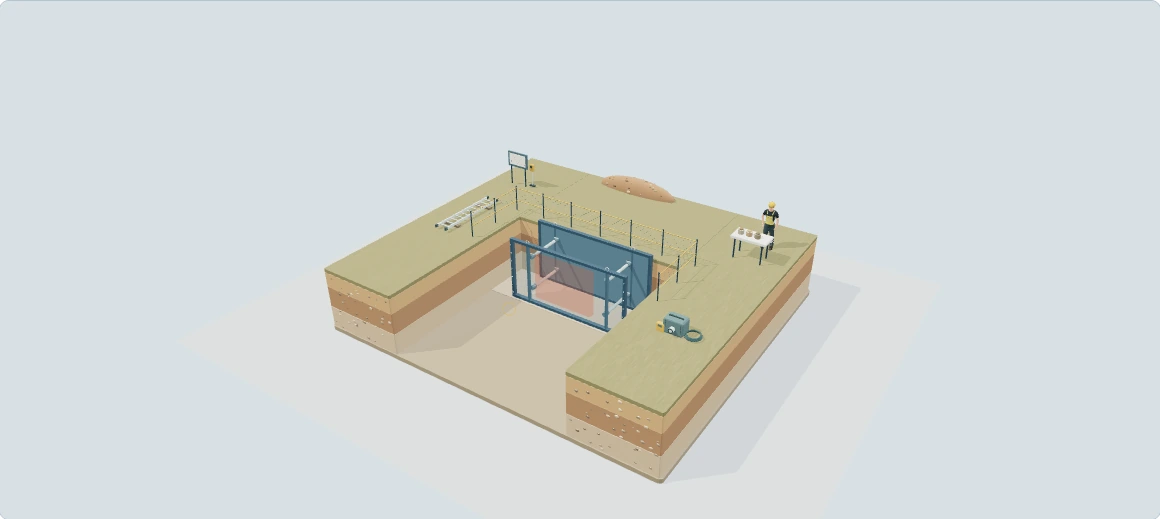

Excavations: see the ground, support and people
Follow a groundworker from planning the excavation to leaving it safely. Compare three ways of dealing with the sides, trace the route in and out, then decide what to do when a machine approaches the edge or water enters.
Checksheets and risk assessments
Equipment checksheets
- Excavations and trench access — 3D checks · Word · PDF
- Excavators and backhoe loaders — 3D checks · Word · PDF
Risk assessment forms
Risk assessment examples
Full written walkthrough — all 13 steps
1. Decide whether anyone needs to enter
What is happening: The cutaway reveals the space a groundworker may occupy and the material surrounding it. The empty excavation is a learning view, not permission to enter.
How harm can occur: Ground movement can bury or crush someone and prevent their escape. People outside can fall into the opening.
Best practice to apply: Consider avoiding entry or using a different method. Establish the design, work sequence, people affected and responsible supervision.
2. Check the ground and neighbouring structures
What is happening: The exposed layers help you see why conditions may change through the ground. Colour does not classify the soil or prove stability.
How harm can occur: Fissures, disturbed ground or undermined foundations can release material or destabilise adjacent structures.
Best practice to apply: Use appropriate site investigation and competent design/review. Check surrounding buildings and services; do not infer stability from a dry-looking face.
3. Locate services before breaking ground
What is happening: The planning station represents records, locating and safe exposure of services. It does not show surveyed service positions.
How harm can occur: A service strike may cause electrocution, burns, fire, explosion or flooding, affecting the operator and nearby people.
Best practice to apply: Plan and verify the actual service locations and precautions. Use the topic’s HSG47 guidance and resolve uncertainty before digging.
4. Trench box — stay inside the shield
What is happening: Look between the two steel panels. The green floor marks the shielded footprint; the spreaders hold the panels apart. The open ends are outside that protection.
How harm can occur: Ground can still move outside the box. A worker reaching past an end or standing between a panel and the trench face can be buried or trapped.
Best practice to apply: Check the specified box, its position, end protection and how workers reach it. Follow the designed sequence for installation, movement and removal. Keep people clear during movement.
5. Shoring — follow the ground load
What is happening: The sheeting bears against the trench faces. Follow the arrows from the ground into the sheets, along the horizontal walers and across the struts to the opposite side.
How harm can occur: A gap behind the sheeting, a displaced waler or a damaged strut can interrupt this load path and allow ground movement.
Best practice to apply: Check the support against the temporary works design and installation sequence. Report a displaced member from a safe position; never remove a brace to make space for access.
6. Battered sides — look at the whole slope
What is happening: Compare the wider opening with the box. Ground has been cut back to form a sloping face, reducing the mass that can fall into the work area. There are no box panels in this example.
How harm can occur: Water, loose layers and loads at the crest can make a previously stable face slip. The end faces also need assessment.
Best practice to apply: A competent person determines the profile for the ground and changing conditions. Allow room for the full batter and protect its crest. Never copy an angle from the model.
7. Compare a stepped cut with a continuous batter
What is happening: The same cross-section now has benches. Notice the short faces and ledges instead of one continuous slope.
How harm can occur: An individual face or the whole cut can fail. A ledge can collect loose material that then falls onto people.
Best practice to apply: Use benches only where specified for the actual ground. Choose a separate access route; the ledges are not a staircase.
8. Enter through the protected landing
What is happening: Follow the green arrows from the approach, through the guarded landing and down the secured ladder. Both feet of the ladder rest on the firm base inside the box, between the spreaders.
How harm can occur: Stepping over the side panel, climbing a brace or landing beyond the box exposes a person to a fall or collapse.
Best practice to apply: Use stairs or another suitable means where the task calls for it. When a ladder is appropriate, secure it on a firm, level base. Extend it at least 1 m above the landing unless another suitable handhold is provided. Face the ladder and keep a secure grip.
9. Trace the escape route back to the surface
What is happening: The arrows reverse. Trace the route along the protected floor to the foot of the ladder, up to the handholds, and back onto the clear surface approach.
How harm can occur: Spoil, hoses or a delivery across either landing can cut off the way out. A clear opening viewed from above tells you little about conditions at the foot.
Best practice to apply: Check both landings before entry. Keep tools off the ladder and arrange to move loads separately. Plan how to raise the alarm and recover an injured person; the ladder alone is not a rescue plan.
10. Keep plant and spoil outside the planned limit
What is happening: Find the excavator behind the marked plant limit and the separate spoil heap. Even a stationary machine adds load to the ground beneath its tracks.
How harm can occur: Extra weight can overload the side or its supporting system. Falling spoil, a slewing bucket or a reversing machine can strike people.
Best practice to apply: Agree the plant route, exclusion zone and spoil location against ground conditions, plant loads and the design. Use suitable barriers or stop blocks where required. The illustrated line gives no safe distance.
11. Plant crosses the limit — stop the movement
What is happening: The same excavator is now between the marker and the trench. Red arrows show extra load beneath the near track. A crack at the crest illustrates one possible warning.
How harm can occur: The edge can give way under the tracks, the machine can overturn, or soil can move towards the trench. Failure can occur before a crack is visible.
Best practice to apply: Stop plant movement, warn others and withdraw from the affected area by the safe route if available. Keep people away. Have the competent team agree safe recovery and reassess the excavation before anyone returns.
12. Water enters — withdraw and reassess
What is happening: Blue streaks show water seeping through the rear face near the end of the box. The blue pool reaches the trench floor and the ladder foot. The red sign marks the hold on entry.
How harm can occur: Flow can wash out fine material, weaken the face and undermine the foot of the ladder. A box does not keep out water or protect the open ends.
Best practice to apply: Stop affected work, raise the alarm and use a safe exit if available. If it is cut off, use the emergency plan. Keep others out. Review inflow, support, drainage and discharge together; uncontrolled pumping can make the ground less stable.
13. Who can release the excavation for work?
What is happening: The route remains on hold while the competent inspector checks the actual excavation. This last scene is a decision point: a clear floor after pumping is insufficient evidence to restart.
How harm can occur: An unseen void, damaged support or undermined landing can remain after water recedes or the machine has moved.
Best practice to apply: Inspect at the start of each shift and again after an event likely to affect stability or a fall of material. Record the findings as required, correct defects, check access and brief the team. Resume only once the competent inspection confirms safe conditions.
Illustrative awareness learning. The model does not design equipment, authorise work, verify safe conditions or complete a real inspection.
The wider workplace has its own account and subscription access. Exploring this lesson does not grant access, record course completion or authorise work.
UK guidance for further reading
HSE: excavation safetyHSE HSG47: avoiding danger from underground servicesWhat is a utility strike and why does it matter?
A strike is unintended contact with or damage to a buried, concealed or overhead service, including damage that is not immediately visible.
Best-practice guide: Utility Strike
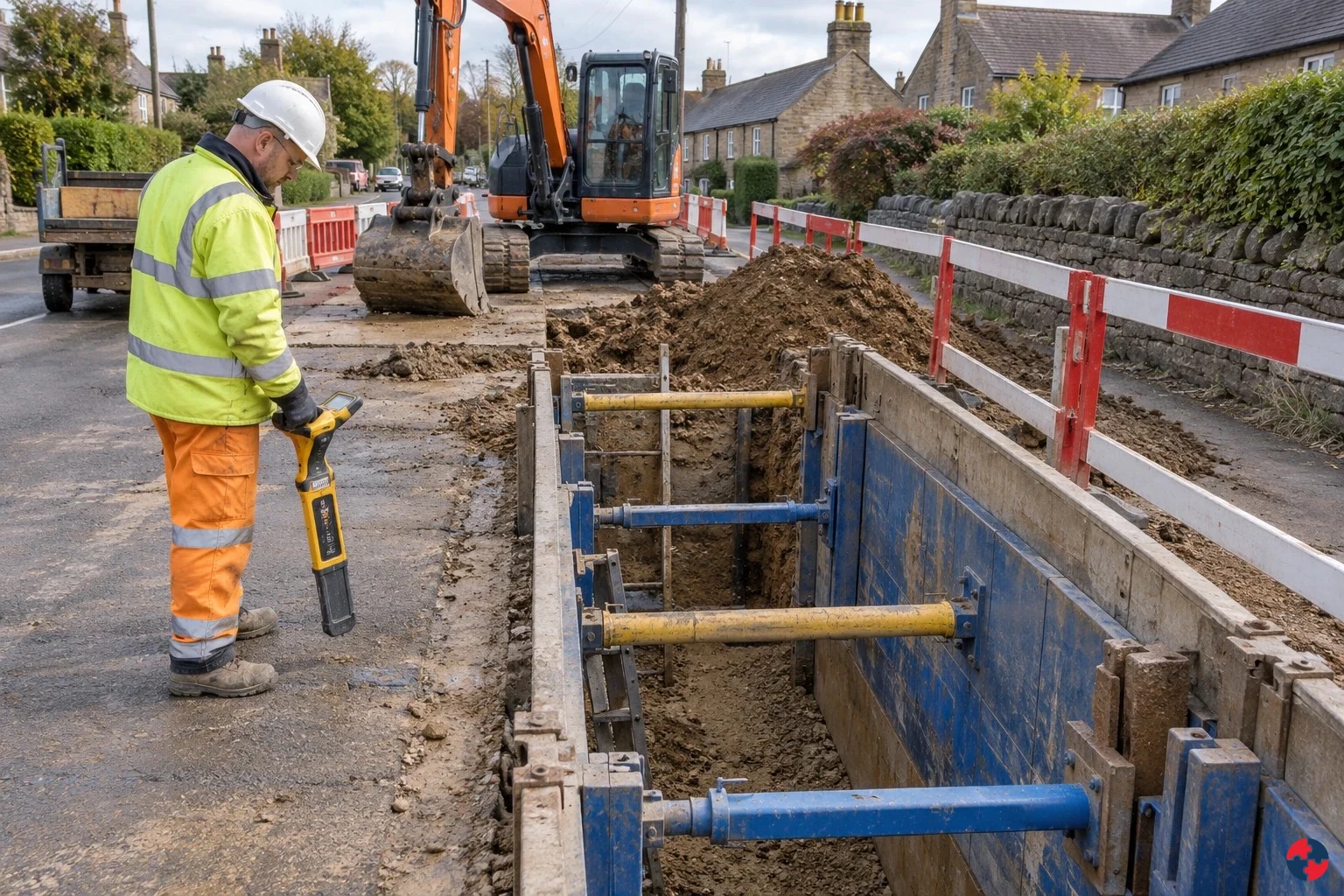
Plan, locate, verify and hold uncertainty
Records, locator indications and controlled verification findings are different evidence. No signal is not proof of absence and colour does not establish identity. Check overhead access, travel and lifting separately; no universal depth or stand-off is supplied here.
Make service evidence useful at the workface
Records, locator indications and controlled verification findings are different evidence. No signal is not proof of absence and colour does not establish identity. Check overhead access, travel and lifting separately; no universal depth or stand-off is supplied here.
Yard-drainage discrepancy and hold point
A new locator indication conflicts with the plan; the supervisor holds the permit and arranges owner consultation and controlled exposure. Exposure identifies a cable; the designer moves the drain, the owner confirms protection requirements, and the supervisor revises and releases the method.
Service strike harm and stop conditions
Buried or overhead electrical cable: Arc or current reaches skin, eyes or heart; an energised machine can transmit danger to a person stepping down. Gas main or service: Escaping gas reaches an ignition source, often after accumulating in a low or enclosed place. Pressurised water or drainage: Jet, rising water or undermined soil reaches workers; sewage may contact skin or be swallowed.
Prevent contact and verify the work method
Read the detailed service-specific controls and emergency branches. Resolve uncertainty, confirm protection and brief the revised method before the authorised release. A repaired service or emergency response does not itself authorise restart.
Use the full utility strike lesson
Use the full topic for the decision points, practical examples, detailed control tables and source scope. HSE guidance applies to Great Britain; use HSENI for the Northern Ireland route and the source’s stated jurisdiction. A simplified guide does not change the page’s technical-review or approval status.

Read all six steps as text
1. Plan, locate, verify and hold uncertainty
A strike is unintended contact with or damage to a buried, concealed or overhead service, including damage that is not immediately visible.
- Plan the footprint: Obtain suitable owner records, define the actual work and consider design alternatives. Plans alone do not establish safe excavation.
- Locate and verify: Use competent locating with its limitations and assessed controlled verification where needed; reconcile the actual finding and owner information.
- Hold and resolve: Stop affected work for unknown identity, unexplained signals, lost markings or a changed boundary. Consult the owner and revise, brief and authorise the method.
Records, locator indications and controlled verification findings are different evidence. No signal is not proof of absence and colour does not establish identity. Check overhead access, travel and lifting separately; no universal depth or stand-off is supplied here.
Apply it: What does each evidence layer establish, what remains unknown, and who resolves the hold?
2. Make service evidence useful at the workface
Use the evidence to improve the actual work arrangement.
- Plan the footprint: Obtain suitable owner records, define the actual work and consider design alternatives. Plans alone do not establish safe excavation.
- Locate and verify: Use competent locating with its limitations and assessed controlled verification where needed; reconcile the actual finding and owner information.
- Hold and resolve: Stop affected work for unknown identity, unexplained signals, lost markings or a changed boundary. Consult the owner and revise, brief and authorise the method.
Records, locator indications and controlled verification findings are different evidence. No signal is not proof of absence and colour does not establish identity. Check overhead access, travel and lifting separately; no universal depth or stand-off is supplied here.
Apply it: What does each evidence layer establish, what remains unknown, and who resolves the hold?
3. Yard-drainage discrepancy and hold point
Example: a practical application of the existing topic lesson.
- Setting: A drainage trench across an older industrial yard with recorded water and telecoms routes.
- Act: Compare owner records and site features, scan the exact route, identify the work envelope and a possible redesign.
- Hold / review: No mechanical search or excavation through the unexplained signal; keep the area controlled until identity and method are resolved.
A new locator indication conflicts with the plan; the supervisor holds the permit and arranges owner consultation and controlled exposure. Exposure identifies a cable; the designer moves the drain, the owner confirms protection requirements, and the supervisor revises and releases the method.
Apply it: At which point would you hold this example, and what evidence would allow it to proceed?
4. Service strike harm and stop conditions
Connect the task, the route to the person and the control that can fail.
- Buried or overhead electrical cable: Arc or current reaches skin, eyes or heart; an energised machine can transmit danger to a person stepping down.
- Gas main or service: Escaping gas reaches an ignition source, often after accumulating in a low or enclosed place.
- Pressurised water or drainage: Jet, rising water or undermined soil reaches workers; sewage may contact skin or be swallowed.
Buried or overhead electrical cable: Arc or current reaches skin, eyes or heart; an energised machine can transmit danger to a person stepping down. Gas main or service: Escaping gas reaches an ignition source, often after accumulating in a low or enclosed place. Pressurised water or drainage: Jet, rising water or undermined soil reaches workers; sewage may contact skin or be swallowed.
Apply it: Who could be exposed, including other trades, cleaners, maintainers and people nearby?
5. Prevent contact and verify the work method
Start with the stronger practicable options and verify their effect.
- Remove exposure: Consider a redesigned route or activity that avoids the service interface.
- Use a safer method: Select the assessed method with competent input and owner requirements; absence is not established by a scan.
- Separate and engineer: Use owner-confirmed isolation or protection where required and suitable separation from remaining danger.
- Control the work: Reconcile records, locating and controlled findings; preserve markings, boundaries and hold points.
- Residual protection: Use suitable PPE for residual exposure; it cannot make an arc, gas cloud or collapsing trench safe.
Read the detailed service-specific controls and emergency branches. Resolve uncertainty, confirm protection and brief the revised method before the authorised release. A repaired service or emergency response does not itself authorise restart.
Apply it: Which stronger option can be used here, and who will verify it before accepting the remaining risk?
6. Use the full utility strike lesson
Follow the official sources below and retain the task-specific evidence.
- Official guidance: HSE: Electricity - underground cables
- Official guidance: HSE: Pipelines and gas supply industry FAQs
- Task decision: Owner enquiry, marked plan, locator limitation, trial-hole record, revised design, permit, briefing and as-built update.
Use the full topic for the decision points, practical examples, detailed control tables and source scope. HSE guidance applies to Great Britain; use HSENI for the Northern Ireland route and the source’s stated jurisdiction. A simplified guide does not change the page’s technical-review or approval status.
Apply it: Which official source and full-topic section will you use to resolve the next decision?
Electric cables can arc, explode and burn even without direct conductor contact. Gas pipe damage can release gas and create a fire or explosion risk. Pressurised water can flood and destabilise an excavation; damaged drainage can contaminate it. Communications ducts and pipelines can be safety-critical beyond the worksite. A marked or exposed service is not automatically safe to touch or move. Near misses and apparently superficial damage need owner notification because hidden integrity may be affected.
How does a service strike harm people?
Contact with a cable, line or pipe can release electrical, thermal, pressure or chemical energy at the workface. The same damage may also interrupt essential services or expose people outside the worksite. Sources: HSE HSG47: Avoiding danger from underground services, HSE: Overhead power lines.
An electrical arc can pass through air to skin and eyes without a worker touching a conductor. Gas from a damaged main may accumulate and ignite. A water main can flood a trench and destabilise its sides; sewage can contaminate water, surfaces and skin. People affected include plant operators, groundworkers, pedestrians, neighbours, service users and responders. Severity changes with voltage, pressure, inventory, excavation stability, ignition sources, enclosure and how quickly the asset owner can make the service safe.
| Service or task | Route and affected system | Likely harm | Warning and stop point |
|---|---|---|---|
| Buried or overhead electrical cable | Arc or current reaches skin, eyes or heart; an energised machine can transmit danger to a person stepping down. | Severe burns, shock, cardiac injury, fall injury or death. | Arc, contact, damaged sheath or unexplained line: stop, keep clear, warn others and notify the network owner. Source: HSE: Electricity - underground cables, HSE: Overhead power lines |
| Gas main or service | Escaping gas reaches an ignition source, often after accumulating in a low or enclosed place. | Fire or explosion burns, blast injury and potentially fatal harm. | Hiss, gas indication, odour or damaged pipe: withdraw, avoid ignition, control access and call the operator or emergency route. Source: HSE: Pipelines and gas supply industry FAQs |
| Pressurised water or drainage | Jet, rising water or undermined soil reaches workers; sewage may contact skin or be swallowed. | Impact injury, drowning or trench collapse; possible infection or illness from contaminated material. | Unexpected flow, wet ground or instability: leave the excavation, keep others out and contact the owner. Source: HSE: Excavations |
| Unidentified duct or concealed service | Tool or plant damages unknown contents or connected protective function. | Outcome cannot be safely assumed; could involve energy, release or wider service failure. | Unknown object, conflicting plan or absent expected service: stop and identify with the owner before disturbing. Source: HSE HSG47: Avoiding danger from underground services |
Direct injury may be immediate; infection or other ill health depends on the actual contaminant and exposure route. Do not infer a medical outcome from an unidentified pipe or treat a quiet, tripped cable as dead.
How can the hierarchy of controls prevent utility strikes during excavation and intrusive work?
Avoid the service where the design allows. Where the work must be near it, identify the owner and actual route, use the owner-approved safe method, separate people and plant from danger, and stop for any discrepancy. Sources: HSE HSG47: Avoiding danger from underground services, HSE GS6: Avoiding danger from overhead power lines.
Three-part underground safe system


Read the complete visual as text
- Plan: Obtain relevant owner information, define the work and consider avoiding the service interface. Plans are clues to verify, not proof of exact position.
- Locate and identify: Competent detection, marking and appropriate controlled exposure establish the actual service against the work footprint. A scan is not proof that nothing is present.
- Excavate safely: Use the assessed HSG47 method, protection, briefing and stop triggers. Unknown identity, conflicting information or a changed route holds work; no universal depth or stand-off is shown.
ERICPD is a planning sequence: Eliminate, Reduce or substitute, Isolate, Control, Personal protective equipment and Discipline. It is not a separate statute. For a buried cable crossing and an overhead plant route, the strongest decision may be to reroute the work or have the owner divert or make the line dead. A permit, scan or item of PPE cannot compensate for an unknown cable location or unproved isolation.
How can the ERICPD hierarchy of controls prevent utility strikes during excavation and intrusive work?
Hierarchy correction, 19 October 2026: use the corrected task text and control panels below. The overview and stage artwork has been updated locally to match the corrected task text. Rendered and release verification remains pending: physical protection belongs under Engineering, procedures under Administrative, and a reduced quantity, rate or footprint is not by itself Substitution. Discipline means response practice, handover, maintenance and defect learning. Read the full task before applying any example.

| Level and concrete control | How it breaks the harm chain | Owner and check | Evidence or failure point |
|---|---|---|---|
| Eliminate — redesign the trench or plant travel path outside the service corridor; agree diversion where feasible. | Removes the tool or plant from the service and prevents contact. | Designer and client confirm a feasible route with the asset owner. | Check revised drawings and workface. A new route may expose other services; do not assume it is clear. Source: HSE HSG47: Avoiding danger from underground services, HSE GS6: Avoiding danger from overhead power lines |
| Reduce — shorten or shallow the intrusive work where design permits; choose a lower-impact method after assessing its own hazards. These measures reduce exposure or strike energy; they are not automatically substitution. | Reduces the opportunity or energy of a strike, without proving absence. | Planner and supervisor compare methods and confirm service information. | Trenchless, vacuum or hand methods can still damage a service; stop if the route or method is unproved. Source: HSE HSG47: Avoiding danger from underground services |
| Isolate — arrange owner-led line isolation or diversion where practicable; barrier the work zone and keep bystanders away. | Removes electrical or gas energy where confirmed and separates people from remaining danger. | Asset owner confirms status; supervisor checks the exclusion boundary. | A tripped, labelled or apparently disconnected line may re-energise. No worker self-certifies owner apparatus safe. Source: HSE: Overhead power lines, HSE HSG47: Avoiding danger from underground services |
| Control — physical: carefully expose, protect and support services; use owner-agreed physical restrictions on plant reach near overhead lines. | Physical protection and restricted reach help prevent tool or plant contact. | Competent specialists verify service protection, support and actual plant envelope. | Plans, locator signals, colours and permits are clues, not proof; stop for unknown or changed conditions. Source: HSE HSG47: Avoiding danger from underground services, HSE GS6: Avoiding danger from overhead power lines |
| PPE — select task-assessed protection for residual ordinary work exposure. | May reduce limited residual injury, but cannot make an electric arc, gas cloud or collapsing trench safe. | Supervisor checks specification, condition and correct use. | No PPE substitutes for avoidance, owner control, verified service location or safe excavation. Source: HSE managing risk using PPE |
| Discipline — practise stop and emergency response, rescan as excavation progresses and verify handovers. | Keeps the agreed method alive after crews, markings, ground or scope change. | Manager samples a live job, records defects and tests close-out. | A signed permit or training card without field control is weak assurance; correct system defects, not just individuals. Source: HSE HSG47: Avoiding danger from underground services |
| Control — administrative: locate and mark, obtain owner agreement, coordinate the permit, brief the crew and hold on change. | Location and workface checks catch discrepancies before damage; markings do not physically prevent contact. | Competent locator, supervisor and plant operator verify the workface and agreed method. | Plans, locator signals, colours and permits are clues, not proof; stop for unknown or changed conditions. HSE HSG47 |
| Substitute — assess a suitable surface-mounted alternative that replaces the buried intrusive installation. | A verified replacement method removes the need for the proposed intrusion; reduced depth or footprint alone remains reduction. | Designer, client and asset owner verify feasibility, loading, access, fire and other new hazards before selection. | Do not adopt an unsuitable replacement or assume the new route is clear. Retain owner control and the approved method for residual interfaces. HSE HSG47 |
How can the ISO 45001 hierarchy of controls prevent utility strikes during excavation and intrusive work?

| Level and concrete control | How it breaks the harm chain | Owner and check | Evidence or failure point |
|---|---|---|---|
| Eliminate — redesign the trench or plant travel path outside the service corridor; agree diversion where feasible. | Removes the tool or plant from the service and prevents contact. | Designer and client confirm a feasible route with the asset owner. | Check revised drawings and workface. A new route may expose other services; do not assume it is clear. Source: HSE HSG47: Avoiding danger from underground services, HSE GS6: Avoiding danger from overhead power lines |
| Reduce — shorten or shallow the intrusive work where design permits; choose a lower-impact method after assessing its own hazards. These measures reduce exposure or strike energy; they are not automatically substitution. | Reduces the opportunity or energy of a strike, without proving absence. | Planner and supervisor compare methods and confirm service information. | Trenchless, vacuum or hand methods can still damage a service; stop if the route or method is unproved. Source: HSE HSG47: Avoiding danger from underground services |
| Isolate — arrange owner-led line isolation or diversion where practicable; barrier the work zone and keep bystanders away. | Removes electrical or gas energy where confirmed and separates people from remaining danger. | Asset owner confirms status; supervisor checks the exclusion boundary. | A tripped, labelled or apparently disconnected line may re-energise. No worker self-certifies owner apparatus safe. Source: HSE: Overhead power lines, HSE HSG47: Avoiding danger from underground services |
| Control — physical: carefully expose, protect and support services; use owner-agreed physical restrictions on plant reach near overhead lines. | Physical protection and restricted reach help prevent tool or plant contact. | Competent specialists verify service protection, support and actual plant envelope. | Plans, locator signals, colours and permits are clues, not proof; stop for unknown or changed conditions. Source: HSE HSG47: Avoiding danger from underground services, HSE GS6: Avoiding danger from overhead power lines |
| PPE — select task-assessed protection for residual ordinary work exposure. | May reduce limited residual injury, but cannot make an electric arc, gas cloud or collapsing trench safe. | Supervisor checks specification, condition and correct use. | No PPE substitutes for avoidance, owner control, verified service location or safe excavation. Source: HSE managing risk using PPE |
| Discipline — practise stop and emergency response, rescan as excavation progresses and verify handovers. | Keeps the agreed method alive after crews, markings, ground or scope change. | Manager samples a live job, records defects and tests close-out. | A signed permit or training card without field control is weak assurance; correct system defects, not just individuals. Source: HSE HSG47: Avoiding danger from underground services |
| Control — administrative: locate and mark, obtain owner agreement, coordinate the permit, brief the crew and hold on change. | Location and workface checks catch discrepancies before damage; markings do not physically prevent contact. | Competent locator, supervisor and plant operator verify the workface and agreed method. | Plans, locator signals, colours and permits are clues, not proof; stop for unknown or changed conditions. HSE HSG47 |
| Substitute — assess a suitable surface-mounted alternative that replaces the buried intrusive installation. | A verified replacement method removes the need for the proposed intrusion; reduced depth or footprint alone remains reduction. | Designer, client and asset owner verify feasibility, loading, access, fire and other new hazards before selection. | Do not adopt an unsuitable replacement or assume the new route is clear. Retain owner control and the approved method for residual interfaces. HSE HSG47 |
Isolation or a different method can create new risks: a reroute may cross another unrecorded service, and temporary barriers may move traffic or plant closer to a line. Reassess the whole route and public interface before release. Any emergency movement of an electrically contacted machine follows the site plan, HSE guidance and the network owner; this table is not a rescue instruction.
How do both control hierarchies work for each strike hazard?
A cable, overhead line, gas pipe and water or unknown service need different owner decisions, but each starts with route avoidance and a verified physical boundary.
HSE’s five-level hierarchy separates elimination, substitution, engineering control, administrative control and PPE. ERICPD adds explicit isolation and discipline; its Control stage contains both physical and administrative measures. These frameworks guide choice and checking, but neither is a separate legal permission. Each case starts with a higher-order option and states why residual controls are still needed.
Buried electrical cable crossing a new trench
For a buried cable crossing, design the route away first; if the crossing remains, owner information, location, safe exposure and a stop for discrepancy govern the workface.
The HSE links here are GB guidance used as technical reference in Northern Ireland, not a statement that GB regulations apply there. Check the actual owner instructions and NI legal route before authorising local work.
Source route: HSE HSG47: Avoiding danger from underground services, HSE: Electricity - underground cables, HSENI: Example method statement for excavations. The sequence below is a task example, not an automatic permission to work.
Eliminate — ERICPD Eliminate; five-level elimination. The designer moves the trench or foundation outside the owner-indicated cable corridor. The client supplies current records and the supervisor checks the revised footprint at the workface; an alternative alignment with another unrecorded service is not verified elimination. See HSE HSG47: Avoiding danger from underground services.
Substitution versus reduction — ERICPD Reduce; five-level substitution assessed. Assess whether a surface-mounted crossing or other non-intrusive installation can replace the trench while still meeting the design need. If it cannot, record that limitation and reduce the crossing depth or footprint only after checking ground and other service risks; a competent locator rescans the revised work area. See HSE HSG47: Avoiding danger from underground services.
Engineering separation — ERICPD Isolate and physical Control; five-level engineering. Where feasible the network owner diverts or isolates the cable. Otherwise the competent team locates, marks and carefully exposes it using the assessed method, supports it and restricts plant reach. Owner confirmation, scan anomalies and trial exposure are checked before each advance; an unknown object or damaged sheath stops work. See HSE: Electricity - underground cables, HSENI: Example method statement for excavations.
Administrative control — ERICPD Control and Discipline; five-level administrative. The permit states the exact dig envelope, owner contact, marked services, permitted tools and change hold. The supervisor observes the workface and checks plans against ground conditions; signatures do not prove cable position. See HSE HSG47: Avoiding danger from underground services.
PPE — ERICPD PPE; five-level PPE. Task-assessed eye, hand and footwear protection addresses ordinary residual excavation exposure; check fit and damage. It cannot make a buried electrical strike safe or replace owner-led electrical control. See HSE managing risk using PPE.
ERICPD Discipline. Repeat location checks as the trench advances, preserve markings and record unexpected services. The manager samples a live crossing and redesigns recurring conflict points before release. See HSE HSG47: Avoiding danger from underground services.
Raised tipper or boom travelling near an overhead line
For an overhead line, change the vehicle or lift route first; owner-agreed isolation or physical access controls govern any residual proximity.
Plan the whole overhead route


Read the complete visual as text
- Footprint and travel: Assess overhead interfaces at the workface and on access, travel and lifting routes, including the actual plant and load envelope.
- Avoid and consult: Divert or redesign where possible and obtain the line owner’s suitable controls for the real operation. No person measures from a live line in this sketch.
- Verify before movement: Unknown clearance, owner information, route or control holds release. No universal distance, improvised material or PPE makes a live line safe.
The HSE links here are GB guidance used as technical reference in Northern Ireland, not a statement that GB regulations apply there. Check the actual owner instructions and NI legal route before authorising local work.
Source route: HSE GS6: Avoiding danger from overhead power lines, HSE: Overhead power lines. The sequence below is a task example, not an automatic permission to work.
Eliminate — ERICPD Eliminate; five-level elimination. Route the vehicle or lift outside the line corridor to remove the proximity task. Bringing the load in by lower plant is equipment substitution where hazardous proximity remains; it does not by itself eliminate the overhead-line hazard. The lift planner checks the actual vehicle and load height at the gate; a route that shifts the hazard to another line or public area is not acceptable. See HSE GS6: Avoiding danger from overhead power lines.
Substitute or reduce — ERICPD Reduce; five-level substitution. Choose lower-reach equipment as a substitution where feasible and assess any remaining proximity. A different unloading position can eliminate that exposure only if the actual work and travel envelope avoids the line corridor. The planner confirms the load can be handled without later raising the body within the corridor and records any residual reach. See HSE GS6: Avoiding danger from overhead power lines.
Engineering separation — ERICPD Isolate and physical Control; five-level engineering. Ask the line owner about diversion or isolation, or establish owner-agreed physical access controls, barriers and height limits under GS6. The site lead inspects their position and the vehicle envelope before use. Moved barriers, changed plant or encroachment stops movement. See HSE: Overhead power lines.
Administrative control — ERICPD Control and Discipline; five-level administrative. The route plan identifies the line, entry gate, restricted activities, marshal role and emergency call. Brief visiting drivers and check the boom/body state before each pass; a marshal cannot neutralise inadequate clearance. See HSE GS6: Avoiding danger from overhead power lines.
PPE — ERICPD PPE; five-level PPE. No ordinary PPE makes overhead-line contact or flashover safe. Select standard site protection only for unrelated residual work hazards and check its condition; maintain the physical separation. See HSE managing risk using PPE.
ERICPD Discipline. Recheck barriers and clearances after site-layout or vehicle changes and sample arriving drivers. Investigate near encroachment and correct route design before restart. See HSE GS6: Avoiding danger from overhead power lines.
Gas main or service beneath a street excavation
For a gas line, reroute or divert where feasible, then use owner-led location and physical protection; any indication of damage requires withdrawal.
The HSE links here are GB guidance used as technical reference in Northern Ireland, not a statement that GB regulations apply there. Check the actual owner instructions and NI legal route before authorising local work.
Source route: HSE HSG47: Avoiding danger from underground services, HSE: Pipelines and gas supply industry FAQs. The sequence below is a task example, not an automatic permission to work.
Eliminate — ERICPD Eliminate; five-level elimination. Move the trench away from the gas route or arrange owner diversion. The designer verifies the replacement route with all affected owners, not just the gas operator; unresolved overlap holds design release. See HSE HSG47: Avoiding danger from underground services.
Substitution versus reduction — ERICPD Reduce; five-level substitution assessed. Assess whether an above-ground installation or a less intrusive construction technique can replace bucket excavation while still meeting the design need. If the site cannot accommodate it, record why; a controlled hand or vacuum exposure method may reduce strike likelihood but does not prove gas location or pipe integrity. See HSE HSG47: Avoiding danger from underground services.
Engineering separation — ERICPD Isolate and physical Control; five-level engineering. Where practicable the gas owner isolates or protects its apparatus. The crew locates and carefully exposes the line by the agreed method, controls plant reach and keeps ignition sources outside the work zone. A hiss, gas indication or damaged pipe triggers withdrawal and owner/emergency call. See HSE: Pipelines and gas supply industry FAQs.
Administrative control — ERICPD Control and Discipline; five-level administrative. The workface brief names the gas owner, emergency route, public exclusion and stop rule; the supervisor verifies all before breaking ground. A generic map or permit does not establish pipe integrity or depth. See HSE HSG47: Avoiding danger from underground services.
PPE — ERICPD PPE; five-level PPE. Ordinary work clothing and eye protection cannot protect a crew from an uncontrolled gas explosion. Select them for residual excavation tasks, inspect them, and retain source/engineering controls as the main barrier. See HSE managing risk using PPE.
ERICPD Discipline. Preserve owner updates and near-miss reports, practise withdrawal and call routing, and keep the area held until the gas operator assesses integrity and the site reauthorises work. See HSE HSG47: Avoiding danger from underground services.
Water, sewer or unidentified duct encountered during digging
For water, sewer or unknown ducts, avoid an unverified route, identify the owner and contents, and keep excavation stability and inflow under continuous check.
Unknown service? Stop and identify.


Read the complete visual as text
- Discrepancy at the workface: A controlled exposure reveals an unrecorded duct across the proposed route. Do not infer identity from colour or an incomplete drawing.
- Hold the affected work: Keep people clear, prevent approach and obtain the actual owner’s decision from a safe place. The crew does not cut, lift or repair the service.
- Replan before release: Resolve identity and route, revise the method and protection, brief the team and record site authority before revised work.
The HSE links here are GB guidance used as technical reference in Northern Ireland, not a statement that GB regulations apply there. Check the actual owner instructions and NI legal route before authorising local work.
Source route: HSE HSG47: Avoiding danger from underground services, HSE: Excavations, HSENI: Example method statement for excavations. The sequence below is a task example, not an automatic permission to work.
Eliminate — ERICPD Eliminate; five-level elimination. Redesign around the asset or defer the intrusion until ownership and route are known. The designer checks the new alignment for other services; an unidentified duct is never presumed harmless. See HSE HSG47: Avoiding danger from underground services.
Substitution versus reduction — ERICPD Reduce; five-level substitution assessed. Test a surface-mounted service or fixing instead of a deep trench where the design permits. If the function still requires digging, record why substitution is infeasible and reduce depth or footprint only after checking stability and all other service routes; an unknown duct remains a stop condition. See HSE HSG47: Avoiding danger from underground services.
Engineering separation — ERICPD Isolate and physical Control; five-level engineering. Arrange owner-led water isolation where needed, locate and expose the pipe carefully, support it and shore or batter the excavation to the assessed ground condition. The supervisor checks water inflow and trench stability during work; unexpected flow or ground movement requires immediate exit and exclusion. See HSE: Excavations, HSENI: Example method statement for excavations.
Administrative control — ERICPD Control and Discipline; five-level administrative. The dig plan identifies who calls the owner, how public access is kept out and when excavation must be re-planned. Record an unknown duct and pause for identification; a colour or drawing cannot certify contents. See HSE HSG47: Avoiding danger from underground services.
PPE — ERICPD PPE; five-level PPE. Select waterproof, hand and eye protection after assessing splash or sewage contact, and replace contaminated or damaged items; hygiene and washing arrangements are needed. PPE cannot prevent drowning or trench collapse. See HSE managing risk using PPE.
ERICPD Discipline. Rescan and inspect the workface as levels change, maintain trench supports, capture owner decisions and verify any repair and revised work method before hand-back. See HSE HSG47: Avoiding danger from underground services.
Where else do these controls apply?
The source-to-contact decision applies wherever ground penetration or tall plant can reach a utility. The task and people change, but owner information, physical identification and a stop point remain essential. Sources: HSE HSG47: Avoiding danger from underground services, HSE GS6: Avoiding danger from overhead power lines.
A Pre-work release: buried or overhead?
2 linked parts. Follow the question numbers and complete the applicable route.
Part 1 of 2 · Questions 1–5

Continue · Part 2 of 2 · Questions 6–10


Read the complete visual as text
- Start: Intrusive work, plant travel or lifting could intersect an existing service.
- Question 1: Define footprint, depth, reach and access/travel/lifting routes Decision owner: Work planner, supervisor and actual service owner.
- ACTION: The work planner defines all possible service interfaces; this is not a clearance distance or excavation method. Owner: Work planner, supervisor and actual service owner. CONTINUE → QUESTION 2.
- Question 2: Is there a buried or concealed-service interface? Decision owner: Work planner, supervisor and actual service owner.
- YES: Obtain actual owner plans and use competent scan, marking and verification. Owner: Work planner, supervisor and actual service owner. CONTINUE → QUESTION 3.
- NO: The overhead check is still mandatory. Owner: Work planner, supervisor and actual service owner. CONTINUE → QUESTION 6.
- UNKNOWN — HOLD: Planner and service owner resolve the possible concealed interface before release. Owner: Work planner, supervisor and actual service owner. HOLD → REPEAT QUESTION 1 AFTER CORRECTION.
- Question 3: Locate and identify against owner information Decision owner: Work planner, supervisor and actual service owner.
- ACTION: The competent locator and supervisor reconcile plans, signals, marking and suitable controlled verification before choosing the digging method. Owner: Work planner, supervisor and actual service owner. CONTINUE → QUESTION 4.
- Question 4: Are service identity, route and limits resolved? Decision owner: Work planner, supervisor and actual service owner.
- YES: Use the assessed HSG47 method and briefing for the actual interface. Owner: Work planner, supervisor and actual service owner. CONTINUE → QUESTION 5.
- NO / UNKNOWN — HOLD: Hold for owner decision, redesign or controlled exposure under the assessed method; return to location/verification. Owner: Work planner, supervisor and actual service owner. HOLD → REPEAT QUESTION 4 AFTER CORRECTION.
- Question 5: Confirm buried-service work method and briefing Decision owner: Work planner, supervisor and actual service owner.
- ACTION: Brief the protection, tools, excavation access, evidence and stop conditions. Completing this path never skips overhead interfaces. Owner: Work planner, supervisor and actual service owner. CONTINUE → QUESTION 6.
- Question 6: MANDATORY: overhead interface at workface or access, travel or lifting route? Decision owner: Work planner, supervisor and actual service owner.
- YES: Obtain owner-led GS6 avoidance or suitable controls for actual plant, load and route. Owner: Work planner, supervisor and actual service owner. CONTINUE → QUESTION 7.
- NO: Continue the ground/public/emergency check. Owner: Work planner, supervisor and actual service owner. CONTINUE → QUESTION 9.
- UNKNOWN — HOLD: Keep release held; consult the line owner and resolve the complete route. Owner: Work planner, supervisor and actual service owner. HOLD → REPEAT QUESTION 6 AFTER CORRECTION.
- Question 7: Are overhead controls agreed for actual plant, load and route? Decision owner: Work planner, supervisor and actual service owner.
- YES: The named evidence is confirmed. Continue the next applicable check. Owner: Work planner, supervisor and actual service owner. CONTINUE → QUESTION 8.
- NO / UNKNOWN — HOLD: Hold or reroute. The line owner and planner resolve the route and control evidence before repeating the overhead check. Owner: Work planner, supervisor and actual service owner. HOLD → REPEAT QUESTION 7 AFTER CORRECTION.
- Question 8: Brief and verify the controlled overhead route Decision owner: Work planner, supervisor and actual service owner.
- ACTION: The supervisor checks the owner-agreed arrangement at the workface and on access/travel/lifting routes; no universal stand-off is supplied. Owner: Work planner, supervisor and actual service owner. CONTINUE → QUESTION 9.
- Question 9: Check ground, public interface and emergency contacts Decision owner: Work planner, supervisor and actual service owner.
- ACTION: Verify stability, separation, access and the actual service-owner/emergency contact arrangements. Owner: Work planner, supervisor and actual service owner. CONTINUE → QUESTION 10.
- Question 10: Are all required controls present for the real work? Decision owner: Work planner, supervisor and actual service owner.
- YES: The authorised site owner records controlled start, briefing and continuing stop triggers. Owner: Work planner, supervisor and actual service owner. OUTCOME → RECORD AND HAND OVER.
- NO / UNKNOWN — HOLD: Hold and replan from the footprint and interface definition; the named site owner resolves missing controls. Owner: Work planner, supervisor and actual service owner. HOLD → REPEAT QUESTION 10 AFTER CORRECTION.
- Outcome: Authorised controlled work, rerouted work or work held for owner/specialist decision.
- Stop and escalation boundary: This learning route supplies no design value, operating setting, clinical diagnosis or site permission. The actual procedure, jurisdiction and competent local authority govern.
The examples are task-specific transfers of HSG47 and GS6 principles. They do not imply every site is a construction project under the same dutyholder arrangements; establish the actual work and jurisdiction first.
| Sector, task and people | Mechanism and harm | Strongest feasible controls and residual safeguards | Check or stop point |
|---|---|---|---|
| Construction — trench across a street; digger driver, ground crew and public. | Bucket reaches an unmapped cable or gas service; arc, fire or blast can injure workers and passers-by. | Reroute if feasible; obtain owners’ plans, locate, expose safely, protect the public and coordinate the workface. | Stop for a conflicting signal or damage; owner-led making safe and site re-authorisation precede restart. Source: HSE HSG47: Avoiding danger from underground services |
| Manufacturing — install a yard foundation or drain; contractor and plant workers. | Auger or excavator hits site-owned power, fuel or process pipe; injury and loss of a protective service may follow. | Design out the clash, include private plant drawings, use detection and controlled exposure, coordinate operations. | Hold for an unidentified branch or changed process route; verify owner and affected plant before work. Source: HSE HSG47: Avoiding danger from underground services |
| Hospitality — repair a hotel courtyard drain or fence; maintenance crew, guests and neighbours. | Post hole or small excavator reaches buried electrical, gas or water supply; shock, fire or flooding can affect occupants. | Choose a non-intrusive repair or reroute; obtain building and network records, locate, hand-expose where assessed, exclude guests. | Stop if plans are absent or the service differs from markings; inform the actual owner after any damage. Source: HSE HSG47: Avoiding danger from underground services |
| Logistics — move a tipper or lifting vehicle through a depot; driver, marshals and visiting hauliers. | Raised body or boom approaches an overhead line; flashover can burn or electrocute without contact. | Change travel/lift route or arrange owner isolation; use GS6 access controls, height limits and supervision if avoidance is impossible. | Confirm line-owner clearance and route at the gate; stop for encroachment or a changed vehicle/load. Source: HSE GS6: Avoiding danger from overhead power lines |
For any of these settings, an apparently minor scrape or damaged sheath still needs owner notification. The asset owner judges integrity; the employer or project team decides how the revised task may resume.
What is the safe-system sequence?
Use three linked stages: plan the work; locate and identify services; excavate safely.
Planning defines the exact footprint and depth, design alternatives, service owners, local history and what information is missing. Locating combines current owner plans, a walkover, suitable detection and physical confirmation where needed. The excavation method then accounts for the identified services, ground and plant; it is briefed and supervised at the workface. Reassess after each change in route, depth, plant, ground, markings or crew. A permit-to-dig is a coordination record, not a detector or a licence to proceed through uncertainty.
What must be settled before breaking ground?
Define the work envelope and contact every likely service owner before choosing a route, equipment or digging method.
Use pre-construction information, utility searches, owner drawings, previous survey or as-built records, site history and a walkover. Check private and site-owned services as well as public networks. Identify service crossings, connections into buildings, covers, chambers, poles and street furniture. Design out a clash or change the installation method where reasonably practicable. Consider emergency access, public protection, excavation support and other work happening nearby. Agree when the owner must attend, isolate or specify a protection method.
What can plans and locators actually prove?
They narrow uncertainty, but neither a drawing nor one locator pass proves the ground is service-free.
Plans can omit service connections, private apparatus or later changes and may not reliably show depth. Locator results depend on equipment mode, service material, signal, ground conditions, adjacent apparatus and operator skill. Non-metallic services may require a trace wire, sonde, other method or owner information. Use the instrument to its instructions, check it, scan repeatedly as work progresses, mark findings and record what remains uncertain. Do not infer a safe depth from standard cover or service colour. Where there is a conflict, stop and resolve it with the owner and appropriate physical exposure.
Compare records, locator indications and controlled findings
A plan, a locator indication and a controlled verification finding are different evidence. Compare them through the competent safe system and hold affected work when identity, position or method remains uncertain.
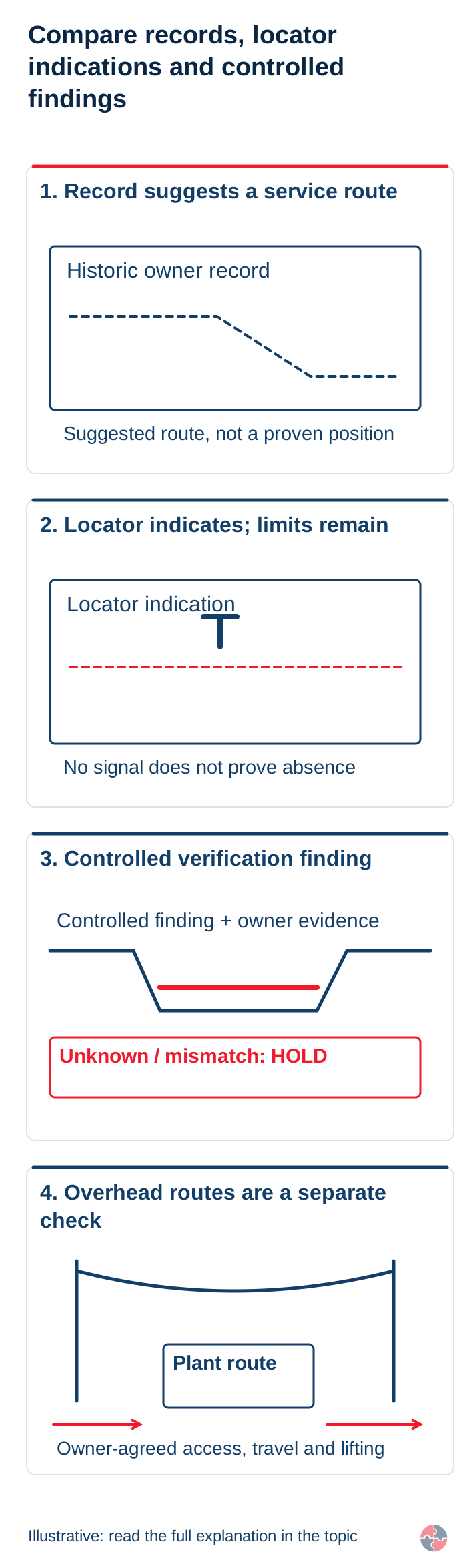
Open full-size diagram · Open stacked diagram · Download PNG · Download PDF
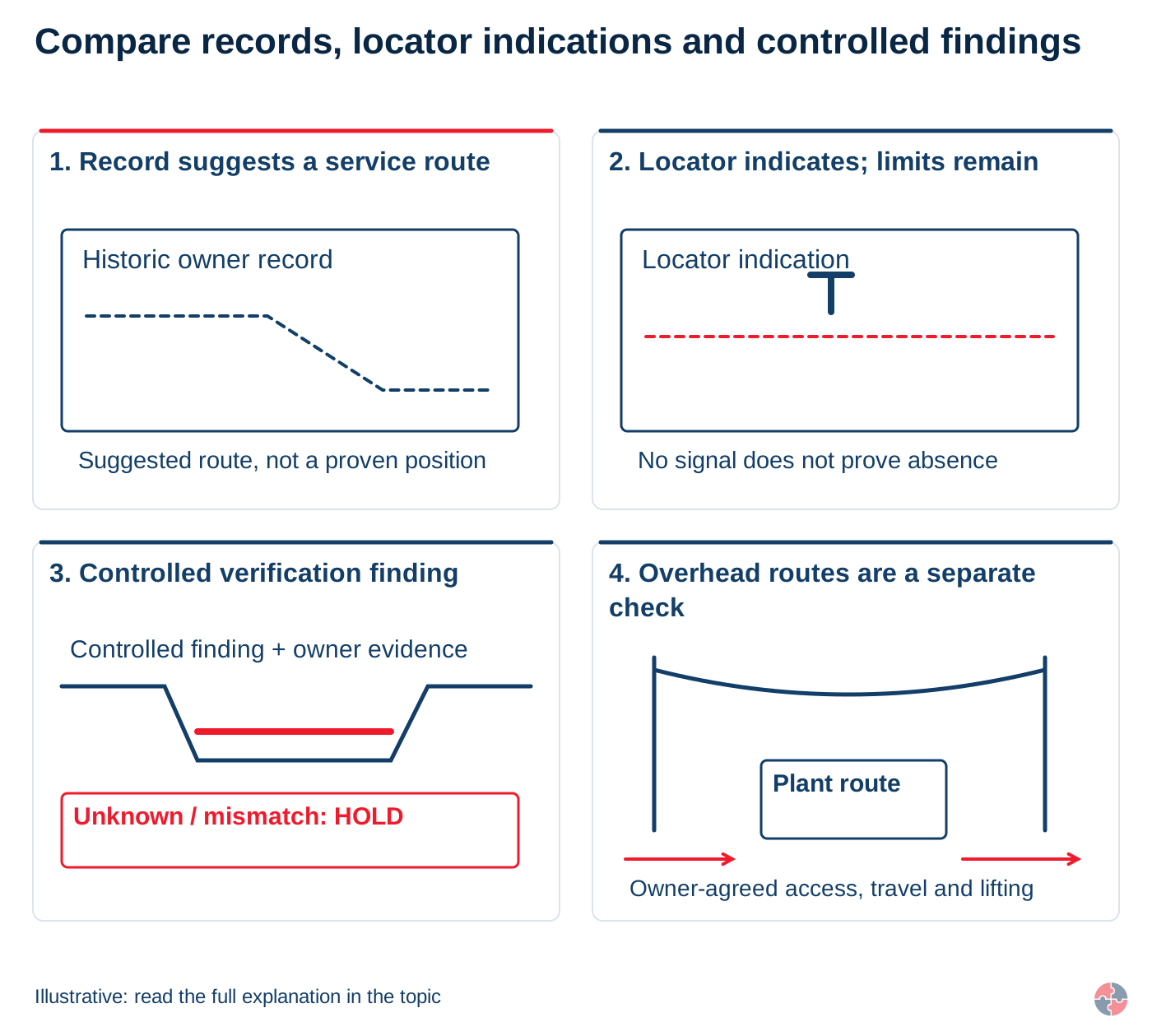
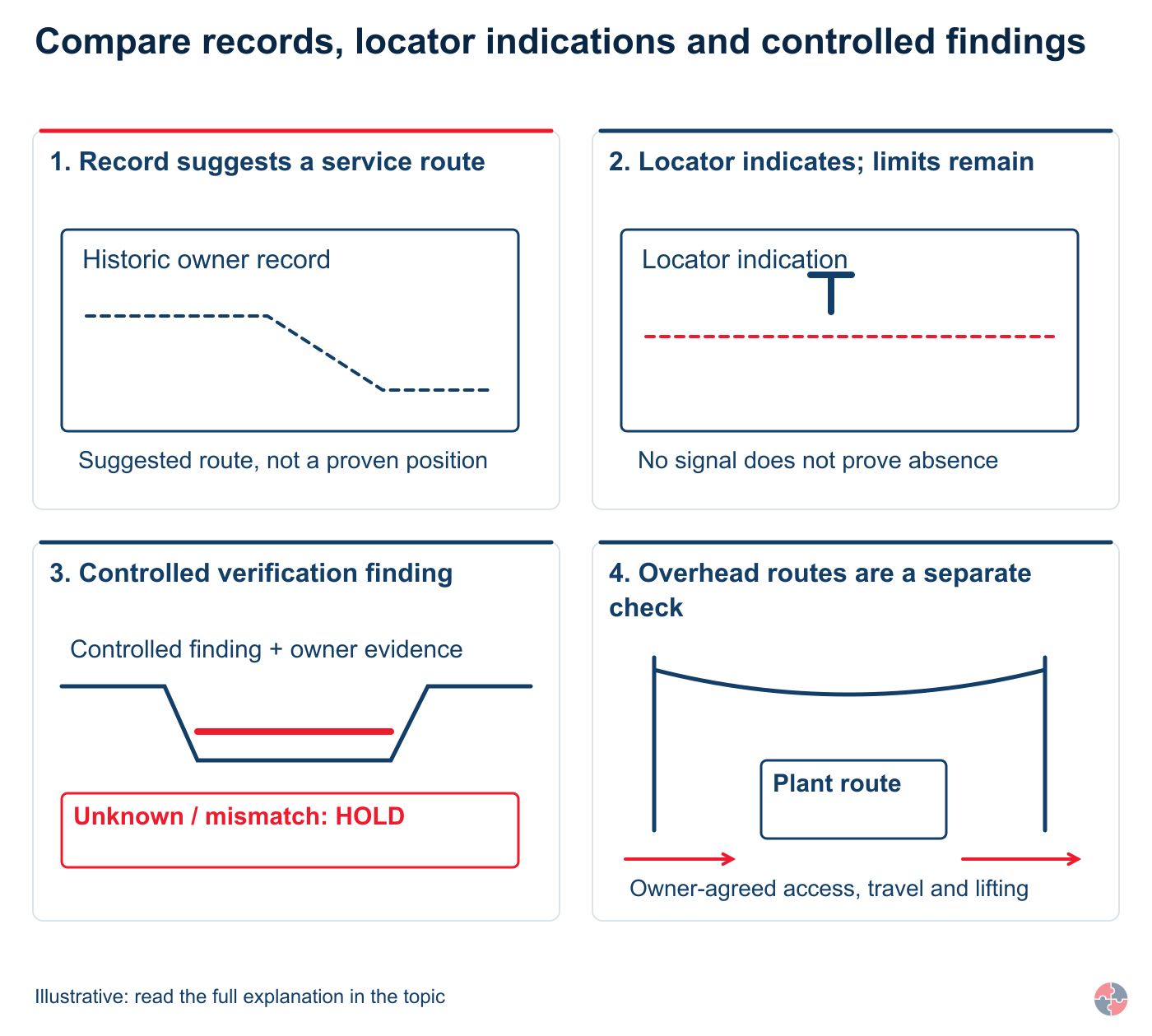
Plan the actual footprint
Obtain suitable current owner information, define the work and consider design alternatives. Records are clues; they can omit or misplace services and cannot alone establish safe excavation.
Locate and identify
Use suitable equipment, competent operators and its known limitations alongside the walkover and records. No indication is not proof of absence; colour alone does not establish a service’s identity.
Verify through the controlled method
Where needed, use the assessed controlled exposure or other competent verification method and owner information to resolve the actual finding. Confirm identity, condition and protection requirements without treating the model’s geometry as survey evidence.
Unknown or mismatch means hold
An unexplained indication, missing expected service, lost marking or changed work boundary requires affected work to stop, access to be controlled and the owner/competent team to resolve and revise the method. Do not mechanically search through uncertainty.
Check the whole overhead interface
Review access, travel, tipping, lifting and working routes with the line owner and competent planners. Buried-service checks do not clear an overhead interface, and this drawing supplies no universal distance, height or stand-off.
Separate emergency response from release
Use the existing service-specific emergency routes for suspected damage or contact. Making safe and owner instructions precede a revised method, briefing and authorised release; an emergency response or repaired asset is not itself permission to resume.
The original model and photographs remain contextual. No schematic coordinates, colours, depths or clearances establish the real service location or a safe work permit.
How is an identified service excavated around?
Select the excavation technique with the owner and competent supervisor, expose cautiously and protect the service through the task. Sources: HSE HSG47: Avoiding danger from underground services, HSENI: Example method statement for excavations.
Mark the route and a task-specific restricted area. Use suitable hand tools or a suitably controlled alternative for trial exposure, following HSG47 and the service owner; the exact distance and technique depend on the service and conditions. Excavate alongside rather than driving a tool directly down onto a cable. HSE advises insulated tools for hand digging near electrical cables. Keep mechanical equipment out of the restricted area until the owner-approved method permits it. Support exposed apparatus, preserve access and prevent loads, heat, vibration or impact. Do not assume a vacuum excavator, GPR or permit is a universal substitute for a sound method.
How can uncertainty and service damage change the excavation decision?
Compare the congested crossing with a stopped service-damage scenario. An unidentified route, conflicting record or changed condition needs escalation and a reviewed method before dependent work resumes.
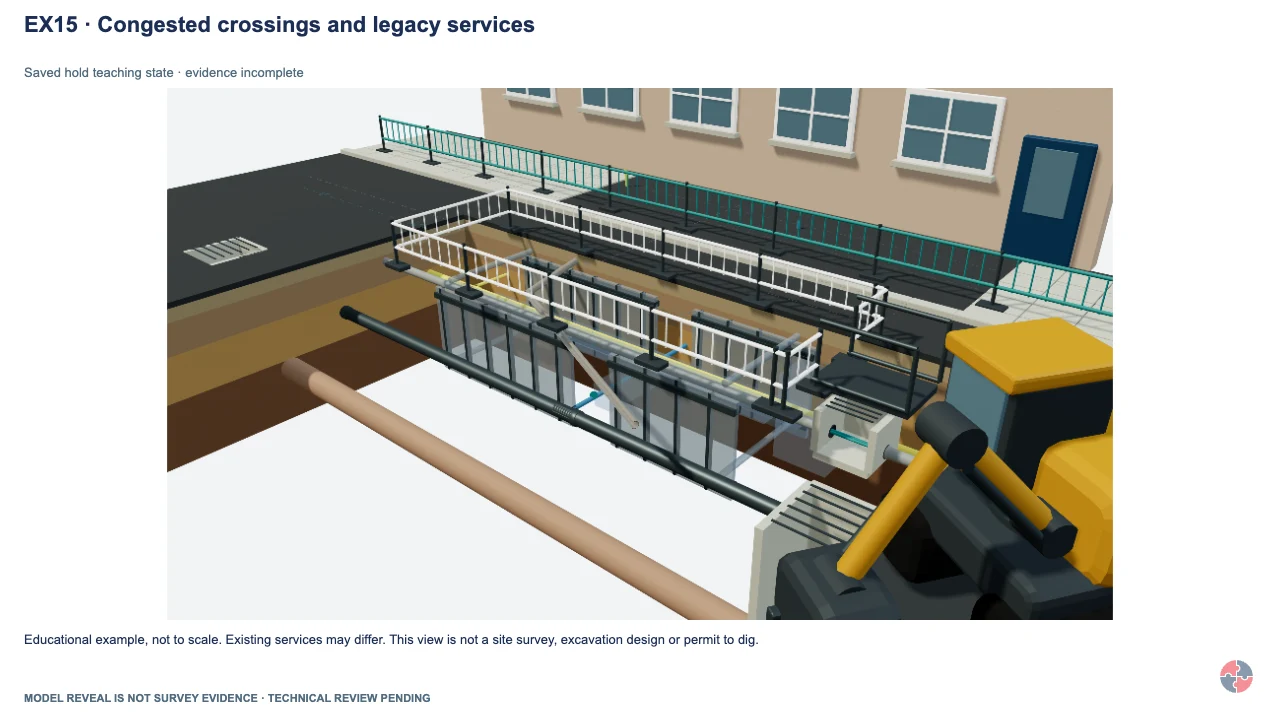
Congested crossings and legacy services
Crowded ground can hide altered branches and unidentified objects. Keep unknowns explicit rather than joining them to a familiar network.
Learning focus: Crowded ground can hide altered branches and unidentified objects. Keep unknowns explicit rather than joining them to a familiar network.
Educational example, not to scale. Existing services may differ. This view is not a site survey, excavation design or permit to dig.
Low voltage can still cause fatal injury. Material, colour and apparent disuse do not prove service identity or status.
Return to the main excavation lesson · Explore the planned Build Out excavation controls
How is overhead-line contact prevented?
Treat overhead lines as a separate work interface: avoid the area or agree a GS6-based plan with the line owner. Sources: HSE GS6: Avoiding danger from overhead power lines, HSE: Overhead power lines.
Survey the whole travel, loading and lifting path, not just the excavation. Consider excavator booms, cranes, MEWPs, tipping bodies, long materials and outriggers. Contact the line owner for voltage, restrictions, isolation or barriers as applicable. Establish an engineered route with access controls and a designated supervisor. No one should infer a generic clearance from this page. If plant touches or arcs to a line, keep people away: the line may re-energise automatically. Follow the line-owner and emergency-service directions before anyone approaches or disentangles equipment.
What does a controlled trench job look like?
An uncertain service indication changes the job plan before the excavator starts.
BuildOut Ltd is planning a short drainage trench across an older yard. The client plan shows water and telecoms; the walkover finds an unrecorded cabinet and the scan indicates another route crossing the trench. The supervisor holds the permit, requests the likely owners records and has the route rescanned by a competent operator. A controlled trial hole identifies an electrical cable. The designer moves the drain and the supervisor agrees the protection and digging method with the owner. Only then is the revised footprint marked and the team briefed. If the signal cannot be resolved, the job remains stopped; a reinstatement booking is not a safety justification.
| Moment | Decision | Record |
|---|---|---|
| Before work | Check plans, owners, ground and route alternatives. | Information and design log. Source: HSE HSG47: Avoiding danger from underground services |
| Unexpected signal | Hold; no mechanical search by guesswork. | Scan limitation and owner query. Source: HSE HSG47: Avoiding danger from underground services |
| Cable exposed | Revise route and protect; brief all crews. | Marked plan, method and permit revision. Source: HSE: Electricity - underground cables |
| Hand-back | Owner confirms service condition; update as-built. | Release and close-out. Source: HSE HSG47: Avoiding danger from underground services |
BuildOut Ltd yard drainage hold point
Task material and setting: A drainage trench across an older industrial yard with recorded water and telecoms routes.
People and prerequisites: Client, designer, supervisor, trained locator, excavation crew and likely asset owner; dated plans and emergency contacts available.
Before: Compare owner records and site features, scan the exact route, identify the work envelope and a possible redesign.
During: A new locator indication conflicts with the plan; the supervisor holds the permit and arranges owner consultation and controlled exposure.
Hold or stop: No mechanical search or excavation through the unexplained signal; keep the area controlled until identity and method are resolved.
Completion and hand back: Exposure identifies a cable; the designer moves the drain, the owner confirms protection requirements, and the supervisor revises and releases the method.
Evidence: Owner enquiry, marked plan, locator limitation, trial-hole record, revised design, permit, briefing and as-built update.
When must work stop or be redesigned?
Stop for uncertainty or suspected damage. For electrical contact, the operator normally stays in the cab and others keep away while the owner and responders are called; immediate fire danger may require exceptional escape under the site plan, never routine climbing down.
Triggers include missing plans, an unrecorded or absent expected service, conflicting scan results, changed ground or route, lost markings, damage, gas odour, electrical arcing, water inflow, overhead-line encroachment or work beyond the permit boundary. Hold work and control access. After electrical contact, do not tell a driver in an electrically contacted machine to climb down: the driver remains in the cab, warns others away and immediately notifies the network owner through the site emergency route. Bystanders stay clear. Call 999 for injury, fire or immediate public danger. A competent owner or responder directs making safe; the supervisor records the change and revises the method before any authorised restart.
What are the first actions after a strike?
Stop the task and warn others. After electrical contact, the operator normally stays in the cab and others keep away. Call 999 for serious injury, fire or immediate public danger and notify the network owner; if immediate fire danger forces escape, follow the site plan and responder or owner guidance, never a routine climb down. Sources: HSE: underground cables; HSE: overhead power lines.
B Damage or suspected damage to hand-back
2 linked parts. Follow the question numbers and complete the applicable route.
Part 1 of 2 · Questions 1–4

Continue · Part 2 of 2 · Questions 5–8


Read the complete visual as text
- Start: A service is contacted, scratched, exposed unexpectedly or suspected damaged.
- Question 1: Stop, warn and prevent approach Decision owner: Work planner, supervisor and actual service owner.
- ACTION: The crew stops the task and keeps people clear of the actual suspected service hazard. Do not touch, repair or recreate contact. Owner: Work planner, supervisor and actual service owner. CONTINUE → QUESTION 2.
- Question 2: Is an occupied machine in electrical contact? Decision owner: Work planner, supervisor and actual service owner.
- YES: Driver stays in cab and warns others; bystanders keep clear and do not climb onto or down from plant. Exceptional overhead fire escape is only the conditional HSE/site-plan route when driving clear is impossible and immediate danger requires escape. Owner: Work planner, supervisor and actual service owner. CONTINUE → QUESTION 3.
- NO: People outside withdraw from the actual hazard; no approach or improvised rescue. Owner: Work planner, supervisor and actual service owner. CONTINUE → QUESTION 3.
- UNKNOWN — HOLD / EXCLUDE: Keep clear, warn and use competent emergency/owner advice; never assume a tripped line is dead. Owner: Work planner, supervisor and actual service owner. HOLD → REPEAT QUESTION 2 AFTER CORRECTION.
- Question 3: Is there injury, fire, release, flooding or public danger? Decision owner: Work planner, supervisor and actual service owner.
- YES: Call 999 and follow the actual site emergency plan; notify the owner immediately as well. Owner: Work planner, supervisor and actual service owner. CONTINUE → QUESTION 4.
- NO: Immediately notify the actual service owner. Owner: Work planner, supervisor and actual service owner. CONTINUE → QUESTION 4.
- UNKNOWN: Protect people, obtain emergency advice as required and notify the owner. Owner: Work planner, supervisor and actual service owner. CONTINUE → QUESTION 4.
- Question 4: Identify and notify the actual owner from safety Decision owner: Work planner, supervisor and actual service owner.
- ACTION: Use plans and competent owner support without touching the service. An unknown owner does not permit work to resume. Owner: Work planner, supervisor and actual service owner. CONTINUE → QUESTION 5.
- Question 5: Do owner/responders confirm safe and intact condition? Decision owner: Work planner, supervisor and actual service owner.
- YES: The named evidence is confirmed. Continue the next applicable check. Owner: Work planner, supervisor and actual service owner. CONTINUE → QUESTION 6.
- NO / UNKNOWN — HOLD: Hold/exclude and return to the actual owner for the missing safe-state or integrity evidence. Owner: Work planner, supervisor and actual service owner. HOLD → REPEAT QUESTION 5 AFTER CORRECTION.
- Question 6: Are ground and adjacent services safe? Decision owner: Work planner, supervisor and actual service owner.
- YES: The named evidence is confirmed. Continue the next applicable check. Owner: Work planner, supervisor and actual service owner. CONTINUE → QUESTION 7.
- NO / UNKNOWN — HOLD: Hold. Obtain the owner and competent ground/service assessment before repeating clearance. Owner: Work planner, supervisor and actual service owner. HOLD → REPEAT QUESTION 6 AFTER CORRECTION.
- Question 7: Revise the work information Decision owner: Work planner, supervisor and actual service owner.
- ACTION: Update drawing, method, permit and briefing for the verified condition; do not retain the failed assumption. Owner: Work planner, supervisor and actual service owner. CONTINUE → QUESTION 8.
- Question 8: Is site release recorded by the authorised owner? Decision owner: Work planner, supervisor and actual service owner.
- YES: Restart only the revised authorised work and monitor change. Owner: Work planner, supervisor and actual service owner. OUTCOME → RECORD AND HAND OVER.
- NO / UNKNOWN — HOLD: Hold and resolve the revised method, briefing or release gap. Owner: Work planner, supervisor and actual service owner. HOLD → REPEAT QUESTION 8 AFTER CORRECTION.
- Outcome: Emergency response, controlled hold, or verified and authorised restart.
- Stop and escalation boundary: This learning route supplies no design value, operating setting, clinical diagnosis or site permission. The actual procedure, jurisdiction and competent local authority govern.
For a buried electrical cable strike, HSG47 warns that climbing down from the excavator can electrocute the driver: remain in the cab and keep everyone away from the machine, cable and excavation until the cable owner makes it safe. HSE overhead-line guidance likewise says to remain in the cab, warn others, immediately inform the distribution network operator and try to drive clear if possible. Its exceptional escape instruction applies when the machine cannot be driven clear and fire makes escape necessary: jump clear, never climb down the steps. This is not a general instruction to move a machine or to jump after every strike; use the site-specific emergency plan and responder/owner directions. A tripped line may re-energise without warning. For gas, water, drainage or unknown services, people outside the hazard withdraw to safety and prevent approach; do not apply the electrical-cab instruction blindly to every incident. Do not touch, move, cover or repair damaged apparatus or attempt an improvised rescue. Give responders the location, observed damage and available plans. Only the owner or authorised responder directs making safe.
How does the response change by service?
The first action depends on the service and where people are. After electrical contact, a driver normally stays in the cab and warns others away; bystanders keep clear. Notify the owner and call 999 for immediate danger; fire may require exceptional escape under the site plan and responder or owner guidance, never routine climbing down.
For buried electrical contact, the driver remains in the excavator cab and everyone else stays away from the machine, cable and excavation until the cable owner makes it safe. For overhead contact, remain in the cab, warn others and immediately notify the distribution network operator; a tripped line may re-energise. If the machine cannot be driven clear and immediate fire danger requires escape, HSE says jump clear rather than climb down; do not generalise this exception to other strikes or prescribe machine movement remotely. For gas or hazardous pipelines, people outside the hazard move away, prevent ignition activity without entering the danger area, call 999 for immediate danger and notify the operator. For water or drainage, keep people out of flooding or unstable excavations and contact the owner. For data or unknown services, stop and identify the owner. Do not touch or repair apparatus. The site contact sheet must name the actual owner, including private networks; GB and NI routes are not interchangeable. Owner-led clearance and site re-authorisation precede restart.
| Service | Do now | Avoid |
|---|---|---|
| Electricity | Driver in electrically contacted cab stays there and warns others; bystanders keep clear. Notify network owner immediately; call 999 for immediate danger. | Climbing down, approaching plant/cable, assuming trip means dead, or improvised rescue. Exceptional fire escape follows HSE/site plan. Sources: HSE HSG47: Avoiding danger from underground services, HSE: Overhead power lines |
| Gas or pipeline | Withdraw, control access, emergency operator and 999 as needed. | Operating devices or ignition sources in the hazard area. Source: HSE: Pipelines and gas supply industry FAQs |
| Water or sewer | Keep clear of inflow/unstable ground; notify owner. | Entering flooded or contaminated excavation. Source: HSE: Excavations |
| Data or unknown | Stop, protect area and identify owner. | Cutting, pulling or burying damage. Source: HSE HSG47: Avoiding danger from underground services |
Who may release the area after a strike?
A supervisor may not restart work merely because the visible leak or fault has stopped; obtain owner-led confirmation and re-authorise the revised task.
Record the struck service, exact location, observed effects, emergency calls, photographs taken from a safe place and owner directions. The asset owner assesses integrity and confirms isolation, repair and safe status within its competence. The project team then checks excavation stability, other damaged services, public protection and any change in route or method. Update plans, permit, briefing, emergency contacts and investigation actions. Release by the authorised site person only after those hold points are closed; retain an explicit no-work boundary if part of the site remains unsafe.
| Gate | Evidence |
|---|---|
| Asset integrity | Owner inspection/repair and written or recorded release. Source: HSE HSG47: Avoiding danger from underground services |
| Worksite condition | Ground, plant, adjacent services and public interface checked. Source: HSE: Excavations |
| Revised method | Plan and permit changed; crew rebriefed. Source: HSE HSG47: Avoiding danger from underground services |
| Learning | Event recorded; drawings and risk controls updated. Source: HSE HSG47: Avoiding danger from underground services |
Why do strikes recur?
The recurring failure is treating one clue or one signature as a complete service-control system.
Typical combinations include old plans accepted without owner checks, one locator sweep, private services omitted from searches, markings lost under spoil, excavation continuing through an unexplained signal, mechanical work before exposure, a permit issued remotely, or a new crew unaware of a changed route. Overhead events arise when machine height and travel routes are not planned. Corrective action must change the workface control, not only add a reminder to be careful.
What evidence should the job retain?
Keep enough evidence to show what was known, what remained uncertain, who decided, and what was verified at the workface.
A useful pack contains owner requests and replies, dated plans, survey scope and limitations, marked-up service routes, trial-hole or exposure records, design and method decisions, permit revisions, briefing attendance, plant restrictions, emergency contacts, inspection and owner hand-back. Photographs are valuable when taken safely and tied to the actual location. A signed form without physical verification is weak evidence.
| Record | What it demonstrates |
|---|---|
| Owner plans and enquiries | Information sought before design and excavation. Source: HSE HSG47: Avoiding danger from underground services |
| Survey and exposure | Location plus uncertainty and limitations. Source: HSE HSG47: Avoiding danger from underground services |
| Briefing and permit | Controls communicated at workface. Source: HSE HSG47: Avoiding danger from underground services, HSENI: Example method statement for excavations |
| Owner release and close-out | Damage resolved and revised work authorised. Source: HSE HSG47: Avoiding danger from underground services |
How should managers check the control is working?
Sample active workfaces, not just completed permits, and test whether crews can explain their stop and emergency routes.
Compare owner plans with site markings, inspect the scan limitations, observe trial exposure and plant restrictions, and ask how a new signal will be handled. Check whether changed drawings reached later crews and whether every damage event was reported to the owner. Trend unrecorded services, damaged apparatus, permit reissues and unresolved owner responses. Close actions by observing the changed practice in a later job.
| Check | Failed-control signal |
|---|---|
| Workface walk | Plan, markings and actual route disagree. Source: HSE HSG47: Avoiding danger from underground services |
| Crew interview | No one can name the service owner or stop trigger. Source: HSE HSG47: Avoiding danger from underground services |
| Event review | Minor damage was hidden or as-built not updated. Source: HSE HSG47: Avoiding danger from underground services |
Which GB and NI duties and reporting rules apply?
Apply the jurisdiction-specific general and construction duties, then assess incident reporting against the actual event criteria. Sources: HSE: Construction Design and Management Regulations 2015, HSENI: CDM Regulations (NI) 2016.
In Great Britain, the Health and Safety at Work etc. Act 1974 and CDM 2015 apply as relevant. In Northern Ireland, use the Health and Safety at Work (NI) Order 1978 and CDM (NI) 2016. HSG47 and GS6 are HSE guidance, not legislation; the site method must fit the service and owner instructions. Great Britain uses RIDDOR 2013 and Northern Ireland uses RIDDOR (NI) 1997. Not every cable strike is automatically reportable, but particular dangerous occurrences, injuries and gas/pipeline events may be. Notify the asset owner regardless of RIDDOR status. Have a competent person check the exact reporting duty promptly; do not delay an emergency call while deciding.
| Jurisdiction | Construction framework | Incident reporting |
|---|---|---|
| Great Britain | CDM 2015; GB general duties. | HSE RIDDOR 2013 criteria and route. Sources: Health and Safety at Work etc. Act 1974, HSE: Construction Design and Management Regulations 2015, HSE: Dangerous occurrences under RIDDOR |
| Northern Ireland | CDM (NI) 2016; NI general duties. | HSENI RIDDOR (NI) 1997 criteria and route. Sources: NI legal route, HSENI: CDM Regulations (NI) 2016, HSENI: Accident reporting |
GB worked comparison: an unintentional plant contact with an uninsulated overhead line above 200 volts, or proximity causing an electrical discharge, has its own Schedule 2 paragraph 3 reporting branch. Separately, paragraph 4 concerns a short circuit or overload that causes electrical-equipment failure and fire or explosion: it is reportable if the damaged equipment is unusable for more than 24 hours OR the event could have killed someone. For example, restoring supply with replacement equipment within 24 hours does not settle the damaged-equipment test; record its repair duration and fatal-harm potential. No injury does not itself make either occurrence non-reportable. The reporting owner checks the actual category and facts promptly; use the separate NI criteria for NI events. See HSE dangerous occurrences: overhead electric lines (paragraph 3) and electrical fire/explosion (paragraph 4).
How does a management system help?
A Plan-Do-Check-Act cycle can keep service information, competence and stop decisions current; ISO 45001 certification does not prove the excavation is safe. Sources: HSE: ISO 45001 management standard.
Plan the work and owner interfaces; do the located and controlled job; check the live workface and incident signals; act on discrepancies by redesigning and updating information. Use the site system to assign ownership and close actions, not as a substitute for physical identification or technical approval.
HSE describes ISO 45001 as an international occupational health and safety management standard. It can organise ownership, worker participation, checks and improvement, but certification cannot prove a cable position or authorise a particular excavation. Apply any chosen edition within its management-system scope after separate rights-cleared verification. Exact clause application has not been verified from an authorised full text and is not claimed here.
What competence and authorisation are needed?
People need different knowledge at design, locating, digging, supervision and owner-release stages. A course card alone cannot establish that a worker can locate this service or control this workface.
A locator must demonstrate the equipment’s modes and limits; a plant operator must know the actual reach and restricted route. Supervisors need to hold work for unresolved evidence, while the asset owner retains authority over its apparatus. Observe practical performance and revisit it after a change, near miss or failed control; no universal certificate expiry is implied.
| Role | Learning to test | Demonstration and assessor | Record and reassessment trigger |
|---|---|---|---|
| Nearby people and new starters | Recognise markings, exclusion zones, damage and the site emergency call route. | Supervisor asks what to do on finding an unknown service; no digging authorisation follows an awareness briefing. | Briefing evidence; revisit after an incident, changed layout or failed understanding. Source: HSE HSG47: Avoiding danger from underground services |
| Locator and survey operator | Use relevant modes, signal generator and checks; explain limits, anomalies and repeated scans. | Competent lead observes a site scan and interpretation of a conflicting indication. | Equipment check and survey record; reassess after device, method or ground-condition change. Source: HSE HSG47: Avoiding danger from underground services |
| Groundworker and plant operator | Follow marked method and restricted reach; stop before an unknown line, damage or overhead encroachment. | Supervisor observes trial exposure or controlled plant route and a stop scenario. | Task-specific instruction and observed competence; reassess after a new plant or changed route. Source: HSE HSG47: Avoiding danger from underground services, HSE GS6: Avoiding danger from overhead power lines |
| Supervisor and permit issuer | Coordinate owners, method, contractors, changed information, public boundary and emergency response. | Manager samples a live workface, permit change and owner escalation. | Hold/release decision and briefing; revisit after near miss or control failure. Source: HSE HSG47: Avoiding danger from underground services |
| Client, designer and manager | Supply known service information, design out clashes, resource surveys and check residual risk. | Competent reviewer challenges a design or procurement decision against owner evidence. | Design decision and owner reply; reassess after changed scope or records. Source: HSE: Construction Design and Management Regulations 2015, HSENI: CDM Regulations (NI) 2016 |
| Asset owner and technical specialist | Confirm service identity, isolation, damage integrity and safe return within their authority. | Owner’s authorised competent person demonstrates the applicable release process. | Owner confirmation and repair record; reassess after damage, modification or uncertain condition. Source: HSE HSG47: Avoiding danger from underground services |
How could BuildOut Ltd manage this in practice?

The contractor makes service ownership and workface hold points visible from design to hand-back.
BuildOut Ltd has drainage, fencing and lifting work on one industrial site. The client supplies its known utility information; the designer reroutes drainage away from a main; the supervisor checks all public and private service owners. Before digging, the locator and crew mark and physically verify the critical crossing. The lift planner separately controls the overhead route under GS6. Each task has a named owner, stop trigger and emergency contact. A damaged duct is reported, inspected by its owner and recorded even when the programme is delayed. Management samples the next live job to confirm learning.
| Management decision | Proof |
|---|---|
| Information before design | Owner replies and revised route. Source: HSE: Construction Design and Management Regulations 2015, HSENI: CDM Regulations (NI) 2016 |
| Workface release | Scan, exposure, method and briefing. Source: HSE HSG47: Avoiding danger from underground services |
| Overhead interface | Line-owner plan and controlled plant route. Source: HSE GS6: Avoiding danger from overhead power lines |
| Incident and hand-back | Owner assessment, revised permit and as-built update. Source: HSE HSG47: Avoiding danger from underground services |
Which acronyms and terms matter?
Use the full name and actual jurisdiction when briefing a crew. A short code or equipment label cannot settle whether a service is present or safe.
HSG47 and GS6 are guidance titles, not legislation. CAT and GPR describe locating methods with limits; CDM and RIDDOR have separate GB and NI instruments.
| Letters or term | Full name | Meaning here |
|---|---|---|
| HSG47 | Avoiding danger from underground services | HSE guidance for plan, locate and safe excavation; not a fixed clearance chart. |
| GS6 | Avoiding danger from overhead power lines | HSE guidance used with the actual line owner and work route. |
| CAT | Cable avoidance tool | A locating device; a negative scan cannot prove absence of all services. |
| GPR | Ground penetrating radar | A survey technique whose findings depend on ground, target and competent interpretation. |
| CDM | Construction Design and Management | GB 2015 and NI 2016 construction-duty regimes differ. |
| RIDDOR | Reporting of Injuries, Diseases and Dangerous Occurrences Regulations | GB 2013 and NI 1997 reporting rules and routes must be checked separately. |
| Asset owner | Organisation responsible for the service | Confirms identity, isolation, integrity and safe status of its apparatus. |
Unlock another resource
You have used this month’s two free downloads. Publish a post in your own words to unlock one more resource, or choose SHARE Individual for 10 downloads per month.
You decide whether to share. If you do, use the relevant platform disclosure tools and do not make claims you do not genuinely hold.