SHARE Knowledge Hub
Slips and Trips
Slips and trips are among the most common workplace accident causes, but they should never be dismissed as clumsiness or chance. A slip usually occurs when the available friction between footwear and floor is too low for the movement being made, often because of contamination, unsuitable flooring, poor cleaning, worn footwear or weather. A trip usually occurs when the foot is unexpectedly obstructed or the walking surface changes, often because of poor housekeeping, cables, defects, uneven levels, lighting or poor route design. Good management treats slips and trips as a design, maintenance, cleaning, supervision and culture issue, with strong controls for routes, flooring, contamination, stairs, footwear, inspections, public interface and incident learning.
Understanding Slips and Trips
Slips and trips are among the most common workplace accident causes, but they should never be dismissed as clumsiness or chance. A slip usually occurs when the available friction between footwear and floor is too low for the movement being made, often because of contamination, unsuitable flooring, poor cleaning, worn footwear or weather. A trip usually occurs when the foot is unexpectedly obstructed or the walking surface changes, often because of poor housekeeping, cables, defects, uneven levels, lighting or poor route design. Good management treats slips and trips as a design, maintenance, cleaning, supervision and culture issue, with strong controls for routes, flooring, contamination, stairs, footwear, inspections, public interface and incident learning.
Why this matters at work
A factory team reports a workplace condition that gets worse after another line starts. The supervisor observes the task under those conditions and asks a competent person to check exposure and controls. A follow-up observation covers the same shift and operating load.
Where slip-resistant footwear is required, select it for the real environment and users, obtain reliable performance information and check experience in use. Do not treat a marketing label or a particular sole pattern as proof of universal grip. Maintain and replace footwear and surfaces as their condition changes. Engineering and housekeeping measures remain important; footwear should not compensate for preventable leaks or unsuitable design. Retain selection and defect information and review after near misses or changed contamination.
How organisations manage this in practice
Examine contamination, cleaning, flooring, footwear, environment and the task together. HSE's slip model recognises that several factors can interact; trip prevention also depends on walkways, housekeeping, design and maintenance. Observe normal and busy conditions, entrances in wet weather, deliveries, cleaning and temporary work. Ask workers about places they avoid or where near misses occur. Prioritise removing sources of contamination and obstructions, designing usable routes and maintaining suitable surfaces. A generic instruction to take care does not correct a leaking machine, poor drainage or trailing cable. Assign repairs and interim protection, verify the result and review recurring defects. Include visitors, cleaners and people with additional mobility or visibility needs. Keep records proportionate to the findings and ensure the practical route remains available, rather than simply marking a line on the floor.
A school opens a temporary classroom and staff report that conditions differ between an empty room and a full lesson. The premises manager observes the occupied room and checks relevant controls with staff. The teacher reports whether the change works at the busiest time.
Make the immediate condition safe, then establish what was happening, the surface and contaminant, lighting, route, footwear and cleaning status. Look at work demands such as carrying loads or rushing imposed by the process. Avoid ending the investigation with the statement that a person was careless. Include people who work different shifts and those responsible for maintenance and cleaning.
Follow water from the entrance to the walking route
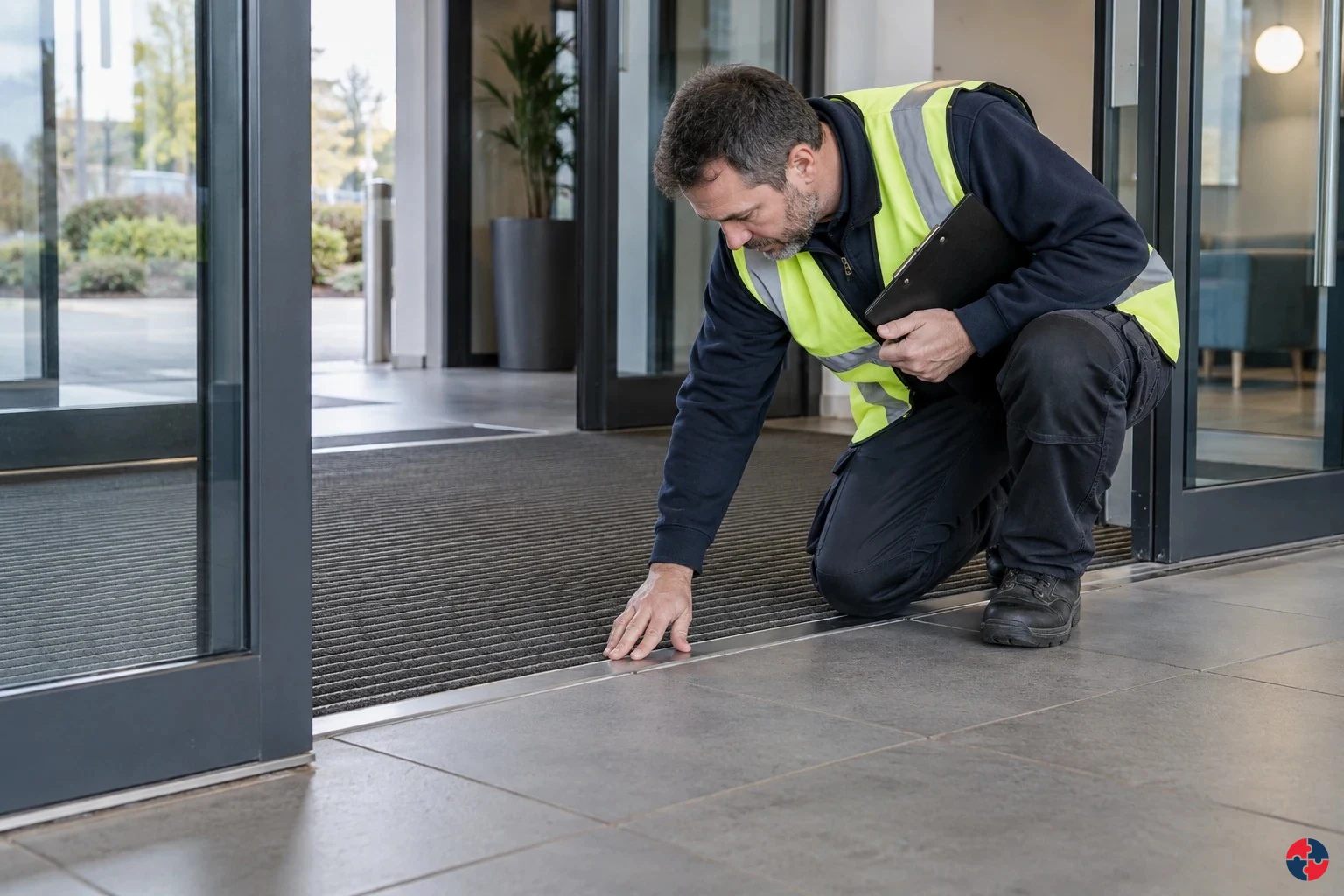
Repeated wet-entry contamination needs source, route and cleaning controls. A warning sign alone cannot restore grip or correct a saturated mat, a displaced edge or recurrent water ingress.
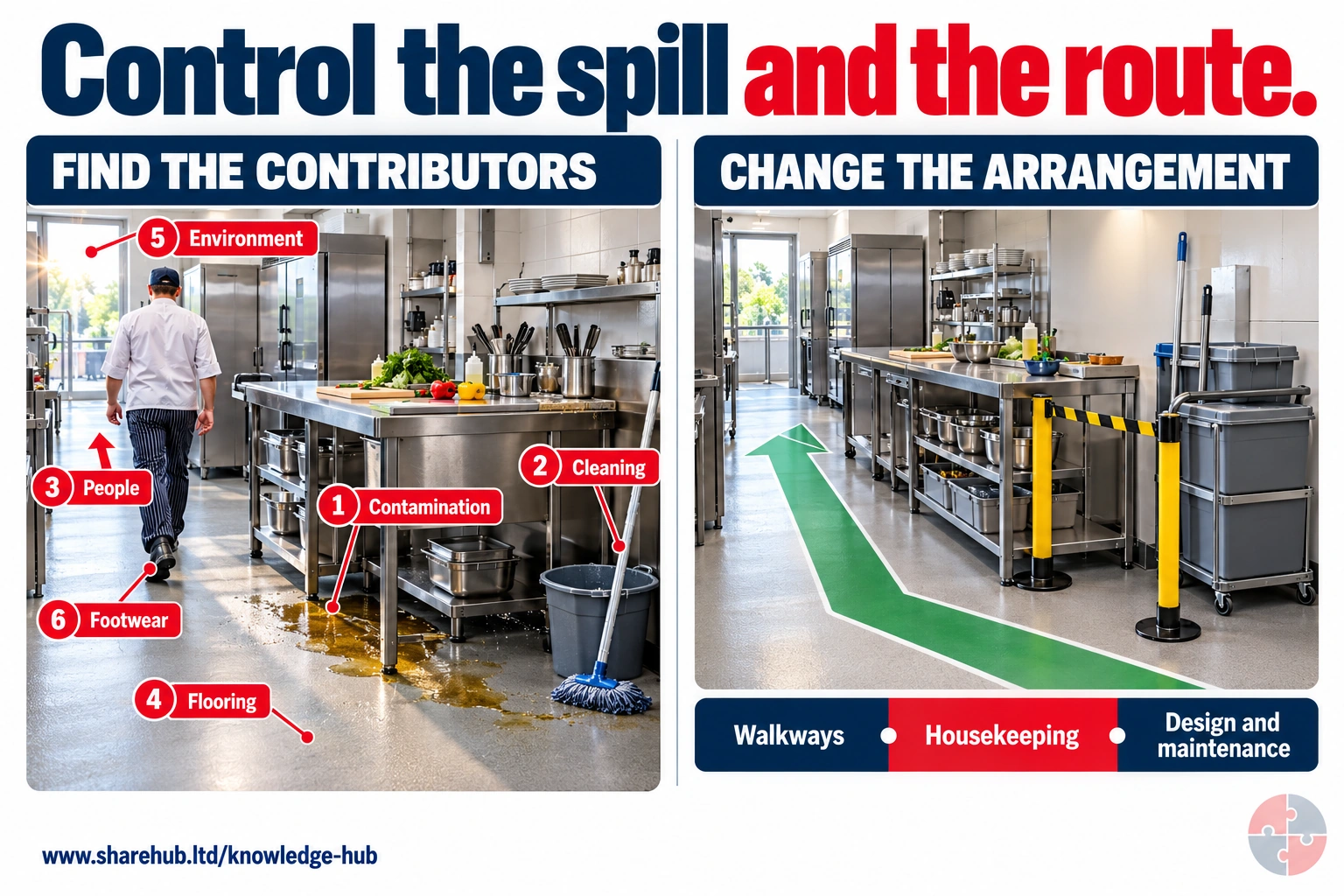
The kitchen example identifies six slip contributors: contamination, cleaning, people, flooring, environment and footwear. The second view shows a clear walking route and organised storage of cleaning equipment. These visible changes must be supported by dealing with the contamination source, suitable cleaning and access control; the image does not establish that a leak has been repaired. The lower prompts add the three trip-prevention considerations: walkways, housekeeping, and design and maintenance.
Is a warning sign the lasting control?
No. Deal with the source and floor condition, manage access during cleaning and check the route afterwards.
Conceptual task example; footwear and floor suitability need the actual conditions.
Source guidance: HSE guidance

Source and spread
Identify where water or leaves enter and how footfall spreads them beyond the mat. Consider leaks, drainage, floor suitability and real weather conditions.
Mat and route defects
Inspect saturation, displaced edges, obstructions and the pedestrian desire line. A mat can itself become a trip hazard if unsuitable or displaced.
Close or divert safely
Protect people from the affected route while providing a safe accessible alternative. A diversion must not introduce traffic, access or escape hazards.
Correct the source
Repair recurrent ingress/drainage and provide suitable flooring, matting and maintenance. Repeatedly mopping the same leak is not a lasting source control.
Clean and dry
Use the assessed cleaning method and prevent people entering the hazardous surface during the work. Do not ask someone to walk across it as a test.
Verify before reopening
The designated owner checks the actual route and conditions before reopening, then observes representative use and reviews after further rain or change.
Read the complete controls: ERICPD planning prompts
Discipline verifies and sustains all the controls; it is not a separate substitute for them.
| Prompt or level | Complete task-specific example |
|---|---|
| Eliminate | Remove recurring water entry at source where practicable. |
| Reduce | Use suitable matting, drainage and safe cleaning. |
| Isolate | Prevent access while unsafe and provide an alternative route. |
| Control | Repair floor and route defects. |
| PPE | Select suitable footwear for residual risk. |
| Discipline | Maintain competent cleaning, inspections and defect closure. Read the accompanying source table for the framework distinctions. |
Read the complete controls: ESEAP effectiveness order
Compare stronger feasible controls while preserving the actual task, checks and release requirements.
| Prompt or level | Complete task-specific example |
|---|---|
| Elimination | Remove recurring water entry at source where practicable. |
| Substitution | No separate measure is specified in this example. |
| Engineering controls | Provide suitable physical matting and, where applicable, drainage for foreseeable contamination. Use assessed physical barriers and a usable protected alternative route while the surface is unsafe. Repair floor and route defects through the competent physical correction. |
| Administrative controls | Plan and perform the assessed safe-cleaning method and timing. Inspect and verify the route and controls before reopening. Maintain competent cleaning, inspections and defect closure. |
| PPE | Select suitable footwear for residual risk. Read the accompanying source table for the framework distinctions. |
The plan specifies no friction value or universal mat dimension. Do not reopen solely because a cone has been removed.
Why are slips and trips a serious workplace risk?
A slip is a loss of grip; a trip is a foot caught by an obstruction or unexpected level change. Prevent both by selecting and maintaining suitable floors and routes, preventing contamination, clearing obstructions, controlling cleaning and verifying the surface is safe before reopening. A cone warns; it does not isolate a wet floor.
Best-practice guide: Slips and Trips
Why are slips and trips a serious workplace risk?
A slip is a loss of grip; a trip is a foot caught by an obstruction or unexpected level change. Prevent both by selecting and maintaining suitable floors and routes, preventing contamination, clearing obstructions, controlling cleaning and verifying the surface is safe before reopening. Slips and trips are among the most common workplace accident causes, but they should never be dismissed as clumsiness or chance.
Turn slips and trips knowledge into a decision
Slips and trips are among the most common workplace accident causes, but they should never be dismissed as clumsiness or chance. A slip usually occurs when the available friction between footwear and floor is too low for the movement being made, often because of contamination, unsuitable flooring, poor cleaning, worn footwear or weather. Record weather trigger, barrier time, floor condition, repair owner, worker feedback and repeat incidents.
Wet leisure-centre entrance
Close or physically separate the wet route, give a safe alternative, remove contamination and inspect matting and drainage. Repair the recurrent water source, choose suitable matting/flooring, brief cleaners and reopen after a dry-floor check.
Separate the failed entrance condition from its consequences
Trace source, spread, route, cleaning and reopening. A cone or a completed cleaning record cannot correct recurrent contamination.
Choose controls for slips and trips
Design: Specify suitable floor, drainage, stairs, lighting and route width. Prevent contamination: Stop leaks, fit drip trays, improve entrance matting and cover outdoor transitions. Remove hazards: Clear cables, waste, stock, hoses and uneven temporary materials. Control cleaning: Use correct method, timing, products, drying and barriers. Maintain: Repair defects, curled mats, loose tiles, potholes and stair nosings. Read the full control table for qualifications, ownership and verification. Use the actual task and applicable jurisdiction; existing technical approval remains unchanged.
Use the full slips and trips lesson
Use the full topic for the decision points, practical examples, detailed control tables and source scope. HSE guidance applies to Great Britain; use HSENI for the Northern Ireland route and the source’s stated jurisdiction. A simplified guide does not change the page’s technical-review or approval status.

Read all six steps as text
1. Why are slips and trips a serious workplace risk?
A slip is a loss of grip; a trip is a foot caught by an obstruction or unexpected level change.
- Avoid / redesign: Select and maintain suitable floors, drainage, stairs, lighting and usable routes.
- Control the task: Prevent contamination and clear obstructions; provide a safe alternative during cleaning or repair.
- Verify before release: Check the actual route and corrected condition before reopening, then review performance in representative wet use.
A slip is a loss of grip; a trip is a foot caught by an obstruction or unexpected level change. Prevent both by selecting and maintaining suitable floors and routes, preventing contamination, clearing obstructions, controlling cleaning and verifying the surface is safe before reopening. Slips and trips are among the most common workplace accident causes, but they should never be dismissed as clumsiness or chance.
Apply it: Which part of this plan would you check at the workface before authorising the task?
2. Turn slips and trips knowledge into a decision
Use the evidence to improve the actual work arrangement.
- Change at source: Correct recurrent ingress and unsuitable flooring, drainage or matting.
- Make it observable: The designated owner checks that cleaning/repair is complete and the route is safe to reopen.
- Keep useful evidence: Record the weather/contamination trigger, safe alternative, repair owner and reopening check.
Slips and trips are among the most common workplace accident causes, but they should never be dismissed as clumsiness or chance. A slip usually occurs when the available friction between footwear and floor is too low for the movement being made, often because of contamination, unsuitable flooring, poor cleaning, worn footwear or weather. Record weather trigger, barrier time, floor condition, repair owner, worker feedback and repeat incidents.
Apply it: What evidence would show that the change improves this task, rather than only completing a record?
3. Wet leisure-centre entrance
Example: a practical application of the existing topic lesson.
- Setting: Heavy rain carries water and leaves through a public leisure-centre entrance.
- Act: Close or physically separate the wet route, provide a safe accessible alternative, remove contamination and correct matting/drainage defects.
- Hold / review: Do not reopen while the hazardous condition remains or the alternative creates another hazard.
Close or physically separate the wet route, give a safe alternative, remove contamination and inspect matting and drainage. Repair the recurrent water source, choose suitable matting/flooring, brief cleaners and reopen after a dry-floor check.
Apply it: At which point would you hold this example, and what evidence would allow it to proceed?
4. Separate the failed entrance condition from its consequences
A saturated mat or water ingress is a warning condition, not the injury itself.
- Failed condition: Water spreads beyond a saturated mat, a mat edge is displaced or recurrent ingress remains unresolved.
- Possible harm: A person may slip or trip and sustain injury; the actual consequence depends on the fall and surrounding hazards.
- Correct and verify: Protect the route, correct source and surface conditions, then verify the safe arrangement before reopening.
Trace source, spread, route, cleaning and reopening. A cone or a completed cleaning record cannot correct recurrent contamination.
Apply it: Which condition failed, who can be affected and what evidence is needed before reopening?
5. Choose controls for slips and trips
Start with the stronger practicable options and verify their effect.
- Design: Specify suitable floor, drainage, stairs, lighting and route width.
- Prevent contamination: Stop leaks, fit drip trays, improve entrance matting and cover outdoor transitions.
- Remove hazards: Clear cables, waste, stock, hoses and uneven temporary materials.
- Control cleaning: Use correct method, timing, products, drying and barriers.
- Maintain: Repair defects, curled mats, loose tiles, potholes and stair nosings.
Design: Specify suitable floor, drainage, stairs, lighting and route width. Prevent contamination: Stop leaks, fit drip trays, improve entrance matting and cover outdoor transitions. Remove hazards: Clear cables, waste, stock, hoses and uneven temporary materials. Control cleaning: Use correct method, timing, products, drying and barriers. Maintain: Repair defects, curled mats, loose tiles, potholes and stair nosings. Read the full control table for qualifications, ownership and verification. Use the actual task and applicable jurisdiction; existing technical approval remains unchanged.
Apply it: Which stronger option can be used here, and who will verify it before accepting the remaining risk?
6. Use the full slips and trips lesson
Follow the official sources below and retain the task-specific evidence.
- Official guidance: Point-of-use source
- Task decision: Record weather trigger, barrier time, floor condition, repair owner, worker feedback and repeat incidents.
Use the full topic for the decision points, practical examples, detailed control tables and source scope. HSE guidance applies to Great Britain; use HSENI for the Northern Ireland route and the source’s stated jurisdiction. A simplified guide does not change the page’s technical-review or approval status.
Apply it: Which official source and full-topic section will you use to resolve the next decision?
Direct primary guidance provides the source boundary for the main claim.
A slip or trip can look like a small everyday event until the injury is serious: broken wrist, dislocated shoulder, head injury, spinal injury, long absence or a member of the public harmed on site. The fact that the person was 'only walking' does not make the event minor. Walking routes are part of the work system.
The professional question is not 'why did they not look where they were going?' It is: why was the floor contaminated, why was the route obstructed, why was the lighting poor, why was the cable there, why was cleaning done during footfall, why did the mat curl, why were stairs worn, why was footwear unsuitable, and why did inspections fail to find the problem?
HSE guidance frames slips and trips around practical causes such as contamination, cleaning, people, flooring, environment and footwear. That structure is useful because it prevents the investigation from stopping at worker behaviour.
| Cause area | Slip or trip mechanism | Control focus |
|---|---|---|
| Contamination | Water, oil, grease, dust, leaves, granules, mud or food reduce grip. | Prevent contamination, contain it and clean it quickly. HSE |
| Cleaning | Wet floors, wrong method, residue or trailing cleaning leads create hazards. | Clean at the right time, use barriers and leave floors dry. HSE |
| Flooring | Surface lacks slip resistance or is damaged, worn or uneven. | Specify, maintain and repair suitable flooring. HSE |
| Footwear | Sole pattern or material does not suit the surface/contaminant. | Select and trial slip-resistant footwear where required. HSE |
| Environment | Poor lighting, glare, weather, transitions and drainage increase risk. | Improve lighting, drainage, matting and winter controls. HSE |
| Human/task factors | Carrying loads, rushing, distractions or poor route layout affect balance. | Design routes and tasks so people can walk safely. HSE |
| Housekeeping | Cables, waste, stock or tools obstruct routes. | Plan storage, waste removal and route inspections. HSE |
How can I practise this topic in 3D?


Rainwater on a smooth entrance floor
A spill crosses the picking route

Dark or icy external route
All related inspection points 15 across 6 locations
Garage workshop 3 inspection points
Warehouse walkabout 2 inspection points
Riverside Leisure 4 inspection points
Harvest & winter housing 1 inspection point
A safer place to call home 4 inspection points
Recover materials. Protect people. 1 inspection point
Practice in the SHAREhub environment. Browser practice is separate from workplace competence and formal learning records.
How should slips and trips be prevented?
Prevention should remove the cause at source before relying on warning signs or people spotting hazards.
The most reliable slip and trip controls are designed into the workplace: suitable floors, safe slopes and steps, drainage, lighting, storage, cable routes, delivery areas, mat wells, cleaning methods and pedestrian routes. A cone on a wet floor may warn people, but it does not make the floor dry or stop access.
A good control strategy asks how contamination will be prevented, how spills will be detected, who owns immediate response, how floors are cleaned, how footwear is selected, how defects are reported, how routes are inspected and how incident patterns are mapped.
| Control layer | Practical control | Weak version to challenge |
|---|---|---|
| Design | Specify suitable floor, drainage, stairs, lighting and route width. | Trying to manage a badly designed route with signs. |
| Prevent contamination | Stop leaks, fit drip trays, improve entrance matting and cover outdoor transitions. | Cleaning the same recurring spill every day. |
| Remove hazards | Clear cables, waste, stock, hoses and uneven temporary materials. | Leaving obstacles for people to step around. |
| Control cleaning | Use correct method, timing, products, drying and barriers. | Wet mopping during peak footfall with cones only. |
| Maintain | Repair defects, curled mats, loose tiles, potholes and stair nosings. | Logging defects without interim control. |
| Footwear | Match footwear to surface and contaminant where work requires it. | Assuming all safety footwear is slip-resistant. |
| Supervise and learn | Inspect routes, map incidents and fix repeat causes. | Blaming individuals after each incident. |
The prevention model applies HSE slip/trip factors to the actual route; the owners and check sequence are illustrative.
How can a wet entrance become a serious slip risk?
A public-facing entrance example shows why signs alone are rarely enough.
Wet leisure-centre entrance
Task material and setting: Wet entrance at a public leisure centre during heavy rain.
People and prerequisites: Reception staff, visitors and cleaner; relief route agreed
Before: Wet leaves and rainwater carried through an entrance onto a smooth floor; no mat change or drainage response.
During: Close or physically separate the wet route, give a safe alternative, remove contamination and inspect matting and drainage.
Hold or stop: Do not reopen while the floor remains wet or the alternate route creates another hazard.
Completion and hand back: Repair the recurrent water source, choose suitable matting/flooring, brief cleaners and reopen after a dry-floor check.
Evidence: Record weather trigger, barrier time, floor condition, repair owner, worker feedback and repeat incidents.
Riverside Leisure Ltd has a busy reception beside the pool corridor. On wet mornings, rain is walked through the entrance, pool users cross the route in flip-flops, and cleaners mop the tiled floor during customer arrivals. A cone is placed near the desk, but people still cross the wet surface because it is the main route.
A professional review would treat this as a route-design and contamination-control problem. It would improve entrance matting, drainage and cleaning timing, use barriers or route diversion while floors dry, check floor suitability, review footwear expectations for staff, increase inspection during peak wet periods and map near misses by location and time.
| Issue | Poor control | Better control |
|---|---|---|
| Water walked in | Put a wet-floor sign by reception. | Improve matting, drainage and inspection frequency. |
| Cleaning during footfall | Mop quickly and hope people avoid it. | Clean in sections, use barriers and leave floor dry. |
| Main route remains open | Expect people to walk carefully. | Divert pedestrians or create a dry route. |
| Repeated near misses | Treat each as bad luck. | Map location/time and fix root causes. |
| Mixed users | Assume staff controls cover customers. | Consider children, older users, visitors and vulnerable service users. |
The entrance sequence is a site illustration; HSE wet-floor access controls supports physical access prevention during wet cleaning.
Drying and inspection are handback checks for this entrance, not proof that every wet-process floor is safe. A kitchen or pool-side surface must be suitable for the actual activity and foreseeable contamination; competent assessment may be needed. The supervisor verifies controls at the route before reopening. HSE floor suitability.
What is the HSE-style cause model for slips and trips?
A useful cause model looks at contamination, flooring, footwear, environment, cleaning, lighting, design, maintenance and behaviour.
This model keeps investigations away from blaming the injured person too early. HSE's prevention material separates causes such as contamination, cleaning, people or human factors, flooring, environment and footwear. A strong workplace model can expand that into the factors supervisors actually see: lighting, design, maintenance and behaviour under real task pressure.
A slip is usually about loss of grip; a trip is usually about an obstruction or unexpected change in walking surface. Some events include both: a worker carrying a box may trip on a mat edge and then slip while trying to recover balance. The cause model helps the assessor test the whole route rather than one visible hazard.
| Cause area | Typical failure | What to check |
|---|---|---|
| Contamination | Water, oil, dust, mud, leaves, food, granules or process residue on the route. | Source prevention, spill response, drainage and cleaning method. |
| Flooring | Surface is too smooth, worn, damaged, uneven or unsuitable for expected contamination. | Slip resistance, condition, transitions, mats and repair history. |
| Footwear | Sole pattern/material does not match surface and contaminant. | Footwear selection, trial, issue and worker feedback. |
| Environment | Weather, glare, temperature, congestion, noise or poor route separation affects walking. | Entrances, external paths, yards, weather plan and route layout. |
| Cleaning | Wet mopping, residue, poor drying or cleaning during peak footfall creates risk. | Method, timing, barriers, drying checks and contractor control. |
| Lighting | Hazards, edges, stairs or changes in level are hard to see. | Lighting level, contrast, shadows, glare and emergency lighting. |
| Design | Route forces people through wet zones, tight turns, slopes, steps or delivery conflicts. | Layout, pedestrian flow, storage, access and public interface. |
| Maintenance | Defects, loose tiles, curled mats, potholes or worn stair nosings remain unresolved. | Defect reporting, interim controls and close-out evidence. |
| Behaviour/task | People rush, carry loads, use phones, push trolleys or cannot see the floor. | Task design, supervision, workload and realistic route use. |
HSE supplies the six slip factors and obstruction/uneven-surface trip causes. Lighting, layout and maintenance are expanded local audit prompts. HSE slip/trip factors.
How do slips and trips differ by sector?
The control principles are similar, but the sources of contamination, route pressure and affected people differ.
Sector examples make the topic less generic. The same wet floor needs a different plan in a kitchen, a hospital corridor, a construction access route and a loading bay. In public-facing premises, non-employees may be exposed and routes may be less controllable.
Competent assessment should include the people using the route: employees, contractors, delivery drivers, visitors, children, older people, patients, customers and emergency responders.
| Sector | Typical problem | Control focus |
|---|---|---|
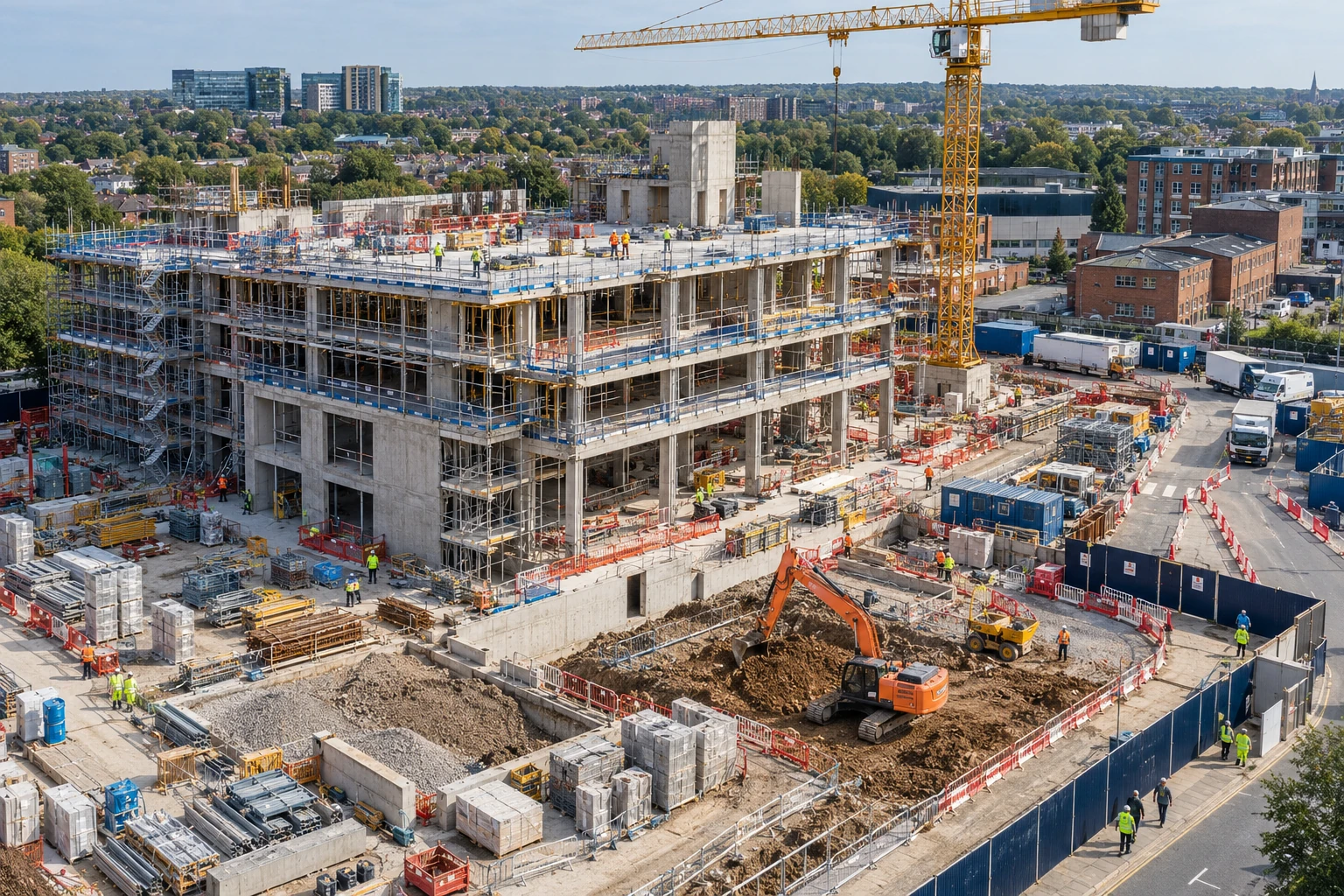
| Construction | Mud, trailing cables, waste, uneven ground and changing levels. | Defined walkways, housekeeping, cable management, lighting and deliveries. |
| Retail/leisure | Wet entrances, spillages, cleaning, queues and public interface. | Mats, spill response, barriers, inspection and customer route control. |
| Healthcare/care | Wet bathrooms, corridors, patient movement and vulnerable service users. | Flooring, cleaning timing, footwear, lighting and care-specific assessment. |
| Warehousing/logistics | Shrink-wrap, pallets, dock plates, tail lifts and weather at yards. | Traffic route design, housekeeping and footwear. |
| Food/kitchens | Grease, water, dropped food and rapid cleaning needs. | Drainage, slip-resistant flooring, cleaning method and footwear. |
| Offices | Cables, mats, stairs, lighting and poor storage. | Cable routing, defect reporting and route inspections. |
The sector table illustrates different operating conditions; use the actual floor, contaminant and route assessment, rather than a universal control list.
Transfer a wet-tile case to an oily workshop: a shoe that performs well with water may perform poorly with oil. Specify the actual floor and contaminant and arrange a controlled representative trial; never expose someone deliberately to an uncontrolled hazard to test footwear. HSE footwear procurement. The workshop illustration requires source/leak control as well as footwear.
Why are cones and signs not the control?
Cones and signs are warning aids; they do not remove contamination, repair a defect or stop access to danger.
This is one of the key teaching points for slips and trips: signs are not the primary control. They may be useful while a temporary hazard is being controlled, but they do not dry a floor, remove a cable, repair a mat, increase lighting or stop people entering a dangerous route.
HSE retail guidance is particularly useful here: signs and cones warn, but they do not prevent people entering a wet area. If the hazard is serious or the floor is smooth and wet, access may need to be stopped with barriers, locked doors or cleaning in sections.
| Situation | Sign-only weakness | Stronger control |
|---|---|---|
| Wet smooth floor | People walk past cone because route is open. | Barrier the section or divert pedestrians until dry. |
| Damaged floor tile | Sign remains for weeks. | Repair, isolate or create temporary safe route. |
| Oil leak | Cone warns but contamination spreads. | Stop source, absorb/clean correctly and prevent recurrence. |
| Trailing cable | Warning does not remove trip point. | Route cable overhead, cover it properly or remove it. |
| Poor lighting | Warning cannot make hazard visible. | Improve lighting and mark edges/changes. |
HSE wet-floor access controls supports barriers or closed routes for unsafe wet floors. The cable and lighting responses are local hazard-control examples.
How can the hierarchy of controls remove slip and trip hazards from workplace routes?
Control classification: Classify the mechanism separately from its upkeep: physical floor repair, drainage, barriers, protected routes, compartmentation, fire doors and suitable disposal facilities are physical measures where specified. Cleaning schedules, inspections, policies, funding, supervision and verification are administrative arrangements maintaining them. A verbal instruction is not a physical barrier. Read this correction with the source table. Retained overview and stage artwork requires the matching classification update.
Remove or reduce the hazard before relying on procedures or personal protection.
For slips and trips, assess the actual task and first look for a way to remove the hazard. Where that is not possible, consider a safer substitute, engineered separation and then clear work procedures. PPE protects against remaining exposure; it does not make an uncontrolled task safe. HSE hierarchy of controls
The selected measures need a named owner, a usable stop point and a check that they still work when the task or conditions change. In Northern Ireland, verify the separate legal route and site instructions.
For the wet entrance, eliminate recurring water entry at source where practicable. Reduce contamination with suitable matting, drainage and a cleaning method that leaves the route safe; physically prevent access while unsafe and provide an alternative. Repair floor and route defects, then select footwear for residual risk and sustain checks. ERICPD (Eliminate, Reduce, Isolate, Control, PPE, Discipline) is a teaching prompt; Discipline means competent cleaning, supervision and defect closure. HSE slip and trip factors; HSE barriers and cleaning.
How can the ERICPD hierarchy of controls remove slip and trip hazards from workplace routes?

| ERICPD control level | Topic-specific example | Source and full task context |
|---|---|---|
| Eliminate | Remove recurring water entry at source where practicable. | Read the full task example, checks and stop points on this page. HSE hierarchy of controls · HSE slip and trip factors · HSE barriers and cleaning |
| Reduce | Use suitable matting, drainage and safe cleaning. | Read the full task example, checks and stop points on this page. HSE hierarchy of controls · HSE slip and trip factors · HSE barriers and cleaning |
| Isolate | Prevent access while unsafe and provide an alternative route. | Read the full task example, checks and stop points on this page. HSE hierarchy of controls · HSE slip and trip factors · HSE barriers and cleaning |
| Control | Repair floor and route defects. | Read the full task example, checks and stop points on this page. HSE hierarchy of controls · HSE slip and trip factors · HSE barriers and cleaning |
| PPE | Select suitable footwear for residual risk. | Read the full task example, checks and stop points on this page. HSE hierarchy of controls · HSE slip and trip factors · HSE barriers and cleaning |
| Discipline | Maintain competent cleaning, inspections and defect closure. | Read the full task example, checks and stop points on this page. HSE hierarchy of controls · HSE slip and trip factors · HSE barriers and cleaning |
How can the ISO 45001 hierarchy of controls remove slip and trip hazards from workplace routes?

| Five-level control stage(s) | Topic-specific example | Source and full task context |
|---|---|---|
| Elimination | Remove recurring water entry at source where practicable. | Read the full task example, checks and stop points on this page. HSE hierarchy of controls · HSE slip and trip factors · HSE barriers and cleaning |
| Engineering controls / Administrative controls | Use suitable matting, drainage and safe cleaning. | Read the full task example, checks and stop points on this page. HSE hierarchy of controls · HSE slip and trip factors · HSE barriers and cleaning |
| Engineering controls | Prevent access while unsafe and provide an alternative route. | Read the full task example, checks and stop points on this page. HSE hierarchy of controls · HSE slip and trip factors · HSE barriers and cleaning |
| Engineering controls / Administrative controls | Repair floor and route defects. | Read the full task example, checks and stop points on this page. HSE hierarchy of controls · HSE slip and trip factors · HSE barriers and cleaning |
| PPE | Select suitable footwear for residual risk. | Read the full task example, checks and stop points on this page. HSE hierarchy of controls · HSE slip and trip factors · HSE barriers and cleaning |
| Administrative controls | Maintain competent cleaning, inspections and defect closure. | Read the full task example, checks and stop points on this page. HSE hierarchy of controls · HSE slip and trip factors · HSE barriers and cleaning |
When should a slip or trip hazard trigger immediate action?
Immediate action is needed when a route is contaminated, obstructed, damaged, poorly lit or exposing people who cannot reasonably avoid the hazard.
Point-of-use source supports the section’s main boundary; check the actual task and location.
Slips and trips are often time-critical. A spill, wet cleaned floor, damaged stair nosing, icy entrance or trailing cable can harm the next person using the route. The first decision is whether to remove, isolate or divert before normal work continues.
Supervisors should be clear that 'reported' is not the same as 'controlled'. If the hazard remains, interim control is needed.
| Trigger | Immediate action | Follow-up |
|---|---|---|
| Spill or wet floor | Stop access if needed, clean with correct method and leave dry. | Find source and prevent recurrence. HSE barriers and cleaning |
| Trailing cable or hose | Remove, reroute, cover properly or restrict route. | Review power/water access and work method. HSE floor suitability |
| Damaged floor or stair | Prevent access to the dangerous area and provide a safe alternative route; marking alone does not control exposure. | Repair and record defect close-out. HSE floor suitability |
| Ice, leaves or mud | Treat, clear, reroute or restrict affected path. | Review weather plan, drainage and inspection frequency. HSE floor suitability |
| Poor lighting | Stop or divert work where hazards cannot be seen. | Repair lighting and verify levels. HSE workplace-transport lighting |
| Repeated incident location | Escalate beyond local housekeeping. | Map causes and review design, cleaning and maintenance. Point-of-use source |
Warnings and cones communicate a hazard; they do not by themselves prevent access. Use the assessed physical separation and usable alternative route, then verify the surface and access conditions before reopening.
Where do slips and trips controls commonly fail?
Controls fail when workplaces normalise poor housekeeping, recurring contamination, weak cleaning and low-quality route inspections.
A slip or trip failure often has a long warning period: near misses, complaints, cones left out daily, repeated cleaning of the same leak, worn stairs, pallets in walkways, or workers stepping over cables so often that nobody sees them anymore.
A strong system treats those weak signals as design and management failures, not as worker clumsiness.
| Failure or weak practice | How it develops | What good looks like |
|---|---|---|
| Recurring spill source | Leak, process or entrance contamination is cleaned but not fixed. | Remove or contain the source. |
| Cones as permanent control | Temporary warning becomes normal. | Repair, isolate or redesign the route. |
| Poor cleaning method | Floor left wet, slippery or with residue. | Use correct method, timing, barriers and drying checks. |
| Housekeeping drift | Waste, stock or tools creep into walkways. | Define storage and inspect routes. |
| Footwear mismatch | Safety boots are assumed to be slip-resistant. | Select footwear for surface and contaminant. |
| No incident mapping | Each incident is investigated alone. | Map locations, times, tasks and conditions. |
| Public route overlooked | Controls focus only on employees. | Assess customers, visitors, patients and delivery drivers. |
The failures illustrate weaknesses in the HSE slip/trip factors model; verify the chosen correction at the actual site.
What evidence shows slips and trips are being prevented?
Good evidence shows that controls are planned, used, checked, corrected and reviewed.
Evidence should fit the site and incident risk: route condition, contamination, cleaning, defects and corrective actions need usable records and verification; serious injury also needs clinical, reporting and recovery follow-up.
| Evidence item | What it should show | Assurance question |
|---|---|---|
| Slip and trip risk assessment | Routes, surfaces, contamination, cleaning, footwear, lighting, stairs, weather and affected people. | Does it cover real high-use routes and non-employees? |
| Route inspection records | Findings, defects, immediate controls, owners and close-out. | Are recurring locations escalated? |
| Cleaning schedule and method | When cleaning occurs, method used, drying checks and barriers. | Does cleaning remove risk or create it? |
| Defect and maintenance log | Floor, stair, lighting, mat, drainage and route repairs. | Are serious defects controlled before repair? |
| Spill response record | Source, response time, method, disposal and recurrence action. | Was the source fixed? |
| Incident and near-miss map | Location, time, conditions, footwear, task and learning. | Are patterns driving design changes? |
| Footwear selection evidence | Surface, contaminant, trial, user feedback and issue records. | Is footwear suitable for the actual contamination? |
| Public interface review | Visitors, customers, children, patients, delivery drivers and contractors. | Are non-employees protected? |
These are illustrative records for route condition and defect closure, informed by HSE slip/trip factors; exact fields and owners are local choices.
How should slip and trip controls be assured?
Assurance should test whether controls work in practice, not whether the page or procedure exists.
Assurance should include frontline checks, manager review and periodic independent sampling where risk warrants it. The purpose is to find weak signals early, close actions properly and update the risk assessment when work changes.
| Assurance level | What to check | What good looks like |
|---|---|---|
| Daily frontline check | Entrances, routes, stairs, cleaning areas, cables, waste and lighting. | Hazards are fixed or isolated immediately. |
| Supervisor sampling | Observe cleaning, deliveries, route use and peak footfall. | Work as done matches the assessment. |
| Facilities review | Trend defects, matting, drainage, flooring and lighting. | Recurring causes are engineered out. |
| Incident review | Map slip/trip incidents and near misses by location and cause. | Learning changes routes, cleaning or maintenance. |
| Senior management review | Review repeat claims, RIDDOR, absence, public incidents and overdue defects. | Resources are allocated to persistent risk. |
Sample contamination, route defects and cleaning handback against HSE slip/trip factors and HSE wet-floor access controls; a completed inspection form is not proof of safe conditions.
Which GB and Northern Ireland duties apply?
Choose the work location first. GB regulation 12 and the separate NI workplace regulations address floor and traffic-route condition; guidance then helps select proportionate controls. A warning sign alone does not satisfy the underlying prevention duty.
Check the actual work location, current commencement and responsible authority before acting.
| Jurisdiction | Route | Direct source | Decision supported |
|---|---|---|---|
| Great Britain | Floor and route condition | Health and Safety at Work etc. Act 1974; Management of Health and Safety at Work Regulations 1999; Workplace (Health, Safety and Welfare) Regulations 1992, regulation 12 | Assess, maintain and keep routes suitable and unobstructed. |
| Northern Ireland | Separate NI floor and route duties | Health and Safety at Work (Northern Ireland) Order 1978; Management of Health and Safety at Work Regulations (Northern Ireland) 2000; Workplace (Health, Safety and Welfare) Regulations (Northern Ireland) 1993 | Apply NI instruments to an NI workplace. |
| Great Britain guidance | Slip and trip causes | Causes and prevention of slips and trips; Retail slips and trips: cleaning and barriers | Prevent contamination, isolate wet cleaning and repair defects. |
| Northern Ireland guidance | NI practical controls | Slips and trips | Check the NI route and practical prevention. |
How should management check this work?
Use a defined plan, carry out the controls, check performance and correct what does not work.
For slips and trips, assign a competent owner to set the work controls, check their use and review them after change, failure or new evidence. HSE managing health and safety
A management-system label or certificate is not approval of a site limit, procedure or individual work decision. Apply GB and NI duties to the correct location.
What training and competence are needed?
Competence is shown by a role-specific decision or task, checked by a named assessor and revisited when conditions change.
Direct training source anchors the topic-specific competence and briefing.
The following role assessments and evidence are illustrative SHARE implementation choices. HSE guidance supports the control topics; it does not prescribe these assessment methods.
| Role | Practice to demonstrate | Assessor and method | Evidence to retain | Reassess when |
|---|---|---|---|---|
| All workers | Spot contamination, poor lighting and obstructions; stop or isolate a route and report it. | Supervisor observes a route walk. | Induction checklist and observed response. | New route, seasonal condition or missed hazard. |
| Cleaners and facilities staff | Demonstrate spill isolation, drying, barrier placement and reopening check. | Facilities lead observes a wet-floor exercise. | Practical assessment and cleaning record. | Product, equipment or cleaning schedule change. |
| Supervisors | Prioritise a hazard, reroute people and verify repair rather than relying on a sign alone. | Safety lead reviews a live defect scenario. | Defect ticket and closure check. | Near miss, repeat slip or failed inspection. |
| Managers | Review slip trends and fund floor, drainage or entrance changes. | Senior leader samples action effectiveness at the site. | Risk review, investment decision and verification. | Trend, redesign or seasonal performance change. |
| Safety and design specialists | Assess surface, contamination, footwear and route interaction; test control hierarchy. | Competent peer reviews a site assessment. | Method, measurements and peer review. | New surface, recurring incidents or guidance update. |
The demonstrations are illustrative assessments of prevention decisions, using HSE slip/trip factors and HSE wet-floor access controls as the factual control context.
How could Riverside Leisure Ltd manage this in practice?

Riverside Leisure Ltd would control slips and trips by addressing contamination, cleaning, floor condition and the routes people use, with prompt action on defects.
Riverside Leisure Ltd · practical example
Fix a recurring wet entrance rather than adding another cone
The key lesson A warning identifies a hazard; it does not remove contamination or make a floor suitable for use.
The situation: At a Riverside hotel, rainwater and wet luggage repeatedly reach the entrance floor. Staff put out a cone, but guests still need to cross the same area. The repeated condition calls for a stronger solution.
Why this matters: Busy entrances combine unfamiliar people, carried items and changing weather, so a small unresolved defect can affect many users.
How Riverside Leisure Ltd would manage it
- Understand how the floor becomes unsafe — Hotel Manager. Observe arrivals with housekeeping and reception. Identify the water source, route, floor condition, lighting and any cleaning process contributing to the problem.
- Improve the entrance arrangement — Facilities Coordinator. Assess suitable measures to limit water reaching the walking surface and maintain a usable route. Consider floor and entrance design as well as maintenance, with appropriate competent advice.
- Control cleaning safely — Department Supervisor. Provide an effective method and equipment for the contamination. Restrict access where needed while cleaning leaves a hazard, rather than routing guests across the wet area.
- Check during real demand — Duty Manager. Review the entrance in poor weather and busy periods. Act promptly on leaks, curled matting, trailing cables or recurring contamination and communicate temporary routes to reception.
- Verify the lasting change — Hotel Manager. Review observations, reports and any incidents after the improvement. If the condition returns, revisit the source or design rather than making repeated warning-cone deployment the normal arrangement.
When the conditions change
- Recognise the trigger
- Contamination or a defect makes the route unsafe.
- Make the immediate decision
- Protect the wet or defective entrance area while guests cannot cross it safely.
- Verify the next step
- The Duty Manager checks that the contamination has been dealt with and a suitable route is usable; persistent floor or entrance defects require Facilities acceptance before normal access resumes.
What good looks like
Guests have a suitable usable route, staff can remove or contain contamination promptly and recurring causes receive maintenance or design action. Checks reflect wet and busy conditions.
Evidence to look for: Entrance observations, defect and contamination records, cleaning method, remedial work and a checked outcome in similar weather.
Common mistake to avoid: Leaving a cone beside a recurring hazard while everyone still has to walk through it.
Apply this to your work: What keeps your warning cone from becoming a permanent feature?
Guidance behind the management approach: HSE: causes and prevention of slips and trips. Use the topic's legal and technical guidance for the applicable work and location.
In this worked example, Riverside Leisure Ltd has wet pool corridors, changing rooms, reception queues, cafe spillages, cleaners, plant rooms, external paths and delivery areas. The risk changes through the day, so the site uses route inspections, cleaning controls and incident mapping.
| Management element | How the business would manage it | Evidence to review |
|---|---|---|
| Assessment | Map wet areas, entrances, stairs, external paths, deliveries and public routes. | Route risk map. |
| Cleaning | Clean in sections, use barriers where needed and confirm floors are dry. | Cleaning method and sign-off. |
| Maintenance | Repair mats, tiles, drains, lighting and stair nosings quickly. | Defect log and close-out. |
| Supervision | Check peak times, weather and changing-room routes. | Supervisor inspection record. |
| Learning | Map incidents and near misses by location, surface, contaminant and time. | Trend review and action tracker. |
The business actions are illustrative; HSE wet-floor access controls supplies the wet-floor access boundary, with resources and owners set for the actual site.
What do the acronyms and key terms mean?
These terms distinguish the event, control and reporting or policy route.
| Term | Meaning | Practical use |
|---|---|---|
| Slip | Loss of grip | Often involves wet or contaminated contact. |
| Trip | Foot obstruction or level change | Check route and housekeeping. |
| Slip resistance | Floor and footwear traction | Assess in realistic contamination. |
| Reopening check | Post-cleaning safety verification | Keep route closed until safe. |
| ERICPD | Eliminate, Reduce, Isolate, Control, PPE, Discipline | Teaching prompt to apply to the actual work hazard. |
How can I practise the checks in 3D?
Follow the highlighted check, compare a sound part with a fault, and see how a missed fault can cause harm. Then use the matching blank checksheet to record what you actually find.

Housekeeping and access routes
24 checks · sound and fault examples
Find route, storage, waste, surface and obstruction checks, then see how faults can injure people. Use the actual equipment, task instructions and required inspection arrangements.
Connect with SHARE
This social destination is not connected on this page yet.