SHARE Knowledge Hub
Safety Culture
Safety culture is the pattern of decisions, behaviours and working conditions that shapes how risk is handled when production, uncertainty or fatigue puts controls under pressure. Leadership, worker involvement, competence, communication and learning influence whether weak signals reach a person who can act. A culture survey can reveal perceptions, but it cannot prove that a guard, safe route or other critical control works in the field.
Understanding Safety Culture
Safety culture is the pattern of decisions, behaviours and working conditions that shapes how risk is handled when production, uncertainty or fatigue puts controls under pressure. Leadership, worker involvement, competence, communication and learning influence whether weak signals reach a person who can act. A culture survey can reveal perceptions, but it cannot prove that a guard, safe route or other critical control works in the field.
Why this matters at work
A reactive pattern appears when action follows injuries, enforcement or a serious upset rather than early signals. Near misses may be dismissed, repeated defects may be tolerated and leaders may demand explanations after failure without asking why the system permitted it. Workers learn that reporting brings blame or no response. A low incident count can be misleading when exposure is hidden or under-reported.
Separate facilitation from decision ownership. Record the worker's concern precisely, the scenario, evidence required and action. When a proposal is rejected, explain the technical basis and alternate protection. Do not score away a credible high-consequence scenario because no injury has occurred.
How organisations manage this in practice
Combine survey findings with worker discussion, work observation, decision records and evidence about critical controls. Explain what will be acted on, assign owners and resources and report progress back. Examine differences between shifts, contractors and roles with care, avoiding unsupported comparisons. Repeat measurement only when it helps assess meaningful change and interpret it alongside implementation and real-work conditions. The useful outcome is improved control and trust, not a target score achieved through pressure, selective participation or a favourable presentation.
Define specific changes in management and work conditions, such as credible escalation, timely correction of critical defects, better task design or meaningful consultation. Establish a proportionate baseline using worker accounts, decision records and control performance. A culture programme may take time, but that does not justify postponing immediate hazard controls. Avoid treating injury rates, training attendance or a branded initiative as the complete measure of improvement.
Culture concerns the shared management context and assumptions that shape decisions over time. Climate is a snapshot of how people perceive that context; observed behaviour describes particular actions. A survey score, observation programme or statement of values captures only part of the picture. Favourable attitudes can coexist with a weak engineered barrier, and visible compliance can conceal poor task design. HSE emphasises management commitment, worker involvement, communication, competence and learning as influential conditions. Ask what happens when someone reports a defect, pauses a job or challenges a production decision. Compare accounts with resources, maintenance, supervision, operating restrictions and field evidence. Use surveys to direct inquiry and action rather than rank individuals or declare the site safe. Explain findings and review improvement over time. The aim is a work system in which reliable protection and informed challenge are sustained, not a label attached to a workforce. GB and NI employer duties remain applicable regardless of how culture is measured.
A guard concern needs action and feedback
The response to a reported defect affects both exposure and the willingness to report next time. Compare pressure to continue with listening, making safe, effective repair and feedback.

Concern raised
Make it possible to describe the defect and its effect without blame or production pressure. Record what is known and the people or tasks affected.
Protect the task
Stop or otherwise make the affected activity safe through the assessed arrangements. A manager’s permission cannot make bypassed or failed safeguarding acceptable.
Competent repair
Assign the defect to a competent owner with the required engineering support, resources and due date. Temporary arrangements need their own authorised assessment.
Prove the function
Verify the repair and required safeguard performance before the designated owner releases equipment. Closing a ticket is not the same as correcting the hazard.
Tell the reporter
Explain what was done, what remains open and how the concern improved the task. Include other shifts and contractors whose work relies on the same arrangement.
Check the change worked
Look for recurring defects, bypass pressure and actual use, alongside workers’ feedback. Avoid judging culture only by low reported incident numbers or an attitude score.
Read the complete controls: ERICPD planning prompts
Discipline verifies and sustains all the controls; it is not a separate substitute for them.
| Prompt or level | Complete task-specific example |
|---|---|
| Eliminate | Remove the need to open the guard through external inspection or redesigned access where feasible. |
| Reduce | Use an approved off-line test rig or replaceable module where it safely removes hazardous live diagnosis. |
| Isolate | Securely isolate hazardous motion and stored energy before repair; restrict access to the test zone. |
| Control | Repair and function-test the guard interlock and stopping behaviour using the approved machine procedure. Agree test authority, restart communication and any controlled diagnostic mode; never improvise a bypass to continue production. |
| PPE | Use protection for assessed maintenance contact hazards; PPE cannot compensate for a defective interlock. |
| Discipline | Retain the test result and defect closure evidence; escalate overdue tests and repeated failures to the equipment owner. Read the accompanying source table for the framework distinctions. |
Read the complete controls: ESEAP effectiveness order
Compare stronger feasible controls while preserving the actual task, checks and release requirements.
| Prompt or level | Complete task-specific example |
|---|---|
| Elimination | Remove the need to open the guard through external inspection or redesigned access where feasible. |
| Substitution | No separate measure is specified in this example. |
| Engineering controls | Use an approved off-line test rig or replaceable module where it safely removes hazardous live diagnosis. Securely isolate hazardous motion and stored energy before repair; restrict access to the test zone. Repair and function-test the guard interlock and stopping behaviour using the approved machine procedure. |
| Administrative controls | Agree test authority, restart communication and any controlled diagnostic mode; never improvise a bypass to continue production. Retain the test result and defect closure evidence; escalate overdue tests and repeated failures to the equipment owner. |
| PPE | Use protection for assessed maintenance contact hazards; PPE cannot compensate for a defective interlock. Read the accompanying source table for the framework distinctions. |
Keep the anti-bypass boundary and genuine technical release requirements. A positive conversation must lead to an effective change in work.
Further source background retained from this topic
What is safety culture in real workplace terms?
Safety culture is the pattern of decisions, behaviours and working conditions that shapes how risk is handled when production, uncertainty or fatigue puts controls under pressure. Leadership, worker involvement, competence, communication and learning influence whether weak signals reach a person who can act. A culture survey can reveal perceptions, but it cannot prove that a guard, safe route or other critical control works in the field.
Culture is a property of the organisation and its management, not a substitute for physical risk controls or a legal duty with a single numeric threshold. HSE distinguishes the deeper culture from a safety-climate survey snapshot and points to management commitment, worker involvement, competence, communication, procedure use and learning. HSE organisational culture overview
HSE describes culture as the way things are done in an organisation. That phrase is simple, but the professional meaning is deeper. Culture is not just attitudes. It is built from leadership choices, supervisor expectations, staffing, competence, procedures, incentives, communication, trust and how the organisation responds when things go wrong.
A mature culture makes risk visible. People report weak signals, challenge drift, raise near misses, discuss uncertainty and expect controls to be fixed. A weak culture hides risk through silence, blame, normalisation, paperwork, target pressure or excessive confidence in lagging indicators.
| Topic area | What it means | Professional test |
|---|---|---|
| Leadership commitment | Leaders show priorities through decisions, resources and response to bad news. | Do leaders act when production pressure conflicts with control standards? |
| Worker involvement | People doing the work help identify hazards, improve controls and report weak signals. | Are workers listened to before decisions are final? |
| Trust and psychological safety | People can raise concerns without fear of unfair blame or retaliation. | Are near misses reported early or hidden until harm occurs? |
| Communication | Risk information flows between shifts, teams, contractors, managers and leaders. | Does important risk information reach the people who need it? |
| Competence and procedure use | People have the skill, time and tools to follow workable procedures. | Are procedures used because they help, or bypassed because they are unrealistic? |
| Learning | Incidents, audits and weak signals lead to verified improvement. | Are lessons embedded or only communicated once? |
| Accountability | Roles and consequences are fair, proportionate and systems-aware. | Does the organisation distinguish error, drift, violation and reckless behaviour? |
How can harm occur, and what stops the task?
Culture changes exposure when people are discouraged from reporting a weak control, when leaders accept an unsafe shortcut, or when evidence of risk fails to change the work.
For example, a changed forklift route creates a pedestrian crossing. If a near miss is treated as a worker-attitude problem, the crossing stays open and a later collision can crush someone. A supervisor should close or divert the route, ask workers how the crossing is used, and verify physical separation before reopening. The manager should then examine why the route change was made without that control and whether similar changes were approved elsewhere.
Check exposed workers, contractors and others nearby. A weak signal is a reason to inspect the actual control before relying on paperwork or reassurance.
| Source and state | Route and possible harm | Warning and hold decision |
|---|---|---|
| Production pressure around a changed forklift route | A pedestrian enters an unsegregated crossing and may be struck or crushed; silence about the near miss allows the exposure to recur. | Close or divert the crossing now; the manager records the route defect and checks a physical separation before reopening. HSE organisational culture overview |
| Reporting suppressed after criticism | A failed interlock or repeated alarm is concealed and people later enter a dangerous machine state. | Protect the reporter, examine the underlying barrier and hold the affected task until the engineering state is verified. HSE INDG417 leading health and safety |
| Survey score rises while defects remain | Leaders infer improvement from sentiment while overdue high-risk actions leave people exposed. | Compare survey themes with live tasks, open defects, worker accounts and control tests; act on contradictory evidence. HSE HSG65 managing for health and safety |
How can the hierarchy of controls turn a reported guard defect into effective machinery protection?
Remove or reduce the hazard before relying on procedures or personal protection.
For safety culture, assess the actual task and first look for a way to remove the hazard. Where that is not possible, consider a safer substitute, engineered separation and then clear work procedures. PPE protects against remaining exposure; it does not make an uncontrolled task safe. HSE hierarchy of controls
The selected measures need a named owner, a usable stop point and a check that they still work when the task or conditions change. In Northern Ireland, verify the separate legal route and site instructions.
How can the ERICPD hierarchy of controls turn a reported guard defect into effective machinery protection?

| Control level | Control for this activity | Owner and verification | Stop / restart decision |
|---|---|---|---|
| Eliminate | Remove the need to open the guard through external inspection or redesigned access where feasible. | Task owner verifies that the proposed change removes the named hazardous step, including foreseeable cleaning, maintenance and work transferred elsewhere. | If the hazardous step remains, keep it within the task assessment and select the stronger feasible remaining controls. |
| Reduce, including substitution | Use an approved off-line test rig or replaceable module where it safely removes hazardous live diagnosis. | Competent task/process owner validates suitability, compatibility and new hazards against the actual operating requirements before the alternative is adopted. | Reject an alternative if its performance is unproved or its new hazards are unresolved. |
| Isolate | Securely isolate hazardous motion and stored energy before repair; restrict access to the test zone. | Supervisor checks the actual boundary, affected people and connected work; verify separation or isolation before allowing access. | Hold or stop for unexpected motion, a defeated safeguard or an incomplete function test. |
| Control: physical safeguards | Repair and function-test the guard interlock and stopping behaviour using the approved machine procedure. | Competent equipment/process owner checks guard alignment, interlock function, stopping response and removal of temporary test arrangements. | Hold or stop for unexpected motion, a defeated safeguard or an incomplete function test. |
| Control: work method and response | Agree test authority, restart communication and any controlled diagnostic mode; never improvise a bypass to continue production. | Supervisor confirms the work limits, competent cover, communication and stop/restart authority with the people doing this activity. | Hold work when the agreed limits, competent cover or effective communication cannot be maintained. |
| PPE | Use protection for assessed maintenance contact hazards; PPE cannot compensate for a defective interlock. | Assessor confirms whether personal protection is needed and checks suitability, condition, compatibility and any required fit evidence. | Do not use unsuitable protection or rely on PPE to continue after an essential source control fails. |
| Discipline | Retain the test result and defect closure evidence; escalate overdue tests and repeated failures to the equipment owner. | Release only after competent maintainer and operations sign the tested return to service. Retain verification and unresolved restrictions at handover. | Keep the task on hold until required reinstatement evidence and unresolved defects are accepted by the responsible owner. |
How can the ISO 45001 hierarchy of controls turn a reported guard defect into effective machinery protection?

| Five-level control stage(s) | Control for this activity | Owner and verification | Stop / restart decision |
|---|---|---|---|
| Elimination | Remove the need to open the guard through external inspection or redesigned access where feasible. | Task owner verifies that the proposed change removes the named hazardous step, including foreseeable cleaning, maintenance and work transferred elsewhere. | If the hazardous step remains, keep it within the task assessment and select the stronger feasible remaining controls. |
| Engineering controls | Use an approved off-line test rig or replaceable module where it safely removes hazardous live diagnosis. | Competent task/process owner validates suitability, compatibility and new hazards against the actual operating requirements before the alternative is adopted. | Reject an alternative if its performance is unproved or its new hazards are unresolved. |
| Engineering controls | Securely isolate hazardous motion and stored energy before repair; restrict access to the test zone. | Supervisor checks the actual boundary, affected people and connected work; verify separation or isolation before allowing access. | Hold or stop for unexpected motion, a defeated safeguard or an incomplete function test. |
| Engineering controls | Repair and function-test the guard interlock and stopping behaviour using the approved machine procedure. | Competent equipment/process owner checks guard alignment, interlock function, stopping response and removal of temporary test arrangements. | Hold or stop for unexpected motion, a defeated safeguard or an incomplete function test. |
| Administrative controls | Agree test authority, restart communication and any controlled diagnostic mode; never improvise a bypass to continue production. | Supervisor confirms the work limits, competent cover, communication and stop/restart authority with the people doing this activity. | Hold work when the agreed limits, competent cover or effective communication cannot be maintained. |
| PPE | Use protection for assessed maintenance contact hazards; PPE cannot compensate for a defective interlock. | Assessor confirms whether personal protection is needed and checks suitability, condition, compatibility and any required fit evidence. | Do not use unsuitable protection or rely on PPE to continue after an essential source control fails. |
| Administrative controls | Retain the test result and defect closure evidence; escalate overdue tests and repeated failures to the equipment owner. | Release only after competent maintainer and operations sign the tested return to service. Retain verification and unresolved restrictions at handover. | Keep the task on hold until required reinstatement evidence and unresolved defects are accepted by the responsible owner. |
How does this decision transfer between sectors?
The same cultural signal can appear in different hazards: a worker speaks up, the organisation tests the underlying control, and someone accountable changes and verifies the work.
In a warehouse that may mean stopping an unsegregated crossing; in healthcare, examining whether staffing and response arrangements protect staff from violence or fatigue across shifts; in a process plant, holding start-up when a credited safeguard is bypassed. A survey can indicate whether people feel heard, but field observation, defect closure and worker feedback show whether the response was effective.
| Setting | Concrete control and stop decision |
|---|---|
| Warehouse | Worker reports repeated crossings after a route change; management closes the crossing, installs separation and feeds back the result. |
| Healthcare | Staff raise violence or fatigue concerns without retaliation; managers redesign staffing/response and verify through shifts, not just surveys. |
| Process plant | A technician flags a bypass before start-up; the technical authority holds the start until a credited safeguard is restored or a justified alternative is approved. |
How should safety culture be assessed and improved?
Culture improvement should diagnose real work, act on findings, verify change and reinforce better decisions over time.
Culture cannot be changed by slogans alone. Surveys and climate tools can help, but they are only starting points. The organisation must also listen to workers, observe work, review decisions, study repeated findings and test whether leaders and supervisors behave differently after learning.
Culture change takes time because people judge leadership by patterns, not speeches. If leaders ask for honesty and then punish bad news, trust falls. If leaders ask for near misses and then do nothing with them, reporting declines. If leaders praise zero injuries while tolerating failed critical controls, the culture learns the wrong lesson.
| Model step | What to define | Evidence or decision point |
|---|---|---|
| Listen | Gather worker voice through conversations, reps, surveys, observations and near misses. | Do people speak freely and give specific examples? |
| Diagnose | Identify themes around leadership, pressure, communication, competence and learning. | Are findings linked to work design and management decisions? |
| Prioritise | Select a small number of high-value culture and control improvements. | Do priorities target real risk, not just sentiment? |
| Act | Change resources, procedures, supervision, escalation, training or assurance. | Are actions practical and owned? |
| Verify | Check whether people experience a difference in work as done. | Do observations and reports show changed behaviour? |
| Reinforce | Recognise good challenge, close feedback loops and align KPIs. | Do leaders keep asking about weak signals and controls? |
Illustrative assessment record: sample day/night shifts, agency and contractor staff and remote teams; name missing voices. Keep questions and comparison periods comparable. Test one theme against observed work and defect/action evidence: improved survey scores can coexist with a failed crossing barrier. Record contrary evidence, the owner, work change and field recheck.
How does human performance affect this work?
Use the overview to connect what happens at the task with what the organisation designs, provides and tolerates. Compare the working conditions and available choices before deciding what change to test.
Select any box to open its explanation below. You can also use the grouped text headings. Several explanations can stay open for comparison.
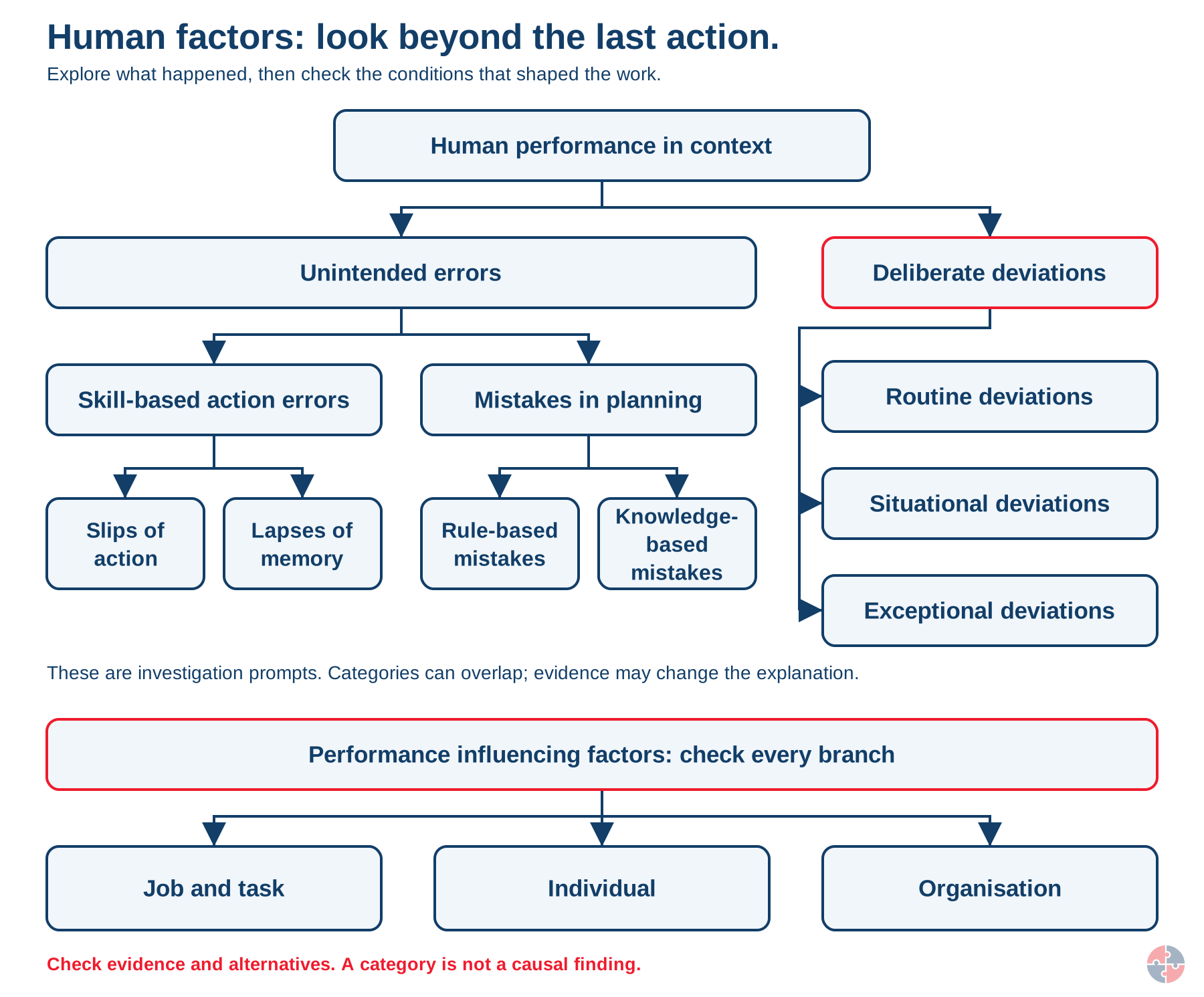
Original SHARElearn teaching overview. Arrows show groupings, not a causal sequence. Examples are fictional; no box establishes an actual cause, diagnosis or responsibility.
Inspect the full-size overview (new tab)
Start with the work context
Human performance in context
Human factors considers how the job, the individual and the organisation interact. A human action is a starting point for inquiry, not a complete explanation.
Fictional example: A pump control is operated incorrectly. The team examines what the operator could see, the control layout and the work arrangements.
Investigate and improve: Reconstruct the information and options available at the time. Ask what made the action understandable and what would prevent or tolerate it.
Unintended errors
An action or decision goes wrong without an intended departure from the expected method. Distinguish doing the wrong action from choosing an unsuitable plan.
Fictional example: A person intends to stop pump A but presses the adjacent control for pump B.
Investigate and improve: An outcome alone does not establish intent. Compare the person’s account, task sequence, equipment and available records; retain uncertainty.
Unintended errors: actions and decisions
Skill-based action errors
A familiar task is intended correctly but its execution goes wrong through a slip or lapse. Experienced people can be affected.
Fictional example: A routine restart is interrupted and the person resumes at the wrong point.
Investigate and improve: Examine distractions, task design and place-keeping aids. Repeating training alone does not remove the conditions that permit these errors.
Slips of action
The intended action is clear, but a different action is performed.
Fictional example: While reaching to stop a pump, a person operates a similar-looking neighbouring switch.
Investigate and improve: Check control spacing, identification, feedback, visibility and interruption. Consider clearer separation or error-tolerant design, with competent review and testing.
Lapses of memory
A needed step is forgotten or the person loses their place.
Fictional example: After an interruption, a person omits a required check while believing the sequence is complete.
Investigate and improve: Check the interruption and restart arrangements. Consider point-of-use prompts, reliable step records and proportionate independent checks for critical steps.
Mistakes in planning or judgement
The chosen action is carried out as intended, but the plan or judgement is unsuitable.
Fictional example: A person selects a familiar response to a warning, believing it fits the present conditions.
Investigate and improve: Check what was known, what the rule covered and how the situation was understood. Consider information, decision support and task-specific competence.
Rule-based mistakes
A remembered rule is misapplied, or an unsuitable rule is used. An apparently missing good rule also needs inquiry: was it known, understood and applicable?
Fictional example: A response suitable for pump A is applied to pump B even though their isolation requirements differ.
Investigate and improve: Inspect the actual procedure and its scope, access and revision. Explore interpretation. Missing a step does not by itself prove a deliberate deviation.
Knowledge-based mistakes
An unfamiliar situation is approached through reasoning without a suitable established solution; the resulting judgement is wrong.
Fictional example: An unusual pump condition is interpreted using incomplete information, leading to an inappropriate response.
Investigate and improve: Examine information gaps and available support. Improve escalation, diagnostic aids and arrangements for obtaining competent advice before uncertain work proceeds.
Deliberate deviations: understand why
Deliberate deviations / violations
A rule or procedure is knowingly departed from. The departure is intentional; harm need not be intended. Establish this distinction through evidence.
Fictional example: A required verification is knowingly bypassed to continue a task.
Investigate and improve: Ask why the rule was bypassed, whether it was workable and what the organisation encouraged or tolerated. Fair accountability and system improvements can both be needed.
Routine deviations
Departures become the usual way work is carried out.
Fictional example: A team commonly skips a required handover check and supervisors accept the practice.
Investigate and improve: Compare written arrangements with everyday work, including management knowledge and response. Make the safe method workable and verify that practice changes.
Situational deviations
A departure is associated with conditions such as time pressure, insufficient resources or unsuitable equipment. These conditions do not authorise unsafe work.
Fictional example: The correct equipment is unavailable and a deadline encourages an improvised shortcut.
Investigate and improve: Check resources, conflicting targets and whether people can stop and escalate. Remove the pressure or constraint rather than treating the shortcut as the solution.
Exceptional deviations
A departure occurs in unusual circumstances outside normal practice. This label is not an automatic justification.
Fictional example: During an unfamiliar equipment upset, a person knowingly bypasses a rule while trying to restore operation.
Investigate and improve: Reconstruct the situation and information available. Review abnormal-event preparation, support, escalation and protection; do not infer malicious intent from the outcome.
Check factors across every branch
Performance influencing factors
Conditions affecting performance can sit within the job, the individual or the organisation. Consider them across errors and deviations.
Fictional example: A difficult control layout combines with an interrupted shift and a production target.
Investigate and improve: Identify specific conditions, their evidence and how they interacted. Do not turn a list of factors into unsupported causal conclusions.
Job and task factors
Consider the work itself: equipment, interface design, instructions, workload, environment, timing and communication.
Fictional example: Two similar controls are poorly lit while alarms and interruptions compete for attention.
Investigate and improve: Observe representative work safely, compare intended and actual demands, and test feasible design changes with the people doing the task.
Individual factors
Consider relevant knowledge, experience, abilities and current needs fairly. Observed behaviour does not establish a health diagnosis or intent.
Fictional example: A newly assigned worker does not understand an unfamiliar alarm; a colleague also reports yawning after a long shift.
Investigate and improve: Check induction, understanding, shift and welfare information through appropriate private routes. Yawning alone proves neither fatigue nor the cause of an event; seek competent support when needed.
Organisational factors
Consider staffing, resources, supervision, targets, planning, culture, change management and learning from earlier events.
Fictional example: A known leak remains open because repair responsibility is unclear and closure is recorded without checking the work.
Investigate and improve: Trace decisions, ownership and earlier warnings. Improve the underlying arrangements and verify effectiveness, rather than closing the investigation at “operator error”.
Try the evidence questions
Choose one fictional pump or travel example. What is observed, what remains a hypothesis, which job or organisational factor needs checking, and what improvement would you test? Explain what evidence would change your view.
Explore at your own pace. These are optional thinking prompts: this page does not save answers, assess performance or create a learning record.
Sources and scope
Original SHARElearn overview informed by HSE guidance. The diagram groups concepts for learning; it does not model a causal sequence. Guidance checked 1 November 2026.
Continue with the incident and accident investigation course. The course outline explains its learning, optional reflections and completion requirements.
How can the same near miss reveal different cultures?
A near-miss scenario shows that culture is revealed by the organisational response, not the event itself.
A forklift nearly strikes a pedestrian where a temporary route crosses a warehouse aisle. No one is hurt. In a blame culture, the driver is criticised and told to be more careful. In a paperwork culture, a reminder is sent and a new sign is added. In a stronger culture, the team asks why the route changed, why the crossing was uncontrolled, how production pressure affected movement and what design control is needed. HSE organisational culture overview.
The mature response is not soft. It still expects people to follow rules, but it looks first for system conditions that made the unsafe situation possible and checks whether similar risks exist elsewhere.
| Stage | Weak handling | Stronger standard |
|---|---|---|
| Immediate response | Driver blamed for not looking. | Area made safe and temporary route reviewed. |
| Investigation question | Who caused it? | Why did this decision make sense at the time and what controls were missing? |
| Learning | Reminder issued to be careful. | Route design, shift pressure, supervision and communication reviewed. |
| Action | New warning sign added. | Physical separation and controlled crossing introduced. |
| Feedback | Workers hear nothing further. | Workers see what changed and why. |
| Wider review | No extent check. | Other temporary routes and vehicle interfaces sampled. |
What does weak and strong safety culture look like?
Culture is visible in routine decisions, not only in values statements.
A culture assessment should look at what happens when there is a conflict between safety, time, cost, quality and customer pressure. It should also look at how supervisors treat challenge, how quickly defects are fixed and whether leaders ask about serious risk controls. HSE organisational culture overview.
The strongest evidence comes from multiple sources: worker conversations, site observations, near-miss quality, action close-out, audit themes, leadership meeting minutes and incident learning.
| Culture signal | Weak culture | Strong culture |
|---|---|---|
| Bad news | Concerns are softened or hidden. | Bad news is welcomed early and acted on. |
| Production pressure | Controls are bent to keep the job moving. | Pressure is visible and risk trade-offs are escalated. |
| Near misses | Low reporting or blame-heavy follow-up. | High-quality reporting with verified learning. |
| Procedures | Procedures exist but are not workable. | Procedures are tested with users and improved. |
| Leadership questions | Main focus is injury rates and audit scores. | Leaders ask about critical controls, weak signals and unresolved risks. |
| Contractors | Contractor concerns are treated as external problems. | Contractors are part of reporting, briefing and learning loops. |
How does culture show what leaders tolerate?
Culture becomes visible in the gap between what leaders say matters and what they allow to continue.
The most useful culture diagnostic is often tolerance. If a leader says near misses matter but no one reports them, something in the system may be discouraging reporting. If a manager says permits are critical but repeated shortcuts are accepted, the tolerated behaviour becomes the real standard. HSE INDG417 leading health and safety.
This is not about blaming individual leaders for every weakness. It is about making leadership signals explicit: what gets funded, what gets challenged, what gets ignored, what gets praised and what receives consequences.
| Tolerated pattern | What it may reveal | Manager or leader next step |
|---|---|---|
| Low near-miss reporting | People may fear blame, see no action, find reporting too hard or believe managers do not want bad news. | Talk to workers, simplify reporting, protect fair treatment and feed back visible learning. |
| Repeated permit shortcuts | Production pressure, poor permit quality, weak supervision or normalised deviation may be stronger than the formal rule. | Stop the shortcut, review permit usability, check authorisation quality and sample similar jobs. |
| Production pressure overrides controls | Targets may be interpreted as more important than safe work standards. | Reset decision rights, resource the plan, document trade-offs and protect stop-work authority. |
| Ignored worker concerns | Worker voice may be treated as complaint rather than risk intelligence. | Assign owners, track actions, explain decisions and report themes to leadership. |
| Normalised defects | People have learned to work around failed lighting, guards, welfare, alarms, tools or fire doors. | Escalate defects by risk, apply temporary controls and verify repair quality. |
| Procedure workarounds | The written method may be unrealistic, out of date, too complex or unsupported by equipment and time. | Observe the task, involve users and revise the procedure or work design. |
| Contractor silence | Commercial pressure or weak interface management may discourage challenge. | Include contractors in briefings, reporting, committees and stop-work rules. |
Before interpreting low report counts, check the observation period, work exposure, event definition and alternative reporting channels, as well as trust and reporting burden. Triangulate worker accounts with the actual controls; do not set a target to inflate reporting.
Why culture is not posters and slogans
Campaigns can support culture, but they cannot substitute for trustworthy decisions and reliable controls.
Posters, values, pledges and slogans may help communicate priorities, but they do not repair failed equipment, reduce workload, redesign unsafe routes, create time for pre-start checks or make workers believe reporting is safe. HSE organisational culture overview. HSE organisational culture overview.
Culture work should therefore focus on the management system in action: resourcing, competence, supervision, procedure usability, action quality, assurance and the response to challenge.
| Activity | If used badly | If used well |
|---|---|---|
| Safety slogan | Creates surface optimism while risks remain unresolved. | Reinforces a visible control improvement. |
| Culture survey | Collects opinions but no action follows. | Feeds an action plan with worker feedback and review. |
| Safety walk | Photo opportunity with little technical challenge. | Leaders ask about controls, workload, defects and weak signals. |
| Award scheme | Rewards low injury reporting. | Recognises useful near misses, challenge and verified improvement. |
| Behaviour programme | Blames individuals for system conditions. | Uses human factors to improve work design and supervision. |
How does safety culture appear in different sectors?
Sector examples help learners see that culture is always local to the work and hazards.
Culture should be interpreted through the organisation's risk profile. A good culture in a process site includes chronic unease around major accident barriers. A good culture in care includes dignity, staffing, fatigue and reporting. A good culture in construction includes challenge around change, subcontractor interfaces and stop-work authority. HSE organisational culture overview.
The same cultural pattern can look different across sectors. Silence in an office may mean stress concerns are not raised. Silence on a process site may mean alarms, bypasses or leaks are normalised.
| Sector | Culture signal | Professional question |
|---|---|---|
| Construction | Workers accept edge protection gaps during short tasks. | Do supervisors stop work when temporary works or work-at-height controls change? |
| Warehouse/logistics | Pedestrians take shortcuts through vehicle routes. | Does the layout make safe movement easier than the shortcut? |
| Process safety | Alarms, bypasses or overdue proof tests become normal. | Do leaders understand barrier health and weak signals? |
| Care or healthcare | Staff skip breaks and accept violence or fatigue as part of the job. | Are staffing, escalation and support controls realistic? |
| Office or hybrid work | Stress, isolation or workload concerns are hidden. | Do managers notice work-design risks without prying into private health? |
| Contracted services | Contractors fear raising concerns will harm the contract. | Is challenge protected and built into interface meetings? |
When should safety culture concerns be escalated?
Escalation is needed when cultural signals suggest risk is being hidden, tolerated or misunderstood.
Culture concerns should be escalated when they point to control failure. A single comment may not prove a culture problem, but repeated patterns of silence, blame, poor close-out, informal workarounds or production pressure should trigger leadership attention.
Escalation should not be framed as 'people have bad attitudes'. The better question is: what conditions, incentives, constraints or leadership responses are shaping this behaviour?
| Trigger or question | Decision route | Escalate if |
|---|---|---|
| Near misses are not reported | Check trust, reporting burden, feedback quality and supervisor response. | Workers say reporting causes blame or no action. |
| Production pressure overrides controls | Review planning, resources, supervisor authority and stop-work routes. | People feel unsafe work is expected to meet targets. |
| Repeated audit findings | Test action quality and root causes. | Findings repeat across sites, shifts or contractors. |
| Workers fear raising concerns | Use confidential routes and leadership intervention. | Concerns involve retaliation, bullying or detriment. |
| Procedures are not followed | Review usability, competence, workload and equipment. | Workarounds are widespread or necessary to get work done. |
| Leaders focus only on injury rates | Add critical control, health, near miss and weak-signal indicators. | Serious risk controls are degraded despite good lagging metrics. |
Where does safety culture improvement commonly fail?
Culture programmes fail when they focus on messages and attitudes without changing work conditions, decisions and accountability.
A culture initiative can make things worse if it asks workers to speak up but then ignores the problems raised. Trust is built by visible follow-through.
Another failure is using culture language to blame frontline behaviour. A professional culture review asks how work is designed, led, resourced and reinforced.
| Failure or weak practice | How it develops | What good looks like |
|---|---|---|
| Survey without action | Workers give feedback but nothing changes. | Publish themes, actions and progress. |
| Blame disguised as culture | Unsafe acts are attributed to attitude. | Review job, individual and organisational factors. |
| Lagging-metric obsession | Zero injuries treated as proof of control. | Use leading indicators and serious-risk assurance. |
| Token worker involvement | People are consulted after decisions are made. | Involve workers early in design and change. |
| Middle-manager squeeze | Supervisors are expected to deliver impossible targets safely. | Review workload, resources and decision rights. |
| No contractor inclusion | Culture stops at the company boundary. | Include contractors in reporting, briefing and learning. |
| Poor feedback loops | Reports disappear into the system. | Close the loop with visible action and explanation. |
What evidence should safety culture hold?
Culture evidence should combine data, conversation, observation and leadership decisions.
Culture is not measured by a single score. Climate surveys, near-miss reports, action quality, audit themes, worker interviews, leadership minutes and field observations all provide partial evidence. The aim is to understand patterns.
Good evidence shows how cultural findings lead to real changes in control, planning, supervision or leadership review.
| Evidence item | What it should show | Assurance question |
|---|---|---|
| Risk assessment or technical assessment | Scope, hazards, affected people, control standard, residual risk, owner and review trigger. | Does it match current work, layout, people and equipment? |
| Action tracker | Actions, owners, priority, dates, interim controls and close-out evidence. | Are high-risk actions verified in the workplace, not just marked complete? |
| Training and briefing records | Who was trained or briefed, by whom, on what standard and how understanding was checked. | Can people explain the control and stop conditions? |
| Inspection and monitoring records | Planned checks, defects, trends, overdue items and corrective actions. | Do inspections sample the controls that prevent serious harm? |
| Incident and near-miss learning | Events, weak signals, investigations, themes and lessons applied. | Are repeated signals driving design or system improvement? |
| Management review | Trend, resources, assurance confidence, escalations and decisions. | Are leaders seeing real control confidence rather than activity counts alone? |
| Safety climate results | Worker perceptions of leadership, trust, communication, reporting and control. | Did results lead to action? |
| Worker voice records | Themes from reps, committees, listening sessions and concerns. | Are hard messages reaching leaders? |
| Near-miss quality review | Depth, openness, themes and action quality. | Are high-potential events identified? |
| Leadership decision evidence | Minutes, board packs, risk reviews and resource decisions. | Do leaders act on weak signals? |
| Procedure usability feedback | Evidence that frontline users help improve procedures. | Are workarounds treated as learning? |
How should safety culture be assured?
Assurance should test whether the organisation's stated values match decisions and behaviour under real pressure.
Culture assurance is not a beauty contest for positive attitudes. It should sample how managers respond to defects, how supervisors handle pressure, how workers raise concerns, how near misses are investigated and whether leaders resource the controls they say matter.
The most mature organisations examine senior leaders too. Leadership assumptions, commercial incentives and board reporting can all shape what people believe is truly valued.
| Assurance sample | What good looks like | Escalate if |
|---|---|---|
| Leadership walk-through | Leaders ask about risk, controls, weak signals and barriers. | Walk-throughs focus on housekeeping and photo opportunities only. |
| Worker interviews | Workers can describe controls, concerns and reporting routes. | Workers fear consequences or doubt action. |
| Action close-out | Actions remove system weaknesses and are verified. | Actions are reminders, posters or incomplete fixes. |
| Near-miss review | High-potential near misses are triaged and learned from. | Near misses are underreported or downgraded. |
| Procedure sampling | Procedures match real work and are improved after feedback. | Informal workarounds are normalised. |
| Board pack review | Leaders see critical risk, health, weak signals and action quality. | Board sees only lagging injury statistics. |
Before interviews, explain who receives raw comments, how identifiable examples and small-team aggregation are handled, and the limits of confidentiality. Escalate a serious current hazard while sharing only necessary information; offer an alternative responsible contact when the immediate manager is implicated. Do not promise anonymity that the narrative cannot sustain.
Which duties and guidance apply in Great Britain and Northern Ireland?
Use the instrument for the site, workforce and activity. Great Britain and Northern Ireland have separate duties, while HSE, HSENI and voluntary-standard guidance have different legal status.
Check current scope and amendments before applying a duty. Culture is an influence on how duties are performed, not a standalone offence or proof that a physical control works. Apply the GB or NI duty to the real hazard and check the relevant regulator source.
| Route | Direct instrument or guidance | Supporting source | Decision supported |
|---|---|---|---|
| GB general duties | Health and Safety at Work etc. Act 1974 | Management of Health and Safety at Work Regulations 1999 | Risk control and management duties apply; “culture” itself is not a standalone offence. |
| NI general duties | Health and Safety at Work (Northern Ireland) Order 1978 | Management of Health and Safety at Work Regulations (Northern Ireland) 2000 | Use the separate NI Order and management regulations. |
| GB regulator guidance | HSE organisational culture overview | HSE INDG417 leading health and safety | HSE describes culture, climate and leadership as practical management influences. |
| NI regulator guidance | HSENI taking responsibility | Health and Safety at Work (Northern Ireland) Order 1978 | HSENI addresses worker meetings and management responsibility under the NI route. |
How should management check this work?
Use a defined plan, carry out the controls, check performance and correct what does not work.
For safety culture, assign a competent owner to set the work controls, check their use and review them after change, failure or new evidence. HSE managing health and safety
A management-system label or certificate is not approval of a site limit, procedure or individual work decision. Apply GB and NI duties to the correct location.
What competence does each level need?
Train and assess each person for the decision they make; attendance alone is not proof of competent action.
Record the assessment, authorisation scope and reassessment trigger. A manager still needs to verify that the underlying control works in the field.
| Role | Learning to test | Demonstration, assessor, record and reassessment |
|---|---|---|
| New / nearby worker | Recognise reporting routes and stop concerns | Can report a live defect without relying on a slogan; induction record and follow-up after changes. |
| Frontline worker / representative | Describe work as done and challenge unsafe drift | Observed participation in route or task review; supervisor checks after a near miss. |
| Supervisor | Respond without blame and make a hold decision | Scenario exercise, record of physical correction and feedback; manager samples response. |
| Senior manager | Choose resources and incentives consistent with risk controls | Board/management decision record and closure of repeated high-risk defects. |
| Designer / change owner | Consult workers and prefer redesign over reminders | Walk-through of changed work and engineering verification before opening. |
| Safety adviser / auditor | Triangulate survey, interviews, observation and control tests | Evidence-based sampling, confidentiality and action validation; peer checks conclusions. |
How could Riverside Leisure Ltd manage this in practice?

Riverside would assess safety culture through leadership behaviours, worker voice, incident learning, contractor interface and the quality of everyday controls.
In a leisure business, culture shows in how managers respond to pool plant defects, customer aggression, manual handling shortcuts, fire-door damage, contractor concerns and staff workload. Riverside would use worker feedback and assurance data to target real improvements.
| Management element | How the business would manage it | Evidence to review |
|---|---|---|
| Listen | Gather worker and contractor voice. | Reps, committee and listening records. |
| Observe | Watch work and supervisor decisions. | Safety walk and field notes. |
| Act | Fix work-design and management-system weaknesses. | Action plan. |
| Verify | Check whether workers experience improvement. | Follow-up interviews and assurance. |
| Review | Report culture and control confidence to leaders. | Management review pack. |
What do the acronyms and key terms mean?
These terms identify different legal or operational decisions.
| Term | Full expression | Meaning here |
|---|---|---|
| Culture | Shared pattern of decisions and practices | Deeper conditions shaping work over time. |
| Climate | Current perceptions of safety | A survey snapshot, not direct proof of control effectiveness. |
| Just culture | Fair response to human actions | Distinguishes system conditions and choices while retaining accountability. |
| Leading indicator | Signal about control before harm | For example critical-defect closure quality, interpreted with field evidence. |
| Lagging indicator | Outcome after harm or loss | Incident rates cannot alone show current barrier strength. |
| HSE | Health and Safety Executive | GB regulator and guidance source. |
Unlock another resource
You have used this month’s two free downloads. Publish a post in your own words to unlock one more resource, or choose SHARE Individual for 10 downloads per month.
You decide whether to share. If you do, use the relevant platform disclosure tools and do not make claims you do not genuinely hold.