SHARE Knowledge Hub
Managing change and procedures
A changed design, sequence, workforce or workface can make a construction procedure unsafe even if the document is signed. Reassess the actual job, revise the controls and brief the people affected before work continues.
Owner: SHARE Knowledge Hub editorial team.
Understanding Managing change and procedures
A changed design, sequence, workforce or workface can make a construction procedure unsafe even if the document is signed. Reassess the actual job, revise the controls and brief the people affected before work continues.
Why this matters at work
Choose investigation depth based on actual and potential consequence, uncertainty and opportunity for learning. A near miss with a falling object over a public route may deserve a deeper analysis than a minor injury with an already understood cause.
Use both. A low injury rate on a short project may be random or reflect under-reporting, while a high permit completion percentage may hide ineffective isolations. Interpret indicators alongside risk exposure and the seriousness of potential harm.
How organisations manage this in practice
During pre-construction, designers and the principal designer where appointed can eliminate or reduce foreseeable risks and provide information about significant residual hazards. The client must make suitable arrangements and provide relevant pre-construction information. The principal contractor then plans, manages, monitors and coordinates the construction phase where appointed.
Use the hierarchy of control and select measures that fit the site: substitute a safer technique, design a physical boundary, isolate energy, control dust at source, provide lifting equipment, then specify procedural checks and PPE for remaining risk. Verify that one measure does not create another hazard.
A construction phase plan is required for every construction project before the construction phase begins, proportionate to the work. The principal contractor leads the plan on multi-contractor projects and a single contractor does so on a single-contractor project. The plan is not a permit or a substitute for a safe method.
Follow the event through failed or missing barriers into design and organisational causes. Close actions on demonstrated effectiveness, rather than on issue of another instruction. Consider design, maintenance, competence, supervision, workload, contractor interface and change control. A causal model should lead to actionable prevention and mitigation, not a decorative diagram.
Suspension means the work has lost its current authority to proceed. Extension requires a fresh check of conditions; handback requires verified restoration and acceptance. Leave the worksite in a safe state and communicate the status. An expiry is a control, not a clerical inconvenience that can be extended without review. Before extension or reissue, check current conditions, isolation, simultaneous work and competence. Re-brief the team and repeat tests where required. A changed scope demands a new assessment, even if the permit number remains the same. On completion, inspect the as-left area, account for people and tools, remove temporary supplies and restore equipment or services by authorised people. Test the restored function and inform the receiving operator or occupier. Close and archive the permit only after handback is accepted. A completed contractor task does not prove a fire alarm, ventilation unit or machine is ready for ordinary use.
Reassess the relocated work before using the old method
Moving storage and cutting to another floor can obstruct escape, expose neighbours or cross a permit boundary. The previous procedure may no longer describe the actual work.

Find the differences
Compare space, escape, adjacent people, exposure and work/permit boundaries with the earlier task.
Reassess and authorise
Hold affected work until competent assessment resolves the changes and the appropriate method and controls are authorised.
Brief and verify
Withdraw superseded instructions, brief affected shifts and check the revised method in use.
A document with a current date is not evidence that its assumptions match the changed workplace.
How can I practise this topic in 3D?
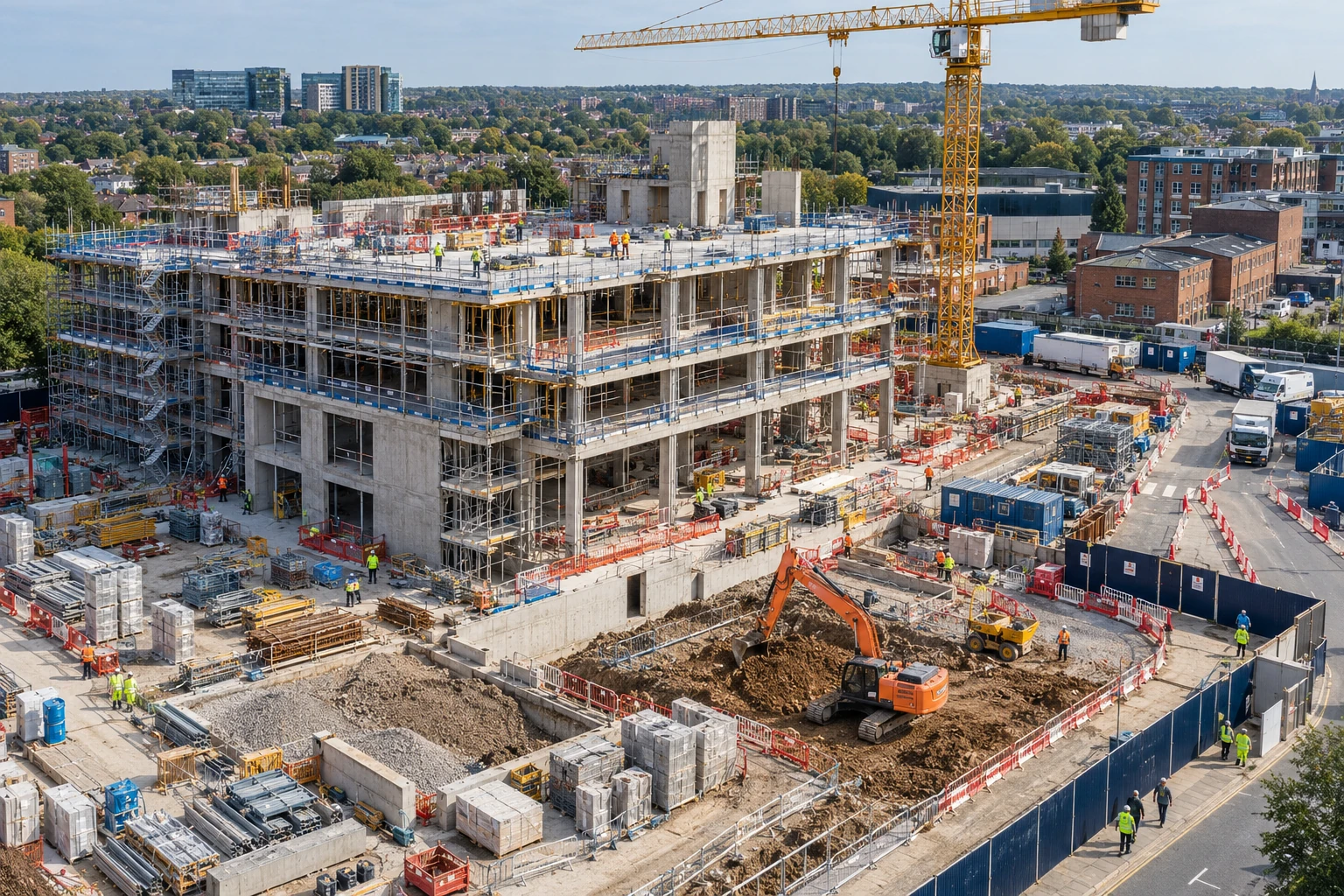

A relocated haul road defeats several plans
All related inspection points 1 across 1 location
Construction site 1 inspection point
Practice in the SHAREhub environment. Browser practice is separate from workplace competence and formal learning records.
What does managing change and procedures mean on a construction project?
Check whether a changed design, sequence, workforce, workface or method invalidates the construction plan; revise controls and brief people before work continues.
A new roof opening, late service diversion, changed subcontractor or altered public access can create a harm route absent from the old method. Define the before and after state, who is exposed, the decision owner and the physical stop point. The construction phase plan and site rules must reflect the actual work. HSE CDM 2015 duties and roles and HSE construction site rules and induction.
Great Britain (GB) uses the Construction (Design and Management) Regulations 2015 (CDM 2015); Northern Ireland (NI) has separate CDM (NI) 2016 regulations. Not every workplace change is construction work: establish activity scope first. Construction (Design and Management) Regulations 2015 and Construction (Design and Management) Regulations (NI) 2016.
How can a changed procedure cause harm?
An old procedure can describe the wrong opening, isolation, sequence or rescue route. Its signature is not proof that the workface is safe.
Safe system and permit have different jobs


Read the complete visual as text
- Risk assessment and safe system: Identify harm, choose controls and define how the specific task will be done safely.
- Permit coordination: Where required, a bounded permit coordinates task, place, people, isolation, interfaces, period and rescue arrangements.
- Physical verification: A permit is not proof of isolation or safe entry. Suspend on changed scope, shift, isolation or conditions; inspect hand-back and do not equate closure with restart.
Suppose a rooflight opening moves after the permit is issued, while the building remains occupied. A worker may fall through; material may strike occupants below; hot work can start a fire. The permit must be rechecked against the physical opening, protection, people and simultaneous work. HSE roof work and openings, HSE construction site rules and induction and HSE permit-to-work systems.
| Stage | Changed risk | Control decision |
|---|---|---|
| Trigger | Rooflight opening moved and occupied area remains open. | Reassess access and people below.Sources: HSE roof work and openings; HSE construction site rules and induction |
| Exposure | Guarding planned for a later shift. | Hold work until a designed cover or guard is proved.Sources: HSE roof work and openings; HSE construction site rules and induction |
| Procedure | Permit describes the former cut. | Reissue the permit and method with current isolation and fire controls.Sources: HSE roof work and openings; HSE construction site rules and induction |
| Escalation | Fall, dropped object or fire affects workers and occupants. | Test rescue, evacuation and communication before restart.Sources: HSE roof work and openings; HSE construction site rules and induction |
Which changes need a screen?
Screen design, sequence, location, plant, material, contractor, workforce, temporary works, access, permit boundary and emergency assumptions.
Changed workface: difference, reassessment and restart
2 linked parts. Follow the question numbers and complete the applicable route.
Part 1 of 2 · Questions 1–3

Continue · Part 2 of 2 · Questions 4–6


Read the complete visual as text
- Start: Actual ground, design, sequence, weather, crew, plant or neighbouring activity differs from the approved plan.
- Question 1: Is there an active release, fire, explosion, exposure or other immediate danger? Decision owner: Person discovering the danger and site emergency lead.
- YES • EMERGENCY: Raise the alarm, warn others, withdraw to safety and follow the local emergency plan now. Do not wait for the change or reporting paperwork. Owner: Person discovering the danger and site emergency lead. STOP / REFER → APPROPRIATE RESPONSE.
- NO: Keep the system in a protected state and examine the affected work decision. Owner: Person discovering the danger and site emergency lead. CONTINUE → QUESTION 2.
- UNKNOWN: Protect people from the possible hazard and obtain the site emergency/competent response from a safe position. Do not enter or restart to find out. Owner: Person discovering the danger and site emergency lead. STOP / REFER → APPROPRIATE RESPONSE.
- Question 2: Is there a material difference from the verified approved method and control assumptions? Decision owner: Supervisor and competent work owner.
- YES: Hold the affected step and name the competent design/supervision owner for reassessment. Owner: Supervisor and competent work owner. CONTINUE → QUESTION 3.
- NO: Record the checked comparison and continue only under the verified existing safe system. Owner: Supervisor and competent work owner. OUTCOME → RECORD AND HAND OVER.
- UNKNOWN: Hold the affected step until drawings, phase plan, permit and workface are reconciled. Owner: Supervisor and competent work owner. HOLD → REPEAT QUESTION 2 AFTER CORRECTION.
- Question 3: Are everyone affected and interacting trades, occupants or adjacent activities included? Decision owner: Principal contractor/coordination owner as applicable.
- YES: Coordinate changed design and work risks with the people doing and affected by the task. Owner: Principal contractor/coordination owner as applicable. CONTINUE → QUESTION 4.
- NO • HOLD: Keep the affected step held; identify and coordinate all affected work and people. Owner: Principal contractor/coordination owner as applicable. HOLD → REPEAT QUESTION 3 AFTER CORRECTION.
- UNKNOWN • HOLD: Hold the affected decision while the owner resolves the missing evidence. Keep the affected step held; identify and coordinate all affected work and people. Owner: Principal contractor/coordination owner as applicable. HOLD → REPEAT QUESTION 3 AFTER CORRECTION.
- Question 4: Has competent reassessment changed the source controls and safe method for the real conditions? Decision owner: Design/technical owner and supervisor.
- YES: Revise the controls, phase information and relevant permit/procedure. Owner: Design/technical owner and supervisor. CONTINUE → QUESTION 5.
- NO • HOLD: Continue the hold and redesign controls; an old signed method cannot override a failed field control. Owner: Design/technical owner and supervisor. HOLD → REPEAT QUESTION 4 AFTER CORRECTION.
- UNKNOWN • HOLD: Hold the affected decision while the owner resolves the missing evidence. Continue the hold and redesign controls; an old signed method cannot override a failed field control. Owner: Design/technical owner and supervisor. HOLD → REPEAT QUESTION 4 AFTER CORRECTION.
- Question 5: Are revised controls, documents, crew competence and emergency arrangements verified at the workface? Decision owner: Competent supervisor and relevant specialists.
- YES: Brief affected people and reinspect the actual task before a restart decision. Owner: Competent supervisor and relevant specialists. CONTINUE → QUESTION 6.
- NO • HOLD: Keep the step held; complete documents, briefing, emergency readiness and field verification. Owner: Competent supervisor and relevant specialists. HOLD → REPEAT QUESTION 5 AFTER CORRECTION.
- UNKNOWN • HOLD: Hold the affected decision while the owner resolves the missing evidence. Keep the step held; complete documents, briefing, emergency readiness and field verification. Owner: Competent supervisor and relevant specialists. HOLD → REPEAT QUESTION 5 AFTER CORRECTION.
- Question 6: Has the named responsible receiving authority accepted the defined safe state? Decision owner: Named work/permit receiving authority.
- YES: Record the bounded restart and monitor for further change. Owner: Named work/permit receiving authority. OUTCOME → RECORD AND HAND OVER.
- NO • HOLD: Remain held with a named owner and safe state; obtain the missing acceptance after evidence is resolved. Owner: Named work/permit receiving authority. HOLD → REPEAT QUESTION 6 AFTER CORRECTION.
- UNKNOWN • HOLD: Hold the affected decision while the owner resolves the missing evidence. Remain held with a named owner and safe state; obtain the missing acceptance after evidence is resolved. Owner: Named work/permit receiving authority. HOLD → REPEAT QUESTION 6 AFTER CORRECTION.
- Outcome: Controlled restart with field evidence or continued hold. Keep design, coordination, permit and contractor responsibilities distinct.
- Stop and escalation boundary: Use the actual workface and applicable GB or NI law. A signed form, permit, course or certificate is not proof of a safe control. No universal staffing ratio, weather, excavation, rescue or temporary-change limit is supplied.
Compare the drawing, phase plan, permit and actual workface. Include cumulative change: a new crew, late roof penetration and altered delivery route may interact. A verbal “minor change” classification needs a competent basis. Hold the activity while the boundary is unknown. HSE CDM 2015 duties and roles and HSE construction site rules and induction.
How should the changed method be reviewed?
Walk the changed task with the people doing it; identify source, exposed people, stronger controls, interfaces and proof needed before release.
Designers share changed design risk; the principal contractor coordinates a multi-contractor construction phase; each contractor controls its own work. Include occupants, visitors and adjacent trades. Match review depth to the possible harm and check whether the phase plan and pre-construction information still fit. HSE CDM 2015 duties and roles and HSENI CDM (NI) 2016 overview.
| Input | Question | Release proof |
|---|---|---|
| Design | What differs from the approved drawing? | Marked-up design and agreed method.Sources: HSE CDM 2015 duties and roles; HSE construction site rules and induction |
| Interfaces | Who enters the workface or area below? | Access and exclusion walked.Sources: HSE CDM 2015 duties and roles; HSE construction site rules and induction |
| Energy | Which plant or service must be isolated? | Isolation and permit boundary proved.Sources: HSE CDM 2015 duties and roles; HSE construction site rules and induction |
| Emergency | Can rescue and evacuation work now? | Competent scenario walk-through.Sources: HSE CDM 2015 duties and roles; HSE construction site rules and induction |
Name design coordination during construction
On a multi-contractor project, the principal designer coordinates continuing design risk work and passes changed information to the principal contractor; individual designers retain their own duties. Identify who updates information for later cleaning/maintenance and the health and safety file. The principal contractor coordinates construction; the task supervisor controls the workface. The permit issuer does not become the design approver. HSE: principal designers.
How can the hierarchy of controls control risks when work methods and procedures change?
Use the design and method review to avoid hazardous roof access first. A permit or revised instruction records controlled work; it does not make an unsafe roof or unsupported design acceptable.
Illustrative decision: a late rooflight design change requires a different installation method on a construction project. The designer, relevant principal dutyholders and specialist contractor review access, fragile surfaces, lifting, weather and rescue before revising the plan.
ERICPD means Eliminate, Reduce (including substitution), Isolate, Control, PPE and Discipline. The five-level hierarchy groups measures as elimination, substitution, engineering controls, administrative controls and PPE. They overlap: isolation is usually an engineering measure; control can include engineered and administrative measures. Discipline means maintaining and checking the controls, supervising the method and learning from defects, rather than blaming someone or accepting weaker protection.
How can the ERICPD hierarchy of controls control risks when work methods and procedures change?

| ERICPD and five-level position | Intervention and owner | Verification, failure and stop point |
|---|---|---|
| Eliminate / elimination | The designer and contractor examine installation or assembly from ground level, or a design that removes the need for hazardous roof access. | Confirm the revised design and method truly remove the identified exposure. Check transferred lifting and handling risks; no unreviewed improvisation is released. |
| Reduce / substitution when replacing a hazard; otherwise engineering or administrative risk reduction | Compare suitable alternative components and methods that reduce fragility, manual handling or time exposed, without compromising the design or introducing another hazard. | Keep the design acceptance and compatibility evidence. A claimed stronger component is not an approved walking surface without competent evidence. |
| Isolate / engineering | Competent people specify suitable access, working platforms, edge protection and protection from fragile surfaces for the actual roof and task. | Verify installation and condition before use through safe checks. Unknown roof support, incomplete protection or unsuitable access holds work. |
| Control / administrative | Site management coordinates the changed method, lifting interfaces, exclusion, weather limits, competence and emergency/rescue arrangements. Update affected plans and brief workers. | Check work as planned can be performed and that the correct version is available. A permit does not replace physical safeguards or rescue capability; changed conditions return to review. |
| PPE / PPE | Assess residual protection; any personal fall protection needs suitable anchorage, equipment, competence and a workable rescue arrangement. | Check the specified system and user competence before exposure. Do not presume a harness alone prevents injury or provides rescue. |
| Discipline / sustained engineering and administrative controls | The supervisor keeps protection effective, checks handover and stops unauthorised method changes. Designers resolve changes affecting the design. | Record defects, corrective action and named release. A displaced guard, new opening or unexplained change suspends the affected task. |
How can the ISO 45001 hierarchy of controls control risks when work methods and procedures change?

| ERICPD and five-level position | Intervention and owner | Verification, failure and stop point |
|---|---|---|
| Eliminate / elimination | The designer and contractor examine installation or assembly from ground level, or a design that removes the need for hazardous roof access. | Confirm the revised design and method truly remove the identified exposure. Check transferred lifting and handling risks; no unreviewed improvisation is released. |
| Reduce / substitution when replacing a hazard; otherwise engineering or administrative risk reduction | Compare suitable alternative components and methods that reduce fragility, manual handling or time exposed, without compromising the design or introducing another hazard. | Keep the design acceptance and compatibility evidence. A claimed stronger component is not an approved walking surface without competent evidence. |
| Isolate / engineering | Competent people specify suitable access, working platforms, edge protection and protection from fragile surfaces for the actual roof and task. | Verify installation and condition before use through safe checks. Unknown roof support, incomplete protection or unsuitable access holds work. |
| Control / administrative | Site management coordinates the changed method, lifting interfaces, exclusion, weather limits, competence and emergency/rescue arrangements. Update affected plans and brief workers. | Check work as planned can be performed and that the correct version is available. A permit does not replace physical safeguards or rescue capability; changed conditions return to review. |
| PPE / PPE | Assess residual protection; any personal fall protection needs suitable anchorage, equipment, competence and a workable rescue arrangement. | Check the specified system and user competence before exposure. Do not presume a harness alone prevents injury or provides rescue. |
| Discipline / sustained engineering and administrative controls | The supervisor keeps protection effective, checks handover and stops unauthorised method changes. Designers resolve changes affecting the design. | Record defects, corrective action and named release. A displaced guard, new opening or unexplained change suspends the affected task. |
The comparison is an original illustrative application of the general HSE hierarchy, not a machine-specific method, permit or design approval. The employer must choose measures for the actual work and jurisdiction. Apply the separate Northern Ireland legal route where relevant; the local assessment and competent technical decision govern release.
What does a permit to work control?
A permit communicates and authorises a defined higher-risk task for a specific time and place; it does not make unsafe design, isolation or access safe.
Permit: verify, issue, suspend and hand back
2 linked parts. Follow the question numbers and complete the applicable route.
Part 1 of 2 · Questions 1–4

Continue · Part 2 of 2 · Questions 5–7


Read the complete visual as text
- Start: A site rule or assessed higher-risk task calls for permit control. The permit supports a risk assessment and does not make failed design, isolation or access safe.
- Question 1: Are the work, location, plant, people, period, issuer and receiver clearly defined? Decision owner: Competent permit issuer and receiver.
- YES: Check the defined scope at the workface before issue. Owner: Competent permit issuer and receiver. CONTINUE → QUESTION 2.
- NO • HOLD: Do not issue; define the bounded work, people and authority before repeating this check. Owner: Competent permit issuer and receiver. HOLD → REPEAT QUESTION 1 AFTER CORRECTION.
- UNKNOWN • HOLD: Hold the affected decision while the owner resolves the missing evidence. Do not issue; define the bounded work, people and authority before repeating this check. Owner: Competent permit issuer and receiver. HOLD → REPEAT QUESTION 1 AFTER CORRECTION.
- Question 2: Are required isolations and critical precautions proved at the workface? Decision owner: Permit issuer and competent isolation/control owners.
- YES: Retain field evidence and check linked work. Owner: Permit issuer and competent isolation/control owners. CONTINUE → QUESTION 3.
- NO • HOLD: Do not issue; hold the task and prove the missing isolation or critical precaution. Owner: Permit issuer and competent isolation/control owners. HOLD → REPEAT QUESTION 2 AFTER CORRECTION.
- UNKNOWN • HOLD: Hold the affected decision while the owner resolves the missing evidence. Do not issue; hold the task and prove the missing isolation or critical precaution. Owner: Permit issuer and competent isolation/control owners. HOLD → REPEAT QUESTION 2 AFTER CORRECTION.
- Question 3: Have other permits, simultaneous work and shift/site interfaces been coordinated? Decision owner: Permit coordinator, issuer and affected supervisors.
- YES: Resolve permit links and communicate the shared boundaries. Owner: Permit coordinator, issuer and affected supervisors. CONTINUE → QUESTION 4.
- NO • HOLD: Do not issue; resolve conflicts and make every affected party aware of the work. Owner: Permit coordinator, issuer and affected supervisors. HOLD → REPEAT QUESTION 3 AFTER CORRECTION.
- UNKNOWN • HOLD: Hold the affected decision while the owner resolves the missing evidence. Do not issue; resolve conflicts and make every affected party aware of the work. Owner: Permit coordinator, issuer and affected supervisors. HOLD → REPEAT QUESTION 3 AFTER CORRECTION.
- Question 4: Are applicable escape, rescue and emergency provisions ready? Decision owner: Issuer with emergency/rescue competent lead.
- YES: Confirm task-specific arrangements before issue. Owner: Issuer with emergency/rescue competent lead. CONTINUE → QUESTION 5.
- NO • HOLD: Do not issue; hold the affected task until practical emergency provisions are ready. Owner: Issuer with emergency/rescue competent lead. HOLD → REPEAT QUESTION 4 AFTER CORRECTION.
- UNKNOWN • HOLD: Hold the affected decision while the owner resolves the missing evidence. Do not issue; hold the affected task until practical emergency provisions are ready. Owner: Issuer with emergency/rescue competent lead. HOLD → REPEAT QUESTION 4 AFTER CORRECTION.
- Question 5: Have competent issuer and receiver agreed conditions and understanding? Decision owner: Competent permit issuer and receiver.
- YES: Issue only the bounded permit under the site system and monitor changes. Owner: Competent permit issuer and receiver. CONTINUE → QUESTION 6.
- NO • HOLD: Do not issue; resolve understanding, authority and the permit conditions. Owner: Competent permit issuer and receiver. HOLD → REPEAT QUESTION 5 AFTER CORRECTION.
- UNKNOWN • HOLD: Hold the affected decision while the owner resolves the missing evidence. Do not issue; resolve understanding, authority and the permit conditions. Owner: Competent permit issuer and receiver. HOLD → REPEAT QUESTION 5 AFTER CORRECTION.
- Question 6: Has scope, shift, isolation or the site condition changed during work? Decision owner: Permit receiver and issuer.
- YES: Suspend the affected permit, leave the task safe, reassess the changed state and re-authorise under the site system. Owner: Permit receiver and issuer. HOLD → REPEAT QUESTION 1 AFTER CORRECTION.
- NO: Maintain the agreed controls and monitoring; use the hand-back check when work is complete. Owner: Permit receiver and issuer. CONTINUE → QUESTION 7.
- UNKNOWN: Suspend the affected work; confirm the actual boundary and controls before any new permit decision. Owner: Permit receiver and issuer. HOLD → REPEAT QUESTION 1 AFTER CORRECTION.
- Question 7: Is the work and plant condition inspected for a safe hand-back? Decision owner: Permit receiver, issuer and receiving plant/site owner.
- YES: Record the hand-back and permit closure under the site system, distinguishing it from operating restart. Owner: Permit receiver, issuer and receiving plant/site owner. OUTCOME → RECORD AND HAND OVER.
- NO • HOLD: Keep the affected plant/task held; correct or own defects and reinspect before closure. Owner: Permit receiver, issuer and receiving plant/site owner. HOLD → REPEAT QUESTION 7 AFTER CORRECTION.
- UNKNOWN • HOLD: Hold the affected decision while the owner resolves the missing evidence. Keep the affected plant/task held; correct or own defects and reinspect before closure. Owner: Permit receiver, issuer and receiving plant/site owner. HOLD → REPEAT QUESTION 7 AFTER CORRECTION.
- Outcome: Inspected hand-back and permit closure, or a continued hold. Permit closure is not automatic operating restart.
- Stop and escalation boundary: Use the actual workface and applicable GB or NI law. A signed form, permit, course or certificate is not proof of a safe control. No universal staffing ratio, weather, excavation, rescue or temporary-change limit is supplied.
Name work, location, plant, time, issuer, acceptor and handback. Prove isolation and conflicting-work controls. Hot work, electrical/mechanical isolation and hazardous cutting may need a permit. Change of workface or conditions requires a fresh decision. HSE permit-to-work systems.
Keep authorisation and physical handover together
Suspend/cancel or revalidate the old authorisation through the site’s controlled process. Reconcile linked permits and isolation ownership before new release. At a shift boundary, record the condition of the unfinished workface, physical protection and the incoming supervisor’s acceptance. Reissuing paper does not close an old live authorisation.
How should safe systems and site rules be updated?
Revise the workface instruction: sequence, access, equipment, isolation, checks, stop conditions and emergency action. Brief the current version before work.
For construction work within CDM, keep the construction phase plan current; keep the task method statement aligned with it. Make client-premises and construction rules clear, including hot work, traffic, restricted areas and emergency arrangements. Observe whether people can follow the method rather than relying on signatures. HSE construction site rules and induction and HSE CDM 2015 duties and roles.
When must emergency arrangements change?
Recheck escape, rescue, first aid, fire response and communication whenever changed work or occupancy could invalidate the old plan.
The changing workface


Read the complete visual as text
- Compare plan and reality: Ground, design, sequence, weather, crew, plant and neighbouring work can invalidate the agreed method.
- Hold the changed step: Protect people, name a competent change owner and reassess effects on other trades, services, routes and health exposures.
- Verify before restart: Coordinate and revise controls and documents. Field evidence and named release are required; no material difference must also be evidenced, not assumed.
Emergency plan follows the site


Read the complete visual as text
- Changed occupation or workface: Reassess escape, alarm coverage, accounting, responder access and specialist rescue as routes, occupancy and work height change.
- Make arrangements usable: Provide trained coverage and suitable equipment, brief affected shifts and update induction and plans.
- Test and correct: An impaired route or unavailable response holds affected work or occupancy. An active emergency invokes immediate response before plan revision.
Changed site emergency plan: capacity before occupancy
2 linked parts. Follow the question numbers and complete the applicable route.
Part 1 of 2 · Questions 1–3

Continue · Part 2 of 2 · Questions 4–6


Read the complete visual as text
- Start: A route, occupancy, fire load, elevated workface, access or specialist rescue need changes.
- Question 1: Is there an active release, fire, explosion, exposure or other immediate danger? Decision owner: Person discovering the danger and site emergency lead.
- YES • EMERGENCY: Raise the alarm, warn others, withdraw to safety and follow the local emergency plan now. Do not wait for the change or reporting paperwork. Owner: Person discovering the danger and site emergency lead. STOP / REFER → APPROPRIATE RESPONSE.
- NO: Keep the system in a protected state and examine the affected work decision. Owner: Person discovering the danger and site emergency lead. CONTINUE → QUESTION 2.
- UNKNOWN: Protect people from the possible hazard and obtain the site emergency/competent response from a safe position. Do not enter or restart to find out. Owner: Person discovering the danger and site emergency lead. STOP / REFER → APPROPRIATE RESPONSE.
- Question 2: Can every affected person escape safely and be accounted for? Decision owner: Site emergency lead and work/occupancy owners.
- YES: Check construction crews, occupants, visitors and changed routes. Owner: Site emergency lead and work/occupancy owners. CONTINUE → QUESTION 3.
- NO • HOLD: Hold affected work or occupancy; restore the route or redesign the arrangement. Owner: Site emergency lead and work/occupancy owners. HOLD → REPEAT QUESTION 2 AFTER CORRECTION.
- UNKNOWN • HOLD: Hold the affected decision while the owner resolves the missing evidence. Hold affected work or occupancy; restore the route or redesign the arrangement. Owner: Site emergency lead and work/occupancy owners. HOLD → REPEAT QUESTION 2 AFTER CORRECTION.
- Question 3: Can the alarm and communication reach everyone in the changed arrangement? Decision owner: Emergency/communications lead.
- YES: Check both occupied and construction areas and affected shifts. Owner: Emergency/communications lead. CONTINUE → QUESTION 4.
- NO • HOLD: Hold affected work/occupancy; correct communication and prove coverage. Owner: Emergency/communications lead. HOLD → REPEAT QUESTION 3 AFTER CORRECTION.
- UNKNOWN • HOLD: Hold the affected decision while the owner resolves the missing evidence. Hold affected work/occupancy; correct communication and prove coverage. Owner: Emergency/communications lead. HOLD → REPEAT QUESTION 3 AFTER CORRECTION.
- Question 4: Are trained responders, necessary equipment and access ready for the foreseeable emergency or rescue? Decision owner: Emergency/rescue competent lead.
- YES: Verify the practical response; a call to emergency services alone is not the rescue plan for foreseeable suspended-worker rescue. Owner: Emergency/rescue competent lead. CONTINUE → QUESTION 5.
- NO • HOLD: Hold affected work or occupancy until the practical response, equipment, trained people and access are ready. Owner: Emergency/rescue competent lead. HOLD → REPEAT QUESTION 4 AFTER CORRECTION.
- UNKNOWN • HOLD: Hold the affected decision while the owner resolves the missing evidence. Hold affected work or occupancy until the practical response, equipment, trained people and access are ready. Owner: Emergency/rescue competent lead. HOLD → REPEAT QUESTION 4 AFTER CORRECTION.
- Question 5: Are plans, induction and briefings updated for every affected shift? Decision owner: Site manager and supervisors.
- YES: Brief the actual changed routes and response responsibilities. Owner: Site manager and supervisors. CONTINUE → QUESTION 6.
- NO • HOLD: Keep affected work/occupancy held until people understand the revised arrangements. Owner: Site manager and supervisors. HOLD → REPEAT QUESTION 5 AFTER CORRECTION.
- UNKNOWN • HOLD: Hold the affected decision while the owner resolves the missing evidence. Keep affected work/occupancy held until people understand the revised arrangements. Owner: Site manager and supervisors. HOLD → REPEAT QUESTION 5 AFTER CORRECTION.
- Question 6: Have the changed arrangements been tested and deficiencies corrected? Decision owner: Emergency lead and responsible receiving manager.
- YES: Record verified emergency capacity and the next review/change trigger. Owner: Emergency lead and responsible receiving manager. OUTCOME → RECORD AND HAND OVER.
- NO • HOLD: Continue the hold with a named lead; correct and retest the failed arrangements. Owner: Emergency lead and responsible receiving manager. HOLD → REPEAT QUESTION 6 AFTER CORRECTION.
- UNKNOWN • HOLD: Hold the affected decision while the owner resolves the missing evidence. Continue the hold with a named lead; correct and retest the failed arrangements. Owner: Emergency lead and responsible receiving manager. HOLD → REPEAT QUESTION 6 AFTER CORRECTION.
- Outcome: Verified emergency capacity or continued hold. Active danger takes the immediate emergency branch and does not wait for plan revision.
- Stop and escalation boundary: Use the actual workface and applicable GB or NI law. A signed form, permit, course or certificate is not proof of a safe control. No universal staffing ratio, weather, excavation, rescue or temporary-change limit is supplied.
At an occupied refurbishment, confirm construction crews and occupants hear the alarm and can use safe routes. Roof work needs practical rescue where a personal fall system is used. Do not assume a call to emergency services alone resolves a foreseeable suspended-worker rescue. HSE construction site rules and induction and HSE roof work and openings.
How should an incident or near miss change the procedure?
Make the situation safe, gather evidence, analyse why controls failed, select stronger corrective action and verify implementation.
HSG245 separates information gathering, analysis, control selection and action. Ask whether the drawing was current, guard available, shift brief credible and interface controlled, rather than ending at “worker failed to follow the method”. HSE HSG245 Investigating accidents and incidents.
How do incident-reporting routes differ in GB and NI?
Assess reporting under the jurisdiction-specific RIDDOR regime while making the situation safe and investigating causes; an internal near-miss log is not a statutory report.
Incident: protect people, select territory, report and learn
2 linked parts. Follow the question numbers and complete the applicable route.
Part 1 of 2 · Questions 1–3

Continue · Part 2 of 2 · Questions 4–6


Read the complete visual as text
- Start: A construction injury, dangerous occurrence, occupational disease or near miss is reported. Reporting and investigation proceed as separate responsibilities.
- Question 1: Is there an active release, fire, explosion, exposure or other immediate danger? Decision owner: Person discovering the danger and site emergency lead.
- YES • EMERGENCY: Raise the alarm, warn others, withdraw to safety and follow the local emergency plan now. Do not wait for the change or reporting paperwork. Owner: Person discovering the danger and site emergency lead. STOP / REFER → APPROPRIATE RESPONSE.
- NO: Keep the system in a protected state and examine the affected work decision. Owner: Person discovering the danger and site emergency lead. CONTINUE → QUESTION 2.
- UNKNOWN: Protect people from the possible hazard and obtain the site emergency/competent response from a safe position. Do not enter or restart to find out. Owner: Person discovering the danger and site emergency lead. STOP / REFER → APPROPRIATE RESPONSE.
- Question 2: Which territory governs the event? Decision owner: Responsible reporting person.
- GREAT BRITAIN: Check GB RIDDOR 2013 and HSE: keep over-seven-day incapacity reporting separate from over-three-day incapacity recording. Confirm the actual category and current rule. Owner: Responsible reporting person. CONTINUE → QUESTION 3.
- NORTHERN IRELAND: Check NI RIDDOR 1997 and HSENI, including the NI over-three-day injury-reporting route. GB changes were not imported. Owner: Responsible reporting person. CONTINUE → QUESTION 3.
- UNKNOWN: Obtain competent jurisdiction advice before the statutory conclusion. Protect people and preserve/investigate evidence in parallel. Owner: Responsible reporting person. HOLD → REPEAT QUESTION 2 AFTER CORRECTION.
- Question 3: Are the actual event facts, work relationship, responsible person and possible reporting category established? Decision owner: Responsible reporting person with competent advice.
- YES: Evaluate reportability under the current correct territorial category. Owner: Responsible reporting person with competent advice. CONTINUE → QUESTION 4.
- NO • HOLD: Seek competent category/fact review promptly; do not let an internal near-miss log substitute for a statutory decision. Continue protection and evidence preservation. Owner: Responsible reporting person with competent advice. HOLD → REPEAT QUESTION 3 AFTER CORRECTION.
- UNKNOWN • HOLD: Hold the affected decision while the owner resolves the missing evidence. Seek competent category/fact review promptly; do not let an internal near-miss log substitute for a statutory decision. Continue protection and evidence preservation. Owner: Responsible reporting person with competent advice. HOLD → REPEAT QUESTION 3 AFTER CORRECTION.
- Question 4: Does the actual event require statutory notification under that route? Decision owner: Responsible reporting person.
- YES: Make the required notification through HSE or HSENI within the applicable current requirement and retain the report record. Owner: Responsible reporting person. CONTINUE → QUESTION 5.
- NO: Record the reasoned decision and retain appropriate incident records; the control-learning route still applies. Owner: Responsible reporting person. CONTINUE → QUESTION 5.
- UNKNOWN: Obtain competent reporting advice promptly while meeting immediate protective duties; investigation need not wait for the reporting conclusion. Owner: Responsible reporting person. HOLD → REPEAT QUESTION 4 AFTER CORRECTION.
- Question 5: Does the investigation test what failed in the actual work system? Decision owner: Competent investigator with workers and specialists.
- YES: Preserve evidence safely, distinguish facts and inference, and examine changed drawings, controls, shift briefing and interfaces. Owner: Competent investigator with workers and specialists. CONTINUE → QUESTION 6.
- NO • HOLD: Continue a proportionate evidence-led investigation; do not close on “worker failed to follow the method”. Owner: Competent investigator with workers and specialists. HOLD → REPEAT QUESTION 5 AFTER CORRECTION.
- UNKNOWN • HOLD: Hold the affected decision while the owner resolves the missing evidence. Continue a proportionate evidence-led investigation; do not close on “worker failed to follow the method”. Owner: Competent investigator with workers and specialists. HOLD → REPEAT QUESTION 5 AFTER CORRECTION.
- Question 6: Are stronger corrective actions implemented and their effectiveness verified? Decision owner: Action owner and responsible verifier.
- YES: Record tested closure and update the method, risk assessment and relevant learning. Owner: Action owner and responsible verifier. OUTCOME → RECORD AND HAND OVER.
- NO • HOLD: Retain protection and open actions; correct the actual control and verify it before closing the learning route. Owner: Action owner and responsible verifier. HOLD → REPEAT QUESTION 6 AFTER CORRECTION.
- UNKNOWN • HOLD: Hold the affected decision while the owner resolves the missing evidence. Retain protection and open actions; correct the actual control and verify it before closing the learning route. Owner: Action owner and responsible verifier. HOLD → REPEAT QUESTION 6 AFTER CORRECTION.
- Outcome: Correct territorial notification/recording decision and verified control learning; unresolved category receives competent review without delaying immediate protection.
- Stop and escalation boundary: Use the actual workface and applicable GB or NI law. A signed form, permit, course or certificate is not proof of a safe control. No universal staffing ratio, weather, excavation, rescue or temporary-change limit is supplied. The retained older INDG344 is not authority for current CDM or RIDDOR categories.
GB uses RIDDOR 2013 and HSE; NI uses separate 1997 regulations and HSENI. HSENI says the GB 2012/2013 reporting changes were not imported. Identify the responsible person and reportable category under current local rules. Do not copy GB injury-day thresholds into NI. Reporting of Injuries, Diseases and Dangerous Occurrences Regulations 2013, Reporting of Injuries, Diseases and Dangerous Occurrences Regulations (NI) 1997, HSE RIDDOR reporting overview and HSENI report an incident.
Reporting runs alongside investigation
Determine reportability and its notification deadline alongside investigation; do not wait for root-cause completion. The responsible person uses HSE: when to report for GB and the separately listed HSENI route for NI.
What evidence shows the changed procedure works?
Check physical controls and observed work, then track permit failures, deviations, near misses, overdue actions and repeat defects.
Signed methods can hide a missing roof guard. Sample actual access, briefing, isolation, emergency route and handback; investigate mismatch. HSG65 supports Plan, Do, Check, Act and HSG245 supports incident learning. HSE HSG65 Managing for health and safety and HSE HSG245 Investigating accidents and incidents.
How would BuildOut manage a late rooflight change?

Stop the cut, reassess the opening and occupied area, protect people above and below, revise the permit and plan, then release after field verification.
Cutting-method change and silica


Read the complete visual as text
- Changed material and method: Identify silica-containing material, cutting process, duration and everyone exposed, including other trades and occupants.
- Avoid or engineer the dust route: Consider redesign or off-site work, then suitable on-tool extraction or water suppression, controlled access and appropriate cleaning.
- Check at the workface: Verify capture and other controls under actual conditions. Escaping dust, unknown material or unproved protection holds the task; low visible dust alone is not exposure evidence.
BuildOut occupied-building rooflight change
Task, material and setting: The rooflight shifts beside an occupied corridor after the method and permit were issued.
People and prerequisites: Roofer, occupants, supervisors and contractors need current drawings, access and isolation boundaries.
Before: Stop the cut; designer tests avoiding the opening and principal contractor coordinates guard, exclusion, fire and rescue controls.
During: Supervisor checks the cover, edge protection, isolation, corridor exclusion and revised briefing.
Hold or stop: Stop for an uncovered opening, wrong permit, occupied corridor or failed isolation.
Completion and hand back: Release with named approval only after controls, rescue and occupancy route are verified.
Evidence: Retain revised plan, method, permit, guard check, briefing, occupancy exclusion and handback record.
Where else do change and procedure decisions transfer?
The screen-to-field-proof method travels, but the hazard, people and legal route depend on the task.
At an infrastructure excavation, a late utility drawing can put a digger operator or the public near an energised service. Locate and protect the service, update the dig method and stop for an unidentified line. HSE CDM 2015 duties and roles.
At a hospital refurbishment, changed access can mix patients, staff and contractors. Separate routes, coordinate fire interfaces, walk the new path with users and stop if egress fails. HSE construction site rules and induction.
At an operating plant, a valve change may need isolation, technical review and a permit even if CDM does not apply. Check the actual construction-work definition rather than assuming all maintenance is or is not CDM. HSE permit-to-work systems and HSE CDM 2015 duties and roles.
Who owns the changed-work decision?
The client and designers provide risk information; the principal contractor coordinates a multi-contractor phase; each contractor controls its work; workers report changed conditions.
Do not invent a principal contractor role on a single-contractor project. Check the GB or NI CDM route. A permit issuer controls the permit boundary but does not remove the contractor’s work-planning duty. Name who may stop, who resolves design conflict and who signs pre-use handback. HSE CDM 2015 duties and roles and HSENI CDM (NI) 2016 overview.
What competence and briefing are needed?
Assess competence for the changed task and controls, not just attendance at a generic induction.
A roofer needs to recognise fragile surfaces, opening protection, personal fall-system limits and rescue. A permit issuer needs plant and simultaneous-work knowledge. A supervisor must compare the as-built state with the approved method and stop mismatch. Give site-specific induction and demonstrate the revised method. HSE construction site rules and induction and HSE roof work and openings.
Which GB and NI legal route applies?
Construction duties differ between GB CDM 2015 and CDM (NI) 2016; incident reporting also has separate GB and NI regimes. Check the project and current amended law.
Incident to verified learning


Read the complete visual as text
- Protect and preserve safely: Make safe, summon help and prevent further exposure. Preserve facts without recreating the dangerous condition.
- Separate reporting and investigation: Check territory and category promptly; apply the correct GB or NI statutory route. Investigate the work-system failure even when the event is not reportable.
- Verify correction: Name owners, improve controls and check effectiveness. Submission of a report or closure of paperwork is not authority to restart.
Reporting: separate GB and NI


Read the complete visual as text
- Great Britain: Use RIDDOR 2013 and the relevant category/timing. Keep over-seven-day injury reporting separate from over-three-day recording.
- Northern Ireland: Use RIDDOR (NI) 1997 and the relevant category/timing, including the over-three-day injury reporting route.
- Serious categories act promptly: Do not use incapacity day counts as waiting periods. Preserve care, investigation, work control and statutory reporting as separate obligations.
| Question | Great Britain | Northern Ireland |
|---|---|---|
| Construction project | CDM 2015 and HSE dutyholder route. | CDM (NI) 2016 and HSENI dutyholder route.Sources: Construction (Design and Management) Regulations 2015; Construction (Design and Management) Regulations (NI) 2016 |
| Changed phase plan | Principal contractor prepares/reviews on multi-contractor work; contractor route for one contractor. | NI CDM route; HSENI explains plan and roles.Sources: HSE CDM 2015 duties and roles; HSENI CDM (NI) 2016 overview |
| Reportable event | GB RIDDOR 2013 and HSE. | NI RIDDOR 1997 and HSENI.Sources: Reporting of Injuries, Diseases and Dangerous Occurrences Regulations 2013; Reporting of Injuries, Diseases and Dangerous Occurrences Regulations (NI) 1997 |
Voluntary-standard detail on hold
Specific standard editions, clauses and derived management-system detail are withheld until authorised text, rights and competent technical review are complete. Use applicable law and verified site evidence for current decisions.
For general health and safety management, see HSE managing health and safety.
When must work stop and return to review?
Stop for changed opening, missing guard, unproved isolation, conflicting permit, unbriefed crew, uncontrolled occupants or failed rescue provision.
Make the area safe, mark the deviation, involve competent design or supervision and revise the actual plan. A signed old method cannot override a failed field control. Reinspect and hand back before restart. HSE roof work and openings and HSE permit-to-work systems.
What do the acronyms and key terms mean?
These terms separate a project duty, work control and reporting route.
| Term | Full name | Meaning here |
|---|---|---|
| CDM | Construction (Design and Management) | Separate GB 2015 and NI 2016 construction regimes. Construction (Design and Management) Regulations 2015; Construction (Design and Management) Regulations (NI) 2016 |
| CPP | Construction phase plan | Written arrangements required for every CDM construction project. HSE CDM 2015 duties and roles; HSENI CDM (NI) 2016 overview |
| PTW | Permit to work | Specific higher-risk work authorisation and communication. HSE permit-to-work systems |
| RIDDOR | Reporting of Injuries, Diseases and Dangerous Occurrences Regulations | Separate GB 2013 and NI 1997 reporting regimes. HSE RIDDOR reporting overview; HSENI report an incident |
| PPE | Personal protective equipment | Residual protection; does not replace an opening guard. HSE managing risk using PPE |
| Workface | Not an acronym | The actual location and state where the task is done. |
| ERICPD | Eliminate, Reduce, Isolate, Control, PPE, Discipline | A control-selection aid; sustain controls through supervision, maintenance and learning. It creates no separate legal duty. |
Unlock another resource
You have used this month’s two free downloads. Publish a post in your own words to unlock one more resource, or choose SHARE Individual for 10 downloads per month.
You decide whether to share. If you do, use the relevant platform disclosure tools and do not make claims you do not genuinely hold.