SHARE Knowledge Hub
Hearing Health and Wellbeing
Hearing health at work combines prevention of noise-induced hearing loss and tinnitus with accessible communication for people with hearing difficulty. Assess personal daily or weekly and peak noise exposure, reduce noise at source, then use suitable protection and surveillance where the applicable GB or NI regulations require. A hearing test or ear defenders cannot make a noisy machine safe by itself.
Understanding Hearing Health and Wellbeing
Hearing health at work combines prevention of noise-induced hearing loss and tinnitus with accessible communication for people with hearing difficulty. Assess personal daily or weekly and peak noise exposure, reduce noise at source, then use suitable protection and surveillance where the applicable GB or NI regulations require. A hearing test or ear defenders cannot make a noisy machine safe by itself.
Why this matters at work
A baseline before exposure is ideal. HSE says checks are usually annual for the first two years and then at three-yearly intervals, more often where risk or findings justify it. The employer keeps a health record of surveillance and fitness advice, while confidential clinical or medical records remain with the clinician. Group trends can reveal a failed noise-control system. A threshold shift should trigger professional review and assessment of exposure and controls; it is not proof by itself that the current job caused the change. Those intervals are usual HSE programme guidance, not a universal statute-fixed schedule or delay rule for new symptoms. ICO worker-health guidance is under review after the Data (Use and Access) Act; selected purpose, conditions, minimisation and security principles are bounded.
The employer should identify noisy tasks and exposed people, estimate daily or weekly personal exposure and peaks, control noise at source so far as reasonably practicable, protect residual exposure and provide information and hearing surveillance where required.
How organisations manage this in practice
HSE requires hearing health surveillance for employees likely to be regularly exposed above the upper exposure action values, or otherwise at risk, for example because they already have hearing loss or are especially susceptible. It is not universal testing of every employee and it is not a substitute for reducing sound. The programme should be under a competent occupational-health professional, using regular hearing checks in controlled conditions, worker explanation, results communication and an escalation pathway.
Hearing health at work is a prevention, communication and inclusion subject. Harmful noise can cause irreversible hearing loss and tinnitus; impaired communication can also make alarms, traffic and instructions harder to recognise. But hearing loss has many causes, and an employer must not diagnose its cause from a conversation or an audiogram alone. In Great Britain, the controlling workplace regime is the Control of Noise at Work Regulations 2005, interpreted through current HSE L108 and noise guidance. Northern Ireland uses its separate 2006 Regulations. NHS material supports symptoms and routes to clinical help.
What are the key points for hearing health and wellbeing?
Hearing health is about prevention, early support, communication, inclusion and control of noise at source.
What are the key points for hearing health and wellbeing? — part 1 of 2


Read the complete visual as text
- Hearing health is about prevention, early support, communication, inclusion…: Hearing health is about prevention, early support, communication, inclusion and control of noise at source.
- Noise damage is preventable: Permanent hearing loss can develop gradually before people realise their hearing has changed.
- Control noise first: Quieter equipment, maintenance, enclosures, screens and task planning are stronger than PPE alone.
What are the key points for hearing health and wellbeing? — part 2 of 2


Read the complete visual as text
- Protection must be suitable: Hearing protection should reduce risk without isolating people from speech, alarms or vehicles.
- Audiometry is a warning system: Hearing checks help detect early damage and test whether controls are working.
- Hearing affects wellbeing: Difficulty hearing can affect confidence, fatigue, sleep, relationships and safety communication.
Best-practice guide: Hearing Health and Wellbeing
What are the key points for hearing health and wellbeing?
Hearing health is about prevention, early support, communication, inclusion and control of noise at source. Hearing health at work combines prevention of noise-induced hearing loss and tinnitus with accessible communication for people with hearing difficulty.
Turn hearing health and wellbeing knowledge into a decision
Hearing health at work combines prevention of noise-induced hearing loss and tinnitus with accessible communication for people with hearing difficulty. Assess personal daily or weekly and peak noise exposure, reduce noise at source, then use suitable protection and surveillance where the applicable GB or NI regulations require. Record task, level, duration, exposed worker group and whether nearby workers are also exposed.
Worked noise exposure example
Task and dB level: Sanding or grinding task measured at 90 dB(A) for two hours, plus impact tool use measured at 95 dB(A) for 30 minutes. Evidence / response: Record task, level, duration, exposed worker group and whether nearby workers are also exposed. Duration and combined exposure: The shorter 95 dB(A) task contributes heavily because higher dB levels add exposure quickly. Evidence / response: Use the HSE exposure calculator or competent assessment; do not average numbers casually.
Hearing health warning signs
People shout at two metres: Noise may be high enough to need assessment. Ear defenders worn over hats: Protection seal fails. Same earplug for every task: Under- or overprotection may occur.
Choose controls for hearing health and wellbeing
Eliminate: Specify a cut-to-size supply that avoids on-site sawing where feasible. Reduce: Choose a quieter saw, blade and cutting process supported by relevant noise data. Isolate: Place saw in an enclosed or screened zone away from others. Control: Maintain acoustic guards and machine condition to reduce noise at source. Control: Restrict time and coordinate noisy work without ignoring cumulative dose. Read the full control table for qualifications, ownership and verification. Use the actual task and applicable jurisdiction; existing technical approval remains unchanged.
Use the full hearing health and wellbeing lesson
Use the full topic for the decision points, practical examples, detailed control tables and source scope. HSE guidance applies to Great Britain; use HSENI for the Northern Ireland route and the source’s stated jurisdiction. A simplified guide does not change the page’s technical-review or approval status.

Read all six steps as text
1. What are the key points for hearing health and wellbeing?
Hearing health is about prevention, early support, communication, inclusion and control of noise at source.
- Avoid / redesign: Specify a cut-to-size supply that avoids on-site sawing where feasible.
- Control the task: Place saw in an enclosed or screened zone away from others.
- Verify before release: Unknown substitute risk: reassess.
Hearing health is about prevention, early support, communication, inclusion and control of noise at source. Hearing health at work combines prevention of noise-induced hearing loss and tinnitus with accessible communication for people with hearing difficulty.
Apply it: Which part of this plan would you check at the workface before authorising the task?
2. Turn hearing health and wellbeing knowledge into a decision
Use the evidence to improve the actual work arrangement.
- Change at source: Specify a cut-to-size supply that avoids on-site sawing where feasible.
- Make it observable: Unknown substitute risk: reassess.
- Keep useful evidence: Record task, level, duration, exposed worker group and whether nearby workers are also exposed.
Hearing health at work combines prevention of noise-induced hearing loss and tinnitus with accessible communication for people with hearing difficulty. Assess personal daily or weekly and peak noise exposure, reduce noise at source, then use suitable protection and surveillance where the applicable GB or NI regulations require. Record task, level, duration, exposed worker group and whether nearby workers are also exposed.
Apply it: What evidence would show that the change improves this task, rather than only completing a record?
3. Worked noise exposure example
Example: a practical application of the existing topic lesson.
- Task and dB level: Sanding or grinding task measured at 90 dB(A) for two hours, plus impact tool use measured at 95 dB(A) for 30 minutes.
- Duration and combined exposure: The shorter 95 dB(A) task contributes heavily because higher dB levels add exposure quickly.
- Exposure action value: The two specified tasks alone calculate to about 86.5 dB(A) LEX,8h over an eight-hour reference day, before other noisy tasks.
Task and dB level: Sanding or grinding task measured at 90 dB(A) for two hours, plus impact tool use measured at 95 dB(A) for 30 minutes. Evidence / response: Record task, level, duration, exposed worker group and whether nearby workers are also exposed. Duration and combined exposure: The shorter 95 dB(A) task contributes heavily because higher dB levels add exposure quickly. Evidence / response: Use the HSE exposure calculator or competent assessment; do not average numbers casually.
Apply it: At which point would you hold this example, and what evidence would allow it to proceed?
4. Hearing health warning signs
Connect the task, the route to the person and the control that can fail.
- People shout at two metres: Noise may be high enough to need assessment.
- Ear defenders worn over hats: Protection seal fails.
- Same earplug for every task: Under- or overprotection may occur.
People shout at two metres: Noise may be high enough to need assessment. Ear defenders worn over hats: Protection seal fails. Same earplug for every task: Under- or overprotection may occur.
Apply it: Who could be exposed, including other trades, cleaners, maintainers and people nearby?
5. Choose controls for hearing health and wellbeing
Start with the stronger practicable options and verify their effect.
- Eliminate: Specify a cut-to-size supply that avoids on-site sawing where feasible.
- Reduce: Choose a quieter saw, blade and cutting process supported by relevant noise data.
- Isolate: Place saw in an enclosed or screened zone away from others.
- Control: Maintain acoustic guards and machine condition to reduce noise at source.
- Control: Restrict time and coordinate noisy work without ignoring cumulative dose.
Eliminate: Specify a cut-to-size supply that avoids on-site sawing where feasible. Reduce: Choose a quieter saw, blade and cutting process supported by relevant noise data. Isolate: Place saw in an enclosed or screened zone away from others. Control: Maintain acoustic guards and machine condition to reduce noise at source. Control: Restrict time and coordinate noisy work without ignoring cumulative dose. Read the full control table for qualifications, ownership and verification. Use the actual task and applicable jurisdiction; existing technical approval remains unchanged.
Apply it: Which stronger option can be used here, and who will verify it before accepting the remaining risk?
6. Use the full hearing health and wellbeing lesson
Follow the official sources below and retain the task-specific evidence.
- Official guidance: HSE noise employer duties
- Official guidance: Control of Noise at Work Regulations (NI) 2006
- Task decision: Record task, level, duration, exposed worker group and whether nearby workers are also exposed.
Use the full topic for the decision points, practical examples, detailed control tables and source scope. HSE guidance applies to Great Britain; use HSENI for the Northern Ireland route and the source’s stated jurisdiction. A simplified guide does not change the page’s technical-review or approval status.
Apply it: Which official source and full-topic section will you use to resolve the next decision?
Noise damage is preventable
Permanent hearing loss can develop gradually before people realise their hearing has changed.
Control noise first
Quieter equipment, maintenance, enclosures, screens and task planning are stronger than PPE alone.
Protection must be suitable
Hearing protection should reduce risk without isolating people from speech, alarms or vehicles.
Audiometry is a warning system
Hearing checks help detect early damage and test whether controls are working.
Hearing affects wellbeing
Difficulty hearing can affect confidence, fatigue, sleep, relationships and safety communication.
What health and privacy boundary should readers understand?
Urgent hearing changes need clinical advice
Sudden hearing loss, deterioration over days/weeks, or hearing loss with earache/discharge needs urgent clinical advice through the appropriate local GP/urgent-care service. Do not wait for routine audiometry. In Northern Ireland use GP/out-of-hours services; workplace surveillance is not emergency care.
This page gives workplace guidance and official signposting, not medical diagnosis or personal treatment advice.
A person with sudden hearing loss, ear pain, discharge, dizziness, tinnitus or concern about hearing should use NHS or GP routes. A manager should not diagnose the cause of hearing changes or assume it is caused by work without evidence. NHS hearing tests and urgent advice Control of Noise at Work Regulations (NI) 2006
Where noise exposure at work may be relevant, the employer should assess and control noise, provide health surveillance where needed and use occupational health advice. Health information should be handled confidentially and managers should receive only work-relevant restrictions or support recommendations.
| Issue | Workplace approach | Avoid |
|---|---|---|
| Possible medical issue | Signpost to NHS/GP and occupational health where work relevance exists. | Diagnosing ear conditions at work. NHS hearing loss |
| Noise exposure | Assess exposure and reduce noise at source. | Issuing earplugs without assessment. HSE noise employer duties |
| Audiometry result | Use OH interpretation and fitness/control advice. | Sharing test results widely. HSE health surveillance for hearing |
| Hearing aid or support need | Discuss communication barriers privately. | Assuming capability or excluding from tasks automatically. NHS hearing loss |
| Safety alarms | Check audibility and alternative alerts where needed. | Assuming alarms work for everyone. HSE hearing protection |
What does hearing health and wellbeing mean?
It means preventing avoidable hearing damage and supporting people to communicate, participate and work safely.
Hearing health has two connected sides. The first is occupational noise control: preventing noise-induced hearing loss and tinnitus by controlling exposure. The second is wellbeing and inclusion: recognising that hearing difficulty can affect conversations, instructions, meetings, alarms, confidence and fatigue. HSE noise employer duties Control of Noise at Work Regulations (NI) 2006
A good workplace does both. It reduces noise at source for those exposed to loud work and makes communication accessible for people who already have hearing difficulties, whether work-related or not.
| Area | What it covers | Workplace example |
|---|---|---|
| Prevention | Noise assessment, controls, hearing protection and training. | Reducing grinder noise and creating hearing protection zones. HSE noise employer duties |
| Early detection | Audiometry and health surveillance where required. | Baseline and periodic hearing checks. HSE noise employer duties |
| Communication | Meetings, briefings, radios, alarms and written follow-up. | Checking that a worker can hear a permit briefing. HSE noise employer duties |
| Inclusion | Adjustments, hearing aids, quiet spaces and respectful communication. | Providing meeting notes and reducing background noise. HSE noise employer duties |
| Wellbeing | Tinnitus, fatigue, confidence and social connection. | Supporting a worker who finds noisy open offices exhausting. HSE noise employer duties |
Which duties and guidance apply in Great Britain and Northern Ireland?
Choose the actual work location before citing workplace or equality law; NHS health advice and ISO standards have different status.
The separate GB and NI instruments can lead to similar practical decisions, but their legal citation, regulator route and scope must stay distinct. Individual medical advice and confidential data need competent handling. Control of Noise at Work Regulations 2005 Control of Noise at Work Regulations (NI) 2006 Management of Health and Safety at Work Regulations 1999 Management of Health and Safety at Work Regulations (NI) 2000 Equality Act 2010 Equality Commission NI reasonable adjustments
| Decision | Great Britain | Northern Ireland |
|---|---|---|
| Occupational noise | Control of Noise at Work Regulations 2005 Control of Noise at Work Regulations 2005 | Control of Noise at Work Regulations (NI) 2006 Control of Noise at Work Regulations (NI) 2006 |
| General risk management | Management Regulations 1999 Management of Health and Safety at Work Regulations 1999 | Management Regulations (NI) 2000 Management of Health and Safety at Work Regulations (NI) 2000 |
| Accessible communication | Equality Act 2010 where disability duty applies Equality Act 2010 | Separate NI disability discrimination law Equality Commission NI reasonable adjustments |
How can the hierarchy of controls reduce noise exposure and protect hearing at work?
ERICPD is used here as a planning mnemonic. The linked HSE five-level hierarchy is the official source for the order and relative reliability of controls; the two labels are not identical.
The hierarchy tests the work exposure or impact pathway; voluntary wellbeing activity cannot replace a physical safeguard.
At a woodworking saw, operator and nearby colleagues may receive a daily noise dose that damages hearing over time; loud peaks can injure hearing immediately. Tinnitus and difficulty hearing warnings are signs for escalation, but waiting for symptoms is too late to prevent damage. HSE woodworking noise
ERICPD is Eliminate, Reduce, Isolate, Control, PPE and Discipline. The HSE five-level order is elimination, substitution, engineering, administration and PPE. Isolate normally maps to engineering; Control can be physical or procedural; Discipline sustains controls without blaming workers. HSE five-level hierarchy HSE five-level hierarchy
How can the ERICPD hierarchy of controls reduce noise exposure and protect hearing at work?

| ERICPD stage | HSE level | Task intervention | Owner and evidence | Failure or stop point |
|---|---|---|---|---|
| Eliminate | Elimination | Specify a cut-to-size supply that avoids on-site sawing where feasible. | Purchaser checks material and delivery needs. | Unknown substitute risk: reassess. HSE woodworking noise |
| Reduce / substitute | Substitution | Choose a quieter saw, blade and cutting process supported by relevant noise data. | Engineer verifies real-task noise after purchase. | Unverified claim: measure. HSE woodworking noise |
| Isolate | Engineering | Place saw in an enclosed or screened zone away from others. | Facilities lead checks leakage and access. | Open screen: hold nearby work. HSE woodworking noise |
| Control: physical | Engineering | Maintain acoustic guards and machine condition to reduce noise at source. | Maintainer measures or observes after repair. | New high noise: stop and investigate. HSE woodworking noise |
| Control: method | Administrative | Restrict time and coordinate noisy work without ignoring cumulative dose. | Supervisor uses task-duration evidence. | Changed duration: recalculate. HSE woodworking noise |
| PPE | PPE | Issue suitable hearing protection for residual exposure with compatible alarms and communication. | Competent assessor checks attenuation and use. | Protection failure: hold affected work. HSE woodworking noise |
| Discipline | Sustains controls | Review noise measurements, worker reports and hearing-surveillance trends. | Manager verifies action and source control. | Threshold or symptoms: reassess. HSE woodworking noise |
How can the ISO 45001 hierarchy of controls reduce noise exposure and protect hearing at work?

| ERICPD stage | HSE level | Task intervention | Owner and evidence | Failure or stop point |
|---|---|---|---|---|
| Eliminate | Elimination | Specify a cut-to-size supply that avoids on-site sawing where feasible. | Purchaser checks material and delivery needs. | Unknown substitute risk: reassess. HSE woodworking noise |
| Reduce / substitute | Substitution | Choose a quieter saw, blade and cutting process supported by relevant noise data. | Engineer verifies real-task noise after purchase. | Unverified claim: measure. HSE woodworking noise |
| Isolate | Engineering | Place saw in an enclosed or screened zone away from others. | Facilities lead checks leakage and access. | Open screen: hold nearby work. HSE woodworking noise |
| Control: physical | Engineering | Maintain acoustic guards and machine condition to reduce noise at source. | Maintainer measures or observes after repair. | New high noise: stop and investigate. HSE woodworking noise |
| Control: method | Administrative | Restrict time and coordinate noisy work without ignoring cumulative dose. | Supervisor uses task-duration evidence. | Changed duration: recalculate. HSE woodworking noise |
| PPE | PPE | Issue suitable hearing protection for residual exposure with compatible alarms and communication. | Competent assessor checks attenuation and use. | Protection failure: hold affected work. HSE woodworking noise |
| Discipline | Sustains controls | Review noise measurements, worker reports and hearing-surveillance trends. | Manager verifies action and source control. | Threshold or symptoms: reassess. HSE woodworking noise |
How should management verify controls for this task?
How should management verify controls for this task?


Read the complete visual as text
- For woodworking saw and nearby worker noise exposure, the…: For woodworking saw and nearby worker noise exposure, the management check should start with a real control decision: Specify a cut-to-size supply that avoids on-site sawing where feasible. Name the person who will test it, keep evidence from the actual work, and reopen the assessment when the failure condition in the hierarchy table occurs. HSE management-system guidance .
- A review should compare the planned control with what…: A review should compare the planned control with what workers and supervisors can use in practice. Record the defect, owner, interim protection, verification and next review trigger so that a policy statement or certificate does not stand in for a working control.
For woodworking saw and nearby worker noise exposure, the management check should start with a real control decision: Specify a cut-to-size supply that avoids on-site sawing where feasible. Name the person who will test it, keep evidence from the actual work, and reopen the assessment when the failure condition in the hierarchy table occurs. HSE management-system guidance.
A review should compare the planned control with what workers and supervisors can use in practice. Record the defect, owner, interim protection, verification and next review trigger so that a policy statement or certificate does not stand in for a working control.
How can hearing loss and tinnitus affect work and wellbeing?
Hearing difficulty can affect speech understanding, fatigue, confidence, safety cues, sleep and social connection.
Hearing loss can be gradual. People may first notice difficulty following conversation in background noise, asking for repetition, phone difficulties, or feeling tired after meetings because listening takes more effort. Tinnitus can affect sleep, concentration and wellbeing. NHS hearing loss
At work, these effects can interact with safety. A worker may miss a reversing alarm, radio call, shouted warning, fire alarm, permit instruction or change in machine sound. The response should be practical and respectful: adjust communication, control noise and use competent health advice where needed.
| Impact | How it may show at work | Support option |
|---|---|---|
| Speech in noise | Missed briefings or repeated questions. | Quiet briefing space and written confirmation. NHS hearing loss |
| Listening fatigue | Tiredness after meetings or customer interaction. | Breaks, shorter meetings and reduced background noise. NHS hearing loss |
| Tinnitus | Concentration or sleep affected. | Signpost to NHS/GP and review noisy exposure. NHS hearing loss |
| Safety cues | Alarms or vehicle sounds missed. | Assess alarm audibility and alternative alerts. NHS hearing loss |
| Confidence | Worker withdraws from team discussion. | Private support and inclusive meeting practices. NHS hearing loss |
Sudden hearing loss in one or both ears, or hearing that worsens over days or weeks, needs urgent clinical advice. In England the NHS route is an urgent GP appointment or NHS 111; in Scotland, Wales or Northern Ireland use the equivalent local urgent service. Workplace health surveillance is not an emergency-care route. NHS hearing tests and urgent advice
When does workplace noise become a health risk?
Noise becomes a health risk when exposure level, duration, peak sound and task pattern can damage hearing.
A useful rule of thumb is that if people have to raise their voice to speak to someone about two metres away, noise may be high enough to need assessment. Short high-noise tasks can matter, and a 3 dB increase represents a doubling of sound energy. HSE noise employer duties Control of Noise at Work Regulations (NI) 2006
Noise risk is not only about one machine. Exposure combines tasks across the day or week. A worker may use a grinder, compressor, impact tool, saw and vehicle cab, and the total exposure may exceed action values even if each task feels familiar.
| Workplace example | Why it matters | Control question |
|---|---|---|
| Vehicle repair panel work | Air saws, sanders, grinders and panel beating can produce high noise. | Can quieter tools, enclosure or task timing reduce exposure? HSE noise employer duties |
| Construction cutting | Saws, breakers and plant expose workers and others nearby. | Can work be planned, screened and separated? HSE noise employer duties |
| Manufacturing line | Continuous machine noise accumulates over the shift. | Can equipment be damped, enclosed or maintained? HSE noise employer duties |
| Leisure events | Music and public address systems can affect staff. | Are exposure levels and duration assessed? HSE noise employer duties |
| Grounds maintenance | Strimmers, mowers and blowers create task-based exposure. | Are quieter tools and rotation used? HSE noise employer duties |
What noise action values and limits should be understood?
Noise action and limit values help decide assessment, control, hearing protection and health surveillance duties.
The Noise Regulations use daily or weekly personal exposure and peak sound pressure. HSE's calculators can help estimate exposure when a competent person has task levels and durations. HSE noise employer duties
The exposure limit value must take account of hearing protection at the ear, but the employer should not use hearing protection as the main route if reasonably practicable noise reduction can be achieved at source.
| Value | HSE figure | Management meaning |
|---|---|---|
| Lower exposure action value | 80 dB(A) daily or weekly exposure; 135 dB(C) peak. | Assess risk, provide information and make hearing protection available if requested. HSE noise employer duties |
| Upper exposure action value | 85 dB(A) daily or weekly exposure; 137 dB(C) peak. | Plan noise reduction, provide and enforce hearing protection zones, and provide health surveillance where risk remains. HSE noise employer duties |
| Exposure limit value | 87 dB(A) daily or weekly exposure; 140 dB(C) peak. | Must not be exceeded after taking hearing protection into account. HSE noise employer duties |
| 3 dB change | A 3 dB increase doubles sound energy. | Small-looking changes can significantly alter exposure. HSE noise employer duties |
| Weekly averaging | Can be relevant where daily exposure varies markedly. | Use only with competent assessment and quiet-day planning. HSE noise employer duties |
In Great Britain, HSE lists lower action values 80 dB(A) daily/weekly and 135 dB(C) peak; upper 85/137; exposure limits 87/140. The NI Noise Regulations 2006 use the separate NI route. These are exposure decisions, not a target to work up to; the limit takes hearing protection at the ear into account, while source reduction remains the priority. HSE noise employer duties Control of Noise at Work Regulations 2005 Control of Noise at Work Regulations (NI) 2006 HSENI noise-induced hearing loss
How can a worked noise example help learners understand exposure?
This worked noise exposure example shows how task level, duration, action values, controls, protection and surveillance decisions connect.
Worked noise exposure example — part 1 of 2


Read the complete visual as text
- Task and dB level: Worked example detail: Sanding or grinding task measured at 90 dB(A) for two hours, plus impact tool use measured at 95 dB(A) for 30 minutes. Decision to make: Record task, level, duration, exposed worker group and whether nearby workers are also exposed.
- Duration and combined exposure: Worked example detail: The shorter 95 dB(A) task contributes heavily because higher dB levels add exposure quickly. Decision to make: Use the HSE exposure calculator or competent assessment; do not average numbers casually.
- Exposure action value: Worked example detail: The two specified tasks alone calculate to about 86.5 dB(A) LEX,8h over an eight-hour reference day, before other noisy tasks. Decision to make: Above the 85 dB(A) upper action value: implement a source-control programme and verify full-shift exposure. Calculator
- Control decision: Worked example detail: Quieter tool procurement, maintained bearings, damping pads, barriers, separation and reduced trigger time may all reduce exposure. Decision to make: Apply engineering and organisational controls before relying on hearing protection.
Worked noise exposure example — part 2 of 2


Read the complete visual as text
- Hearing protection selection: Worked example detail: Choose protection that reduces exposure enough without preventing speech, alarms, vehicles or radios from being heard. Decision to make: Check SNR, fit, compatibility, comfort, hygiene and overprotection.
- Health surveillance trigger: Worked example detail: Regular exposure above the upper action value or other risk factors should trigger audiometry under a suitable scheme. Decision to make: Use baseline and periodic hearing checks, then feed trends back into the noise-control plan.
- Verification: Worked example detail: Supervisor confirms controls are used, noisy work is planned, zones are marked and protection is worn correctly. Decision to make: Use field verification and worker feedback, not only PPE issue records.
The numbers below are illustrative. Real decisions should use competent noise measurements or reliable manufacturer data, task duration evidence and the HSE exposure calculator or suitable professional method. The teaching point is that exposure is not judged from the loudest tool alone; it is the combination of level and time across the day or week. HSE noise employer duties Control of Noise at Work Regulations (NI) 2006
Imagine a maintenance worker spends two hours using a tool measured at 90 dB(A), then 30 minutes using a much louder impact tool at 95 dB(A), with other lower-noise tasks during the shift. Using an eight-hour energy-equivalent calculation, those two tasks alone give about 86.5 dB(A) LEX,8h before any other noise. This exceeds the 85 dB(A) upper exposure action value; confirm the actual task levels and durations with a competent assessment. That should trigger a control plan, not just a box of earplugs. HSE calculator
| Learning step | Worked example detail | Decision to make |
|---|---|---|
| Task and dB level | Sanding or grinding task measured at 90 dB(A) for two hours, plus impact tool use measured at 95 dB(A) for 30 minutes. | Record task, level, duration, exposed worker group and whether nearby workers are also exposed. HSE noise exposure calculators |
| Duration and combined exposure | The shorter 95 dB(A) task contributes heavily because higher dB levels add exposure quickly. | Use the HSE exposure calculator or competent assessment; do not average numbers casually. HSE noise exposure calculators |
| Exposure action value | The two specified tasks alone calculate to about 86.5 dB(A) LEX,8h over an eight-hour reference day, before other noisy tasks. | Above the 85 dB(A) upper action value: implement a source-control programme and verify full-shift exposure. Calculator HSE noise exposure calculators HSE noise employer duties |
| Control decision | Quieter tool procurement, maintained bearings, damping pads, barriers, separation and reduced trigger time may all reduce exposure. | Apply engineering and organisational controls before relying on hearing protection. HSE woodworking noise |
| Hearing protection selection | Choose protection that reduces exposure enough without preventing speech, alarms, vehicles or radios from being heard. | Check SNR, fit, compatibility, comfort, hygiene and overprotection. HSE hearing protection |
| Health surveillance trigger | Regular exposure above the upper action value or other risk factors should trigger audiometry under a suitable scheme. | Use baseline and periodic hearing checks, then feed trends back into the noise-control plan. HSE health surveillance for hearing |
| Verification | Supervisor confirms controls are used, noisy work is planned, zones are marked and protection is worn correctly. | Use field verification and worker feedback, not only PPE issue records. HSE noise employer duties |
How should noise be controlled?
Noise should be eliminated or reduced by process, equipment, engineering and organisational controls before relying on hearing protection.
A strong noise programme starts at source. Choose quieter equipment, damp vibration, maintain worn parts, fit silencers, enclose noisy machines, separate noisy tasks, use barriers, reduce time in noisy areas and keep noisy work away from people who do not need to be there. HSE woodworking noise Control of Noise at Work Regulations (NI) 2006
Hearing protection remains important where residual risk remains, but it is vulnerable to poor fit, compatibility, comfort, removal, contamination and overprotection. It should sit within a wider hearing conservation plan.
| Control level | Practical examples | Evidence |
|---|---|---|
| Eliminate | Use a different process that avoids noisy cutting, impact or compressed air. | Design review or method change. HSE woodworking noise |
| Substitute | Buy quieter tools, machines or attachments. | Procurement specification and supplier noise data. HSE woodworking noise |
| Engineering | Enclosures, damping, silencers, isolation mounts, barriers and acoustic absorption. | Maintenance records and post-control survey. HSE woodworking noise |
| Organisational | Separate noisy work, reduce exposure time and plan quiet days. | Work schedule and exposure calculation. HSE woodworking noise |
| PPE | Suitable hearing protection in defined zones. | Issue records, training and spot checks. HSE woodworking noise |
How should hearing protection be selected and checked?
Illustrative SNR calculation: use the correct measurement
Use task C-weighted sound-pressure data for the SNR method, not the daily A-weighted dose or a sound-power label. A separate illustrative LCeq of 98 dB(C), SNR 26 and HSE’s 4 dB real-world allowance gives 98 − 26 + 4 = 76 dB(A) estimated at the ear. This does not approve a product: competent selection still checks spectrum, peaks, fit, wear time, compatibility and warning signals. Weekly averaging cannot remove source-control duties or average away a hazardous peak; record why it is appropriate and consult workers.
Hearing protection should be suitable, compatible, maintained, worn correctly and not overprotect workers from needed signals.
HSE guidance warns against blanket hearing protection that cuts out too much sound. Overprotection can make workers feel isolated and may stop them hearing alarms, vehicles or instructions. Aim to reduce exposure enough without removing necessary situational awareness. HSE noise employer duties Control of Noise at Work Regulations (NI) 2006
Selection should consider SNR, task level, comfort, hygiene, communication, PPE compatibility, long hair, glasses, hard hats and whether disposable plugs are used properly. Supervisors should check actual use in hearing protection zones.
| Check | Good practice | Common failure |
|---|---|---|
| Selection | Choose suitable protection for noise level and task. | Highest SNR issued to everyone. HSE hearing protection HSENI noise-induced hearing loss |
| Fit | Train workers to fit plugs or muffs properly. | Plugs inserted shallowly or muffs over hats. HSE hearing protection HSENI noise-induced hearing loss |
| Compatibility | Check with helmets, eye protection and RPE. | Seal broken by glasses or long hair. HSE hearing protection HSENI noise-induced hearing loss |
| Maintenance | Inspect seals, headbands, cleanliness and storage. | Damaged muffs remain in use. HSE hearing protection HSENI noise-induced hearing loss |
| Use | Target zones and tasks where protection is required. | Removed briefly in high noise, sharply reducing protection. HSE hearing protection HSENI noise-induced hearing loss |
| Communication | Check alarms, speech and radios can still be heard. | Protection causes unsafe isolation. HSE hearing protection HSENI noise-induced hearing loss |
When is hearing health surveillance needed?
Hearing health surveillance is needed for workers likely to be regularly exposed above upper exposure action values or otherwise at risk.
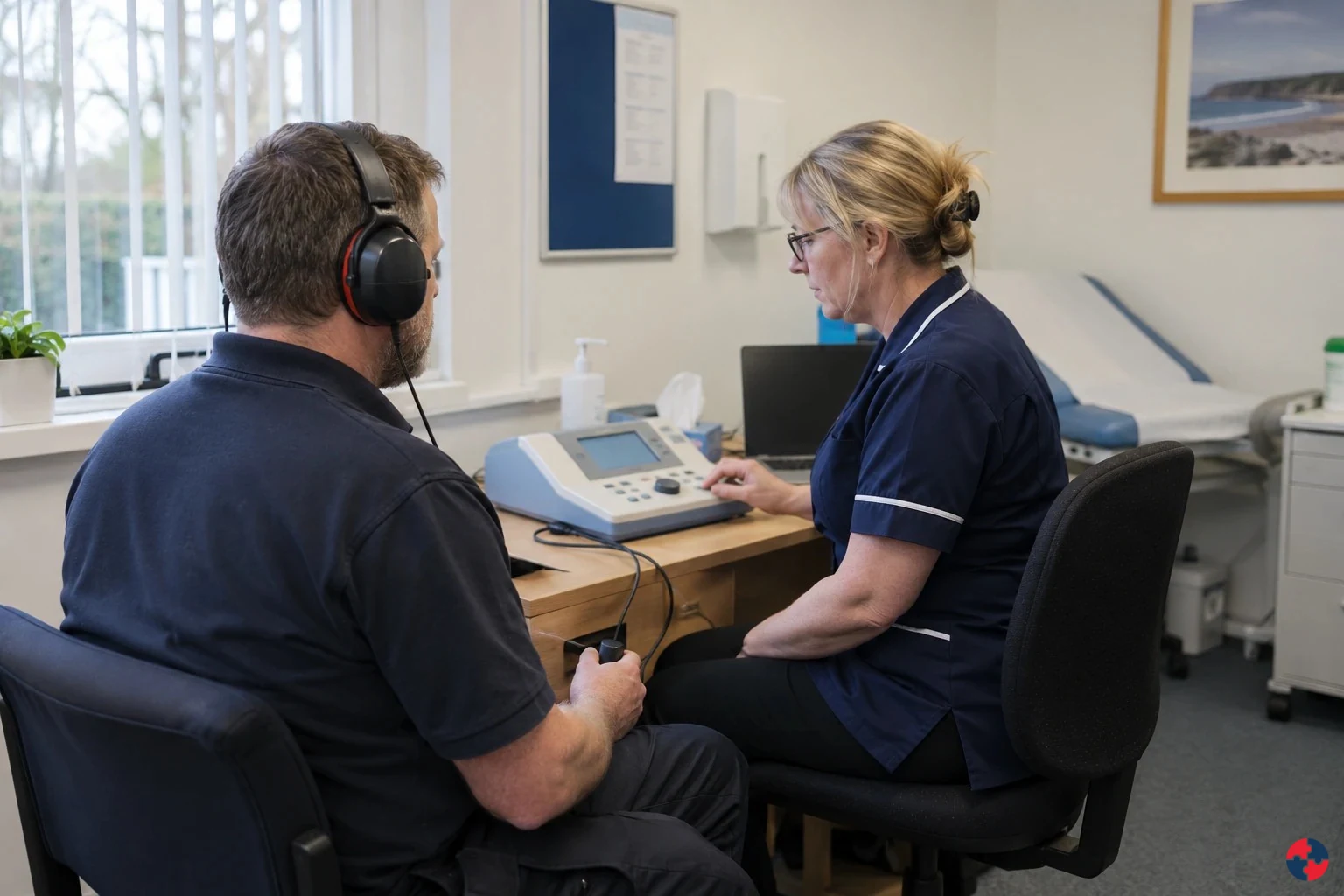
Hearing surveillance usually means regular hearing checks in controlled conditions, baseline checks where possible, worker feedback on results, health records and medical referral where hearing damage is identified. HSE health surveillance for hearing Control of Noise at Work Regulations (NI) 2006
HSE guidance describes annual checks for the first two years and then three-yearly checks, though the frequency may need to change if problems are detected or risk is high. The scheme should be under the control of an occupational health professional.
| Element | Good practice | Management response |
|---|---|---|
| Baseline | Start before exposure where possible. | Use as reference for future change. HSE health surveillance for hearing |
| Periodic checks | Regular audiometry based on risk and professional advice. | Track attendance and outcomes. HSE health surveillance for hearing |
| Worker result | Tell workers about their hearing check result. | Support early advice and referral. HSE health surveillance for hearing |
| Health record | Keep employer-held fitness/outcome record. | Avoid clinical details in management records. HSE health surveillance for hearing |
| Grouped trend | Use anonymised findings to review controls. | Target noisy areas, training and equipment. HSE health surveillance for hearing |
Provide hearing health surveillance when risk assessment indicates it, including regular exposure at or above the upper action value and other at-risk cases described by the applicable regulator. Individual audiograms are confidential; trend findings must trigger review of noise controls, not just more ear defenders. HSE health surveillance for hearing HSENI noise-induced hearing loss
How should communication be managed where hearing is affected?
Communication should be designed so safety-critical information is understood, confirmed and accessible.
A noisy workplace can make communication unreliable even for people with normal hearing. Where someone has hearing difficulty, the barrier is greater. Safety briefings, permit handovers, radios, alarms, training and emergency instructions may need a clearer method. Equality Commission NI reasonable adjustments
Use face-to-face positioning, reduced background noise, written follow-up, visual prompts, closed-loop communication and agreed methods for alarms or urgent messages. Do not rely on shouting in noisy areas as a control.
| Situation | Risk | Better method |
|---|---|---|
| Toolbox talk in noisy area | Key instructions are missed. | Move to quiet area and issue written summary. HSE hearing protection |
| Permit handover | Isolation or gas test detail misunderstood. | Use read-back and written permit review. HSE hearing protection |
| Fire alarm | Worker may not hear signal. | Assess audible/visual/vibrating alert needs. Equality Act 2010 Equality Commission NI reasonable adjustments |
| Radio instruction | Message distorted by noise. | Use clear protocol and confirmation. HSE hearing protection |
| Training video | Audio-only content excludes people. | Use captions and transcript. Equality Act 2010 Equality Commission NI reasonable adjustments |
How can workplaces support people with hearing difficulties?
Support should remove communication barriers and avoid stigma, while keeping safety-critical duties controlled.
Hearing support may include quieter meeting spaces, captions, written notes, loop systems, visual alerts, adjusted radio equipment, hearing protection that supports communication, or occupational health advice on safety-critical tasks. Equality Commission NI reasonable adjustments
The worker should be involved in the discussion. Some people use hearing aids, some lip-read, some prefer written instructions and some may not want colleagues to know details. Confidentiality and dignity matter.
| Barrier | Support option | Check |
|---|---|---|
| Background noise | Quieter meetings or acoustic improvements. | Can the person follow discussion without fatigue? NHS hearing loss |
| Safety alarms | Visual or vibrating alerts where needed. | Do emergency arrangements work? Equality Act 2010 Equality Commission NI reasonable adjustments |
| Training access | Captions, transcripts and written materials. | Is safety-critical information understood? Equality Act 2010 Equality Commission NI reasonable adjustments |
| Team communication | Face the person, speak clearly and confirm key points. | Has the worker agreed what helps? NHS hearing loss |
| Customer-facing work | Reduce noise, provide scripts or assistive equipment. | Is communication safe and dignified? Equality Act 2010 Equality Commission NI reasonable adjustments |
How should hearing health information be handled?
Hearing health information should be handled confidentially and shared only where needed for support or safe work.
Hearing health information should be handled confidentially and shared only where needed for support or safe work. The table gives practical examples, evidence expectations and common decision points so the section can be used for learning, supervision, audit and review. ICO workers health information guidance
| Control | How to apply it | Evidence |
|---|---|---|
| Purpose | Collect health or wellbeing information only where it is needed for hearing health support and audiometry, safe work, support, legal duties or agreed adjustments. | Avoid curiosity questions or records that do not change the work decision. ICO workers health information guidance |
| Minimum necessary detail | Managers usually need restrictions, adjustments, fitness advice and review dates, not diagnosis or clinical notes. | Keep clinical detail with occupational health or medical professionals. ICO workers health information guidance |
| Transparency | Workers should understand what information is collected, why, who will see it and how long it will be retained. | Use privacy notices, referral information and clear consent routes where applicable. ICO workers health information guidance |
| Access control | Limit access to managers, HR, occupational health or advisers who genuinely need the information. | Store records securely and separate health information from ordinary personnel notes where possible. ICO workers health information guidance |
| Group learning | Use anonymised grouped results where the purpose is to review controls or identify trends. | Do not publish identifiable health information or informal sickness comparisons. ICO workers health information guidance |
What evidence shows hearing risk is being managed?
Evidence should show noise assessment, source control, suitable protection, surveillance, worker training and action closure.
The important evidence is the measured or justified exposure for the real work pattern, the chosen quieter method and proof it performs after installation. Sample saw condition, enclosure closure, worker reports, protection fit and hearing-surveillance trends. If noise rises after a blade change or screen is left open, recalculate exposure and hold affected nearby work until engineering controls are restored. A box of ear defenders alone does not demonstrate effective prevention. HSE noise employer duties Control of Noise at Work Regulations (NI) 2006
Evidence should be read as a chain rather than a filing exercise. A single record rarely proves good management on its own; stronger assurance comes from matching records, observations, interviews, trends and verified action closure.
| Evidence | What it can evidence | What to challenge |
|---|---|---|
| Noise risk assessment | Exposure and action values are understood. | Are all tasks and durations included? HSE noise employer duties |
| Noise control action plan | Higher-level controls are being implemented. | Is PPE being used instead of feasible source control? HSE noise employer duties |
| Procurement records | Quieter equipment is considered. | Are supplier noise levels reviewed? HSE woodworking noise |
| Hearing protection records | Suitable PPE is issued and maintained. | Is overprotection checked? HSE hearing protection |
| Audiometry records | Health surveillance is provided where needed. | Are trends used to improve controls? HSE health surveillance for hearing |
| Training and briefing | Workers understand risks, controls and reporting. | Do workers know when protection is mandatory? HSE noise employer duties |
| Spot checks | Protection zones and rules are followed. | Are supervisors setting the standard? HSE hearing protection |
How could BuildOut Ltd manage this in practice?

BuildOut Ltd would manage hearing health through noise assessment, quieter methods, hearing protection zones, audiometry and inclusive communication.
At the woodworking saw, measure or estimate the operator’s actual task level and duration, then include nearby staff and any short high-noise operations. The example combines two hours at 90 dB(A) with half an hour at 95 dB(A), giving about 86.5 dB(A) daily personal exposure over eight hours; this exceeds the 85 dB(A) upper action value. The engineer first tests a quieter process and acoustic enclosure. The supervisor controls access and checks protection while source controls are developed. New task duration, blade or guard condition requires a new exposure decision. HSE noise exposure calculators Control of Noise at Work Regulations (NI) 2006
In this worked example, BuildOut Ltd carries out construction work involving saws, breakers, plant, grinders, compressors and traffic interfaces. The business also needs to make sure site briefings, emergency alarms and permit instructions are accessible to workers with different hearing needs.
| Management element | How the business would manage it | Evidence to review |
|---|---|---|
| Assessing | Measure or estimate task noise levels, durations, peak noise, exposed groups, neighbouring workers, plant areas and communication needs. | Noise survey, task exposure sheet and risk register. HSE noise exposure calculators |
| Analysing | Use HSE calculators, compare against action values, review noisy equipment, maintenance condition and audiometry trends. | Noise action plan and health surveillance trend review. HSE noise exposure calculators HSE health surveillance for hearing |
| Implementing | Buy quieter tools, isolate noisy tasks, use screens, plan exposure time, set hearing zones and issue suitable protection. | Procurement standard, site plan and PPE issue/training records. HSE woodworking noise HSE hearing protection |
| Checking | Carry out supervisor spot checks, inspect hearing protection, verify zones and review whether alarms/briefings are heard. | Inspection records and worker feedback. HSE hearing protection |
| Learning | Investigate hearing shifts, complaints, missed instructions and noisy defects as signs the system may be failing. | Incident/health review and action tracker. HSE health surveillance for hearing |
| Improving | Update equipment selection, maintenance, task planning, training and communication methods based on evidence. | Management review and verified improvements. HSE noise employer duties |
What competence must each role demonstrate?
Use an observed task decision, assessor record and reassessment trigger; a general awareness briefing is not control authorisation.
The operator should identify a noisy defect, use the specified protection correctly and stop when a guard or screen fails. A supervisor should demonstrate a task-duration calculation and hold work when controls are unproved. An engineer verifies saw condition and the noise reduction after modification. A competent assessor checks attenuation without overprotection, and occupational health manages surveillance privately when indicated. Record observed demonstrations, assessors and triggers; audiometry is not a substitute for source control. HSE health surveillance for hearing
Test the affected work and the ability to stop or escalate when a control fails. Keep individual health information limited to people who need it. HSE woodworking noise
| Role | Demonstration | Assessor and record | Reassess when |
|---|---|---|---|
| Saw operator | Identify noise-control defect and use protection correctly. | Supervisor observes real start/stop decision. | Machine or blade change. HSE woodworking noise |
| Nearby worker | Recognise noise zone and report alarm masking. | Supervisor tests communication scenario. | Layout or signal change. HSE noise employer duties |
| Supervisor | Check exposure evidence, source controls and task duration. | Manager samples field decision and record. | Duration or task change. HSE noise employer duties |
| Engineer or purchaser | Select quieter machinery and test enclosure. | Technical peer checks measured performance. | New equipment or defect. HSE woodworking noise |
| Occupational-health or safety adviser | Scope surveillance, privacy and GB/NI law. | Competent peer checks source and restricted results. | Hearing trend or site change. HSENI noise-induced hearing loss |
What warning signs show hearing health is not controlled?
Warning signs appear when noise is accepted as normal, hearing protection is misused or communication barriers are ignored.
A louder saw, open acoustic screen, repeated tinnitus reports or protection that blocks warning signals all require action. Stop or separate the affected task, check machine condition and remeasure where needed. Workers with sudden hearing loss should follow the urgent healthcare route for their nation; workplace audiometry should not delay that assessment. HSE hearing protection Control of Noise at Work Regulations (NI) 2006
Warning signs are included because failure usually appears before a serious event. Treat these points as prompts for inspection, audit, supervision and management review rather than as simple compliance statements.
| Warning sign | How harm can develop | Action |
|---|---|---|
| People shout at two metres | Noise may be high enough to need assessment. | Check exposure and task duration. HSE noise employer duties |
| Ear defenders worn over hats | Protection seal fails. | Retrain and check compatibility. HSE hearing protection |
| Same earplug for every task | Under- or overprotection may occur. | Review selection using noise data. HSE hearing protection |
| Noisy equipment gets louder | Maintenance failure increases exposure. | Repair, maintain or replace equipment. HSE noise employer duties |
| Audiometry trends worsen | Controls are not preventing damage. | Review noise controls and health surveillance actions. HSE health surveillance for hearing |
| Workers miss alarms or radios | Safety-critical communication may fail. | Assess alarm and communication methods. HSE hearing protection |
| Hearing difficulty is mocked | People hide issues and risks grow. | Brief managers and protect inclusion. Equality Act 2010 Equality Commission NI reasonable adjustments |
What do the acronyms and key terms mean?
Acronyms should be understood before they are used in assessments, briefings, audits or learning answers.
Acronyms can exclude newer readers if they are not explained. This section keeps the main terms available at the end of the page so the article stays readable while still supporting learners and audit users. Control of Noise at Work Regulations (NI) 2006
| Acronym | Meaning | Plain-English use |
|---|---|---|
| dB | Decibel | Unit used to describe sound level. |
| dB(A) | A-weighted decibel | Noise measure adjusted to approximate human hearing sensitivity. |
| dB(C) | C-weighted decibel | Often used for peak sound pressure. |
| SNR | Single Number Rating | Simplified hearing protector performance rating. |
| OH | Occupational Health | Specialist advice connecting health and work. |
| PPE | Personal Protective Equipment | Equipment worn by a person to reduce exposure or injury. |
| LEV | Local Exhaust Ventilation | Engineering control for airborne contaminants, included here where noisy extraction systems interact with work. |
Unlock another resource
You have used this month’s two free downloads. Publish a post in your own words to unlock one more resource, or choose SHARE Individual for 10 downloads per month.
You decide whether to share. If you do, use the relevant platform disclosure tools and do not make claims you do not genuinely hold.