SHARE Knowledge Hub
Fluorine Diseases and Fluoride Exposure at Work
Fluorine gas, hydrogen fluoride or hydrofluoric acid and fluoride dusts create different acute and long-term risks. Identify the exact chemical and route, prevent exposure at source, and treat suspected HF skin or eye contact as an emergency even without pain. Apply GB COSHH 2002 or NI COSHH 2003 for the work location.
Understanding Fluorine Diseases and Fluoride Exposure at Work
Fluorine Diseases is a topic label, not a diagnosis or one chemical. Distinguish elemental fluorine, hydrogen fluoride gas, hydrofluoric acid solution, inorganic fluoride and other fluorinated products. Establish actual SDS, generated species, concentration, task and route before applying a health or control claim. HF toxicology does not establish identical hazards for every fluorinated substance.
Why this matters at work
Map the source to each route and then to the person. A breathing-zone measurement cannot describe a splash onto a glove, eye contact or contaminated food. A closed vessel can still create exposure when sampled or maintained. Record direct and indirect routes, including contaminated tools and clothing. For HF, local corrosive injury and systemic uptake require urgent competent attention; absence of early pain does not close the exposure concern.
Hydrofluoric acid can cause serious local and systemic harm, and early pain may not reliably indicate severity. Exposure route, concentration and extent matter. Do not wait for symptoms to become severe, attempt improvised neutralisation or rely on a generic acid-burn assumption. Activate the site's substance-specific emergency arrangements and obtain urgent professional medical advice or emergency services according to the situation.
How organisations manage this in practice
Change control begins when the proposed task or equipment changes, not after an exposure result worsens. Compare old and new chemistry, throughput, interfaces and emergency assumptions. Assign reviewers with the needed disciplines and record conditions the trial did not cover. Confirm the supplied equipment and workface match the accepted change. Procurement or project approval and technical verification are connected decisions with different evidence.
Assess where the agent is generated, how people can inhale it and how deposits or contaminated clothing create secondary exposure. Consider normal operation, cleaning, breakdown and maintenance. Avoid or substitute the hazardous process where practicable, reduce release and use suitable enclosure or extraction before relying on personal protection. Controls must suit the material, process and actual emission pattern.
A useful action tracker distinguishes issue identified, interim safeguards, permanent action installed, effectiveness verified and accountable closure. Review overdue defects with the actual exposed work, not just counts. Include quiet shifts, contractors and low-frequency tasks in assurance coverage. Professional health interpretation and technical evidence inform the responsible management decision. Reopen an action when the safeguard fails or a change makes its earlier evidence invalid.
Separate acute contact from repeated exposure
The exact compound and route matter. Suspected hydrofluoric-acid exposure needs the established emergency response promptly; do not wait for visible damage or pain.

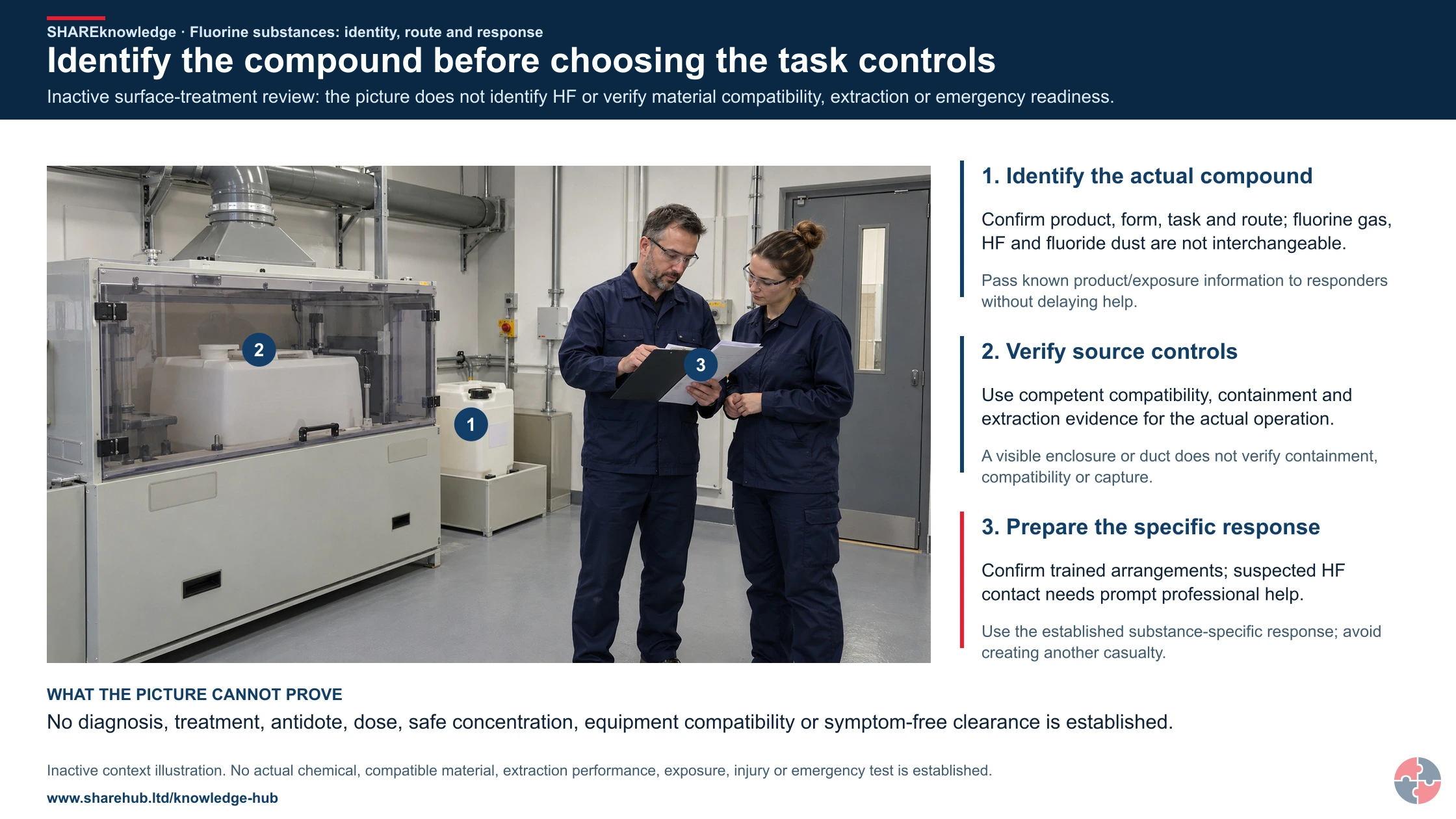
Identify the compound before choosing the task controls
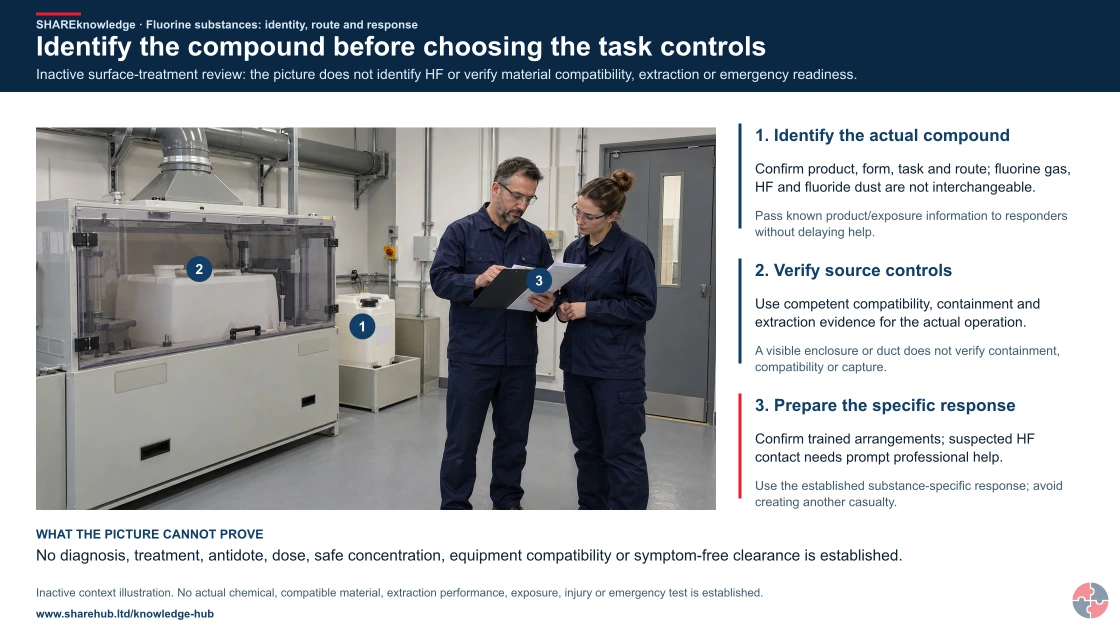
Full written explanation
A new realistic UK surface-treatment illustration shows a closed process enclosure with a connected extraction duct, a white polymer vessel, a separate stock container in a tray and two reviewers using inert papers. Three numbered questions ask about actual chemical identity, task-specific source controls and trained substance-specific emergency arrangements. No chemical is handled and no exposure or treatment is shown. The illustration cannot establish that HF is present, that a container or enclosure is compatible, that ventilation performs its duty or that an emergency arrangement is ready. The generic current glassware laboratory image is retained as general context and is not relabelled as HF equipment.
Inactive surface-treatment review: the picture does not identify HF or verify material compatibility, extraction or emergency readiness.
- Identify the actual compound. Confirm product, form, task and route; fluorine gas, HF and fluoride dust are not interchangeable.
- Verify source controls. Use competent compatibility, containment and extraction evidence for the actual operation.
- Prepare the specific response. Confirm trained arrangements; suspected HF contact needs prompt professional help.
Change the pathway
- A plain container proves no identity. Pass known product/exposure information to responders without delaying help.
- Appearance is not performance. A visible enclosure or duct does not verify containment, compatibility or capture.
- Do not wait for visible damage. Use the established substance-specific response; avoid creating another casualty.
Evidence check: No diagnosis, treatment, antidote, dose, safe concentration, equipment compatibility or symptom-free clearance is established.
Keep acute suspected contact ahead of the longer exposure reference
Primary references: UKHSA HF general information, 2024
Open the complete HD image (new tab)Download image
Keep acute suspected contact ahead of the longer exposure reference
Primary references: UKHSA HF general information, 2024

Acute concern now
Move away from the hazard safely, raise the alarm and obtain emergency professional help using the substance-specific site arrangements.
Identify the substance
Pass the known product and exposure information to responders without delaying help or creating another exposure.
Repeated exposure route
Use the actual fluoride compound, task and route for competent exposure assessment, source controls and appropriate health advice.
Keep boundaries clear
An anatomy model is explanatory, not a diagnosis. No treatment dose, antidote recipe or symptom-free clearance is supplied here.
Read the complete task-specific control examples
ERICPD is a planning cross-map: Discipline verifies and sustains every control. ESEAP compares effectiveness. A label does not authorise the task; retain the owner, evidence and stop or change decision.
Etching components with hydrofluoric acid · ERICPD
- Eliminate
- Use a validated non-HF process or suitably supplied finished component where it removes local HF use.
- Reduce
- Evaluate a suitable lower-hazard etching chemistry through process and product validation; lower concentration alone does not establish safety.
- Isolate
- Use a restricted specialist work area with compatible storage and segregation from incompatible substances.
- Control
- Provide suitable closed handling, containment and verified local extraction matched to HF and the actual process.
- PPE
- Specify HF-compatible gloves, clothing, eye/face protection and any RPE through specialist assessment; ordinary disposable protection may be unsuitable.
- Discipline
- Inspect containment, extraction and protective equipment; any suspected exposure activates the urgent HF-specific response.
Etching components with hydrofluoric acid · ESEAP
- Elimination
- Use a validated non-HF process or suitably supplied finished component where it removes local HF use.
- Substitution
- Evaluate a suitable lower-hazard etching chemistry through process and product validation; lower concentration alone does not establish safety.
- Engineering controls
- Use a restricted specialist work area with compatible storage and segregation from incompatible substances.
- Administrative controls
- Authorise trained personnel, verify product and emergency arrangements, and control waste and decontamination before handling.
- PPE
- Specify HF-compatible gloves, clothing, eye/face protection and any RPE through specialist assessment; ordinary disposable protection may be unsuitable.
Weighing a fluoride-containing powder · ERICPD
- Eliminate
- Buy a suitable measured preparation or remove an unnecessary local weighing stage.
- Reduce
- Validate a less hazardous compound or suitable non-dusty supplied form without assuming all fluoride compounds are interchangeable.
- Isolate
- Separate weighing from general work and use dedicated contained equipment and clean storage.
- Control
- Use suitable enclosed weighing or source extraction and compatible waste containment; avoid open high-drop transfers.
- PPE
- Select suitable skin/eye protection and any RPE for the identified compound and exposure; apply fit requirements to tight-fitting RPE.
- Discipline
- Check capture and housekeeping and reconcile labelled stock and waste before releasing the station.
Weighing a fluoride-containing powder · ESEAP
- Elimination
- Buy a suitable measured preparation or remove an unnecessary local weighing stage.
- Substitution
- Validate a less hazardous compound or suitable non-dusty supplied form without assuming all fluoride compounds are interchangeable.
- Engineering controls
- Separate weighing from general work and use dedicated contained equipment and clean storage.
- Administrative controls
- Confirm the exact compound and quantity, prevent contamination and use the approved cleaning and spill method.
- PPE
- Select suitable skin/eye protection and any RPE for the identified compound and exposure; apply fit requirements to tight-fitting RPE.
Put suspected HF contact before the longer exposure reference
Suspected hydrogen fluoride or hydrofluoric acid contact requires immediate emergency action under the substance-specific plan and urgent medical help; absence of pain is not reassurance because effects can be delayed. Stop the activity, avoid creating another casualty and give responders the known chemical information. Use the emergency section below; this page does not supply clinical treatment or dosing instructions.
Identify the exact substance and form before applying longer-term controls. Fluorine gas, hydrofluoric acid and fluoride-containing dust are not interchangeable exposures. A changed cleaner must be held for identification, competent task assessment, suitable controls and a trained emergency arrangement before use. Keep acute response, chronic exposure management and any health-surveillance decisions distinct.
BuildOut: the replacement cleaner is not identified
Illustrative example. A specialist contractor proposes a different cleaner, and possible HF contact cannot be ruled out after a handling incident.
Decision. The team activates the substance-specific emergency route for suspected contact and holds further product use for competent identification and assessment.
Evidence to check. Container/SDS identity, exposure route and event information for responders; task controls and trained emergency arrangements before any later use.
Hold or escalation point. Do not wait for pain or apparent injury, and do not improvise a clinical treatment protocol.
Follow-up. After the emergency, review procurement, contractor approval, exposure records and the verified prevention arrangements.
What are the key facts about fluorine and fluoride exposure?
Identify the exact fluorine-containing substance and exposure route before choosing controls. Suspected hydrofluoric acid or hydrogen fluoride skin or eye contact needs immediate site emergency action and urgent medical assessment even when pain is absent or delayed.
Fluorine gas is highly reactive
Fluorine is a very reactive gas and can cause severe respiratory and eye irritation where it is used or generated.
Hydrofluoric acid needs special controls
Hydrofluoric acid can penetrate tissue and bind calcium and magnesium, so exposure can become serious even where the visible burn looks modest.
Fluoride dust or fume can affect bones over time
Repeated excessive exposure to some fluoride-containing dusts or fumes can contribute to skeletal fluorosis, joint stiffness and bone changes.
COSHH applies to the health risk
The assessment should consider inhalation, skin, eye and ingestion routes, exposure frequency, task duration and foreseeable accidents.
Emergency arrangements must be task-specific
Generic first-aid instructions are not enough for hydrofluoric acid, high-concentration fluoride or gas exposure scenarios.
The UKHSA HF general information describes delayed symptoms and serious systemic effects; GB COSHH and NI COSHH have separate statutory routes.
Elemental fluorine uses US NIOSH science context; UKHSA supports HF and fluoride toxicology within its stated limits. These sources do not approve UK exposure limits, detailed chronic causation or clinical decisions.
What are fluorine diseases and fluoride-related health effects?
“Fluorine diseases” is an umbrella label, not a diagnosis. Fluorine gas, hydrogen fluoride or hydrofluoric acid and fluoride dusts or fumes differ in acute injury, systemic toxicity and long-term exposure pattern; identify the actual substance and task.
The term should not be treated as one single disease. Acute exposure can irritate or burn the eyes, skin and respiratory tract. Hydrofluoric acid can cause deep, painful tissue injury and systemic toxicity because fluoride ions bind calcium and magnesium. Longer-term overexposure to some fluoride dusts or fumes can affect bones and joints.
A good page and a good risk assessment both separate the chemical form. A dilute fluoride salt, a high-concentration hydrofluoric acid product, hot fluoride fume and fluorine gas do not create the same exposure profile or emergency response requirement.
For a learner or supervisor, the most important starting point is to separate the chemistry from the disease label. Fluorine gas, hydrogen fluoride, hydrofluoric acid and fluoride salts behave differently in storage, use, release and human exposure. That is why the COSHH assessment should never rely on a generic word such as fluoride without checking the product, concentration and physical form.
In practice, higher-risk exposure often appears during small tasks that look routine: wiping a surface-treatment bench, decanting from a bulk container, cleaning residue from pipework, changing filters, responding to a spill or working on equipment that previously carried fluoride-containing chemicals. The task method, not just the product name, decides whether the risk is mainly inhalation, splash, contamination or chronic dust exposure.
| Form | Typical workplace context | Main concern |
|---|---|---|
| Fluorine gas | Specialist chemical manufacture or laboratory work. | Severe respiratory and eye irritation, high reactivity and emergency containment. |
| Hydrogen fluoride gas | Process releases, etching, pickling or high-temperature fluoride reactions. | Respiratory injury, corrosive effects and systemic fluoride risk. |
| Hydrofluoric acid | Glass etching, metal cleaning, laboratories and some maintenance tasks. | Deep chemical burns, delayed pain and systemic toxicity. |
| Fluoride salts | Metal treatment, welding fluxes, laboratory reagents or manufacturing. | Dust, ingestion, skin contact and chronic exposure depending on solubility. Detailed skeletal-fluorosis diagnosis, ligament/bone changes, chronic potroom asthma causation and prognosis remain held for current agent-specific government evidence and named clinical review. Symptoms alone do not diagnose occupational disease. |
| Fluoride fume or dust | High-temperature work, smelting, welding flux use or abrasive operations involving fluoride materials. | Inhalation exposure and possible longer-term skeletal effects. Detailed skeletal-fluorosis diagnosis, ligament/bone changes, chronic potroom asthma causation and prognosis remain held for current agent-specific government evidence and named clinical review. Symptoms alone do not diagnose occupational disease. |
Relevant official context: HSE COSHH assessment and control; verify the actual chemical and task.HSENI COSHH2003 guide; verify the actual chemical and task.
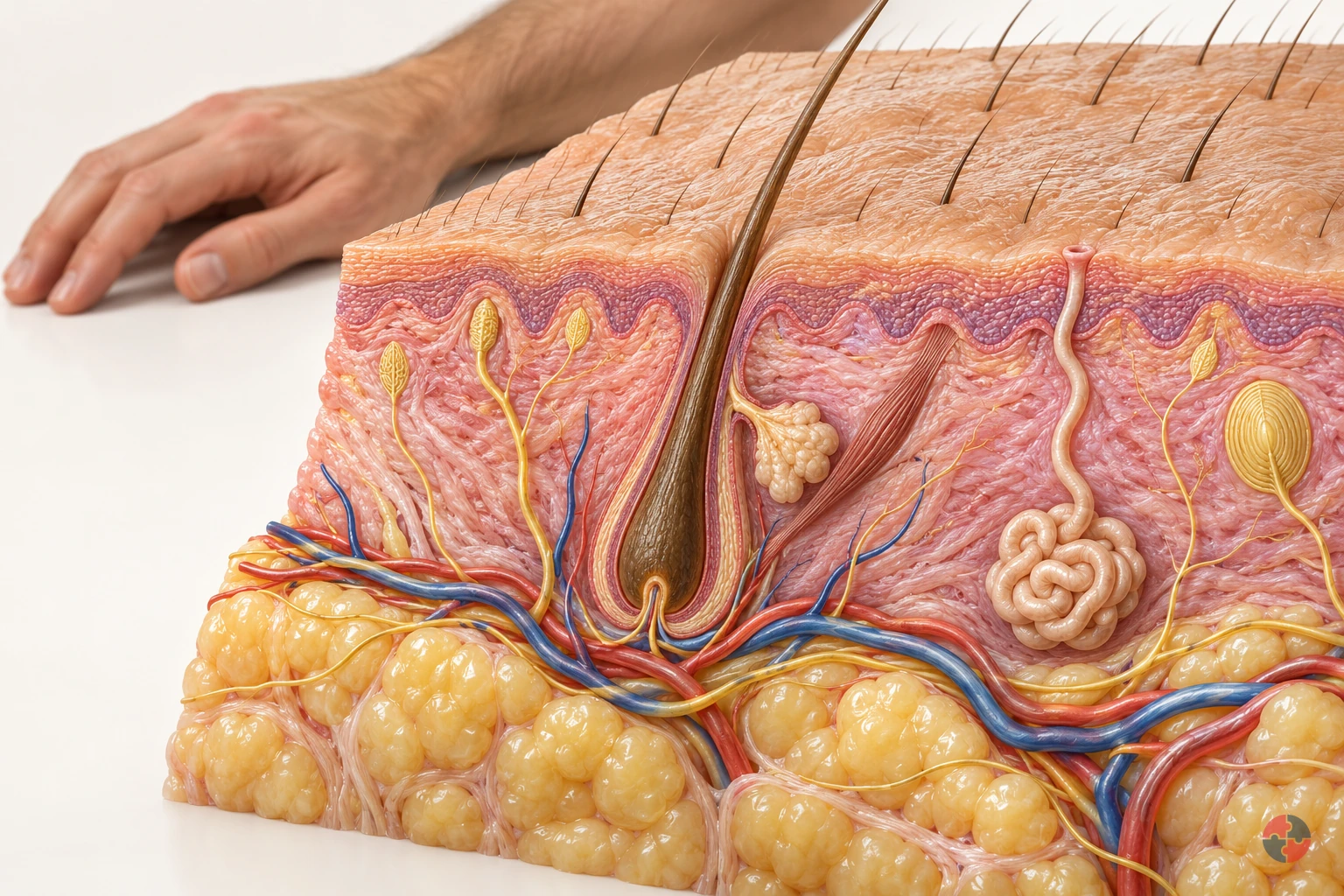

How does the skin barrier work, and how can workplace contact damage it?
Interactive anatomy · Skin barrier and injury · Updated 2026-10-23
Read all anatomy and process explanations without the viewer
General education about normal skin and example mechanisms; not diagnosis, treatment selection or a patient assessment. Hair-bearing forearm example. Vessels remain below the epidermis; the normal barrier has no large open holes. Image-based diagnosis or patch-testing simulation Treatment doses or guaranteed glove/barrier-cream protection Calculated injury depth, contact-dose thresholds or a number of safe washes Hydrofluoric-acid protocols and unreviewed named-substance injury overlays Immediate chemical-burn advice must remain readable outside the model and before any scenario answer.
Outer barrier
The outermost layer helps limit water loss and harmful contact. The outermost epidermal layer combines flattened cells with materials between them to help retain moisture and limit harmful contact. It is a selective protective barrier, rather than a waterproof coating. Use the magnified inset to locate its components. The model shows their relationship but cannot tell whether a particular substance will cross a person’s skin. Health and Safety Executive: Structure and functions of the skin
Barrier lipids
Lipids between surface cells help maintain the barrier. Repeated detergent contact can remove some of these fatty materials and overwhelm repair. Health and Safety Executive: Understanding the causes of skin disease
Epidermis
The outer skin layer continually renews. New cells form in the deeper epidermis and move towards the surface, becoming flattened as the outer layer is renewed and shed. The epidermis therefore contributes active renewal as well as surface protection. Follow its position above the dermis in the cutaway; the model enlarges a static structure rather than timing an individual’s cell renewal. Health and Safety Executive: Structure and functions of the skin
Dermis
Supporting tissue beneath the epidermis contains vessels, nerves and glands. The dermis is supporting tissue beneath the epidermis. It contains structures involved in supply, sensation and temperature regulation, including vessels, nerves and sweat glands. The cutaway enlarges selected components so their different functions can be followed. Their shared location does not mean that they form one open passage through the skin barrier. Oxford Health NHS Foundation Trust: The Skin — Community Tissue Viability Team
Subcutaneous tissue
Tissue and fat below the dermis help insulate and cushion. The lower layer supports the skin block; it is not part of the surface barrier. Health and Safety Executive: Structure and functions of the skin · Oxford Health NHS Foundation Trust: The Skin — Community Tissue Viability Team
Blood vessels
Vessels supply the deeper skin. These vessels supply the deeper skin tissues. They sit below the epidermal surface in the cutaway, alongside other supporting structures. Compare them with the nerve and sweat duct rather than interpreting every tube as the same pathway. The drawing explains location and function; its vessel size and colour are not measurements of circulation or skin temperature. Oxford Health NHS Foundation Trust: The Skin — Community Tissue Viability Team
Sensory nerves
Nerve endings help detect touch and temperature. The signalling symbol represents sensory information, not a visible electrical spark. Health and Safety Executive: Structure and functions of the skin · Oxford Health NHS Foundation Trust: The Skin — Community Tissue Viability Team
Sweat gland and duct
Sweat reaches the surface through a duct. A sweat gland produces sweat that reaches an opening at the surface through a duct. This contributes to the skin’s role in temperature regulation. Trace the coiled gland and its duct separately from the vessels and nerves. The enlarged path makes the connection visible; it does not measure sweating or represent every route by which a substance can enter skin. Health and Safety Executive: Structure and functions of the skin
Hair follicle
Hair grows from a follicle in hair-bearing skin. This forearm example includes a follicle. The palm has a different structure and must not use this site label. Health and Safety Executive: Structure and functions of the skin
Immune response inset
Skin participates in immune responses. In contact allergy, prior sensitisation can lead to an inflammatory response after later contact. Health and Safety Executive: Understanding the causes of skin disease · NHS: Contact dermatitis — causes
Open the complete process transcript
The process, step by step
Find the surface
Start with the forearm locator to establish where this sample of skin belongs. The enlarged block represents hair-bearing skin, with the epidermis on the outside, the dermis beneath it and deeper subcutaneous tissue below. The surface is only one part of this living organ. New epidermal cells are formed deeper down and move towards the outside, where flattened cells contribute to the protective layer. Use the block to connect the familiar body surface with these layers; it is an enlarged teaching section, not a standard thickness shared by every body site. Health and Safety Executive: Structure and functions of the skin
What to watch: Use the forearm locator first, then follow the enlarged block from the outer epidermis down through the dermis to the deeper tissue.
Why it matters: Locating the body site prevents the sample from being mistaken for every kind of skin. The outer layer, supporting tissues and deeper structures contribute different functions within the same organ.
Explore this step: Identify the outermost layer and the hair follicle before changing to the magnified barrier view.
Magnify the barrier
The outer barrier depends on both flattened surface cells and the fatty materials, or lipids, between them. The cells provide one part of the structure; the surrounding lipids help control the passage of water and substances through it. Look at their arrangement together rather than treating the skin as a single waterproof sheet. This is a selective barrier, not a complete seal against every material. The enlargement helps explain why a change in the material between cells can affect protection even when there is no large cut through the skin. Health and Safety Executive: Understanding the causes of skin disease
What to watch: Compare the flattened surface cells with the lipids between them, using the enlarged barrier inset rather than the whole skin block.
Why it matters: The arrangement helps limit unwanted passage through the surface while retaining moisture. Understanding both components explains why skin protection depends on more than whether the surface looks visibly broken.
Explore this step: Point out one surface cell and the surrounding lipid region, then describe how they work together.
Limit water loss
Water retention is part of healthy barrier function. The outer cells and the materials between them help limit water leaving the skin, while some water can still pass through. The labelled arrows represent that background loss; they are not streams from a wound or measurements of an individual’s hydration. Moisture matters because the outer layer needs appropriate hydration to remain flexible and function well. Read the arrows alongside the cell-and-lipid arrangement, so the explanation connects a movement across the surface with the structure that helps regulate it. Health and Safety Executive: Understanding the causes of skin disease
What to watch: Look at the labelled water-loss arrows beside the outer cells and lipids, noting their direction across the barrier surface.
Why it matters: Limiting water loss helps the outer layer retain the moisture needed for normal function. A barrier can perform this role without being impermeable, and the model cannot assess somebody’s skin hydration.
Explore this step: Compare this step with the barrier enlargement and explain why “limits water loss” is more accurate than “waterproof”.
Explore deeper structures
The deeper skin contains structures with different jobs. Blood vessels supply the deeper tissues, sensory nerves help carry information such as touch and temperature, and sweat glands connect to the surface through ducts. Follow each labelled structure separately instead of reading the cutaway as one channel running down through the skin. The enlarged vessels, nerves and gland are learning features within the supporting tissue; their positions explain relationships, not the route or speed of an absorbed substance. Notice that surface barrier function and these deeper functions are connected parts of skin health. Health and Safety Executive: Structure and functions of the skin · Oxford Health NHS Foundation Trust: The Skin — Community Tissue Viability Team
What to watch: Locate the vessels, sensory nerves and coiled sweat gland below the surface, then trace the gland’s duct towards its opening.
Why it matters: Supply, sensation and temperature regulation require different structures. Recognising those roles avoids mistaking every visible line for a chemical entry route or assuming the outer barrier carries out all skin functions.
Explore this step: Select the gland, nerve and vessel labels in turn and name a different function for each.
Connect structure and function
Return to the whole section and connect the functions you have explored. The renewing outer layer helps form a protective barrier and limit moisture loss. Deeper supporting tissues contain sensory structures, vessels and glands, while subcutaneous tissue contributes cushioning and insulation. These functions operate together rather than as a single switch that makes skin either completely protected or unprotected. Use the separate mechanism examples to explore particular changes only after locating the healthy structures. The cutaway explains relationships; its colours and enlarged components do not diagnose a skin condition or identify a safe contact time. Health and Safety Executive: Structure and functions of the skin · Oxford Health NHS Foundation Trust: The Skin — Community Tissue Viability Team
What to watch: Review the complete skin section, connecting the outer barrier with the supporting dermis, sensory structures, sweat gland and deeper tissue.
Why it matters: Skin both separates the body from its surroundings and helps it respond to them. Connecting protection, sensation and temperature functions gives a more useful picture than viewing the surface as a passive covering.
Explore this step: Choose one structure from the surface and one from deeper tissue, and explain how their jobs differ.
Read the practice situations and all answer explanations
Sources and how the model is made
The opening images are AI-generated anatomical illustrations. The interactive 3D models and labelled SVG diagrams use original procedural artwork. These teaching images are not medical scans or diagnostic tools. Source references support the learner explanations and do not grant artwork rights.
- Health and Safety Executive: Structure and functions of the skin — Three skin layers; renewal; sweat, hair, sensory, barrier and temperature functions. Factual reference only; no diagram copied.
- Oxford Health NHS Foundation Trust: The Skin — Community Tissue Viability Team — Layer and deeper vessel/nerve context, mechanical injury and skin-tone assessment considerations. No treatment regimen or illustration reused.
- Health and Safety Executive: Understanding the causes of skin disease — Barrier lipids and water retention; cumulative irritation; sensitisation, delayed contact allergy, small subsequent amounts and coexistence. Replaces the former separate dermatitis URL, which failed direct retrieval.
- NHS: Contact dermatitis — causes — Irritant versus allergic mechanisms and workplace wet work. Printed next-review date May 2026 is overdue; recheck at qualified clinical sign-off and corroborate with HSE.
- Health and Safety Executive: Construction hazardous substances: Cement — Alkaline burns from trapped cement; abrasive irritation; chromate sensitisation; task methods and suitable contact protection.
- Health and Safety Executive: How do I prevent skin problems in my business? — Avoid contact, suitable gloves, washing and drying, skin care, early checks/reporting and medical advice. No universal glove or cream claim.
- NHS: Acid and chemical burns — Immediate chemical skin-burn first aid: 999, avoid contamination, clothing and dry-chemical removal, copious water about one hour, no creams or other chemicals. Skin advice is not substituted for eye or thermal guidance.
- NHS: Cuts and grazes — General shallow-wound context and the need for professional help with serious wounds; not a visual diagnosis or full first-aid simulation.
- NHS: Contact dermatitis — symptoms — Dryness, cracking, inflammation and fluid-filled blisters can occur in contact dermatitis. Irritant and allergic appearances overlap. Original illustrative textures are not diagnostic photographs and no source artwork is copied.
Where can fluorine or fluoride exposure occur?
Exposure can occur wherever fluorine, hydrogen fluoride, hydrofluoric acid or fluoride compounds are used, heated, mixed, sprayed, machined or cleaned.
Workplaces should not rely only on container labels. Fluoride exposure can come from process-generated fume, residues, contaminated equipment, waste, incompatible reactions or maintenance on plant that previously contained fluoride substances.
The highest-risk tasks are often non-routine: cleaning, descaling, line opening, laboratory transfer, waste handling, vessel entry, blocked pipework, spill response and work on poorly identified legacy materials.
| Activity or sector | Possible exposure route | Control focus |
|---|---|---|
| Laboratory use | Small-volume liquid handling, vapour, splashes and contaminated gloves. | Fume cupboard, small quantities, compatible containers and emergency response kit. |
| Glass etching or surface treatment | Hydrofluoric acid contact, mist and contaminated work surfaces. | Closed or contained process, trained operators, splash control and calcium gluconate arrangements. |
| Metal cleaning or pickling | Acid mist, splashes, tank vapour and maintenance exposure. | Enclosure, LEV, automated handling, emergency showers and permit controls. |
| Hot work involving fluoride fluxes | Fume inhalation and residue contamination. | Substitution, extraction, work planning and RPE where LEV cannot fully control exposure. |
| Waste and spill response | Unknown concentration, mixed waste, contaminated absorbents and secondary exposure. | Segregated waste, trained responders, PPE compatibility and decontamination. |
Relevant official context: HSE COSHH assessment and control; verify the actual chemical and task.
What health effects should be understood?
Health effects range from irritation to serious chemical injury, depending on the substance, concentration, duration and route of entry.
Routes of entry matter. Inhalation can affect the nose, throat and lungs. Skin contact can cause local injury and, with hydrofluoric acid, systemic fluoride absorption. Eye contact can rapidly threaten sight. Ingestion is less likely in controlled workplaces but can occur through poor hygiene, contaminated hands or contaminated drink areas.
Workers should be told which symptoms need immediate reporting. Pain may be delayed after some hydrofluoric acid exposures, so waiting for symptoms can be unsafe where contact is suspected.
Health effects should be taught as a route-of-entry story. A vapour or fume release challenges the nose, throat and lungs; a liquid splash challenges skin and eyes; contaminated hands can transfer material to the face or mouth; and residues can expose cleaners, maintenance staff or waste handlers who were not part of the original job.
Hydrofluoric acid deserves particular care because pain can be delayed and the visible skin injury can underestimate the seriousness of exposure. Workers need clear, repeated messages: report suspected contact immediately, do not wait to see whether it settles, and make sure medical responders are told exactly what substance and concentration was involved.
| Effect | How it may present | Workplace response |
|---|---|---|
| Eye irritation or burn | Watering, pain, redness, blurred vision or splash history. | Immediate eyewash, remove from exposure and follow site emergency and medical arrangements. |
| Skin exposure | Pain, whitening, redness, numbness or delayed pain after contact. | Remove contaminated clothing, irrigate, use substance-specific first aid and escalate for medical assessment. |
| Respiratory irritation | Cough, tight chest, throat irritation, breathlessness or wheeze. | Move away from exposure only without endangering a rescuer, stop work and activate urgent emergency medical assessment for suspected significant HF inhalation; do not wait for a routine occupational-health appointment. |
| Systemic fluoride toxicity | Symptoms may include deep pain, weakness, cramps or effects after HF exposure. | Treat as a serious exposure requiring site emergency response and qualified medical support. |
| Skeletal fluorosis | Long-term stiffness, joint pain or bone changes after repeated excessive exposure. | Review exposure history, monitoring, health surveillance and occupational-health referral. Detailed skeletal-fluorosis diagnosis, ligament/bone changes, chronic potroom asthma causation and prognosis remain held for current agent-specific government evidence and named clinical review. Symptoms alone do not diagnose occupational disease. |
Relevant official context: UKHSA HF general information; verify the actual chemical and task.
How do acute HF injury and chronic fluoride harm differ?
Acute HF or hydrogen fluoride contact can cause serious local and systemic injury and needs immediate response; skeletal fluorosis develops only after substantial cumulative fluoride uptake over time. Neither condition should be inferred from a product name alone.
Acute exposure is linked to a specific splash, inhalation or release, sometimes with delayed pain after HF contact. Activate the emergency plan and obtain urgent medical assessment for suspected HF skin or eye contact, including when symptoms are absent initially.
Chronic excessive fluoride uptake may affect bones and joints, including osteosclerosis and ligament calcification with progressive stiffness. UKHSA notes that reported occupational skeletal fluorosis involved combined HF and dust exposure, with unreported or estimated concentrations; those reports do not support definitive conclusions about repeated HF exposure or establish causation for a particular local task. Consider concentration, chemical form, route, duration and cumulative exposure; aluminium potroom and other fume or dust work can require competent exposure assessment.
A worker with persistent symptoms or a concerning exposure history needs confidential occupational-health or medical referral. A clinician and occupational hygienist should interpret exposure records and decide any investigation or surveillance; a single symptom or product label cannot diagnose fluorosis.
For the acute boundary use UKHSA HF general information; for workplace inhalation exposure and surveillance planning use HSE EH40 workplace exposure limits and HSE health surveillance.
UKHSA UK HF toxicological overview:2018 content,2024 format update. Fluoride bone uptake and systemic toxicity are described; repeated-exposure evidence is limited/mixed with dust and cannot establish definite local causation. US NIOSH government elemental fluorine science: highly reactive strong oxidiser, nonflammable, severe eye/skin/airway injury possible. US occupational limits and respirator schedules are not UK limits or approved selection; public-body reuse and specialist approval remain held. Detailed skeletal-fluorosis diagnosis, ligament/bone changes, chronic potroom asthma causation and prognosis remain held for current agent-specific government evidence and named clinical review. Symptoms alone do not diagnose occupational disease.
What should happen after suspected significant exposure?
Suspected hydrofluoric acid or hydrogen fluoride skin or eye exposure is an emergency even if pain has not started. Stop exposure, activate the pre-planned site response, start immediate decontamination or irrigation using trained responders, and obtain urgent specialist medical help. Do not wait for symptoms.
Before work begins, the site assessment, safety data sheet and competent medical advice must set substance-specific first-aid supplies, trained roles, emergency communication and handover. This page does not prescribe a clinical treatment or dose.
Emergency planning should cover splashes, inhalation, contaminated clothing, waste, isolation of the source, protection of responders and communication with medical services about the chemical involved.
| Scenario | Immediate workplace action | Preparation needed before work |
|---|---|---|
| Skin splash | Stop work, remove contaminated clothing and irrigate as instructed. | Emergency shower, trained first aiders, SDS, HF-specific arrangements where relevant. |
| Eye splash | Use eyewash immediately and continue as instructed. | Accessible eyewash, route to medical assessment and supervisor escalation. |
| Fume or gas exposure | Move away from exposure if safe and escalate. | Gas release procedure, ventilation, isolation and emergency communication. |
| Contaminated work area | Prevent further access and isolate the source. | Spill kit, competent responders, waste route and decontamination plan. |
| Uncertain exposure | Treat credible contact or inhalation as significant until assessed. | Clear reporting culture and no-blame escalation. |
Use UKHSA HF publication collection for responders and UKHSA HF general information for the delayed-harm warning; follow the site emergency plan and medical service.
Suspected significant HF inhalation, ingestion or skin/eye exposure needs prompt site emergency and qualified medical action; delayed pain is not reassurance. Begin the approved chemical-specific decontamination response immediately, even without pain. Unprotected responders must not enter a contaminated area or approach an incapacitated casualty. Tell emergency responders about the chemical and contamination; do not transfer contamination into vehicles or care areas. Do not induce vomiting or use improvised neutralising chemicals. No clinical dose or universal irrigation duration is prescribed here.
What immediate actions are needed by exposure route?
Give workers short, rehearsed route-specific actions for inhalation, skin and eye exposure, including immediate escalation and medical handover. A responder must avoid secondary contamination and work within their training.
The COSHH assessment should say what workers must do for inhalation, skin, eye and ingestion scenarios, including when to call 999 or activate the site emergency plan. The wording should be simple, posted where the work happens and rehearsed with the people most likely to respond.
For hydrofluoric acid or hydrogen fluoride exposure, local arrangements should make clear how specialist first-aid materials, SDS information and medical handover information will reach responders quickly. This is workplace guidance only; significant exposure should be escalated to qualified medical support.
| Exposure route | Call 999 or activate emergency response when | Workplace preparation |
|---|---|---|
| Inhalation | There is breathing difficulty, chest tightness, collapse, significant gas or fume release, or symptoms after a credible exposure. | Fresh-air route, emergency communication, trained responders and SDS available for medical handover. |
| Skin contact | There is hydrofluoric acid contact, significant burn, spreading pain, delayed deep pain, contaminated clothing or uncertainty about concentration. | Emergency shower, rapid clothing removal arrangements, compatible gloves and HF-specific first-aid arrangements where relevant. |
| Eye contact | Any splash or vapour exposure causes pain, blurred vision, persistent watering or known contact with HF or corrosive fluoride substances. | Eyewash within reach, route to medical assessment and someone nominated to bring SDS information. |
| Ingestion | A worker may have swallowed chemical residue or contaminated food or drink. | No eating or drinking in work areas, handwashing, poison information route and immediate medical escalation. |
| Responder exposure | A first aider or cleaner could be exposed while helping or decontaminating. | Responder PPE, exclusion zones, spill response training and contaminated waste controls. |
The UKHSA HF publication collection and UKHSA HF toxicological overview support substance-specific planning, not a generic treatment protocol.
Suspected significant HF inhalation, ingestion or skin/eye exposure needs prompt site emergency and qualified medical action; delayed pain is not reassurance. Begin the approved chemical-specific decontamination response immediately, even without pain. Unprotected responders must not enter a contaminated area or approach an incapacitated casualty. Tell emergency responders about the chemical and contamination; do not transfer contamination into vehicles or care areas. Do not induce vomiting or use improvised neutralising chemicals. No clinical dose or universal irrigation duration is prescribed here.
How should COSHH assessment be carried out for fluorine substances?
Assess the exact chemical form, concentration, task and route under GB COSHH 2002 or NI COSHH 2003, including routine and non-routine work, credible release, control verification and emergency readiness.
Assessment should start with a chemical inventory and safety data sheets, then challenge what actually happens in the task. Decanting, heating, spraying, cleaning residues, maintenance and waste can all change exposure.
The assessment should also identify incompatible substances, ventilation performance, emergency equipment, PPE compatibility, worker competence and whether air monitoring or biological/health surveillance advice is needed.
A useful assessment follows the work from storage to disposal. It should consider delivery, labelling, segregation, decanting, use, cleaning, waste, emergency washing and contractor involvement. If the task involves heat, spray, pressure, confined work or poor ventilation, the exposure profile can change significantly.
The assessment should also test whether emergency arrangements are physically ready. An eyewash bottle locked in a cabinet, a calcium gluconate arrangement that nobody can find, or an SDS stored only in an office can all look acceptable on paper while failing during the first minute of an exposure.
| Question | Why it matters | Evidence |
|---|---|---|
| Which fluorine or fluoride substance is present? | Different forms have very different health and emergency risks. | Inventory, SDS, label, process description and waste profile. |
| How can exposure occur? | Controls differ for fume, gas, splash, mist, dust and contaminated surfaces. | Task observation and exposure route assessment. |
| Can the substance be eliminated or substituted? | Prevention is stronger than relying on PPE. | Substitution review and procurement standard. |
| Are engineering controls effective? | LEV, enclosure and automation must actually capture or contain exposure. | LEV examination, airflow checks and maintenance records. |
| What happens if control fails? | Emergency arrangements must be ready before the job starts. | Emergency plan, first-aid kit and drill evidence. |
| Is health surveillance needed? | Residual exposure may require monitoring for early signs of harm. | Competent occupational-health advice and surveillance records. |
Compare HSE COSHH assessment and control in GB with HSENI COSHH2003 guide in NI; check HSE EH40 workplace exposure limits for relevant inhalation limits, never as a safe skin-contact threshold.
What should be in the SDS and COSHH plan before work starts?
The SDS and COSHH plan should give enough practical detail for safe handling, emergency response, monitoring and review.
| Plan element | What it should confirm | Why it matters |
|---|---|---|
| Substance identity | Exact product, concentration, chemical form and any hydrofluoric acid content. | Prevents treating very different fluoride risks as if they were the same. |
| Hazard classification | Corrosive, toxic, irritant, acute toxicity or other relevant classifications. | Sets the baseline for controls and emergency planning. |
| Routes of exposure | Inhalation, skin, eye, ingestion and secondary contamination routes. | Links controls to how harm can actually occur. |
| First-aid instructions | Substance-specific first aid, emergency washing, medical escalation and HF arrangements where relevant. | Avoids delay while people search for information. |
| Control measures | Substitution, containment, LEV, PPE, storage, waste and spill controls. | Shows how exposure will be prevented or reduced before work begins. |
| Monitoring and records | Whether air monitoring, exposure records, health surveillance or biological monitoring advice is needed. | Provides evidence that controls are effective and health risks are being followed up. |
Relevant official context: HSE COSHH assessment and control; verify the actual chemical and task.HSENI COSHH2003 guide; verify the actual chemical and task.
How can the hierarchy of controls reduce fluorine and fluoride exposure at work?
Control should follow ERICPD, with elimination and engineering control considered before relying on PPE or behaviour.
Controls should be designed around the worst credible exposure route. For example, a glove that resists one fluoride product may be unsuitable for another; a fume cupboard may not protect against a spill outside the hood; and an emergency shower is not a substitute for preventing splash exposure.
Where hydrofluoric acid is used, local rules should be unusually clear: who may use it, where it may be used, maximum quantities, compatible PPE, emergency materials, buddy systems, waste handling and medical escalation.
Fluoride controls should be layered. A small, closed, pre-filled container used in a fume cupboard is stronger than an open beaker and a pair of gloves. Automated dosing, local exhaust ventilation, restricted access and compatible emergency equipment should be considered before accepting routine manual handling of high-consequence products.
PPE remains important, but it is a final personal barrier. Gloves, aprons, eye protection and respiratory protective equipment only work when they are selected for the actual substance, inspected, worn correctly, removed without contamination and replaced when damaged. That is why supervision and practical drills matter.
Choose the activity
How can the ERICPD hierarchy of controls reduce risks while etching components with hydrofluoric acid?

| Control level | Control for this activity | Owner and verification | Stop / restart decision |
|---|---|---|---|
| Eliminate | Use a validated non-HF process or suitably supplied finished component where it removes local HF use. | Process owner verifies that the revised workflow achieves the required output and the hazardous step is genuinely removed. | If the hazardous step remains, retain a task assessment and select the stronger feasible remaining controls. |
| Reduce, including substitution | Evaluate a suitable lower-hazard etching chemistry through process and product validation; lower concentration alone does not establish safety. | Process/technical owner validates the alternative, its compatibility and any new risks before adoption. | Reject the alternative if suitability is unproved or its new hazards are unresolved. |
| Isolate | Use a restricted specialist work area with compatible storage and segregation from incompatible substances. | Supervisor verifies the task boundaries and that the separation or isolation protects affected people and connected work. | Hold or stop for leak, failed extraction, incompatible equipment or suspected exposure. |
| Control: physical safeguards | Provide suitable closed handling, containment and verified local extraction matched to HF and the actual process. | Competent equipment/process owner checks HF identity, specialist method, compatible equipment, extraction and emergency readiness. | Hold or stop for leak, failed extraction, incompatible equipment or suspected exposure. |
| Control: work method and response | Authorise trained personnel, verify product and emergency arrangements, and control waste and decontamination before handling. | Supervisor confirms the limits, response, communication and restart authority with the people doing this activity. | Stop if the agreed method, communication, competent cover or task limits cannot be maintained. |
| PPE | Specify HF-compatible gloves, clothing, eye/face protection and any RPE through specialist assessment; ordinary disposable protection may be unsuitable. | Assessor confirms whether PPE is needed and checks selection, condition, compatibility and any required face-fit evidence. | Do not rely on unsuitable or defective protection, or use PPE to continue after an essential source control fails. |
| Discipline | Inspect containment, extraction and protective equipment; any suspected exposure activates the urgent HF-specific response. | Release only after specialist process owner confirms functioning controls and emergency arrangements. Retain the checks and unresolved restrictions at handover. | Keep the activity on hold while defects or required reinstatement evidence remain unresolved. |
How can the ISO 45001 hierarchy of controls reduce risks while etching components with hydrofluoric acid?

| Control level | Control for this activity | Owner and verification | Stop / restart decision |
|---|---|---|---|
| Elimination | Use a validated non-HF process or suitably supplied finished component where it removes local HF use. | Process owner verifies that the revised workflow achieves the required output and the hazardous step is genuinely removed. | If the hazardous step remains, retain a task assessment and select the stronger feasible remaining controls. |
| Substitution | Evaluate a suitable lower-hazard etching chemistry through process and product validation; lower concentration alone does not establish safety. | Process/technical owner validates the alternative, its compatibility and any new risks before adoption. | Reject the alternative if suitability is unproved or its new hazards are unresolved. |
| Engineering controls | Use a restricted specialist work area with compatible storage and segregation from incompatible substances. | Supervisor verifies the task boundaries and that the separation or isolation protects affected people and connected work. | Hold or stop for leak, failed extraction, incompatible equipment or suspected exposure. |
| Engineering controls | Provide suitable closed handling, containment and verified local extraction matched to HF and the actual process. | Competent equipment/process owner checks HF identity, specialist method, compatible equipment, extraction and emergency readiness. | Hold or stop for leak, failed extraction, incompatible equipment or suspected exposure. |
| Administrative controls | Authorise trained personnel, verify product and emergency arrangements, and control waste and decontamination before handling. | Supervisor confirms the limits, response, communication and restart authority with the people doing this activity. | Stop if the agreed method, communication, competent cover or task limits cannot be maintained. |
| PPE | Specify HF-compatible gloves, clothing, eye/face protection and any RPE through specialist assessment; ordinary disposable protection may be unsuitable. | Assessor confirms whether PPE is needed and checks selection, condition, compatibility and any required face-fit evidence. | Do not rely on unsuitable or defective protection, or use PPE to continue after an essential source control fails. |
| Administrative controls | Inspect containment, extraction and protective equipment; any suspected exposure activates the urgent HF-specific response. | Release only after specialist process owner confirms functioning controls and emergency arrangements. Retain the checks and unresolved restrictions at handover. | Keep the activity on hold while defects or required reinstatement evidence remain unresolved. |
How can the ERICPD hierarchy of controls reduce risks while weighing a fluoride-containing powder?

| Control level | Control for this activity | Owner and verification | Stop / restart decision |
|---|---|---|---|
| Eliminate | Buy a suitable measured preparation or remove an unnecessary local weighing stage. | Process owner verifies that the revised workflow achieves the required output and the hazardous step is genuinely removed. | If the hazardous step remains, retain a task assessment and select the stronger feasible remaining controls. |
| Reduce, including substitution | Validate a less hazardous compound or suitable non-dusty supplied form without assuming all fluoride compounds are interchangeable. | Process/technical owner validates the alternative, its compatibility and any new risks before adoption. | Reject the alternative if suitability is unproved or its new hazards are unresolved. |
| Isolate | Separate weighing from general work and use dedicated contained equipment and clean storage. | Supervisor verifies the task boundaries and that the separation or isolation protects affected people and connected work. | Hold or stop for unknown compound, failed capture, uncontrolled dust or contamination. |
| Control: physical safeguards | Use suitable enclosed weighing or source extraction and compatible waste containment; avoid open high-drop transfers. | Competent equipment/process owner checks compound identity, balance enclosure, capture, quantity and compatible waste route. | Hold or stop for unknown compound, failed capture, uncontrolled dust or contamination. |
| Control: work method and response | Confirm the exact compound and quantity, prevent contamination and use the approved cleaning and spill method. | Supervisor confirms the limits, response, communication and restart authority with the people doing this activity. | Stop if the agreed method, communication, competent cover or task limits cannot be maintained. |
| PPE | Select suitable skin/eye protection and any RPE for the identified compound and exposure; apply fit requirements to tight-fitting RPE. | Assessor confirms whether PPE is needed and checks selection, condition, compatibility and any required face-fit evidence. | Do not rely on unsuitable or defective protection, or use PPE to continue after an essential source control fails. |
| Discipline | Check capture and housekeeping and reconcile labelled stock and waste before releasing the station. | Release only after laboratory lead accepts a clean station and verified exposure controls. Retain the checks and unresolved restrictions at handover. | Keep the activity on hold while defects or required reinstatement evidence remain unresolved. |
How can the ISO 45001 hierarchy of controls reduce risks while weighing a fluoride-containing powder?

| Control level | Control for this activity | Owner and verification | Stop / restart decision |
|---|---|---|---|
| Elimination | Buy a suitable measured preparation or remove an unnecessary local weighing stage. | Process owner verifies that the revised workflow achieves the required output and the hazardous step is genuinely removed. | If the hazardous step remains, retain a task assessment and select the stronger feasible remaining controls. |
| Substitution | Validate a less hazardous compound or suitable non-dusty supplied form without assuming all fluoride compounds are interchangeable. | Process/technical owner validates the alternative, its compatibility and any new risks before adoption. | Reject the alternative if suitability is unproved or its new hazards are unresolved. |
| Engineering controls | Separate weighing from general work and use dedicated contained equipment and clean storage. | Supervisor verifies the task boundaries and that the separation or isolation protects affected people and connected work. | Hold or stop for unknown compound, failed capture, uncontrolled dust or contamination. |
| Engineering controls | Use suitable enclosed weighing or source extraction and compatible waste containment; avoid open high-drop transfers. | Competent equipment/process owner checks compound identity, balance enclosure, capture, quantity and compatible waste route. | Hold or stop for unknown compound, failed capture, uncontrolled dust or contamination. |
| Administrative controls | Confirm the exact compound and quantity, prevent contamination and use the approved cleaning and spill method. | Supervisor confirms the limits, response, communication and restart authority with the people doing this activity. | Stop if the agreed method, communication, competent cover or task limits cannot be maintained. |
| PPE | Select suitable skin/eye protection and any RPE for the identified compound and exposure; apply fit requirements to tight-fitting RPE. | Assessor confirms whether PPE is needed and checks selection, condition, compatibility and any required face-fit evidence. | Do not rely on unsuitable or defective protection, or use PPE to continue after an essential source control fails. |
| Administrative controls | Check capture and housekeeping and reconcile labelled stock and waste before releasing the station. | Release only after laboratory lead accepts a clean station and verified exposure controls. Retain the checks and unresolved restrictions at handover. | Keep the activity on hold while defects or required reinstatement evidence remain unresolved. |
Relevant official context: HSE COSHH assessment and control; verify the actual chemical and task.HSENI COSHH2003 guide; verify the actual chemical and task.
How should the selected controls be checked in practice?
Prevent exposure at source before relying on PPE; verify engineering controls and emergency readiness for the exact chemical and task. Discipline means assurance of control performance, not blaming an exposed worker.
UKHSA September 2024 incident-management PDF covers HF/hydrofluoric acid. Avoid secondary contamination, prompt decontamination and urgent qualified medical response; detailed clinical treatment belongs to trained responders/clinicians and current specialist advice. Chemical form, concentration, task and exposure route determine controls. UKHSA HF evidence is not automatically evidence for elemental fluorine or every salt; named chemical/clinical and technical approval remain held.
A specialist surface-treatment task could splash skin or eyes during transfer or clean-up.
Maintenance disturbs fluoride residues or hot work generates fume, creating inhalation risk.
What monitoring and health surveillance may be needed?
Use competent exposure monitoring when it will test the control of gas, fume, mist or dust; compare the correct substance and time basis with applicable EH40 limits. Decide any health surveillance from the actual residual risk; neither monitoring nor surveillance replaces prevention.
Exposure monitoring should be planned by a competent person. It may include personal air sampling, static sampling, LEV performance checks, wipe sampling or task-based observation depending on the substance and route.
Health surveillance should be proportionate and confidential. It is not a replacement for exposure control, and it should feed anonymised trend learning back into the management system.
Monitoring is not just a laboratory result. It includes observing whether the task is done as assessed, checking local exhaust ventilation, reviewing symptoms and near misses, testing emergency response arrangements and using exposure sampling where inhalation risk is credible.
Where monitoring shows rising exposure, failed capture, repeated symptoms or uncertainty, the answer should be control improvement first. Health surveillance and biological monitoring can support early detection and review, but they are never a substitute for preventing exposure.
| Option | When it may be useful | What good evidence looks like |
|---|---|---|
| Air monitoring | Where inhalation of gas, fume, mist or dust is foreseeable. | Sampling plan, results, interpretation against WELs and action close-out. |
| LEV checks | Where extraction controls exposure. | Assessed user checks, applicable statutory thorough examination and maintenance actions. |
| Surface or contamination checks | Where residues may contaminate benches, tools, gloves or welfare areas. | Cleaning standard, wipe results and supervisor inspections. |
| Health surveillance | Where residual risk and COSHH criteria identify an associated disease/adverse change, feasible detection that reduces further harm, and workplace conditions making occurrence likely. | Confidential records, competent oversight and review of anonymised trends. |
| Emergency drill review | Where high-consequence exposure is credible. | Drill records, learning actions and updated first-aid arrangements. |
See HSE EH40 workplace exposure limits for exposure limits, HSE health surveillance for GB and HSENI health and medical surveillance for NI.
Surveillance is additional to prevention. Assess residual risk, disease association, whether detection can reduce further harm and workplace likelihood; use competent occupational-health interpretation and act on results. Employer health records and confidential clinical records have different purposes and access; detailed retention and biological testing protocols require current specialist review.
What should exposure records show?
Exposure records should show who may have been exposed, what controls were in place, what monitoring found and what follow-up was completed.
Exposure records are most useful when they connect people, tasks, measurements and controls. A result without the task description, duration, control status and interpretation is hard to use later.
Biological monitoring is not automatically required for every fluoride task, but competent occupational hygiene or occupational-health advice should consider it where there is credible systemic uptake risk, repeated exposure, high-consequence hydrofluoric acid work or unexplained symptoms.
| Record field | What good evidence includes | Review trigger |
|---|---|---|
| Person and task | Worker or group, task, date, duration, substance and concentration. | New worker, changed product or changed work method. |
| Control status | LEV condition, enclosure, PPE, emergency arrangements and supervision at the time. | Failed control, bypassed arrangement or missing inspection. |
| Monitoring result | Sample type, method, result, WEL comparison and competent interpretation. | Result above action level, trend increase or uncertainty. |
| Health follow-up | Confidential referral route, surveillance outcome category and fitness advice where relevant. | Symptoms, repeated exposure or occupational-health recommendation. |
| Corrective action | Actions, owners, due dates and verification of effectiveness. | Repeat finding, overdue action or incident. |
Relevant official context: HSE EH40 workplace exposure limits; verify the actual chemical and task.HSENI health and medical surveillance; verify the actual chemical and task.
Surveillance is additional to prevention. Assess residual risk, disease association, whether detection can reduce further harm and workplace likelihood; use competent occupational-health interpretation and act on results. Employer health records and confidential clinical records have different purposes and access; detailed retention and biological testing protocols require current specialist review.
Which fluorine-exposure duties apply in GB and NI?
GB COSHH 2002 and NI COSHH 2003 are separate hazardous-substance regimes. Identify the location and chemical, prevent or adequately control exposure, maintain controls and plan foreseeable emergencies before work starts.
EH40 supplies workplace exposure limits for relevant inhalation exposures. It is not a universal safe threshold for skin or eye contact, nor a substitute for chemical-specific emergency planning.
The Health and Safety at Work etc. Act 1974 and Management Regulations 1999 are GB routes; Northern Ireland uses the 1978 Order and Management Regulations 2000. The employer must apply the correct local route, not assume a GB regulation is UK-wide.
| Jurisdiction | Duty or regulation | Where it applies | Practical implication |
|---|---|---|---|
| GB | Health and Safety at Work etc. Act 1974 | GB general work-health duties. | Safe plant, systems and training. |
| GB | Management Regulations 1999 | GB assessment and arrangements. | Task assessment, competent support and review. |
| GB | COSHH Regulations 2002 | GB hazardous-substance assessment and control. | Substitution, containment, maintenance and emergency plan. |
| NI | Health and Safety at Work (NI) Order 1978 | NI general work-health duties. | NI safe system and supervision. |
| NI | Management Regulations (NI) 2000 | NI assessment and arrangements. | NI task assessment and review. |
| NI | COSHH Regulations (NI) 2003 | NI hazardous-substance assessment and control. | NI control, maintenance and emergency plan. |
Check GB COSHH 2002 or NI COSHH 2003 for the location, plus UKHSA HF publication collection for response planning.
How can BS EN ISO 45001 support fluorine diseases and fluoride exposure at work management?
A voluntary occupational health and safety system can support exposure assessment, control maintenance, competence, emergency preparedness and health surveillance decisions made under the applicable COSHH regime.
HSE public guidance supports practical management themes in Great Britain. ISO clause mapping, conformity and certification claims remain held for current licensed-text and specialist review; this page does not establish compliance or certification.
How could BuildOut Ltd manage this in practice?

BuildOut Ltd would manage fluoride exposure by treating chemical selection, task planning, controls, emergency response and health surveillance as one controlled system.
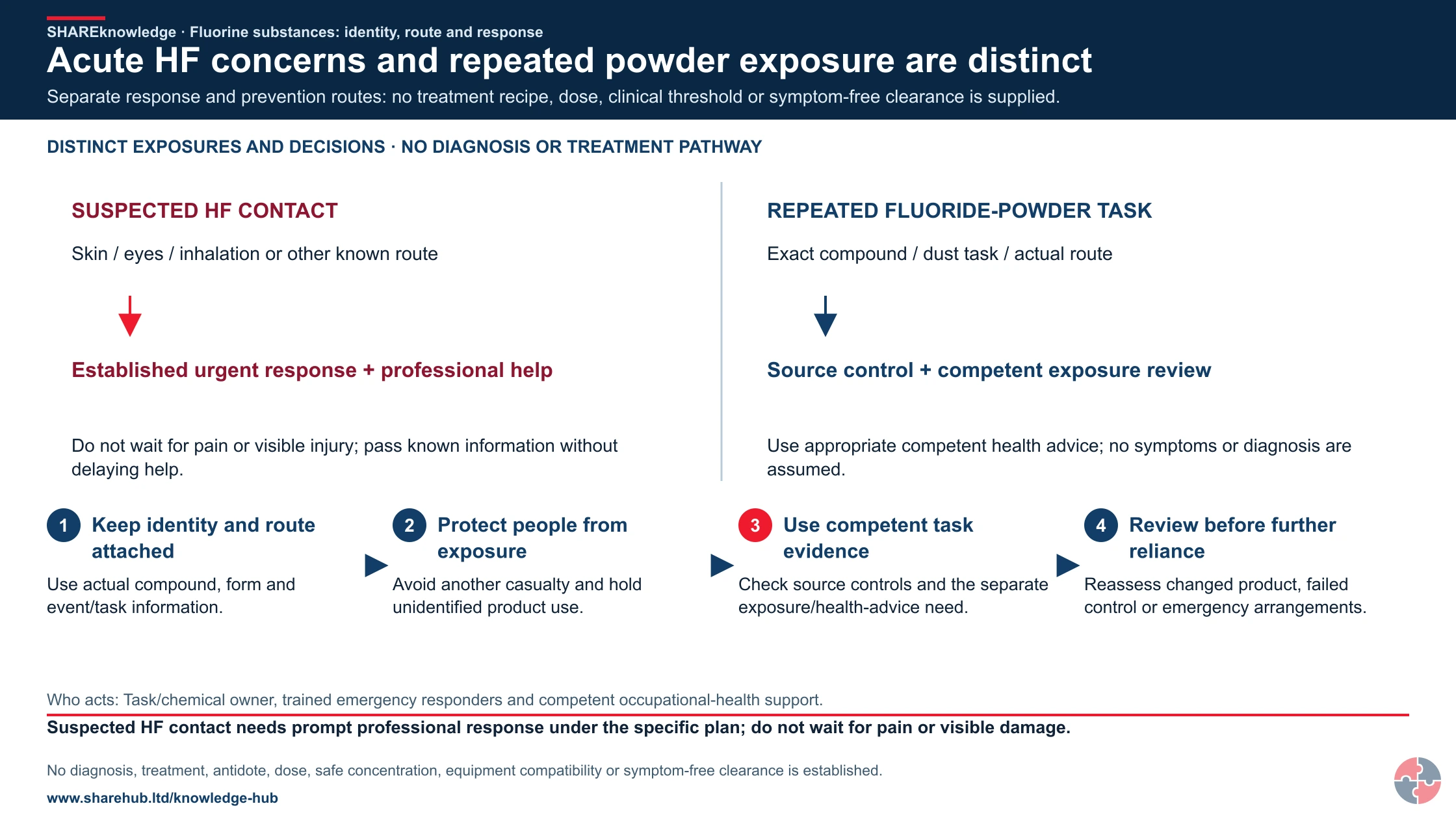
Acute HF concerns and repeated powder exposure are distinct
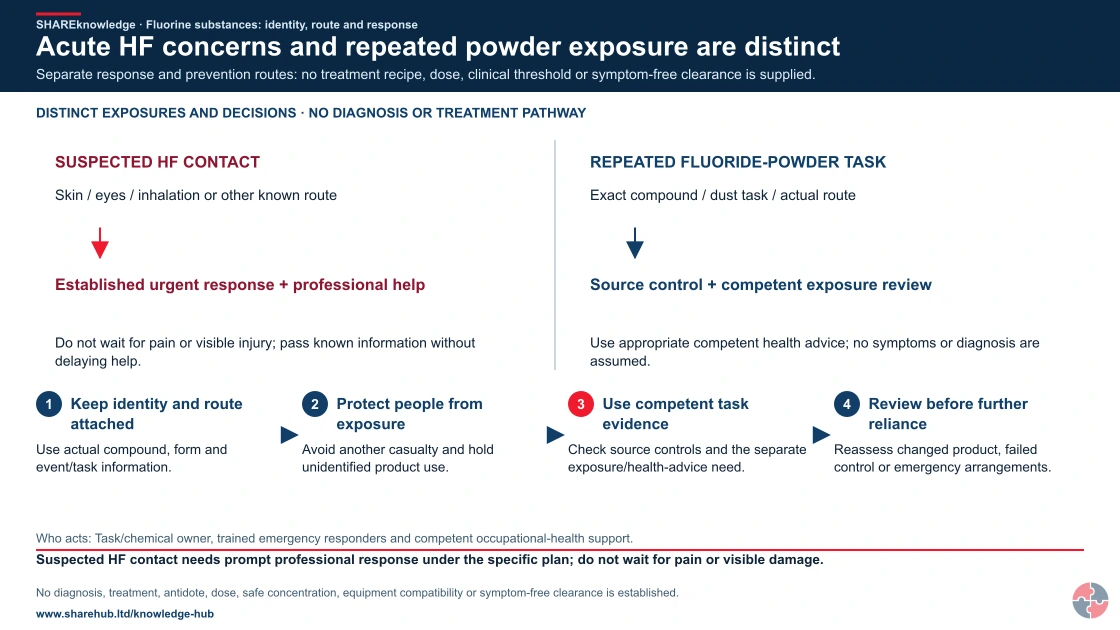
Full written explanation
A complete native comparison keeps two routes separate. Suspected hydrogen-fluoride or hydrofluoric-acid contact connects directly to the established urgent substance-specific response and professional help, with known identity/route information passed without delay. A repeated fluoride-containing powder task connects instead to exact compound and route assessment, contained handling/source control, exposure evidence and appropriate competent health advice. There is no arrow from one exposure to the other, no injury anatomy and no inference that absence of visible harm clears the task. The shared checks establish identity, protect people, use competent task evidence and review changed products or controls.
Separate response and prevention routes: no treatment recipe, dose, clinical threshold or symptom-free clearance is supplied.
- Keep identity and route attached. Use actual compound, form and event/task information.
- Protect people from exposure. Avoid another casualty and hold unidentified product use.
- Use competent task evidence. Check source controls and the separate exposure/health-advice need.
- Review before further reliance. Reassess changed product, failed control or emergency arrangements.
When the evidence does not fit: Suspected HF contact needs prompt professional response under the specific plan; do not wait for pain or visible damage.
Who acts: Task/chemical owner, trained emergency responders and competent occupational-health support.
Changed workplace
Surface treatment: Identify the actual chemistry and task; keep the trained emergency route ready.
Fluoride-containing powder: Assess the particular compound, dust task, source control and exposure route.
Evidence check: No diagnosis, treatment, antidote, dose, safe concentration, equipment compatibility or symptom-free clearance is established.
Keep acute suspected contact ahead of the longer exposure reference
Primary references: UKHSA HF general information, 2024
Open the complete HD image (new tab)Download image
Keep acute suspected contact ahead of the longer exposure reference
Primary references: UKHSA HF general information, 2024
In this worked example, BuildOut Ltd occasionally uses fluoride-containing cleaners and surface treatments during specialist refurbishment work. The business would not allow local teams to improvise; it would pre-approve products, restrict high-risk chemicals, use competent contractors for specialist work and verify emergency arrangements before tasks start.
The example should be read as an operating model. BuildOut would make chemical approval a gate before the work starts, then verify the task at the point of use. The aim is to stop a site team discovering the real chemical risk only after a splash, fume release or waste-handling problem.
A mature arrangement would link the chemical inventory to COSHH assessments, training records, emergency equipment inspections, procurement controls, contractor approvals, exposure monitoring and incident learning. That gives managers a practical chain of evidence, not a loose collection of documents.
| Management element | How the business would manage it | Evidence to review |
|---|---|---|
| Assessing | Maintain a chemical inventory, SDS library and COSHH assessments that separate HF, fluoride salts and fluoride-containing products. | Inventory, SDS review log, COSHH approval and substitution record. |
| Planning and procurement | Block purchase of high-risk products unless approved by a competent person and linked to a safe method. | Procurement rule, authorised substance list and contractor scope review. |
| Implementing controls | Use designated areas, LEV or fume cupboards, compatible PPE, emergency showers and spill arrangements before work starts. | Pre-task check, LEV records, PPE compatibility record and emergency equipment inspection. |
| Training | Train users on exposure routes, symptoms, first response, contamination control and stop-work triggers. | Training matrix, competence checks and supervisor observation. |
| Oversight | Supervisors sample tasks, check storage, observe decanting and review whether first-aid arrangements are present. | Supervisor checklist and action tracker. |
| Learning | Review spills, near misses, symptoms, failed inspections and emergency-drill learning. | Incident reports, investigation actions and management review minutes. |
Relevant official context: HSE COSHH assessment and control; verify the actual chemical and task.HSENI COSHH2003 guide; verify the actual chemical and task.
Who needs fluorine-exposure competence?
Demonstrate the real task, stop decision and emergency handover; a general COSHH attendance record is insufficient.
| Role | Learning to test | Competence demonstration | Assessor and record | Reassessment trigger |
|---|---|---|---|---|
| Operators | Identify exact chemical and route of exposure. | Demonstrate setup, no-use decision and response call. | Supervisor observes task. | Product or method change. |
| Supervisors | Check authorisation, barriers and emergency readiness. | Stop a failed enclosure or missing response supply. | Competent lead records field check. | Incident or failed drill. |
| Maintenance teams | Plan residues, isolation and fume risk. | Show safe opening and hand-back decision. | Engineer records observed task. | Plant or residue change. |
| Emergency responders | Act within trained decontamination and handover plan. | Rehearse skin/eye and release scenario. | Emergency lead observes drill. | Plan or staff change. |
| Hygiene and health advisers | Interpret exposure and surveillance need. | Review sampling, EH40 basis and escalation. | Competent specialist signs record. | New data or symptoms. |
Relevant official context: HSE COSHH assessment and control; verify the actual chemical and task.HSENI COSHH2003 guide; verify the actual chemical and task.
What warning signs show fluorine exposure is not controlled?
Warning signs usually appear as poor chemical knowledge, weak emergency readiness, damaged controls or symptoms that are not investigated.
| Warning sign | How harm can develop | Action |
|---|---|---|
| Unknown chemical contents | Workers cannot distinguish low-risk products from HF or high-concentration fluoride substances. | Stop purchase or use until SDS and COSHH review are complete. |
| No emergency materials | Exposure occurs but responders lack substance-specific arrangements. | Suspend the task and verify emergency plan before restart. |
| Damaged gloves or wrong PPE | Skin contact or eye splash risk increases sharply. | Replace PPE and review compatibility. |
| LEV alarms ignored | Inhalation exposure continues while controls are degraded. | Stop affected work and repair or verify LEV. |
| Symptoms not escalated | Early irritation or exposure warning is missed. | Investigate symptoms, review controls and seek occupational-health advice. Suspected significant HF contact or inhalation requires immediate site emergency and urgent medical response, even when pain is delayed. Routine occupational-health referral is for continuing or non-acute concerns. UKHSA September2024 incident-management PDF covers HF/hydrofluoric acid. Avoid secondary contamination, prompt decontamination and urgent qualified medical response; detailed clinical treatment belongs to trained responders/clinicians and current specialist advice. UKHSA HF incident management 2024 |
Relevant official context: UKHSA HF general information; verify the actual chemical and task.
What do the acronyms and key terms mean?
Acronyms should be understood before they are used in COSHH assessments, training or monitoring records.
| Acronym | Meaning | Plain-English use |
|---|---|---|
| COSHH | Control of Substances Hazardous to Health | UK framework for controlling hazardous substances. |
| HF | Hydrogen fluoride or hydrofluoric acid depending on context | Confirm the exact substance and concentration from the SDS. |
| SDS | Safety Data Sheet | Supplier document describing hazards, controls and emergency information. |
| WEL | Workplace Exposure Limit | Exposure limit listed in EH40 where applicable. |
| LEV | Local Exhaust Ventilation | Engineering control that captures contaminant at source. |
| RPE | Respiratory Protective Equipment | Breathing protection used when higher-order controls do not fully control inhalation exposure. |
| GB | Great Britain | GB COSHH 2002 legal route. |
| NI | Northern Ireland | NI COSHH 2003 legal route. |
| ERICPD | Eliminate, Reduce, Isolate, Control, PPE, Discipline | Control and assurance decision aid. |
Unlock another resource
You have used this month’s two free downloads. Publish a post in your own words to unlock one more resource, or choose SHARE Individual for 10 downloads per month.
You decide whether to share. If you do, use the relevant platform disclosure tools and do not make claims you do not genuinely hold.