SHARE Knowledge Hub
Fire Risk Assessment Objectives and Competence
A fire risk assessment should identify how ignition, fuel and smoke could harm people, then test whether prevention, warning and escape work in the real premises. Its depth and the assessor’s capability must match the building, activities and occupants. In England and Wales the responsible person must record the full assessment and fire safety arrangements; Scotland and Northern Ireland have separate routes. Changed charging, occupancy or barriers require a new decision before work continues.
Understanding Fire Risk Assessment Objectives and Competence
A fire risk assessment should identify how ignition, fuel and smoke could harm people, then test whether prevention, warning and escape work in the real premises. Its depth and the assessor’s capability must match the building, activities and occupants. In England and Wales the responsible person must record the full assessment and fire safety arrangements; Scotland and Northern Ireland have separate routes. Changed charging, occupancy or barriers require a new decision before work continues.
Why this matters at work
Action closure should demonstrate the intended safety result. Attendance, purchase, installation and verified function are different stages. A record is convincing when it links the original risk to the observed correction and explains any limitations. Recurring failure after nominal closure can expose weak acceptance criteria or inadequate management resources and needs further action.
Define the intended outcome before closure, then inspect or test the relevant condition after the repair or procedural change. Match the evidence to the problem: a purchase order does not demonstrate installation, and attendance at training does not demonstrate a usable response. Record remaining limitations and any continuing temporary controls. Reopen the action if observed performance is poor. Management should receive the unresolved risk and resource decision, not merely a favourable percentage of completed tasks.
How organisations manage this in practice
Appointing assistance and retaining legal control are different matters. Fire-law duties attach through the relevant national framework and the facts of employment or control. Contractors may also have duties within their scope. Task allocation should provide authority, resources and coordination without assuming that a job title or service contract removes another person’s obligations. Distinguish commissioning an assessment from controlling the premises and implementing its findings. Identify the actual dutyholders under the relevant national law and allocate tasks with adequate authority and resources. The assessor’s professional obligations do not automatically remove the employer’s or other controllers’ duties. Check that recommendations are understood, prioritised and verified after implementation. Obtain legal advice where responsibility is disputed rather than treating a contract title as the final answer.
Suitability and sufficiency concern the quality of the decision and evidence for the actual risk. A simple premises may need a straightforward assessment; complex processes, vulnerable people or uncertain construction need greater depth and specialist input. The objective is prevention and protection, not producing a favourable score or completing every field with an unsupported answer. Match the depth to the premises, people and credible fire scenarios and explain how the evidence supports implemented measures. Address normal and unusual occupancy, shared systems and limitations. Identify significant uncertainties, necessary actions and interim restrictions rather than concealing them behind a score. Proportionate means enough evidence for the decision, not a shorter checklist regardless of risk. Use the correct national framework and review when the assessment’s validity is affected.
Review should test continuing validity and the capability needed for the changed scope. New occupants, working patterns, processes, alterations, defects or incident learning can require action before a planned date. Keep historical assessments clearly separated from current decisions. Neither an unchanged date nor a familiar assessor demonstrates that the earlier conclusion remains applicable. Review when the building, occupancy, processes, staffing or evidence changes, after relevant incidents and when the existing assessment may no longer be valid. Reconsider whether the person and team have the competence for the changed scope. Keep any planned periodic programme but do not wait for it when a significant issue arises. Record the trigger, revised assumptions and communicated actions. A date on a report is not evidence that its conclusions remain applicable.
Choose the assessor against the premises, not the certificate alone
Begin with the simple-shop and complex-warehouse comparison. Describe the actual premises, occupants, storage, charging, process hazards, shared areas and proposed changes when commissioning the assessment. Ask for relevant experience, the inspection approach, example findings and how the assessor identifies their competence limits and obtains specialist support.
Best-practice guide: Fire Risk Assessment Objectives and Competence
Choose the assessor against the premises, not the certificate alone
Begin with the simple-shop and complex-warehouse comparison. Describe the actual premises, occupants, storage, charging, process hazards, shared areas and proposed changes when commissioning the assessment. A fire risk assessment should identify how ignition, fuel and smoke could harm people, then test whether prevention, warning and escape work in the real premises.
Turn fire risk assessment objectives and competence knowledge into a decision
A fire risk assessment should identify how ignition, fuel and smoke could harm people, then test whether prevention, warning and escape work in the real premises. Its depth and the assessor’s capability must match the building, activities and occupants. Reviews storage height, separation, waste, flammable goods and aisle control.
Warehouse FRA competence scenario
Stock and fire load: Reviews storage height, separation, waste, flammable goods and aisle control. Battery charging: Reviews location, damage, ventilation, isolation, fire response and user checks.
Where do fire risk assessments fail in practice?
Scope mismatch: A generic assessment may omit complex occupancy, processes or dependencies. Possible consequence: Significant fire or escape failures can remain unidentified or unresolved. Competence gap: The assessor works beyond relevant knowledge or experience without the specialist support needed for the premises.
Choose controls for the actual task
Elimination: Remove charging from the stock area and use an existing suitable separate charging location if the operation allows it. Substitution: If travel makes removal impracticable, replace the task with charged exchange equipment or a lower-risk charging arrangement selected against manufacturer instructions; do not claim a battery chemistry is inherently safe. Engineering: Place charging in a correctly designed separated area with suitable electrical installation, fire detection and barriers matched to the building strategy; check smoke paths to the stair. Administrative: Set the authorised charging location, combustible exclusion, defect quarantine and emergency alarm/withdrawal method; inspect shift change and contractor access. PPE: Electrical or maintenance PPE may protect an authorised technician for the specific isolated repair, if selected for that task; it cannot make smoke exposure or an unsafe charging location acceptable. Read the full control table for qualifications, ownership and verification. Use the actual task and applicable jurisdiction; existing technical approval remains unchanged.
Use the full fire risk assessment objectives and competence lesson
Use the full topic for the decision points, practical examples, detailed control tables and source scope. HSE guidance applies to Great Britain; use HSENI for the Northern Ireland route and the source’s stated jurisdiction. A simplified guide does not change the page’s technical-review or approval status.

Read all six steps as text
1. Choose the assessor against the premises, not the certificate alone
Begin with the simple-shop and complex-warehouse comparison.
- Avoid / redesign: Remove charging from the stock area and use an existing suitable separate charging location if the operation allows it.
- Control the task: Place charging in a correctly designed separated area with suitable electrical installation, fire detection and barriers matched to the building strategy; check smoke paths to the stair.
- Verify before release: If charging still occurs by cartons, hold the activity.
Begin with the simple-shop and complex-warehouse comparison. Describe the actual premises, occupants, storage, charging, process hazards, shared areas and proposed changes when commissioning the assessment. A fire risk assessment should identify how ignition, fuel and smoke could harm people, then test whether prevention, warning and escape work in the real premises.
Apply it: Which part of this plan would you check at the workface before authorising the task?
2. Turn fire risk assessment objectives and competence knowledge into a decision
Use the evidence to improve the actual work arrangement.
- Change at source: Remove charging from the stock area and use an existing suitable separate charging location if the operation allows it.
- Make it observable: If charging still occurs by cartons, hold the activity.
- Keep useful evidence: Reviews storage height, separation, waste, flammable goods and aisle control.
A fire risk assessment should identify how ignition, fuel and smoke could harm people, then test whether prevention, warning and escape work in the real premises. Its depth and the assessor’s capability must match the building, activities and occupants. Reviews storage height, separation, waste, flammable goods and aisle control.
Apply it: What evidence would show that the change improves this task, rather than only completing a record?
3. Warehouse FRA competence scenario
Example: a practical application of the existing topic lesson.
- Stock and fire load: Reviews storage height, separation, waste, flammable goods and aisle control.
- Battery charging: Reviews location, damage, ventilation, isolation, fire response and user checks.
- Agency workers: Checks induction, language, supervision and drill inclusion.
Stock and fire load: Reviews storage height, separation, waste, flammable goods and aisle control. Battery charging: Reviews location, damage, ventilation, isolation, fire response and user checks.
Apply it: At which point would you hold this example, and what evidence would allow it to proceed?
4. Where do fire risk assessments fail in practice?
Connect the task, the route to the person and the control that can fail.
- Scope mismatch: A generic assessment may omit complex occupancy, processes or dependencies.
- Possible consequence: Significant fire or escape failures can remain unidentified or unresolved.
- Competence gap: The assessor works beyond relevant knowledge or experience without the specialist support needed for the premises.
Scope mismatch: A generic assessment may omit complex occupancy, processes or dependencies. Possible consequence: Significant fire or escape failures can remain unidentified or unresolved. Competence gap: The assessor works beyond relevant knowledge or experience without the specialist support needed for the premises.
Apply it: Who could be exposed, including other trades, cleaners, maintainers and people nearby?
5. Choose controls for the actual task
Control summary. Read the complete task-specific controls and checks in the linked topic.
- Elimination: Remove charging from the stock area and use an existing suitable separate charging location if the operation allows it.
- Substitution: If travel makes removal impracticable, replace the task with charged exchange equipment or a lower-risk charging arrangement selected against manufacturer instructions; do not claim a battery chemistry is inherently safe.
- Engineering controls: Place charging in a correctly designed separated area with suitable electrical installation, fire detection and barriers matched to the building strategy; check smoke paths to the stair.
- Administrative controls: Set the authorised charging location, combustible exclusion, defect quarantine and emergency alarm/withdrawal method; inspect shift change and contractor access.
- PPE: Electrical or maintenance PPE may protect an authorised technician for the specific isolated repair, if selected for that task; it cannot make smoke exposure or an unsafe charging location acceptable.
Elimination: Remove charging from the stock area and use an existing suitable separate charging location if the operation allows it. Substitution: If travel makes removal impracticable, replace the task with charged exchange equipment or a lower-risk charging arrangement selected against manufacturer instructions; do not claim a battery chemistry is inherently safe. Engineering: Place charging in a correctly designed separated area with suitable electrical installation, fire detection and barriers matched to the building strategy; check smoke paths to the stair. Administrative: Set the authorised charging location, combustible exclusion, defect quarantine and emergency alarm/withdrawal method; inspect shift change and contractor access. PPE: Electrical or maintenance PPE may protect an authorised technician for the specific isolated repair, if selected for that task; it cannot make smoke exposure or an unsafe charging location acceptable. Read the full control table for qualifications, ownership and verification. Use the actual task and applicable jurisdiction; existing technical approval remains unchanged.
Apply it: Which stronger option can be used here, and who will verify it before accepting the remaining risk?
6. Use the full fire risk assessment objectives and competence lesson
Follow the official sources below and retain the task-specific evidence.
- Official guidance: GOV.UK fire safety risk assessment: offices and shops
- Official guidance: Home Office five-step checklist
- Task decision: The commissioning owner resolves unclear scope or competence before relying on the assessment; specialist dependencies remain explicit.
Use the full topic for the decision points, practical examples, detailed control tables and source scope. HSE guidance applies to Great Britain; use HSENI for the Northern Ireland route and the source’s stated jurisdiction. A simplified guide does not change the page’s technical-review or approval status.
Apply it: Which official source and full-topic section will you use to resolve the next decision?
The appointment should define access to real operating conditions, information and people, the recorded assessment and arrangements, and how urgent findings are communicated. Dutyholder ownership remains with those controlling the premises. Use the legal section for the specific nation and its qualified commencement wording; do not turn a general competence statement into an unverified claim about the appointed-assessor provision. Use Principles and Practice for carrying out and closing the assessment.
An office checklist does not cover the new warehouse
Illustrative example. A warehouse adds charging and complex storage while agency workers and visiting drivers use a shared mezzanine route.
Decision. The responsible person commissions an assessor with matching experience and agreed specialist escalation.
Evidence to check. Scope, relevant competence evidence, observed peak use, inspected conditions, limits and an actionable assessment.
Hold or escalation point. Do not accept a generic office report or registration badge as evidence that the actual warehouse risks were assessed.
Follow-up. Review the quality of findings and whether specialist issues and urgent restrictions reached the dutyholder promptly.
Match assessor competence to the premises and task
A small shop and a complex warehouse can require different knowledge and specialist input. A certificate or checklist score alone does not establish competence for every assessment.

Define the scope
Identify premises, occupants, activities, hazards and the decisions required of the assessment.
Check relevant capability
Consider knowledge, experience, task complexity, limits and access to specialist advice.
Connect findings to action
Require clear evidence, priorities, owners and a verification plan for actual fire controls.
Recognise a limit
The commissioning owner resolves unclear scope or competence before relying on the assessment; specialist dependencies remain explicit.
Read the complete task-specific control examples
ERICPD is a planning cross-map: Discipline verifies and sustains every control. ESEAP compares effectiveness. A label does not authorise the task; retain the owner, evidence and stop or change decision.
Fire Risk Assessment Objectives and Competence · ERICPD
- Eliminate
- Remove charging from the stock area and use an existing suitable separate charging location if the operation allows it.
- Reduce
- If travel makes removal impracticable, replace the task with charged exchange equipment or a lower-risk charging arrangement selected against manufacturer instructions; do not claim a battery chemistry is inherently safe.
- Isolate
- Place charging in a correctly designed separated area with suitable electrical installation, fire detection and barriers matched to the building strategy; check smoke paths to the stair.
- Control
- Set the authorised charging location, combustible exclusion, defect quarantine and emergency alarm/withdrawal method; inspect shift change and contractor access.
- PPE
- Electrical or maintenance PPE may protect an authorised technician for the specific isolated repair, if selected for that task; it cannot make smoke exposure or an unsafe charging location acceptable.
- Discipline
- Review charging defects, near misses and worker reports; verify the physical separation still works after stock or layout changes.
Fire Risk Assessment Objectives and Competence · ESEAP
- Elimination
- Remove charging from the stock area and use an existing suitable separate charging location if the operation allows it.
- Substitution
- If travel makes removal impracticable, replace the task with charged exchange equipment or a lower-risk charging arrangement selected against manufacturer instructions; do not claim a battery chemistry is inherently safe.
- Engineering controls
- Place charging in a correctly designed separated area with suitable electrical installation, fire detection and barriers matched to the building strategy; check smoke paths to the stair.
- Administrative controls
- Set the authorised charging location, combustible exclusion, defect quarantine and emergency alarm/withdrawal method; inspect shift change and contractor access.
- PPE
- Electrical or maintenance PPE may protect an authorised technician for the specific isolated repair, if selected for that task; it cannot make smoke exposure or an unsafe charging location acceptable.
What should a fire risk assessment achieve?
It should identify fire hazards, people at risk and suitable precautions so the responsible person can prevent fire and protect people if fire occurs.
SHAREFire tools. Fire risk assessment form · All SHAREFire tools
UK fire safety guides. Choose the guide for the country where your premises are located. England · Northern Ireland · Scotland · Wales
A fire risk assessment (FRA) follows a harm chain: ignition or dangerous process reaches fuel; fire and smoke use doors, voids or services; people may be exposed before escape is complete. The objective is to identify relevant persons, prevent ignition and spread, make warning and escape credible, and make the responsible person’s decisions visible. It is not a certificate that every future change is safe.
Use current government guidance and competent task-specific advice; this section does not establish a technical specification.
A fire risk assessment is not just a form. It is a structured judgement about fire hazards, ignition sources, fuel, people at risk, detection, warning, escape, firefighting equipment, emergency planning, maintenance, training, management arrangements and review. Its purpose is to decide whether existing measures are suitable and what further action is needed.
The assessment should be proportionate to the premises, but proportional does not mean shallow. A small low-risk shop may be assessed by a competent person using straightforward guidance. A care setting, complex building, sleeping accommodation, public venue, process site, warehouse, multi-occupied premises or premises with dangerous substances may need specialist fire safety competence.
The responsible person remains accountable for ensuring the assessment is suitable, sufficient, recorded in full in England and Wales under current Fire Safety Order amendments, with the separate Scotland or NI recording rule checked for that site, reviewed and acted upon. Competent advice helps, but it does not replace ownership of actions, communication, training and maintenance.
| Objective | What the assessor should consider | What good output looks like |
|---|---|---|
| Identify fire hazards | Ignition sources, fuel, oxygen, dangerous substances, contractors and process changes. | Specific hazards linked to locations and activities. |
| Identify people at risk | Workers, visitors, contractors, public, disabled people, lone workers, young people, night staff and people nearby. | Clear vulnerable-person and occupancy considerations. |
| Evaluate existing controls | Prevention, detection, alarm, escape, compartmentation, firefighting, signs, lighting and management. | Judgement on whether controls are suitable and maintained. |
| Decide further action | Gaps, priorities, interim controls, competence and cost/time proportionality. | Action plan with owner, due date, risk priority and evidence. |
| Plan and train | Emergency plan, instruction, drills, wardens, contractor information and assistance arrangements. | People know what to do and records show it. |
| Review | Change, incident, near miss, enforcement, assessor concern, occupancy change or new hazard. | Documented review and updated control decisions. |
A hazard is something that could start, intensify or spread a fire, such as a faulty charger beside packaging. Risk concerns how likely that event is and how seriously it could harm the people exposed. Inspect the condition, quantity, occupancy and warning/escape controls; a label or numerical score cannot replace that judgement.
Prioritise people and credible escape. Property loss, environmental harm and business interruption are additional objectives to consider in planning, but a cheaper recovery measure cannot justify leaving an unsafe escape route or failed warning in use.
How competent does a fire risk assessor need to be?
Competence should match the complexity and risk of the premises, the limitations of the assessor and the decisions being made.
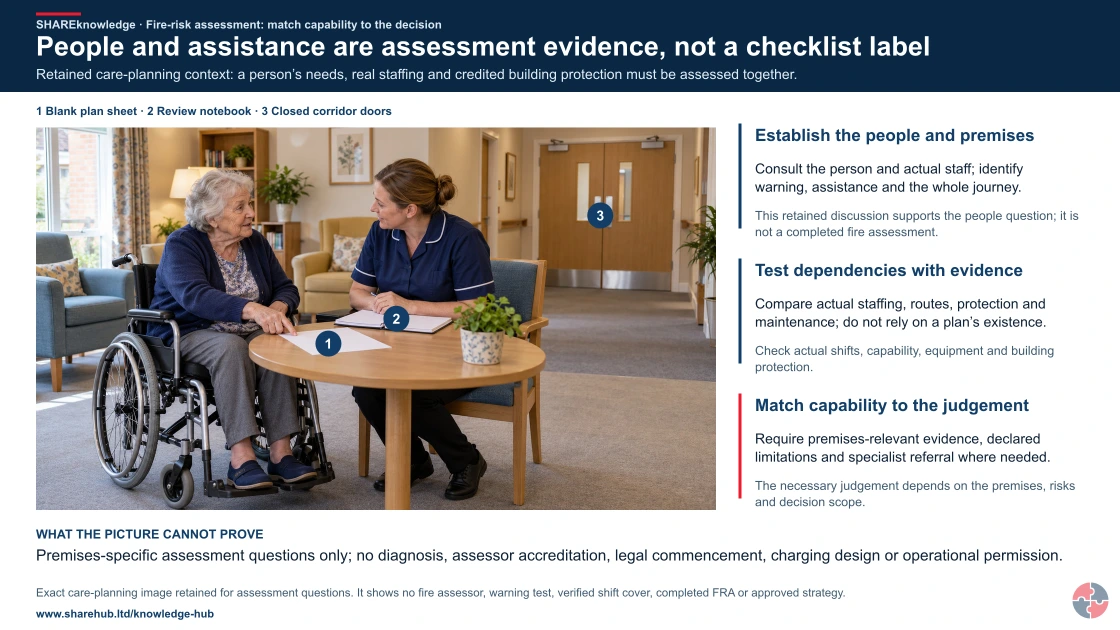
People and assistance are assessment evidence, not a checklist label
Full written explanation
The exact F-03 person-led care-planning scene is meaningfully reused. Markers locate the blank personal-plan sheet, staffing notebook and closed corridor doors. These are questions an assessor must verify against actual occupants and resources; the staff member is not relabelled as a fire assessor and the image shows no warning test, inspection or assessment result. New annotations connect the people/premises basis, verified dependencies and the assessor’s scope/limitations. No diagnosis, assistance technique, helper count or care/healthcare strategy approval is inferred. Picture key: 1 Blank plan sheet · 2 Review notebook · 3 Closed corridor doors. The separate process headings are unnumbered.
Retained care-planning context: a person’s needs, real staffing and credited building protection must be assessed together.
- Establish the people and premises. Consult the person and actual staff; identify warning, assistance and the whole journey.
- Test dependencies with evidence. Compare actual staffing, routes, protection and maintenance; do not rely on a plan’s existence.
- Match capability to the judgement. Require premises-relevant evidence, declared limitations and specialist referral where needed.
Change the pathway
- The staff member is not an assessor label. This retained discussion supports the people question; it is not a completed fire assessment.
- A notebook is not resource assurance. Check actual shifts, capability, equipment and building protection.
- A certificate is not every competence. The necessary judgement depends on the premises, risks and decision scope.
Evidence check: Premises-specific assessment questions only; no diagnosis, assessor accreditation, legal commencement, charging design or operational permission.
Match assessor capability, limitations and evidence to the actual decision
Primary references: GOV.UK: fire risk assessment and help with competence · GOV.UK: factories and warehouses guidance — England · GOV.UK: people and means of escape — stated England scope
Open the complete HD image (new tab)Download image
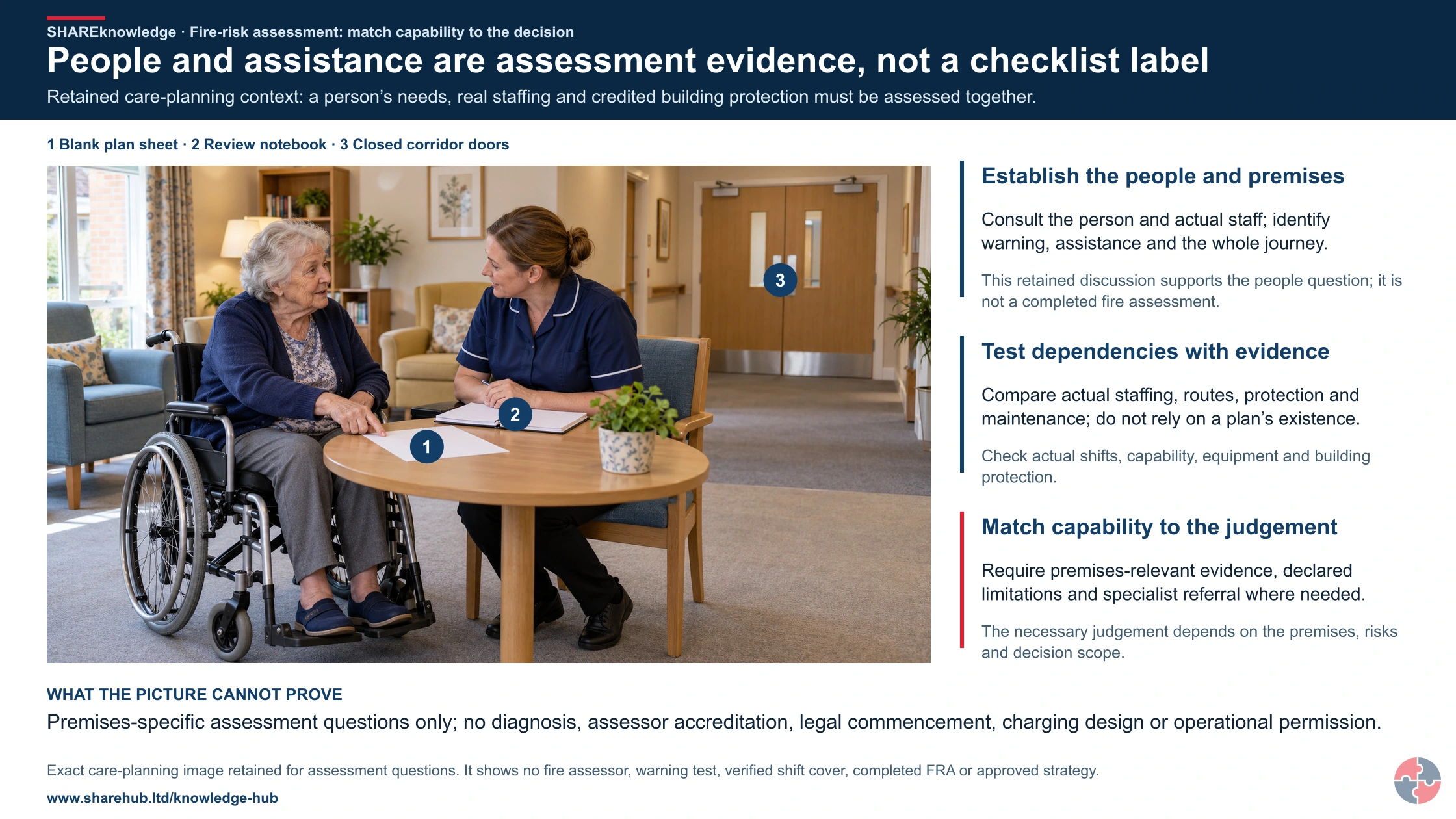
Match assessor capability, limitations and evidence to the actual decision
Primary references: GOV.UK: fire risk assessment and help with competence · GOV.UK: factories and warehouses guidance — England · GOV.UK: people and means of escape — stated England scope
Match the assessor to the premises and the decision: a simple small shop may need a different depth of skill from a warehouse with charging, mixed tenants, alterations and assisted escape. Ask what the assessor inspected, which drawings and maintenance records they tested, who they consulted, which assumptions remain uncertain, and when a fire engineer or dangerous-substance specialist must take over. The responsible person retains the duty to procure and act on a suitable and sufficient assessment.
The Home Office Section 156 guide says the later appointed-assessor competence provision has not commenced; competent appointment is currently recommended, while the existing suitable-and-sufficient assessment duty remains. Home Office five-step checklist helps structure a simple assessment but cannot settle complex fire strategy or product-specific controls.
Competence is not a job title or a certificate alone. It combines knowledge of fire hazards, legislation, building features, human behaviour, means of escape, fire protection, management systems, technical limitations and the ability to identify when specialist input is needed.
Simple premises may be assessed competently by someone with suitable training, experience and access to official guidance. Complex premises may require a competent fire risk assessor, fire engineer or specialist input, especially where evacuation strategy, compartmentation, smoke control, dangerous substances, sleeping risk or vulnerable occupants are involved.
| Premises or issue | Competence needed | Warning sign of under-competence |
|---|---|---|
| Small low-risk office | Basic fire risk assessment competence and understanding of official guidance. | Checklist completed without walking the premises. |
| Warehouse or workshop | Understanding of fire load, storage, electrics, hot work, vehicles, alarm and evacuation. | No review of stock height, charging, waste or contractors. |
| Public venue | Understanding of occupancy, crowd movement, staff roles, alarm messages and emergency lighting. | Assessment assumes visitors behave like trained staff. |
| Care or healthcare setting | Premises-specific competence in assisted escape, any justified horizontal strategy and vulnerable people; healthcare design needs its own specialist evidence. | No evidence that staffing and compartments support the strategy. Context: Home Office disabled means-of-escape guide. England disabled-escape guidance supports general assistance and competence matched to the people and premises. It does not approve hospital design, staffing or a horizontal evacuation strategy; specialist healthcare evidence remains held. |
| Dangerous substances | DSEAR competence and fire/explosion understanding. | Flammable vapours, gases or dusts treated as ordinary housekeeping. Context: HSE work-process guidance. HSE GB guidance supports identifying and controlling work-process fire and explosion risks. DSEAR applicability and specialist process competence require site-specific assessment; no NI scope is inferred. |
| Complex building | Specialist knowledge of compartmentation, smoke control, fire strategy and maintenance. | Assessor cannot explain assumptions or limits. |
How should competence be judged for a warehouse fire assessment?
A warehouse example shows why assessor competence must match storage, vehicles, charging, contractors and fire load.
A distribution warehouse stores palletised goods, aerosols, returned electrical items and packaging. It has delivery vehicles, battery charging, racking, temporary agency workers, visiting drivers, waste compactors and a small mezzanine office. A generic office-style assessment would miss important fire risk features.
For the warehouse premises context, Home Office factories-and-warehouses fire-risk guide applies to England; charger and fire-stopping details still depend on the actual equipment instructions and building strategy.
The responsible person asks whether the assessor understands high fire load, storage layout, travel distances, racking, alarm audibility, emergency lighting, extinguisher location, charging areas, contractor hot work, vehicle interface and people who may be unfamiliar with the premises. Where dangerous substances or complex storage questions arise, specialist advice is sought.
| Issue | Poor assessment | Competent assessment |
|---|---|---|
| Stock and fire load | Notes that stock is present. | Reviews storage height, separation, waste, flammable goods and aisle control. |
| Battery charging | Assumes chargers are normal electrics. | Reviews location, damage, ventilation, isolation, fire response and user checks. |
| Agency workers | Assumes all staff know exits. | Checks induction, language, supervision and drill inclusion. |
| Contractor hot work | Relies on contractor RAMS. | Checks permit controls, fire watch and area clearance. |
| Mezzanine escape | Counts stairs only. | Considers smoke, travel, occupancy and alarm audibility. |
What is the difference between a simple and complex fire risk assessment?
The difference is not page count; it is the level of judgement, competence and evidence needed to make defensible decisions.
For a powered pallet truck charge, first identify battery and charger type, quantity, manufacturer instructions, the charging location, fuel nearby, warning and escape dependencies. Do not apply a universal ventilation or isolation rule to unlike equipment. Damaged batteries or chargers, an impaired alarm or a compromised escape route require the activity to stop and competent reassessment.
A simple premises assessment may use official checklists effectively where hazards are familiar, occupancy is low, escape is straightforward and building features are uncomplicated. The assessor still needs to inspect the premises, identify people at risk and create an action plan.
A complex assessment may require drawings, fire strategy information, compartmentation review, specialist systems knowledge, DSEAR input, vulnerable-person planning, smoke movement assumptions and review of management systems. A long but generic report is not better than a short, accurate and action-focused assessment.
| Assessment type | Typical features | Evidence standard |
|---|---|---|
| Simple | Small, low-risk, straightforward escape, ordinary occupancy. | Clear findings, action plan, training and routine review. |
| Moderate | Workshop, warehouse, public access, contractors, changing stock or multiple shifts. | Specific site observations and stronger management controls. |
| Complex | Sleeping risk, care, high occupancy, phased evacuation, dangerous substances or complex building. | Competent specialist review and clear assumptions. |
| High hazard | Process fire, DSEAR, COMAH interface or major business continuity impact. | Fire strategy, technical studies, maintenance and assurance evidence. |
How can the hierarchy of controls guide risk reduction after a fire risk assessment?
Use the two related frameworks as decision aids: ERICPD names Eliminate, Reduce, Isolate, Control, PPE and Discipline; the HSE five levels are elimination, substitution, engineering, administrative controls and PPE. Start at source, justify any lower-level reliance and verify effectiveness in the field.
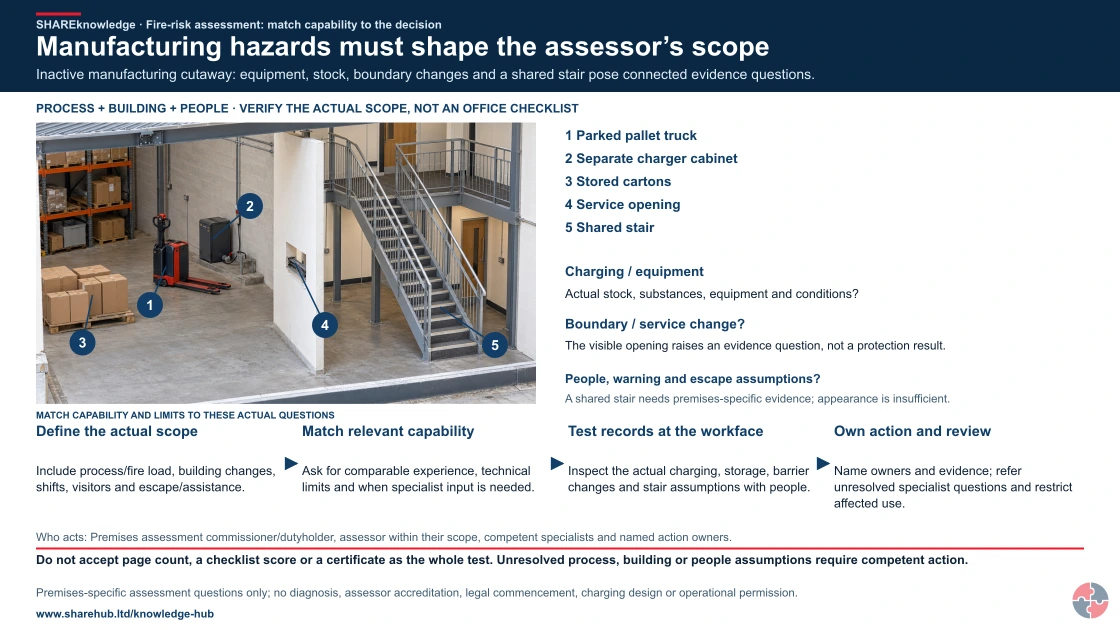
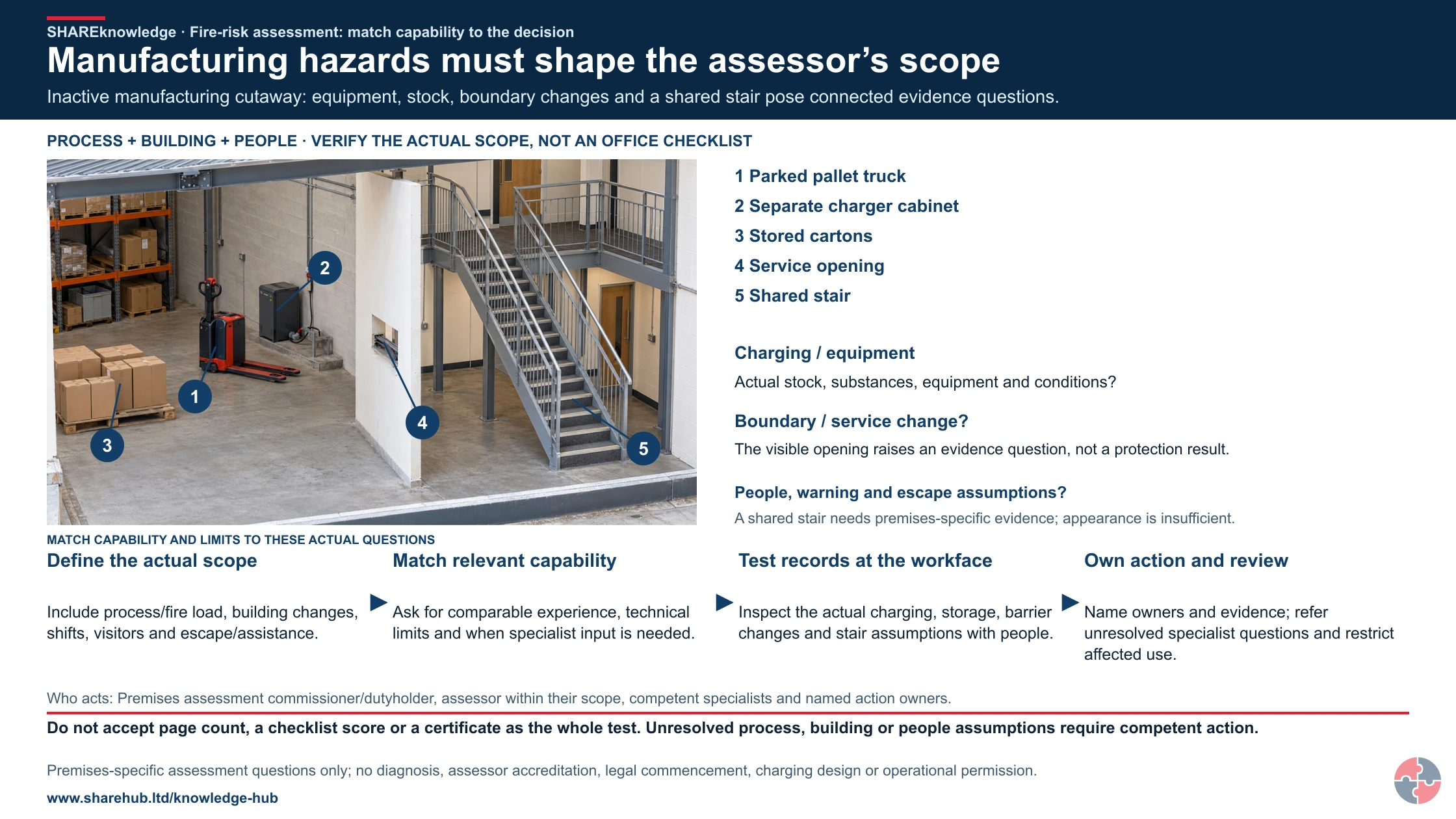
Manufacturing hazards must shape the assessor’s scope
Full written explanation
An illustrative empty, inactive small-manufacturing cutaway shows a parked powered pallet truck, a separate charger cabinet and unattached connector, stored cartons, a real service opening with continuous cables, and a supported shared stair. Picture key: 1 Parked pallet truck · 2 Separate charger cabinet · 3 Stored cartons · 4 Service opening · 5 Shared stair. The process, building and people questions remain connected: identify the actual equipment, stock, substances and conditions; investigate the boundary or service change; and test the people, warning and escape assumptions with premises-specific evidence. The opening is an assessment question, not a verified protective assembly or a predicted smoke path. Equipment appearance and loose connectors do not establish electrical isolation, charger compatibility, battery chemistry, safe charging, adequate ventilation or clearance. The stair’s appearance establishes no capacity, protection, strategy, usable escape or permission. Four unnumbered checks define the actual scope, match relevant capability, test records at the workface and own action and review. Assessor limitations, specialist referral and dutyholder action remain distinct; no certificate, score or page count settles the decision. No live charging, fire, smoke, inspection result, qualification, accreditation, legal commencement, technical design or operating method is shown.
Inactive manufacturing cutaway: equipment, stock, boundary changes and a shared stair pose connected evidence questions.
- Define the actual scope. Include process/fire load, building changes, shifts, visitors and escape/assistance.
- Match relevant capability. Ask for comparable experience, technical limits and when specialist input is needed.
- Test records at the workface. Inspect the actual charging, storage, barrier changes and stair assumptions with people.
- Own action and review. Name owners and evidence; refer unresolved specialist questions and restrict affected use.
When the evidence does not fit: Do not accept page count, a checklist score or a certificate as the whole test. Unresolved process, building or people assumptions require competent action.
Who acts: Premises assessment commissioner/dutyholder, assessor within their scope, competent specialists and named action owners.
Changed workplace
Care planning context: Test people, warning, actual assistance and credited premises protection together.
Small manufacturing premises: Match assessor capability to process, building and people risks, with explicit limits and actions.
Evidence check: Premises-specific assessment questions only; no diagnosis, assessor accreditation, legal commencement, charging design or operational permission.
Match assessor capability, limitations and evidence to the actual decision
Primary references: GOV.UK: fire risk assessment and help with competence · GOV.UK: factories and warehouses guidance — England · GOV.UK: people and means of escape — stated England scope
Open the complete HD image (new tab)Download image
Match assessor capability, limitations and evidence to the actual decision
Primary references: GOV.UK: fire risk assessment and help with competence · GOV.UK: factories and warehouses guidance — England · GOV.UK: people and means of escape — stated England scope
The control matrices are illustrations; premises-specific suitability, implementation and specialist design approval remain held for competent review.
A powered pallet truck charges beside shrink-wrapped cartons; a fault can ignite packaging and smoke can reach pickers and a shared stair. The assessment owner must test both ignition prevention and escape, rather than accepting a charger checklist.
A contractor runs cables through a wall protecting the warehouse stair while late-shift workers use that route. An unsealed opening lets smoke bypass the intended barrier and can remove safe escape.
How can the ERICPD hierarchy of controls guide risk reduction after a fire risk assessment?

| Hazard and harm route | ERICPD → five-level control | Task-specific measure and feasibility | Owner, checks and evidence | Failure and stop decision |
|---|---|---|---|---|
| Warehouse charging beside cartons | Eliminate → Elimination | Remove charging from the stock area and use an existing suitable separate charging location if the operation allows it. Facilities manager checks the revised traffic and power plan before approval. Source: Home Office guide. | Facilities manager signs layout and observes a normal shift. If charging still occurs by cartons, hold the activity. | If charging still occurs by cartons, hold the activity. |
| Same scenario | Reduce → Substitution | If travel makes removal impracticable, replace the task with charged exchange equipment or a lower-risk charging arrangement selected against manufacturer instructions; do not claim a battery chemistry is inherently safe. Source: Home Office guide. | Purchaser and assessor record equipment specification, charging needs and revised fire assessment. If the substitute is unverified, keep the old activity on hold. | If the substitute is unverified, keep the old activity on hold. |
| Same scenario | Isolate → Engineering | Place charging in a correctly designed separated area with suitable electrical installation, fire detection and barriers matched to the building strategy; check smoke paths to the stair. Source: Home Office guide. | Fire designer and competent installer verify drawings, commissioning and penetration seals; facilities samples doors and alarm response. Stop if barriers or detection are impaired. | Stop if barriers or detection are impaired. |
| Same scenario | Control → Administrative | Set the authorised charging location, combustible exclusion, defect quarantine and emergency alarm/withdrawal method; inspect shift change and contractor access. Source: Home Office guide. | Supervisor keeps inspection and fault logs and observes workers. Stop on damaged leads, combustible encroachment or unknown fire-system impairment. | Stop on damaged leads, combustible encroachment or unknown fire-system impairment. |
| Same scenario | PPE → PPE | Electrical or maintenance PPE may protect an authorised technician for the specific isolated repair, if selected for that task; it cannot make smoke exposure or an unsafe charging location acceptable. Source: Home Office guide. | Maintenance lead verifies task assessment, fit, condition and replacement. No public or worker PPE is credited as an escape route control. | Do not proceed if the chosen measure or its field evidence cannot be verified for this task. |
| Same scenario | Discipline → Administrative assurance | Review charging defects, near misses and worker reports; verify the physical separation still works after stock or layout changes. Discipline here means sustaining controls, not blaming staff. Source: Home Office guide. | Responsible person samples layout, alarms and closeout records. Suspend use when repeated encroachment is not corrected. | Suspend use when repeated encroachment is not corrected. |
| Protected stair during refurbishment | Eliminate → Elimination | Route new cables without crossing the protected wall where a technically suitable route exists. Designer checks the alternative against service and fire drawings before work. Source: Home Office guide. | Project lead records selected route. Stop drilling until the credited boundary is identified. | Stop drilling until the credited boundary is identified. |
| Same scenario | Reduce → Substitution | Use a predesigned service route or smaller compatible assembly that needs fewer openings; substitution does not excuse an unsealed crossing. Source: Home Office guide. | Designer documents route selection and tested system requirement. Reject an unverified product-only claim. | Reject an unverified product-only claim. |
| Same scenario | Isolate → Engineering | Where the crossing is necessary, specify and install a compatible tested fire-stopping system for the wall, service and required performance; maintain a safe alternate route during impairment. Source: Home Office guide. | Competent installer photographs the seal; fire lead checks installed detail and stair protection before hand-back. Restrict occupancy if the route is unsafe. | Restrict occupancy if the route is unsafe. |
| Same scenario | Control → Administrative | Permit the opening, log the impairment and notify affected tenants; keep temporary escape instructions, warning and responder information current. Source: Home Office guide. | Contract coordinator checks work pack and shift briefing. Stop if the opening is untracked or an alternate escape decision is missing. | Stop if the opening is untracked or an alternate escape decision is missing. |
| Same scenario | PPE → PPE | Contractor task PPE can address drilling dust or cuts after separate assessment; it does not protect occupants from a failed smoke barrier. Source: Home Office guide. | Contractor supervisor checks PPE suitability and condition; no PPE credit is taken for stair tenability. | Do not proceed if the chosen measure or its field evidence cannot be verified for this task. |
| Same scenario | Discipline → Administrative assurance | Sample completed penetrations, update as-built plans and revisit the FRA after hand-back; repeat defects trigger procurement and supervision review. Source: Home Office guide. | Responsible person records competent acceptance and corrective action. Keep the stair restriction until barrier evidence is credible. | Keep the stair restriction until barrier evidence is credible. |
How can the ISO 45001 hierarchy of controls guide risk reduction after a fire risk assessment?

| Hazard and harm route | ERICPD → five-level control | Task-specific measure and feasibility | Owner, checks and evidence | Failure and stop decision |
|---|---|---|---|---|
| Warehouse charging beside cartons | Eliminate → Elimination | Remove charging from the stock area and use an existing suitable separate charging location if the operation allows it. Facilities manager checks the revised traffic and power plan before approval. Source: Home Office guide. | Facilities manager signs layout and observes a normal shift. If charging still occurs by cartons, hold the activity. | If charging still occurs by cartons, hold the activity. |
| Same scenario | Reduce → Substitution | If travel makes removal impracticable, replace the task with charged exchange equipment or a lower-risk charging arrangement selected against manufacturer instructions; do not claim a battery chemistry is inherently safe. Source: Home Office guide. | Purchaser and assessor record equipment specification, charging needs and revised fire assessment. If the substitute is unverified, keep the old activity on hold. | If the substitute is unverified, keep the old activity on hold. |
| Same scenario | Isolate → Engineering | Place charging in a correctly designed separated area with suitable electrical installation, fire detection and barriers matched to the building strategy; check smoke paths to the stair. Source: Home Office guide. | Fire designer and competent installer verify drawings, commissioning and penetration seals; facilities samples doors and alarm response. Stop if barriers or detection are impaired. | Stop if barriers or detection are impaired. |
| Same scenario | Control → Administrative | Set the authorised charging location, combustible exclusion, defect quarantine and emergency alarm/withdrawal method; inspect shift change and contractor access. Source: Home Office guide. | Supervisor keeps inspection and fault logs and observes workers. Stop on damaged leads, combustible encroachment or unknown fire-system impairment. | Stop on damaged leads, combustible encroachment or unknown fire-system impairment. |
| Same scenario | PPE → PPE | Electrical or maintenance PPE may protect an authorised technician for the specific isolated repair, if selected for that task; it cannot make smoke exposure or an unsafe charging location acceptable. Source: Home Office guide. | Maintenance lead verifies task assessment, fit, condition and replacement. No public or worker PPE is credited as an escape route control. | Do not proceed if the chosen measure or its field evidence cannot be verified for this task. |
| Same scenario | Discipline → Administrative assurance | Review charging defects, near misses and worker reports; verify the physical separation still works after stock or layout changes. Discipline here means sustaining controls, not blaming staff. Source: Home Office guide. | Responsible person samples layout, alarms and closeout records. Suspend use when repeated encroachment is not corrected. | Suspend use when repeated encroachment is not corrected. |
| Protected stair during refurbishment | Eliminate → Elimination | Route new cables without crossing the protected wall where a technically suitable route exists. Designer checks the alternative against service and fire drawings before work. Source: Home Office guide. | Project lead records selected route. Stop drilling until the credited boundary is identified. | Stop drilling until the credited boundary is identified. |
| Same scenario | Reduce → Substitution | Use a predesigned service route or smaller compatible assembly that needs fewer openings; substitution does not excuse an unsealed crossing. Source: Home Office guide. | Designer documents route selection and tested system requirement. Reject an unverified product-only claim. | Reject an unverified product-only claim. |
| Same scenario | Isolate → Engineering | Where the crossing is necessary, specify and install a compatible tested fire-stopping system for the wall, service and required performance; maintain a safe alternate route during impairment. Source: Home Office guide. | Competent installer photographs the seal; fire lead checks installed detail and stair protection before hand-back. Restrict occupancy if the route is unsafe. | Restrict occupancy if the route is unsafe. |
| Same scenario | Control → Administrative | Permit the opening, log the impairment and notify affected tenants; keep temporary escape instructions, warning and responder information current. Source: Home Office guide. | Contract coordinator checks work pack and shift briefing. Stop if the opening is untracked or an alternate escape decision is missing. | Stop if the opening is untracked or an alternate escape decision is missing. |
| Same scenario | PPE → PPE | Contractor task PPE can address drilling dust or cuts after separate assessment; it does not protect occupants from a failed smoke barrier. Source: Home Office guide. | Contractor supervisor checks PPE suitability and condition; no PPE credit is taken for stair tenability. | Do not proceed if the chosen measure or its field evidence cannot be verified for this task. |
| Same scenario | Discipline → Administrative assurance | Sample completed penetrations, update as-built plans and revisit the FRA after hand-back; repeat defects trigger procurement and supervision review. Source: Home Office guide. | Responsible person records competent acceptance and corrective action. Keep the stair restriction until barrier evidence is credible. | Keep the stair restriction until barrier evidence is credible. |
The same competence test transfers to a hotel kitchen: assess cooking fuel, night occupancy and assisted escape rather than copying the warehouse controls. The hotel manager should observe an overnight drill and stop use of any route whose warning or fire separation is impaired.
How can managers test whether a fire risk assessment is good enough?
A good assessment should help managers make decisions, not just prove that a document exists.
Managers can test quality by asking whether the assessment reflects the real premises, names specific hazards, identifies vulnerable people, explains control assumptions, prioritises actions and says when review is needed.
Weak assessments often contain generic wording, missing drawings, copied photos, no action ownership, no evidence that defects closed and no clear link to drills, maintenance or training.
| Quality question | Strong answer | Weak answer |
|---|---|---|
| Does it describe real hazards? | Yes, by location and task. | Generic list copied from guidance. |
| Does it identify people at risk? | Includes visitors, contractors, vulnerable people and shift patterns. | Says employees only. |
| Does it assess controls? | Judges alarm, escape, doors, lighting, training and maintenance. | Lists controls without testing suitability. |
| Does it drive action? | Actions have owner, date, priority and evidence. | Recommendations are vague. |
| Does it review change? | States triggers and links to management of change. | Annual review only regardless of change. |
What must the assessment and action register connect?
Connect each credible ignition or smoke route to the people affected, chosen hierarchy controls, owner, field test, interim restriction and review trigger.
At a warehouse, record the charging equipment and instructions, packaging load, late-shift occupancy, stair protection, alarm and contractor changes. A finding is actionable only when it says what condition will change, who can change it, what evidence proves it, and what work stops meanwhile.
A manager should sample the actual shift, not only the document. If charging moves, the protected wall is drilled or a person needs assistance, reopen the assessment before relying on the old route or alarm assumptions.
What is the difference between a poor and a good fire risk assessment?
A poor assessment is generic paperwork; a good assessment is a suitable and sufficient judgement that drives action and review.
Two fire risk assessments can look similar in length but be very different in quality. The weaker version names broad hazards, copies legal phrases and leaves managers with vague recommendations. The stronger version identifies significant findings, people at risk, premises complexity, control condition, competence limits, action ownership and review triggers.
This distinction is especially important for learners. The aim is not to produce a beautiful report; it is to help the responsible person prevent fire, protect relevant persons, brief people, maintain controls and know when arrangements are not good enough.
| Assessment area | Generic or weak checklist | Suitable and sufficient assessment |
|---|---|---|
| Significant findings | Lists 'electrical equipment' and 'waste' without location or judgement. | Identifies specific ignition sources, fuel loads, people at risk and control gaps by area. |
| Occupant risk | Assumes all people can self-evacuate. | Considers visitors, contractors, disabled people, young people, lone workers, night staff and vulnerable occupants. |
| Premises complexity | Uses the same template for office, warehouse and care setting. | Matches depth to layout, fire protection, occupancy, dangerous substances and evacuation strategy. |
| Action plan | Says 'improve housekeeping' or 'review training'. | Sets risk-ranked actions with owner, due date, interim control and completion evidence. |
| Competence | Assessor does not state limits or specialist needs. | Explains competence basis and escalates complex fire engineering, DSEAR or compartmentation issues. |
| Review triggers | Annual review only. | Review after building change, incident, drill failure, enforcement, occupancy change or new risk. |
| Evidence | Contains photos and certificates but no clear decision trail. | Connects evidence to controls, defects, repairs, drills and management review. |
When should a fire risk assessment be reviewed or escalated?
Review is needed after significant change, evidence of control failure, new people at risk or uncertainty about assessor competence.
The fire risk assessment should be a living management tool. If the premises change, stock changes, building work starts, dangerous substances are introduced, a drill fails, a fire or near miss occurs, enforcement advice is received or a vulnerable-person need arises, the assessment should be reviewed.
Escalation is also needed where the person carrying out the assessment does not have the competence to judge the risk. Recognising limits is part of competence, not a weakness.
| Trigger or question | Immediate action | Evidence before normal operation |
|---|---|---|
| Has the building, process or occupancy changed? | Review the fire risk assessment and confirm whether controls still match the risk. | Updated assessment, action plan and communication record. |
| Is a key fire precaution impaired? | Apply temporary controls, inform relevant people and escalate to the responsible person. | Impairment log, compensatory measures and close-out evidence. |
| Could people be trapped, delayed or confused? | Review escape, warning, signage, assistance and drill findings. | Drill record, PEEP review, route inspection and action tracker. |
| Is specialist design or technical judgement needed? | Seek competent advice before relying on assumptions. | Competent report, design note, certificate or reviewed fire strategy. |
| Has a near miss, false alarm or drill failure occurred? | Investigate the learning point and update arrangements. | Investigation note, corrective action and communication record. |
Where do fire risk assessments fail in practice?
They fail when they become generic paperwork, do not reflect real work, use the wrong competence or do not lead to action.
A poor assessment may look polished but fail to identify the real risk: blocked routes during deliveries, unauthorised storage, changed night staffing, poor alarm audibility, contractor penetrations, unsafe charging or a phased evacuation strategy unsupported by building condition.
A good assessment teaches the organisation what must not fail and gives managers evidence to check. It is specific, proportionate, competent and alive.
| Failure or weak practice | How it develops | What good looks like |
|---|---|---|
| Assumption without evidence | The organisation assumes fire risk assessment is adequate because it has existed for years. | Review the fire risk assessment, inspect the real condition and test the arrangement. |
| Unmanaged change | Refurbishment, new stock, changed hours, altered routes or different users undermine the original arrangement. | Add fire safety review to change control and contractor handover. |
| Open defects | Defects are recorded but not risk-ranked, resourced or closed. | Escalate overdue critical actions and use interim controls. |
| Poor communication | Workers, visitors, contractors or night staff do not understand what to do. | Update briefings, notices, inductions and drills. |
| Competence gap | A non-specialist makes design assumptions about complex premises, smoke spread, evacuation or fire resistance. | Use competent advice and record the decision basis. |
| Competence mismatch | A simple checklist is used for complex premises or dangerous substances. | Get competent specialist review. |
| No action discipline | Findings are made but not owned, funded or closed. | Use risk-ranked action tracking and leadership escalation. |
What evidence shows fire risk assessment objectives and competence is controlled?
Evidence should show that fire precautions are suitable, available, maintained, tested, understood and reviewed.
Fire evidence should connect the fire risk assessment to real controls. A log book alone is not enough if defects remain open, staff do not know the procedure or equipment cannot be reached during normal work.
Good records show what was checked, what failed, who owned the action, when it was closed and how the responsible person knows the arrangement still protects relevant persons.
| Evidence item | What it should show | Assurance question |
|---|---|---|
| Assessor competence evidence | The assessor's knowledge, experience and limits match the premises. | Record why the person was suitable and when specialists were used. |
| Significant findings | Hazards, people at risk and controls are clear. | Findings are site-specific and actionable. |
| FRA review record | Reviews are triggered by change, incident, drill learning and defects. | Dates, reasons and decisions are recorded. |
| Fire risk assessment | Current hazards, people at risk, existing controls, further actions and review triggers are recorded. | Check after change, incident, refurbishment, occupancy change or drill learning. |
| Action tracker | Actions show owner, due date, priority, interim control and close-out evidence. | High-risk defects should not drift without escalation. |
| Testing and inspection records | Alarms, emergency lighting, extinguishers, doors, escape routes and relevant systems are checked at suitable intervals. | Records should show defects and corrective action, not just ticks. |
| Training and drill records | Workers, wardens and relevant contractors know what to do and how to report defects. | Drill observations should lead to improvement. |
How should fire risk assessment objectives and competence be assured?
Assurance should test whether the fire arrangement works in the building, at the time, with the people who may need it.
First-line assurance comes from daily checks, weekly tests, warden observations and immediate defect reporting. Second-line assurance reviews fire risk assessment actions, drills, maintenance, contractor records and repeat findings. Specialist assurance may include competent fire risk assessor review, fire alarm contractor reports, extinguisher servicing, emergency lighting testing and enforcement feedback.
The test is practical: if the alarm operates today, can everyone hear, understand, move, escape, account for vulnerable people and keep routes safe without relying on luck?
| Assurance layer | What to check | What good looks like |
|---|---|---|
| Frontline checks | Supervisors and wardens check that fire risk assessment competence controls are available before and during normal work. | Defects are reported, prioritised and corrected before people rely on failed controls. |
| Manager review | Managers review fire risk assessment actions, contractor changes, drills, inspections and repeat defects. | Resources, ownership and close-out dates match the risk. |
| Competent review | A competent fire risk assessor, engineer or specialist reviews complex design, strategy or technical uncertainty. | Recommendations are understood, risk-ranked and turned into practical actions. |
| Leadership assurance | Senior leaders review overdue critical actions, enforcement feedback, recurring impairments and high-risk premises. | Important fire risks are visible in governance rather than buried in a log book. |
Which fire-risk-assessment duties apply in each UK jurisdiction?
England and Wales, Scotland and Northern Ireland have separate non-domestic premises fire routes; work and dangerous-substance duties must also be checked for the actual location and activity.
The Dangerous Substances and Explosive Atmospheres Regulations (DSEAR) address relevant dangerous-substance work in Great Britain; the Health and Safety Executive (HSE) or local authority may enforce work-process precautions. Northern Ireland has corresponding but separate legislation and enforcement. A premises fire assessment should still connect these process controls to warning and escape without collapsing the legal routes.
The Fire Safety Order is the England and Wales premises route. Scottish and Northern Irish instruments are separate. GB work-health rules and DSEAR do not silently apply in NI; use the corresponding NI rules where in scope. This table identifies routes, not legal approval for a site-specific strategy.
For this page’s fire assessment and control decisions, Fire Safety Order prevention principles apply in England and Wales, while HSE work-process guidance explains the separate GB route for dangerous substances and ignition from work. Check the corresponding NI rules and regulator for an NI site.
| Jurisdiction | Duty or guidance | What it means | How to apply it |
|---|---|---|---|
| E&W | Regulatory Reform (Fire Safety) Order 2005 | Requires the responsible person to assess fire risk and maintain suitable fire precautions in non-domestic premises. | Use as the main fire safety legal framework for England and Wales. |
| GB | Health and Safety at Work etc. Act 1974 | Requires employers to protect employees and others affected by work so far as reasonably practicable. | Use for work activities that create fire, emergency or firefighting risk. |
| GB | Management of Health and Safety at Work Regulations 1999 | Requires suitable and sufficient risk assessment, preventive arrangements, competent help, emergency arrangements and review. | Use for management arrangements, competence and emergency procedures. |
| GB | Dangerous Substances and Explosive Atmospheres Regulations 2002 | Requires fire and explosion risk from dangerous substances to be assessed and controlled. | Use where flammable substances, gases, vapours, dusts or oxygen enrichment affect the fire arrangements. |
| England | Building Safety Act Section 156 implementation guidance | England guidance on the Fire Safety Order amendments: full FRA record, information sharing and uncommenced appointed-assessor competence provision. | Updated 2023 |
| Wales | Welsh Government Section 156 guidance | Wales guidance on the same Fire Safety Order amendments: full FRA record, information sharing and uncommenced appointed-assessor competence provision. | Updated 2023 |
| Scotland | Fire (Scotland) Act 2005 | Scottish non-domestic premises fire framework. | Assess people and fire precautions in the actual premises. |
| Scotland | Fire Safety (Scotland) Regulations 2006 | Scottish detailed premises precautions. | Warning, escape, maintenance and coordination. |
| NI | Fire and Rescue Services (NI) Order 2006 | NI non-domestic premises fire framework. | Identify the appropriate person and affected premises. |
| NI | Fire Safety Regulations (NI) 2010 | NI detailed premises precautions. | Warning, escape, maintenance and review. |
| NI | Health and Safety at Work (NI) Order 1978 | NI general work-health and safety route. | Control work-created fire and emergency risks. |
| NI | Management Regulations (NI) 2000 | NI risk-assessment and emergency arrangements. | Coordinate workers, contractors, competence and emergency action. |
| NI | DSEAR (NI) 2003 | NI dangerous-substance work-risk route where relevant. | Plan release, ignition and emergency controls. |
In England and Wales, Article 14 of the Fire Safety Order addresses emergency routes and exits; Article 15 addresses procedures for serious and imminent danger, including appropriate drills. The Workplace Regulations 1992 address ordinary traffic routes, not emergency escape routes.
For the England and Wales Fire Safety Order amendments, Home Office Section 156 guidance explains the England implementation, full recorded assessment and uncommenced appointed-assessor provision; Welsh Government guidance gives the corresponding Wales implementation. Scotland and Northern Ireland have different recording tests.
Separate the premises and work-process routes: Fire Safety Order Article 4 defines general fire precautions in England and Wales; HSE work-process fire guidance explains that HSE or the local authority generally enforce process precautions such as flammable storage, ventilation and ignition control under work-health rules. The appropriate enforcing body can differ by premises or activity.
How can BS EN ISO 45001 support fire risk assessment objectives and competence management?
A voluntary occupational health and safety system can help a dutyholder define who commissions an assessment, test assessor capability against premises complexity, resource corrective work and verify that the result changes real conditions.
HSE public guidance supports practical management themes. Exact ISO clause mapping requires an authorised licensed copy and specialist review; no clause-level compliance or certification is asserted.
Who needs competence, and how should it be demonstrated?
Test the decisions and actions each role must make in a realistic fire scenario, including faults, absent staff and hand-back.
| Role | Learning to test | Competence demonstration | Assessor and record | Reassessment trigger |
|---|---|---|---|---|
| Workers and visiting drivers | Recognise blocked routes, charging defects and smoke; raise alarm and withdraw. | Show route and defect report during induction. | Supervisor observes and records induction. | Area, shift or route change. |
| Assessment commissioner and manager | Define scope, competence and action authority. | Challenge an assessor’s unsupported warehouse assumption and approve a hold. | Senior leader samples commissioning and closeout record. | New process or assessor limits. |
| Fire risk assessor | Inspect real work, people and building; distinguish legal jurisdictions. | Trace charging and stair scenarios to controls, uncertainty and written findings. | Competent peer reviews method and report. | Premises or law change. |
| Contractor and maintenance lead | Protect alarms, doors and credited boundaries. | Demonstrate penetration permit, installation and hand-back. | Fire lead checks installed system evidence. | New service or impairment. |
| Dutyholder and assurance lead | Own the full recorded assessment and action effectiveness. | Sample night shift, occupancy and completed corrections. | Leadership records field verification. | Incident, enforcement or repeated defect. |
Plan exercises safely: represent an unavailable route or helper through a briefing or simulation while keeping real emergency exits usable. Agree participation and assistance with the person. Use trained operators and suitable manual-handling assessment; simulate carry-down where practice would create avoidable injury risk. Stop the exercise if it threatens anyone’s safety.
How could Riverside Leisure Ltd manage this in practice?

At Riverside Distribution, the responsible person commissions a warehouse assessment after a new charging task is proposed near cartons and a contractor plans cables through a stair wall. The assessor records equipment identity, a full shift observation, worker and visitor routes, drawings, and the limits of their own competence. The manager moves charging to a suitable location, holds cable work pending a specified fire-stopping detail, and records the full assessment and interim restrictions. After installation, a competent checker witnesses barrier hand-back and a shift supervisor confirms routes stay usable.
A warehouse can use fire risk assessment as a management tool by matching competence to risk and tracking actions to completion.
Riverside Leisure Ltd reviews competence before assessing public leisure buildings, plant rooms, contractor works, storage and temporary events.
| Management element | How the business would manage it | Evidence to review |
|---|---|---|
| Competence selection | Simple areas are reviewed internally; complex questions are escalated to competent fire safety support. | Assessor record and scope note. |
| Action control | Findings are risk-ranked and tracked to close. | Action tracker and photos. |
| Change review | Refurbishment, events and altered occupancy trigger assessment review. | Management of change record. |
| Leadership oversight | Overdue high-risk fire actions are reviewed monthly. | Management meeting record. |
How does portable-extinguisher recognition support this topic?
Identify the fuel and additional electrical hazard, read the actual extinguisher label and follow the site fire plan. Raise the alarm and protect escape first; only trained, authorised people should consider a small initial fire within their safe response limits.
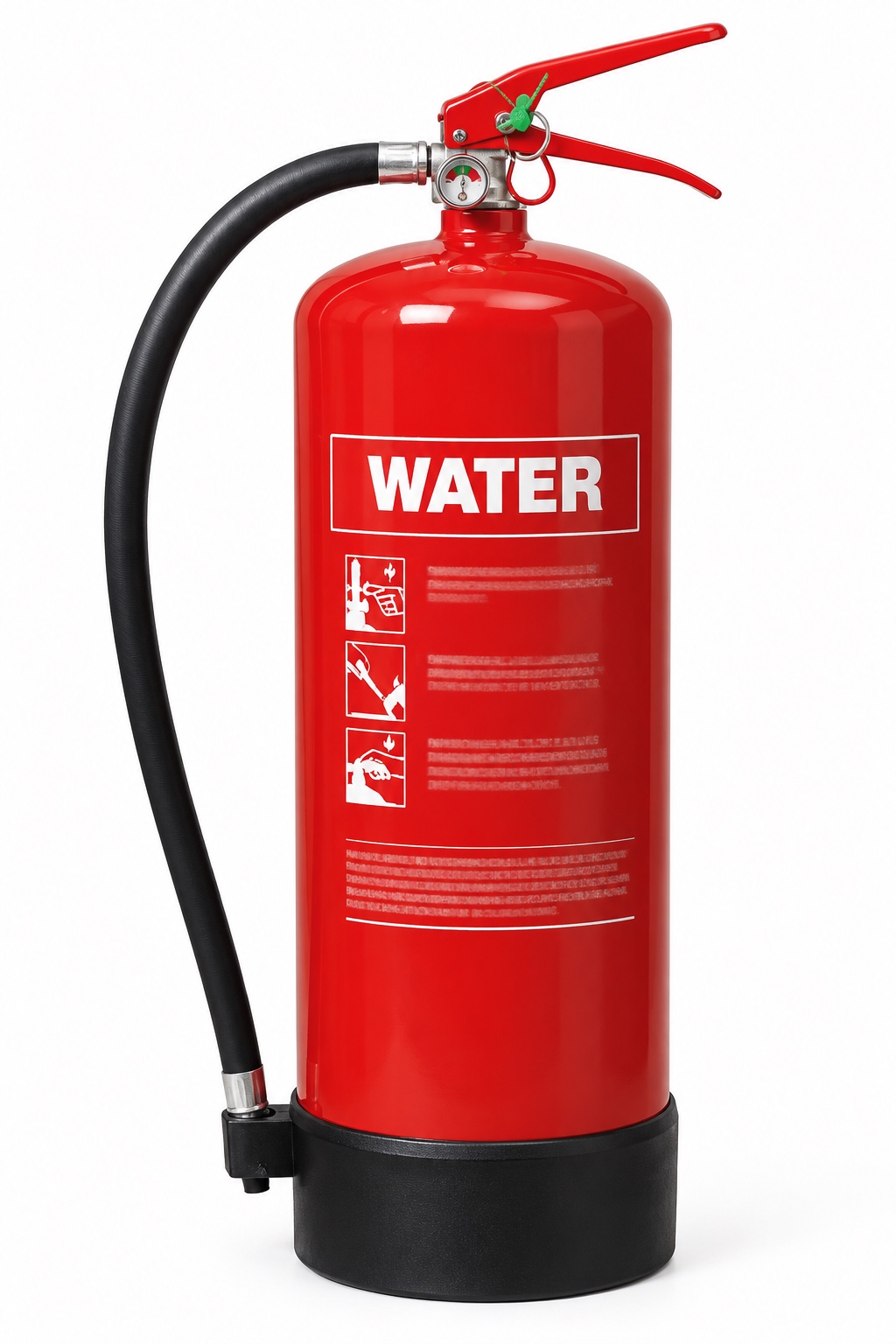

Recognise the pin, seal, pressure gauge and agent marking.
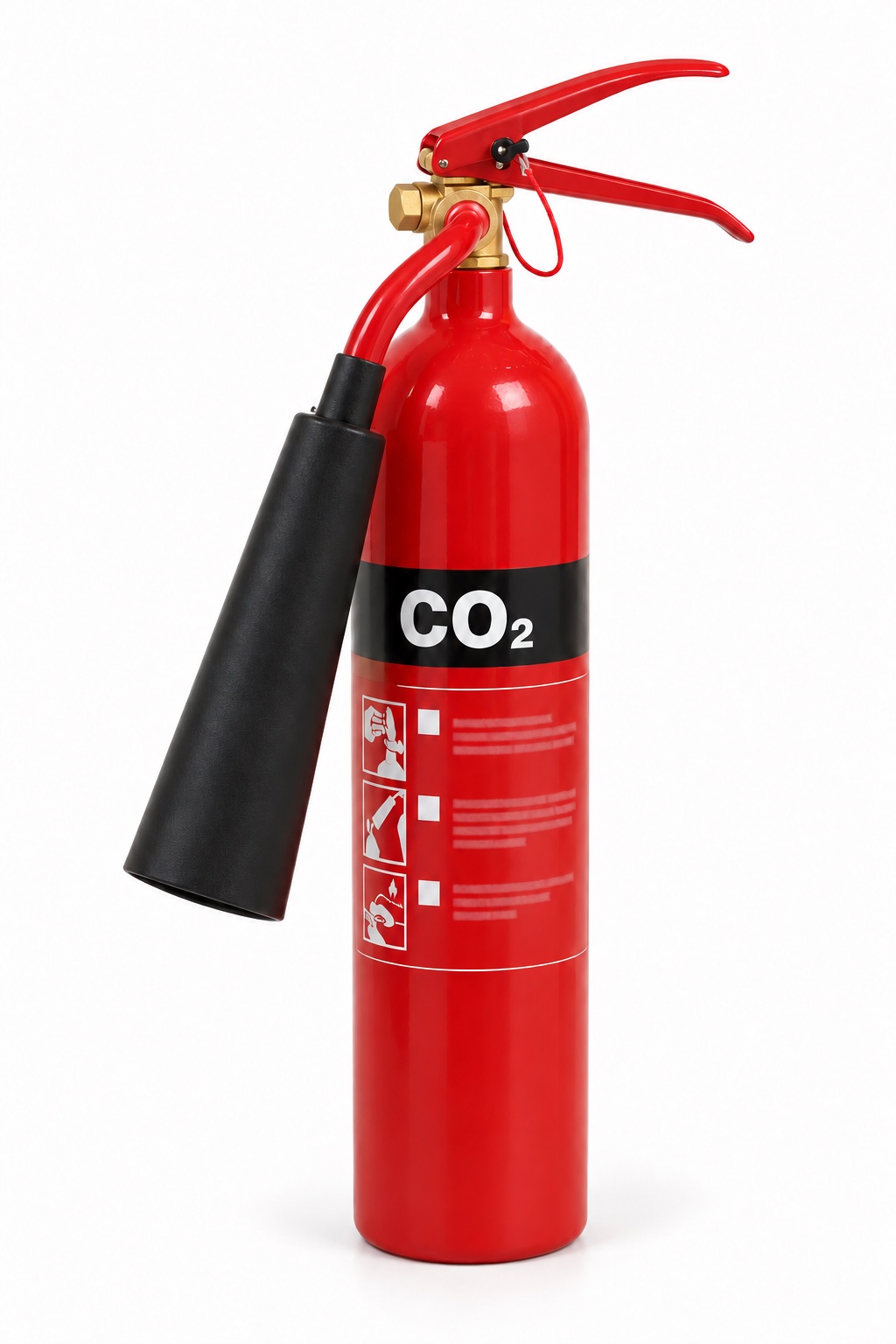
A different cylinder and discharge arrangement; cold and atmosphere hazards still matter.
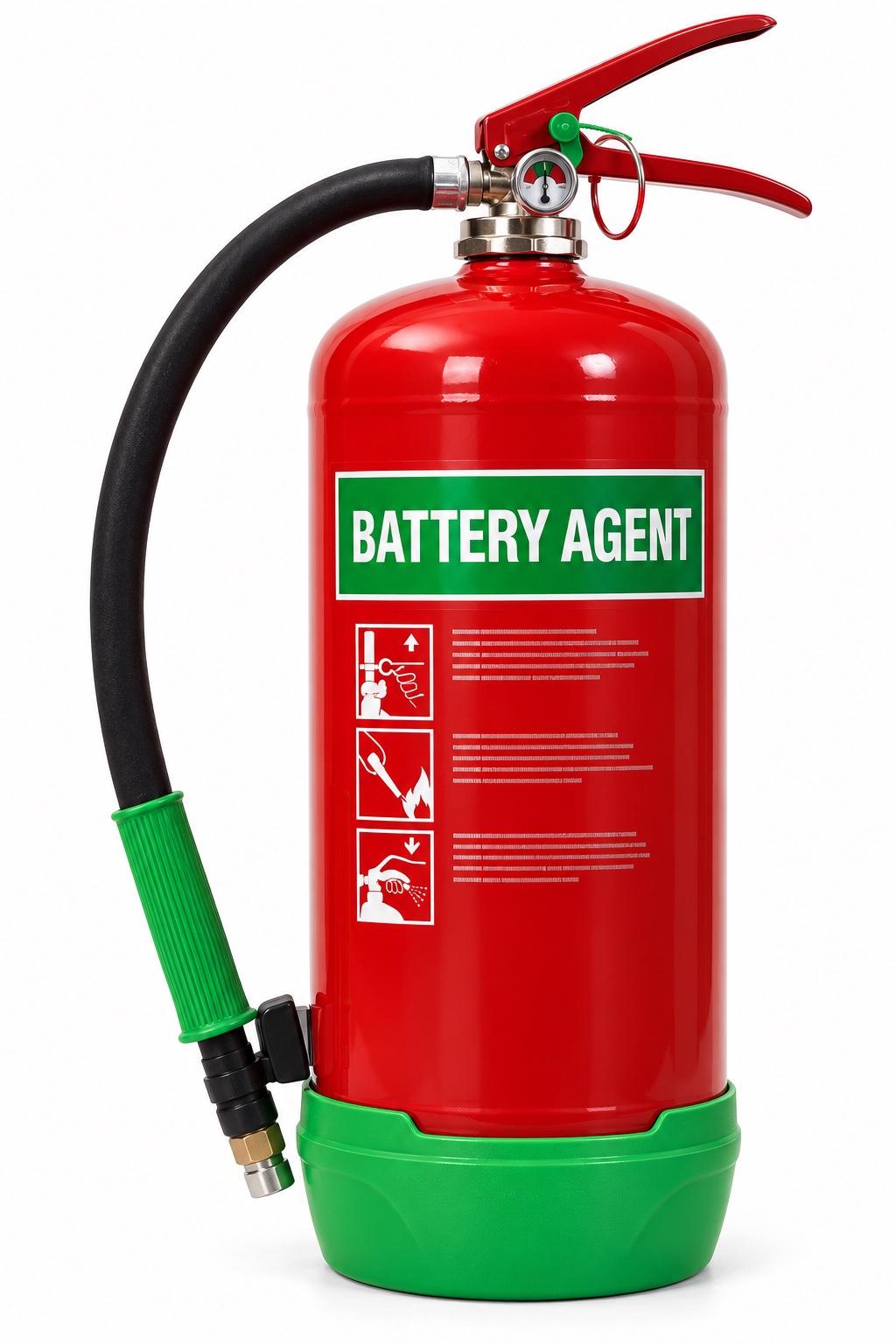
The named product and battery scope matter; green is not a universal Class L colour code.
Raise the alarm, follow the site’s evacuation plan and arrange the emergency call to 999. Only consider a small fire in its earliest stage if you are trained, authorised, have the correct equipment and a clear escape behind you. Smoke, spreading fire, uncertainty or an unsafe approach mean withdraw. Never delay escape to fetch an extinguisher.
Riverside hotel fire safety examples
Use these fictional hotel policies and records to see how a manager documents local fire precautions, evacuation arrangements and decisions on shift. Adapt the examples to the premises and obtain local approval before use.
- England Word and PDF pack (ZIP) · England reading copy (PDF)
- Northern Ireland Word and PDF pack (ZIP) · Northern Ireland reading copy (PDF)
- Scotland Word and PDF pack (ZIP) · Scotland reading copy (PDF)
- Wales Word and PDF pack (ZIP) · Wales reading copy (PDF)
Browse all Riverside fire examples in the Policy Builder library
What do the acronyms and key terms mean?
Use these terms to read the fire assessment, legal duties and control decisions without confusing a role, a hazard or a record.
Acronyms can exclude newer readers if they are not explained. This section keeps the main terms available at the end of the page so the article stays readable while still supporting learners and audit users.
| Term or acronym | Meaning | Plain-English use |
|---|---|---|
| FRA | Fire Risk Assessment | A structured assessment of fire hazards, people at risk, controls, emergency arrangements and review needs. |
| HSE | Health and Safety Executive | Great Britain workplace health and safety regulator. |
| HSWA | Health and Safety at Work etc. Act 1974 | Great Britain general work-health and safety statute; Northern Ireland has a separate 1978 Order. |
| MHSWR | Management of Health and Safety at Work Regulations 1999 | Regulations requiring suitable and sufficient risk assessment and management arrangements. |
| DSEAR | Dangerous Substances and Explosive Atmospheres Regulations | GB work-process fire/explosion rules for dangerous substances; NI has separate corresponding regulations. |
| Relevant person | Person exposed to fire risk | Person the premises fire assessment must consider, including workers and visitors where in scope. |
Unlock another resource
You have used this month’s two free downloads. Publish a post in your own words to unlock one more resource, or choose SHARE Individual for 10 downloads per month.
You decide whether to share. If you do, use the relevant platform disclosure tools and do not make claims you do not genuinely hold.