
SHARE Knowledge Hub
Evacuation Chair
An evacuation chair can help a person descend stairs during an emergency when the building strategy, person, route and trained operators make that method suitable. It is one option alongside step-free escape, horizontal evacuation, protected lifts, refuges and assistance. A chair that cannot be safely used with the people and staffing present creates false assurance and may delay escape.
Understanding Evacuation Chair
An evacuation chair can help a person descend stairs during an emergency when the building strategy, person, route and trained operators make that method suitable. It is one option alongside step-free escape, horizontal evacuation, protected lifts, refuges and assistance. A chair that cannot be safely used with the people and staffing present creates false assurance and may delay escape.
Why this matters at work
A useful fire-risk assessment identifies ignition sources, fuel and oxygen, then considers how fire and smoke could develop and spread through rooms, shafts, doors, stairs, ducts, storage or external cladding. Common workplace initiators include electrical faults or battery charging, hot work, smoking, cooking, heaters, arson, poorly stored flammables, vehicle or plant fire, combustible waste, process chemicals and lithium-ion battery thermal runaway. A reliable evacuation plan also considers route impairment, power loss, false or unwanted alarms, smoke migration, crowd behaviour and a fire occurring while the building is altered or partially occupied.
A refuge or temporary waiting space must have an identified purpose, a means of communication, a responsible receiver and a planned next action. Do not use its sign or a presumed fire-resistance period as permission to leave someone indefinitely. Check how the control point knows who is waiting, how assistance is mobilised and how a failed call is recognised. Test the response chain safely; a successful button test without anyone answering or taking action is incomplete assurance.
How organisations manage this in practice
Management review should test whether the emergency system remains effective, inclusive and resourced. Leading indicators include completion and quality of route inspections; fire-door, alarm, lighting, chair and communication-system maintenance; training and competent coverage; PEEP and visitor-plan review; closure time for defects; change assessments; worker consultation; and drill action closeout. Lagging indicators include unwanted alarms, actual fires, route obstructions, chair or transfer incidents, missed assistance, drill failures, emergency-service feedback and enforcement findings.
Control includes suitable engineering and collective measures, such as a compatible device, protected doors, warning and communication, together with assessed operating arrangements. Personal protective equipment is a residual task measure where justified; ordinary clothing, restraint or a chair is not automatically PPE. Do not equip an ordinary helper with an escape hood to legitimise smoke entry or prolong exposure. Record the actual safety function rather than assigning every item to the nearest acronym letter.
Follow the actual manufacturer's checks, maintenance, service, storage and cleaning requirements, integrated with the workplace assessment. Relevant parts can include restraints, tracks, wheels, fixings and batteries where present. Identify the chair and responsible owner and arrange inspection where deterioration could cause danger. The work-equipment duties require suitable safe equipment and adequate information and training; do not assume a generic examination interval applies to every chair or that all chairs automatically fall under the same lifting-equipment regime.
Resolve missing operator cover before relying on the chair
Before an evening event, the planned second operator is absent. The responsible person checks a competent replacement or an assessed alternative, such as moving the activity to an area with suitable step-free escape. Confirm it with the person, check the route and assistance arrangements, and brief the actual shift.
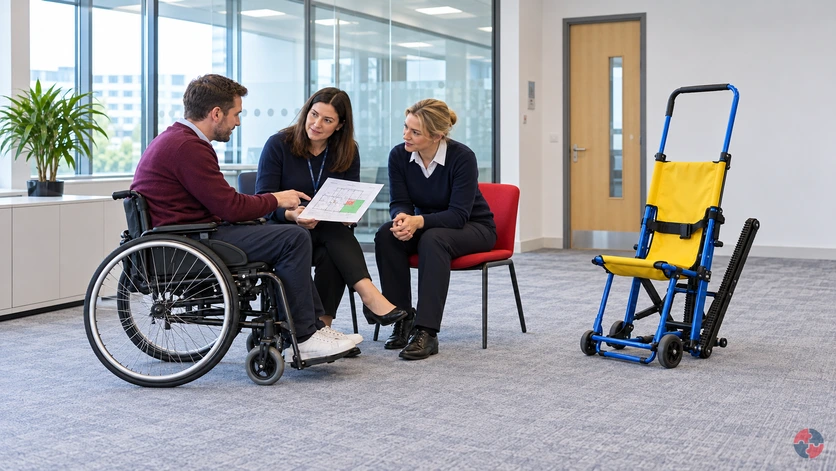
Plan with the person before relying on a chair
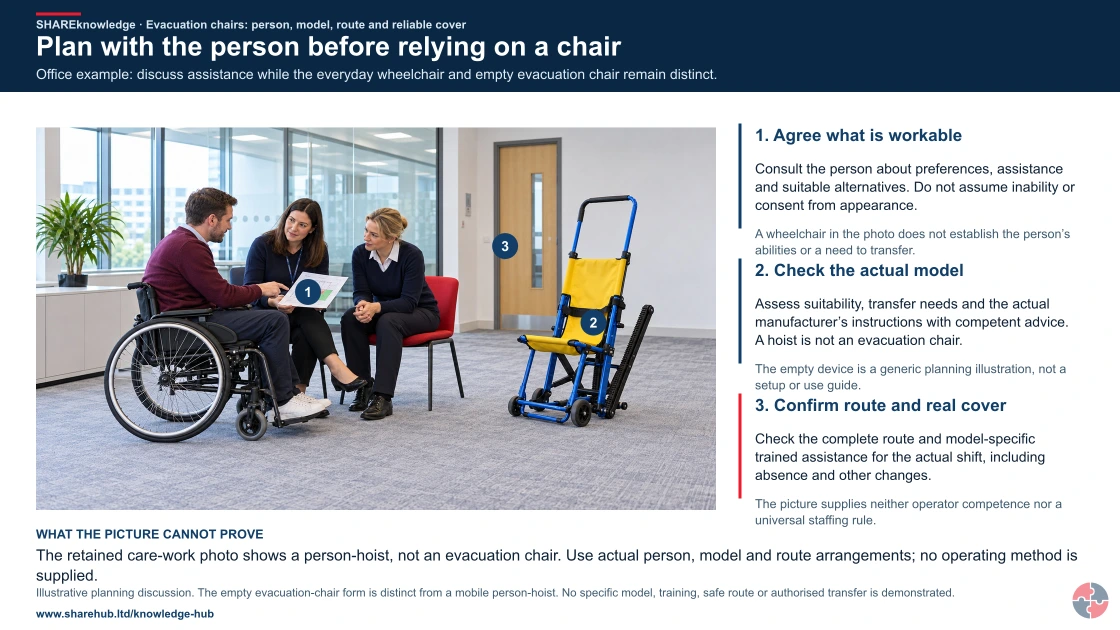
Full written explanation
Office example: discuss assistance while the everyday wheelchair and empty evacuation chair remain distinct.
- Agree what is workable. Consult the person about preferences, assistance and suitable alternatives. Do not assume inability or consent from appearance.
- Check the actual model. Assess suitability, transfer needs and the actual manufacturer’s instructions with competent advice. A hoist is not an evacuation chair.
- Confirm route and real cover. Check the complete route and model-specific trained assistance for the actual shift, including absence and other changes.
Change the pathway
- Choice is person-centred. A wheelchair in the photo does not establish the person’s abilities or a need to transfer.
- No operating technique is shown. The empty device is a generic planning illustration, not a setup or use guide.
- Two colleagues prove no ratio. The picture supplies neither operator competence nor a universal staffing rule.
Evidence check: The retained care-work photo shows a person-hoist, not an evacuation chair. Use actual person, model and route arrangements; no operating method is supplied.
Resolve missing cover through a competent person-centred alternative
Primary references: England: accessible escape planning — check current legal context · Workplace fire-safety and evacuation plans
Open the complete HD image (new tab)Download image
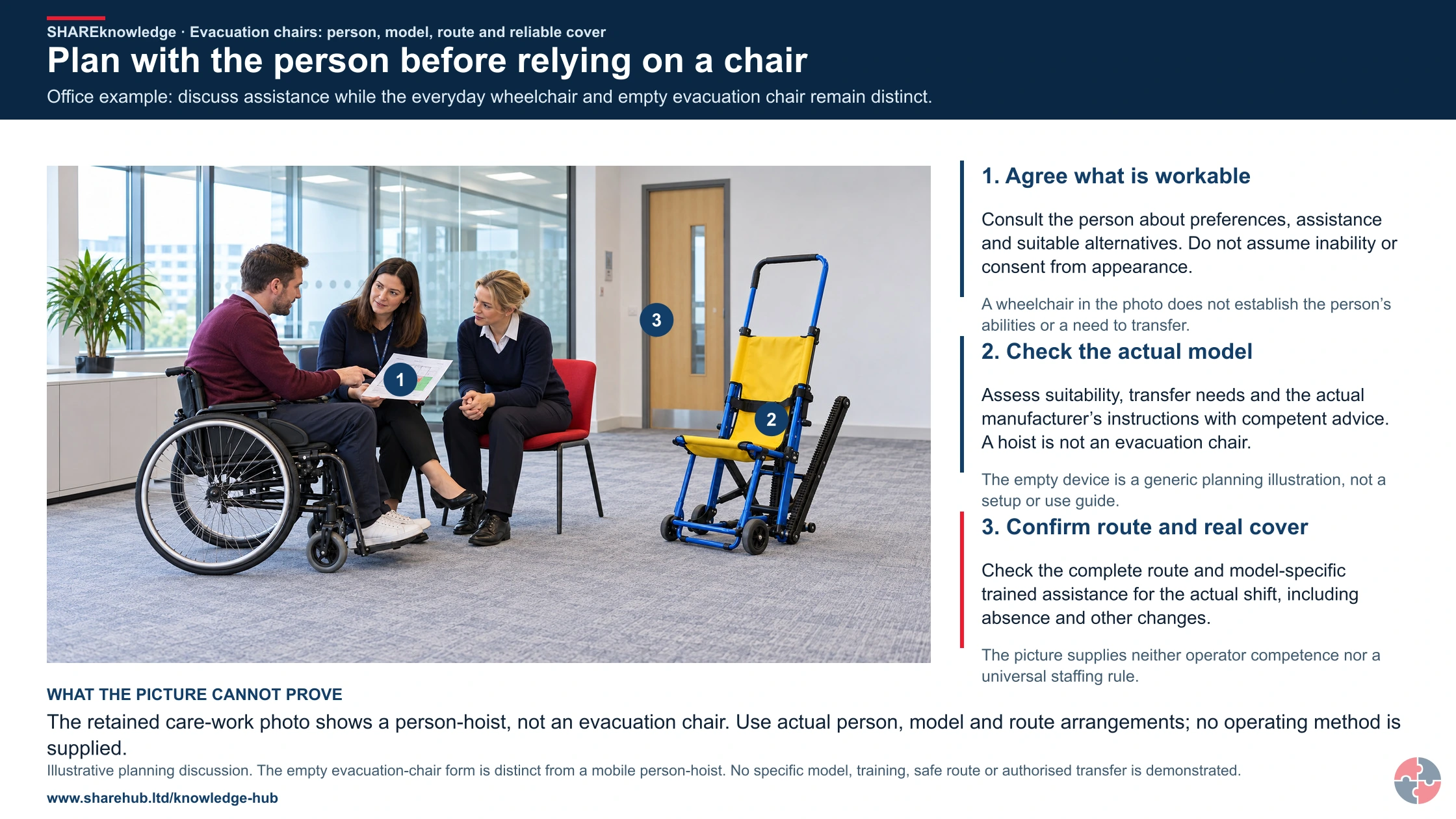
Resolve missing cover through a competent person-centred alternative
Primary references: England: accessible escape planning — check current legal context · Workplace fire-safety and evacuation plans
- Choose an accessible escape strategy — Consider step-free, horizontal or other assessed escape options before a chair.
- Check the person, route and staffing — Confirm suitability, dignity, safe transfer and competent cover.
- Missing operator or failed route — Use a deliverable contingency or hold the affected operation.
- Follow Riverside’s full example — Retain person-centred consultation, emergency limits and hand-back.
If no suitable arrangement can be delivered, hold the affected activity or access decision and obtain a competent, person-centred solution. Do not improvise a carry-down, use an untrained substitute or make escape depend on firefighters arriving. In an actual emergency, follow the agreed contingency and communication route. Workplace accessible escape and England’s specified residential PEEP regime remain separate legal contexts.
Content amended 19 October 2026 by the SHARE Knowledge Hub editorial team. This records an editorial content change; the existing technical-review and approval status still applies.
Check transfer, landing space and trained cover
The original evacuation-chair photograph remains part of the lesson. A usable arrangement needs the person, route, specific chair model and trained assistance to work together.
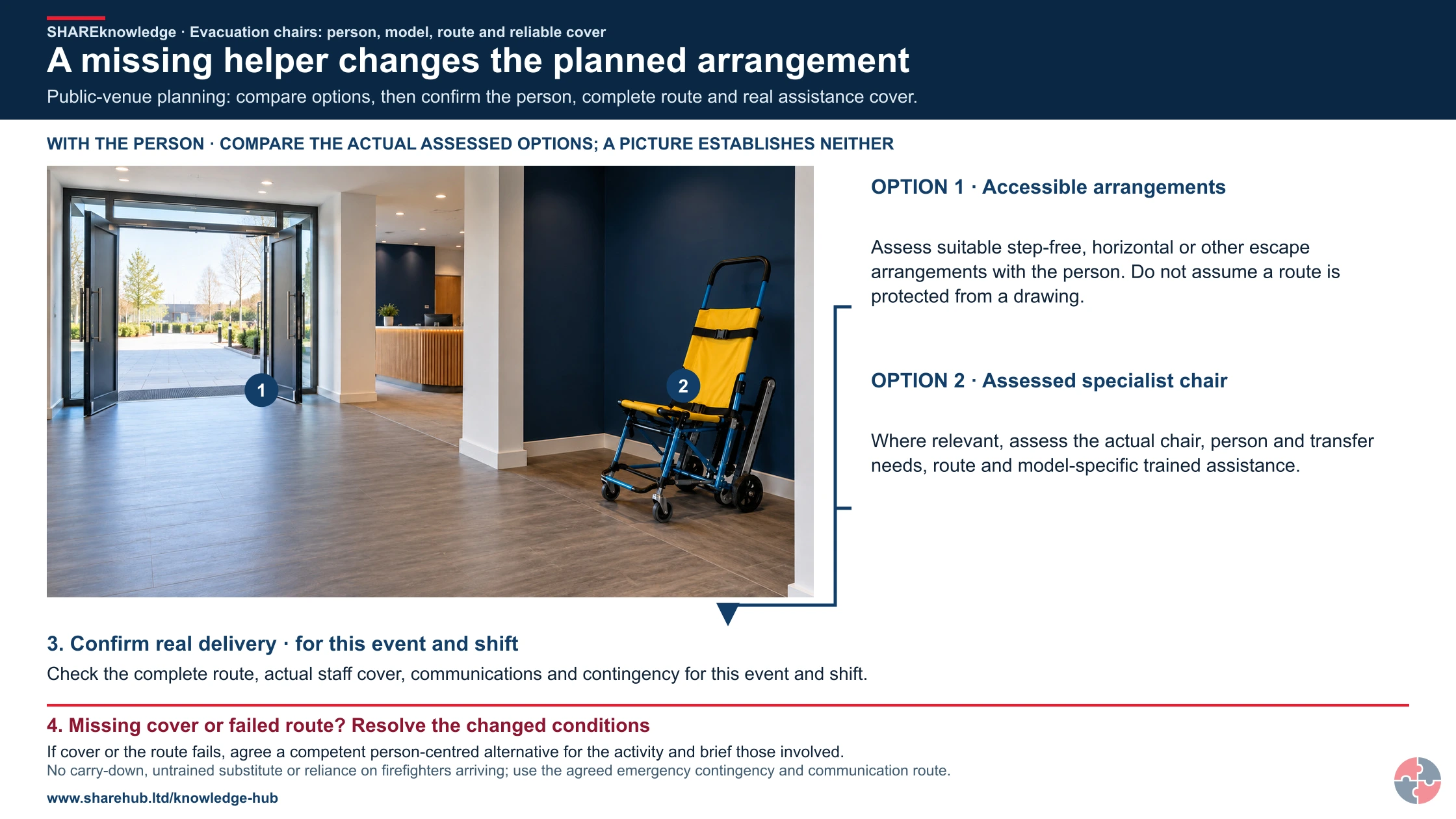
A missing helper changes the planned arrangement
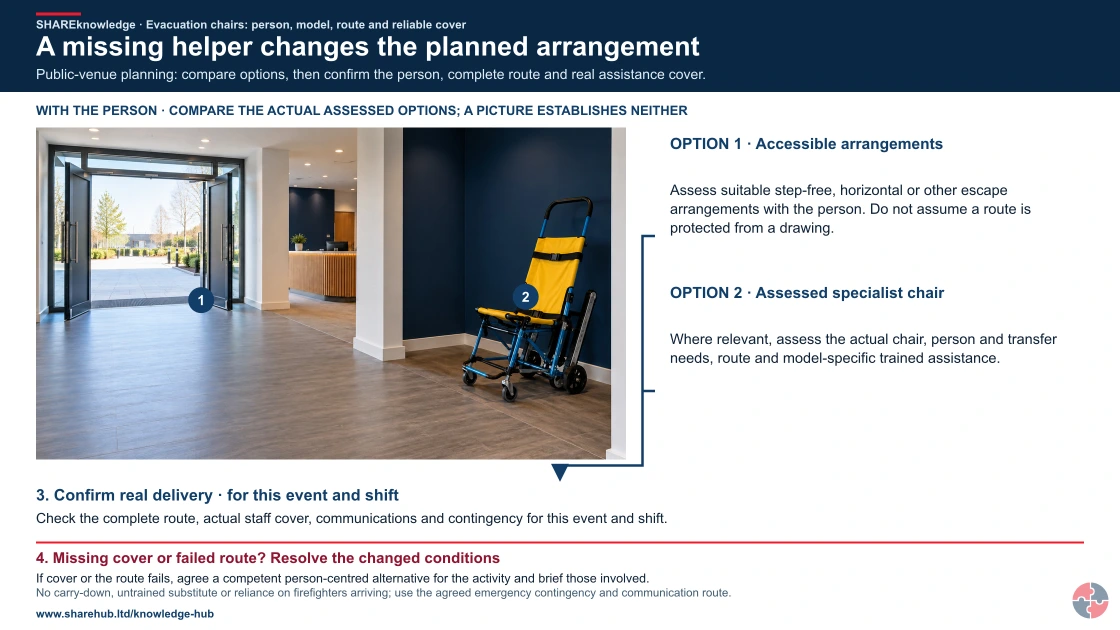
Full written explanation
A new realistic HD public-venue lobby shows an open level doorway on the left and a separate empty generic blue/yellow evacuation-chair form stored in an alcove on the right. Native identifiers connect these physical features to two parallel assessment lanes: accessible step-free/horizontal or other suitable arrangements, and an assessed specialist-chair option where relevant. Neither is presumed safe or available from appearance. Both lanes join the actual person-centred delivery check for the complete route, staff cover, communications and contingency for this event and shift. A separate red changed-conditions band requires a competent deliverable alternative and briefing when cover or route fails. The whole four-check management relationship is retained; it is not an emergency sequence. No person transfer, chair setup, stair descent, universal staffing ratio, protected-route rating, model certification, drill result or suitability judgement is demonstrated. No carry-down or untrained substitute is authorised; a real emergency uses the actual agreed contingency and communication route. The plan must not rely on firefighters arriving to make the arrangement work.
Public-venue planning: compare options, then confirm the person, complete route and real assistance cover.
- Consider accessible options. Assess suitable step-free, horizontal or other escape arrangements with the person. Do not assume a route is protected from a drawing.
- Assess the specialist option. Where relevant, assess the actual chair, person and transfer needs, route and model-specific trained assistance.
- Confirm real delivery. Check the complete route, actual staff cover, communications and contingency for this event and shift.
- Resolve changed conditions. If cover or the route fails, agree a competent person-centred alternative for the activity and brief those involved.
When the evidence does not fit: Do not improvise a carry-down or substitute an untrained helper. Use a deliverable assessed arrangement; in a real emergency use the actual agreed contingency and communication route.
Who acts: Responsible building/activity lead, the person concerned and competent access/handling and trained-assistance roles.
Changed workplace
Multi-storey office: Match person, actual model, complete route and shift cover.
Visitor venue: Assess accessible alternatives and changing assistance needs.
Evidence check: The retained care-work photo shows a person-hoist, not an evacuation chair. Use actual person, model and route arrangements; no operating method is supplied.
Resolve missing cover through a competent person-centred alternative
Primary references: England: accessible escape planning — check current legal context · Workplace fire-safety and evacuation plans
Open the complete HD image (new tab)Download image
Resolve missing cover through a competent person-centred alternative
Primary references: England: accessible escape planning — check current legal context · Workplace fire-safety and evacuation plans

Person and transfer
Agree assistance with the person and assess transfer, consent and the actual model’s suitability; an unsuitable transfer can injure or prevent evacuation.
Route and landing
Check the complete route and model-specific space/landing needs. A blocked or unsuitable landing can stop movement; use the assessed alternative arrangement.
Competent cover
Verify trained assistance across the actual rota. An absent team member is a coverage failure requiring the agreed contingency and management action.
A hoist is not an evacuation chair. This comparison is not a chair-operating sequence, transfer technique or universal stair/landing specification.
What is an evacuation chair?
An evacuation chair is a specialist chair designed to help move a person down stairs or across a route during emergency evacuation where ordinary escape is not possible.
What is an evacuation chair? — part 1 of 2


Read the complete visual as text
- An evacuation chair is a specialist chair designed to…: An evacuation chair is a specialist chair designed to help move a person down stairs or across a route during emergency evacuation where ordinary escape is not possible.
- A chair is not an automatic answer to accessible…: A chair is not an automatic answer to accessible evacuation. It is only one part of the means-of-escape strategy. The preferred arrangement may be level escape, horizontal movement to a protected compartment, an evacuation lift, a refuge with communication, staff assistance or a personal plan.
What is an evacuation chair? — part 2 of 2


Read the complete visual as text
- The key question is not simply whether a chair…: The key question is not simply whether a chair exists. The real test is whether it is suitable for the person, route, stair geometry, staffing level, emergency timing, dignity needs, maintenance state and training standard.
- Poorly managed chairs can create new risks: unsafe transfers,…: Poorly managed chairs can create new risks: unsafe transfers, manual handling injury, blocked stairs, delayed escape, abandonment in refuges, loss of dignity, conflict with evacuation flow and false confidence in a control that cannot be delivered under pressure.
Best-practice guide: Evacuation Chair

What is an evacuation chair?
An evacuation chair is a specialist chair designed to help move a person down stairs or across a route during emergency evacuation where ordinary escape is not possible. An evacuation chair can help a person descend stairs during an emergency when the building strategy, person, route and trained operators make that method suitable.
Turn evacuation chair knowledge into a decision
An evacuation chair can help a person descend stairs during an emergency when the building strategy, person, route and trained operators make that method suitable. It is one option alongside step-free escape, horizontal evacuation, protected lifts, refuges and assistance. Current risk assessment and GEEP, chair and route check, operator assessment and rota, incident or drill record, defect closure, recheck and responsible-person restart sign-off.
Riverside evening event: before, during and after
The planned escape strategy and its contingency must be deliverable through the assessed premises arrangements and staff; they must not depend on firefighters arriving to complete evacuation. Alerting emergency services is escalation for an actual failure or emergency, while staff keep communication and follow the assessed plan. The duty manager records the actual response, chair condition, timings, route defect, person’s feedback and any emergency-services handover without unnecessary health detail.
Three ways an evacuation-chair plan can fail
The person, model, complete route and trained cover must work together. A drill record alone cannot resolve a live transfer, route or staffing defect.
Choose controls for evacuation chair
Eliminate; ERICPD Eliminate: Move the activity to a level with a reliable step-free final exit, or remove an avoidable stair dependency during redesign. Substitute; ERICPD Reduce: Where the fire strategy supports it, choose a protected evacuation lift or horizontal escape instead of a stair chair. Engineering; ERICPD Isolate and Control: Maintain protected stairs/refuge, fire doors, lighting, two-way communication and unobstructed turning space; select a chair compatible with the specific stairs and transfer. Administrative; ERICPD Control and Discipline: Agree a PEEP or visitor GEEP, consented transfer method, named operators and backup cover for each shift; rehearse the sequence using simulation where appropriate, then act on drill defects. Residual PPE; ERICPD PPE: Select any operator PPE only for a separately assessed task risk; footwear or hand protection cannot make a smoke-filled stair, unsafe transfer or defective chair safe. Read the full control table for qualifications, ownership and verification. Use the actual task and applicable jurisdiction; existing technical approval remains unchanged.
Use the full evacuation chair lesson
Use the full topic for the decision points, practical examples, detailed control tables and source scope. HSE guidance applies to Great Britain; use HSENI for the Northern Ireland route and the source’s stated jurisdiction. A simplified guide does not change the page’s technical-review or approval status.

Read all six steps as text
1. What is an evacuation chair?
An evacuation chair is a specialist chair designed to help move a person down stairs or across a route during emergency evacuation where ordinary escape is not possible.
- Avoid / redesign: Move the activity to a level with a reliable step-free final exit, or remove an avoidable stair dependency during redesign.
- Control the task: Maintain protected stairs/refuge, fire doors, lighting, two-way communication and unobstructed turning space; select a chair compatible with the specific stairs and transfer.
- Verify before release: Building manager and fire-risk assessor check the whole route to safety, including external ground and door access; record drawings and a walk-through.
An evacuation chair is a specialist chair designed to help move a person down stairs or across a route during emergency evacuation where ordinary escape is not possible. An evacuation chair can help a person descend stairs during an emergency when the building strategy, person, route and trained operators make that method suitable.
Apply it: Which part of this plan would you check at the workface before authorising the task?
2. Turn evacuation chair knowledge into a decision
Use the evidence to improve the actual work arrangement.
- Change at source: Move the activity to a level with a reliable step-free final exit, or remove an avoidable stair dependency during redesign.
- Make it observable: Building manager and fire-risk assessor check the whole route to safety, including external ground and door access; record drawings and a walk-through.
- Keep useful evidence: Current risk assessment and GEEP, chair and route check, operator assessment and rota, incident or drill record, defect closure, recheck and responsible-person restart sign-off.
An evacuation chair can help a person descend stairs during an emergency when the building strategy, person, route and trained operators make that method suitable. It is one option alongside step-free escape, horizontal evacuation, protected lifts, refuges and assistance. Current risk assessment and GEEP, chair and route check, operator assessment and rota, incident or drill record, defect closure, recheck and responsible-person restart sign-off.
Apply it: What evidence would show that the change improves this task, rather than only completing a record?
3. Riverside evening event: before, during and after
Example: a practical application of the existing topic lesson.
- Setting: Accessible fire evacuation from a two-storey leisure venue during an evening event, using a protected stair and an assessed chair only where appropriate.
- Act: The venue manager checks a visitor’s agreed assistance request without displaying health details on a public list.
- Hold / review: Do not use the chair if consent or transfer is unsafe, competent cover is missing, smoke reaches the route, the landing is blocked or the chair is defective.
The planned escape strategy and its contingency must be deliverable through the assessed premises arrangements and staff; they must not depend on firefighters arriving to complete evacuation. Alerting emergency services is escalation for an actual failure or emergency, while staff keep communication and follow the assessed plan. The duty manager records the actual response, chair condition, timings, route defect, person’s feedback and any emergency-services handover without unnecessary health detail.
Apply it: At which point would you hold this example, and what evidence would allow it to proceed?
4. Three ways an evacuation-chair plan can fail
Keep failure, possible harm and contingency distinct.
- Unsuitable transfer: A transfer that does not suit the person or chair can cause injury or prevent use. Assess consent, assistance and the actual model; use the agreed alternative.
- Unusable route or landing: Obstruction or unsuitable space can stop movement and compromise escape. Check the complete assessed route and activate the alternative plan.
- Missing trained cover: An absent or unavailable operator can leave the plan unable to work. Verify the real rota and agreed backup before relying on the arrangement.
The person, model, complete route and trained cover must work together. A drill record alone cannot resolve a live transfer, route or staffing defect.
Apply it: Which part has failed, who may be affected, and which assessed contingency applies?
5. Choose controls for evacuation chair
Start with the stronger practicable options and verify their effect.
- Eliminate; ERICPD Eliminate: Move the activity to a level with a reliable step-free final exit, or remove an avoidable stair dependency during redesign.
- Substitute; ERICPD Reduce: Where the fire strategy supports it, choose a protected evacuation lift or horizontal escape instead of a stair chair.
- Engineering; ERICPD Isolate and Control: Maintain protected stairs/refuge, fire doors, lighting, two-way communication and unobstructed turning space; select a chair compatible with the specific stairs and transfer.
- Administrative; ERICPD Control and Discipline: Agree a PEEP or visitor GEEP, consented transfer method, named operators and backup cover for each shift; rehearse the sequence using simulation where appropriate, then act on drill defects.
- Residual PPE; ERICPD PPE: Select any operator PPE only for a separately assessed task risk; footwear or hand protection cannot make a smoke-filled stair, unsafe transfer or defective chair safe.
Eliminate; ERICPD Eliminate: Move the activity to a level with a reliable step-free final exit, or remove an avoidable stair dependency during redesign. Substitute; ERICPD Reduce: Where the fire strategy supports it, choose a protected evacuation lift or horizontal escape instead of a stair chair. Engineering; ERICPD Isolate and Control: Maintain protected stairs/refuge, fire doors, lighting, two-way communication and unobstructed turning space; select a chair compatible with the specific stairs and transfer. Administrative; ERICPD Control and Discipline: Agree a PEEP or visitor GEEP, consented transfer method, named operators and backup cover for each shift; rehearse the sequence using simulation where appropriate, then act on drill defects. Residual PPE; ERICPD PPE: Select any operator PPE only for a separately assessed task risk; footwear or hand protection cannot make a smoke-filled stair, unsafe transfer or defective chair safe. Read the full control table for qualifications, ownership and verification. Use the actual task and applicable jurisdiction; existing technical approval remains unchanged.
Apply it: Which stronger option can be used here, and who will verify it before accepting the remaining risk?
6. Use the full evacuation chair lesson
Follow the official sources below and retain the task-specific evidence.
- Official guidance: England accessible-escape guide
- Official guidance: HSE hierarchy
- Task decision: Current risk assessment and GEEP, chair and route check, operator assessment and rota, incident or drill record, defect closure, recheck and responsible-person restart sign-off.
Use the full topic for the decision points, practical examples, detailed control tables and source scope. HSE guidance applies to Great Britain; use HSENI for the Northern Ireland route and the source’s stated jurisdiction. A simplified guide does not change the page’s technical-review or approval status.
Apply it: Which official source and full-topic section will you use to resolve the next decision?
A chair is not an automatic answer to accessible evacuation. It is only one part of the means-of-escape strategy. The preferred arrangement may be level escape, horizontal movement to a protected compartment, an evacuation lift, a refuge with communication, staff assistance or a personal plan.
The key question is not simply whether a chair exists. The real test is whether it is suitable for the person, route, stair geometry, staffing level, emergency timing, dignity needs, maintenance state and training standard.
Poorly managed chairs can create new risks: unsafe transfers, manual handling injury, blocked stairs, delayed escape, abandonment in refuges, loss of dignity, conflict with evacuation flow and false confidence in a control that cannot be delivered under pressure.
How can the hierarchy of controls improve safe evacuation before relying on an evacuation chair?
A chair should be selected only after considering better or more suitable accessible escape options.
Compare the accessible escape options below against this building and the person’s needs before accepting a chair-dependent route.
| Option | Where it may work well | Limits and checks |
|---|---|---|
| Level or step-free escape | Ground-floor exits, ramps, accessible routes and safe external routes. | Route must remain usable in the emergency and not rely on a locked or obstructed path. |
| Horizontal evacuation | Care homes, hospitals, larger buildings with suitable compartmentation and staff. | Compartmentation, fire doors, staff roles and progressive movement must be reliable. |
| Evacuation lift | Buildings designed or adapted with protected lifts for evacuation. | Needs fire strategy, power, controls, management procedure and trained operators. |
| Refuge with communication | Multi-storey buildings where temporary waiting is part of the plan. | Refuge is not a final destination; assistance and communication must be managed. |
| Evacuation chair | Stairs where a suitable person can be transferred and trained operators are available. | Requires suitability assessment, transfer plan, route check, maintenance and enough competent staff. |
| Carry-down by people | Exceptional last-resort situations only. | High manual handling and dignity risk; should not be the planned control where safer options exist. |
The harm chain has several routes: a rushed or unsuitable transfer can cause a fall or handling injury to the person and operators; an uncontrolled descent or turn can tip or trap the chair; a delayed or blocked route can expose people to smoke and heat. A person’s disability is not the hazard. If the assessed transfer, operator cover, chair or route is not available, pause that method and use the agreed accessible contingency while the incident lead coordinates the response.
ERICPD and HSE’s five-level hierarchy are related planning aids, not matching legal duties. Eliminate avoidable stair movement where a reliable step-free escape can be provided; reduce exposure by selecting a safer protected strategy, such as a suitable evacuation lift or horizontal escape where the fire design supports it; isolate smoke and traffic from the route through protected construction and segregation; control remaining risks with a tested chair, transfer plan, staffing, communication and drills; use PPE only for separately assessed residual operator hazards; and use Discipline to sustain inspection, practice and corrective action. In the five-level hierarchy, the step-free redesign is elimination, a genuinely safer escape method is substitution, protected routes and suitable equipment are engineering controls, PEEPs/GEEPs and rehearsed staffing are administrative controls, and PPE remains last. A chair is never an automatic solution, and ordinary staff must not improvise a hazardous carry-down or enter smoke to rescue someone. See the HSE hierarchy, HSE manual-handling guide and the England accessible-escape guide for their stated scopes.
How can the ERICPD hierarchy of controls improve safe evacuation before relying on an evacuation chair?

| Framework level | Intervention and harm-chain break | Owner, evidence and stop point |
|---|---|---|
| Eliminate; ERICPD Eliminate | Move the activity to a level with a reliable step-free final exit, or remove an avoidable stair dependency during redesign. This removes transfer and descent exposure. | Building manager and fire-risk assessor check the whole route to safety, including external ground and door access; record drawings and a walk-through. Blocked or unusable route: hold the arrangement. |
| Substitute; ERICPD Reduce | Where the fire strategy supports it, choose a protected evacuation lift or horizontal escape instead of a stair chair. Confirm lift protection, power and operation; an ordinary passenger lift is not assumed suitable. | Fire designer and responsible person verify strategy and commissioning evidence. Loss of the lift, compartmentation or staff cover: switch to the assessed contingency. |
| Engineering; ERICPD Isolate and Control | Maintain protected stairs/refuge, fire doors, lighting, two-way communication and unobstructed turning space; select a chair compatible with the specific stairs and transfer. These barriers reduce smoke, fall and trapping routes. | Facilities lead and trained operator inspect route, chair, communications and restraints before use and after changes; retain defect record. Smoke, blocked landing, missing part or failed communication: stop that route. |
| Administrative; ERICPD Control and Discipline | Agree a PEEP or visitor GEEP, consented transfer method, named operators and backup cover for each shift; rehearse the sequence using simulation where appropriate, then act on drill defects. | Duty manager checks rota, briefing, drill observations and hand-back. No competent cover, unclear consent/transfer or failed drill action: hold chair deployment and escalate. |
| Residual PPE; ERICPD PPE | Select any operator PPE only for a separately assessed task risk; footwear or hand protection cannot make a smoke-filled stair, unsafe transfer or defective chair safe. | Task lead checks fit, condition and compatibility with chair grips. Missing assessment or PPE interfering with control: do not proceed on that method. |
How can the ISO 45001 hierarchy of controls improve safe evacuation before relying on an evacuation chair?

| Framework level | Intervention and harm-chain break | Owner, evidence and stop point |
|---|---|---|
| Eliminate; ERICPD Eliminate | Move the activity to a level with a reliable step-free final exit, or remove an avoidable stair dependency during redesign. This removes transfer and descent exposure. | Building manager and fire-risk assessor check the whole route to safety, including external ground and door access; record drawings and a walk-through. Blocked or unusable route: hold the arrangement. |
| Substitute; ERICPD Reduce | Where the fire strategy supports it, choose a protected evacuation lift or horizontal escape instead of a stair chair. Confirm lift protection, power and operation; an ordinary passenger lift is not assumed suitable. | Fire designer and responsible person verify strategy and commissioning evidence. Loss of the lift, compartmentation or staff cover: switch to the assessed contingency. |
| Engineering; ERICPD Isolate and Control | Maintain protected stairs/refuge, fire doors, lighting, two-way communication and unobstructed turning space; select a chair compatible with the specific stairs and transfer. These barriers reduce smoke, fall and trapping routes. | Facilities lead and trained operator inspect route, chair, communications and restraints before use and after changes; retain defect record. Smoke, blocked landing, missing part or failed communication: stop that route. |
| Administrative; ERICPD Control and Discipline | Agree a PEEP or visitor GEEP, consented transfer method, named operators and backup cover for each shift; rehearse the sequence using simulation where appropriate, then act on drill defects. | Duty manager checks rota, briefing, drill observations and hand-back. No competent cover, unclear consent/transfer or failed drill action: hold chair deployment and escalate. |
| Residual PPE; ERICPD PPE | Select any operator PPE only for a separately assessed task risk; footwear or hand protection cannot make a smoke-filled stair, unsafe transfer or defective chair safe. | Task lead checks fit, condition and compatibility with chair grips. Missing assessment or PPE interfering with control: do not proceed on that method. |
The planned escape strategy and its contingency must be deliverable through the assessed premises arrangements and staff; they must not depend on firefighters arriving to complete evacuation. Alerting emergency services is escalation for an actual failure or emergency, while staff keep communication and follow the assessed plan.
How should chair suitability be assessed?
Suitability is a combined assessment of the person, the equipment, the route and the people expected to operate it.
Evacuation chair suitability prompts — part 1 of 2


Read the complete visual as text
- Person needing assistance: What to assess: Mobility, transfer needs, posture, pain, pregnancy, fatigue, anxiety, communication, sensory needs and consent. Why it matters: A chair that works for one person may be unsuitable or undignified for another.
- Transfer method: What to assess: How the person moves from wheelchair, seat, bed or standing position into the chair. Why it matters: Many incidents arise during transfer, not descent.
- Chair design and capacity: What to assess: Manufacturer limits, tracks, restraints, handles, head support, brakes and storage condition. Why it matters: Equipment must match foreseeable use.
Evacuation chair suitability prompts — part 2 of 2


Read the complete visual as text
- Stair and route: What to assess: Width, pitch, landings, turns, door widths, thresholds, lighting, surface condition and final exit. Why it matters: A chair may descend one stair but fail on tight turns or obstructed landings.
- Staffing model: What to assess: Number of trained operators, shift cover, absence, visitors, contractors and out-of-hours arrangements. Why it matters: A chair is not available if competent people are not present.
- Emergency conditions: What to assess: Smoke, crowd movement, alarms, lighting, fire doors, weather outside and assembly-point distance. Why it matters: The plan must work in the conditions likely during evacuation.
Record the combined checks below and resolve any mismatch before relying on the selected equipment or assistance method.
| Factor | What to assess | Why it matters |
|---|---|---|
| Person needing assistance | Mobility, transfer needs, posture, pain, pregnancy, fatigue, anxiety, communication, sensory needs and consent. | A chair that works for one person may be unsuitable or undignified for another. |
| Transfer method | How the person moves from wheelchair, seat, bed or standing position into the chair. | Many incidents arise during transfer, not descent. |
| Chair design and capacity | Manufacturer limits, tracks, restraints, handles, head support, brakes and storage condition. | Equipment must match foreseeable use. |
| Stair and route | Width, pitch, landings, turns, door widths, thresholds, lighting, surface condition and final exit. | A chair may descend one stair but fail on tight turns or obstructed landings. |
| Staffing model | Number of trained operators, shift cover, absence, visitors, contractors and out-of-hours arrangements. | A chair is not available if competent people are not present. |
| Emergency conditions | Smoke, crowd movement, alarms, lighting, fire doors, weather outside and assembly-point distance. | The plan must work in the conditions likely during evacuation. |
How do PEEPs and GEEPs connect to evacuation chairs?
PEEPs and GEEPs turn accessible evacuation into a planned arrangement rather than a last-minute discussion on the stairs.
Use the plan to name the route, assistance, communication and backup cover; confirm that the arrangement can be delivered on the actual shift.
| Step | What good looks like | Evidence |
|---|---|---|
| Identify need | Offer a PEEP route at induction, when circumstances change and where someone requests assistance. | Induction record and confidential PEEP offer. |
| Discuss work impact | Talk about escape assistance, communication, mobility and dignity without asking for unnecessary diagnosis detail. | PEEP notes limited to necessary information. |
| Select arrangement | Choose horizontal evacuation, lift, refuge, chair, buddy support or combined controls. | Plan signed off by competent person and the individual where appropriate. |
| Check resources | Confirm trained operators, chair location, route, communication and backup. | Training matrix, route check and equipment inspection. |
| Brief relevant people | Tell only those who need to know their role in an emergency. | Confidential briefing record. |
| Review | Review after drill, building change, role change, health change, staffing change or incident. | Review date and action tracker. |
How does evacuation-chair planning differ by premises?
The same chair can carry very different risk in different buildings.
Use the premises examples below to check occupancy, staffing, protected routes and the relevant national fire-safety arrangements.
| Premises | Key issue | Good planning |
|---|---|---|
| Office or shared workplace | Visitors, hot desks, hybrid work and landlord/tenant responsibilities. | GEEP for visitors, PEEPs for workers, reception/security roles and shared drill learning. |
| Public venue or leisure site | Unknown occupants, noise, crowd movement and temporary seating layouts. | Steward training, accessible route information, refuge checks and event-specific staffing. |
| School, college or university | Young people, visitors, events, exams and changing timetables. | Personal plans, staff cover, drill variation and safeguarding-aware communication. |
| Healthcare or care setting | Progressive horizontal evacuation may be safer than immediate stair descent. | Fire compartments, staffing ratios, evacuation aids, dependency assessment and clinical dignity. |
| Hotel or sleeping accommodation | Sleeping risk, unfamiliar occupants and night staffing. | Accessible-room information, night response, alarm communication and reception records. |
| Factory, laboratory or warehouse | Noise, process hazards, stairs, plant movement and hazardous materials. | Area ownership, shutdown interface, refuge communication and emergency-route protection. |
| Construction or temporary site | Changing routes, temporary stairs, weather and contractor turnover. | Daily route checks, temporary arrangements, induction and chair storage protected from damage. |
What route and location checks are needed?
An evacuation chair is only as useful as the route it must travel through.
Walk the complete assessed route, including landings, final exit and onward safe area, and resolve defects before relying on it.
| Element | Check | Failure sign |
|---|---|---|
| Chair location | Near the likely point of use, visible, signed, secure and not blocking escape. | Stored in a locked cupboard no operator can access. |
| Refuge | Suitable space, communication, fire protection and onward movement plan. | People wait with no communication or named responder. |
| Stair width and landings | Enough space for chair, operators and evacuation flow. | Chair cannot turn or blocks the stair for others. |
| Doors and thresholds | Door widths, opening force, hold-open arrangements and final-exit route. | Door forces require an extra person not in the plan. |
| Lighting and signage | Emergency lighting, contrast, wayfinding and visibility. | Operators cannot see stair edges or route signs during a drill. |
| External route | Safe route from final exit to assembly or refuge away from weather and traffic. | Chair reaches outside but then cannot cross gravel, kerbs or yard traffic. |
What training and practice are needed?
Training must prove people can deploy the chair, transfer safely and manage the route under realistic conditions.
Training should be role-based. General awareness creates a baseline, but supervisors, managers, advisers and senior leaders need different levels of decision-making, verification and escalation competence.
| Training area | What it should cover | Evidence |
|---|---|---|
| Equipment familiarisation | Chair opening, brakes, tracks, handles, restraints, folding, storage and defects. | Observed practice and refresher record. |
| Transfer and dignity | Consent, communication, posture, privacy and avoiding unnecessary lifting. | PEEP-aligned transfer plan. |
| Stair descent | Controlled movement, turns, landings, doorways, communication and fatigue. | Practical competence sign-off. |
| Emergency role | Alarm response, refuge communication, buddy system, assembly point and handover. | Fire-drill role record. |
| Backup cover | Absence, shift cover, out-of-hours, visitors and contractors. | Training matrix by location and shift. |
| Learning from drills | Blocked routes, slow response, chair access, operator confidence and occupant feedback. | Drill report and action close-out. |
The assessor should observe each named operator on the actual chair model and representative route: access and unfold it, explain a consented transfer, secure the person or training substitute, control the descent and turn, respond to a blocked landing, reach the final safe area and hand over. Record the chair model, route, transfer method, assessor, date, pass conditions and limits. Reassess after an equipment or route change, a failed drill, a long gap in practice or a changed transfer need. A disabled person should not be forced to take part in a drill; use simulation and consult them about the real plan.
How should evacuation chairs be inspected and maintained?
A defective chair should be treated like any other failed emergency control: take it out of service and put temporary arrangements in place.
Record the defect, prevent reuse and check that the alternative escape arrangement remains suitable until competent repair and recheck are complete.
| Check | What to inspect | Action if failed |
|---|---|---|
| Pre-use or routine visual check | Location, accessibility, obvious damage, straps, handles, wheels or tracks. | Report defect and use backup arrangement. |
| Formal inspection | Manufacturer-recommended checks, fixings, brakes, track condition, fasteners and cleanliness. | Record defect, quarantine chair and repair before return to service. |
| Service or maintenance | Competent service in line with manufacturer and local equipment-management procedure. | Keep service record and review replacement need. |
| After use or drill | Damage, contamination, wear, missing parts and operator feedback. | Clean, inspect and update learning. |
| Route inspection | Stairs, refuges, doors, lighting, signage, storage and final exit. | Treat route obstruction as impairment of emergency arrangements. |
| Temporary impairment | Chair unavailable, route blocked or no trained operators. | Record interim control, notify relevant people and set repair or cover deadline. |
What should happen during an emergency?
Emergency deployment should be simple, rehearsed and matched to the fire strategy.
Use the rehearsed sequence below only while the route, transfer and operators remain suitable; keep the agreed contingency and communication available.
| Stage | Action | Control point |
|---|---|---|
| Alarm | Respond according to the fire strategy and assigned role. | Do not wait for informal confirmation if evacuation is required. |
| Locate person | Make contact at agreed location, workstation, refuge or visitor point. | Keep communication calm and private where possible. |
| Confirm route | Check stairs, refuge, lighting, smoke conditions and route obstruction. | Stop and escalate if route is unsafe. |
| Transfer | Explain what will happen, secure restraints and maintain dignity. | Do not force a transfer. If the person declines or transfer is unsafe, use the agreed contingency, alert the incident lead and request emergency-service assistance; follow incident directions within your training and capability. |
| Descend | Use trained operators, controlled pace and communication. | Avoid blocking flow and protect operator safety. |
| Final exit | Move to assembly or safe area, away from traffic and weather where possible. | Account for the person and operators. |
| Afterwards | Record use, inspect chair, capture learning and review PEEP or GEEP. | Action defects before normal arrangements resume. |
The planned escape strategy and its contingency must be deliverable through the assessed premises arrangements and staff; they must not depend on firefighters arriving to complete evacuation. Alerting emergency services is escalation for an actual failure or emergency, while staff keep communication and follow the assessed plan.
Where do evacuation-chair arrangements fail?
Failures are often visible during drills, route checks and staffing reviews before a real emergency occurs.
Use each failure below as a trigger to correct the arrangement, name an owner and verify the change before relying on the escape method.
| Failure | Why it matters | Immediate decision |
|---|---|---|
| No trained operators on shift | The chair exists but cannot be used. | Create temporary staffing control or alternative evacuation plan. |
| Person cannot transfer safely | The highest risk may be getting into the chair. | Review PEEP and consider different control. |
| Route obstruction | Chair cannot pass or operators are delayed. | Treat as emergency-route defect and remove obstruction. |
| Chair defective or missing parts | Control may fail on stairs. | Quarantine chair and use backup arrangement. |
| Refuge communication not working | People may be left without information or help. | Escalate as fire-safety impairment. |
| Plan assumes a lift that cannot be used | Ordinary lifts may not be suitable for evacuation. | Check fire strategy and evacuation-lift status. |
| Dignity ignored | People may avoid disclosing needs or cooperating in drills. | Review consultation and confidentiality. |
Which legal routes govern accessible evacuation?
An evacuation chair is one possible part of a suitable escape arrangement. The fire law for the premises, work-risk duties and any equipment or manual-handling duties must be applied in the correct nation.
For non-domestic premises, England and Wales, Scotland and Northern Ireland have separate fire-law routes. A chair does not itself prove that escape is suitable: the assessment must cover the person, building, alarm, refuge or lift options, route, staffing, transfer and emergency handover. GOV.UK means of escape for disabled people is an England guide, so use it as a planning aid within its stated scope.
The 2025 Residential PEEP rules came into force on 6 April 2026 in England for specified multi-occupancy buildings. They do not apply to every workplace or every residential building. Check the building criteria in the GOV.UK residential PEEPs factsheet before applying them. Equality, privacy and employment duties need their own jurisdiction-specific review; no one should infer that a diagnosis or wheelchair use automatically requires a chair.
| Jurisdiction | Direct instrument or guidance | Relevant duty or scope | Practical decision |
|---|---|---|---|
| England and Wales | Regulatory Reform (Fire Safety) Order 2005 | Fire precautions and assessment for relevant premises. | Choose accessible escape measures through the premises fire risk assessment; test staffing and route. |
| Scotland | Fire (Scotland) Act 2005, Part 3 | Separate Scottish non-domestic fire-safety framework. | Apply the Scottish route to the building and its fire strategy; confirm any local guidance. |
| Northern Ireland | Fire and Rescue Services (Northern Ireland) Order 2006, Part III | Separate Northern Ireland fire-safety framework. | Assess the NI premises and arrangements without importing an England and Wales duty. |
| England | GOV.UK residential PEEPs factsheet | Residential PEEP rules commenced on 6 April 2026 for specified buildings only. | Check the building-height and evacuation-strategy criteria before claiming this duty applies. |
| Great Britain | Management of Health and Safety at Work Regulations 1999 | Work risk assessment and emergency arrangements. | Name who assists, how the route works and what happens when a trained operator is absent. |
| Northern Ireland | Management of Health and Safety at Work Regulations (Northern Ireland) 2000 | NI work risk and serious-danger arrangements. | Test the same practical decisions under the NI instrument. |
| Great Britain | Provision and Use of Work Equipment Regulations 1998 | Work-equipment suitability, maintenance and training. | Check actual chair, user, stair, defect route and manufacturer instructions. |
| Northern Ireland | Provision and Use of Work Equipment Regulations (Northern Ireland) 1999 | NI work-equipment duties. | Maintain and train for the chair used at the NI site. |
| Great Britain | Manual Handling Operations Regulations 1992 | Avoid or reduce hazardous manual handling. | Assess transfer and descent demands before assigning operators. |
| Northern Ireland | Manual Handling Operations Regulations (Northern Ireland) 1992 | NI manual-handling duties. | Assess transfer and descent demands under the NI rules. |
| Great Britain | Equality Act 2010 | Reasonable-adjustment and discrimination context. | Discuss the individual plan and avoid assuming a chair suits every disabled person. |
| United Kingdom | Data Protection Act 2018 | Personal-data safeguards. | Limit personal-plan details to people who need them for safe response. |
What evidence shows evacuation-chair arrangements are reliable?
Evidence should prove the arrangement works in the building with the people, routes and staffing actually present.
Evidence should be read as a chain rather than a filing exercise. A single record rarely proves good management on its own; stronger assurance comes from matching records, observations, interviews, trends and verified action closure.
| Evidence | What it proves | Review prompt |
|---|---|---|
| Fire risk assessment | Accessible escape has been considered in significant findings. | Does it include disabled people, visitors and temporary changes? |
| PEEPs and GEEPs | Individual and visitor arrangements are planned. | Are plans reviewed after role, health, building or staffing changes? |
| Training matrix | Enough competent operators cover shifts and absence. | Is there cover for evenings, events and lone reception/security periods? |
| Chair inspection and service records | Equipment is available and maintained. | Are defects quarantined and tracked? |
| Route checks | Stairs, refuges, doors, lighting, signs and final exits remain usable. | Are refurbishment, contractors and storage changes captured? |
| Drill learning | The arrangement has been tested without compromising dignity. | Were blocked routes, response time and communication tested? |
| Action tracker | Fire, facilities and accessibility actions are closed. | Are overdue items escalated to the responsible person? |
How should accessible escape arrangements be managed over time?
Assign an owner for the accessible escape strategy, make the chosen equipment and staffing available, test the route and use drill findings to improve it.
The person responsible for the premises should involve people who may need assistance, operators, facilities staff and the fire-risk assessor. Procurement must check the real stair geometry and manufacturer limits; training must demonstrate safe use rather than count attendance. A rota change, chair defect, altered exit or new occupant need should trigger reassessment before the plan is relied on.
HSE Managing for health and safety describes a practical plan, do, check and act cycle. For this topic, the check is whether the route and assistance work with current people and conditions; the evidence is an updated plan, assessed operators, equipment checks, drill observations and closed corrective actions.
What competence is needed?
Competence should cover fire strategy, equipment use, communication, transfer dignity and the limits of the chair.
Check role-specific performance and the decision to stop, as well as attendance; reassess after equipment, route or staffing changes.
| Level | Who it is for | What it should cover |
|---|---|---|
| General awareness | All workers who may be affected by the topic. | Plain-English overview of evacuation chair and accessible emergency evacuation, why it matters, early warning signs, basic reporting routes and where to find support or guidance. |
| Task-specific practical training | Workers who carry out the activity or face the exposure. | Real tasks, equipment, decision points, stop triggers, pre-use checks, emergency response and practical scenarios. |
| Supervisor and line manager training | People who plan work, allocate staff, check controls or respond to concerns. | How to brief work, verify controls, challenge drift, protect confidentiality where relevant and escalate when conditions change. |
| HSE, HR, OH or technical adviser coordination | Advisers who support the system. | Legal boundaries, records, assurance checks, trend review, referral quality, evidence standards and action tracking. |
| Specialist competence | Fire-risk assessors, access specialists, facilities specialists, equipment suppliers, occupational health, HR or legal advisers where the premises, person, transfer or evacuation strategy is complex. | Competent assessment, technical review, design, inspection, audit, occupational health or engineering support where ordinary management competence is not enough. |
Operator sign-off is chair- and route-specific, not a general attendance certificate. The supervisor checks observed practical performance and the current PEEP/GEEP boundary before assigning a shift; the premises manager verifies backup cover and re-assessment triggers. Fire-risk and access specialists review route design and exceptional transfer decisions, while the operator reports a defect and stops when the rehearsed boundary is exceeded.
How could Riverside Leisure Ltd manage this in practice?

Evacuation-chair management would be built into accessible fire evacuation, not treated as a loose piece of equipment near the stairs.
Riverside evening event: before, during and after — part 1 of 3


Read the complete visual as text
- 1. Task and setting: Accessible fire evacuation from a two-storey leisure venue during an evening event, using a protected stair and an assessed chair only where appropriate.
- 2. People and prerequisites: A visitor, reception, a duty manager, two trained operators and backup; agreed GEEP, suitable transfer, checked chair, protected route, working refuge communication and safe final exit.
- 3. Before the task: The venue manager checks a visitor’s agreed assistance request without displaying health details on a public list. The fire-risk assessment and GEEP choose the protected route and a chair only if transfer, turning space, chair capacity and consent are suitable. Reception names two trained operators and a backup for the evening, checks the chair, refuge communication, stair, exit and external path, and records the check. A missing operator, defective chair or blocked route holds the proposed method; the responsible person arranges a safe alternative before admitting the visitor to an area that depends on it.
Riverside evening event: before, during and after — part 2 of 3


Read the complete visual as text
- 1. Check during work: The planned escape strategy and its contingency must be deliverable through the assessed premises arrangements and staff; they must not depend on firefighters arriving to complete evacuation. Alerting emergency services is escalation for an actual failure or emergency, while staff keep communication and follow the assessed plan. On an alarm requiring evacuation, reception contacts the visitor and incident lead. Operators check current smoke, route and chair condition, explain the transfer, obtain cooperation and use the rehearsed method. If the person declines, transfer is unsafe, smoke reaches the stair or the landing is blocked, they stop that method, keep communication and follow the agreed contingency; the incident lead alerts emergency services to the person’s location and status. They do not improvise a carry-down. At the final safe area, the lead accounts for the visitor and operators and hands over any urgent need.
- 2. Stop, hold or refer: Do not use the chair if consent or transfer is unsafe, competent cover is missing, smoke reaches the route, the landing is blocked or the chair is defective. Use the agreed contingency and keep the incident lead informed.
Riverside evening event: before, during and after — part 3 of 3


Read the complete visual as text
- 1. Completion and hand-back: The duty manager records the actual response, chair condition, timings, route defect, person’s feedback and any emergency-services handover without unnecessary health detail. Facilities quarantine a defective chair and keep the affected plan on hold until a competent owner confirms repair, route clearance, staff cover and a successful practical recheck. The responsible person updates the fire assessment and PEEP/GEEP, briefs the next shift and signs off restart.
- 2. Retained evidence: Current risk assessment and GEEP, chair and route check, operator assessment and rota, incident or drill record, defect closure, recheck and responsible-person restart sign-off.
Riverside Leisure Ltd has public venues, visitors, staff with PEEPs, swimming and event areas, and evening activities. Two evacuation chairs are stored near protected staircases.
| Management element | How the business would manage it | Evidence to review |
|---|---|---|
| Planning | Create PEEPs for workers who need assistance and a GEEP for visitors and events. | PEEP/GEEP register and reception briefing. |
| Equipment | Locate chairs near agreed refuge points and inspect them on a risk-based schedule and after drills, following manufacturer instructions. | Inspection and service records. |
| People | Train reception, security and floor wardens with backup cover for evenings. | Training matrix and rota check. |
| Routes | Check refuges, communication points, stairs, final exits and assembly route. | Route inspection and drill observations. |
| Review | Review after building changes, events, staff changes, defects and drills. | Action tracker and responsible-person review. |
Riverside evening event: before, during and after
Task, material and setting: Accessible fire evacuation from a two-storey leisure venue during an evening event, using a protected stair and an assessed chair only where appropriate.
People and prerequisites: A visitor, reception, a duty manager, two trained operators and backup; agreed GEEP, suitable transfer, checked chair, protected route, working refuge communication and safe final exit.
Before: The venue manager checks a visitor’s agreed assistance request without displaying health details on a public list. The fire-risk assessment and GEEP choose the protected route and a chair only if transfer, turning space, chair capacity and consent are suitable. Reception names two trained operators and a backup for the evening, checks the chair, refuge communication, stair, exit and external path, and records the check. A missing operator, defective chair or blocked route holds the proposed method; the responsible person arranges a safe alternative before admitting the visitor to an area that depends on it.
During: The planned escape strategy and its contingency must be deliverable through the assessed premises arrangements and staff; they must not depend on firefighters arriving to complete evacuation. Alerting emergency services is escalation for an actual failure or emergency, while staff keep communication and follow the assessed plan. On an alarm requiring evacuation, reception contacts the visitor and incident lead. Operators check current smoke, route and chair condition, explain the transfer, obtain cooperation and use the rehearsed method. If the person declines, transfer is unsafe, smoke reaches the stair or the landing is blocked, they stop that method, keep communication and follow the agreed contingency; the incident lead alerts emergency services to the person’s location and status. They do not improvise a carry-down. At the final safe area, the lead accounts for the visitor and operators and hands over any urgent need.
Hold or stop: Do not use the chair if consent or transfer is unsafe, competent cover is missing, smoke reaches the route, the landing is blocked or the chair is defective. Use the agreed contingency and keep the incident lead informed.
Completion and hand back: The duty manager records the actual response, chair condition, timings, route defect, person’s feedback and any emergency-services handover without unnecessary health detail. Facilities quarantine a defective chair and keep the affected plan on hold until a competent owner confirms repair, route clearance, staff cover and a successful practical recheck. The responsible person updates the fire assessment and PEEP/GEEP, briefs the next shift and signs off restart.
Evidence: Current risk assessment and GEEP, chair and route check, operator assessment and rota, incident or drill record, defect closure, recheck and responsible-person restart sign-off.
| Related page | Why it helps |
|---|---|
| Emergency response | Connect the chair to alarm, command and handover arrangements. |
| Emergency procedures and first aid needs | Plan for assistance, staffing and changed conditions. |
| Fire risk assessment | Check the overall escape strategy and affected people. |
What do the acronyms and key terms mean?
These terms distinguish a personal plan, a visitor plan and the physical options in an accessible escape strategy.
| Term | Full form | Plain-English meaning here |
|---|---|---|
| PEEP | Personal emergency evacuation plan | An individual arrangement agreed with a person whose escape needs are known. |
| GEEP | General emergency evacuation plan | A plan for people such as visitors whose individual needs are not known in advance. |
| PUWER | Provision and Use of Work Equipment Regulations | The GB or NI work-equipment rules; use the applicable instrument. |
| Refuge | Protected temporary waiting point | A planned place with communication and a credible assistance route; not the final safe place. |
| Horizontal evacuation | Movement on the same level | Moving to a safer compartment where the building strategy supports it. |
| Responsible person | Fire-safety dutyholder | The person or organisation with duties for the relevant premises under its jurisdiction. |
Unlock another resource
You have used this month’s two free downloads. Publish a post in your own words to unlock one more resource, or choose SHARE Individual for 10 downloads per month.
You decide whether to share. If you do, use the relevant platform disclosure tools and do not make claims you do not genuinely hold.