NVQ Level 6 Diploma in OSH
Develop and implement health and safety review systems
Assess whether the management system delivers effective protection, then secure decisions, resources and follow-up for improvements.
Understanding Develop and implement health and safety review systems
A health and safety review system is the structured way an organisation decides whether its arrangements still protect people, remain legally and operationally suitable, and need to change. It is the Act stage of HSE's Plan Do Check Act model. Review is not a meeting calendar, dashboard or archive of completed actions. It turns reliable evidence into decisions, resources, accountable actions and confirmation that risk has actually reduced.
Why this matters at work
Common failure modes include treating review as an annual compliance ritual; measuring activity rather than risk control; relying on injury rates; excluding workers; accepting self-reported completion; closing actions without effect verification; obscuring overdue critical maintenance; failing to review after change; and presenting a formal management system as proof that risks are controlled. Each failure can create false assurance.
Better responses are specific: design indicators around credible harm and critical barriers; visit the work; use independent challenge where needed; segment data by site, shift, activity and exposure; give workers time to contribute; distinguish implementation from effectiveness; make action backlog and impairment visible; apply management-of-change; and keep the review focused on decisions leaders can own.
How organisations manage this in practice
The review should decide whether the organisation's controls remain effective and what management must change. Set the scope from credible harm and the risk profile, then combine field, maintenance, exposure, incident and worker evidence. Distinguish facts from assumptions and identify gaps. Record the reason for each decision, responsible manager, resources, completion date and effectiveness check. A meeting minute saying performance satisfactory is weak where the basis cannot be traced. Bring urgent safeguard concerns to operational owners immediately rather than waiting for the next scheduled meeting. A balanced review draws on inspections, audits, maintenance, testing, competence checks, health and exposure information, near misses, worker concerns, emergency exercises and change records as relevant. Each source has limits: a complete maintenance log may omit the critical asset population, and a favourable injury trend may coexist with deteriorating barriers. Check the evidence against the control being claimed. The resulting decision should identify both immediate protection and longer-term system change, including whether policy, resources, procurement or supervision need adjustment.
Return to the actual work and examine what has changed in equipment, people, processes, substances or surrounding conditions. Check whether the stated controls exist and work during foreseeable non-routine tasks. Involve workers and the relevant technical specialists, and record the evidence behind changes or a reasoned no-change conclusion. Give unresolved limitations an interim restriction and an owner. Administrative renewal alone does not address a credible new hazard. Keep the assessment linked to instructions, maintenance, competence and emergency arrangements that implement its decisions. Include maintenance, set-up, delivery, breakdown and contractor work where these can expose people differently from routine production. Reconfirm affected groups, exposure routes, emergency arrangements and the practical residual risks. Check the implementation documents that people actually use, since a correct assessment can still be undermined by obsolete instructions or missing cover. A review is strongest when it explains why a control remains adequate under current conditions and what evidence supports that conclusion. Make any untested assumption visible to the person authorising the work.
Manufacturing review should focus on guarding, isolation, maintenance, production change, manual handling, exposure control, competence, quality pressure and shift handover. A useful board question is whether production targets or overtime have changed the availability or use of safeguards. Combine engineering data, work observation, operator feedback, defects, maintenance backlog, near misses and health information rather than relying on annual policy review.
How can I turn study guidance into authentic workplace evidence?
Use the worked example below to understand the decision chain. Build your portfolio from your own authorised workplace activity, preserve its provenance and discuss evidence suitability with your assessor.
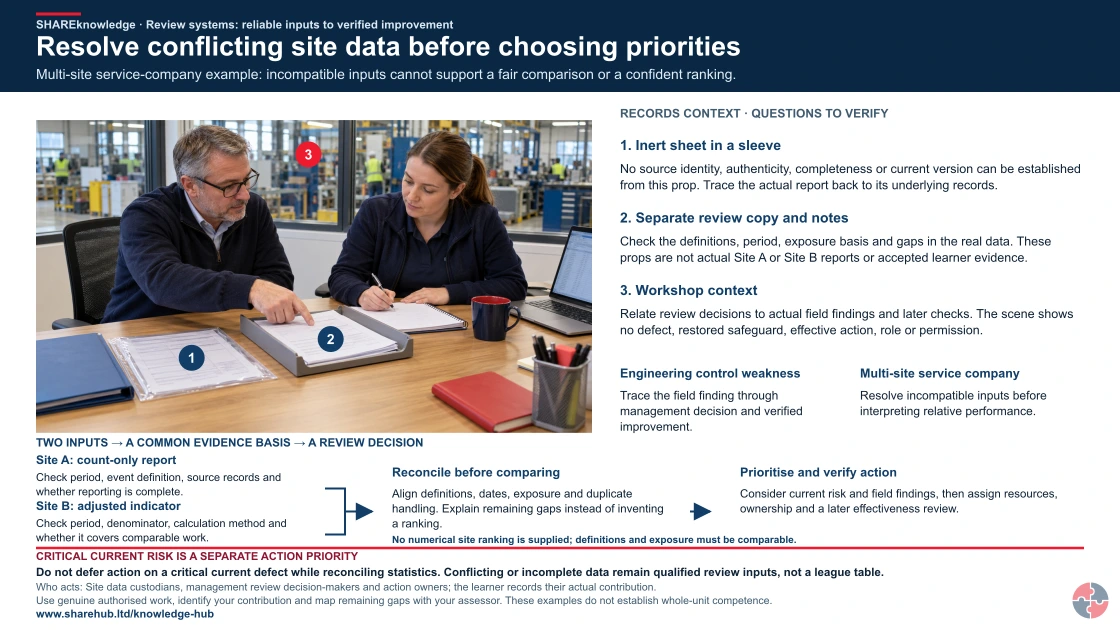
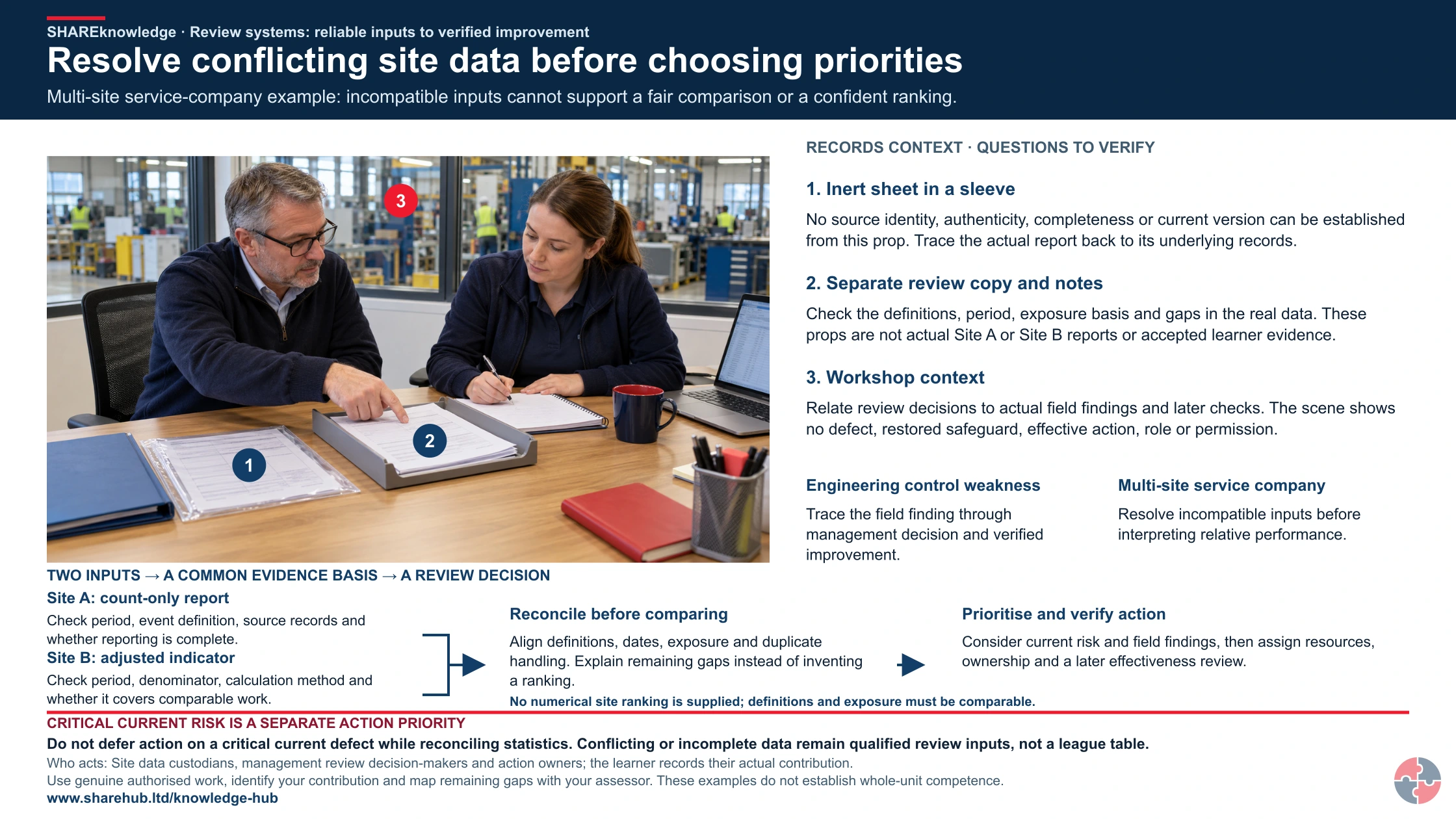
Resolve conflicting site data before choosing priorities
Full written explanation
An illustrative workplace records discussion shows an inert sheet in a transparent sleeve, a separate review copy and notebook, and a workshop beyond glazing. Picture key: 1 identifies the inert sheet in a sleeve; 2 identifies the separate review copy and notes; 3 identifies the workshop context. The substantial natural scene locates source-traceability, assumptions and field-check questions. It is not an actual multi-site service company and the papers are not actual Site A or Site B reports, authentic original evidence, private records or measured performance. The full analytical graph retains TWO INPUTS → A COMMON EVIDENCE BASIS → A REVIEW DECISION. Site A: count-only report and Site B: adjusted indicator remain independent inputs, connected by a common unarrowed join rather than a sequence from one site to the other. Two genuine forward arrows connect their common evidence basis to reconciliation and then prioritisation and verification. All four full checks remain native with unnumbered headings; formal Site A and Site B identifiers retain their technical meaning and are distinct from the single literal picture key. No numerical site ranking is supplied; definitions and exposure must be comparable. The separate full band, CRITICAL CURRENT RISK IS A SEPARATE ACTION PRIORITY, accompanies the complete hold, responsible roles, evidence limit and both workplace cases. Do not defer protection against a critical current defect while reconciling statistics; statistical review is not a clearance gate for urgent risk action. No count, reporting completeness, period, event definition, exposure, denominator, rate, calculation, duplicate-handling finding, standardised score, ranking or causal outcome is invented. The scene establishes no actual review decision, budget, saving, management role, learner contribution, restored machinery safeguard, effective action, competence, assessment acceptance or work permission. Keep inspection, audit and management review distinct, evaluate every component and the whole system beyond a sample, and verify actual implementation and effectiveness. Genuine authorised contribution, partial-unit coverage, complete H/616/9540 criterion mapping, cost assumptions and limitations, assessor and IQA decisions, current awarding-body requirements, confidentiality and the stated GB and NI source qualifications remain separate. Neither meeting papers nor an approved budget prove that a control was restored.
Multi-site service-company example: incompatible inputs cannot support a fair comparison or a confident ranking.
- Site A: count-only report. Check period, event definition, source records and whether reporting is complete.
- Site B: adjusted indicator. Check period, denominator, calculation method and whether it covers comparable work.
- Reconcile before comparing. Align definitions, dates, exposure and duplicate handling. Explain remaining gaps instead of inventing a ranking.
- Prioritise and verify action. Consider current risk and field findings, then assign resources, ownership and a later effectiveness review.
When the evidence does not fit: Do not defer action on a critical current defect while reconciling statistics. Conflicting or incomplete data remain qualified review inputs, not a league table.
Who acts: Site data custodians, management review decision-makers and action owners; the learner records their actual contribution.
Changed workplace
Engineering control weakness: Trace the field finding through management decision and verified improvement.
Multi-site service company: Resolve incompatible inputs before interpreting relative performance.
Evidence check: Use genuine authorised work, identify your contribution and map remaining gaps with your assessor. These examples do not establish whole-unit competence.
Inspection, audit, whole-system review and resource decisions
Primary references: HSE: leadership review and action (GB) · HSE: HSG65 review and learning (GB)
Open the complete HD image (new tab)Download image
Inspection, audit, whole-system review and resource decisions
Primary references: HSE: leadership review and action (GB) · HSE: HSG65 review and learning (GB)
A management review leads to a funded action
Illustrative example. A review finds repeated control defects hidden by a positive headline indicator.
Decision. Challenge the input, assign an owner and resources, and check the resulting control.
Evidence to check. Authentic review input, decision rationale, learner contribution and follow-up evidence.
Hold or escalation point. Minutes alone do not demonstrate effectiveness or the learner’s own contribution.
Follow-up. Record unresolved gaps honestly and explain the decision and its effect to the assessor.
How can review findings lead to checked decisions?
A review needs reliable inputs and outputs that name the decision, resource and follow-up evidence. Filing a meeting record does not show that the system improved.
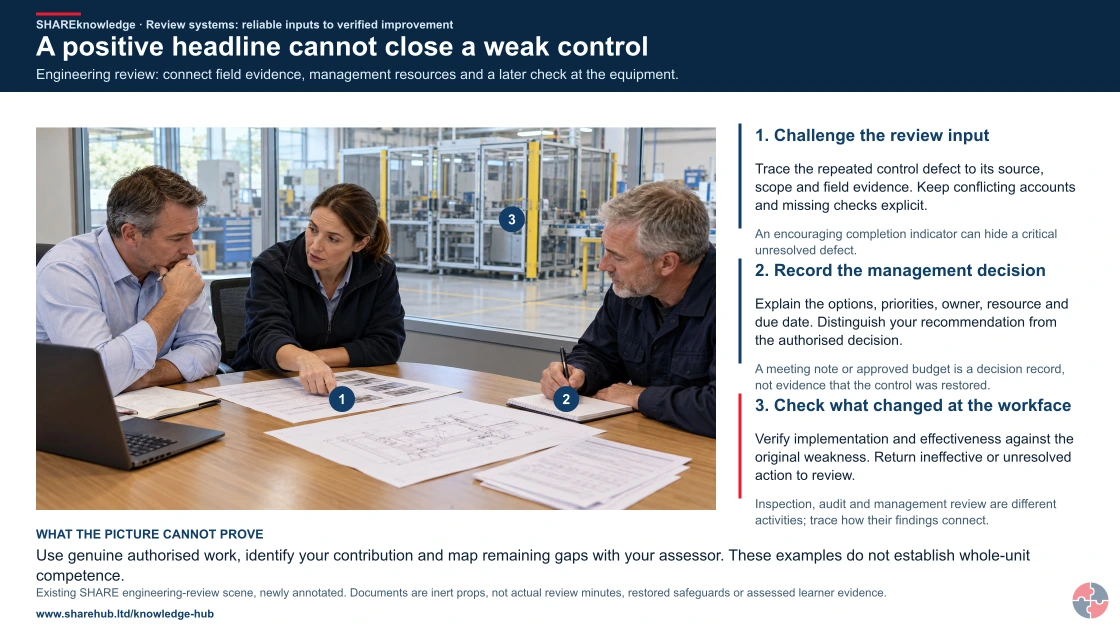
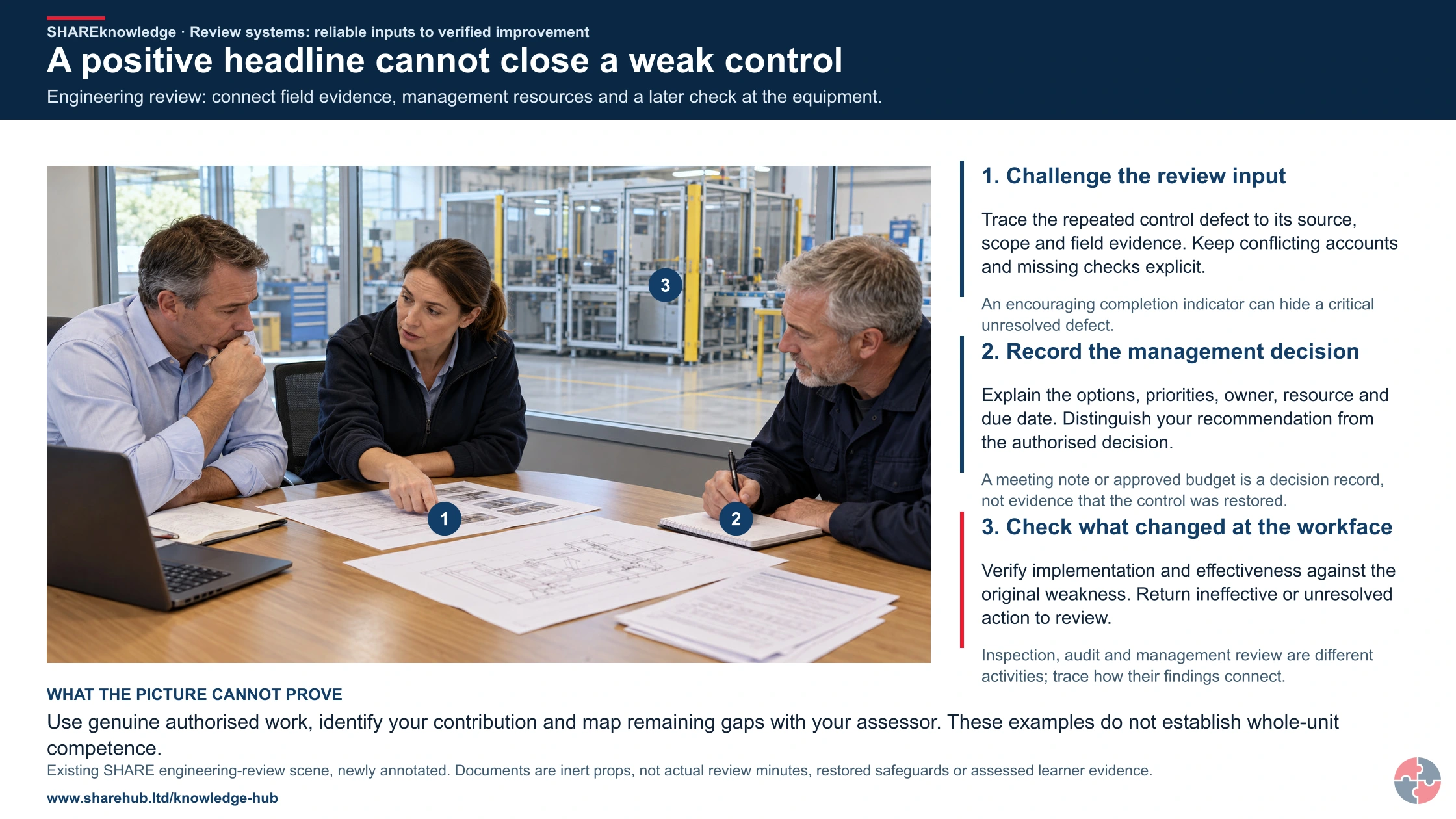
A positive headline cannot close a weak control
Full written explanation
Engineering review: connect field evidence, management resources and a later check at the equipment.
- Challenge the review input. Trace the repeated control defect to its source, scope and field evidence. Keep conflicting accounts and missing checks explicit.
- Record the management decision. Explain the options, priorities, owner, resource and due date. Distinguish your recommendation from the authorised decision.
- Check what changed at the workface. Verify implementation and effectiveness against the original weakness. Return ineffective or unresolved action to review.
Change the pathway
- Do not substitute the headline. An encouraging completion indicator can hide a critical unresolved defect.
- Distinguish minutes from improvement. A meeting note or approved budget is a decision record, not evidence that the control was restored.
- Check the system interface. Inspection, audit and management review are different activities; trace how their findings connect.
Evidence check: Use genuine authorised work, identify your contribution and map remaining gaps with your assessor. These examples do not establish whole-unit competence.
Inspection, audit, whole-system review and resource decisions
Primary references: HSE: leadership review and action (GB) · HSE: HSG65 review and learning (GB)
Open the complete HD image (new tab)Download image
Inspection, audit, whole-system review and resource decisions
Primary references: HSE: leadership review and action (GB) · HSE: HSG65 review and learning (GB)

Evaluate inputs
Bring inspection, incident, consultation and change information together, with its reliability and gaps.
Decide and resource
Record the decision, accountable owner, resource and due date, identifying the learner’s contribution.
Check effect
Verify implementation and effectiveness; return unresolved or ineffective actions to the next review.
This is a evidence-planning example, not a completed portfolio, an assessment decision or evidence of whole-unit competence.
How can I demonstrate my workplace practice for unit 9?
Assess whether the management system delivers effective protection, then secure decisions, resources and follow-up for improvements. Unit reference: H/616/9540.
Plan a real activity with your assessor and identify the decisions, work products and witnesses that can show your own competence. The following suggestions are options to adapt, not mandatory document lists or model answers to submit.
What practical work should the evidence demonstrate?
Separate inspection, audit and management review. Inspection looks at conditions or activities; audit tests arrangements against defined criteria; management review judges overall suitability, effectiveness and the decisions needed for improvement. The same findings can inform all three without making them interchangeable.
Review individual arrangements and their interfaces. Training may be effective in isolation while contractor selection fails to identify who needs it. Follow a real job across procurement, planning, authorisation, delivery and assurance to test the system as a whole.
Efficiency is not simply reducing spending or paperwork. Examine whether resources produce reliable protection and useful decisions. State cost assumptions, limitations and the risk implications of any proposed saving. A management-review minute should show decisions, owners and follow-up rather than a list of topics discussed.
What workplace project could I use to develop evidence?
A business completes audits but repeats the same contractor-control findings. Use that weakness as an entry point, then inventory and review every component of the management system within the agreed organisational scope, including how components connect. Test field performance and bring a prioritised improvement paper to management. Track approved changes through implementation and confirm whether the next whole-system review shows better control, not merely more documents.
This is an illustrative project, not an account to copy or a required template. Choose an activity you genuinely undertook and agree its scope with your assessor. If you advise rather than hold operational authority, evidence the recommendations, consultation and follow-up that were yours, alongside the decisions taken by authorised colleagues.
One project may cover only part of the unit. Check the full criterion map and plan additional genuine activities, knowledge evidence and professional development wherever the project leaves gaps. Do not treat an illustrative sample as proof of whole-unit coverage.
Build an evidence trail
- Explain the workplace, your role, the starting problem and the limits of your authority. Identify the activity dates and who can confirm your contribution.
- Keep the information you used, the options considered and your reasons for the decision. Identify specialist advice and distinguish what you knew from what you assumed.
- Show consultation and implementation: who agreed the action, what you personally delivered and how resources, ownership and deadlines were arranged.
- Include a follow-up check and an honest account of the result. Explain remaining gaps and what you would change; do not create outcomes that did not occur.
Prepare the evidence index
For unit 9, give each item an identifier, date, version, author, your contribution, relevant criterion references and exact page or paragraph locations. Record how authenticity can be checked. Cross-reference a genuinely relevant item to other units rather than creating duplicate copies, but explain separately how it supports each criterion.
Obtain permission before sharing workplace records. Redact names, commercial details and health information while preserving enough context for assessment. Arrange secure assessor access or an authenticated witness account where copying is inappropriate. Never upload identifiable incident or medical records to a public page or an unapproved AI tool.
How can I plan workplace evidence against each criterion?
The reference numbers below help you plan work and locate evidence. The activities, evidence suggestions and questions are original SHARE learning guidance, not the official criterion wording or a promise of acceptance. Use your assessor-issued assessment plan and the awarding-body specification for the exact requirements.
Open the ProQual qualification specificationOutcome 1: Review individual arrangements
1.1 · Inventory every management-system component within the agreed organisational scope, then analyse each component's inputs, ownership and outputs; do not stop at a few selected arrangements.
Evidence you could select
Complete component register and evidenced analysis. Keep the relevant extract and explain your personal contribution rather than submitting an unexplained file.
Discuss with your assessor
How have you demonstrated coverage of every component? Refer to a specific decision, the information available at the time and what happened afterwards.
1.2 · Define a usable success test for each arrangement, including resource and interface requirements.
Evidence you could select
Component evaluation criteria. Keep the relevant extract and explain your personal contribution rather than submitting an unexplained file.
Discuss with your assessor
What would effective operation look like? Refer to a specific decision, the information available at the time and what happened afterwards.
1.3 · Set review intervals and event triggers based on risk and change, recording why each differs.
Evidence you could select
Review schedule and rationale. Keep the relevant extract and explain your personal contribution rather than submitting an unexplained file.
Discuss with your assessor
What would require an earlier review? Refer to a specific decision, the information available at the time and what happened afterwards.
1.4 · Present managers with specific improvements and realistic resource implications.
Evidence you could select
Management paper and response. Keep the relevant extract and explain your personal contribution rather than submitting an unexplained file.
Discuss with your assessor
Which decision did you need from them? Refer to a specific decision, the information available at the time and what happened afterwards.
1.5 · Plan agreed changes with operational owners, milestones and controls during transition.
Evidence you could select
Implementation plan. Keep the relevant extract and explain your personal contribution rather than submitting an unexplained file.
Discuss with your assessor
How will you avoid introducing new risks? Refer to a specific decision, the information available at the time and what happened afterwards.
1.6 · Retain findings, decisions and follow-up against the arrangement reviewed.
Evidence you could select
Component review register. Keep the relevant extract and explain your personal contribution rather than submitting an unexplained file.
Discuss with your assessor
Can you trace a finding to a completed action? Refer to a specific decision, the information available at the time and what happened afterwards.
Outcome 2: Test how the arrangements work together
2.1 · Analyse all management-system components and their interfaces. Trace real jobs to test connections, but explain how the complete system was covered beyond that sample.
Evidence you could select
Whole-system analysis and coverage map. Keep the relevant extract and explain your personal contribution rather than submitting an unexplained file.
Discuss with your assessor
Which interfaces need additional evidence beyond your sample? Refer to a specific decision, the information available at the time and what happened afterwards.
2.2 · Identify the common ownership, information and resourcing needed for the system to function.
Evidence you could select
System success criteria. Keep the relevant extract and explain your personal contribution rather than submitting an unexplained file.
Discuss with your assessor
What prevents one strong component compensating for another weak one? Refer to a specific decision, the information available at the time and what happened afterwards.
2.3 · Agree an overall management-review cycle plus triggers for major change or serious findings.
Evidence you could select
System review calendar. Keep the relevant extract and explain your personal contribution rather than submitting an unexplained file.
Discuss with your assessor
Why is this cycle suitable? Refer to a specific decision, the information available at the time and what happened afterwards.
2.4 · Compare actual control performance and proportionate resource use rather than equating low cost with effectiveness.
Evidence you could select
Evaluation and cost assumptions. Keep the relevant extract and explain your personal contribution rather than submitting an unexplained file.
Discuss with your assessor
Where does apparent efficiency hide risk? Refer to a specific decision, the information available at the time and what happened afterwards.
2.5 · Develop improvements addressing repeated failures or broken interfaces and consult those affected.
Evidence you could select
Change proposal and options analysis. Keep the relevant extract and explain your personal contribution rather than submitting an unexplained file.
Discuss with your assessor
Why will this change address the cause? Refer to a specific decision, the information available at the time and what happened afterwards.
2.6 · Coordinate implementation, escalate delays and verify that changed arrangements function on the job.
Evidence you could select
Delivery and verification records. Keep the relevant extract and explain your personal contribution rather than submitting an unexplained file.
Discuss with your assessor
What did you do when progress stalled? Refer to a specific decision, the information available at the time and what happened afterwards.
2.7 · Record management decisions, responsible owners and evidence of system-level follow-up.
Evidence you could select
Review minutes and action register. Keep the relevant extract and explain your personal contribution rather than submitting an unexplained file.
Discuss with your assessor
Could an independent reviewer follow the decision chain? Refer to a specific decision, the information available at the time and what happened afterwards.
Outcome 3: Explain your assurance judgement
3.1 · Evaluate how review differs from routine checking and auditing in your organisation.
Evidence you could select
Reflective comparison. Keep the relevant extract and explain your personal contribution rather than submitting an unexplained file.
Discuss with your assessor
What decisions should management review produce? Refer to a specific decision, the information available at the time and what happened afterwards.
3.2 · Describe the actual system using linked responsibilities, processes and evidence rather than reproducing a manual.
Evidence you could select
System diagram and explanation. Keep the relevant extract and explain your personal contribution rather than submitting an unexplained file.
Discuss with your assessor
How do the parts interact? Refer to a specific decision, the information available at the time and what happened afterwards.
3.3 · Explain why competent ownership, consultation, reliable information and resources affect performance and cost.
Evidence you could select
Worked system analysis. Keep the relevant extract and explain your personal contribution rather than submitting an unexplained file.
Discuss with your assessor
Which feature is essential but currently weak? Refer to a specific decision, the information available at the time and what happened afterwards.
3.4 · Evaluate whole-system efficiency and cost-effectiveness using control outcomes, resource use and explicit cost assumptions; challenge conclusions with field evidence and alternative explanations.
Evidence you could select
Whole-system evaluation, cost comparison and limitations. Keep the relevant extract and explain your personal contribution rather than submitting an unexplained file.
Discuss with your assessor
Does apparent efficiency deliver reliable protection, and what evidence supports that judgement? Refer to a specific decision, the information available at the time and what happened afterwards.
3.5 · Compare paper and digital records for access, control, retention and meeting users' needs.
Evidence you could select
Record-system comparison. Keep the relevant extract and explain your personal contribution rather than submitting an unexplained file.
Discuss with your assessor
Who cannot currently access useful information? Refer to a specific decision, the information available at the time and what happened afterwards.
3.6 · Explain how relevant requirements, external learning and document-quality expectations influence review scope.
Evidence you could select
External-factor review. Keep the relevant extract and explain your personal contribution rather than submitting an unexplained file.
Discuss with your assessor
What change should trigger a fresh review? Refer to a specific decision, the information available at the time and what happened afterwards.
4.1 · Evidence your professional development
Use a learning episode related to this unit: identify a gap in your capability, set a realistic objective, record the activity and explain how you applied the learning. Discuss an ethical decision, an inclusion issue and a contribution to professional discussion. Finish with a dated review of progress and the next priority. A list of courses attended is not a reflective development record.
Evidence options: a competence self-review, dated development plan, reflective CPD entry, an ethical or inclusive-practice example and a record of professional exchange. Cross-reference the same genuine portfolio across units where appropriate, adding a unit-specific reflection.
Which background reading supports this unit?
Use the linked SHARE topics to strengthen your understanding, then explain the decisions you made in your own organisation. Reading alone is not evidence that you performed the work.
What should I check before submitting evidence to my assessor?
Check that the evidence is authentic, relevant to the registered criteria and clear about your own decisions, actions and results. Resolve gaps with your assessor and protect personal or confidential information before submission.
- Performance: show work you actually did, not just what a practitioner ought to do. Explain your contribution to team-produced documents.
- Reasoning: answer explain, analyse, evaluate and justify questions with decisions, alternatives and limitations, not copied definitions.
- Coverage: map every reference to a precise piece of evidence. Discuss gaps early, including missing authority, specialist tasks or no genuine incident or external request.
- Authenticity and sufficiency: ask what observation, questioning or witness evidence the assessor needs. A job title, course certificate or large upload alone is not proof of competence.
- Exercises: label drills and simulated records accurately. Their acceptability depends on the assessment requirements and assessor agreement; never present them as genuine emergencies or incidents.
- Outcome: the assessor decides whether the evidence meets the requirements, subject to centre and awarding-body quality assurance. These learning pages do not award competence or replace assessment.