SHARE Knowledge Hub
Decompression sickness and caisson disease at work
Decompression sickness occurs when dissolved inert gas forms bubbles as pressure falls after work under increased pressure. It can affect joints, nerves, breathing and other body systems after compressed-air construction or occupational diving. Controlled exposure and decompression, competent specialist supervision and an immediately usable medical response are essential because symptoms can be serious or delayed.
Understanding Decompression sickness and caisson disease at work
Decompression sickness, commonly called the bends, is an acute form of decompression illness caused by reduction in ambient pressure after exposure to compressed gas. It is a high-consequence occupational health and process-control topic. It can arise in commercial diving, compressed-air tunnelling and caisson work, hyperbaric operations and other work involving pressure exposure. It is not a routine office or general workplace illness topic.
Why this matters at work
Breathing gas at raised ambient pressure increases dissolved inert gas in tissues. Controlled decompression allows its removal through the lungs and manages bubble risk; it cannot guarantee that illness will never occur. Bubbles can injure tissues or disrupt circulation after pressure reduction, including in an apparently compliant exposure. Lung expansion injury can introduce gas into the arterial circulation through a different mechanism. The actual risk depends on gas, pressure/depth, time, work, temperature, individual factors and the procedure. Clinical interpretation belongs with the specialist team.
Pressure change can also damage ears, sinuses, lungs and other air-containing spaces, and the same project can expose people to exertion, cold, fatigue, hypoxia, toxic gas, noise, vibration and emergency hazards. A good risk assessment identifies the combined profile and makes sure a control for one hazard does not worsen another, for example oxygen exposure, fire risk or chamber access.
How organisations manage this in practice
For diving work, the project plan turns the legal and technical requirements into a controlled operation. It must match the class of diving, the actual site and the team. It should establish the task, limits, decompression approach, equipment and breathing-gas arrangements, communications, team roles, surface support, emergency response, medical arrangements, weather or water constraints, interfaces and recording. It is a live control document: changing the task, location, water conditions, team, gas, equipment or emergency route can invalidate assumptions made in the original plan.
During the operation, protect the integrity of the exposure record and the decision chain. Record actual conditions and deviations as they occur, maintain communications, monitor the task and conditions, and do not turn a change into a normal practice by repeated informal acceptance. A handover between supervisors or shifts needs explicit transfer of exposure status, outstanding work, equipment condition, weather/plant concerns, emergency readiness and authority limits. The incoming team should be able to reconstruct what has happened without relying on memory.
Pressure-work safety starts before mobilisation. A client, principal contractor, asset owner or purchasing team should define the exact work and risk boundaries, select a genuinely competent specialist, allow enough time and resource for the approved procedure and emergency readiness, and verify the contractor's proposed system against the actual site. A generic health-and-safety questionnaire, insurance certificate or prior relationship is not evidence that a contractor can safely manage the particular dive, chamber, caisson, gas or remote-location profile.
Find the pressure-exposure response route first
Use the existing emergency guidance for suspected symptoms after diving or compressed-air work. Readiness needs an agreed specialist contact and transfer arrangement before exposure, including outside normal hours; this page supplies no decompression or recompression procedure.
The specialist contact is unavailable after hours
Illustrative example. A planned pressure-work activity finishes when the usual support team is off duty.
Decision. The supervisor verifies the project-specific emergency arrangements and competent cover before the activity proceeds.
Evidence to check. Current contact route, trained response capability, exposure records and agreed transfer arrangements.
Hold or escalation point. Pause the planned exposure when the required medical or emergency readiness cannot be demonstrated.
Follow-up. Exercise the communication and transfer arrangements and resolve any gap with the competent team.
Avoid pressure exposure before planning controlled access
Normal-pressure alternatives, controlled access and supervised return are different parts of the assessment. Specialist pressure-work and medical arrangements govern the task.
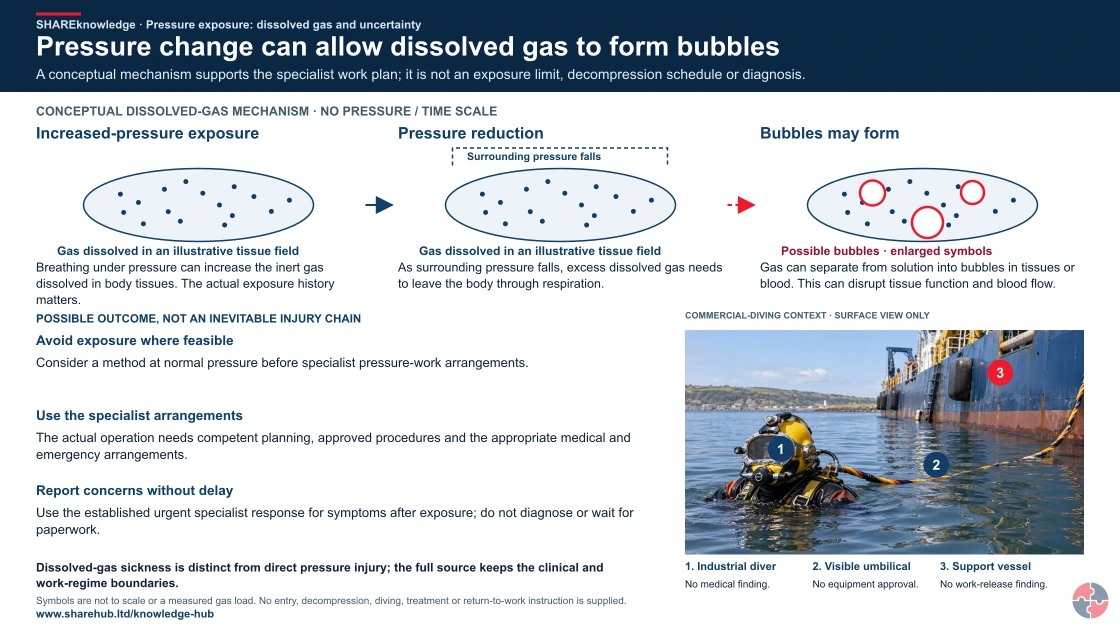
Pressure change can allow dissolved gas to form bubbles
Full written explanation
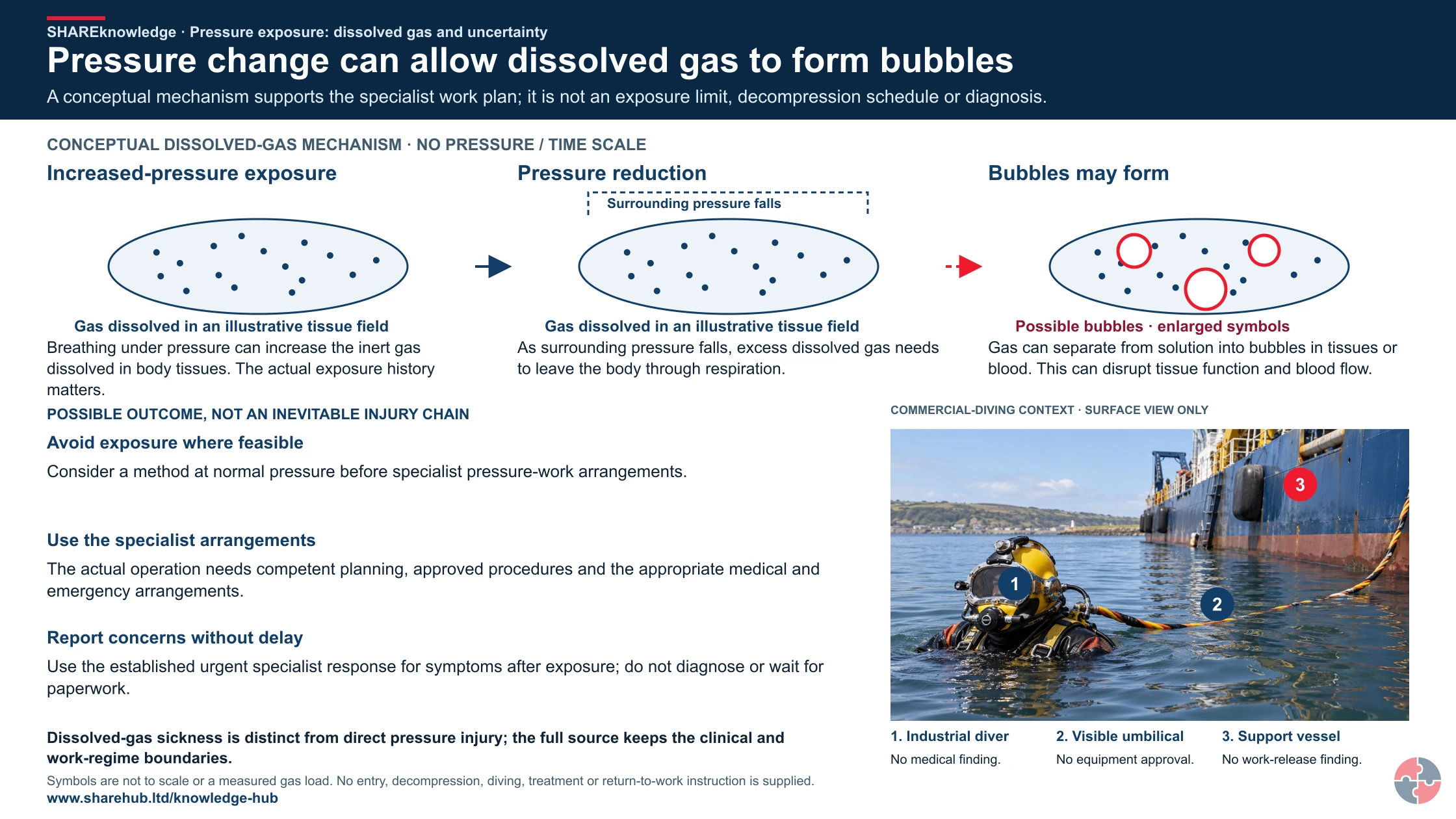
A complete conceptual dissolved-gas mechanism uses three symbolic tissue fields alongside an illustrative surface commercial-diving context. Filled dots represent dissolved gas; enlarged open rings represent possible bubbles. The symbols are not anatomy, measured gas, a pressure or time scale, or an inevitable injury prediction. Increased-pressure exposure connects to pressure reduction; the last dashed red connection to possible bubble formation remains conditional. The surrounding-pressure-falls label and all three full stage explanations remain within the complete mechanism. Three separate full control explanations address normal-pressure alternatives, actual specialist arrangements and prompt reporting through the established urgent route. An illustrative commercial diver at the water surface beside a stationary support vessel provides the requested industrial-diving context. Picture key: 1 identifies the industrial diver; 2 identifies the visible umbilical; 3 identifies the support vessel. This surface view establishes no increased-pressure exposure, gas identity, depth, time, exposure history, approved equipment arrangement, medical fitness, readiness, vessel capability or work release. No submerged task, pressurised entry, chamber operation, anatomical tissue, injury, symptom, rescue or treatment is shown. The scene is context rather than an operating demonstration. No compression, ascent, decompression, oxygen, recompression, treatment, transport or return-to-work instruction is supplied. The full source distinguishes dissolved-gas sickness from direct pressure injury and keeps compressed-air construction and diving under their actual specialist GB or NI work and medical arrangements. Urgent specialist help remains independent of paperwork, a workplace diagnosis or manager clearance.
A conceptual mechanism supports the specialist work plan; it is not an exposure limit, decompression schedule or diagnosis.
- Increased-pressure exposure. Breathing under pressure can increase the inert gas dissolved in body tissues. The actual exposure history matters.
- Pressure reduction. As surrounding pressure falls, excess dissolved gas needs to leave the body through respiration.
- Bubbles may form. Gas can separate from solution into bubbles in tissues or blood. This can disrupt tissue function and blood flow.
Change the pathway
- Avoid exposure where feasible. Consider a method at normal pressure before specialist pressure-work arrangements.
- Use the specialist arrangements. The actual operation needs competent planning, approved procedures and the appropriate medical and emergency arrangements.
- Report concerns without delay. Use the established urgent specialist response for symptoms after exposure; do not diagnose or wait for paperwork.
Evidence check: Dissolved-gas sickness is distinct from direct pressure injury; the full source keeps the clinical and work-regime boundaries.
Existing urgent symptoms, specialist response and separate GB/NI work regimes
Primary references: HSE: compressed-air health conditions (GB) · HSE: specialist compressed-air arrangements (GB) · CDC Yellow Book: dissolved gas and distinct dive-related conditions
Open the complete HD image (new tab)Download image
Existing urgent symptoms, specialist response and separate GB/NI work regimes
Primary references: HSE: compressed-air health conditions (GB) · HSE: specialist compressed-air arrangements (GB) · CDC Yellow Book: dissolved gas and distinct dive-related conditions

Avoid where feasible
Define the work outcome and consider a method that avoids pressure exposure.
Specialist plan
Where exposure remains, use the competent plan, controlled access and monitoring/records for the actual operation.
Return and report
Follow the supervised return and post-exposure reporting arrangements and activate the agreed medical response for symptoms.
No pressure/time schedule, decompression table or treatment instruction can be taken from this conceptual sequence.
What key facts should people know first about decompression sickness?
Decompression sickness is a potentially serious pressure-exposure illness; symptoms after compressed-air or diving work need prompt specialist assessment.
Suspected decompression illness needs prompt specialist medical assessment through the planned emergency route. Employers and supervisors should not try to diagnose or wait to see whether symptoms pass. Their role is to ensure the emergency plan works, oxygen is available where required, relevant records travel with the person and access to recompression or specialist medical advice is understood before the work begins.
Prevention depends on planning the pressure exposure. Compressed-air construction must use compression and decompression procedures approved by the relevant regulator under the applicable GB or NI compressed-air rules. Work diving needs the applicable competent project plan and sector ACOP route. Both need suitable equipment, medical arrangements, trained supervision, exposure records, emergency drills and clear stop-work authority.
| Fact | Why it matters |
|---|---|
| It is pressure-related | Risk arises from compression and decompression, not from ordinary air compressor use. |
| Symptoms can be serious | Joint pain may be common, but neurological, breathing or systemic symptoms can be life-threatening. |
| Specialist competence is essential | Compressed air and diving work require competent people, medical arrangements and statutory records. |
| Emergency arrangements must be pre-planned | Oxygen, communication, records, transport and recompression access cannot be improvised well. |
| Records matter | Exposure and health records support medical treatment, surveillance and legal compliance. |
What is decompression sickness or caisson disease?
Decompression sickness is an acute form of decompression illness caused by gas bubbles forming as pressure reduces.
When a person works under increased pressure, gases dissolve into body tissues in greater amounts. If pressure is reduced too quickly or the exposure is otherwise poorly controlled, bubbles can form during decompression. These bubbles can affect joints, skin, nerves, lungs or other body systems. The same broad risk logic applies to compressed air work and diving, although the regulatory frameworks and project arrangements differ.
In its compressed-air guidance, HSE groups decompression sickness, barotrauma and dysbaric osteonecrosis as pressure-related health problems under the heading decompression illness. Diving medicine may use a narrower acute DCI definition that includes arterial gas embolism; the terms should not be treated as identical. Barotrauma is direct injury from pressure changes in air spaces such as ears or sinuses. Dysbaric osteonecrosis is a chronic bone condition associated with pressure exposure. Caisson disease is the older term often associated with compressed air construction work.
This topic therefore needs two layers of control: medical/physiological control of pressure exposure and management-system control of a specialist high-risk project.
The CDC Yellow Book 2026: decompression illness and dive-related injuries explains the distinction between decompression sickness and arterial gas embolism in scuba-diving medicine. It supports the clinical terminology here; it is US travel/diving guidance, not a GB or NI work procedure.
| Term | Meaning |
|---|---|
| Decompression sickness | Bubble-related illness after pressure reduction, sometimes called the bends. |
| Caisson disease | Historical term for decompression sickness in compressed air construction and caisson work. |
| Decompression illness | HSE’s compressed-air grouping includes decompression sickness, barotrauma and dysbaric osteonecrosis. In acute diving medicine, DCI commonly means decompression sickness and arterial gas embolism. |
| Barotrauma | Direct pressure injury to air-containing cavities such as ears, sinuses or lungs. |
| Dysbaric osteonecrosis | A chronic bone condition associated with pressure exposure. |
| Recompression | Specialist treatment using a chamber to recompress and then decompress under medical control. |
How does decompression sickness develop?
It develops when pressure changes allow dissolved gas to form bubbles in tissues or blood.
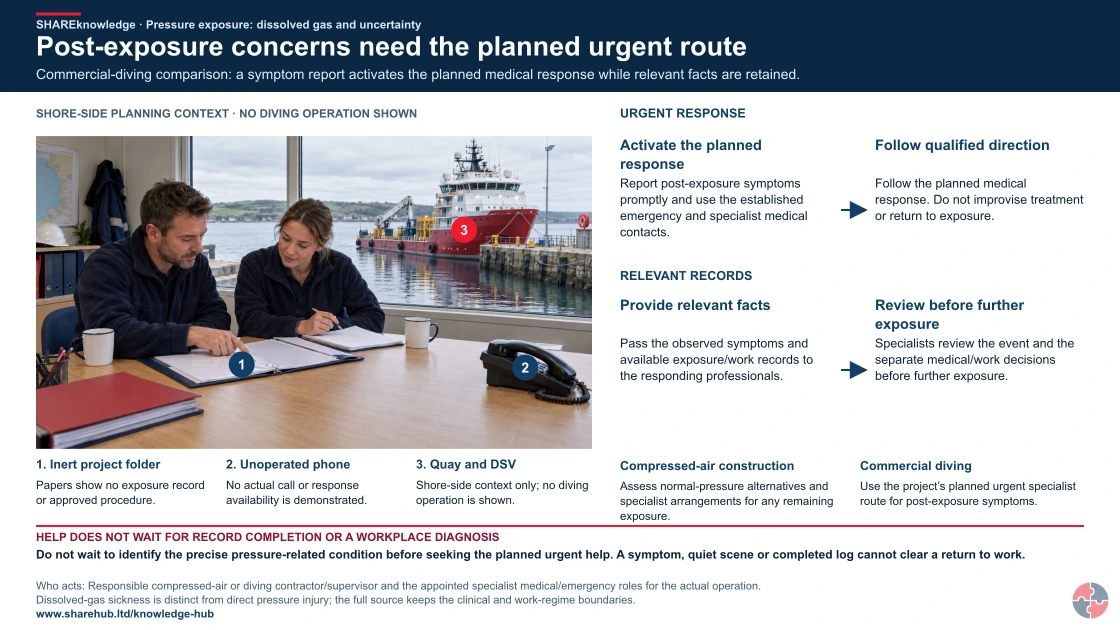
Post-exposure concerns need the planned urgent route
Full written explanation
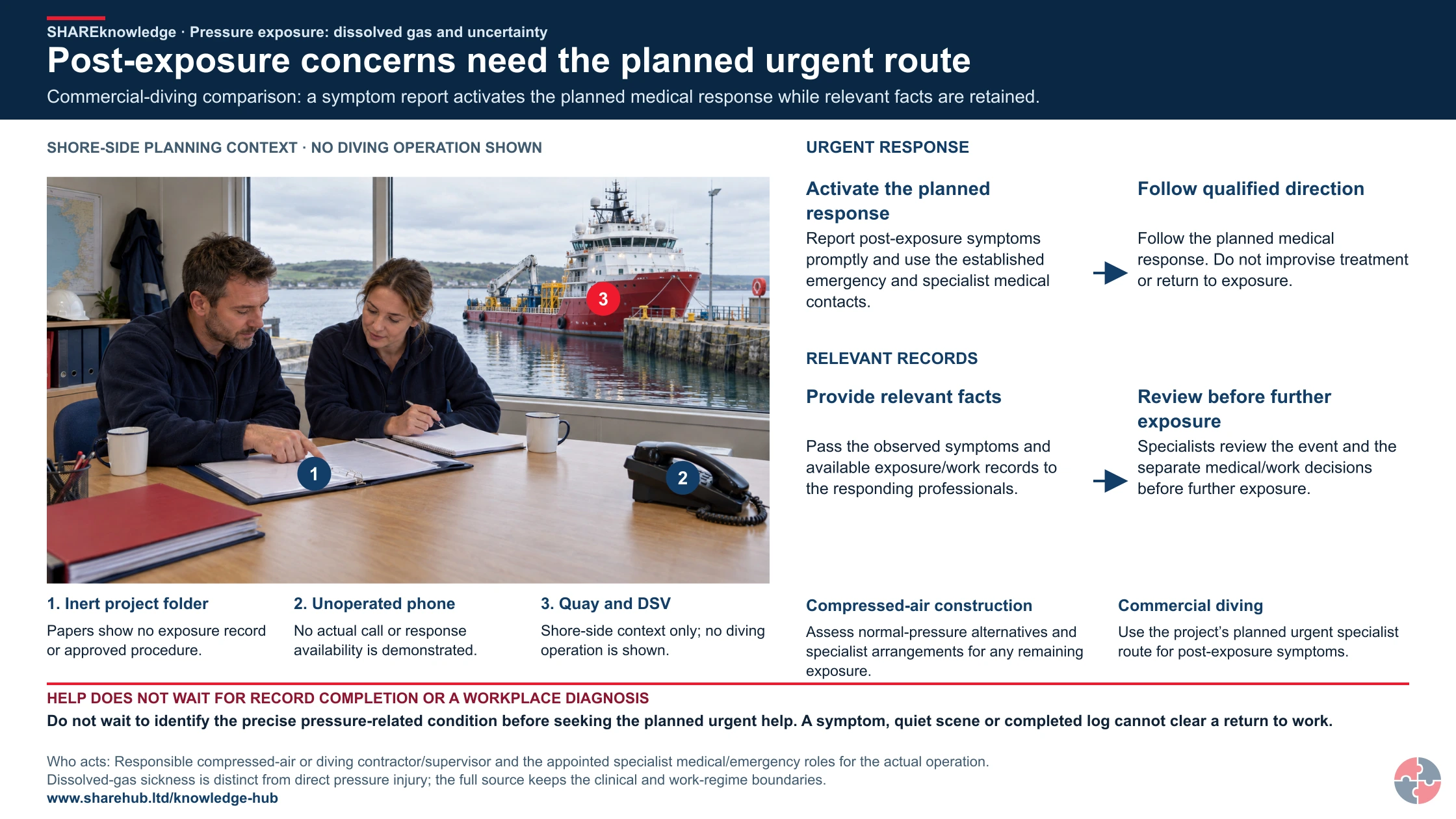
An illustrative inactive shore-side planning cabin shows normal uninjured colleagues reviewing an inert project folder, with an unoperated desk phone and a quay and stationary offshore diving support vessel (DSV) beyond the window. Picture key: 1 identifies the inert project folder; 2 identifies the unoperated phone; 3 identifies the quay and DSV. The photograph is shore-side context only and does not demonstrate a commercial diving operation, actual exposure, a symptom report, live contact, connected communications, specialist role, response availability or work permission. No diving gear, diver, cylinder, hose, chamber, water entry, clinical pose, rescue, treatment or transfer is shown. The complete explanation keeps two independent tracks. URGENT RESPONSE connects the full checks to activate the planned response and follow qualified direction. RELEVANT RECORDS separately connects provision of relevant facts to specialist review before further exposure. Only the two within-track arrows are present; the process headings are unnumbered and separate from the physical picture key. HELP DOES NOT WAIT FOR RECORD COMPLETION OR A WORKPLACE DIAGNOSIS. All four full checks, the complete hold, responsible roles, evidence boundary and compressed-air-construction and commercial-diving cases accompany these independent tracks. A symptom, quiet scene or completed log cannot clear a return to work. Relevant records are provided without delaying the planned urgent medical and specialist route; help is not conditional on a diagnostic label, manager agreement, clinical-record sharing or a work-release decision. No ascent, pressure/time, depth, gas, oxygen, recompression, treatment, transport, flying or return protocol is supplied. Use the full source for its separate GB and NI compressed-air and work-diving regimes, current-fitness and confidential medical boundaries, and the distinction between dissolved-gas sickness and direct pressure injury.
Commercial-diving comparison: a symptom report activates the planned medical response while relevant facts are retained.
- Activate the planned response. Report post-exposure symptoms promptly and use the established emergency and specialist medical contacts.
- Follow qualified direction. Follow the planned medical response. Do not improvise treatment or return to exposure.
- Provide relevant facts. Pass the observed symptoms and available exposure/work records to the responding professionals.
- Review before further exposure. Specialists review the event and the separate medical/work decisions before further exposure.
When the evidence does not fit: Do not wait to identify the precise pressure-related condition before seeking the planned urgent help. A symptom, quiet scene or completed log cannot clear a return to work.
Who acts: Responsible compressed-air or diving contractor/supervisor and the appointed specialist medical/emergency roles for the actual operation.
Changed workplace
Compressed-air construction: Assess normal-pressure alternatives and specialist arrangements for any remaining exposure.
Commercial diving: Use the project’s planned urgent specialist route for post-exposure symptoms.
Evidence check: Dissolved-gas sickness is distinct from direct pressure injury; the full source keeps the clinical and work-regime boundaries.
Existing urgent symptoms, specialist response and separate GB/NI work regimes
Primary references: HSE: compressed-air health conditions (GB) · HSE: specialist compressed-air arrangements (GB) · CDC Yellow Book: dissolved gas and distinct dive-related conditions
Open the complete HD image (new tab)Download image
Existing urgent symptoms, specialist response and separate GB/NI work regimes
Primary references: HSE: compressed-air health conditions (GB) · HSE: specialist compressed-air arrangements (GB) · CDC Yellow Book: dissolved gas and distinct dive-related conditions
The risk is influenced by pressure, depth or working pressure, time under pressure, breathing gas, workload, temperature, repeat exposures, ascent or decompression rate, physical fitness, hydration, fatigue and individual medical factors. Good planning does not rely on one control; it combines exposure limits, decompression procedures, competent supervision, medical fitness and emergency readiness. UK compressed-air illness categories: HSE - Decompression illness.
In compressed air work, the work chamber, man locks, compression, decompression, oxygen breathing, medical surveillance and emergency procedures are central. In diving work, the diving project plan, dive team, breathing apparatus, surface support, communication, decompression schedule, emergency gas and chamber arrangements become critical.
The control principle is simple: keep pressure exposure within planned limits, decompress under competent procedures and act immediately if symptoms are reported.
For the dissolved-gas mechanism and diving risk factors, see the CDC Yellow Book 2026: decompression illness and dive-related injuries. Its clinical explanation informs this lesson; approved project procedures and the GB or NI medical route govern workplace decisions.
| Factor | Why it matters | Control focus |
|---|---|---|
| Pressure and duration | Higher pressure and longer exposure increase dissolved gas loading. | Plan exposure limits and decompression procedures. |
| Rate of decompression | Too rapid decompression can increase bubble formation. | Use approved or competent decompression schedules. |
| Repeat exposures | Residual gas loading may accumulate across repeated exposures. | Track exposure history and apply repeat exposure rules. |
| Workload and temperature | Heavy work, cold and fatigue can affect physiology and performance. | Plan work/rest, thermal protection and fitness. |
| Medical fitness | Certain conditions or temporary illness can affect suitability. | Use AMED or appointed doctor processes where required. |
Where can decompression sickness occur at work?
It can occur in occupational diving, compressed air tunnelling, caisson work and some hyperbaric work.
The risk is specialist and should not be confused with ordinary compressed-air tools or pneumatic equipment. It is associated with people entering or working in environments where the body is exposed to pressure above normal atmospheric pressure and must later decompress safely.
Compressed air work may arise in tunnelling, shafts, caissons, ground engineering or pressurised construction environments. Diving at work may include offshore, inland/inshore, scientific, archaeological, media, recreational instruction or other work activities where one or more divers are at work. The exact ACOP or project requirement depends on the diving sector.
Clients who only occasionally procure this work still have to understand enough to choose competent contractors, challenge missing plans and confirm emergency arrangements.
| Setting | Examples | Key management issue |
|---|---|---|
| Compressed air construction | Tunnelling, shafts, caissons or pressurised ground work. | Compressed air contractor competence, notification, procedures, medical surveillance and records. |
| Inland or inshore diving | Civil engineering, inspection, marine work, harbours, fish farms or infrastructure. | Diving contractor, project plan, diver competence, medical fitness and emergency plan. |
| Offshore diving | Offshore energy, pipelines, structures and marine projects. | ACOP compliance, diving team, chamber arrangements, specialist rescue and medical support. |
| Scientific or archaeological diving | Research, education and investigation of historic sites. | Correct ACOP, project planning, competence and medical fitness. |
| Hyperbaric support activities | Specialist work around chambers or pressure systems. | Competent medical and engineering control. |
What symptoms should trigger the emergency arrangements?
Any symptoms after pressure exposure should be taken seriously and managed through the planned medical response route.
Warning signs after pressure exposure can include joint or limb pain, skin changes, unusual fatigue, dizziness, weakness, numbness, tingling, balance problems, visual disturbance, breathing difficulty, chest symptoms, confusion or collapse. These signs can occur with decompression illness or other pressure-related injuries; they do not identify decompression sickness on their own. Some cases may appear mild at first. The workplace rule should be conservative: report symptoms immediately and follow the project emergency plan. UK compressed-air illness context: HSE - Decompression illness.
The page does not provide diagnosis or treatment instructions. The key management requirement is that supervisors, workers and support teams know what to report, who to contact, where oxygen and records are kept, how to reach specialist advice and how to transfer the person without delay through the planned route.
The CDC Yellow Book 2026: decompression illness and dive-related injuries distinguishes the clinical warning signs of decompression sickness from arterial gas embolism. Staff should report the observed signs and exposure history, then use the project emergency medical route; they should not attempt that differential diagnosis at work.
| Symptom pattern | Why it matters | Workplace response |
|---|---|---|
| Joint or limb pain | Can be a common presentation of decompression sickness. | Stop further exposure and activate medical assessment route. |
| Numbness, weakness, dizziness or confusion | May indicate neurological involvement. | Escalate immediately through the emergency plan. |
| Breathing difficulty or chest symptoms | Can indicate serious decompression illness or barotrauma. | Follow emergency oxygen and specialist medical response arrangements. |
| Skin changes, itching or rash | May occur after decompression and should not be ignored. | Record symptoms and seek planned medical advice. |
| Delayed symptoms | Symptoms may occur after leaving the pressure environment. | Ensure workers know reporting requirements after the shift or dive. |
How should work in compressed air be managed?
Compressed air work should be managed as a specialist construction activity with competent roles, procedures, medical surveillance and emergency arrangements.
HSE explains that the Work in Compressed Air Regulations cover matters such as notification, safe systems of work, competent persons, plant and equipment, health surveillance, compression and decompression procedures, medical treatment, emergency procedures, fire precautions, information, training and health and exposure records. That is a strong signal that this work should not be treated as an ordinary construction method.
The compressed air contractor is normally central because they control the technical method and pressure exposure. Clients and principal contractors still need assurance that the contractor is competent, the project is properly notified where required, the Contract Medical Adviser and appointed doctor arrangements are in place, decompression procedures are defined and emergency treatment is practical.
Work planning should include access and egress, man locks, oxygen breathing where required, pressure limits, shift patterns, exposure records, welfare, rescue, fire precautions, communications and post-shift symptom reporting.
| Area | What should be controlled |
|---|---|
| Competent appointments | Compressed air contractor, contract medical adviser, appointed doctor, supervisors and trained lock attendants where relevant. |
| Procedures | Compression, decompression, oxygen breathing, exposure limits, emergency and fire procedures. |
| Plant and equipment | Locks, chambers, air supply, monitoring, communications, breathing apparatus and emergency equipment. |
| Medical surveillance | Fitness, periodic review, symptom reporting, treatment arrangements and return-to-work advice. |
| Records | Exposure records, decompression records, health records, training records, inspections and emergency drills. |
How should diving at work be managed?
Diving at work should be planned and controlled through the Diving at Work Regulations, suitable ACOP, competent diving contractor and medical fitness arrangements.
HSE states that the Diving at Work Regulations cover dives when one or more divers are at work, whether employed or self-employed. Duties can apply across the project, from the client to the diver. Divers must hold appropriate approved qualifications, be competent and hold a valid certificate of medical fitness to dive.
A diving project plan should be specific to the task, site, water conditions, depth, breathing gas, decompression obligation, team size, communications, plant, rescue, emergency oxygen and chamber arrangements. The plan should also cover what happens if a diver becomes ill, misses a decompression stop, has equipment failure or reports symptoms after leaving site.
Fitness to dive is not a paperwork formality. The medical process is a critical control because diving places unusual demands on the body and certain conditions, injuries, illnesses or medications may affect fitness.
| Control area | What good looks like |
|---|---|
| Project planning | Written diving project plan matching the sector ACOP, task, site and conditions. |
| Diver competence | Approved qualifications, experience, task competence and briefing. |
| Medical fitness | Valid certificate from an Approved Medical Examiner of Divers and re-examination after relevant illness or injury. |
| Supervision and team | Competent diving supervisor, adequate team, communications and support. |
| Emergency arrangements | Emergency oxygen, rescue, specialist advice, chamber access and records. |
What medical fitness and health surveillance arrangements are needed?
Medical fitness and health surveillance should be built into the project before pressure exposure begins.
Medical fitness routes differ by place and activity: GB diving uses HSE - Certificate of medical fitness to dive, while NI diving uses HSENI diving. A general article cannot authorise an individual to work under pressure.
For diving at work, medical fitness to dive is assessed through an Approved Medical Examiner of Divers and a certificate of medical fitness to dive. HSE guidance also explains circumstances where re-examination may be needed after illness or injury. For work in compressed air, HSE guidance for appointed doctors supports medical surveillance of compressed-air workers.
Medical information must be handled confidentially. Managers need the fitness outcome, restrictions and work implications; they do not need unnecessary clinical detail. Health and exposure records should be retained and available for legitimate medical, legal and occupational health purposes.
Return-to-work decisions after symptoms, illness, decompression illness or injury should involve competent medical advice. The pressure environment is not a place for informal judgement about whether someone looks fit enough.
| Arrangement | Purpose | Evidence |
|---|---|---|
| AMED certificate | Confirms medical fitness to dive at work. | Valid certificate and any restrictions. |
| Appointed doctor surveillance | Supports compressed-air worker fitness and surveillance. | Medical surveillance records and fitness outcomes. |
| Exposure records | Supports clinical assessment and long-term health records. | Pressure, duration, decompression and shift/dive records. |
| Return-to-work review | Checks fitness after relevant illness, injury or decompression event. | Medical advice, restrictions and review date. |
| Confidentiality controls | Protects sensitive health information. | Restricted access, clear consent and data handling rules. |
Why must fitness be reconsidered during the project?
Medical readiness includes continuing fitness and access to exposure information, not only possession of an earlier certificate.
For GB compressed-air work, HSE’s appointed-doctor guidance (MS35) covers pre-exposure assessment, continuing fitness and reassessment after significant illness or pressure-related ill health. The appointed doctor needs adequate information about the person and the work. Plan examinations in advance and make exposure records available through the proper confidential route; programme pressure is not a reason to decide fitness from incomplete information. The NI compressed-air guidance provides the separate NI medical-surveillance route.
Diving has its own route. Under the GB medical-fitness requirements for diving, a diver must not dive when aware of illness or another condition making them unfit, and re-examination by an Approved Medical Examiner of Divers may be required after illness or injury. A certificate does not cancel that duty. For NI diving, use HSENI’s diving guidance. In either setting, report a health change, hold the affected pressure exposure and obtain the appropriate medical decision; do not substitute a supervisor’s informal judgement.
What emergency arrangements are needed for decompression illness?
Emergency arrangements should be planned, practised and immediately available before any pressure exposure occurs.
The emergency plan should define symptoms to report, who stops the work, who contacts medical advice, where oxygen is kept, which records accompany the worker, how the person is transferred, where recompression treatment can be accessed and how the scene is controlled. People should not be searching for phone numbers or arguing about responsibility after symptoms appear. Specialist emergency planning: HSE - Decompression illness; HSENI compressed air.
For diving and compressed air projects, emergency planning should consider out-of-hours work, remote locations, weather, communications failure, chamber availability, transport time, multiple casualties and the need to keep accurate exposure records. Drills should test the weak points, not only the easy scenario.
First aiders and supervisors should be trained in the project-specific plan. Emergency oxygen and recompression arrangements should be specified by competent people and maintained ready for use.
| Check | Why it matters |
|---|---|
| Symptom trigger list | Workers know what to report and supervisors know when to activate the plan. |
| Emergency oxygen | Oxygen arrangements should be available, maintained and used only by trained people. |
| Specialist advice contact | Medical decision-making needs competent diving or hyperbaric advice. |
| Recompression route | Chamber access and transport arrangements should be known before work starts. |
| Exposure records | Medical responders need pressure, time, decompression and symptom information. |
| Drills and debrief | Exercises reveal whether the plan works under realistic conditions. |
How can the hierarchy of controls reduce pressure-exposure and decompression risks at work?
The hierarchy is useful, but this topic is specialist. Where pressure exposure is necessary, strong control depends on competent design and procedures: avoid the work if possible, reduce pressure and duration, isolate the pressure environment, control exposure through engineered systems and procedures, then use PPE, medical controls and disciplined behaviour as supporting layers.
The hierarchy should never be interpreted as permission to manage decompression risk with training alone. Training is essential, but it sits on top of project design, competent appointments, approved procedures, medical fitness and emergency capability.
A commercial-diving task has a different pressure system, breathing gas, supervision and medical route from a tunnel lock. Neither team can copy the other’s decompression schedule. In both settings, the contractor and client check the task-specific plan, personnel status and rescue capability before entry.
How can the ERICPD hierarchy of controls reduce pressure-exposure and decompression risks at work?

| Control priority | HSE hierarchy level | Design and use for this task | Owner, verification and stop point |
|---|---|---|---|
| Eliminate | Elimination | Trial a ground-improvement or construction method at normal atmospheric pressure that removes the need for a worker to enter the pressurised face. | Designer and client verify technical feasibility and any transferred geotechnical risk; hold the package until the chosen method is assessed. Sources: HSE - Compressed air; HSENI compressed air. |
| Reduce | Substitution and exposure reduction | If entry remains essential, a competent specialist designs the lowest workable pressure and duration, staffing pattern and exposure sequence without guessing a universal safe limit. | Specialist contractor approves pressure and time assumptions; suspend entry if the work envelope or personnel exposure history is unknown. Sources: HSE - Compressed air; HSENI compressed air. |
| Isolate | Engineering separation | Provide a controlled lock and pressure boundary that prevents unintended access, pressure loss or mixing of exposed and unexposed personnel. | Pressure-system engineer commissions seals, controls and communications; stop on leak, uncontrolled pressure change or failed interlock. Sources: HSE - Compressed air; HSENI compressed air. |
| Control | Engineering plus specialist procedure | Monitor pressure and time, follow an approved decompression schedule, maintain emergency oxygen and treatment arrangements, and use medical surveillance where the applicable regime requires it. | Appointed specialist checks instruments and individual records before entry and during decompression; an abnormal symptom or failed monitor triggers the emergency plan, not self-directed ascent. Sources: HSE - Compressed air; HSENI compressed air; HSE - Compressed air legislation; Work in Compressed Air Regulations 1996; NI Work in Compressed Air Regulations 2004. |
| PPE | No direct PPE prevention of bubble injury | Task-specific breathing and other protective equipment may be required for the work, but ordinary PPE cannot prevent decompression sickness or replace pressure control and approved decompression. | Specialist verifies breathing system and equipment condition; stop on gas-supply defect, while pressure-exposure decisions remain separate. Sources: HSE - Compressed air; HSENI compressed air. |
| Supervision and review (administrative) | Administrative assurance | Maintain exposure, decompression, fitness, equipment and drill records; review deviations and ensure contractors know who can hold or stop entry. | Client and specialist supervisor audit records and hand-back; no new entry when an exposed worker needs medical assessment or contingency management. Sources: HSE - Compressed air; HSENI compressed air. |
How can the ISO 45001 hierarchy of controls reduce pressure-exposure and decompression risks at work?

| Control priority | HSE hierarchy level | Design and use for this task | Owner, verification and stop point |
|---|---|---|---|
| Eliminate | Elimination | Trial a ground-improvement or construction method at normal atmospheric pressure that removes the need for a worker to enter the pressurised face. | Designer and client verify technical feasibility and any transferred geotechnical risk; hold the package until the chosen method is assessed. Sources: HSE - Compressed air; HSENI compressed air. |
| Reduce | Substitution and exposure reduction | If entry remains essential, a competent specialist designs the lowest workable pressure and duration, staffing pattern and exposure sequence without guessing a universal safe limit. | Specialist contractor approves pressure and time assumptions; suspend entry if the work envelope or personnel exposure history is unknown. Sources: HSE - Compressed air; HSENI compressed air. |
| Isolate | Engineering separation | Provide a controlled lock and pressure boundary that prevents unintended access, pressure loss or mixing of exposed and unexposed personnel. | Pressure-system engineer commissions seals, controls and communications; stop on leak, uncontrolled pressure change or failed interlock. Sources: HSE - Compressed air; HSENI compressed air. |
| Control | Engineering plus specialist procedure | Monitor pressure and time, follow an approved decompression schedule, maintain emergency oxygen and treatment arrangements, and use medical surveillance where the applicable regime requires it. | Appointed specialist checks instruments and individual records before entry and during decompression; an abnormal symptom or failed monitor triggers the emergency plan, not self-directed ascent. Sources: HSE - Compressed air; HSENI compressed air; HSE - Compressed air legislation; Work in Compressed Air Regulations 1996; NI Work in Compressed Air Regulations 2004. |
| PPE | No direct PPE prevention of bubble injury | Task-specific breathing and other protective equipment may be required for the work, but ordinary PPE cannot prevent decompression sickness or replace pressure control and approved decompression. | Specialist verifies breathing system and equipment condition; stop on gas-supply defect, while pressure-exposure decisions remain separate. Sources: HSE - Compressed air; HSENI compressed air. |
| Supervision and review (administrative) | Administrative assurance | Maintain exposure, decompression, fitness, equipment and drill records; review deviations and ensure contractors know who can hold or stop entry. | Client and specialist supervisor audit records and hand-back; no new entry when an exposed worker needs medical assessment or contingency management. Sources: HSE - Compressed air; HSENI compressed air. |
Which UK legal duties apply to decompression sickness and caisson disease?
Pressure-exposed work has distinct compressed-air and diving duties, with separate GB and Northern Ireland instruments.
The specific legal framework depends on whether the work is compressed air construction, diving at work, or another specialist pressure exposure. Compressed air construction can also sit within CDM project duties. Diving at work is covered by the Diving at Work Regulations and relevant ACOPs. In all cases, general duties require suitable risk assessment, competent arrangements and protection of workers and others. GB/NI compressed-air routes: Work in Compressed Air Regulations 1996; NI Work in Compressed Air Regulations 2004.
Legal compliance must be demonstrated through real evidence: competent appointments, project plan, procedures, medical fitness, exposure records, training, emergency arrangements, drills, records and investigation of symptoms or incidents.
In Great Britain, the Work in Compressed Air Regulations 1996 and Diving at Work Regulations 1997 address distinct operations. Northern Ireland uses the Work in Compressed Air Regulations (Northern Ireland) 2004 and Diving at Work Regulations (Northern Ireland) 2005; NI CDM 2016 also matters for construction. Confirm the actual activity, site and current amendments before applying a procedure. A GB HSE guide can inform technical practice in NI, but it is not NI law.
| Duty or regulation | When it applies | Evidence |
|---|---|---|
| Health and Safety at Work etc. Act 1974 | General duties to protect employees and others. | Management arrangements, competence, contractor control and emergency planning. |
| Management of Health and Safety at Work Regulations 1999 | Risk assessment, preventive arrangements and competent advice. | Risk assessment, arrangements, cooperation and review. |
| Work in Compressed Air Regulations 1996 | Tunnelling and construction work undertaken in compressed air. | Notification, safe systems, roles, decompression procedures, medical surveillance, emergency arrangements and records. |
| Diving at Work Regulations 1997 | Dives where one or more divers are at work. | Diving contractor, project plan, qualifications, supervision, medical fitness and diving records. |
| Construction (Design and Management) Regulations 2015 | Construction projects involving compressed air or related works. | Client, principal designer, principal contractor and contractor arrangements. |
| RIDDOR 2013 | Reportable incidents, diseases or dangerous occurrences where criteria are met. | Reporting decision record, investigation and exposure evidence. |
| Health and Safety at Work (Northern Ireland) Order 1978 | General health and safety duties in NI. | Competent arrangements, cooperation, risk control and emergency planning. |
| Work in Compressed Air Regulations (Northern Ireland) 2004 | Construction work in compressed air in NI. | Specialist appointments, exposure procedures, medical surveillance, treatment and records. |
| Diving at Work Regulations (Northern Ireland) 2005 | Work diving projects in NI. | Registered contractor, competent qualified diver, project supervision and medical fitness. |
| Construction (Design and Management) Regulations (Northern Ireland) 2016 | NI construction projects involving compressed-air work. | Client and contractor planning, coordination and information. |
What should the risk register include for decompression sickness?
The risk register should record pressure exposure scenarios, specialist controls, medical arrangements and emergency evidence.
The register should link a credible pressure profile to people and treatment, not merely say “decompression sickness”. Record planned pressure and exposure, the control that governs return to normal pressure, the person authorised to change it, medical and treatment readiness, and the evidence checked before entry. A missed lock log or repeated minor post-shift pain is a control signal requiring a hold and specialist investigation, even if no formal diagnosis has yet been made. Medical detail remains confidential while the project retains the work-exposure facts needed for care and review.
| Scenario | Controls | Evidence |
|---|---|---|
| Compressed air tunnelling exposure | Competent compressed air contractor, procedures, medical surveillance, exposure limits and emergency plan. | Notification, appointments, procedures, exposure records and drill findings. |
| Diving project decompression illness | Diving project plan, competent diving supervisor, qualified divers, medical fitness and chamber/oxygen arrangements. | Dive records, certificates, ACOP checks and emergency rehearsal. |
| Symptoms after exposure | Immediate reporting, stop further exposure, specialist medical route and exposure data transfer. | Symptom record, emergency log, medical advice and incident review. |
| Contractor interface failure | Prequalification, method review, role clarity, competence evidence and audit. | Contractor file, meeting minutes, inspections and non-conformance actions. |
| Medical fitness lapse | Certificate tracking, restrictions, re-examination triggers and confidentiality controls. | Fitness certificates, surveillance records and access controls. |
How could BuildOut Ltd manage decompression sickness and caisson disease risk?

BuildOut Ltd would manage this risk by treating compressed air or diving work as specialist high-risk contracted activity requiring evidence before mobilisation.
BuildOut Ltd
BuildOut Ltd is a construction and property services business used by SHARE to show how a client or principal contractor could control specialist compressed air, tunnelling or diving interfaces.
BuildOut would not self-manage compressed air or diving work with generic construction controls. At tender stage it would define the scope, require specialist competence evidence, check previous experience, confirm regulatory knowledge and require a project-specific plan before appointment. The contractor file would include roles, qualifications, medical arrangements, insurance, emergency capability, equipment standards and record-keeping arrangements.
Before work starts, BuildOut's project team would hold a readiness review covering pressure exposure, decompression procedures, appointed medical arrangements, diving medical certificates where relevant, emergency oxygen, recompression access, communications, rescue, welfare, fire precautions, CDM interfaces and public protection. Missing evidence would stop mobilisation.
During work, first-line checks would confirm that only authorised people enter the pressure environment or diving project, exposure records are completed, decompression procedures are followed and symptoms are reported. Second-line HSE checks would review records, emergency equipment, drills and contractor supervision. Third-line specialist review would be used for higher-risk or novel works.
After the project, BuildOut would capture lessons on contractor performance, near misses, symptoms, emergency drills, defects and record quality. Those findings would influence future procurement, design decisions and prequalification standards.
Worked example: a changed tunnel pressure profile
Task material and setting: BuildOut commissions a pressurised tunnel repair below a live site. Lock attendants, tunnelling workers, the specialist supervisor and rescue staff may be exposed when moving between working and atmospheric pressure. A pressure or exposure-time change can increase inert-gas loading even if nobody feels unwell at the time.
People and prerequisites: The principal contractor appoints a competent compressed-air contractor. The specialist team has the regulator-approved compression and decompression procedure for the actual work, a contract medical adviser, medically assessed workers, an exposure-record system, communication, treatment facilities appropriate to the working pressure and a rehearsed emergency route. BuildOut checks those interfaces but does not write its own decompression schedule.
Before: Before entry, the contractor supervisor checks the planned working pressure and time, equipment condition, lock staffing, medical and emergency availability, worker fitness restrictions and the approved procedure. Each worker knows the symptoms to report and who can stop new entry. The entry and exposure record identifies the person, time and pressure; the supervisor does not use a generic construction permit as proof of medical readiness.
During: Ground movement changes the proposed pressure profile while some people are inside. The contractor holds new entry, keeps communication with those inside and records each person’s current exposure. The authorised specialist team stabilises the situation under its contingency plan and obtains the required competent and regulator route for any procedure change; the contract medical adviser is involved where medical risk changes. Workers already inside follow specialist-controlled exposure and decompression, never an improvised faster exit.
Hold or stop: Stop new entry for an unapproved pressure change, loss of lock communication, a missing exposure record, equipment fault, unavailable treatment facility or any symptom. A person with symptoms follows the medical emergency route promptly; supervisors do not wait to see whether pain passes. The supervisor keeps other people clear and preserves pressure and decompression information for clinicians.
Completion and hand back: After exit, the specialist supervisor accounts for every exposed person, confirms that required monitoring and medical referral have occurred, records the actual exposure and any departure from plan, and releases the lock only through the authorised hand-back. A changed method is briefed and accepted before the next shift. BuildOut’s principal-contractor representative checks the interface and outstanding actions without overruling the compressed-air specialist.
Evidence: Retain the approved procedure and change decision, worker fitness/authorisation status without exposing confidential diagnoses, individual exposure and decompression logs, lock/equipment checks, drills, incident and medical-referral timestamps, briefing records and close-out of the ground-change action. Audit the records against what the lock team actually did.
Changed conditions and related decisions
If a diving project is used instead of compressed-air tunnelling, the diving contractor must plan it under the applicable diving law and sector ACOP, with competent supervisor, diver medical fitness, breathing-gas and rescue arrangements. The compressed-air procedure is not a substitute for the diving plan. If a worker reports joint pain only after going home, the reporting and specialist medical route still applies; the project should make that route available after the shift.
| Area | How BuildOut manages it | Evidence and improvement |
|---|---|---|
| Prequalification | Checks specialist contractor competence, medical arrangements, equipment, emergency capability and past performance. | Approved contractor file, competence matrix and gap actions. |
| Planning | Requires a project-specific compressed air or diving plan before mobilisation. | Project plan, procedures, risk assessment and interface meeting notes. |
| Medical controls | Verifies AMED certificates or appointed doctor arrangements and confidentiality rules. | Fitness evidence, restrictions, health surveillance arrangements and access control. |
| Emergency preparedness | Confirms oxygen, chamber/recompression route, communications, rescue and drill arrangements. | Emergency plan, drill debrief and corrective actions. |
| Assurance | Uses first-line checks, second-line HSE reviews and specialist third-line audits. | Inspection records, exposure records, action close-out and management review. |
What training and competence are needed?
Training should match the role, from basic awareness to specialist statutory competence.
General site teams need awareness of the exclusion zones, emergency signals, who is authorised and why symptoms after pressure exposure must be reported. Workers directly involved need project-specific training on procedures, communication, decompression, emergency response and personal responsibilities.
Supervisors and managers need enough knowledge to challenge missing evidence, stop unsafe work and escalate medical or emergency concerns. Specialist competence sits with compressed air contractors, diving contractors, diving supervisors, AMEDs, appointed doctors and other competent persons defined by the relevant framework.
Competence must be shown in a realistic task or decision, assessed by someone competent, recorded with its scope, and reassessed after material change, a failed control, incident or extended time away from the activity. Attendance alone does not authorise specialist work.
| Role | Learning to test | Competence demonstration | Assessor and record | Reassessment trigger |
|---|---|---|---|---|
| Nearby staff | Recognise symptoms, alarms and exclusion | Explain who to call and how to preserve access | Supervisor; induction/briefing record | Changed emergency route or failed drill |
| Pressure-exposed worker | Exposure plan, communications, symptoms and stop rules | Observed procedure and recorded authorisation for the actual task | Specialist supervisor; task record | Changed pressure profile, procedure or symptoms |
| Lock/diving specialist | Equipment, decompression and rescue within legal role | Role-specific qualification and supervised demonstration | Competent contractor; authorised scope and logs | Equipment or procedure change, incident |
| Supervisor/client | Hold points, contractor evidence and emergency readiness | Challenge an absent medical route and record the stop | Competent specialist/client reviewer; readiness record | New contractor, method or site |
| Medical adviser | Fitness, surveillance and referral within professional role | Professional appointment and confidential records | Appropriate authority; medical record | Health change or required review |
How should the controls be managed and reviewed?
Assign owners to the significant risks, put the chosen controls into the work plan, check that they work in practice and change them when conditions or evidence change.
HSE describes this as a continuing plan, do, check and act process. For decompression sickness caisson disease, record who checks the controls, what evidence shows they are working, and which failure stops the work or triggers review. A formal management system is a choice, not a substitute for the applicable legal duties. Read HSE management guidance.
What warning signs show decompression risk is not controlled?
Warning signs appear when specialist work is being managed through generic arrangements, missing records or weak emergency planning.
The contractor evidence is thin
Compressed air or diving work should not proceed without clear competence, medical and emergency evidence.
Emergency routes are vague
If people do not know the oxygen, specialist advice or recompression route, the plan is not ready.
Exposure records are incomplete
Medical assessment and legal compliance depend on accurate pressure, time and decompression records.
Fitness certificates are out of date
Medical fitness is a critical control, not an administrative detail.
Workers minimise symptoms
A culture that discourages reporting can turn early symptoms into serious harm.
Change is informal
Changes to pressure, method, team, equipment, programme or chamber access should trigger review.
What do the acronyms and key terms mean?
These acronyms are commonly used in diving, compressed air and occupational health guidance.
| Term | Full form or definition | Meaning here |
|---|---|---|
| ACOP | Approved Code of Practice | Regulator-approved guidance for a specific diving activity; select the applicable code. |
| AMED | Approved Medical Examiner of Divers | HSE-approved doctor who assesses a GB working diver’s fitness. |
| CDM | Construction (Design and Management) | Construction project duties under the applicable GB or NI instrument. |
| DWR | Diving at Work Regulations | Work-diving law; GB 1997 and NI 2005 instruments differ. |
| HSE | Health and Safety Executive | Great Britain regulator; its pages do not themselves enact NI duties. |
| OH | Occupational health | Specialist advice on fitness and surveillance, with medical confidentiality. |
| PPE | Personal protective equipment | Personal protection does not replace pressure and decompression controls. |
| RIDDOR | Reporting of Injuries, Diseases and Dangerous Occurrences Regulations | Reportability requires the event to meet the applicable legal criteria. |
| DCS | Decompression sickness | Acute bubble-related illness after pressure reduction. |
| DCI | Decompression illness | Umbrella term whose exact grouping differs between compressed-air and diving contexts. |