
SHARE Knowledge Hub
Cancer Awareness at Work
Cancer awareness at work helps people recognise changes that deserve medical advice, make an informed choice about screening and seek support without stigma. It cannot diagnose an individual or make a normal screening result a guarantee. Employers also need to prevent cancer-causing exposures from work, including dust, fumes, fibres and solar ultraviolet radiation, through effective controls rather than awareness messages alone.
Understanding Cancer Awareness at Work
Cancer awareness in a workplace means giving accurate, inclusive and current information that helps people notice changes that are not normal for them, use the correct NHS route and access screening when invited. It also means removing practical and cultural barriers to care. Awareness must never become diagnosis, compulsory disclosure, workplace examination, employer-run screening or a substitute for controlling occupational carcinogens.
Why this matters at work
Fear-based messaging can also cause harm. Graphic stories, absolute survival claims, competitive screening targets and statements that a symptom 'means cancer' can increase distress, stigma or avoidance. Use neutral language, explain that symptoms commonly have other causes, provide choice and identify confidential routes. Do not surprise staff with intimate body content in public settings.
Occupational cancer awareness should explain the source-to-exposure-to-harm chain: which agents or processes can cause cancer, how people are exposed, why harm may be delayed, which controls prevent exposure, how to check them and what to do when they fail. A generic message to wear PPE or live healthily is inadequate and can conceal employer responsibility.
How organisations manage this in practice
Explain the source, exposure route, potential delayed harm and the controls workers can check. Relevant examples include dust from cutting, welding fume, diesel exhaust, wood dust, certain chemicals and solar UV, depending on the work. Generated hazards may not appear on a purchased product's label. Identify the actual substance or process and use competent assessment rather than applying one generic cancer checklist to all tasks. Teach workers how to recognise a failed enclosure, ineffective extraction, contaminated clothing, unexpected material or unsafe method, and who can pause and investigate the job. Pair PPE information with prevention and engineering controls, maintenance and hygiene. Health surveillance cannot justify poor exposure control, and a normal result is not a cancer screening result. Record defects, corrective action, owners and verification of effectiveness; retain the applicable exposure records through the proper system. Healthy-lifestyle messages can be helpful but must not imply that workers' personal choices excuse occupational exposure or that only smokers develop work-related lung cancer.
Map harm pathways: public questions lead to disclosure; graphic content triggers distress; a remembered screening age becomes outdated; a manager diagnoses; a QR code tracks identity; a supplier markets tests; a worker seeks care but cannot leave; or a lifestyle message obscures carcinogen exposure. Record preventive and recovery barriers for each.
Use three clear routes. A concerning change goes to a GP for assessment. Population screening follows the current national programme and eligibility rules for people without symptoms. A workplace exposure concern goes through the employer's safety arrangements so the source and controls can be investigated. These routes may run together, but one does not replace another. Normal occupational lung-function or skin checks do not establish that a person is cancer-free.
Check the campaign message before it goes out
Before a campaign is issued, identify the audience and country, check the current NHS programme being described, provide a symptom-help route and decide who answers private enquiries. Do not collect attendance or results as proof of campaign success. The exposure-control owner should separately confirm that the workplace carcinogen controls are working.
A private concern needs the appropriate health route
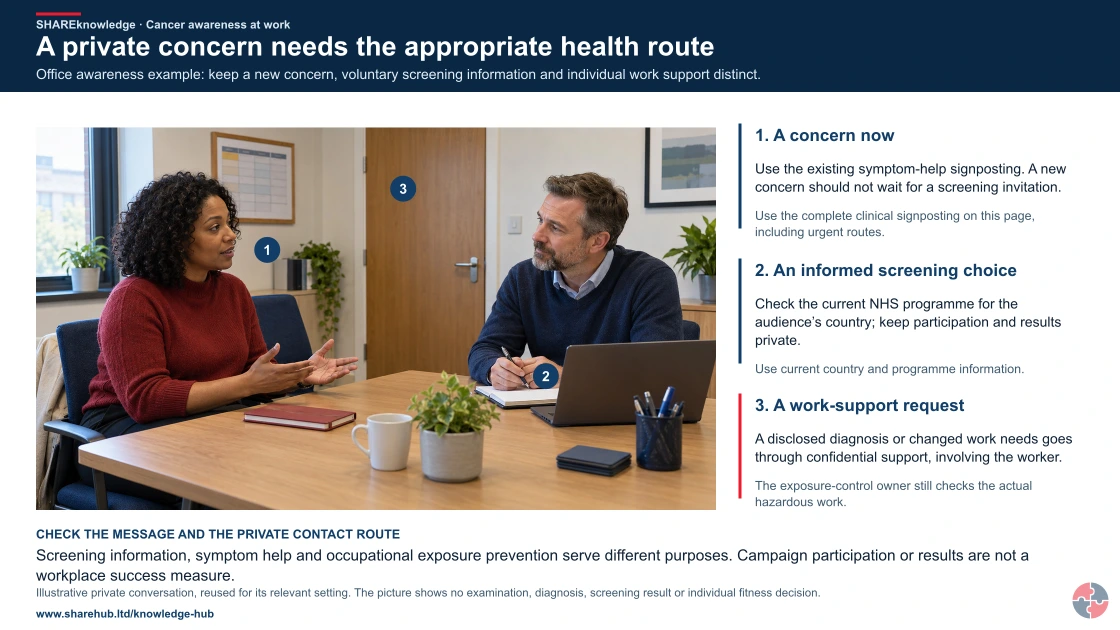
Full written explanation
Office awareness example: keep a new concern, voluntary screening information and individual work support distinct.
- A concern now. Use the existing symptom-help signposting. A new concern should not wait for a screening invitation.
- An informed screening choice. Check the current NHS programme for the audience’s country; keep participation and results private.
- A work-support request. A disclosed diagnosis or changed work needs goes through confidential support, involving the worker.
Change the pathway
- Do not diagnose at work. Use the complete clinical signposting on this page, including urgent routes.
- Avoid a universal UK message. Use current country and programme information.
- Keep prevention owned. The exposure-control owner still checks the actual hazardous work.
Evidence check: Screening information, symptom help and occupational exposure prevention serve different purposes. Campaign participation or results are not a workplace success measure.
Full campaign checks, symptom-help links and confidential support routes
Primary references: NHS: current lung-screening information (England programme scope) · HSE: cancer and construction — silica
Open the complete HD image (new tab)Download image
Full campaign checks, symptom-help links and confidential support routes
Primary references: NHS: current lung-screening information (England programme scope) · HSE: cancer and construction — silica
Compare two messages: “Check the screening invitation and information relevant to your country” supports an informed choice. “Wait for your next screening invitation if you notice a change” wrongly merges screening with symptoms. Use the existing symptom signposting for a concern now; a disclosed diagnosis belongs in Cancer and Work, not a public campaign discussion. No campaign replaces control of silica, asbestos, wood dust or other occupational carcinogens.
Riverside: two messages need two routes
Illustrative example. A wellbeing lead prepares a screening reminder while a worker privately asks about a new symptom.
Decision. The lead keeps the reminder general and voluntary, uses the existing symptom-help signposting and offers the confidential worker-support route.
Evidence to check. Country-specific current programme information, checked wording, private contact and a separate exposure-control owner.
Hold or escalation point. Do not publish a universal UK invitation age or ask staff to disclose screening attendance or results.
Follow-up. Recheck links when the campaign is reused; review reach and access without retaining individual health disclosures.
Separate a symptom concern, screening and prevention
These routes serve different purposes. A person with a new concern should not wait for a routine screening invitation, while workplace prevention continues independently.

A change or concern
Use the appropriate health-assessment route for a new or persistent change; do not diagnose from a symptom illustration.
Screening invitation
Use current country-specific screening information and informed choice. Screening is not a substitute for assessment of symptoms.
Workplace prevention
Identify and control the actual exposure-generating task. Keep health enquiries private and give managers only necessary work information.
Follow the clinical and urgent-help signposting on this page; a workplace image cannot determine individual cancer risk.
Use a GP or the appropriate NHS service for a personal health concern. A manager can make time for care, discuss practical work support privately and act on an uncontrolled workplace exposure; they should not interpret symptoms or request screening results.
What does cancer awareness mean in a workplace?
Cancer awareness in a workplace means helping people understand signs, screening, risk reduction, support routes and occupational exposure prevention.
Cancer awareness should be practical and calm. It should help a worker recognise when something is not normal for them, know where to get NHS advice, understand that screening invitations are important, and feel able to ask for support if cancer affects work.
Good awareness avoids fear-based messaging. It does not tell people they have cancer, speculate on symptoms or push private tests. It gives simple signposting, explains confidentiality and connects the topic to existing wellbeing, occupational health and health and safety systems.
The workplace also has a prevention role where cancer risk comes from work. That includes identifying carcinogens, assessing exposure routes, reducing exposure at source and checking whether controls still work over time.
What possible cancer signs should workplace awareness cover?
Workplace awareness should cover general warning signs and encourage people to seek NHS advice where symptoms are unusual, persistent or worrying.
Cancer signs vary and many common symptoms are caused by conditions that are not cancer. That is why workplace awareness should avoid alarmist language and focus on the principle: if a change is unusual for the person, persists, gets worse or causes worry, it should be checked through NHS or GP routes.
Helpful awareness is specific enough to be memorable but broad enough not to diagnose. It can mention lumps, unusual bleeding, unexplained weight loss, persistent pain, skin changes, changes in bowel or bladder habit, coughing blood, persistent cough, swallowing difficulty, breathlessness, mouth ulcers that do not heal, or fatigue that is unusual for the person.
Managers should not investigate symptoms. If a worker raises a health concern, the manager can listen, signpost and ask whether anything at work needs short-term support while the worker seeks advice. Coughing up blood needs prompt medical assessment; the NHS emergency guidance says to call 999 or go to A&E for more than a few spots or streaks, or for blood with breathing difficulty, a very fast heartbeat or chest or upper-back pain. Do not delay that action for a workplace discussion.
| Area | Plain-language message | Workplace boundary |
|---|---|---|
| New lump or swelling | A new lump or swelling should be checked. | Signpost; do not inspect or assess. |
| Unusual bleeding | Bleeding that is not normal for the person should be checked. | Support privacy and time for appointments. |
| Persistent cough or breathlessness | A cough, breathlessness or coughing blood should be discussed with healthcare professionals. | Consider occupational exposure history if relevant. |
| Skin changes | A new mole, changing mole or sore that does not heal should be checked. | Outdoor workers also need UV protection controls. |
| Bowel or bladder changes | Persistent changes in bowel or bladder habit should be checked. | Support dignity and confidentiality. |
| Unexplained weight loss or fatigue | Unexplained changes should not be ignored. | Encourage health advice; do not infer performance issues. |
How should workplaces talk about NHS cancer screening?
Workplaces should signpost NHS screening as an informed choice and recognise that screening programmes can differ across UK countries.
Screening is aimed at identifying people who may have a higher chance of a health problem so that early treatment or informed decisions can follow. It is not the same as diagnosis and it is not perfect: it can miss disease, find something that needs further tests, or create anxiety. That nuance should be included in good workplace awareness.
Cancer-related NHS screening includes cervical, breast and bowel screening. Lung cancer screening is currently available for eligible people in some parts of England, as the NHS lung screening guide explains. The UK National Screening Committee advises all four UK countries, but each country sets its own screening policy and implementation, so eligibility, timing and local arrangements may differ.
Employers should allow reasonable time and flexibility for screening appointments where possible. They should avoid asking for screening results unless there is a specific work need and a lawful, proportionate reason.
| Screening topic | What workers should understand | Employer role |
|---|---|---|
| Cervical screening | Offered to eligible people with a cervix to check cervical cell health. | Permit private time and signpost to NHS information. |
| Breast screening | Offered to eligible women and some people can self-refer after the routine age range. | Support appointment attendance and privacy. |
| Bowel screening | Uses home test kits for eligible age groups. | Use campaign reminders without collecting results. |
| Lung cancer screening | Currently available for eligible people in some parts of England; check the NHS lung screening guide and local eligibility. | Signpost; also control workplace respiratory carcinogens. |
| Devolved routes | England, Scotland, Wales and Northern Ireland can implement screening differently. | Use current NHS or public-health pages for the relevant country. |
| Private screening | Private tests may not be recommended by the UK NSC. | Avoid promoting unvalidated tests as workplace benefit. |
How can the hierarchy of controls reduce silica exposure during masonry drilling?
Health messages can support informed personal choices, while the employer must assess and control cancer-causing work exposures at source.
A toolbox talk supports prevention, not screening checks
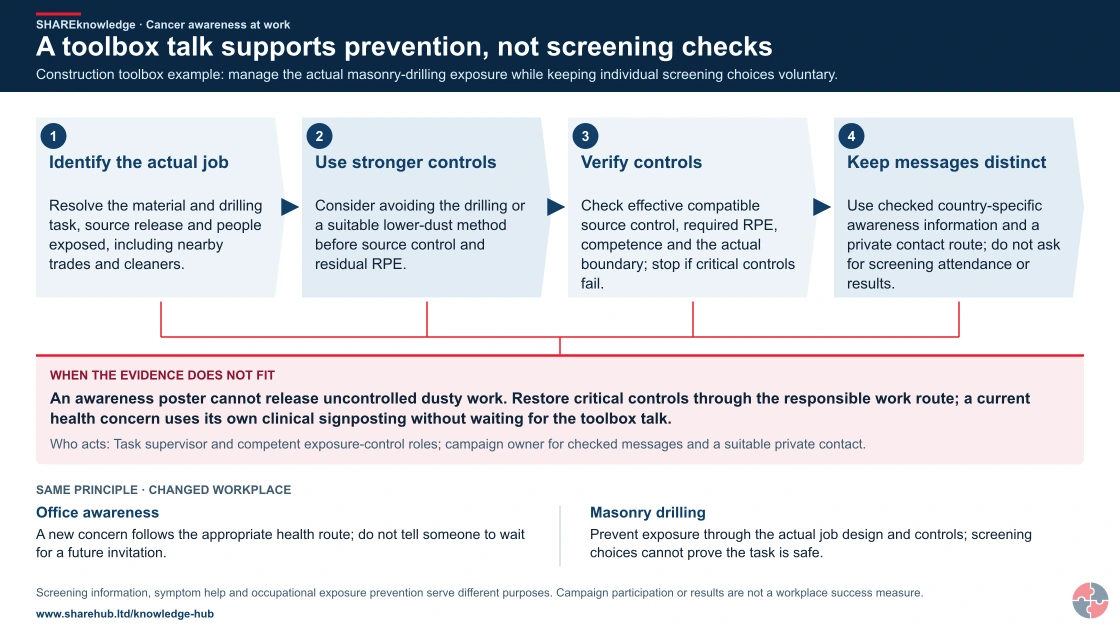
Full written explanation
Construction toolbox example: manage the actual masonry-drilling exposure while keeping individual screening choices voluntary.
- Identify the actual job. Resolve the material and drilling task, source release and people exposed, including nearby trades and cleaners.
- Use stronger controls. Consider avoiding the drilling or a suitable lower-dust method before source control and residual RPE.
- Verify controls. Check effective compatible source control, required RPE, competence and the actual boundary; stop if critical controls fail.
- Keep messages distinct. Use checked country-specific awareness information and a private contact route; do not ask for screening attendance or results.
When the evidence does not fit: An awareness poster cannot release uncontrolled dusty work. Restore critical controls through the responsible work route; a current health concern uses its own clinical signposting without waiting for the toolbox talk.
Who acts: Task supervisor and competent exposure-control roles; campaign owner for checked messages and a suitable private contact.
Changed workplace
Office awareness: A new concern follows the appropriate health route; do not tell someone to wait for a future invitation.
Masonry drilling: Prevent exposure through the actual job design and controls; screening choices cannot prove the task is safe.
Evidence check: Screening information, symptom help and occupational exposure prevention serve different purposes. Campaign participation or results are not a workplace success measure.
Full campaign checks, symptom-help links and confidential support routes
Primary references: NHS: current lung-screening information (England programme scope) · HSE: cancer and construction — silica
Open the complete HD image (new tab)Download image
Full campaign checks, symptom-help links and confidential support routes
Primary references: NHS: current lung-screening information (England programme scope) · HSE: cancer and construction — silica
Age, inherited factors and chance are outside an individual’s control, so a campaign must avoid blame. Signpost smoking cessation, alcohol advice, vaccination and sun protection where relevant. A poster cannot replace control of respirable silica, asbestos fibres, wood dust, diesel exhaust or hazardous substances in the actual job.
Trace the chain before choosing a measure: a source releases an agent, a task puts it into air or onto skin, a person is exposed, the agent reaches tissue and disease may emerge much later. Check who else may be exposed, including contractors and cleaners. If an enclosure, extraction or wet method fails, stop the affected work and restore effective control before restarting.
Use the HSE hierarchy of controls for the actual exposure: remove or substitute the hazard where possible, use physical or engineering controls, organise work to limit residual risk, and use suitable PPE only where it helps. Assign an owner, check that each control works, and stop the task if a critical control fails. In Northern Ireland, check the applicable local duty and assessment.
On a small screen, scroll this table sideways to read all columns.
How can the ERICPD hierarchy of controls reduce silica exposure during masonry drilling?

| Control level | Control for this activity | Owner and verification | Stop / restart decision |
|---|---|---|---|
| Eliminate | Use preformed openings or a fixing design that avoids on-site drilling where feasible. | Task owner verifies that the proposed change removes the named hazardous step, including foreseeable cleaning, maintenance and work transferred elsewhere. | If the hazardous step remains, keep it within the task assessment and select the stronger feasible remaining controls. |
| Reduce, including substitution | Consider a suitable lower-dust fixing or installation method and check the new structural and access risks. | Competent task/process owner validates suitability, compatibility and new hazards against the actual operating requirements before the alternative is adopted. | Reject an alternative if its performance is unproved or its new hazards are unresolved. |
| Isolate | Separate drilling from other trades and protect people downwind or in adjacent occupied areas. | Supervisor checks the actual boundary, affected people and connected work; verify separation or isolation before allowing access. | Hold or stop for untested tight-fitting model, poor seal, failed extraction or changed material. |
| Control: physical safeguards | Use effective compatible on-tool extraction or an approved wet method; verify dust control at the drill point. | Competent equipment/process owner checks material identity, source control, required protection and exact facepiece/fit-test match. | Hold or stop for untested tight-fitting model, poor seal, failed extraction or changed material. |
| Control: work method and response | Select adequate and suitable RPE for the task; obtain the correct fit-tested model or a suitable assessed alternative before release. | Supervisor confirms the work limits, competent cover, communication and stop/restart authority with the people doing this activity. | Hold work when the agreed limits, competent cover or effective communication cannot be maintained. |
| PPE | Check facepiece model/size, fit-test evidence, seal and compatibility with eye/hearing protection; complete pre-use checks. | Assessor confirms whether personal protection is needed and checks suitability, condition, compatibility and any required fit evidence. | Do not use unsuitable protection or rely on PPE to continue after an essential source control fails. |
| Discipline | Review fit after relevant changes and replace damaged equipment; failed source control requires a task hold, not a mask swap. | Release only after supervisor confirms suitable source control and RPE before drilling. Retain verification and unresolved restrictions at handover. | Keep the task on hold until required reinstatement evidence and unresolved defects are accepted by the responsible owner. |
How can the ISO 45001 hierarchy of controls reduce silica exposure during masonry drilling?

| Control level | Control for this activity | Owner and verification | Stop / restart decision |
|---|---|---|---|
| Elimination | Use preformed openings or a fixing design that avoids on-site drilling where feasible. | Task owner verifies that the proposed change removes the named hazardous step, including foreseeable cleaning, maintenance and work transferred elsewhere. | If the hazardous step remains, keep it within the task assessment and select the stronger feasible remaining controls. |
| Substitution | Consider a suitable lower-dust fixing or installation method and check the new structural and access risks. | Competent task/process owner validates suitability, compatibility and new hazards against the actual operating requirements before the alternative is adopted. | Reject an alternative if its performance is unproved or its new hazards are unresolved. |
| Engineering controls | Separate drilling from other trades and protect people downwind or in adjacent occupied areas. | Supervisor checks the actual boundary, affected people and connected work; verify separation or isolation before allowing access. | Hold or stop for untested tight-fitting model, poor seal, failed extraction or changed material. |
| Engineering controls | Use effective compatible on-tool extraction or an approved wet method; verify dust control at the drill point. | Competent equipment/process owner checks material identity, source control, required protection and exact facepiece/fit-test match. | Hold or stop for untested tight-fitting model, poor seal, failed extraction or changed material. |
| Administrative controls | Select adequate and suitable RPE for the task; obtain the correct fit-tested model or a suitable assessed alternative before release. | Supervisor confirms the work limits, competent cover, communication and stop/restart authority with the people doing this activity. | Hold work when the agreed limits, competent cover or effective communication cannot be maintained. |
| PPE | Check facepiece model/size, fit-test evidence, seal and compatibility with eye/hearing protection; complete pre-use checks. | Assessor confirms whether personal protection is needed and checks suitability, condition, compatibility and any required fit evidence. | Do not use unsuitable protection or rely on PPE to continue after an essential source control fails. |
| Administrative controls | Review fit after relevant changes and replace damaged equipment; failed source control requires a task hold, not a mask swap. | Release only after supervisor confirms suitable source control and RPE before drilling. Retain verification and unresolved restrictions at handover. | Keep the task on hold until required reinstatement evidence and unresolved defects are accepted by the responsible owner. |
For an office-based campaign, the immediate action may be a credible GP or screening route and a confidential support contact. For a stone-cutting task, the immediate action is the exposure control and stop rule. These routes can run together, but one cannot replace the other.
How should a workplace cancer awareness campaign be planned?
A workplace cancer awareness campaign should be accurate, respectful, inclusive, practical and connected to support routes.
A useful campaign starts with purpose. The aim may be to improve knowledge of symptoms, increase screening confidence, reduce stigma, support carers, improve manager response, or strengthen occupational cancer controls. Trying to do all of that in one poster usually makes the message weak.
Campaigns should be inclusive. Cancer can affect people of different ages, sexes, ethnicities, job roles and literacy levels. Some people may be in treatment, in remission, recently bereaved or caring for someone with cancer, so messaging should avoid dramatic imagery or guilt.
The best campaigns give people a next step: speak to a GP, use NHS screening, contact occupational health, ask HR about adjustments, speak to a manager, use an employee assistance programme, or report uncontrolled carcinogen exposure.
| Campaign element | What good looks like | Evidence |
|---|---|---|
| Purpose | One clear campaign goal and audience. | Campaign brief. |
| Accuracy | NHS, GOV.UK, HSE or recognised cancer charity sources used. | Source list and review date. |
| Tone | Calm, supportive and non-alarming. | Reviewed wording. |
| Accessibility | Plain English, readable formats and inclusive images. | Accessibility check. |
| Signposting | Clear routes to NHS advice, screening, OH, HR or H&S reporting. | Poster, intranet and manager pack. |
| Confidentiality | Explains that health disclosures are private. | Manager guidance and privacy reminder. |
| Action tracking | Campaign reach and follow-up actions reviewed. | Evaluation report. |
How does occupational exposure lead to cancer?
A carcinogen can enter the body during work and damage tissue long before a disease becomes visible; prevention depends on controlling the source and exposure route now.
Dust and fibres can be inhaled deep into the lung; some agents can also reach the skin or be swallowed from contaminated hands. Dose, duration, agent and route matter, but an individual’s later cancer usually cannot be attributed from a symptom alone. An exposure concern should trigger a task assessment and control check, while a health concern goes to a GP.
Examples help a team recognise a pathway. Hard-wood dust from machining can reach the nose and sinuses; respirable crystalline silica from cutting stone can reach the lungs; diesel exhaust from idling plant can accumulate in a poorly ventilated loading bay; outdoor ultraviolet radiation damages skin. The exact material, method and local conditions determine the controls. For asbestos or ionising radiation, use the specialist legal and competent-person routes rather than a generic COSHH checklist.
On a small screen, scroll this table sideways to read all columns.
| Sector, task and route | Potential harm and source control | Stop or verification decision |
|---|---|---|
| Joinery: machining hard wood; airborne dust enters nose and airways. | Nasal cancer risk; capture dust at the machine, clean without raising dust, assess residual protection. | Stop on failed extraction; check capture at the point of release and maintenance records. |
| Construction: cutting concrete; respirable silica reaches lungs. | Long-latency lung cancer risk; redesign the cut, use on-tool extraction or water suppression and task-matched RPE. | Stop if suppression or extraction fails; verify the chosen system against the actual material and cut. |
| Warehouse or tunnel: diesel plant emits exhaust that workers breathe. | Long-term lung cancer risk; avoid unnecessary engines, segregate plant and ventilate. | Stop avoidable idling in enclosed space; check airflow and plant condition. |
| Outdoor leisure or construction: solar UV reaches exposed skin. | Skin damage and later skin cancer risk; plan shade, timing, clothing and sunscreen as part of the work system. | Review when shade or clothing is unavailable, heat rises, or the task changes. |
Exposure control protects people who may never have symptoms during the job. Where health surveillance is legally indicated, a competent programme supports control assurance; it is not a substitute for reducing exposure or a general cancer-screening test.
How should confidentiality be managed during cancer awareness work?
Cancer awareness should protect personal health information and avoid turning campaigns into data-gathering exercises.
Awareness activities can accidentally create confidentiality problems. A manager might ask why someone attended a screening appointment, a wellbeing lead might collect too much information in a survey, or a team might speculate after a campaign discussion. These risks should be planned out.
The safest approach is to keep awareness data anonymous wherever possible. If individual support is requested, move that into the proper HR, occupational health or management support route with clear privacy boundaries.
Worker health information is sensitive. Employers should only collect what they need, explain why, restrict access, keep it secure and retain it for no longer than necessary.
| Risk | Control | Evidence |
|---|---|---|
| Over-collecting health details | Use anonymous feedback unless individual support is requested. | Survey design review. |
| Manager curiosity | Train managers to signpost rather than ask clinical questions. | Manager briefing record. |
| Public disclosure | Agree communication before sharing any personal story. | Written consent and agreed wording. |
| Screening-result requests | Do not ask for results unless there is a specific lawful work reason. | Privacy and HR guidance. |
| Poor record access | Restrict health information access to those with a need to know. | Access controls and retention schedule. |
Which GB and Northern Ireland duties shape a campaign and its controls?
Keep general health signposting, worker support, privacy and occupational exposure prevention distinct; use the law and regulator for the work location.
A campaign itself should be accurate, accessible and voluntary. If a worker asks for help, discuss job impact and reasonable work changes under the applicable equality framework. Store health information only where necessary and with restricted access. If the issue is an occupational carcinogen, the employer must assess and control the exposure; a personal cancer diagnosis alone does not make a GB RIDDOR occupational-cancer report.
The Health and Safety at Work etc. Act 1974, Management Regulations 1999, COSHH 2002, Equality Act 2010 and GB RIDDOR 2013 are GB routes. Northern Ireland has its own Health and Safety at Work (Northern Ireland) Order 1978, Management Regulations 2000, COSHH Regulations (Northern Ireland) 2003 and disability and reporting framework. Check HSENI and the applicable NI text before giving a statutory answer there. Screening programme rules and invitations are also country-specific.
On a small screen, scroll this table sideways to read all columns.
| Decision | Great Britain | Northern Ireland / evidence |
|---|---|---|
| Prevent an exposure | Use HSE risk assessment and COSHH guidance; identify the agent, route and source control. | Use HSENI risk assessment and occupational-cancer guidance; retain task assessment, controls and checks. |
| Support a worker | Apply GB Equality Act and Acas reasonable-adjustment route to the actual disadvantage. | Apply NI disability framework and nidirect support route; record agreed functional changes privately. |
| Handle health information | Use ICO worker-health guidance: purpose, lawful basis, minimum data and restricted access. | UK data protection principles also apply; define who can see the NI worker’s support record. |
| Consider disease reporting | Use HSE occupational-cancer RIDDOR criteria; do not report all diagnoses automatically. | Use the relevant HSENI reporting process and competent NI advice; keep causation/exposure evidence separate from general awareness. |
How should cancer awareness appear in risk registers and action plans?
Cancer awareness should appear as wellbeing, communication and exposure-control actions, not as personal medical information.
A cancer awareness campaign does not need a list of who has cancer, who attended screening or who asked a health question. That information should remain private unless the worker asks for support through a proper route.
The risk register should capture occupational cancer exposures and campaign actions. For example, a construction business might record silica dust and solar radiation as health risks, while a leisure business records outdoor UV exposure and older-building asbestos disturbance risk.
Action plans should show how learning leads to control improvement: better signage, refreshed training, clearer support routes, more effective dust suppression, improved health surveillance or manager guidance.
| Record | Where it belongs | What it should show |
|---|---|---|
| Campaign plan | Wellbeing or communications plan. | Audience, message, source, date and owner. |
| Manager briefing | Training record. | Confidentiality, signposting and escalation boundaries. |
| Individual support | Restricted HR/OH support plan. | Only necessary work-impact and adjustment information. |
| Carcinogen exposure | Health and safety risk register. | Hazard, route, controls, monitoring and surveillance. |
| Worker feedback | Anonymous improvement log where possible. | Themes and actions, not personal health details. |
| Review record | Management review or wellbeing dashboard. | What changed and whether controls improved. |
How could Riverside Leisure Ltd manage cancer awareness?

Riverside Leisure Ltd would manage cancer awareness through calm health signposting, manager training, privacy controls and occupational cancer prevention for outdoor and maintenance work.
Riverside Leisure Ltd
a leisure, hotel and outdoor activity business with campsites, swimming areas, catering, housekeeping, grounds teams, instructors and maintenance workers
Riverside has a mixed workforce, so its cancer awareness activity is deliberately practical. It uses short seasonal campaigns on skin cancer awareness before outdoor summer work, NHS screening reminders in staff wellbeing communications, and manager briefings on how to support a worker who discloses a cancer concern or diagnosis.
The wellbeing lead and HR manager agree campaign wording from NHS and GOV.UK sources. They do not ask workers to report screening attendance or results. If someone asks for support, the line manager offers a private conversation and HR explains how health information will be handled.
The H&S adviser connects awareness to occupational exposure control. Grounds and activity staff have ultraviolet radiation controls in the risk register, maintenance workers check the asbestos register before intrusive work, workshop wood dust is controlled by extraction and cleaning, and diesel plant use is reviewed to reduce exhaust exposure in enclosed or semi-enclosed areas.
Riverside checks effectiveness through campaign reach, manager confidence checks, anonymised feedback, risk-register reviews, contractor audits, training completion, exposure-control inspections and action close-out. Lessons from absence cases and inspections feed into annual wellbeing and H&S planning.
| Activity | How Riverside manages it | Evidence |
|---|---|---|
| Assess | Identifies worker groups, likely awareness needs and occupational cancer exposures. | Wellbeing plan and carcinogen risk register. |
| Analyse | Separates general health awareness from individual support and exposure control. | Campaign brief and COSHH/asbestos/UV reviews. |
| Train | Provides awareness for all staff and deeper training for managers, HR and exposed workers. | Training matrix and attendance records. |
| Implement | Runs screening signposting, UV controls, asbestos checks, wood dust controls and confidential support routes. | Campaign materials, controls and support records. |
| Check | Reviews manager confidence, worker feedback, inspection findings and campaign reach. | Dashboard, inspections and anonymised feedback. |
| Learn | Uses feedback and near misses to improve support and exposure controls. | Action tracker and management review. |
| Improve | Updates manager scripts, risk assessments, contractor requirements and annual campaign timing. | Revised documents and close-out evidence. |
What should each role learn and demonstrate?
Training must match the decision a person makes: seek health advice, respond privately, manage an exposure task, or verify that the controls remain effective.
General awareness can be short, but people should be able to find the GP route and a confidential workplace contact without interpreting a symptom themselves. Managers need a practised conversation and an adjustment/cover decision. Exposed workers must demonstrate the actual process controls, protection, defect response and stop rule. Reassessment follows a task, control, role or guidance change; no universal cancer-awareness certificate or fixed refresher interval proves competence.
On a small screen, scroll this table sideways to read all columns.
| Role and learning | Practical demonstration and assessor | Record and reassessment trigger |
|---|---|---|
| All workers: possible signs, screening limits, GP route, privacy and exposure reporting. | Supervisor uses a brief scenario: worker chooses clinical route and reports a failed control without sharing another person’s health detail. | Induction/briefing and scenario outcome; revisit when official signposting or local reporting changes. |
| Line manager: confidential response, functional support, safe cover and referral limits. | HR or trained manager observes an example conversation and checks a private action plan and cover decision. | Restricted support note and assessor; revisit after changed duties, treatment effects or policy. |
| Wellbeing/HR lead: campaign accuracy, inclusion, privacy and GB/NI support route. | Competent HR/wellbeing reviewer checks campaign wording, country-specific screening link and a data-minimised support process. | Approved message version and review owner; revisit after NHS, law or service change. |
| Exposed worker or maintainer: agent, route, engineering control, PPE limits and stop. | Task specialist observes the actual enclosure/extraction/wet method, defect report and restart authorisation. | Task authorisation and observed result; reassess after material, process, equipment or control failure. |
| Supervisor, purchaser and designer: source elimination, contractor interface and effective verification. | Operations/safety assessor tests a real task specification, control failure and competent-cover handover. | Specification/risk decision and audit sample; revisit after procurement, contractor or process change. |
| Occupational-health, safety adviser and auditor: advice within competence, evidence and escalation. | Relevant specialist reviews a case with health privacy, exposure evidence and GB/NI boundary. | Documented judgement and reviewer; revisit on material clinical, legal or technical update. |
Where a team uses a short campaign briefing, check whether staff can act correctly on a realistic situation. Attendance alone is weaker evidence than a demonstrated safe decision.
How does this topic support professional learning?
A useful learner can separate health promotion, individual support and prevention of occupational exposure, then apply the correct evidence to each.
For introductory safety study, explain how to signpost a worrying symptom without diagnosis, make screening an informed choice, and turn an exposure concern into a risk assessment. For advanced study, trace a long-latency harm chain from task and route to tissue, then test whether source controls and assurance records match what occurs at work. A manager should practise the private support conversation; a safety adviser should challenge a campaign that leaves a dust or fume source uncontrolled.
A strong scenario answer names the country, agent, task, exposed people, control owner, stop point and evidence. It does not use a generic awareness certificate as proof of safe work.
How can a management system sustain accurate awareness and prevention?
Assign owners for health messages, confidential support and exposure controls, then check that each route works in practice.
A campaign should have an approved source, audience, contact route and review trigger. A support case needs a private record and agreed work actions. An occupational exposure risk needs a task owner, effective controls, inspection, maintenance and corrective action. Worker feedback can reveal confusing signposting or controls that fail during ordinary shifts.
HSE Managing for health and safety (HSG65) is HSE guidance for Great Britain on managing health and safety using Plan–Do–Check–Act. Use it to plan responsibilities and exposure controls, put them into practice, check their effectiveness and act on failures or changes. It is regulator guidance, and does not replace the applicable legal duties or provide permission to expose anyone.
Management evidence might include an approved campaign message, a de-identified feedback trend, a control specification, an extraction test and a closed corrective action. Check the real task and people affected, not merely whether a document exists.
What are the warning signs that cancer awareness is being managed poorly?
Warning signs include fear-based campaigns, poor privacy, weak signposting, private screening pressure and uncontrolled carcinogen exposure.
Awareness can do harm if it is sensational, intrusive or disconnected from real support. People may avoid disclosure if they think managers will gossip, record excessive health details or treat them as less capable.
A separate warning sign is an organisation that runs wellbeing campaigns while leaving occupational cancer exposures uncontrolled. Workers quickly notice the contradiction if posters encourage screening while site work still creates dust, fumes, fibres or UV exposure without proper controls.
If a campaign has no GP or support contact, add one before distribution. If it pressures people into private tests or sharing results, stop that practice and check the screening and privacy route. Review de-identified feedback and the exposure-control action log after the campaign; a one-off poster and attendance count cannot show whether people are safer.
Cancer awareness FAQs: what do people ask?
People usually ask about symptoms, screening, workplace campaigns, privacy, occupational cancer and manager responsibilities.
What is cancer awareness at work?
It is workplace education and signposting that helps people recognise possible cancer signs, use NHS screening, reduce risk factors and seek support early.
Should a workplace cancer awareness campaign diagnose symptoms?
No. It should encourage people to use NHS, GP or screening services and avoid diagnosing or interpreting individual symptoms.
What symptoms should awareness messages mention?
General messages can mention unusual lumps, bleeding, unexplained weight loss, persistent pain, skin changes, bowel or bladder changes, persistent cough, breathlessness or symptoms that are not normal for the person.
Are cancer symptoms always cancer?
No. Many symptoms have other causes, but NHS advice is to get symptoms checked where they are unusual, persistent or worrying.
What NHS screening programmes are relevant to cancer?
Cancer-related screening includes cervical, breast and bowel screening, with lung cancer screening currently available for eligible people in some parts of England; programmes differ across UK countries.
Can employers run screening at work?
Employers should be cautious with private or workplace screening and should signpost NHS screening and UK NSC advice rather than promoting unvalidated tests.
What is the link between cancer awareness and occupational cancer?
Awareness helps people understand signs and support, while occupational cancer prevention requires controlling carcinogen exposure at work.
What workplace exposures can increase cancer risk?
Examples include asbestos, silica dust, wood dust, diesel exhaust, solar radiation, ionising radiation, welding fume and some hazardous chemicals.
How should confidentiality be handled?
Health information should be private, limited to what is needed, processed lawfully and shared only with appropriate consent or a clear lawful reason.
What training should managers receive?
Managers should learn how to signpost, hold sensitive conversations, protect confidentiality, support reasonable adjustments and escalate occupational exposure concerns.
How should cancer awareness be measured?
Measure campaign reach, screening signposting, manager competence, worker feedback, support uptake and occupational exposure-control actions.
What should an employer do if a worker says they are worried about cancer?
Respond privately, encourage NHS or GP advice, ask what workplace support is needed, avoid diagnosis and protect confidentiality.
Acronyms and terms: what do they mean here?
These terms separate clinical signposting, screening policy, confidential work support and exposure control.
A term can mean different duties in GB and Northern Ireland. Check the country and actual agent before turning an acronym into an instruction.
On a small screen, scroll this table sideways to read all columns.
| Term | Full expansion | Meaning in this topic |
|---|---|---|
| NHS | National Health Service | Clinical and screening information; programme details vary by country. |
| GP | General practitioner | First clinical route for a persistent, unusual or worrying symptom. |
| UK NSC | UK National Screening Committee | Advises all four UK countries; each decides implementation. |
| OH | Occupational health | Specialist advice about health and work function, not a cancer diagnosis. |
| EAP | Employee assistance programme | Optional confidential support service offered by some employers. |
| COSHH | Control of Substances Hazardous to Health | GB and NI have separate regulations controlling many hazardous substances. |
| RIDDOR | Reporting of Injuries, Diseases and Dangerous Occurrences Regulations | GB and NI reporting routes differ; not every cancer diagnosis is reportable. |
| UV | Ultraviolet radiation | Solar exposure that can damage skin during outdoor work. |
| LEV | Local exhaust ventilation | Engineering system capturing dust or fume near its source. |
| RPE | Respiratory protective equipment | Breathing protection for residual exposure after source controls. |
| PPE | Personal protective equipment | Protection for a wearer; it does not replace effective source control. |
| control hierarchy | Eliminate, reduce, isolate, control, personal protective equipment, discipline | Six-stage planning prompt for choosing and sustaining controls. |
| Carcinogen | Cancer-causing agent | Agent or exposure with cancer potential; identify the actual task and route. |