
Crown Fuels and process safety / Forecourt and private-customer fuel deliveries
Crown Fuels and process safety · SH-FUEL-11Forecourt and private-customer fuel deliveries
Free online training · Approximate learning time: 90–140 minutes · Self-paced
Verify the destination, protect the public and know when delivery must stop.
Full public teaching and readers are free without an account. A free learner account is required for saved LMS progress and recorded assessment. Completion and any course-completion certificate depend on the configured LMS conditions.
Who this course is for
Fuel delivery drivers, receiving-site staff, supervisors and planners who need awareness of downstream transfer risks.
A tanker leaving Crown Fuels may deliver petrol to a public forecourt or heating oil to a private customer. These settings share the need for correct product, a sound receiving system, sufficient safe capacity and controlled transfer, but their equipment and procedures are not interchangeable. This course uses both model destinations to practise pre-delivery checks, customer/public interfaces, hose protection and safe stop decisions. It supports awareness alongside the operator’s procedures and required driver training; completion is not ADR certification, a tank inspection qualification or authorisation to unload.
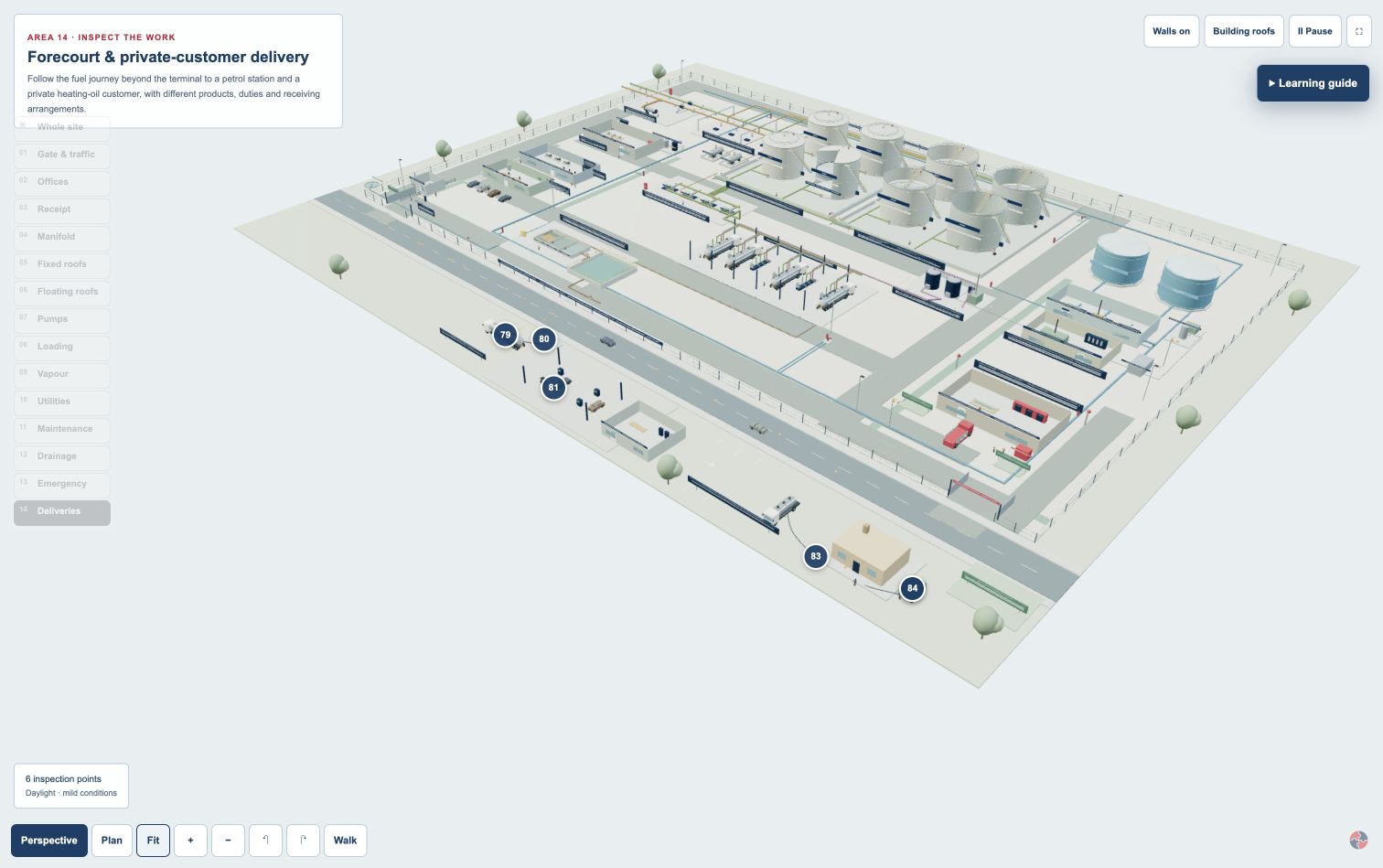
Separate retail petrol-forecourt and private heating-oil cases; product, legal duties and receiving arrangements are deliberately compared, never treated as interchangeable.
Learning outcomes
- Distinguish petrol-forecourt unloading from a private heating-oil delivery and identify shared responsibilities.
- Verify product, receiving connection, available safe capacity and transfer conditions before starting.
- Choose protective stop and escalation decisions when labels, access, tank condition or hose arrangements disagree.
Course outline
Distinguish delivery settings and responsibilities
- Start with the setting and the shared responsibilitiesCompare the receiver, hazards and procedures in two delivery environments.
- Prove the product, connection and available capacityExplain why independent agreement of delivery evidence is required.
Prepare safe forecourt delivery
- Protect the public and the entire hose routeIdentify changing access, hose and communication risks during delivery.
- Make stopping and escalation part of a successful deliveryDistinguish a justified hold from an improvised workaround.
- Forecourt receipt: reconcile the whole product-to-tank pathAt every transfer boundary, positively establish product, route and receiving capacity before introducing flow.
- Forecourt unloading: protect the public around a temporary processA delivery creates a temporary process boundary; public protection must work for people unfamiliar with the task.
Verify private-tank condition and capacity
- Heating-oil receipt: a small customer site still needs a sound systemProduct and scale change the arrangements, not the need for verified identity, capacity and a suitable receiving system.
Control customer hose routes and stop unsafe deliveries
- Customer hose routes: control the whole temporary connectionFollow the whole hose and the people around it; safe tank capacity alone cannot make an uncontrolled delivery route acceptable.
Plan a complete customer-delivery decision
- Two destinations, two delivery decisionsApply common principles while preserving the different delivery methods.
- Turn the learning into a verified workplace actionChoose a bounded action, owner, task-specific evidence and escalation trigger within your role.
Activities, model practice and assessment
Work through 4 required applied activities and 3 model-practice pauses, with explanatory feedback and independent lesson decisions. Complete 4 distinct model mission sequences across those pauses. Use the actual fictional Crown Fuels model or its equivalent accessible route to complete the required decision sequences; launching the model alone does not complete practice.
The 20-question assessment requires at least 80% plus every designated critical safety answer. Complete the required activities, practice and lesson checks. Points and badges cannot offset a critical safety error.
Use the LMS for confirmed save/resume and recorded results. Any certificate follows its configured passed-completion and grade conditions.
Open the public interactive practice copy; public practice is separate from the LMS record.
Sources and learning provenance
Original fictional cases are paired with public SHAREhub teaching and structured topic records. Use the applicable jurisdiction and primary guidance for live work.
- Pollution prevention for businesses
- Oil storage regulations for businesses
- Unloading petrol from road tankers (L133, second edition 2014)
- Using an underground fuel storage tank
- Carriage, loading, unloading and handling: CDG manual
- Driving and riding safely for work: Employers
Topic sections, source identities and versions
| Public topic | Chunk and version | Jurisdiction and sources |
|---|---|---|
| loading-unloading-and-transfer-operations · evidence | loading-unloading-and-transfer-operations--evidence 2026-10-02-additive-1 | Great Britain, Northern Ireland loading-unloading-and-transfer-operations-src-01 |
| bulk-storage-and-tank-farm-safety · transfer | bulk-storage-and-tank-farm-safety--transfer 20261016-letter-review-1 | Great Britain, Northern Ireland hsg176, hse-comah, buncefield, hse-large-tanks |
| workplace-transport-and-work-related-driving · technical-model | workplace-transport-and-work-related-driving--technical-model 4.1 | Great Britain, Northern Ireland source-hse_safeplace, source-hse_transport, source-hse_reversing, source-hse_loading |
| loading-unloading-and-transfer-operations · receiver-discrepancy | loading-unloading-and-transfer-operations--receiver-discrepancy 2026-10-02-additive-1 | Great Britain loading-unloading-and-transfer-operations-src-01, loading-unloading-and-transfer-operations-src-04, loading-unloading-and-transfer-operations-src-11 |
| loading-unloading-and-transfer-operations · barriers | loading-unloading-and-transfer-operations--barriers 2026-10-02-additive-1 | Great Britain, Northern Ireland loading-unloading-and-transfer-operations-src-01, loading-unloading-and-transfer-operations-src-02 |
| traffic-maangement · technical-model | traffic-maangement--technical-model 2.3 | Great Britain, Northern Ireland source-hsg136, source-hse_traffic, source-hseni_site |
| human-factors-in-process-operations · assurance | human-factors-in-process-operations--assurance | Great Britain source-hse-bulk |
Course SH-FUEL-11 · version 2026.10.20.1. .
Questions about this course
Is this training free?
Full public teaching and readers are free without an account. A free learner account is required for saved LMS progress and recorded assessment. Completion and any course-completion certificate depend on the configured LMS conditions.
How long should I allow?
Approximately 90–140 minutes, including teaching, lesson checks, required activities, model or accessible practice and one assessment attempt. Individual pace, review and retries vary. Save and resume in the LMS.
Can I learn without a 3D-capable browser?
Yes. The complete HTML reader provides the teaching. Required model practice has an equivalent accessible decision route in the interactive course. Use the LMS route for recorded learning.
What is required to pass?
Complete the required learning, activities, practice and lesson decisions. The 20-question final assessment requires at least 80% plus every designated critical safety answer. Points cannot compensate for a critical safety error. Follow the feedback before retrying.
Does this authorise fuel operations?
Separate retail petrol-forecourt and private heating-oil cases; product, legal duties and receiving arrangements are deliberately compared, never treated as interchangeable. This independent course does not award a NEBOSH qualification or replace competent task assessment, practical training or site authorisation.