
Crown Fuels and process safety / Emergency command, evacuation, rescue and recovery
Crown Fuels and process safety · SH-FUEL-09Emergency command, evacuation, rescue and recovery
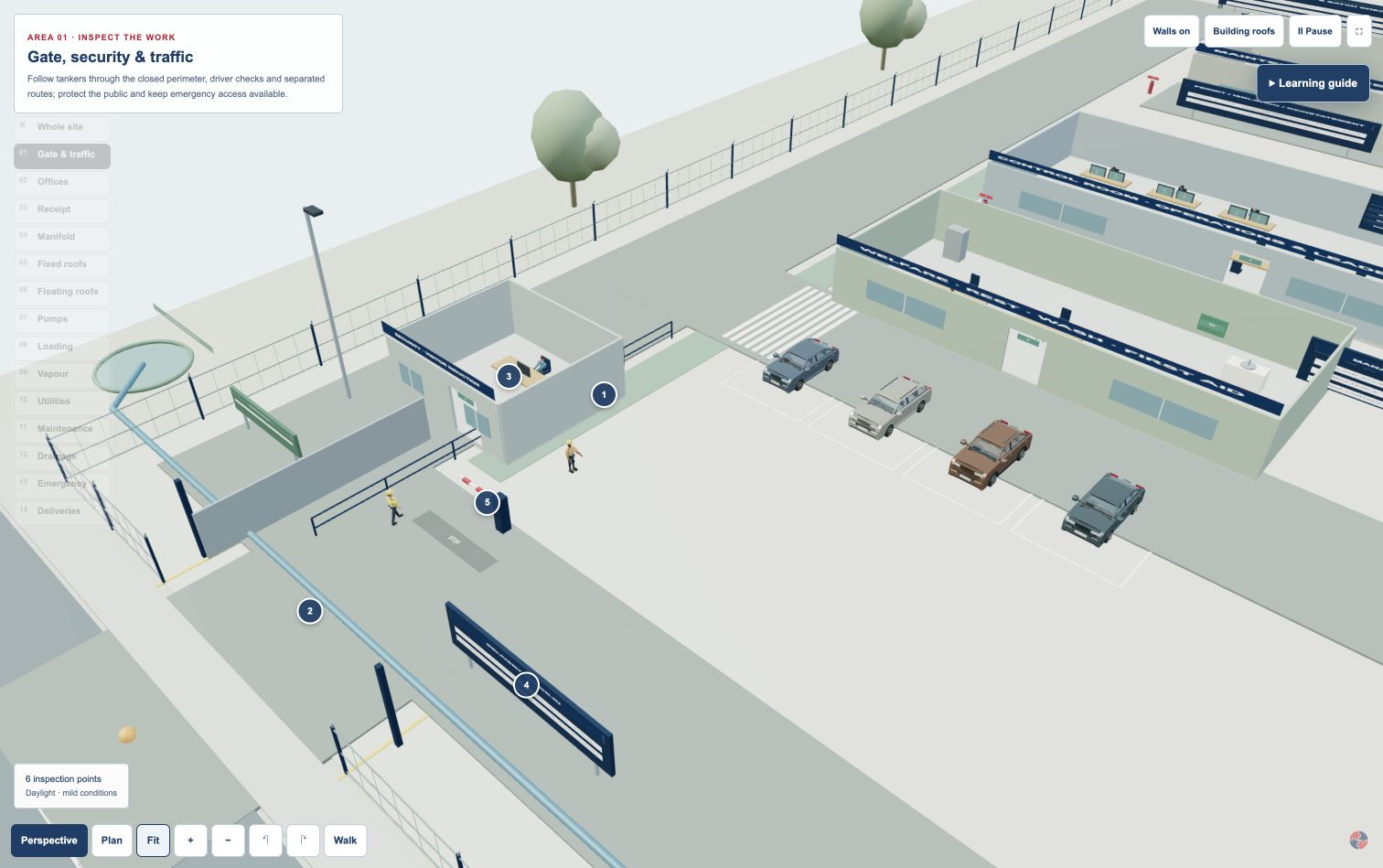
Free online training · Approximate learning time: 110–180 minutes · Self-paced
Make the first report useful, protect people and support a controlled recovery.
Full public teaching and readers are free without an account. A free learner account is required for saved LMS progress and recorded assessment. Completion and any course-completion certificate depend on the configured LMS conditions.
Who this course is for
Terminal operators, supervisors, drivers, contractors and emergency coordinators who need awareness of their assigned emergency role.
An emergency plan becomes useful when people recognise a developing event, communicate what matters and stay within their trained role. This course follows a fictional Crown Fuels incident from the first uncertain report through access, accountability, command, assistance and controlled recovery. The terminal receives finished fuel by pipeline and distributes it by road. Its actual COMAH tier is not established by the model. You will practise decisions that support the site plan while distinguishing them from specialist firefighting, hazardous-area rescue and the statutory external-plan duties that apply to particular establishments.
Terminal emergency awareness, command interfaces and response limits; no claim that every premises is COMAH, no untrained entry or firefighting.
Learning outcomes
- Choose a protective first response and communicate a concise, evidence-based incident report.
- Connect safe access, accountability and command interfaces without entering danger or improvising rescue.
- Identify the evidence needed for controlled re-entry and a separately authorised operational restart.
Course outline
Prepare for credible emergencies
- Recognise the event before the full picture is knownIdentify developing major-accident signs and give an actionable first report.
- Plan access, routes and accountability togetherExplain how the site protects escape, responder access and reliable accountability.
Protect access, people and accountability
- Build a shared command pictureDistinguish useful operational intelligence from competing or improvised instructions.
- Separate safe assistance, re-entry and restartRecognise rescue limits and the evidence required before returning people or equipment.
- Protect the response route before an emergencyEmergency capability depends on ordinary operating decisions that preserve access every day.
- Changing wind: protect people using current hazard informationAn emergency route is a protective decision that must remain suitable as conditions change.
Coordinate command and external interfaces
- COMAH scope: establish duties before claiming an external planLegal applicability needs evidence; effective emergency coordination also needs real scenario and interface information.
- Emergency command: turn a contact list into coordinated actionAn emergency plan works through capable people, clear authority, current information and tested communication.
Understand rescue limits and safe assistance
- Suspected release casualty: rescue must not create another casualtyAct quickly from safety: alarm and planned rescue are active help; unprotected entry can multiply casualties.
- All-clear and restart: recover control before restoring activityRecovery is a controlled transition with evidence and authority; stopping a release does not automatically restore a safe site.
Control re-entry, recovery and learning
- A changing release at shift changeCombine protective reporting, accountability, command support and recovery limits.
- Turn the learning into a verified workplace actionChoose a bounded action, owner, task-specific evidence and escalation trigger within your role.
Activities, model practice and assessment
Work through 4 required applied activities and 3 model-practice pauses, with explanatory feedback and independent lesson decisions. Complete 6 distinct model mission sequences across those pauses. Use the actual fictional Crown Fuels model or its equivalent accessible route to complete the required decision sequences; launching the model alone does not complete practice.
The 20-question assessment requires at least 80% plus every designated critical safety answer. Complete the required activities, practice and lesson checks. Points and badges cannot offset a critical safety error.
Use the LMS for confirmed save/resume and recorded results. Any certificate follows its configured passed-completion and grade conditions.
Open the public interactive practice copy; public practice is separate from the LMS record.
Sources and learning provenance
Original fictional cases are paired with public SHAREhub teaching and structured topic records. Use the applicable jurisdiction and primary guidance for live work.
- Dangerous Substances and Explosive Atmospheres Regulations 2002: HSE overview
- COMAH 2015: duties for operators
- COMAH Regulations 2015: Guidance on Regulations (L111)
- Control of Major Accident Hazards Regulations: HSENI
- Emergency response / spill control: Technical Measures
- First aid at work: assessing needs
Topic sections, source identities and versions
| Public topic | Chunk and version | Jurisdiction and sources |
|---|---|---|
| emergency-preparedness-for-major-accident-hazards · scenarios | emergency-preparedness-for-major-accident-hazards--scenarios 2.2 | Great Britain, Northern Ireland hse-comah15, hse-comah-emergency, HSE-RESPONSE |
| emergency-procedures-and-first-aid-needs · procedures | emergency-procedures-and-first-aid-needs--procedures 2.2 | Great Britain, Northern Ireland hse-firstaid-needs, hse-firstaid-employer, hse-emergency, share-hierarchy-hse |
| emergency-response-drills-and-incident-command · command | emergency-response-drills-and-incident-command--command 2.2 | Great Britain, Northern Ireland hse-comah15, hse-comah-emergency |
| emergency-response-drills-and-incident-command · responder-safety | emergency-response-drills-and-incident-command--responder-safety 2.2 | Great Britain, Northern Ireland hse-comah15, hse-comah-emergency, share-hierarchy-hse, share-activity-emergency-response-drills-and-incident-command-1, share-hierarchy-iosh |
| emergency-preparedness-for-major-accident-hazards · site-actions | emergency-preparedness-for-major-accident-hazards--site-actions 2.2 | Great Britain, Northern Ireland hse-comah15, hse-comah-emergency, HSE-RESPONSE |
| emergency-preparedness-for-major-accident-hazards · people | emergency-preparedness-for-major-accident-hazards--people 2.2 | Great Britain, Northern Ireland hse-comah15, hse-comah-emergency, HSE-RESPONSE |
| emergency-preparedness-for-major-accident-hazards · interfaces | emergency-preparedness-for-major-accident-hazards--interfaces 2.2 | Great Britain, Northern Ireland hse-comah15, hse-comah-emergency, HSE-RESPONSE, gb-comah-reg13, ni-comah-reg13 |
| pre-start-up-safety-review-and-operational-readiness · readiness-gate | pre-start-up-safety-review-and-operational-readiness--readiness-gate 2.0 | source-hse_commissioning_and_operating_procedures |
| emergency-response-drills-and-incident-command · exercise-design | emergency-response-drills-and-incident-command--exercise-design 2.2 | Great Britain, Northern Ireland hse-comah15, hse-comah-emergency |
| emergency-response-drills-and-incident-command · debrief | emergency-response-drills-and-incident-command--debrief 2.2 | Great Britain, Northern Ireland hse-comah15, hse-comah-emergency |
Course SH-FUEL-09 · version 2026.10.20.1. .
Questions about this course
Is this training free?
Full public teaching and readers are free without an account. A free learner account is required for saved LMS progress and recorded assessment. Completion and any course-completion certificate depend on the configured LMS conditions.
How long should I allow?
Approximately 110–180 minutes, including teaching, lesson checks, required activities, model or accessible practice and one assessment attempt. Individual pace, review and retries vary. Save and resume in the LMS.
Can I learn without a 3D-capable browser?
Yes. The complete HTML reader provides the teaching. Required model practice has an equivalent accessible decision route in the interactive course. Use the LMS route for recorded learning.
What is required to pass?
Complete the required learning, activities, practice and lesson decisions. The 20-question final assessment requires at least 80% plus every designated critical safety answer. Points cannot compensate for a critical safety error. Follow the feedback before retrying.
Does this authorise fuel operations?
Terminal emergency awareness, command interfaces and response limits; no claim that every premises is COMAH, no untrained entry or firefighting. This independent course does not award a NEBOSH qualification or replace competent task assessment, practical training or site authorisation.