
Crown Fuels and process safety / Drainage, containment, pollution and waste
Crown Fuels and process safety · SH-FUEL-10Drainage, containment, pollution and waste
Free online training · Approximate learning time: 110–180 minutes · Self-paced
Trace every release beyond the bund and plan its safe recovery.
Full public teaching and readers are free without an account. A free learner account is required for saved LMS progress and recorded assessment. Completion and any course-completion certificate depend on the configured LMS conditions.
Who this course is for
Terminal operators, supervisors, maintenance teams, drivers and environmental coordinators.
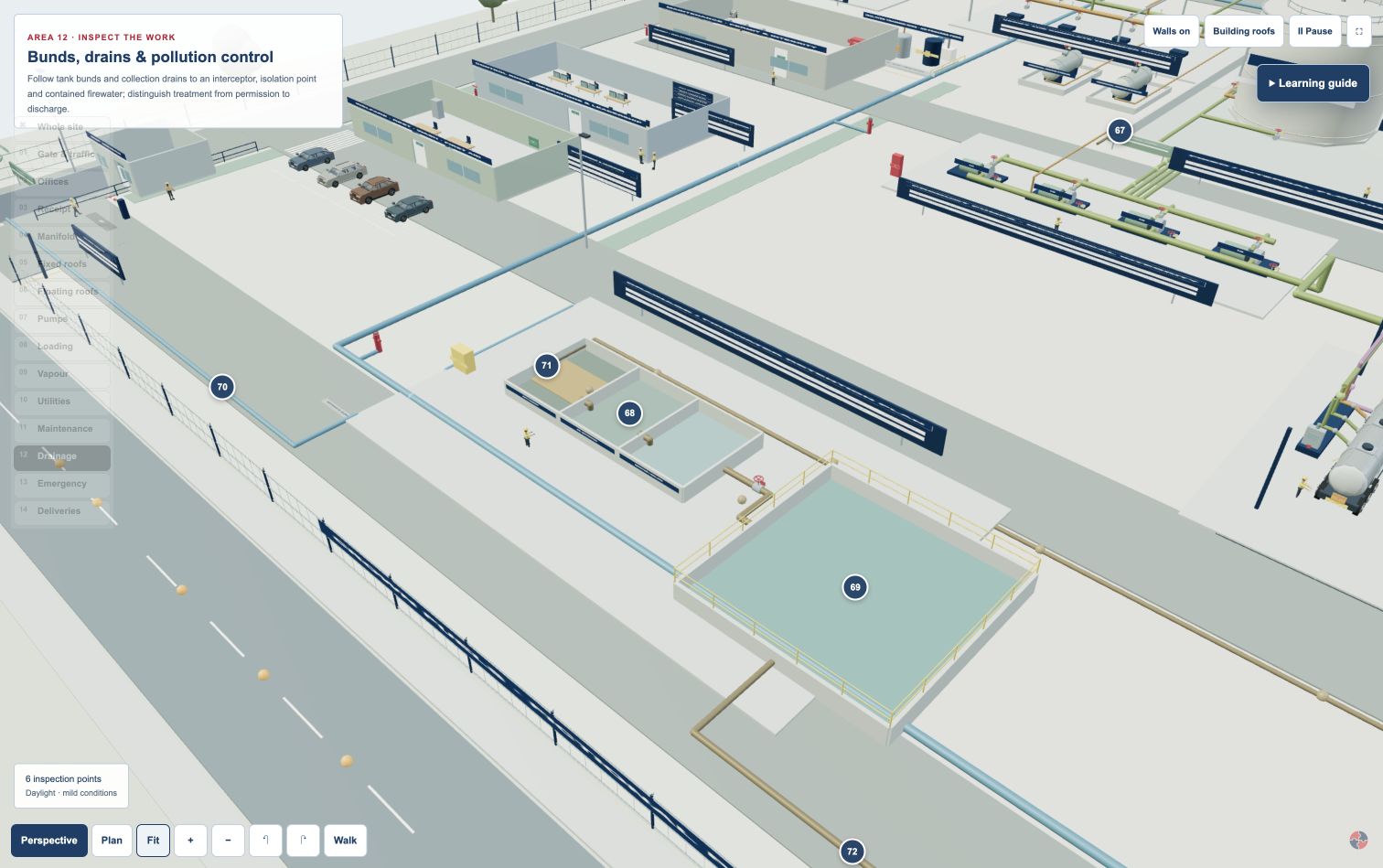
A fuel spill can harm people and the environment long after it leaves the equipment. The important question is where it can travel: through a bund penetration, drainage system, separator, outfall, soil or groundwater. This course follows those pathways at the fictional Crown Fuels bulk distribution terminal and at downstream deliveries. You will compare prevention, secondary containment, drainage isolation, incident response and waste recovery. The environmental regulator, consents and waste rules depend on the actual UK nation and activity; the model is not a permit or a drainage survey.
Terminal and downstream environmental harm pathways, with England/Wales/Scotland/Northern Ireland requirements checked for the actual site.
Learning outcomes
- Trace a credible release through containment and drainage to people and environmental receptors.
- Identify what proves that bunds, separators and firewater retention can perform their assigned duty.
- Choose safe reporting, recovery, waste and restoration decisions using the actual jurisdiction and authorisations.
Course outline
Follow the release to its final destination
- Map the pathway before selecting the controlUse a source–pathway–receptor view to identify pollution risk.
- Keep containment ready for the eventExplain why nominal bund volume and a separator do not prove effective protection.
Keep containment and drainage effective
- Plan spill and firewater recovery without creating another releaseDistinguish emergency containment from unsafe clean-up or disposal.
- Manage the waste and close the incident properlyIdentify evidence for waste transfer, reporting and environmental restoration.
- Bund drainage: retain the barrier through wet weatherA bund is effective only when its entire boundary and available retention are maintained, including the drain.
- Interceptors: treatment duty is different from emergency retentionTreatment, isolation, containment and permission to discharge are separate questions that need separate evidence.
- Firewater retention: available volume is a live barrier conditionBarrier credit depends on available performance now, not only its original design or asset presence.
Plan spill and firewater recovery
- Outfalls: a connected pipe is not discharge permissionIdentify the material, pathway, receptor and actual authorisation before releasing contaminated or uncertain water.
- Drain work: hidden routes can carry vapour to ignitionFollow the hidden pathway and the changing work interface; a small opening can alter a much larger hazard boundary.
Manage waste and environmental interfaces
- Recovered waste: absorption does not remove hazardous propertiesWaste remains part of process-safety and environmental control until its properties, containment and onward route are established.
- Delivery spills: stop the pathway and preserve honest learningA spill is not closed when it disappears from view; source control, pathway assessment, lawful recovery and verified learning must follow.
Verify restoration and report learning
- Rain, impaired drainage and an urgent loading scheduleMake a joined-up environmental decision before and after a transfer.
- Turn the learning into a verified workplace actionChoose a bounded action, owner, task-specific evidence and escalation trigger within your role.
Activities, model practice and assessment
Work through 4 required applied activities and 3 model-practice pauses, with explanatory feedback and independent lesson decisions. Complete 7 distinct model mission sequences across those pauses. Use the actual fictional Crown Fuels model or its equivalent accessible route to complete the required decision sequences; launching the model alone does not complete practice.
The 20-question assessment requires at least 80% plus every designated critical safety answer. Complete the required activities, practice and lesson checks. Points and badges cannot offset a critical safety error.
Use the LMS for confirmed save/resume and recorded results. Any certificate follows its configured passed-completion and grade conditions.
Open the public interactive practice copy; public practice is separate from the LMS record.
Sources and learning provenance
Original fictional cases are paired with public SHAREhub teaching and structured topic records. Use the applicable jurisdiction and primary guidance for live work.
- Secondary containment: Technical Measures
- Active / passive fire protection: Technical Measures
- Pollution prevention for businesses
- Control and monitor emissions for your environmental permit
- Oil storage regulations for businesses
- Waste duty of care: code of practice
- Hazardous waste: producers and holders
- DAERA Environmental Incident Reporting System
- PFAS: general information
Topic sections, source identities and versions
| Public topic | Chunk and version | Jurisdiction and sources |
|---|---|---|
| environmental-hazards · source-pathway-receptor | environmental-hazards--source-pathway-receptor 2.2 | Great Britain, Northern Ireland gov-pollution, gov-permit, niea-prevention |
| bulk-storage-and-tank-farm-safety · bunding | bulk-storage-and-tank-farm-safety--bunding 20261016-letter-review-1 | Great Britain, Northern Ireland hsg176, hse-comah, buncefield |
| environmental-hazards · emergencies | environmental-hazards--emergencies 2.2 | Great Britain, Northern Ireland gov-pollution, gov-permit, niea-prevention |
| environmental-hazards · waste | environmental-hazards--waste 2.2 | England and Wales, Scotland, Northern Ireland gov-waste, scot-waste, ni-waste, epa34 |
| bulk-storage-and-tank-farm-safety · containment-boundary | bulk-storage-and-tank-farm-safety--containment-boundary 20261016-letter-review-1 | Great Britain, Northern Ireland hsg176, hse-comah |
| active-fire-protection · emergency-interface | active-fire-protection--emergency-interface 20261016-letter-review-1 | Great Britain, Northern Ireland source-hse-emergency, source-gb-comah, source-ni-comah, source-eh70 |
| environmental-hazards · water | environmental-hazards--water 2.2 | Great Britain, Northern Ireland gov-pollution, gov-permit, niea-prevention |
| flammability-limits-and-vapour-cloud-behaviour · layout-ventilation | flammability-limits-and-vapour-cloud-behaviour--layout-ventilation 20261016-letter-review-1 | Great Britain hse-fireandexplosion-dsear-background-htm |
| environmental-hazards · management-system | environmental-hazards--management-system 2.2 | Great Britain, Northern Ireland gov-pollution, hse-rights-16 |
Course SH-FUEL-10 · version 2026.10.20.1. .
Questions about this course
Is this training free?
Full public teaching and readers are free without an account. A free learner account is required for saved LMS progress and recorded assessment. Completion and any course-completion certificate depend on the configured LMS conditions.
How long should I allow?
Approximately 110–180 minutes, including teaching, lesson checks, required activities, model or accessible practice and one assessment attempt. Individual pace, review and retries vary. Save and resume in the LMS.
Can I learn without a 3D-capable browser?
Yes. The complete HTML reader provides the teaching. Required model practice has an equivalent accessible decision route in the interactive course. Use the LMS route for recorded learning.
What is required to pass?
Complete the required learning, activities, practice and lesson decisions. The 20-question final assessment requires at least 80% plus every designated critical safety answer. Points cannot compensate for a critical safety error. Follow the feedback before retrying.
Does this authorise fuel operations?
Terminal and downstream environmental harm pathways, with England/Wales/Scotland/Northern Ireland requirements checked for the actual site. This independent course does not award a NEBOSH qualification or replace competent task assessment, practical training or site authorisation.