
Care home safety / Medicines, infection prevention and sharps awareness
Care home safety · SH-CARE-07Medicines, infection prevention and sharps awareness
Free online training · Approximate learning time: 90–150 minutes · Self-paced
Recognise unsafe storage, conflicting records and contamination risks, then escalate within your role.
Full public teaching and readers are free without an account. A free learner account is required for saved LMS progress and recorded assessment. Completion and any course-completion certificate depend on the configured LMS conditions.
Who this course is for
Care staff, senior carers and support staff who recognise and report medicines or infection-control concerns.
Recognise unsafe storage, conflicting records and contamination risks, then escalate within your role. Work through person-centred teaching, original cases and independent decisions before the model-linked practice. Preserve dignity, individual choice and the applicable lawful care process.
Care-home safety awareness with a Great Britain workplace baseline. CQC, DHSC and cited residential-care examples apply to England where stated; confirm the relevant national regime. This course does not confer clinical, medicines, lifting, restraint, maintenance or emergency-response competence or authorisation.
Learning outcomes
- Recognise medicines access, storage and record discrepancies without making prescribing decisions.
- Connect hand hygiene to the care task and transmission route.
- Recognise unsafe sharps containment and use the appropriate exposure response.
Course outline
Understand the person and activity
- Awareness is knowing when a decision is outside your roleApply awareness is knowing when a decision is outside your role to the current person and task.
- Break the transmission chain during the actual taskApply break the transmission chain during the actual task to the current person and task.
Choose suitable controls and support
- Secure access should respect the individual planPrevent unauthorised use without automatically removing independence.
- An excursion remains relevant after the reading recoversPreserve evidence and obtain product-specific advice.
Verify information and role boundaries
- Conflicting instructions need prompt authorised clarificationDo not choose a dose from memory or convenience.
- Sharps capacity and response are a protection chainPrevent the next puncture and obtain urgent assessment after injury.
- Secure medicines in a way that fits the individual planCheck medicines security at transitions and interruptions; preserve autonomy through assessed access rather than assumption.
- A temperature excursion needs a stock decision as well as a repairSeparate recovery of the storage system from authorised disposition of exposed products, and verify both before closure.
- Resolve conflicting medicine instructions before administrationTreat medicines handover as a controlled transfer of reliable information, with explicit responsibility for discrepancies.
Practise the care-home decisions
- Break the infection pathway between care tasksAudit the transitions in care rather than counting only sinks or dispensers; the control is effective use at the right moment.
- Close and replace sharps containers before overfillingResolve shared responsibilities before visiting care begins, including waste, replacement supplies and prompt exposure response.
Defend the complete readiness plan
- An interrupted care-support roundKeep clinical authority, storage evidence and exposure response distinct.
- Take a verified action into the workplaceConnect one actual task to an owner, evidence and a clear release or escalation decision.
Activities, model practice and assessment
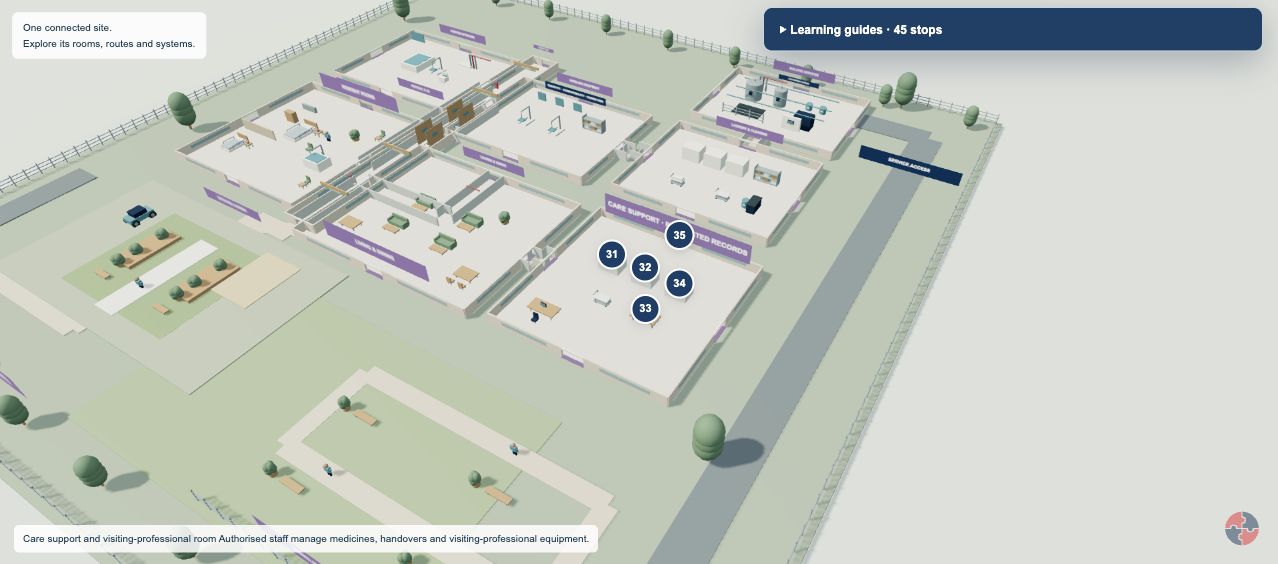
Work through 5 required applied activities and 3 model-practice pauses, with explanatory feedback and independent lesson decisions. Complete 5 distinct model mission sequences across those pauses. Use the actual fictional residential care home model or its equivalent accessible route to complete the required decision sequences; launching the model alone does not complete practice.
The 20-question assessment requires at least 80% plus every designated critical safety answer. Complete the required activities, practice and lesson checks. Points and badges cannot offset a critical safety error.
Use the LMS for confirmed save/resume and recorded results. Any certificate follows its configured passed-completion and grade conditions.
Open the public interactive practice copy; public practice is separate from the LMS record.
Sources and learning provenance
Original fictional cases are paired with public SHAREhub teaching and structured topic records. Use the applicable jurisdiction and primary guidance for live work.
- CQC · Medicines storage in England care homes
- DHSC · Infection prevention in England adult social care
- HSE · Sharps injuries
Topic sections, source identities and versions
| Public topic | Chunk and version | Jurisdiction and sources |
|---|---|---|
| hazard-identification-and-risk-assessment-foundations · uncertainty | hazard-identification-and-risk-assessment-foundations--uncertainty | Great Britain, Northern Ireland source-hse-risk, source-hseni-risk |
| hand-hygiene-and-infection-prevention · transmission | hand-hygiene-and-infection-prevention--transmission | Great Britain, Northern Ireland source-hse-infections, source-nhs-hands |
| hazard-identification-and-risk-assessment-foundations · people | hazard-identification-and-risk-assessment-foundations--people | Great Britain, Northern Ireland source-hse-risk, source-hseni-risk |
| hazard-identification-and-risk-assessment-foundations · register | hazard-identification-and-risk-assessment-foundations--register | Great Britain, Northern Ireland source-hse-risk, source-hseni-risk |
| sharps-awareness · disposal | sharps-awareness--disposal | |
| duty-of-care · reasonable-care | duty-of-care--reasonable-care 20261016-letter-review-1 | Great Britain duty-of-care-src-003 |
| maintenance-inspection-and-testing-of-work-equipment-and-machinery · functional-testing | maintenance-inspection-and-testing-of-work-equipment-and-machinery--functional-testing 2.0 | Great Britain, Northern Ireland hse-l22, hse-maint |
| human-failures-human-factors-and-human-reliability · meaning | human-failures-human-factors-and-human-reliability--meaning | Great Britain source-hse-hf-intro |
| hand-hygiene-and-infection-prevention · meaning | hand-hygiene-and-infection-prevention--meaning | Great Britain, Northern Ireland source-hse-infections, source-hse-welfare, source-hseni-welfare |
Course SH-CARE-07 · version 2026.10.20.2. .
Questions about this course
Is this training free?
Full public teaching and readers are free without an account. A free learner account is required for saved LMS progress and recorded assessment. Completion and any course-completion certificate depend on the configured LMS conditions.
How long should I allow?
Approximately 90–150 minutes, including teaching, lesson checks, required activities, model or accessible practice and one assessment attempt. Individual pace, review and retries vary. Save and resume in the LMS.
Can I learn without a 3D-capable browser?
Yes. The complete HTML reader provides the teaching. Required model practice has an equivalent accessible decision route in the interactive course. Use the LMS route for recorded learning.
What is required to pass?
Complete the required learning, activities, practice and lesson decisions. The 20-question final assessment requires at least 80% plus every designated critical safety answer. Points cannot compensate for a critical safety error. Follow the feedback before retrying.
Does this authorise care operations?
Care-home safety awareness with a Great Britain workplace baseline. CQC, DHSC and cited residential-care examples apply to England where stated; confirm the relevant national regime. This course does not confer clinical, medicines, lifting, restraint, maintenance or emergency-response competence or authorisation. This independent course does not award an external qualification or replace competent task assessment, practical training or site authorisation.