
Warehouse and logistics / Warehouse maintenance and workshop safety
Warehouse and logistics · SH-WH-07Warehouse maintenance and workshop safety

Free online training · Approximate learning time: 150–240 minutes · Self-paced
Plan the intervention before touching the equipment
Full public teaching and readers are free without an account. A free learner account is required for saved LMS progress and recorded assessment. Completion and any course-completion certificate depend on the configured LMS conditions.
Who this course is for
Warehouse workers, team leaders, supervisors and others who plan or support these tasks.
Coordinate isolation, contractors and specialist tools.
Independent warehouse awareness and decision practice for a GB baseline; check corresponding Northern Ireland duties and site arrangements. Completion is not practical competence, a licence or authority for specialist work.
Learning outcomes
- Identify hazardous energy and interfaces before maintenance begins.
- Recognise hot-work, electrical, noise, vibration, wheel and gas-equipment hazards.
- Use competent task planning, controlled isolation and evidence-based handback.
Course outline
Understand the work
- Define the job and its energy sourcesIdentify hazardous energy and interfaces before maintenance begins.
- Coordinate the contractor and the warehouseRecognise hot-work, electrical, noise, vibration, wheel and gas-equipment hazards.
Spot the developing risk
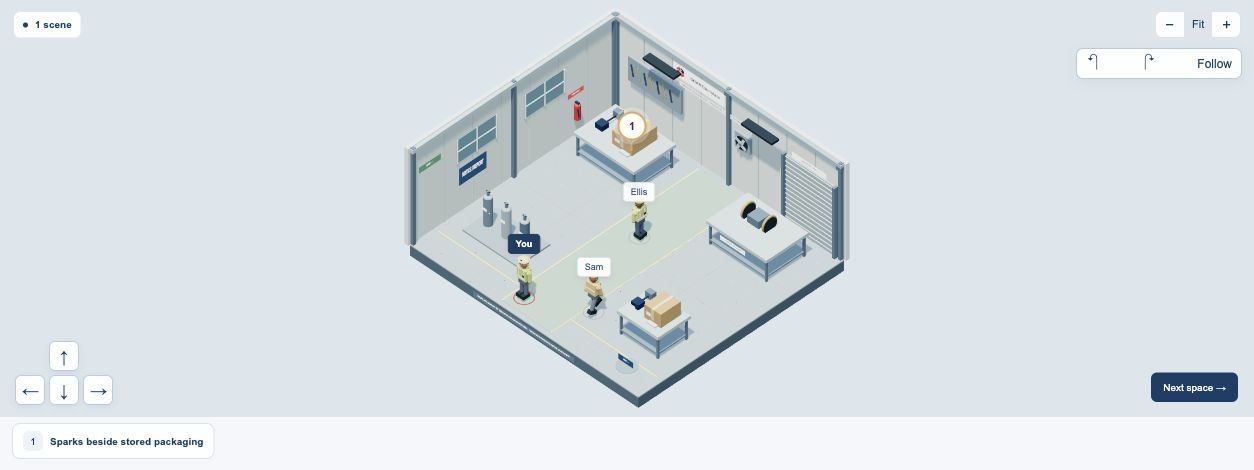
- Sparks beside stored packagingHold the hot work and have the responsible person assess a cold method or a fully controlled task and hand-back.
- A damaged lead on a cleaning machineStop use, keep others from the defective equipment and arrange safe withdrawal and competent assessment.
- A noisy task beside another workstationArrange assessment and suitable control of the noisy task and nearby exposure; do not treat discomfort alone as an exposure measurement.
Choose effective controls
- Unplanned extra time on a vibrating toolReview and control the actual task and exposure, act on symptoms and defects, and arrange appropriate competent support.
- Maintenance conflicts with warehouse trafficHold the conflicting activities and coordinate a safe work area, method, access and hand-back with the responsible people.
Verify and practise
- An unverified grinding wheel is fittedDo not run the machine. Have a competent authorised person verify the wheel, fitting, guarding and task controls.
- An oxygen connection is treated like ordinary airKeep the equipment out of use and refer the complete assembly to the competent contractor and gas supplier. Do not try the fitting, lubricate it or improvise an adapter.
Bring the evidence together
- Shift handover: connect the hazardsDefend the stopping condition and the evidence needed for release.
- Your workplace transfer challengeTurn one lesson into a bounded check with an owner and a review trigger.
Activities, model practice and assessment
Work through 10 required applied activities and 7 model-practice pauses, with explanatory feedback and independent lesson decisions. Complete 7 distinct model mission sequences across those pauses. Use the actual fictional warehouse model or its equivalent accessible route to complete the required decision sequences; launching the model alone does not complete practice.
The 20-question assessment requires at least 80% plus every designated critical safety answer. Complete the required activities, practice and lesson checks. Points and badges cannot offset a critical safety error.
Use the LMS for confirmed save/resume and recorded results. Any certificate follows its configured passed-completion and grade conditions.
Open the public interactive practice copy; public practice is separate from the LMS record.
Sources and learning provenance
Original fictional cases are paired with public SHAREhub teaching and structured topic records. Use the applicable jurisdiction and primary guidance for live work.
Topic sections, source identities and versions
| Public topic | Chunk and version | Jurisdiction and sources |
|---|---|---|
| control-of-ignition-sources-and-hot-work · what-is-it | control-of-ignition-sources-and-hot-work--what-is-it 20261016-letter-review-1 | Great Britain, Northern Ireland source-hot-hse-dsear, source-hot-hse-ptw, source-hot-ni-dsear |
| portable-electrical-equipment · core | portable-electrical-equipment--core 2.0 | source-hse_portable_appliance_testing_faq |
| control-of-ignition-sources-and-hot-work · ericpd | control-of-ignition-sources-and-hot-work--ericpd 20261016-letter-review-1 | Great Britain, Northern Ireland source-hot-hse-dsear, source-hot-hse-ptw, source-hot-ni-dsear, source-hot-hse-five-level, source-hot-hse-hsg253, share-hierarchy-iosh |
| portable-electrical-equipment · controls | portable-electrical-equipment--controls 2.0 | source-hse_portable_appliance_testing_faq |
| noise-at-work · key-points | noise-at-work--key-points 2.4 | Great Britain, Northern Ireland source-hse_noise_risk_assessment, source-hse_buy_quiet_guidance, source-hse_noise_construction_controls, source-hseni_noise_induced_hearing_loss, source-hse_noise_worker_advice, gov-n-nidirect-hearing, source-hse_noise_overview |
| noise-at-work · controls | noise-at-work--controls 2.4 | Great Britain, Northern Ireland source-hse_noise_construction_controls, source-hseni_noise_induced_hearing_loss, source-hse_five_level_control_hierarchy, ear-s7, source-hse_noise_reduction, share-hierarchy-iosh |
| vibration-at-work · scope | vibration-at-work--scope 20261019-V-review-1 | Great Britain, Northern Ireland source-hse_hav, source-hse_wbv, an-hv3, source-l141, source-hse_five_level_hierarchy, source-hav_calc, source-hav_assess, an-hv2, source-hav_health, source-wbv_ports |
| vibration-at-work · source-control-options | vibration-at-work--source-control-options 20261019-V-review-1 | Great Britain, Northern Ireland source-hse_five_level_hierarchy |
| contractor-safety · what-is-it | contractor-safety--what-is-it 20261016-letter-review-1 | Great Britain, Northern Ireland source-cs-hse-hsg159, source-cs-ni-maint |
| abrasive-wheels · scope | abrasive-wheels--scope 20261016-letter-review-1 | Great Britain, Northern Ireland source-health_and_safety_at_work_etc_act_1974, source-health_and_safety_at_work_northern_ireland_order_1978 |
| abrasive-wheels · checks | abrasive-wheels--checks 20261016-letter-review-1 | Great Britain, Northern Ireland source-hse_hsg17_safety_in_the_use_of_abrasive_wheels |
| gas-safety · gas-types | gas-safety--gas-types 2.4 | Great Britain, Northern Ireland src-gas-l56, src-gas-lpg, src-gas-indg297, src-gas-hsg139 |
| gas-safety · controls | gas-safety--controls 2.4 | Great Britain, Northern Ireland src-gas-l56, src-gas-dsear, src-gas-indg297, src-gas-hsg139 |
Course SH-WH-07 · version 2026.10.20.2. .
Questions about this course
Is this training free?
Full public teaching and readers are free without an account. A free learner account is required for saved LMS progress and recorded assessment. Completion and any course-completion certificate depend on the configured LMS conditions.
How long should I allow?
Approximately 150–240 minutes, including teaching, lesson checks, required activities, model or accessible practice and one assessment attempt. Individual pace, review and retries vary. Save and resume in the LMS.
Can I learn without a 3D-capable browser?
Yes. The complete HTML reader provides the teaching. Required model practice has an equivalent accessible decision route in the interactive course. Use the LMS route for recorded learning.
What is required to pass?
Complete the required learning, activities, practice and lesson decisions. The 20-question final assessment requires at least 80% plus every designated critical safety answer. Points cannot compensate for a critical safety error. Follow the feedback before retrying.
Does this authorise warehouse operations?
Independent warehouse awareness and decision practice for a GB baseline; check corresponding Northern Ireland duties and site arrangements. Completion is not practical competence, a licence or authority for specialist work. This independent course does not award an external qualification or replace competent task assessment, practical training or site authorisation.