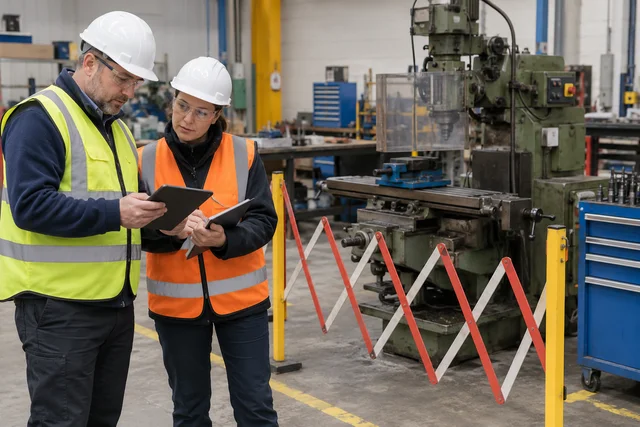
Turn incidents, near misses and experience into justified changes that survive staff and plant changes.
Free training · Approx. 75–110 minutes
Public teaching and practice are free. Use a free learner account in Moodle for confirmed saves and recorded assessment. A certificate of completion depends on completing the required learning, scoring at least 80% and answering every critical safety question correctly.
A fictional wrong-route near miss exposes confusing identification and an interrupted handover. You follow its evidence, action and retained knowledge without inventing a cause or an operating approval.
Operators, supervisors, maintenance staff, contractors and managers who need independent process-safety awareness; practical roles remain subject to employer competence and authorisation.
Independent SHAREhub process-safety awareness. Selected learning maps to a numbered process-safety syllabus topic; this is not the NEBOSH qualification, approved provision, specialist design instruction or work authorisation. GB guidance is distinguished from corresponding NI requirements; establish applicability for the actual jurisdiction and establishment.
What you will learn
Preserve evidence without creating further exposure.
Separate actual outcome, credible potential and uncertainty.
Develop supported causal questions and mechanism-focused actions.
Evaluate external learning and retain decision context.
Distinguish implementation from verified effectiveness.
Course outline
Respond and preserve
Protect before investigatingSeparate emergency response from evidence collection.
Judge potential as well as outcomeExplain why a no-injury event may merit substantial investigation.
Build an honest timelineSeparate observations, records and hypotheses.
Understand events and causes
Ask without supplying the answerUse open questions to understand work as performed.
Look beyond the last actionConnect immediate and underlying conditions.
Design and apply learning
Design an action that changes the mechanismCompare a reminder with a more effective control response.
Close the loop in the workplaceDistinguish circulation from applied learning.
Transfer the mechanism, not the headlineEvaluate whether another organisation’s event is relevant.
Retain useful knowledge
Protect knowledge that is not in the manualRecognise tacit and explicit process knowledge.
Keep knowledge aligned with the plantIdentify how change can break corporate memory.
Verify and communicate
Test learning effectivenessChoose evidence that answers the original concern.
Assemble a learning handoverIntegrate facts, action and retained knowledge.
Practise and test your reasoning
12 lesson decisions and 6 required activities use evidence sorting, matching, sequencing, branching choices and applied checks. Dragging has equivalent labelled controls. The 20-question final assessment requires 80% and every critical answer, after all learning requirements are complete.
Use the linked risk assessment, toolbox talk, policy and assurance resources with their included fictional exercises. Points and module badges help show progress; they do not replace the assessment requirements.
Duration estimates include teaching, activities, checks and assessment. Your pace and retries may vary.
Sources and scope
Independent awareness study · PSM topic 1.3. Independent SHAREhub learning; this is not the NEBOSH qualification.
Use the same course imagery, worked decisions and historical case in a 28-slide teaching companion. Practise classification, compare explained choices and inspect the linked model case.
This optional companion does not replace the required course activities or final assessment.
Investigation methods and worked examples
Explore causes with Fishbone and Five Whys
A fishbone, also called a cause-and-effect or Ishikawa diagram, places the event at its head. The main bones group possible contributors; smaller branches explore what led to each one. Categories are prompts to investigate, not findings.
Fishbone: explore the wider picture
Use it when several things may have contributed. Start with categories such as people, equipment, methods, materials, environment and management; rename them to suit the work. Add causes and subcauses without forcing a single chain.
Ask what led to a specific explanation. Branch when there is another reason, and stop where the evidence runs out. Five is a guide, not a target. Use the two methods together to examine a broad picture and its individual paths.
Define what happened, including the task, place and sequence. Keep the event separate from assumptions about why.
Gather accounts from people involved and add several possible explanations. Explore work conditions, equipment and management arrangements as well as individual actions.
Record supporting and contradictory evidence for each explanation. Keep untested ideas separate from accepted findings; add an open question where evidence is missing.
Review immediate, underlying and root causes from the evidence. A category, the final card or the depth of a branch does not decide the cause level.
Link actions to the supported causes, assign an owner and date, then check implementation and whether the action prevents recurrence.
Compare the worked examples
The two BuildOut reports examine the same invented excavator-arm/scaffold incident: 18 explanations and six actions. Their evidence references are fictional teaching records.
BuildOut fishbone
Six cause categories with subcauses, evidence checks and actions · 24 pages.