
SHARE Knowledge Hub
Obliterative Bronchiolitis (Popcorn Lung)
Obliterative bronchiolitis is a rare disease that scars and narrows the small airways after some workplace inhalation exposures. Diacetyl vapour from heated flavourings and coffee processing is a well-documented occupational route; other inhaled agents have also been reported. Uncontrolled exposure can cause lasting breathing impairment, so identify releases, control them at source and act promptly on symptoms under the applicable GB or NI route.
Understanding Obliterative Bronchiolitis (Popcorn Lung)
Obliterative bronchiolitis is a rare disease that scars and narrows the small airways after some workplace inhalation exposures. Diacetyl vapour from heated flavourings and coffee processing is a well-documented occupational route; other inhaled agents have also been reported. Uncontrolled exposure can cause lasting breathing impairment, so identify releases, control them at source and act promptly on symptoms under the applicable GB or NI route.
Why this matters at work
The hazard is inhaled diacetyl or a related alpha-diketone vapour released from flavouring, warm coffee, hot addition, spray drying, a spill or cleaning. The possible harm is serious, potentially irreversible small-airway disease; carbon monoxide and other agents need separate assessments. The barriers are not simply a worker’s choices: hidden ingredients, warm batches, open transfers, ineffective capture, missed peak sampling, contractor exposure and delayed recognition all affect risk.
Compare test results with commissioning baseline: flow, pressure, capture, condition of hoods, ducting, filters, fans, discharge and interlocks. Inspect for blocked filters, altered hood position, disconnected hoses, corrosive damage or increased production beyond design. Repair defects and verify restoration before normal exposure resumes.
How organisations manage this in practice
A WEL is not a line between harm and no harm. COSHH requires prevention or adequate control and continued reduction where reasonably practicable, and HSE's alert calls for strict controls. If a result is above a WEL, stop or modify the contributing task, investigate the source and verify new controls. If below, still check whether sampling represented all tasks and whether source controls are maintained.
Plan what happens when the cooling system fails, production backs up or a rush order encourages warm grinding. A written interlock or supervisor release rule can prevent a temporary exception becoming routine. Sample during representative high-output operation after the change to confirm that the combined controls, not merely the temperature reading, protect workers.
Agree the exposed population, baseline and follow-up methods, test-quality requirements, symptom reporting between appointments, referral triggers and response to significant change. A competent provider may use respiratory history and serial lung-function evidence, but clinical interpretation is essential; a value inside a broad reference range may still need review if it has declined. Tell workers the purpose and protect their clinical information. Keep the employer’s necessary health record distinct from the medical file. Group signals and individual reports should lead promptly to a review of the process and other exposed workers.
What is obliterative bronchiolitis, and why does it matter?
Obliterative bronchiolitis (also called bronchiolitis obliterans or constrictive bronchiolitis) scars and narrows the small airways. Some occupational cases have followed inhalation of diacetyl-containing flavouring vapours; the damage may be permanent. HSE diacetyl exposure bulletin
A dry cough, wheeze and increasing breathlessness on exertion can occur, but these symptoms have other causes. Some workers may have no early symptoms. Diagnosis belongs to a clinician who can consider work history and lung-function and imaging findings. There is no cure for established airway scarring; stopping further hazardous exposure and clinical care remain essential. CDC/NIOSH flavouring-related lung disease; NIOSH flavouring-related lung disease.
The popular name “popcorn lung” reflects clusters among microwave-popcorn workers. It does not mean that eating popcorn causes this occupational disease. Diacetyl can also be present in flavourings and arise during coffee roasting and grinding. The UK HSE diacetyl vapour safety alert addresses food and drink manufacturing exposure; the historic IIAC food flavouring agents report records UK evidence. Other causes of bronchiolitis obliterans exist, including post-transplant and infectious disease, outside this workplace focus.
How does the harm reach a worker?
The source is a heated flavouring or coffee process, not a person with a health condition. Vapour or aerosol escapes through an opening or failed capture, enters the breathing zone and can injure the small airways. Concentration, temperature, duration, frequency and nearby people change the exposure; persistent symptoms and permanent scarring are different points on that timeline. Treat sudden severe breathing signs as a medical emergency under the local response plan.
| Task and source | Route and affected tissue | Likely harm and early clues | Stop or escalation trigger |
|---|---|---|---|
| Heated flavouring addition or open mixing | Diacetyl-containing vapour leaves the vessel and is inhaled into the small airways. Heat and open pouring can raise release. | Persistent cough, wheeze or breathlessness may signal respiratory disease; repeated exposure is linked to irreversible small-airway scarring. Symptoms alone do not establish diagnosis. | Unknown ingredient, failed capture, spill or new/worsening breathing symptoms: stop exposure and seek competent or clinical advice. |
| Warm coffee grinding after roasting | Naturally generated diacetyl can off-gas from warm beans; operators and nearby people may inhale it. | Onset and progression of small-airway disease vary; early symptoms or failed controls require prompt action. Absence of smell or early symptoms does not establish safety. | Hot beans entering an unassessed open grinder or ineffective extraction: hold the process and reassess. |
| Opening vessels for cleaning or maintenance | Residual vapour or aerosol can reach cleaners, engineers or contractors when a closed process is opened. | Possible respiratory irritation and exposure contributing to longer-term disease risk; the exact risk depends on material and concentration. | Unplanned opening, failed isolation, visible release or worker symptoms: withdraw people, control release and use the site response plan. |
Other occupational routes. Food-flavouring and coffee work are the detailed examples here because HSE provides a specific UK diacetyl alert. Occupational bronchiolitis is broader: a NIOSH-authored review describes reports after other inhalation exposures, including styrene-related reinforced-plastics work and some military deployment settings. Those associations differ in evidence and exposure pattern; they do not prove that every such worker has this disease or that a diacetyl WEL applies. Record all current and past inhalation exposures for the clinician and assess each substance and task under the applicable GB or NI route. Occupational bronchiolitis review by NIOSH authors.
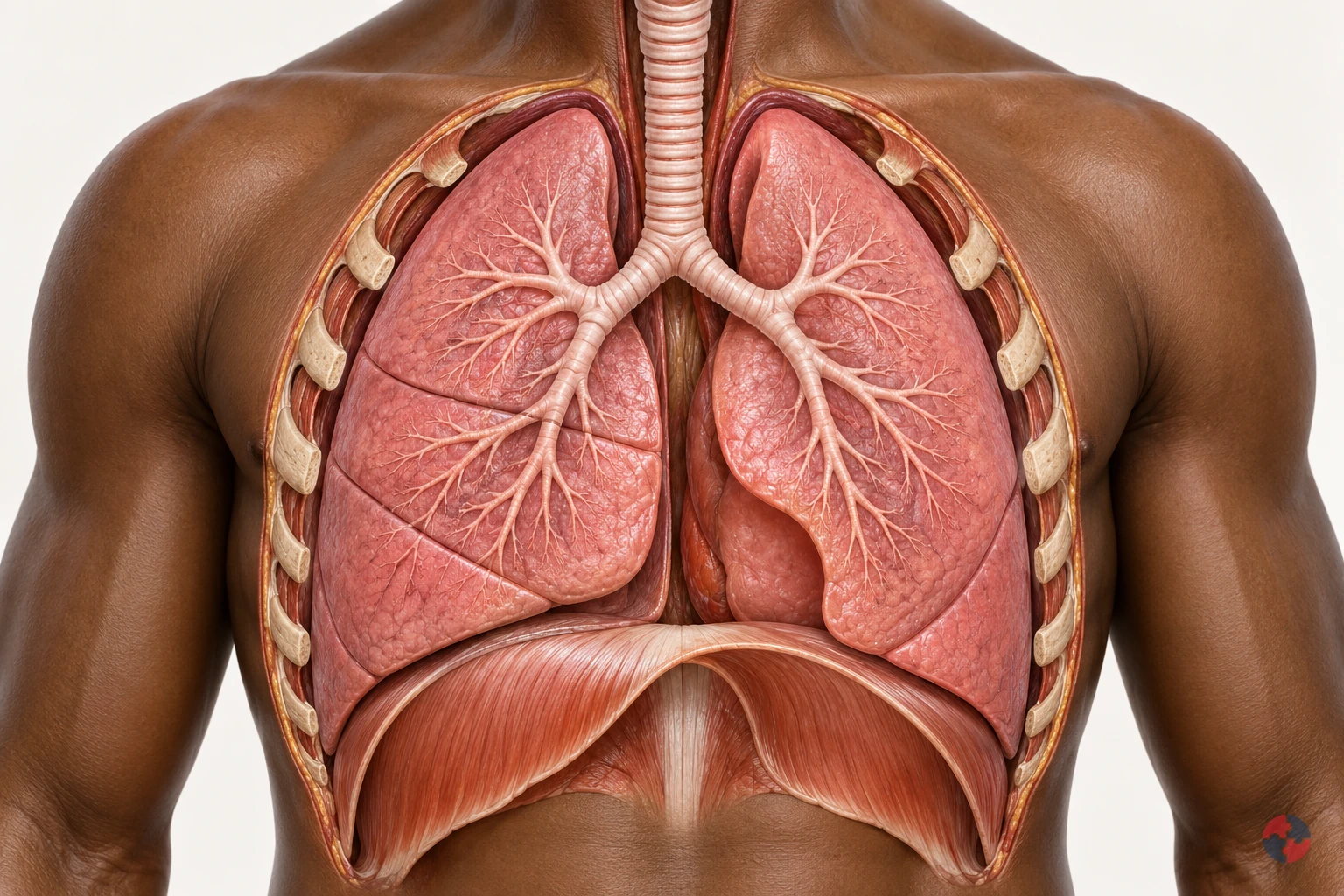

How do the lungs work, and how can workplace exposures affect breathing?
Interactive anatomy · Respiratory tract and lungs · Updated 2026-10-23
Read all anatomy and process explanations without the viewer
Simplified education, not diagnosis, a lung-function or oxygen-saturation test, an exposure calculator or a fitness-to-work assessment. No breath-holding challenge, breathing-rate score or personal health-data collection. Ordinary particle filters do not protect against every gas or oxygen deficiency. COPD and coal-dust topics may reuse normal anatomy only until separate mechanisms are reviewed.
Nose and mouth
Air enters and leaves here. The nose and mouth connect the outside air with the respiratory passages. Air moves through these openings on both the inward and outward breath. Follow the route towards the windpipe before looking at the smaller branches. The illustrated flow is air, a mixture of gases, rather than pure oxygen passing directly into blood. Frimley Health NHS Foundation Trust: How your lungs work · Central and North West London NHS Foundation Trust: How do we breathe?
Trachea
The windpipe carries air into the chest. The trachea, commonly called the windpipe, carries air down towards the chest. It divides into the two main bronchi that supply the lungs. Locate this shared passage before following either branch. Its role is to conduct air towards the gas-exchange regions and provide an outward route for the next exhalation. Frimley Health NHS Foundation Trust: How your lungs work
Bronchi
A main branch carries air into each lung. The two main bronchi take air from the windpipe into the right and left lungs. They divide into progressively smaller branches, distributing the breath through the lungs. Use the split as a landmark before following one highlighted route. These are air passages, distinct from the blood vessels that run through the same organs. Frimley Health NHS Foundation Trust: How your lungs work · University Hospitals of North Midlands NHS Trust: My lung surgery: about your lungs
Bronchioles
Smaller branches distribute air. Bronchioles are smaller branches of the airway system inside the lungs. Their branching routes lead towards clusters of alveoli, where the breath reaches the gas-exchange surface. Follow one branch to its end, using the others as context. This simplified route represents part of a much larger network supplying the lungs together. Frimley Health NHS Foundation Trust: How your lungs work
Alveoli
Tiny air sacs provide a gas-exchange surface. Alveoli are tiny air sacs at the ends of the small airway routes. Their close relationship with surrounding capillaries allows oxygen to pass towards blood and carbon dioxide towards alveolar air. Connect the highlighted cluster with the enlarged gas-exchange view. The enlargement changes the scale so the air space and neighbouring blood vessel can be distinguished. Frimley Health NHS Foundation Trust: How your lungs work · Central and North West London NHS Foundation Trust: How do we breathe?
Air–blood barrier
A thin boundary separates air from blood. The thin alveolar and capillary walls separate air in the sac from blood in its neighbouring vessel. Oxygen and carbon dioxide cross this boundary in opposite directions. Locate the tissue between the two spaces in the enlarged view. Blood cells remain in the vessel; the model does not represent an open connection through which air and blood mix. Central and North West London NHS Foundation Trust: How do we breathe?
Pulmonary capillaries
Small blood vessels pass beside the air sacs. Pulmonary capillaries are small blood vessels beside the alveoli. Blood moving through them receives oxygen and releases carbon dioxide across the thin exchange boundary, then continues through the circulation. Follow the labelled gas routes separately from the blood cells. These cells stay inside the capillary rather than moving into the air sac. Central and North West London NHS Foundation Trust: How do we breathe?
Diaphragm
This muscle helps make room for a breath. The diaphragm is a broad, dome-shaped breathing muscle beneath the lungs. It contracts and flattens downwards during inhalation, helping increase the space in the chest. During a quiet exhalation it relaxes towards its dome shape. Compare it with the rib cage: their changing positions help move air without the lung tissue acting as a contracting muscle. Cambridge University Hospitals NHS Foundation Trust: Breathing techniques to ease breathlessness: muscles involved
Rib cage and breathing muscles
Chest movement changes the space around the lungs. The rib cage protects the chest organs and moves with the breathing muscles. Expansion upwards and outwards helps increase chest space during inhalation; relaxation reduces that space during a quiet exhalation. Compare this movement with the diaphragm below the lungs. Together these structures provide the mechanics that allow air to move through the airways. Central and North West London NHS Foundation Trust: How do we breathe? · Cambridge University Hospitals NHS Foundation Trust: Breathing techniques to ease breathlessness: muscles involved
Pleura
Two thin layers surround the lungs and line the chest. The pleura has two thin layers around the lungs and inside the chest wall. A small amount of fluid between them allows the surfaces to slide with less friction as breathing changes the chest space. Locate this outer covering separately from the internal air sacs; it is not the thin air–blood exchange boundary. Blackpool Teaching Hospitals NHS Foundation Trust: Pleural clinic
Open the complete process transcript
The process, step by step
1 · Make space
Breathing in begins with a change in the space inside the chest. The diaphragm, a dome-shaped muscle beneath the lungs, contracts and moves downwards. Muscles around the ribs help lift the chest upwards and outwards. As the lungs expand with this changing space, air can enter through the airways. Locate the diaphragm and rib cage together rather than treating the lungs as muscles that pull themselves open. The model separates the movement into a teaching step so you can follow its purpose. In the body, chest movement, airflow and blood circulation are connected parts of a continuing process. Central and North West London NHS Foundation Trust: How do we breathe? · Cambridge University Hospitals NHS Foundation Trust: Breathing techniques to ease breathlessness: muscles involved
What to watch: Locate the diaphragm beneath the lungs and the rib cage around them; compare their positions with the space occupied by the lungs.
Why it matters: Changing the chest space draws air into the lung passages. The breathing muscles supply the movement, while the lungs expand with the chest to receive the next breath.
Explore this step: Select the diaphragm and rib cage in turn, then explain how their movement helps air enter without the lungs contracting like muscles.
2 · Move air
Air entering through the nose or mouth travels down the trachea, or windpipe, towards the chest. The trachea divides into the two main bronchi, with one route supplying each lung. Follow this continuous passage in the whole-chest view before moving into the smaller branches. The moving air is a mixture of gases, including oxygen; it is not a stream of pure oxygen travelling straight into the blood. These larger airways carry the breath towards the places where gas exchange happens. The same connected passages also provide the outward route when air is breathed out. Frimley Health NHS Foundation Trust: How your lungs work
What to watch: Start at the nose and mouth, follow the trachea downwards and find the split into the right and left main bronchi.
Why it matters: The larger passages distribute air to both lungs and connect the outside air with the smaller branches inside. Gas exchange takes place further along the route, rather than within the windpipe.
Explore this step: Trace the route to each lung and distinguish the tubes carrying air from the separate vessels carrying blood.
3 · Reach the air sacs
Inside each lung, the bronchi divide into smaller branches called bronchioles. These passages distribute air towards clusters of tiny air sacs, the alveoli. Follow one branch in the close-up and connect its end with an air-sac cluster, using the other branches as surrounding context. These routes distribute the breath throughout the lungs rather than supplying only one working air sac. A real lung contains many branching routes and air sacs operating together. This distribution brings air close to a large network of small blood vessels, preparing for the exchange shown in the next view. Frimley Health NHS Foundation Trust: How your lungs work
What to watch: Follow one smaller airway to the cluster of air sacs at its end, keeping the other branches as surrounding context.
Why it matters: Branching delivers air throughout the lungs instead of to one large chamber. The many air sacs bring the inhaled gases close to blood vessels where oxygen and carbon dioxide can cross.
Explore this step: Trace one complete branch to its air sacs, then explain how the many branches distribute air throughout the lungs.
4 · Change scale
The lesson now changes from a branching airway to an enlarged air–blood interface. An alveolus contains air; beside it runs a capillary containing blood. Their very thin walls form the boundary across which gases can move. Locate the air space, the separating tissue and the inside of the vessel before following any gas symbols. The magnified view represents a tiny part of the same lung, not a separate organ or a hole that joins air and blood into one space. The enlargement helps explain how the two systems can exchange gases while keeping their contents separate. Central and North West London NHS Foundation Trust: How do we breathe?
What to watch: Find the air inside the enlarged alveolus, the thin separating boundary and the neighbouring capillary with blood cells inside it.
Why it matters: A close boundary allows gases to cross between alveolar air and capillary blood. Keeping the two spaces separate lets ventilation and circulation cooperate without blood cells entering the air sac.
Explore this step: Identify the air space and blood-vessel space, then point to the boundary each gas must cross between them.
5 · Exchange gases
At the air–blood boundary, oxygen moves from the alveolar air into the capillary blood. At the same time, carbon dioxide carried back from the body moves from the blood into the air sac. The two gases cross in opposite directions; blood cells stay within the vessel. Follow each labelled symbol separately so that exchanging gases is not confused with mixing the air and blood together. Blood then carries oxygen onwards towards the heart and the body’s tissues. The teaching symbols simplify continuous gas movement, and their size, colour and speed do not represent a measurement. Central and North West London NHS Foundation Trust: How do we breathe?
What to watch: Follow the O₂ symbol towards the capillary and the CO₂ symbol towards the air sac, while locating the blood cells within the vessel.
Why it matters: Oxygen can be carried onwards for use by the body, while carbon dioxide returns to the airways for removal. Both transfers connect the breath with the continuing circulation of blood.
Explore this step: Trace the two gas routes in opposite directions and explain why a blood cell should remain inside the capillary.
6 · Breathe out
During a quiet breath out, the diaphragm and other breathing muscles relax. The diaphragm returns towards its dome shape, chest space decreases and air moves back along the airways to the nose or mouth. This outgoing air carries carbon dioxide that crossed from the blood into the alveoli. Trace the route in reverse without reversing the direction of blood circulation: oxygen-carrying blood continues towards the heart while another breath prepares to enter. The model presents a single cycle to explain the relationship. It does not show breathing as a series of separate events in which circulation stops between steps. Central and North West London NHS Foundation Trust: How do we breathe? · Cambridge University Hospitals NHS Foundation Trust: Breathing techniques to ease breathlessness: muscles involved
What to watch: Compare the diaphragm and chest with the inhalation step, then follow the outward airway route from the lungs to the nose or mouth.
Why it matters: Exhalation removes air containing carbon dioxide from gas exchange. Meanwhile, blood circulation continues carrying oxygen onwards, linking this breathing cycle with the needs of the rest of the body.
Explore this step: Trace the outward air route and the onward blood route separately, then describe why they are connected processes with different pathways.
Read the practice situations and all answer explanations
Sources and how the model is made
The opening images are AI-generated anatomical illustrations. The interactive 3D models and labelled SVG diagrams use original procedural artwork. These teaching images are not medical scans or diagnostic tools. Source references support the learner explanations and do not grant artwork rights.
- Frimley Health NHS Foundation Trust: How your lungs work — Normal airway branching, air sacs and capillary gas exchange; factual text only.
- Central and North West London NHS Foundation Trust: How do we breathe? — Thin alveolar/capillary walls, opposing gas transfer, circulation and chest mechanics. No illustrations or exercises copied.
- Cambridge University Hospitals NHS Foundation Trust: Breathing techniques to ease breathlessness: muscles involved — Diaphragm movement and breathing-muscle context only; this module does not prescribe breathing exercises.
- HSE: Health risks from welding — Welding-related airway irritation, possible deeper injury and irritant asthma; not a universal pattern for every gas.
- HSE: Asthma: an overview — Sensitisation, later triggering and work aggravation. Legacy labelling language and statistics are not reused.
- HSE: Advice for employers: occupational asthma — Exposure prevention, controls and health surveillance only; legacy legislation wording is not reused.
- NHS: Silicosis — Silica-associated inflammation/fibrosis, varying latency, irreversible damage and possible progression after exposure stops.
- HSE: Why is asbestos dangerous? — Asbestosis, mesothelioma and pleural disease are distinct; long disease latency.
- HSE: Construction dust: cutting paving blocks, kerbs and flags — Task design, source suppression/extraction, suitable RPE and checking controls; not a generic dust safe-dose rule.
- NHS: Shortness of breath — Emergency recognition of severe breathing difficulty and 999; emergency advice is outside the activity.
- NHS: Asthma — Narrowed/swollen airways, symptoms and clinical diagnosis; no medication doses or treatment plan reproduced.
- University Hospitals of North Midlands NHS Trust: My lung surgery: about your lungs — Right/left lung lobe counts and airway anatomy; no source image copied.
- Blackpool Teaching Hospitals NHS Foundation Trust: Pleural clinic — Pleural layers and the small lubricating fluid layer outside lung tissue; no procedural teaching included.
- HSE: Asphyxiation hazards in welding and allied processes — Oxygen-deficient spaces and need for independent air supply; no unprotected entry or rescue.
- HSE: Respiratory protective equipment at work — RPE selection must match the contaminant and conditions; filtering protection is not a supply of oxygen.
- HSE: Flour dust and risks to bakers — Flour sensitisation and practical reduction of dusty handling; exposure-limit numbers are not reused.
- Health and Safety Executive: Asbestos essentials — Task planning, training and competent asbestos work arrangements for the maintenance exposure example; not permission to disturb unknown material or a licence/classification decision.
- Health and Safety Executive: Welding fume: protect your workers — Alternative joining, fume reduction, LEV, suitable RPE and maintained controls for the welding-fume example. No unprotected exposure or rescue procedure.
How should inhalation exposure be controlled?
Assess the actual substance, task and release route; remove or reduce exposure at source, then verify containment and extraction before relying on respiratory protection.
Start with the product and process. Ask the supplier whether a flavouring contains diacetyl; a safety data sheet alone is not the COSHH assessment. Avoid or substitute the hazardous ingredient if feasible, but check the substitute: 2,3-pentanedione is not automatically safe. Where coffee roasting generates diacetyl naturally, redesign the process instead. HSE diacetyl vapour safety alert; NIOSH exposure control and prevention.
Use closed transfer, enclosure and suitable local exhaust ventilation (LEV) where release can occur. Control temperature and the order of addition; maintain and test LEV, plan cleaning and keep contractors and bystanders out of exposure zones. Select task-specific RPE with competent advice for residual exposure; this page does not prescribe a filter or facepiece. Provide worker information and check that the controls work during real production. HSE COSHH control measures; HSENI COSHH guidance.
An odour is an investigation prompt, not an exposure result; lack of smell does not prove control. A monitoring programme measures air exposure, while health surveillance looks for early health change. Use both where the assessment and applicable rules require them.
Which controls break the harm chain?
control hierarchy is an HSE planning framework, not a separate legal duty. It broadly maps to HSE elimination, substitution, engineering, administrative and PPE controls. Here, “discipline” means reliable training, supervision, checks and follow-through, never blame. Use the strongest feasible source controls first. Closed transfer and LEV can introduce maintenance and cleaning exposure when opened, so plan those interfaces too. HSE hierarchy of controls; HSE PPE hierarchy.
For the actual task hazard, HSE places elimination first, then substitution, engineering controls, administrative controls and suitable PPE for residual risk. Record why a higher control is not practicable and how the chosen measure is checked in use. HSE hierarchy of controls
Use the HSE hierarchy for this task: eliminate the hazard where possible, substitute, use engineering controls, organise the work and use suitable PPE for residual risk. The exact choices require a task-specific assessment and competent verification. HSE hierarchy of controls
How should a flavouring process be released and reviewed?
Hold a heated flavouring task until the ingredient, release points, exposure controls and verification plan are known. A disposable mask or an odour check cannot stand in for process control. HSE DIACETYL
Open release · closed addition and capture · inhalation route


Read the complete visual as text
- Open release: Warm vessel → open hatch → vapour in shared air → operator and nearby cleaner breathing zones. The open task is a risk explanation, not an approved method.
- Closed addition and capture: A proposed closed addition line, enclosure and local extraction contain/capture the source. Commissioning and representative exposure checks must verify performance.
- Small airway: Inhalation reaches the lungs and small airways. Several conditions can cause cough, wheeze or breathlessness; clinical assessment establishes diagnosis.
Release a flavouring process
2 linked parts. Follow the question numbers and complete the applicable route.
Part 1 of 2 · Questions 1–3

Continue · Part 2 of 2 · Questions 4–5


Read the complete visual as text
- Start: New ingredient, heat, transfer, cleaning, throughput or equipment change could release inhalable vapour.
- Question 1: Is the ingredient and generated emission understood? Decision owner: Process owner and competent COSHH assessor; responsible manager for release.
- YES: Consider elimination or a verified safer formulation. Owner: Process owner and competent COSHH assessor; responsible manager for release. CONTINUE → QUESTION 2.
- NO / UNKNOWN: Hold and ask the supplier and competent assessor; identify generated emissions as well as the ingredient. Owner: Process owner and competent COSHH assessor; responsible manager for release. HOLD → REPEAT QUESTION 1 AFTER CORRECTION.
- Question 2: Can the vapour source be eliminated or a verified safer formulation used? Decision owner: Process owner and competent COSHH assessor; responsible manager for release.
- YES: Redesign and assess new hazards, then check the resulting task controls. Owner: Process owner and competent COSHH assessor; responsible manager for release. CONTINUE → QUESTION 3.
- NO: Check the closed-transfer, enclosure and extraction design. Owner: Process owner and competent COSHH assessor; responsible manager for release. CONTINUE → QUESTION 3.
- UNKNOWN: Hold selection while competent assessment establishes the options and any new hazards. Owner: Process owner and competent COSHH assessor; responsible manager for release. HOLD → REPEAT QUESTION 2 AFTER CORRECTION.
- Question 3: Are closed transfer, enclosure and extraction designed for this task? Decision owner: Process owner and competent COSHH assessor; responsible manager for release.
- YES: Check commissioning and representative verification. Owner: Process owner and competent COSHH assessor; responsible manager for release. CONTINUE → QUESTION 4.
- NO / UNKNOWN: Hold and redesign; verify task-specific design before this check is repeated. Owner: Process owner and competent COSHH assessor; responsible manager for release. HOLD → REPEAT QUESTION 3 AFTER CORRECTION.
- Question 4: Are commissioning, representative exposure checks, cleaning and maintenance controls complete? Decision owner: Process owner and competent COSHH assessor; responsible manager for release.
- YES: Responsible manager releases the assessed method; continue checking performance and change. Owner: Process owner and competent COSHH assessor; responsible manager for release. CONTINUE → QUESTION 5.
- NO / UNKNOWN: Hold and verify actual performance, cleaning and maintenance controls with competent support. Owner: Process owner and competent COSHH assessor; responsible manager for release. HOLD → REPEAT QUESTION 4 AFTER CORRECTION.
- Question 5: Failed capture, spill, changed temperature or symptoms? Decision owner: Process owner and competent COSHH assessor; responsible manager for release.
- YES / UNKNOWN: Stop affected work, secure the area and obtain competent or clinical advice. Reassess the cause and verified controls before manager release. Owner: Process owner and competent COSHH assessor; responsible manager for release. HOLD → REPEAT QUESTION 1 AFTER CORRECTION.
- NO: Continue task checks; hand back only after defects are closed and records updated. Owner: Process owner and competent COSHH assessor; responsible manager for release. OUTCOME → RECORD AND HAND OVER.
- Outcome: Hand-back requires closed defects, verified controls and updated records.
- Stop and escalation boundary: Decision aid, not process specification. No odour check or disposable mask substitutes for source control. A safer label does not establish inhalation safety.
Task and people. A snack manufacturer plans to add a concentrated butter flavouring to a warm mixing vessel. Operators open and weigh it; cleaners open the vessel later; maintenance staff service the extraction. Adjacent workers may share the air. The desired outcome is safe production without vapour release to breathing zones.
Before. Obtain ingredient and supplier information, compare a safer formulation, and assess whether heat and open transfer can be avoided. Option A keeps manual pouring under general ventilation: reject it because the release and exposure are uncontrolled. Option B uses verified closed addition and capture, with a competent monitoring plan, controlled cleaning and a defined maintenance interface: consider it only after its actual performance is checked. Confirm worker training, segregation, emergency arrangements and any occupational-health surveillance decision. HSE diacetyl vapour safety alert.
During. Operators use the agreed method and watch for failed capture, changed temperature, open containers, spills or symptoms. A new flavouring, higher throughput, warm coffee grinding or an altered cleaning agent is a change hold point, even if the room smells normal. The supervisor records and investigates the deviation with the competent COSHH adviser.
Stop and hand-back. If capture fails or an unassessed release occurs, stop the affected process, prevent further exposure and arrange competent review before restart. Seek medical advice for symptoms and give the clinician the exposure history; use the emergency route for severe breathing signs. After repair, verify extraction and exposure control, update instructions and brief all shifts and contractors. The release decision belongs to the responsible manager with competent evidence, not a worker told to tolerate the odour.
How is this different from asthma or ordinary irritation?
Cough, wheeze and breathlessness overlap across conditions, so a manager must not label a worker with “popcorn lung” or dismiss symptoms as irritation. Clinical assessment and exposure control should proceed together.
Obliterative bronchiolitis involves small-airway scarring and may cause persistent airflow limitation; occupational asthma has a different mechanism and assessment route. A worker may have another illness entirely. The HSE respiratory guidance (INDG172), where relevant to the specific exposure concerns asthma and is used only to show why respiratory symptoms need reporting, not to diagnose this disease. CDC/NIOSH flavouring-related lung disease.
Tell the clinician about current and past flavouring, coffee and other inhalation exposures. Occupational health can advise functional work arrangements while the employer reviews the process and wider exposed group. Do not wait for a confirmed diagnosis before fixing an uncontrolled process. NIOSH flavouring-related lung disease.
Where can relevant exposure occur?
Look for release during food-flavouring manufacture, heated mixing, spray drying, coffee roasting, warm grinding, open transfer, packing, cleaning and maintenance; the risk depends on the actual process.
Hold the proposed process · verify controls · release only the assessed method


Read the complete visual as text
- Hold the proposed process
- Verify the controls
- Release only the assessed method
- A proposed warm-coffee demonstration needs its own assessment. Check cooling, enclosure/extraction, cleaning and a separate carbon-monoxide sampling decision. Diacetyl sampling does not cover carbon monoxide. Ordinary coffee service is not the scenario shown.
| Process | What to check | Decision |
|---|---|---|
| Flavouring addition | Ingredient identity, heat, open transfer and local capture. | Hold if ingredient or release path is unclear; redesign before production. |
| Coffee roasting and grinding | Cooling before grinding, off-gassing location and adjacent people. | Control hot grinding and verify enclosure/extraction and exposure. |
| Spray drying and packing | Aerosol and vapour release during equipment opening and packing. | Use contained handling and competent monitoring. |
| Cleaning and maintenance | Opening vessels, spills, LEV isolation and contractor access. | Plan controlled cleaning and hand-back before entry. |
HSE reports that low diacetyl percentages in a mixture can still produce high vapour exposure when heated. Neither a finished food label nor an SDS silence is proof that an inhalation hazard is absent; ask the supplier and assess the process. HSE diacetyl vapour safety alert.
How does the decision transfer between workplaces?
The exposure belongs to the process, not to every workplace in an industry. Sealed goods in ordinary logistics and routine construction work are not treated here as flavouring-vapour tasks; assess a specific unusual process if one is proposed.
| Sector and affected task | Mechanism and possible harm | Strongest feasible control | Residual safeguard and check or stop |
|---|---|---|---|
| Food manufacturing — operators add a butter flavour to a heated snack mixer; cleaners later open it. | Open heated addition can create inhalable vapour; repeated exposure can damage small airways. | Avoid or substitute the hazardous formulation where verified, then use closed addition and LEV. | Assess cleaner exposure and monitor representative tasks; stop for unknown ingredient, open transfer or failed capture. |
| Coffee roasting — roaster and packer handle freshly roasted beans and warm grinding. | Off-gassing at the hopper or grinder may expose operators and nearby staff; long-term respiratory harm is possible. | Cool before grinding where feasible, enclose the release and verify extraction. | Check temperature, diacetyl exposure and need for CO sampling under actual throughput; stop if hot beans enter an unassessed open grinder. |
| Hospitality event — a mobile coffee supplier proposes roasting and grinding beside café staff and visitors. | Warm open grinding could expose the supplier and bystanders to vapour. | Remove on-site roasting or move to a contained, assessed process away from occupied areas. | Venue checks supplier COSHH evidence, CO sampling decision and separation; do not release a demonstration based on a window or mask alone. |
What changes when diacetyl or a similar chemical is identified?
Check the current UK diacetyl WELs, assess the process against them and reduce release at source; evaluate any substitute before treating it as safer.
HSE’s GB safety alert states diacetyl limits of 20 parts per billion (ppb) over 8 hours and 100 ppb over 15 minutes, both time-weighted averages. The alert instructs employers to sample where exposure may occur, control it below the WELs and consider health surveillance when harm is reasonably likely. HSENI identifies EH40 WELs as legally binding under COSHH NI, but the NI assessment and enforcement route is separate. These values are not permission to ignore avoidable exposure or other ingredients. HSE diacetyl vapour safety alert; HSENI COSHH guidance.
A proposed switch from diacetyl to 2,3-pentanedione does not pass the substitute test by name alone. NIOSH reports similar respiratory concerns and advises evaluation. Use supplier evidence, a competent assessment and the actual production conditions, then verify controls after scale-up. NIOSH exposure control and prevention.
For the GB substitution decision, HSE’s diacetyl alert says alternatives should exclude similar compounds, including 2,3-pentanedione. Do not treat that compound as the routine safer replacement. The competent assessment must cover all ingredients and the scaled-up process.
When should work stop or medical help be sought?
Stop the affected task for failed containment, unknown ingredients, an unassessed change or concerning symptoms; isolate the release and obtain competent COSHH and clinical advice before restart. HSE DIACETYL
Symptoms and exposure — parallel clinical and process response


Read the complete visual as text
- Start: Breathing concern or uncontrolled release.
- Question 1: Severe breathing difficulty, tight/heavy chest, spreading chest pain, very pale/blue/grey skin or sudden confusion? Decision owner: Supervisor and first aider; clinical/emergency service for symptoms; manager and competent assessor for process.
- YES: Call 999, use local first aid and follow emergency-service instructions; do not drive to emergency care. Owner: Supervisor and first aider; clinical/emergency service for symptoms; manager and competent assessor for process. STOP / REFER → APPROPRIATE RESPONSE.
- NO: Check the continuing release while retaining the independent clinical route. Owner: Supervisor and first aider; clinical/emergency service for symptoms; manager and competent assessor for process. CONTINUE → QUESTION 2.
- UNKNOWN: Obtain urgent appropriate clinical/emergency advice and protect the person. Owner: Supervisor and first aider; clinical/emergency service for symptoms; manager and competent assessor for process. STOP / REFER → APPROPRIATE RESPONSE.
- Question 2: Is the process still releasing vapour or has a control failed? Decision owner: Supervisor and first aider; clinical/emergency service for symptoms; manager and competent assessor for process.
- YES / UNKNOWN: Stop affected work, keep others clear and use the site response plan. The clinical symptom check still applies. Owner: Supervisor and first aider; clinical/emergency service for symptoms; manager and competent assessor for process. CONTINUE → QUESTION 3.
- NO: Continue the separate symptom check. Owner: Supervisor and first aider; clinical/emergency service for symptoms; manager and competent assessor for process. CONTINUE → QUESTION 3.
- Question 3: Are symptoms new or worsening? Decision owner: Supervisor and first aider; clinical/emergency service for symptoms; manager and competent assessor for process.
- YES: Seek prompt local urgent-care or GP advice and provide work-exposure history. Owner: Supervisor and first aider; clinical/emergency service for symptoms; manager and competent assessor for process. STOP / REFER → APPROPRIATE RESPONSE.
- NO: Arrange appropriate clinical or occupational-health review if concerns persist. Owner: Supervisor and first aider; clinical/emergency service for symptoms; manager and competent assessor for process. STOP / REFER → APPROPRIATE RESPONSE.
- UNKNOWN: Seek appropriate clinical advice and describe the concern and work history. Owner: Supervisor and first aider; clinical/emergency service for symptoms; manager and competent assessor for process. STOP / REFER → APPROPRIATE RESPONSE.
- Outcome: Investigate the process and wider exposed group. Only the responsible manager with competent evidence can restart work; clinical advice governs the person.
- Stop and escalation boundary: Cough, wheeze and breathlessness have several causes. Do not label a worker with this disease. Occupational health supports work decisions and does not replace urgent care. UK 999 emergency help is distinct from local non-emergency routes, which differ between GB and NI.
For severe difficulty breathing, a tight or heavy chest, spreading chest pain, very pale/blue/grey skin or sudden confusion, call 999 and activate local first aid. Do not let the person drive to emergency care. For less severe new or worsening breathlessness, arrange prompt clinical advice through the local urgent-care or GP route; NI routes differ from England’s government health 111. nidirect shortness of breath.
| Trigger | Immediate decision | Evidence to restart or review |
|---|---|---|
| Unknown ingredient or substitute | Do not introduce it to the process. | Supplier clarification, COSHH review and control design. HSE DIACETYL |
| LEV failure, spill or open hot transfer | Stop exposure and secure the area. | Repair, test, competent release and any needed air sampling. HSE DIACETYL |
| Worker cough, wheeze or worsening breathlessness | Move away from exposure; seek clinical advice according to urgency. | Exposure investigation, OH advice and review of the exposed group. HSE DIACETYL |
| Monitoring suggests WEL exceedance | Hold affected work and correct controls. | Competent interpretation, documented corrective action and verified re-sampling. HSE DIACETYL |
What should a commissioning or process-change check cover?
Check foreseeable release tasks and actual operating conditions before accepting a new control. Keep unresolved exposure questions with a competent assessor; a quiet production run does not represent cleaning or upset conditions.
Use this SHARE planning aid alongside the GB HSE food-and-drink bulletin. NIOSH supports repeated exposure checks after interventions as US research, not UK law. A hygienist should design safe, representative sampling; do not deliberately create an uncontrolled exposure to test it. HSE diacetyl bulletin · NIOSH exposure-control advice · NI COSHH assessment route.
| Commissioning question | Evidence and owner | Decision before routine use |
|---|---|---|
| What is in the process? | Purchaser confirms ingredients with the supplier, including an unclear safety data sheet. | Assess substitutes for similar hazards rather than accepting a new label. |
| Where can releases occur? | Assessor maps opening, transfer, heating, packing, cleaning and spills. | Check enclosure and extraction for these states, not only normal mixing. |
| Do controls work in use? | Hygienist relates sampling to tasks, temperatures and relevant averaging periods. | Resolve failed controls or unrepresentative evidence before routine use. |
| Is this coffee processing? | Assessor includes carbon monoxide sampling in the risk assessment. | Decide whether further CO controls are needed; diacetyl evidence alone is insufficient. |
| What changes reopen the check? | Manager records changed ingredients, temperature, throughput or extraction. | Reassess control and sampling needs; retain the reason for the decision. |
These checks organise the evidence pack below. They do not replace the separately scoped GB and NI duties, occupational-health advice or the process-specific controls already explained.
What evidence shows the risk is controlled?
A useful evidence set connects the process assessment to installed controls, exposure measurements, worker reports, health-surveillance decisions and closure of defects.
Keep the substance and process inventory, supplier responses, COSHH assessment, commissioning and LEV examination records, sampling plan and results, RPE selection rationale where needed, change controls and cleaning/maintenance instructions. Record who can stop and release each task. Do not mistake one low sample or one symptom-free day for proof of continuing control. HSE diacetyl vapour safety alert; HSENI COSHH guidance.
Health surveillance is conditional: HSE and HSENI describe when it is needed. An occupational-health provider designs the programme and interprets findings; managers receive the functional and control information needed to act, while individual clinical details are protected. Distinguish air monitoring from medical monitoring and review group trends. HSE COSHH health surveillance; GOV.UK personal data an employer may keep.
Review recurring defects, delayed repairs, process changes, monitoring trends, symptoms, contractor interfaces and training gaps. HSG65’s Plan–Do–Check–Act cycle is a way to assign owners and close learning; it does not certify that one process is safe. HSE HSG65 managing for health and safety.
Which GB and Northern Ireland COSHH duties apply?
Great Britain uses COSHH Regulations 2002; Northern Ireland uses COSHH Regulations (NI) 2003. Both require assessment and control of harmful substances, but the instruments and regulator routes differ.
| Jurisdiction | Framework and decision | Official route |
|---|---|---|
| Great Britain | Health and Safety at Work etc. Act 1974 and COSHH Regulations 2002 (as amended): assess the task and prevent or adequately control diacetyl exposure. HSE’s alert and EH40 give the GB diacetyl WELs. Health surveillance depends on assessed likelihood of harm. | Use HSE diacetyl vapour safety alert, HSE COSHH control measures and HSE workplace exposure limits. |
| Northern Ireland | Health and Safety at Work (Northern Ireland) Order 1978 and COSHH Regulations (NI) 2003: assess and control harmful substances. HSENI identifies EH40 WELs as binding under COSHH NI; verify current amendments and task-specific rules with NI advice. | Use HSENI COSHH guidance and current NI legislation. HSENI EH40 |
| United Kingdom | UK GDPR and Data Protection Act 2018 apply to workers health information. Keep occupational-health detail controlled and share only what managers need to implement work controls. | Use GOV.UK personal data an employer may keep; check updates because guidance is under review. |
US NIOSH recommended exposure limits are research recommendations, not UK legal WELs. Meeting a WEL does not remove the duty to use good control practice. This page gives no automatic RIDDOR decision for a suspected disease: any reporting question needs a confirmed diagnosis and the applicable jurisdiction-specific rules. HSE workplace exposure limits. HSE DIACETYL HSENI COSHH HSENI EH40
How should management arrangements verify controls?
Assign an owner, involve workers, check the control in use and act on failures before returning to routine work.
HSE’s Plan, Do, Check, Act guidance provides the government management route for this topic. Apply it to the actual task, equipment, people and jurisdiction, then keep the verification and corrective-action record. Standards-specific claims are held until their rights and competent review are resolved. HSE Plan, Do, Check, Act
What should workers and managers be able to do?
Workers should recognise possible vapour-release tasks and report symptoms or failing controls; supervisors should hold unsafe work, check the COSHH assessment and call competent hygiene and health advisers.
Train on the actual substance, temperature, equipment and cleaning task. Demonstrate closed transfer and LEV checks, how to report a fault, who can stop/restart, and what the emergency plan requires. Maintenance and contractors need the same interface information. Purchasers should challenge an unverified “diacetyl-free” or “safe to eat” claim as proof of inhalation safety. HSE diacetyl vapour safety alert; HSENI COSHH guidance.
Only competent specialists should specify exposure sampling, LEV performance, RPE and surveillance programmes. A general awareness course does not qualify someone to diagnose lung disease or certify a process. Refresh training after process/product change, defects, symptoms or evidence of poor practice; this page does not invent a fixed certificate expiry.
| Role | Learning and practical test | Assessor and evidence | Reassessment trigger |
|---|---|---|---|
| Workers and nearby staff | Recognise heated flavouring and coffee-process releases, symptoms and failed controls; use the stop/report route. Awareness is not process authorisation. | Supervisor checks a task walk-through and reporting scenario; briefing and observation record. | Product, task or symptom pattern changes. |
| Operators and supervisors | Demonstrate closed transfer, LEV checks, abnormal-release hold, contractor separation and restart approval. | Competent process/safety lead assesses actual task; authorisation and hold/release record. | Control failure, process change or unsafe observation. |
| Maintenance and contractors | Understand isolation, cleaning, filter/LEV work and how a change may create new inhalation exposure. | Competent maintenance lead checks method and hand-back; permit or work record remains. | Modification, defect or new contractor scope. |
| Hygiene and occupational-health specialists | Design exposure assessment or health surveillance within professional competence; explain results without diagnosing from a single test. | Qualified lead reviews sampling plan or clinical pathway; restricted specialist record remains. | New substance, monitoring result or reported symptoms. |
| Managers, purchasers and auditors | Challenge “safe to eat” or “diacetyl-free” claims, fund source controls and sample evidence that they still work. | Technical owner checks a procurement/control decision; specification, action and assurance records remain. | Supplier change, trend, incident or audit finding. |
How could Riverside Leisure Ltd manage this in practice?

Riverside Leisure Ltd, the worked example organisation, should hold a proposed on-site hot-coffee demonstration until the supplier shows how roasting, cooling, grinding and cleaning exposures will be controlled.
Proposal. A mobile supplier wants to roast and grind coffee beside a leisure-centre café for a public event. The supplier’s plan has hot beans entering a grinder, an open off-gassing hopper and café staff working nearby. The decision belongs to the venue manager and competent supplier, with public and contractor interfaces in scope.
Before. Ask for the process and COSHH assessment, cooling method, enclosure/extraction, representative diacetyl exposure evidence, carbon monoxide (CO) sampling to decide whether further CO controls are needed, cleaning plan, public separation and fault response. Option A relies on a window and a mask for the grinder: do not release it. Option B moves roasting off site or uses a contained, assessed process with verified capture and cooling before grinding: consider it only after site interfaces and evidence are checked. HSE specifically identifies warm grinding as an exposure concern and CO as another coffee-processing by-product; control of diacetyl may help with CO but must not replace its assessment. HSE diacetyl vapour safety alert.
During or change. If the supplier changes the machine, runs hot beans directly to the grinder, opens hoppers or reports failed extraction, pause the demonstration and keep café staff and visitors clear. A worker’s new cough or breathlessness prompts health advice and an exposure review, not a quick diagnosis.
Hand-back. Confirm the process is shut down, equipment and waste leave safely, shared ventilation and access are restored, and any defect or symptom report has an owner. If the supplier cannot show control evidence, use ordinary pre-roasted, appropriately supplied products instead of running this demonstration. Document the decision for future events.
How can the hierarchy of controls reduce risks while adding a diacetyl-containing flavouring?
How can the ERICPD hierarchy of controls reduce risks while adding a diacetyl-containing flavouring?

| Control level | Control for this activity | Owner and verification | Stop / restart decision |
|---|---|---|---|
| Eliminate | Remove the diacetyl-containing ingredient or the local open-addition stage where validated product and process changes allow it. | Task owner verifies that the proposed change removes the named hazardous step, including foreseeable cleaning, maintenance and work transferred elsewhere. | If the hazardous step remains, keep it within the task assessment and select the stronger feasible remaining controls. |
| Reduce, including substitution | Validate a genuinely safer flavouring or process with competent hazard information; 2,3-pentanedione is not an automatically safe replacement. | Competent task/process owner validates suitability, compatibility and new hazards against the actual operating requirements before the alternative is adopted. | Reject an alternative if its performance is unproved or its new hazards are unresolved. |
| Isolate | Use a restricted, contained charging arrangement and separate nearby workers from the vapour release pathway. | Supervisor checks the actual boundary, affected people and connected work; verify separation or isolation before allowing access. | Hold or stop for unknown flavouring, failed capture, uncontrolled vapour or unassessed process change. |
| Control: physical safeguards | Provide suitable closed dosing or effective local extraction at the actual opening and addition points, considering process temperature. | Competent equipment/process owner checks ingredient identity, temperature, opening/charging release, capture performance and cleaning method. | Hold or stop for unknown flavouring, failed capture, uncontrolled vapour or unassessed process change. |
| Control: work method and response | Confirm product identity, quantities, heating conditions, cleaning and maintenance exposures; agree what evidence permits work to continue. | Supervisor confirms the work limits, competent cover, communication and stop/restart authority with the people doing this activity. | Hold work when the agreed limits, competent cover or effective communication cannot be maintained. |
| PPE | Select adequate suitable RPE and compatible contact protection for assessed residual exposure; this example does not prescribe a universal filter. | Assessor confirms whether personal protection is needed and checks suitability, condition, compatibility and any required fit evidence. | Do not use unsuitable protection or rely on PPE to continue after an essential source control fails. |
| Discipline | Check source controls during real batches and cleaning, investigate exposure or symptom reports and reassess material/process changes. | Release only after process owner accepts product validation and competent evidence of effective exposure control. Retain verification and unresolved restrictions at handover. | Keep the task on hold until required reinstatement evidence and unresolved defects are accepted by the responsible owner. |
How can the ISO 45001 hierarchy of controls reduce risks while adding a diacetyl-containing flavouring?

| Control level | Control for this activity | Owner and verification | Stop / restart decision |
|---|---|---|---|
| Elimination | Remove the diacetyl-containing ingredient or the local open-addition stage where validated product and process changes allow it. | Task owner verifies that the proposed change removes the named hazardous step, including foreseeable cleaning, maintenance and work transferred elsewhere. | If the hazardous step remains, keep it within the task assessment and select the stronger feasible remaining controls. |
| Substitution | Validate a genuinely safer flavouring or process with competent hazard information; 2,3-pentanedione is not an automatically safe replacement. | Competent task/process owner validates suitability, compatibility and new hazards against the actual operating requirements before the alternative is adopted. | Reject an alternative if its performance is unproved or its new hazards are unresolved. |
| Engineering controls | Use a restricted, contained charging arrangement and separate nearby workers from the vapour release pathway. | Supervisor checks the actual boundary, affected people and connected work; verify separation or isolation before allowing access. | Hold or stop for unknown flavouring, failed capture, uncontrolled vapour or unassessed process change. |
| Engineering controls | Provide suitable closed dosing or effective local extraction at the actual opening and addition points, considering process temperature. | Competent equipment/process owner checks ingredient identity, temperature, opening/charging release, capture performance and cleaning method. | Hold or stop for unknown flavouring, failed capture, uncontrolled vapour or unassessed process change. |
| Administrative controls | Confirm product identity, quantities, heating conditions, cleaning and maintenance exposures; agree what evidence permits work to continue. | Supervisor confirms the work limits, competent cover, communication and stop/restart authority with the people doing this activity. | Hold work when the agreed limits, competent cover or effective communication cannot be maintained. |
| PPE | Select adequate suitable RPE and compatible contact protection for assessed residual exposure; this example does not prescribe a universal filter. | Assessor confirms whether personal protection is needed and checks suitability, condition, compatibility and any required fit evidence. | Do not use unsuitable protection or rely on PPE to continue after an essential source control fails. |
| Administrative controls | Check source controls during real batches and cleaning, investigate exposure or symptom reports and reassess material/process changes. | Release only after process owner accepts product validation and competent evidence of effective exposure control. Retain verification and unresolved restrictions at handover. | Keep the task on hold until required reinstatement evidence and unresolved defects are accepted by the responsible owner. |
What do the acronyms and key terms mean?
These terms distinguish disease, exposure limits, air monitoring and health surveillance.
| Term | Meaning |
|---|---|
| Obliterative bronchiolitis | Scarring and permanent narrowing of the small airways; “popcorn lung” is an informal name. |
| Diacetyl | 2,3-butanedione, a substance or process by-product linked to flavouring-related lung disease. |
| 2,3-pentanedione | A related flavouring chemical; substitution requires toxicity assessment. |
| COSHH | Control of Substances Hazardous to Health; GB and NI have separate regulations. |
| WEL / TWA | Workplace exposure limit / time-weighted average over a specified sampling period. |
| LEV / RPE | Local exhaust ventilation / respiratory protective equipment. |
| Air monitoring | Measurement of airborne substance exposure; different from health surveillance. |
| Health surveillance | A planned occupational-health process when legal and risk criteria are met. |