SHARE Knowledge Hub
Night Worker Health
Night work can disrupt sleep and alertness, increase fatigue and make safety-critical tasks and the journey home harder. Good management combines lawful hours and free health-assessment offers with a rota, breaks, supervision and task controls that work on real night shifts. Use the separate Great Britain or Northern Ireland working-time rules for the job location.
Understanding Night Worker Health
Night work is both a working-time category and a health and safety exposure.
Why this matters at work
The first layer records the applicable jurisdiction, status, averaging period, special-hazard limits and assessment offers. The second examines workload, sleep opportunity, handovers, error consequences, staffing, lighting, supervision, transport and ability to stop unsafe work. Both need owners, records and review triggers.
Assess violence, security, medical events, equipment failure and emergency evacuation as well as fatigue. A check-in app is useful only if missed contact leads to timely action. Ensure emergency information, first aid and access arrangements work when daytime offices are closed.
How organisations manage this in practice
A high-consequence error can arise from reduced alertness in driving, plant control, lifting, isolation or other work, depending on the setting. Safe response requires a person able to relieve the worker and a method for pausing and handing over without creating another hazard. Reporting should not require diagnostic disclosure. Consider when workload becomes demanding and what happens when staffing is already at minimum. A policy without competent replacement cover is unlikely to provide the promised protection.
Consult affected workers and give adequate notice. Train schedulers and supervisors on the new rules and escalation points. During the trial, watch for unplanned swaps, missed breaks and extended handovers that undermine the planned pattern.
Review actual hours, break delivery and response to reported sleepiness alongside incidents and errors by shift and time. Include temporary staff and call-outs. Explain findings to planners and workers and allocate corrective actions to someone able to change the roster or staffing. Keep confidential clinical details out of routine dashboards. Counts alone are ambiguous unless the organisation also checks whether workers trust the reporting route.
Leading evidence such as roster compliance, usable breaks, overtime concentration and health-assessment offers complements lagging evidence such as errors, near misses and reported sleepiness. Group and hour-of-shift patterns can expose a recurring problem hidden in annual department totals. Low reporting can reflect silence, so examine response quality and worker trust. Keep the analysis focused on work patterns rather than diagnosing people from attendance or fatigue data. A review should be able to change the arrangements that create the risk.
Compare the planned roster with the actual shift
A roster cannot show all fatigue risks. Compare actual hours, overtime, travel, recovery opportunities, breaks and safety-critical work with the arrangements planned for the night shift.

Planned hours
Review the pattern of shifts and the demands of each task with the people who work them.
Actual hours
Include overtime, call-outs, overruns and missed breaks in the review; investigate why the plan is repeatedly exceeded.
Recovery opportunity
Look at realistic daytime sleep and recovery opportunities rather than treating time away from work as guaranteed sleep.
Critical task
Plan demanding or safety-critical activity with competent staffing, supervision and a route to report fatigue.
Qualified cover
Provide usable relief, welfare and break arrangements. PPE and a rota sheet do not substitute for these organisational controls.
Safe travel
Consider fatigue on the journey home and the agreed response if someone cannot travel safely.
Review with night staff
Review actual work and offer the applicable confidential health-assessment route. A health assessment is not an automatic fitness clearance for every shift.
Act on fatigue affecting safe work through the local reporting and cover arrangements. Keep health information separate from the operational review.
Why does night work affect health and safety?
Night work can disrupt circadian rhythm, sleep, alertness, digestion, recovery and social wellbeing, which can increase health and safety risk if work is poorly designed.
Night work health and safety model — part 1 of 2


Read the complete visual as text
- Circadian disruption: Why it matters: Working against the body clock can reduce alertness. Control focus: Rota design, light and recovery planning.
- Sleep loss: Why it matters: Daytime sleep is often shorter and lighter. Control focus: Rest periods, shift sequence and education.
- Fatigue: Why it matters: Fatigue affects judgement, reaction time and communication. Control focus: Breaks, task timing and stop triggers.
- Commute risk: Why it matters: Driving after night shift can be hazardous. Control focus: Travel planning and worker briefing.
Night work health and safety model — part 2 of 2


Read the complete visual as text
- Lone work: Why it matters: Fewer people may be available to help. Control focus: Check-ins and escalation.
- Health conditions: Why it matters: Some conditions or medicines may be affected by night work. Control focus: Health assessment and OH route.
- Social wellbeing: Why it matters: Isolation and family disruption can affect mental health. Control focus: Team connection and manager check-ins.
Best-practice guide: Night Worker Health
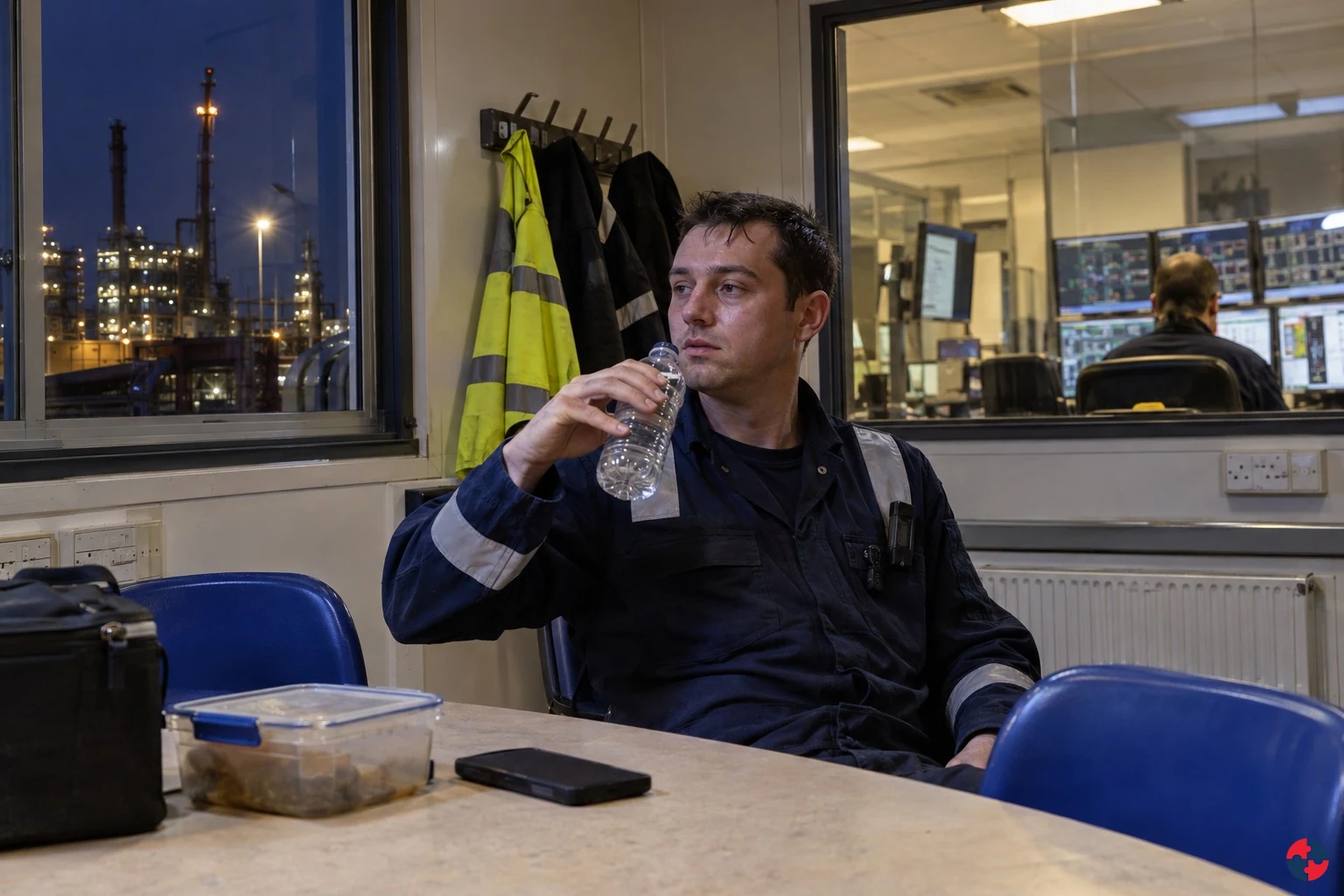
Why does night work affect health and safety?
Night work can disrupt circadian rhythm, sleep, alertness, digestion, recovery and social wellbeing, which can increase health and safety risk if work is poorly designed. Night work can disrupt sleep and alertness, increase fatigue and make safety-critical tasks and the journey home harder.
Turn night worker health knowledge into a decision
Night work can disrupt sleep and alertness, increase fatigue and make safety-critical tasks and the journey home harder. Good management combines lawful hours and free health-assessment offers with a rota, breaks, supervision and task controls that work on real night shifts. Monitor hours and fatigue risk.
Warehouse night-shift scenario
Overtime: Monitor hours and fatigue risk. Breaks: Protected breaks and cover.
Where does night worker health management fail?
It fails when night work is treated as a rota issue only, with little attention to health assessment, fatigue, supervision, welfare and recovery.
Choose controls for night worker health
Remove the exposure: Planner documents why night timing is necessary; stop non-essential work when cover fails. Use a safer method: Review actual hours and swaps; revise roster when fatigue reports recur. Separate and engineer: Supervisor verifies segregation; stop movement if barrier fails. Organise the work: Sample a live night shift; reallocate a critical task when alertness is impaired. Residual protection: Check suitability for the task; never treat PPE as permission to work exhausted. Read the full control table for qualifications, ownership and verification. Use the actual task and applicable jurisdiction; existing technical approval remains unchanged.
Use the full night worker health lesson
Use the full topic for the decision points, practical examples, detailed control tables and source scope. HSE guidance applies to Great Britain; use HSENI for the Northern Ireland route and the source’s stated jurisdiction. A simplified guide does not change the page’s technical-review or approval status.

Read all six steps as text
1. Why does night work affect health and safety?
Night work can disrupt circadian rhythm, sleep, alertness, digestion, recovery and social wellbeing, which can increase health and safety risk if work is poorly designed.
- Avoid / redesign: Planner documents why night timing is necessary; stop non-essential work when cover fails.
- Control the task: Supervisor verifies segregation; stop movement if barrier fails.
- Verify before release: Planner documents why night timing is necessary; stop non-essential work when cover fails.
Night work can disrupt circadian rhythm, sleep, alertness, digestion, recovery and social wellbeing, which can increase health and safety risk if work is poorly designed. Night work can disrupt sleep and alertness, increase fatigue and make safety-critical tasks and the journey home harder.
Apply it: Which part of this plan would you check at the workface before authorising the task?
2. Turn night worker health knowledge into a decision
Use the evidence to improve the actual work arrangement.
- Change at source: Planner documents why night timing is necessary; stop non-essential work when cover fails.
- Make it observable: Planner documents why night timing is necessary; stop non-essential work when cover fails.
- Keep useful evidence: Monitor hours and fatigue risk.
Night work can disrupt sleep and alertness, increase fatigue and make safety-critical tasks and the journey home harder. Good management combines lawful hours and free health-assessment offers with a rota, breaks, supervision and task controls that work on real night shifts. Monitor hours and fatigue risk.
Apply it: What evidence would show that the change improves this task, rather than only completing a record?
3. Warehouse night-shift scenario
Example: a practical application of the existing topic lesson.
- Overtime: Monitor hours and fatigue risk.
- Breaks: Protected breaks and cover.
- Lighting: Repair and inspect.
Overtime: Monitor hours and fatigue risk. Breaks: Protected breaks and cover.
Apply it: At which point would you hold this example, and what evidence would allow it to proceed?
4. Where does night worker health management fail?
Connect the task, the route to the person and the control that can fail.
- Source / exposure: It fails when night work is treated as a rota issue only, with little attention to health assessment, fatigue, supervision, welfare and recovery.
- Possible consequence: Night shift can become invisible to day management.
- Control failure: Defects, workload pressure, poor welfare and weak supervision may persist because senior leaders rarely see the night operation.
It fails when night work is treated as a rota issue only, with little attention to health assessment, fatigue, supervision, welfare and recovery.
Apply it: Who could be exposed, including other trades, cleaners, maintainers and people nearby?
5. Choose controls for night worker health
Start with the stronger practicable options and verify their effect.
- Remove the exposure: Planner documents why night timing is necessary; stop non-essential work when cover fails.
- Use a safer method: Review actual hours and swaps; revise roster when fatigue reports recur.
- Separate and engineer: Supervisor verifies segregation; stop movement if barrier fails.
- Organise the work: Sample a live night shift; reallocate a critical task when alertness is impaired.
- Residual protection: Check suitability for the task; never treat PPE as permission to work exhausted.
Remove the exposure: Planner documents why night timing is necessary; stop non-essential work when cover fails. Use a safer method: Review actual hours and swaps; revise roster when fatigue reports recur. Separate and engineer: Supervisor verifies segregation; stop movement if barrier fails. Organise the work: Sample a live night shift; reallocate a critical task when alertness is impaired. Residual protection: Check suitability for the task; never treat PPE as permission to work exhausted. Read the full control table for qualifications, ownership and verification. Use the actual task and applicable jurisdiction; existing technical approval remains unchanged.
Apply it: Which stronger option can be used here, and who will verify it before accepting the remaining risk?
6. Use the full night worker health lesson
Follow the official sources below and retain the task-specific evidence.
- Official guidance: HSE fatigue guidance
- Official guidance: HSE shift-worker advice
- Task decision: Monitor hours and fatigue risk.
Use the full topic for the decision points, practical examples, detailed control tables and source scope. HSE guidance applies to Great Britain; use HSENI for the Northern Ireland route and the source’s stated jurisdiction. A simplified guide does not change the page’s technical-review or approval status.
Apply it: Which official source and full-topic section will you use to resolve the next decision?
Night work asks people to work when the body is biologically primed for sleep. HSE shift-worker guidance recognises that sleep loss and fatigue are significant problems for shift workers, and that night and early morning shifts can reduce alertness and increase the risk of errors, injury and accidents.
Night work is not automatically unsafe. Many sectors need it: healthcare, transport, manufacturing, security, utilities, emergency services, logistics, cleaning, process operations and leisure. The risk depends on rota design, task demand, supervision, workload, breaks, light, welfare, commute arrangements, lone work and worker health.
The Working Time Regulations add a clear legal baseline. GOV.UK explains that employers must offer free health assessments before a worker becomes a night worker and at regular intervals during employment, and must keep confidential assessment records or records of offers where workers decline.
| Factor | Why it matters | Control focus |
|---|---|---|
| Circadian disruption | Working against the body clock can reduce alertness. | Rota design, light and recovery planning. |
| Sleep loss | Daytime sleep is often shorter and lighter. | Rest periods, shift sequence and education. |
| Fatigue | Fatigue affects judgement, reaction time and communication. | Breaks, task timing and stop triggers. |
| Commute risk | Driving after night shift can be hazardous. | Travel planning and worker briefing. |
| Lone work | Fewer people may be available to help. | Check-ins and escalation. |
| Health conditions | Some conditions or medicines may be affected by night work. | Health assessment and OH route. |
| Social wellbeing | Isolation and family disruption can affect mental health. | Team connection and manager check-ins. |
What should a night-worker management system include?
A night-worker system should cover legal limits, health assessments, rota design, task risk, fatigue controls, welfare, supervision, reporting and review.
Night-worker health is best managed as a work-design issue. Telling people to sleep better is not enough if the rota creates long runs of demanding night shifts, break cover is poor, high-risk tasks are scheduled at the lowest-alertness point and workers are expected to drive home exhausted.
Health assessment records need privacy. The employer needs to know whether the person has been offered an assessment and whether work adjustments or alternative work are needed. Detailed clinical information should be handled through occupational health or another competent health route.
| Element | What good looks like | Evidence |
|---|---|---|
| Night worker identification | Workers meeting the night-work definition are known. | Rota and HR record. |
| Hours and limits | Average and special-hazard limits are monitored. | Working time records. |
| Health assessment | Free assessment offered before and during night work. | Confidential assessment/offer record. |
| Rota design | Consecutive nights, recovery, overtime and shift swaps controlled. | Rota review. |
| Task scheduling | Demanding or safety-critical tasks planned around low-alertness risk. | Task plan and supervisor brief. |
| Welfare | Food, drink, temperature, lighting and rest areas available at night. | Night welfare inspection. |
| Reporting | Workers can raise fatigue, health or travel concerns without stigma. | Fatigue reports and review. |
How can the hierarchy of controls reduce health and fatigue risks from night work?
Design the rota and task first; use training and personal strategies to support a safe system, not to compensate for an exhausted shift pattern.
How do stronger controls interrupt night-work fatigue?


Read the complete visual as text
- Design the rota and task first; use training and…: Design the rota and task first; use training and personal strategies to support a safe system, not to compensate for an exhausted shift pattern.
- A long run of nights can shorten daytime sleep.…: A long run of nights can shorten daytime sleep. Fatigue can then slow reaction and judgement during a driving or machinery task. The supervisor needs a clear stop and cover decision before an error reaches a person. HSE says working-time compliance alone is insufficient to manage fatigue. HSE fatigue guidance .
- HSE prioritises eliminating and substituting hazards before engineering controls,…: HSE prioritises eliminating and substituting hazards before engineering controls, administrative controls and PPE, as explained in its five-level hierarchy of controls . SHARE uses ERICPD as a task-planning prompt: Eliminate; Reduce, including substitution; Isolate through engineered separation; Control with other engineered or administrative measures; PPE; and Discipline, meaning continued verification and maintenance. ERICPD is not a sixth HSE level or a separate legal duty. Here, reducing consecutive nights and overtime is rota design and administrative control; it is not substitution of the hazard.
A long run of nights can shorten daytime sleep. Fatigue can then slow reaction and judgement during a driving or machinery task. The supervisor needs a clear stop and cover decision before an error reaches a person. HSE says working-time compliance alone is insufficient to manage fatigue. HSE fatigue guidance.
| Night-work action | Check and failure response |
|---|---|
| Move avoidable high-risk work to a better-alertness time or eliminate unnecessary overnight work. | Planner documents why night timing is necessary; stop non-essential work when cover fails. |
| Limit consecutive nights, overtime and long shifts; provide real recovery and breaks. | Review actual hours and swaps; revise roster when fatigue reports recur. |
| Separate tired workers from moving plant and vehicles through route barriers and controlled access. | Supervisor verifies segregation; stop movement if barrier fails. |
| Use sufficient staffing, lighting, task scheduling, check-backs, lone-worker contact and a fatigue escalation route. | Sample a live night shift; reallocate a critical task when alertness is impaired. |
| Use task-required protective equipment for residual physical hazards; it does not prevent fatigue. | Check suitability for the task; never treat PPE as permission to work exhausted. |
| Train and supervise the rota, stop-work and reporting process without blaming a worker who reports fatigue. | Manager reviews reports and verifies corrective action. |
HSE prioritises eliminating and substituting hazards before engineering controls, administrative controls and PPE, as explained in its five-level hierarchy of controls. SHARE uses ERICPD as a task-planning prompt: Eliminate; Reduce, including substitution; Isolate through engineered separation; Control with other engineered or administrative measures; PPE; and Discipline, meaning continued verification and maintenance. ERICPD is not a sixth HSE level or a separate legal duty. Here, reducing consecutive nights and overtime is rota design and administrative control; it is not substitution of the hazard.
How can the ERICPD hierarchy of controls reduce health and fatigue risks from night work?

| ERICPD control level | Topic-specific example | Source and full task context |
|---|---|---|
| Eliminate | Move avoidable hazardous work to a better-alertness time. | Read the full task example, checks and stop points on this page. HSE fatigue guidance · five-level hierarchy of controls |
| Reduce | Limit consecutive nights and overtime, with real recovery. | Read the full task example, checks and stop points on this page. HSE fatigue guidance · five-level hierarchy of controls |
| Isolate | Separate tired workers from plant and vehicles. | Read the full task example, checks and stop points on this page. HSE fatigue guidance · five-level hierarchy of controls |
| Control | Provide staffing, lighting, check-backs and fatigue escalation. | Read the full task example, checks and stop points on this page. HSE fatigue guidance · five-level hierarchy of controls |
| PPE | Task PPE does not prevent fatigue. | Read the full task example, checks and stop points on this page. HSE fatigue guidance · five-level hierarchy of controls |
| Discipline | Review actual hours and verify corrective actions without blame. | Read the full task example, checks and stop points on this page. HSE fatigue guidance · five-level hierarchy of controls |
How can the ISO 45001 hierarchy of controls reduce health and fatigue risks from night work?

| ERICPD control level | Topic-specific example | Source and full task context |
|---|---|---|
| Elimination | Move avoidable hazardous work to a better-alertness time. | Read the full task example, checks and stop points on this page. HSE fatigue guidance · five-level hierarchy of controls |
| Administrative controls: exposure reduction | Limit consecutive nights and overtime, with real recovery. | Read the full task example, checks and stop points on this page. HSE fatigue guidance · five-level hierarchy of controls |
| Engineering controls | Separate tired workers from plant and vehicles. | Read the full task example, checks and stop points on this page. HSE fatigue guidance · five-level hierarchy of controls |
| Engineering / administrative controls | Provide staffing, lighting, check-backs and fatigue escalation. | Read the full task example, checks and stop points on this page. HSE fatigue guidance · five-level hierarchy of controls |
| PPE (does not prevent fatigue) | Task PPE does not prevent fatigue. | Read the full task example, checks and stop points on this page. HSE fatigue guidance · five-level hierarchy of controls |
| Administrative controls: continuing verification | Review actual hours and verify corrective actions without blame. | Read the full task example, checks and stop points on this page. HSE fatigue guidance · five-level hierarchy of controls |
How can a night-shift risk develop in real work?
A warehouse night-shift example shows how fatigue, overtime, poor breaks and commute risk can combine.
Warehouse night-shift scenario — part 1 of 2


Read the complete visual as text
- Overtime: Weak handling: Accepted as normal. Stronger control: Monitor hours and fatigue risk.
- Breaks: Weak handling: Delayed to meet dispatch. Stronger control: Protected breaks and cover.
- Lighting: Weak handling: Poor aisle lighting tolerated. Stronger control: Repair and inspect.
Warehouse night-shift scenario — part 2 of 2


Read the complete visual as text
- Agency workers: Weak handling: Briefed quickly on task only. Stronger control: Night-specific induction and route briefing.
- Fatigue signs: Weak handling: Seen as attitude. Stronger control: Supervisor fatigue prompt and stop trigger.
- Driving home: Weak handling: Left to individuals. Stronger control: Worker briefing and transport options where needed.
A warehouse team moves to a peak-season night schedule. Overtime becomes normal, pick rates rise, agency workers join the shift, lighting is poor in one aisle and the supervisor routinely delays breaks because dispatch targets are tight. Near the end of shift, a tired picker steps into a vehicle route while a forklift operator is also fatigued.
A stronger system reviews shift length, consecutive nights, overtime, break cover, lighting, pedestrian routes, agency induction, supervisor checks and travel-home risk. It also uses worker feedback and near misses as early warning, rather than treating fatigue as a personal weakness.
| Issue | Weak handling | Stronger control |
|---|---|---|
| Overtime | Accepted as normal. | Monitor hours and fatigue risk. |
| Breaks | Delayed to meet dispatch. | Protected breaks and cover. |
| Lighting | Poor aisle lighting tolerated. | Repair and inspect. |
| Agency workers | Briefed quickly on task only. | Night-specific induction and route briefing. |
| Fatigue signs | Seen as attitude. | Supervisor fatigue prompt and stop trigger. |
| Driving home | Left to individuals. | Worker briefing and transport options where needed. |
How should night worker health assessments be handled?
Employers must offer free health assessments to night workers, but workers do not have to accept them.
GOV.UK guidance explains that workers must be offered a free health assessment before becoming a night worker and at regular intervals throughout employment. The frequency depends on the assessment outcome. The assessment may include a questionnaire written with input from a health professional. GOV.UK health-assessment guidance; nidirect night-work guidance.
The assessment route should be confidential. Managers should not use it to obtain unnecessary medical details. If a health professional confirms that night work has affected health, the employer must find other suitable work where possible.
| Stage | Employer action | Privacy boundary |
|---|---|---|
| Before night work | Offer free health assessment. | Record offer/assessment, not unnecessary detail. Sources: GOV.UK, nidirect. |
| Questionnaire | Use competent health input where appropriate. | Clinical interpretation remains competent. Sources: GOV.UK, nidirect. |
| Worker declines | Record that it was offered. | Do not pressure or disadvantage. Sources: GOV.UK, nidirect. |
| Assessment concern | Review work and suitable alternative work where possible. | Share only restrictions needed for management. Sources: GOV.UK, nidirect. |
| Regular review | Repeat assessment at suitable intervals. | Keep confidential records. Sources: GOV.UK, nidirect. |
| Work change | Review after shift pattern, health or task changes. | Update only necessary records. Sources: GOV.UK, nidirect. |
Keep confidential health-assessment records for at least two years and record the dates of offers where a worker declines. Name the HR/occupational-health owner who schedules the next offer. The employer’s restricted offer/outcome record is separate from clinical notes; this is not a two-year deletion rule for every occupational-health record. See GOV.UK night-worker health assessments.
Where does night worker health need special attention?
The night-work controls should be matched to the role, task and harm potential.
A control-room operator, lone security guard, nurse, HGV driver, cleaner, plant operator and warehouse picker face different night-work risks. The shared theme is fatigue and lower support outside normal hours, but the controls differ.
Managers should avoid assuming that a quiet night shift is low risk. Low workload can create underload and sleepiness; high workload can create fatigue and rushing.
| Role | Risk pattern | Control focus |
|---|---|---|
| Healthcare/care | High emotional load and manual tasks. | Staffing, breaks and clinical escalation. |
| Security | Lone work, violence and low alertness. | Check-ins, lighting and emergency response. |
| Control room | Low stimulation, alarms and vigilance. | Task variation, breaks and alarm management. |
| HGV or delivery | Driving at circadian low and commute risk. | Hours, rest, route planning and sleepiness reporting. |
| Manufacturing | Machine guarding, isolation and maintenance at night. | Supervision, handover and permit controls. |
| Cleaning | Lone sites and chemical use out of hours. | Access control, COSHH and check-in. |
HGV dispatch: A planner sees that a late change would leave a driver starting a long route after an extended night duty. The manager first redesigns the schedule or assigns another rested driver, then checks the actual transport-specific rules and the driver’s rest before release; a generic workplace-hours average alone does not settle that route. HSE fatigue guidance supports the risk decision.
Control room and healthcare handover: A controller or clinician nearing the end of a night shift must pass a high-consequence alarm or patient concern to an incoming team. The supervisor designs overlap and a structured handover, checks understanding and coverage in the live shift, and holds a critical task if the receiving team or alertness control is absent. Follow-up checks an incident or missed handover trend rather than blaming a tired individual. HSE shift-work guidance supports this work-design approach.
When should night work be changed or escalated?
Night work should be changed or escalated when health assessment advice, fatigue, errors, commute risk, lone work or special hazards show the current arrangement is not safe.
Escalation should happen before a serious incident. Repeated microsleeps or inability to stay awake are immediate impairment signals: pause the affected task, arrange safe handover and competent cover. Near misses, missed alarms, road incidents after shift and rising overtime also require management investigation and control review.
Where work involves special hazards or heavy physical or mental strain, managers should check the stricter night-work limits and ensure the risk assessment reflects the real work.
| Trigger | Action | Evidence |
|---|---|---|
| Health assessment advice | Review alternative work or adjustments. | Confidential outcome and action. |
| Sleepiness during safety-critical task | Pause task and review fatigue controls. | Fatigue report. |
| Near miss late in shift | Investigate time-of-day, workload and break factors. | Incident learning. |
| Excessive overtime or shift swaps | Control hours and recovery. | Rota review. |
| Driving home concern | Discuss transport, rest and fatigue warning. | Worker briefing and manager note. |
| Night welfare missing | Stop or correct before continuing. | Welfare action record. |
Inability to stay awake or repeated microsleeps is an immediate impairment signal: pause the affected task, arrange safe handover and competent cover. Review trends such as rising overtime or missed-break frequency separately; do not describe direct loss of alertness merely as a weak signal.
Where does night worker health management fail?
It fails when night work is treated as a rota issue only, with little attention to health assessment, fatigue, supervision, welfare and recovery.
Night shift can become invisible to day management. Defects, workload pressure, poor welfare and weak supervision may persist because senior leaders rarely see the night operation.
A mature organisation verifies night work directly through night audits, worker consultation, fatigue reports, overtime review, health assessment records and incident trends by shift.
| Failure or weak practice | How it develops | What good looks like |
|---|---|---|
| No health assessment offer | Workers moved to nights with no formal offer. | Offer and record assessments. |
| Poor rota design | Long runs of nights and overtime. | Rota risk review. |
| Breaks not real | Breaks shown but not covered. | Protected break plan. |
| Day-only assurance | Audits miss night conditions. | Night verification visits. |
| Commute ignored | Sleepy driving after shift. | Travel risk briefing and controls. |
| Symptoms dismissed | Fatigue seen as poor attitude. | Reporting route and supervisor training. |
What evidence shows night worker health is managed?
Good evidence shows that controls are planned, used, checked, corrected and reviewed.
Evidence should be proportionate to risk. A low-risk wellbeing campaign may need simple review records, while higher-risk or safety-critical work needs stronger assessment, supervision, monitoring and escalation evidence.
| Evidence item | What it should show | Assurance question |
|---|---|---|
| Night worker register | Who is a night worker and what limits apply. | Is it current? |
| Health assessment records | Assessments offered, accepted or declined confidentially. | Are records kept privately? |
| Working time records | Night limits, overtime and special-hazard limits monitored. | Are exceedances acted on? |
| Rota review | Consecutive nights, recovery, shift swaps and breaks assessed. | Does design reduce fatigue? |
| Night welfare checks | Lighting, temperature, rest, food, water and toilets available. | Is night provision equivalent enough? |
| Fatigue/incident data | Near misses, errors and sleepiness reports reviewed by shift. | Are weak signals escalated? |
| Worker consultation | Night workers can raise health, social and commute concerns. | Are actions closed? |
How should night worker health be assured?
Assurance should test whether controls work in practice, not whether the page or procedure exists.
Assurance should include frontline checks, manager review and periodic independent sampling where risk warrants it. The purpose is to find weak signals early, close actions properly and update the risk assessment when work changes.
| Assurance level | What to check | What good looks like |
|---|---|---|
| Frontline check | Workers and supervisors check conditions before and during work. | Concerns are corrected or escalated before harm occurs. |
| Manager review | Managers review actions, trends, resources and repeated weak signals. | Resources and priorities follow the risk picture. |
| Specialist review | HSE, OH, facilities or technical specialists review complex risks. | Advice is competent, recorded and converted into action. |
| Leadership review | Senior leaders review assurance confidence and unresolved risk. | Important decisions are made and revisited. |
Which duties apply to night work in Great Britain and Northern Ireland?
Both jurisdictions require attention to night-work hours and health assessment, but Northern Ireland has its own 2016 Working Time Regulations. Fatigue still needs a task-specific risk assessment beyond legal hour limits.
In Great Britain, the Working Time Regulations 1998 and GOV.UK night working hours set the baseline. In Northern Ireland, use the Northern Ireland Working Time Regulations 2016 and nidirect working at night. Both routes require a free assessment offer before night work and regularly after; the worker may decline. A professional finding that night work affects health requires consideration of suitable alternative work where possible. GOV.UK night-worker health assessments explains the GB process.
HSE fatigue guidance says long hours, poor shift design, overtime and inadequate breaks can cause ill health and accidents. Employers should consult workers and control the actual pattern, including call-outs and swaps. The eight-hour special-hazard limit needs particular care; check the applicable regulation and risk assessment before relying on exceptions. A preferred rota or an hour-limit record does not remove foreseeable fatigue risk.
How do you decide whether a rota is lawful and safe?
A worker who regularly works at least three hours during the night period is normally a night worker. The usual period is 23:00–06:00; an agreed different period must last at least seven hours and include midnight–05:00. In both GB and NI, ordinary night work is limited to an average of eight working hours in each 24 hours, normally over 17 weeks; regular overtime counts and a worker cannot opt out. If the assessed work involves special hazards or heavy physical or mental strain, eight working hours in any 24 hours is an absolute limit rather than an average. Check the applicable exceptions, collective or workforce agreement and any sector-specific transport working-time rules before deciding a particular rota. GOV.UK night working hours; nidirect working at night.
Worked rota decision: Riverside Leisure proposes five ten-working-hour night shifts each week across a full 17-week reference period. Using the official NI illustration method, that is 850 working hours divided by 102 countable days after one weekly rest day, or about 8.33 hours per 24 hours: above the ordinary eight-hour average. The planner must check the applicable GB or NI calculation, any leave and lawful exceptions, then redesign the rota rather than seek a night-limit opt-out. A shorter four-by-nine-hour pattern would not, by itself, breach that average. If pool-plant work is assessed as special-hazard or heavy-strain work, even one ten-working-hour shift would exceed the separate absolute eight-hour limit unless a relevant exception applies. Regardless of legal arithmetic, assess fatigue, actual breaks, task timing and travel home. A break that cannot be taken is not a control. nidirect working-time calculation.
| Location and source | What matters for a night worker | Manager check |
|---|---|---|
| Great Britain: Working Time Regulations 1998 and GOV.UK night working hours | Night-work limits, special-hazard rules and a free health assessment offered before night work and regularly thereafter. | Identify who qualifies; monitor all actual hours, overtime and swaps; record offers and confidential assessment outcomes. |
| Northern Ireland: Working Time Regulations (NI) 2016 and Northern Ireland Working Time Regulations 2016 | Separate NI regulations set night-work limits and health-assessment duties. nidirect working at night explains the worker-facing route. | Use the NI rule for NI work; monitor hours, offers, restrictions and suitable alternative work where required. |
| GB health and safety framework; NI Health and Safety at Work Order 1978 and NI management regulations | Employers must assess and control foreseeable work-related fatigue and task hazards; local statutes differ. | Test rota and workload risk in real night conditions. Working-time compliance alone does not prove fatigue control. |
| Health information and equality duties | Use confidential occupational-health advice where needed. GB Equality Act 2010 and NI disability law are separate. | Keep clinical detail restricted; decide any adjustment from the individual task and circumstances. |
The arithmetic here illustrates adult/general working-time rules. Young workers have different night-work protections and relevant exceptions require their own check; use the applicable GB or NI guidance. In the five-ten-hour example, check weekly hours, daily/weekly rest and breaks separately: satisfying one night-hours calculation cannot settle every working-time duty. Sector-specific transport rules remain separate.
How can an employer keep controls effective?
HSE explains that a formal health and safety management system is optional. The employer must still plan, control, check and improve the measures for this task. Sample the live rota, actual overtime and missed breaks, then check who can cover a fatigued worker and who authorises safe hand-back after a night fault.
What learning and competence are needed for night work?
Workers need to recognise fatigue and know when to stop; planners and supervisors need to demonstrate safe rota and task decisions; health professionals interpret assessment findings within their competence.
Awareness attendance alone is not competence. Check a real shift plan and ask people to demonstrate how they would handle an exhausted driver, an absent break cover or a health-assessment restriction. HSE shift-work good practice supports training and supervision matched to shift risk.
| Role | Learning and authority | Practical demonstration and reassessment |
|---|---|---|
| Night worker and new starter | Recognise fatigue signs, breaks, reporting route and how to stop an unsafe task; use the site emergency procedure. | Supervisor asks the worker to explain a real fatigue or travel concern and action. Repeat after rota or task change. |
| Supervisor and shift planner | Build a rota that considers sleep recovery, overtime, swaps, workload, lone work, welfare and low-alertness tasks; act on a reported concern. | Manager samples a live rota and observes a stop/reallocation decision. Reassess after a fatigue incident or repeated overtime. |
| HR and occupational-health route | Offer and record health assessments, protect confidential health information, consider suitable alternative work and individual support. | HR checks offer records and a de-identified case decision with competent clinical input. Review after legal or assessment changes. |
| Safety adviser and senior manager | Assess task-specific fatigue risk, resource cover and track whether controls work across shifts. | Audit a night shift, hours and reports, then verify action closure. Reassess after plant, staffing or schedule change. |
Record the observed decision, assessor, scope and next review trigger. Reassess after a near miss, repeated fatigue reports, a changed rota or new safety-critical task; no universal night-work certificate or fixed refresher interval is implied.
How could Riverside Leisure manage a night pool-plant fault?

A night supervisor should pause a safety-critical fault job when overtime and poor break cover have left the available technician unfit for the planned task, then arrange competent cover or a safe delay.
Task and people. At a leisure centre, a circulation pump alarms at 04:30. A technician has worked three consecutive nights, stayed late on each, and missed a planned break. A contractor is due at 06:00 and the pool is scheduled to reopen at 07:00. The technician, contractor, day staff and eventual pool users depend on correct isolation and hand-back.
Before. The manager checks actual hours against the GB or NI night-work rule, the technician’s fatigue report, the risk assessment and available cover. The plant is kept in its planned safe state. The job is not started merely to meet opening time.
During and hold. A rested, authorised technician and contractor use the current isolation and handover method with clear roles and independent checks. Work stops if the plant ID, isolation, alarm status or competence is uncertain, or if either worker reports impaired alertness. A supervisor contacts competent cover or delays reopening rather than asking the tired technician to press on.
Hand-back and evidence. The team verifies the pump and plant status, communicates to the day team, and records hours, break cover, fatigue report, task assessment, isolation, training scope, stop/restart decision and corrective rota action. Health details stay in the confidential route. The manager checks whether repeated overtime indicates insufficient staffing. This illustrates HSE fatigue management guidance; local competent assessment remains necessary.
What should a manager check before extending a night shift?
Check the applicable hours rules and the actual fatigue risk, including the task, previous work, staffing and the ability to take breaks.
Imagine a maintenance team offered overtime after a delayed shutdown. The manager needs the real hours and work pattern, not only the printed rota. Identify the workplace jurisdiction and whether the applicable average-hours calculation or special-hazard rule governs the work. Do not treat agreement to overtime as proof that every night-work limit or safety requirement has been satisfied. See GOV.UK night working hours. Also see nidirect working at night.
Then assess the work that remains. A person performing repetitive monitoring, a lone technician making an isolation decision and a driver leaving the site have different demands and exposure to error. Staffing shortages, interrupted breaks and an extended handover can make the accepted schedule inaccurate. A legally compliant hours result does not by itself establish that the work is safe. See nidirect working at night. Also see HSE fatigue guidance.
The manager should consider deferring a non-essential task, using rested competent cover or changing the work sequence before relying on a reminder to stay alert. Record the decision, who provides cover and the conditions requiring another pause. This is an illustrative operational review, not a universal maximum shift length or a clinical assessment. See HSE fatigue guidance.
Decision basis: GOV.UK night working hours. nidirect working at night. HSE fatigue guidance. The scenario and suggested records are illustrative; apply the source within its stated jurisdiction and the assessed work.
What should handover protect after an unexpected night fault?
Keep the plant status, unresolved work, isolation boundaries and responsible decisions clear to the incoming team.
When an unexpected fault consumes the planned break and handover time, the outgoing supervisor should not hand over an unexplained 'almost finished' repair. Identify the actual safe state, incomplete checks, who is authorised to continue and whether rested competent support is available. Hold an affected safety-critical decision if the required competence or reliable verification cannot be provided. See HSE shift-work good practice.
Use the agreed accessible handover method and confirm understanding with the receiving team. Record actual hours and the reason the rota departed from plan so the rota owner can address recurring overrun. A repeated pattern of overtime, missed breaks or emergency repair is a work-design issue; blaming an individual for tiredness leaves that pattern unchanged. See HSENI working time. Also see HSE shift-work good practice.
Decision basis: HSE shift-work good practice. HSENI working time. The scenario and suggested records are illustrative; apply the source within its stated jurisdiction and the assessed work.
Can the learner separate health assessment, hours and fitness for a task?
These are related but separate decisions: offer the appropriate night-worker health assessment, comply with the applicable hours rules and control fatigue in the actual work.
Learning check: a manager says that a previously satisfactory health assessment allows any new night rota. The learner should explain that clinical advice about the person does not approve an altered schedule, extended hours or changed task risk. The health-assessment offer and confidentiality arrangements must be kept distinct from operational acceptance. See GOV.UK night-worker health assessments.
Learning check: a worker says they are too tired to verify a critical isolation and is told that the arithmetic average is below eight hours. The supervisor must address the immediate task and provide suitable support or hold the work. A calculated average does not restore attention or supply missing competence. See nidirect working at night. Also see HSE fatigue guidance.
Ask the roster owner to demonstrate how actual work, overtime, break cover and recurring changes reach the planning review. Ask the supervisor to explain the local escalation route and how the safe plant state is communicated. Those practical answers provide better competence evidence than memorising one hours figure without its conditions. See HSE fatigue guidance.
Decision basis: GOV.UK night-worker health assessments. nidirect working at night. HSE fatigue guidance. The scenario and suggested records are illustrative; apply the source within its stated jurisdiction and the assessed work.
Which acronyms and terms help with night-work decisions?
The key terms distinguish body-clock disruption and fatigue from the legal and occupational-health routes used to manage them.
Explain a term before using it in a handover or health-assessment record. A worker’s description of tiredness should prompt a practical check, not a diagnosis by the supervisor.
| Term | Full form or meaning | Use here |
|---|---|---|
| Circadian rhythm | Body-clock pattern across roughly a day | Night work can put alertness and sleep out of step with the natural cycle. |
| Fatigue | Reduced mental or physical performance from sleep loss, long work, disrupted body clock or workload | A system risk requiring rota, task and recovery controls; not proof of misconduct. |
| HSE | Health and Safety Executive | Great Britain safety regulator and source of fatigue guidance. |
| HSENI | Health and Safety Executive for Northern Ireland | Northern Ireland safety regulator. |
| OH | Occupational health | Confidential professional advice about health and work. |
| WTR | Working Time Regulations | GB 1998 and NI 2016 regulations are separate; use the one for the work location. |
| GB | Great Britain | England, Scotland and Wales; distinguish the NI legal route. |
| NI | Northern Ireland | Use the Northern Ireland legislation and regulator route. |
| PPE | Personal protective equipment | Residual personal protection supporting stronger source controls. |
| COSHH | Control of Substances Hazardous to Health | Hazardous-substance control; GB and NI have separate regulations. |
| ERICPD | Eliminate; Reduce; Isolate; Control; PPE; Discipline | SHARE planning prompt; Discipline means maintaining controls, not blame. |
| HGV | Heavy goods vehicle | A vehicle context; assess the actual task and driving duties rather than assuming one fatigue rule. |