SHARE Knowledge Hub
Gut Health
Gut health is a broad wellbeing term for digestive function, symptoms and the daily conditions that affect comfort; it is not a diagnosis. Work can make support harder through poor toilet or water access, missed breaks, shift patterns, stress or exposure, and those barriers may affect dignity and safe performance. Employers should fix the work conditions and handle individual needs privately, while qualified clinicians or occupational-health professionals assess symptoms, treatment and fitness for work.
Understanding Gut Health
Gut health is a broad wellbeing term relating to digestive function, diet, hydration, symptoms, bowel habits, physical activity, stress, sleep and health conditions. It is not a clinical diagnosis and it should not be used to assume that a person has, or does not have, a medical condition. The NHS digestive-health pages provide general public-health information; individual symptoms, treatment, medication, nutrition requirements and fitness for work need appropriate NHS, GP, occupational-health, pharmacist, dietitian or emergency-service input.
Why this matters at work
Stress can affect wellbeing and may coexist with digestive symptoms, sleep problems, fatigue and reduced concentration. It should not be assumed to be the cause of a person's symptoms. HSE's stress-management approach supports a suitable and sufficient assessment of work-related stressors such as demands, control, support, relationships, role and change. A supportive system focuses on work conditions, not on judging a person’s resilience or private lifestyle.
In manufacturing, garages, energy and petrochemical work, chemicals, fumes, heat, shift patterns and remote welfare may need integrated control. In hospitality and retail, cleaning chemicals, food allergens, manual work, customer demand and infection control may be relevant. In haulage and warehouse work, driving, heat/cold, access, schedules, welfare and dust/chemical exposure may be relevant. The control must follow the actual hazard, not the label 'gut health'.
How organisations manage this in practice
A shift-work assessment should look at roster design, overtime, call-out, night work, rest, commute, workload, heat/cold, lone work, welfare access, food/drink provision, supervision, handover and the work's safety consequences. The most important evidence is how the arrangement works for real people, including agency, pregnant, disabled, older, new and remote workers. Changes should be trialled, monitored and reviewed with worker input.
Garages need proportionate welfare separated from oils, fuels, dust, exhaust, chemicals and workshop activity. Energy and petrochemical sites may need robust remote-site, control-room, turnaround, contractor-catering, emergency, occupational-health and major-hazard interfaces. Across these sectors, providing a kettle or a poster is not enough if staffing, access, work location, contamination controls or supervision prevent people from using welfare facilities in practice.
Some workplace exposures can cause acute illness or affect health through inhalation, skin contact, ingestion, heat, fumes, dust, biological agents, noise, vibration, physical strain or fatigue. COSHH, DSEAR, temperature, welfare, manual-handling and sector-specific assessments govern these risks. A digestive-health record must not hide a potential occupational exposure behind generic lifestyle advice. If symptoms occur in relation to a task, substance, process or location, the employer should review the relevant hazard assessment and escalate to competent occupational-health or hygiene advice.
Work support and food-handling illness need separate routes
Practical welfare support can be agreed privately. A food-handling illness concern also needs its applicable restriction and competent return-to-work route.

Fix the work barrier
Review access to toilets, water, breaks and qualified cover without requiring unnecessary diagnosis details.
Keep private support voluntary
Agree work-impact changes with the person and signpost suitable professional advice when needed.
Check food-handling applicability
The food-business owner applies current relevant guidance and competent advice; private support does not close an illness-related restriction.
Verify cover and follow-up
Make sure relief does not leave another critical duty unattended. Urgent health concerns use the appropriate clinical route, not a generic return interval.
Read the complete task-specific control examples
ERICPD is a planning cross-map: Discipline verifies and sustains every control. ESEAP compares effectiveness. A label does not authorise the task; retain the owner, evidence and stop or change decision.
Gut Health · ERICPD
- Eliminate
- Remove locked welfare facilities and unrealistic work targets.
- Reduce
- Assess a schedule or staffed post that allows reliable relief.
- Isolate
- Keep clean welfare separate from contaminated work.
- Control
- Provide usable facilities, relief cover and an illness-reporting route.
- PPE
- PPE cannot replace welfare or make an ill food handler safe.
- Discipline
- Check real access every shift and act on failed facilities.
Gut Health · ESEAP
- Elimination
- Remove avoidable work barriers such as locked welfare facilities and targets that prevent necessary access.
- Substitution
- No separate hazard substitute is demonstrated by changing a rota or cover plan. Assess a genuinely less hazardous replacement task or process where relevant.
- Engineering controls
- Provide adequate accessible toilets, drinking-water points, suitable clean eating facilities and physical separation from contamination.
- Administrative controls
- Arrange relief staffing, breaks and routes, inspections, private reporting, infection exclusion and role-specific return-to-work decisions.
- PPE
- Use task-selected protection for remaining chemical, biological or cleaning exposure.
When to get urgent medical help
For sudden or severe abdominal pain, vomiting blood, breathing difficulty or collapse, seek emergency care: call 999 for a life-threatening emergency or follow the national advice to attend A&E. Do not drive yourself. For worsening, persistent or recurrent symptoms, or inability to keep fluids down, obtain prompt medical advice rather than waiting for a workplace review. Use an urgent GP appointment or the relevant national urgent-care route: NHS 111 in England, NHS 24 on 111 in Scotland, NHS 111 Wales, or the local GP/out-of-hours and applicable Phone First service in Northern Ireland. NHS 111 is not the NI route.
These are selected examples, not a diagnostic checklist. Follow NHS stomach-ache urgent and emergency advice and NHS vomiting and diarrhoea advice; in NI use nidirect urgent and emergency care. Do not delay emergency care for a routine adjustment discussion. Possible workplace exposure also triggers the relevant emergency or exposure procedure and competent advice.
Infection and reporting: For suspected infectious vomiting or diarrhoea, stay off work until at least 48 hours after the last episode, following current public-health advice. This precaution extends beyond food handling. A known non-infectious condition needs individual advice; food handlers and other higher-risk roles also follow their role-specific return or clearance requirements. Food-area reporting and return decisions follow their separate route.
What are the key facts about gut health?
The key facts are that gut health is personal, influenced by daily routines and supported best through practical, non-judgemental conditions.
Gut health is not a character test
Digestive symptoms are affected by biology, diet, stress, medication, health conditions, sleep, shift work, hydration and access to facilities.
Work can help or hinder
Poor break planning, restricted toilet access, poor welfare, long shifts, heat, travel and fatigue can make symptoms harder to manage.
Privacy matters
Digestive symptoms can be embarrassing. Managers should avoid unnecessary detail and focus on what support or adjustment is needed.
Food and hydration are practical controls
Water, rest areas, food storage, microwaves, fridges and predictable breaks make healthier routines easier.
Medical advice has a clear place
Persistent, severe, unusual or worrying symptoms should be handled through a GP, other qualified clinician, occupational health or emergency route as appropriate.
What should readers understand before using this gut health information?
This is general workplace wellbeing guidance, not medical, legal or HR advice.
Gut-health information should help people understand routines, support and workplace design. It should not be used to diagnose conditions, recommend treatment, challenge someone about weight, judge what someone eats or make assumptions about capability.
Use the urgent medical help route to distinguish emergencies, prompt medical assessment and persistent concerns. Managers should keep conversations private and focus on work barriers, while arranging immediate safety or cover where needed.
For personal symptoms, use nidirect abdominal-pain advice or an appropriate clinician. A manager may need to make the work safe or arrange cover immediately, but should not tell someone to change medication, diagnose irritable bowel syndrome or decide that a person is fit for a safety-critical role.
| Boundary | What it means | Good practice |
|---|---|---|
| General wellbeing | Provide education on hydration, food routines, breaks and signposting. | Use government health sources and inclusive campaign language. |
| Individual health | Do not diagnose, prescribe or interpret symptoms. | Encourage government health, GP or occupational health advice where needed. |
| Work adjustment | Discuss what helps the person work safely and comfortably. | Consider breaks, toilet access, shift pattern, uniform, travel and duties. |
| Privacy | Digestive health information may be sensitive. | Record only what is necessary and protect confidentiality. |
| Emergency concern | Some symptoms need rapid medical assessment. | Use first-aid or emergency arrangements when serious symptoms are reported. |
What does gut health mean in everyday language?
Gut health means digestive wellbeing: how comfortably and reliably the body digests food, absorbs fluid and nutrients, and removes waste.
People often notice gut health through constipation, diarrhoea, bloating, reflux, cramps, nausea, urgency, appetite changes or discomfort. These symptoms can be short-term, linked to infection or diet, or associated with longer-term conditions such as irritable bowel syndrome, inflammatory bowel disease, coeliac disease, medication effects or stress-related patterns. For general digestive information, see nidirect digestive-symptom advice; individual symptoms need a qualified clinical route.
For workplace purposes, the diagnosis is not the starting point. The practical question is whether the person has safe access to toilets, drinking water, suitable breaks, privacy, sickness support, recovery time, shift-pattern support and reasonable adjustments where a condition creates barriers.
Food routines, hydration, stress, sleep, medication and health conditions can each affect comfort, but the pattern differs from person to person. The workplace can make predictable breaks, drinking water, safe food storage and usable toilets available; it should not diagnose which factor explains an individual’s symptoms.
When work itself limits access to these basics, assess the work arrangement and remove the barrier. If symptoms are persistent, severe or worrying, signpost to a qualified health professional rather than treating a workplace change as medical treatment.
How does digestion link to energy, comfort and wellbeing?
Digestion breaks down food, absorbs nutrients and fluid, and helps maintain daily comfort and energy; symptoms can affect dignity and confidence at work.
The digestive system breaks food down, absorbs nutrients and fluid, and removes waste. Food quality, fibre, fluid, sleep, activity and stress can all influence how settled or unsettled the gut feels. A person doing active work in heat, standing for long shifts or travelling between sites may need different practical support from an office worker with stable breaks. For general digestive information, see nidirect digestive-symptom advice; individual symptoms need a qualified clinical route.
Gut health is also connected to confidence and dignity. Someone who worries about sudden symptoms, limited toilet access or public embarrassment may avoid travel, meetings, lone work or customer-facing roles unless adjustments are handled sensitively.
In practice, irregular meals or poor fluid access can coincide with energy dips; discomfort or urgency can make concentration and travel difficult; and embarrassment can make people reluctant to ask for help. The manager’s useful response is to check breaks, water, welfare stops, workload and privacy, then agree a proportionate work change. Heavy, hot or mobile tasks may require a separate hydration or fatigue assessment.
Digestive illness may also mean absence or a phased return. Discuss the work impact privately and use occupational-health or clinical advice for fitness questions, especially where the task is safety-critical. Do not assume that a single diet, fluid target or symptom explanation suits everyone.
Which work factors can make gut health better or worse?
Work factors include breaks, toilets, water, food access, shift design, travel, heat, stress, culture and job control.
The same person may manage well in one role and struggle in another because the work environment changes. A call-centre worker may avoid drinking water because toilet breaks are monitored. A delivery driver may rely on fast food because welfare access is unpredictable. A night worker may eat at awkward times because the canteen is closed. These are design issues, not personal failures.
Useful support starts by removing friction: make it easier to drink water, eat calmly, access toilets, take medication privately, store food safely and speak to a manager before symptoms become an absence or safety problem.
| Work factor | How it may show up | Practical improvement |
|---|---|---|
| Restricted breaks | Rushed eating, skipped meals or anxiety about toilet access. | Plan predictable breaks and flexible cover where needed. |
| Poor welfare | Workers avoid toilets or cannot wash hands properly. | Inspect toilets, washing, drinking water and rest facilities. |
| Shift work | Eating overnight, sleep disruption and fatigue. | Review rota design and access to suitable food. |
| Hot or active work | Higher fluid loss and increased dehydration risk. | Hydration points, shaded rest and workload planning. |
| Mobile work | Limited toilets, water and food storage. | Plan welfare stops and allow reasonable access. |
| Work pressure | Stress, presenteeism and poor recovery. | Manage workload and encourage early support. |
How can work conditions cause harm around gut health?
A workplace does not diagnose a gut condition, but it can create a harmful pathway: a person cannot use a toilet, drink, eat safely or leave a task when ill; discomfort, dehydration, fatigue, infection spread or unsafe performance can follow.
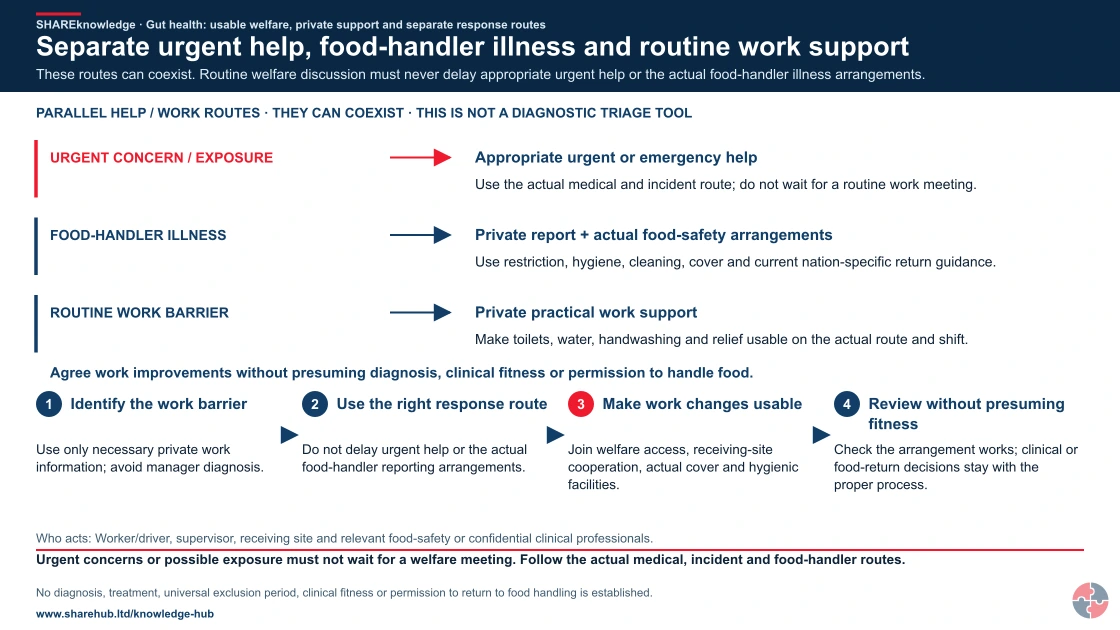
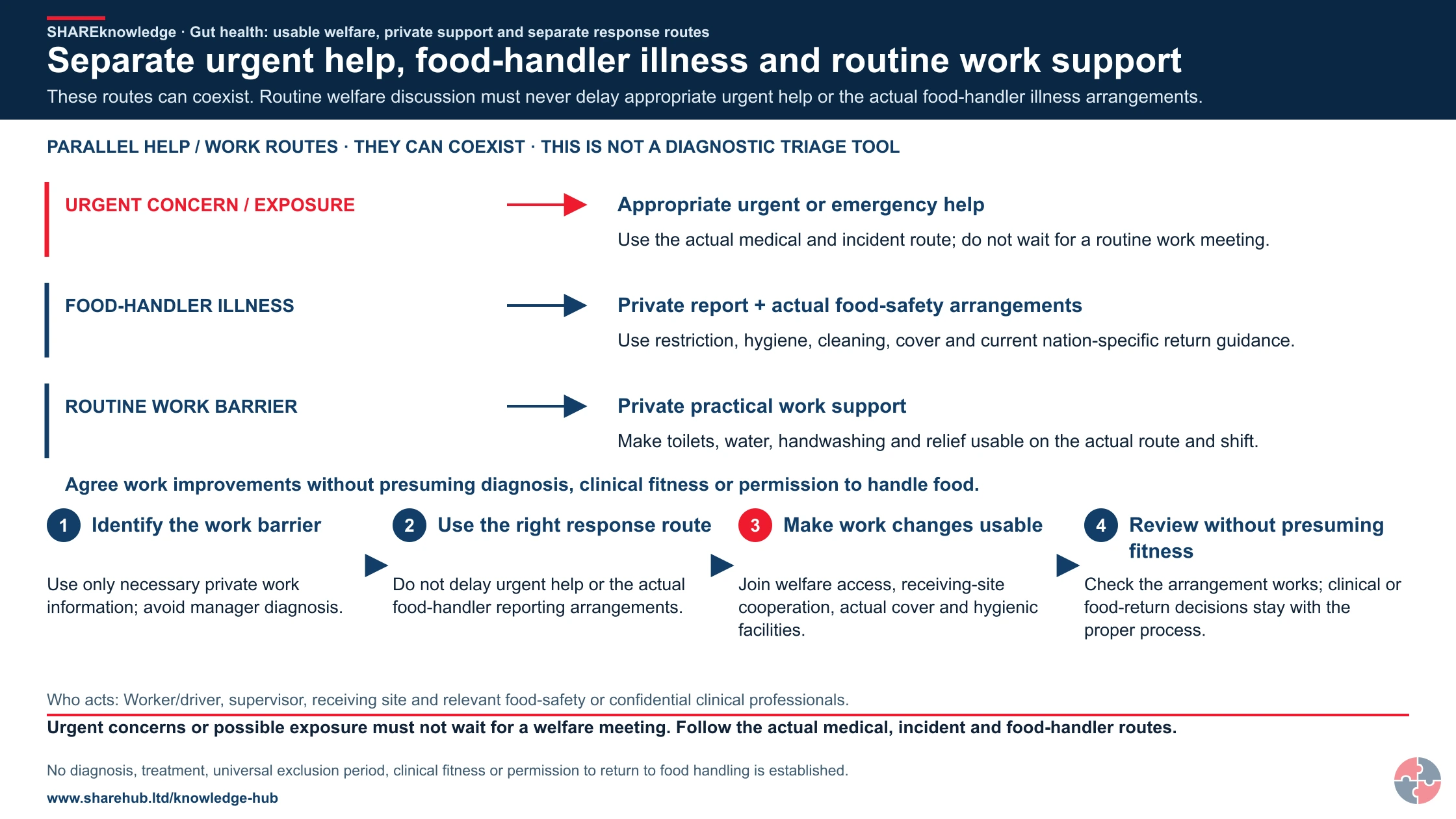
Separate urgent help, food-handler illness and routine work support
Full written explanation
A complete native work-support map places three distinct response routes on parallel lanes. An urgent medical concern or possible harmful exposure goes to appropriate urgent/emergency help and the actual incident response without waiting for a routine work discussion. A food-handler illness concern goes to private reporting, the actual restriction and hygiene/cleaning arrangements, competent advice and current nation-specific return guidance; no universal exclusion period is supplied. A routine work barrier goes to a private practical discussion, usable toilet/water/handwashing access, actual relief cover and review on the real shift. These are potentially concurrent work and help routes, not a symptom-scoring or diagnostic triage tool. The food business retains separate reporting and hygienic controls even when work adjustments are agreed. No treatment, diagnosis, fitness certificate or automatic permission to handle food is established.
These routes can coexist. Routine welfare discussion must never delay appropriate urgent help or the actual food-handler illness arrangements.
- Identify the work barrier. Use only necessary private work information; avoid manager diagnosis.
- Use the right response route. Do not delay urgent help or the actual food-handler reporting arrangements.
- Make work changes usable. Join welfare access, receiving-site cooperation, actual cover and hygienic facilities.
- Review without presuming fitness. Check the arrangement works; clinical or food-return decisions stay with the proper process.
When the evidence does not fit: Urgent concerns or possible exposure must not wait for a welfare meeting. Follow the actual medical, incident and food-handler routes.
Who acts: Worker/driver, supervisor, receiving site and relevant food-safety or confidential clinical professionals.
Changed workplace
Driver delivery route: Agree reliable welfare and drinking-water access with usable relief and private support.
Food-handling business: Keep private work support distinct from illness reporting, hygiene and nation-specific return guidance.
Evidence check: No diagnosis, treatment, universal exclusion period, clinical fitness or permission to return to food handling is established.
Connect usable welfare and private work support to the separate clinical and food-safety routes
Primary references: HSE visiting-driver welfare access · HSENI welfare facilities · FSA fitness-to-work route for England, Wales and NI · NHS current stomach-pain help route · Food Standards Scotland separate guidance overview
Open the complete HD image (new tab)Download image
Connect usable welfare and private work support to the separate clinical and food-safety routes
Primary references: HSE visiting-driver welfare access · HSENI welfare facilities · FSA fitness-to-work route for England, Wales and NI · NHS current stomach-pain help route · Food Standards Scotland separate guidance overview
Trace the route rather than assuming a lifestyle cause. A locked toilet or no relief cover can cause a worker to delay a necessary visit or reduce drinking. Hot work and long routes can make that harder. A food handler with vomiting or diarrhoea can expose customers if the illness-reporting and exclusion controls fail. Some symptoms may instead signal an occupational exposure or a medical emergency; a manager must not label them “just gut health”.
| Work condition | Possible harm route | Immediate decision |
|---|---|---|
| No toilet, water or safe relief cover | Delayed toilet use, restricted drinking, discomfort or fatigue; a safety-critical post may be left without cover. | Provide relief and usable facilities; pause or reassign the task if safe cover is unavailable. |
| Food handler reports vomiting or diarrhoea | Contaminated hands, food or surfaces can spread illness to customers and colleagues. | Keep the person away from open food and follow current Food Standards Agency and site fitness-to-work rules. |
| Symptoms follow chemical, heat or process work | An exposure may be missed if symptoms are treated as a lifestyle complaint. | Stop the suspect task, use the hazard-specific response and seek competent health/exposure assessment. Follow the GB COSHH control route or NI COSHH route for the actual substance. |
| Severe or suddenly worsening symptoms | Delayed clinical assessment can worsen harm. | For urgent non-emergency help, use NHS 111 in England, NHS 24 on 111 in Scotland, NHS 111 Wales, or nidirect Phone First/GP out-of-hours guidance in Northern Ireland, as applicable. For a life-threatening emergency call 999. Managers arrange safe cover; clinicians assess symptoms. |
Urgent medical help takes priority over routine support discussions, including after possible workplace exposure. For sudden or severe abdominal pain, vomiting blood, breathing difficulty or collapse, seek emergency care: call 999 for a life-threatening emergency or follow the national advice to attend A&E. Do not drive yourself. For worsening, persistent or recurrent symptoms, or inability to keep fluids down, obtain prompt medical advice rather than waiting for a workplace review. Use an urgent GP appointment or the relevant national urgent-care route: NHS 111 in England, NHS 24 on 111 in Scotland, NHS 111 Wales, or the local GP/out-of-hours and applicable Phone First service in Northern Ireland. NHS 111 is not the NI route. These examples are not an exhaustive diagnostic checklist. The work decision is to make the person safe and support access to care, rather than guess a diagnosis.
How can shift work affect gut health?
Shift work can disrupt eating, sleep, hydration and bowel routines because work is taking place against normal body rhythms.
Night shifts and rotating shifts can make people eat when their body expects sleep, rely on vending food, drink more caffeine or skip proper meals. Some workers also reduce fluids to avoid toilet breaks during busy or remote work. Over time, this can affect comfort, fatigue, concentration and wellbeing.
A good shift-work approach includes rota design, worker consultation, access to food and water, rest breaks, fatigue management and education that is realistic for the shift pattern.
HSE HSG256 uses assess, act, check and review for shift work. A change to meal timing alone is not a cure or a substitute for assessing fatigue, workload, rest, welfare and safety consequences.
| Issue | Risk pattern | Control idea |
|---|---|---|
| Night eating | Heavy meals at night may feel uncomfortable for some people. | Provide lighter, healthier options and allow planned breaks. |
| Caffeine reliance | Caffeine may disturb sleep after shift and affect some people's digestion. | Promote moderation and hydration choices. |
| Closed canteens | Workers rely on vending or takeaway food. | Provide fridges, microwaves and access to suitable food. |
| Short recovery | Fatigue affects food choices and digestion. | Review rota, rest days and overtime pressure. |
| Toilet access | Workers may delay using facilities during busy operations. | Plan relief cover and treat access as a basic welfare need. |
What welfare facilities support gut health?
Clean toilets, washing, drinking water and rest areas are basic controls that support digestive comfort, hygiene and dignity.
Good welfare is often the simplest and most overlooked intervention. People need enough toilets, clean washing facilities, drinking water, suitable seating, somewhere to eat away from contamination and facilities that are usable by mobile, shift and visiting workers.
For higher-risk workplaces, welfare also prevents exposure spread. Construction dust, biological contamination, chemicals or dirty work clothing should not be carried into eating areas.
Great Britain uses the Workplace (Health, Safety and Welfare) Regulations 1992; Northern Ireland has its own 1993 Regulations and HSENI guidance. Both routes require suitable welfare and drinking-water provision within their scope. Check actual access for night shifts, mobile staff and visiting drivers.
For construction sites, use the site-specific CDM welfare route rather than assuming the general workplace instrument governs every site: HSE construction welfare guidance explains GB CDM 2015 Schedule 2, and HSENI CDM 2016 guidance explains the Northern Ireland dutyholder route. The site client, principal contractor and contractors must plan usable facilities for the work and shift.
| Facility or arrangement | Why it matters | Evidence to check |
|---|---|---|
| Toilets | Supports dignity, digestive symptoms and normal bodily needs. | Inspection records, worker feedback and access arrangements. Sources: GB workplace welfare regulations 1992; NI workplace welfare regulations 1993. |
| Washing facilities | Supports hygiene before eating and after dirty work. | Soap, water, drying and cleaning checks. Sources: GB workplace welfare regulations 1992; NI workplace welfare regulations 1993. |
| Drinking water | Supports hydration and heat/fatigue control. | Water points, refills and mobile-worker planning. Sources: GB workplace welfare regulations 1992; NI workplace welfare regulations 1993. |
| Rest and eating area | Allows calmer eating away from contamination. | Clean seating, tables, bins and separation from work hazards. Sources: GB workplace welfare regulations 1992; NI workplace welfare regulations 1993. |
| Food storage | Supports healthier choices and safe packed meals. | Fridge/microwave condition and cleaning. A fridge or microwave is a site choice, not a universal statutory item. Sources: GB workplace welfare regulations 1992; NI workplace welfare regulations 1993. |
| Mobile welfare | Drivers and remote workers need practical access. | Route planning and welfare arrangements. Sources: HSE access to welfare for visiting drivers; HSENI welfare facilities. |
How can the hierarchy of controls reduce work factors that aggravate digestive symptoms?
Start by removing avoidable work barriers: usable welfare, realistic breaks, relief cover and safe food and water access. Individual support and education matter, but a poster or training session cannot repair an unavailable toilet or an unsafe rota.
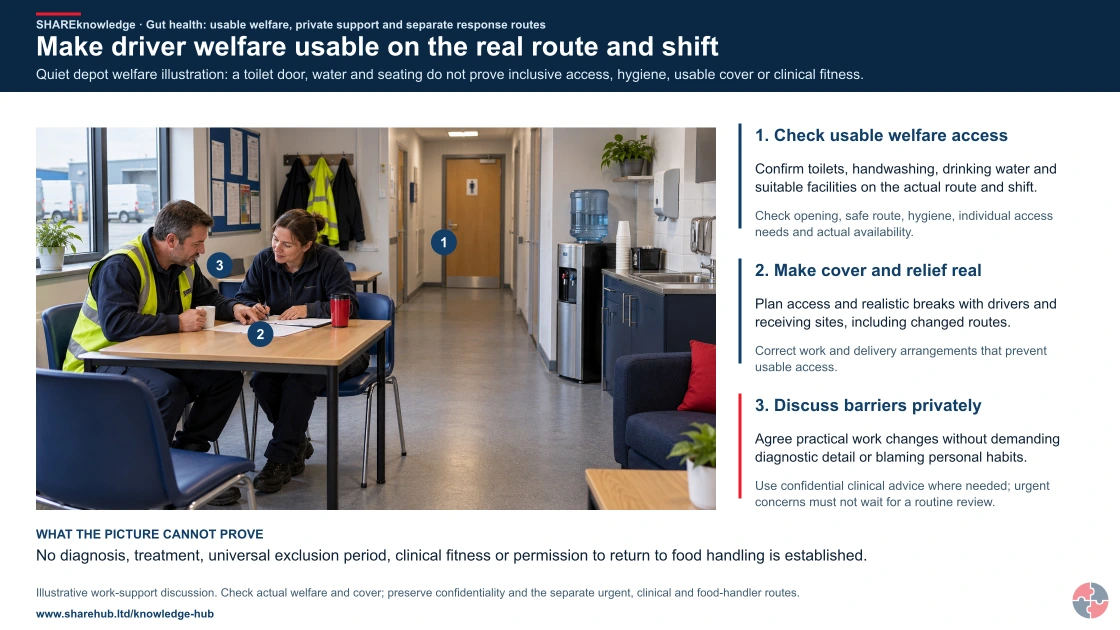
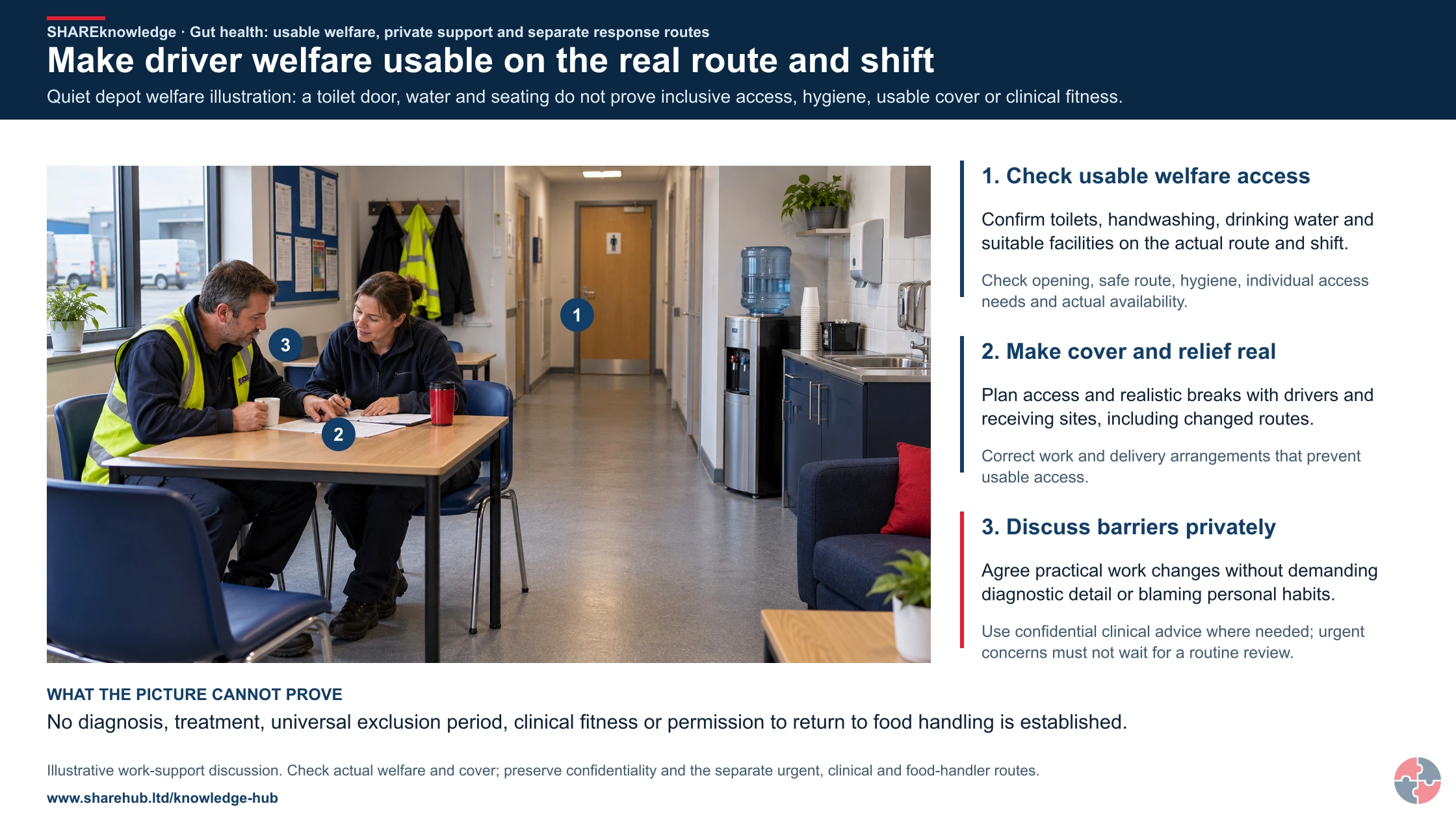
Make driver welfare usable on the real route and shift
Full written explanation
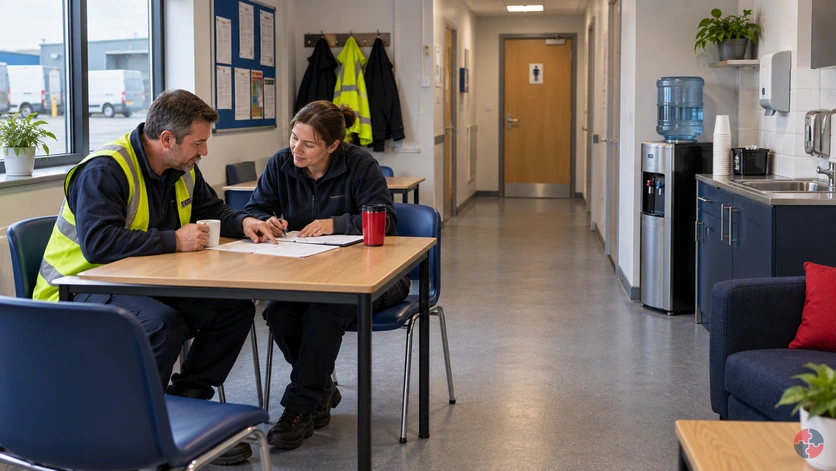
A new realistic UK driver-welfare scene shows a driver and coordinator discussing inert route-cover papers, with a closed toilet door, drinking-water dispenser, sink and seating nearby. Numbered prompts ask whether facilities and the route are usable, whether breaks and relief can actually happen, and whether work barriers can be discussed privately. A sign or clean-looking room does not prove accessibility, hygiene, drinking-water safety or out-of-hours access. No medical record, diagnosis, digestive anatomy or dietary judgement is shown. The existing professional consultation scene supports a distinct confidential advice route; a manager must not diagnose the worker. The second native explainer separates urgent clinical or exposure response, food-handler illness arrangements and routine work-support improvements without introducing treatment or a universal return period.
Quiet depot welfare illustration: a toilet door, water and seating do not prove inclusive access, hygiene, usable cover or clinical fitness.
- Check usable welfare access. Confirm toilets, handwashing, drinking water and suitable facilities on the actual route and shift.
- Make cover and relief real. Plan access and realistic breaks with drivers and receiving sites, including changed routes.
- Discuss barriers privately. Agree practical work changes without demanding diagnostic detail or blaming personal habits.
Change the pathway
- A facility on paper is not access. Check opening, safe route, hygiene, individual access needs and actual availability.
- A reminder cannot create relief. Correct work and delivery arrangements that prevent usable access.
- Keep professional decisions separate. Use confidential clinical advice where needed; urgent concerns must not wait for a routine review.
Evidence check: No diagnosis, treatment, universal exclusion period, clinical fitness or permission to return to food handling is established.
Connect usable welfare and private work support to the separate clinical and food-safety routes
Primary references: HSE visiting-driver welfare access · HSENI welfare facilities · FSA fitness-to-work route for England, Wales and NI · NHS current stomach-pain help route · Food Standards Scotland separate guidance overview
Open the complete HD image (new tab)Download image
Connect usable welfare and private work support to the separate clinical and food-safety routes
Primary references: HSE visiting-driver welfare access · HSENI welfare facilities · FSA fitness-to-work route for England, Wales and NI · NHS current stomach-pain help route · Food Standards Scotland separate guidance overview
Use both the page’s control-planning shorthand and the HSE five-level hierarchy as related planning tools. The five levels are elimination, substitution, engineering, administrative controls and PPE. ERICPD separates reduction and isolation, and adds Discipline to sustain the chosen measures. Neither framework is a medical treatment or a separate statute. Start by removing a work-created barrier, then consider a less hazardous task or process and engineered separation before procedures or PPE. If elimination is infeasible because the service must run, record why and test the stronger feasible alternative. The HSE hierarchy and HSE hierarchy of controls explain the two lenses.

| Material work hazard and higher controls | Engineering and administrative controls | Owner, check, failure and stop |
|---|---|---|
| Toilet, water and relief barriers: eliminate a locked or inaccessible facility and an unrealistic target. Change a schedule (administrative control), route or staffed post that allows relief. ERICPD Reduce means shorten heat or travel exposure; Isolate means provide clean welfare outside the process area. These changes outrank a hydration reminder. | Engineering: accessible drinking points, adequate toilets, clean eating areas and physical separation from contamination. Administrative: relief roster, mobile welfare stops, inspection and worker feedback. PPE is for a separate assessed heat or contamination hazard, never a replacement for welfare. GB welfare law; HSENI welfare guidance. | Operations manager checks every shift and visiting-driver access. Repeated missed breaks, closed toilets or water shortage show failure; pause or reassign safety-critical work when safe relief cannot be arranged. Discipline means maintaining facilities and acting on reports, not blaming staff. |
| Food-handler illness: eliminate open-food exposure by taking the ill handler off that task. A trained replacement or closed/prepacked service may substitute if genuinely safe; the business need not eliminate the entire food service where safe cover exists. ERICPD Isolate separates ill staff and affected food/surfaces. | Engineering: suitable handwashing and clean food/welfare separation. Administrative: illness reporting, restriction, cleaning decision, cover and return assessment under FSA fitness-to-work guidance. PPE or gloves cannot make an actively ill food handler safe to prepare open food. In Scotland, follow FSS fitness-to-work guidance. | Food business manager verifies restriction, cleaning and competent cover. Vomiting, diarrhoea, suspect contamination or unavailable safe replacement means stop open-food handling or affected service. Discipline is consistent reporting and follow-up. |
| Process exposure mistaken for gut illness: eliminate the suspect substance or task where practicable; substitute a safer chemical/process after assessing new hazards. ERICPD Reduce lowers intensity and duration; Isolate contains the source and separates people. A wellbeing leaflet cannot control an occupational exposure. | Engineering: enclosure or ventilation designed for the actual hazard. Administrative: COSHH or relevant hazard assessment, maintenance, monitoring, training and health/exposure referral. PPE is selected only for residual assessed exposure and cannot replace source control. HSE hierarchy. Assess the applicable GB or NI COSHH route for this task. | Task owner and competent safety/occupational-health adviser check controls and symptom pattern. A suspected exposure, failed engineering control or acute illness means stop the task and use the site emergency/medical route; investigate before restart. |
For a new or changed facility, the facilities owner checks that toilets, drinking points, cleaning and safe eating areas are installed, accessible and usable before the shift starts; a supervisor tests the relief route with the actual staffing. For food work, the food-business manager checks the restriction and cleaning route before service; for chemical or heat exposure, a competent person verifies the engineered control against the task assessment before restart. Keep routine inspections, defect actions, worker feedback and change reviews. A failed facility, unstaffed relief plan or failed engineered control triggers a hold, not a reminder to be more disciplined.
A supervisor should test the arrangement during the least convenient shift, not only in an office-hours inspection. Ask whether a lone worker can actually be relieved, whether a driver can use the site facilities, whether water is accessible outside a contaminated process area, and whether an adjustment still works after a roster change. HSENI welfare guidance and HSE driver-welfare guidance make availability and access practical tests.
How can the ERICPD hierarchy of controls reduce work factors that aggravate digestive symptoms?

Use the five-level table to distinguish physical engineering controls from administrative arrangements. Read the illustration alongside this explanation.
| ERICPD control level | Topic-specific example | Source and full task context |
|---|---|---|
| Eliminate | Remove locked welfare facilities and unrealistic work targets. | Read the full task example, checks and stop points on this page. HSE hierarchy · GB welfare rules · NI welfare rules · HSENI welfare guidance · FSA fitness-to-work guidance · FSS fitness-to-work guidance · GB · NI · HSE driver-welfare guidance |
| Reduce | Assess a schedule or staffed post that allows reliable relief. | Read the full task example, checks and stop points on this page. HSE hierarchy · GB welfare rules · NI welfare rules · HSENI welfare guidance · FSA fitness-to-work guidance · FSS fitness-to-work guidance · GB · NI · HSE driver-welfare guidance |
| Isolate | Keep clean welfare separate from contaminated work. | Read the full task example, checks and stop points on this page. HSE hierarchy · GB welfare rules · NI welfare rules · HSENI welfare guidance · FSA fitness-to-work guidance · FSS fitness-to-work guidance · GB · NI · HSE driver-welfare guidance |
| Control | Provide usable facilities, relief cover and an illness-reporting route. | Read the full task example, checks and stop points on this page. HSE hierarchy · GB welfare rules · NI welfare rules · HSENI welfare guidance · FSA fitness-to-work guidance · FSS fitness-to-work guidance · GB · NI · HSE driver-welfare guidance |
| PPE | PPE cannot replace welfare or make an ill food handler safe. | Read the full task example, checks and stop points on this page. HSE hierarchy · GB welfare rules · NI welfare rules · HSENI welfare guidance · FSA fitness-to-work guidance · FSS fitness-to-work guidance · GB · NI · HSE driver-welfare guidance |
| Discipline | Check real access every shift and act on failed facilities. | Read the full task example, checks and stop points on this page. HSE hierarchy · GB welfare rules · NI welfare rules · HSENI welfare guidance · FSA fitness-to-work guidance · FSS fitness-to-work guidance · GB · NI · HSE driver-welfare guidance |
How can the five-level hierarchy of controls reduce work factors that aggravate digestive symptoms?

Use the five-level table to distinguish physical engineering controls from administrative arrangements. Read the illustration alongside this explanation.
| Control level | Topic-specific control | Owner, check and hold point | Sources and full task context |
|---|---|---|---|
| Elimination | Remove avoidable work barriers such as locked welfare facilities and targets that prevent necessary access. | Manager verifies real access throughout the shift rather than relying on a welfare poster. | HSE hierarchy · GB welfare rules · NI welfare rules · HSENI welfare guidance · FSA fitness-to-work guidance · FSS fitness-to-work guidance · GB · NI · HSE driver-welfare guidance |
| Substitution | No separate hazard substitute is demonstrated by changing a rota or cover plan. Assess a genuinely less hazardous replacement task or process where relevant. | Task owner checks the replacement and new risks. Rota and relief changes remain administrative controls. | HSE hierarchy · GB welfare rules · NI welfare rules · HSENI welfare guidance · FSA fitness-to-work guidance · FSS fitness-to-work guidance · GB · NI · HSE driver-welfare guidance |
| Engineering controls | Provide adequate accessible toilets, drinking-water points, suitable clean eating facilities and physical separation from contamination. | Facilities owner checks physical provision, accessibility and defects before the shift; PPE cannot replace welfare. | HSE hierarchy · GB welfare rules · NI welfare rules · HSENI welfare guidance · FSA fitness-to-work guidance · FSS fitness-to-work guidance · GB · NI · HSE driver-welfare guidance |
| Administrative controls | Arrange relief staffing, breaks and routes, inspections, private reporting, infection exclusion and role-specific return-to-work decisions. | Supervisor verifies actual relief and access; food-business manager checks applicable food-safety clearance. Illness is not diagnosed by a manager. | HSE hierarchy · GB welfare rules · NI welfare rules · HSENI welfare guidance · FSA fitness-to-work guidance · FSS fitness-to-work guidance · GB · NI · HSE driver-welfare guidance |
| PPE | Use task-selected protection for remaining chemical, biological or cleaning exposure. | Competent assessor checks residual risk; PPE cannot make an ill food handler safe or replace water, toilets and cover. | HSE hierarchy · GB welfare rules · NI welfare rules · HSENI welfare guidance · FSA fitness-to-work guidance · FSS fitness-to-work guidance · GB · NI · HSE driver-welfare guidance |
How can gut health be included in a wellbeing campaign?
A gut-health campaign should promote practical habits without shaming people or collecting unnecessary personal health information.
The best campaigns focus on everyday behaviours: drinking enough water, eating more fibre if suitable, moving more, taking breaks, sleeping well, washing hands before eating and using official NHS/HSC or public-health guidance or qualified clinical advice for symptoms. Avoid body-shape messages, weight competitions, public pledges or anything that makes people feel watched.
Campaigns should also ask whether the workplace makes good choices realistic. A poster about fibre does little if night workers have no food access, drivers have no welfare stops or call handlers avoid water because toilet breaks are discouraged.
Ask whether healthy food and safe storage are actually available and affordable across shifts, and whether messages respect different cultures, medical diets and personal circumstances. Offer choices and practical access rather than weight targets or a single approved eating pattern. The GOV.UK Eatwell Guide is a general public-health signpost, not an employer diet prescription.
Before launching a campaign, ask workers on every shift whether water, toilets, breaks and suitable food access actually work. Use optional official NHS/HSC or public-health guidance, anonymous feedback and facility checks to review it. Avoid supplement claims, weight contests and collection of symptom histories: those can distract from work barriers and intrude on private health matters.
How should gut-health conversations be handled confidentially?
Gut-health conversations should be private, respectful and limited to the work impact and support needed.
Managers do not need a detailed symptom history to support someone. They may need to understand whether the worker needs flexible toilet access, temporary duties, remote work, shift adjustment, recovery time, medication storage or occupational health referral.
Records should be factual and minimal. For example, record the agreed adjustment and review date rather than personal digestive details. Where health data is processed, HR and data-protection arrangements should be followed.
In Great Britain, the GOV.UK reasonable adjustments explains the Equality Act 2010 duty for disability-related disadvantage. In Northern Ireland, the nidirect NI disability employment rights identifies the Disability Discrimination Act 1995 route. Neither route means every digestive symptom is a disability; decide support from the individual work barrier, current law and competent advice.
| Conversation point | Better question | Poor practice to avoid |
|---|---|---|
| Work impact | What makes the working day difficult at the moment? | What exactly is wrong with your stomach? |
| Support | Would changes to breaks, duties, travel or shift pattern help? | You need to eat better. |
| Medical advice | Have you been able to access appropriate health advice if needed? | I think you have this condition. |
| Privacy | Who needs to know the work arrangement? | Telling the team why someone needs breaks. |
| Review | When shall we check whether the arrangement is working? | Leaving informal arrangements unmanaged. |
Health information is special-category personal data. Record and share only what is necessary, restrict access, and follow the organisation’s documented Article 6 lawful basis, applicable Article 9 condition, retention and confidentiality arrangements. HR or the data-protection lead should confirm the route; do not assume employee consent is the right basis. An adjustment note may still reveal health information without naming a diagnosis. ICO health-information safeguards. ICO marks this guidance under review; the data-protection lead should recheck it at approval.
Agreed arrangement: A supervisor arranges relief on request and confirms usable receiving-site toilets for the worker’s route. The team sees the cover plan only. Worker and manager agree a review date and check actual access then. Necessary medical detail follows a separate restricted process. Practical interim support need not await a diagnosis; HR separately assesses any statutory adjustment duty and professional fitness referral.
What workplace boundaries should employers understand?
Employers can support conditions for healthy routines, but they should not police private diet or make medical decisions.
A workplace can offer information, facilities, flexible arrangements, occupational-health referral and supportive leadership. Avoid diet judgement, public or unnecessary questioning, pressure to join challenges and using wellbeing campaigns as performance management. Do not request unnecessary or public details about bowel symptoms. Minimum relevant information may be needed for food safety, work safety, adjustments or professional referral: give it privately to the designated manager or clinical route. The wider team generally needs only the cover plan or work restrictions. This includes staff entering food-handling areas where contamination could occur, regardless of job title.
Where a digestive condition affects attendance or work ability, the correct route is fair absence management, reasonable adjustments where relevant, occupational health advice and review.
| Area | Supportive | Overreach |
|---|---|---|
| Food | Provide options and facilities. | Dictating diets or judging body size. |
| Hydration | Make water accessible. | Punishing reasonable toilet use. |
| Health conditions | Consider work adjustments. | Demanding unnecessary diagnosis details. |
| Campaigns | Share official NHS/HSC or public-health guidance. | Promoting unverified health claims. |
| Records | Keep necessary adjustment notes. | Recording intimate symptoms without need. |
What changes when a food handler is ill?
Food handling adds a customer-protection decision: privately report relevant illness and keep affected people away from open food or food-handling areas where contamination could occur, following the business fitness-to-work procedure. This can include maintenance and other staff entering those areas. For suspected infectious vomiting or diarrhoea, stay off work until at least 48 hours after the last episode, following current public-health advice. This precaution extends beyond food handling. A known non-infectious condition needs individual advice; food handlers and other higher-risk roles also follow their role-specific return or clearance requirements.
The Food Standards Agency fitness-to-work guidance normally requires 48 hours after symptoms stop naturally before working with or around open food. Apply current FSA guidance in England, Wales and NI, the food-safety system and competent local advice. For suspected infectious vomiting or diarrhoea, reassignment must not circumvent the general stay-off-work precaution. A known non-infectious condition needs individual advice. Record restrictions and return decisions privately.
In Scotland, use Food Standards Scotland’s fitness-to-work guidance. It also uses a normally 48-hour period after symptoms stop naturally, but allows a different route where infection is ruled out and says some infections require medical clearance. The food-business manager should check which nation’s source and any competent local instruction applies before releasing open-food duties. The 48-hour food-handler rule must not be applied as a universal exclusion from every job.
For a leisure-centre café, the supervisor removes an ill food handler from preparation, checks affected food and surfaces and follows the cleaning and incident route. The manager arranges cover and checks role-specific return or clearance against current guidance. A receptionist with a suspected stomach bug also stays off work for at least 48 hours after the last vomiting or diarrhoea episode; they have different role-specific controls. A worker with a known non-infectious chronic condition receives individual support and advice rather than automatic infection exclusion.
NHS stomach-bug work advice; nidirect vomiting and diarrhoea advice. Managers do not diagnose infection or waive exclusion because a worker feels better.
What do supportive gut-health scenarios look like in real workplaces?
Good gut-health support removes practical barriers without turning personal health into a public performance issue.
Gut-health support becomes much easier to understand through ordinary examples. Most workers do not need a clinical conversation; they need a working day that allows drinking water, eating at a sensible time, using toilets without embarrassment and asking for temporary support when symptoms flare.
The strongest workplace response is usually quiet and practical. A manager does not need to know a diagnosis to arrange cover for breaks, plan welfare stops, adjust a shift, allow medication storage, or refer the person to occupational health where the work impact is more complex.
| Scenario | What can go wrong | Supportive response |
|---|---|---|
| Night-shift leisure worker with poor meal access | The worker relies on vending snacks, skips proper meals and uses caffeine to get through the shift. | Provide fridge/microwave access, planned breaks, hydration prompts and realistic night-shift food guidance. |
| Delivery driver with limited toilet breaks | The worker reduces fluid intake and delays toilet use, increasing discomfort and fatigue. | Plan routes with welfare stops, avoid punitive tracking culture and discuss reasonable flexibility privately. |
| Office worker with stress-related digestive symptoms | Symptoms worsen before difficult meetings and the worker avoids raising concerns through embarrassment. | Review workload, stressors, break flexibility and signpost to qualified health support if symptoms persist. |
| Employee with a long-term digestive condition | Rigid shift, uniform, travel or toilet arrangements make attendance harder than the actual work task. | Consider reasonable adjustments, occupational-health advice, privacy and a review date. |
| Wellbeing campaign focused on diets and weight | People feel judged, excluded or pressured to disclose personal information. | Reframe around hydration, breaks, fibre awareness, movement, sleep and official NHS/HSC or public-health signposting. |
| Construction or event worker eating in unsuitable areas | Food is eaten near dust, chemicals, waste or dirty clothing because welfare is poor. | Improve rest/eating facilities and separate contamination from food areas. |
How should gut-health support change across work settings?
The welfare and privacy principles stay the same, while the practical barrier changes: relief at a fixed safety post, safe food handling in catering, toilet stops for drivers, and clean eating areas in industrial work.
| Setting | Likely barrier | Owner and useful evidence |
|---|---|---|
| Leisure and hospitality | Early and late shifts, poolside heat, public-facing relief and café illness. | Duty manager: cover rota, welfare check and food-handler fitness decision. Sources: GB welfare · NI welfare · FSA food-handler guidance · FSS food-handler guidance. |
| Manufacturing, garages or energy | Process contamination, PPE, heat, remote areas and production peaks. | Operations manager: clean welfare separation, safe relief and exposure assessment. Sources: GB welfare · NI welfare. |
| Haulage, delivery and warehouses | Route targets, loading-site access, agency shifts and temperature. | Transport manager and receiving site: realistic welfare stops and accessible facilities. Sources: HSE driver welfare · GB welfare · NI welfare. |
| Office, retail or call centre | Monitored toilet use, customer queues, lone coverage and stress. | Line manager: staffing/target review, worker feedback and private adjustment plan. Sources: HSE stress standards · GOV.UK reasonable adjustments · nidirect NI disability employment rights. |
The owner starts with the barrier created by the job, not an assumed diagnosis. At a fixed safety post, the duty manager arranges qualified relief so the worker can reach a usable toilet without leaving the activity uncovered; if safe cover cannot be provided, the affected activity must wait under the site operating procedure. For a driver, the transport manager checks the route and receiving-site welfare before dispatch, then changes stops or timings if access is unreliable. For an ill food handler, the food-business manager removes open-food duties and makes the return decision under the current national fitness-to-work guidance.
Close the loop by checking the arrangement on the shift and with the worker, recording only the work control and review date. A locked toilet, repeated missed relief or an unworkable delivery route is a defect to assign and close, not merely a wellbeing message. The responsible manager should provide a safe interim arrangement and hold the affected work where the essential control cannot be maintained.
A manager should confirm that each control works in practice by asking staff on different shifts, sampling access and closing reported defects. The work condition can be changed without asserting that it caused any individual illness.
How could Riverside Leisure Ltd manage this in practice?

Riverside Leisure Ltd would support gut health through welfare standards, shift planning, food access, privacy and non-judgemental wellbeing communication.
In this worked example, Riverside Leisure Ltd has lifeguards, reception staff, cleaners, cafe workers, maintenance staff and event teams. Work includes early starts, late finishes, public-facing roles, hot poolside areas, physical cleaning tasks and occasional event catering. Gut-health support would be managed as part of wellbeing, welfare, sickness support and shift-work risk assessment rather than as a personal discipline campaign.
A café worker becomes ill during a late shift
Task material and setting: A café worker serving open food at Riverside Leisure Ltd reports vomiting; the late shift is short-staffed and a lifeguard also needs a planned relief break.
People and prerequisites: The café worker, customers, supervisor and duty manager are affected. The manager has the food-safety illness procedure, a relief rota, usable welfare and a confidential reporting route.
Before: The manager checks toilet, water and break access on late shifts, briefs workers on illness reporting and arranges trained cover for food service and safety posts.
During: The supervisor removes the ill worker from open-food handling, follows the food-safety cleaning/assessment route, asks only for information needed for work safety, and arranges cover without leaving the lifeguard post unsafe.
Hold or stop: Food handling stays closed to this worker until the current FSA and local procedure allow return. If safe relief cannot be provided, pause the affected service or task rather than using an untrained stand-in. Scottish fitness-to-work route applies in Scotland; use FSA guidance in England, Wales and Northern Ireland.
Completion and hand-back: The duty manager records the restriction, checks welfare and cleaning, confirms suitable cover, and makes a private return-to-work decision using current guidance and competent advice where needed.
Evidence: Keep the illness/food-safety action record, cover and welfare checks, cleaning decision and review of the late-shift rota. Restrict personal health detail to those who need it.
What awareness or training helps with gut health at work?
Competence is role-specific: workers need a usable reporting and relief route; food handlers, supervisors and managers need demonstrated decisions; specialist health and exposure advice belongs to qualified people.
A briefing alone does not prove that a night-shift café worker can report illness or that a lifeguard can be relieved safely. Use a realistic demonstration and an assessor with the relevant operational or professional competence. Keep a proportionate record of the decision and repeat learning when the task, rota, legal route or control changes; there is no universal gut-health certificate or refresher period. HSE HSG256 supports shift-risk review; FSS and FSA govern the food-handler route by nation.
| Role | Learning and practical demonstration | Assessor, record and reassessment |
|---|---|---|
| All workers and new starters | Understand toilet, water, break and confidential reporting routes; practise how to request relief on their actual shift. | Supervisor observes the route and records induction; repeat after rota, location or welfare change. |
| Food handlers and café supervisors | Demonstrate illness reporting, removal from open food, cleaning/cover decision and nation-specific return check. | Food-business manager observes a scenario, records competence and reassesses after a case, guidance change or observed failure. |
| Safety-critical and mobile workers | Practise safe handover or route-stop decision when urgent welfare is needed; know when to pause work. | Task supervisor checks a realistic handover/stop scenario and keeps authorisation/briefing evidence; reassess after staffing or route change. |
| Line managers and HR | Practise a private conversation focused on work barriers, fair adjustment, minimal records and medical referral boundary. | HR or competent manager reviews a case example and agreed action; reassess after feedback, a new legal route or a significant case. |
| Occupational health, safety and facilities specialists | Apply professional scope to fitness, exposure, welfare and work-design questions; verify controls rather than offering a digestive diagnosis. | Named discipline lead checks professional competence, facilities/exposure evidence and closed corrective actions; reassess after changed risk or guidance. |
What evidence guides workplace wellbeing decisions?
Use the applicable GB or Northern Ireland welfare law and HSE or HSENI guidance for toilets, drinking water, rest and work controls. A private management-system standard is not needed to establish these duties. Any further standard-based claim is held until rights-cleared competent clause review shows how it changes a real workplace decision.
What warning signs show gut-health support is poor?
Poor support is often visible through facilities, break culture, worker embarrassment, absence patterns and intrusive management behaviour.
Respond to a warning sign as a work-design problem. The supervisor should first restore a safe way to take water, use a toilet or obtain relief; facilities or transport management then corrects the underlying access fault. Record the owner, interim measure, worker check and closure date without collecting intimate symptoms. If a safety-critical post cannot be covered or food-safety restrictions cannot be met, pause that activity until suitable cover and controls are in place.
| Warning sign | How harm or difficulty can develop | Action |
|---|---|---|
| Workers avoid drinking water | Dehydration, headaches, fatigue or constipation may become more likely. | Supervisor checks water and toilet access this shift; facilities owner fixes any gap and records worker confirmation. Sources: nidirect water guidance · GB welfare · NI welfare. |
| Toilet access is discouraged | Workers may feel embarrassed, unsafe or unable to manage symptoms. | Duty manager arranges qualified relief now, removes any punitive restriction and checks the rota; hold an uncovered safety post under the site procedure. Sources: GB welfare · NI welfare. |
| Night workers rely on vending only | Irregular eating and poor food choice become built into the job. | Facilities and shift managers check night-shift food and water access, agree a workable alternative and review it with workers. Sources: HSE shift-work guidance · GB welfare · NI welfare. |
| Managers ask for intimate details | Trust is damaged and health data may be mishandled. | Line manager stops intrusive questioning; HR or occupational health advises on work adjustments and checks that private records are limited. Sources: GOV.UK reasonable adjustments · nidirect NI disability employment rights. |
| Campaigns focus on weight | People may feel judged or excluded. | Wellbeing lead revises the message and checks anonymous feedback before relaunch. Sources: GOV.UK Eatwell Guide · HSE stress standards. |
| Welfare complaints repeat | The workplace is ignoring a basic control. | Facilities manager assigns each defect, supplies a safe interim facility and verifies closure with affected shifts. Sources: GB welfare · NI welfare. |
What do the acronyms and key terms mean?
Acronyms should be explained so readers understand support routes and workplace boundaries.
| Acronym | Meaning | Plain-English use |
|---|---|---|
| GP | General Practitioner | Primary medical contact for personal health concerns. |
| OH | Occupational Health | Specialist advice on how health affects work and how work affects health. |
| HR | Human Resources | Employment support, absence, adjustments and policy function. |
| HSE | Health and Safety Executive | GB workplace health-and-safety regulator and guidance provider; use HSENI for Northern Ireland. |
| ACOP | Approved Code of Practice | HSE code giving practical guidance with special legal status. |
| HSENI | Health and Safety Executive for Northern Ireland | Northern Ireland workplace health-and-safety regulator. |
Unlock another resource
You have used this month’s two free downloads. Publish a post in your own words to unlock one more resource, or choose SHARE Individual for 10 downloads per month.
You decide whether to share. If you do, use the relevant platform disclosure tools and do not make claims you do not genuinely hold.