SHARE Knowledge Hub
Fire Safety Regulation, Enforcement and Responsible Persons
Fire safety duties follow who employs people and who controls the actual premises or activity; several parties may share a building. In England and Wales the Fire Safety Order requires a full recorded assessment, cooperation and suitable general fire precautions, while work-process risks may follow a separate HSE or local-authority route. Enforcement notices address duty breaches; prohibition notices address sufficiently serious risk from use. Scotland and Northern Ireland have different legal and enforcement routes, so identify the site before acting on a notice.
Understanding Fire Safety Regulation, Enforcement and Responsible Persons
Fire safety duties follow who employs people and who controls the actual premises or activity; several parties may share a building. In England and Wales the Fire Safety Order requires a full recorded assessment, cooperation and suitable general fire precautions, while work-process risks may follow a separate HSE or local-authority route. Enforcement notices address duty breaches; prohibition notices address sufficiently serious risk from use. Scotland and Northern Ireland have different legal and enforcement routes, so identify the site before acting on a notice.
Why this matters at work
Assurance should distinguish verified facts, open uncertainty and actions requiring resources or restricted use. Misleading closure can leave leaders unaware of exposure. Records must honestly show what was checked and what remains unverified. Effective board review follows the physical or procedural result and preserves the evidence behind continued reliance or the decision to stop.
E/W FSO29 alterations,30 enforcement and31 prohibition notices differ. Article30 specified remedy period is not less28days and is subject36; it is not safe-use permission. Article31 serious-risk restriction takes immediate effect only on the stated imminent serious-personal-injury opinion, otherwise after the notice period. Read the actual terms and protect people while obtaining timely qualified advice.
How organisations manage this in practice
GB general workplace duties use HSWA1974 and Management Regulations1999 within actual undertaking and role scope. HSG65 supports planning, implementation, checking and improvement. HSE risk guidance concerns general workplace assessment; it does not remove current E/W FSO full fire-record duties. NI has separate law. A report alone does not establish implemented precautions.
Fire duties depend on jurisdiction and actual employment or control. Delegated administration and professional assistance can improve delivery, but they do not automatically transfer the statutory allocation. Shared systems may involve several persons whose tasks and decisions must be coordinated. Contracts should clarify implementation while preserving the underlying legal and technical responsibilities. Map employment, control and relevant contractual obligations under the actual national framework, then distinguish those legal duties from delegated tasks. Give managers and advisers adequate scope, information and resources and verify implementation. A landlord, contractor and employer may each retain responsibilities within their control. Use competent legal advice for a disputed allocation rather than treating a job title, insurance policy or signed service agreement as a complete answer.
Read the actual notice and the relevant national provisions to identify notification conditions before making a relevant change. Review proposed occupancy, layout, use, stock and protection with competent advisers and the enforcing authority where required. Maintain safe interim conditions and update the assessment and emergency information. An alterations notice is not an approval of every proposed change, and a building-control submission may not fulfil the separate fire-law notification duty.
Map actual control and resolve a shared-premises impairment together
An alarm fault does not become another party’s problem merely because the contract names a landlord, tenant or managing agent. Map who controls the common system, occupied areas, staff, contractor changes and information. Name who receives the fault, assesses affected use, obtains competent correction, communicates restrictions and accepts restoration.
Keep each dutyholder informed about dependencies they rely on and record decisions rather than assuming the contractor has closed the fault. Select the actual premises nation and notice route before interpreting enforcement requirements. Premises-fire notices and health-and-safety enforcement are distinct; obtain appropriate legal advice for any appeal or suspension question instead of importing a single UK deadline.
The tenant reports the fault; no one owns hand-back
Illustrative example. A cafe reports a common alarm fault while an office move obstructs the shared stair.
Decision. The managing agent and occupiers identify their actual control, clear the obstruction and agree the live-use restriction and restoration owner.
Evidence to check. Dutyholder contact/control map, fault extent, communicated restrictions and competent functional verification.
Hold or escalation point. Do not continue affected use on an assumption that another party or contractor has resolved the warning failure.
Follow-up. All affected parties receive the accepted hand-back and cooperation arrangements are tested after the next change.
Shared premises need clear control boundaries
A shared stair or alarm can connect several organisations. Contracts can allocate work, but they do not automatically transfer statutory duties.
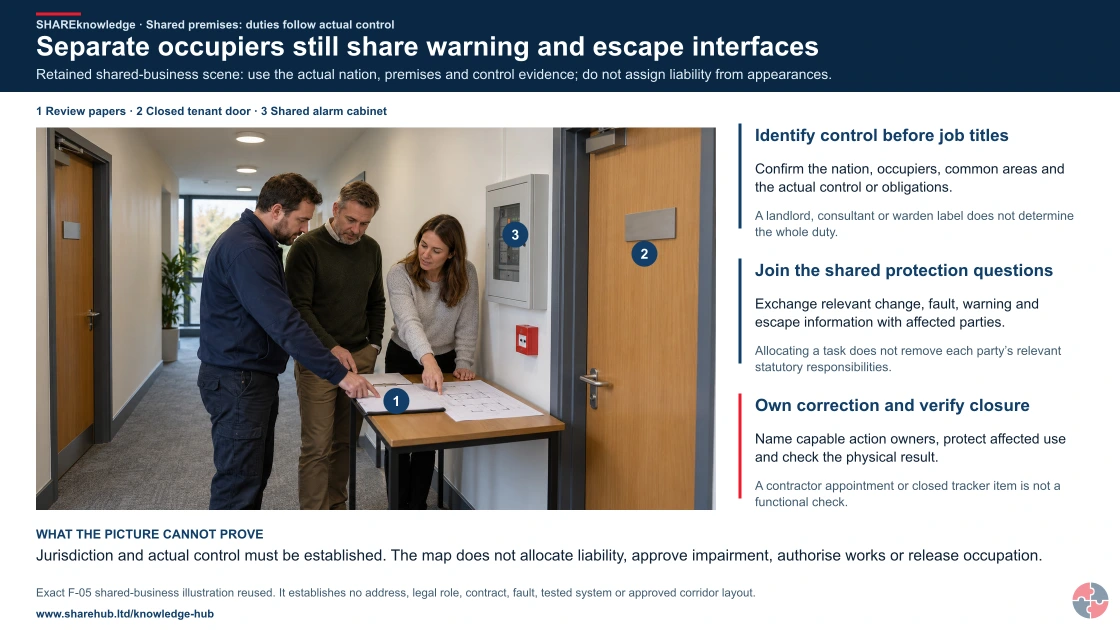
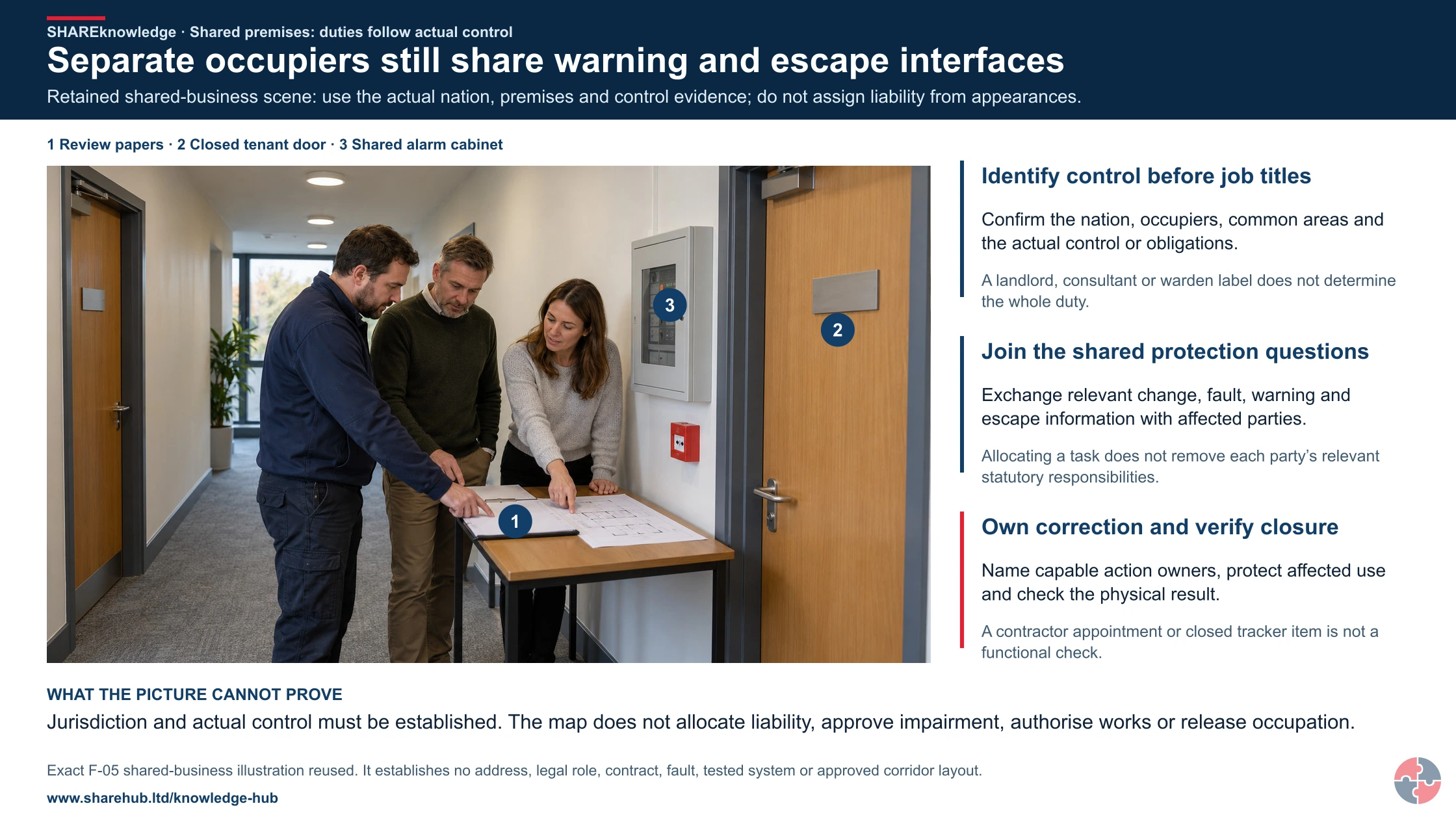
Separate occupiers still share warning and escape interfaces
Full written explanation
The exact retained business-unit scene is reused to locate review papers, a separate tenant doorway and the shared alarm cabinet. New annotations ask about actual employment/control, shared-system responsibilities and verified correction. The people are possible coordination participants, not identified Responsible Persons or contractual parties. It proves no alarm fault, contract, legal allocation, tested system or approved corridor layout. The current topic retains separate national frameworks and enforcement scope. Picture key: 1 Review papers · 2 Closed tenant door · 3 Shared alarm cabinet. The separate process headings are unnumbered.
Retained shared-business scene: use the actual nation, premises and control evidence; do not assign liability from appearances.
- Identify control before job titles. Confirm the nation, occupiers, common areas and the actual control or obligations.
- Join the shared protection questions. Exchange relevant change, fault, warning and escape information with affected parties.
- Own correction and verify closure. Name capable action owners, protect affected use and check the physical result.
Change the pathway
- Responsibility is not a badge. A landlord, consultant or warden label does not determine the whole duty.
- Contracts do not erase interfaces. Allocating a task does not remove each party’s relevant statutory responsibilities.
- Assumed repair is not evidence. A contractor appointment or closed tracker item is not a functional check.
Evidence check: Jurisdiction and actual control must be established. The map does not allocate liability, approve impairment, authorise works or release occupation.
Read the actual-control, cooperation and separate national framework explanation
Primary references: Welsh Government: control and coordination scope · Home Office: offices/shops premises guidance — stated scope · HSE: current construction fire guidance
Open the complete HD image (new tab)Download image
Read the actual-control, cooperation and separate national framework explanation
Primary references: Welsh Government: control and coordination scope · Home Office: offices/shops premises guidance — stated scope · HSE: current construction fire guidance

Map the interfaces
Identify occupiers, common areas, shared protection and who controls each relevant part.
Share necessary information
Communicate changes, impairments and emergency arrangements to those affected through the agreed coordination route.
Own the correction
Name the person or organisation able to correct each gap and verify the actual physical protection.
Check the legal route
Use the applicable jurisdiction and premises duties with competent advice. Keep affected occupants protected until coordinated acceptance is recorded.
Read the complete task-specific control examples
ERICPD is a planning cross-map: Discipline verifies and sustains every control. ESEAP compares effectiveness. A label does not authorise the task; retain the owner, evidence and stop or change decision.
Fire Safety Regulation, Enforcement and Responsible Persons · ERICPD
- Eliminate
- Remove combustible stock and flammable liquid from the plant room; provide a suitable separate store before occupation.
- Reduce
- Provide and maintain the assessed enclosure, fire-resisting separation, doors and warning systems; verify physical protection across shared-premises interfaces.
- Isolate
- Maintain the plant-room fire-resisting enclosure, door closure, electrical installation and warning interfaces that protect shared escape.
- Control
- Record which responsible person controls the room, common route, contractor and alarm; share FRA and defect information and give one action owner a deadline.
- PPE
- Task PPE for an electrician or cleaner may address their separate work exposure; it is not a substitute for plant-room fire precautions or tenant escape.
- Discipline
- Walk the room with both dutyholders, verify stock removal and sample recurring defects after tenant change.
Fire Safety Regulation, Enforcement and Responsible Persons · ESEAP
- Elimination
- Remove combustible stock and flammable liquid from the plant room; provide a suitable separate store before occupation.
- Substitution
- No separate substitute is specified. Compare suitable safer materials, equipment or processes; check new risks before any change.
- Engineering controls
- Provide and maintain the assessed enclosure, fire-resisting separation, doors and warning systems; verify physical protection across shared-premises interfaces.
- Administrative controls
- Record which responsible person controls the room, common route, contractor and alarm; share FRA and defect information and give one action owner a deadline.
- PPE
- Task PPE for an electrician or cleaner may address their separate work exposure; it is not a substitute for plant-room fire precautions or tenant escape.
Who is the responsible person for fire safety?
The responsible person is the person or organisation with control of the premises or work activity, and there may be more than one.
In England and Wales, the responsible person is identified by employment and control under the Fire Safety Order; several parties can have duties in shared premises. An owner cannot pass away its statutory role simply by hiring a managing agent or assessor. Agree which party controls the room, common escape, alarm, contractor and fire risk assessment (FRA) information, then share findings and verify actions in the building. Scotland uses dutyholders under separate fire law and Northern Ireland uses its appropriate-person route.
Use current government guidance and competent task-specific advice; this section does not establish a technical specification.
In non-domestic premises, fire safety duties usually sit with employers, owners, landlords, occupiers and others with control of the premises, such as facilities managers, building managers or managing agents. In shared premises, more than one responsible person may have duties and they must coordinate so the whole building is safe.
Control is the practical test. A tenant may control their work area, a landlord may control common escape routes, a managing agent may control maintenance contracts, and an employer may control staff training and work activities. Fire safety fails when each party assumes another is dealing with the critical interface.
Current fire safety expectations place strong emphasis on written evidence: full fire risk assessment records, fire safety arrangements, assessor identity where applicable, responsible person contact details, cooperation with other responsible persons and information transfer when responsibility changes.
| Party | Likely fire safety control | Evidence to expect |
|---|---|---|
| Employer | Worker training, work activities, emergency procedures, contractors and risk assessment for occupied areas. | FRA, training records, emergency plan and action tracker. |
| Owner or landlord | Common parts, structure, shared fire systems, access, fire doors and maintenance depending on control. | Lease/control records, maintenance contracts and shared fire information. |
| Occupier or tenant | Activities, storage, ignition sources, staff, visitors and local emergency arrangements. | Local FRA, induction, inspections and cooperation records. |
| Facilities or managing agent | Fire alarm, emergency lighting, fire doors, contractor coordination and planned maintenance where delegated. | Contracts, inspection logs, defect close-out and service reports. |
| Competent fire assessor | Assistance with making or reviewing the assessment within competence limits. | Assessor identity, scope, competence evidence and report. |
| Other responsible persons | Shared escape, common alarms, shared plant and whole-building coordination. | Information exchange and coordination meeting records. |
How does fire safety enforcement usually develop?
Enforcement moves from inspection and evidence review to advice, notices, restriction, prosecution or appeal depending on risk and compliance.
Do not treat every fire hazard as enforced by one authority. The Fire Safety Order concerns general fire precautions in E&W, such as escape and warning; HSE or local authorities generally enforce work-process fire precautions such as flammable storage, ignition control and ventilation under work-health rules. Article 25 identifies enforcing authorities and exceptions. The dutyholder still coordinates both routes in the premises risk picture.
Read Fire Safety Order Article 4 for the general-precautions definition, Article 25 for enforcing authority, and HSE work-process fire guidance for the process boundary.
Fire and rescue authorities inspect premises and may check whether the fire risk assessment and fire precautions are suitable. A good responsible person should be able to provide evidence calmly: assessment, actions, training, testing, maintenance, defects, interim controls and management review.
Enforcement should not be treated as a one-off confrontation. It is a signal about control confidence. A notice, letter or inspector concern should trigger root-cause thinking: why was the weakness present, where else might it exist, what action is needed and how will leadership know the risk has reduced?
| Stage | What it means | Responsible-person response |
|---|---|---|
| Inspection or concern | Authority reviews premises, assessment and precautions. | Cooperate, provide accurate evidence and preserve records. |
| Informal advice | Suggested improvements may be given where formal action is not needed. | Risk-rank, assign actions and record completion. |
| Alterations notice | May apply where premises have or may develop high fire risk. | Notify and manage relevant changes before making them. |
| Enforcement notice | May be served where the authority considers a Fire Safety Order duty breached; serious risk is not its required trigger. | Create a clear action plan, interim controls and governance oversight. |
| Prohibition notice | Restricts or prohibits use where fire risk is very serious. | Stop or restrict use immediately as required and seek competent support. |
| Appeal or determination | Formal routes may exist if a notice or technical issue is disputed. | Use proper legal/competent advice and do not ignore notice requirements. |
| Prosecution or penalties | Serious non-compliance may lead to court action, fines or imprisonment. | Preserve evidence, seek legal advice and implement organisational learning. |
How can responsible-person duties fail in shared premises?
A shared commercial building example shows how unclear control can become an enforcement and life-safety issue.
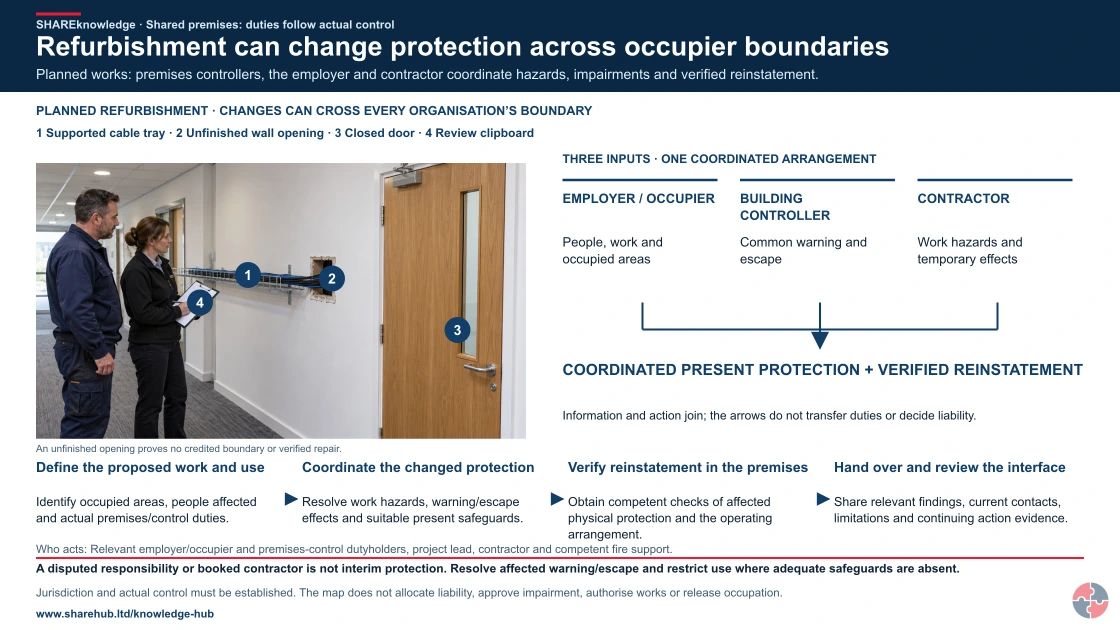
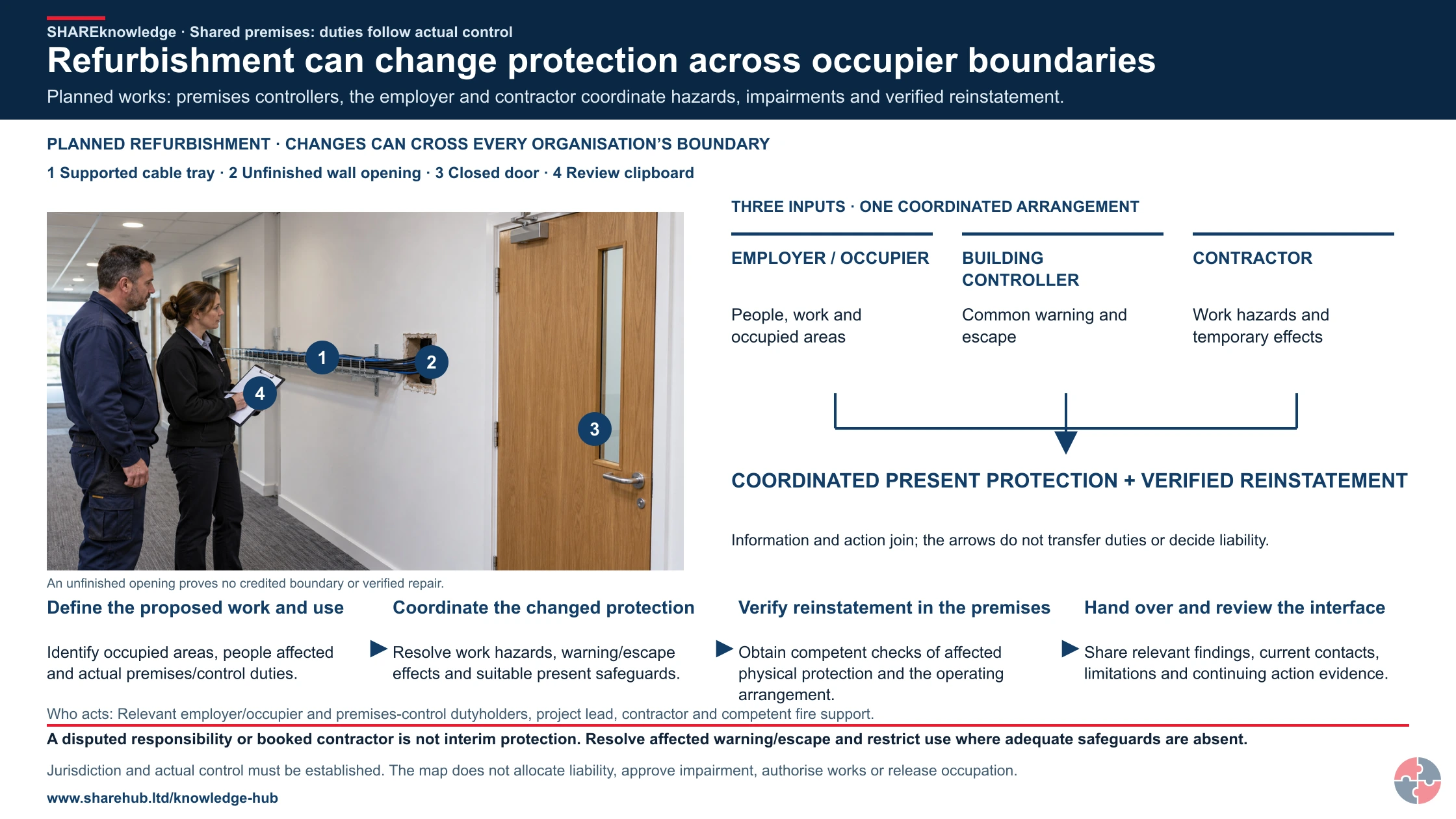
Refurbishment can change protection across occupier boundaries
Full written explanation
An illustrative inactive office-refurbishment scene places continuous supported cables and an unfinished wall opening beside a closed door and a blank review clipboard. Picture key: 1 Supported cable tray · 2 Unfinished wall opening · 3 Closed door · 4 Review clipboard. Three separate analytical inputs identify employer / occupier concerns about people, work and occupied areas; building-controller concerns about common warning and escape; and contractor concerns about work hazards and temporary effects. All three join coordinated present protection and verified reinstatement. Information and action join; the arrows do not transfer duties or decide liability. Four checks define proposed work and use, coordinate changed protection, verify reinstatement in the premises, then hand over and review the interface. Separate process headings are unnumbered. The scene proves no rated or credited wall or door, fire seal, energised condition, repair result, legal role, duty allocation or work, impairment or occupation permission. Jurisdiction and actual control must be established under the current topic national and source qualifications.
Planned works: premises controllers, the employer and contractor coordinate hazards, impairments and verified reinstatement.
- Define the proposed work and use. Identify occupied areas, people affected and actual premises/control duties.
- Coordinate the changed protection. Resolve work hazards, warning/escape effects and suitable present safeguards.
- Verify reinstatement in the premises. Obtain competent checks of affected physical protection and the operating arrangement.
- Hand over and review the interface. Share relevant findings, current contacts, limitations and continuing action evidence.
When the evidence does not fit: A disputed responsibility or booked contractor is not interim protection. Resolve affected warning/escape and restrict use where adequate safeguards are absent.
Who acts: Relevant employer/occupier and premises-control dutyholders, project lead, contractor and competent fire support.
Changed workplace
Multi-tenant building: Trace common-system faults to ownership, present protection and verified repair.
Refurbishment: Coordinate temporary changes and receiving-user evidence across the real control boundaries.
Evidence check: Jurisdiction and actual control must be established. The map does not allocate liability, approve impairment, authorise works or release occupation.
Read the actual-control, cooperation and separate national framework explanation
Primary references: Welsh Government: control and coordination scope · Home Office: offices/shops premises guidance — stated scope · HSE: current construction fire guidance
Open the complete HD image (new tab)Download image
Read the actual-control, cooperation and separate national framework explanation
Primary references: Welsh Government: control and coordination scope · Home Office: offices/shops premises guidance — stated scope · HSE: current construction fire guidance
A three-storey building contains a shop, two offices and a cafe. The landlord controls the common stair, entrance lobby, fire alarm contract and emergency lighting. Each tenant controls their own area and staff. A fire alarm fault is reported by the cafe, but the managing agent assumes the alarm contractor has fixed it. Meanwhile, an office stores boxes in the common stair during a move.
An inspection finds poor cooperation records, unclear responsible-person boundaries, no full shared fire information, blocked common escape and open alarm defects. The solution is not just to remove the boxes. The responsible persons need a cooperation process, shared action tracker, named contacts, escalation rules and evidence that common fire precautions are maintained.
| Issue | Regulatory concern | Competent management response |
|---|---|---|
| Alarm fault not closed | Warning system may not be reliable. | Escalate defect, apply interim controls, repair and retest. |
| Common stair obstructed | Escape route compromised for all occupiers. | Remove obstruction, brief tenants and inspect shared route. |
| Responsibilities unclear | Duties may not be coordinated. | Record responsible persons, scope of control and contact details. |
| Tenant change | Incoming occupier lacks fire safety information. | Transfer relevant FRA, arrangements and shared-building information. |
| Inspector notice | Formal action may require specific improvements. | Create governance action plan and preserve evidence. |
What do Section 156-style responsible-person duties mean in practice?
They strengthen the need to record fire safety information, cooperate and keep fire safety evidence available.
For England and Wales, the 2023 Section 156 commencement requires every responsible person to record the full fire risk assessment and fire safety arrangements, identify an appointed assessor and their organisation where applicable, cooperate with other responsible persons and transfer relevant information on changeover. The separate statutory competence provision for appointed fire risk assessors has not commenced; commissioning a capable assessor remains prudent because the suitable-and-sufficient assessment duty applies now. Do not copy these recording rules into Scotland or NI without checking their law.
Direct guidance: Home Office Section 156 guide for England and Welsh Government companion for Wales.
For practical management, the key message is that responsible persons should keep full fire risk assessment records, record fire safety arrangements, identify fire risk assessor details where applicable, maintain contact information and cooperate with other responsible persons in shared premises.
The duty is not satisfied by owning a report. The records should be current, accessible, aligned with the building as used and capable of being shared with relevant parties where required.
| Duty area | Practical meaning | Evidence |
|---|---|---|
| Full FRA record | Record the assessment in full rather than relying on informal notes. | Current FRA and review history. |
| Fire safety arrangements | Show how fire safety is managed day to day. | Policy, roles, checks, maintenance, training and emergency plan. |
| Assessor identity | Record who helped make or review the assessment. | Name, organisation and scope. |
| Cooperation | Identify and exchange information with other responsible persons. | Written contact and scope records. |
| Information transfer | Pass relevant fire safety information to incoming responsible persons. | Handover pack and confirmation. |
| Resident information where relevant | Provide relevant fire safety information in multi-domestic premises where duties apply. | Resident information record. |
How do fire safety notices differ?
Different notices signal different levels or types of regulatory concern and require disciplined response.
Responsible persons should understand notice types before they receive one. Informal advice may still matter, but formal notices create legal obligations and deadlines. A prohibition notice is especially serious because it restricts or prohibits use where risk is so great that access should be limited.
Under the England and Wales Fire Safety Order, Article 29 deals with alterations notices; Article 30 permits an enforcement notice for a breach of duty; Article 31 addresses prohibition or restriction where use creates sufficiently serious risk; and Article 35 governs appeal. Read the actual notice and local legal route before assuming a deadline or that an appeal suspends restrictions.
The management response should include immediate risk control, legal/competent advice where needed, action tracking, evidence preservation and learning across other premises.
| Notice or action | Typical trigger | Management response |
|---|---|---|
| Informal advice | Improvement needed but formal notice may not be justified. | Record, risk-rank and close actions. |
| Alterations notice | High-risk premises or risk could increase after change. | Notify relevant changes and manage design/control evidence. Source: Direct E&W article. |
| Enforcement notice | The enforcing authority considers that a Fire Safety Order duty has not been complied with. | Plan, resource and complete required improvements by deadline. Source: Direct E&W article. |
| Prohibition notice | Risk is so serious that use/access must be restricted. | Comply from the notice’s stated operative time, take immediate safety precautions where needed, control access and do not resume use contrary to the notice. Source: Direct E&W article. |
| Prosecution | Serious breach or failure to comply. | Preserve evidence, seek legal advice and implement organisational learning. |
For an England and Wales prohibition notice, read its operative time: Article 31 provides immediate effect when the authority states imminent serious personal injury, and otherwise the specified period governs. Article 35 gives a 21-day appeal period from service; an appeal against prohibition does not suspend it unless the court directs. Obtain prompt legal advice and maintain the necessary safety restrictions.
What does the fire enforcement ladder look like?
The enforcement ladder helps responsible persons understand how regulatory concern can move from advice to formal restriction or prosecution.
GOV.UK explains that fire and rescue authorities may inspect premises, check the fire risk assessment and prevention measures, issue informal advice, issue formal notices, prohibit or restrict use where risk is very serious, and that penalties may include fines or imprisonment. The practical lesson is that enforcement should trigger immediate control and organisational learning.
Under the England and Wales Fire Safety Order, Article 29 deals with alterations notices; Article 30 permits an enforcement notice for a breach of duty; Article 31 addresses prohibition or restriction where use creates sufficiently serious risk; and Article 35 governs appeal. Read the actual notice and local legal route before assuming a deadline or that an appeal suspends restrictions.
The ladder is not a guaranteed sequence. A serious risk may move straight to prohibition. Equally, informal advice should not be dismissed just because it is not a formal notice. The responsible person should record the concern, decide whether interim controls are needed, close actions and review whether the same weakness exists elsewhere.
| Level | What it means | Responsible-person response |
|---|---|---|
| Advice or verbal/written comment | The enforcing officer identifies improvement points or explains expected compliance. | Record the issue, risk-rank it and close it with evidence. |
| Informal notice | The authority suggests fire safety measures without using a formal notice. | Treat as a serious signal and track actions through management review. |
| Alterations notice | Premises have high risk or could become high risk if use changes. | Notify relevant changes and control design, occupancy and layout before implementation. Source: Direct E&W article. |
| Enforcement notice | The authority considers a duty breached; the notice specifies remedial steps and a deadline. Serious risk is not a separate Article 30 threshold. | Plan resources, interim controls, owner, deadlines and evidence of completion. Source: Direct E&W article. |
| Prohibition notice | Risk is so serious that use of all or part of the premises must be prohibited or restricted. | Comply from the notice’s stated operative time, take immediate safety precautions where needed, control access and do not resume use contrary to the notice. Source: Direct E&W article. |
| Appeal or determination | A formal challenge or dispute-resolution route may be available. | Seek competent/legal advice while managing immediate risk. Source: Direct E&W article. |
| Penalties or prosecution | Failure to comply or serious breaches may lead to fines or imprisonment. | Preserve evidence, learn at leadership level and correct systemic causes. |
How do responsible-person duties differ by premises?
The legal duty is applied through the real control each party has over a building, workplace or shared area.
Responsible-person duties can look simple in a single-occupier office, but they become more complex in shopping parades, managed office blocks, schools, care premises, industrial estates, construction sites and mixed-use buildings. The key question is always who controls the activity, area, system, route or building feature.
Good arrangements make those boundaries visible. They define who inspects common stairs, who repairs the fire alarm, who briefs contractors, who controls fire doors, who shares information after a tenant change and who responds when a defect affects more than one occupier.
| Premises | Dutyholder complexity | Good evidence |
|---|---|---|
| Single-occupier office | Employer usually controls most arrangements. | FRA, training, maintenance and action tracker in one system. Context: Home Office guide; Home Office Section 156 guide; Welsh Government companion. |
| Managed office block | Landlord/managing agent may control common parts while tenants control work areas. | Responsible-person map and shared defect process. Context: Home Office guide; Home Office Section 156 guide; Welsh Government companion. |
| Shopping parade | Separate occupiers may share rear routes, yards or alarms. | Cooperation records and common escape inspections. Context: Home Office guide; Home Office Section 156 guide; Welsh Government companion. |
| Care premises | Provider controls staff, vulnerable occupants and assisted evacuation. | FRA, staffing assumptions and PEEP/generic evacuation evidence. Context: Home Office residential care fire-risk-assessment guide; Home Office disabled means-of-escape guide. |
| Industrial estate | Yards, hydrants, access roads and shared boundaries may be split. | Access responsibilities and emergency service liaison. Context: Home Office factories-and-warehouses guide; HSE guidance. |
| Construction site | Principal contractor and contractors control temporary works and activities. | Construction phase fire plan, inductions and hot work controls. Context: HSG168 Fire safety in construction. |
| Mixed-use building | Domestic, commercial and common areas interact. | Whole-building information sharing and contact details. Context: Home Office guide; Home Office Section 156 guide; Welsh Government companion. |
How can the hierarchy of controls guide fire precautions selected by the responsible person?
Use the two related frameworks as decision aids: ERICPD names Eliminate, Reduce, Isolate, Control, PPE and Discipline; the HSE five levels are elimination, substitution, engineering, administrative controls and PPE. Start at source, justify any lower-level reliance and verify effectiveness in the field.
The control matrices are illustrations; premises-specific suitability, implementation and specialist design approval remain held for competent review.
A tenant stores cartons and flammable cleaning fluid near shared electrical plant, while lease boundaries obscure who can remove the stock. Ignition can expose staff, visitors and other tenants to smoke.
A fit-out contractor opens a protected-corridor wall used by several tenants; smoke can bypass the compartment while each party assumes another party will fire-stop it.
How can the ERICPD hierarchy of controls guide fire precautions selected by the responsible person?

| Hazard and harm route | ERICPD → five-level control | Task-specific measure and feasibility | Owner, checks and evidence | Failure and stop decision |
|---|---|---|---|---|
| Shared plant-room fuel and ignition | Eliminate → Elimination | Remove combustible stock and flammable liquid from the plant room; provide a suitable separate store before occupation. Control of premises determines who acts, not a label in a lease alone. Source: Home Office guide. | Building owner and tenant agree the area boundary and record removal. Stop plant-room storage immediately. | Stop plant-room storage immediately. |
| Same scenario | Reduce → Substitution | Provide and maintain the assessed enclosure, fire-resisting separation, doors and warning systems; verify physical protection across shared-premises interfaces. Source: HSE guidance. | Tenant purchaser and fire assessor approve specification and revised inventory. Unknown substance prevents storage approval. | Do not proceed if the chosen measure or its field evidence cannot be verified for this task. |
| Same scenario | Isolate → Engineering | Maintain the plant-room fire-resisting enclosure, door closure, electrical installation and warning interfaces that protect shared escape. Source: Home Office guide. | Owner commissions competent inspection and tests; tenants receive impairment notice. Restrict affected use if barrier or warning fails. | Restrict affected use if barrier or warning fails. |
| Same scenario | Control → Administrative | Record which responsible person controls the room, common route, contractor and alarm; share FRA and defect information and give one action owner a deadline. Source: Home Office guide. | Property manager checks coordination minutes and action tracker. Escalate unresolved control gaps to all affected dutyholders. | Escalate unresolved control gaps to all affected dutyholders. |
| Same scenario | PPE → PPE | Task PPE for an electrician or cleaner may address their separate work exposure; it is not a substitute for plant-room fire precautions or tenant escape. Source: Home Office guide. | Employer checks fit and condition for the task. No PPE is credited for visitors. | Do not proceed if the chosen measure or its field evidence cannot be verified for this task. |
| Same scenario | Discipline → Administrative assurance | Walk the room with both dutyholders, verify stock removal and sample recurring defects after tenant change. Source: Home Office guide. | Building owner records shared sign-off. Hold reoccupation if the danger persists or a prohibition notice restricts use. | Hold reoccupation if the danger persists or a prohibition notice restricts use. |
| Contractor opening through shared escape barrier | Eliminate → Elimination | Route the service away from the protected boundary when technically possible and verify the alternative design before drilling. Source: Home Office guide. | Project designer and building owner approve route. Stop any unapproved opening. | Stop any unapproved opening. |
| Same scenario | Reduce → Substitution | Use an existing service route or fewer penetrations with a compatible system, rather than multiple untracked holes. Source: Home Office guide. | Designer checks full assembly and future maintenance. Reject unspecified filler. | Reject unspecified filler. |
| Same scenario | Isolate → Engineering | Install and inspect the required tested penetration seal and preserve door, alarm and corridor protection during work. Source: Home Office guide. | Competent installer and independent checker document the installed detail. Restrict affected occupancy until restored. | Restrict affected occupancy until restored. |
| Same scenario | Control → Administrative | Agree responsibilities across landlord, tenant and contractor; use change permit, impairment notice, alternate escape decision and shared hand-back record. Source: Home Office guide. | Named responsible persons exchange documents under the E&W information-sharing route. Stop work or use if no one owns the breach. | Stop work or use if no one owns the breach. |
| Same scenario | PPE → PPE | Contractor PPE for dust, cuts or electrical isolation has task value but cannot protect occupants from an open smoke path. Source: Home Office guide. | Contractor supervisor checks the task assessment; do not credit PPE for the public corridor. | Contractor supervisor checks the task assessment; do not credit PPE for the public corridor. |
| Same scenario | Discipline → Administrative assurance | Audit the installed seal, drawing and common action register after fit-out and at tenant handover; escalate repeated gaps to dutyholders. Source: Home Office guide. | Property manager and tenant leads sign field verification. Keep restrictions until evidence and conditions agree. | Keep restrictions until evidence and conditions agree. |
How can the ISO 45001 hierarchy of controls guide fire precautions selected by the responsible person?

| Hazard and harm route | ERICPD → five-level control | Task-specific measure and feasibility | Owner, checks and evidence | Failure and stop decision |
|---|---|---|---|---|
| Shared plant-room fuel and ignition | Eliminate → Elimination | Remove combustible stock and flammable liquid from the plant room; provide a suitable separate store before occupation. Control of premises determines who acts, not a label in a lease alone. Source: Home Office guide. | Building owner and tenant agree the area boundary and record removal. Stop plant-room storage immediately. | Stop plant-room storage immediately. |
| Same scenario | Reduce → Substitution | Provide and maintain the assessed enclosure, fire-resisting separation, doors and warning systems; verify physical protection across shared-premises interfaces. Source: HSE guidance. | Tenant purchaser and fire assessor approve specification and revised inventory. Unknown substance prevents storage approval. | Do not proceed if the chosen measure or its field evidence cannot be verified for this task. |
| Same scenario | Isolate → Engineering | Maintain the plant-room fire-resisting enclosure, door closure, electrical installation and warning interfaces that protect shared escape. Source: Home Office guide. | Owner commissions competent inspection and tests; tenants receive impairment notice. Restrict affected use if barrier or warning fails. | Restrict affected use if barrier or warning fails. |
| Same scenario | Control → Administrative | Record which responsible person controls the room, common route, contractor and alarm; share FRA and defect information and give one action owner a deadline. Source: Home Office guide. | Property manager checks coordination minutes and action tracker. Escalate unresolved control gaps to all affected dutyholders. | Escalate unresolved control gaps to all affected dutyholders. |
| Same scenario | PPE → PPE | Task PPE for an electrician or cleaner may address their separate work exposure; it is not a substitute for plant-room fire precautions or tenant escape. Source: Home Office guide. | Employer checks fit and condition for the task. No PPE is credited for visitors. | Do not proceed if the chosen measure or its field evidence cannot be verified for this task. |
| Same scenario | Discipline → Administrative assurance | Walk the room with both dutyholders, verify stock removal and sample recurring defects after tenant change. Source: Home Office guide. | Building owner records shared sign-off. Hold reoccupation if the danger persists or a prohibition notice restricts use. | Hold reoccupation if the danger persists or a prohibition notice restricts use. |
| Contractor opening through shared escape barrier | Eliminate → Elimination | Route the service away from the protected boundary when technically possible and verify the alternative design before drilling. Source: Home Office guide. | Project designer and building owner approve route. Stop any unapproved opening. | Stop any unapproved opening. |
| Same scenario | Reduce → Substitution | Use an existing service route or fewer penetrations with a compatible system, rather than multiple untracked holes. Source: Home Office guide. | Designer checks full assembly and future maintenance. Reject unspecified filler. | Reject unspecified filler. |
| Same scenario | Isolate → Engineering | Install and inspect the required tested penetration seal and preserve door, alarm and corridor protection during work. Source: Home Office guide. | Competent installer and independent checker document the installed detail. Restrict affected occupancy until restored. | Restrict affected occupancy until restored. |
| Same scenario | Control → Administrative | Agree responsibilities across landlord, tenant and contractor; use change permit, impairment notice, alternate escape decision and shared hand-back record. Source: Home Office guide. | Named responsible persons exchange documents under the E&W information-sharing route. Stop work or use if no one owns the breach. | Stop work or use if no one owns the breach. |
| Same scenario | PPE → PPE | Contractor PPE for dust, cuts or electrical isolation has task value but cannot protect occupants from an open smoke path. Source: Home Office guide. | Contractor supervisor checks the task assessment; do not credit PPE for the public corridor. | Contractor supervisor checks the task assessment; do not credit PPE for the public corridor. |
| Same scenario | Discipline → Administrative assurance | Audit the installed seal, drawing and common action register after fit-out and at tenant handover; escalate repeated gaps to dutyholders. Source: Home Office guide. | Property manager and tenant leads sign field verification. Keep restrictions until evidence and conditions agree. | Keep restrictions until evidence and conditions agree. |
At a logistics park the landlord may control shared yards and alarms while a tenant controls charging; in a hotel refurbishment the owner, operator and contractor may each control different precautions. Record that control map, inspect the boundary in the field and restrict affected use when no party can demonstrate a working escape measure.
What must shared dutyholders record and verify?
Name each party’s actual control, affected people, common precautions, hazard-to-harm route, chosen hierarchy measures, evidence and escalation owner.
For a shared plant room, record which party can remove tenant stock, who controls electrical plant and fire doors, who tests alarms and who notifies other tenants. For a contractor opening in the protected corridor, record the design detail, temporary restriction, installer, checker and signed hand-back.
If an enforcement or prohibition notice is received, record the precise article, terms, deadlines and affected use; take legal advice on appeals while meeting immediate safety restrictions. A notice does not substitute for an active risk decision.
When should responsible persons escalate fire safety regulation concerns?
Escalation is needed when duties are unclear, evidence is missing, enforcement action is possible or risk is not being controlled.
A responsible person should not wait for an inspector to identify a serious gap. Missing FRA records, unclear shared-premises responsibilities, overdue fire actions, alarm or route impairments and unresolved competent-assessor findings all need management attention.
Escalation should identify who has control, what immediate risk exists, what interim control is needed, who must be informed and what evidence will close the matter.
| Trigger or question | Immediate action | Evidence before normal operation |
|---|---|---|
| Has the premises, occupancy or work activity changed? | Review the fire risk assessment and decide whether the current controls still work. | Updated assessment, action tracker and briefing record. |
| Is a critical fire precaution impaired? | Apply temporary controls and escalate to the responsible person. | Impairment record, competent repair and retest evidence. |
| Is the finding outside internal competence? | Seek competent fire safety advice before making assumptions. | Scope of advice, report, decision record and action closure. |
| Did a drill, alarm, inspection or incident reveal weakness? | Investigate the cause and update the arrangement. | Learning record, corrective action and re-test. |
| Could delay expose people to smoke, heat or blocked escape? | Stop normal reliance on the weak arrangement until a safe interim control exists. | Temporary control approval and communication record. |
Where do responsible-person arrangements fail?
They fail when ownership is vague, shared premises are not coordinated, records are incomplete or enforcement findings do not lead to learning.
Fire safety regulation is practical. Effective operational evidence includes visible control: clear responsibility, suitable assessment, maintained precautions, trained people, managed actions and honest review.
Weaknesses usually appear before a serious incident: repeated overdue actions, disputed ownership, informal landlord-tenant assumptions, missing records, contractors working through fire barriers and ignored inspector advice.
| Failure or weak practice | How it develops | What good looks like |
|---|---|---|
| Paper compliance | responsible-person arrangements exists as a document but does not describe real conditions. | Walk the premises, talk to staff and compare records with the work as done. |
| Unowned actions | Findings are made but no one owns budget, deadline or close-out. | Assign accountable owner and escalate high-risk delay. |
| Poor coordination | Landlord, tenant, contractor or shared-premises controls do not join up. | Record responsibilities and information sharing. |
| Unmanaged change | Refurbishment, layout, stock, staffing, plant or contractor changes undermine controls. | Add fire review to change and handover. |
| Weak evidence | Certificates and tick sheets exist but do not prove the control works today. | Check defects, retests, drill learning and close-out quality. |
What evidence shows fire safety regulation, enforcement and responsible persons is controlled?
Evidence should show that fire precautions are suitable, available, maintained, tested, understood and reviewed.
Fire evidence should connect the fire risk assessment to real controls. A log book alone is not enough if defects remain open, staff do not know the procedure or equipment cannot be reached during normal work.
Good records show what was checked, what failed, who owned the action, when it was closed and how the responsible person knows the arrangement still protects relevant persons.
| Evidence item | What it should show | Assurance question |
|---|---|---|
| Responsible-person register | Who controls each area and fire precaution is known. | Names, addresses and scope of control are recorded. |
| Cooperation records | Shared premises and interfaces are coordinated. | Meetings, emails, shared action trackers and handover packs. |
| Enforcement response pack | Inspector findings are converted into controlled actions. | Notice, action plan, interim controls, close-out evidence and learning review. |
| Fire risk assessment | Hazards, people at risk, controls, significant findings, action plan and review triggers are current. | Assessment reflects real premises, not just a template. |
| Action tracker | Actions have owner, date, priority, interim control and close-out evidence. | High-risk actions are escalated when overdue. |
| Inspection and test records | Alarms, emergency lighting, doors, routes, extinguishers and relevant systems are checked. | Records show defects and repairs, not just completed ticks. |
| Training and drill evidence | People understand their role and drills produce learning. | Records include observations and improvements. |
| Management review | Trends, repeat defects, enforcement feedback and major changes are reviewed. | Resources and priorities follow the risk. |
How should fire safety regulation, enforcement and responsible persons be assured?
Assurance should test whether the fire arrangement works in the building, at the time, with the people who may need it.
First-line assurance comes from daily checks, weekly tests, warden observations and immediate defect reporting. Second-line assurance reviews fire risk assessment actions, drills, maintenance, contractor records and repeat findings. Specialist assurance may include competent fire risk assessor review, fire alarm contractor reports, extinguisher servicing, emergency lighting testing and enforcement feedback.
The test is practical: if the alarm operates today, can everyone hear, understand, move, escape, account for vulnerable people and keep routes safe without relying on luck?
| Assurance layer | What to check | What good looks like |
|---|---|---|
| Frontline checks | Workers, supervisors and wardens check that responsible-person duties controls are present, usable and understood during normal work. | Defects are corrected or escalated before people rely on weak controls. |
| Manager review | Managers review assessment actions, drills, inspections, contractor effects, training, maintenance and repeat weak signals. | Action ownership, resources and deadlines match the fire risk. |
| Competent review | Competent fire safety support reviews complex premises, technical assumptions, enforcement concerns or uncertainty. | Advice is recorded, risk-ranked and converted into practical action. |
| Leadership review | Senior leaders review overdue high-risk actions, notices, significant impairments, insurance concerns and recurring failures. | Important fire risks are visible in governance and business planning. |
Which fire-risk-assessment duties apply in each UK jurisdiction?
England and Wales, Scotland and Northern Ireland have separate non-domestic premises fire routes; work and dangerous-substance duties must also be checked for the actual location and activity.
The Dangerous Substances and Explosive Atmospheres Regulations (DSEAR) address relevant dangerous-substance work in Great Britain; the Health and Safety Executive (HSE) or local authority may enforce work-process precautions. Northern Ireland has corresponding but separate legislation and enforcement. A premises fire assessment should still connect these process controls to warning and escape without collapsing the legal routes.
The Fire Safety Order is the England and Wales premises route. Scottish and Northern Irish instruments are separate. GB work-health rules and DSEAR do not silently apply in NI; use the corresponding NI rules where in scope. This table identifies routes, not legal approval for a site-specific strategy.
For this page’s fire assessment and control decisions, Fire Safety Order prevention principles apply in England and Wales, while HSE work-process guidance explains the separate GB route for dangerous substances and ignition from work. Check the corresponding NI rules and regulator for an NI site.
| Jurisdiction | Duty or guidance | What it means | How to apply it |
|---|---|---|---|
| E&W | Regulatory Reform (Fire Safety) Order 2005 | Requires the responsible person to assess fire risk and maintain suitable fire precautions in non-domestic premises. | Use as the main fire safety legal framework for England and Wales. |
| GB | Health and Safety at Work etc. Act 1974 | Requires employers to protect employees and others affected by work so far as reasonably practicable. | Use for work activities that create fire, emergency or firefighting risk. |
| GB | Management of Health and Safety at Work Regulations 1999 | Requires suitable and sufficient risk assessment, preventive arrangements, competent help, emergency arrangements and review. | Use for management arrangements, competence and emergency procedures. |
| GB | Dangerous Substances and Explosive Atmospheres Regulations 2002 | Requires fire and explosion risk from dangerous substances to be assessed and controlled. | Use where flammable substances, gases, vapours, dusts or oxygen enrichment affect the fire arrangements. |
| England | Building Safety Act Section 156 implementation guidance | England guidance on the Fire Safety Order amendments: full FRA record, information sharing and uncommenced appointed-assessor competence provision. | Updated 2023 |
| Wales | Welsh Government Section 156 guidance | Wales guidance on the same Fire Safety Order amendments: full FRA record, information sharing and uncommenced appointed-assessor competence provision. | Updated 2023 |
| Scotland | Fire (Scotland) Act 2005 | Scottish non-domestic premises fire framework. | Assess people and fire precautions in the actual premises. |
| Scotland | Fire Safety (Scotland) Regulations 2006 | Scottish detailed premises precautions. | Warning, escape, maintenance and coordination. |
| NI | Fire and Rescue Services (NI) Order 2006 | NI non-domestic premises fire framework. | Identify the appropriate person and affected premises. |
| NI | Fire Safety Regulations (NI) 2010 | NI detailed premises precautions. | Warning, escape, maintenance and review. |
| NI | Health and Safety at Work (NI) Order 1978 | NI general work-health and safety route. | Control work-created fire and emergency risks. |
| NI | Management Regulations (NI) 2000 | NI risk-assessment and emergency arrangements. | Coordinate workers, contractors, competence and emergency action. |
| NI | DSEAR (NI) 2003 | NI dangerous-substance work-risk route where relevant. | Plan release, ignition and emergency controls. |
In England and Wales, Article 14 of the Fire Safety Order addresses emergency routes and exits; Article 15 addresses procedures for serious and imminent danger, including appropriate drills. The Workplace Regulations 1992 address ordinary traffic routes, not emergency escape routes.
For the England and Wales Fire Safety Order amendments, Home Office Section 156 guidance explains the England implementation, full recorded assessment and uncommenced appointed-assessor provision; Welsh Government guidance gives the corresponding Wales implementation. Scotland and Northern Ireland have different recording tests.
Separate the premises and work-process routes: Fire Safety Order Article 4 defines general fire precautions in England and Wales; HSE work-process fire guidance explains that HSE or the local authority generally enforce process precautions such as flammable storage, ventilation and ignition control under work-health rules. The appropriate enforcing body can differ by premises or activity.
How can BS EN ISO 45001 support fire safety regulation, enforcement and responsible persons management?
A voluntary occupational health and safety system can help management map control boundaries, consult occupiers, allocate action owners and test whether defects are closed across a shared building.
HSE public guidance supports practical management themes. Exact ISO clause mapping requires an authorised licensed copy and specialist review; no clause-level compliance or certification is asserted.
Who needs competence, and how should it be demonstrated?
Test the decisions and actions each role must make in a realistic fire scenario, including faults, absent staff and hand-back.
| Role | Learning to test | Competence demonstration | Assessor and record | Reassessment trigger |
|---|---|---|---|---|
| Workers and occupiers | Recognise common-route or plant-room defects and report them. | Identify the named contact and alarm action. | Occupier supervisor observes induction. | Tenant or route change. |
| Tenant and landlord dutyholders | Map actual control and share fire information. | Resolve a contested plant-room and corridor action owner. | Senior dutyholder records agreement and field closeout. | Lease, tenant or building change. |
| Managing agents and contractor coordinators | Control shared actions, impairments and hand-back. | Demonstrate notification and restriction during a wall opening. | Owner audits work pack and tracker. | New contractor or defect. |
| Fire assessors and legal advisers | Distinguish E&W, Scottish and NI routes and notice thresholds. | Explain Article 30 breach versus Article 31 serious-risk restriction. | Competent peer reviews advice and record. | Law change or notice. |
| Leaders and assurance staff | Resource corrective action and verify cross-party learning. | Sample site condition against full FRA, notices and closeout. | Board or owner records effectiveness review. | Enforcement or repeated failure. |
Plan exercises safely: represent an unavailable route or helper through a briefing or simulation while keeping real emergency exits usable. Agree participation and assistance with the person. Use trained operators and suitable manual-handling assessment; simulate carry-down where practice would create avoidable injury risk. Stop the exercise if it threatens anyone’s safety.
How could Riverside Leisure Ltd manage this in practice?

At Riverside House, a tenant stores cleaning fluid and cartons in a shared plant room while its fit-out contractor opens a corridor fire wall. The owner, tenant and managing agent map their actual control, remove the stock, restrict use of the affected route and commission a specified seal. Each party receives the current full assessment and action log under the E&W coordination route. A competent checker inspects the installed seal and alarm interface, and the owner signs hand-back only after the shared corridor again supports the escape strategy.
A shared commercial building can manage responsible-person duties through recorded control boundaries, common action tracking and evidence-led cooperation.
Riverside Leisure Ltd leases space in a shared building and coordinates with the landlord, cafe operator and maintenance contractor.
| Management element | How the business would manage it | Evidence to review |
|---|---|---|
| Duty map | Defines which party controls alarm, common stairs, tenant areas and training. | Responsible-person register. |
| Information sharing | Exchanges FRA findings and defects with other parties. | Shared action tracker. |
| Enforcement readiness | Keeps records ready for inspection. | FRA, maintenance, drills and training pack. |
| Change control | Tenant fit-out or refurbishment triggers shared fire review. | Handover and review record. |
Riverside hotel fire safety examples
Use these fictional hotel policies and records to see how a manager documents local fire precautions, evacuation arrangements and decisions on shift. Adapt the examples to the premises and obtain local approval before use.
- England Word and PDF pack (ZIP) · England reading copy (PDF)
- Northern Ireland Word and PDF pack (ZIP) · Northern Ireland reading copy (PDF)
- Scotland Word and PDF pack (ZIP) · Scotland reading copy (PDF)
- Wales Word and PDF pack (ZIP) · Wales reading copy (PDF)
Browse all Riverside fire examples in the Policy Builder library
What do the acronyms and key terms mean?
Use these terms to read the fire assessment, legal duties and control decisions without confusing a role, a hazard or a record.
Acronyms can exclude newer readers if they are not explained. This section keeps the main terms available at the end of the page so the article stays readable while still supporting learners and audit users.
| Term or acronym | Meaning | Plain-English use |
|---|---|---|
| FRA | Fire Risk Assessment | A structured assessment of fire hazards, people at risk, controls, emergency arrangements and review needs. |
| HSE | Health and Safety Executive | Great Britain workplace health and safety regulator. |
| HSWA | Health and Safety at Work etc. Act 1974 | Great Britain general work-health and safety statute; Northern Ireland has a separate 1978 Order. |
| MHSWR | Management of Health and Safety at Work Regulations 1999 | Regulations requiring suitable and sufficient risk assessment and management arrangements. |
| DSEAR | Dangerous Substances and Explosive Atmospheres Regulations | GB work-process fire/explosion rules for dangerous substances; NI has separate corresponding regulations. |
| Relevant person | Person exposed to fire risk | Person the premises fire assessment must consider, including workers and visitors where in scope. |
| Responsible person | E&W Fire Safety Order dutyholder | Employer or person with control who has Fire Safety Order duties for the premises. |
| Appropriate person | Northern Ireland fire-law dutyholder | The NI route differs from the E&W responsible-person label. |
| General fire precautions | Premises fire safety measures | E&W Fire Safety Order measures such as risk reduction, warning, escape and firefighting facilities. |
Unlock another resource
You have used this month’s two free downloads. Publish a post in your own words to unlock one more resource, or choose SHARE Individual for 10 downloads per month.
You decide whether to share. If you do, use the relevant platform disclosure tools and do not make claims you do not genuinely hold.