SHARE Knowledge Hub
Fire Alarms and Firefighting
Fire alarms should give prompt, intelligible warning to every person at risk, and firefighting equipment should support only a limited, trained first response where the assessment permits it. Design, testing, impairment controls, escape and staff action must work together in the actual premises. On fire or smoke, raise the alarm, evacuate under the local plan and call the emergency services; never delay escape to protect property.
Understanding Fire Alarms and Firefighting
Fire alarms and firefighting arrangements are parts of a wider fire-safety system. They must be selected from a current assessment of the people, premises, work, fire scenarios and emergency strategy. The required outcome is prompt, intelligible warning and a safe response; it is not merely possession of a panel, detector, bell or extinguisher.
Why this matters at work
Typical hazards include delayed warning, ineffective communication, alarm confusion, smoke and heat exposure, blocked escape, fire growth, explosion, panic, manual-handling injury while using equipment and unnecessary re-entry. Harm can arise when a fire is not detected, a warning is not understood, a response is delayed or the control in front of a worker is unavailable or unsuitable.
System changes can add or remove alarms, alter priorities, change displays, interrupt a communications path, invalidate a response procedure, create a new impairment or introduce a common-cause failure. Apply management of change before modifications to process, building layout, software, sensor, equipment, occupancy, emergency plan, service provider, maintenance interval or security interface.
How organisations manage this in practice
Set clear performance requirements in terms of the safety function: detect or receive warning; alert; communicate; guide; permit safe escape; trigger a defined response where applicable; remain available for the needed scenario; and provide safe recovery when it fails. Avoid assigning detector type, call-point location, sound level, coverage, response time or suppression design without competent, site-specific determination.
Start with credible fire scenarios: ignition sources, fuels, smoke movement, people at risk, escape strategy, business hours, lone work, temporary activity, impaired systems, public access, sleeping accommodation where relevant and hazardous materials. Consider how quickly warning must reach different people and what action is expected after it is received. Design choices must follow this analysis.
Alarm and firefighting equipment must remain available for its intended safety function. The organisation needs an asset register, clear test/maintenance regime, competent providers, defect reporting, records, verification after work and a method to confirm that maintenance has not introduced a new fault. Routine attendance by a contractor is not by itself proof of functional performance.
The fire-risk assessment should define system boundaries and interfaces with doors, smoke control, lifts, shutdown, ventilation, access control, monitoring centres, emergency lighting, suppression, process control and emergency services. A signal transfer is not equivalent to a safe outcome unless the subsequent action, authority, timing, availability and verification are defined.
How can I practise this topic in 3D?
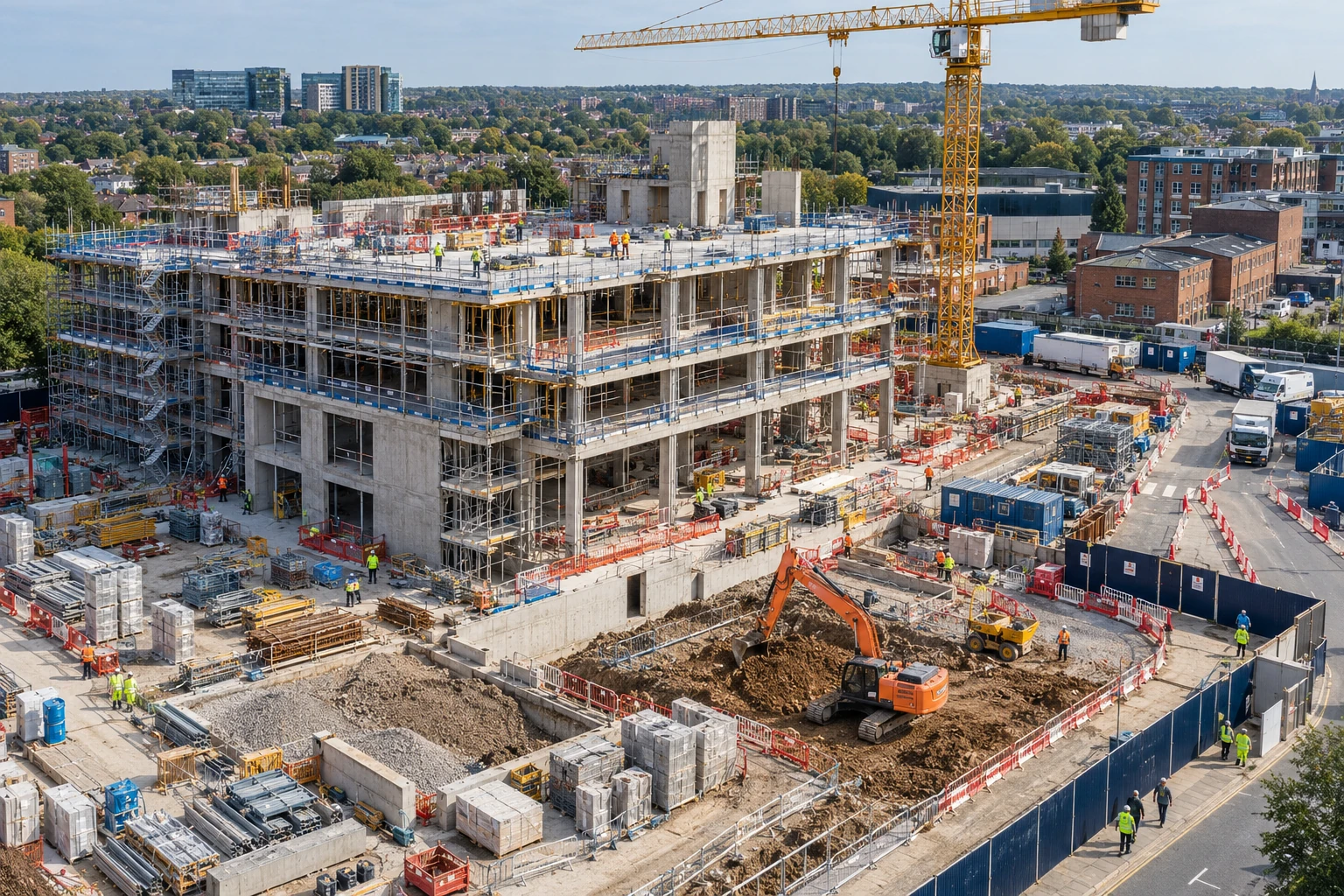

A phase change reveals an alarm and escape gap
All related inspection points 1 across 1 location
Construction site 1 inspection point
Practice in the SHAREhub environment. Browser practice is separate from workplace competence and formal learning records.
Start with the current impairment, then prove the warning and response work
Use this guide for the combined operational decision when warning or first-response equipment is impaired. Identify what has failed, which areas and people depend on it, what the current use involves and who has authority to restrict that use. Temporary controls need competent assessment, named ownership and testing in the actual staffing conditions; merely opening a repair job is insufficient.
After correction, test the affected warning path and interfaces, brief every relevant shift and have the premises owner accept hand-back. A normal panel can coexist with a failed door or message interface. Separately, suitable extinguishing media do not permit staff intervention without trained authority and a safe withdrawal route. Battery, chemical or gas incidents need the relevant specialist plan.
A normal panel with a failed interface
Illustrative example. The panel displays normal, but a credited interface or warning route fails during a check.
Decision. The dutyholder identifies affected use and agrees restrictions and verified interim arrangements while competent repair is arranged.
Evidence to check. Fault extent, occupied areas, current staffing, tested warning/escape path and witnessed restoration.
Hold or escalation point. Hold affected use where warning or escape cannot be relied on; do not improvise firefighting to compensate.
Follow-up. The owner accepts hand-back after functional checks and reviews why the failure was not evident from the panel.
A reset is not evidence of restored warning
Follow an alarm fault from the affected people to verified restoration. Moving work is a temporary management arrangement, not repair of the warning system.

Identify the lost function
Record the device or system, affected areas and people, warning needs and other interfaces.
Protect affected occupants
The named owner decides restrictions and assessed temporary arrangements; do not allow occupancy to depend on a failed essential warning.
Repair and verify
A competent person verifies the repaired function through its relevant end-to-end path, including receipt of warning by users.
Named hand-back
Record test evidence, remaining limits, communication to shifts and the operating acceptance; a cleared panel indication alone does not close the action.
Read the complete task-specific control examples
ERICPD is a planning cross-map: Discipline verifies and sustains every control. ESEAP compares effectiveness. A label does not authorise the task; retain the owner, evidence and stop or change decision.
Fire Alarms and Firefighting · ERICPD
- Eliminate
- Stop the affected occupancy until adequate warning is restored.
- Reduce
- Restore the assessed physical warning system and verify the relevant end-to-end function through competent repair and testing.
- Isolate
- No separate physical-isolation measure is specified. Verify the applicable engineered protection and work arrangements under Control.
- Control
- Repair and function-test detection, sounders and interfaces.
- PPE
- Firefighting PPE is for trained responders, not a substitute for warning.
- Discipline
- Witness test and record the safe hand-back against the fire plan.
Fire Alarms and Firefighting · ESEAP
- Elimination
- Stop the affected occupancy until adequate warning is restored.
- Substitution
- No separate substitute is specified. Compare suitable safer materials, equipment or processes; check new risks before any change.
- Engineering controls
- Restore the assessed physical warning system and verify the relevant end-to-end function through competent repair and testing.
- Administrative controls
- Authorise the impairment, restrict affected occupancy or move work to a suitable unaffected area, define temporary warning and evacuation roles, and verify restoration before named hand-back.
- PPE
- Firefighting PPE is for trained responders, not a substitute for warning.
What do fire alarms and firefighting need to achieve?
A fire risk assessment (FRA) should determine how the premises will detect fire, warn people in time, support escape and provide suitable first-response equipment without delaying evacuation.
A fire alarm system is not just a sounder. It is the way a fire is discovered, confirmed, communicated and acted on. It may include automatic detection, manual call points, a control panel, sounders, visual alarms, voice messages, remote signalling, alarm zones, staff investigation arrangements and procedures for people who cannot hear or understand the warning easily.
Firefighting arrangements are not a licence for staff to take risks. Portable extinguishers, hose reels and trained first responders may stop a very small fire becoming larger, but the primary purpose is life safety. The alarm must be raised first, escape must remain available, the right media must be used and staff must know when not to fight the fire.
The responsible person should be able to show that alarms and firefighting equipment match the fire risk assessment, occupancy, building layout, shift patterns, vulnerable people, public access, contractors, lone work, high-risk rooms and maintenance arrangements.
| Element | Purpose | Professional test |
|---|---|---|
| Fire discovery | Detect or recognise fire early. | Would fire be found quickly in occupied, quiet, noisy and out-of-hours areas? |
| Alarm raising | Tell people there is a fire condition. | Can workers, visitors, contractors and disabled people recognise the warning? |
| Evacuation coordination | Move people to safety. | Are staff roles clear without improvisation? |
| First-response equipment | Allow trained people to tackle a small fire if safe. | Is the equipment right for the likely fire class and location? |
| Fire service interface | Help emergency responders locate and manage the incident. | Are panels, zones and premises information usable? |
| Maintenance and tests | Keep systems available. | Are defects acted on rather than logged and tolerated? |
How should alarm and firefighting arrangements be designed?
They should be based on fire risk assessment, building layout, people at risk, fire growth, escape time and staff capability.
The design question is not 'do we have an alarm and extinguishers?' It is whether the alarm and firefighting arrangements are suitable for the premises. A small office, a warehouse, a school, a care setting, a workshop and a multi-occupied building have different alarm needs, communication challenges, fire loads, evacuation constraints and staff roles.
Fire alarm and firefighting controls should be linked to escape routes, compartmentation, emergency lighting, signage, fire doors, staff training, contractors, public access and business continuity. If one part changes, the others may need review.
| Design question | Why it matters | Example evidence |
|---|---|---|
| How is fire detected? | Delayed detection reduces available escape time. | FRA, detector layout, call point locations. |
| How is warning given? | People must hear, see or understand the warning. | Audibility checks, visual alarm review, staff procedure. |
| Who responds? | Roles prevent confusion and delay. | Warden list, training, drill observations. |
| What equipment is provided? | Wrong media can be ineffective or dangerous. | Extinguisher/media assessment and service record. |
| What happens if a system is impaired? | A disabled alarm zone or missing extinguisher changes risk. | Impairment procedure and temporary controls. |
| How is performance tested? | Systems degrade and people forget. | Weekly test, maintenance log, drill learning. |
How could alarm and firefighting controls fail in a warehouse?
A small fire can escalate when alarms are unclear, equipment is obstructed and staff are unsure whether to fight or evacuate.
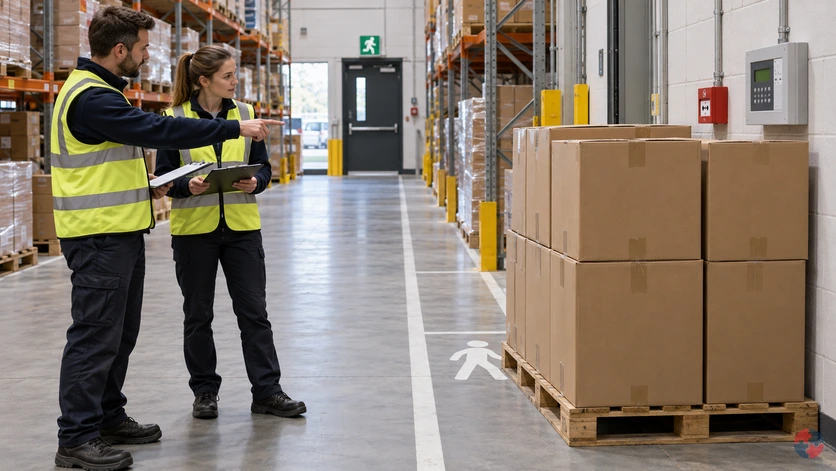
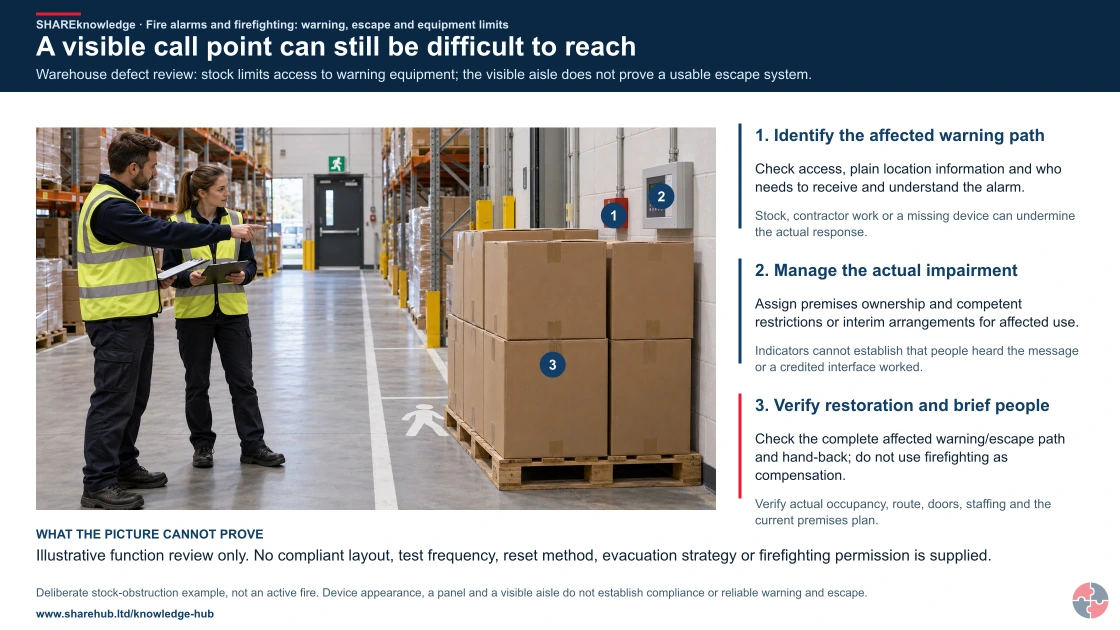
A visible call point can still be difficult to reach
Full written explanation
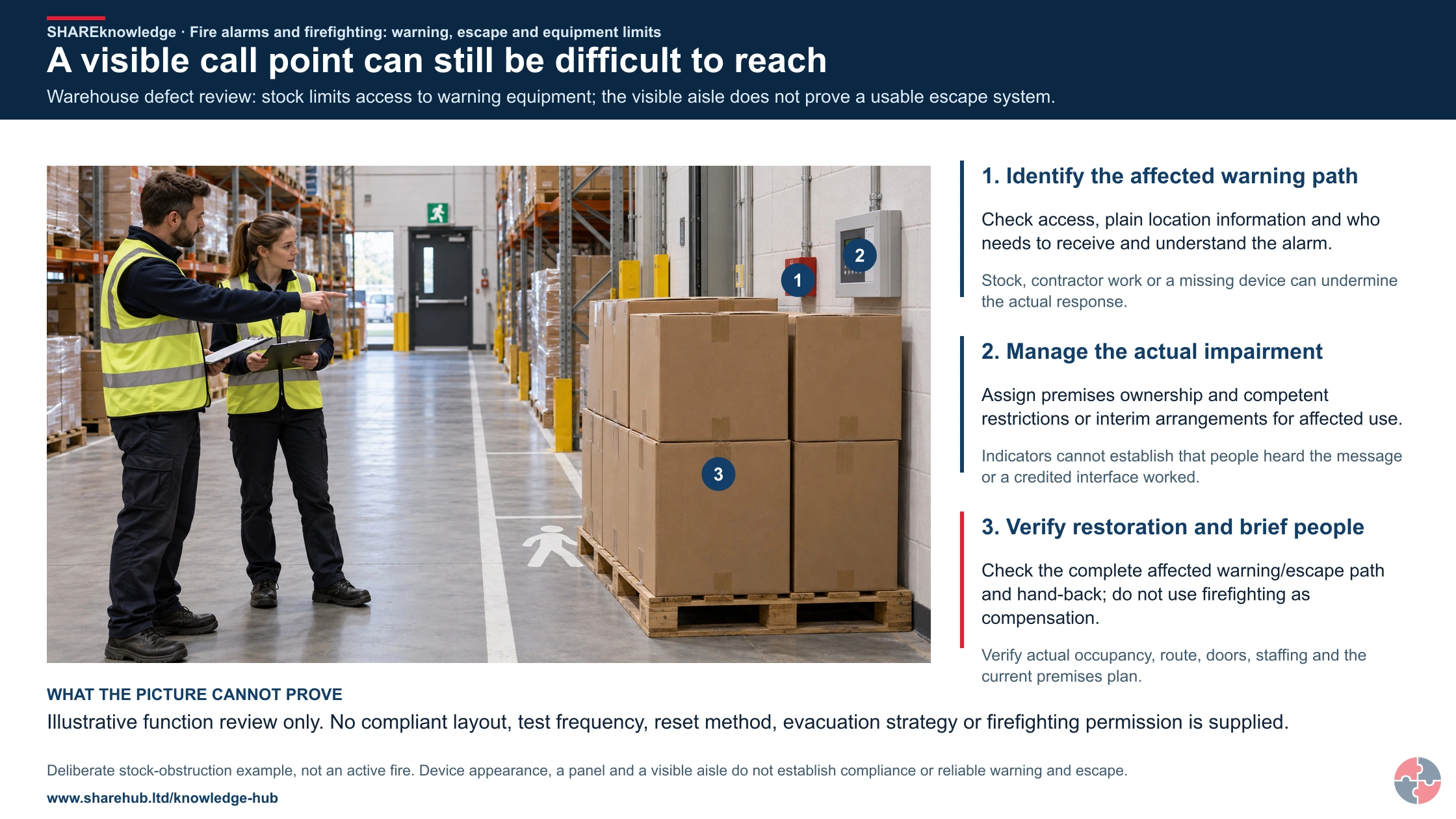
The new inactive warehouse scene deliberately shows cartons in front of a wall-mounted red call point and nearby alarm panel, with two colleagues reviewing the defect from the foreground. Markers locate the call point, panel and obstructing stock. There is no fire or firefighting attempt. The scene does not establish device heights, installed compliance, an intelligible alarm zone, successful warning, a complete escape path or permission for continued use. Checks prioritise warning/escape arrangements, the actual impairment decision and witnessed restoration.
Warehouse defect review: stock limits access to warning equipment; the visible aisle does not prove a usable escape system.
- Identify the affected warning path. Check access, plain location information and who needs to receive and understand the alarm.
- Manage the actual impairment. Assign premises ownership and competent restrictions or interim arrangements for affected use.
- Verify restoration and brief people. Check the complete affected warning/escape path and hand-back; do not use firefighting as compensation.
Change the pathway
- Visible is not accessible. Stock, contractor work or a missing device can undermine the actual response.
- A panel is not the whole function. Indicators cannot establish that people heard the message or a credited interface worked.
- An aisle is not an escape verdict. Verify actual occupancy, route, doors, staffing and the current premises plan.
Evidence check: Illustrative function review only. No compliant layout, test frequency, reset method, evacuation strategy or firefighting permission is supplied.
Review current impairment, functional checks and controlled hand-back
Primary references: GOV.UK: equipment, warning, maintenance and training · GOV.UK: offices and shops — apply the premises and jurisdiction
Open the complete HD image (new tab)Download image
Review current impairment, functional checks and controlled hand-back
Primary references: GOV.UK: equipment, warning, maintenance and training · GOV.UK: offices and shops — apply the premises and jurisdiction
A warehouse has a small electrical fire near a charging area. The manual call point is behind stacked pallets, the nearest extinguisher is missing after contractor work, the alarm panel shows a zone number staff do not understand and several workers delay evacuation while looking for a supervisor. The fire is small at first, but the organisation has allowed several weak signals to align.
A stronger arrangement keeps call points and extinguishers accessible, labels zones in plain building language, trains staff to raise the alarm first, gives wardens defined roles, controls charging areas, tests alarms weekly, records defects and reviews the incident against the fire risk assessment.
| Stage | Weak practice | Stronger standard |
|---|---|---|
| Discovery | Worker investigates smoke alone. | Raise alarm immediately and keep escape route available. |
| Call point | Blocked by stock. | Call points kept visible and checked daily. |
| Alarm panel | Zone number not understood. | Zone information maps to plain location names. |
| Extinguisher | Missing after contractor work. | Daily visual check and contractor handback check. |
| First response | Untrained staff hesitate with wrong extinguisher. | Only trained staff attempt small fires where safe. |
| Learning | Reset alarm and carry on. | Record defect, update FRA and brief learning. |
How should alarm zones, call points and weekly tests be managed?
Alarm management should make the warning reliable and understandable, not just technically present.
Weekly alarm tests should confirm that the system activates and that people can recognise the signal. Rotating call points can help confirm more of the system over time, but the test regime should follow competent advice and the system design.
Alarm zones should make sense to the people who respond. A panel that says 'Zone 7' is weak if wardens, security or the fire service cannot quickly identify the area.
| Item | Good practice | Common failure |
|---|---|---|
| Manual call points | Visible, accessible and near exits or escape routes. | Blocked by stock, furniture or temporary works. |
| Alarm zones | Mapped to clear building locations. | Only technical zone numbers understood by contractor. |
| Weekly test | Regular test, recorded and varied where appropriate. | Same call point tested forever without follow-up. |
| Audibility/visibility | Warning is heard or seen in noisy, isolated and accessible areas. | Staff assume everyone can hear the sounder. |
| False alarms | Investigated and reduced without disabling protection. | Nuisance alarms normalise non-response. |
| Impairment | Temporary controls are authorised and communicated. | Panel faults left open without risk review. |
What should happen when alarms repeatedly activate without a fire?
Investigate the cause and its effect on response, while treating each activation as real under the local procedure.
Repeated unwanted alarms can train people to delay, silence or ignore a real warning. Keep event records with device and zone, conditions, response and cause; look for a pattern after cleaning, cooking, construction, weather, maintenance or process changes.
Have a competent maintainer investigate detector condition, siting, configuration and interfaces. Improve the underlying environment or design through controlled change; do not bypass protection or simply raise thresholds to suppress reports. Brief occupants when action is taken and confirm that the revised system still warns in the scenarios in the fire assessment.
A false-alarm trend is an assurance signal. Review response delays, unwanted fire-service calls, outstanding faults and worker feedback together, then verify that the correction worked across shifts.
How do process and fire-and-gas alarms differ from a building fire warning?
A process alarm prompts a defined operator action; a premises fire alarm warns people to follow the building emergency plan. Some fire-and-gas signals also initiate shutdown or evacuation, so interfaces must be clear.
For a process plant, each safety-relevant alarm needs a known cause, priority, affected plant, required response, available response time and escalation if the operator cannot recover the condition. A display or acknowledgement is not the control action. Test the human response against real staffing, abnormal loads, shift handover and a loss of communications or power.
Standing, repeating and nuisance alarms can hide a critical new signal. A flood during an upset can exceed the operator’s ability to diagnose and act. Reduce avoidable alarm load, prioritise by consequence and required action, provide a safe-state procedure and competent support, and review event data after a flood. Never silence or bypass a safety alarm merely to make a screen quieter.
Fire-and-gas detection, trips, shutdowns and control-room displays may share interfaces but have different functions and integrity needs. A change, fault or isolation requires the process-safety and fire-safety owners to agree which protective functions are affected, whether operations can continue, and what end-to-end test proves restoration. HSE process-alarm and DSEAR guidance is Great Britain guidance; Northern Ireland has separate dangerous-substances regulations and HSENI guidance. Specialist local duties and plant design evidence govern actual settings, response times and safety integrity.
How can everyone receive and understand a fire warning?
Test the warning with the people, tasks and conditions that exist in each part of the premises.
A sounder may be missed in a noisy plant room, by a worker wearing hearing protection, by a lone worker or by a person with a hearing impairment. Visual, tactile, spoken or staff-assisted warning may be needed, but each method must be designed and maintained for the place and escape plan. Do not infer coverage from a device being installed.
Check the whole journey: detection or call point, signal transmission, message meaning, staff action, assisted escape, refuge communication where used, assembly and accounting. Include visitors, contractors, occupied changing rooms and out-of-hours staffing. Consult affected people without collecting unnecessary medical detail.
Exercise credible failures, including loss of power, a missed signal, absent helper and a blocked route. A fire risk assessor and competent alarm designer should resolve coverage, audibility, visibility and interface questions using current design evidence; this page gives no universal sound level or detector spacing.
When must staff leave a fire rather than attempt first-response firefighting?
Raise the alarm and evacuate. A trained person may consider a very limited early response only when the local plan, correct equipment and a clear retreat make it safe.
Leave immediately if smoke builds, visibility falls, the fire grows, a cylinder, battery or unknown chemical is involved, the extinguisher is uncertain, or the way out could be cut off. No worker should be pressed to protect stock or avoid a callout; report the location and hazards to the incident controller from safety.
| Condition | Fight only if | Do not fight if |
|---|---|---|
| Fire size | Very small and early stage. | Flames are spreading or smoke is building. |
| Training | Person is trained and confident. | Person is unsure or pressured. |
| Extinguisher | Correct media is available. | Fire class is unknown or media could react badly. |
| Escape | Clear exit remains behind the person. | Fire is between person and exit. |
| Atmosphere | Smoke, heat and fumes are minimal. | Breathing is affected or visibility is poor. |
| Hazardous contents | No cylinders, flammables or dangerous substances involved. | Cylinder, solvent, battery or process hazard is present. |
How should a workplace decide whether an extinguisher is suitable?
Identify the actual fuel, equipment and conditions in the fire assessment; a trained person must never guess a medium in an emergency.
Ordinary solid materials, flammable liquids, gases, combustible metals and cooking oils have different fire behaviour and can need different equipment. Live electrical involvement adds a separate shock and isolation concern. A multipurpose label is not proof that one extinguisher suits every hazard, especially in a process, kitchen, battery or chemical setting.
Select and position portable equipment with competent advice and the licensed current selection code, BS 5306-8:2023, for its premises scope; BSI says it does not cover motor vehicles, aircraft, caravans or marine craft. Keep equipment and limitations visible, accessible and maintained. The current maintenance code is BS 5306-3:2017. Train any nominated first responder on the actual premises and withdrawal conditions. Alarm, safe escape and emergency-service call always take priority.
For a fuller comparison of fire types and consequences, see Fire: classes and behaviour. That overview is not a substitute for site-specific selection and training.
Which extinguisher matches the fire, and what parts should I recognise?
Identify the fuel and additional electrical hazard, read the actual extinguisher label and follow the site fire plan. Raise the alarm and protect escape first; only trained, authorised people should consider a small initial fire within their safe response limits.
Fire classes and fire extinguishersFire classes · agent types · dangerous mismatches
 Recognise the fuel. Read the extinguisher. Protect your escape.
UK awareness reference for common and specialist portable extinguisher families. Actual ratings, exclusions and manufacturer instructions govern each unit. Reading this guide is not practical training or permission to fight a fire. Fixed systems, hose reels and specialist industrial firefighting require their own assessed arrangements.
What is burning? Understand the fire classes
Class L is the 2026 addition to the classification standard. Existing extinguisher labels and product test claims vary; a new class name does not certify every battery product.
Extinguisher types: uses and dangers
These are typical applications, not universal permissions. Check the label on the actual unit. Images are AI-generated photorealistic teaching illustrations inspired by the referenced equipment; they are not photographs or certified product labels. Use Inspect the parts to explore the hardware. Band, nozzle and label details vary.
| Type and recognition | Typical rating and use | Wrong use: what can go wrong? |
|---|---|---|
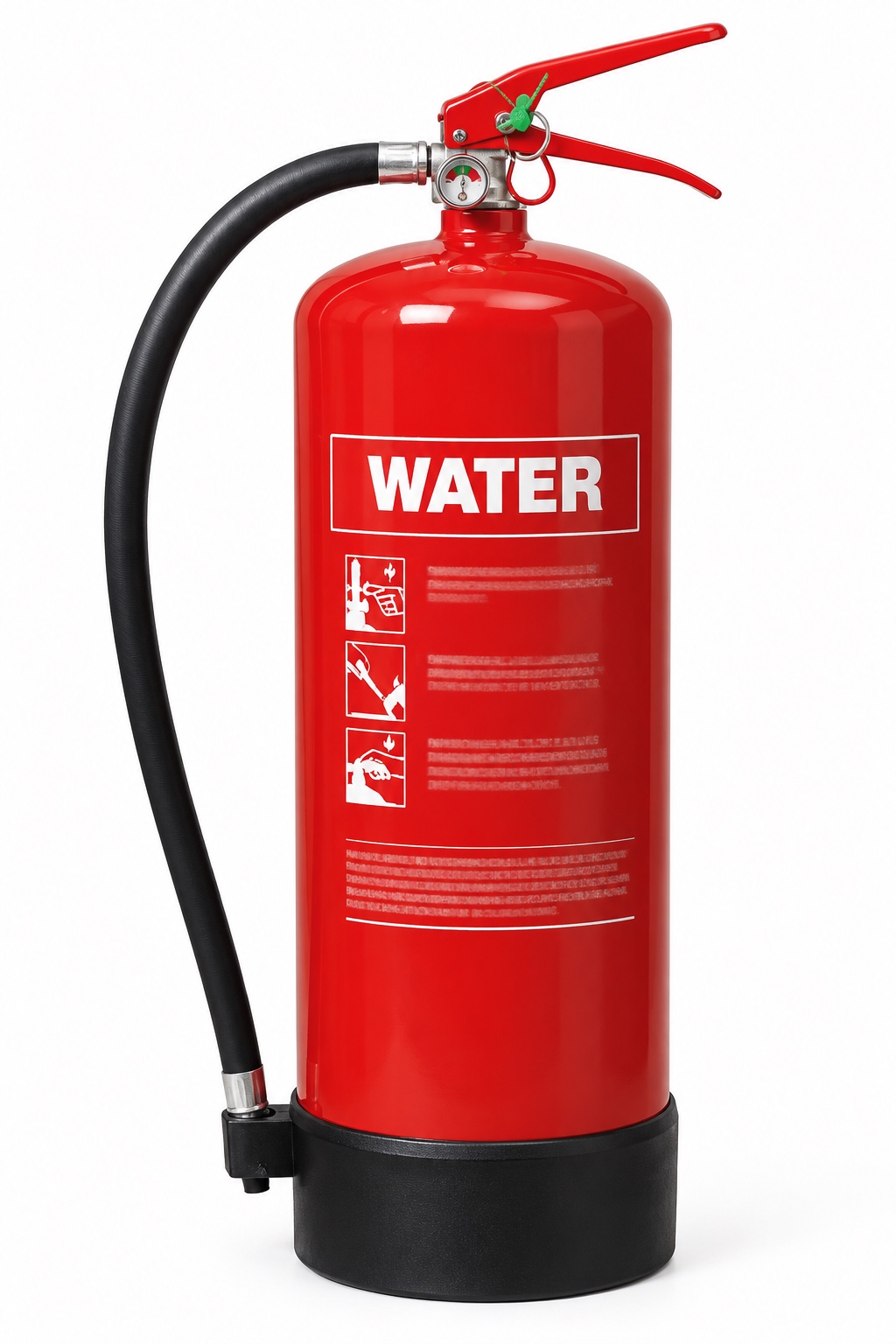  | Normally A Cools burning solid material such as paper, wood or fabric. | Check the limitation Ordinary water is unsuitable for live electrical equipment, flammable-liquid pools, cooking oil and reactive metals: shock, spreading fuel or violent reaction can result. |
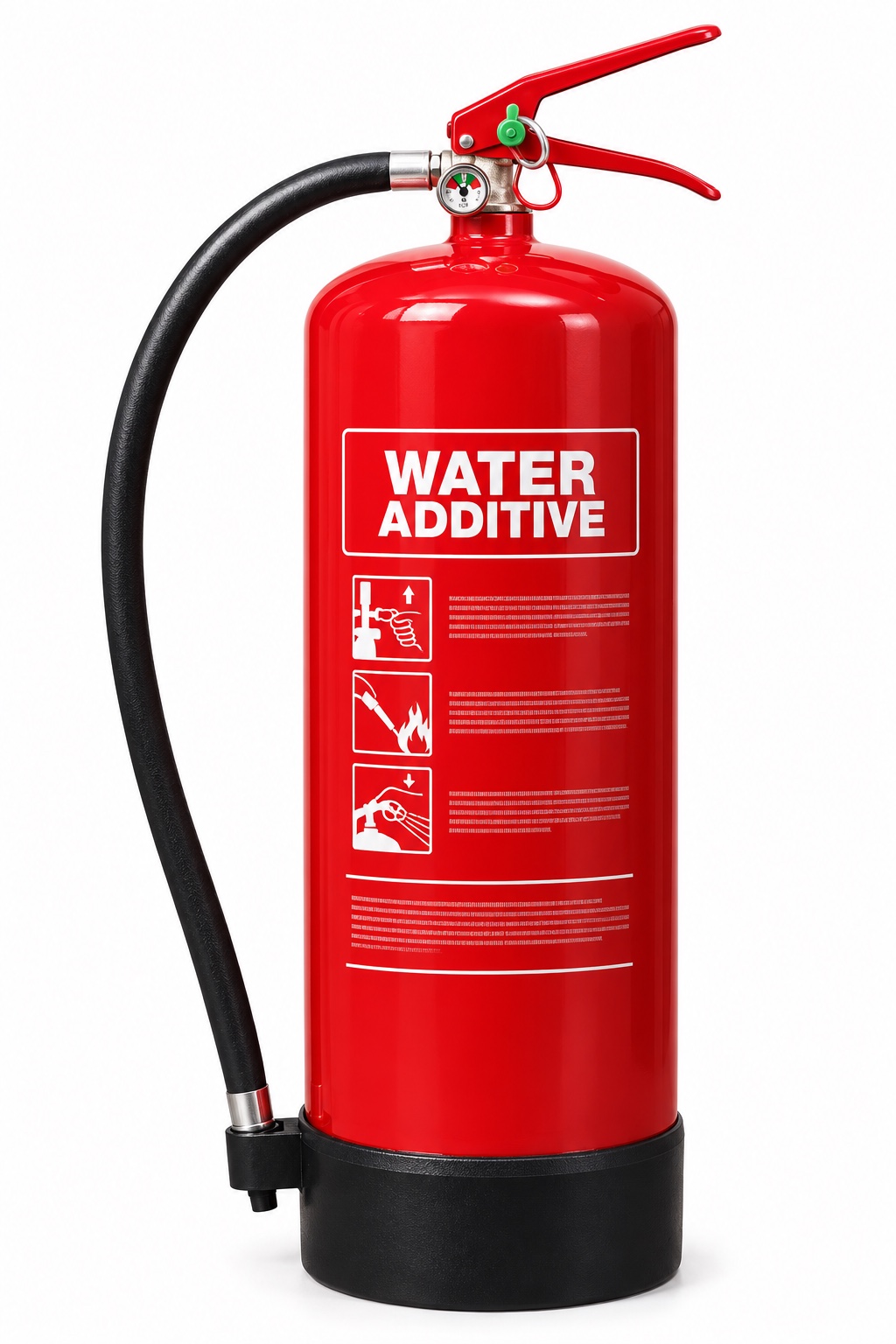 | A; B only if explicitly rated Improved wetting or spray performance can help on the hazards stated on that model’s label. | Check the limitation An additive does not make every water extinguisher safe for electricity, oils or reactive chemicals. Check the specific exclusions. |
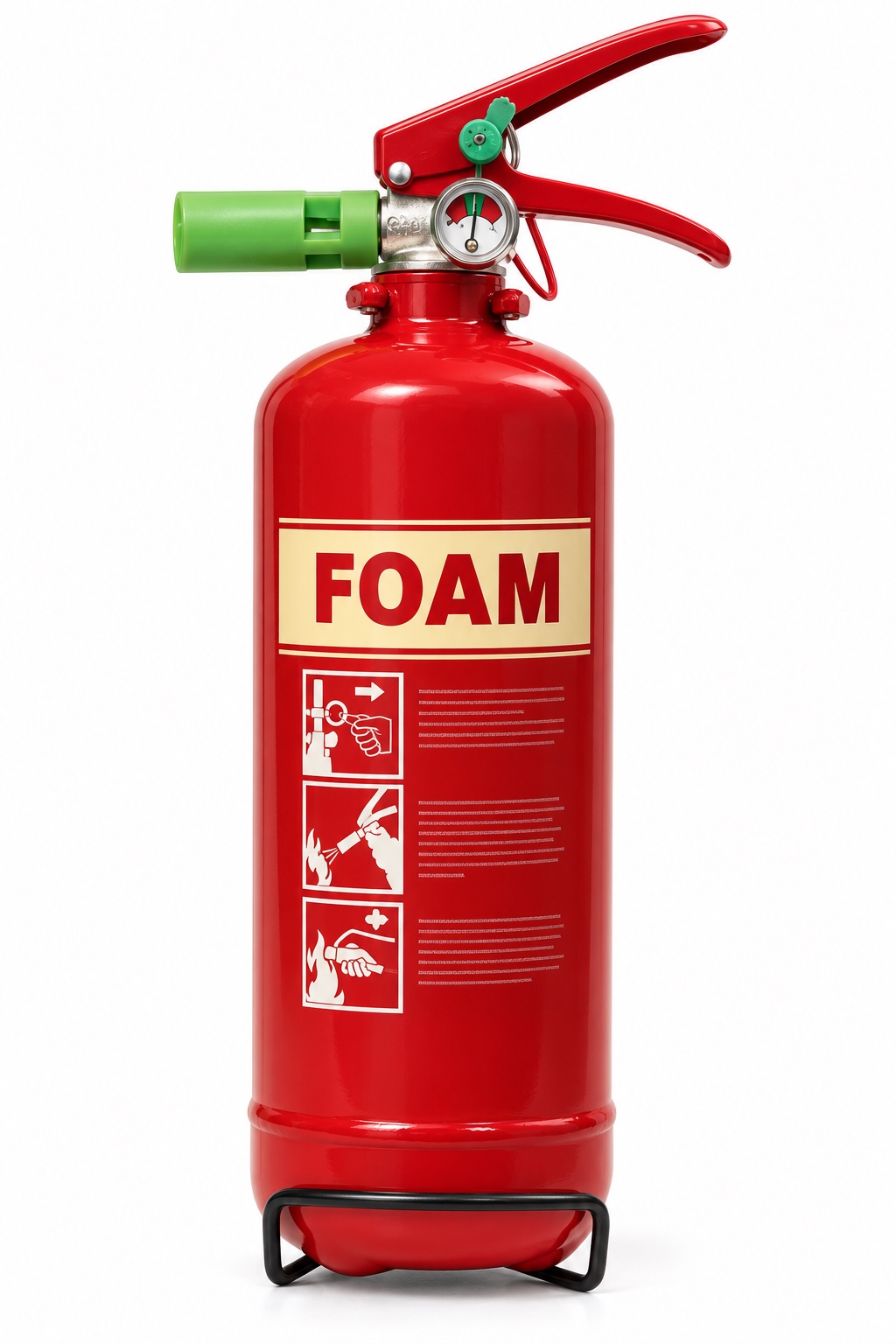 | Commonly A and B Cools and forms a surface blanket on suitable liquid fires. The agent must suit the actual fuel; some alcohols need alcohol-resistant foam. | Check the limitation Ordinary foam is not a general answer for live electricity, cooking oil or metal fires. Unsuitable foam may break down on a solvent; a jet can spread fuel. Free-flowing fuel needs specialist response. |
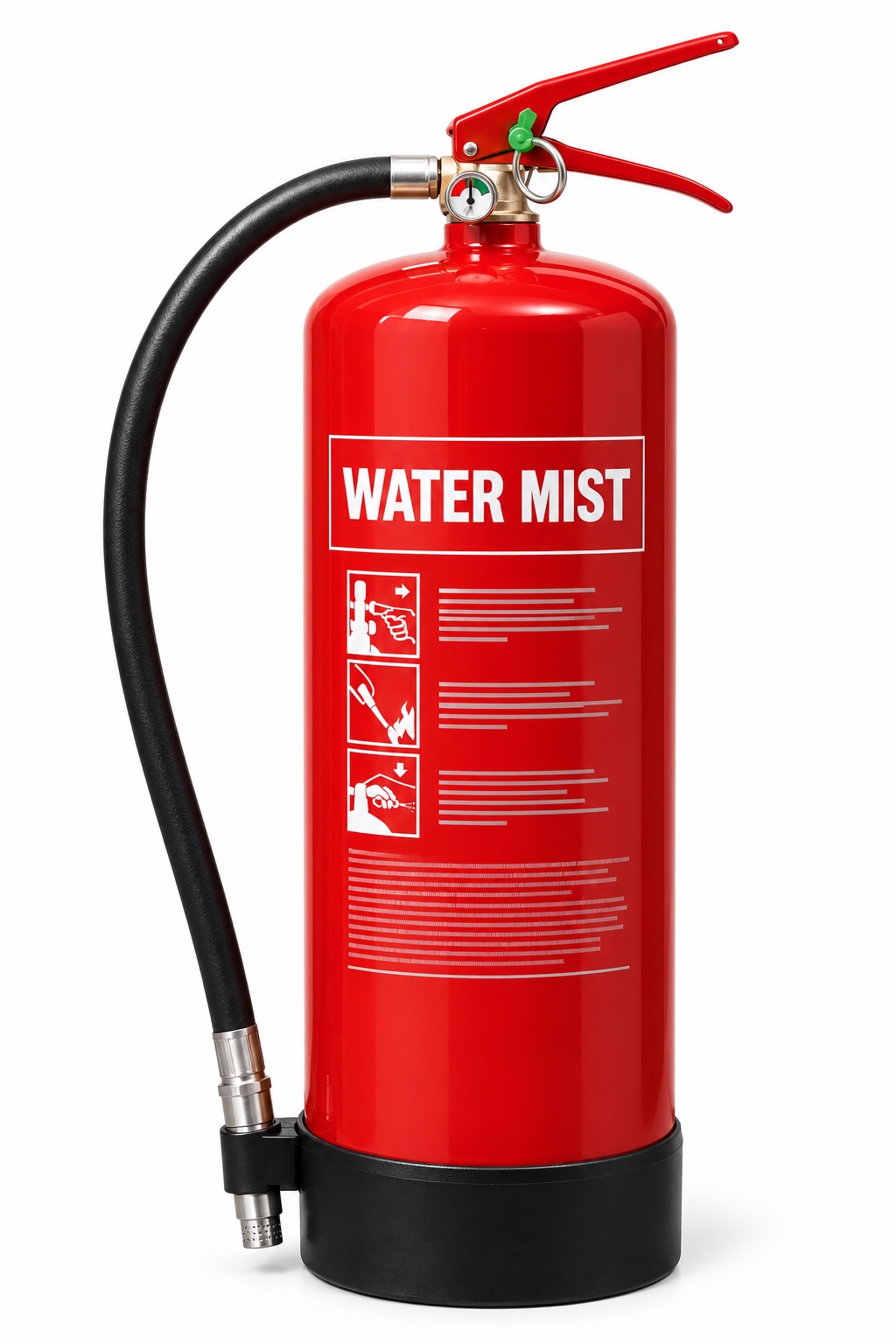 | Model-specific; commonly A, some F Fine droplets absorb heat. Some products have additional ratings or tested electrical suitability, with stated voltage and distance conditions. | Check the limitation ‘Mist’ is not universal approval. Use only the classes and electrical conditions actually declared for that model; do not assume it covers metals, liquids or batteries. |
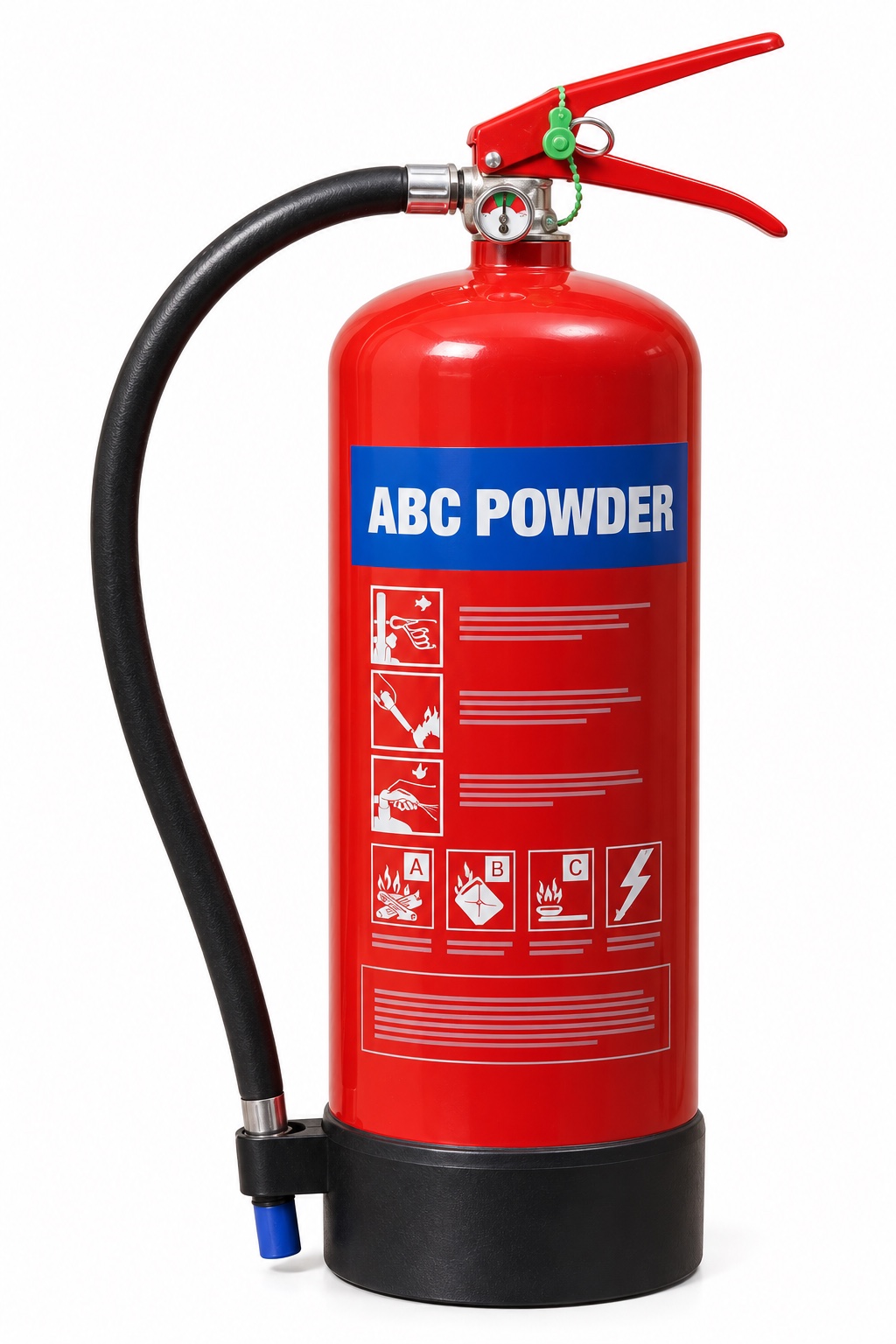 | A, B and C if marked Interrupts flame chemistry; multipurpose powder also acts on Class A material. A C marking does not authorise tackling a gas leak. | Check the limitation Powder can obscure escape and impair breathing; it is not generally recommended indoors. Limited cooling allows reignition. It is not metal-specific D powder or a substitute for F-rated cooking-oil equipment. |
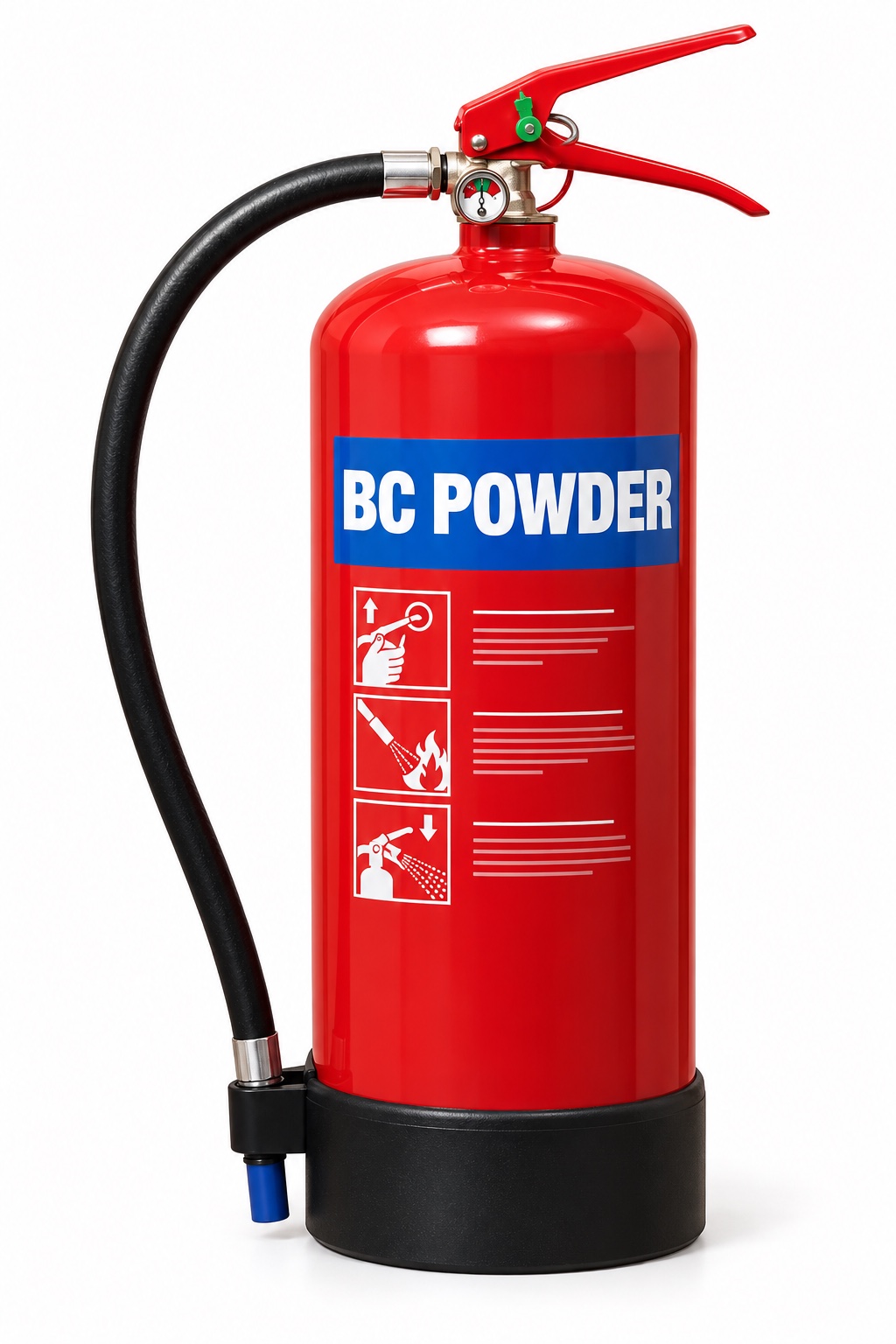 | B and C if marked; not A Selected for particular liquid or gas hazards under the assessed plan. Electrical use must follow the actual unit’s instructions. | Check the limitation Do not assume all blue powder extinguishers protect wood or paper. It has the visibility, breathing and reignition limitations of powder; it does not provide Class D or F protection. |
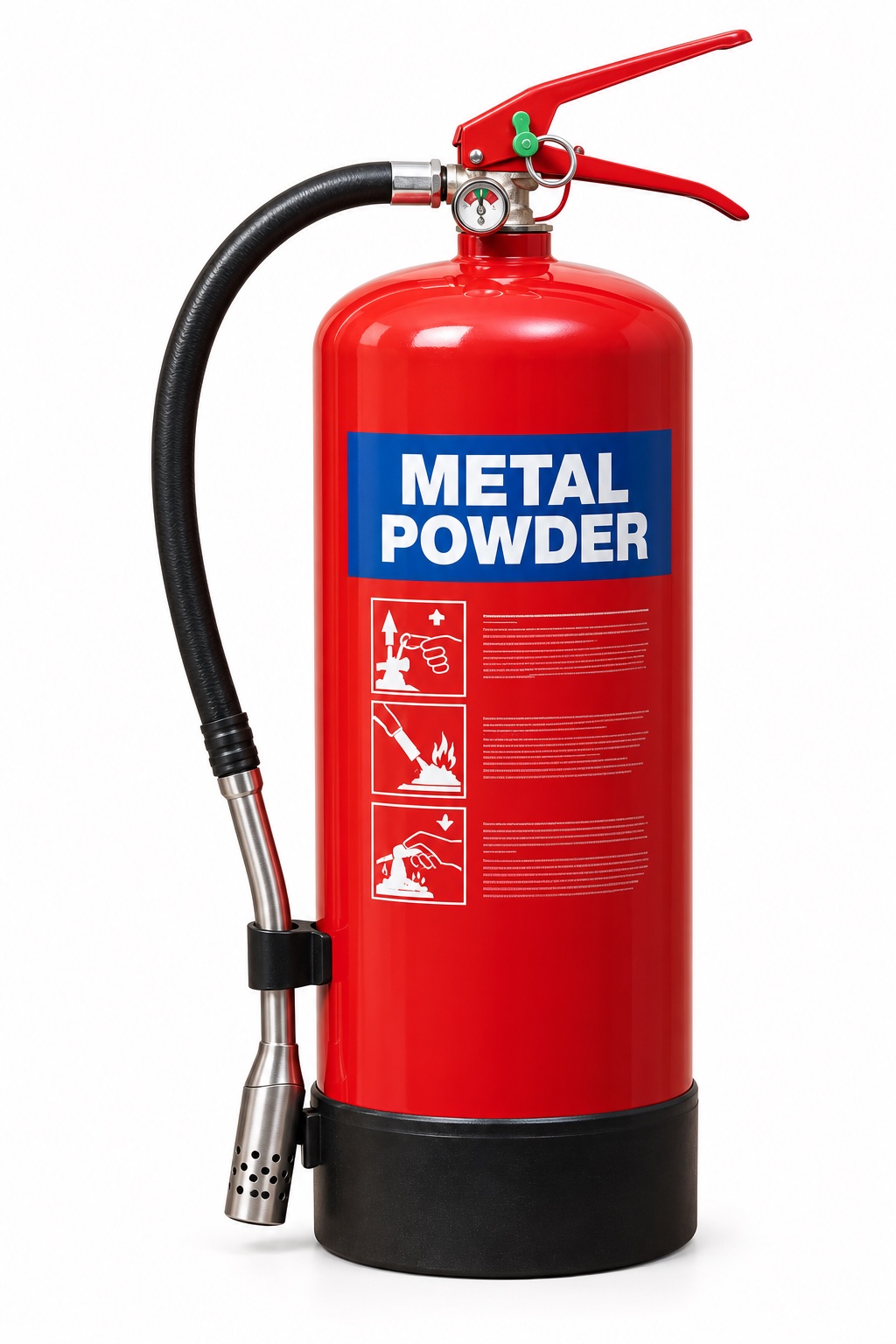 | D, for the specified metal A specialist powder can isolate or absorb heat from a compatible burning metal. Selection requires knowledge of the metal and its form. | Check the limitation The wrong powder can fail or react. Water, foam and CO₂ can be dangerous on certain burning metals. A powder suitable for magnesium is not automatically suitable for metallic lithium. |
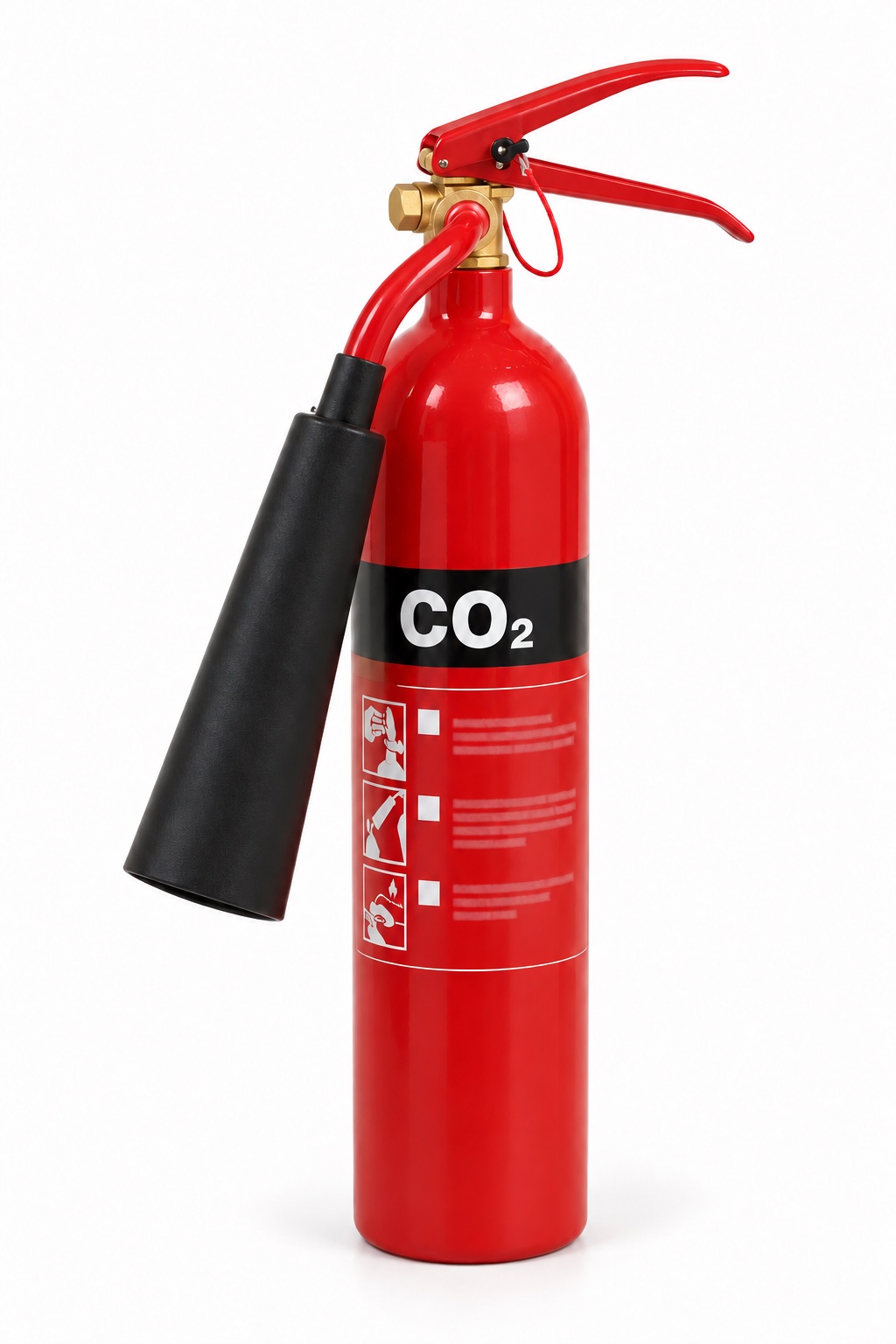 | B; electrical use as instructed Displaces the atmosphere around a small flame and leaves no powder residue. Often selected around electrical equipment. | Check the limitation Poor cooling means reignition is possible. CO₂ can create a dangerous atmosphere in enclosed spaces; discharge can cause frostbite. Hold only the designated insulated parts. Not a cooking-oil or metal-fire substitute. |
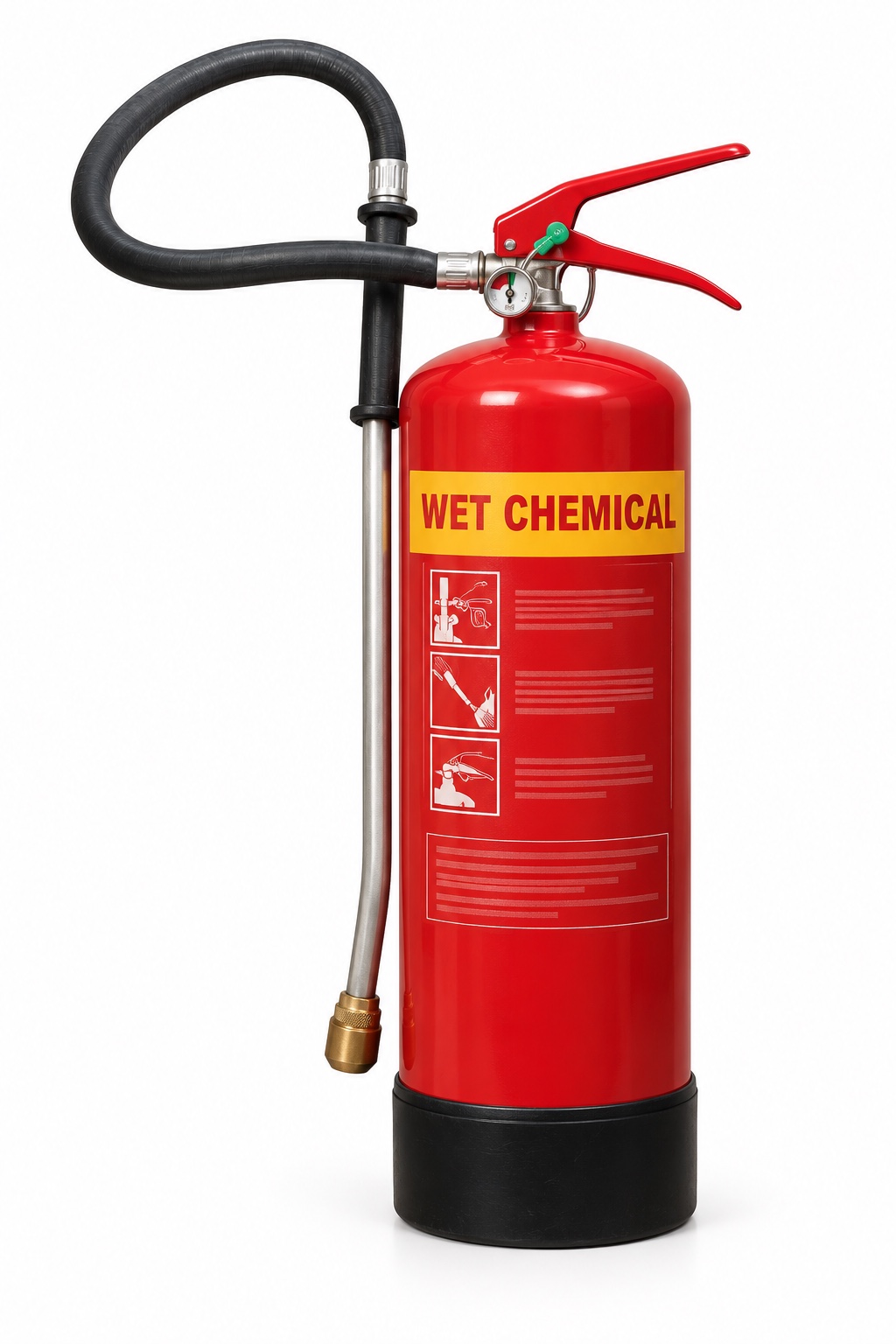 | F; often A if marked Cools cooking oil and creates a protective surface layer through reaction with the fat. Use only within the actual unit’s rating and instructions. | Check the limitation Do not mistake it for a general liquid-fire or electrical extinguisher. Incorrect application or moving the fryer can splash hot oil; apparent flame-out does not establish safe temperature. |
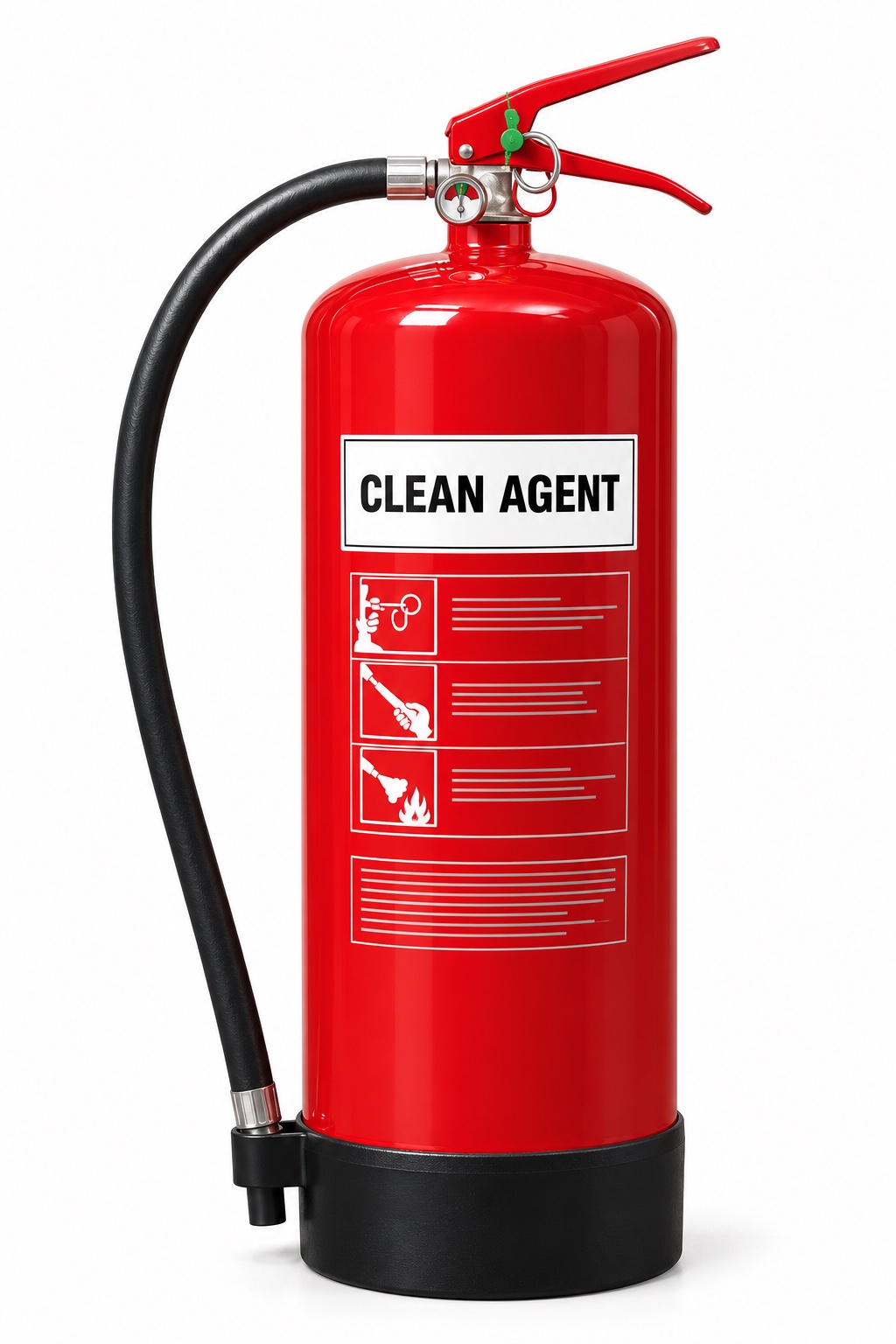 | Product- and jurisdiction-specific Specialist low-residue agents may protect sensitive equipment. Confirm the UK-approved application and the manufacturer’s limits. | Check the limitation Low residue does not mean safe to breathe. Do not copy a US A:B:C rating as UK gas-fire approval. Legacy halon is restricted to permitted critical uses and applicable deadlines. |
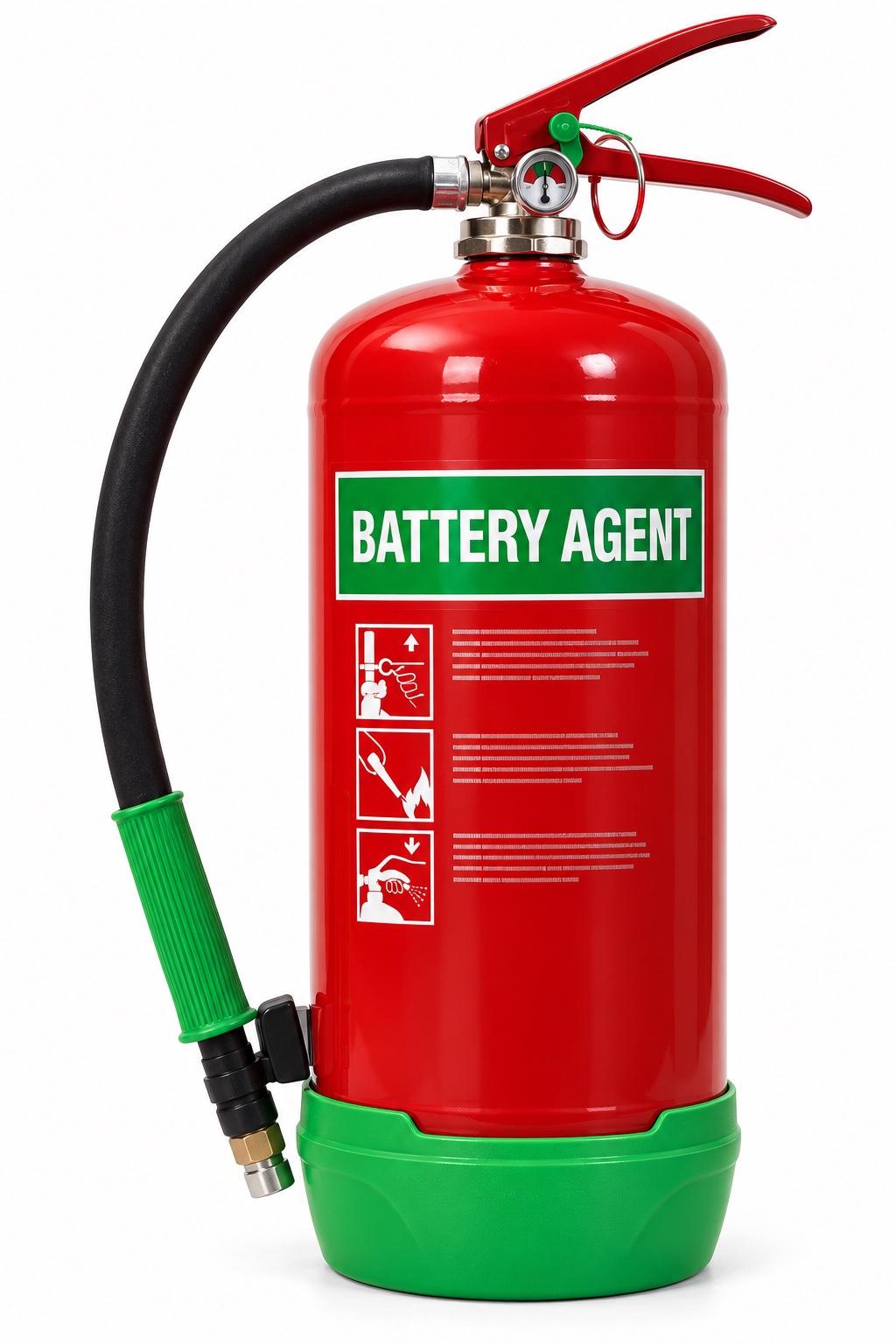 | Check independent scope and instructions Some products use water-based cooling or specialist media such as aqueous vermiculite for specified battery scenarios. Selection depends on chemistry, capacity and location. | Check the limitation A ‘lithium’ label is not proof it will stop thermal runaway in a large pack. Flame suppression may not prevent reignition or gas release. Do not approach, carry or submerge a failing battery as a learner exercise. |
Lithium-ion product example · Firechief 6 L Lith-Ex
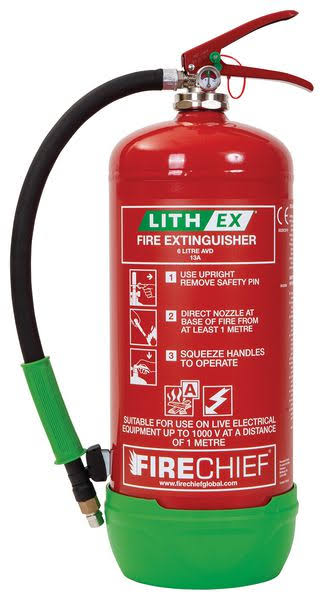
A named product example helps connect the generic table to an actual unit. Confirm the exact product before using its claims.
- Agent and intended application
- The linked Seton example uses aqueous vermiculite dispersion (AVD) for specified lithium-ion battery fire applications. Water content cools; the dispersed mineral helps form a barrier. This is not generic Class D metal-fire powder.
- Read the actual rating
- Seton lists a 6 L product with a 13A rating. That A rating describes its solid-material test performance; it does not, by itself, certify a universal Class L battery capability.
- Match the exact model and generation
- The manufacturer’s current 6 L G2 page identifies FLE6X and different discharge details from the retailer’s older listing. Do not mix their time, range or pressure values. Match the delivered label, product sheet and manual.
- Check the battery scope
- Confirm the allowed battery chemistry, energy capacity, state and scenario with the current manufacturer information and competent fire assessment. A large EV or energy-storage pack cannot be treated as a small-device fire.
- Electrical conditions are product-specific
- The supplied product label includes a voltage and minimum-distance condition. Do not transfer that condition to another battery extinguisher or infer that it makes an unsafe electrical approach acceptable.
- After the flame disappears
- Heat, off-gas and reignition can remain. Follow the planned withdrawal, exclusion and fire-service response; do not pick up, submerge or return a failed battery to charging.
Seton · supplied 6 L Lith-Ex example ↗
Firechief · current 6 L G2 model information ↗
Read the actual label
Read the agent, fire-class letters, performance rating, electrical warnings, operating instructions and service condition. Numbers such as 13A or 55B describe standardised test performance, not a safe room size or permission to tackle that amount of fire. Colour is a clue; the actual label and assessed plan decide suitability.
Spot the dangerous assumption
Pause at each question, then open the explanation. These are unscored learning prompts alongside the course assessment.
Keep prevention, alarms, compartmentation and escape effective. Report a missing, obstructed, damaged or discharged extinguisher; do not return a partly used unit to service. Competent selection, maintenance and practical training belong in the fire arrangements.
How do alarm and firefighting arrangements differ by sector?
Sector examples help test whether arrangements fit the building and work rather than a generic checklist.
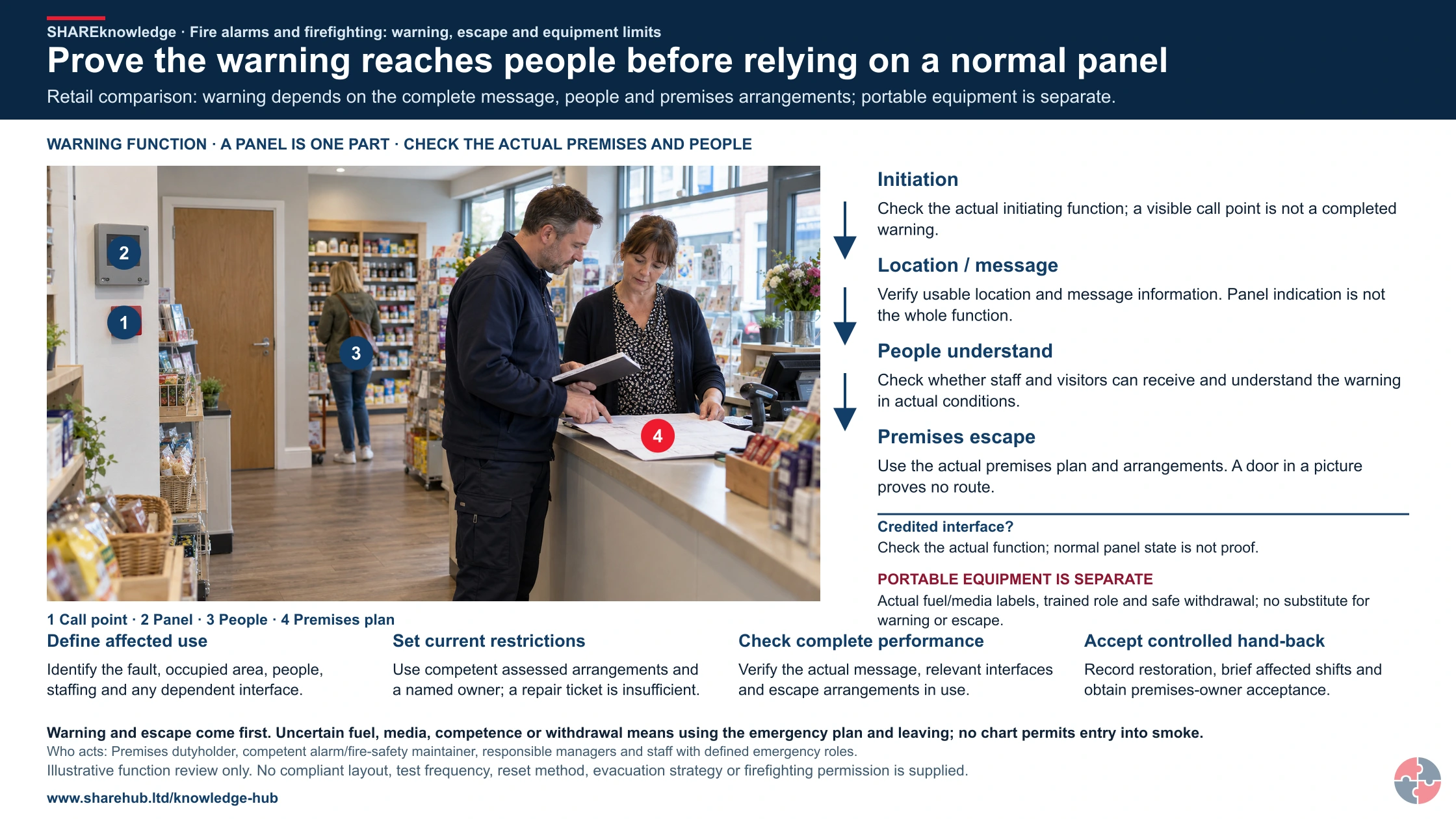
Prove the warning reaches people before relying on a normal panel
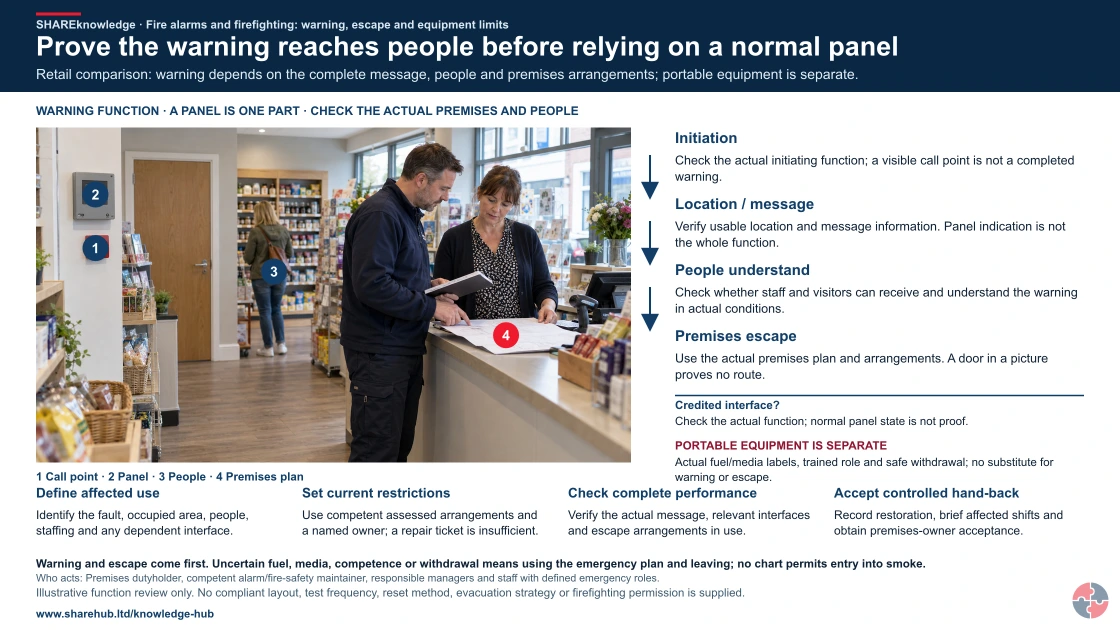
Full written explanation
An illustrative UK retail scene shows a wall call point and neutral alarm panel, a staff discussion of inert premises papers and a visitor among shop displays. Picture key: 1 Call point · 2 Panel · 3 People · 4 Premises plan. The warning-function explanation connects initiation, location/message, staff and visitor understanding and the actual premises escape arrangements. The picture does not establish a device state, successful warning, working interface, safe route or equipment compliance. A credited interface remains a separate question wherever the actual fire strategy relies on it; a normal panel indication is not proof of complete performance. Four unnumbered review checks identify affected use, current restrictions, complete performance and controlled hand-back. Portable-equipment limits stay separate: actual fuel/media labels, trained roles and safe withdrawal do not substitute for warning or escape. No fire, smoke, casualty, discharge, alarm test, reset, evacuation, rescue, re-entry or firefighting demonstration is shown. No detection design, timing, equipment rating, route clearance or authority to tackle a fire is supplied.
Retail comparison: warning depends on the complete message, people and premises arrangements; portable equipment is separate.
- Define affected use. Identify the fault, occupied area, people, staffing and any dependent interface.
- Set current restrictions. Use competent assessed arrangements and a named owner; a repair ticket is insufficient.
- Check complete performance. Verify the actual message, relevant interfaces and escape arrangements in use.
- Accept controlled hand-back. Record restoration, brief affected shifts and obtain premises-owner acceptance.
When the evidence does not fit: Warning and escape come first. Uncertain fuel, media, competence or withdrawal means using the emergency plan and leaving; no chart permits entry into smoke.
Who acts: Premises dutyholder, competent alarm/fire-safety maintainer, responsible managers and staff with defined emergency roles.
Changed workplace
Warehouse: Obstructed call point, unclear zone and equipment defects need a current-use decision.
Retail premises: Check that staff and visitors receive an understandable warning and can follow the plan.
Evidence check: Illustrative function review only. No compliant layout, test frequency, reset method, evacuation strategy or firefighting permission is supplied.
Review current impairment, functional checks and controlled hand-back
Primary references: GOV.UK: equipment, warning, maintenance and training · GOV.UK: offices and shops — apply the premises and jurisdiction
Open the complete HD image (new tab)Download image
Review current impairment, functional checks and controlled hand-back
Primary references: GOV.UK: equipment, warning, maintenance and training · GOV.UK: offices and shops — apply the premises and jurisdiction
The same legal duty can look very different across a care home, warehouse, office, school, leisure centre, construction refurbishment and industrial workshop.
The fire risk assessment should explain the differences and set standards for detection, warning, equipment, staffing, vulnerable people and maintenance.
| Setting | Alarm issue | Firefighting/control issue |
|---|---|---|
| Office | Visitors and meeting rooms may miss instructions. | Extinguishers should match electrical and ordinary combustible risks. |
| Warehouse | Large spaces, high racking and noise affect warning. | Equipment access and stock obstruction need checks. |
| Care setting | Progressive evacuation and vulnerable people need staff coordination. | Staff focus is evacuation support, not heroic firefighting. |
| Workshop | Hot work, fuels and machinery create varied fire classes. | Media must match flammable liquid/electrical/metal risks. |
| Leisure venue | Public alarm response and crowd movement need management. | Staff need clear roles and public communication. |
| Shared premises | Alarm interfaces and responsibility can blur. | Responsible persons must cooperate on checks and defects. |
How should alarm and firefighting impairments be managed?
An impairment should trigger immediate risk judgement, temporary controls, escalation and repair evidence.
Fire alarm and firefighting controls are only reliable if defects are treated as operational risk, not routine admin. A failed weekly alarm test, a zone fault, a damaged manual call point, a missing extinguisher or blocked access to firefighting equipment can all change the level of protection people are relying on that day.
The responsible person should decide whether the premises can continue normally, needs temporary controls, needs extra staff or patrols, needs a temporary fire watch, needs part of the building taken out of use, or needs urgent competent contractor repair. The decision should be recorded with the defect, interim controls, owner, timescale and close-out evidence.
| Impairment | Immediate risk question | Competent response and close-out evidence |
|---|---|---|
| Weekly alarm test fails | Could people still be warned quickly in every occupied area? | Escalate to the responsible person, apply temporary warning arrangements if needed, call the alarm contractor and record retest evidence. |
| Zone fault on panel | Which area is affected and does the fault reduce detection, warning or investigation? | Identify the zone, brief wardens, consider temporary patrols and keep the repair report with the fire log. |
| Manual call point damaged | Can people in that area still raise the alarm without delay? | Protect or replace the call point, provide temporary instruction and record repair date. |
| Extinguisher missing or discharged | Is a foreseeable small early-stage fire now without suitable first-response equipment? | Replace with the correct type, investigate why it was missing and update inspection evidence. |
| Fire watch needed | Is temporary human monitoring suitable for the risk and occupancy? | Define patrol route, frequency, communication method, authority to evacuate and handback criteria. |
| Contractor repair complete | Has the affected control been restored and tested? | Keep contractor report, retest evidence, defect close-out and any worker rebriefing. |
When can an impaired alarm or firefighting measure return to service?
Only after the affected function and its interfaces have been repaired, checked and formally handed back.
Name the impaired zone, equipment, affected people and protection function. Before a planned isolation, authorise its boundary and duration, coordinate with occupiers and contractors, control ignition and fuel, and decide whether occupancy or high-hazard work can continue. A patrol is not automatically equivalent to designed detection and warning.
On restoration, a competent person checks the device or system, any monitoring and cause-and-effect interfaces, panel state and remaining overrides. The owner confirms that temporary measures can end and tells the people affected. A normal-looking panel alone is not evidence that every interface works.
Keep the impairment log, decision maker, temporary controls, test evidence, communications and recurrence review. An unexpected defect follows the same immediate risk decision; if warning or escape cannot be made reliable, restrict the area or stop the activity.
When should alarm or firefighting arrangements be stopped or escalated?
Escalation is needed when warning, equipment, staffing, access, impairment or evacuation confidence is uncertain.
A fire precaution defect is not just a maintenance task. If the defect affects warning, escape, first response or fire service information, the responsible person should decide whether temporary controls, restricted occupation or closure of an area are needed.
The decision should be recorded and reviewed until the defect is closed.
| Trigger or question | Immediate action | Evidence before normal operation |
|---|---|---|
| Alarm fault or disabled zone | Assess occupied areas, inform responsible person and set temporary controls. | Fault report, risk review and repair evidence. |
| Call point or extinguisher blocked | Clear immediately and investigate storage/housekeeping failure. | Daily check and corrective action. |
| Alarm not heard or understood | Review warning method and vulnerable-person arrangements. | Audibility/visual alarm review and drill evidence. |
| False alarms becoming routine | Investigate cause and reinforce response expectations. | False alarm trend and action record. |
| Extinguisher missing, discharged or wrong type | Replace or restrict area if risk is not controlled. | Service/inspection record. |
| Staff unsure what to do | Repeat briefing, drill and manager review. | Training and drill learning. |
Where do alarm and firefighting arrangements fail?
They fail when equipment exists on paper but is not accessible, understood, maintained or integrated with evacuation.
Common failures include blocked call points, alarm panel faults, poor zone information, people ignoring false alarms, extinguishers used as door props, missing service records, staff not trained in evacuation roles and contractors disabling systems without temporary controls.
Another failure is confusing firefighting with rescue. If people need to evacuate, the priority is warning, movement to safety and calling the fire and rescue service, not delaying evacuation to save property.
| Failure or weak practice | How it develops | What good looks like |
|---|---|---|
| Alarm treated as background noise | False alarms and weak drills create complacency. | Investigate false alarms and reinforce immediate response. |
| Obstructed equipment | Storage gradually blocks call points or extinguishers. | Daily checks and housekeeping controls. |
| Poor impairment control | Contractor isolates system without risk review. | Permit/impairment procedure and temporary watch. |
| Wrong extinguisher media | Equipment selected by habit, not fire class. | Media matched to FRA and competent advice. |
| Unclear roles | Wardens improvise during alarm. | Named roles, deputies and drills. |
| No learning from tests | Weekly tests recorded but defects repeat. | Trend review and management action. |
What evidence shows fire alarms and firefighting is controlled?
Evidence should show that fire precautions are suitable, available, maintained, tested, understood and reviewed.
Fire evidence should connect the fire risk assessment to real controls. A log book alone is not enough if defects remain open, staff do not know the procedure or equipment cannot be reached during normal work.
Good records show what was checked, what failed, who owned the action, when it was closed and how the responsible person knows the arrangement still protects relevant persons.
| Evidence item | What it should show | Assurance question |
|---|---|---|
| Fire risk assessment | Alarm and equipment needs match the premises and people at risk. | Does the FRA explain why the provision is suitable? |
| Weekly alarm test records | Tests are carried out, recorded and faults acted on. | Are repeated faults closed? |
| Extinguisher service and visual checks | Equipment is present, suitable and in apparent working order. | Can staff reach it during normal work? |
| Drill and training records | People know alarm response, roles and limits of firefighting. | Did drills reveal confusion? |
| Impairment records | Faults, isolations and temporary controls are authorised. | Was risk reviewed while protection was reduced? |
| Fire service information | Panels, zones and building information are usable. | Could responders locate the incident quickly? |
What should a fire alarm and firefighting risk register record?
Connect each credible failure to people at risk, a named owner, an immediate decision, controls and verification evidence.
For example, an isolated detector during hot work needs an explicit stop or occupancy decision, an authorised interim warning method if suitable, a time limit and restoration check. An extinguisher obscured by storage needs the route and equipment access restored, plus a check that storage controls prevent recurrence.
Record residual uncertainty and who can accept reoccupation or restart; do not use a closed maintenance ticket as the only evidence. Review after false alarms, failed tests, drills, building work, changed occupancy and actual fires.
How can the hierarchy of controls reduce fire risk before relying on alarms and firefighting?
Remove the actual hazard where possible, then use substitution and verified physical controls before relying on procedures or PPE. Discipline checks that the chosen barriers still work.
The scenario is alarm impairment during occupied trading. The controls below are reasoned task applications of linked guidance, not a prescribed design or evidence that each intervention appears verbatim in a source. A competent owner must check feasibility, local law and stop criteria.
Use current government guidance and competent task-specific advice; this section does not establish a technical specification.
How can the ERICPD hierarchy of controls reduce fire risk before relying on alarms and firefighting?

| Hazard and harm route | ERICPD → five-level control | Task intervention and feasibility | Owner, test and evidence | Failure and stop decision |
|---|---|---|---|---|
| Alarm impairment during occupied trading | Eliminate → Elimination | Stop the affected occupancy until adequate warning is restored. Source: GOV.UK fire safety risk assessment: offices and shops. | Confirm the affected area is unoccupied until an adequate warning method is restored; the alarm impairment itself remains open. | Stop or redesign if unwarned occupants. |
| Same scenario | Reduce → Substitution | Restore the assessed physical warning system and verify the relevant end-to-end function through competent repair and testing. Source: GOV.UK fire safety risk assessment: offices and shops. | Fire-safety manager trials the replacement method and documents new hazards, residual risk and worker feedback before release. | Pause until the alternative and its new risks are assessed. |
| Same scenario | Control → Engineering | Repair and function-test detection, sounders and interfaces. Source: GOV.UK fire safety risk assessment: offices and shops. | Fire-safety manager must witness a zone alarm and interface test, including the occupied area warning. | Stop or redesign if unwarned occupants. |
| Same scenario | Control → Administrative | Authorise the impairment, restrict affected occupancy or move work to a suitable unaffected area, define temporary warning and evacuation roles, and verify restoration before named hand-back. Source: GOV.UK fire safety risk assessment: offices and shops. | Fire-safety manager spot-checks the actual instruction, authorisation and shift handover against work in progress. | Pause if the procedure or handover cannot be verified. |
| Same scenario | PPE → PPE | Firefighting PPE is for trained responders, not a substitute for warning. Source: GOV.UK fire safety risk assessment: offices and shops. | Fire-safety manager records why PPE cannot control this mapped harm, checks the operative higher-level barrier, and stops the task if that barrier fails. | PPE cannot be the sole credited barrier. |
| Same scenario | Discipline → Administrative assurance | Witness test and record the safe hand-back against the fire plan. Source: GOV.UK fire safety risk assessment: offices and shops. | Witness test and record the safe hand-back against the fire plan. | Stop or redesign if unwarned occupants. |
How can the ISO 45001 hierarchy of controls reduce fire risk before relying on alarms and firefighting?

| Hazard and harm route | ERICPD → five-level control | Task intervention and feasibility | Owner, test and evidence | Failure and stop decision |
|---|---|---|---|---|
| Alarm impairment during occupied trading | Eliminate → Elimination | Stop the affected occupancy until adequate warning is restored. Source: GOV.UK fire safety risk assessment: offices and shops. | Confirm the affected area is unoccupied until an adequate warning method is restored; the alarm impairment itself remains open. | Stop or redesign if unwarned occupants. |
| Same scenario | Reduce → Substitution | Restore the assessed physical warning system and verify the relevant end-to-end function through competent repair and testing. Source: GOV.UK fire safety risk assessment: offices and shops. | Fire-safety manager trials the replacement method and documents new hazards, residual risk and worker feedback before release. | Pause until the alternative and its new risks are assessed. |
| Same scenario | Control → Engineering | Repair and function-test detection, sounders and interfaces. Source: GOV.UK fire safety risk assessment: offices and shops. | Fire-safety manager must witness a zone alarm and interface test, including the occupied area warning. | Stop or redesign if unwarned occupants. |
| Same scenario | Control → Administrative | Authorise the impairment, restrict affected occupancy or move work to a suitable unaffected area, define temporary warning and evacuation roles, and verify restoration before named hand-back. Source: GOV.UK fire safety risk assessment: offices and shops. | Fire-safety manager spot-checks the actual instruction, authorisation and shift handover against work in progress. | Pause if the procedure or handover cannot be verified. |
| Same scenario | PPE → PPE | Firefighting PPE is for trained responders, not a substitute for warning. Source: GOV.UK fire safety risk assessment: offices and shops. | Fire-safety manager records why PPE cannot control this mapped harm, checks the operative higher-level barrier, and stops the task if that barrier fails. | PPE cannot be the sole credited barrier. |
| Same scenario | Discipline → Administrative assurance | Witness test and record the safe hand-back against the fire plan. Source: GOV.UK fire safety risk assessment: offices and shops. | Witness test and record the safe hand-back against the fire plan. | Stop or redesign if unwarned occupants. |
How should fire alarms and firefighting be assured?
Assurance should test whether the fire arrangement works in the building, at the time, with the people who may need it.
First-line assurance comes from daily checks, weekly tests, warden observations and immediate defect reporting. Second-line assurance reviews fire risk assessment actions, drills, maintenance, contractor records and repeat findings. Specialist assurance may include competent fire risk assessor review, fire alarm contractor reports, extinguisher servicing, emergency lighting testing and enforcement feedback.
The test is practical: if the alarm operates today, can everyone hear, understand, move, escape, account for vulnerable people and keep routes safe without relying on luck?
| Assurance layer | What to check | What good looks like |
|---|---|---|
| Daily/weekly checks | Panel, routes, call points and extinguishers. | Defects are corrected or escalated immediately. |
| Warden assurance | Staff actions, vulnerable people and public interface. | Roles are understood across shifts. |
| Contractor assurance | Alarm service, extinguisher service and repair quality. | Reports are reviewed, not filed unread. |
| Manager review | False alarms, open defects, drills and FRA actions. | Recurring issues get resources and deadlines. |
| Leadership review | High-risk impairments and enforcement/insurer findings. | Protection shortfalls influence investment. |
Which UK legal duties and official guidance are relevant?
Premises fire safety follows different legal routes in England and Wales, Scotland and Northern Ireland. Choose the route for the actual premises, then assess warning, escape, equipment and work interfaces with competent advice.
The workplace Fire Safety Order applies in England and Wales. Scotland and Northern Ireland have separate premises fire legislation. Great Britain workplace health-and-safety laws may also apply to work activities but do not replace premises fire duties; check the precise dutyholder and building scope before using this table.
| Jurisdiction | Duty or guidance | What it means | How to apply it |
|---|---|---|---|
| E&W | Regulatory Reform (Fire Safety) Order 2005 | Requires the responsible person to assess fire risk and maintain suitable fire precautions in non-domestic premises. | Use as the main fire safety legal framework for England and Wales. |
| GB | Health and Safety at Work etc. Act 1974 | Requires employers to protect employees and others affected by work so far as reasonably practicable. | Use for work activities that create fire, emergency or firefighting risk. |
| GB | Management of Health and Safety at Work Regulations 1999 | Requires suitable and sufficient risk assessment, preventive arrangements, competent help, emergency arrangements and review. | Use for management arrangements, competence and emergency procedures. |
| GB | Dangerous Substances and Explosive Atmospheres Regulations 2002 | Requires fire and explosion risk from dangerous substances to be assessed and controlled. | Use where flammable substances, gases, vapours, dusts or oxygen enrichment affect the fire arrangements. |
| Scotland | Fire (Scotland) Act 2005 | Sets the Scottish non-domestic fire-safety framework and dutyholder route. | Use with the Scottish fire-safety regulations and guidance for the relevant premises. |
| Scotland | Fire Safety (Scotland) Regulations 2006 | Adds detailed Scottish fire-safety duties and arrangements. | Check warning, means of escape, equipment, maintenance and emergency arrangements in context. |
| NI | Fire and Rescue Services (Northern Ireland) Order 2006 | Sets the Northern Ireland non-domestic fire-safety framework. | Identify the appropriate person and relevant premises under the NI route. |
| NI | Fire Safety Regulations (Northern Ireland) 2010 | Provides detailed Northern Ireland fire-safety duties. | Use NIFRS guidance and competent assessment for warning, escape and maintenance. |
| NI | DSEAR (Northern Ireland) 2003 | Work-risk controls for dangerous substances and explosive atmospheres in Northern Ireland. | Use alongside the NI premises fire route where processes, fire-and-gas alarms or dangerous substances create this risk. |
| NI | Health and Safety at Work (Northern Ireland) Order 1978 | NI general work-health and safety duties for employers and others affected by work. | Assess work activities, staff roles and emergency risk alongside premises fire duties. |
| NI | Management Regulations (Northern Ireland) 2000 | NI work-risk assessment, preventive arrangements, competence and emergency procedures. | Coordinate staff training, alarm impairment and contractor work with the NI fire strategy. |
How can BS EN ISO 45001 support fire alarms and firefighting management?
ISO 45001 helps turn this topic into leadership, planning, support, operational control, performance evaluation and continual improvement rather than a static page of guidance.
Use current government guidance and competent task-specific advice; this section does not establish a technical specification.
BSI lists BS 5839-1:2025 as the current non-domestic fire alarm code and BS 5306-3:2017 as the current, under-review portable-extinguisher commissioning and maintenance code. These are voluntary technical standards, not universal device spacing, sound levels, testing intervals or permission to fight a fire. Competent designers and maintainers should use the licensed text and the actual fire assessment.
Use the management-system themes below to assign responsibility, competence, operational controls and checks. The exact licensed clauses are not reproduced here.
| Management theme | Practical management principle | How to apply it |
|---|---|---|
| Understanding the organisation and its context | Consider the people, premises and outside conditions that shape the warning and escape plan. | Use workforce profile, work locations, activities, contractors, vulnerable groups and business change to shape fire alarms and firefighting arrangements. |
| Leadership and commitment | Assign an accountable owner, resources and an escalation route for critical fire controls. | Leaders should set expectations, provide resources, remove conflicting pressures and review evidence of control. |
| Consultation and participation of workers | Ask workers and affected people whether signals and procedures work in real conditions. | Use worker feedback, supervisor learning, safety representatives and affected teams to test whether controls work in real conditions. |
| Hazard identification and assessment of risks and opportunities | Identify credible fire, missed-warning and impairment scenarios and the people at risk. | Assess credible harm pathways, affected people, routine work, non-routine work, change, emergency conditions and practical opportunities to improve. |
| Competence | Check that each person can demonstrate the decisions their fire role requires. | Define training, authorisation, assessment, supervision and refresher expectations for workers, supervisors, managers and specialists. |
| Documented information | Keep current plans, fault records, tests and hand-back evidence accessible to those who need them. | Keep risk assessments, procedures, inspection records, health or wellbeing records where relevant, and action close-out evidence under control. |
| Operational planning and control | Translate assessment into maintained equipment, local instructions and change control. | Turn assessment decisions into field controls, safe systems, supervision, equipment standards, welfare, emergency arrangements and change controls. |
| Procurement, contractors and outsourced processes | Coordinate alarm engineers, contractors and occupiers before work changes protection. | Make sure purchased equipment, contractor methods, delivery arrangements and outsourced services meet the same control standard. |
| Monitoring, measurement, analysis and performance evaluation | Use checks, drills, trends and field evidence to test actual performance. | Use inspections, assurance checks, worker feedback, trend data, audit findings, incident learning and overdue action reviews. |
| Incident, nonconformity and corrective action | Investigate failures and confirm that corrective action works after implementation. | Investigate weak signals, close actions with evidence and update risk assessments, training, equipment standards and procedures. |
These are practical management-system themes, not a clause-by-clause interpretation. A competent reviewer must verify any clause mapping against a lawfully accessed current standard.
Who needs alarm and firefighting competence, and how is it checked?
Training should help people understand fire alarms and firefighting, their role, emergency actions, defect reporting, vulnerable-person arrangements and when to escalate.
Training should be role-based. General awareness creates a baseline, but supervisors, managers, advisers and senior leaders need different levels of decision-making, verification and escalation competence.
| Role | Learning to test | Competence demonstration | Assessor and record | Reassessment trigger |
|---|---|---|---|---|
| Workers, visitors and contractors | Recognise the local warning, escape route and defect-reporting route. | Respond to a drill from the actual work area and report an inaccessible device. | Supervisor or host observes and records local induction. | Changed alarm, route, task or site. |
| Fire wardens and first-aid firefighters | Know evacuation assistance, withdrawal limits and when not to use equipment. | Run a scenario with smoke, a blocked exit and an incipient fire; choose withdrawal when unsafe. | Competent fire lead assesses the practical exercise. | Drill failure, role change or new hazard. |
| Responsible persons and managers | Own the assessment, coverage, impairment, coordination and restart decisions. | Decide whether the pool can remain occupied while an alarm zone is isolated. | Independent competent adviser samples decision and hand-back. | Building change, repeated alarm or critical fault. |
| Alarm and extinguisher specialists | Understand system design basis, interfaces, service, faults and restoration. | Trace a fault through authorised isolation, cause-and-effect check and signed return. | Technical lead checks work record, limitations and witness evidence. | System modification, failed test or standard change. |
| Emergency and assurance leads | Coordinate public warning, emergency call, responder information, trends and reoccupation. | Test a false-alarm trend, missed accessible warning and failed reinstatement. | Leadership reviews exercise and corrective-action evidence. | Major change, incident or recurring defect. |
How could Riverside Leisure Ltd manage this in practice?

Riverside Leisure Ltd can manage alarms and firefighting by linking the fire risk assessment to alarm testing, extinguisher provision, staff roles and defect escalation.
At the Riverside Leisure Ltd pool, an engineer needs to isolate one alarm zone during planned maintenance. The manager identifies which changing rooms and plant areas lose warning, suspends contractor hot work, assigns a short, resourced interim arrangement and decides whether any area must close. Staff, visitors and the monitoring service receive the changed instructions. When the engineer removes the isolation, the team witnesses the functional and interface checks, confirms the panel status and records who authorised normal use. If a test fails, the affected area stays restricted and the impairment remains open.
In this leisure centre, alarms and firefighting arrangements cover reception, pool areas, plant rooms, kitchens, changing rooms, offices, public events and contractor work.
| Management element | How the business would manage it | Evidence to review |
|---|---|---|
| Assessment | FRA defines alarm and firefighting needs. | FRA action plan. |
| Testing | Weekly alarm tests rotate call points and record faults. | Fire log book. |
| Equipment | Extinguishers are selected for likely fire classes. | Service report and visual checks. |
| Training | Staff know alarm response and firefighting limits. | Training and drill record. |
| Impairment | Faults trigger temporary controls. | Impairment log. |
| Review | False alarms and defects are trended. | Manager review. |
How can a fuel-site example connect alarms and firefighting planning?
Discuss warning, withdrawal, access and the selected fuel scenario as linked considerations. No scene control is a real alarm or authorisation to intervene.
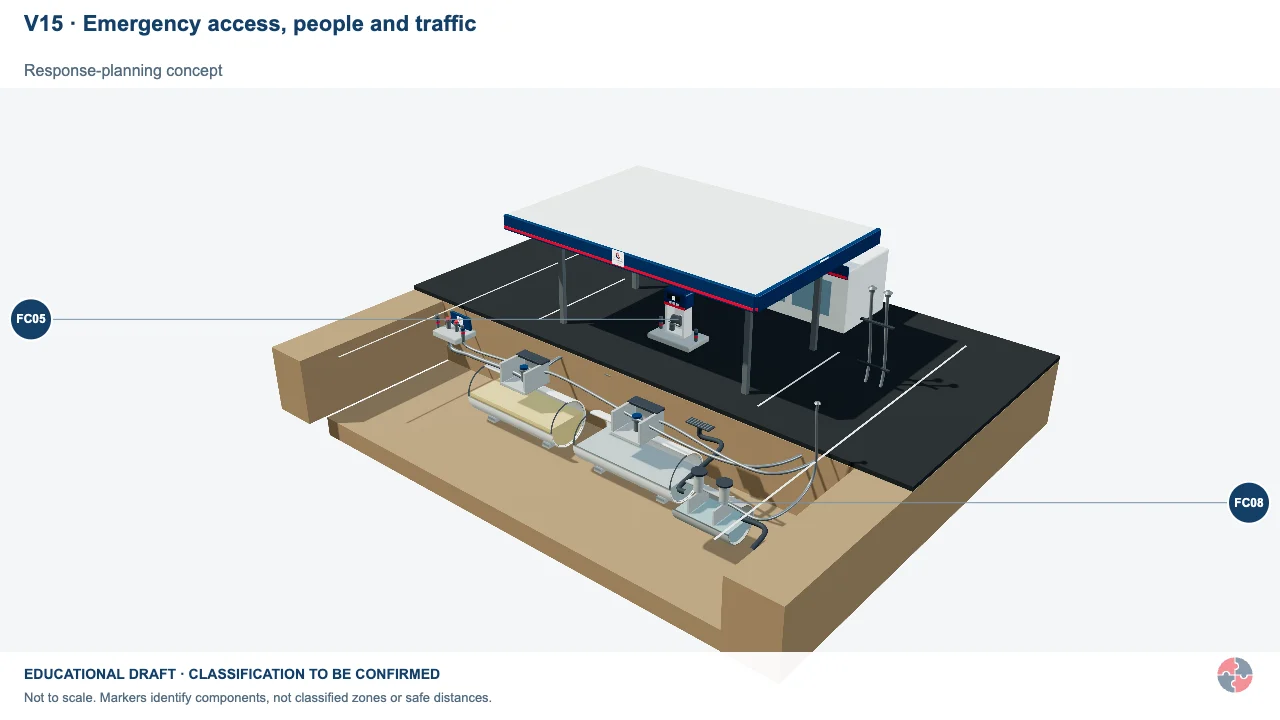
Emergency access, people and traffic
Delivery hoses, the movable refuelling interface and drainage sources can affect access and response. Plan routes around the incident and people involved rather than using a coloured zone as a muster boundary.
Activity focus: Inspect the tanker working area, hose route, nozzle/filler positions, separator covers and vent. Check communication, control of dispensing and traffic, and access for the response plan.
Contextual illustration. The image alone does not establish equipment state, effective controls, individual health or authorisation; use the task-specific checks and competent evidence.
Educational illustration, not to scale. Coloured zones are teaching examples, not a site-specific hazardous-area classification.
Which acronyms and terms matter here?
Acronyms should be understood before they are used in assessments, briefings, audits or learning answers.
Acronyms can exclude newer readers if they are not explained. This section keeps the main terms available at the end of the page so the article stays readable while still supporting learners and audit users.
| Acronym | Meaning | Plain-English use |
|---|---|---|
| ACOP | Approved Code of Practice | Practical guidance with special legal status; following it is not compulsory, but it can be used as evidence of compliance. |
| FRA | Fire Risk Assessment | A structured assessment of fire hazards, people at risk, controls, emergency arrangements and review needs. |
| FRS | Fire and Rescue Service | The emergency service and enforcing authority for many fire safety matters in England and Wales. |
| HSE | Health and Safety Executive | Great Britain workplace health and safety regulator. |
| HSWA | Health and Safety at Work etc. Act 1974 | The core UK health and safety statute. |
| MHSWR | Management of Health and Safety at Work Regulations 1999 | Regulations requiring suitable and sufficient risk assessment and management arrangements. |
| PEEP | Personal Emergency Evacuation Plan | A person-specific plan for someone who may need assistance to evacuate safely. |
| MCP | Manual Call Point | Device used by a person to raise the fire alarm. |
| Impairment | A credited fire-safety measure is unavailable or degraded | Needs a current risk decision, temporary controls and verified restoration. |
| Cause and effect | The intended response of linked alarm and building systems | Requires competent end-to-end checks after relevant change or repair. |
| First-aid firefighting | Limited response to a very small early-stage fire | Only where the site plan, training, equipment and safe withdrawal allow it. |
Unlock another resource
You have used this month’s two free downloads. Publish a post in your own words to unlock one more resource, or choose SHARE Individual for 10 downloads per month.
You decide whether to share. If you do, use the relevant platform disclosure tools and do not make claims you do not genuinely hold.