SHARE Knowledge Hub
Fibromyalgia and Work
Fibromyalgia can involve widespread pain, fatigue, poor sleep and cognitive difficulty that fluctuate from day to day. Work becomes safer and more sustainable when physical demand, display screen work, shifts and high-consequence duties are assessed against functional ability and adjusted with the worker. A manager should not diagnose the condition or assume incapacity; they should provide a private support route, safe task controls and review when work or symptoms change.
Understanding Fibromyalgia and Work
Fibromyalgia can involve widespread pain, fatigue, poor sleep and cognitive difficulty that fluctuate from day to day. Work becomes safer and more sustainable when physical demand, display screen work, shifts and high-consequence duties are assessed against functional ability and adjusted with the worker. A manager should not diagnose the condition or assume incapacity; they should provide a private support route, safe task controls and review when work or symptoms change.
Why this matters at work
Investigate injury, near miss, flare during a hazardous task, missed adjustment, unsuitable PPE, unsafe journey report or disclosure failure with a systems lens. Ask about work design, training, staffing, maintenance, layout, work pressure, supervision, communication, contractor arrangements and reporting culture. Do not treat the worker’s condition as the root cause by default.
Potential harm mechanisms include delayed response, reduced concentration, pain-limited movement, fatigue, impaired balance or difficulty sustaining an emergency posture. Consequences can include a collision, fall, equipment injury, delayed evacuation or loss of a process barrier. Assess the normal task, abnormal task and journey home.
How organisations manage this in practice
Management review should decide improvements, resources, ownership, timescales and effectiveness checks. It should test whether health plans are confidential and accessible, whether supervisors can obtain support, whether controls are fair and whether recurring problems indicate a wider design failure.
Monitor whether controls work in practice: manual-handling risk, equipment availability, DSE actions, workload, shift patterns, breaks, workplace temperature, incidents, worker feedback, adjustment review dates and equality concerns. Use data carefully: a diagnosis or absence record is not a performance metric and should not be used to label people as a risk.
Imagine a manager change during an ongoing adjustment. The incoming supervisor needs to know the task restriction, equipment, cover arrangement, review trigger and contact route. Establish what should be shared, with whom and for what purpose. An adjustment passport can avoid repeatedly reconstructing an agreement, but its existence does not authorise every recipient to see treatment details. Acas describes passports as a practical record; they do not replace a current task assessment.
Eliminate non-essential safety-critical exposure during a flare; reduce duration and workload; isolate through engineering safeguards, automation or buddying; control with supervision, checklists, controlled handover, task restriction and fitness escalation; use PPE for residual physical hazards; reinforce with competence and just culture.
Where does workplace fibromyalgia advice stop?
The workplace assesses job demands and functional restrictions; diagnosis, treatment and individual medical fitness require qualified health advice.
Fibromyalgia symptoms differ between people and can change within a shift. Ask what the person can do safely, which task or environment is difficult, what helps, and when the arrangement should be reviewed. Do not ask a manager to judge the cause of pain or interpret medication.
If a worker cannot safely drive, lift, isolate plant or perform another high-consequence duty now, stop or transfer that task and arrange competent cover. Occupational health can advise on function while protecting clinical privacy. Apply Great Britain or Northern Ireland safety and equality law for the work location.
Updated 2026-09-25.
What is the work-health boundary for Fibromyalgia and Work?
Managers should assess how symptoms affect specific tasks, agree practical adjustments and seek occupational health advice where needed without making clinical judgements.
| Boundary | Good practice | Evidence |
|---|---|---|
| Advice boundary | This is workplace guidance, not medical, legal or HR advice. | Page boundary and signposting. |
| Confidential route | Workers can raise concerns privately without unnecessary personal detail being shared. | Confidential reporting/support route. |
| Occupational health route | Use occupational health where work-health fitness, restrictions or adjustments need professional advice. | Referral and recommendations. |
| Reasonable adjustments | Consider duties and practical adjustments where health conditions may affect work. | Adjustment discussion and review. |
| Safety-critical trigger | Pause or restrict safety-critical work if symptoms, medication, fatigue or injury could create immediate risk. | Fitness-for-task review. |
| What managers should not ask | Avoid diagnosis, intrusive medical detail or speculative assumptions. | Manager guidance and record quality. |
| What managers should not record | Do not record unnecessary health detail; record work impact, adjustments and agreed support. | Minimum necessary records. |
Who needs to understand fibromyalgia and work?
Workers, line managers, HR, occupational health, safety advisers and wellbeing leads all need to understand functional impact and work design.
Workers
Need to raise work barriers, symptoms at work and support needs without being expected to prove pain.
Line managers
Need to hold respectful conversations, adjust work and review support.
HR teams
Need to support reasonable adjustments, absence, return to work and confidentiality.
Occupational health
Need to translate health information into functional advice and restrictions.
Safety advisers
Need to review DSE, manual handling, ergonomics and safety-critical duties.
Wellbeing leads
Need to reduce stigma and connect people to official support routes.
Agree a flexible functional plan that can respond to a changing week
Discuss what the work requires on a difficult day: travel, walking, grip, sustained posture, concentration and the consequence of an error. Agree trial adjustments with the worker, such as a revised sequence, equipment or travel arrangement, and record when to review. The diagnosis alone neither proves incapacity nor establishes that every task is safe.
Agree a work plan that can respond to a changing week
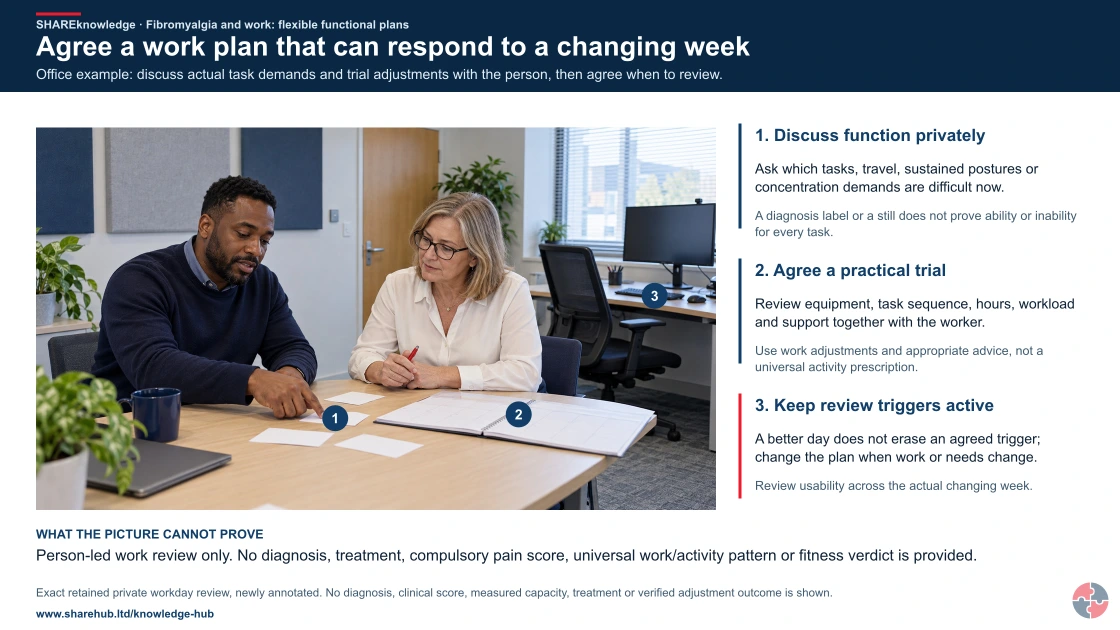
Full written explanation
The exact retained private-office scene shows a worker-led discussion using blank task cards, an inert planner and a nearby workstation. Markers identify the selected card, planner and workstation. No pictured person is diagnosed with fibromyalgia, a clinical severity score is absent and a pose cannot establish capacity or a successful adjustment. The ordinary work-review context supports a person-led plan that responds to changing physical and cognitive demands.
Office example: discuss actual task demands and trial adjustments with the person, then agree when to review.
- Discuss function privately. Ask which tasks, travel, sustained postures or concentration demands are difficult now.
- Agree a practical trial. Review equipment, task sequence, hours, workload and support together with the worker.
- Keep review triggers active. A better day does not erase an agreed trigger; change the plan when work or needs change.
Change the pathway
- Appearance does not determine function. A diagnosis label or a still does not prove ability or inability for every task.
- A planner is not a treatment plan. Use work adjustments and appropriate advice, not a universal activity prescription.
- One day is not the whole pattern. Review usability across the actual changing week.
Evidence check: Person-led work review only. No diagnosis, treatment, compulsory pain score, universal work/activity pattern or fitness verdict is provided.
Review changing function and task demands with the person
Primary references: NI Direct: fibromyalgia overview — no treatment programme reproduced · Acas: individual reasonable adjustments — apply the actual jurisdiction · HSE: DSE and task assessment
Open the complete HD image (new tab)Download image
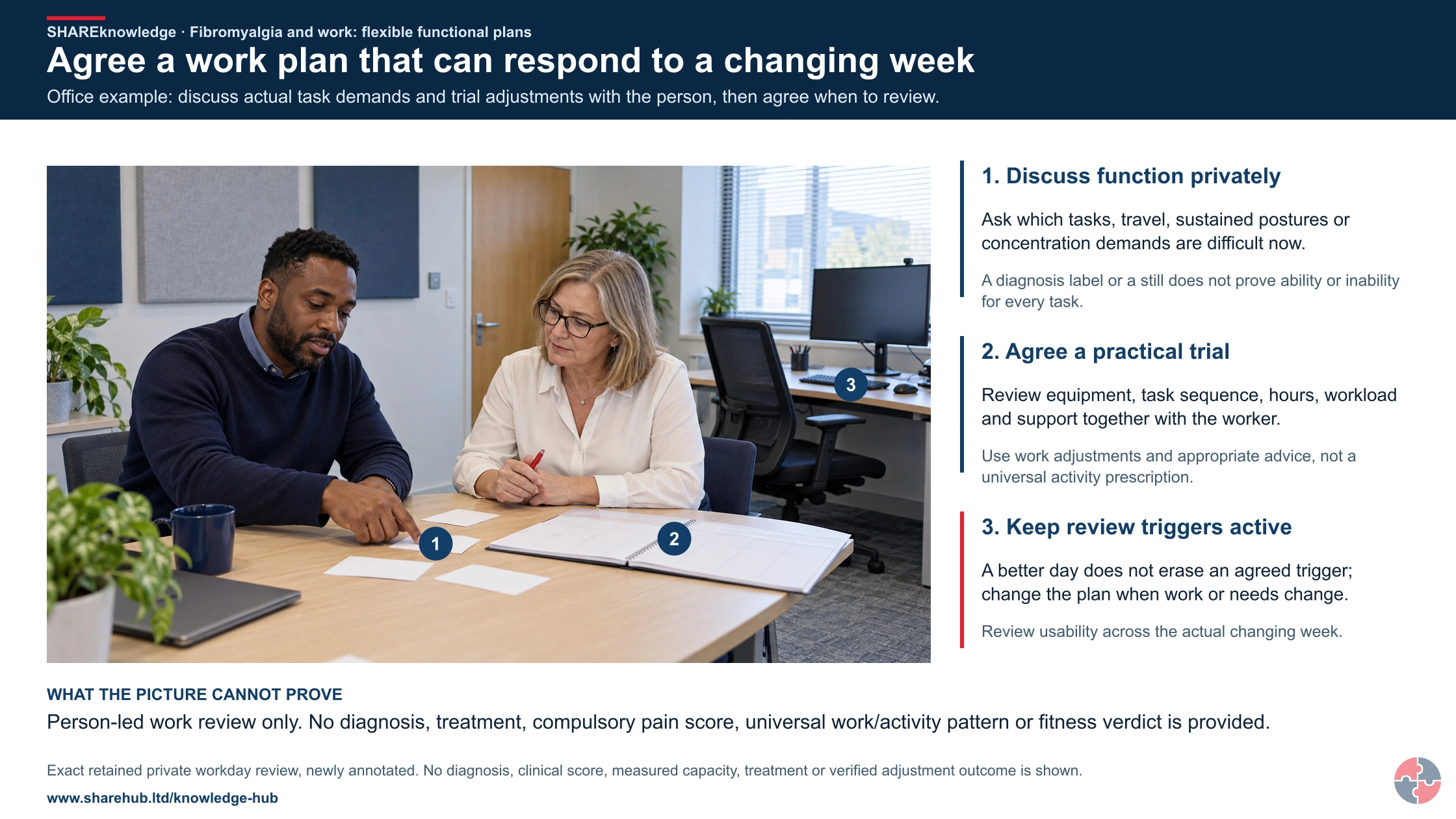
Review changing function and task demands with the person
Primary references: NI Direct: fibromyalgia overview — no treatment programme reproduced · Acas: individual reasonable adjustments — apply the actual jurisdiction · HSE: DSE and task assessment
Use a changing week to test the plan. A lighter day should not erase a previously agreed trigger, while a flare should prompt a task decision rather than a permanent assumption. Review work design and DSE alongside private functional advice when needed. Keep any immediate high-consequence restriction separate from attendance or performance decisions and avoid collecting unnecessary treatment detail.
BuildOut: the plan works on different days
Illustrative example. A supervisor manages office planning well early in the week but later reports increased pain, fatigue and difficulty with a long site drive.
Decision. The manager follows agreed triggers, reallocates the drive and trials a revised site/DSE schedule with the worker.
Evidence to check. Task demands, the worker-agreed functional plan, available cover and feedback on the trial.
Hold or escalation point. Hold a task where current safe performance is doubtful; do not impose a blanket ban from the diagnosis.
Follow-up. Review after the trial and after material changes, retaining support that remains useful on better days.
Plan for changing function across the whole job
A useful work plan responds to the person’s current functional needs across physical, cognitive and screen-based tasks. It does not infer capability from appearance.
Review the whole assembly cycle when a fixed pace becomes difficult
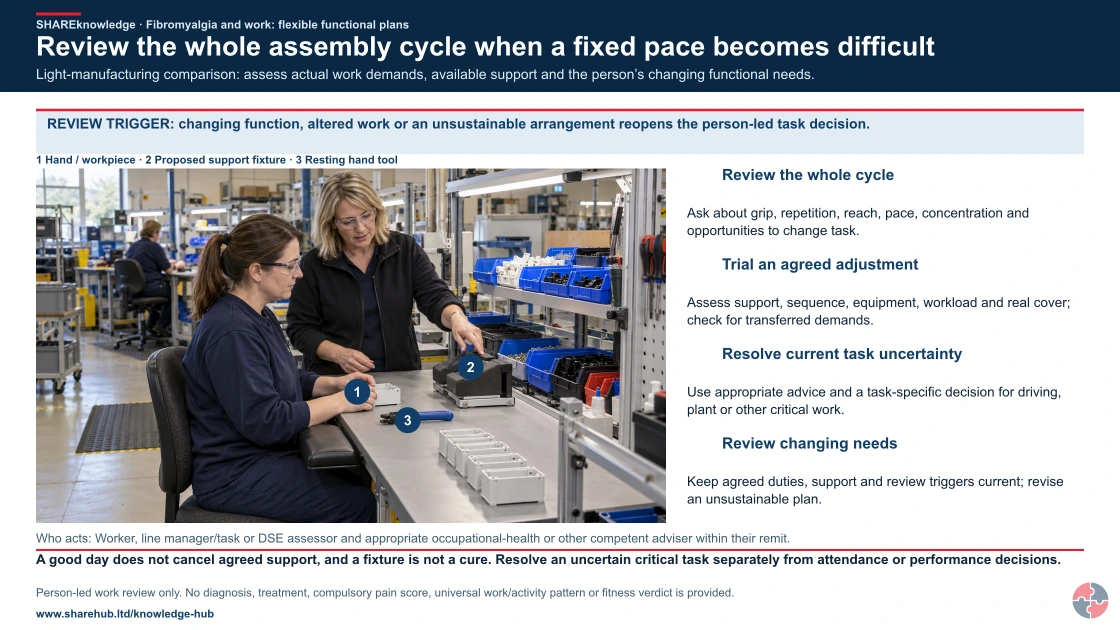
Full written explanation
The exact retained light-assembly scene identifies the hand/workpiece, proposed support fixture and resting hand tool. It shows a task discussion, not a worker with a verified diagnosis, a measured pace, successful ergonomic trial or medical cure. Four checks connect the whole work cycle and pace, an agreed practical adjustment, current critical-duty uncertainty and flexible review. A change band keeps worsening function or altered work linked to the task decision; clinical diagnosis, fixed exercise plans and compulsory pain scores are excluded. Picture key: 1 Hand / workpiece · 2 Proposed support fixture · 3 Resting hand tool. The separate process headings are unnumbered.
Light-manufacturing comparison: assess actual work demands, available support and the person’s changing functional needs.
- Review the whole cycle. Ask about grip, repetition, reach, pace, concentration and opportunities to change task.
- Trial an agreed adjustment. Assess support, sequence, equipment, workload and real cover; check for transferred demands.
- Resolve current task uncertainty. Use appropriate advice and a task-specific decision for driving, plant or other critical work.
- Review changing needs. Keep agreed duties, support and review triggers current; revise an unsustainable plan.
When the evidence does not fit: A good day does not cancel agreed support, and a fixture is not a cure. Resolve an uncertain critical task separately from attendance or performance decisions.
Who acts: Worker, line manager/task or DSE assessor and appropriate occupational-health or other competent adviser within their remit.
Changed workplace
Office work: Trial functional changes and retain a flexible review trigger.
Light manufacturing: Review pace, support and actual cover across the full cycle.
Evidence check: Person-led work review only. No diagnosis, treatment, compulsory pain score, universal work/activity pattern or fitness verdict is provided.
Review changing function and task demands with the person
Primary references: NI Direct: fibromyalgia overview — no treatment programme reproduced · Acas: individual reasonable adjustments — apply the actual jurisdiction · HSE: DSE and task assessment
Open the complete HD image (new tab)Download image
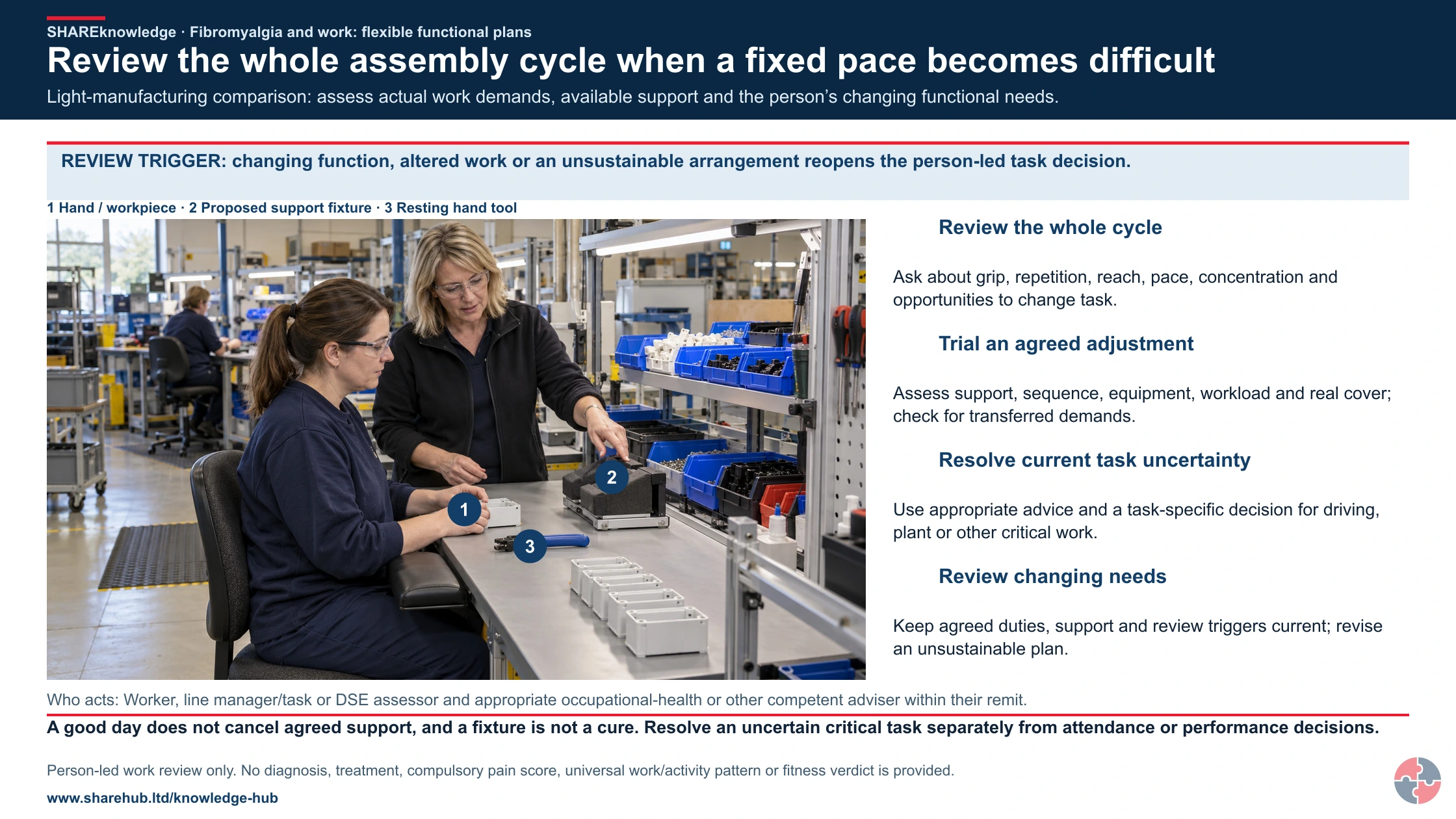
Review changing function and task demands with the person
Primary references: NI Direct: fibromyalgia overview — no treatment programme reproduced · Acas: individual reasonable adjustments — apply the actual jurisdiction · HSE: DSE and task assessment

Listen privately
Ask which tasks, working patterns or environments are difficult and which changes help; avoid a compulsory pain score.
Trial practical changes
Consider equipment, reach, handling aids, DSE setup, workload, hours and recovery together. Mechanical assistance is an engineering measure, not a cure.
Protect critical duties
Resolve uncertainty about driving, plant or other critical tasks through appropriate advice and a task-specific risk decision.
Review a fluctuating plan
Record agreed duties, limits, support and a review trigger. Change the plan if a flare or altered work makes it unsustainable.
Read the complete task-specific control examples
ERICPD is a planning cross-map: Discipline verifies and sustains every control. ESEAP compares effectiveness. A label does not authorise the task; retain the owner, evidence and stop or change decision.
Fibromyalgia and Work · ERICPD
- Eliminate
- Remove the unnecessary manual lift.
- Reduce
- Use smaller loads or a different workflow after worker consultation.
- Isolate
- Provide mechanical handling aid and adjust the workstation layout.
- Control
- Agree a private functional plan, pacing, review dates and escalation.
- PPE
- Handling gloves may address grip hazards but cannot make an unsafe lift acceptable.
- Discipline
- Observe actual handling and review symptom impact without disclosing diagnosis widely.
Fibromyalgia and Work · ESEAP
- Elimination
- Remove the unnecessary manual lift.
- Substitution
- Use smaller loads or a different workflow after worker consultation.
- Engineering controls
- Provide mechanical handling aid and adjust the workstation layout.
- Administrative controls
- Agree a private functional plan, pacing, review dates and escalation.
- PPE
- Handling gloves may address grip hazards but cannot make an unsafe lift acceptable.
What are the key facts about fibromyalgia and work?
The key facts are that symptoms are real, variable and often affected by work design, fatigue, stress and recovery.
Pain can fluctuate
Capability may vary by day, shift, task, sleep, workload and recovery.
Fatigue matters
Fatigue can affect stamina, concentration, driving, communication and safe performance.
Work design can help
Ergonomics, pacing, task variation and flexibility can reduce barriers.
Pain is not poor attitude
Managers should avoid disbelief, judgement or pressure to prove symptoms.
Function matters most
Support should focus on what the person can do safely and what work changes help.
Review is essential
Adjustments should be reviewed because symptoms, work demands and recovery can change.
What does fibromyalgia mean in plain English?
Fibromyalgia is a long-term pain condition that can also affect sleep, energy, concentration and daily functioning.
Northern Ireland government health guidance describes fibromyalgia as a long-term condition that causes widespread pain. People may also experience increased sensitivity to pain, fatigue, muscle stiffness, difficulty sleeping, problems with mental processes such as memory and concentration, headaches and other symptoms. The pattern is often individual and fluctuating.
For work, the diagnosis label is not enough. Two workers with the same condition may need very different support. One may need workstation changes and pacing; another may need reduced manual handling, flexible start times, hybrid work, occupational health advice or a phased return after a flare-up.
| Area | What it may involve | Work relevance |
|---|---|---|
| Pain | Widespread pain, soreness or heightened sensitivity. | Task design, posture, movement and load may need review. |
| Fatigue | Reduced energy and slow recovery. | Hours, breaks, workload and safety-critical work need consideration. |
| Sleep disruption | Poor sleep can worsen symptoms and fatigue. | Start times, shift work and recovery may need review. |
| Cognitive symptoms | Memory, concentration or word-finding difficulty. | High-risk decisions, complex tasks and interruptions may need controls. |
| Flare-ups | Periods of increased symptoms. | Temporary adjustments and review dates help. |
| Medication effects | Drowsiness or concentration effects may occur for some people. | Occupational health advice may be needed for safety-critical roles. |
What symptoms and work patterns may need a private conversation?
Symptoms and work patterns should be treated as prompts for support, not as proof of a diagnosis or poor performance.
Workplace signs may include difficulty sitting or standing for long periods, guarding movement, variable pace, increased absence, fatigue after demanding tasks, needing more recovery, discomfort with repetitive work, difficulty concentrating, irritability or withdrawal. The same signs can have many causes.
Managers should focus on work barriers: what tasks are hard, what triggers symptoms, what helps, whether safety is affected and what can reasonably change. This is more useful and respectful than asking the person to defend or explain their medical condition in detail.
| Sign or pattern | Possible workplace meaning | Support response |
|---|---|---|
| Pain after repetitive tasks | Task may exceed tolerance or recovery. | Review repetition, pace, variation and breaks. |
| Difficulty with static posture | Sitting or standing still may worsen symptoms. | Introduce movement variation and workstation changes. |
| Fatigue late in shift | Workload or shift length may be too demanding. | Review hours, breaks and task timing. |
| Concentration difficulty | Pain, fatigue or medication may affect focus. | Reduce interruptions and review safety-critical work. |
| Frequent short absence | Symptoms may fluctuate or flare. | Support return-to-work and adjustment planning. |
| Reluctance to disclose | Worker may fear disbelief or stigma. | Reassure confidentiality and focus on support. |
How can fibromyalgia affect work?
Fibromyalgia can affect stamina, concentration, posture tolerance, manual tasks, travel, shift work, communication and recovery.
The practical impact depends on the job. In office work, prolonged DSE use, poor seating, static posture and long meetings may be the main barriers. In construction, care, leisure, logistics or manufacturing, manual handling, standing, walking, vibration, cold, PPE and early starts may be more important.
Work should be designed around functional capability. That does not mean removing all responsibility from the worker. It means agreeing realistic controls that allow safe contribution without making symptoms worse through preventable strain.
| Work factor | How it may affect symptoms | Good management |
|---|---|---|
| Static posture | Can increase pain or stiffness. | Movement breaks and workstation adjustment. |
| Repetition | Can build discomfort and fatigue. | Task rotation and pace review. |
| Manual handling | Can exceed load tolerance. | Mechanical aids and task redesign. |
| Shift work | Can worsen sleep and recovery. | Roster review and fatigue management. |
| Stress and workload | Can amplify pain and fatigue. | Demand review and clear priorities. |
| Travel | Can create pain, fatigue and recovery problems. | Journey planning or hybrid options where suitable. |
How should a functional work plan be agreed and reviewed?
Describe real tasks, barriers and safe alternatives with the worker, then test the plan in actual work.
A job title is not an assessment. Record the demands that matter: lifting, grip, standing, reach, screen time, travel, concentration, emergency response, shift timing and recovery. Agree specific controls, a person who can authorise a change, a private contact route and a review date. Share only functional restrictions with those who need them.
A plan made on one good or bad day may fail when symptoms fluctuate. Review after changed duties, equipment or symptoms, an incident, an unsuccessful adjustment or return from absence. A phased return needs tasks, load, hours, travel and success criteria; shorter hours alone can concentrate the hardest work into less time.
For a warehouse picker, a safe plan might combine a handling aid, lower shelf, predictable break and a route to switch task when grip fails. The test is whether the controls work during a busy shift, not whether a form was signed.
How should work be designed around chronic pain and fatigue?
Work should reduce unnecessary strain, allow movement variety, protect recovery and make task demands predictable.
Good design starts by looking at task duration, posture, force, repetition, reach, grip, pace, breaks, temperature, vibration, travel and mental demand. Small changes can be valuable: moving frequently used items closer, using lighter loads, splitting tasks, avoiding long static meetings, changing chair setup or building in recovery after demanding tasks.
Pacing is important. Sudden full-load return after absence or a flare-up can create a boom-and-bust pattern: the person overdoes activity on a better day, symptoms worsen, and recovery takes longer. A planned, graded approach is often more sustainable.
| Control | Example | Why it helps |
|---|---|---|
| Task variation | Alternate sitting, standing, walking and light admin. | Reduces static load and repeated strain. |
| Micro-breaks | Short movement or stretch breaks. | Supports pacing without removing productivity. |
| Predictable workload | Avoid sudden peaks where possible. | Reduces stress and overexertion. |
| Flexible timing | Adjust start time after poor sleep or treatment. | Improves recovery and attendance. |
| Environmental comfort | Control cold, heat, noise or poor lighting where possible. | Reduces symptom triggers. |
| Graded return | Increase duties gradually after absence. | Supports sustainable recovery. |
What if pain or fatigue affects a safety-critical task?
Pause a high-consequence task when safe performance is in doubt, then use cover, handover, deferral or safe shutdown.
Driving, machinery, plant isolation, work at height, lone work and emergency roles need a task-specific decision. Fibromyalgia itself is not an automatic ban; the concern is whether pain, fatigue, attention, grip, balance or a disclosed treatment effect removes a necessary safety margin today. A supervisor should use agreed triggers, not guess from a diagnosis.
In a control room, an alarm-response role may need independent checking and relief after a poor night. In a garage, a technician may safely complete bench work but defer a test drive or heavy component lift. For a process-isolation task, arrange a competent replacement and controlled handover before leaving the barrier unstaffed.
Do not tell a worker to stop prescribed medicine or demand a medication list. Seek occupational-health or clinical advice on function where needed, record the operational control and arrange safe travel if the person should not drive home.
How should DSE work be managed for fibromyalgia?
DSE work should be assessed for posture, reach, screen position, input devices, breaks and home-working arrangements.
Display screen equipment work can aggravate symptoms where a person holds static postures, reaches awkwardly, works for long periods without movement, uses unsuitable seating or works from a poor home setup. The answer is not simply a new chair; it is a review of the whole work pattern.
DSE assessment should consider chair adjustment, lumbar support, feet support, keyboard and mouse position, screen height, glare, lighting, document handling, headset use, break patterns, workload and whether specialist ergonomic input is needed.
| DSE issue | Potential adjustment | Evidence |
|---|---|---|
| Static sitting | Movement breaks, sit-stand option or task variation. | DSE assessment and review. |
| Keyboard or mouse discomfort | Alternative input device or layout change. | Trial record and feedback. |
| Poor home setup | Home DSE assessment and suitable equipment. | Home-working assessment. |
| Long meetings | Breaks, camera flexibility or shorter sessions. | Meeting standard. |
| Screen or visual strain | Screen position, lighting and eyesight test route. | DSE record. |
| High workload | Priorities and pacing. | Workload review. |
How should manual handling be managed for fibromyalgia?
Manual handling should be assessed for load, posture, repetition, carrying distance, frequency and recovery.
Manual handling can be difficult where pain, fatigue or reduced strength affects tolerance. The manual handling assessment should not simply ask whether the worker can lift a standard load. It should examine the actual task: weight, grip, reach, twist, distance, height, frequency, team handling, environment and recovery between tasks.
Controls may include avoiding unnecessary handling, using mechanical aids, splitting loads, changing storage height, using trolleys, limiting repetitive handling, rotating tasks, team handling where suitable and adjusting duties during flare-ups or phased return.
| Issue | Control | Why it matters |
|---|---|---|
| Heavy load | Reduce weight or use lifting aid. | Controls force demand. |
| Awkward reach | Change layout or storage height. | Reduces strain and pain trigger. |
| Repetition | Rotate tasks or alter pace. | Allows recovery. |
| Long carry | Use trolley or closer storage. | Reduces fatigue. |
| Poor grip | Improve handles or packaging. | Reduces hand and shoulder strain. |
| Flare-up | Temporary duty change. | Prevents avoidable deterioration. |
What reasonable adjustments may help fibromyalgia at work?
Adjustments should focus on functional barriers, safe performance and sustainable attendance.
Fibromyalgia may amount to a disability depending on its impact and duration. Employers should not wait for perfect certainty before considering practical adjustments. Sensible support can be agreed and reviewed without turning every conversation into a formal dispute.
Adjustments should be individual. A worker may need flexibility in hours, modified duties, DSE equipment, reduced manual handling, hybrid work, rest breaks, predictable shifts, temperature control, quieter work, phased return or support with travel.
| Adjustment area | Examples | Review question |
|---|---|---|
| Hours | Flexible start, phased return or reduced overtime. | Is recovery improving and work being completed safely? |
| Task content | Reduce high-strain tasks or rotate duties. | Are symptoms and productivity more stable? |
| Equipment | Ergonomic chair, input device, trolley or lifting aid. | Does the equipment remove the barrier? |
| Location | Hybrid work or closer parking where suitable. | Does travel or environment affect symptoms? |
| Breaks | Micro-breaks or movement breaks. | Are breaks usable in real work? |
| Communication | Named manager, privacy and review dates. | Does the worker know how to raise concerns early? |
How might adjustments differ across workplaces?
Choose controls for the actual physical and cognitive demands, rather than a standard list for everyone with fibromyalgia.
Manufacturing and garages may need mechanical aids, redesigned reach, temperature control, protected maintenance handover and a test-drive decision. Energy and petrochemical operations may need staffing resilience, alarm management, controlled relief and review of remote travel or emergency-team roles. None should depend on a single person working through unsafe pain or fatigue.
Retail and hospitality may need seated tasks, stock placement, predictable breaks and support for customer conflict. Warehouses and haulage add load handling, vehicle interfaces, driving and remote welfare. A flexible start time must not create unsafe lone cover or a rushed journey.
Agency and contractor workers need access to the same work-risk information, reporting route, welfare and safe task adjustments. Coordinate between hirer and employer without circulating private medical detail.
How should managers talk about fibromyalgia and work?
Managers should use private, non-judgemental conversations focused on work impact and support.
A respectful manager does not ask the worker to prove pain. They ask what is difficult at work, what makes symptoms worse, what has helped before, what support would be useful and what must remain private. They should keep essential standards clear while recognising that adjustment and performance management are different conversations.
If the work includes safety-critical tasks, the manager should ask whether pain, fatigue, concentration or medication effects could affect safe performance. That question is about risk control, not blame.
| Prompt | Purpose | Boundary |
|---|---|---|
| What work tasks are hardest at the moment? | Identifies barriers. | Does not request diagnosis. |
| What helps you manage symptoms at work? | Builds on existing strategies. | Keeps worker voice central. |
| Are any duties unsafe when symptoms flare? | Controls immediate risk. | Escalate to OH if needed. |
| What information can be shared? | Protects confidentiality. | Agree need-to-know limits. |
| Would an occupational health referral help? | Gets functional advice. | Explain purpose and consent route. |
| When shall we review? | Recognises fluctuating symptoms. | Set clear review date. |
Which legal duties apply to fibromyalgia and work?
Legal duties may involve health and safety risk assessment, DSE, manual handling, equality and health-data protection.
Great Britain health-and-safety regulations and the Equality Act 2010 do not replace Northern Ireland instruments or the NI disability-discrimination route. Assess the actual task and use the right jurisdiction before adopting a formal adjustment or legal conclusion.
| Jurisdiction | Duty or regulation | How it applies | Typical evidence |
|---|---|---|---|
| GB | Health and Safety at Work etc. Act 1974 | Requires protection of health, safety and welfare so far as reasonably practicable. | Safe systems, supervision and work design. |
| GB | Management of Health and Safety at Work Regulations 1999 | Requires suitable risk assessment, preventive arrangements and review. | Task risk assessments and adjustment review. |
| GB | Health and Safety (Display Screen Equipment) Regulations 1992 | Relevant where DSE workstations, training, breaks and eyesight arrangements are needed. | DSE assessment and equipment provision. |
| GB | Manual Handling Operations Regulations 1992 | Relevant where lifting, carrying, pushing or pulling may worsen symptoms or create risk. | Manual handling assessment and controls. |
| GB | Equality Act 2010 | Relevant where fibromyalgia has substantial and long-term effect on normal day-to-day activities. | Reasonable adjustment records and fair decision-making. |
| UK | Data Protection Act 2018 | Relevant to handling health information and occupational health advice. | Secure, proportionate health records. |
| NI | Health and Safety at Work (NI) Order 1978 | Northern Ireland general work-risk duties. | NI task and risk assessment. |
| NI | Management Regulations (NI) 2000 | Northern Ireland risk-management and review framework. | Work plan and control review. |
| NI | Manual Handling Operations Regulations (NI) 1992 | Northern Ireland handling-risk hierarchy. | Avoid, assess and reduce hazardous handling. |
| NI | Display Screen Equipment Regulations (NI) 1992 | Northern Ireland DSE assessment and control route. | Workstation assessment and review. |
| NI | Use current government guidance and competent task-specific advice; this section does not establish a technical specification. | Northern Ireland disability discrimination and reasonable-adjustment duties; use the Equality Commission NI employment guidance and individual facts. | Documented adjustment decision and review. |
How should fibromyalgia and work appear in risk assessment?
Risk assessment should focus on task demands, functional impact, safety-critical work and control effectiveness.
The manager and worker identify the real task demands and safe alternatives; the safety adviser checks manual handling, DSE, travel and high-consequence interfaces. Record who owns each work control, what evidence shows it works in a busy shift, who can authorise temporary reassignment and when the plan will be reviewed. Keep the general task-risk record separate from confidential health detail.
A failed adjustment, changed shift, near miss, new equipment, symptom flare affecting safe performance or return from absence prompts reassessment. Where grip, attention, balance or fatigue puts driving, lifting, plant isolation or emergency response in doubt, hold that task and arrange competent cover and handover. Restart follows a task-specific check and agreed functional plan, not a diagnosis label alone.
| Scenario | Risk | Controls and evidence |
|---|---|---|
| DSE-heavy role | Static posture and fatigue worsen symptoms. | DSE assessment, breaks, equipment and review. |
| Manual handling role | Loads and repetition exceed tolerance. | Task redesign, aids and temporary duty controls. |
| Safety-critical task | Pain, fatigue or medication affects alertness. | OH advice, task review and supervision. |
| Shift work | Poor sleep and recovery worsen fatigue. | Roster review and fatigue controls. |
| Return after flare-up | Full duties too soon cause relapse. | Phased return and graded workload. |
| Travel between sites | Driving or commuting worsens pain and fatigue. | Journey planning or location flexibility. |
How can the hierarchy of controls reduce workplace demands that aggravate fibromyalgia symptoms?
Remove the actual hazard where possible, then use substitution and verified physical controls before relying on procedures or PPE. Discipline checks that the chosen barriers still work.
The scenario is pain and fatigue during manual handling. The controls below are reasoned task applications of linked guidance, not a prescribed design or evidence that each intervention appears verbatim in a source. A competent owner must check feasibility, local law and stop criteria.
Use current government guidance and competent task-specific advice; this section does not establish a technical specification.
How can the ERICPD hierarchy of controls reduce workplace demands that aggravate fibromyalgia symptoms?

| Hazard and harm route | ERICPD → five-level control | Task intervention and feasibility | Owner, test and evidence | Failure and stop decision |
|---|---|---|---|---|
| Pain and fatigue during manual handling | Eliminate → Elimination | Remove the unnecessary manual lift. Source: HSE - Musculoskeletal disorders. | Observe the revised stock process and confirm that the unnecessary manual lift no longer occurs; review remaining handling load with the worker. | Stop or redesign if an unsafe manual lift. |
| Same scenario | Reduce → Substitution | Use smaller loads or a different workflow after worker consultation. Source: HSE - Musculoskeletal disorders. | Line manager trials the replacement method and documents new hazards, residual risk and worker feedback before release. | Pause until the alternative and its new risks are assessed. |
| Same scenario | Isolate → Engineering | Provide mechanical handling aid and adjust the workstation layout. Source: HSE - Musculoskeletal disorders. | Line manager must observe a representative lift using the aid and confirm it reduces force and awkward posture. | Stop or redesign if an unsafe manual lift. |
| Same scenario | Control → Administrative | Agree a private functional plan, pacing, review dates and escalation. Source: HSE - Musculoskeletal disorders. | Line manager spot-checks the actual instruction, authorisation and shift handover against work in progress. | Pause if the procedure or handover cannot be verified. |
| Same scenario | PPE → PPE | Handling gloves may address grip hazards but cannot make an unsafe lift acceptable. Source: HSE - Musculoskeletal disorders. | Line manager confirms the assessed residual hazard, verifies PPE selection, fit or condition, and observes correct use; PPE remains subordinate to source controls. | PPE cannot be the sole credited barrier. |
| Same scenario | Discipline → Administrative assurance | Observe actual handling and review symptom impact without disclosing diagnosis widely. Source: HSE - Musculoskeletal disorders. | Observe actual handling and review symptom impact without disclosing diagnosis widely. | Stop or redesign if an unsafe manual lift. |
How can the ISO 45001 hierarchy of controls reduce workplace demands that aggravate fibromyalgia symptoms?

| Hazard and harm route | ERICPD → five-level control | Task intervention and feasibility | Owner, test and evidence | Failure and stop decision |
|---|---|---|---|---|
| Pain and fatigue during manual handling | Eliminate → Elimination | Remove the unnecessary manual lift. Source: HSE - Musculoskeletal disorders. | Observe the revised stock process and confirm that the unnecessary manual lift no longer occurs; review remaining handling load with the worker. | Stop or redesign if an unsafe manual lift. |
| Same scenario | Reduce → Substitution | Use smaller loads or a different workflow after worker consultation. Source: HSE - Musculoskeletal disorders. | Line manager trials the replacement method and documents new hazards, residual risk and worker feedback before release. | Pause until the alternative and its new risks are assessed. |
| Same scenario | Isolate → Engineering | Provide mechanical handling aid and adjust the workstation layout. Source: HSE - Musculoskeletal disorders. | Line manager must observe a representative lift using the aid and confirm it reduces force and awkward posture. | Stop or redesign if an unsafe manual lift. |
| Same scenario | Control → Administrative | Agree a private functional plan, pacing, review dates and escalation. Source: HSE - Musculoskeletal disorders. | Line manager spot-checks the actual instruction, authorisation and shift handover against work in progress. | Pause if the procedure or handover cannot be verified. |
| Same scenario | PPE → PPE | Handling gloves may address grip hazards but cannot make an unsafe lift acceptable. Source: HSE - Musculoskeletal disorders. | Line manager confirms the assessed residual hazard, verifies PPE selection, fit or condition, and observes correct use; PPE remains subordinate to source controls. | PPE cannot be the sole credited barrier. |
| Same scenario | Discipline → Administrative assurance | Observe actual handling and review symptom impact without disclosing diagnosis widely. Source: HSE - Musculoskeletal disorders. | Observe actual handling and review symptom impact without disclosing diagnosis widely. | Stop or redesign if an unsafe manual lift. |
How could BuildOut Ltd support fibromyalgia and work?

BuildOut would support fibromyalgia by assessing real tasks, adjusting physical and DSE demands, training managers and reviewing whether changes work.
BuildOut Ltd
a construction and fit-out contractor with site supervisors, trades, planners, administrators, warehouse staff and mobile managers
BuildOut recognises that fibromyalgia may affect site and office roles differently. For a site supervisor, barriers may include walking long distances, cold weather, stairs, early starts, driving and long meetings. For a planner or administrator, the main barriers may be static DSE work, workload peaks and concentration fatigue. The company avoids a one-size-fits-all adjustment plan.
The manager holds a private conversation and asks what work factors are difficult. The safety adviser reviews manual handling, access, temperature, travel and DSE risks. HR coordinates any reasonable-adjustment process. Occupational health is used where medication, fatigue, safety-critical decisions, site access or phased return needs specialist functional advice.
BuildOut checks whether controls are working. First-line supervisors monitor task allocation and breaks. The HSSE team reviews DSE and manual handling assessments. HR reviews adjustment timeliness and sickness absence patterns without exposing private medical detail. Lessons from repeated flare-ups are used to alter workload planning, equipment provision and manager training.
For example, before a cold early-morning site inspection BuildOut agrees a shorter route, breaks, a warm base and another competent person for lifting or driving. During the visit the supervisor reports worsening grip and concentration before a planned vehicle movement; the line manager pauses that duty, arranges a covered handover and records only the functional restriction.
The safety adviser checks the route and manual tasks, HR reviews the agreed adjustment and occupational health advises if functional limits remain unclear. The authorised manager returns the duty only when the task check, cover and worker review show it can be done safely; the team records the change and a review date without sharing medical detail.
| Stage | How BuildOut applies it | Evidence |
|---|---|---|
| Assess | Reviews DSE, manual handling, travel, access, weather and safety-critical tasks. | Role risk assessment and DSE record. |
| Analyse | Considers symptoms, triggers, recovery pattern and work barriers without medical interrogation. | Manager notes focused on work impact. |
| Implement | Uses task rotation, equipment, flexible hours, hybrid work and phased return where suitable. | Adjustment plan and review date. |
| Train | Trains managers on chronic pain, privacy, reasonable adjustments and OH referral. | Manager training records. |
| Check | Reviews whether adjustments improve safe performance and attendance. | Worker feedback and action tracker. |
| Improve | Updates procedures, equipment standards and workload planning after feedback. | Management review and closed actions. |
Who needs fibromyalgia-related competence, and how is it checked?
Training should help people understand chronic pain, work design, reasonable adjustments and respectful conversations.
General awareness should explain that chronic pain and fibromyalgia can be real, fluctuating and invisible. It should avoid turning workers into clinicians. The emphasis is on respect, early reporting, good work design and support routes.
Managers need more detailed training because they make practical decisions about duties, flexibility, absence, DSE, manual handling and performance. Safety advisers need enough knowledge to connect symptoms to ergonomic and manual handling controls.
| Role | Learning to test | Competence demonstration | Assessor and record | Reassessment trigger |
|---|---|---|---|---|
| Workers and agency staff | Recognise task-demand triggers, report symptoms or failed controls privately and use stop routes. | Walk through a manual task or screen-work concern and identify a safe pause or alternative. | Supervisor observes and records induction and task briefing. | New task, failed adjustment or changing work demand. |
| Supervisors | Use functional plans, break cover, safe task reassignment and respectful escalation. | Lead a simulated high-consequence task concern through cover and handover without diagnosis. | Operations lead assesses the decision and records follow-up. | Near miss, unsafe return, roster or team change. |
| DSE and manual-handling assessors | Assess actual workstation, handling force, frequency, layout and equipment options. | Observe the work and show how controls reduce strain without creating another risk. | Competent ergonomics or safety lead signs the assessment. | Workstation, load, method or worker-function change. |
| HR and occupational-health partners | Apply GB or NI adjustments, confidentiality, functional advice and review duties. | Review an anonymised case for data minimisation and a tested return plan. | Competent HR/OH lead records case review and limits. | New law, complaint, treatment effect or failed plan. |
| Senior managers and contractors | Resource staffing, aids, welfare, alternatives and a no-stigma reporting route. | Trace an adjustment through procurement, frontline use and verified outcome. | Independent safety or management reviewer samples evidence. | Repeated absence, incident, contractor change or audit finding. |
How can BS EN ISO 45001 support fibromyalgia and work?
ISO-style management systems make worker participation, risk assessment, competence, operational control and review visible.
Use current government guidance and competent task-specific advice; this section does not establish a technical specification.
| Management theme | How it supports fibromyalgia and work | Useful evidence |
|---|---|---|
| Consultation and participation of workers | Uses worker feedback on pain triggers, workload and adjustment effectiveness. | Consultation and review notes. |
| Actions to address risks and opportunities | Identifies DSE, manual handling, fatigue and work-design risks. | Risk assessment and action plans. |
| Competence | Ensures managers understand chronic pain, adjustments and respectful conversations. | Training records. |
| Operational planning and control | Controls tasks, equipment, breaks, phased return and safety-critical duties. | Work plans and adjustment records. |
| Monitoring, measurement, analysis and evaluation | Reviews absence, feedback, DSE findings and adjustment outcomes. | Trends and management review. |
| Incident, nonconformity and corrective action | Learns where poor work design or poor management worsens symptoms. | Corrective actions and lessons learned. |
These are practical management-system themes, not a clause-by-clause interpretation. A competent reviewer must verify any clause mapping against a lawfully accessed current standard.
What are the warning signs that fibromyalgia support is failing?
Warning signs include disbelief, repeated flare-ups, ignored DSE or manual handling issues, poor confidentiality and unmanaged fatigue.
Poor support can cause harm by increasing pain, fatigue, absence, presenteeism, distress, conflict and loss of trust. It can also increase safety risk where a person struggles with driving, machinery, manual handling or other safety-critical work but does not feel able to report it.
A common failure is treating adjustments as a one-off favour. Support needs review because symptoms, workload and work demands change. If adjustments are not checked, they may drift, stop being used or become unsuitable.
| Warning sign | How it can cause harm | Management response |
|---|---|---|
| Disbelief or jokes | Worker hides symptoms and support is delayed. | Train managers and address conduct. |
| Repeated flare-ups after same task | Work design may be worsening symptoms. | Review task, pace, recovery and equipment. |
| Poor DSE setup | Static posture and reach increase pain. | Update DSE assessment and equipment. |
| Manual handling still high | Load exceeds functional tolerance. | Redesign task or use aids. |
| No review date | Adjustments become stale or ineffective. | Set formal review. |
| Safety concerns hidden | Driving, machinery or site risks may increase. | Create non-blame escalation route. |
Fibromyalgia and work FAQs - what do people ask?
People usually ask about symptoms, work capability, adjustments, occupational health and how managers should respond.
Is this page medical advice?
No. It gives workplace guidance only. Diagnosis, treatment, medication and personal health decisions should be discussed with a GP, specialist or appropriate local health service.
What is fibromyalgia?
Northern Ireland government health guidance describes widespread pain, fatigue, sleep problems and cognitive symptoms.
Can someone with fibromyalgia work?
Many people can work with suitable work design, flexibility and support, but capability and adjustments should be based on functional impact rather than assumptions.
What are common work barriers?
Barriers can include static posture, repetitive tasks, manual handling, poor DSE setup, long shifts, cold, stress, travel, fatigue and inflexible targets.
What should managers ask?
Ask what work is making symptoms harder, what support helps, whether any duties are unsafe, what information can be shared and when to review.
Is fibromyalgia a disability?
It may be a disability depending on its impact and duration. Employers should take reasonable-adjustment considerations seriously and seek HR advice where needed.
Should occupational health be involved?
Occupational health is useful where symptoms are fluctuating, medication may affect safety, duties are safety critical or adjustments are unclear.
What adjustments may help?
Useful options can include flexible hours, pacing, micro-breaks, workstation changes, task rotation, reduced manual handling, phased return and hybrid work where suitable.
How should health information be recorded?
Record agreed support, restrictions and review dates; avoid unnecessary clinical detail and restrict access to people with a genuine need to know.
What if performance is affected?
Explore health and work barriers, adjustments and occupational health advice before moving to formal performance action, while keeping essential safety standards clear.
Which acronyms and terms matter here?
Acronyms should be explained so readers understand official sources, adjustments and workplace controls.
| Acronym | Meaning | Plain English use |
|---|---|---|
| DSE | Display Screen Equipment | Screens, keyboards and related workstation equipment. |
| EAP | Employee Assistance Programme | Confidential support service where provided by the employer. |
| HR | Human Resources | People management function. |
| MSD | Musculoskeletal Disorder | Health condition affecting muscles, joints, tendons, ligaments, nerves or supporting structures. |
| OH | Occupational Health | Specialist work-health advice service. |
| ERICPD | Eliminate, Reduce, Isolate, Control, PPE, Discipline | A planning aid for work-design controls, not a clinical treatment. |
| Functional restriction | Limit on a task or activity | Work-focused information that can be shared without revealing a full diagnosis. |
| Pacing | Balancing demand and recovery | Plan activity to avoid repeated overexertion and long recovery. |
| Flare | Period of increased symptoms | A change that may trigger a temporary task adjustment or reassessment. |