SHARE Knowledge Hub
Electromagnetic fields at work
Electromagnetic fields are present around ordinary electrical equipment, but stronger sources such as MRI magnets, induction heaters and transmitters need a task-specific assessment. The established workplace concerns are acute sensory or health effects and indirect effects such as implanted-device interference. Identify the source and people exposed, use manufacturer or sector information, control access where needed and seek competent assessment when exposure or a particular-risk worker is uncertain.
Understanding Electromagnetic fields at work
Electromagnetic fields, or EMFs, are non-ionising fields generated wherever electricity is used.
Why this matters at work
Process failure: Dutyholder relies on a generic policy without source assessment | How control is lost: High-field source, changed equipment or particular-risk worker is missed | Possible consequence: Exposure above limits, device interference, injury and enforcement | Management arrangements and recovery: Avoid: remove/defer uncertain task; Limit scope: limit source/time/access; Restrict release: restrict high-field area; Management arrangements: CEMFAW assessment, ownership, supplier data, competence and review; Residual task protection: residual specialist measures only; Implementation assurance: dutyholder checks the applicable assessment conditions, ownership and funded actions.
Process failure: Particular-risk concern is handled informally or disclosed widely | How control is lost: Technical risk is unresolved and worker avoids reporting or is unnecessarily excluded | Possible consequence: Medical-device effect, distress, discrimination and unsafe exposure | Management arrangements and recovery: Avoid: avoid uncertain exposure; Limit scope: reduce source/time/proximity; Restrict release: restrict access pending review; Management arrangements: confidential case process, competent/clinical input and adjustments; Residual task protection: only assessed residual protection; Implementation assurance: case manager checks that agreed adjustments and restrictions are workable and reviewed with the worker.
How organisations manage this in practice
Elimination and reduction are usually the strongest EMF controls. Remove unnecessary high-field equipment, choose a lower-emission process, automate or move the source away from people, reduce operating output/duty cycle where this is technically safe, increase separation through layout, sequence tasks when the source is inactive and reduce concurrent work. Do not select a control simply because it is familiar; select the measure that reduces the actual field or access pathway.
Administrative controls support, rather than replace, physical measures. Use competent operating instructions, role authorisation, maintenance procedures, contractor controls, visitor arrangements, shift handover, signage, supervision, supplier liaison, inspection, emergency information and clear stop-work authority. Information/training should explain source-specific risks, particular restrictions and why a control matters, not merely distribute legal terminology or numerical limits.
Process failure: EMF controls are not reviewed after change or concern | How control is lost: Earlier source/access assumptions no longer match equipment or workforce | Possible consequence: Exposure, device interference, indirect injury and enforcement | Management arrangements and recovery: Avoid: stop uncertain use; Limit scope: reduce source/time/access; Restrict release: zone/isolate/control entry; Management arrangements: MOC, assessment, maintenance, consultation and audit; Residual task protection: residual specialist PPE; Implementation assurance: assurance owner checks changes trigger review and closed actions work at the task.
Screen the source and the person before deciding the EMF response
For an induction heater, a changed power setting, duty cycle or work position reopens the assessment. The equipment owner obtains current manufacturer information; the competent assessor checks whether the existing basis covers the changed mode. General reassurance about ordinary office sources does not resolve an unassessed high-output task.
- Identify sources and operating modes — Use equipment information and the actual task and exposure conditions.
- A worker needs particular assessment — Use a private functional route and competent device-specific advice.
- Select and verify controls — Apply the source-specific assessment and review changes.
If a worker raises an implanted-device concern, discuss the needed work restriction privately and obtain suitable occupational-health, manufacturer or specialist advice without circulating clinical details. Hold the uncertain exposure until the decision is resolved. Do not infer that every Wi-Fi source requires measurement or exclusion.
Content amended 19 October 2026 by the SHARE Knowledge Hub editorial team. This records an editorial content change; the existing technical-review and approval status still applies.
Assess the actual induction-heater configuration
Field exposure depends on the equipment, operating mode, task and position. An assessment boundary for one configuration is not a universal distance for all equipment.

Assess the induction-heater configuration and the actual task
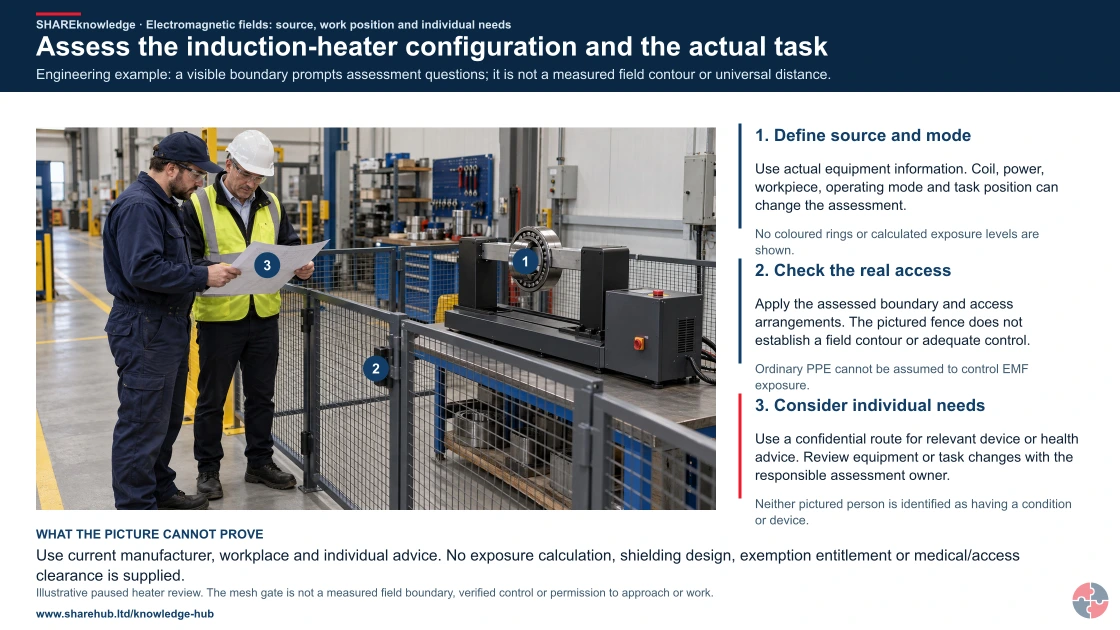
Full written explanation
Engineering example: a visible boundary prompts assessment questions; it is not a measured field contour or universal distance.
- Define source and mode. Use actual equipment information. Coil, power, workpiece, operating mode and task position can change the assessment.
- Check the real access. Apply the assessed boundary and access arrangements. The pictured fence does not establish a field contour or adequate control.
- Consider individual needs. Use a confidential route for relevant device or health advice. Review equipment or task changes with the responsible assessment owner.
Change the pathway
- No invisible-field claim. No coloured rings or calculated exposure levels are shown.
- PPE is not a general shield. Ordinary PPE cannot be assumed to control EMF exposure.
- No medical inference. Neither pictured person is identified as having a condition or device.
Evidence check: Use current manufacturer, workplace and individual advice. No exposure calculation, shielding design, exemption entitlement or medical/access clearance is supplied.
Individual considerations, actual source information and controlled access
Primary references: HSE: electromagnetic fields and employer assessment · HSE: equipment and workers at particular risk
Open the complete HD image (new tab)Download image
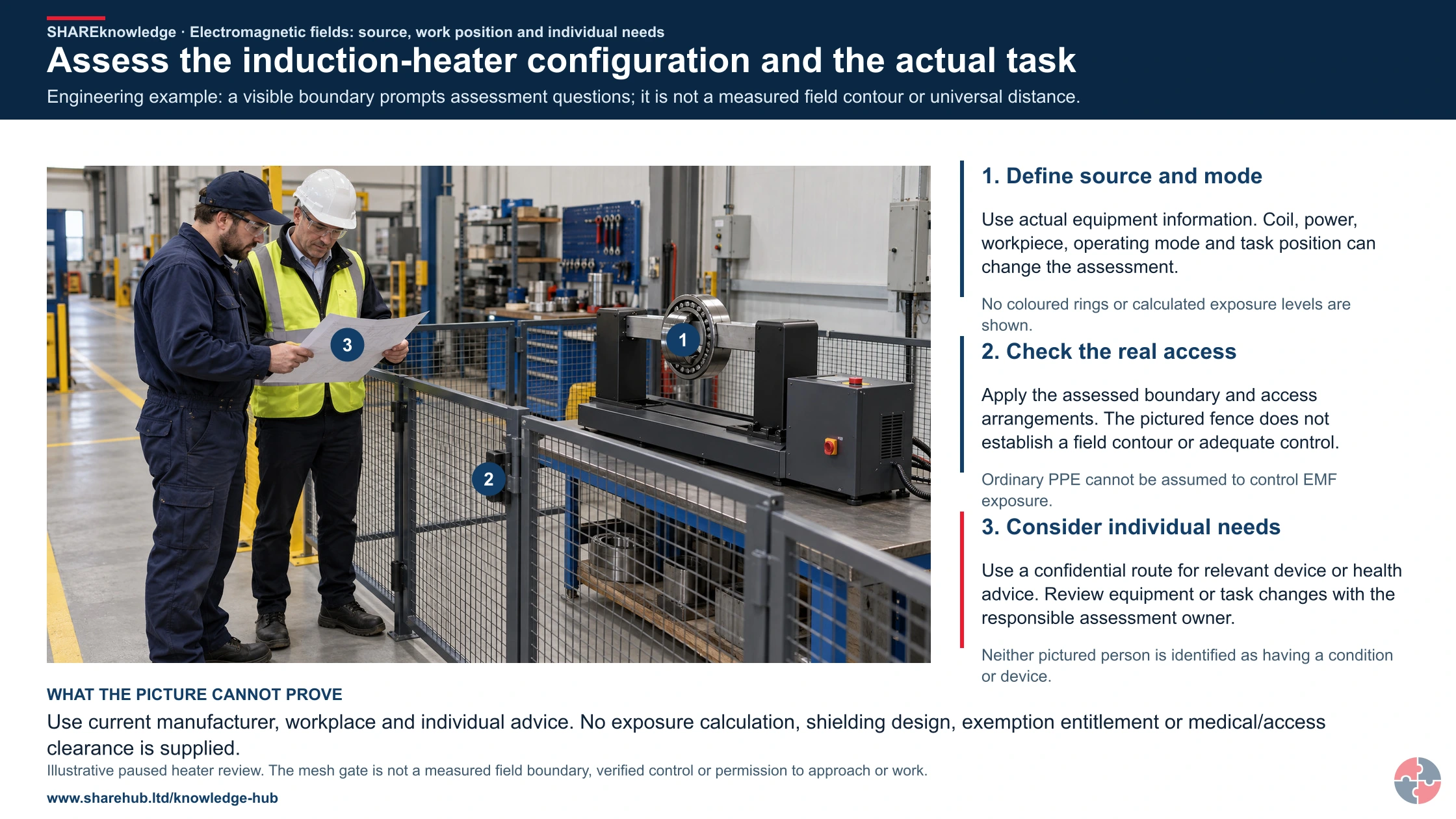
Individual considerations, actual source information and controlled access
Primary references: HSE: electromagnetic fields and employer assessment · HSE: equipment and workers at particular risk

Define exposure
Use manufacturer information and a suitable assessment of the actual mode, layout and work positions.
Particular-risk needs
Provide a confidential route for relevant device or health advice without publishing personal medical details.
Verify and review
Use the assessed access controls and review changes to equipment, mode or task. Ordinary PPE is not a general shield against electromagnetic fields.
The scene provides no exposure calculation, implant clearance or generic safe-distance rule.
What is the health and advice boundary for electromagnetic field effects?
This page is workplace exposure guidance, not medical advice, diagnostic advice or specialist radiation-protection consultancy.
What is the health and advice boundary for electromagnetic field effects?


Read the complete visual as text
- This page is workplace exposure guidance, not medical advice,…: This page is workplace exposure guidance, not medical advice, diagnostic advice or specialist radiation-protection consultancy.
- Workers with symptoms, implanted devices, body-worn medical devices, pregnancy-related…: Workers with symptoms, implanted devices, body-worn medical devices, pregnancy-related concerns or uncertainty about fitness for work should be supported through normal occupational health, medical and workplace reporting routes. Employers should not dismiss concerns, but they should also communicate accurately so ordinary low-risk sources do not create unnecessary anxiety.
- Where stronger electromagnetic field (EMF) sources exist, competent assessment…: Where stronger electromagnetic field (EMF) sources exist, competent assessment may require equipment information, HSE guidance, manufacturer data, calculation, measurement or specialist advice. The level of assessment should match the source and risk.
Workers with symptoms, implanted devices, body-worn medical devices, pregnancy-related concerns or uncertainty about fitness for work should be supported through normal occupational health, medical and workplace reporting routes. Employers should not dismiss concerns, but they should also communicate accurately so ordinary low-risk sources do not create unnecessary anxiety.
Where stronger electromagnetic field (EMF) sources exist, competent assessment may require equipment information, HSE guidance, manufacturer data, calculation, measurement or specialist advice. The level of assessment should match the source and risk.
What are the key facts about electromagnetic field effects?
The key facts are that EMFs are common, usually low risk in ordinary workplaces, but need deliberate control around stronger or specialist sources.
EMFs are everywhere
Electrical and electronic equipment produces EMFs, so the topic should be filtered by source strength and exposure scenario.
The workplace focus is established effects
The Control of Electromagnetic Fields at Work (CEMFAW) Regulations address acute sensory, health and indirect effects rather than unproven long-term claims.
Some workers need individual consideration
Implanted devices, body-worn devices and pregnancy can change the assessment even where others are not at risk.
Measurement is not always needed
Existing information, manufacturer data and HSG281 may be enough for many workplaces.
Higher-risk sources need control
MRI, powerful transmitters, induction heating, welding and high-current equipment can need more detailed assessment.
Communication is a control
Clear explanation prevents both complacency and avoidable fear.
When does an EMF source need more than routine reassurance?
Identify the actual field source, frequency, task and people exposed. Use reliable equipment data and HSE assessment guidance; hold access or seek competent assessment when a stronger source or particular-risk worker makes the exposure uncertain.
Ordinary office devices usually need no elaborate measurement. An MRI access route, induction heater or antenna maintenance task is different: the responsible manager must know the operating mode, field zone, device compatibility and who may enter before authorising work.
What are electromagnetic field effects?
Electromagnetic field effects are effects that may occur when EMF exposure is strong enough to interact with the body, devices or nearby objects.
EMFs include static electric fields, static magnetic fields, low-frequency fields from power systems, and radiofrequency fields from communications, heating and transmitting equipment. They sit within non-ionising radiation, so the mechanism is different from ionising radiation such as X-rays.
In workplace law, the established effects are mainly immediate or acute. These include sensory effects such as nausea, vertigo and flickering sensations; health effects such as shocks, nerve stimulation and tissue heating; and indirect effects such as interference with implanted medical devices or attraction of ferromagnetic objects in strong magnetic fields.
| Category | Plain English meaning | Example |
|---|---|---|
| Sensory effect | An effect that may be unpleasant or distracting but not necessarily harmful if controlled. | Vertigo, nausea or flickering sensation. |
| Health effect | An effect that can harm the body at high enough exposure. | Nerve stimulation, shock or heating. |
| Indirect effect | An effect caused through equipment, devices or objects. | Pacemaker interference or MRI projectile risk. |
| Public concern | Anxiety or symptoms attributed to EMF despite uncertain causation. | Worker concerns around transmitters or Wi-Fi. |
Which health and sensory effects should workplaces understand?
Workplaces should understand sensory effects, health effects and indirect effects, while being careful not to overstate unproven long-term effects.
Low-frequency fields can induce currents in the body and affect nerves or muscles at sufficiently high levels. Radiofrequency fields can cause heating at high levels. Static magnetic fields, such as those around MRI scanners, can cause transient effects when people move through them and can attract ferromagnetic objects.
HSE states that effects are extremely rare in most day-to-day work situations. That statement matters: it helps employers communicate proportionately while still controlling specialist sources properly.
| Effect | What it means | Where it may matter |
|---|---|---|
| Vertigo or nausea | Transient sensory effect in certain fields. | Strong static magnetic fields such as MRI. |
| Flickering sensations | Peripheral visual effect at certain exposures. | Higher-field work covered by CEMFAW. |
| Nerve stimulation | Induced currents stimulate nerves or muscles. | Higher low-frequency exposure. |
| Heating | RF energy heats tissue at high enough exposure. | Transmitters, RF heating or welding processes. |
| Microshocks | Small shocks from induced/contact currents. | Strong electric fields or conductive objects. |
| Device interference | Medical device operation may be affected. | Pacemakers, pumps or implanted devices. |
| Ignition from induced currents or sparks | An EMF source can create an indirect ignition route. | Electro-explosive devices, explosive materials or flammable atmospheres. |
| Projectile attraction | Ferromagnetic objects pulled by strong magnets. | MRI rooms and magnet areas. |
The established control target is the frequency- and intensity-dependent acute effect: low-frequency stimulation or sensory disturbance, higher-frequency heating, and indirect interference or attraction. Long-term neurological or reproductive disease claims should not be stated as proven occupational outcomes. A worker with symptoms still needs an ordinary clinical route and a competent exposure review; uncertainty is not a reason to dismiss the concern. See HSE EMF regulations and employer duties.
Where can electromagnetic field exposure happen at work?
EMF exposure can occur in almost any workplace, but higher or more specialised sources need the most attention.
Ordinary office and domestic-type equipment usually produces low exposures. The assessment should become more deliberate where equipment is high current, high power, close to the body, specialist, poorly documented, modified, old, or used by workers at particular risk.
Relevant sectors include healthcare, energy distribution, engineering, broadcasting, transport and telecommunications. Sources can include MRI scanners, induction heaters, resistance welders, arc welding, radio and TV transmitters, radar, antennas, high-current cables, transformers, traction systems and some industrial heaters or sealers.
| Source | Frequency/type | Assessment focus |
|---|---|---|
| MRI scanner | Strong static magnetic field and time-varying fields. | Access, implants, projectiles and trained staff. |
| Broadcast or telecom antenna | Radiofrequency fields. | Exclusion zones and transmitter status. |
| Induction heater | High field close to equipment. | Distance, shielding and task design. |
| Resistance welding | High currents and local fields. | Operator position and equipment data. |
| Power distribution | Low-frequency electric/magnetic fields. | High-current areas and worker proximity. |
| Transport traction systems | Static/low-frequency fields. | Maintenance access and particular-risk workers. |
Which workers may be at particular risk from EMFs?
People with implanted or body-worn medical devices and expectant mothers may need individual EMF assessment. The regulations also treat workers close to electro-explosive devices, explosive materials or flammable atmospheres as at particular risk because of indirect ignition effects.
CEMFAW requires employers to consider employees at particular risk. This does not mean these workers are automatically excluded from work. It means the assessment must consider whether the source, exposure, device, task, duration and location create a risk requiring adjustment, information or restriction.
A radiofrequency transmitter or induction source near a flammable-atmosphere area needs a separate indirect-effect assessment: induced currents may create a spark or other ignition route. Check source specifications, competent EMF advice and the site’s DSEAR assessment before access or operation. This is a process-safety issue, distinct from a person’s implant or pregnancy-related concern. See GB CEMFAW definitions.
Confidentiality matters. Workers need a safe route to declare an implanted device or pregnancy-related concern without unnecessary disclosure to colleagues. Managers should involve competent occupational health or specialist advice where needed and document controls sensitively.
| Worker group | Why it matters | Good management |
|---|---|---|
| Active implanted medical device | EMFs may interfere with device operation. | Confidential assessment and restrictions where needed. |
| Passive implanted device | Metal implants may interact with strong fields. | Check device/material information and source. |
| Body-worn medical device | Device may be affected by fields. | Review device guidance and work area. |
| Expectant mother | Must be considered in risk assessment. | Review exposure and communicate supportively. |
| Workers near electro-explosive devices or flammable atmospheres | EMF-induced currents or sparks could ignite explosive materials or atmospheres. | Assess ignition route with competent EMF and DSEAR evidence; control source and access. |
A general-workforce exposure conclusion does not automatically decide compatibility for a pacemaker, insulin pump or other declared device. Arrange a confidential, individual assessment with the worker and appropriate clinical/device advice; define access boundaries without broadcasting private health information. See HSE EMF regulations and employer duties.
How should employers assess electromagnetic field exposure?
Employers should identify EMF sources, compare exposure with available information and decide whether further assessment or controls are needed.
For many employers, existing information and HSE guidance will be enough to show that exposure is low. The assessment should list sources, workers exposed, workers at particular risk, exposure duration, distance, equipment data, maintenance state, access arrangements and whether action levels or exposure limit values could be relevant.
Measurement or specialist calculation should be reserved for situations where source information is insufficient or higher-power equipment could exceed relevant levels. Overcomplicated measurement programmes can waste effort; under-assessment of specialist sources can leave real risk unmanaged.
| Step | What to do | Evidence |
|---|---|---|
| Identify sources | List equipment and locations producing EMFs. | EMF source register. |
| Screen low-risk sources | Use HSE guidance and manufacturer data. | Assessment note. |
| Identify particular-risk workers | Provide confidential reporting route. | Sensitive risk record. |
| Compare exposure information | Use ALs, ELVs or equipment data where relevant. | HSG281-based assessment. |
| Decide controls | Use distance, time, access, shielding or work method. | Action plan. |
| Review | Update after equipment, layout, process or worker change. | Review record. |
Start with an inventory of sources and normal/maintenance modes, then use manufacturer data or reliable sector guidance to compare likely exposure with action levels and exposure-limit values. Identify declared implants, body-worn devices and pregnancy as particular-risk circumstances. If the information cannot resolve a stronger source, restrict access while a competent person evaluates it; measurement is not automatically required for every office device. See HSE HSG281 electromagnetic fields at work. See Control of Electromagnetic Fields at Work Regulations (Northern Ireland) 2016.
How can the hierarchy of controls reduce risks while setting up an industrial induction heater?
Use HSE’s hierarchy to eliminate or substitute a hazard where practicable, then apply engineering and administrative controls before relying on PPE. Check each chosen control against the actual task and stop when it fails.
Verify controls: Setting up an industrial induction heater


Read the complete visual as text
- Actual task: An operator sets up and uses an induction heater. Assess the actual field source, operating modes and workers at particular risk with competent advice; do not invent a universal safe distance.
- Evidence to check: source configuration, assessed operating modes, access boundary and protective functions
- Stop or hold condition: failed interlock, changed coil/power outside the assessment or unresolved individual access advice
- Release evidence and owner: competent EMF and equipment owners accept the assessed setup
For EMFs, controls often use distance, access control, equipment selection and work planning. Exposure normally falls quickly with distance from many sources, so layout and exclusion zones can be powerful controls. Time near sources may also matter, especially for maintenance or testing.
PPE is not usually the main EMF control in the way it might be for chemical or mechanical hazards. The main controls are identification, design, separation, access restriction, competent work methods, information and review.
How can the ERICPD hierarchy of controls reduce risks while setting up an industrial induction heater?

| Control level | Control for this activity | Owner and verification | Stop / restart decision |
|---|---|---|---|
| Eliminate | Perform setup and adjustment with the field source switched off where this removes unnecessary exposure. | Task owner verifies that the proposed change removes the named hazardous step, including foreseeable cleaning, maintenance and work transferred elsewhere. | If the hazardous step remains, keep it within the task assessment and select the stronger feasible remaining controls. |
| Reduce, including substitution | Consider a suitable lower-emission heating process or source after validating heating performance and its other hazards. | Competent task/process owner validates suitability, compatibility and new hazards against the actual operating requirements before the alternative is adopted. | Reject an alternative if its performance is unproved or its new hazards are unresolved. |
| Isolate | Establish access boundaries from the actual EMF assessment and keep unassessed people away from the source during operation. | Supervisor checks the actual boundary, affected people and connected work; verify separation or isolation before allowing access. | Hold or stop for failed interlock, changed coil/power outside the assessment or unresolved individual access advice. |
| Control: physical safeguards | Use suitable enclosure, shielding, remote controls and interlocks; verify the complete system in the operating modes that create exposure. | Competent equipment/process owner checks source configuration, assessed operating modes, access boundary and protective functions. | Hold or stop for failed interlock, changed coil/power outside the assessment or unresolved individual access advice. |
| Control: work method and response | Control changes of coil, power and workpiece; provide a confidential route for workers needing individual advice without asking them to disclose health details publicly. | Supervisor confirms the work limits, competent cover, communication and stop/restart authority with the people doing this activity. | Hold work when the agreed limits, competent cover or effective communication cannot be maintained. |
| PPE | Ordinary PPE does not provide general EMF protection. Any specialist protection requires competent assessment and cannot replace effective source control. | Assessor confirms whether personal protection is needed and checks suitability, condition, compatibility and any required fit evidence. | Do not use unsuitable protection or rely on PPE to continue after an essential source control fails. |
| Discipline | Check interlocks and configuration, and reassess after repairs, changed power or altered access; do not release an unassessed setup. | Release only after competent EMF and equipment owners accept the assessed setup. Retain verification and unresolved restrictions at handover. | Keep the task on hold until required reinstatement evidence and unresolved defects are accepted by the responsible owner. |
How can the ISO 45001 hierarchy of controls reduce risks while setting up an industrial induction heater?

| Control level | Control for this activity | Owner and verification | Stop / restart decision |
|---|---|---|---|
| Elimination | Perform setup and adjustment with the field source switched off where this removes unnecessary exposure. | Task owner verifies that the proposed change removes the named hazardous step, including foreseeable cleaning, maintenance and work transferred elsewhere. | If the hazardous step remains, keep it within the task assessment and select the stronger feasible remaining controls. |
| Substitution | Consider a suitable lower-emission heating process or source after validating heating performance and its other hazards. | Competent task/process owner validates suitability, compatibility and new hazards against the actual operating requirements before the alternative is adopted. | Reject an alternative if its performance is unproved or its new hazards are unresolved. |
| Engineering controls | Establish access boundaries from the actual EMF assessment and keep unassessed people away from the source during operation. | Supervisor checks the actual boundary, affected people and connected work; verify separation or isolation before allowing access. | Hold or stop for failed interlock, changed coil/power outside the assessment or unresolved individual access advice. |
| Engineering controls | Use suitable enclosure, shielding, remote controls and interlocks; verify the complete system in the operating modes that create exposure. | Competent equipment/process owner checks source configuration, assessed operating modes, access boundary and protective functions. | Hold or stop for failed interlock, changed coil/power outside the assessment or unresolved individual access advice. |
| Administrative controls | Control changes of coil, power and workpiece; provide a confidential route for workers needing individual advice without asking them to disclose health details publicly. | Supervisor confirms the work limits, competent cover, communication and stop/restart authority with the people doing this activity. | Hold work when the agreed limits, competent cover or effective communication cannot be maintained. |
| PPE | Ordinary PPE does not provide general EMF protection. Any specialist protection requires competent assessment and cannot replace effective source control. | Assessor confirms whether personal protection is needed and checks suitability, condition, compatibility and any required fit evidence. | Do not use unsuitable protection or rely on PPE to continue after an essential source control fails. |
| Administrative controls | Check interlocks and configuration, and reassess after repairs, changed power or altered access; do not release an unassessed setup. | Release only after competent EMF and equipment owners accept the assessed setup. Retain verification and unresolved restrictions at handover. | Keep the task on hold until required reinstatement evidence and unresolved defects are accepted by the responsible owner. |
How do time, distance and screening apply to electromagnetic fields?
Start with the source, frequency, field strength, operating mode and people exposed. Avoid unnecessary energised work, choose lower-emission equipment where suitable and use assessed separation, engineering controls and access arrangements. Time limits, shielding and ordinary PPE are not universal solutions for every field.
Induction-heater hierarchy of controls · Workers at particular risk · Compare ionising-radiation controls
Time: duration is only one part of an EMF assessment
Source-off setup, remote observation and planned maintenance can avoid unnecessary exposure. Where duration or duty cycle is relevant, use the averaging and exposure conditions appropriate to the actual frequency and applicable limits. Do not invent a general number of safe minutes or assume short exposure prevents every direct or indirect effect.
Workers with implanted or body-worn medical devices may need individual advice even where arrangements protect the general workforce. An assessment also needs to consider relevant indirect hazards such as interference, contact currents and the attraction of ferromagnetic objects. Share necessary access restrictions confidentially, not personal medical details on a public noticeboard.
Distance: establish the boundary for the real equipment
Moving the operator or controls away from an induction coil, antenna or other significant source can reduce exposure. Plan the person's whole task: normal position, reaching, loading, fault-finding and access by others. Reliable manufacturer data or competent calculations may be sufficient; measurements are needed where the available information does not establish exposure adequately.
Do not apply a universal inverse-square rule. Near-field electric and magnetic fields, static fields, coil geometry, operating frequency and nearby equipment can produce different spatial patterns. A floor line copied from another machine is not evidence of a suitable boundary. Verify the assessed configuration and review changes to coil, power, frequency, workpiece, shielding or layout.
Screening: effectiveness depends on field type and frequency
Source design, suitable screening, enclosure, remote operation and interlocks can control exposure. Conductive screening can be useful in appropriate electric-field or radiofrequency applications, but screening may be ineffective for some low-frequency magnetic-field work. A metal panel or lead apron must not be assumed to solve an EMF problem.
A competent equipment/EMF assessment determines whether a screen is suitable and checks its performance in the actual operating modes. Preserve protective functions after repair. Ordinary PPE is not general protection against an electromagnetic field; any task-specific protection must address the assessed mechanism, not replace effective source control.
Verification and stop points
- The equipment/process owner retains source data, the exposure assessment and the basis for boundaries, screening, interlocks and any individual access restrictions.
- The supervisor checks the assessed coil, power and work configuration before operation, and prevents unassessed access during setup or testing.
- Stop for a failed safeguard, an unassessed configuration, unresolved device-compatibility advice or exposure information that no longer covers the task. Keep people clear and obtain competent review before restart.
- Reassess significant changes and record the checks, maintenance, briefings and authorised return to service.
HSE HSG281 explains the Great Britain exposure-assessment and action-plan framework, including lower-emission equipment, separation and screening limitations. The page's legal-duty section covers jurisdiction; do not treat the GB regulations as the Northern Ireland instrument. HSE HSG281; HSE EMF guidance.
Learning boundary: no universal safe distance, safe duration, screening specification or medical-device clearance is supplied here. Apply the source-specific assessment and competent individual advice where needed. Specialist review of this teaching addition remains pending.
Sources and scope for these control principles
- HSE HSG281: Electromagnetic fields at work. Exposure assessment, action planning, source changes, separation, screening limitations and workers at particular risk. No universal safe distance or medical-device clearance.
- HSE: Electromagnetic fields and employers' duties. Source/frequency and individual-risk context; most ordinary workplaces need no additional EMF measures.
When might health surveillance or medical examination be relevant?
The specific CEMFAW medical-examination duty applies when exposure exceeds a health-effect exposure limit value and the worker reports a health effect. Investigate reported symptoms and support the worker even when that combined statutory trigger is not established.
HSE describes health surveillance for EMF as likely to be necessary only in limited circumstances. Most ordinary workplaces should not create a medical surveillance programme for EMFs simply because electrical equipment is present.
Under GB CEMFAW regulation 11, a suitable medical examination and relevant health surveillance are required when both a health-effect exposure limit value has been exceeded and the employee reports a health effect. Review exposure and controls whenever either concern arises; offer appropriate clinical or occupational-health support for reported symptoms without representing that support as the regulation 11 trigger. Check the corresponding NI instrument for an NI workplace.
| Trigger | Likely action | Evidence |
|---|---|---|
| Health-effect ELV exceeded and employee reports a health effect | Arrange the statutory medical examination and relevant surveillance; review controls. | Exposure assessment, symptom report and medical record. |
| Reported symptom without an established health-effect ELV exceedance | Investigate exposure and provide appropriate clinical or occupational-health support. | Symptom report, assessment review and referral as needed. |
| Particular-risk worker concern | Review role, source and device/pregnancy information. | Confidential assessment. |
| Uncertain specialist source | Seek competent advice before routine exposure. | Specialist report or measurement. |
How should employers communicate about EMFs without causing unnecessary concern?
Employers should communicate EMF risk clearly, proportionately and honestly, explaining both what is controlled and what is not established.
EMF topics can create anxiety because the hazard is invisible and public discussion can be confusing. Good communication explains the source, exposure level, evidence, controls, worker groups at particular risk and reporting route. It should avoid dismissive language and avoid dramatic claims not supported by official guidance.
Where a workplace has only low-risk sources, managers should explain why. Where stronger sources exist, managers should explain access limits, signs, exclusion zones, device restrictions and what workers should do before entering controlled areas.
| Need | What to explain | Good evidence |
|---|---|---|
| General workforce reassurance | Ordinary low-risk sources and reporting route. | EMF screening assessment. |
| Particular-risk workers | How to raise device or pregnancy concerns confidentially. | Procedure and OH route. |
| Higher-field area briefing | Access controls, signs and behaviour rules. | Induction and permit record. |
| Contractor information | Site EMF zones and equipment restrictions. | Contractor briefing. |
| Change communication | New equipment, layout or process effects. | MOC and worker briefing. |
Which legal duties apply to electromagnetic field effects?
Select the legal instrument for the site and activity: Great Britain and Northern Ireland have separate rules.
| Where | Instrument | Practical duty boundary |
|---|---|---|
| Great Britain | Control of Electromagnetic Fields at Work Regulations 2016 | GB EMF assessment and exposure duties |
| Northern Ireland | Control of Electromagnetic Fields at Work Regulations (Northern Ireland) 2016 | NI EMF assessment and exposure duties |
| Great Britain | Health and Safety at Work etc. Act 1974 | GB general work-safety duties |
| Northern Ireland | Health and Safety at Work (Northern Ireland) Order 1978 | NI general work-safety duties |
| Great Britain | Management of Health and Safety at Work Regulations 1999 | GB risk assessment and serious/imminent danger arrangements |
| Northern Ireland | Management of Health and Safety at Work Regulations (Northern Ireland) 2000 | NI risk assessment and emergency arrangements |
The specialist regulation applies only in its stated scope. General risk-management duties still require planning, competence and review; a guidance page or voluntary standard does not replace law.
What should an EMF risk register include?
An EMF risk register should identify higher-field sources, exposed groups, particular-risk workers, controls and review triggers.
A useful register avoids listing every office laptop or phone as if all sources are equal. It filters ordinary low-risk sources from sources that need attention: MRI, antennas, induction heating, welding, high-current systems, older equipment without data and tasks involving workers with medical devices.
The register should show what evidence was used. That may be HSE guidance, manufacturer data, previous survey, calculation, measurement, signage plan, exclusion zone, maintenance record or occupational health advice.
| Scenario | Main concern | Evidence |
|---|---|---|
| MRI maintenance access | Strong static magnetic field and projectile risk. | Controlled area rules and training. |
| Telecom antenna roof work | RF exposure near transmitter. | Isolation, exclusion and permit. |
| Resistance welding | Local magnetic fields near operator. | Manufacturer data and work-position control. |
| Worker with pacemaker near high-current equipment | Medical device interference. | Confidential individual assessment. |
| New induction heater | Unknown exposure level. | Supplier data and assessment. |
| Low-risk office equipment | Concern but low expected exposure. | Screening note and worker communication. |
How could Riverside Leisure Ltd manage electromagnetic field concerns?

Riverside Leisure Ltd would manage EMF concerns by separating ordinary low-risk sources from specific equipment and worker circumstances that need assessment.

MRI staff access needs its own task and individual assessment
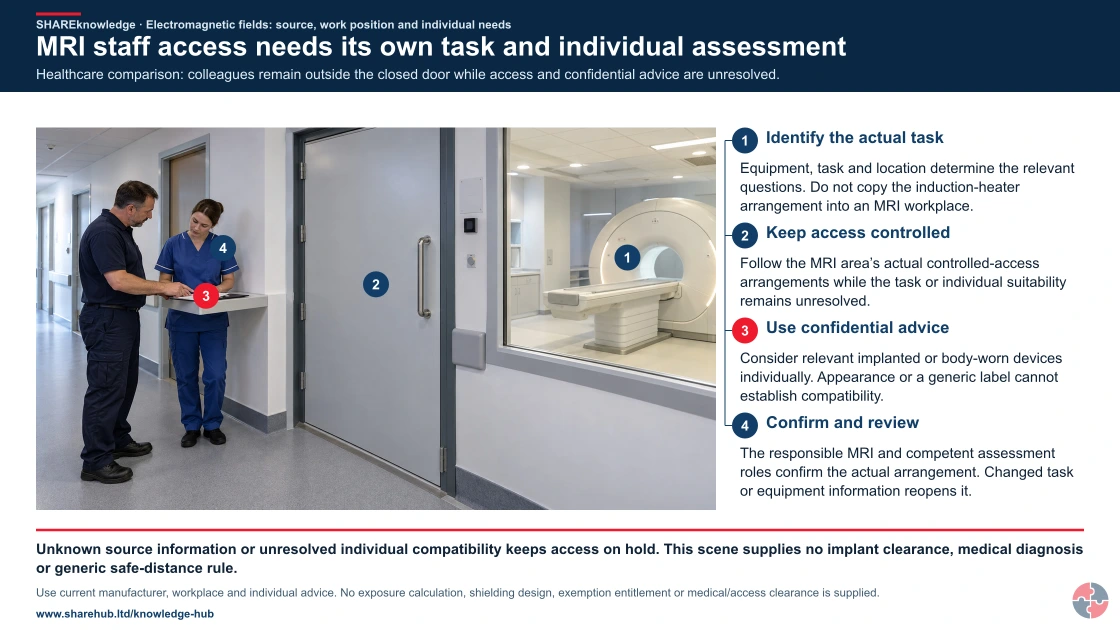
Full written explanation
A worker and imaging staff member discuss an inert task form outside a closed MRI access door; an empty scanner is visible through the observation window. Four markers identify the scanner, door, form and conversation. No patient, implant, screening result, field contour or approval to enter is depicted. The comparison distinguishes equipment/task information, controlled access, individual advice and a separately confirmed access arrangement.
Healthcare comparison: colleagues remain outside the closed door while access and confidential advice are unresolved.
- Identify the actual task. Equipment, task and location determine the relevant questions. Do not copy the induction-heater arrangement into an MRI workplace.
- Keep access controlled. Follow the MRI area’s actual controlled-access arrangements while the task or individual suitability remains unresolved.
- Use confidential advice. Consider relevant implanted or body-worn devices individually. Appearance or a generic label cannot establish compatibility.
- Confirm and review. The responsible MRI and competent assessment roles confirm the actual arrangement. Changed task or equipment information reopens it.
When the evidence does not fit: Unknown source information or unresolved individual compatibility keeps access on hold. This scene supplies no implant clearance, medical diagnosis or generic safe-distance rule.
Who acts: Responsible equipment/area manager, competent EMF assessment role and appropriate MRI or individual-advice specialists.
Changed workplace
Induction heater: Assess actual mode, work position and controlled access.
MRI workplace: Use the specific area arrangements and confidential individual-advice route.
Evidence check: Use current manufacturer, workplace and individual advice. No exposure calculation, shielding design, exemption entitlement or medical/access clearance is supplied.
Individual considerations, actual source information and controlled access
Primary references: HSE: electromagnetic fields and employer assessment · HSE: equipment and workers at particular risk
Open the complete HD image (new tab)Download image
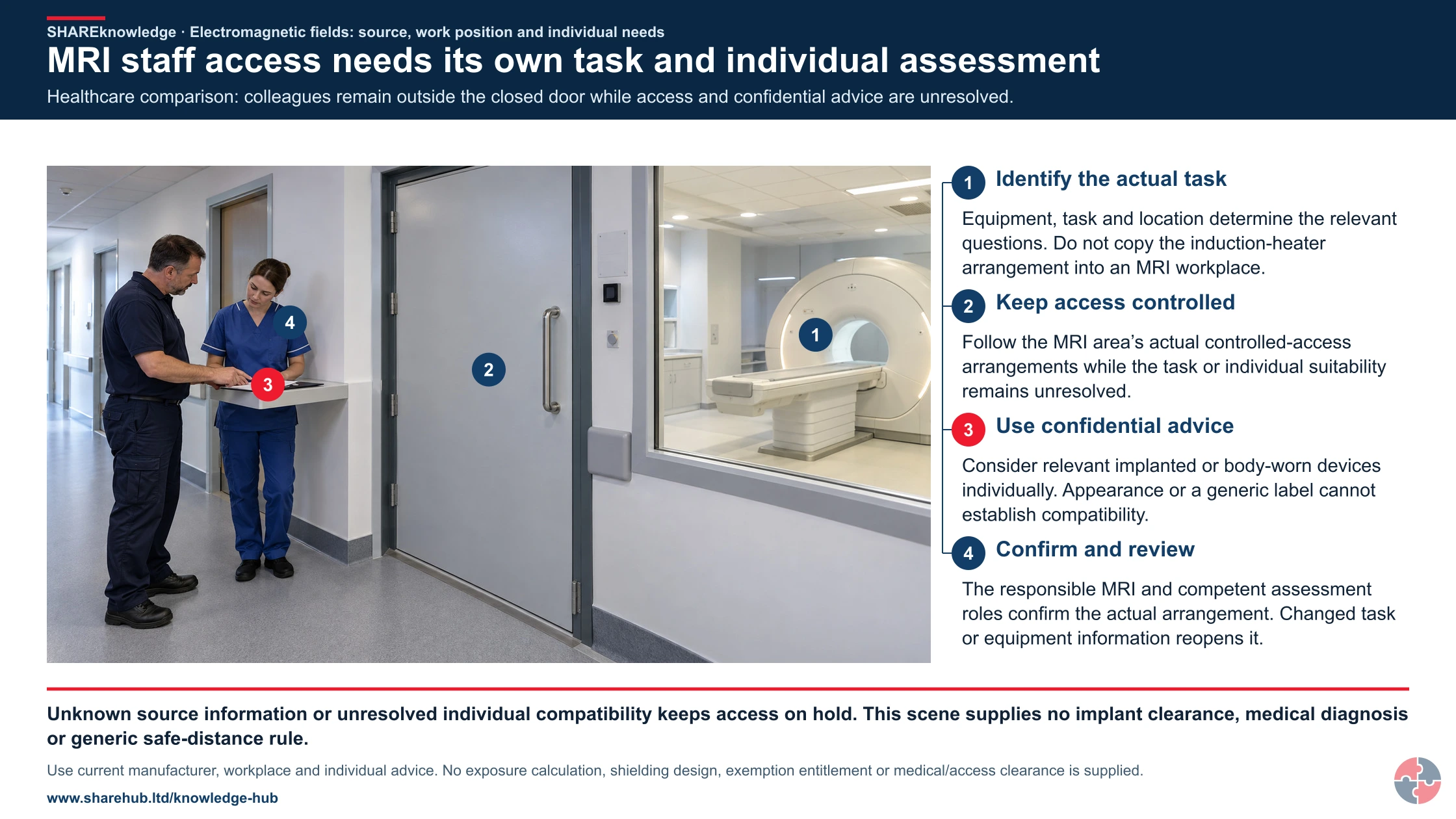
Individual considerations, actual source information and controlled access
Primary references: HSE: electromagnetic fields and employer assessment · HSE: equipment and workers at particular risk
A field decision from start to hand-back — part 1 of 3


Read the complete visual as text
- 1. Task and setting: Riverside commissions an industrial induction heater next to an operator walkway.
- 2. People and prerequisites: Operator, maintainer, manager and competent EMF adviser; equipment modes and field information are required.
- 3. Before the task: Move routine work outside the stronger-field zone, obtain manufacturer data and assess declared device or pregnancy-related needs confidentially.
A field decision from start to hand-back — part 2 of 3


Read the complete visual as text
- 1. Check during work: Check access boundary, approved mode and interlock before start; monitor changes and reported effects.
- 2. Stop, hold or refer: Unknown field data, failed interlock, unassessed implant compatibility or changed power mode stops access.
A field decision from start to hand-back — part 3 of 3


Read the complete visual as text
- 1. Completion and hand-back: Record field-zone and access decisions, train affected roles and release equipment only after checks.
- 2. Retained evidence: Source inventory, manufacturer data, individual assessment record, interlock test and change review.
Riverside Leisure Ltd
Riverside Leisure Ltd operates leisure facilities with offices, gyms, kitchens, plant rooms, Wi-Fi, security systems and occasional contractor work, so most EMF sources are low risk but still need a sensible reporting and assessment route.
Riverside's facilities manager keeps a simple EMF source register. Ordinary office, Wi-Fi and domestic-type equipment are screened using HSE/UKHSA guidance and recorded as low risk. Higher-current plant, specialist therapy equipment, large motors, contractor test equipment or roof-mounted communications equipment are flagged for review before maintenance or access.
The worker wellbeing procedure explains how staff can confidentially raise concerns about implanted medical devices, body-worn devices or pregnancy. Managers do not ask for unnecessary medical detail; they involve occupational health or competent advice where the worker's role may bring them close to relevant sources.
Procurement asks suppliers for EMF information where equipment may be higher output or unusual. Contractor rules require disclosure of temporary transmitters, welding equipment or strong magnets brought onto site. Supervisors check signs, restricted access and work instructions for plant-room or roof work.
Assurance is proportionate. Frontline checks confirm signs and access restrictions. Second-line checks review source registers, staff concerns and maintenance changes. A specialist is only brought in when the source information is insufficient or the risk profile justifies calculation or measurement.
Riverside introduces an industrial induction heater. The manager obtains operating-mode and manufacturer field information, maps the maintenance and operator positions and checks who may be at particular risk. A guarded access zone and a stop on changed settings are tested before the equipment is handed over.
A field decision from start to hand-back
Task material and setting: Riverside commissions an industrial induction heater next to an operator walkway.
People and prerequisites: Operator, maintainer, manager and competent EMF adviser; equipment modes and field information are required.
Before: Move routine work outside the stronger-field zone, obtain manufacturer data and assess declared device or pregnancy-related needs confidentially.
During: Check access boundary, approved mode and interlock before start; monitor changes and reported effects.
Hold or stop: Unknown field data, failed interlock, unassessed implant compatibility or changed power mode stops access.
Completion and hand back: Record field-zone and access decisions, train affected roles and release equipment only after checks.
Evidence: Source inventory, manufacturer data, individual assessment record, interlock test and change review.
What training is needed for electromagnetic field effects?
Training should be proportionate: general awareness for most staff and more detailed instruction for those near higher-field sources.
General awareness can be short and clear: what EMFs are, why most sources are low risk, how to report concerns, and why particular-risk workers may need individual consideration. Workers near higher-field sources need task-specific briefings on exclusion zones, signage, access, equipment status and emergency arrangements.
Managers need enough competence to avoid two errors: ignoring a real higher-field source, or escalating ordinary low-risk sources into unnecessary fear. Specialist training is appropriate for MRI, telecoms, RF heating, welding, energy distribution or measurement roles.
| Role | Learning | Demonstration | Assessor | Record | Reassess when |
|---|---|---|---|---|---|
| General workers | Recognise stronger source signs and report symptoms or concerns | Identify the local boundary and contact | Supervisor | Observed induction | New source or concern |
| Equipment operators | Use approved settings and stay outside assessed zones | Demonstrate start-up and safe position | Equipment supervisor | Observed task | Changed mode or device |
| Particular-risk workers and adviser | Raise a confidential device or pregnancy-related need | Agree an individual access route without unnecessary disclosure | Competent occupational-health/device adviser | Confidential assessment and work restriction | Device or work change |
| EMF technical specialists | Assess source, frequency, field and AL/ELV evidence | Review manufacturer data and field map | Qualified technical lead | Scoped assessment | New equipment or measurement |
| Managers and purchasers | Select lower exposure and resource controls | Trace purchase specification to field evidence | Technical manager | Design and action record | New project or defect |
| Safety auditors | Test source scope and access-control effectiveness | Sample one zone, permit and closure | Independent competent reviewer | Audit trail | Incident or repeated entry |
Attendance alone does not establish competence. Observe the actual role, record the scope of authorisation and reassess after a changed task, failed drill, defect or incident.
How does electromagnetic field effects knowledge support NEBOSH Diploma study?
The topic supports Diploma study by showing how physical-agent hazards are assessed using evidence, limits and proportionate control.
For Diploma-style answers, explain that EMFs are non-ionising, usually low risk in ordinary settings, but may require assessment and controls around stronger sources. Strong answers distinguish established acute effects from unproven long-term claims, identify particular-risk workers and explain how action levels and exposure limit values guide decisions.
Scenario-based application matters. A healthcare MRI scenario needs access control, projectile risk, implants and trained staff. A telecoms roof-work scenario needs antenna status, exclusion zones and contractor communication. An office concern scenario needs evidence-based reassurance and a reporting route.
How can management arrangements support this topic?
HSE’s Plan–Do–Check–Act guidance helps assign ownership, deliver controls, check evidence and improve weak arrangements. Apply the relevant legal duties and task-specific technical evidence separately.
Official management guidance: HSE Managing for health and safety (HSG65)
Use the management system to keep the source inventory, particular-risk assessment and access controls current after equipment changes.
What are the warning signs that EMF risk is not managed well?
Warning signs include no source register, no route for particular-risk workers, poor communication and uncontrolled access to higher-field sources.
Poor EMF management can appear as either complacency or confusion. Complacency occurs when strong sources are treated like ordinary office equipment. Confusion occurs when low-risk sources create fear because no one explains the assessment or evidence.
Both problems can cause harm: direct exposure may go uncontrolled, particular-risk workers may not be protected, or anxiety may grow because workers feel their concerns are ignored.
| Warning sign | How it can manifest | Action |
|---|---|---|
| No EMF source register | Higher-field sources may be missed. | Create proportional source inventory. |
| No confidential declaration route | Implant or pregnancy issues may not be raised. | Set worker support process. |
| Unclear signage | Workers enter restricted areas unknowingly. | Review access control. |
| No supplier data | Exposure cannot be assessed properly. | Request data or seek advice. |
| All concerns dismissed | Trust falls and anxiety increases. | Communicate evidence and review. |
| Specialist equipment changed without review | New exposure scenario created. | Use management of change. |
What do the acronyms and key terms mean?
Acronyms should be explained because EMF guidance uses specialist terminology that can confuse readers.
| Term | Full expansion | Meaning here |
|---|---|---|
| AL | Action level | Action Level. |
| CEMFAW | Control of Electromagnetic Fields at Work | Control of Electromagnetic Fields at Work Regulations. |
| ELV | Exposure limit value | Exposure Limit Value. |
| EMF | Electromagnetic field | Electromagnetic Field. |
| GHz | Gigahertz | Gigahertz. |
| Hz | Hertz | Hertz. |
| ICNIRP | International Commission on Non-Ionizing Radiation Protection | International Commission on Non-Ionizing Radiation Protection. |
| MRI | Magnetic resonance imaging | Magnetic Resonance Imaging. |
| NIR | Non-ionising radiation | Non-Ionising Radiation. |
| RF | Radiofrequency | Radiofrequency. |
| UKHSA | UK Health Security Agency | UK Health Security Agency. |