SHARE Knowledge Hub
What should you know about diet and nutrition at work?
Diet and nutrition at work is about the food, drink, break patterns, facilities and working conditions that influence energy, concentration, recovery, long-term health and dignity during real shifts. A useful workplace approach does not blame individuals or prescribe personal diets; it makes healthier choices easier by providing clean eating areas, drinking water, predictable breaks, appropriate welfare, suitable food options, fair shift planning and respectful signposting to official health advice where personal medical or dietetic needs exist. The strongest programmes connect nutrition to work design, fatigue, hydration, heat, diabetes, pregnancy, religious or cultural needs, affordability, night work and evaluation, so wellbeing becomes practical support rather than posters and slogans.
Understanding What should you know about diet and nutrition at work?
Diet and nutrition affect health, energy, concentration, recovery and wellbeing, but they are not a basis for managers to diagnose, shame or control private choices. The workplace role is to prevent work-created barriers to eating, drinking, resting and accessing welfare; provide a safe food and drink environment where it offers catering or facilities; manage fatigue and workload; and make reasonable, confidential adjustments where a health condition or disability creates a work need. NHS and registered clinical professionals remain the appropriate source for personal dietary and medical advice.
Why this matters at work
Make support usable. Agree actions, owner, coverage, review date and escalation route. If a worker tells you they cannot safely continue because of illness, heat, fatigue or a dietary-related need, make the task safe first. Later, check whether scheduling, welfare, staffing, supervisor behaviour or food access contributed. A culture that treats pauses as a failure will hide early warning until an error, illness or emergency happens.
Garages should consider vehicle lifts, tyres, welding, exhaust, fuels, chemicals, battery work, road testing, customer demand and small-team cover. Provide a clean, separate eating area, washing facilities, accessible water and a realistic pause process. Do not permit eating or drinking where lead, solvents, oils, exhaust contamination or other substances could create ingestion exposure. Supervisors should respond to heat, fatigue or illness without forcing a technician to continue under a vehicle or on a road test.
How organisations manage this in practice
A practical workflow is: map work, welfare and food-safety hazards; identify task and workforce groups; check official duties and local standards; consult workers; assess water, rest, eating, heat, shift and travel barriers; make immediate conditions safe; design elimination, reduction, isolation and engineering controls; set administrative arrangements and emergency response; implement across shifts and contractors; monitor use; and review after change or learning. Keep individual health information separate from the general workplace plan.
Welfare and nutrition-related controls need visible ownership. Senior leaders should provide sufficient resources for potable water, clean facilities, break cover, food-safety controls, catering and contractor arrangements, heat/fatigue management, first aid and emergency continuity. Managers translate those commitments into rotas, facilities, supervision and work planning. Supervisors make the arrangements usable in real time, escalate defects and protect workers' authority to pause. Workers cooperate, report concerns and use facilities safely, but should not have to solve a missing resource or unsafe schedule alone.
Verify effectiveness in work. Ask workers whether breaks and facilities are genuinely usable, examine missed-break and heat information, observe cleaning and contamination control, sample night and weekend conditions, review food safety and allergen reports, test emergency welfare arrangements, and correct recurring barriers. Use the data to improve design and resource decisions, not to measure a person's diet or reduce support. Review after change, learning or evidence that work-as-done has diverged from the plan.
Improve access through the design of the shift
Look at whether staff can actually take breaks and access suitable food, storage and clean welfare facilities. Support should be voluntary and practical; medical diets and treatment need qualified individual advice.
Daytime provision misses the night shift
Illustrative example. A food offer closes before the night team starts and late breaks are repeatedly missed.
Decision. Adjust relief cover and access arrangements with the team.
Evidence to check. Actual break opportunities, storage and eating space, available options and worker feedback.
Hold or escalation point. Do not treat a campaign or a worker’s weight as evidence that shift arrangements are suitable.
Follow-up. Check availability on nights and weekends after the change.
Plan clean facilities and real break access
An event-site welfare plan needs drinking water, safe food storage and a usable route and time to eat. Food advice cannot compensate for an inaccessible break.
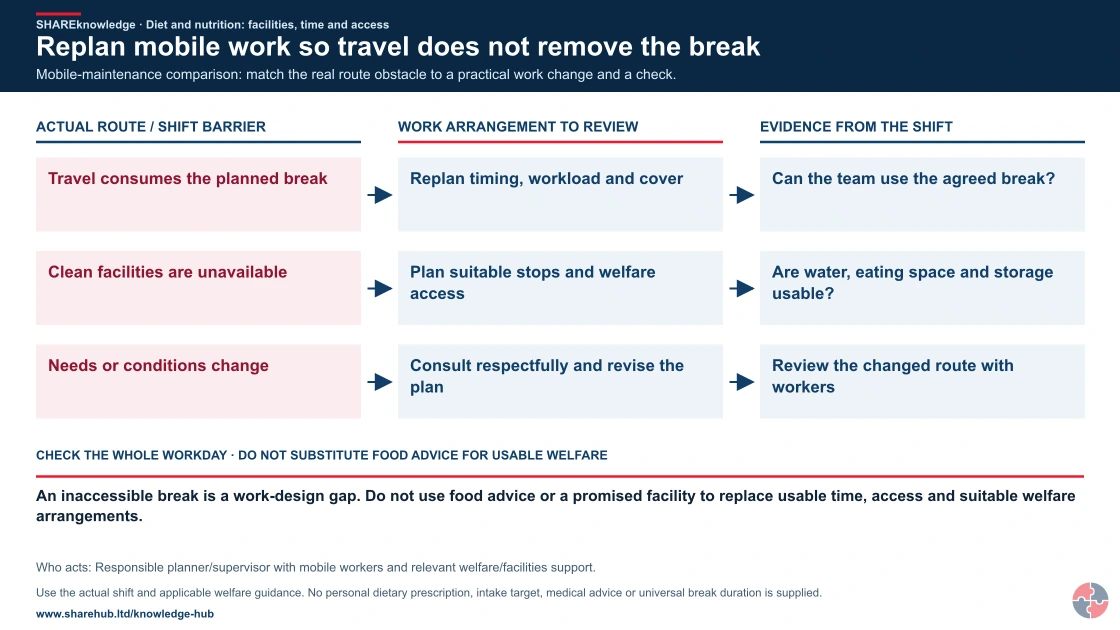
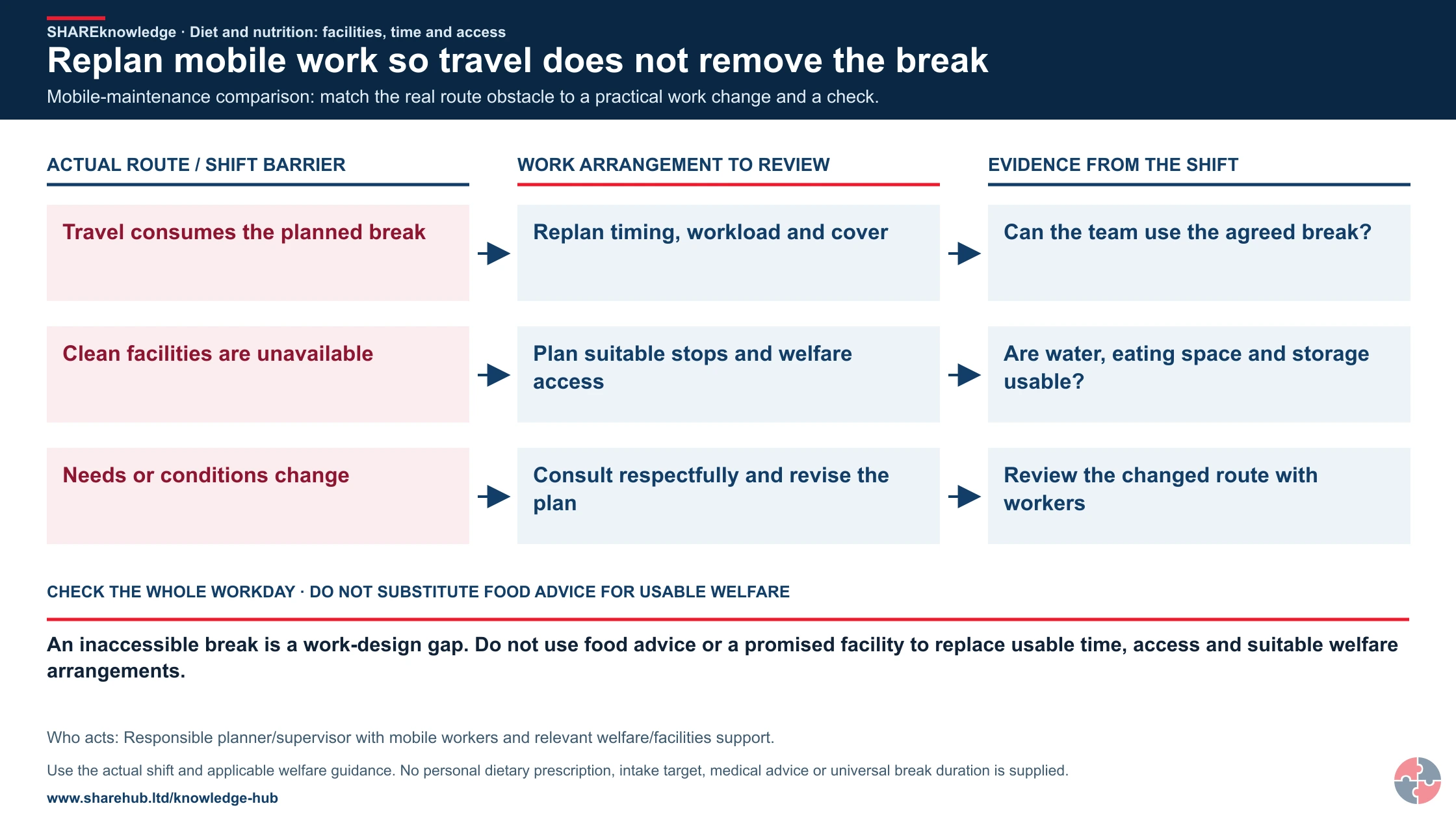
Replan mobile work so travel does not remove the break
Full written explanation
A complete three-column work-design map connects route/schedule pressure, unavailable clean facilities and changing individual needs to practical changes and evidence from the actual mobile shift. It supports opportunity to eat and drink without prescribing intake, a menu or a legal break duration. Review the actual welfare and work arrangements rather than treating personal food choices as the control.
Mobile-maintenance comparison: match the real route obstacle to a practical work change and a check.
- Identify the actual barrier. Review travel, task timing, staffed cover, facilities and the people affected.
- Plan a practical work change. Consider suitable workload, route, stop and welfare arrangements with workers.
- Verify at the point of use. Check whether facilities and the agreed break can actually be used on the shift.
- Review different needs. Revisit changing conditions respectfully; use qualified advice for individual dietary questions.
When the evidence does not fit: An inaccessible break is a work-design gap. Do not use food advice or a promised facility to replace usable time, access and suitable welfare arrangements.
Who acts: Responsible planner/supervisor with mobile workers and relevant welfare/facilities support.
Changed workplace
Night-shift warehouse: Review facilities, cover and usable access at the hours actually worked.
Mobile maintenance: Redesign travel and workload where they repeatedly remove break opportunity.
| ACTUAL ROUTE / SHIFT BARRIER | WORK ARRANGEMENT TO REVIEW | EVIDENCE FROM THE SHIFT |
|---|---|---|
| Travel consumes the planned break | Replan timing, workload and cover | Can the team use the agreed break? |
| Clean facilities are unavailable | Plan suitable stops and welfare access | Are water, eating space and storage usable? |
| Needs or conditions change | Consult respectfully and revise the plan | Review the changed route with workers |
Evidence check: Use the actual shift and applicable welfare guidance. No personal dietary prescription, intake target, medical advice or universal break duration is supplied.
Work design, welfare access, shift work and respectful inclusion
Primary references: HSE: workplace welfare facilities (GB) · HSENI: welfare facilities (NI)
Open the complete HD image (new tab)Download image
Work design, welfare access, shift work and respectful inclusion
Primary references: HSE: workplace welfare facilities (GB) · HSENI: welfare facilities (NI)

Facilities
Provide appropriate clean eating space, water and food-storage arrangements for the site.
Time and route
Check staffed break cover and safe access, including late shifts and busy periods.
Different needs
Offer practical options and review individual requirements respectfully rather than prescribe a universal menu.
The example supports workplace welfare; it is not an individual dietary prescription.
What key facts should people know first about diet and nutrition at work?
Diet and nutrition at work should be treated as general wellbeing guidance, not personal medical or dietetic advice.
This page does not prescribe personal diets, diagnose nutrition problems, manage eating disorders or replace GP, registered dietitian, diabetes team, occupational health or public health advice. It explains how workplaces can create conditions that make healthy, safe and dignified food and drink choices easier.
Nutrition is personal, cultural, economic and medical as well as behavioural. A worker's food choices may be shaped by income, shift pattern, fatigue, religious practice, pregnancy, diabetes, medication, access to shops, canteen prices, welfare quality and whether breaks are actually protected.
A mature workplace avoids blame. It asks whether people have water, somewhere clean to eat, enough time to take breaks, access to suitable food during all shifts, and a culture where health needs can be discussed privately.
| Key fact | What it means in practice |
|---|---|
| Work shapes choices | Breaks, shifts, workload, welfare and food environment often matter more than posters. |
| The Eatwell Guide is the UK baseline | Use it for general education, while recognising individual medical or cultural needs. |
| Hydration is part of nutrition | Drinking water access is a basic welfare requirement and a heat/fatigue control. |
| Shift work needs specific planning | Night workers may have fewer healthy options and disrupted meal timing. |
| Avoid stigma | Weight, food choices and health conditions should not be mocked, moralised or used for public comparison. |
| Evaluate programmes | Wellbeing activity should be checked for access, participation, fairness and actual impact. |
What does diet and nutrition mean in workplace wellbeing?
Diet and nutrition means how food and drink support energy, recovery, concentration and long-term health during work and outside work.
In simple terms, nutrition is the way the body obtains and uses energy, fluid and nutrients. A balanced diet supports physical health, mental wellbeing, immune function, digestion, concentration, muscle repair and recovery. Poor access to food, water or breaks can increase fatigue, irritability, headaches, dehydration, poor concentration and difficulty managing long-term conditions.
At work, nutrition should be discussed through environment and support rather than judgement. A construction worker with no clean eating area, a night worker with only vending machines, a driver without planned stops and a receptionist who cannot leave the desk all face different barriers.
The workplace cannot control everything people eat, and it should not try to. It can control the conditions that make healthier choices realistic: time, access, facilities, information, dignity and management behaviour.
For this decision, use GOV.UK Eatwell Guide and GOV.UK Eatwell Guide for NI for the applicable work and jurisdiction.
| Element | Plain-English explanation | Workplace link |
|---|---|---|
| Energy | Food provides energy for physical and cognitive work. | Long shifts and heavy work need realistic break and meal planning. |
| Hydration | Fluid supports concentration, temperature regulation and physical function. | Drinking water must be available and easy to access. |
| Micronutrients | Vitamins and minerals support body functions over time. | General education should use official sources, not fads. |
| Meal timing | Irregular eating can affect energy, mood, digestion and some medical conditions. | Rota and break planning matter. |
| Medical needs | Some people need specific advice due to diabetes, allergies, pregnancy or other conditions. | Use qualified advice and confidential adjustments. |
How can diet and nutrition affect work performance and health?
Food, drink and meal timing can affect energy, concentration, fatigue, digestion, hydration, recovery and longer-term health.
Short-term effects are often the first things people notice: tiredness, poor concentration, headaches, irritability, hunger, thirst, dizziness, digestive discomfort or reduced stamina. These effects can be more noticeable during physical work, hot work, night shifts, long driving periods, overtime or emotionally demanding work.
Longer-term effects are wider. Diet and nutrition interact with weight, cardiovascular health, type 2 diabetes risk, blood pressure, cholesterol, dental health, musculoskeletal wellbeing and mental wellbeing. A workplace should not overclaim what a programme can achieve, but it can support healthier routines and remove barriers.
Food and drink also interact with safety. Dehydration can affect heat stress and fatigue. Skipped meals can affect concentration. Poor welfare can push workers towards rushed eating or unsafe storage. For workers with diabetes, meal and medication routines may be directly safety-relevant.
| Effect area | What people may notice | Workplace relevance |
|---|---|---|
| Energy and fatigue | Tiredness, reduced stamina or afternoon/night-shift dips. | Plan breaks, workload, hydration and shift food access. |
| Concentration | Reduced focus, slower decisions or more mistakes. | Consider meal timing and fatigue for safety-critical tasks. |
| Hydration | Headaches, thirst, dizziness or heat strain. | Provide drinking water and heat controls. |
| Digestion | Discomfort, irregular appetite or digestive upset. | Review night work, break timing and access to toilets. |
| Long-term health | Diabetes, cardiovascular and weight-related risks may be influenced. | Use non-stigmatising health promotion and official sources. |
How does work design influence diet and nutrition?
Work design influences nutrition by shaping time, access, affordability, facilities, fatigue and control over eating and drinking.
A worker cannot make good choices from options that do not exist. If the only food available on a night shift is high-sugar vending, if drivers cannot stop, if a production line has no cover for breaks, or if a welfare area is dirty, then education alone will not solve the issue.
Good design means protected breaks, real cover, clean rest areas, water access, storage for food, reheating where appropriate, facilities for hot drinks, canteen/vending choices that include healthier options, and consultation with workers about what actually works on their shifts.
Design also includes social norms. If managers praise people for skipping lunch, meetings are booked across every break, or workers are mocked for bringing healthier food, the culture is working against wellbeing.
For this decision, use HSE workplace facilities and HSENI welfare facilities for the applicable work and jurisdiction.
| Work design factor | What good looks like | What to check |
|---|---|---|
| Break protection | People can take breaks without guilt or operational collapse. | Rota cover, supervisor checks and worker feedback. |
| Food access | Suitable options are available across all shifts, not only office hours. | Canteen hours, vending content and local access. |
| Water access | Drinking water is available, identified and easy to access. | Welfare inspection and heat-risk checks. |
| Facilities | Clean seating, tables, storage, heating/cooling and food preparation facilities where appropriate. | Welfare audit and maintenance actions. |
| Workload | Pace and staffing allow people to eat and recover. | Missed-break data, overtime and near-miss themes. |
| Culture | Managers model breaks and avoid judgemental comments. | Observation, engagement feedback and manager training. |
Why does shift-worker nutrition need separate attention?
Shift-worker nutrition needs separate attention because night work and rotating shifts disrupt sleep, appetite, digestion, meal timing and food access.
Night and rotating shifts can make nutrition harder because the body is awake, eating and digesting at times when it would normally be resting. Workers may rely on convenience food, caffeine, sugary snacks or irregular meals to get through the shift. Fatigue can also reduce motivation to shop, cook or prepare meals before or after work.
The workplace can help by planning breaks, improving night-shift food options, making drinking water and hot drinks available, supporting meal storage/reheating, avoiding back-to-back shifts that destroy recovery time, and involving workers in practical solutions.
Advice should be realistic. Telling a night worker to eat perfectly while offering only vending machines and no protected break is not a control.
Shift work can disturb sleep and meal timing, but there is no single meal schedule suitable for every worker. Workers should use reliable public-health advice and any individual clinical advice; employers should supply usable breaks, water and food access, then address fatigue and night-work risk through work design.
For this decision, use HSE managing shift work for the applicable work and jurisdiction.
| Issue | Why it matters | Practical workplace response |
|---|---|---|
| Night availability | Healthy food options may be closed or unavailable. | Provide better vending, fridge/microwave access or night canteen options. |
| Caffeine use | Caffeine may help alertness but can affect later sleep. | Educate without policing and consider fatigue controls. |
| Meal timing | Irregular meals can affect energy, digestion and diabetes management. | Plan predictable breaks and avoid unnecessary break cancellation. |
| Fatigue after work | Cooking and shopping may be harder after nights. | Support rota design and recovery time. |
| Hydration | Workers may drink less to avoid toilet trips or because water is inconvenient. | Ensure water and toilet access are practical during all shifts. |
How should canteens, vending and food provision be managed?
Food provision should offer practical, affordable and inclusive choices without forcing personal diet decisions.
Canteens and vending machines are part of the workplace environment. They can either support wellbeing or make healthier choices harder. The aim is not to remove all treats or police lunchboxes; it is to make balanced, affordable options available and visible.
Useful checks include opening times, pricing, portion options, fruit and vegetables, wholegrain choices, lower-sugar drinks, allergen management, cultural and religious needs, vegetarian/vegan options, food safety, food storage and worker feedback. Contractor catering should be included in procurement and performance review.
Food provision should be accessible to lower-paid workers and those on non-standard shifts. A premium-priced healthy option that is only available to office staff during the day is not an inclusive wellbeing control.
For this decision, use FSA allergen guidance for food businesses for the applicable work and jurisdiction.
For supplied food in Scotland, use Food Standards Scotland’s allergen guidance alongside the actual catering specification.
| Area | Good practice | Evidence |
|---|---|---|
| Canteen contract | Include healthier options, allergen control, affordability and shift access in specifications. | Contract, audit and worker feedback. |
| Vending | Include lower-sugar drinks, water, balanced snacks and clear pricing. | Vending review and sales/stock checks. |
| Food storage | Provide clean fridges, microwaves and preparation areas where appropriate. | Welfare inspection and cleaning records. |
| Inclusivity | Consider cultural, religious, vegetarian, vegan, allergy and medical needs. | Menu review and consultation. |
| Communication | Use clear, non-judgemental information. | Signage and campaign review. |
How can the hierarchy of controls reduce risks while providing usable welfare during a night event?
Start by removing the hazard where practicable, then consider substitution, engineering controls and work-method controls. Use PPE for residual risk. These priorities follow HSE’s hierarchy of controls; the task-specific examples below must still be checked against the relevant HSE guidance and local conditions.

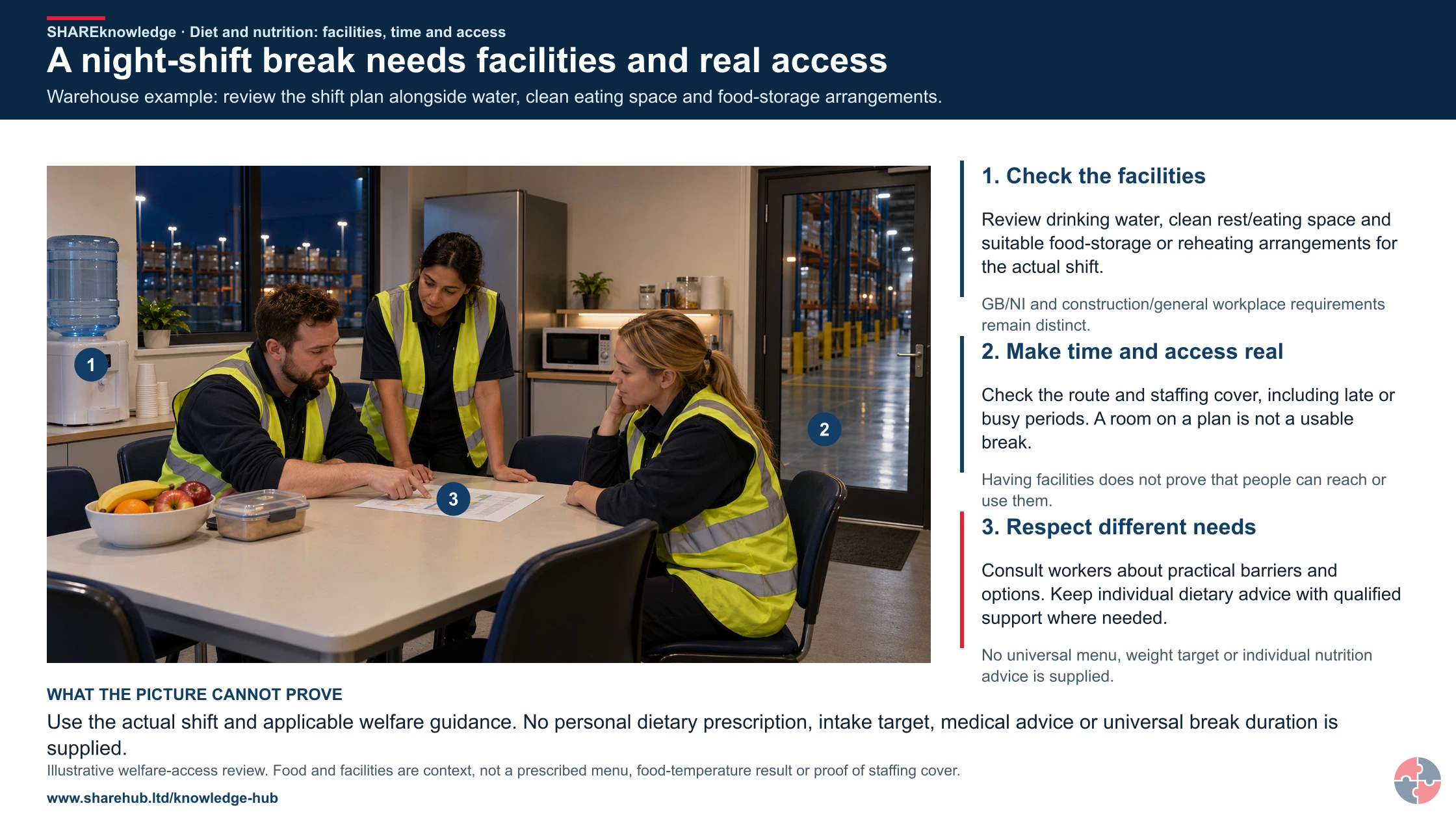
A night-shift break needs facilities and real access
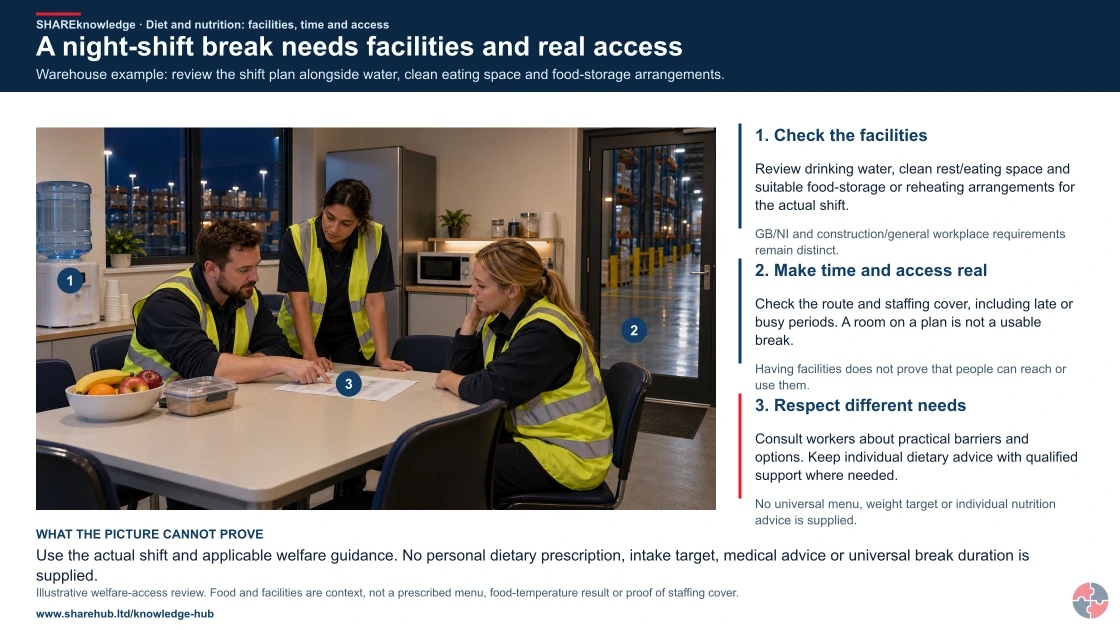
Full written explanation
Warehouse example: review the shift plan alongside water, clean eating space and food-storage arrangements.
- Check the facilities. Review drinking water, clean rest/eating space and suitable food-storage or reheating arrangements for the actual shift.
- Make time and access real. Check the route and staffing cover, including late or busy periods. A room on a plan is not a usable break.
- Respect different needs. Consult workers about practical barriers and options. Keep individual dietary advice with qualified support where needed.
Change the pathway
- Use the correct welfare route. GB/NI and construction/general workplace requirements remain distinct.
- Review the whole shift. Having facilities does not prove that people can reach or use them.
- Avoid body judgement. No universal menu, weight target or individual nutrition advice is supplied.
Evidence check: Use the actual shift and applicable welfare guidance. No personal dietary prescription, intake target, medical advice or universal break duration is supplied.
Work design, welfare access, shift work and respectful inclusion
Primary references: HSE: workplace welfare facilities (GB) · HSENI: welfare facilities (NI)
Open the complete HD image (new tab)Download image
Work design, welfare access, shift work and respectful inclusion
Primary references: HSE: workplace welfare facilities (GB) · HSENI: welfare facilities (NI)
The material work hazards are an inaccessible water point, unsuitable eating area and missed breaks during the night event. Workers’ food choices or body size are not hazards. The route is prolonged work without usable food, water or rest, which can contribute to fatigue and poor concentration; a separate clinical diet remains a clinician’s decision.
How can the ERICPD hierarchy of controls reduce risks while providing usable welfare during a night event?

| Control level | Control for this activity | Owner and verification | Stop / restart decision |
|---|---|---|---|
| Eliminate | Remove the need to eat beside chemicals or waste by providing a suitable clean welfare space before the event opens. | Task owner verifies that the proposed change removes the named hazardous step, including foreseeable cleaning, maintenance and work transferred elsewhere. | If the hazardous step remains, keep it within the task assessment and select the stronger feasible remaining controls. |
| Reduce, including substitution | Choose a staffing and service arrangement that allows planned breaks instead of expecting workers to cover the whole event continuously. | Competent task/process owner validates suitability, compatibility and new hazards against the actual operating requirements before the alternative is adopted. | Reject an alternative if its performance is unproved or its new hazards are unresolved. |
| Isolate | Separate food storage and eating areas from chemical storage, dirty equipment and vehicle movements. | Supervisor checks the actual boundary, affected people and connected work; verify separation or isolation before allowing access. | Hold or stop for unavailable drinking water, contaminated welfare or inability to provide agreed safe breaks. |
| Control: physical safeguards | Provide accessible drinking water, suitable seating and the food-storage or preparation facilities needed for the actual shift. | Competent equipment/process owner checks night-time welfare access, water supply, clean eating space and actual break cover. | Hold or stop for unavailable drinking water, contaminated welfare or inability to provide agreed safe breaks. |
| Control: work method and response | Agree relief cover, welfare access, cleaning and any work-related adjustments with staff and contractors; do not collect unnecessary dietary or medical information. | Supervisor confirms the work limits, competent cover, communication and stop/restart authority with the people doing this activity. | Hold work when the agreed limits, competent cover or effective communication cannot be maintained. |
| PPE | PPE is not a control for missing welfare or missed breaks; remove contaminated work clothing as required before entering the clean eating area. | Assessor confirms whether personal protection is needed and checks suitability, condition, compatibility and any required fit evidence. | Do not use unsuitable protection or rely on PPE to continue after an essential source control fails. |
| Discipline | Check welfare during the night operation, including contractor access and stock replenishment; resolve failed facilities or unavailable break cover. | Release only after event manager confirms usable facilities and relief cover with the shift team. Retain verification and unresolved restrictions at handover. | Keep the task on hold until required reinstatement evidence and unresolved defects are accepted by the responsible owner. |
How can the ISO 45001 hierarchy of controls reduce risks while providing usable welfare during a night event?

| Control level | Control for this activity | Owner and verification | Stop / restart decision |
|---|---|---|---|
| Elimination | Remove the need to eat beside chemicals or waste by providing a suitable clean welfare space before the event opens. | Task owner verifies that the proposed change removes the named hazardous step, including foreseeable cleaning, maintenance and work transferred elsewhere. | If the hazardous step remains, keep it within the task assessment and select the stronger feasible remaining controls. |
| Administrative controls | Choose a staffing and service arrangement that allows planned breaks instead of expecting workers to cover the whole event continuously. | Competent task/process owner validates suitability, compatibility and new hazards against the actual operating requirements before the alternative is adopted. | Reject an alternative if its performance is unproved or its new hazards are unresolved. |
| Engineering controls | Separate food storage and eating areas from chemical storage, dirty equipment and vehicle movements. | Supervisor checks the actual boundary, affected people and connected work; verify separation or isolation before allowing access. | Hold or stop for unavailable drinking water, contaminated welfare or inability to provide agreed safe breaks. |
| Engineering controls | Provide accessible drinking water, suitable seating and the food-storage or preparation facilities needed for the actual shift. | Competent equipment/process owner checks night-time welfare access, water supply, clean eating space and actual break cover. | Hold or stop for unavailable drinking water, contaminated welfare or inability to provide agreed safe breaks. |
| Administrative controls | Agree relief cover, welfare access, cleaning and any work-related adjustments with staff and contractors; do not collect unnecessary dietary or medical information. | Supervisor confirms the work limits, competent cover, communication and stop/restart authority with the people doing this activity. | Hold work when the agreed limits, competent cover or effective communication cannot be maintained. |
| PPE | PPE is not a control for missing welfare or missed breaks; remove contaminated work clothing as required before entering the clean eating area. | Assessor confirms whether personal protection is needed and checks suitability, condition, compatibility and any required fit evidence. | Do not use unsuitable protection or rely on PPE to continue after an essential source control fails. |
| Administrative controls | Check welfare during the night operation, including contractor access and stock replenishment; resolve failed facilities or unavailable break cover. | Release only after event manager confirms usable facilities and relief cover with the shift team. Retain verification and unresolved restrictions at handover. | Keep the task on hold until required reinstatement evidence and unresolved defects are accepted by the responsible owner. |
A construction site needs welfare available before work starts; a logistics depot must account for drivers who are away from the main canteen. The responsible manager tests the actual route and opening time, not only the site plan, and holds work where a required facility is unavailable.
Which welfare arrangements support diet, hydration and nutrition?
Welfare arrangements should give workers clean, practical and dignified places to drink, rest and eat.
HSE welfare guidance is highly relevant because nutrition is not only about information. Workers need drinking water, rest areas and somewhere suitable to eat meals. In construction and mobile work, this can be the difference between a serious wellbeing control and a paper promise.
Rest areas should not double as storage for dirty tools, chemicals, dusty PPE or waste. People should be able to sit, eat, wash hands, access toilets, drink water and take proper breaks away from contamination or excessive noise where practicable.
Welfare should be checked at the point of work, not assumed from a policy. If workers are remote, mobile, on night shifts or on temporary sites, the arrangements still need to be real.
For this decision, use GB HSE welfare guidance and NI HSENI welfare guidance for the applicable work and jurisdiction.
Use government Eatwell guidance and its NI edition for general healthy-eating information. They do not establish whether a particular workplace has usable welfare facilities. The workplace decision is supported by GB HSE welfare guidance and NI HSENI welfare guidance. For example, inspect the actual night shift: can staff reach drinking water, wash their hands and use a clean place to rest and eat while daytime catering is closed? If the only available eating space becomes a contaminated equipment store overnight, arrange a suitable clean alternative and check that workers can use it. This is an illustrative facilities check; an individual’s clinical dietary requirements need their own qualified advice.
| Welfare issue | What good looks like | Why it matters |
|---|---|---|
| Drinking water | Available, clean, marked and easy to reach. | Supports hydration, heat control and general welfare. |
| Eating area | Clean, seated, protected from contamination and available to all shifts. | Prevents eating in unsuitable areas. |
| Hand washing | Facilities available before eating. | Supports hygiene and infection control. |
| Food storage | Secure and clean storage where workers bring meals. | Prevents spoilage and improves access. |
| Mobile work | Planned welfare stops or facilities for remote teams. | Drivers and field teams need the same dignity as site-based workers. |
| Construction/temporary sites | Welfare set up from the start and maintained as the site changes. | Temporary work often fails when welfare is delayed or poorly maintained. |
How can diet and nutrition programmes avoid stigma and discrimination?
Programmes should be voluntary, respectful, inclusive and focused on the work environment rather than body judgement.
Diet and nutrition can easily be handled badly. Public weigh-ins, weight-loss competitions, moral language about food, jokes about body size or pressure to disclose medical information can damage trust and worsen inequality. A good programme supports healthier choices without turning people into targets.
Fairness means recognising different needs: diabetes, pregnancy, menopause, eating disorders, allergies, religious fasting, cultural diets, medication, night work, low income, neurodiversity, sensory needs and caring responsibilities can all affect food and eating patterns.
Employers should signpost to official sources and qualified professionals where personal advice is needed. Managers should not give individual diet plans unless they are properly qualified and acting within an appropriate role.
| Topic | Good practice | Avoid |
|---|---|---|
| Body weight | Use health-supportive language and environmental controls. | Public comparison, shaming or moral judgement. |
| Medical diets | Make reasonable adjustments and use qualified advice where needed. | Asking intrusive questions or giving amateur advice. |
| Religious/cultural needs | Consult respectfully about fasting, food choices and facilities. | Assuming one diet fits everyone. |
| Income | Consider affordability and access for lower-paid workers. | Only offering expensive healthy options. |
| Privacy | Keep personal health information confidential. | Discussing people's eating, weight or health in public. |
Which UK legal duties are relevant to diet and nutrition at work?
Workplace, equality and privacy duties depend on the site and the individual facts; GB and Northern Ireland use different instruments for several key duties.
Employers are not legally required to manage every personal food choice. They are required to provide suitable welfare and manage foreseeable health and safety risks. Where nutrition links to disability, pregnancy, religion, fasting, diabetes, heat, fatigue or safety-critical work, more specific review may be needed.
Food provision can also introduce food safety and allergen issues if the employer operates catering, provides food commercially or contracts catering services. Those detailed controls belong in the food safety topic, but procurement and oversight still matter here.
GB welfare and working-time regulations have separate NI instruments. The Eatwell Guide is public-health guidance, not a statutory personal diet or workplace prescription. Individual medical diets need qualified clinical advice.
| Jurisdiction and duty | Practical meaning | Decision evidence |
|---|---|---|
| Great Britain — Health and Safety at Work etc. Act 1974 and Management Regulations 1999 — instrument; instrument | Assess relevant welfare, heat, fatigue and shift-work risks. | Use the applicable source and retain proportionate evidence of the real decision. |
| Northern Ireland — NI Health and Safety Order 1978 and Management Regulations 2000 — instrument; instrument | Apply NI general risk-management duties to actual work conditions. | Use the applicable source and retain proportionate evidence of the real decision. |
| Great Britain — Workplace (Health, Safety and Welfare) Regulations 1992 — instrument | Provide drinking water and suitable rest/eating facilities. | Use the applicable source and retain proportionate evidence of the real decision. |
| Northern Ireland — Workplace (Health, Safety and Welfare) Regulations (NI) 1993 — instrument | Apply NI water and rest/eating-facility requirements. | Use the applicable source and retain proportionate evidence of the real decision. |
| Great Britain — Working Time Regulations 1998 — instrument | Plan applicable rest breaks and night-work arrangements. | Use the applicable source and retain proportionate evidence of the real decision. |
| Northern Ireland — Working Time Regulations (Northern Ireland) 2016 — instrument | Plan applicable NI rest breaks and night-work arrangements. | Use the applicable source and retain proportionate evidence of the real decision. |
| Great Britain — Equality Act 2010 — instrument | Consider disability, pregnancy or religion-related barriers and fair adjustments. | Use the applicable source and retain proportionate evidence of the real decision. |
| Northern Ireland — NI equality and disability law — authority guidance | Seek jurisdiction-specific HR advice; the NI DDA route applies to disability adjustments. | Use the applicable source and retain proportionate evidence of the real decision. |
How could Riverside Leisure Ltd manage diet and nutrition at work?

Riverside Leisure Ltd shows how food, drink, breaks and welfare can become practical wellbeing controls.
Riverside Leisure Ltd
Riverside Leisure Ltd is a leisure and hospitality business with reception teams, lifeguards, instructors, catering staff, cleaners, events workers, maintenance teams and seasonal night events. Diet and nutrition issues may arise from skipped breaks, hot poolside environments, event catering, vending choices, food safety, lower-paid shift workers, religious fasting, diabetes and fatigue.
Riverside starts with the basics: every site has drinking water, clean rest areas, toilets, handwashing, food storage and a place to eat away from cleaning chemicals and pool treatment materials. Supervisors check whether breaks are actually taken during busy periods, not just written into the rota.
The business reviews canteen and vending provision with workers. It keeps popular choices but adds healthier, affordable options; ensures night-event teams can access food and water; and includes allergen, cultural and religious needs in catering reviews. Procurement specifications require the catering contractor to provide menu data, food safety evidence and worker feedback themes.
Riverside links nutrition to wider risk management. Lifeguards in hot poolside environments have hydration prompts and cover for breaks. Reception teams are not expected to remain alone at the desk through meal breaks. Event staff have planned rest and food windows. Workers with diabetes or pregnancy-related needs can agree private adjustments without having to explain details to the whole team.
The organisation measures learning through missed-break data, welfare inspections, worker surveys, complaints, first-aid themes, heat-stress observations and absence trends. Improvements are recorded in the wellbeing action plan and reviewed by senior managers.
Worked example: night-event food, water and breaks
Task material and setting: Riverside Leisure runs a late-night public event with security, catering, cleaners and drivers. The canteen closes before the night team starts, one cleaner works away from the main building, and the initial rota leaves no reliable cover for breaks. Staff may face fatigue, hunger, poor hydration and contaminated eating areas.
People and prerequisites: The event manager owns rota and welfare access; the facilities lead owns clean water, rest and eating areas; the catering contractor owns the food supplied. Before opening, Riverside checks shift numbers, break cover, food availability and cost, allergen information, cleaning, storage and access for mobile workers.
Before: The manager sets a real cover plan so each worker can leave the post, reach drinking water and use a clean place to eat. The food offer includes affordable varied choices and respects cultural or medical needs without demanding disclosure or policing personal meals. A worker with a clinical diet uses their own healthcare advice, not a workplace nutrition prescription.
During: During the event, supervisors ask whether breaks and water access are actually working. They provide replacement cover when a queue or incident interrupts the plan. The cleaner’s route includes a safe return point for water and rest; nobody is directed to eat beside cleaning chemicals or waste.
Hold or stop: A closed water point, contaminated rest area, repeated missed breaks, absent allergen information for supplied food or a fatigued safety-critical driver is a hold for the affected activity or food service. The relevant owner fixes the condition before releasing the task; reminders to “eat better” do not remove a work-design barrier.
Completion and hand back: After the event, Riverside reviews break logs, worker feedback, welfare checks, fatigue reports and catering complaints. It changes the next event’s rota and supplier order where evidence shows an access gap.
Evidence: Keep the event welfare check, staffing and break-cover plan, catering specification, allergen/food-safety handoff, defect and action records, and evidence that changes were implemented. Avoid recording individual diet or weight unless there is a necessary lawful purpose.
For this decision, use FSA allergen guidance for supplied food for the applicable work and jurisdiction.
For supplied food in Scotland, use Food Standards Scotland’s allergen guidance alongside the actual catering specification.
| Management area | How Riverside applies it | Evidence and improvement |
|---|---|---|
| Assessing | Maps break pressure, hot areas, night events, vending/canteen access and worker groups with specific needs. | Wellbeing risk register, welfare audit and worker feedback. |
| Analysing | Looks for missed breaks, dehydration complaints, fatigue, first-aid themes and low uptake of healthy options. | Trend review and management meeting actions. |
| Implementing | Improves water access, rest areas, food storage, affordable options, cover for breaks and night-shift access. | Action tracker, procurement records and rota updates. |
| Training | Gives managers practical training on breaks, respectful language, diabetes/pregnancy support and welfare standards. | Training matrix and supervisor checks. |
| Checking | Audits welfare facilities, canteen standards, vending choices, night arrangements and break compliance. | Inspection findings and contractor performance review. |
| Learning | Uses feedback and data to refine menus, rota cover, welfare investment and communication. | Quarterly wellbeing review and closed improvements. |
What training supports better diet and nutrition at work?
Training should help people understand the topic without turning managers into dietitians or workers into blame targets.
General awareness should be light, practical and official-source based: Eatwell Guide basics, hydration, breaks, shift work, food safety boundaries, stigma and where to find reliable health advice. It should avoid fad diets, supplements, weight-loss competitions and unqualified advice.
Managers need deeper training on work design: break cover, welfare standards, night-shift access, inclusive communication, religious fasting, diabetes/pregnancy adjustments and how to respond when a health issue affects work. Facilities and catering teams need practical competence in food environment review, allergen/food safety interface and worker consultation.
Senior leaders need to know how to evaluate programmes. A wellbeing campaign has limited value if missed breaks, poor welfare and unaffordable options remain unchanged.
Competence should be demonstrated in a realistic conversation or task decision, checked by a suitable owner and revisited after a material work change, incident, failed control or role change. Attendance alone does not qualify a manager to diagnose, prescribe or decide a specialist medical question.
| Role | Learning to test | Competence demonstration | Assessor and record | Reassessment trigger |
|---|---|---|---|---|
| Worker and representative | Recognise work barriers, report concerns and use support routes | Explain a realistic stop or support request | Supervisor; induction or briefing record | Work or support route changes |
| Supervisor | Plan cover, have respectful conversations, protect privacy and escalate | Practice the page’s worked case and identify hold points | Manager/HR; observed scenario and action record | Failed action, incident or changed team |
| HR, safety and occupational health | Assess jurisdiction, functional impact and work design within role boundaries | Review a de-identified case and quality of evidence | Competent specialist; scoped advice record | New law, clinical or task issue |
| Senior manager and facilities owner | Fund controls, assure access, sample action close-out | Challenge missed breaks, failed adjustments or unsafe work design | Governance lead; audit and improvement record | Trend or repeated defect |
How should the controls be managed and reviewed?
Assign owners to the significant risks, put the chosen controls into the work plan, check that they work in practice and change them when conditions or evidence change.
HSE describes this as a continuing plan, do, check and act process. For diet and nutrition, record who checks the controls, what evidence shows they are working, and which failure stops the work or triggers review. A formal management system is a choice, not a substitute for the applicable legal duties. Read HSE management guidance.
What are the warning signs that diet and nutrition are poorly managed?
Warning signs usually show up as missed breaks, poor welfare, judgemental culture or programmes that do not fit real shifts.
The most obvious warning sign is when workers cannot reliably drink, eat or rest during the working day. This can manifest as fatigue, irritability, headaches, dehydration, errors, conflict, poor recovery, worsening medical conditions or reliance on rushed high-sugar/high-caffeine coping strategies.
Another warning sign is a blame-heavy culture. If managers talk about weight, food or health in judgemental ways, people may stop engaging with wellbeing support or hide medical needs. If a programme only reaches office workers and day shifts, it may widen inequality rather than improve wellbeing.
A strong organisation investigates these signals as design failures: break cover, staffing, welfare, procurement, shift planning, affordability and communication all need to be checked.
| Warning sign | How harm can manifest | What to do |
|---|---|---|
| Missed breaks | Fatigue, poor concentration, rushed eating and difficulty managing health conditions. | Review staffing, cover and supervisor accountability. |
| Poor eating areas | Workers eat in vehicles, at desks, near contaminants or skip meals. | Improve welfare and inspect regularly. |
| Night workers excluded | Healthy options and hot food are unavailable outside daytime hours. | Review vending, storage, reheating and night canteen access. |
| Judgemental campaigns | Workers disengage or feel shamed. | Use inclusive, voluntary and official-source communication. |
| No water access | Dehydration and heat/fatigue risk increase. | Fix drinking water provision immediately. |
| No evaluation | Programmes continue without evidence of value. | Measure participation, access, feedback and practical improvements. |
What do the acronyms and key terms mean?
These acronyms are commonly used in nutrition, welfare and workplace health guidance.
| Term | Full form or definition | Meaning here |
|---|---|---|
| HSE | Health and Safety Executive | GB regulator guidance is not an NI legal instrument. |
| HSENI | Health and Safety Executive for Northern Ireland | NI work health and safety regulator. |
| FSA | Food Standards Agency | Regulator guidance for nutrition in NI and food-allergen information in England, Wales and NI. |
| PPE | Personal protective equipment | Protective clothing for a separate cleaning hazard; it cannot replace water, breaks or clean eating space. |
| NHS | National Health Service | Clinical and public-health source, with service routes sometimes nation-specific. |
| OH | Occupational health | May advise on functional work needs; a line manager does not prescribe a clinical diet. |
| Eatwell Guide | UK public-health model for a balanced diet | Population guidance, not an individual treatment plan. |
| AI | Artificial intelligence | The site’s question tool; it cannot make clinical or legal decisions. |
| GB | Great Britain | England, Scotland and Wales for the GB safety and equality routes used here. |
| NI | Northern Ireland | Northern Ireland, with separate work-safety and some employment instruments. |
| HR | Human resources | The organisational role that implements fair work support and privacy arrangements. |
| GP | General practitioner | A clinician who can assess personal health, outside line-manager competence. |
| DDA | Disability Discrimination Act | The NI disability-discrimination route discussed in this article. |