SHARE Knowledge Hub
Defences, compensation and SARHA in workplace claims
A workplace injury can lead to a civil claim for compensation as well as separate action under health and safety law. Liability, causation, loss and any defence depend on the facts and the law of the relevant UK jurisdiction. In England and Wales, the Social Action, Responsibility and Heroism Act 2015 asks a court to consider specified context; it does not excuse unsafe work or decide a claim automatically.
Understanding Defences, compensation and SARHA in workplace claims
Defences, compensation and SARHA considerations is a legal-theory, governance and claims-process topic for UK occupational safety and health. It explains how civil negligence claims and compensation differ from criminal enforcement and internal prevention, how evidence informs possible defences, and the limited England-and-Wales context of the Social Action, Responsibility and Heroism Act 2015. It is not a substitute for legal advice on a live dispute.
Why this matters at work
Hassam v Rabot [2024] UKSC 11 explains assessment of combined injury effects and avoidance of double counting. Its dispute concerned road-traffic whiplash and non-whiplash injuries; its statutory tariff must not be applied as a workplace injury tariff. BAE Systems v Konczak [2017] EWCA Civ 1188, paragraphs 60–72, separates divisibility of harm from causative contribution and pre-existing vulnerability. That employment-discrimination psychiatric-injury case requires an evidential basis for apportionment; a manager’s estimate of competing causes is insufficient.
Holmes v Poeton [2023] EWCA Civ 1377 distinguishes contribution to an injury from contribution to the risk of developing it. The Court of Appeal accepted that material contribution can apply to indivisible injury, but allowed the employer’s appeal because individual causation was not proved on the evidence. Exposure, a plausible mechanism or an epidemiological association alone should not be presented as a judicial finding that the exposure caused this person’s disease.
How organisations manage this in practice
Reasonable care is demonstrated through operational evidence: engineered safety, maintained plant, competent supervision, exposure control, consultation, action on warnings and learning across similar operations. A legal register without field implementation does not prevent injury or establish reasonable care.
Plan: understand the risk profile, legal requirements, vulnerable groups, objectives and resources. Do: organise responsibilities, competence, worker involvement and source controls. Check: monitor critical controls, inspect, investigate and audit. Act: review performance, learn and change the system.
Where an employee is injured in the course of employment because of defective equipment provided by the employer and the defect is attributable wholly or partly to a third party's fault, the GB Employer’s Liability (Defective Equipment) Act 1969 can deem the injury attributable to the employer's negligence for the employee's action. Contribution or recovery from the third party may follow.
Civil liability is best managed by preventing harm, not by writing defensively after it. HSWA 1974 requires employers, so far as is reasonably practicable, to ensure employees' health, safety and welfare and to protect others affected by the undertaking. Regulations add specific controls. HSG65 provides a Plan, Do, Check, Act management model.
Separate the incident facts from legal arguments
Begin with jurisdiction, the people affected and the actual controls. A possible civil argument, a criminal duty and a contextual SARHA consideration answer different questions; none should be treated as a promised outcome.
One incident, several legal questions
Illustrative example. A visitor injury leads to questions about care, shared responsibility and records.
Decision. Preserve the factual record and ask the appropriate legal owner to identify the applicable route.
Evidence to check. Contemporaneous observations, actual control decisions and relevant jurisdiction.
Hold or escalation point. Do not rewrite records to improve a defence or assume one legal framework applies everywhere.
Follow-up. Link the evidence-preservation and civil-proceedings guidance to the authorised review.
Build the chronology before considering interpretations
Preserved facts and possible legal interpretations belong in different lanes. A record of good intent does not guarantee a defence or compensation result.
Preserve what happened before interpreting it
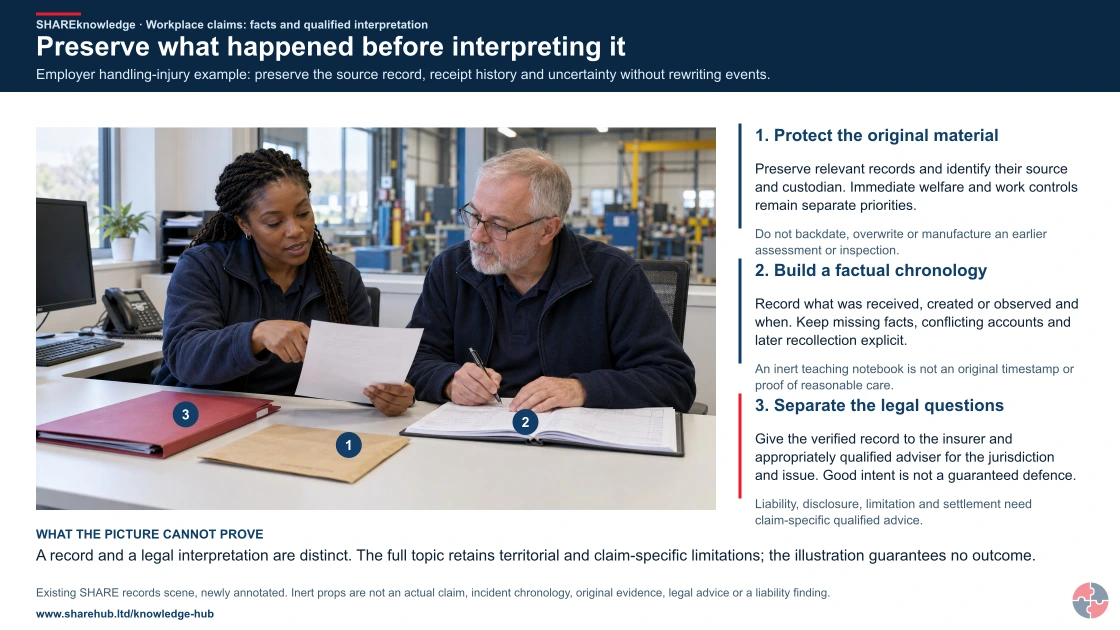
Full written explanation
Employer handling-injury example: preserve the source record, receipt history and uncertainty without rewriting events.
- Protect the original material. Preserve relevant records and identify their source and custodian. Immediate welfare and work controls remain separate priorities.
- Build a factual chronology. Record what was received, created or observed and when. Keep missing facts, conflicting accounts and later recollection explicit.
- Separate the legal questions. Give the verified record to the insurer and appropriately qualified adviser for the jurisdiction and issue. Good intent is not a guaranteed defence.
Change the pathway
- Do not improve the past. Do not backdate, overwrite or manufacture an earlier assessment or inspection.
- Distinguish records from findings. An inert teaching notebook is not an original timestamp or proof of reasonable care.
- Retain independent decisions. Liability, disclosure, limitation and settlement need claim-specific qualified advice.
Evidence check: A record and a legal interpretation are distinct. The full topic retains territorial and claim-specific limitations; the illustration guarantees no outcome.
Full territorial, insurance, limitation and SARHA context
Primary references: Official SARHA Act text: scope and factors (England and Wales) · Official SARHA commencement and transitional provisions
Open the complete HD image (new tab)Download image
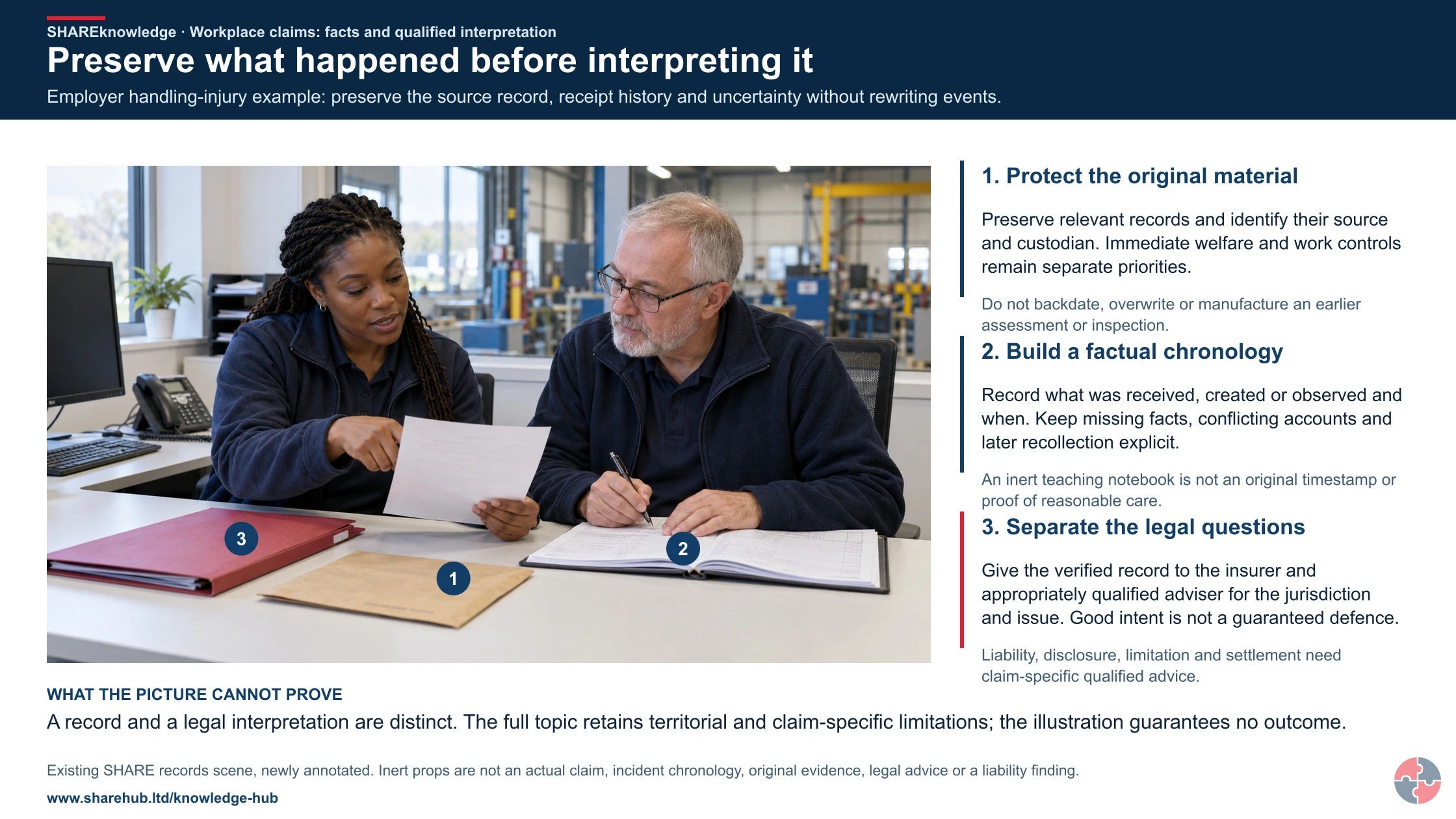
Full territorial, insurance, limitation and SARHA context
Primary references: Official SARHA Act text: scope and factors (England and Wales) · Official SARHA commencement and transitional provisions

Preserve
Protect original evidence and record who created or obtained it and when; attend to immediate welfare and controls.
Separate fact from interpretation
Mark uncertainty and conflicting accounts. Label a proposed interpretation as a question rather than an established finding.
Qualified advice
Give the verified record to an appropriately qualified adviser for the applicable jurisdiction and issue.
This example supplies no guaranteed defence, entitlement or outcome.
What key facts should people know first about defences, compensation and SARHA?
The key fact is that civil liability is evidence-led and legal decisions should be made by competent legal or insurer advisers.
This page is general workplace information, not legal advice. It does not tell any organisation whether it is liable, whether a claim will succeed or whether a defence should be pleaded. Those decisions belong with solicitors, insurers and the relevant court process.
Health and safety professionals still have an important role. They help prevent harm before incidents and, after an incident, they help preserve accurate facts, identify what happened, support learning and provide reliable records. They should avoid statements that admit liability, blame individuals without evidence, speculate about causation, coach witnesses or alter records.
A strong organisation treats claim defensibility as an outcome of good management, not as a post-incident tactic. If risk assessments, training, maintenance, supervision and action close-out are poor before an incident, it is difficult to manufacture credibility afterwards.
| Fact | Why it matters |
|---|---|
| Compensation is not punishment | Civil compensation is mainly about financial remedy for proven loss, while criminal enforcement punishes or deters wrongdoing. |
| Defences depend on facts | No defence works in the abstract; evidence, causation and legal context matter. |
| SARHA is limited | It requires courts to consider social action, responsibility and heroism contexts but is not a blanket shield. |
| ERRA changed statutory breach claims | Breach of health and safety legislation does not usually create automatic civil liability by itself. |
| Evidence must be preserved | Contemporaneous records usually carry more weight than reconstructed explanations. |
What do defences, compensation and SARHA mean in health and safety claims?
They describe how civil claims may be valued, challenged and considered by a court after workplace harm.
A civil health and safety claim usually asks whether a defendant owed a duty of care, breached that duty and caused compensable harm. In Scotland, the legal language and procedure differ, but the practical safety lesson is similar: decisions turn on duty, evidence, causation, reasonableness and loss. Civil-claim boundary: HSE civil-law compensation guidance.
Compensation concerns the losses claimed. Defences concern why liability should not be found, should be reduced or should be limited. SARHA is a statutory consideration in England and Wales that tells courts to consider whether the defendant acted for the benefit of society, demonstrated a generally responsible approach, or acted heroically in an emergency.
For health and safety people, the important boundary is professional discipline. They can explain the management system, evidence and lessons learned; they should not provide legal opinions on liability unless they are appropriately qualified and instructed to do so.
| Concept | Plain-English meaning | Workplace implication |
|---|---|---|
| Duty of care | A legal duty to take reasonable care for another person's safety. | Know who may be affected by the undertaking. |
| Breach | Failure to meet the required standard of care. | Records should show suitable assessment, control, training and review. |
| Causation | The link between breach and harm. | Incident investigation should separate facts from assumptions. |
| Compensation | Financial remedy for proven injury, loss and future impact. | Accurate records help determine what happened and what was affected. |
| Defence | An argument that liability is not established, reduced or legally limited. | Legal teams need reliable evidence, not speculation. |
| SARHA | A statutory context the court must consider in certain claims. | Responsible conduct matters, but SARHA does not excuse poor control. |
What is compensation trying to achieve?
Compensation aims to provide a civil financial remedy for proven harm and loss.
In personal injury claims, compensation may include general damages for pain, suffering and loss of amenity, and special damages for financial losses such as loss of earnings, care, treatment costs, travel, equipment or future losses. The exact categories and valuation are legal matters, but managers should understand why evidence is requested.
Health and safety records may influence liability and causation. Payroll, absence, occupational health, training, maintenance, CCTV, photographs, inspection records and witness accounts may all become relevant. That does not mean every record should be handed around informally. Documents should be managed lawfully, proportionately and through the organisation's claims, insurer and legal process.
Compensation is separate from criminal enforcement. A serious incident may generate a civil claim, an HSE investigation, RIDDOR reporting, internal disciplinary issues, insurance action and learning review. Those processes interact but are not the same.
A claim must be assessed on evidence of duty, breach, causation and loss. The HSE does not run civil claims or decide damages. A criminal investigation, insurer response and civil action may proceed on different questions and timelines; preserve facts for each without assuming that one outcome decides another.
| Category | What it may cover | Evidence that may be relevant |
|---|---|---|
| Pain, suffering and loss of amenity | The injury and its effect on life. | Medical evidence and witness evidence. |
| Loss of earnings | Past or future income impact. | Payroll, absence records, return-to-work and capability evidence. |
| Care and assistance | Support needed because of the injury. | Care records, statements and medical evidence. |
| Treatment and rehabilitation | Reasonable treatment or recovery costs. | Medical advice, invoices and rehab plans. |
| Equipment or adaptations | Practical aids or adjustments. | Occupational health, ergonomic or medical recommendations. |
| Legal costs and process costs | Costs depend on claim route and court rules. | Handled through insurer and legal advisers. |
What defences may be relevant in workplace injury claims?
Defences usually challenge duty, breach, causation, loss, limitation or the claimant's own contribution.
A defence is not a moral argument that the organisation is a good employer. It is a structured legal response to the claim. The strongest practical support for a defence is reliable evidence that the organisation assessed the risk, applied suitable controls, trained and supervised people, maintained equipment, acted on defects and responded to change. Contributory-fault and limitation routes: Law Reform (Contributory Negligence) Act 1945; NI Law Reform (Miscellaneous Provisions) Act 1948; Limitation Act 1980; NI Limitation Order 1989.
Contributory negligence may arise where the claimant's own conduct contributed to the harm. Voluntary assumption of risk is much narrower and should not be casually assumed in employment situations. Limitation may prevent or restrict claims brought too late, subject to legal rules and discretion. Causation may be contested where the injury was not caused by the alleged breach or where alternative causes exist.
Health and safety advisers should describe what the records show and what the investigation found. They should not decide whether a legal defence will succeed.
| Theme | What it asks | Useful evidence |
|---|---|---|
| No duty or limited duty | Was the defendant responsible for this person or risk? | Contracts, site control, role allocation, visitor/contractor arrangements. |
| No breach | Did the defendant take reasonable care in the circumstances? Which controls were actually in place? | Risk assessments, training, inspections, maintenance, supervision and audits. |
| Causation | Did the alleged breach cause the injury or loss? | Incident facts, medical evidence, timeline, photographs and witness accounts. |
| Contributory negligence | Did the claimant's own fault contribute? | Training, clear instructions, supervision, PPE issue/use and behavioural evidence. |
| Limitation | Was the claim brought within the relevant time limit? | Incident date, knowledge date, correspondence and legal advice. |
| Reasonable conduct/SARHA context | Was the defendant acting responsibly, socially or heroically? | Planning records, emergency context, decision rationale and conduct evidence. |
What does SARHA actually do?
SARHA requires courts in England and Wales to consider specific context, but it does not give automatic immunity.
The Social Action, Responsibility and Heroism Act 2015 is short but often misunderstood. It tells the court to have regard to whether the defendant was acting for the benefit of society, demonstrated a predominantly responsible approach towards protecting safety, or acted heroically by intervening in an emergency.
SARHA does not tell the court what result to reach. It does not remove the duty to manage risk, does not excuse reckless behaviour and does not mean that a business can ignore foreseeable hazards because it had good intentions. It is a contextual factor for the court.
In health and safety management, SARHA is best understood as a reminder that responsible conduct matters. If an organisation can show sensible planning, proportionate controls and good-faith emergency response, that context may be relevant. If records show ignored hazards, poor training or unsafe shortcuts, SARHA is unlikely to rescue credibility.
Section 1 sets the court-context question; sections 2 to 4 address social action, a predominantly responsible approach to protecting safety, and heroic emergency intervention. The Act extends to England and Wales only. It does not reverse the burden of proof, erase negligence, or prevent a worker from making a claim. A legal adviser should decide whether it is relevant on the actual facts. England and Wales statutory context: Social Action, Responsibility and Heroism Act 2015.
For an England and Wales claim, first identify the decision governed by SARHA section 1: the court is considering alleged negligence or breach of statutory duty and deciding what care the person was required to take. Evidence about responsible conduct should relate to the activity in which the alleged failure occurred. A good annual audit elsewhere in the business cannot, by itself, establish how this particular task was planned and controlled. Preserve the actual instructions, decisions and emergency circumstances, and ask the claim adviser how they bear on the statutory context. This is a practical evidence example, not a prediction of the court’s finding.
| SARHA theme | What the court considers | Practical caution |
|---|---|---|
| Social action | Was the person acting for the benefit of society or any of its members? | This may matter for volunteering or public benefit activity, but risks still need control. |
| Responsibility | Did the person demonstrate a predominantly responsible approach to protecting safety? | Good records and sensible systems matter more than slogans. |
| Heroism | Was the person acting heroically by intervening in an emergency? | Emergency context may be relevant, but reckless conduct is not automatically excused. |
| Limit | The Act does not decide the claim by itself. | Always obtain legal advice before relying on SARHA in a claim. |
How should claims-related information and evidence be managed?
Evidence should be preserved, factual, complete, traceable and handled through the proper legal, insurer and data protection route.
After an incident, the first priorities remain welfare, emergency response and making the area safe. Once immediate needs are controlled, evidence should be preserved. That may include photographs, CCTV, equipment condition, maintenance records, training evidence, risk assessments, permits, inspection records, witness details, environmental conditions, PPE and communications.
The investigation report should separate facts, analysis, findings and recommendations. Avoid speculative wording such as 'we were definitely liable', 'the worker was at fault' or 'this was just bad luck' unless that conclusion is properly evidenced and legally reviewed. Witnesses should give their own account in their own words; they should not be coached into a preferred version.
Legal privilege is specialist and should not be assumed. If the organisation needs privileged legal advice, solicitors should be involved early. Routine health and safety records, incident reports and audit documents are not made privileged simply by marking them confidential.
| Evidence type | Good handling | Common mistake |
|---|---|---|
| Scene evidence | Photograph, isolate and preserve relevant equipment or conditions. | Cleaning up or repairing before evidence is recorded. |
| Witness accounts | Take timely factual accounts in the witness's own words. | Leading questions or group-written statements. |
| Documents | Preserve current and historical versions of assessments, procedures and records. | Editing or recreating records after the incident. |
| Digital records | Secure CCTV, telematics, access logs, emails and system data quickly. | Allowing automatic overwrite or uncontrolled sharing. |
| Investigation report | Separate facts, analysis, root causes and actions. | Speculating on legal liability or blaming without evidence. |
| Insurer/legal route | Notify as required and follow advice on disclosure and privilege. | Trying to manage a claim informally outside policy conditions. |
How should insurers and legal advisers be involved?
Insurers and legal advisers should be involved early enough to protect policy conditions, evidence quality and communication discipline.
Employers' liability insurance is a legal requirement for most employers. Insurance policies normally contain notification and cooperation conditions. Delayed notification, missing documents or unmanaged admissions can create avoidable difficulty. The safety team should know the organisation's escalation route before a serious incident occurs.
Involving insurers does not mean hiding learning. A well-run organisation can both cooperate with claims handling and improve safety. The key is discipline: welfare support, factual records, legal notification, regulator cooperation where required, and learning actions that are verified rather than performative.
Communications with injured people should be humane and careful. Organisations can express concern, provide support and explain processes without making premature legal admissions.
| Action | Why it matters |
|---|---|
| Notify according to policy | Protects policy conditions and allows early advice. |
| Preserve evidence | Supports accurate liability, causation and quantum decisions. |
| Coordinate communications | Avoids inconsistent messages to claimant, regulator, insurer and workforce. |
| Track actions | Shows learning and prevents recurrence without prejudging liability. |
| Control document access | Protects personal data, legal strategy and record integrity. |
Which legal duties and sources are relevant?
Civil-claim rules and workplace safety duties vary by jurisdiction; SARHA is restricted to England and Wales.
The law differs across UK jurisdictions and claim types. England and Wales, Scotland and Northern Ireland have different civil procedure and terminology. SARHA is focused on England and Wales. Scotland uses delict rather than the English tort terminology. This page therefore explains practical concepts and points to official sources, but legal advice should always be obtained for live claims. England/Wales SARHA: Social Action, Responsibility and Heroism Act 2015.
For HSE professionals, the most important practical point is that good health and safety management produces useful evidence before an incident: clear responsibilities, risk assessment, worker consultation, competent advice, maintenance, supervision, inspections, training and management review.
SARHA applies only in England and Wales and requires a court to have regard to social action, a predominantly responsible approach to safety, or heroic emergency intervention where relevant. It creates no automatic defence or immunity. The Law Reform (Contributory Negligence) Act 1945 and Limitation Act 1980 also do not supply the NI route; NI uses its own legislation. The GB Employers’ Liability (Compulsory Insurance) Act 1969 expressly excludes NI. Refer live liability, limitation, disclosure and settlement decisions to the insurer and a qualified lawyer in the claim jurisdiction.
| Duty or source | Why it matters | Workplace evidence |
|---|---|---|
| Social Action, Responsibility and Heroism Act 2015 | Court context for social action, responsibility and heroism. | Records showing responsible planning or emergency context. |
| Enterprise and Regulatory Reform Act 2013 section 69 | Changed civil reliance on health and safety statutory breach. | Evidence of negligence or reasonable care, not just statutory wording. |
| Law Reform (Contributory Negligence) Act 1945 | Basis for reducing damages where claimant fault contributed. | Training, warnings, supervision and conduct evidence. |
| Limitation Act 1980 | Time limits for many claims in England and Wales. | Incident dates, knowledge dates and correspondence. |
| Employers' Liability (Compulsory Insurance) Act 1969 | Insurance requirement for most employers. | Policy, certificate, notification and cooperation evidence. |
| Health and Safety at Work etc. Act 1974 | General criminal duties, relevant background to management standards. | Arrangements, records, training and supervision. |
| Management of Health and Safety at Work Regulations 1999 | Risk assessment and preventive arrangements. | Assessments, competent advice, review and action close-out. |
| Limitation (Northern Ireland) Order 1989 | NI civil limitation questions. | Preserve dates and seek claim-specific NI legal advice. |
| Law Reform (Miscellaneous Provisions) Act (Northern Ireland) 1948 | NI contributory-negligence questions. | Record factual conduct without assigning fault internally. |
| Employer’s Liability (Defective Equipment and Compulsory Insurance) (Northern Ireland) Order 1972 | NI employers’ liability insurance. | Check NI policy, certificate and notification route. |
| Health and Safety at Work (Northern Ireland) Order 1978 | General NI workplace duties. | Risk controls and factual implementation evidence. |
What should the claims defensibility register include?
The register should identify high-value evidence, ownership, retention, notification triggers and improvement actions.
A claims-readiness register is useful only if it improves real prevention and evidence quality. For each material hazard, identify the responsible control owner, the actual records that show the control operated, where they are stored, who can preserve them after an incident, and the retention decision. A missing inspection or contradictory date is a reason to investigate the control and preserve the discrepancy, not to edit the file until it looks defensible. Trend repeated claim themes back into risk assessment and field verification while keeping personal claim data restricted.
| Risk or issue | Control | Evidence |
|---|---|---|
| Incident evidence lost | Immediate evidence preservation process and responsible owner. | Incident pack, photographs, CCTV request and equipment quarantine. |
| Unclear liability narrative | Structured investigation separating facts, causes and actions. | Investigation report, witness accounts and timeline. |
| Late insurer notification | Claims notification trigger in incident procedure. | Notification record and policy reference. |
| Speculative admissions | Manager training and communication controls. | Briefing notes, escalation route and reviewed statements. |
| Weak pre-incident evidence | Management system records and periodic assurance checks. | Training, maintenance, risk assessment and audit records. |
| Poor learning from claims | Trend review and action close-out. | Claims review, lessons learned and management review minutes. |
How can the hierarchy of controls prevent machinery injury when responding to a reported interlock defect?
A retail facilities team changing high-level signage may be able to lower the sign or use a suitable guarded platform; a construction crew inspecting a roof needs different edge, access and rescue arrangements. The owner checks the actual work height, task duration, surface and people below before choosing equipment.
How can the ERICPD hierarchy of controls prevent machinery injury when responding to a reported interlock defect?

| Control level | Control for this activity | Owner and verification | Stop / restart decision |
|---|---|---|---|
| Eliminate | Remove the need to open the guard through external inspection or redesigned access where feasible. | Task owner verifies that the proposed change removes the named hazardous step, including foreseeable cleaning, maintenance and work transferred elsewhere. | If the hazardous step remains, keep it within the task assessment and select the stronger feasible remaining controls. |
| Reduce, including substitution | Use an approved off-line test rig or replaceable module where it safely removes hazardous live diagnosis. | Competent task/process owner validates suitability, compatibility and new hazards against the actual operating requirements before the alternative is adopted. | Reject an alternative if its performance is unproved or its new hazards are unresolved. |
| Isolate | Securely isolate hazardous motion and stored energy before repair; restrict access to the test zone. | Supervisor checks the actual boundary, affected people and connected work; verify separation or isolation before allowing access. | Hold or stop for unexpected motion, a defeated safeguard or an incomplete function test. |
| Control: physical safeguards | Repair and function-test the guard interlock and stopping behaviour using the approved machine procedure. | Competent equipment/process owner checks guard alignment, interlock function, stopping response and removal of temporary test arrangements. | Hold or stop for unexpected motion, a defeated safeguard or an incomplete function test. |
| Control: work method and response | Agree test authority, restart communication and any controlled diagnostic mode; never improvise a bypass to continue production. | Supervisor confirms the work limits, competent cover, communication and stop/restart authority with the people doing this activity. | Hold work when the agreed limits, competent cover or effective communication cannot be maintained. |
| PPE | Use protection for assessed maintenance contact hazards; PPE cannot compensate for a defective interlock. | Assessor confirms whether personal protection is needed and checks suitability, condition, compatibility and any required fit evidence. | Do not use unsuitable protection or rely on PPE to continue after an essential source control fails. |
| Discipline | Retain the test result and defect closure evidence; escalate overdue tests and repeated failures to the equipment owner. | Release only after competent maintainer and operations sign the tested return to service. Retain verification and unresolved restrictions at handover. | Keep the task on hold until required reinstatement evidence and unresolved defects are accepted by the responsible owner. |
How can the ISO 45001 hierarchy of controls prevent machinery injury when responding to a reported interlock defect?

| Control level | Control for this activity | Owner and verification | Stop / restart decision |
|---|---|---|---|
| Elimination | Remove the need to open the guard through external inspection or redesigned access where feasible. | Task owner verifies that the proposed change removes the named hazardous step, including foreseeable cleaning, maintenance and work transferred elsewhere. | If the hazardous step remains, keep it within the task assessment and select the stronger feasible remaining controls. |
| Engineering controls | Use an approved off-line test rig or replaceable module where it safely removes hazardous live diagnosis. | Competent task/process owner validates suitability, compatibility and new hazards against the actual operating requirements before the alternative is adopted. | Reject an alternative if its performance is unproved or its new hazards are unresolved. |
| Engineering controls | Securely isolate hazardous motion and stored energy before repair; restrict access to the test zone. | Supervisor checks the actual boundary, affected people and connected work; verify separation or isolation before allowing access. | Hold or stop for unexpected motion, a defeated safeguard or an incomplete function test. |
| Engineering controls | Repair and function-test the guard interlock and stopping behaviour using the approved machine procedure. | Competent equipment/process owner checks guard alignment, interlock function, stopping response and removal of temporary test arrangements. | Hold or stop for unexpected motion, a defeated safeguard or an incomplete function test. |
| Administrative controls | Agree test authority, restart communication and any controlled diagnostic mode; never improvise a bypass to continue production. | Supervisor confirms the work limits, competent cover, communication and stop/restart authority with the people doing this activity. | Hold work when the agreed limits, competent cover or effective communication cannot be maintained. |
| PPE | Use protection for assessed maintenance contact hazards; PPE cannot compensate for a defective interlock. | Assessor confirms whether personal protection is needed and checks suitability, condition, compatibility and any required fit evidence. | Do not use unsuitable protection or rely on PPE to continue after an essential source control fails. |
| Administrative controls | Retain the test result and defect closure evidence; escalate overdue tests and repeated failures to the equipment owner. | Release only after competent maintainer and operations sign the tested return to service. Retain verification and unresolved restrictions at handover. | Keep the task on hold until required reinstatement evidence and unresolved defects are accepted by the responsible owner. |
How could BuildOut Ltd manage defences, compensation and SARHA considerations?

BuildOut Ltd would manage this topic by keeping safety evidence strong before incidents and disciplined after incidents.
Different territorial routes, no automatic defence
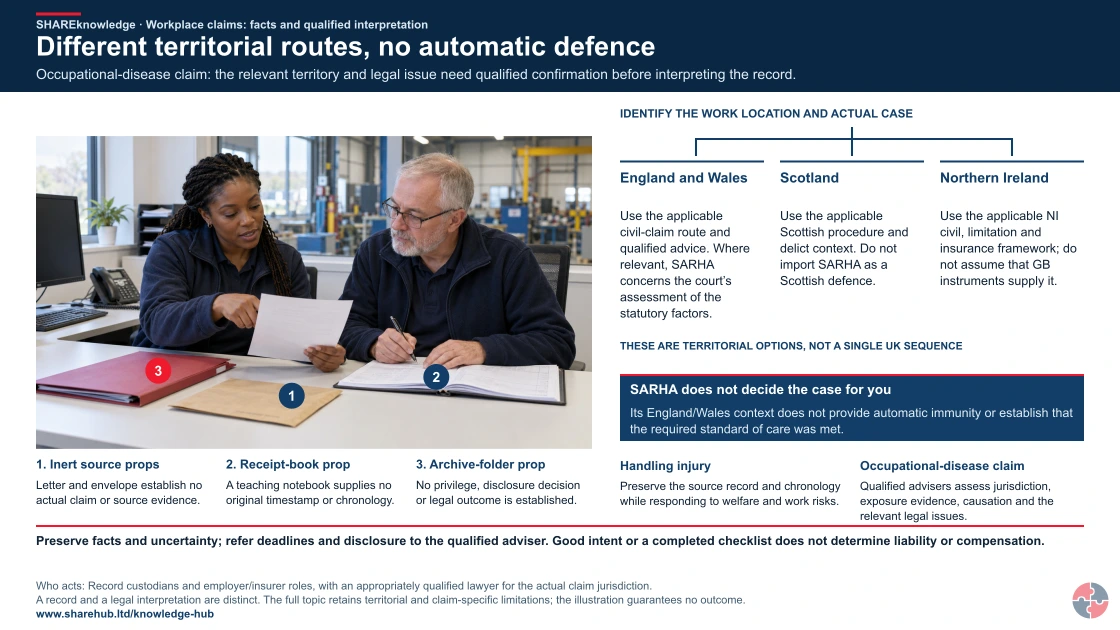
Full written explanation
An illustrative manufacturing-office records scene shows normal uninjured people, an inert letter and envelope, a separate receipt-notebook prop and an archival-folder prop. Picture key: 1 identifies the inert source props; 2 identifies the receipt-book prop; 3 identifies the archive-folder prop. These objects locate source, chronology and custodianship questions. They do not establish an actual claim, original evidence, receipt time, admissibility, privilege, disclosure decision, professional role, work causation, insurance cover or outcome. The people are not assigned employer, insurer or lawyer roles by appearance. Beside this physical context, an unarrowed work-location and actual-case fork leads to three alternative territorial options. England and Wales, Scotland and Northern Ireland retain their complete separate source explanations; they are not a sequence, interchangeable legal regimes or a universal UK route. A separate fourth complete SARHA band retains its England-and-Wales qualification and its limit: SARHA does not decide the case or provide automatic immunity or establish the required standard of care. All four original headings and full bodies, the complete hold, responsible roles, evidence boundary and both handling-injury and occupational-disease cases accompany the comparison. Independent headings are unnumbered and separate from the literal physical picture key. Welfare, immediate work controls and learning remain separate from the claim and qualified legal interpretation. Relevant deadlines, disclosure, limitation, privilege and settlement are for appropriately qualified advisers in the actual claim jurisdiction. No new legal test, litigation advice, liability, compensation, defence, entitlement, policy result or permission is supplied. Use the full topic for its current territorial, source, insurance, record-integrity and privacy qualifications.
Occupational-disease claim: the relevant territory and legal issue need qualified confirmation before interpreting the record.
- England and Wales. Use the applicable civil-claim route and qualified advice. Where relevant, SARHA concerns the court’s assessment of the statutory factors.
- Scotland. Use the applicable Scottish procedure and delict context. Do not import SARHA as a Scottish defence.
- Northern Ireland. Use the applicable NI civil, limitation and insurance framework; do not assume that GB instruments supply it.
- SARHA does not decide the case for you. Its England/Wales context does not provide automatic immunity or establish that the required standard of care was met.
When the evidence does not fit: Preserve facts and uncertainty; refer deadlines and disclosure to the qualified adviser. Good intent or a completed checklist does not determine liability or compensation.
Who acts: Record custodians and employer/insurer roles, with an appropriately qualified lawyer for the actual claim jurisdiction.
Changed workplace
Handling injury: Preserve the source record and chronology while responding to welfare and work risks.
Occupational-disease claim: Qualified advisers assess jurisdiction, exposure evidence, causation and the relevant legal issues.
Evidence check: A record and a legal interpretation are distinct. The full topic retains territorial and claim-specific limitations; the illustration guarantees no outcome.
Full territorial, insurance, limitation and SARHA context
Primary references: Official SARHA Act text: scope and factors (England and Wales) · Official SARHA commencement and transitional provisions
Open the complete HD image (new tab)Download image
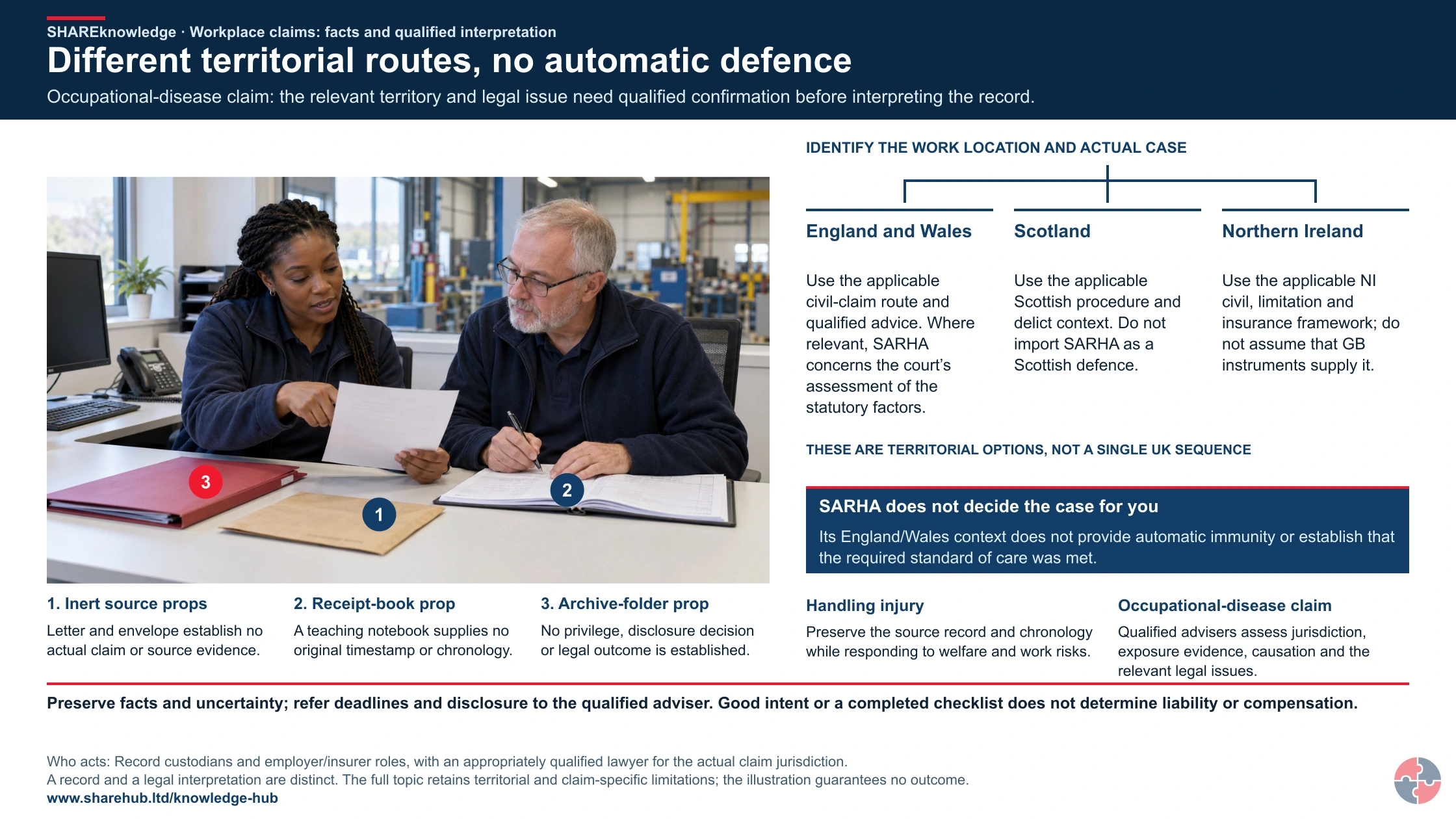
Full territorial, insurance, limitation and SARHA context
Primary references: Official SARHA Act text: scope and factors (England and Wales) · Official SARHA commencement and transitional provisions
BuildOut Ltd
BuildOut Ltd is a construction and property services business used by SHARE to show how claims defensibility, insurer notification and learning can work across projects, contractors and maintenance operations.
BuildOut would start by accepting that claims defensibility begins before an incident. Project risk assessments, method statements, inductions, toolbox talks, plant inspections, temporary works checks, supervision records, contractor approvals and action close-out would be stored in a controlled system with clear ownership and retention rules.
After an incident, the supervisor would prioritise welfare and scene safety, then preserve evidence using a standard incident evidence checklist. Photographs, equipment condition, witness details, permits, training records, inspection records, CCTV and environmental conditions would be captured without speculation. The HSE adviser would coordinate factual investigation and learning, while the insurance/legal route would handle liability and claim strategy.
Managers would be trained not to admit liability, blame individuals, alter documents or make promises about compensation. They could still show concern, provide support, explain reporting routes and make immediate safety improvements. Legal advice would be sought where SARHA, contributory negligence, limitation, contractual indemnity or privilege questions arise.
BuildOut would review claims trends quarterly. If several claims relate to poor housekeeping, manual handling or contractor supervision, the board would see the pattern and fund corrective action rather than treating each claim as an isolated file.
Worked example: a ladder fall and a disputed account
Task material and setting: BuildOut receives notice of a civil claim after an employee falls from a ladder during a short maintenance task. The worker’s welfare and prevention of another fall come first. The initial account is disputed: the supervisor recalls a brief task, while a colleague recalls that the planned platform was unavailable. The organisation must not turn either recollection into a legal conclusion.
People and prerequisites: The site manager owns immediate safety action; a named claims lead controls evidence and insurer contact. The insurer and qualified lawyer assess limitation, disclosure, possible defences and the response in the claim jurisdiction; a court decides contested liability. Workers and witnesses are entitled to give independent factual accounts. Relevant prerequisites are the policy/notification route, privacy controls, versioned incident system and a way to preserve short-lived CCTV.
Before: The manager arranges care, makes the area safe and preserves the ladder without modifying it. The claims lead records the incident date, location and jurisdiction, secures CCTV before automatic deletion, photographs the equipment and area, and freezes the relevant inspection, training, risk assessment, work instruction and maintenance versions. Witnesses are asked what they saw, separately and without suggested answers.
During: The safety adviser checks how the task was actually arranged: available access equipment, supervision, time pressure and any previous defect report. The claims lead logs who collected each record, when, and whether it is an original or copy; personal information is shared only with those who need it. The insurer is notified through the policy route. A solicitor decides what must be disclosed and whether any communication may be privileged; an ordinary incident report does not become privileged by labelling it so.
Hold or stop: A missing platform record, conflicting account, newly found image or uncertainty about the claim jurisdiction stops a confident internal “no breach” or “worker fault” conclusion. The organisation preserves the new material and asks the legal adviser to reassess. SARHA is only an England-and-Wales court-context issue; a manager must not invoke it as permission for a risky method or as a reason to delay support.
Completion and hand back: The site separately implements a safer access method and verifies it at the workface. The claims lead hands a dated evidence inventory and correction trail to the insurer/legal team, retaining its own controlled copy under the applicable retention decision. Managers tell the worker what support and safety action is available without speculating about compensation. Safety learning continues whatever the claim outcome.
Evidence: Keep the policy and notification timestamp, original records and metadata, access log, witness accounts, photographs, CCTV preservation record, legal hand-off, safety action owner and field verification. If an error is found in an incident report, retain the original and add a dated correction; never silently overwrite it.
Changed conditions and related decisions
If the injury occurred in Northern Ireland, the England-and-Wales SARHA and Limitation Act routes must not be copied into the response. If it occurred in Scotland, the civil terminology and procedure also differ. The same factual preservation and welfare steps are useful, but qualified local advisers decide the legal route. A later regulatory investigation is a separate process; do not assume it settles the civil claim.
| Area | How BuildOut manages it | Evidence and improvement |
|---|---|---|
| Pre-incident records | Keeps risk assessments, training, inspections and maintenance records in controlled systems. | Record audit, retention schedule and action tracker. |
| Incident response | Uses welfare-first response and evidence preservation checklist. | Scene photos, witness accounts, equipment quarantine and incident timeline. |
| Claims escalation | Notifies insurer and legal advisers through defined thresholds. | Notification log and correspondence register. |
| Professional boundaries | Trains managers and HSE advisers to avoid speculative admissions or legal conclusions. | Training records, communication templates and escalation guidance. |
| Learning | Reviews claims themes and links them to risk register improvements. | Claims trend report, management review and verified actions. |
What training supports better handling of claims-related information?
Training should help people record facts, preserve evidence, communicate carefully and escalate correctly.
General awareness is useful for supervisors, HSE advisers, HR and managers who may be involved in incident response. It should cover civil versus criminal processes, evidence preservation, witness handling, insurer notification, data protection, confidentiality and professional boundaries.
More detailed training is needed for people who investigate serious incidents or manage claims interfaces. They need to understand root cause analysis, document control, legal privilege boundaries, worker communication, regulator contact, insurer expectations and action tracking.
The aim is not to turn managers into lawyers. The aim is to stop well-meaning people from damaging evidence, making unsupported statements or missing opportunities to learn.
Competence must be shown in a realistic task or decision, assessed by someone competent, recorded with its scope, and reassessed after material change, a failed control, incident or extended time away from the activity. Attendance alone does not authorise specialist work.
| Role | Learning to test | Competence demonstration | Assessor and record | Reassessment trigger |
|---|---|---|---|---|
| Worker/witness | Prompt factual reporting and welfare | Give own account without speculation or coaching | Supervisor; dated record | New evidence or incident |
| Supervisor | Preserve scene and records, notify claims lead | Run an evidence-preservation scenario | Claims lead; incident record | Procedure change or missed evidence |
| HSE/HR adviser | Separate safety learning, privacy and legal decisions | Trace factual controls and restricted data access | Manager/legal adviser; audit trail | Claim or privacy issue |
| Manager/insurer liaison | Policy notice, retention and communication route | Show timely hand-off and versioned records | Insurer/legal team; notification record | Policy or jurisdiction change |
| Legal specialist | Jurisdiction, limitation, liability and disclosure | Professional review of the live claim | Qualified lawyer; advice file | New fact, pleading or law |
How should the controls be managed and reviewed?
Assign owners to the significant risks, put the chosen controls into the work plan, check that they work in practice and change them when conditions or evidence change.
HSE describes this as a continuing plan, do, check and act process. For defences compensation and sarha considerations, record who checks the controls, what evidence shows they are working, and which failure stops the work or triggers review. A formal management system is a choice, not a substitute for the applicable legal duties. Read HSE management guidance.
What warning signs show claims-related arrangements are weak?
Warning signs show when records are unreliable, communication is uncontrolled or learning is disconnected from claims.
Records are recreated after incidents
Reconstructed records may damage credibility and obscure what was really controlled at the time.
Managers admit or deny liability informally
Legal positions should be handled through insurers and legal advisers.
Witness accounts are delayed or coached
Late or influenced accounts are less reliable and may be challenged.
Incident reports mix facts and opinions
Speculative conclusions can create confusion and undermine learning.
Insurer notification is ad hoc
Policy conditions and early advice may be missed.
Claims trends are ignored
Repeated claims may reveal control weaknesses that need management action.
What do the acronyms and key terms mean?
These acronyms are commonly used in civil claims and health and safety legal discussion.
| Term | Full form or definition | Meaning here |
|---|---|---|
| CCTV | Closed-circuit television | Time-limited footage may preserve the event sequence; handle it lawfully. |
| CPR | Civil Procedure Rules | England-and-Wales civil procedure, not the NI or Scottish court route. |
| ELCI | Employers' Liability Compulsory Insurance | Insurance for employee injury liability; GB and NI instruments differ. |
| ERRA | Enterprise and Regulatory Reform Act 2013 | Section 69 changed the civil effect of some GB safety-law breaches. |
| HSE | Health and Safety Executive | GB safety regulator; it does not decide civil compensation. |
| MoJ | Ministry of Justice | England-and-Wales justice department; policy background is not case advice. |
| PSLA | Pain, suffering and loss of amenity | A head of general damages for pain, suffering and lost enjoyment. |
| SARHA | Social Action, Responsibility and Heroism Act 2015 | England-and-Wales court context for social action, responsibility or heroism; no immunity. |
| Contributory negligence | Claimant contribution to damage | A court/legal issue requiring facts and jurisdiction-specific law. |