
SHARE Knowledge Hub
What is corporate manslaughter and how can organisations prevent fatal management failure?
The 2007 Act creates an organisational offence where a gross breach of a relevant duty of care causes death and the way senior management managed or organised activities is a substantial element. The offence is called corporate homicide in Scotland. Prevent fatal hazards through real controls and board oversight, not paperwork alone.
Understanding What is corporate manslaughter and how can organisations prevent fatal management failure?
The 2007 Act creates an organisational offence where a gross breach of a relevant duty of care causes death and the way senior management managed or organised activities is a substantial element. The offence is called corporate homicide in Scotland. Prevent fatal hazards through real controls and board oversight, not paperwork alone.
Why this matters at work
Use fatal-risk scenarios to test whether design, maintenance, competence, supervision and emergency controls are actually resourced and effective. Review repeated defects, overdue actions and barriers that depend on unavailable people. Ask whether leaders receive bad news and act on it. A low injury rate, signed policy or training completion figure cannot establish control of a rare high-consequence event.
The Corporate Manslaughter and Corporate Homicide Act concerns specified organisations whose management or organisation of activities causes death and amounts to a gross breach of a relevant duty of care. The way senior management manages or organises activities must be a substantial element of the breach. Gross means conduct falling far below what can reasonably be expected. A fatality, poor paperwork or an isolated junior error does not by itself establish all elements.
How organisations manage this in practice
Competent investigation should examine equipment, method, resources, supervision, prior warnings and management decisions, with uncertainty explicit. Legal analysis separately considers duty, gross breach, causation and senior-management contribution. Do not infer corporate manslaughter solely from the death or announce that worker error resolves the case. Necessary preventive action should proceed while evidence is protected. Records, clinical information, disclosure and privilege need appropriate advice. This example provides neither a mechanical diagnosis nor a legal verdict.
Preserve accurate organisation charts, responsibilities, decisions, budgets, warnings and control-performance evidence, including information that challenges the proposed explanation. Obtain case-specific legal advice on the actual organisation and duty. The senior-management element, grossness, relevant duty and causation remain distinct parts of the test. Prevention should improve where credible weaknesses are found without waiting for a legal conclusion. A delegated operational task does not automatically transfer away every organisational duty or establish that a director is personally guilty.
Prevent risk through competent selection, clear scope, exchanged hazard information, coordination, suitable resources, supervision and verified handback. Retain enough customer capability to challenge safety-critical work and recognise missing evidence. Record decisions and changes accurately. Construction, major-hazard and other specific regimes may impose additional applicable duties with GB and NI differences. After a death, preserve evidence and obtain specialist advice. This guidance supports accountable contracting and does not determine which company, parent, subsidiary or individual would be charged on unknown facts.
Use governance evidence to prevent fatal control failures
Use a governance case to connect a foreseeable fatal hazard with repeated warnings, a resource decision and the barrier that should prevent harm. Ask what leaders knew, what action was assigned, whether resources matched the risk and how effectiveness was checked. The practical aim is to correct the system before a fatal event.
The offence is not established by a fatality alone, and a score cannot decide guilt. Keep the organisational offence, separate individual offences and relevant prosecution route distinct; retain corporate homicide as the Scottish terminology. For an actual fatal incident, use the fatal-incident guide, official investigation route and competent legal advice rather than asking a manager to classify liability.
BuildOut: repeated access warnings reach the board
Illustrative example. A leadership team sees recurring reports that a critical access barrier is unreliable while a replacement has been deferred.
Decision. The responsible director requires immediate risk control, a funded corrective decision and verified effectiveness instead of accepting an unresolved warning trend.
Evidence to check. Warnings and observations, barrier condition, decision reasons, resources, action ownership and verification in use.
Hold or escalation point. Do not continue hazardous exposure because incidents have so far been avoided or the action is on a future budget.
Follow-up. Review whether senior reporting exposes unresolved fatal risks and whether closed actions actually restore control.
Trace leadership decisions to the workface evidence
A board decision, resource choice and critical-control defect may be relevant facts. They need an evidence trail; legal tests remain a separate specialist assessment.

Trace the decision to the workface
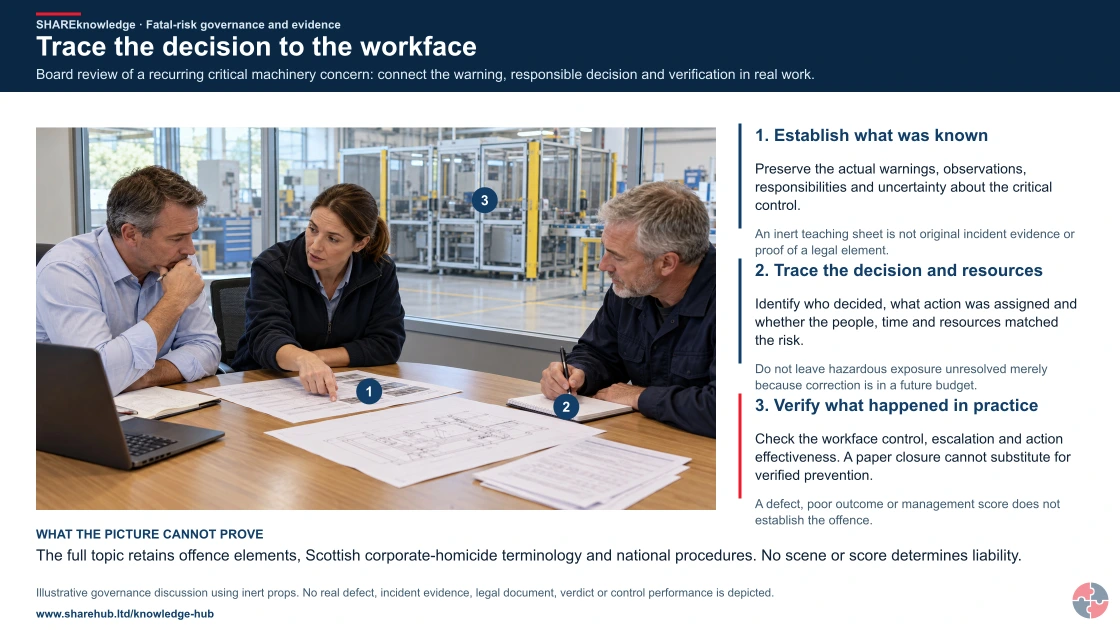
Full written explanation
Board review of a recurring critical machinery concern: connect the warning, responsible decision and verification in real work.
- Establish what was known. Preserve the actual warnings, observations, responsibilities and uncertainty about the critical control.
- Trace the decision and resources. Identify who decided, what action was assigned and whether the people, time and resources matched the risk.
- Verify what happened in practice. Check the workface control, escalation and action effectiveness. A paper closure cannot substitute for verified prevention.
Change the pathway
- Keep facts and conclusions distinct. An inert teaching sheet is not original incident evidence or proof of a legal element.
- Act before the fatal event. Do not leave hazardous exposure unresolved merely because correction is in a future budget.
- Use qualified legal analysis. A defect, poor outcome or management score does not establish the offence.
Evidence check: The full topic retains offence elements, Scottish corporate-homicide terminology and national procedures. No scene or score determines liability.
Full offence boundaries, current-law source and distinct national procedures
Primary references: HSE: corporate liability and investigation distinctions · CPS: offence elements and prosecution context (England and Wales) · HSE: leadership and prevention
Open the complete HD image (new tab)Download image
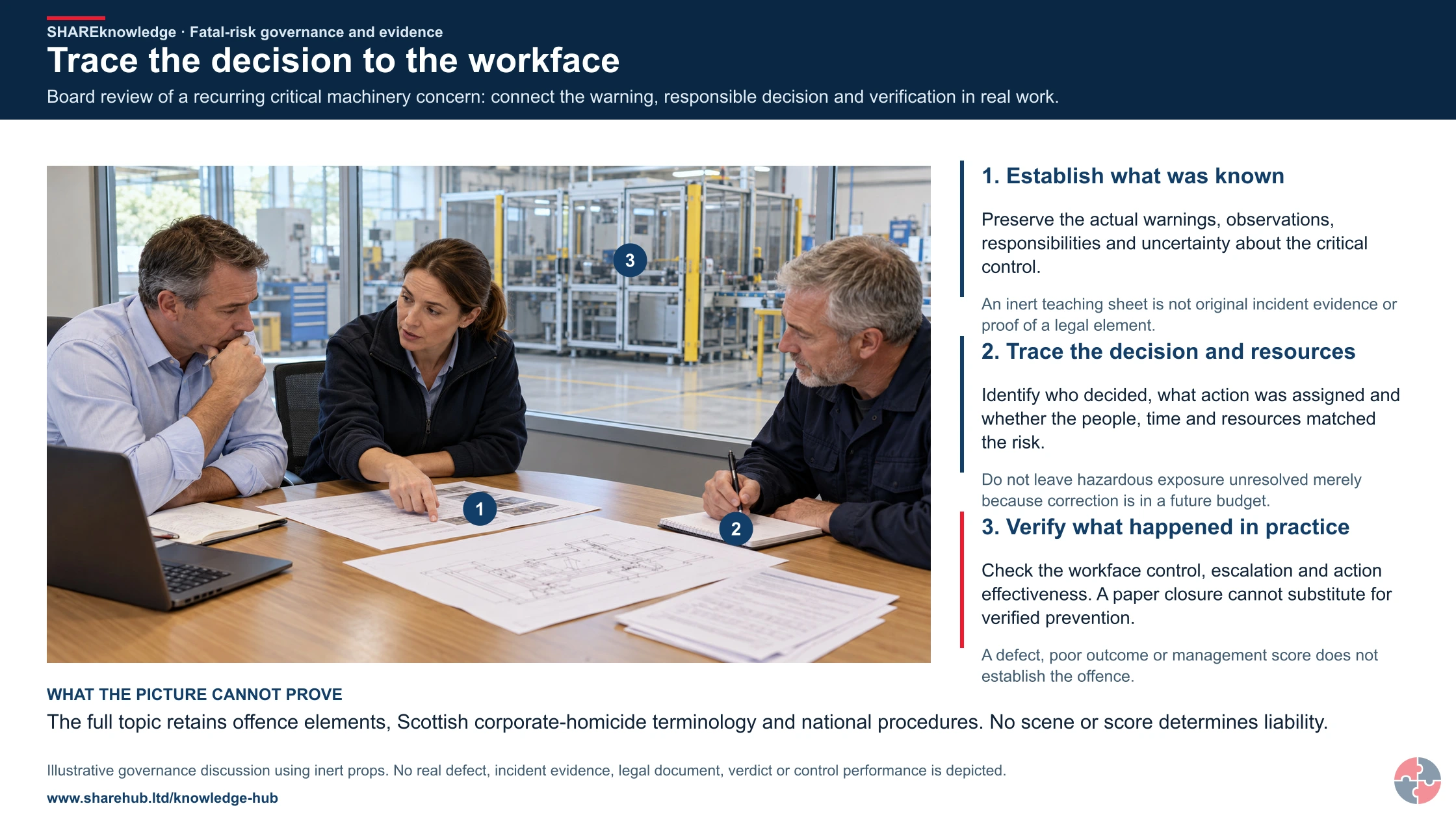
Full offence boundaries, current-law source and distinct national procedures
Primary references: HSE: corporate liability and investigation distinctions · CPS: offence elements and prosecution context (England and Wales) · HSE: leadership and prevention

Who knew and owned it?
Record actual information, decision ownership and the critical control at issue.
What followed?
Trace resources, workface verification, escalation and corrective action, including unresolved concerns.
Separate legal tests
Preserve the evidence and obtain advice on the applicable legal elements. A poor outcome or defect alone is not a guilt score.
The hypothetical roof-defect example does not determine anyone’s criminal liability.
What are the key points about corporate manslaughter?
The key points are that the offence is organisational, requires death, requires a gross breach of a relevant duty of care and requires senior management to be a substantial element.
Corporate manslaughter and corporate homicide cases are serious criminal matters. Organisations should take competent legal, regulatory and insurance advice after any fatal incident, investigation, enforcement action, inquest, Fatal Accident Inquiry or prosecution concern.
It is an organisational offence
Individuals cannot be convicted of corporate manslaughter, though they may face other offences.
The threshold is high
The breach must fall far below what could reasonably be expected.
Senior management matters
The way activities were managed or organised by senior management must be a substantial element.
It is not a substitute for HSWA
Health and safety offences may be charged alongside or instead of corporate manslaughter.
Scotland uses corporate homicide terminology
The 2007 Act covers corporate manslaughter and corporate homicide.
Prevention evidence matters
Risk registers, audits, action tracking and leadership review show whether fatal risks were genuinely controlled.
What is corporate manslaughter?
Corporate manslaughter is a criminal offence committed by an organisation where its management or organisation of activities causes death through a gross breach of a relevant duty of care.
The Corporate Manslaughter and Corporate Homicide Act 2007 was designed to make organisations accountable for very serious management failings resulting in death. The offence moved the focus away from having to identify one controlling mind and towards how the organisation’s activities were managed or organised.
The CPS guidance explains that the offence applies only to the most serious corporate failings. It is not enough that a death occurred. The prosecution must prove the relevant elements: qualifying organisation, relevant duty of care, gross breach, senior management substantial element and causation.
In workplace learning, the topic should be understood as governance failure. The question is not just what happened at the moment of death; it is whether the organisation’s systems, leadership, resourcing, supervision and learning fell so far below the required standard that criminal liability may arise.
| Element | Meaning | Practical evidence |
|---|---|---|
| Qualifying organisation | The defendant must be an organisation covered by the Act. | Legal identity, group structure and contracting arrangements. |
| Relevant duty of care | The organisation owed a duty to the deceased. | Employer, occupier, supplier, operator or service role. |
| Gross breach | Conduct fell far below reasonable expectations. | Serious control, competence or leadership failure. |
| Senior management element | Senior management organisation or management was a substantial part of the breach. | Board, executive, senior operational decisions and omissions. |
| Causation | The breach caused or contributed to death. | Timeline, expert evidence and incident facts. |
| Penalty | Organisation faces unlimited fine and possible ancillary orders. | Sentencing, remedial and publicity orders. |
CPS offence explanation directly supports the organisational-failure explanation. Current case-specific legal advice is needed.
What must prosecutors establish?
The organisation owed a relevant duty of care, grossly breached it, caused death, and senior management’s way of managing or organising activity was a substantial element.
The 2007 Act sets the elements and relevant duties. The HSE FAQ explains that the offence concerns the organisation, while separate law can apply to individuals. A fatality alone does not establish the offence, and a board policy alone does not disprove it. Legal counsel should assess a live case; this page does not predict prosecution or guilt.
Why is not every fatal incident corporate manslaughter?
Not every fatal incident is corporate manslaughter because the offence has specific legal elements and a high threshold.
A fatal workplace incident may lead to HSE prosecution under HSWA in Great Britain, prosecution of individuals, civil claims, enforcement notices, an inquest, a Fatal Accident Inquiry or no prosecution if the evidence does not support legal action. Corporate manslaughter is one possible route, not the automatic outcome.
This distinction matters for study and professional practice. Overstating corporate manslaughter can lead to poor advice and weak analysis. Understating it can lead senior leaders to miss the seriousness of systemic fatal-risk failings.
The stronger learning position is balanced: understand the offence precisely, then use its principles to improve fatal-risk governance even where no prosecution occurs.
| Route | Focus | Key distinction |
|---|---|---|
| Corporate manslaughter/homicide | Organisation gross breach causing death. | Requires senior management substantial element. |
| Gross negligence manslaughter (England and Wales) | Individual gross breach causing death. | Applies to individuals. |
| HSWA prosecution (Great Britain) | Exposure to health and safety risk. | Death not always required; may sit alongside manslaughter. |
| Inquest or FAI | Public fact-finding after death. | Not a criminal trial. |
| Civil claim | Compensation for loss. | Different burden and purpose. |
| Internal investigation | Learning and control improvement. | Should not replace legal/regulatory process. |
How does senior management influence liability?
Senior management matters because the offence looks at whether senior management organisation or management was a substantial element in the gross breach.
Senior management includes people who play significant roles in making decisions about how the whole or a substantial part of the organisation’s activities are managed or organised. This can include formal directors and senior operational leaders depending on the facts.
Evidence may show senior management influence through what leaders prioritised, funded, ignored, rewarded or failed to monitor. A policy signed by a director is not enough if the organisation allowed unsafe practice to continue. Likewise, an isolated frontline breach may not indicate senior management failure unless the wider system contributed.
For prevention, leaders should ensure fatal-risk controls are visible in board papers, budgets, competence systems, audit programmes, incident reviews, contractor reviews and maintenance decisions. Senior management should ask for evidence, not reassurance.
| Theme | What it may show | Evidence |
|---|---|---|
| Resources | Whether enough people, time, equipment and maintenance were provided. | Budgets, staffing and backlog records. |
| Prior knowledge | Whether warnings or near misses were ignored. | Audit, incident and action logs. |
| Production pressure | Whether output was prioritised over safety. | Targets, emails and supervision records. |
| Competence | Whether people were trained and authorised for risk-critical tasks. | Competence matrix and assessments. |
| Monitoring | Whether leaders checked controls and acted on findings. | KPIs, audits and review minutes. |
| Culture | Whether unsafe normal practice was tolerated. | Worker evidence and repeated deviations. |
What penalties and orders can follow conviction?
A convicted organisation can receive an unlimited fine and may also face remedial and publicity orders.
The Corporate Manslaughter and Corporate Homicide Act 2007 sets the organisational offence and provides for a fine, remedial orders and publicity orders. It does not supply fine category ranges. CPS guidance discusses sentencing and organisation size for England and Wales. Check the currently applicable sentencing guidance and the organisation’s means with competent case-specific legal advice; Scotland and NI have their own prosecution and court systems.
A remedial order can require specified steps to address failures. A publicity order can require the organisation to publicise the conviction, offence details, fine and any remedial order. These penalties are designed to punish, deter and make the conviction visible.
For leadership, the practical message is clear: consequences are not limited to money. Reputation, trust, insurance, contracting ability, morale, family impact, regulator attention and public confidence can all be affected.
| Outcome | What it means | Management implication |
|---|---|---|
| Unlimited fine | Financial penalty based on seriousness and organisation means. | Turnover and financial position can matter. |
| Remedial order | Court-ordered correction of specified failings. | Action must be specific and enforceable. |
| Publicity order | Requirement to publicise conviction and details. | Reputational consequence is part of penalty. |
| Costs | Prosecution costs may be ordered. | Investigation and trial costs can be significant. |
| Civil and insurance effects | Claims and insurance issues may follow. | Coordinate legal and insurance response. |
| Leadership consequences | Senior leaders may face scrutiny or separate action. | Governance and accountability review. |
How can the hierarchy of controls address management failures that can lead to fatal workplace harm?
Know the fatal hazards, fund and verify critical controls, respond to warning signals and test whether management arrangements work at the workface.
For repeated unprotected roof access, first redesign maintenance to ground level where feasible, then reduce visits, engineer collective edge protection and safe access, control permits and supervision, and use personal fall protection only for residual risk with rescue. Directors should ask for inspection failures, overdue actions and worker concerns, not accept training counts as proof. The HSE leadership guide supports board oversight. Stop access when the edge or rescue arrangement fails; authorise restart only after a competent check.
On a small screen, scroll this table sideways to read all columns.
How can the ERICPD hierarchy of controls address management failures that can lead to fatal workplace harm?

| Five-level / ERICPD | Control choice | Owner, evidence, failure and stop |
|---|---|---|
| Eliminate / eliminate | Move maintainable equipment to ground if feasible. | Board funds design; hold roof access where no-height method works. |
| Substitute / reduce | Use longer-life component after compatibility check. | Engineer approves; stop on unassessed failure mode. |
| Engineering / isolate and control | Collective edge protection and safe access. | Facilities lead inspects; stop on missing guardrail. |
| Administrative / discipline | Permit, supervision, defect escalation and audit. | Manager samples work; stop on unresolved critical defect. |
| PPE / PPE | Residual fall protection with rescue. | Supervisor verifies; no work if PPE or rescue fails. |
How can the ISO 45001 hierarchy of controls address management failures that can lead to fatal workplace harm?

| Five-level / ERICPD | Control choice | Owner, evidence, failure and stop |
|---|---|---|
| Eliminate / eliminate | Move maintainable equipment to ground if feasible. | Board funds design; hold roof access where no-height method works. |
| Substitute / reduce | Use longer-life component after compatibility check. | Engineer approves; stop on unassessed failure mode. |
| Engineering / isolate and control | Collective edge protection and safe access. | Facilities lead inspects; stop on missing guardrail. |
| Administrative / discipline | Permit, supervision, defect escalation and audit. | Manager samples work; stop on unresolved critical defect. |
| PPE / PPE | Residual fall protection with rescue. | Supervisor verifies; no work if PPE or rescue fails. |
The HSE five-level hierarchy complements ERICPD. For the roof, the competent designer checks actual geometry, fragile areas, access, loads and protection/support compatibility. Verify the installed collective protection and access against that design and record acceptance before use. Keep maintenance, inspection and defect records. The facilities lead checks barriers, access, surface condition and relevant weather before work and as conditions change; changes or damage require reassessment. A missing barrier, suspect fragile surface or failed access stops roof work. Correct the cause and verify the accepted arrangement before authorised restart. HSE roof-work guidance and HSE work-height hierarchy support avoiding height, then preventing falls, then minimising consequences, with collective protection prioritised. Personal fall protection requires suitable selection and rescue arrangements; a permit does not establish that the physical protection works.
What evidence would show good or poor management?
Evidence should show whether risk was understood, controlled, resourced, monitored and improved before the fatal event.
After a fatality, investigators may examine not only the immediate incident but the history of how the organisation managed the relevant risk. Evidence can include board minutes, policies, audits, risk assessments, maintenance records, permit systems, training, emails, budgets, contractor records, previous incidents, complaints and action trackers.
Good evidence is created before the incident. A company cannot credibly prove control by creating records afterwards. Backfilled documents, incomplete actions, copied risk assessments and repeated overdue defects can damage credibility.
For Diploma learners, evidence analysis is where the topic becomes practical: identify which records would show senior management influence, system failure, prior knowledge, causation and control effectiveness.
| Evidence area | What it can indicate | Examples |
|---|---|---|
| Risk assessment | Whether fatal hazards were identified. | Task risk assessments, COSHH, fire, DSEAR, CDM. |
| Control verification | Whether controls worked in practice. | Inspections, permits, audits and checks. |
| Leadership review | Whether senior managers knew and acted. | Board papers and management review. |
| Resource decisions | Whether safety was adequately resourced. | Budgets, staffing and maintenance backlog. |
| Incident history | Whether warnings were ignored. | Near misses, complaints and previous events. |
| Action closure | Whether improvements were verified. | Action tracker and effectiveness review. |
Where and how does the 2007 Act apply?
The Act covers the UK, with corporate manslaughter named in England, Wales and NI and corporate homicide in Scotland; verify the current text for a live case.
Read the latest Act for duty, gross breach, senior management, possible orders and extent. The HSE explanatory FAQ distinguishes corporate liability from possible separate individual offences. Health and safety prosecution, police inquiry and an inquest or Scottish FAI are separate routes. Obtain legal advice promptly after a fatal event while making immediate hazards safe and preserving evidence.
The CPS corporate manslaughter guidance supports the offence elements, causation and senior-management explanation above; its prosecution procedures and sentencing discussion are for England and Wales. The Act also applies in Scotland and NI with their own prosecution systems. The HSE FAQ retains historical wording anticipating commencement of publicity/custody provisions; use the Act and current competent legal advice for commencement, amendments and a live case. Do not infer that publicity orders remain unavailable from that old wording.
How should corporate manslaughter risk appear in governance?
Corporate manslaughter should not be listed as the hazard; the register should list fatal-risk activities and the governance controls that prevent gross management failure.
The practical mistake is to create a risk entry called corporate manslaughter and give it a generic legal control. That does not prevent death. The useful approach is to identify activities that can kill and then show the management controls that prevent organisational drift.
A board-level fatal-risk register should connect each fatal hazard to control owners, assurance evidence, overdue actions, legal duties, competence, contractors and incident learning. This gives senior leaders an evidence trail that they are managing the real risk.
| Fatal-risk theme | Critical management controls | Evidence |
|---|---|---|
| Work at height | Design, edge protection, permits, competence and inspections. | Audit and supervisor checks. |
| Machinery and isolation | Guarding, lock-off, maintenance and supervision. | PUWER and isolation records. |
| Workplace transport | Traffic plan, segregation and contractor control. | Monitoring and incident trends. |
| Confined spaces | Entry control, rescue and competence. | Permits and drills. |
| Process safety | Major accident barriers and management of change. | Barrier assurance and audit. |
| Contractor work | Selection, RAMS, induction and monitoring. | Contractor performance review. |
How could BuildOut Ltd manage corporate manslaughter risk?

BuildOut Ltd could manage corporate manslaughter risk by governing fatal hazards before incidents occur and proving that senior leaders act on warning signs.
Protect people while the legal route examines facts
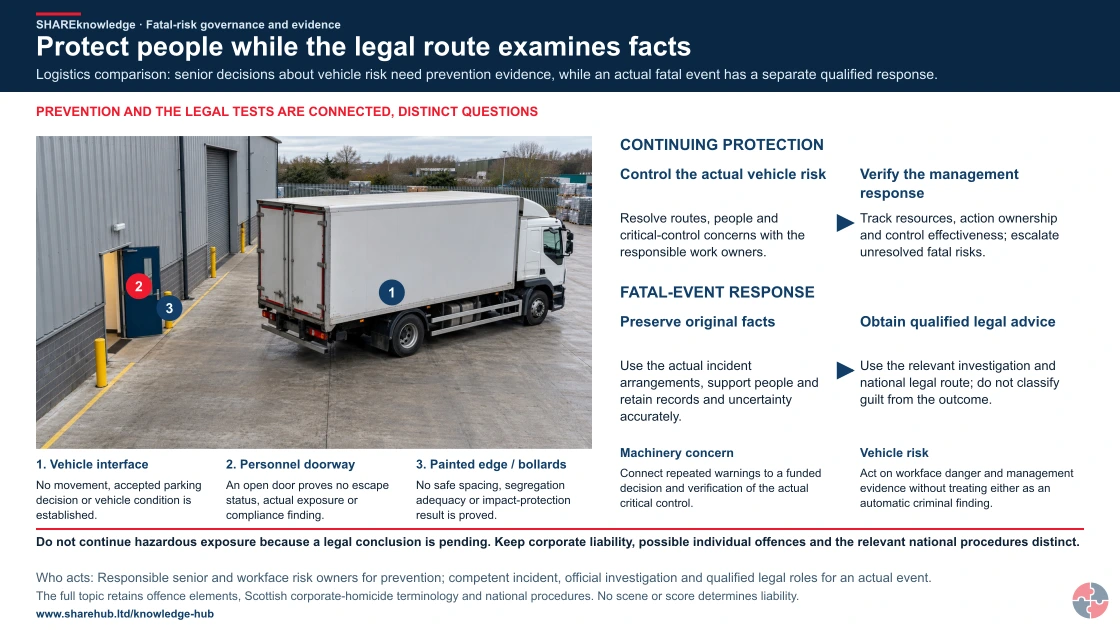
Full written explanation
An illustrative inactive depot workface shows a parked-looking lorry beside an open personnel door, a painted edge and bollards. No person, motion, collision, injury, fatal event or investigation is depicted. Picture key: 1 identifies the vehicle interface; 2 identifies the personnel doorway; 3 identifies the painted edge and bollards. The picture establishes no actual vehicle movement or condition, accepted parking, safe movement envelope, segregation adequacy, impact protection, escape status, failed control, legal element or permission. The full comparison keeps two independent tracks. CONTINUING PROTECTION connects control of actual routes, people and critical-control concerns with management resources, ownership, effectiveness and escalation. FATAL-EVENT RESPONSE connects the actual incident arrangements, support for people and preservation of original facts and uncertainty with the relevant official investigation and qualified national legal advice. Arrows remain within each track; there is no cross-lane gate, universal four-stage legal process, guilt score or prosecution prediction. Independent check headings are unnumbered, separate from the physical picture key. All four complete checks, the prevention-versus-legal-question band, full hold, responsible roles, evidence limits and both workplace cases accompany the explanation. Continuing protection must not wait for a legal conclusion. The scene is not original incident evidence and no actual fatal event or legal document is represented. Corporate liability, possible individual offences and relevant national procedures remain distinct. Use the complete topic for the offence elements, Scottish corporate-homicide terminology, England/Wales CPS scope, separate national systems and source qualifications; the historical HSE FAQ wording does not settle current commencement or a live case. No legal test, case attribution, liability result, operating method, safe geometry or work clearance is supplied.
Logistics comparison: senior decisions about vehicle risk need prevention evidence, while an actual fatal event has a separate qualified response.
- Control the actual vehicle risk. Resolve routes, people and critical-control concerns with the responsible work owners.
- Verify the management response. Track resources, action ownership and control effectiveness; escalate unresolved fatal risks.
- Preserve original facts. Use the actual incident arrangements, support people and retain records and uncertainty accurately.
- Obtain qualified legal advice. Use the relevant investigation and national legal route; do not classify guilt from the outcome.
When the evidence does not fit: Do not continue hazardous exposure because a legal conclusion is pending. Keep corporate liability, possible individual offences and the relevant national procedures distinct.
Who acts: Responsible senior and workface risk owners for prevention; competent incident, official investigation and qualified legal roles for an actual event.
Changed workplace
Machinery concern: Connect repeated warnings to a funded decision and verification of the actual critical control.
Vehicle risk: Act on workface danger and management evidence without treating either as an automatic criminal finding.
Evidence check: The full topic retains offence elements, Scottish corporate-homicide terminology and national procedures. No scene or score determines liability.
Full offence boundaries, current-law source and distinct national procedures
Primary references: HSE: corporate liability and investigation distinctions · CPS: offence elements and prosecution context (England and Wales) · HSE: leadership and prevention
Open the complete HD image (new tab)Download image
Full offence boundaries, current-law source and distinct national procedures
Primary references: HSE: corporate liability and investigation distinctions · CPS: offence elements and prosecution context (England and Wales) · HSE: leadership and prevention
BuildOut Ltd
BuildOut Ltd is a construction and refurbishment contractor used by SHARE to show how leadership can manage fatal-risk governance.
BuildOut keeps a fatal-risk register covering falls from height, temporary works, lifting, demolition, excavation, electrical isolation, buried services, confined spaces, plant movement, fire and contractor management. Each risk has a named senior owner, critical controls, inspection frequency and escalation route.
The board reviews leading indicators: overdue temporary works checks, scaffold defects, permit breaches, near misses, contractor audit findings, maintenance backlogs, training gaps and repeated workface observations. High-risk actions cannot be closed until evidence is verified.
Procurement rules prevent the cheapest contractor being selected where capability is weak. Site managers are trained to stop work where critical controls fail. Worker concerns and safety representative feedback are reviewed before they become incident evidence.
If a fatality occurs, BuildOut’s response plan preserves evidence, supports the bereaved family through appropriate routes, cooperates with police/HSE, protects witnesses and avoids speculative statements. Learning from investigation, inquest, prosecution or PFD findings is converted into board-tracked action.
| Management element | How BuildOut applies it | Evidence |
|---|---|---|
| Assessing | Identifies fatal-risk work and legal duties. | Fatal-risk register. |
| Analysing | Reviews trends and weak signals at leadership level. | Board dashboard. |
| Implementing | Funds controls, competence, contractor standards and supervision. | Budget and action plans. |
| Training | Trains directors, managers and supervisors in fatal-risk governance. | Training and competence records. |
| Checking | Uses audits and critical-control verification. | Assurance reports. |
| Learning | Updates standards after incidents, near misses and legal findings. | Verified action tracker. |
What should each role learn and demonstrate?
Learning must match the decisions people make, from recognising danger to checking that controls work.
Briefings should tell people how to act, but attendance alone does not show competence. Assess the real decision or task, record who assessed it and revisit after a material change, failed control or incident. A local authorisation is task-specific; no universal external certificate is implied.
On a small screen, scroll this table sideways to read all columns.
| Role and learning | Demonstration and assessor | Record and reassessment trigger |
|---|---|---|
| Director | Challenge fatal-risk evidence and overdue barriers; board peer reviews. | Minutes and action proof; revisit on failure. |
| Manager | Verify engineered controls at workface; safety lead assesses. | Inspection; repeat after defect. |
| Incident lead | Preserve evidence and protect people; legal/safety leads assess. | Chronology; review as facts emerge. |
How should NEBOSH Diploma learners understand corporate manslaughter?
NEBOSH Diploma learners should understand corporate manslaughter as an organisational offence that tests senior management, gross breach, causation and evidence.
For Diploma study, learners should avoid simplistic statements such as “a death equals corporate manslaughter”. Strong answers explain the statutory elements, the high threshold, the difference between corporate manslaughter, gross negligence manslaughter and HSWA offences, and the role of police/HSE/prosecutor liaison after a work-related death.
Scenario answers should identify what evidence would matter: leadership decisions, resource allocation, prior warnings, audits, training, supervision, contractor controls, maintenance backlog, risk assessments, previous incidents and whether action was verified.
The Diploma value is in evaluation. A learner should be able to judge whether an organisation’s management system genuinely controlled fatal risk or whether the paperwork concealed operational drift.
| Study point | What to know | How to apply it |
|---|---|---|
| Offence elements | Organisation, duty, gross breach, senior management and causation. | Apply each element to a fatality scenario. |
| Legal routes | Corporate manslaughter, HSWA, individual offences, inquest and FAI. | Explain which route may be relevant and why. |
| Evidence | Governance, audits, warnings, resources and control records. | Identify evidence that supports or undermines control. |
| Senior management | Substantial element in breach. | Assess leadership decisions and omissions. |
| Sentencing | Fines, remedial orders and publicity orders. | Explain consequences beyond prosecution. |
| Prevention | Fatal-risk governance and critical controls. | Recommend credible improvements. |
How can a management system sustain effective decisions?
Give each hazard or support route an owner, a control, a check and a response to failure.
Join board oversight, fatal-risk inventory, critical-control verification, worker escalation and corrective action. An owner should sample actual work and corrective actions, not accept a policy or certificate as evidence that the controls work.
The free GB regulator guide HSE Managing for health and safety (HSG65) explains a plan–do–check–act approach: assign controls and owners, involve workers, check work as done, and correct failures. For Northern Ireland, use HSENI risk assessment guidance for the local duty. A certificate alone does not demonstrate that a control works.
What warning signs show organisational fatal-risk governance is weak?
Warning signs include repeated near misses, ignored audits, overdue critical actions, weak supervision, poor contractor control and leadership reliance on reassurance.
Warning signs matter because corporate manslaughter is about organisational management. Evidence that leaders knew, or should have known, about serious risks but failed to act can become important after a fatality.
A strong organisation treats warning signs as governance data. It asks why actions are late, why defects repeat, why supervisors tolerate unsafe practice, why contractors fail checks and why workers have stopped reporting concerns.
| Warning sign | How it can contribute to serious failure | Response |
|---|---|---|
| Repeated near misses | Shows risk is known but not controlled. | Escalate and verify action. |
| Overdue safety-critical actions | Known weaknesses remain in place. | Senior review and resource decision. |
| Ignored worker concerns | Frontline warning signals are lost. | Strengthen consultation and response. |
| Paper-only audits | Leadership receives false assurance. | Improve audit quality and sampling. |
| Maintenance backlog | Safety-critical equipment degrades. | Prioritise by risk. |
| Contractor failures | Outsourced work weakens control. | Review contractor approval and supervision. |
What acronyms are used on this page?
Acronyms should be explained so legal and management terms are clear.
| Acronym | Meaning | Why it matters |
|---|---|---|
| CMCHA | Corporate Manslaughter and Corporate Homicide Act | The 2007 Act creating the offence. |
| CPS | Crown Prosecution Service | Prosecuting authority in England and Wales. |
| FAI | Fatal Accident Inquiry | Scottish public inquiry process. |
| HSE | Health and Safety Executive | Regulator involved in many work-related death investigations. |
| HSWA | Health and Safety at Work etc. Act | Core health and safety statute. |
| PFD | Prevention of Future Deaths | Coroner report requiring action to reduce future-death risk. |
| WRDP | Work-related Death Protocol | Liaison protocol after work-related deaths. |