
SHARE Knowledge Hub
How should workplaces support carers?
Unpaid caring can affect sleep, attendance, concentration and safe work. Employers can respond with confidential conversations, predictable scheduling and proportionate workload controls. Statutory leave and flexible-working rights differ between Great Britain and Northern Ireland; check the work location before promising an entitlement.
Understanding How should workplaces support carers?
Unpaid caring can affect sleep, attendance, concentration and safe work. Employers can respond with confidential conversations, predictable scheduling and proportionate workload controls. Statutory leave and flexible-working rights differ between Great Britain and Northern Ireland; check the work location before promising an entitlement.
Why this matters at work
Harm mechanisms include insufficient sleep opportunity, sustained stress response, divided attention, delayed healthcare, unsafe rushing, loss of income, concealment and social isolation. In manual or safety-critical work, fatigue may impair reaction, judgement, coordination and communication. In customer-facing work, abuse about caring or leave may cause psychological harm and undermine reporting.
The principal workplace hazards are organisational: excessive demands, low control, poor support, conflict, role ambiguity and poorly managed change; long or irregular hours; inadequate staffing; punitive attendance; unsafe lone work; and discrimination or harassment. Physical exposures remain controlled under their own risk assessments and can become harder to tolerate when recovery is reduced.
How organisations manage this in practice
Use HSE's six Management Standards: Demands, Control, Support, Relationships, Role and Change. Prepare the organisation, gather evidence, consult workers, identify hotspots, develop group and individual actions, implement and review. Carer support should be integrated into this process rather than treated solely as a private wellbeing matter.
Practical HSWA fulfilment includes staffing and competence sufficient for safe relief, actual-hours review, HSE Management Standards assessment, safe emergency handover, individual-risk review where function may be affected, home/lone-work assessment, manager training, consultation and verified actions. An EAP or carers policy alone is not risk control.
Some carers assist with mobility, transfers, bathing, equipment, domestic tasks or transport and may develop back pain, upper-limb symptoms or fatigue. These activities occur outside the employer's undertaking in many cases, so the employer does not normally risk-assess or control the home care task. It can still respond to the worker's health and functional needs at work.
HSE defines stress as the adverse reaction people have to excessive pressures or other types of demand. Employers have a legal duty to assess and act on work-related stress risk. Caring pressure may originate outside work, but excessive demands, poor control, inadequate support, conflict, unclear role and badly managed change remain workplace risk factors.
Analyse by site, shift, role and employment group only where numbers protect identity. Review refusals and postponements for repeated business reasons that indicate a resourcing problem. Do not publish the cared-for person's condition or rank managers by low leave use.
Carer support can involve employment rights, flexible working, sensitive personal circumstances, health information and safeguarding concerns. Employers should use current GOV.UK, Acas, HR and competent advice for individual cases, and should not require unnecessary evidence about a dependant's condition or the worker's private family life.
Who needs to understand carer support at work?
Carer support should be understood by workers, managers, HR, wellbeing leads, H&S advisers, occupational health and senior leaders.
Working carers
Need to understand support routes, leave, flexibility and confidentiality.
Line managers
Need to respond fairly, plan work and avoid intrusive questioning.
HR teams
Need to manage carer's leave, flexible working, time off and policy consistency.
Wellbeing leads
Need to signpost support and reduce stigma around caring.
H&S advisers
Need to consider fatigue, stress, lone work and safety-critical tasks.
Senior leaders
Need to set a culture where caring is planned and not hidden.
Choose the caring request route and secure safe cover
A planned appointment, an unforeseen dependant emergency and a recurring shift-pattern request need different routes. Establish the work location and the actual request before applying the GB or NI guidance already set out below. An informal arrangement may be agreed promptly while a separate entitlement or longer-term request is considered.
For safety-critical cover, ask when the worker needs to leave, what duties must transfer and who is competent to take over. A rota record needs the agreed availability and review date, not the dependant’s diagnosis. A caring-related fatigue concern also needs a safe-work response; do not turn it automatically into a conduct issue or ask the worker to find unqualified cover.
Riverside: a caring request during a lifeguard rota
Illustrative example. A lifeguard requests predictable early finishes for recurring care, then has an unforeseen emergency on another day.
Decision. The manager treats the two requests separately, arranges qualified relief and agrees an interim rota while HR checks the location-specific route.
Evidence to check. Request type, work location, agreed availability, competent cover and a private record of the arrangement.
Hold or escalation point. No uncovered water-supervision period and no demand for unnecessary clinical details about the dependant.
Follow-up. Review the trial rota with the worker and check fairness across shifts before making it the ongoing arrangement.
Match caring-related support to the situation
An urgent disruption, planned absence and longer-term flexibility may need different arrangements. Agree support privately and check that work cover is safe.

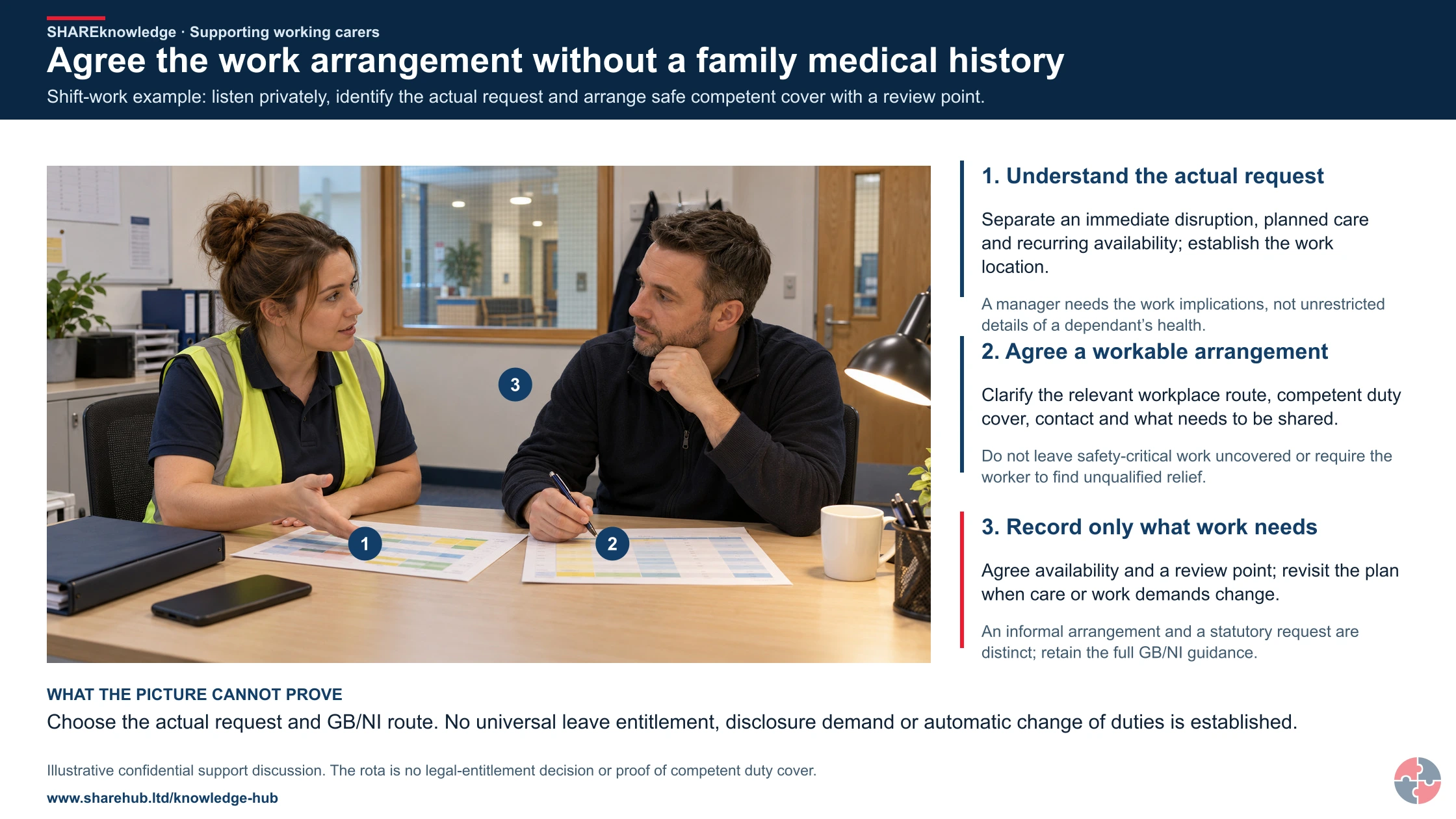
Agree the work arrangement without a family medical history
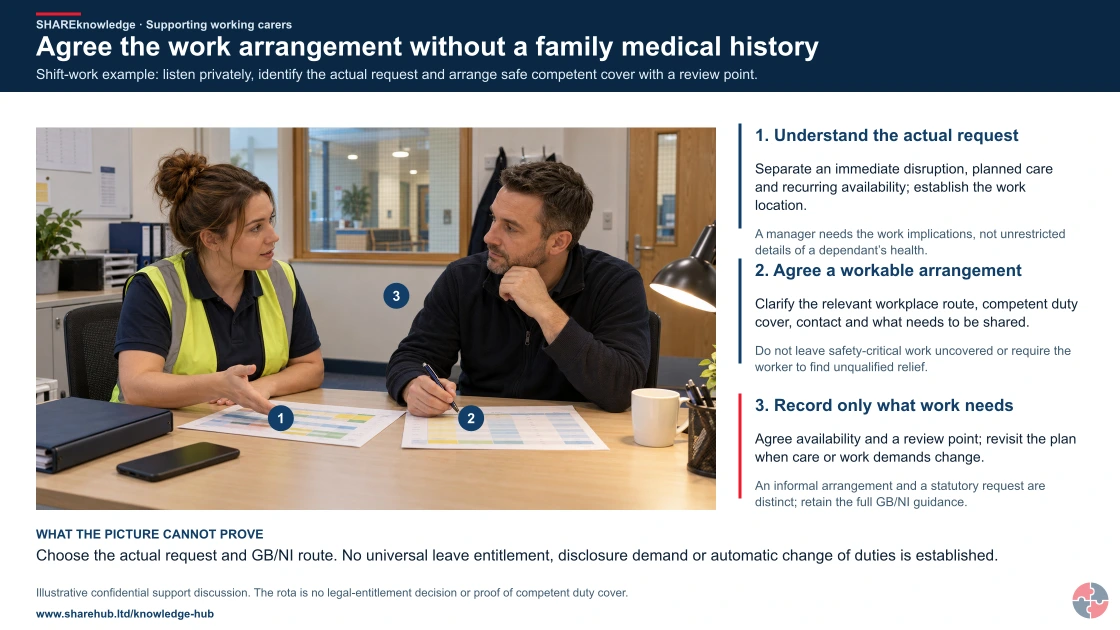
Full written explanation
Shift-work example: listen privately, identify the actual request and arrange safe competent cover with a review point.
- Understand the actual request. Separate an immediate disruption, planned care and recurring availability; establish the work location.
- Agree a workable arrangement. Clarify the relevant workplace route, competent duty cover, contact and what needs to be shared.
- Record only what work needs. Agree availability and a review point; revisit the plan when care or work demands change.
Change the pathway
- Do not demand unnecessary disclosure. A manager needs the work implications, not unrestricted details of a dependant’s health.
- Safe cover is an employer decision. Do not leave safety-critical work uncovered or require the worker to find unqualified relief.
- Use the correct location-specific route. An informal arrangement and a statutory request are distinct; retain the full GB/NI guidance.
Evidence check: Choose the actual request and GB/NI route. No universal leave entitlement, disclosure demand or automatic change of duties is established.
Full request-type, GB/NI location and safe-cover distinctions
Primary references: Acas: carer’s leave (GB) · nidirect: caring while working (Northern Ireland)
Open the complete HD image (new tab)Download image
Full request-type, GB/NI location and safe-cover distinctions
Primary references: Acas: carer’s leave (GB) · nidirect: caring while working (Northern Ireland)

What is needed now?
Listen without requesting unnecessary family medical details. Identify whether the request concerns immediate disruption, planned time away or ongoing flexibility.
Agree the route
Confirm the applicable workplace process, contact arrangement and what may be shared for cover.
Check and review
Arrange competent cover and an agreed review point. Reopen the plan if the caring situation or work demands change.
A support conversation should not become a request for unrestricted family health information.
What are the key facts about carer support and workplace wellbeing?
The key facts are that caring is often hidden, can affect work and wellbeing, and is best managed through predictable, confidential and flexible support.
Many carers are invisible
Workers may not use the term carer or may fear career consequences.
Caring can fluctuate
Needs can change because of appointments, emergencies, illness, deterioration or service gaps.
Leave and flexibility matter
Carer's leave, flexible working and time off for dependants can all be relevant.
Wellbeing is affected
Sleep, stress, fatigue, concentration and social connection can be affected.
Safety can be affected
Fatigue or distraction may matter in driving, plant, lone work or high-risk tasks.
Privacy builds trust
Managers should avoid collecting unnecessary personal or medical details.
What does carer support at work mean?
Carer support at work means helping employees balance paid work with unpaid caring responsibilities in a fair, confidential and operationally planned way.
A carer may support a child, partner, parent, neighbour, friend or relative. The support may involve appointments, medication, transport, personal care, emotional support, finance, supervision, crisis response or coordinating services.
Caring can start suddenly after a diagnosis, accident or hospital discharge. It can also build gradually as a person becomes frail or a condition worsens. That means a worker's needs may change over time and may not fit neat annual processes.
Good employers make it easier to talk about caring before it becomes absence, conflict or ill health. They provide clear policies, manager prompts, flexible options and a trusted confidential route.
| Aspect | What it means | Workplace implication |
|---|---|---|
| Unpaid care | Support given outside paid employment. | May affect time, energy and availability. |
| Dependant | Someone who relies on the worker for care or help. | Relevant to leave and emergency time off. |
| Long-term need | Care need linked to disability, illness, injury or old age. | Relevant to carer's leave. |
| Hidden responsibility | Worker may not disclose caring role. | Use inclusive policies and signposting. |
| Workplace support | Flexible, fair arrangements that help the worker remain in work. | Requires manager skill and policy clarity. |
How can caring responsibilities affect work and wellbeing?
Caring responsibilities can affect attendance, sleep, concentration, flexibility, stress, progression, work-life balance and safe performance.
Caring pressure can be physical, emotional and administrative. A worker may be lifting or supporting someone at home, attending medical appointments, receiving crisis calls, managing finances, arranging social care or dealing with a loved one's distress.
The effect at work may be subtle. The worker may arrive tired, avoid overtime, need to keep a phone on, request predictable shifts, take sudden absence or struggle with concentration after nights of disturbed sleep.
A supportive manager treats these signs as a prompt for a private conversation, not a conduct label. The question is what arrangement would help the worker perform well while keeping work safe.
| Impact | How it may show at work | Support to consider |
|---|---|---|
| Sleep disruption | Tiredness, mistakes or reduced concentration. | Rota review, breaks and fatigue controls. |
| Appointment pressure | Need for time off or changed hours. | Flexible working or carer's leave. |
| Emergency calls | Phone interruptions or sudden absence. | Agreed communication and dependant leave route. |
| Stress | Worry, reduced resilience or conflict. | Stress risk assessment and EAP/OH signposting. |
| Physical strain | Back pain or fatigue from caring tasks. | OH advice and workload review. |
| Career impact | Missed training or progression opportunities. | Fair access to development and flexible options. |
What employment rights and routes may support carers?
Choose the route by work location and need: planned care, an unexpected dependant emergency, a lasting work-pattern change or an employer policy.
In Great Britain, eligible employees can take up to one unpaid working week of statutory carer’s leave in each 12 months to give or arrange care for a dependant with a long-term care need. It is a day-one right. The employer cannot refuse a valid request but may delay it for serious disruption under the statutory conditions. It is distinct from emergency time off for dependants and a flexible-working request.
The 2023 Carer’s Leave Act and 2024 Regulations do not extend the GB statutory carer’s-leave right to Northern Ireland. NI workers can ask for flexibility and may have unpaid time off for an unexpected dependant emergency; employers may offer contractual or discretionary carer leave. Current nidirect guidance gives a 26-week continuous-service test for the NI statutory flexible-working request. HR must check current NI law and contract before deciding entitlement. A worker can always ask informally for a flexible arrangement even if they do not meet a statutory request test.
On a small screen, scroll this table sideways to read all columns.
| Need | Great Britain route | Northern Ireland route | Manager action |
|---|---|---|---|
| Planned care for a dependant with long-term need | Statutory unpaid carer’s leave up to one usual working week per 12 months, if eligible. | Check contract or employer carer-leave policy; no equivalent GB statutory week should be promised. | Agree cover and privacy; refer complex eligibility to HR. |
| Unexpected dependant emergency | Reasonable unpaid time off for dependants may apply. | Reasonable unpaid time off for dependants may apply under NI law. | Act promptly; do not insist on annual leave as the only response. |
| Recurring change to hours or location | Day-one statutory flexible-working request route; consider informal adjustment too. | Statutory request route has a 26-week continuous-service rule in current nidirect guidance; informal requests may be considered sooner. | Explore trial pattern, service cover and review date. |
| Additional support | Policy, annual or parental leave may be relevant on their own terms. | Policy, annual or parental leave may be relevant on their own terms. | Check the specific eligibility and worker preference. |
How should employers support working carers?
Employers should support carers through clear policy, private conversations, flexible options, workload planning, signposting and regular review.
Support starts with recognition. A policy should define caring broadly enough to include partners, relatives, friends, neighbours and people who rely on the worker. It should also make clear that support is available without stigma.
A practical support plan may include predictable shifts, changed start times, remote work, agreed phone access, appointment flexibility, temporary workload adjustment, access to a quiet space for calls, emergency contacts, or signposting to carer assessment and advice services.
Review is essential because caring rarely stays static. A hospital discharge, change in medication, new care package, diagnosis or deterioration can change what the worker needs.
| Measure | When it helps | Evidence |
|---|---|---|
| Carers policy | Workers need a clear route and definitions. | Policy and intranet guidance. |
| Carers passport | Worker wants to avoid repeating personal details. | Confidential agreed support record. |
| Flexible working | Ongoing predictable care pattern. | Request and outcome record. |
| Emergency plan | Sudden calls or crisis events occur. | Agreed contact and cover arrangement. |
| Workload review | Caring pressure affects capacity. | Temporary task plan. |
| Carers network | Peer support and feedback. | Network terms and attendance. |
| External signposting | Worker needs practical carer advice. | GOV.UK, NHS, Acas or Carers UK links. |
How can flexible working be used well for carers?
Flexible working works best when it is planned around the caring pattern, the job requirements and reviewable business arrangements.
Flexible working is not one arrangement. It can include flexible start and finish times, compressed hours, part-time hours, home or hybrid work, annualised hours, job-share, predictable shifts, reduced travel, changed days or temporary flexibility during a crisis.
The employer should discuss what problem the worker is trying to solve. A carer who needs to take someone to dialysis may need predictable start times; a carer dealing with unpredictable falls may need emergency phone access and rapid leave; a carer coordinating social care may need short private calls.
Good flexible working is documented and reviewed. The arrangement should state what changes, when it starts, communication expectations, cover arrangements and when it will be reviewed.
| Option | Best suited to | Management point |
|---|---|---|
| Flexible start/finish | Regular morning or evening care tasks. | Check handovers and coverage. |
| Home or hybrid work | Care coordination, appointments and reduced travel strain. | Set availability expectations. |
| Compressed hours | Worker wants longer blocks away from work. | Check fatigue and workload. |
| Predictable shifts | Care packages or appointments need stability. | Plan rota early. |
| Temporary reduction | Crisis period or treatment phase for dependant. | Set review date. |
| Emergency phone access | Worker may receive critical calls. | Agree safe use and cover. |
How should a manager respond when someone says they are a carer?
A manager should respond privately, listen, avoid judgement, explain support routes and agree practical next steps.
The first conversation sets the tone. The manager should thank the worker for sharing, ask what support would help, explain confidentiality and avoid asking for unnecessary evidence or personal detail.
The manager should distinguish between immediate pressure and longer-term arrangements. A crisis may need dependant leave or urgent cover. Ongoing caring may need flexible working, carer's leave, rota planning or a carers passport.
A good conversation ends with action: what will change, who needs to know, what will be recorded, when it will be reviewed and where the worker can get additional advice.
| Step | What to do | Avoid |
|---|---|---|
| Listen | Ask what is happening and what support is needed. | Do not interrogate or judge. |
| Clarify work impact | Discuss hours, absence, concentration, calls and safety. | Do not request medical details of the dependant. |
| Explain routes | Carer's leave, flexible working, dependant leave, EAP or carers policy. | Do not default to annual leave only. |
| Agree confidentiality | Confirm who needs to know and why. | Do not disclose without agreement unless necessary. |
| Plan cover | Agree rota, handover, emergency cover and review. | Do not leave colleagues guessing. |
| Review | Set a date and adjust if caring needs change. | Do not assume one meeting solves it. |
How should carer information be kept confidential?
Carer information should be recorded only where necessary and should avoid unnecessary details about the dependant's health or private life.
Carer support often involves two people's privacy: the worker and the person they care for. The employer usually does not need to know the dependant's diagnosis, treatment plan, finances or family conflict. It needs enough information to manage leave, flexibility, absence, support and safe work.
Managers should record practical arrangements: dates, leave type, agreed flexibility, communication plan, review date and any work restrictions. HR should control access to sensitive records.
If a worker shares safeguarding, domestic abuse, serious mental-health or other high-risk information, the manager should use the appropriate safeguarding or HR route rather than trying to manage it alone.
| Issue | Good practice | Evidence |
|---|---|---|
| Dependant's health details | Avoid collecting unless essential. | Minimal support record. |
| Worker disclosure | Agree who can know and what can be said. | Communication agreement. |
| Carers passport | Keep access restricted and review regularly. | Confidential passport. |
| Team cover | Explain work cover without disclosing private details. | Neutral rota note. |
| Data retention | Keep records only as long as needed. | Retention schedule. |
How should carer support be managed as a wellbeing and risk issue?
Carer support should be managed through work design, stress prevention, fatigue controls, fair absence processes and confidential support routes.
Caring responsibilities are not a hazard in themselves, but unmanaged strain can create health, wellbeing and safety issues. A tired worker operating plant, driving, lone working or supervising children in leisure settings may need a temporary review of risk.
The risk assessment should not identify named carers unless an individual plan is required. It should identify work factors that make caring harder: unpredictable rotas, last-minute overtime, refusal of short calls, rigid start times, no emergency cover or poor manager understanding.
The organisation should use both active and reactive monitoring: policy use, flexible-working outcomes, absence themes, worker feedback, manager confidence, grievances, turnover and stress indicators.
| Area | Control | Evidence |
|---|---|---|
| Work design | Predictable rotas, break planning and cover arrangements. | Rota and cover review. |
| Stress | Use HSE Management Standards where pressure is work-related. | Stress action plan. |
| Fatigue | Review safety-critical work, driving, nights and overtime. | Fatigue risk assessment. |
| Policy fairness | Track carer's leave and flexible-working outcomes. | HR dashboard. |
| Consultation | Ask carers and representatives what support helps. | Feedback and action plan. |
| Learning | Review absence, grievances and manager issues. | Management review. |
Which legal duties apply to carer support at work?
Employment rights differ by jurisdiction; safety and privacy duties require a separate work-risk and information-handling decision.
The GB Carer’s Leave Act 2023 and Carer’s Leave Regulations 2024, the GB flexible-working changes and Acas guidance should not be copied into NI policy as if they apply there. In NI, use nidirect and NI employment legislation for statutory requests and dependant emergencies. Caring status alone does not automatically create a reasonable-adjustments duty; disability, association, sex or other protected-characteristic issues require fact-specific equality advice under the correct GB or NI law.
Where disrupted sleep or competing demands affect safety-critical work, assess the work hazard—hours, workload, breaks, supervision and task allocation—without demanding unnecessary family or medical detail. Limit access to confidential support records, and record only arrangements needed to implement and review them.
On a small screen, scroll this table sideways to read all columns.
| Decision | Great Britain | Northern Ireland |
|---|---|---|
| Planned statutory carer leave | One unpaid working week per 12 months under GB carer-leave law, subject to eligibility and notice. | No equivalent GB Act entitlement; check local law, contract and employer policy. |
| Statutory flexible-working request | Day-one request route; apply current GB response procedure. | Current nidirect guidance states 26 weeks’ continuous service; apply NI procedure. |
| Unexpected dependant emergency | Reasonable unpaid time off under GB employment law. | Reasonable unpaid time off under NI Employment Rights Order. |
| Work-related stress, fatigue and confidentiality | Assess work risk under GB safety law; apply UK data protection. | Assess work risk under NI safety law; apply UK data protection. |
How could Riverside Leisure Ltd support working carers?

Riverside Leisure Ltd would support working carers through policy, predictable rotas, manager training, confidential records, flexible working and stress-risk controls.
Separate planned care from an unforeseen disruption
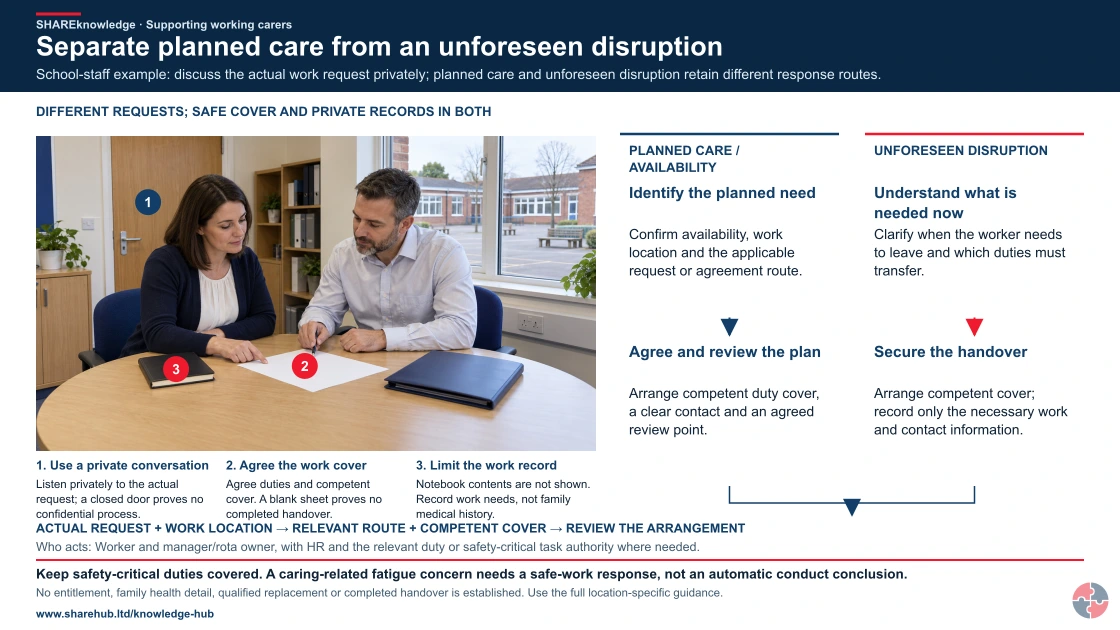
Full written explanation
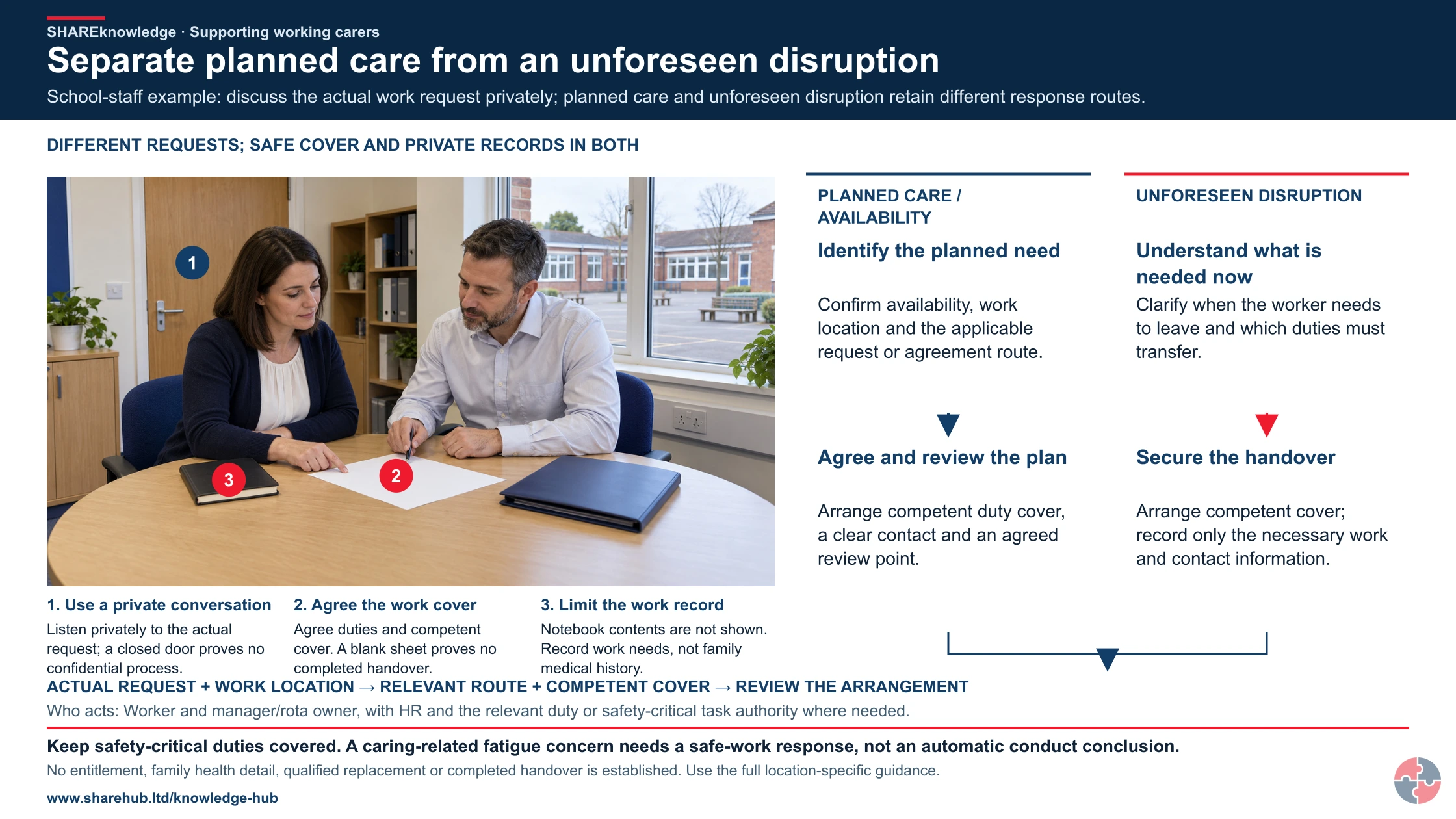
A school-staff office scene distinguishes planned care or availability from an unforeseen dependant disruption. Two adult colleagues discuss a blank duty-cover sheet beside a closed personal notebook and work folder; the office door is shut and the school playground outside is empty. Picture key1 identifies the private conversation,2the work-cover paper and3the limited work record. Neither a closed door nor a blank sheet proves confidentiality compliance, competent cover or a completed handover; notebook contents are not shown. The two unnumbered tracks ask different questions. For planned care, identify availability, work location and the applicable request/agreement route, then agree competent cover, a contact and review point. For an unforeseen disruption, clarify when the worker needs to leave and which duties must transfer, then arrange competent cover and record only necessary work/contact information. Arrows show these relationships without granting permission or deciding an entitlement. A caring-related fatigue concern needs its own safe-work response and is not automatically a conduct issue. Apply the location-specific GB or NI guidance to the actual request; an informal arrangement and a statutory request are distinct. No new leave amount, notice period, eligibility rule, dependant diagnosis, private health record, fatigue threshold, actual staffing adequacy or automatic duty change is supplied.
School-staff example: discuss the actual work request privately; planned care and unforeseen disruption retain different response routes.
- Identify the planned need. Confirm availability, work location and the applicable request or agreement route.
- Agree and review the plan. Arrange competent duty cover, a clear contact and an agreed review point.
- Understand what is needed now. Clarify when the worker needs to leave and which duties must transfer.
- Secure the handover. Arrange competent cover; record only the necessary work and contact information.
When the evidence does not fit: Do not leave a safety-critical duty uncovered. A caring-related fatigue concern also needs a safe-work response; it is not automatically a conduct issue.
Who acts: Worker and manager/rota owner, with HR and the relevant duty or safety-critical task authority where needed.
Changed workplace
Shift worker: Agree predictable availability and safe cover; keep the record limited to the work arrangement.
School employee: Distinguish a planned appointment from unforeseen disruption and verify the duty handover.
Evidence check: Choose the actual request and GB/NI route. No universal leave entitlement, disclosure demand or automatic change of duties is established.
Full request-type, GB/NI location and safe-cover distinctions
Primary references: Acas: carer’s leave (GB) · nidirect: caring while working (Northern Ireland)
Open the complete HD image (new tab)Download image
Full request-type, GB/NI location and safe-cover distinctions
Primary references: Acas: carer’s leave (GB) · nidirect: caring while working (Northern Ireland)
Riverside Leisure Ltd
a leisure, hospitality and outdoor activity business with seasonal peaks, shift work, lifeguards, instructors, housekeeping, catering and customer-service teams
Riverside identifies that carers may be hidden in every department. Some staff care for older parents, disabled children, partners with long-term illness or neighbours who rely on them. The business updates its wellbeing policy to define carers clearly and signpost carer's leave, flexible working, dependant leave, employee assistance and local carer services.
The rota manager gives staff earlier visibility of shifts and records caring constraints confidentially where the worker chooses to share them. Managers avoid last-minute rota changes where possible, build emergency cover into busy periods and allow agreed phone access for carers who may receive critical calls.
HR monitors requests and outcomes to check fairness. The H&S adviser reviews fatigue and safety-critical work, especially lifeguarding, driving, outdoor activities and lone maintenance. If a carer is exhausted after night-time caring, the manager can temporarily adjust safety-critical duties rather than treating the issue as misconduct.
Riverside learns through anonymised feedback, exit interviews, stress risk assessments, absence patterns, flexible-working outcomes and manager review. Improvements include clearer policy wording, manager scripts, carers passport use, more predictable scheduling and training for supervisors who handle rota pressure.
| Activity | How Riverside manages it | Evidence |
|---|---|---|
| Assess | Identifies where caring responsibilities interact with shifts, fatigue, absence and safety-critical work. | Wellbeing risk review and rota mapping. |
| Analyse | Reviews flexible-working outcomes, absence themes, stress feedback and turnover. | HR and wellbeing dashboard. |
| Train | Trains managers on carer's leave, flexibility, confidentiality and difficult conversations. | Training matrix and scenario practice. |
| Implement | Uses carers policy, passports, predictable rotas, phone access and emergency cover. | Policy and agreed support plans. |
| Check | Audits leave handling, rota fairness, manager response and fatigue controls. | Assurance checks and action tracker. |
| Learn | Uses feedback and cases to improve policy and scheduling. | Management review and worker consultation. |
| Improve | Updates manager prompts, flexible-working templates and wellbeing signposting. | Revised procedures and close-out evidence. |
What should each role learn and demonstrate?
Learning must match the decisions people make, from recognising danger to checking that controls work.
Briefings should tell people how to act, but attendance alone does not show competence. Assess the real decision or task, record who assessed it and revisit after a material change, failed control or incident. A local authorisation is task-specific; no universal external certificate is implied.
On a small screen, scroll this table sideways to read all columns.
| Role and learning | Demonstration and assessor | Record and reassessment trigger |
|---|---|---|
| Worker: routes and safe disclosure. | Manager confirms that the worker can distinguish planned care, emergency absence and informal support. | Briefing acknowledgement; revisit after policy or law changes. |
| Line manager: private response and safe cover. | HR assesses a scenario with an urgent dependant call and a fatigue risk; manager listens, arranges cover and limits detail recorded. | Scenario outcome and supervision; revisit after complaint or failed cover. |
| HR: GB/NI eligibility and consistent decisions. | Employment specialist checks two locations against current statutory and policy routes, including delay and appeal boundaries. | Decision record with jurisdiction, date and source; review at legal update. |
| Safety adviser: work-design controls. | Competent adviser reviews rota, breaks and safety-critical tasks without treating caring status as a diagnosis. | Risk review and control verification after change or incident. |
| Privacy lead: confidential support record. | Data lead tests access, purpose and retention for carer and dependant information. | Privacy review and access audit after process change. |
How does carer support support qualification study and professional development?
Carer support helps learners connect wellbeing, stress, fatigue, consultation, human factors, equality and management arrangements.
For NEBOSH National General Certificate study, the topic can support answers on worker wellbeing, stress risk assessment, consultation, absence, supervision and management arrangements. A good scenario answer explains what the manager should do, what records are appropriate and how work should be adapted.
For Diploma-level study, it supports deeper thinking about psychosocial risk, work design, inclusion, organisational culture, human reliability, fatigue and governance of sensitive worker information.
Professional development value comes from judgement. A competent manager can support a carer without overstepping into private family life and can still keep safety-critical work under control.
| Learning context | What to know | Scenario application |
|---|---|---|
| NEBOSH National General Certificate | Wellbeing, stress, consultation, supervision and management systems. | A worker's caring role causes fatigue and short-notice absence. |
| NEBOSH Diploma | Psychosocial risk, culture, human factors and assurance. | Audit of how carers are supported in a shift-work organisation. |
| Manager CPD | Flexible working, leave, confidentiality and fair treatment. | Worker discloses they are caring for a parent with dementia. |
| HR CPD | Policy consistency, current rights and data protection. | Review of carer's leave and flexible-working decisions. |
How can a management system sustain effective decisions?
Give each hazard or support route an owner, a control, a check and a response to failure.
A carer-support process should join line management, HR, safety and privacy decisions through a named owner, a review date and worker feedback. Look for whether agreed rota and workload changes actually held during a difficult week. An owner should sample actual work and corrective actions, not accept a policy or certificate as evidence that the controls work.
The free GB regulator guide HSE Managing for health and safety (HSG65) explains a plan–do–check–act approach: assign controls and owners, involve workers, check work as done, and correct failures. For Northern Ireland, use HSENI risk assessment guidance for the local duty. A certificate alone does not demonstrate that a control works.
What are the warning signs that carer support is not working?
Warning signs include hidden carers, rigid rotas, forced annual leave, poor confidentiality, fatigue, resentment and inconsistent manager decisions.
Poor support often appears as performance or attendance problems before it is understood as caring pressure. If managers only use discipline, workers may hide the issue until stress, fatigue or absence worsens.
Inconsistent treatment is another warning sign. One team may approve flexible working while another refuses without meaningful discussion. That damages trust and increases grievance risk.
Safety warning signs include exhausted workers driving, lone working, supervising vulnerable people, operating plant or making high-consequence decisions without a review of fatigue or concentration.
| Warning sign | How harm can develop | Improvement action |
|---|---|---|
| No one discloses caring | Support is hidden and problems emerge as absence. | Improve awareness and trust. |
| Rigid rota changes | Workers cannot arrange care and stress rises. | Plan schedules earlier. |
| Annual leave is the only option | Workers lose rest and recovery time. | Use proper leave and flexibility routes. |
| Poor confidentiality | Workers avoid seeking help. | Train managers and restrict records. |
| Fatigue in safety-critical work | Errors, incidents or near misses can increase. | Review duties and recovery. |
| Inconsistent decisions | Fairness, morale and legal risk worsen. | Audit outcomes and manager practice. |
Carer support FAQs: what do people ask?
People usually ask who counts as a carer, what leave applies, how flexible working works, what evidence is needed and how managers should respond.
Who is a carer at work?
A carer is someone who provides unpaid support to a family member, partner, friend or dependant who needs care because of illness, disability, frailty, mental health, addiction or care needs.
Do workers always identify themselves as carers?
No. Many people see themselves as a partner, parent, child or friend rather than as a carer.
What is carer's leave?
In Great Britain, statutory carer’s leave is unpaid leave for eligible employees to give or arrange care for a dependant with a long-term care need. Northern Ireland does not have this GB statutory week; check local law and employer policy.
How much carer's leave can an employee take?
For eligible GB employees, up to one usual working week in each 12 months. This GB entitlement does not extend to Northern Ireland.
Can an employer refuse carer's leave?
For a valid GB statutory request, the employer cannot refuse but can delay only under the specified serious-disruption conditions. NI employer-policy leave follows that policy.
Is flexible working relevant to carers?
Yes. GB has a day-one statutory request route; current NI guidance states a 26-week continuous-service test. Informal arrangements may be agreed in either place.
What is time off for dependants?
It is time off to deal with certain emergencies involving a dependant, which may be relevant where care needs are sudden or unpredictable.
Should a worker have to provide medical evidence about the person they care for?
For GB statutory carer’s leave, employees do not have to give evidence of the dependant’s care needs. Keep any NI or employer-policy request proportionate and private.
How should managers respond to a carer?
Managers should speak privately, ask what support would help, explain relevant routes, avoid intrusive questions and agree review points.
Can caring affect safety at work?
Yes. Fatigue, distraction, stress, sleep loss or sudden calls can affect concentration and safety-critical tasks.
How should carer information be recorded?
Record agreed work arrangements and review dates; avoid unnecessary details about the dependant's health or family situation.
What training is useful?
General awareness, manager training, flexible-working training, HR process training and refresher learning are useful.
Which acronyms are useful for carer support?
Acronyms help readers follow HR, wellbeing, occupational health and employment-rights language.
| Acronym or term | Meaning | Why it matters |
|---|---|---|
| HR | Human Resources | Often owns policy, leave, flexible working and employee relations. |
| OH | Occupational Health | May advise where caring affects health, fatigue or safe work. |
| EAP | Employee Assistance Programme | Confidential support route offered by some employers. |
| DSE | Display Screen Equipment | May be relevant if flexible or home working is agreed. |
| WTR | Working Time Regulations | Relevant to hours, rest and fatigue. |
| GDPR | General Data Protection Regulation | Relevant to sensitive personal information handling. |
| KPI | Key Performance Indicator | Can track policy use, outcomes and improvement. |