SHARE Knowledge Hub
Byssinosis and cotton-dust exposure
Byssinosis is a preventable occupational airway disease associated mainly with breathing cotton dust, and sometimes dust from flax or hemp, during textile processing. It is often called brown lung disease or Monday fever because early symptoms can be worse on the first shift back after a weekend or break, then ease as the working week continues. The important workplace lesson is that byssinosis is not simply an individual health problem; it is evidence that organic textile dust exposure, ventilation, cleaning, local exhaust ventilation, respiratory protective equipment and health surveillance need to be properly assessed, controlled and reviewed under COSHH.
Understanding Byssinosis and cotton-dust exposure
Byssinosis is a preventable occupational airway disease associated mainly with breathing cotton dust, and sometimes dust from flax or hemp, during textile processing. It is often called brown lung disease or Monday fever because early symptoms can be worse on the first shift back after a weekend or break, then ease as the working week continues. The important workplace lesson is that byssinosis is not simply an individual health problem; it is evidence that organic textile dust exposure, ventilation, cleaning, local exhaust ventilation, respiratory protective equipment and health surveillance need to be properly assessed, controlled and reviewed under COSHH.
Why this matters at work
Exposure monitoring measures the environment; health surveillance looks for early adverse effects in people. They answer different questions. Arrange surveillance where the applicable COSHH conditions are met, using competent occupational health input and a reasoned assessment of exposed tasks and groups. Explain what checks will occur, who holds information and how concerns lead to action. Do not substitute a general wellbeing check or an unrelated silica surveillance programme. Cotton exposure alone does not establish a requirement for appointed-doctor surveillance or routine chest X-rays. When a relevant health professional identifies an adverse effect attributable to hazardous exposure, review the assessment and controls, give the worker qualified advice and consider suitable work without further exposure in light of that advice. Consider similarly exposed colleagues without disclosing the individual's clinical details. Give named owners responsibility for interim duties, engineering review and follow-up. Keep necessary health records distinct from confidential medical records and routine production logs. Record why the programme is appropriate and review it when symptoms, feedstock, process or control performance changes.
A result is evidence about the conditions and measurement method represented, rather than approval of all work. Check whether it covers the manual feeder, dusty batches, start-up, cleaning, waste handling and maintenance. A fixed-location room sample may miss the person's breathing-zone exposure. A gravimetric result also does not measure every biologically active component or establish that an individual has no adverse effect. Do not invent an endotoxin limit or use research findings to bypass assessment of the whole dust exposure.
How organisations manage this in practice
A garment warehouse, raw-cotton opening room and mixed-fibre recycling plant therefore need different assessment reasoning. Exclusion from this particular entry does not remove the duty to prevent or adequately control hazardous exposure. Ask a competent hygienist to specify representative sampling and an appropriate method; do not compare an area measurement or a different dust fraction directly with this personal inhalable value. Record materials, processes, duration and method alongside results. For NI, use the NI COSHH approval route rather than presenting GB legislation as UK-wide.
Combine representative personal evidence, task observations, control checks and confidential health findings. Ask workers whether the survey reflected normal speed and difficult conditions. Investigate visible release or credible symptoms promptly even if an earlier result was low. Workers may not volunteer breathing problems, especially where they fear losing work. Record uncertainties, corrective actions, responsible people and the conditions for reassessment. Obtain competent interpretation where methods or fractions differ. Continuing work requires a justified adequate-control decision for the actual task, not simply a favourable number copied into a register.
Plan safe isolation, access, cleaning before opening machinery, collection-container emptying, filter handling and disposal. Maintenance may remove enclosures or make normal extraction unavailable, so normal production measurements do not clear the job. Define residual protective equipment through the assessment and confirm workers know how to use it. Wet cleaning also needs assessment for electrical, slip and product risks. Record the chosen method, isolation responsibility and readiness checks. Verify that staffing, equipment and access make the method achievable before treating failure as a worker conduct issue.
Chest tightness, wheeze, breathlessness, persistent cough or symptoms that follow a work pattern should be assessed through qualified health routes. Managers should not diagnose byssinosis; they should reduce exposure, preserve relevant records, arrange competent occupational health input where needed and review the workplace dust controls.
Keep the raw-cotton scope with the restart decision
Identify the material and process stage before using a cotton-dust limit. The specific scope is not a blanket clearance value for all textiles or finished laundry. General exposure-control duties and actual dust properties still need assessment outside that specific entry.
Before restart, verify repaired extraction, worker position, cleaning and representative exposure evidence. A low sample away from the manual feeder may miss the person most exposed. Individual respiratory concerns need appropriate clinical/OH advice; restarting the line is a separate control decision.
The manual feeder is missing from the sample
Illustrative example. A raw-cotton line has an LEV repair and a reassuring result, but the sample did not represent manual feeding.
Decision. Hold the unresolved restart decision and obtain evidence covering actual feeder exposure and safe cleaning.
Evidence to check. Link repair/test evidence to worker position, process conditions, representative sampling and competent interpretation.
Hold or escalation point. No release from an unrepresentative result; finished-laundry work cannot simply inherit the raw-cotton limit.
Follow-up. The release owner verifies representative controls and keeps clinical follow-up in the proper restricted system.
Measure the task where exposure happens
A room sample, a visible duct and a person’s symptoms answer different questions. Connect the actual raw-cotton opening or feeding task to source release, capture and representative exposure evidence.

- Raw cotton / feeding source
- Capture boundary and breathing zone
- Personal sample ≠ room sample
Read the labels in the full-size drawing
- RAW COTTON FEED
- CAPTURE / ENCLOSURE
- Breathing zone / sample scope
- Verify the actual task
| Evidence | What it can help answer | What it cannot establish alone |
|---|---|---|
| Material and task | Which cotton/textile material, handling stage and dusty conditions are involved? | That every textile dust is interchangeable or has the same assessment basis. |
| Capture and enclosure | Is the source controlled during normal feeding, cleaning and foreseeable disturbance? | That a duct or running fan proves effective capture at the source. |
| Representative personal sampling | What was the worker’s exposure during the assessed task and conditions? | That a convenient room reading represents every person, task or shift. |
| Clinical route | How should reported breathing symptoms or surveillance concerns be assessed? | That a clinical result clears failed controls or diagnoses work-related disease by itself. |
The embedded model deliberately shows normal respiratory anatomy only. It must not substitute an asthma or scarring overlay for cotton-dust disease. Hold a dusty process with failed required controls and resolve the task-specific restart evidence.
What are the key facts about byssinosis?
The key facts are that byssinosis is dust-related, work-patterned, preventable and controlled through COSHH rather than medical response alone.
It is mainly linked to cotton dust
HSE associates byssinosis with cotton dust. Wool process dust can cause other respiratory harm, but should not be labelled a byssinosis cause. Assess the actual fibre and process.
Early textile processes carry higher risk
Raw material handling, opening, carding, drawing, combing, beaming, ring spinning and high-speed winding are typical higher-exposure stages.
The classic symptom pattern is work-related
Chest tightness or breathlessness can be worst after returning from a weekend or holiday.
Long-term exposure can cause lasting disease
The 2007 IIAC historical review describes increasingly persistent symptoms and severe ventilatory impairment. It supplies no individual reversibility forecast; clinical assessment and prevention remain essential.
Cleaning can make exposure worse
Dry sweeping, brushing and compressed air can re-suspend settled textile dust and increase inhalation exposure.
Health surveillance tests the control system
Lung function checks and symptom questions help identify early harm and show whether controls are protecting workers.
What is byssinosis?
Byssinosis is an occupational airway disease caused by inhalation of organic textile dust, especially cotton dust. See HSE textile dust and byssinosis
Byssinosis affects the airways rather than behaving like a classic scarring pneumoconiosis such as silicosis or asbestosis. The immediate effect is narrowing and irritation of the airways, which can feel like chest tightness, wheeze, breathlessness or cough.
The older names are useful because they describe the workplace pattern. Brown lung disease links the condition to cotton dust, while Monday fever describes the tendency for symptoms to be worse on the first day back after time away from exposure.
The condition is historically associated with cotton mills, but similar disease patterns have also been described in people exposed to flax or hemp dust. The historical disease pattern remains useful for prevention, but it supplies no current case count or reassurance about this workplace. Dusty processes still need competent exposure control and health surveillance based on their actual risks.
Byssinosis. An occupational airway disease linked mainly to cotton dust exposure. Signals a need to review dusty textile processes and worker health protection.
Brown lung disease. Older name for byssinosis. Helps workers recognise the cotton dust association.
Monday fever. Older name describing first-day-back symptoms. A useful clue during health surveillance and symptom reporting.
Organic textile dust. Dust from plant or animal fibres such as cotton, flax, hemp or wool. Can irritate airways and, for cotton, is strongly associated with byssinosis.
Obstructive lung disease. Airways become narrowed, making breathing out harder. Can affect long-term fitness for dusty or physically demanding work.
The linked IIAC Belfast proceedings are a 2007 historical review of cotton, flax and soft-hemp airway effects and first-day-back patterns. Use timing as information for qualified assessment, not a diagnostic test. HSENI describes current cotton/textile symptoms and exposure prevention in NI; current GB legal limits and controls have their separate HSE/EH40 basis.
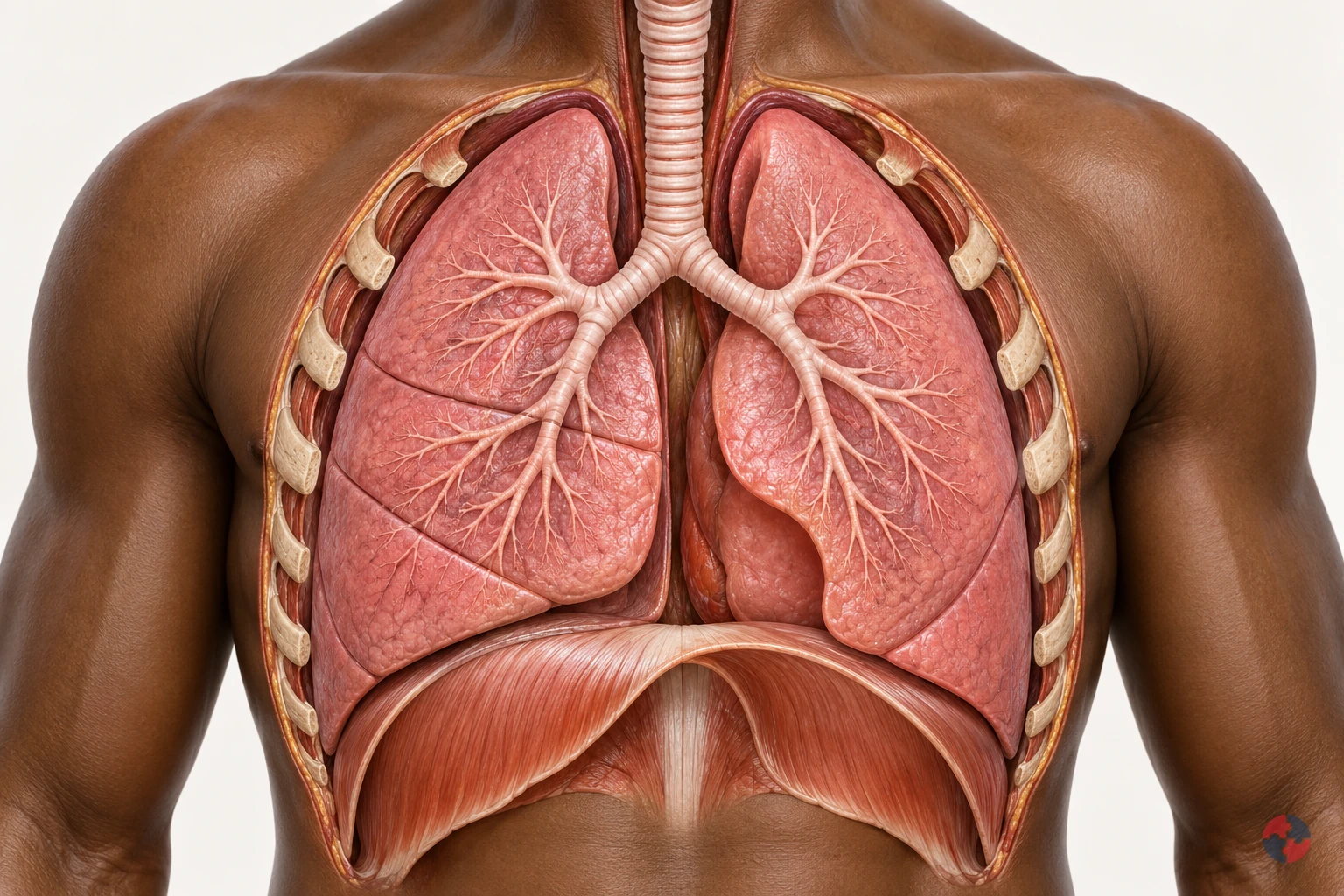

How do the lungs work, and how can workplace exposures affect breathing?
Interactive anatomy · Respiratory tract and lungs · Updated 2026-10-23
Read all anatomy and process explanations without the viewer
Simplified education, not diagnosis, a lung-function or oxygen-saturation test, an exposure calculator or a fitness-to-work assessment. No breath-holding challenge, breathing-rate score or personal health-data collection. Ordinary particle filters do not protect against every gas or oxygen deficiency. COPD and coal-dust topics may reuse normal anatomy only until separate mechanisms are reviewed.
Nose and mouth
Air enters and leaves here. The nose and mouth connect the outside air with the respiratory passages. Air moves through these openings on both the inward and outward breath. Follow the route towards the windpipe before looking at the smaller branches. The illustrated flow is air, a mixture of gases, rather than pure oxygen passing directly into blood. Frimley Health NHS Foundation Trust: How your lungs work · Central and North West London NHS Foundation Trust: How do we breathe?
Trachea
The windpipe carries air into the chest. The trachea, commonly called the windpipe, carries air down towards the chest. It divides into the two main bronchi that supply the lungs. Locate this shared passage before following either branch. Its role is to conduct air towards the gas-exchange regions and provide an outward route for the next exhalation. Frimley Health NHS Foundation Trust: How your lungs work
Bronchi
A main branch carries air into each lung. The two main bronchi take air from the windpipe into the right and left lungs. They divide into progressively smaller branches, distributing the breath through the lungs. Use the split as a landmark before following one highlighted route. These are air passages, distinct from the blood vessels that run through the same organs. Frimley Health NHS Foundation Trust: How your lungs work · University Hospitals of North Midlands NHS Trust: My lung surgery: about your lungs
Bronchioles
Smaller branches distribute air. Bronchioles are smaller branches of the airway system inside the lungs. Their branching routes lead towards clusters of alveoli, where the breath reaches the gas-exchange surface. Follow one branch to its end, using the others as context. This simplified route represents part of a much larger network supplying the lungs together. Frimley Health NHS Foundation Trust: How your lungs work
Alveoli
Tiny air sacs provide a gas-exchange surface. Alveoli are tiny air sacs at the ends of the small airway routes. Their close relationship with surrounding capillaries allows oxygen to pass towards blood and carbon dioxide towards alveolar air. Connect the highlighted cluster with the enlarged gas-exchange view. The enlargement changes the scale so the air space and neighbouring blood vessel can be distinguished. Frimley Health NHS Foundation Trust: How your lungs work · Central and North West London NHS Foundation Trust: How do we breathe?
Air–blood barrier
A thin boundary separates air from blood. The thin alveolar and capillary walls separate air in the sac from blood in its neighbouring vessel. Oxygen and carbon dioxide cross this boundary in opposite directions. Locate the tissue between the two spaces in the enlarged view. Blood cells remain in the vessel; the model does not represent an open connection through which air and blood mix. Central and North West London NHS Foundation Trust: How do we breathe?
Pulmonary capillaries
Small blood vessels pass beside the air sacs. Pulmonary capillaries are small blood vessels beside the alveoli. Blood moving through them receives oxygen and releases carbon dioxide across the thin exchange boundary, then continues through the circulation. Follow the labelled gas routes separately from the blood cells. These cells stay inside the capillary rather than moving into the air sac. Central and North West London NHS Foundation Trust: How do we breathe?
Diaphragm
This muscle helps make room for a breath. The diaphragm is a broad, dome-shaped breathing muscle beneath the lungs. It contracts and flattens downwards during inhalation, helping increase the space in the chest. During a quiet exhalation it relaxes towards its dome shape. Compare it with the rib cage: their changing positions help move air without the lung tissue acting as a contracting muscle. Cambridge University Hospitals NHS Foundation Trust: Breathing techniques to ease breathlessness: muscles involved
Rib cage and breathing muscles
Chest movement changes the space around the lungs. The rib cage protects the chest organs and moves with the breathing muscles. Expansion upwards and outwards helps increase chest space during inhalation; relaxation reduces that space during a quiet exhalation. Compare this movement with the diaphragm below the lungs. Together these structures provide the mechanics that allow air to move through the airways. Central and North West London NHS Foundation Trust: How do we breathe? · Cambridge University Hospitals NHS Foundation Trust: Breathing techniques to ease breathlessness: muscles involved
Pleura
Two thin layers surround the lungs and line the chest. The pleura has two thin layers around the lungs and inside the chest wall. A small amount of fluid between them allows the surfaces to slide with less friction as breathing changes the chest space. Locate this outer covering separately from the internal air sacs; it is not the thin air–blood exchange boundary. Blackpool Teaching Hospitals NHS Foundation Trust: Pleural clinic
Open the complete process transcript
The process, step by step
1 · Make space
Breathing in begins with a change in the space inside the chest. The diaphragm, a dome-shaped muscle beneath the lungs, contracts and moves downwards. Muscles around the ribs help lift the chest upwards and outwards. As the lungs expand with this changing space, air can enter through the airways. Locate the diaphragm and rib cage together rather than treating the lungs as muscles that pull themselves open. The model separates the movement into a teaching step so you can follow its purpose. In the body, chest movement, airflow and blood circulation are connected parts of a continuing process. Central and North West London NHS Foundation Trust: How do we breathe? · Cambridge University Hospitals NHS Foundation Trust: Breathing techniques to ease breathlessness: muscles involved
What to watch: Locate the diaphragm beneath the lungs and the rib cage around them; compare their positions with the space occupied by the lungs.
Why it matters: Changing the chest space draws air into the lung passages. The breathing muscles supply the movement, while the lungs expand with the chest to receive the next breath.
Explore this step: Select the diaphragm and rib cage in turn, then explain how their movement helps air enter without the lungs contracting like muscles.
2 · Move air
Air entering through the nose or mouth travels down the trachea, or windpipe, towards the chest. The trachea divides into the two main bronchi, with one route supplying each lung. Follow this continuous passage in the whole-chest view before moving into the smaller branches. The moving air is a mixture of gases, including oxygen; it is not a stream of pure oxygen travelling straight into the blood. These larger airways carry the breath towards the places where gas exchange happens. The same connected passages also provide the outward route when air is breathed out. Frimley Health NHS Foundation Trust: How your lungs work
What to watch: Start at the nose and mouth, follow the trachea downwards and find the split into the right and left main bronchi.
Why it matters: The larger passages distribute air to both lungs and connect the outside air with the smaller branches inside. Gas exchange takes place further along the route, rather than within the windpipe.
Explore this step: Trace the route to each lung and distinguish the tubes carrying air from the separate vessels carrying blood.
3 · Reach the air sacs
Inside each lung, the bronchi divide into smaller branches called bronchioles. These passages distribute air towards clusters of tiny air sacs, the alveoli. Follow one branch in the close-up and connect its end with an air-sac cluster, using the other branches as surrounding context. These routes distribute the breath throughout the lungs rather than supplying only one working air sac. A real lung contains many branching routes and air sacs operating together. This distribution brings air close to a large network of small blood vessels, preparing for the exchange shown in the next view. Frimley Health NHS Foundation Trust: How your lungs work
What to watch: Follow one smaller airway to the cluster of air sacs at its end, keeping the other branches as surrounding context.
Why it matters: Branching delivers air throughout the lungs instead of to one large chamber. The many air sacs bring the inhaled gases close to blood vessels where oxygen and carbon dioxide can cross.
Explore this step: Trace one complete branch to its air sacs, then explain how the many branches distribute air throughout the lungs.
4 · Change scale
The lesson now changes from a branching airway to an enlarged air–blood interface. An alveolus contains air; beside it runs a capillary containing blood. Their very thin walls form the boundary across which gases can move. Locate the air space, the separating tissue and the inside of the vessel before following any gas symbols. The magnified view represents a tiny part of the same lung, not a separate organ or a hole that joins air and blood into one space. The enlargement helps explain how the two systems can exchange gases while keeping their contents separate. Central and North West London NHS Foundation Trust: How do we breathe?
What to watch: Find the air inside the enlarged alveolus, the thin separating boundary and the neighbouring capillary with blood cells inside it.
Why it matters: A close boundary allows gases to cross between alveolar air and capillary blood. Keeping the two spaces separate lets ventilation and circulation cooperate without blood cells entering the air sac.
Explore this step: Identify the air space and blood-vessel space, then point to the boundary each gas must cross between them.
5 · Exchange gases
At the air–blood boundary, oxygen moves from the alveolar air into the capillary blood. At the same time, carbon dioxide carried back from the body moves from the blood into the air sac. The two gases cross in opposite directions; blood cells stay within the vessel. Follow each labelled symbol separately so that exchanging gases is not confused with mixing the air and blood together. Blood then carries oxygen onwards towards the heart and the body’s tissues. The teaching symbols simplify continuous gas movement, and their size, colour and speed do not represent a measurement. Central and North West London NHS Foundation Trust: How do we breathe?
What to watch: Follow the O₂ symbol towards the capillary and the CO₂ symbol towards the air sac, while locating the blood cells within the vessel.
Why it matters: Oxygen can be carried onwards for use by the body, while carbon dioxide returns to the airways for removal. Both transfers connect the breath with the continuing circulation of blood.
Explore this step: Trace the two gas routes in opposite directions and explain why a blood cell should remain inside the capillary.
6 · Breathe out
During a quiet breath out, the diaphragm and other breathing muscles relax. The diaphragm returns towards its dome shape, chest space decreases and air moves back along the airways to the nose or mouth. This outgoing air carries carbon dioxide that crossed from the blood into the alveoli. Trace the route in reverse without reversing the direction of blood circulation: oxygen-carrying blood continues towards the heart while another breath prepares to enter. The model presents a single cycle to explain the relationship. It does not show breathing as a series of separate events in which circulation stops between steps. Central and North West London NHS Foundation Trust: How do we breathe? · Cambridge University Hospitals NHS Foundation Trust: Breathing techniques to ease breathlessness: muscles involved
What to watch: Compare the diaphragm and chest with the inhalation step, then follow the outward airway route from the lungs to the nose or mouth.
Why it matters: Exhalation removes air containing carbon dioxide from gas exchange. Meanwhile, blood circulation continues carrying oxygen onwards, linking this breathing cycle with the needs of the rest of the body.
Explore this step: Trace the outward air route and the onward blood route separately, then describe why they are connected processes with different pathways.
Read the practice situations and all answer explanations
Sources and how the model is made
The opening images are AI-generated anatomical illustrations. The interactive 3D models and labelled SVG diagrams use original procedural artwork. These teaching images are not medical scans or diagnostic tools. Source references support the learner explanations and do not grant artwork rights.
- Frimley Health NHS Foundation Trust: How your lungs work — Normal airway branching, air sacs and capillary gas exchange; factual text only.
- Central and North West London NHS Foundation Trust: How do we breathe? — Thin alveolar/capillary walls, opposing gas transfer, circulation and chest mechanics. No illustrations or exercises copied.
- Cambridge University Hospitals NHS Foundation Trust: Breathing techniques to ease breathlessness: muscles involved — Diaphragm movement and breathing-muscle context only; this module does not prescribe breathing exercises.
- HSE: Health risks from welding — Welding-related airway irritation, possible deeper injury and irritant asthma; not a universal pattern for every gas.
- HSE: Asthma: an overview — Sensitisation, later triggering and work aggravation. Legacy labelling language and statistics are not reused.
- HSE: Advice for employers: occupational asthma — Exposure prevention, controls and health surveillance only; legacy legislation wording is not reused.
- NHS: Silicosis — Silica-associated inflammation/fibrosis, varying latency, irreversible damage and possible progression after exposure stops.
- HSE: Why is asbestos dangerous? — Asbestosis, mesothelioma and pleural disease are distinct; long disease latency.
- HSE: Construction dust: cutting paving blocks, kerbs and flags — Task design, source suppression/extraction, suitable RPE and checking controls; not a generic dust safe-dose rule.
- NHS: Shortness of breath — Emergency recognition of severe breathing difficulty and 999; emergency advice is outside the activity.
- NHS: Asthma — Narrowed/swollen airways, symptoms and clinical diagnosis; no medication doses or treatment plan reproduced.
- University Hospitals of North Midlands NHS Trust: My lung surgery: about your lungs — Right/left lung lobe counts and airway anatomy; no source image copied.
- Blackpool Teaching Hospitals NHS Foundation Trust: Pleural clinic — Pleural layers and the small lubricating fluid layer outside lung tissue; no procedural teaching included.
- HSE: Asphyxiation hazards in welding and allied processes — Oxygen-deficient spaces and need for independent air supply; no unprotected entry or rescue.
- HSE: Respiratory protective equipment at work — RPE selection must match the contaminant and conditions; filtering protection is not a supply of oxygen.
- HSE: Flour dust and risks to bakers — Flour sensitisation and practical reduction of dusty handling; exposure-limit numbers are not reused.
- Health and Safety Executive: Asbestos essentials — Task planning, training and competent asbestos work arrangements for the maintenance exposure example; not permission to disturb unknown material or a licence/classification decision.
- Health and Safety Executive: Welding fume: protect your workers — Alternative joining, fume reduction, LEV, suitable RPE and maintained controls for the welding-fume example. No unprotected exposure or rescue procedure.
What causes byssinosis at work?
Byssinosis is caused by repeated inhalation of airborne cotton dust, and sometimes flax or hemp dust, during dusty textile operations. See HSE textile dust and byssinosis See DWP/IIAC Belfast proceedings (2007 historical review)
The exposure route is inhalation. Airborne textile dust is inhaled into the respiratory tract. HSE states that the component or components responsible for cotton-dust disease are not known; do not treat endotoxin or one fibre measurement as a settled explanation of the worker’s illness. Assess the actual material, process and dust release, then prevent exposure rather than wait for a mechanism to be proved.
The highest exposures are usually in early processing, where raw or waste cotton is opened, handled, carded, combed, drawn, beamed or spun. Later processes and finished articles are generally lower risk, although this must be assessed rather than assumed.
Risk increases with the concentration of dust, years of exposure, dry dusty processes, poor housekeeping, ineffective ventilation, badly maintained extraction, dusty maintenance tasks and repeated disturbance of settled dust.
Raw cotton dust. Inhaled dust can trigger acute airway narrowing and long-term obstructive disease. Raw material handling, opening, carding, drawing, combing and spinning.
Flax or hemp dust. Vegetable fibre dust can produce a byssinosis-like respiratory pattern. Fibre processing, spinning and textile preparation.
Material and process dustiness. HSE says the responsible cotton-dust components are unknown; material and process influence dust release. Check the actual batch, treatment, handling and airborne dust instead of assuming a single causative component.
Settled dust disturbance. Dust is re-suspended and breathed in during cleaning or maintenance. Dry sweeping, brushing, compressed air and machine clean-down.
Poor ventilation or LEV. Dust is not captured at source and background levels rise. Opening rooms, card rooms, dusty winding areas and filter rooms.
Dust collector emptying. Short-duration tasks can create heavy exposure if not controlled. Filter changes, bin emptying and extraction maintenance.
How does byssinosis affect the lungs?
Byssinosis mainly narrows and irritates the airways, producing symptoms that can become persistent if exposure continues. See HSENI occupational lung disease
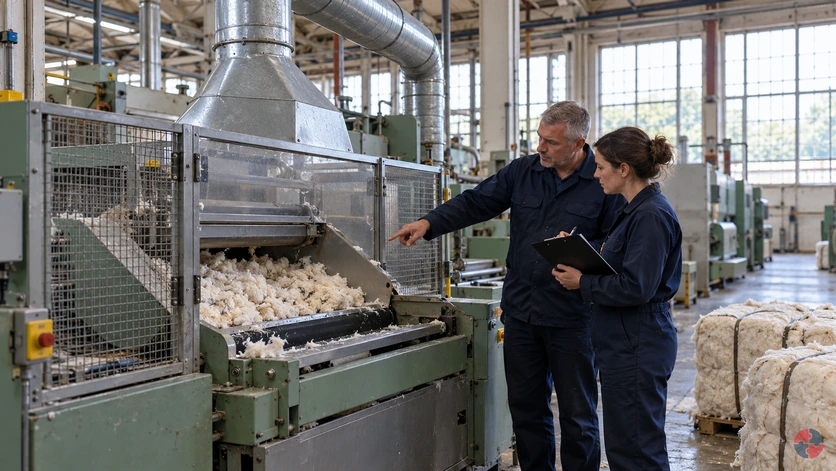
Check the feeding task, not just a visible duct
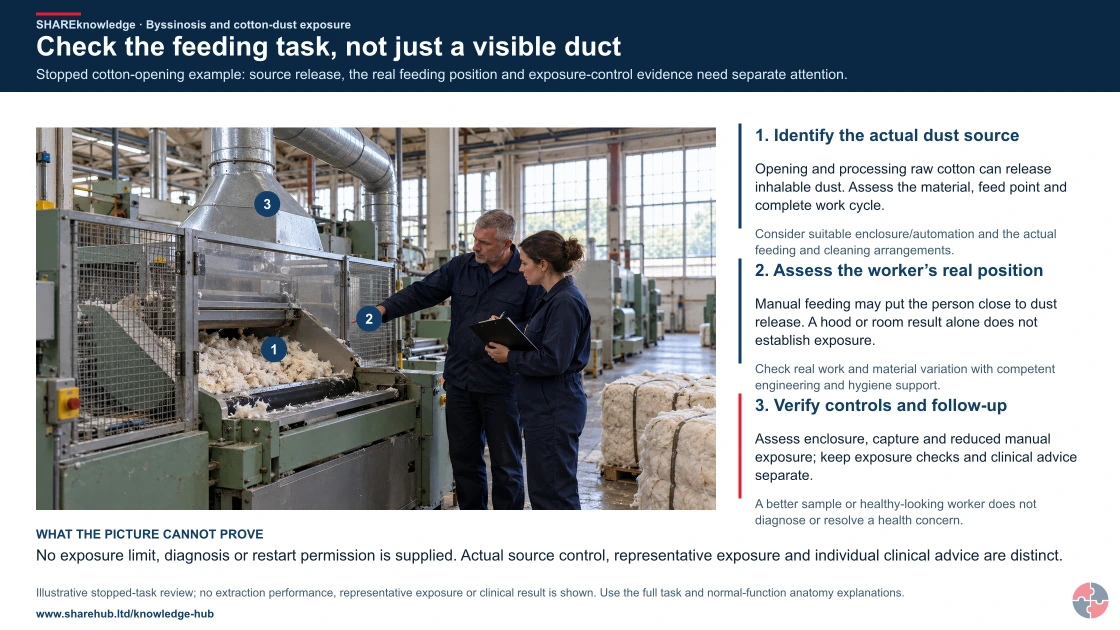
Full written explanation
Stopped cotton-opening example: source release, the real feeding position and exposure-control evidence need separate attention.
- Identify the actual dust source. Opening and processing raw cotton can release inhalable dust. Assess the material, feed point and complete work cycle.
- Assess the worker’s real position. Manual feeding may put the person close to dust release. A hood or room result alone does not establish exposure.
- Verify controls and follow-up. Assess enclosure, capture and reduced manual exposure; keep exposure checks and clinical advice separate.
Change the pathway
- Control generation at source. Consider suitable enclosure/automation and the actual feeding and cleaning arrangements.
- Use representative evidence. Check real work and material variation with competent engineering and hygiene support.
- Do not infer medical clearance. A better sample or healthy-looking worker does not diagnose or resolve a health concern.
Evidence check: No exposure limit, diagnosis or restart permission is supplied. Actual source control, representative exposure and individual clinical advice are distinct.
Full symptom, urgent-breathing and qualified clinical/OH advice context
Primary references: HSE: textile dust and source controls · HSE: textile health surveillance · NHS: shortness of breath and when to obtain help
Open the complete HD image (new tab)Download image
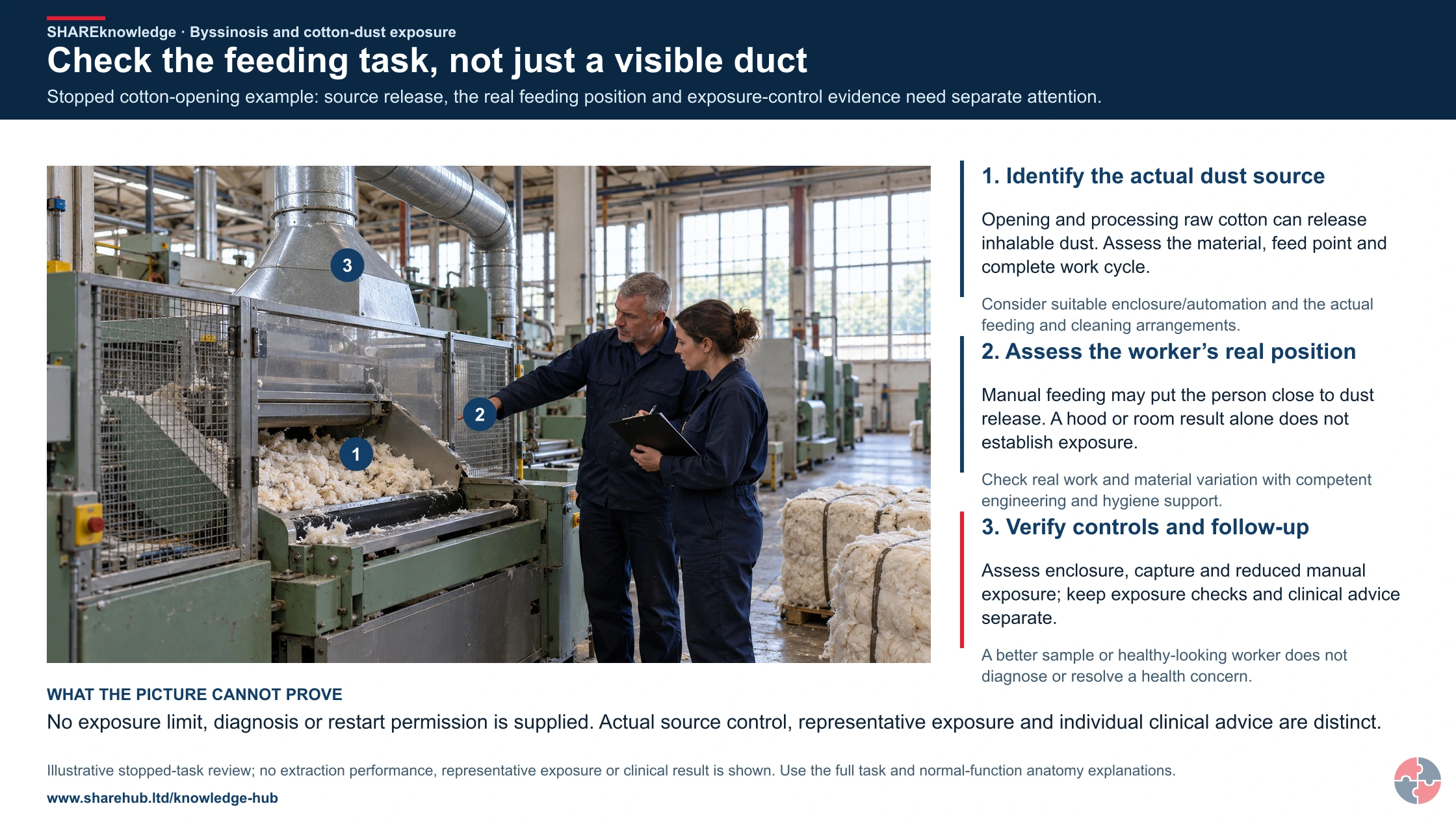
Full symptom, urgent-breathing and qualified clinical/OH advice context
Primary references: HSE: textile dust and source controls · HSE: textile health surveillance · NHS: shortness of breath and when to obtain help
A room result cannot clear a dusty feeding task


Read the complete visual as text
- SOURCE: Opening and processing raw cotton can release inhalable organic dust. Manual feeding may place the worker close to the release.
- AIRWAYS: Dust exposure can irritate and narrow airways; chest tightness may recur on the first shift after a break and become persistent.
- CONTROL: Reduce manual exposure through suitable enclosure or automation, repair capture and keep cleaning controlled. A hood alone may not protect a manual feeder.
- EVIDENCE: Use representative personal sampling for the actual work and material variation. Improved sampling does not diagnose or medically clear a worker.
In early byssinosis, the lungs may react strongly when the worker returns to exposure after time away. Airways narrow, breathing becomes more difficult and the worker may notice chest tightness, wheeze or shortness of breath. The pattern can be missed because symptoms may ease later in the week.
The 2007 IIAC historical review describes increasingly persistent symptoms and, in severe cases, permanent loss of ventilatory capacity. Its discussion also records uncertainty about whether byssinosis caused COPD. Similar breathing symptoms do not make these diagnoses interchangeable: qualified clinicians investigate and advise on the individual condition and work capability.
This is why a symptom questionnaire alone is not enough. Lung function monitoring, exposure assessment and a proper review of controls are needed to understand whether the workplace is preventing harm.
Inhalation. Cotton, flax or hemp dust enters the airways. Dust generation and airborne exposure must be assessed.
Acute airway response. Airways narrow and become irritated. First-day-back symptoms should be treated as a warning sign.
Repeated reaction. Episodes recur when exposure continues. Controls and health surveillance should be reviewed early.
Chronic obstruction. Airflow limitation becomes more persistent. Worker fitness, adjustments and long-term prevention become important.
Wider team risk. Symptoms in one worker may signal exposure affecting others. Investigate the process, not just the individual case.
What symptoms can byssinosis cause?
Byssinosis can cause chest tightness, wheeze, breathlessness, cough and reduced tolerance for dusty or physically demanding work. See HSENI occupational lung disease
The classic pattern is chest tightness or breathlessness on the first day back at work after a weekend, holiday or other break. The worker may feel better later in the week, which can lead to under-reporting unless the pattern is specifically asked about.
As disease progresses, symptoms may become more persistent and less clearly linked to Mondays. A person may notice cough, wheeze, reduced exercise tolerance, difficulty with stairs or tasks that used to be easy, and more symptoms in dusty rooms.
A workplace should not use symptoms to make a diagnosis. The useful management question is whether the symptoms could be linked to exposure and whether controls are strong enough to protect that worker and colleagues.
Chest tightness on first day back. Classic byssinosis-type work pattern. Record timing and review textile dust exposure.
Wheeze or breathlessness in dusty areas. Airway irritation or obstruction linked to exposure. Reduce exposure and arrange health assessment route.
Cough during or after dusty work. Respiratory irritation or early disease signal. Check process controls, cleaning and ventilation.
Symptoms easing away from work. Possible work-related respiratory condition. Compare work and non-work pattern through competent advice.
Persistent reduced exercise tolerance. Possible longer-term airflow limitation. Consider occupational health advice and task restrictions.
Several workers reporting similar symptoms. Potential control failure affecting the group. Investigate the process and increase monitoring.
Which work activities are most likely to create byssinosis risk?
The highest-risk activities are usually dusty early-stage cotton, flax or hemp processing and uncontrolled cleaning or maintenance around textile machinery. See HSE textile dust and byssinosis See DWP/IIAC Belfast proceedings (2007 historical review)
HSE identifies cotton processes where controls are likely to be required, including raw material handling, opening, carding, drawing, combing, beaming, ring spinning and high-speed winding. These are stages where fibre is handled, separated, moved or processed in ways that release dust.
Maintenance work deserves particular attention because normal enclosures may be removed, settled dust may be disturbed, extraction may be off, and workers may be close to dirty plant. A maintenance job that looks short can create a much higher exposure than routine operation.
Laundries and textile handling operations can have respiratory hazards too, but classic byssinosis is most strongly associated with textile processing of raw or waste cotton and similar fibres. The page should therefore be applied proportionately.
Raw material handling. Manual movement of raw or waste cotton can release significant dust. Reduce manual handling, automate where practicable and provide capture control.
Opening and carding. Fibre separation can release high airborne dust levels. Enclosure, negative pressure, LEV and effective general ventilation.
Drawing, combing and beaming. Moving fibre and entrained air can carry dust towards workers. Control airflow, locate operators away from dust and use extraction.
Ring spinning and winding. Some operations can create high exposures depending on fibre and machine design. Assess by task, improve ventilation and monitor exposure.
Cleaning machines and floors. Dry cleaning methods can put settled dust back into the breathing zone. Use suitable industrial vacuum systems and avoid compressed air.
Dust collector emptying. Accumulated dust may be released during emptying or maintenance. Switch off safely, contain dust, use RPE where residual exposure remains.
How should COSHH be applied to cotton and textile dust?
COSHH requires employers to assess hazardous textile dust exposure, prevent or adequately control it, maintain controls and use health surveillance where required. See Control of Substances Hazardous to Health Regulations 2002
A good COSHH assessment for byssinosis is task-specific. It should identify the fibre, process, dust form, who is exposed, how exposure occurs, the likely concentration, the duration and frequency, the effectiveness of existing controls and what monitoring or surveillance is needed.
Cotton dust has a workplace exposure limit in HSE textile guidance for specified raw and waste cotton handling. Where a specific WEL does not apply, dust must still be adequately controlled under COSHH, particularly where excessive inhalable or respirable dust is present.
The assessment should not sit in a folder while the mill runs differently. It needs to be checked against real conditions: visible dust, cleaning methods, filter performance, worker symptoms, exposure monitoring, health surveillance outcomes and maintenance records.
What is the substance?. Cotton dust, flax dust, hemp dust, wool process dust, dyestuff dust or mixed textile dust. Material inventory and process map.
How can exposure occur?. Inhalation during processing, cleaning, maintenance, filter changes and manual handling. Task exposure assessment and observations.
Who is exposed?. Operators, cleaners, maintenance teams, contractors and nearby workers. Affected-persons list and exposure groups.
How much exposure is likely?. Dust concentration, duration, frequency and comparison with WELs where applicable. Air monitoring strategy and results.
What controls exist?. Enclosure, LEV, general ventilation, vacuum cleaning, RPE and training. Control inspection and maintenance evidence.
How is health protected?. Symptom reporting, lung function surveillance and action on results. Health surveillance programme and anonymised trend review.
How should textile dust exposure be controlled?
Textile dust exposure should be controlled at source through process design, enclosure, ventilation, LEV, cleaning standards and maintenance before relying on RPE. See HSE textile dust and byssinosis
The strongest controls stop dust entering the breathing zone. Machinery should be enclosed as far as practicable, essential openings should be served by properly designed local exhaust ventilation (LEV), and general ventilation should prevent background dust build-up.
Cleaning is a critical control. HSE textile guidance is clear that cleaning should use methods such as vacuum cleaning rather than broom, brush or compressed air. Dry sweeping and blowing down machines may look efficient, but they can create a short-lived dust cloud exactly where workers breathe.
RPE may still be needed for some tasks, particularly dusty maintenance, dust collector emptying or short-duration work where engineering controls cannot fully control exposure. It must be selected, face-fit tested where tight fitting, maintained, stored, worn correctly and understood by the user.
| Control area | Good practice | What to check |
|---|---|---|
| Process design | Reduce dust generation when introducing or changing processes and machinery. | Change records, design review and exposure assessment. See HSE textile dust and byssinosis |
| Enclosure | Keep dusty machinery enclosed as far as practicable. | Enclosure condition and doors or panels kept closed. See HSE textile dust and byssinosis |
| LEV | Capture dust escaping from essential openings. | Thorough examination, test records and visual checks. See HSE textile dust and byssinosis |
| General ventilation | Prevent build-up of background dust in workrooms. | Airflow, room layout and returned-air quality. See HSE textile dust and byssinosis |
| Vacuum cleaning | Remove settled dust without re-suspending it. | Suitable industrial vacuum or piped vacuum system. See HSE textile dust and byssinosis |
| No compressed air | Avoid blowing dust from machines or clothing. | Observed cleaning behaviours and supervisor checks. See HSE textile dust and byssinosis |
| RPE | Use as residual protection for tasks that still create dust. | Selection, fit testing, maintenance and user training. See HSE textile dust and byssinosis |
| Maintenance | Clean plant before work and control exposures when guards or enclosures are removed. | Permit conditions, method statements and task briefing. See HSE textile dust and byssinosis |
What if a new material batch makes the same task dustier?
Include material condition in the exposure assessment, not only the machine setting. A different feedstock or delivery can alter the dust released during opening, feeding and clearing even when the process name and extraction indication are unchanged. The absence of a new machine fault does not prove that the existing capture arrangement controls the changed source.
For an illustrative textile-feeding task, workers report more dust escaping as a newly received batch is opened. The supervisor holds the affected dusty step for competent review, confirms the material and handling changes and checks capture where the dust is released. The occupational hygienist decides whether existing exposure measurements represent the changed activity and what further checks are needed. Review waste and cleaning tasks as well as feeding, and avoid using dry sweeping or compressed air as an improvised response. Resume under an accepted method with verified controls and communicate the change to all affected shifts. Worker respiratory symptoms require the separate occupational-health or clinical route; production acceptance is not medical clearance.
Guidance and scope: Original SHARE material-change example applying HSE GB textile-dust and LEV guidance. Material-specific assessment determines the applicable exposure limit and controls; no visible-dust threshold, universal airflow value or diagnosis is inferred. HSE textile dust and byssinosis HSE local exhaust ventilation
How does ERICPD apply to byssinosis prevention?
ERICPD helps prioritise dust prevention and engineering control before relying on masks or worker behaviour. See HSE textile dust and byssinosis
Byssinosis prevention is a classic hierarchy-of-control issue. A respirator may protect a worker for a specific residual exposure, but it does not make a dusty process well controlled. The main gains usually come from lower-dust materials, automation, enclosure, ventilation, good cleaning and reduced time near the dust source.
Discipline still matters, but it should reinforce engineered protection. Workers need to understand why compressed air cleaning is poor practice, why LEV must be reported if damaged, why symptoms must be reported early and why RPE must fit the wearer.
Eliminate. Remove or avoid the dustiest process where reasonably practicable. Use cleaner or treated fibre, pre-processed materials or automation.
Reduce. Reduce the amount of dust generated and the time people spend exposed. Limit manual raw cotton handling and reduce people in early process rooms.
Isolate. Separate workers from dusty processes. Enclosed machinery, segregated dusty rooms and filtered-air booths where appropriate.
Control. Capture and remove dust and control cleaning and maintenance. LEV, general ventilation, vacuum cleaning and planned filter maintenance.
PPE. Use respiratory protective equipment for residual exposure. Task-specific respirator with fit testing and maintenance.
Discipline. Train and supervise behaviours that keep controls working. No compressed air cleaning, early symptom reporting and attendance at surveillance.
What health surveillance is needed for byssinosis risk?
Health surveillance is needed where textile dust exposure could cause detectable respiratory disease and early action can prevent further harm. See HSE textile health surveillance
HSE COSHH health surveillance guidance explains that health surveillance is about detecting adverse health changes early, evaluating health hazards and checking whether controls are working. For byssinosis risk, that usually means a planned respiratory health programme rather than informal conversations after symptoms appear.
A suitable programme may include a pre-placement respiratory questionnaire, periodic symptom questionnaires, lung function testing such as spirometry, competent interpretation, clear escalation criteria and feedback to management about control failure trends without unnecessary disclosure of personal medical details.
Surveillance only has value if the business acts on results. If one person develops symptoms, the response should consider that worker's health and the exposure affecting others in the same process.
Baseline assessment. Understand pre-existing respiratory issues and fitness for dusty work. Use competent occupational health input and protect confidentiality.
Symptom questionnaire. Ask about chest tightness, wheeze, cough and first-day-back pattern. Investigate work-related patterns early.
Lung function testing. Detect airflow obstruction or change over time. Review exposure controls where results change.
Competent review. Interpret results and advise on work restrictions or referral. Use qualified occupational health advice.
Group trend analysis. Identify clusters in tasks, departments or shifts. Improve controls for the process, not only one worker.
Confidential records. Protect health information and retain appropriate surveillance evidence. Limit access and follow data protection controls.
What records and reporting issues matter for byssinosis?
Records should show exposure assessment, control maintenance, health surveillance, worker information and decisions on reporting or benefit routes. See NI RIDDOR 1997 Schedule 3
Byssinosis is important in the UK because it appears in industrial disease and dust-related compensation contexts, even though it is now rare. GOV.UK IIDB technical guidance lists byssinosis as prescribed disease D2 for specified work involving raw or waste cotton or flax processes. See Government Industrial Injuries Disablement Benefit guidance
RIDDOR is jurisdiction-specific. GB HSE’s current occupational-disease list does not name byssinosis, but NI RIDDOR 1997 Schedule 3 item 40 includes specified cotton/flax work, including weaving-room work. The doctor’s diagnosis and statutory work conditions determine an NI report. Do not confuse the NI activity scope with the narrower GB raw/waste cotton WEL or with IIDB benefit prescription. See Government Industrial Injuries Disablement Benefit guidance See NI RIDDOR 1997 Schedule 3 See GB RIDDOR occupational diseases
Health information must be kept confidential. Managers normally need to know restrictions, fitness, control actions and review dates, not full clinical details.
COSHH assessment. Shows how cotton or textile dust exposure has been assessed. Review after changes, symptoms, monitoring or surveillance findings.
Exposure monitoring. Shows whether WELs or internal standards are being met. Keep sampling strategy, results and improvement actions.
LEV examination and test. Shows dust extraction remains effective. Keep thorough examination and test records and repair evidence.
RPE records. Shows residual respiratory protection is suitable. Record selection, face fit, issue, maintenance and training.
Health surveillance. Detects early respiratory harm and control failure. Keep confidential occupational health records and management action logs.
RIDDOR decision. Avoids assumptions about reportability. Check current HSE disease criteria and record the rationale.
IIDB information. Supports awareness of prescribed disease context. Signpost to GOV.UK without giving benefits or legal advice.
Which legal duties apply to byssinosis and textile dust?
The legal and disease-reporting route depends on whether the work is in Great Britain or Northern Ireland; do not transfer a GB disease list to NI.
The legal focus is prevention. Employers must assess hazardous substances, prevent or adequately control exposure, maintain control measures, provide information and training, and arrange health surveillance where required. For cotton and textile dust, this means a live COSHH system supported by exposure monitoring, LEV testing, competent occupational health and worker involvement.
Devolved differences are limited for the practical control standard. HSE is the regulator for most GB workplace health and safety; HSENI should be checked for Northern Ireland workplaces. Benefits and compensation routes also differ between Great Britain and Northern Ireland, so signposting should be jurisdiction-specific where a worker asks about support.
| Direct instrument or regulator route | Jurisdiction | How it applies | Practical evidence |
|---|---|---|---|
| Health and Safety at Work etc. Act 1974 | Great Britain | General GB duty to prevent work-related ill health. | Task and control review. |
| Management of Health and Safety at Work Regulations 1999 | Great Britain | GB assessment, arrangements and competent support. | Risk decision and action owner. |
| Health and Safety at Work (Northern Ireland) Order 1978 | Northern Ireland | Separate NI general duty. | NI task and control record. |
| Management of Health and Safety at Work Regulations (Northern Ireland) 2000 | Northern Ireland | Separate NI assessment and preventive arrangements. | NI risk decision. |
| Control of Substances Hazardous to Health Regulations 2002 | Great Britain | GB textile-dust assessment, prevention/adequate control and surveillance where required. | COSHH and monitoring record. |
| Control of Substances Hazardous to Health Regulations (Northern Ireland) 2003 | Northern Ireland | NI hazardous-dust assessment and control. | NI COSHH and monitoring record. |
| Personal Protective Equipment at Work Regulations (Northern Ireland) 1993 | Northern Ireland | NI residual RPE selection and maintenance. | Fit and issue record. |
| GB RIDDOR occupational diseases | Great Britain | Current GB listed-disease criteria: this named condition is not listed; assess any distinct reportable condition on its own terms. | GB diagnosis/criteria decision. |
| NI RIDDOR 1997 Schedule 3 | Northern Ireland | NI Schedule 3 includes the named condition under specific occupational and diagnosis conditions. | NI statutory-criteria decision. |
GB RIDDOR 2013 and NI RIDDOR 1997 are separate disease lists. Industrial Injuries Disablement Benefit prescription is a compensation route, not an employer reporting test. Seek competent advice where diagnosis, qualifying work or accident circumstances are uncertain.
How should byssinosis risk be recorded in a risk register?
A byssinosis risk register should link dusty textile processes to exposed groups, WELs, controls, surveillance and assurance evidence.
A useful register entry should be process-led. 'Dust exposure' is too vague if the real hazard is workers feeding raw cotton into opening machinery while extraction is weak and settled dust is blown down at shift end.
The register should record both leading and lagging indicators: LEV performance, cleaning compliance, exposure monitoring, RPE defects, health surveillance attendance, respiratory symptoms and action close-out.
| Field | What to record | Example |
|---|---|---|
| Process | The dusty textile activity. | Raw cotton opening and carding. |
| Hazard | Cotton dust inhalation and byssinosis risk. | Airway disease from raw cotton dust. |
| Exposed people | Operators, cleaners, maintenance staff and contractors. | Opening room team and maintenance engineer. |
| Exposure standard | WEL or internal control standard. | Cotton dust WEL and local action level. |
| Controls | Enclosure, LEV, vacuum cleaning, RPE and training. | LEV at carding machine and no compressed air policy. |
| Health controls | Surveillance, symptom reporting and occupational health referral. | Annual questionnaire and spirometry. |
| Assurance | How controls are checked. | LEV test, air monitoring, supervisor inspection and OH trend review. |
| Review trigger | When the assessment changes. | New machinery, symptoms, WEL exceedance or failed LEV test. |
How could Riverside Leisure Ltd manage byssinosis-related textile dust risk?

Riverside Leisure Ltd would manage byssinosis proportionately by recognising that its main risk is linen and laundry dust, while any raw textile processing contractor work would need stricter COSHH control.
Riverside Leisure Ltd
a leisure, hotel and events business with housekeeping, laundry handling, facilities maintenance and contractor-managed refurbishment activities
Riverside is not a cotton mill, so it should not pretend that routine hotel linen handling carries the same byssinosis profile as raw cotton processing. Its first step is a proportionate hazard review: where are textiles handled, where is visible dust created, who empties filters, who cleans laundry rooms, and could any contractor work involve raw cotton, old textile stock, insulation-like fibre, dust from cutting fabrics or contaminated laundry?
The facilities manager keeps textile and laundry hazards in the COSHH register. Routine linen sorting is assessed for laundry or textile dust and respiratory irritation; higher-risk contractor work, such as refurbishing a former mill building or handling dusty stored textile bales, must have a separate method statement, cleaning plan, RPE assessment and waste route. Riverside does not allow contractors to blow down dusty rooms with compressed air.
Housekeeping supervisors use frontline checks: visible dust on high surfaces, blocked lint filters, poor ventilation, workers coughing in laundry areas, dry sweeping, damaged vacuum hoses and poorly stored RPE. The H&S lead completes a second-line review of COSHH assessments, training records, contractor RAMS, maintenance logs and any health reports. A third-line audit samples the full system on Riverside’s illustrative risk-based audit schedule, including whether actions from symptoms or cleaning defects were actually closed.
If a worker reports chest tightness linked to a dusty laundry task, Riverside reduces exposure, records the work pattern, reviews controls, considers occupational health advice and checks whether others in the same area have similar symptoms. The learning is then fed back into procurement, cleaning standards, contractor rules and supervisor training.
Assess. Separates routine linen dust from higher-risk textile processing or contractor exposure. COSHH register, task inventory and contractor pre-start review.
Analyse. Looks at dust generation, cleaning method, ventilation, symptoms and exposed groups. Laundry inspection, worker feedback and exposure concern log.
Train. Briefs housekeeping, maintenance and contractors on dust control, symptom reporting and cleaning standards. Training matrix, toolbox talk and contractor induction.
Implement. Uses vacuum cleaning, lint/filter maintenance, no compressed air cleaning, suitable ventilation and RPE where residual risk remains. Inspection records, maintenance logs and RPE issue records.
Check. Runs frontline checks, H&S reviews and periodic audit of COSHH and occupational health actions. Three-line assurance record and close-out tracker.
Learn. Reviews symptoms, absence, complaints, defects and contractor performance. Health trend review and management meeting minutes.
Improve. Updates procurement, cleaning equipment, contractor controls, training and risk register entries. Updated COSHH assessment and revised standards.
Riverside’s finished-linen work is an adjacent laundry-dust COSHH case, not a classic raw-cotton byssinosis or cotton-WEL example. A raw-cotton mill needs its own exposure-control and surveillance decision. If Riverside encounters raw or waste cotton during a contractor task, assess that distinct material and process before using the cotton-specific WEL.
What training is useful for byssinosis prevention?
Training should explain the disease, the dust sources, the control standard and the behaviours that prevent exposure.
General awareness is suitable for anyone working around dusty textile or laundry areas. It should explain what byssinosis is, why first-day-back symptoms matter, why dust controls protect long-term health and how to report concerns.
Short topical training is needed for workers in dusty processes, cleaners, maintenance teams and contractors. It should cover cotton/flax/hemp dust, COSHH, cleaning methods, LEV, RPE, symptoms, stop-and-report rules and what to do if dust controls fail.
Supervisors and managers need deeper training so they can read a COSHH assessment, challenge poor housekeeping, understand exposure monitoring, check health surveillance actions, interpret assurance data and avoid treating RPE as the main control.
Competence means a person can carry out the actual task safely, recognise a changed condition and respond correctly. Attendance alone is insufficient. The matrix makes assessment, ownership, records and reassessment explicit.
| Role | Required learning | How competence is assessed | Assessor or owner | Record | Reassess when |
|---|---|---|---|---|---|
| Cotton-process worker | Recognise raw/waste cotton scope, symptoms and dust stop point | Observed cleaning and reporting scenario | Supervisor | Task check and briefing | Dust/process or symptoms change |
| LEV/maintenance technician | Inspect capture, filters and safe collector isolation | Demonstrated airflow check and filter-change simulation | Competent engineer | Test and maintenance record | Defect, process or equipment change |
| Manager | Fund containment, exposure monitoring and surveillance response | Review scoped WEL and failed-LEV case | Occupational hygienist | COSHH and restart decision | Monitoring failure or new material |
| Adviser | Separate GB/NI COSHH, RIDDOR and IIDB | Audit national reportability and WEL scope | Competent peer | Source and case review | Law or standard change |
How does byssinosis support qualification study and professional development?
Byssinosis helps learners understand how occupational disease develops through repeated exposure and why COSHH controls must be checked in practice.
For NEBOSH National General Certificate study, byssinosis sits naturally within hazardous substances, occupational health, health surveillance and respiratory disease. A strong scenario answer would identify the substance, exposure route, worker groups, symptoms, COSHH control hierarchy, RPE limitations, health surveillance and management review.
For Diploma-level study, the topic supports deeper analysis of exposure standards, sampling strategy, LEV design and maintenance, occupational disease epidemiology, worker consultation, confidentiality and assurance. The higher-value answer is not 'give masks'; it is to design and verify a dust control system.
For professional development, byssinosis is a useful reminder that rare diseases still matter. If a disease has become rare because controls improved, weakening those controls can allow the same harm route to return.
NEBOSH National General Certificate. COSHH assessment, respiratory hazards, health surveillance and worker information. Textile workers report chest tightness after weekends in dusty cotton processing.
NEBOSH Diploma. Exposure monitoring, WELs, LEV, occupational health governance and legal compliance. Audit finds visible dust, failed LEV tests and poor surveillance follow-up.
Supervisor CPD. Control verification and early symptom reporting. A cleaner uses compressed air to blow down dusty machinery.
H&S adviser CPD. Respiratory risk registers and health trend review. Spirometry trends worsen in one production area.
How can management systems strengthen byssinosis prevention?
A management system turns dust control into planned assurance rather than informal good housekeeping.
The management system should define how textile dust hazards are identified, how COSHH assessments are approved, who owns LEV maintenance, when exposure monitoring is completed, how health surveillance findings are acted on and how workers can raise respiratory concerns without blame.
A voluntary management framework can be useful where its management stages are translated into practical evidence: consultation with workers who clean the machines, procurement controls for extraction and vacuum systems, management of change for new textile processes, and corrective action when surveillance or monitoring suggests control failure.
A practical management cycle assigns a risk owner, designs source controls, checks task competence and performance, acts on symptom or exposure evidence, and verifies improvement. A standard certificate alone does not prove this task safe.
What are the warning signs that byssinosis controls are failing?
Warning signs include visible textile dust, first-day-back breathing symptoms, poor cleaning, weak LEV and health surveillance findings that are not acted on.
The practical warning signs are usually visible before formal diagnosis. Dust lies on beams, surfaces and lights; workers dry sweep floors; compressed air is used because it is quick; extraction is noisy, damaged or untested; and workers accept coughing or chest tightness as part of the job.
The harm pathway is predictable. Dust is released, workers breathe it in, airways react, symptoms are under-reported, exposure continues, lung function may deteriorate and the business slowly normalises a preventable occupational disease risk.
Dust visible during early processing. Workers inhale cotton or fibre dust during routine work. Review process enclosure, LEV and exposure monitoring.
First-day-back chest symptoms. Classic byssinosis pattern may be emerging. Arrange health assessment route and review workplace controls.
Dry sweeping or compressed air cleaning. Settled dust is re-suspended into the breathing zone. Introduce vacuum cleaning and supervise the standard.
LEV overdue or poorly maintained. Capture control weakens and background dust rises. Repair, test and review maintenance ownership.
RPE used as the main control. Workers remain exposed if masks fit poorly or are not worn. Improve engineering controls and strengthen RPE programme.
No health surveillance response. Early symptoms or lung function changes are missed. Use competent OH review and management action tracking.
Contractors disturb dusty plant without controls. Short tasks create high exposure peaks. Add permit conditions, cleaning standards and contractor checks.
Which textile dust and exposure limit are relevant?
Byssinosis is associated primarily with inhalation of raw cotton dust. Wool dust can cause other respiratory harm, but do not call wool dust a byssinosis cause. HSE identifies dusty raw-material handling, opening, carding and early processing as priority tasks. See HSE textile dust and byssinosis
In Great Britain, the cotton-dust WEL is 2.5 mg/m³ as an 8-hour time-weighted average for inhalable dust when handling raw or waste cotton or blends. HSE/EH40 exclude weaving, knitting, braiding and subsequent processes, bleached or dyed cotton and finished articles. These exclusions from that specific WEL do not remove the duty to assess and adequately control hazardous dust. See HSE textile dust and byssinosis; HSE EH40 workplace exposure limits
Is byssinosis reportable in Great Britain or Northern Ireland?
Great Britain: byssinosis is not named on the current HSE RIDDOR occupational-disease list. Investigate and control suspected work-related illness, and assess any separate reportable occupational-asthma or other listed diagnosis against its own criteria; do not treat IIDB D2 prescription as RIDDOR. See GB RIDDOR occupational diseases
Northern Ireland: NI RIDDOR 1997 Schedule 3 item 40 includes byssinosis with specified raw/waste cotton or flax spinning/manipulation, or weaving cotton/flax in a factory room (including other work in that room). A doctor’s qualifying diagnosis and statutory work conditions drive an HSENI disease report. The NI reporting activity scope is distinct from the GB cotton-dust WEL, which excludes weaving. See NI RIDDOR 1997 Schedule 3; HSENI disease-reporting route
What should happen when a worker reports first-day-back chest tightness?
Take the symptom seriously, arrange appropriate clinical/occupational-health assessment, and assess the worker’s actual dust exposure and colleagues’ risk without making a diagnosis. The classic first-day-back pattern is a clue, not proof. See HSE textile dust and byssinosis
Health surveillance should detect early harm and trigger review of process containment, extraction, cleaning, monitoring and RPE. It does not replace dust prevention. Confidential clinical details stay with health professionals; management receives fit-for-work and control-action information. See HSE textile health surveillance
How should these decisions work on a real shift?
These examples show task prerequisites, controls, hold points, decision owner, hand-back and evidence. Adapt to the individual and worksite.
Assess settled textile dust before maintenance
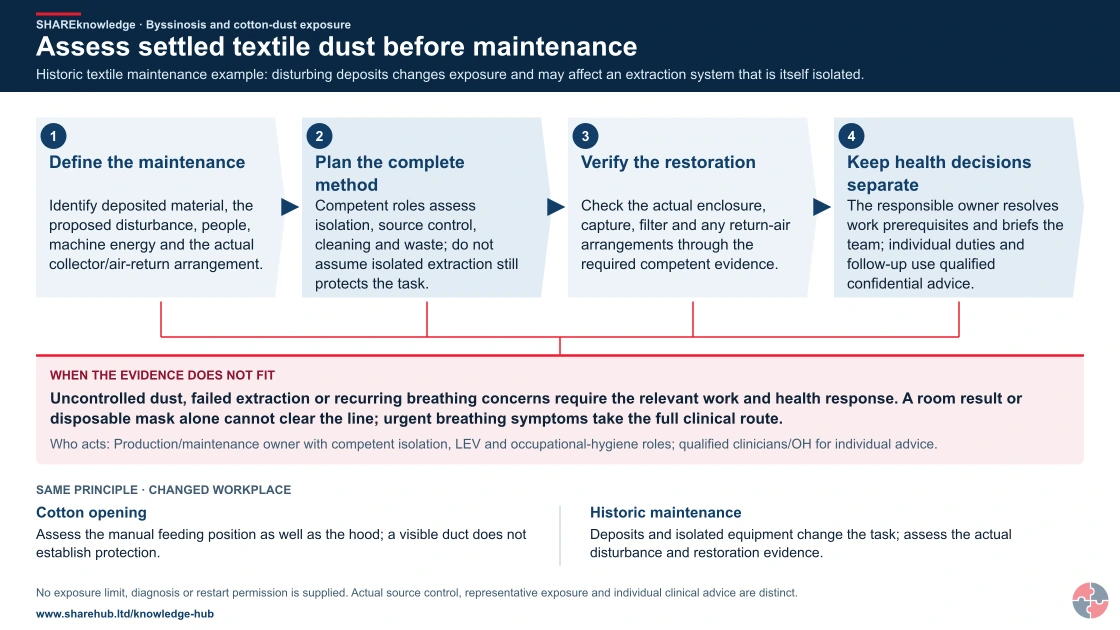
Full written explanation
Historic textile maintenance example: disturbing deposits changes exposure and may affect an extraction system that is itself isolated.
- Define the maintenance. Identify deposited material, the proposed disturbance, people, machine energy and the actual collector/air-return arrangement.
- Plan the complete method. Competent roles assess isolation, source control, cleaning and waste; do not assume isolated extraction still protects the task.
- Verify the restoration. Check the actual enclosure, capture, filter and any return-air arrangements through the required competent evidence.
- Keep health decisions separate. The responsible owner resolves work prerequisites and briefs the team; individual duties and follow-up use qualified confidential advice.
When the evidence does not fit: Uncontrolled dust, failed extraction or recurring breathing concerns require the relevant work and health response. A room result or disposable mask alone cannot clear the line; urgent breathing symptoms take the full clinical route.
Who acts: Production/maintenance owner with competent isolation, LEV and occupational-hygiene roles; qualified clinicians/OH for individual advice.
Changed workplace
Cotton opening: Assess the manual feeding position as well as the hood; a visible duct does not establish protection.
Historic maintenance: Deposits and isolated equipment change the task; assess the actual disturbance and restoration evidence.
Evidence check: No exposure limit, diagnosis or restart permission is supplied. Actual source control, representative exposure and individual clinical advice are distinct.
Full symptom, urgent-breathing and qualified clinical/OH advice context
Primary references: HSE: textile dust and source controls · HSE: textile health surveillance · NHS: shortness of breath and when to obtain help
Open the complete HD image (new tab)Download image
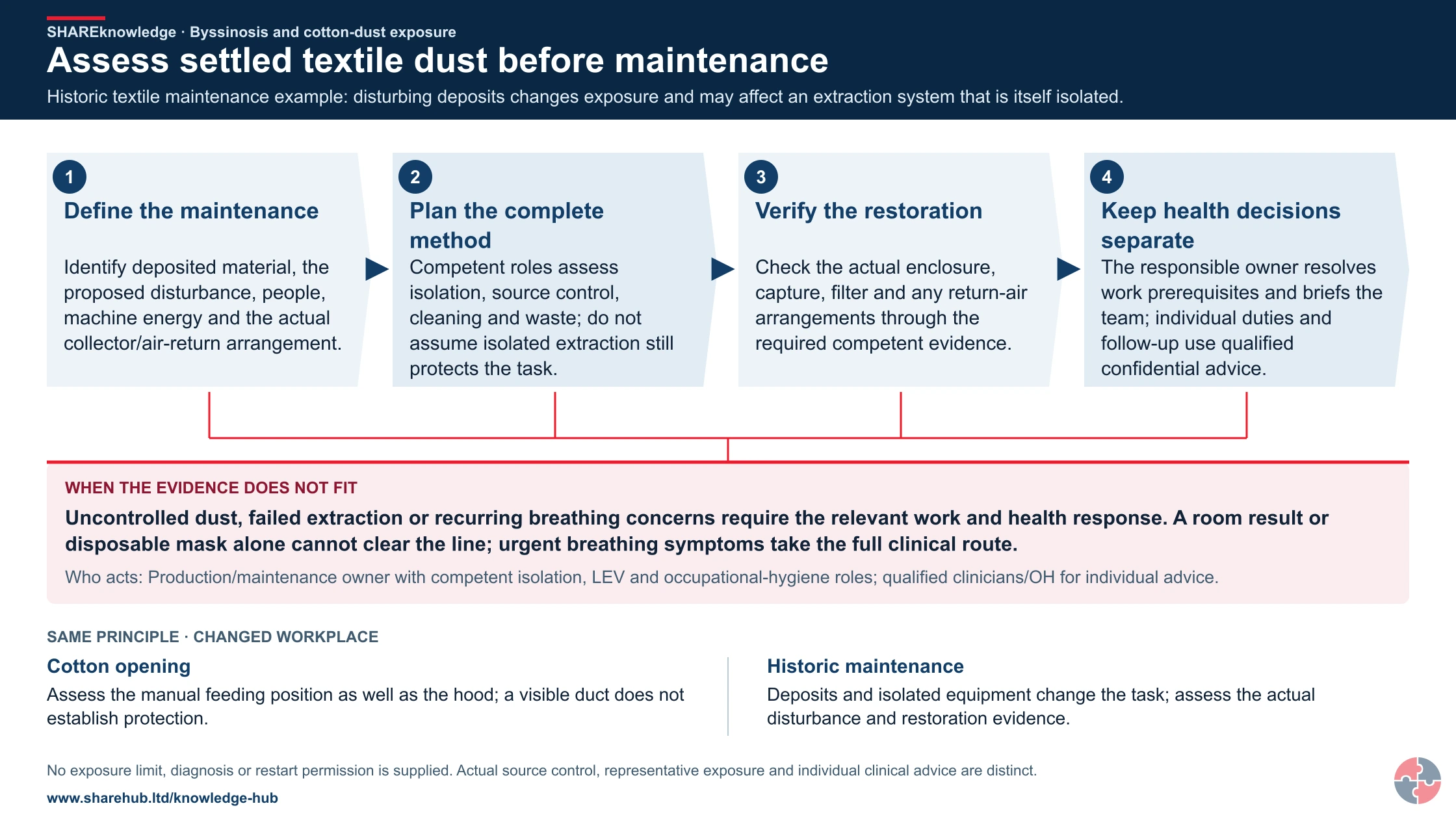
Full symptom, urgent-breathing and qualified clinical/OH advice context
Primary references: HSE: textile dust and source controls · HSE: textile health surveillance · NHS: shortness of breath and when to obtain help
Assess cotton dust where the worker breathes


Read the complete visual as text
- Control the manual-feed source
- Verify enclosure and extraction
- Keep exposure and clinical decisions separate
- The photograph provides topic context. Cotton bale opening with first-shift chest tightness is an illustrative learning example; the checks below must be adapted to the actual task.
Contextual extraction photograph. A visible duct does not establish capture efficiency or representative personal exposure in cotton opening; assess the actual source geometry, feeding, cleaning and task conditions.
Cotton-opening symptoms: a control and follow-up map


Read the complete visual as text
- 1. ACTUAL TASK: Identify raw-cotton opening, manual feeding, dust at the chute and the reported first-shift chest tightness.
- 2. PEOPLE AND BASIS: Stop affected dusty exposure, arrange qualified clinical/OH review and involve competent engineering and hygiene support.
- 3. BEFORE: Inspect the real feeding position, enclosure and LEV; consider reducing manual feed and plan controlled cleaning.
- 4. VERIFY DURING: Verify capture and representative personal inhalable-dust sampling across normal, dustier and start-up conditions.
- 5. HOLD OR REFER: Hold an uncontrolled dusty line, failed extraction or recurring symptoms; a room sample or disposable mask is not sufficient evidence.
- 6. HAND BACK AND REVIEW: Record competent acceptance of method and controls, brief workers and set review. Individual duties follow separate confidential qualified advice.
Cotton bale opening with first-shift chest tightness
Task material and setting: At a raw-cotton opening line, one operator has chest tightness after the weekend; dust builds near a transfer chute.
People and prerequisites: The operator, production lead, occupational hygienist and LEV engineer need the raw-cotton process map, current source-capture status, sampling plan and symptom escalation route.
Before: Stop affected dusty exposure, arrange clinical/OH review, inspect enclosure and LEV and measure representative inhalable-dust exposure against the scoped WEL.
During: Check manual feeding and the worker’s position as well as the hood: HSE warns that extraction at a feed point may not significantly reduce a manual feeder’s exposure. Reduce manual handling through suitable enclosure/automation, repair capture and verify performance. The hygienist selects representative personal inhalable-dust sampling covering normal work, dustier material, starts and manual-feed variations; one room result is not a worker-exposure verdict. Keep cleaning controlled and arrange competent worker/OH follow-up.
Hold or stop: Do not resume an uncontrolled dusty line on a normal-looking area sample or a disposable mask alone; stop on failed extraction or recurring symptoms.
Decision owner: Production manager owns operation; engineer proves LEV; OH owns confidential health assessment.
Completion and hand back: The production owner restarts only after competent acceptance of the real operating method, enclosure/capture and representative exposure evidence against the applicable limit and adequate-control duty. Brief workers and set a review date. The individual’s duty plan follows confidential qualified advice; no improved sample diagnoses or clears the worker.
Evidence: Keep COSHH assessment, LEV result, exposure samples and de-identified surveillance action.
Changed conditions: Reassess when the task, symptoms, material, equipment or jurisdiction changes.
Source scope: HSE/EH40 is GB guidance and raw/waste-cotton WEL scope; NI COSHH/reporting is separate. Historical first-day pattern is not diagnosis, and local capture cannot be assumed effective for manual feeding.
Filter change releases stored cotton dust
Task material and setting: Maintenance opens a collector after a filter alarm; settled raw-cotton dust can become airborne.
People and prerequisites: The isolation owner and LEV engineer need the actual fan/collector energy and pressure arrangement, filter/return-air design, alarm history and controlled dust-removal/waste method, with a competent exposure and RPE assessment.
Before: Stop and isolate the collector/plant using its assessed energy method, control stored dust and plan contained removal and sealed waste handling. Do not rely on an extraction unit that has itself been isolated; provide suitable independent capture or another assessed method where needed, plus suitable RPE for residual exposure.
During: Use controlled vacuum/contained removal rather than compressed air. Competent engineering verifies the correct filter seating, integrity, system airflow/capture and any recirculated air under controlled test conditions. Positive-pressure leaks can blow dust into a room; obtain specialist return-air advice rather than assume a replacement filter restores safety.
Hold or stop: Stop if the collector is live, dust is being blown with compressed air, extraction fails or respiratory protection is unverified.
Decision owner: Maintenance lead owns isolation; competent engineer verifies extraction; production owner authorises restart.
Completion and hand back: Hand back after competent acceptance of isolation release, closed collector/filter condition, capture and return-air performance, controlled housekeeping and worker-exposure assessment. Record alarm cause and corrective action, brief the next operators and revisit the next-change method; a changed filter alone does not close the defect.
Evidence: Keep permit, test sheet, exposure decision and defect closure.
Changed conditions: Reassess when the task, symptoms, material, equipment or jurisdiction changes.
Source scope: HSE textile guidance distinguishes collector pressure, controlled emptying and return-air specialist advice. This illustration requires the actual isolation/system design and NI duties separately; it does not authorise opening a live collector.
How can the hierarchy of controls reduce cotton-dust exposure and byssinosis risk?
ERICPD (Eliminate, Reduce including substitution, Isolate, Control, PPE, Discipline) and HSE’s five-level hierarchy (elimination, substitution, engineering, administrative, PPE) guide related but non-identical choices. Start at source; consider feasibility and any risk shifted elsewhere. Discipline means maintaining, supervising and learning from controls, not blaming workers. See HSE hierarchy; HSE five-level hierarchy of control
- IdentifyConfirm the fibre, process and applicable dust-limit scope; map where dust is released.
- RedesignRemove open handling where possible and test a lower-dust material or process without shifting harm.
- ContainEnclose and capture at source. Check LEV, cleaning, representative exposure and worker feedback.
- Hold or restartStop failed extraction or uncontrolled dust. A competent owner verifies repairs and exposure before restart; RPE covers residual work only.
How can the ERICPD hierarchy of controls reduce cotton-dust exposure and byssinosis risk?

| Five-level choice | ERICPD map | Task-specific intervention and feasibility | Owner, check, failure and stop |
|---|---|---|---|
| Elimination | Eliminate | Remove unnecessary open bale handling or dusty manual transfer, and design closed feed where the product permits. | Process owner checks material flow and all exposure points; stop design if dust simply moves to another room. See HSE textile dust and byssinosis |
| Substitution | Reduce / substitute | Use cleaned or lower-dust feed where the product and process allow; assess whether a different fibre creates a new respiratory hazard. | Purchasing and hygienist test product quality and exposure; reject substitution if overall harm rises. See HSE textile dust and byssinosis |
| Engineering | Isolate / Control | Enclose opening/carding and capture dust at source with maintained LEV and safe collector isolation. | Engineer checks capture and test results; stop when enclosure/LEV fails or dust escapes visibly. See HSE local exhaust ventilation; HSE textile dust and byssinosis |
| Administrative | Control / Discipline | Use controlled vacuum cleaning, planned filter change, restricted access, exposure monitoring and action on surveillance. | Supervisor samples method; hygienist interprets monitoring; stop on compressed-air cleaning or overdue defects. See HSE textile dust and byssinosis; HSE textile health surveillance |
| PPE | PPE | Select fit-tested, maintained RPE for assessed residual/temporary exposure; it cannot make a failed dusty process acceptable. | Competent assessor checks fit, wear and suitability; stop if required RPE is absent or ineffective. See HSE respiratory protective equipment |
How can the ISO 45001 hierarchy of controls reduce cotton-dust exposure and byssinosis risk?

| Five-level choice | ERICPD map | Task-specific intervention and feasibility | Owner, check, failure and stop |
|---|---|---|---|
| Elimination | Eliminate | Remove unnecessary open bale handling or dusty manual transfer, and design closed feed where the product permits. | Process owner checks material flow and all exposure points; stop design if dust simply moves to another room. See HSE textile dust and byssinosis |
| Substitution | Reduce / substitute | Use cleaned or lower-dust feed where the product and process allow; assess whether a different fibre creates a new respiratory hazard. | Purchasing and hygienist test product quality and exposure; reject substitution if overall harm rises. See HSE textile dust and byssinosis |
| Engineering | Isolate / Control | Enclose opening/carding and capture dust at source with maintained LEV and safe collector isolation. | Engineer checks capture and test results; stop when enclosure/LEV fails or dust escapes visibly. See HSE local exhaust ventilation; HSE textile dust and byssinosis |
| Administrative | Control / Discipline | Use controlled vacuum cleaning, planned filter change, restricted access, exposure monitoring and action on surveillance. | Supervisor samples method; hygienist interprets monitoring; stop on compressed-air cleaning or overdue defects. See HSE textile dust and byssinosis; HSE textile health surveillance |
| PPE | PPE | Select fit-tested, maintained RPE for assessed residual/temporary exposure; it cannot make a failed dusty process acceptable. | Competent assessor checks fit, wear and suitability; stop if required RPE is absent or ineffective. See HSE respiratory protective equipment |
How does the hierarchy apply to each material harm route?
Each route below maps all five HSE levels to ERICPD, records where a stronger control may not be feasible, and states who checks failure and when the task must stop. It supplements the general task hierarchy above; site conditions and the affected people still govern the final control choice.
| Material hazard | Five levels and ERICPD for this route | Higher-order feasibility and decision | Owner, effectiveness check and stop trigger |
|---|---|---|---|
| Raw cotton opening and carding dust | Eliminate: closed feed or remove unnecessary open handling; substitute/reduce: lower-dust feed if process permits; engineering/isolate: enclosure and LEV; administrative/control and discipline: monitoring, housekeeping and surveillance response; PPE: fit-tested residual RPE. | Raw cotton may be required; then capture and containment must be proved against scoped WEL and adequate-control duty. | Process owner and hygienist check exposure and airflow; stop on failed capture, visible release or recurrent first-shift symptoms. See HSE textile dust and byssinosis; HSE EH40 workplace exposure limits |
| Waste cotton and filter/collector maintenance | Eliminate: avoid manual dusty disposal; substitute/reduce: sealed removable collector; engineering/isolate: shutdown, contained removal and local capture; administrative/control and discipline: permit, vacuum cleaning and test; PPE: residual RPE and clothing. | Maintenance cannot be eliminated entirely; engineering containment is stronger than relying on a respirator during an open filter change. | Maintenance lead tests isolation/capture; stop on live plant, compressed-air cleaning, damaged filter or unverified RPE. See HSE textile dust and byssinosis; HSE local exhaust ventilation; HSE respiratory protective equipment |
| Other textile dust and WEL-scope uncertainty | Eliminate: prevent avoidable dust generation; substitute/reduce: lower-dust process; engineering/isolate: local capture; administrative/control and discipline: task-specific COSHH assessment even where cotton WEL exclusions apply; PPE: residual RPE. | Wool/finished-article dust is not automatically byssinosis or within the raw/waste cotton WEL; other respiratory harms still require assessment. | Hygienist confirms material and applicable limit; stop using the 2.5 mg/m³ figure as blanket clearance or allowing uncontrolled dust. See HSE textile dust and byssinosis; HSE EH40 workplace exposure limits |
What does official guidance add to this decision?
Control the actual fibre-dust release at source, verify extraction and cleaning methods, and arrange appropriate exposure and health-surveillance review.
Use the current HSE textile-dust guidance and the jurisdiction-specific duties listed on this page to verify the actual task and controls.
If a contract or competent design specifies a published technical standard, obtain authorised access to its current text and check its exact scope and edition. Apply the standard only within its stated scope; this guidance does not reproduce its clauses.
What do the acronyms and key terms mean?
Acronyms help readers follow COSHH, respiratory protection, exposure monitoring and occupational health terminology.
| Acronym or term | Meaning | Why it matters |
|---|---|---|
| COSHH | Control of Substances Hazardous to Health Regulations | Main UK framework for assessing and controlling cotton and textile dust. |
| WEL | Workplace Exposure Limit | Legal or guidance exposure limit used to judge airborne substance exposure. |
| TWA | Time-Weighted Average | Exposure averaged over a specified time, commonly 8 hours for many WELs. |
| LEV | Local Exhaust Ventilation | Engineering control that captures dust close to where it is generated. |
| RPE | Respiratory Protective Equipment | Masks or respirators used for residual inhalation risk. |
| PPE | Personal Protective Equipment | Equipment worn to reduce exposure, including RPE where relevant. |
| OH | Occupational Health | Competent health advice for surveillance, fitness and work restrictions. |
| COPD | Chronic Obstructive Pulmonary Disease | Long-term obstructive lung disease that can overlap with chronic byssinosis features. |
| RIDDOR | Reporting of Injuries, Diseases and Dangerous Occurrences Regulations | Framework for reporting specified injuries, diseases and dangerous occurrences. |
| IIDB | Industrial Injuries Disablement Benefit | Benefit route for certain prescribed occupational diseases. |
| ERICPD | Eliminate, Reduce, Isolate, Control, PPE, Discipline | Hierarchy used to prioritise practical risk reduction. |