SHARE Knowledge Hub
Occupational bladder cancer
Occupational bladder cancer is bladder cancer linked to workplace exposure to carcinogens, especially aromatic amines historically used in dye, rubber, textile, chemical and related industries. It most often involves urothelial cells lining the bladder and can appear decades after exposure because carcinogenic metabolites are filtered into urine and remain in contact with the bladder lining. Modern UK prevention focuses on eliminating or tightly controlling carcinogens under COSHH, recognising legacy exposure histories, controlling skin and inhalation routes, monitoring where needed, investigating urinary symptoms promptly and keeping long-term evidence of exposure control.
Understanding Occupational bladder cancer
Occupational bladder cancer is bladder cancer linked to workplace exposure to carcinogens, especially aromatic amines historically used in dye, rubber, textile, chemical and related industries. It most often involves urothelial cells lining the bladder and can appear decades after exposure because carcinogenic metabolites are filtered into urine and remain in contact with the bladder lining. Modern UK prevention focuses on eliminating or tightly controlling carcinogens under COSHH, recognising legacy exposure histories, controlling skin and inhalation routes, monitoring where needed, investigating urinary symptoms promptly and keeping long-term evidence of exposure control.
Why this matters at work
Use competent chemical and hygiene advice to resolve uncertainty and select interim controls. Include opening, transfer, cleanup, residues and the waste contractor in the task assessment. If substitution or disposal is chosen, evaluate the new method's hazards and compatibility rather than treating removal from stock as the end of the exposure pathway. Record the evidence, unresolved identity, responsible owner and restrictions. Preserve relevant historical exposure information for future competent review, while keeping personal health information restricted. Do not claim the stock caused an individual's disease or that a current supplier's safer marketing description retrospectively establishes the old product's composition.
The assessment record should connect a hazard to a control and to evidence of performance. An entry saying use PPE is incomplete unless the selection, residual exposure, wearer needs, maintenance and failure response are explained. Assign a review owner and identify what missing information prevents authorisation. Where a specialist measurement or chemical opinion is needed, commission it with a defined question rather than collecting an isolated number that cannot support the decision.
How organisations manage this in practice
Keep advice, authorisation and verification distinguishable even where one person performs several functions. For example, a hygienist's sampling report informs the manager's control decision, but the supervisor still needs a usable pre-task check. A clinician's work restriction informs an adjustment plan, but the employer must arrange and review its implementation. A worker's symptom report should reach a health route without becoming a supervisor's diagnosis.
Control paperwork should support these decisions rather than replace them. A signed permit does not demonstrate that extraction captures the release, that gloves suit the material or that a contractor knows what residue remains. Observe the task, speak with those doing it and use appropriate technical checks. When the task differs from the method, revise the assessment or pause; do not quietly redefine the intended control to match an uncontrolled routine.
Use a change record that explains what changed, which assumptions are affected and what must be demonstrated before use. A replacement glove, filter or cleaning method may affect the exposure route even if the purchasing system treats it as routine. Include foreseeable maintenance and contractor work in the review. Workers should receive instruction that matches the revised task and can explain the new stop point.
Blood in urine, persistent urinary symptoms or a bladder cancer diagnosis should be discussed with a GP, urologist or cancer specialist. Anyone with relevant work history should explain past exposure to dyes, rubber chemicals, aromatic amines, petroleum products, combustion products, paints, solvents or other suspected bladder carcinogens.
Put clinical assessment before attribution
Clinical assessment is the first route for a urinary concern. A job title, a substance association or an old exposure history cannot diagnose cancer or prove that work caused an individual illness. Reporting and benefit eligibility remain separate decisions with their own conditions.
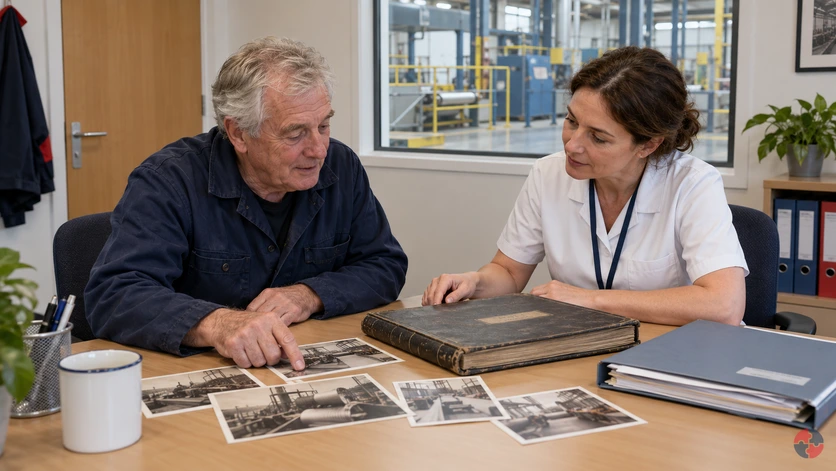
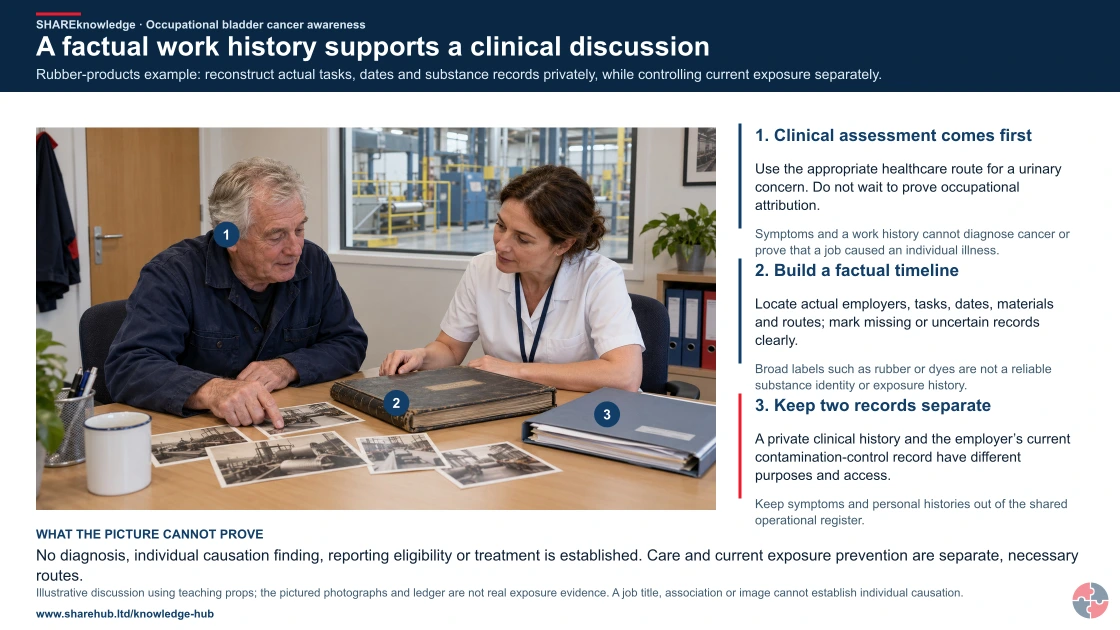
A factual work history supports a clinical discussion
Full written explanation
Rubber-products example: reconstruct actual tasks, dates and substance records privately, while controlling current exposure separately.
- Clinical assessment comes first. Use the appropriate healthcare route for a urinary concern. Do not wait to prove occupational attribution.
- Build a factual timeline. Locate actual employers, tasks, dates, materials and routes; mark missing or uncertain records clearly.
- Keep two records separate. A private clinical history and the employer’s current contamination-control record have different purposes and access.
Change the pathway
- Avoid a one-cause conclusion. Symptoms and a work history cannot diagnose cancer or prove that a job caused an individual illness.
- Identify actual agents. Broad labels such as rubber or dyes are not a reliable substance identity or exposure history.
- Protect private information. Keep symptoms and personal histories out of the shared operational register.
Evidence check: No diagnosis, individual causation finding, reporting eligibility or treatment is established. Care and current exposure prevention are separate, necessary routes.
Full urinary-symptom and appropriate clinical-response route
Primary references: HSE: dyes and dyeing · HSE: occupational cancer statement for MbOCA · NHS: blood in urine and medical help
Open the complete HD image (new tab)Download image
Full urinary-symptom and appropriate clinical-response route
Primary references: HSE: dyes and dyeing · HSE: occupational cancer statement for MbOCA · NHS: blood in urine and medical help
A useful private history follows the actual process and substance over time, including skin contact and where records may exist. Mark uncertain dates and substances clearly. The employer control record should address contamination and prevention without storing smoking history, symptoms or full clinical records in a shared register.
A legacy dye task needs two different records
Illustrative example. A former worker seeks help reconstructing dye-stripping tasks while the employer reviews a current contaminated-work area.
Decision. Use a private worker-to-clinician history for the individual and a separate operational contamination-control record.
Evidence to check. Locate employer/process/date/substance and route evidence; distinguish known material from broad dye/rubber/fuel labels.
Hold or escalation point. No causation conclusion from the job title or presumed chemical; clinical and reporting decisions need their proper evidence/owners.
Follow-up. Update the factual timeline as records are found and independently verify current skin/contamination controls.
Exposure pathway and clinical question are different
For some substances, uptake into the body and subsequent urinary contact are relevant to bladder-cancer risk. The pathway depends on the agent; a job title or industry label cannot establish someone’s diagnosis or its cause.

- Agent and uptake route
- Body / urinary pathway varies
- Bladder contact + separate care
Read the labels in the full-size drawing
- Relevant agent and entry
- route
- Urinary contact varies by
- substance
- Symptoms → clinical care; work cause is a separate question
Relevant exposure
Identify the actual material, constituents, process, inhalation or skin route, period and control evidence. Mark gaps and uncertainty in any work history.
Possible target pathway
A simplified sequence links uptake, body processing and urinary contact. It does not show that every agent follows the same route or predict dose, latency or cancer.
Clinical question
Symptoms or concerns need the appropriate clinical assessment without waiting for proof of a work cause. The occupational investigation can proceed separately.
Keep the existing symptom and care advice prominent. A historic-work scene supplies context only: verify the material and task, and do not infer risk from a logo, clothing or a picture of a factory.
What are the key facts about occupational bladder cancer?
The key facts are that occupational bladder cancer is linked to carcinogen exposure, has long latency and requires prevention long before symptoms appear.
Aromatic amines are the classic cause
Historic exposure in dye, rubber, textile and chemical work is especially important.
Latency can be very long
Disease may appear decades after the relevant work exposure.
The bladder lining is the target
Carcinogenic metabolites in urine can contact urothelial cells for prolonged periods.
Skin exposure matters
Some bladder carcinogens can be absorbed through skin as well as inhaled or ingested.
Blood in urine needs assessment
Symptoms should not be dismissed because they may be intermittent.
Records matter years later
Employment history, COSHH records and exposure information can support medical and occupational investigation.
What is occupational bladder cancer?
Occupational bladder cancer is bladder cancer where workplace exposure to carcinogenic substances has contributed to the risk.
Bladder cancer usually begins in the lining of the bladder. The most common type is urothelial carcinoma, also known as transitional cell carcinoma. Occupational bladder cancer is not a separate tumour type; it is bladder cancer with a work-related exposure pathway.
The strongest historical occupational link is with aromatic amines. Some of these substances were used in dyestuffs, rubber processing, textiles and chemical manufacture. Many have been banned or tightly restricted, but historic exposure remains important because disease can develop long after exposure has ended.
Modern risk management focuses on preventing exposure to known or suspected bladder carcinogens and capturing exposure history when someone develops bladder cancer.
Condition. Cancer of the bladder lining. May be associated with workplace carcinogen exposure.
Common tumour type. Urothelial or transitional cell carcinoma. Important clinical term in records.
Classic occupational agents. Aromatic amines including benzidine and naphthylamines. Historic dye, rubber and chemical exposure.
Latency. Often many years or decades. Past work history is essential.
Main symptom. Blood in urine or urinary changes. Prompt medical assessment is needed.
Prevention focus. Carcinogen elimination, substitution and exposure control. COSHH and long-term records matter.
What causes bladder cancer at work?
Bladder cancer at work is caused by exposure to carcinogens that can affect the bladder lining after absorption and excretion in urine.
The classic causes are aromatic amines historically used in dyes, rubber chemicals, pigments, textiles and chemical intermediates. Examples include benzidine, 2-naphthylamine, 1-naphthylamine, 4-aminobiphenyl, ortho-toluidine, auramine and magenta-related exposures.
Occupational cancer prevention requires a substance-specific evidence review and a documented exposure history. Certain aromatic amines have an established bladder-cancer association; petrol and other complex mixtures need assessment of their actual constituents and task routes. Do not infer the same bladder-cancer evidence from every fuel, oil or petroleum mixture.
The exposure route may be inhalation, skin absorption or ingestion from contaminated hands. For some substances, skin exposure can be a major route, so clean hands and intact skin control are not minor housekeeping issues.
Aromatic amines. Metabolites can damage bladder lining cells. Dye, pigment, rubber, textile and chemical manufacture.
Benzidine and naphthylamines. Historically strong bladder carcinogen link. Historic dyestuff and rubber chemical work.
Ortho-toluidine and related intermediates. Aromatic amine exposure pathway. Dyes, pigments, rubber chemicals and specialist manufacture.
PAHs. Some combustion mixtures contain carcinogens, but PAH presence alone does not establish an individual bladder-cancer cause. Identify the mixture, exposure and relevant evidence.
Automotive gasoline. Assess the actual product, constituents, vapour and skin/contact tasks. Petrol health information does not make every petroleum product an equivalent bladder-cancer exposure.
Contaminated hands and surfaces. Hand-to-mouth or skin absorption increases dose. Poor hygiene, staining, wet gloves and dirty welfare areas.
What is the damage mechanism of occupational bladder cancer?
The damage mechanism involves carcinogens entering the body, being metabolised, excreted in urine and damaging bladder lining cells.
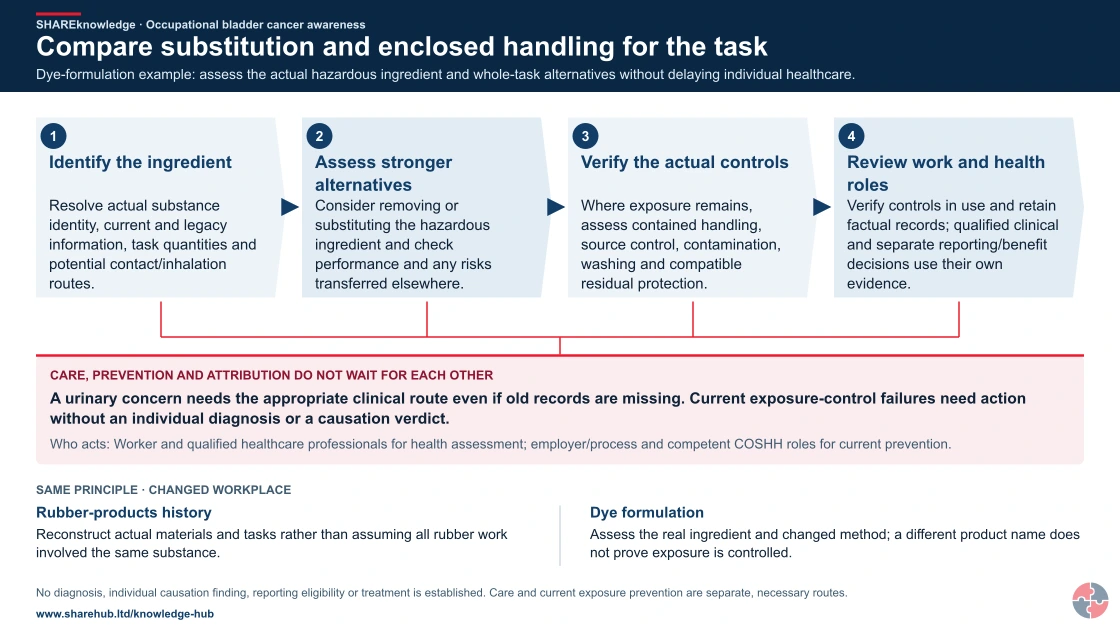
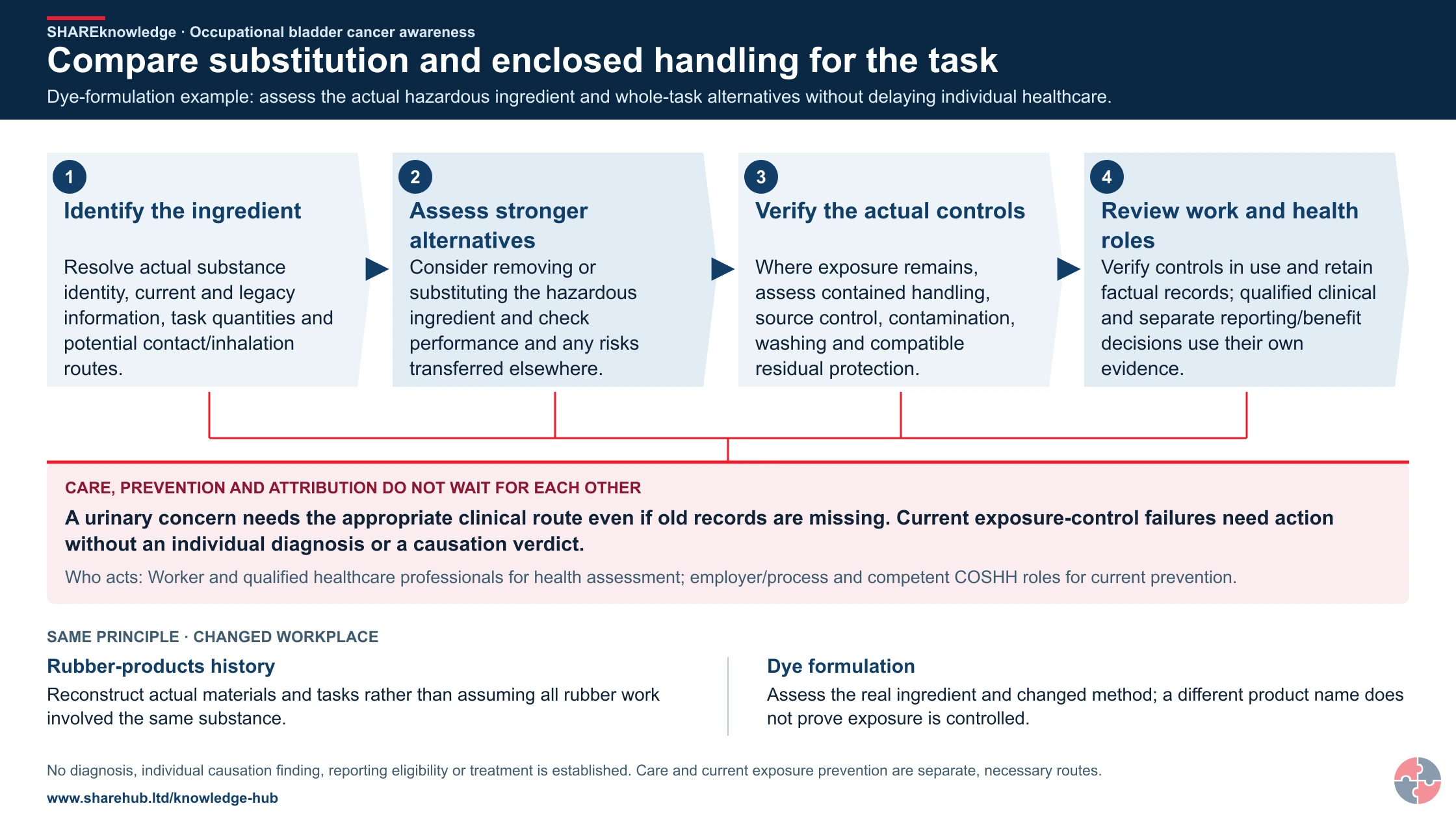
Compare substitution and enclosed handling for the task
Full written explanation
Dye-formulation example: assess the actual hazardous ingredient and whole-task alternatives without delaying individual healthcare.
- Identify the ingredient. Resolve actual substance identity, current and legacy information, task quantities and potential contact/inhalation routes.
- Assess stronger alternatives. Consider removing or substituting the hazardous ingredient and check performance and any risks transferred elsewhere.
- Verify the actual controls. Where exposure remains, assess contained handling, source control, contamination, washing and compatible residual protection.
- Review work and health roles. Verify controls in use and retain factual records; qualified clinical and separate reporting/benefit decisions use their own evidence.
When the evidence does not fit: A urinary concern needs the appropriate clinical route even if old records are missing. Current exposure-control failures need action without an individual diagnosis or a causation verdict.
Who acts: Worker and qualified healthcare professionals for health assessment; employer/process and competent COSHH roles for current prevention.
Changed workplace
Rubber-products history: Reconstruct actual materials and tasks rather than assuming all rubber work involved the same substance.
Dye formulation: Assess the real ingredient and changed method; a different product name does not prove exposure is controlled.
Evidence check: No diagnosis, individual causation finding, reporting eligibility or treatment is established. Care and current exposure prevention are separate, necessary routes.
Full urinary-symptom and appropriate clinical-response route
Primary references: HSE: dyes and dyeing · HSE: occupational cancer statement for MbOCA · NHS: blood in urine and medical help
Open the complete HD image (new tab)Download image
Full urinary-symptom and appropriate clinical-response route
Primary references: HSE: dyes and dyeing · HSE: occupational cancer statement for MbOCA · NHS: blood in urine and medical help
Exposure history and symptoms answer different questions


Read the complete visual as text
- ENTRY: Some occupational aromatic amines can enter through inhalation and skin contact during dye, rubber or related chemical work.
- TARGET: Carcinogenic metabolites can be excreted in urine and contact bladder-lining cells; disease may emerge decades after exposure.
- PREVENTION: Identify legacy materials, consider substitution and verify enclosed handling, extraction, compatible gloves and washing. Staining is a warning, not a control.
- CLINICAL ROUTE: Blood in urine or other changes need medical assessment. Do not wait to prove occupational attribution or infer a diagnosis from one task history.
Many bladder carcinogens do not act only at the site of contact. Aromatic amines can enter the body through inhalation, skin absorption or ingestion, then undergo metabolism. Some metabolites are excreted through the urinary tract.
Because urine is stored in the bladder, the bladder lining can be exposed to reactive metabolites for prolonged periods. Repeated or significant exposure can contribute to DNA damage, abnormal cell growth and cancer development over many years.
Smoking can add to this pathway because tobacco smoke contains chemicals that are also excreted in urine. Occupational history and smoking history are both important, but smoking should not be used as a reason to ignore possible work exposure.
Absorption. Carcinogens enter through breathing, skin or ingestion. Control vapour, dust, liquids and hygiene.
Metabolism. The body converts substances into reactive metabolites. Hazard may not be obvious at point of contact.
Excretion. Metabolites are filtered into urine. The urinary tract becomes exposed.
Bladder contact. Urine remains in contact with bladder lining. Longer contact supports damage pathway.
Cell damage. DNA damage and abnormal cell changes can occur. Exposure prevention is the main control.
Latency. Cancer may appear decades later. Long-term records and exposure history matter.
Why is latency important in occupational bladder cancer?
Latency is important because bladder cancer may develop many years after workplace exposure has stopped.
A worker diagnosed today may have been exposed decades ago. That means current employers, doctors and investigators need to ask about old jobs, old chemicals, past processes, contaminated clothing, historic hygiene standards and substances that may now be banned.
Latency also creates a prevention challenge. A workplace can look healthy today while past exposure damage has already occurred, and a control failure today may not appear as disease until far in the future.
This is why carcinogen records, exposure monitoring, substance inventories and job histories are valuable. They help workers, clinicians and employers reconstruct exposure history later.
Long delay. Disease may appear decades after exposure. Ask about full occupational history.
Historic substances. Some banned agents may have been used in old processes. Review older roles and industry history.
Changing employers. Records may be split across companies. Keep personal work history where possible.
Record retention. Carcinogen records may be relevant long term. Keep COSHH, monitoring and surveillance evidence.
Attribution complexity. Smoking and non-work factors may coexist. Use balanced medical and occupational assessment.
Prevention lag. Today's exposure may harm future health. Control carcinogens before symptoms exist.
What are the typical symptoms of bladder cancer?
Typical symptoms include blood in the urine, urinary frequency, pain or changes that should be medically assessed.
The most important symptom is blood in the urine. It may be visible or detected on testing, and it may come and go. Intermittent symptoms should not be dismissed, especially where there is relevant work or smoking history.
Other symptoms can include needing to pass urine more often, pain or burning when passing urine, lower abdominal discomfort or repeated urinary symptoms. These symptoms have many possible causes, but they need proper clinical assessment.
Workplace content should not diagnose bladder cancer. Its value is to prompt early medical assessment and help people share exposure history with clinicians.
Blood in urine. Possible bladder or urinary tract condition. Seek medical assessment and mention work history.
Frequent urination. May indicate irritation or another urinary condition. Medical assessment if persistent.
Pain or burning. May indicate infection or other urinary issue. Do not self-diagnose; seek assessment.
Intermittent symptoms. Symptoms can come and go. Do not delay because symptoms improve temporarily.
Diagnosis of bladder cancer. Occupational history may be relevant. Discuss workplace chemical exposure with specialist.
No symptoms despite exposure. Cancer risk is not visible early. Prevent exposure and maintain records.
How can occupational bladder cancer affect working life and future health?
Bladder cancer can affect working life through investigations, treatment, fatigue, restrictions, absence and long-term surveillance.
Treatment and follow-up may involve repeated appointments, procedures, surgery, intravesical therapy, chemotherapy, radiotherapy or long-term surveillance depending on the stage and clinical plan.
Work impact can include fatigue, pain, urinary urgency, infection risk, emotional distress, absence, reduced stamina and difficulty with travel or safety-critical duties. Occupational health advice can help translate clinical restrictions into work adjustments.
Where occupational exposure is suspected, the employer may need to review current controls, consider RIDDOR decisions, support the worker with exposure history and check whether others may have been similarly exposed.
Treatment schedule. Appointments and recovery time affect attendance. Ongoing flexibility may be needed.
Fatigue and stamina. Reduced capacity for long shifts or physical tasks. Phased return and workload review.
Urinary symptoms. More frequent breaks or facilities may be needed. Work planning and dignity.
Safety-critical duties. Medication, fatigue or treatment effects may matter. Occupational health advice.
Mental wellbeing. Cancer diagnosis can cause anxiety or distress. Support and confidential communication.
Occupational investigation. Past exposure may need reconstruction. Records, job history and specialist advice.
Which industries and occupations are most at risk of occupational bladder cancer?
Established occupational concerns include certain aromatic amines used historically in dyes and rubber. Other chemical or fuel tasks require review of the named product, constituents and exposure evidence. Individual assessment depends on the substance, task, route, dose and history; a broad job or product label is insufficient.
Historic risk is particularly important in dyestuffs, rubber, textiles and chemical manufacture because some highly hazardous aromatic amines were used or present as contaminants in the past. Some modern uses are banned or restricted, but legacy exposure remains relevant.
Other jobs may involve automotive gasoline, diesel, aviation fuel or other hazardous mixtures. Identify the actual substances and routes rather than treating all petroleum products, oils, paints or metalworking fluids as equivalent bladder-cancer causes. Hazard assessment and exposure prevention remain necessary even where disease attribution is uncertain.
Maintenance workers, cleaners and contractors can be missed because they may disturb contaminated residues even if they are not process operators.
Dyestuffs and pigments. Process workers, laboratory workers and maintenance teams. Aromatic amine manufacture or use.
Rubber industry. Compounders, process workers and maintenance workers. Historic antioxidant contamination and rubber chemicals.
Textiles, leather and printing. Dye handlers, finishers and printers. Dyes, pigments and chemical intermediates.
Chemical manufacture. Operators, samplers, chemists and engineers. Aromatic amines, intermediates and contaminated equipment.
Automotive gasoline work. Production, transport, distribution, refuelling and maintenance may expose workers to gasoline vapour; assess the actual product and task.
Other mixed-exposure work. Identify the specific agent in painting, combustion or maintenance tasks before drawing a bladder-cancer conclusion; control any other hazardous exposure on its own merits.
What should someone do if occupational bladder cancer is suspected?
A person should seek medical assessment for urinary symptoms and give healthcare professionals a clear occupational exposure history.
Workers should not try to decide for themselves whether symptoms are work-related. Blood in urine or persistent urinary symptoms should be discussed with a GP or cancer specialist. If bladder cancer is diagnosed, work history becomes important.
Useful information includes job titles, employers, dates, processes, chemicals, dyes, rubber work, solvents, oils, fuels, PAHs, smoking history, PPE used, skin staining, hygiene conditions and whether colleagues had similar illnesses.
The employer should respond by reviewing current exposures, preserving relevant records, supporting occupational health referral where appropriate and considering reporting or compensation routes with competent advice.
Seek medical assessment. Discuss blood in urine or urinary symptoms with healthcare professionals. Symptoms need clinical assessment.
Share work history. Tell GP, urologist or cancer specialist about relevant exposure. Supports diagnosis and attribution discussions.
Record exposure details. List chemicals, tasks, dates, employers and controls. Long latency makes memory and records important.
Inform workplace where appropriate. Raise concern through occupational health, HR or management route. Triggers control review.
Review current controls. Check whether similar exposure still exists. Protects other workers.
Consider reporting routes. Review RIDDOR, IIDB and support options with competent advice. Ensures legal and worker-support duties are considered.
Contact a GP promptly about blood in urine, even if it comes and goes. Nidirect gives this advice for NI; elsewhere use the local primary-care route. Symptoms and exposure history are reasons for assessment, not a diagnosis, and medical advice should not wait for proof of occupational attribution.
How can occupational bladder cancer be prevented?
Occupational bladder cancer is prevented by eliminating or tightly controlling exposure to bladder carcinogens before disease develops.
Prevention is the core message because symptoms may not appear for decades. Employers should identify known and suspected carcinogens, substitute safer materials where possible and control any remaining exposure at source.
Skin control is as important as airborne control for some aromatic amines and related substances. Clean hands, clean surfaces, suitable gloves, controlled laundering, no eating or drinking in contaminated areas and good welfare are part of carcinogen control.
PPE should be treated as a last line of defence. A glove or respirator does not compensate for open handling, poor process design, inadequate LEV or lack of substance information.
Eliminate. Remove the carcinogen or process. Ban or remove aromatic amine use; redesign product specification. Historic exposure cannot be undone.
Reduce. Lower quantity, concentration, duration and exposed people. Use lower-risk substances, smaller batches and restricted access. Residual risk may remain.
Isolate. Separate people from carcinogen sources. Closed systems, sealed transfer, automated dosing and clean/dirty zones. Maintenance can breach isolation.
Control. Prevent inhalation, skin and ingestion exposure. LEV, containment, hygiene, surface cleaning, monitoring and health surveillance. Controls must be maintained and checked.
PPE. Protect against residual exposure. Chemical-resistant gloves, protective clothing, eye protection and RPE where justified. Can fail through breakthrough, poor fit or contamination.
Discipline. Use rules, training, permits and supervision. No eating/drinking, decontamination, reporting and audits. Relies on culture and management follow-up.
How should exposure to bladder carcinogens be monitored?
Exposure monitoring should measure or verify the routes by which bladder carcinogens may enter the body.
Monitoring may include air sampling, biological monitoring, surface contamination checks, LEV testing, glove breakthrough review and hygiene audits depending on the substance and task.
For substances that are easily absorbed through skin, air monitoring alone can be misleading. A low airborne result does not prove total exposure is controlled if workers have stained hands, contaminated gloves or dirty welfare areas.
Monitoring should be planned by competent occupational hygiene advice and reviewed when materials, suppliers, processes, quantities, maintenance tasks or health information change.
Air monitoring. Inhalation exposure to vapour, dust or fume. Compare with WELs and improve controls.
Biological monitoring. Total absorbed dose where applicable. Assess skin plus inhalation contribution.
Surface contamination checks. Spread of carcinogenic material. Improve cleaning and hygiene.
LEV examination. Engineering capture effectiveness. Repair and maintain exposure controls.
Glove and PPE review. Suitability and breakthrough risk. Change materials, task duration or process.
Health and symptom review. Possible early warning or diagnosis trend. Trigger occupational health and exposure investigation.
What occupational exposure history is useful after bladder cancer diagnosis?
A useful exposure history describes the substances, tasks, employers, dates, routes and controls that may have contributed to risk.
Because of latency, exposure history should go back across the person's working life. It should include apprenticeships, short jobs, agency work, military or industrial service, maintenance work and work abroad where controls may have differed.
The most useful details are specific: chemical names, trade names, dyes, rubber chemicals, fuel products, solvents, oils, combustion sources, job tasks, whether hands were stained, whether PPE was used, whether ventilation existed and whether monitoring was done.
This history should be shared with healthcare professionals and, where appropriate, occupational health or compensation advisers.
Industries. Dye, rubber, textile, chemical, petroleum, painting or combustion work. Identifies known risk sectors.
Substances. Aromatic amines, dyes, PAHs, oils, fuels, solvents and trade names. Supports hazard identification.
Routes. Inhalation, skin staining, ingestion or contaminated clothing. Shows how exposure may have occurred.
Dates and duration. Start and end dates, frequency and length of exposure. Supports latency assessment.
Controls. LEV, gloves, hygiene, monitoring, substitution and training. Shows whether exposure was controlled.
Other factors. Smoking, urinary history and non-work exposure. Supports balanced clinical discussion.
How can an exposure history stay useful when records are incomplete?
Separate what is documented from what is recalled and what remains unknown. A job title or the colour of a dye cannot establish the chemical composition or the dose received. Record product names and dates where known, the actual mixing or handling task, dust or skin contact, ventilation and protective arrangements, and where further records might be held. Do not fill gaps with a presumed ingredient or claim that a missing record proves there was no exposure.
For an illustrative former dye worker, a useful account distinguishes an old label or safety data sheet from a remembered trade name and explains which years and tasks each relates to. Ask the clinician or occupational-health adviser which additional information would help. The employer can investigate records and current controls while the person pursues clinical assessment; neither activity has to wait for a completed occupational-attribution decision. Keep personal clinical information in its appropriate private route and share operational findings with those responsible for controlling exposure.
Guidance and scope: Original SHARE history example grounded in HSE GB dye and MbOCA control guidance. It does not infer that every dye or rubber task causes bladder cancer or calculate individual causation, exposure dose or benefit eligibility. HSE dyes and dyeing: benzidine-based dyes HSE occupational cancer statement for MbOCA
Which legal duties apply in Great Britain and Northern Ireland?
The applicable legal route depends on where the work takes place. The duties below are scoped to Great Britain and Northern Ireland; a task assessment and the current instruments determine the actual requirements.
Great Britain
GB COSHH 2002 requires identifying hazardous aromatic amines and other carcinogens, preventing exposure where reasonably practicable, otherwise adequately controlling it and reducing carcinogen exposure as low as reasonably practicable. Assessment must include skin uptake, contaminated surfaces and maintenance, not only airborne measurement. RIDDOR occupational-cancer reporting is conditional on reasonable evidence of a causal link to the person’s current work; a historic exposure in a retired worker is not automatically a current-employer RIDDOR report. Prescribed Disease C23 under the separate Industrial Injuries scheme has specific exposure and occupation tests; it does not by itself diagnose or establish workplace causation.
Northern Ireland
Apply the NI Health and Safety at Work Order and COSHH (Northern Ireland) 2003, with HSENI carcinogen ALARP guidance. NI reporting and industrial-injuries routes must be checked against NI-specific current provisions; GB RIDDOR and C23 guidance should not be copied as NI entitlement or a diagnosis.
The HSENI RIDDOR (NI) booklet distinguishes Schedule 3 item 31, cancer of the urinary tract linked to specified aromatic-amine substances or auramine/magenta manufacture, from item 32, bladder cancer linked to aluminium smelting using the Söderberg process. A diagnosis of bladder cancer alone does not establish either NI reporting route. Check the named work, medical notification and current statutory conditions in the actual case.
How should bladder cancer risk appear in a risk register?
Bladder cancer risk should appear as a carcinogen exposure risk linked to substances, routes, controls, records and long-term review.
A risk register should identify known or suspected bladder carcinogens by name, process and exposure route. Generic wording such as 'chemical risk' is too weak for long-latency cancer prevention.
The register should include both routine and non-routine work: mixing, weighing, sampling, cleaning, maintenance, waste handling, spill response, glove removal and laundering.
Each control should have evidence, such as substance approval, substitution review, LEV examination, hygiene audit, exposure monitoring, health surveillance decision and training records.
| Scenario | Exposure concern | Controls and evidence |
|---|---|---|
| Dye or pigment handling | Aromatic amine exposure by dust, liquid or skin contact. | Substitution, closed transfer, LEV and hygiene. |
| Rubber chemical use | Historic or current hazardous intermediates. | Substance approval, COSHH and monitoring. |
| Petroleum residue maintenance | PAH and hydrocarbon exposure. | Permit, PPE/RPE, hygiene and exposure assessment. |
| Paint or solvent work | Mixed chemical and possible carcinogen exposure. | SDS review, ventilation and substitution. |
| Contaminated clothing | Skin and ingestion route continues beyond task. | Laundry, decontamination and welfare. |
| Legacy materials | Banned or restricted substances may be present. | Pre-work survey and stop point. |
How could Crownway Fuels Ltd manage bladder cancer risk?

Crownway Fuels Ltd should identify and control exposure to automotive gasoline and its hazardous constituents while assessing each other fuel, residue and combustion product against its own evidence and hazards. The example is about actual exposure prevention, not assigning one bladder-cancer conclusion to all fuels.
Crownway Fuels Ltd
Crownway stores and distributes fuels. Its bladder-cancer prevention example focuses on automotive gasoline exposure during transfer, refuelling and maintenance; diesel, waste oils and mixed residues need separate, substance-specific COSHH assessments rather than an assumed identical cancer link.
Crownway would maintain a hazardous-substance register identifying automotive gasoline separately from diesel, waste oils, sludge, tank residues, additives, solvents and any identified PAH-containing materials. It would record which substances have a supported carcinogenic classification or evidence, and which tasks create inhalation, skin or ingestion routes.
Routine fuel handling would focus on closed transfer, vapour control, glove selection, hygiene, clean welfare facilities and spill prevention. Non-routine work such as tank cleaning, filter change, line-breaking and contaminated waste handling would require permits, isolation, substance review, PPE/RPE, decontamination and competent supervision.
Exposure monitoring would be risk-based. Crownway would not assume that low routine exposure proves maintenance is safe. It would review task monitoring, skin contamination, glove breakthrough, hygiene audits, contractor methods and health surveillance decisions.
Training would explain latency and why dirty hands, contaminated gloves, oily clothing and casual eating or smoking controls matter. Supervisors would verify that controls are used, not simply that workers have attended a briefing.
Continuous improvement would use audit findings, exposure trends, occupational health advice, incident reports and contractor reviews. If repeated contamination is found during hose disconnection or tank maintenance, Crownway would review engineering, procedure, PPE, training and procurement rather than blaming the worker.
Substance and carcinogen register. Distinguishes automotive gasoline from other fuels and residues; records each material’s evidence, classification and COSHH controls. Substance inventory, SDS and task assessments.
Risk register. Separates routine handling from high-risk maintenance. Task entries with routes and control owners.
Engineering controls. Uses closed transfer, ventilation and vapour control. Inspection, maintenance and monitoring records.
Hygiene and PPE. Controls skin and ingestion exposure. Glove trials, laundering and welfare checks.
Training. Explains latency, symptoms, exposure routes and reporting. Training matrix and supervisor checks.
Assurance. Reviews monitoring, incidents, contractor controls and action close-out. Audit reports and management review.
What training is needed for bladder carcinogen control?
Training should help workers and managers understand carcinogen routes, latency, hygiene, COSHH controls and symptom reporting.
General awareness should explain that occupational cancer prevention is about today's exposure and future disease. Workers should know why controls matter even when they feel well.
Task-specific training should cover the actual substances, routes and controls: closed transfer, LEV, gloves, laundering, decontamination, no eating or smoking in contaminated areas, PPE/RPE limitations and incident reporting.
Supervisors and managers need deeper training on COSHH carcinogen duties, substance approval, exposure monitoring, health surveillance, RIDDOR decisions and long-term record keeping.
Competence means a person can carry out the actual task safely, recognise a changed condition and respond correctly. Attendance alone is insufficient. The matrix makes assessment, ownership, records and reassessment explicit.
| Role | Required learning | How competence is assessed | Assessor or owner | Record | Reassess when |
|---|---|---|---|---|---|
| Exposed workers and cleaners | Identify aromatic-amine stock, skin contamination, hygiene and abnormal-release stop points. | Observed material check, glove/clothing removal and wash-down method. | Task supervisor | Authorisation and observation | After material or process change. |
| Maintenance and engineering | Control residues in ducts, seals, filters and old plant before intrusive work. | Method demonstration with isolation and contamination verification. | Engineering lead | Permit, survey and hand-back | After refurbishment or unexpected residue. |
| Hygienists and OH | Interpret air and biological monitoring within their limits and refer symptoms without diagnosing from exposure alone. | Peer-reviewed sampling and surveillance case. | Competent professional lead | Monitoring and confidential clinical advice | After result or health signal. |
| Managers and HR | Review exposure history, source substitution, RIDDOR/benefit tests and private adjustments. | Case review with distinct current-work and historic-exposure facts. | Senior manager / HR | Decision and action record | After diagnosis or evidence change. |
How does occupational bladder cancer support study and professional development?
Occupational bladder cancer supports study by connecting carcinogen exposure, latency, COSHH, occupational history and disease prevention.
For NEBOSH National General Certificate learners, this topic is a strong example of hazardous-substance control and occupational health. A scenario answer should include routes of exposure, hierarchy of control, information, training, monitoring, health surveillance and reporting.
For Diploma-level learners, the topic requires deeper analysis of carcinogen mechanisms, long latency, prescribed disease evidence, exposure reconstruction, occupational hygiene and management-system assurance.
For professionals, it reinforces why record keeping and exposure history matter: the people harmed may no longer work for the employer by the time disease appears.
New learner. Occupational bladder cancer is linked to workplace carcinogens. Explain aromatic amines and latency in plain language.
NEBOSH NGC learner. COSHH controls prevent hazardous substance exposure. Use ERICPD, hygiene, training and monitoring.
NEBOSH Diploma learner. Long-latency cancer needs deeper evidence analysis. Discuss exposure history, reporting and records.
Supervisor. Skin and ingestion routes can be overlooked. Check hygiene, gloves and welfare.
Manager. Carcinogen control needs governance. Maintain registers, monitoring and reviews.
Occupational hygienist. Exposure evidence needs route-specific measurement. Plan air, surface and biological monitoring where appropriate.
How can a management system make bladder cancer prevention robust?
A management system makes bladder cancer prevention robust by linking carcinogen identification, substitution, exposure control, monitoring, records and review.
Long-latency disease prevention depends on systems that outlast people and projects. A carcinogen register, substance approval process, COSHH review, monitoring plan and record-retention approach are essential.
A management cycle helps assign leadership, planning, competence, safe operations, performance review and improvement. A voluntary management framework is a voluntary system reference; a licensed current text is needed for exact clause applications.
The system should answer: which bladder carcinogens could be present, who may be exposed, what route is controlled, what evidence proves control and how long are records kept?
| Management-system stage | Plain-English expectation | Bladder cancer prevention evidence |
|---|---|---|
| Leadership and worker participation | Leaders support conservative carcinogen control. | Substitution decisions and worker consultation. |
| Planning | Carcinogens and exposure routes are identified. | Carcinogen register and COSHH risk register. |
| Support | People and information are maintained. | SDS library, training and occupational hygiene competence. |
| Operation | Exposure is controlled in routine and non-routine tasks. | Procedures, LEV, PPE/RPE, hygiene and permits. |
| Performance evaluation | Monitoring and audits test control. | Air, biological, surface and hygiene evidence. |
| Improvement | Incidents and new knowledge strengthen controls. | Action close-out and revised standards. |
Which official learning shows why bladder carcinogen control matters?
HSE rubber-industry learning and MbOCA guidance show how occupational bladder cancer risk depends on controlling specific carcinogens and skin exposure.
HSE's RUBIAC statement describes historic UK rubber-industry bladder cancer linked to beta-naphthylamine contamination in an antioxidant used in rubber compounding. The important lesson is that removing the contaminated chemical removed the specific increased bladder tumour problem in later groups of workers.
HSE's MbOCA statement is also relevant because MbOCA is a polyurethane curing agent that may cause bladder cancer and can be absorbed through skin. It shows why pellet, granule or liquid form does not remove the need for strict contamination control.
The shared lesson is prevention by substance knowledge: know what is in the material, remove or substitute where possible, control skin and inhalation routes, and keep evidence that controls remain effective.
Historic rubber industry. Beta-naphthylamine contamination in a rubber chemical created bladder cancer risk. Substance identity and contaminant control matter.
Historic rubber industry. Risk reduced after the contaminated chemical was removed. Elimination or substitution is the strongest control.
MbOCA in polyurethane. Skin absorption can be a major exposure route. Control contamination, gloves, hygiene and biological monitoring where relevant.
HSE workplace dye and MbOCA controls. Certain aromatic amines in dye and rubber tasks need substance-specific controls. Take an occupational history and control current exposure; PAH-containing mixtures require their own agent, route and disease-evidence assessment.
What are the warning signs that bladder carcinogen controls are failing?
Warning signs include unknown substances, skin staining, poor hygiene, open handling, missing monitoring and weak long-term records.
Control failure may be visible decades before any disease appears. Workers may handle stained gloves, wash hands in solvents, eat near contamination, reuse dirty PPE, work with old imported dyes or process residues without substance information.
These failures can cause harm by allowing carcinogens into the body through skin, breathing or ingestion. The absence of immediate symptoms is not reassuring because cancer risk may develop silently over time.
The response should be to stop uncontrolled exposure, identify the substance, review COSHH, improve engineering and hygiene controls and record the outcome.
Unknown dye or chemical. Hidden aromatic amine exposure may occur. Obtain SDS and competent review before use.
Skin staining or wet gloves. Skin absorption and contamination spread. Improve closed handling, glove selection and hygiene.
Eating or smoking in work area. Ingestion route may occur. Improve welfare, supervision and discipline.
No exposure monitoring. Inhalation or absorbed dose may be unknown. Plan monitoring with competent advice.
Dirty workwear taken home. Worker and family contamination route. Provide controlled laundering and changing.
Old COSHH assessments. Banned, restricted or reclassified substances may be missed. Review substances and update controls.
What can an exposure history and urinary symptom establish?
Blood in urine can have several causes and is not a bladder-cancer diagnosis. Seek prompt GP assessment even if it comes and goes; nidirect describes the NI route and other nations use their local service. Clinicians decide investigation and referral. A work history should name substances, tasks, routes, dates, controls and records, including jobs decades ago.
Exposure history helps a clinician and occupational specialist consider possible attribution, but it does not prove an individual cause or automatically trigger a RIDDOR report or Industrial Injuries award.
What does official guidance add to this decision?
Identify the actual carcinogenic substance and exposure route, reduce exposure at source and maintain appropriate monitoring and review; diagnosis and benefit eligibility are separate decisions.
Use the current HSE COSHH basics and the jurisdiction-specific duties listed on this page to verify the actual task and controls.
If a contract or competent design specifies a published technical standard, obtain authorised access to its current text and check its exact scope and edition. Apply the standard only within its stated scope; this guidance does not reproduce its clauses.
How are the decisions made on real work?
The scenarios show what must be known, controlled, stopped and verified before hand-back. They are illustrations, not site instructions.
Legacy dye stripping: evidence for exposure control


Read the complete visual as text
- 1. ACTUAL TASK: Record the old benzidine-based dye, incomplete supplier file, reducing chemistry and staining on gloves/cuffs.
- 2. PEOPLE AND BASIS: The material owner, process specialist, engineering and hygienist establish identity, contamination and substitution options.
- 3. BEFORE: Hold the process; assess skin, inhalation, surface, workwear and waste routes while considering a safer process.
- 4. VERIFY DURING: Verify enclosed handling, suitable extraction, compatible gloves, washing, briefing and the limits of monitoring evidence.
- 5. HOLD OR REFER: Keep work held for unresolved identity/contamination or reliance on gloves alone. Clinical symptom assessment must not wait for attribution.
- 6. HAND BACK AND REVIEW: Record accepted substitution or contained handling, decontamination and control checks; operations releases the revised assessed task under named authority.
Illustrative legacy dye-stripping task. Establish the actual product, constituents, task and control history; neither an industry label nor a company identity proves an individual’s exposure or the cause of a cancer.
Legacy dye-strip operation
Task material and setting: A textile site finds an old benzidine-based dye in a stripping process. The supplier file is incomplete and operators have staining on gloves and cuffs.
People and prerequisites: The dyehouse, stores, engineering and occupational hygiene leads need the precise dye identity, process chemistry, contamination survey and substitution options.
Before: Hold the process while the material owner identifies the legacy dye and reducing chemistry. Evaluate substitution with the process specialist, including new sensitisation/reaction hazards, then survey contaminated stock, surfaces and workwear and assess skin, inhalation and waste routes.
During: Only a competent owner can release work after enclosed handling, suitable gloves and washing, extraction, worker briefing and verification are specified.
Hold or stop: Do not continue while identity or contamination is unresolved or gloves are the only effective barrier.
Decision owner: The material owner confirms stock; engineering owns enclosure; operations controls release; hygienist interprets exposure.
Completion and hand back: Remove or substitute stock where feasible. Operations releases the revised task only after decontamination and contained handling/LEV checks are accepted against the assessment, glove compatibility and washing arrangements are demonstrated, and the hygienist explains monitoring limits and remaining actions.
Evidence: Keep dye identity and supplier evidence, reducing-process review, substitution trial, COSHH controls, contamination/LEV verification, exposure records, worker information and named release decision.
Changed conditions: Reassess after supplier identification, reducing chemistry, substitution or monitoring results change.
Source scope: Legacy benzidine-dye task supported by GB HSE technical guidance; NI work follows separate NI COSHH duties. Actual chemistry, glove selection and verification require competent task review.
Former rubber worker with blood in urine
Task material and setting: A retired worker handled rubber chemicals decades ago and now notices blood in their urine. A former colleague asks whether the old employer must file RIDDOR.
People and prerequisites: The former worker needs a prompt clinical route and any available past task or substance records; the former employer needs a confidential contact and current-risk review owner.
Before: Advise the person to contact a GP promptly and give their occupational history; do not delay assessment while proving work attribution or infer cancer from one exposure or symptom.
During: A clinician investigates the symptom. The former employer, if approached, preserves available exposure records and seeks qualified legal/OH advice on its current obligations.
Hold or stop: Do not delay medical assessment while trying to prove occupational attribution; do not disclose health information widely.
Decision owner: The worker and clinician own medical decisions; the employer controls its records and current exposure risks.
Completion and hand back: Close the workplace review by checking present-day use of similar substances and any action on current workers, without implying a historic case is automatically reportable.
Evidence: Keep confidential correspondence and current-risk review; C23 eligibility and any reporting decision need their own tests.
Changed conditions: Recheck present-day exposure controls if similar chemicals or residues remain; historical attribution stays a clinical and specialist question.
Source scope: Nidirect describes the NI symptom route; general advice to seek clinical assessment is transferable, but local service arrangements differ elsewhere. C23 eligibility and GB/NI reporting have separate conditions.
Which national legal route governs this decision?
Use the rule for the place and the actual activity. These rows identify the topic-specific work-risk route; existing legal sections explain other relevant instruments.
| Direct authority | Jurisdiction | Application to this topic | Practical evidence |
|---|---|---|---|
| COSHH Regulations 2002 | Great Britain | GB carcinogen exposure calls for COSHH prevention or stringent control. | Applicability, task assessment, control owner and review record. |
| COSHH Regulations (Northern Ireland) 2003 | Northern Ireland | NI carcinogen exposure follows its separate COSHH regulations. | Applicability, task assessment, control owner and review record. |
How can the hierarchy of controls reduce occupational exposure to bladder carcinogens?
For each controllable work hazard, the five HSE levels and ERICPD guide a specific decision. A stronger measure is assessed for feasibility before reliance on procedures or personal protection; the owner checks whether it works and stops the task on failure. HSE examples are GB regulator guidance applied as technical principles in NI, not NI law; use the separate NI legal map. See HSE five-level hierarchy of control; HSE five-level hierarchy of control
How can the ERICPD hierarchy of controls reduce occupational exposure to bladder carcinogens?

| Material harm route | Five levels and ERICPD control choice | Higher-order feasibility and risk transfer | Owner, effectiveness check and stop condition |
|---|---|---|---|
| Aromatic amine exposure in dye or rubber work | Elimination / ERICPD Eliminate: Eliminate carcinogenic amine process or task; Substitution / Reduce: Use non-carcinogenic chemistry validated for the product; Engineering / Isolate and Control: Enclose transfer and capture dust/vapour; Administrative / Control and Discipline: Inventory, monitor, maintain and investigate contamination; PPE / PPE: Chemical PPE for residual contact only. | Replacement chemistry needs its own hazard review; historical exposure requires separate clinical pathway | COSHH owner verifies containment and exposure records; stop on leak or uncontrolled transfer See HSE dyes and dyeing: benzidine-based dyes |
| Carcinogen contamination during intrusive maintenance | Elimination / ERICPD Eliminate: Eliminate unnecessary opening of contaminated plant; Substitution / Reduce: Use a validated less hazardous cleaning agent or disposable component; Engineering / Isolate and Control: Isolate, drain and contain residues; provide verified capture; Administrative / Control and Discipline: Permit, decontaminate, segregate waste and retain exposure records; PPE / PPE: Task-assessed chemical gloves and clothing protect residual contact. | Maintenance may remain necessary; replacement cleaner needs its own hazard review | Maintenance lead checks isolation and clean release; stop on unknown residue or failed containment See HSE COSHH assessment and controls |
How can the ISO 45001 hierarchy of controls reduce occupational exposure to bladder carcinogens?

| Material harm route | Five levels and ERICPD control choice | Higher-order feasibility and risk transfer | Owner, effectiveness check and stop condition |
|---|---|---|---|
| Aromatic amine exposure in dye or rubber work | Elimination / ERICPD Eliminate: Eliminate carcinogenic amine process or task; Substitution / Reduce: Use non-carcinogenic chemistry validated for the product; Engineering / Isolate and Control: Enclose transfer and capture dust/vapour; Administrative / Control and Discipline: Inventory, monitor, maintain and investigate contamination; PPE / PPE: Chemical PPE for residual contact only. | Replacement chemistry needs its own hazard review; historical exposure requires separate clinical pathway | COSHH owner verifies containment and exposure records; stop on leak or uncontrolled transfer See HSE dyes and dyeing: benzidine-based dyes |
| Carcinogen contamination during intrusive maintenance | Elimination / ERICPD Eliminate: Eliminate unnecessary opening of contaminated plant; Substitution / Reduce: Use a validated less hazardous cleaning agent or disposable component; Engineering / Isolate and Control: Isolate, drain and contain residues; provide verified capture; Administrative / Control and Discipline: Permit, decontaminate, segregate waste and retain exposure records; PPE / PPE: Task-assessed chemical gloves and clothing protect residual contact. | Maintenance may remain necessary; replacement cleaner needs its own hazard review | Maintenance lead checks isolation and clean release; stop on unknown residue or failed containment See HSE COSHH assessment and controls |
What do the acronyms and key terms mean?
Acronyms should be defined because occupational cancer control uses medical, legal and hygiene shorthand.
| Acronym or term | Full wording | Meaning in this topic |
|---|---|---|
| COSHH | Control of Substances Hazardous to Health | Main UK framework for controlling bladder carcinogen exposure. |
| PAH | Polycyclic Aromatic Hydrocarbon | Chemical family found in some combustion mixtures; identify the actual agent and evidence before attributing bladder-cancer risk. |
| WEL | Workplace Exposure Limit | Exposure limit used for airborne hazardous substances. |
| BMGV | Biological Monitoring Guidance Value | Benchmark used for some substances to interpret biological monitoring. |
| RIDDOR | Reporting of Injuries, Diseases and Dangerous Occurrences Regulations | Reporting framework for certain occupational diseases. |
| IIDB | Industrial Injuries Disablement Benefit | Government benefit route for certain prescribed work-related diseases. |
| Urothelial carcinoma | Cancer arising from urothelial lining cells | Common term for bladder cancer type. |
| RPE | Respiratory Protective Equipment | Protection used where residual inhalation risk remains. |