
Hotel, pool and leisure safety / Water hygiene, scald prevention and pool plant
Hotel, pool and leisure safety · SH-HOTEL-07Water hygiene, scald prevention and pool plant
Free online training · Approximate learning time: 140–210 minutes · Self-paced
Understand connected water controls and keep chemical or plant intervention within competent roles.
Full public teaching and readers are free without an account. A free learner account is required for saved LMS progress and recorded assessment. Completion and any course-completion certificate depend on the configured LMS conditions.
Who this course is for
Hotel managers, maintenance coordinators, leisure supervisors and staff who report water or plant defects
Understand connected water controls and keep chemical or plant intervention within competent roles. Follow the task, explain harm, compare controls and justify what may be released.
Independent hotel, pool and leisure awareness using the fictional Riverside model. GB workplace guidance; apply corresponding NI and nation-specific arrangements. England-specific fire guidance is labelled. Learning does not establish practical competence, clinical advice, specialist work or operational authority.
Learning outcomes
- Explain why water-system knowledge must include actual branches and use patterns.
- Coordinate water hygiene and scald prevention without improvised temperature changes.
- Recognise incompatible chemicals, isolation gaps and release emergencies; maintain the correct boundaries.
Course outline
Understand the hotel work
- Understand the system before trusting the logExplain why water-system knowledge must include actual branches and use patterns.
- Protect against scalding and infection togetherCoordinate water hygiene and scald prevention without improvised temperature changes.
Establish evidence and responsibility
- Start with an accurate picture of the water systemConnect the assessment and control scheme to the actual installation and its use.
- Review scald prevention and infection control togetherAvoid solving an outlet problem by making an unsupported change to the whole system.
Choose controls and practise
- Control access and work in the treatment plantSeparate awareness reporting from chemical handling, dosing and specialist intervention.
- Make a monitoring record support a decisionEvaluate the location, method, reliability and response behind a recorded result.
- Pool chemicals are stored incompatiblyUse product-specific compatibility information and a competent chemical assessment. Arrange suitable segregation, containment, ventilation, access control and dedicated identifiable equipment. A common bund or shared transfer hose can defeat separation. Only trained authorised personnel should handle products under the established method.
- Dosing equipment is changed without safe isolationUse a competent system-specific method that identifies every energy and chemical source. Secure isolation, deal safely with trapped pressure and contents, and verify the correct product and line before opening or reconnecting. A permit records authorisation but does not physically isolate a pipe.
- Chemical release draws an untrained responder insideRaise the alarm, prevent entry and move people according to the assessed emergency arrangements, considering wind and ventilation pathways where relevant. Call emergency services with product and location information from a safe place. Only the planned competent specialist response can decide about hazardous entry and recovery.
Verify the connected service
- Domestic water schematic omits a branchHave competent people verify the actual system and update the risk assessment, schematic and control scheme together. Trace how changes are handed over from contractors to the responsible water person. Do not remove or modify pipework informally; assess the effect on the wider distribution system.
- Scald protection and water hygiene are treated separatelyAssign coordinated responsibility for user safety and water hygiene. Competent changes should consider storage, distribution, outlet conditions and foreseeable users, including guests with additional needs. Recheck both outcomes after any alteration; one acceptable reading cannot establish that the entire system and every outlet are controlled.
Apply, hand over and assess
- A busy hotel shift: justify each releaseRecognise incompatible chemicals, isolation gaps and release emergencies; maintain the correct boundaries.
- Take a verified action into the workplaceConnect one actual task to an owner, evidence and a clear release or escalation decision.
Activities, model practice and assessment
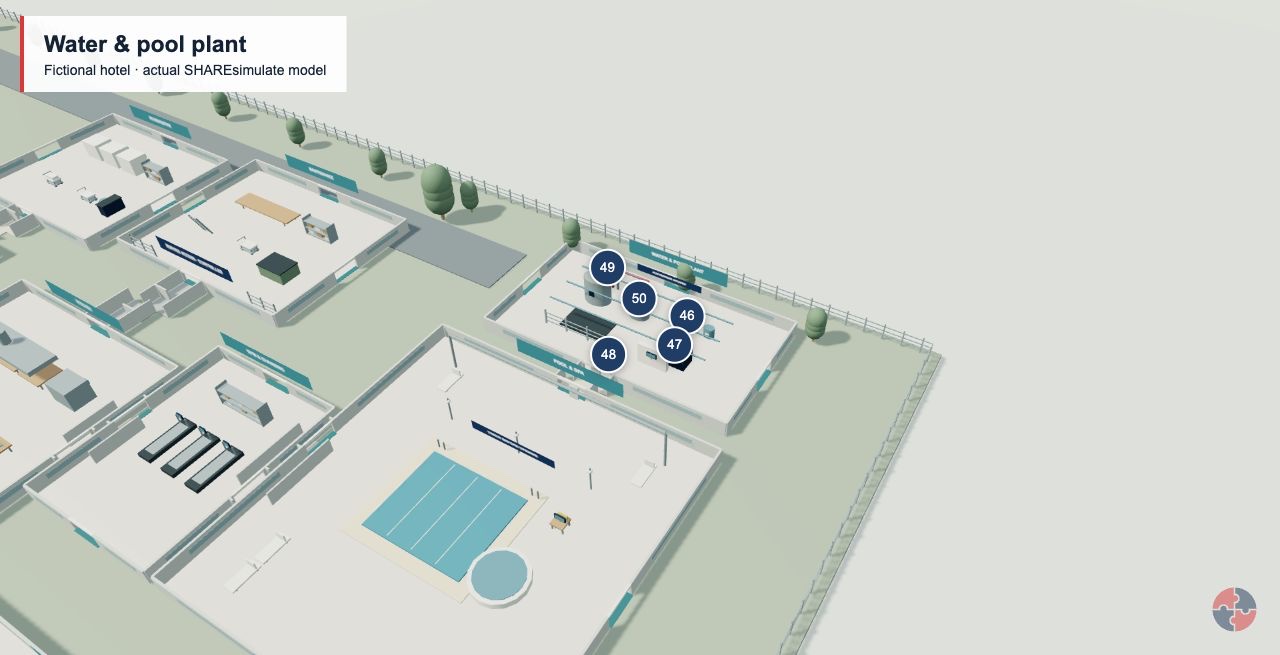
Work through 5 required applied activities and 3 model-practice pauses, with explanatory feedback and independent lesson decisions. Complete 5 distinct model mission sequences across those pauses. Use the actual fictional Riverside hotel, pool and leisure model or its equivalent accessible route to complete the required decision sequences; launching the model alone does not complete practice.
The 20-question assessment requires at least 80% plus every designated critical safety answer. Complete the required activities, practice and lesson checks. Points and badges cannot offset a critical safety error.
Use the LMS for confirmed save/resume and recorded results. Any certificate follows its configured passed-completion and grade conditions.
Open the public interactive practice copy; public practice is separate from the LMS record.
Sources and learning provenance
Original fictional cases are paired with public SHAREhub teaching and structured topic records. Use the applicable jurisdiction and primary guidance for live work.
- HSE · COSHH and cleaners
- HSE · HSG179, Health and safety in swimming pools
- HSE · maintenance of work equipment
- HSE · first aid at work
- HSE · hot and cold water systems
Topic sections, source identities and versions
| Public topic | Chunk and version | Jurisdiction and sources |
|---|---|---|
| legionella-management · control-scheme | legionella-management--control-scheme 2026-10-02-additive-1 | Great Britain, Northern Ireland legionella-management-src-01, legionella-management-src-03 |
| coshh-control-measures-and-health-surveillance · controls | coshh-control-measures-and-health-surveillance--controls 20261016-letter-review-1 | Great Britain, Northern Ireland source-coshh-hse-control, source-coshh-hse-spray, source-coshh-ni-coshh, source-coshh-hierarchy, source-coshh-mr2, source-coshh-lev-commission, share-hierarchy-iosh |
| isolation-lockout-and-line-breaking · verification | isolation-lockout-and-line-breaking--verification | Great Britain, Northern Ireland isol-legacy-01, isol-legacy-02 |
| confined-spaces-risk-management · rescue-governance | confined-spaces-risk-management--rescue-governance 20261016-letter-review-1 | Great Britain, Northern Ireland source-csrm-hse-l101, source-csrm-hse-law, source-csrm-ni-law, source-csrm-ni-acop |
Course SH-HOTEL-07 · version 2026.10.20.hotel.2. .
Questions about this course
Is this training free?
Full public teaching and readers are free without an account. A free learner account is required for saved LMS progress and recorded assessment. Completion and any course-completion certificate depend on the configured LMS conditions.
How long should I allow?
Approximately 140–210 minutes, including teaching, lesson checks, required activities, model or accessible practice and one assessment attempt. Individual pace, review and retries vary. Save and resume in the LMS.
Can I learn without a 3D-capable browser?
Yes. The complete HTML reader provides the teaching. Required model practice has an equivalent accessible decision route in the interactive course. Use the LMS route for recorded learning.
What is required to pass?
Complete the required learning, activities, practice and lesson decisions. The 20-question final assessment requires at least 80% plus every designated critical safety answer. Points cannot compensate for a critical safety error. Follow the feedback before retrying.
Does this authorise hotel or leisure work?
Independent hotel, pool and leisure awareness using the fictional Riverside model. GB workplace guidance; apply corresponding NI and nation-specific arrangements. England-specific fire guidance is labelled. Learning does not establish practical competence, clinical advice, specialist work or operational authority. This independent course does not award an external qualification or replace competent task assessment, practical training or site authorisation.