Full public teaching and readers are free without an account. A free learner account is required for saved LMS progress and recorded assessment. Completion and any course-completion certificate depend on the configured LMS conditions. Full course outline and access routes.
Lesson 1
Recognise the event before the full picture is known
Identify developing major-accident signs and give an actionable first report.
From an observation to a protective decision
A major emergency may begin as an ambiguous observation: a persistent fuel smell, an unusual pump sound, a rapidly changing tank trend or a driver reporting vapour. The absence of flames does not show that conditions are safe. A release may travel beyond its visible liquid pool, enter low points or threaten people outside the immediate work area. Start with the credible hazard and the site response triggers, rather than waiting for certainty about the initiating failure.
Your first action must fit your role and position. Raise the alarm and use the site emergency communication route promptly. Operate an emergency control only if the procedure assigns it to you and it can be reached without entering danger. Leave by the designated safe route, alert others as instructed and keep clear of the affected area. Do not walk closer to obtain a better photograph, investigate a cloud or confirm a leak by touch.
A useful report separates observation from assumption. State your identity, location, what you saw or heard, whether people are missing or injured, and any immediate threat to access or drains. Identify the product or equipment only when known. Explain which actions have been taken and from where you are calling. An uncertain tank number should be described as uncertain; false precision can send responders to the wrong location.
Crown Fuels is a learning model, not evidence of a particular legal tier or response capability. GB DSEAR requires suitable dangerous-substance emergency arrangements; COMAH adds duties where its substance inventory and thresholds apply. Northern Ireland has separate instruments and authority interfaces. At work, learn the actual alarm signals, reporting route, muster instructions and limits of your assigned role before a transfer begins.
Which scenarios should emergency preparedness cover?
Emergency preparedness should cover the major accident scenarios that could challenge people, equipment, emergency services and public protection.
A credible major accident scenario is not a vague hazard label. 'Fire' is too broad; 'bunded tank fire after overfill and vapour ignition with potential off-site smoke impact' is a scenario. 'Gas release' is too broad; 'toxic gas release during unloading with wind towards public receptor' starts to guide decisions.
Scenario selection should include initiating event, escalation route, consequences, early warning, emergency actions, resources, muster/shelter choice, isolation, responder safety, environmental pathways and recovery. The plan should also cover reasonably foreseeable low-probability, high-consequence events.
Major accident scenario prompts - Major accident scenario prompts
Scenario
Planning questions
Evidence
Loss of containment
What leaks, how quickly, where does it go?
Hazard register and isolation plan.
Toxic release
Who shelters, who warns the public, what monitoring is needed?
Toxic plume plan and communications.
Tank fire
What foam/water is needed and what runoff containment exists?
Firewater and containment checks.
Vapour cloud explosion
How are ignition, escalation and casualty zones managed?
DSEAR and emergency plan.
BLEVE or vessel heating
When is withdrawal safer than firefighting?
Pressure vessel fire scenario.
Domino escalation
Which neighbouring plant or businesses may be affected?
Layout and external interface review.
Start with the safety report and hazard studies: a tank overfill, toxic release, multiple tank fire or explosion can damage normal routes, utilities and communications. Decide which scenarios require shelter, evacuation, rescue or source control, including low-probability severe events; record assumptions that exercises must challenge. See HSE COMAH 2015 duties and emergency planning.
Applied case
At the loading area, a contractor hears a loud release and sees mist near a tanker. No flame is visible. The contractor is outside the affected area and knows the alarm point and route to the muster point. Their first report gives the gantry location and observed mist, with product identity unconfirmed.
Decision and explanation
Giving location, observations, known actions and uncertainties from a safe place.
Prompt protective action and a clear report allow the response system to act. Entering a possible flammable atmosphere or delaying for certainty can increase exposure.
Look closer
Explore the numbered equipment and control points. Existing SHAREhub teaching schematic; illustrative and not to scale.Alarm and incident control
Account for people and plant impairments through the agreed incident-control arrangements.
Beyond the site
Exercise links with responders, the local authority and affected neighbours. Use the actual emergency plan for shelter or evacuation decisions.
Changing conditions
Consider blocked access, wind, lost communications and contaminated runoff. The watercourse shows why consequences can extend beyond the fence.
01 · Read the situation
At the loading area, a contractor hears a loud release and sees mist near a tanker. No flame is visible. The contractor is outside the affected area and knows the alarm point and route to the muster point. Their first report gives the gantry location and observed mist, with product identity unconfirmed.
02 · Explain the principle
A major emergency may begin as an ambiguous observation: a persistent fuel smell, an unusual pump sound, a rapidly changing tank trend or a driver reporting vapour. The absence of flames does not show that conditions are safe. A release may travel beyond its visible liquid pool, enter low points or threaten people outside the immediate work area. Start with the credible hazard and the site response triggers, rather than waiting for certainty about the initiating failure.
03 · Carry it into work
Prompt protective action and a clear report allow the response system to act. Entering a possible flammable atmosphere or delaying for certainty can increase exposure.
Lesson 2
Plan access, routes and accountability together
Explain how the site protects escape, responder access and reliable accountability.
Access is an emergency barrier
An emergency route has more than one purpose. People need a safe way out while responders need an agreed way in. A parked tanker, delivery queue or locked gate can delay access to critical equipment and casualties. Treat route protection as a routine operational task: know who controls the gate, how authorised responders gain entry and how alternative access is communicated when the normal approach is affected.
An assembly point is useful only while its location remains safe for the event. A windsock shows local wind direction at that moment; it does not map the full vapour or smoke hazard. Buildings, terrain, turbulence and a changing release affect dispersion. Follow the site plan and command instructions for safe routes, shelter or relocation. Never use the windsock as permission to cross an incident zone or approach from a supposedly safe side.
Accountability must cover employees, visitors, contractors and drivers, including people temporarily away from their usual area. Report at the designated point and provide accurate information about anyone believed missing and their last known location. Distinguish a confirmed observation from an assumption based on an old sign-in list. A missing name is important intelligence for command; it is not an instruction for colleagues to search an unsafe area.
Good preparation tests the information chain as well as the movement of people. Ask whether an out-of-hours driver can understand the alarm, whether a visitor with limited mobility has an appropriate arrangement, and whether the gate team can pass current access restrictions to arriving responders. Exercise findings should lead to practical changes, with clear responsibility and evidence that the changed arrangement works.
What should emergency procedures tell people to do?
Emergency procedures should tell each role how to raise the alarm, protect people, call help, reach safety and hand over without improvisation.
Procedures should avoid long paragraphs at the moment of need. People need to know how to raise the alarm, leave or shelter, call emergency services, find first aid, account for people, keep access clear, stop unsafe work, support visitors and prevent re-entry until authorised.
Where activities have specific hazards, procedures should include details such as isolating electricity, using spill kits, decontamination, rescue restrictions, chemical SDS information, lock-off, emergency shutoffs or escalation to specialist responders.
Test instructions on the late shift and with a blocked normal route. Identify who controls the incident, who meets responders and who confirms that the area is safe before restart.
Applied case
A tanker awaiting documents blocks the emergency entrance. During an alarm the ordinary muster point is downwind of smoke. The gate marshal reports both facts through the agreed channel; command selects the preplanned alternative approach and assembly arrangement. Drivers remain accounted for rather than moving vehicles without instruction.
Decision and explanation
Give command the last known location and reliable information, and remain in the safe area.
Accountability informs an organised rescue decision. Unauthorised entry can create additional casualties and make the original search harder.
Look closer
Photorealistic illustrative UK workplace scene. Review checks: No current needs assessment: Provision may not match real risk. First aider absent: Immediate help delayed. Kit empty or inaccessible: Treatment delayed.01 · Read the situation
A tanker awaiting documents blocks the emergency entrance. During an alarm the ordinary muster point is downwind of smoke. The gate marshal reports both facts through the agreed channel; command selects the preplanned alternative approach and assembly arrangement. Drivers remain accounted for rather than moving vehicles without instruction.
02 · Explain the principle
An emergency route has more than one purpose. People need a safe way out while responders need an agreed way in. A parked tanker, delivery queue or locked gate can delay access to critical equipment and casualties. Treat route protection as a routine operational task: know who controls the gate, how authorised responders gain entry and how alternative access is communicated when the normal approach is affected.
03 · Carry it into work
Accountability informs an organised rescue decision. Unauthorised entry can create additional casualties and make the original search harder.
Lesson 3
Build a shared command picture
Distinguish useful operational intelligence from competing or improvised instructions.
One coherent picture across interfaces
An incident creates several urgent demands at once: protecting people, stabilising plant, keeping access available, informing responders and limiting pollution. These demands can conflict if each team acts on a different picture. The emergency plan should identify who starts the response, who coordinates it and how authority transfers or is shared with external responders. An ordinary worker supports that structure by using the nominated reporting route and following current instructions.
Operational intelligence should be concise and relevant to the next decision. Useful information includes the affected equipment and substances, possible inventories, isolation status, known impairments, people at risk and routes that are no longer usable. Drawings and safety data can help responders when accurate and available. Do not overwhelm the contact point with unverified detail, or assume that an emergency stop has isolated every possible source of product or energy.
Off-site consequences need a planned interface. Where GB upper-tier COMAH duties apply, the operator prepares the internal plan and supplies information for the local authority’s external plan. Northern Ireland arrangements involve the NI competent authority. Other sites still need arrangements proportionate to their hazards. The course does not classify the fictional terminal. At any real site, use its confirmed arrangements for neighbouring premises, public information and environmental notification.
Communication should remain two-way as conditions change. Repeat back safety-critical instructions where the procedure requires it, record important updates and identify who needs to know that an assumption has changed. A road closure, loss of firewater or missing-person correction can alter the response. Public statements and warnings should come through authorised arrangements; personal social-media updates can create confusion and reveal incomplete information.
How should incident command be structured?
Incident command should define who is in control, how information is logged and how decisions are escalated.
The command structure should be simple enough to work under pressure. For a small site, this may be a duty manager with deputies. For a process site, it may include site incident controller, technical adviser, emergency response leader, communications lead, security/access lead, muster coordinator and senior strategic command.
The command role should not be given to someone only because they are senior. Command requires site knowledge, calm decision-making, authority, communication discipline and training in the emergency plan.
Incident command roles - Incident command roles
Role
Command responsibility
Evidence of readiness
Site incident controller
Sets priorities, directs response and coordinates handover.
Training, rota, exercises and command log.
Technical adviser
Explains plant, substances, isolation, escalation and safe shutdown.
Competence record and emergency information pack.
Emergency response team leader
Controls trained responders and equipment.
Team training and equipment checks.
Muster coordinator
Accounts for people and escalates missing-person information.
Muster drill and roll-call record.
Communications lead
Manages internal updates, emergency contacts and external messages.
Contact list tests and message templates.
Strategic manager
Supports business, regulatory, recovery and resource decisions.
Crisis exercise and leadership review.
The site incident controller manages the operator response and handover. Emergency services command their own response on arrival; the site must keep an accurate shared picture rather than issuing conflicting instructions. See HSE COMAH emergency arrangements inspector guidance.
Applied case
The first report says a small pump leak. A later field report identifies increasing release and a nearby open drain. The control-room contact updates command with the changing conditions, known shutdown status and pollution pathway. The original description is corrected rather than repeated as settled fact.
Decision and explanation
A verified change that threatens the responder access route.
Command needs current hazard and access information to make protective decisions. Blame and uncontrolled public messages do not stabilise the response.
Look closer
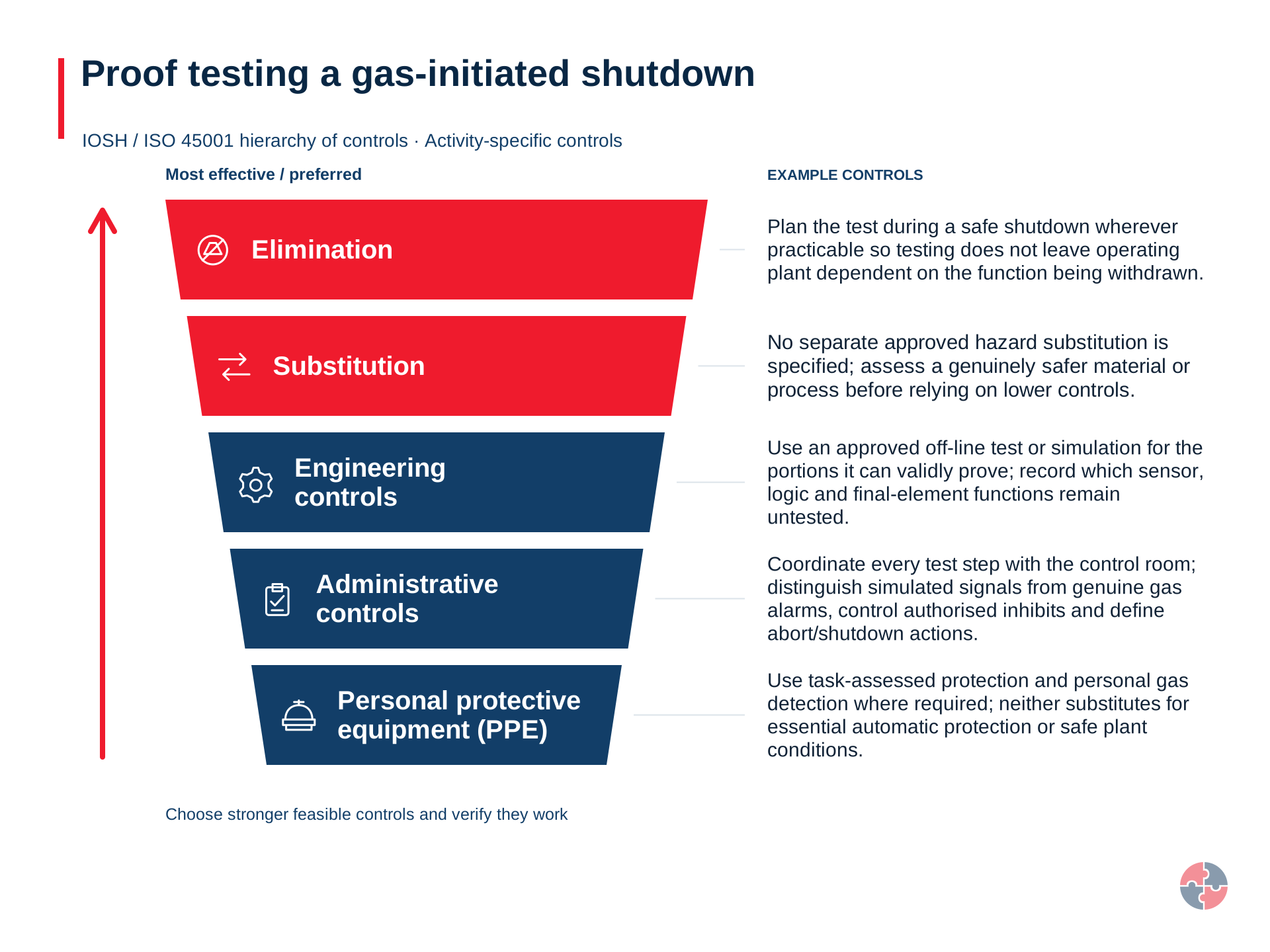
Photorealistic illustrative UK workplace scene. Review checks: Elimination: Plan the test during a safe shutdown wherever practicable so testing does not leave operating plant dependent on the function being withdrawn. Engineering controls: Use an approved off-line test or simulation for the portions it can validly prove; record which sensor, logic and final-element functions remain untested. Engineering controls: Place affected equipment in the required safe state and control energy, inventory and access around moving shutdown equipment. Engineering controls: Use the approved test facilities and verify the required sensor, logic, alarm and final-element actions against the safety-function specification. Administrative controls: Coordinate every test step with the control room; distinguish simulated signals from genuine gas alarms, control authorised inhibits and define abort/shutdown actions.01 · Read the situation
The first report says a small pump leak. A later field report identifies increasing release and a nearby open drain. The control-room contact updates command with the changing conditions, known shutdown status and pollution pathway. The original description is corrected rather than repeated as settled fact.
02 · Explain the principle
An incident creates several urgent demands at once: protecting people, stabilising plant, keeping access available, informing responders and limiting pollution. These demands can conflict if each team acts on a different picture. The emergency plan should identify who starts the response, who coordinates it and how authority transfers or is shared with external responders. An ordinary worker supports that structure by using the nominated reporting route and following current instructions.
03 · Carry it into work
Command needs current hazard and access information to make protective decisions. Blame and uncontrolled public messages do not stabilise the response.
Lesson 4
Separate safe assistance, re-entry and restart
Fire classes and fire extinguishersFire classes · agent types · dangerous mismatches
Recognise the fuel. Read the extinguisher. Protect your escape.
People and escape first. Raise the alarm, follow the site’s evacuation plan and arrange the emergency call to 999. Only consider a small fire in its earliest stage if you are trained, authorised, have the correct equipment and a clear escape behind you. Smoke, spreading fire, uncertainty or an unsafe approach mean withdraw. Never delay escape to fetch an extinguisher.
UK awareness reference for common and specialist portable extinguisher families. Actual ratings, exclusions and manufacturer instructions govern each unit. Reading this guide is not practical training or permission to fight a fire. Fixed systems, hose reels and specialist industrial firefighting require their own assessed arrangements.
Terminal response: protect escape and give responders accurate product information. A handheld extinguisher is not a response to a developing tank or loading-rack fire.
Fire classes: fuel, examples and the important distinction
Class
Fuel and examples
What matters
AClass A
Solid materials
Wood, paper, textiles and many solid plastics.
Usually forms an ember or char bed. Cooling matters; check the marked A rating.
BClass B
Flammable liquids
Petrol, solvents, diesel when burning, and liquefiable solids such as wax.
Fuel can spread across a surface. An unsuitable jet can spread burning liquid; solvent compatibility matters.
CClass C
Flammable gases
Propane, butane or methane.
Not a routine employee firefighting task. Knocking down flame while gas continues to escape can create an explosive cloud. Fuel isolation requires safe, competent action under the emergency plan.
DClass D
Combustible metals
Magnesium, sodium or metallic lithium.
Needs a metal-specific specialist agent. Ordinary ABC powder is not Class D powder.
FClass F
Cooking oils and fats
Hot oil in a fryer or pan.
Very hot oil can reignite. Water can produce violent steam expansion and eject burning oil.
LClass L
Lithium-ion batteries
A lithium-ion tool, e-bike or vehicle battery in thermal runaway.
Class L is included in BS ISO 3941:2026. Toxic or flammable gas, heat propagation and reignition need specialist planning. This is different from a metallic-lithium Class D fire.
Electrical equipment: Energised electrical equipment is an additional hazard, not a UK fire class called E. Do not import US Class C electrical or Class K cooking labels into this UK guide. Isolation, only where safe and authorised, does not remove the burning fuel or stored battery energy. Use the unit’s explicit electrical suitability and limitations.
Class L is the 2026 addition to the classification standard. Existing extinguisher labels and product test claims vary; a new class name does not certify every battery product.
Compare the classes · including lithium-ion batteries
Typical = usual application for the labelled family. If rated / unit limits = confirm the actual label and manufacturer conditions. No = not a normal selection for that hazard; specialist engineered arrangements are separate. This table cannot authorise firefighting.
* Electrical is an additional hazard, not a fire class. Gas-fire and battery-fire response require the assessed specialist plan. Scroll the table sideways on a narrow screen.
Typical portable-agent applications: always confirm the actual unit
Agent family
A · solids
B · liquids
C · gases
D · metals
Electrical*
F · cooking oil
L · Li-ion
Water
Typical
No
No
No
Unit limits
No
No
Water spray / water with additives
Typical
If rated
No
No
Unit limits
No
No
Foam
Typical
Typical
No
No
Unit limits
No
No
Water mist
Typical
If rated
No
No
Unit limits
If rated
Specialist plan
ABC dry powder
Typical
Typical
Specialist plan
No
Unit limits
No
No
BC dry powder
No
Typical
Specialist plan
No
Unit limits
No
No
Class D specialist powder
No
No
No
Exact metal
No
No
No
Carbon dioxide (CO₂)
No
Typical
No
No
Unit limits
No
No
Wet chemical
If rated
If rated
No
No
Unit limits
Typical
No
Clean agent / vaporising liquid
Unit rating
Unit rating
No
No
Unit limits
No
No
Battery-specific suppression products
If rated
No
No
No
Unit limits
No
Specified battery
Extinguisher types: uses and dangers
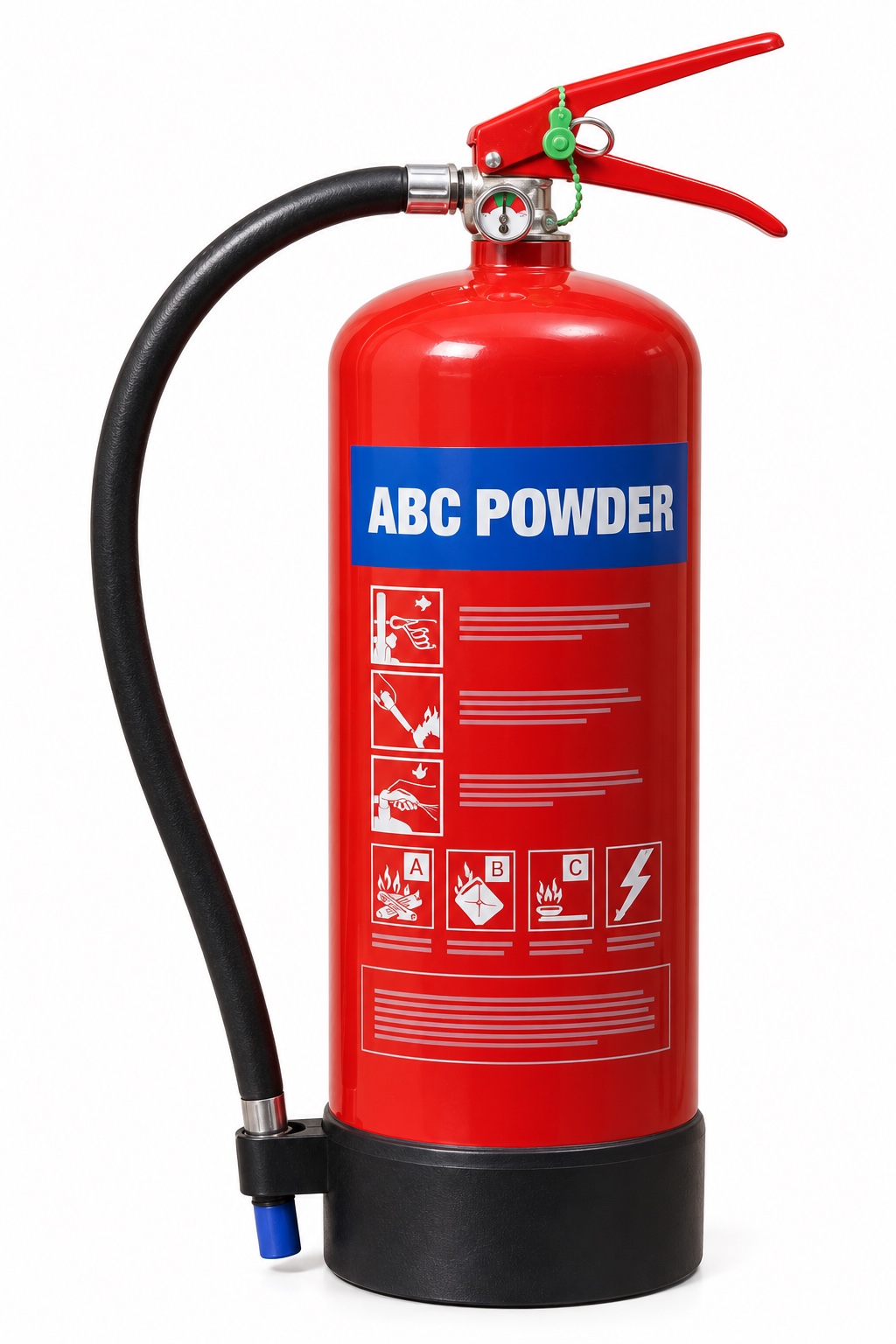
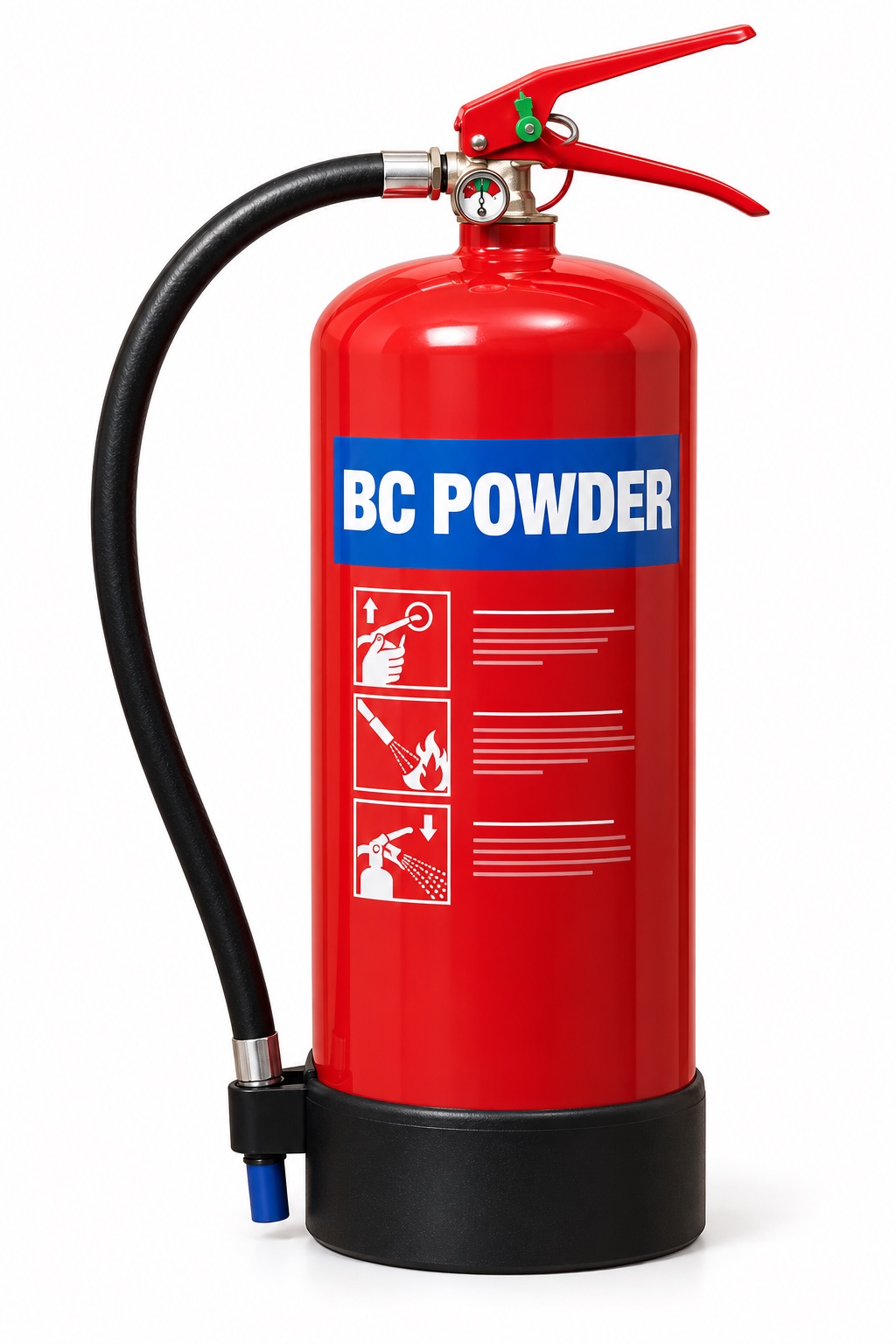
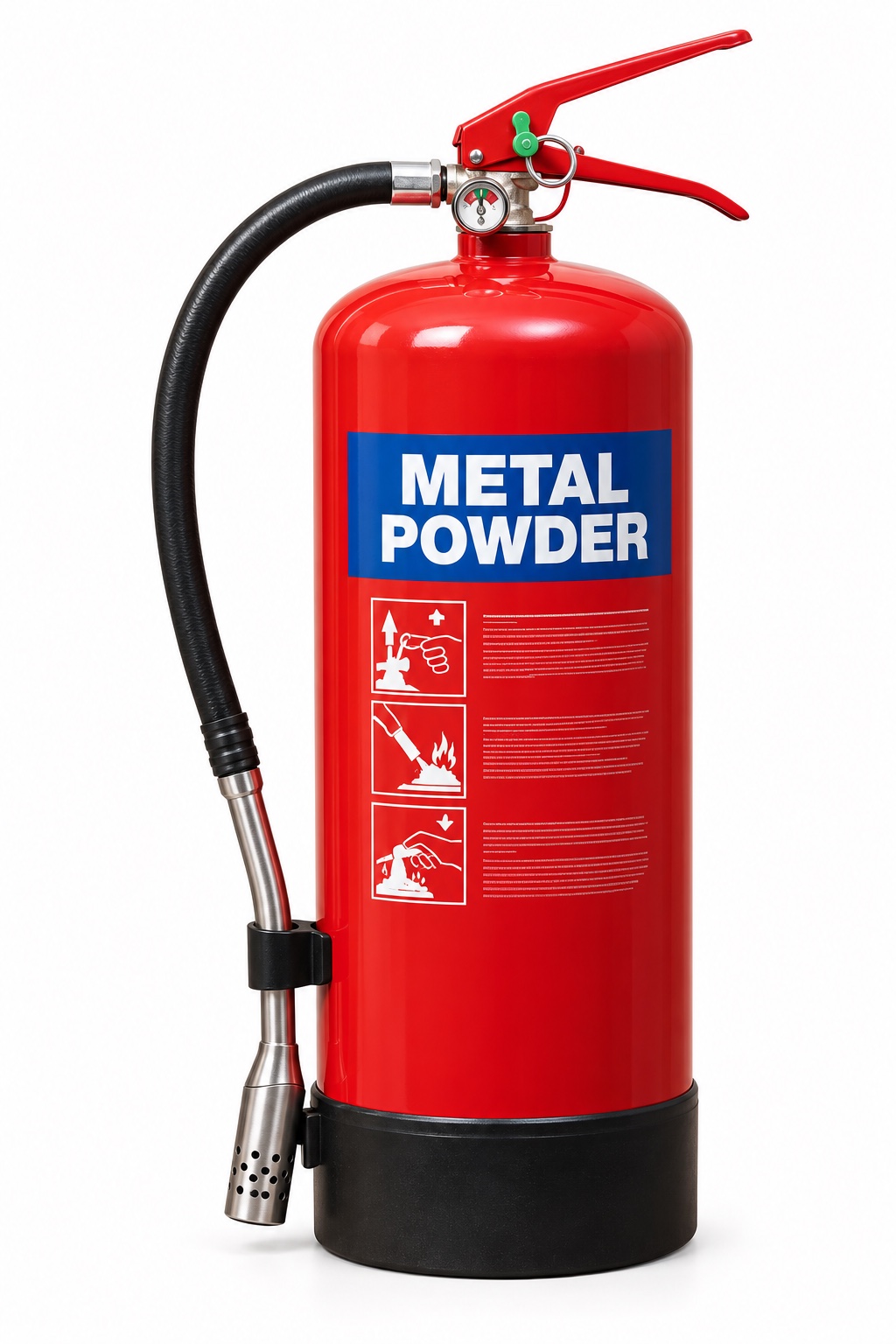
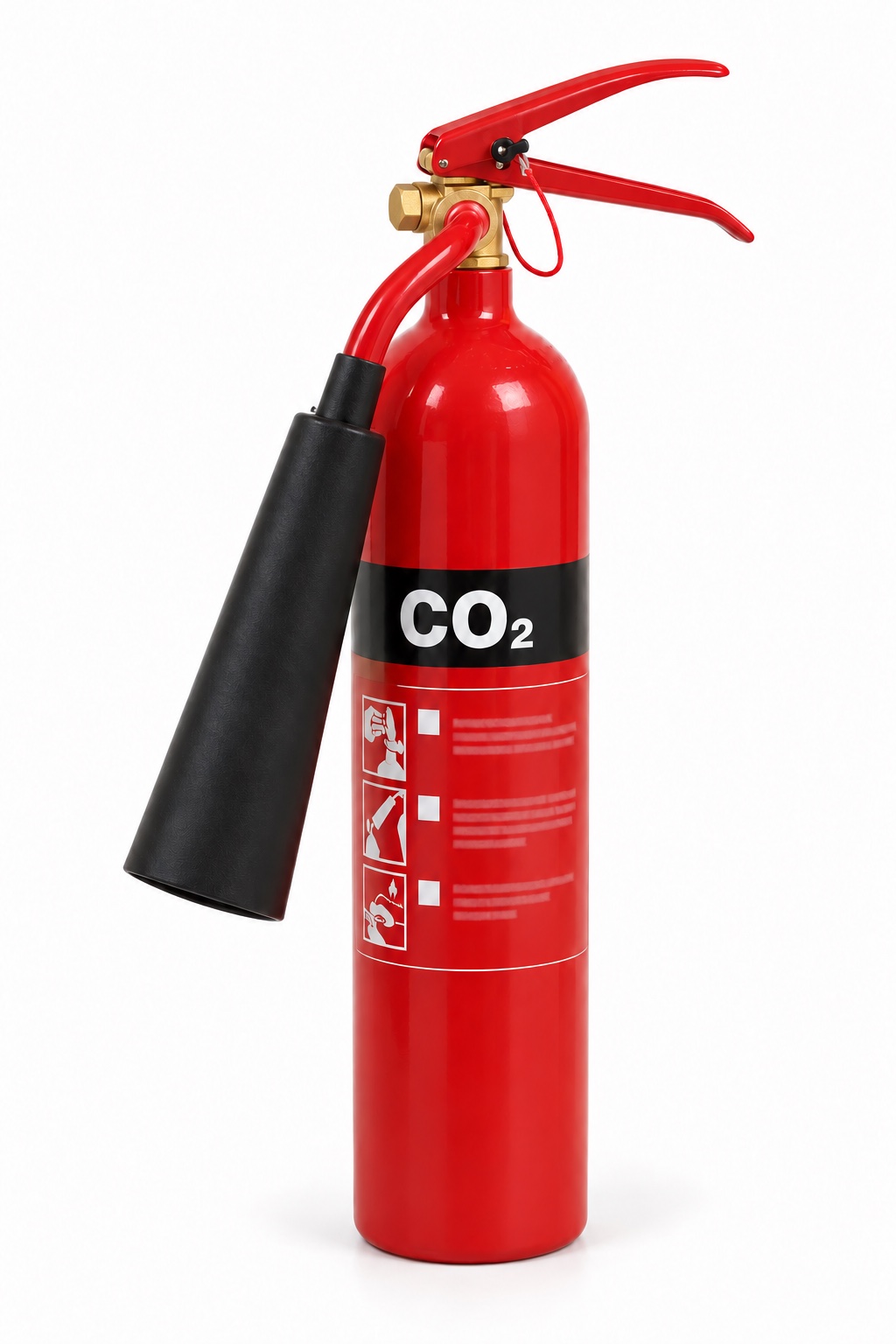
These are typical applications, not universal permissions. Check the label on the actual unit. Images are photorealistic teaching illustrations inspired by the referenced equipment; they are not photographs or certified product labels. Use Inspect the parts to explore the hardware. Band, nozzle and label details vary.
Common and specialist portable extinguisher families
Type and recognition
Typical rating and use
Wrong use: what can go wrong?
Parts in text
Cylinder
The pressure vessel holds the agent and propellant as designed. Report corrosion, dents or other damage. Do not open, refill or repair it as an awareness check.
Agent name and colour marking
Read the actual agent name, fire ratings, electrical warnings and instructions. Colour is a recognition aid; it does not prove suitability. The illustration is not an operating label.
Fixed carrying handle
The lower fixed handle supports the unit. It is different from the upper operating lever. The exact grip and operation belong in practical instruction for the model.
Operating / squeeze lever
The upper lever operates the discharge valve when the safety device is released. Do not squeeze or discharge a unit to test it during a routine visual check.
Safety pin and pull ring
The pin mechanically prevents accidental operation. A pin or ring that is missing, distorted or insecure needs reporting; its presence does not prove the unit is serviceable.
Tamper indicator / snap-lock seal
The breakable indicator or snap-lock seal shows possible disturbance. Designs can use a separate pin-retaining strap or a pin-mounted indicator. It is different from the mechanical safety pin and is not a theft lock. Report it if broken or missing.
Pressure gauge
On this stored-pressure example the gauge indicates pressure, not the mass of agent remaining. A pointer in the marked range does not prove the cylinder is full or the unit has passed its service checks.
Hose, nozzle or applicator
The flexible hose ends in the model’s discharge nozzle. The clip is for stowage; a hose being clipped in place is not a service check. Do not block, detach or test-discharge it during a visual inspection.
Base / protective boot
The boot protects the base on this example. Other models have a different foot arrangement or no separate boot. Check the approved mounting and access rather than guessing from the picture.
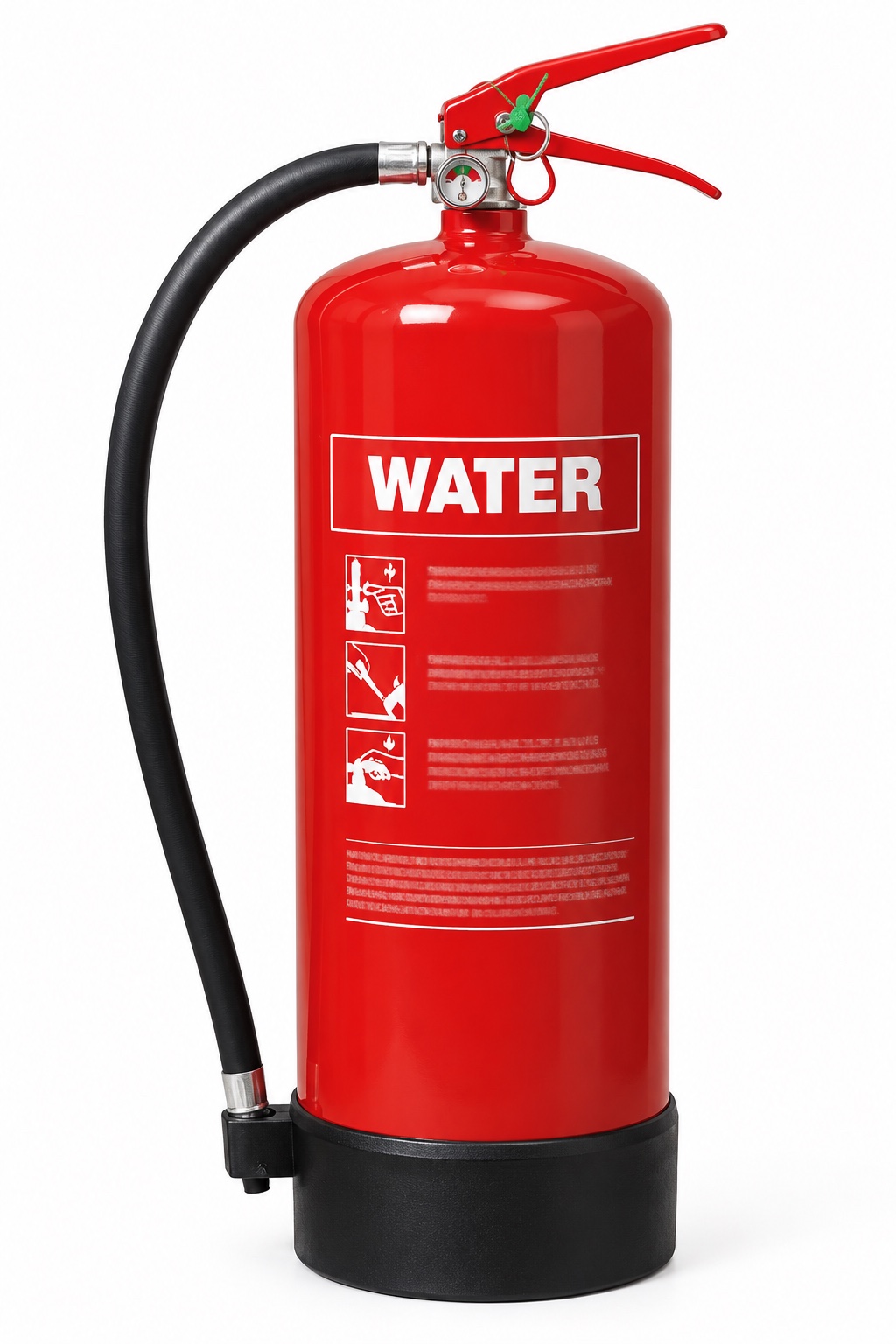
WaterRed / WATER marking
Normally A
Cools burning solid material such as paper, wood or fabric.
Check the limitation
Ordinary water is unsuitable for live electrical equipment, flammable-liquid pools, cooking oil and reactive metals: shock, spreading fuel or violent reaction can result.
Parts in text
Cylinder
The pressure vessel holds the agent and propellant as designed. Report corrosion, dents or other damage. Do not open, refill or repair it as an awareness check.
Agent name and colour marking
Read the actual agent name, fire ratings, electrical warnings and instructions. Colour is a recognition aid; it does not prove suitability. The illustration is not an operating label.
Fixed carrying handle
The lower fixed handle supports the unit. It is different from the upper operating lever. The exact grip and operation belong in practical instruction for the model.
Operating / squeeze lever
The upper lever operates the discharge valve when the safety device is released. Do not squeeze or discharge a unit to test it during a routine visual check.
Safety pin and pull ring
The pin mechanically prevents accidental operation. A pin or ring that is missing, distorted or insecure needs reporting; its presence does not prove the unit is serviceable.
Tamper indicator / snap-lock seal
The breakable indicator or snap-lock seal shows possible disturbance. Designs can use a separate pin-retaining strap or a pin-mounted indicator. It is different from the mechanical safety pin and is not a theft lock. Report it if broken or missing.
Pressure gauge
On this stored-pressure example the gauge indicates pressure, not the mass of agent remaining. A pointer in the marked range does not prove the cylinder is full or the unit has passed its service checks.
Hose, nozzle or applicator
The flexible hose ends in the model’s discharge nozzle. The clip is for stowage; a hose being clipped in place is not a service check. Do not block, detach or test-discharge it during a visual inspection.
Base / protective boot
The boot protects the base on this example. Other models have a different foot arrangement or no separate boot. Check the approved mounting and access rather than guessing from the picture.
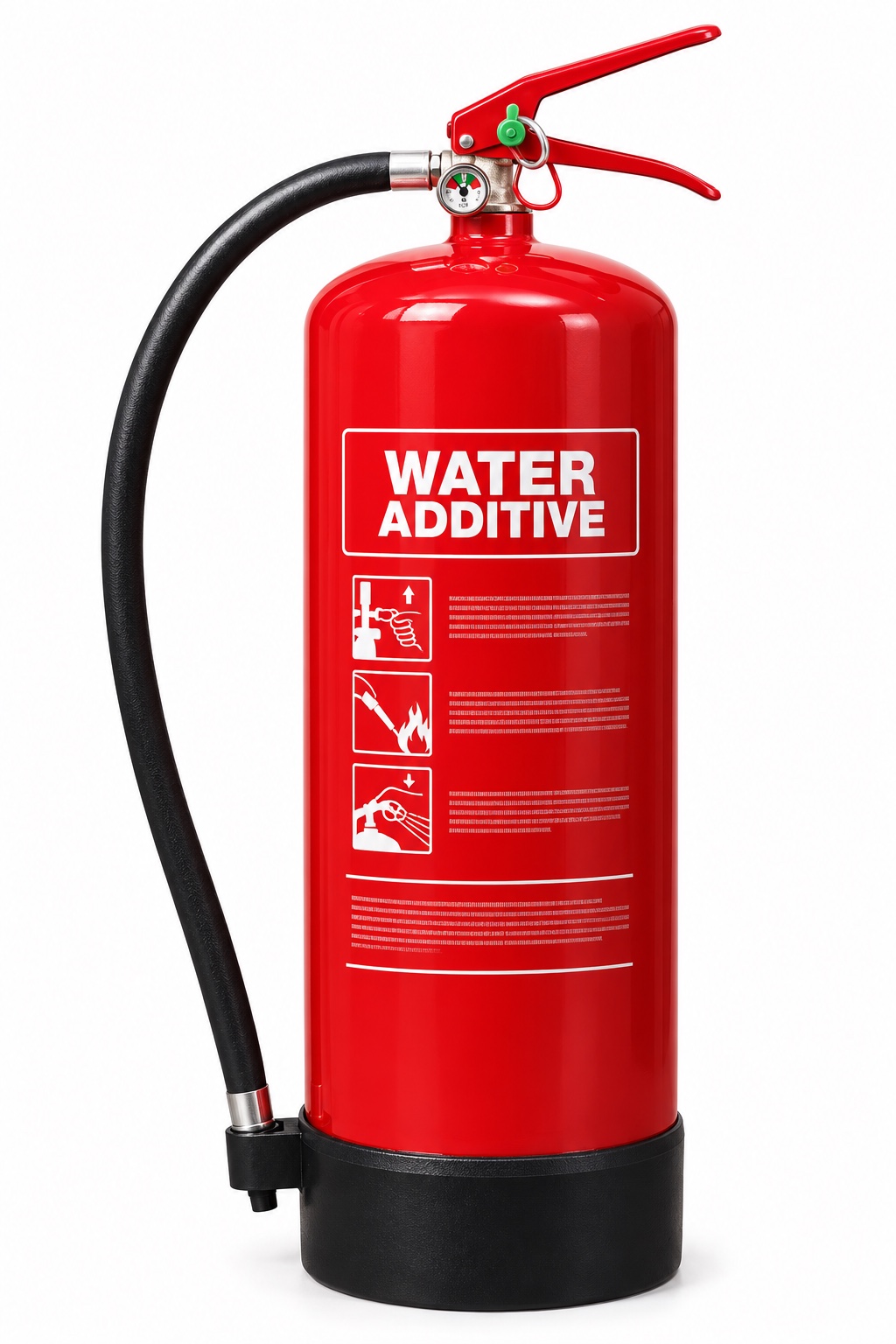
Water spray / water with additivesUsually red; read the agent name
A; B only if explicitly rated
Improved wetting or spray performance can help on the hazards stated on that model’s label.
Check the limitation
An additive does not make every water extinguisher safe for electricity, oils or reactive chemicals. Check the specific exclusions.
Parts in text
Cylinder
The pressure vessel holds the agent and propellant as designed. Report corrosion, dents or other damage. Do not open, refill or repair it as an awareness check.
Agent name and colour marking
Read the actual agent name, fire ratings, electrical warnings and instructions. Colour is a recognition aid; it does not prove suitability. The illustration is not an operating label.
Fixed carrying handle
The lower fixed handle supports the unit. It is different from the upper operating lever. The exact grip and operation belong in practical instruction for the model.
Operating / squeeze lever
The upper lever operates the discharge valve when the safety device is released. Do not squeeze or discharge a unit to test it during a routine visual check.
Safety pin and pull ring
The pin mechanically prevents accidental operation. A pin or ring that is missing, distorted or insecure needs reporting; its presence does not prove the unit is serviceable.
Tamper indicator / snap-lock seal
The breakable indicator or snap-lock seal shows possible disturbance. Designs can use a separate pin-retaining strap or a pin-mounted indicator. It is different from the mechanical safety pin and is not a theft lock. Report it if broken or missing.
Pressure gauge
On this stored-pressure example the gauge indicates pressure, not the mass of agent remaining. A pointer in the marked range does not prove the cylinder is full or the unit has passed its service checks.
Direct spray nozzle
This compact foam example has a nozzle attached directly to the valve. Larger units may have a hose. Recognise the actual discharge arrangement and use only the approved agent and instructions.
Base / protective boot
The boot protects the base on this example. Other models have a different foot arrangement or no separate boot. Check the approved mounting and access rather than guessing from the picture.
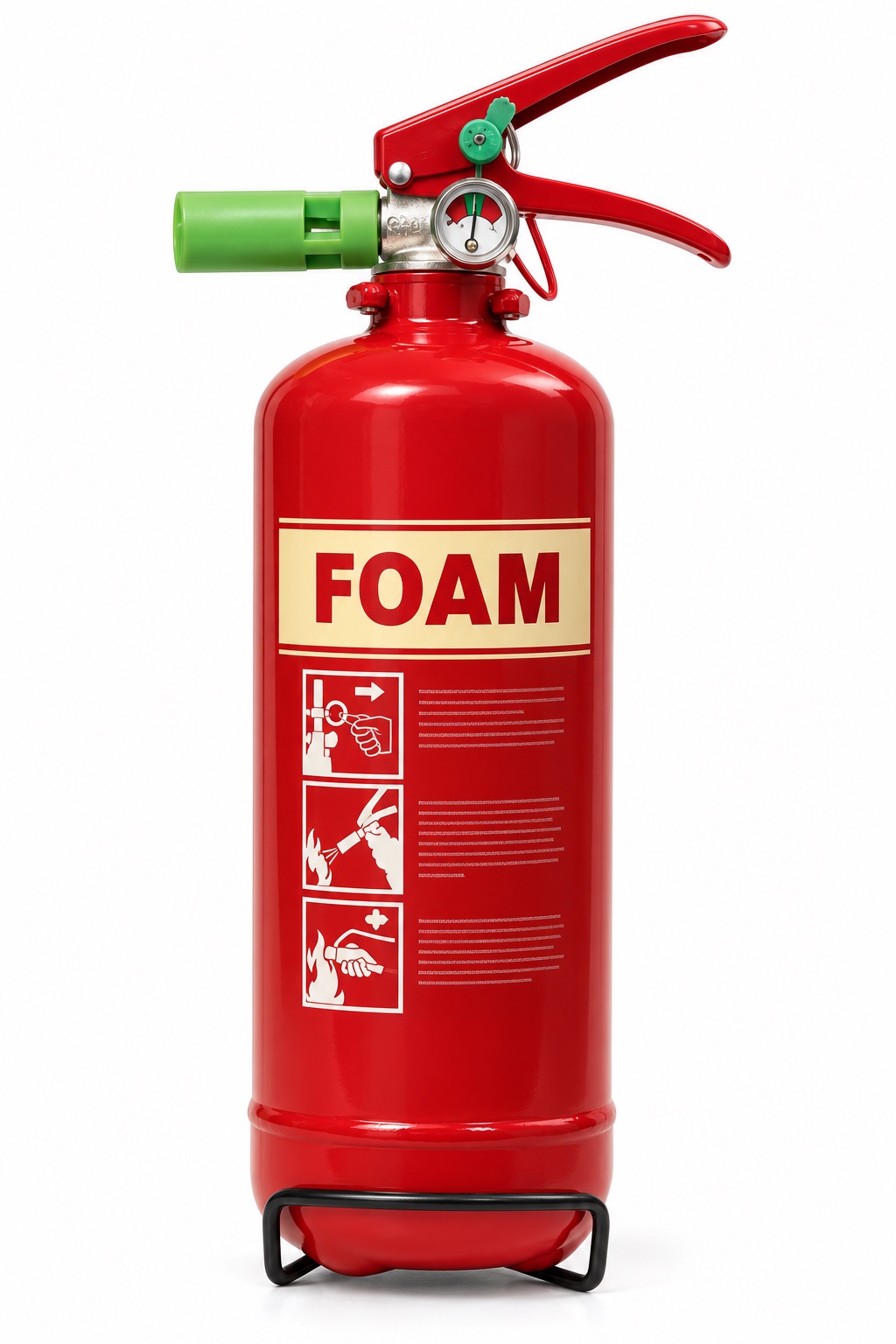
FoamCream panel / FOAM
Commonly A and B
Cools and forms a surface blanket on suitable liquid fires. The agent must suit the actual fuel; some alcohols need alcohol-resistant foam.
Check the limitation
Ordinary foam is not a general answer for live electricity, cooking oil or metal fires. Unsuitable foam may break down on a solvent; a jet can spread fuel. Free-flowing fuel needs specialist response.
Parts in text
Cylinder
The pressure vessel holds the agent and propellant as designed. Report corrosion, dents or other damage. Do not open, refill or repair it as an awareness check.
Agent name and colour marking
Read the actual agent name, fire ratings, electrical warnings and instructions. Colour is a recognition aid; it does not prove suitability. The illustration is not an operating label.
Fixed carrying handle
The lower fixed handle supports the unit. It is different from the upper operating lever. The exact grip and operation belong in practical instruction for the model.
Operating / squeeze lever
The upper lever operates the discharge valve when the safety device is released. Do not squeeze or discharge a unit to test it during a routine visual check.
Safety pin and pull ring
The pin mechanically prevents accidental operation. A pin or ring that is missing, distorted or insecure needs reporting; its presence does not prove the unit is serviceable.
Tamper indicator / snap-lock seal
The breakable indicator or snap-lock seal shows possible disturbance. Designs can use a separate pin-retaining strap or a pin-mounted indicator. It is different from the mechanical safety pin and is not a theft lock. Report it if broken or missing.
Pressure gauge
On this stored-pressure example the gauge indicates pressure, not the mass of agent remaining. A pointer in the marked range does not prove the cylinder is full or the unit has passed its service checks.
Fine-mist nozzle
The specially designed nozzle creates the intended fine spray. It is not an ordinary water jet. Nozzle appearance alone does not establish any tested electrical suitability.
Base / protective boot
The boot protects the base on this example. Other models have a different foot arrangement or no separate boot. Check the approved mounting and access rather than guessing from the picture.
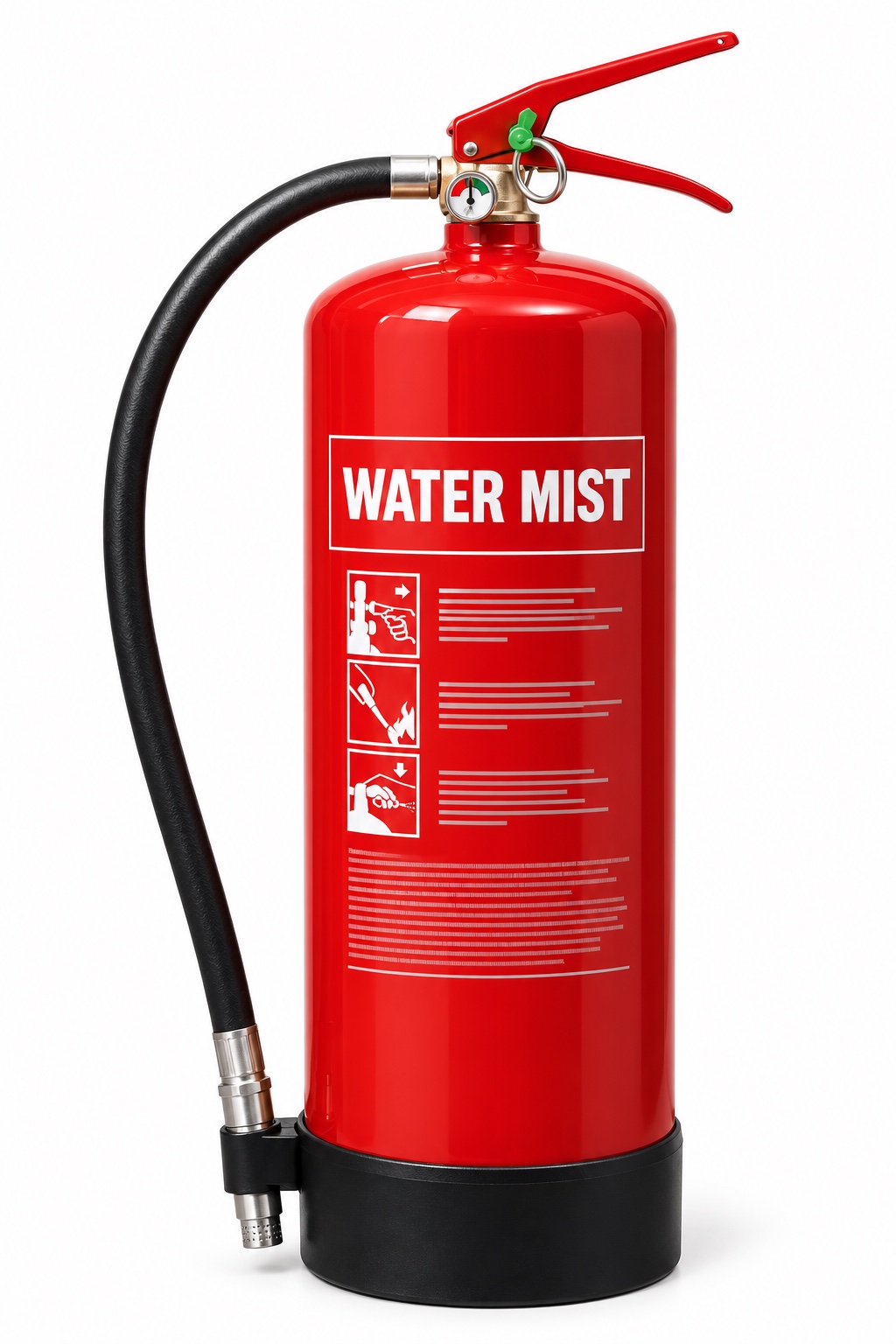
Water mistManufacturer marking varies
Model-specific; commonly A, some F
Fine droplets absorb heat. Some products have additional ratings or tested electrical suitability, with stated voltage and distance conditions.
Check the limitation
‘Mist’ is not universal approval. Use only the classes and electrical conditions actually declared for that model; do not assume it covers metals, liquids or batteries.
Parts in text
Cylinder
The pressure vessel holds the agent and propellant as designed. Report corrosion, dents or other damage. Do not open, refill or repair it as an awareness check.
Agent name and colour marking
Read the actual agent name, fire ratings, electrical warnings and instructions. Colour is a recognition aid; it does not prove suitability. The illustration is not an operating label.
Fixed carrying handle
The lower fixed handle supports the unit. It is different from the upper operating lever. The exact grip and operation belong in practical instruction for the model.
Operating / squeeze lever
The upper lever operates the discharge valve when the safety device is released. Do not squeeze or discharge a unit to test it during a routine visual check.
Safety pin and pull ring
The pin mechanically prevents accidental operation. A pin or ring that is missing, distorted or insecure needs reporting; its presence does not prove the unit is serviceable.
Tamper indicator / snap-lock seal
The breakable indicator or snap-lock seal shows possible disturbance. Designs can use a separate pin-retaining strap or a pin-mounted indicator. It is different from the mechanical safety pin and is not a theft lock. Report it if broken or missing.
Pressure gauge
On this stored-pressure example the gauge indicates pressure, not the mass of agent remaining. A pointer in the marked range does not prove the cylinder is full or the unit has passed its service checks.
Hose, nozzle or applicator
The flexible hose ends in the model’s discharge nozzle. The clip is for stowage; a hose being clipped in place is not a service check. Do not block, detach or test-discharge it during a visual inspection.
Base / protective boot
The boot protects the base on this example. Other models have a different foot arrangement or no separate boot. Check the approved mounting and access rather than guessing from the picture.
ABC dry powderBlue panel / ABC POWDER
A, B and C if marked
Interrupts flame chemistry; multipurpose powder also acts on Class A material. A C marking does not authorise tackling a gas leak.
Check the limitation
Powder can obscure escape and impair breathing; it is not generally recommended indoors. Limited cooling allows reignition. It is not metal-specific D powder or a substitute for F-rated cooking-oil equipment.
Parts in text
Cylinder
The pressure vessel holds the agent and propellant as designed. Report corrosion, dents or other damage. Do not open, refill or repair it as an awareness check.
Agent name and colour marking
Read the actual agent name, fire ratings, electrical warnings and instructions. Colour is a recognition aid; it does not prove suitability. The illustration is not an operating label.
Fixed carrying handle
The lower fixed handle supports the unit. It is different from the upper operating lever. The exact grip and operation belong in practical instruction for the model.
Operating / squeeze lever
The upper lever operates the discharge valve when the safety device is released. Do not squeeze or discharge a unit to test it during a routine visual check.
Safety pin and pull ring
The pin mechanically prevents accidental operation. A pin or ring that is missing, distorted or insecure needs reporting; its presence does not prove the unit is serviceable.
Tamper indicator / snap-lock seal
The breakable indicator or snap-lock seal shows possible disturbance. Designs can use a separate pin-retaining strap or a pin-mounted indicator. It is different from the mechanical safety pin and is not a theft lock. Report it if broken or missing.
Pressure gauge
On this stored-pressure example the gauge indicates pressure, not the mass of agent remaining. A pointer in the marked range does not prove the cylinder is full or the unit has passed its service checks.
Hose, nozzle or applicator
The flexible hose ends in the model’s discharge nozzle. The clip is for stowage; a hose being clipped in place is not a service check. Do not block, detach or test-discharge it during a visual inspection.
Base / protective boot
The boot protects the base on this example. Other models have a different foot arrangement or no separate boot. Check the approved mounting and access rather than guessing from the picture.
BC dry powderBlue panel / BC POWDER
B and C if marked; not A
Selected for particular liquid or gas hazards under the assessed plan. Electrical use must follow the actual unit’s instructions.
Check the limitation
Do not assume all blue powder extinguishers protect wood or paper. It has the visibility, breathing and reignition limitations of powder; it does not provide Class D or F protection.
Parts in text
Cylinder
The pressure vessel holds the agent and propellant as designed. Report corrosion, dents or other damage. Do not open, refill or repair it as an awareness check.
Agent name and colour marking
Read the actual agent name, fire ratings, electrical warnings and instructions. Colour is a recognition aid; it does not prove suitability. The illustration is not an operating label.
Fixed carrying handle
The lower fixed handle supports the unit. It is different from the upper operating lever. The exact grip and operation belong in practical instruction for the model.
Operating / squeeze lever
The upper lever operates the discharge valve when the safety device is released. Do not squeeze or discharge a unit to test it during a routine visual check.
Safety pin and pull ring
The pin mechanically prevents accidental operation. A pin or ring that is missing, distorted or insecure needs reporting; its presence does not prove the unit is serviceable.
Tamper indicator / snap-lock seal
The breakable indicator or snap-lock seal shows possible disturbance. Designs can use a separate pin-retaining strap or a pin-mounted indicator. It is different from the mechanical safety pin and is not a theft lock. Report it if broken or missing.
Pressure gauge
On this stored-pressure example the gauge indicates pressure, not the mass of agent remaining. A pointer in the marked range does not prove the cylinder is full or the unit has passed its service checks.
Specialist low-velocity applicator
The specialist applicator places the compatible metal-fire agent without unnecessarily disturbing burning material. Both agent and application method must suit the specific metal; this is not an ABC powder nozzle.
Base / protective boot
The boot protects the base on this example. Other models have a different foot arrangement or no separate boot. Check the approved mounting and access rather than guessing from the picture.
Class D specialist powderSpecific metal and agent named on label
D, for the specified metal
A specialist powder can isolate or absorb heat from a compatible burning metal. Selection requires knowledge of the metal and its form.
Check the limitation
The wrong powder can fail or react. Water, foam and CO₂ can be dangerous on certain burning metals. A powder suitable for magnesium is not automatically suitable for metallic lithium.
Parts in text
Cylinder
The narrow steel cylinder contains carbon dioxide under pressure. There is normally no pressure gauge on this portable type; service assessment includes the appropriate mass and integrity checks by competent personnel.
Agent name and colour marking
Read the actual agent name, fire ratings, electrical warnings and instructions. Colour is a recognition aid; it does not prove suitability. The illustration is not an operating label.
Fixed carrying handle
The lower fixed handle supports the unit. It is different from the upper operating lever. The exact grip and operation belong in practical instruction for the model.
Operating / squeeze lever
The upper lever operates the discharge valve when the safety device is released. Do not squeeze or discharge a unit to test it during a routine visual check.
Safety pin and pull ring
The pin mechanically prevents accidental operation. A pin or ring that is missing, distorted or insecure needs reporting; its presence does not prove the unit is serviceable.
Tamper indicator / snap-lock seal
The breakable indicator or snap-lock seal shows possible disturbance. Designs can use a separate pin-retaining strap or a pin-mounted indicator. It is different from the mechanical safety pin and is not a theft lock. Report it if broken or missing.
Horn and designated insulated grip
The flared horn directs the CO₂ discharge. Discharge parts can become extremely cold. Only the parts identified by the manufacturer as safe to hold should be gripped; not every horn is frost-free.
Displaces the atmosphere around a small flame and leaves no powder residue. Often selected around electrical equipment.
Check the limitation
Poor cooling means reignition is possible. CO₂ can create a dangerous atmosphere in enclosed spaces; discharge can cause frostbite. Hold only the designated insulated parts. Not a cooking-oil or metal-fire substitute.
Parts in text
Cylinder
The pressure vessel holds the agent and propellant as designed. Report corrosion, dents or other damage. Do not open, refill or repair it as an awareness check.
Agent name and colour marking
Read the actual agent name, fire ratings, electrical warnings and instructions. Colour is a recognition aid; it does not prove suitability. The illustration is not an operating label.
Fixed carrying handle
The lower fixed handle supports the unit. It is different from the upper operating lever. The exact grip and operation belong in practical instruction for the model.
Operating / squeeze lever
The upper lever operates the discharge valve when the safety device is released. Do not squeeze or discharge a unit to test it during a routine visual check.
Safety pin and pull ring
The pin mechanically prevents accidental operation. A pin or ring that is missing, distorted or insecure needs reporting; its presence does not prove the unit is serviceable.
Tamper indicator / snap-lock seal
The breakable indicator or snap-lock seal shows possible disturbance. Designs can use a separate pin-retaining strap or a pin-mounted indicator. It is different from the mechanical safety pin and is not a theft lock. Report it if broken or missing.
Pressure gauge
On this stored-pressure example the gauge indicates pressure, not the mass of agent remaining. A pointer in the marked range does not prove the cylinder is full or the unit has passed its service checks.
Hose, lance and spray applicator
The hose feeds the long lance and purpose-designed applicator. It helps distinguish this kitchen-fire unit from an ordinary short-nozzle extinguisher. Use requires model-specific practical training.
Base / protective boot
The boot protects the base on this example. Other models have a different foot arrangement or no separate boot. Check the approved mounting and access rather than guessing from the picture.
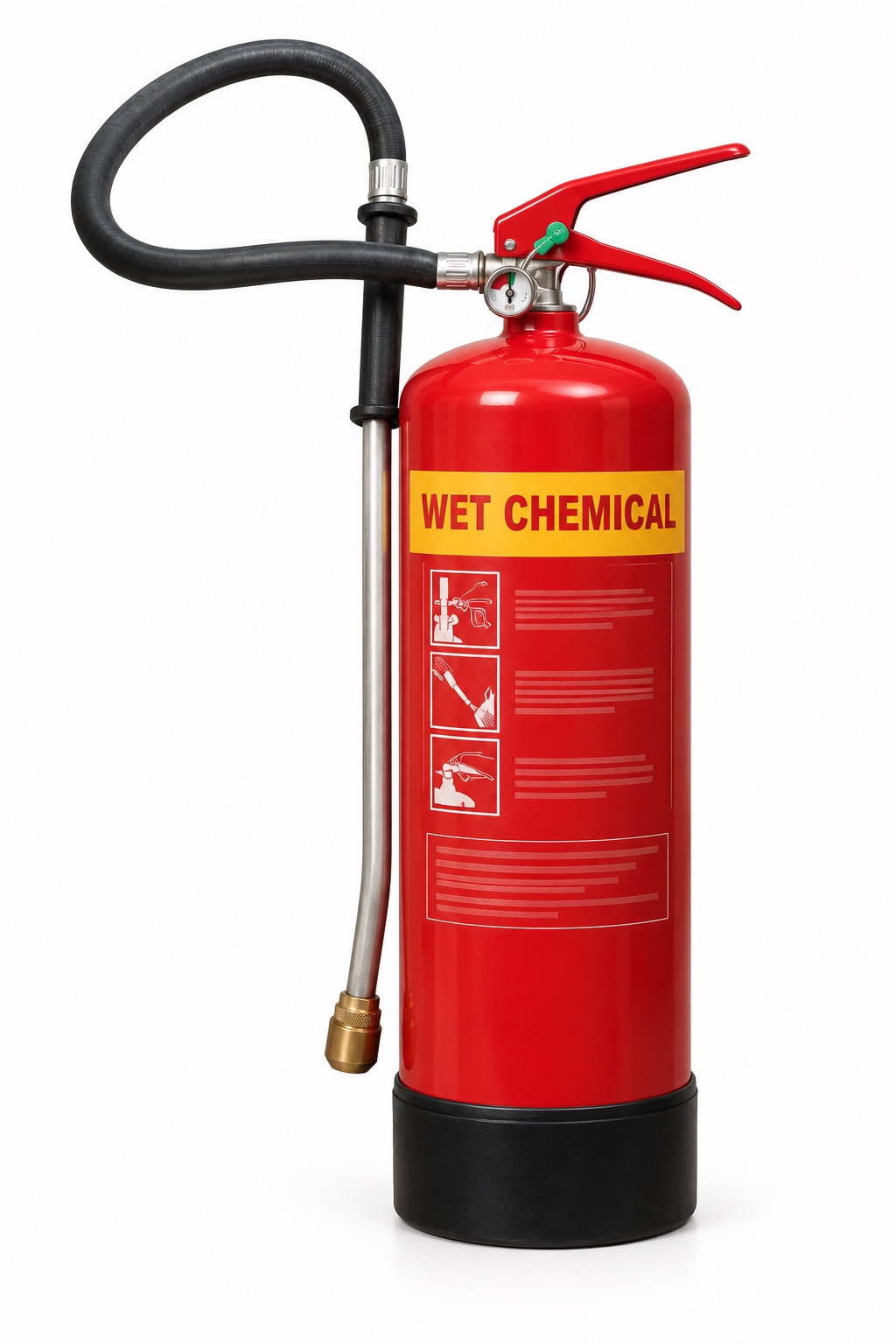
Wet chemicalYellow panel / WET CHEMICAL
F; often A if marked
Cools cooking oil and creates a protective surface layer through reaction with the fat. Use only within the actual unit’s rating and instructions.
Check the limitation
Do not mistake it for a general liquid-fire or electrical extinguisher. Incorrect application or moving the fryer can splash hot oil; apparent flame-out does not establish safe temperature.
Parts in text
Cylinder
The pressure vessel holds the agent and propellant as designed. Report corrosion, dents or other damage. Do not open, refill or repair it as an awareness check.
Agent name and colour marking
Read the actual agent name, fire ratings, electrical warnings and instructions. Colour is a recognition aid; it does not prove suitability. The illustration is not an operating label.
Fixed carrying handle
The lower fixed handle supports the unit. It is different from the upper operating lever. The exact grip and operation belong in practical instruction for the model.
Operating / squeeze lever
The upper lever operates the discharge valve when the safety device is released. Do not squeeze or discharge a unit to test it during a routine visual check.
Safety pin and pull ring
The pin mechanically prevents accidental operation. A pin or ring that is missing, distorted or insecure needs reporting; its presence does not prove the unit is serviceable.
Tamper indicator / snap-lock seal
The breakable indicator or snap-lock seal shows possible disturbance. Designs can use a separate pin-retaining strap or a pin-mounted indicator. It is different from the mechanical safety pin and is not a theft lock. Report it if broken or missing.
Pressure gauge
On this stored-pressure example the gauge indicates pressure, not the mass of agent remaining. A pointer in the marked range does not prove the cylinder is full or the unit has passed its service checks.
Hose, nozzle or applicator
The flexible hose ends in the model’s discharge nozzle. The clip is for stowage; a hose being clipped in place is not a service check. Do not block, detach or test-discharge it during a visual inspection.
Base / protective boot
The boot protects the base on this example. Other models have a different foot arrangement or no separate boot. Check the approved mounting and access rather than guessing from the picture.
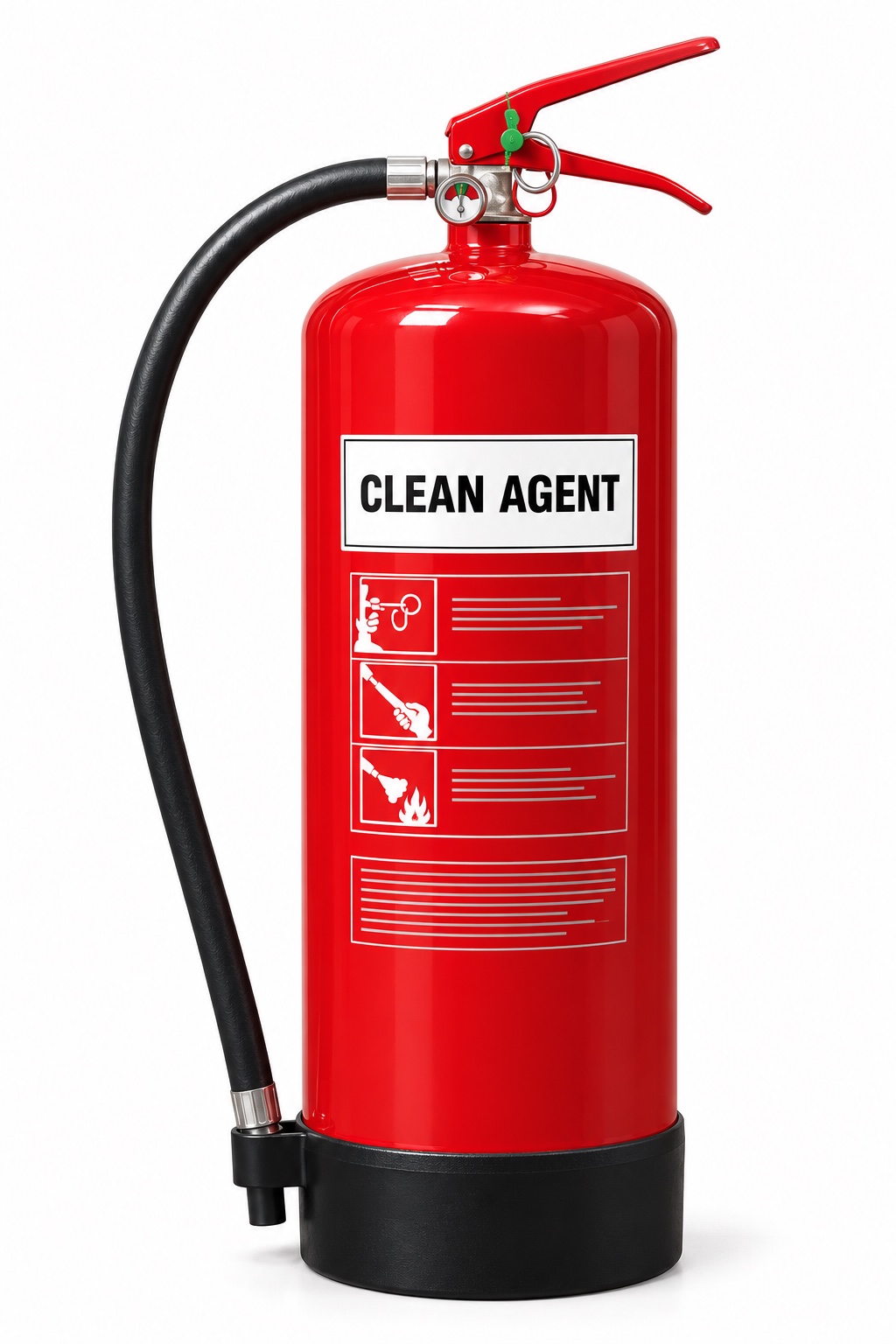
Clean agent / vaporising liquidRead the agent; no universal colour shortcut
Product- and jurisdiction-specific
Specialist low-residue agents may protect sensitive equipment. Confirm the UK-approved application and the manufacturer’s limits.
Check the limitation
Low residue does not mean safe to breathe. Do not copy a US A:B:C rating as UK gas-fire approval. Legacy halon is restricted to permitted critical uses and applicable deadlines.
Parts in text
Cylinder
The pressure vessel holds the agent and propellant as designed. Report corrosion, dents or other damage. Do not open, refill or repair it as an awareness check.
Agent name and colour marking
This generic illustration has a green agent area and boot inspired by the supplied product. Green is not a universal Class L identification code. Read the real product name, chemistry, battery limits and instructions.
Fixed carrying handle
The lower fixed handle supports the unit. It is different from the upper operating lever. The exact grip and operation belong in practical instruction for the model.
Operating / squeeze lever
The upper lever operates the discharge valve when the safety device is released. Do not squeeze or discharge a unit to test it during a routine visual check.
Safety pin and pull ring
The pin mechanically prevents accidental operation. A pin or ring that is missing, distorted or insecure needs reporting; its presence does not prove the unit is serviceable.
Tamper indicator / snap-lock seal
The breakable indicator or snap-lock seal shows possible disturbance. Designs can use a separate pin-retaining strap or a pin-mounted indicator. It is different from the mechanical safety pin and is not a theft lock. Report it if broken or missing.
Pressure gauge
On this stored-pressure example the gauge indicates pressure, not the mass of agent remaining. A pointer in the marked range does not prove the cylinder is full or the unit has passed its service checks.
Hose, grip and applicator
The illustrated hose has a coloured ribbed grip and a small application tip. This shows the hardware family, not a tested battery capability. Follow the instructions for the actual agent and generation.
Base / protective boot
The boot protects the base on this example. Other models have a different foot arrangement or no separate boot. Check the approved mounting and access rather than guessing from the picture.
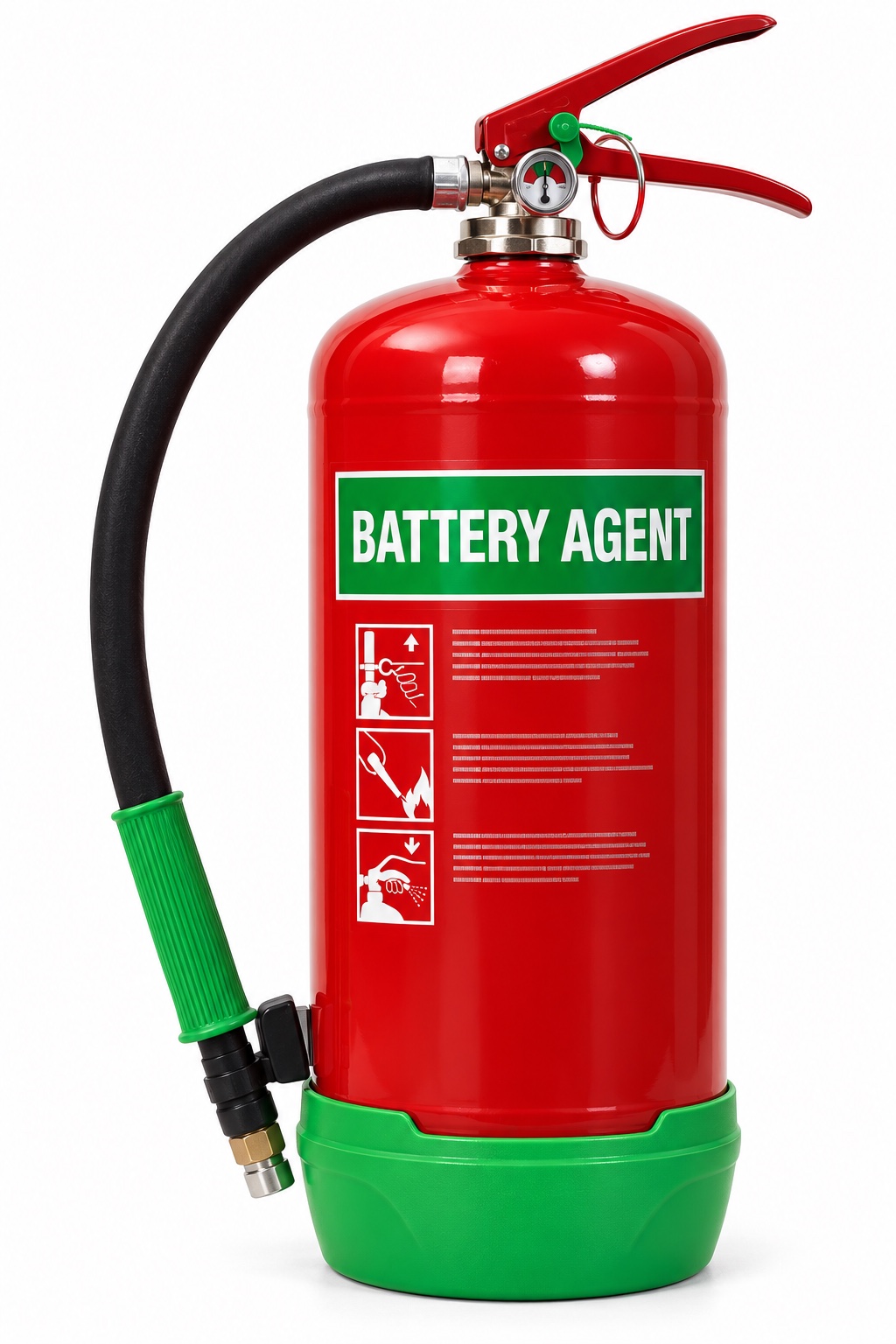
Battery-specific suppression productsNamed formulation and tested application
Check independent scope and instructions
Some products use water-based cooling or specialist media such as aqueous vermiculite for specified battery scenarios. Selection depends on chemistry, capacity and location.
Check the limitation
A ‘lithium’ label is not proof it will stop thermal runaway in a large pack. Flame suppression may not prevent reignition or gas release. Do not approach, carry or submerge a failing battery as a learner exercise.
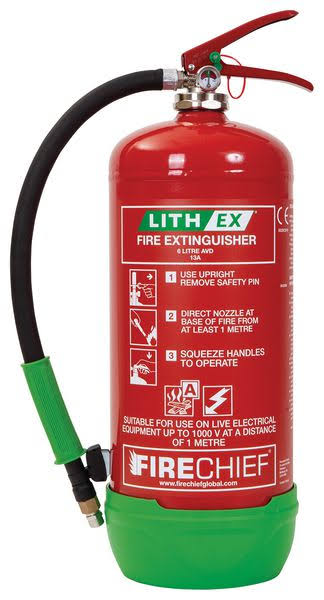
Lithium-ion product example · Firechief 6 L Lith-Ex
A named product example helps connect the generic table to an actual unit. Confirm the exact product before using its claims.
Agent and intended application
The linked Seton example uses aqueous vermiculite dispersion (AVD) for specified lithium-ion battery fire applications. Water content cools; the dispersed mineral helps form a barrier. This is not generic Class D metal-fire powder.
Read the actual rating
Seton lists a 6 L product with a 13A rating. That A rating describes its solid-material test performance; it does not, by itself, certify a universal Class L battery capability.
Match the exact model and generation
The manufacturer’s current 6 L G2 page identifies FLE6X and different discharge details from the retailer’s older listing. Do not mix their time, range or pressure values. Match the delivered label, product sheet and manual.
Check the battery scope
Confirm the allowed battery chemistry, energy capacity, state and scenario with the current manufacturer information and competent fire assessment. A large EV or energy-storage pack cannot be treated as a small-device fire.
Electrical conditions are product-specific
The supplied product label includes a voltage and minimum-distance condition. Do not transfer that condition to another battery extinguisher or infer that it makes an unsafe electrical approach acceptable.
After the flame disappears
Heat, off-gas and reignition can remain. Follow the planned withdrawal, exclusion and fire-service response; do not pick up, submerge or return a failed battery to charging.
Read the agent, fire-class letters, performance rating, electrical warnings, operating instructions and service condition. Numbers such as 13A or 55B describe standardised test performance, not a safe room size or permission to tackle that amount of fire. Colour is a clue; the actual label and assessed plan decide suitability.
What about a fire blanket?
A fire blanket is separate equipment, not an extinguisher type. It may be specified for a small contained cooking fire, but safe approach and the manufacturer’s limits still matter. Never carry a burning pan, improvise a cover or put yourself between fire and your exit.
Spot the dangerous assumption
Pause at each question, then open the explanation. These are unscored learning prompts alongside the course assessment.
A pan of cooking oil is burning. Would ordinary water help?
No. Rapid steam production can throw burning oil across the room. Raise the alarm and follow the kitchen emergency plan; never move the pan. Only a trained, authorised person should consider the specified F-rated equipment with a safe escape.
There is a C on the powder extinguisher. Should I put out the leaking gas flame?
Not as a routine response. Unburnt gas may continue escaping and form an explosive cloud. Withdraw, alarm and report the supply involved. Any safe isolation and specialist firefighting must follow the assessed emergency arrangements.
The flame around a battery has disappeared. Is the incident over?
No. Internal heat, flammable or toxic off-gas and reignition can remain. Keep clear, prevent access and tell the fire and rescue service what battery is involved. Flame-out is not permission to handle it or restart charging.
Both extinguishers have blue panels. Are the powders interchangeable?
No. Read ABC, BC or the exact Class D metal specification. Colour identifies a family; it does not establish the correct agent, rating or safe application.
A CO₂ extinguisher leaves no mess. Is it ideal in a small unventilated room?
No. A dangerous CO₂ concentration can incapacitate a person, while the fire and smoke already threaten escape. Do not enter an unsafe room. The fire plan and competent equipment selection must account for the space.
A water-mist product claims electrical suitability. Can I use any water extinguisher on a live cabinet?
No. Any tested electrical claim belongs to that particular model, with its own voltage and distance limits. It does not apply to ordinary water or another mist product, and it does not make an unsafe approach acceptable.
Source guidance and scope
UK learning context. Consult the applicable national fire guidance and your premises’ assessed plan. Manufacturer examples explain product variation; they are not product recommendations. Guidance checked 24 October 2026.
Recognise rescue limits and the evidence required before returning people or equipment.
Recovery is a series of controlled decisions
A casualty in a hazardous area creates a powerful urge to act. First aid begins with scene safety: fuel, vapour, fire, electricity and oxygen deficiency may make ordinary access unsafe. Call the designated help and provide the casualty’s location and known hazards from a safe position. Only trained, equipped and authorised responders should enter a danger area. An awareness course cannot provide the equipment, team arrangements or practical competence needed for such rescue.
First-aid provision should follow an assessment of the real site’s hazards, staffing, shift pattern and access to medical help. Chemical exposure, burns and traumatic injuries may require arrangements beyond an office first-aid kit. Learners should know where safe assistance can be given and how responders obtain product information. Do not improvise treatment, move into contamination or use equipment for which you have not been trained.
The end of visible smoke does not prove that an area is safe. Re-entry may require evidence about atmosphere, structural condition, residual product, electrical hazards, drainage, isolated equipment and environmental contamination. Command must define who may enter, for what purpose, under which controls and for how long. A limited entry for inspection or recovery does not automatically authorise general occupancy or normal work.
Operational restart is a separate decision. The initiating cause, damaged containment, protective-system performance, temporary arrangements and outstanding work all need suitable assessment. Relevant permits, drawings, procedures and competence must be current, with tests and approvals completed by the responsible people. Record the decision and communicate the actual state across shifts. Investigation and exercise learning should improve the system without delaying urgent protective actions or treating blame as a substitute for analysis.
How can the ISO 45001 hierarchy of controls control plant and communication risks during a shutdown response test?
Use the stronger source and work-design controls first; response or individual support does not replace prevention.
Drills should teach people where intervention stops. Workers should not enter a confined space, approach a toxic cloud, fight a developed fire, isolate live electrical equipment or recover property unless they are trained, equipped and authorised for that task.
Responder safety controls include exclusion zones, dynamic risk assessment, PPE suited to the hazard, communications, buddy systems, withdrawal criteria, medical support, wind direction, heat stress controls and command permission before entering hazardous areas.
The instrument and operations team test a gas-initiated shutdown as part of preparedness. Distinguish a controlled functional test, simulated exercise messages and a real alarm; the real emergency procedure takes priority.
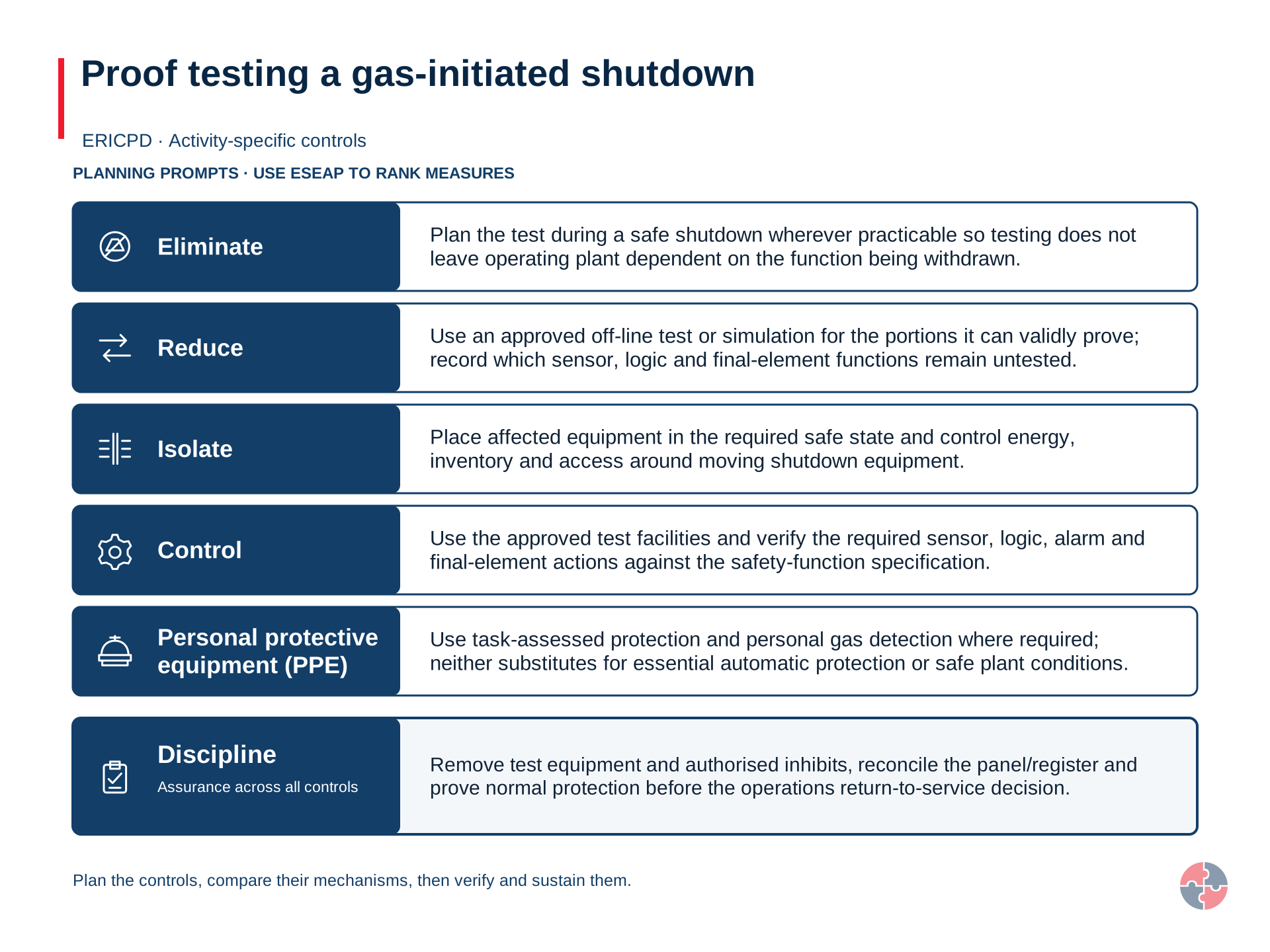
How can the ERICPD hierarchy of controls control plant and communication risks during a shutdown response test?
ERICPD is a planning crossmap. Its prompts do not add a sixth rung or rank Isolate above engineering. Discipline verifies and sustains every control level.
Control level
Control for this activity
Owner and verification
Stop / restart decision
Eliminate
Plan the test during a safe shutdown wherever practicable so testing does not leave operating plant dependent on the function being withdrawn.
Task owner verifies that the proposed change removes the named hazardous step, including foreseeable cleaning, maintenance and work transferred elsewhere.
If the hazardous step remains, keep it within the task assessment and select the stronger feasible remaining controls.
Reduce, including substitution
Use an approved off-line test or simulation for the portions it can validly prove; record which sensor, logic and final-element functions remain untested.
Competent task/process owner validates suitability, compatibility and new hazards against the actual operating requirements before the alternative is adopted.
Reject an alternative if its performance is unproved or its new hazards are unresolved.
Isolate
Place affected equipment in the required safe state and control energy, inventory and access around moving shutdown equipment.
Competent equipment/process owner checks approved test scope, expected cause-and-effect, control-room communication and final-element response.
Hold or stop for unexpected plant action, real gas alarm, communication failure or a test result outside the required performance.
Control: work method and response
Coordinate every test step with the control room; distinguish simulated signals from genuine gas alarms, control authorised inhibits and define abort/shutdown actions.
Supervisor confirms the work limits, competent cover, communication and stop/restart authority with the people doing this activity.
Hold work when the agreed limits, competent cover or effective communication cannot be maintained.
PPE
Use task-assessed protection and personal gas detection where required; neither substitutes for essential automatic protection or safe plant conditions.
Assessor confirms whether personal protection is needed and checks suitability, condition, compatibility and any required fit evidence.
Do not use unsuitable protection or rely on PPE to continue after an essential source control fails.
Discipline
Remove test equipment and authorised inhibits, reconcile the panel/register and prove normal protection before the operations return-to-service decision.
Release only after instrument and operations owners accept complete results, restored protection and reconciled inhibits. Retain verification and unresolved restrictions at handover.
Keep the task on hold until required reinstatement evidence and unresolved defects are accepted by the responsible owner.
How can the ISO 45001 hierarchy of controls control plant and communication risks during a shutdown response test?
The hierarchy of controls in ISO 45001:2018 comes under Clause 8.1.2 (Eliminating hazards and reducing OH&S risks), which is located within Clause 8 ("Operation").
Task owner verifies that the proposed change removes the named hazardous step, including foreseeable cleaning, maintenance and work transferred elsewhere.
If the hazardous step remains, keep it within the task assessment and select the stronger feasible remaining controls.
Engineering controls
Use an approved off-line test or simulation for the portions it can validly prove; record which sensor, logic and final-element functions remain untested.
Competent task/process owner validates suitability, compatibility and new hazards against the actual operating requirements before the alternative is adopted.
Reject an alternative if its performance is unproved or its new hazards are unresolved.
Engineering controls
Place affected equipment in the required safe state and control energy, inventory and access around moving shutdown equipment.
Competent equipment/process owner checks approved test scope, expected cause-and-effect, control-room communication and final-element response.
Hold or stop for unexpected plant action, real gas alarm, communication failure or a test result outside the required performance.
Administrative controls
Coordinate every test step with the control room; distinguish simulated signals from genuine gas alarms, control authorised inhibits and define abort/shutdown actions.
Supervisor confirms the work limits, competent cover, communication and stop/restart authority with the people doing this activity.
Hold work when the agreed limits, competent cover or effective communication cannot be maintained.
PPE
Use task-assessed protection and personal gas detection where required; neither substitutes for essential automatic protection or safe plant conditions.
Assessor confirms whether personal protection is needed and checks suitability, condition, compatibility and any required fit evidence.
Do not use unsuitable protection or rely on PPE to continue after an essential source control fails.
Administrative controls
Remove test equipment and authorised inhibits, reconcile the panel/register and prove normal protection before the operations return-to-service decision.
Release only after instrument and operations owners accept complete results, restored protection and reconciled inhibits. Retain verification and unresolved restrictions at handover.
Keep the task on hold until required reinstatement evidence and unresolved defects are accepted by the responsible owner.
Worked control decision: one scenario through the hierarchy
Illustrative upper-tier fuel-storage drill: a tank overfills, vapour travels towards an occupied gate, and a detector becomes unavailable. The site must adapt decisions to its actual safety report, plan and responder agreements.
Level
Barrier and location
Pre-use and continuing check
Failure and residual risk
Stop decision
Eliminate
Test whether the hazardous transfer or on-site inventory can be removed from this operation.
Process owner documents feasibility in the hazard study and reviews it after process change.
A different transfer may move risk elsewhere; residual inventory may remain.
Do not accept an unexamined process change as risk reduction.
Reduce / substitute
Where the transfer is needed, assess smaller batches and a lower-hazard material if technically possible.
Engineering checks compatibility and consequence modelling before trial and after changes.
Smaller inventory may still form a dangerous vapour cloud.
Hold the trial until the new hazard study is approved.
Isolate
Keep occupied gate and command post beyond modelled release zones with controlled access routes.
Site lead checks plans and physical routes before the drill and at each shift handover.
Wind change or blocked access can defeat separation.
Move command and exclude entry when the zone or route becomes unsafe.
Control — physical
At the tank, test independent high-level shutdown, remote isolation, detection and backup communications.
Maintainer verifies proof-test records before exercise; controller tracks impairments live.
Stop transfer on critical impairment and activate the site escalation plan.
Control — method
Command card requires wind-aware shelter/evacuation decision, exclusion zone and fire-service handover.
Controller rehearses succession and communication checks before exercise; observers log decisions.
Conflicting reports can delay warning and off-site coordination.
Escalate and withdraw responders when conditions or facts are uncertain.
PPE
Only trained, authorised responders use hazard-rated protection inside a defined safe operating envelope.
Response lead checks fit, air supply, buddy and rescue capability before any entry.
PPE cannot make an unknown toxic or fire zone safe.
No entry without verified protection, backup and command approval.
Discipline / assurance
Inject detector failure and a wind shift, then retest corrective actions with the agencies involved.
Exercise lead compares objectives, command log and actions at debrief and retest.
Paper closure may hide an untested command weakness.
Keep the affected response capability restricted until the failed action is demonstrated.
Applied case
After a small incident is stabilised, a responder permits a specialist inspection of the pump enclosure. A supervisor proposes restarting the transfer because access has been allowed. The receiving operator asks for the separate readiness decision, repair evidence and protection tests before accepting restart.
Decision and explanation
Only that the defined entry may proceed under its stated conditions.
Controlled access and process readiness answer different questions. Restart needs verified containment, protection and an authorised operating decision.
Look closer
Teaching graphic from the linked SHAREhub source section.01 · Read the situation
After a small incident is stabilised, a responder permits a specialist inspection of the pump enclosure. A supervisor proposes restarting the transfer because access has been allowed. The receiving operator asks for the separate readiness decision, repair evidence and protection tests before accepting restart.
02 · Explain the principle
A casualty in a hazardous area creates a powerful urge to act. First aid begins with scene safety: fuel, vapour, fire, electricity and oxygen deficiency may make ordinary access unsafe. Call the designated help and provide the casualty’s location and known hazards from a safe position. Only trained, equipped and authorised responders should enter a danger area. An awareness course cannot provide the equipment, team arrangements or practical competence needed for such rescue.
03 · Carry it into work
Controlled access and process readiness answer different questions. Restart needs verified containment, protection and an authorised operating decision.
Lesson 5
Protect the response route before an emergency
Emergency capability depends on ordinary operating decisions that preserve access every day.
Understand this fuel-industry task
The emergency gate on the far side of the model is part of the terminal's response arrangements, not spare parking capacity. A queue of waiting tankers can occupy the turning room or approach needed by responders even when the gate itself remains visible. During a release, congestion can also prevent people leaving, bring additional drivers towards the incident and complicate control of ignition sources. An access problem that looks reversible in ordinary traffic may become impossible to solve once smoke, vapour or alarm causes confusion.
Compare everyday delivery management with the emergency plan. Responders may need a different approach when wind direction, fire or a blocked road makes the usual entrance unsuitable. Gate opening, route ownership and the authority to stop incoming deliveries should be understood before the incident. Exercise these interfaces with the relevant response parties. The exact on-site and off-site duties depend on the establishment and applicable regime; this fictional emergency route does not by itself establish COMAH tier or prescribe a real response layout.
Trace the initiating event and loss of control
Step
Case pathway
initiatingEvent
A delivery schedule uses the emergency access approach as an unmanaged tanker holding area.
lossOfControl
Responders and evacuees cannot use the intended route promptly when the incident makes normal movement unsafe.
consequences
Intervention is delayed, more people and vehicles are exposed, and an initially local event may escalate across the terminal.
Choose effective safeguards
Control priority
Practical application
Eliminate
Prevent major releases and reduce the hazardous inventory.
Substitute
Choose locations and layouts that reduce off-site exposure where practicable.
Engineer
Provide alarms, resilient communications, protected routes and containment.
Manage
Coordinate and exercise plans with relevant authorities, neighbours and responders.
Protect
Provide trained teams with equipment suitable for their defined roles and limits.
Provide an assessed holding arrangement away from emergency approaches, escape routes and process hazards; prevent bookings exceeding the capacity to wait safely.
Keep agreed route and turning envelopes available, with appropriate gate control and a reliable method of stopping and redirecting arriving deliveries.
Coordinate normal and alternative access with the emergency plan, response parties and relevant public-road interfaces; define who selects and communicates a safe approach.
Include congestion, out-of-hours staffing, gate power failure and changing wind conditions in exercises, then correct access weaknesses before treating the plan as reliable.
Verify effectiveness before release
Walk the full approach with the response team or use a suitable assessed exercise, including vehicle size, turning room and gate-opening arrangements.
Check a busy delivery period against the emergency route plan; look beyond the gate leaf for parked trailers, materials and queued vehicles.
Ask gate staff who stops new arrivals during an alarm and how drivers receive an instruction that does not send them towards the affected area.
Transfer the decision to the workplace
Check the same hidden dependencies at firewater pump houses, hydrants, assembly routes and hospitals' or customer sites' emergency access points.
What actions must work on site during the first minutes?
The first minutes should establish alarm, command, isolation, people protection and emergency services notification.
Emergency response is often lost early. If the alarm is unclear, the control room waits for confirmation, isolation points are not obvious, muster points are downwind, radios do not work or responders do not know who commands the scene, the event can outrun the plan.
First-minute actions should be drilled as behaviours: recognise, raise alarm, stop work, isolate if safe, move or shelter as instructed, account for people, communicate factual information and avoid self-deployment into danger.
First-minute actions - First-minute actions
Action
Purpose
Weakness to test
Raise alarm
Warn people and trigger command.
Delay or unclear alarm meaning.
Establish command
Create decision authority.
Multiple people giving conflicting instructions.
Isolate where safe
Stop escalation source.
Remote isolation unavailable or unknown.
Protect people
Muster, shelter or evacuate.
Wrong route or downwind muster point.
Notify external responders
Bring correct resources early.
Poor information in first call.
Control access
Keep people out of danger.
Uncontrolled contractors or visitors.
Applied case
Three tankers are booked into a full loading area. A scheduler suggests they wait in the emergency entrance because its gate can still be seen.
Decision and explanation
Use the planned safe holding arrangement or reschedule arrivals while keeping the entire emergency approach clear.
Access includes the approach and manoeuvring space. Managing demand now avoids relying on hurried vehicle clearance during an incident. Keys do not establish that moving the vehicles will be safe, timely or possible during a release, and can introduce additional security concerns. Contact information cannot restore physical access or prevent arriving vehicles being exposed when the incident develops.
Look closer
Photorealistic illustrative UK workplace scene. Review checks: Generic fire drill only: Major accident decisions are never tested. No command deputies: No clear authority on nights/weekends. Untested firewater/foam: Fire response assumption fails.01 · What to notice
A delivery plan proposes holding several tankers beside the emergency access gate shown on the model.
02 · Trace the harm
Congestion can delay responders and evacuation, while vehicles can bring people and ignition sources towards an escalating release.
03 · Test the safeguard
Test the approach with the response team under realistic congestion assumptions, including gate opening, route clearance and control of arriving deliveries.
Lesson 6
Changing wind: protect people using current hazard information
An emergency route is a protective decision that must remain suitable as conditions change.
Understand this fuel-industry task
The windsock and two assembly options illustrate why an emergency route cannot be selected by habit alone. In the exercise, the wind changes after a fuel release and the usual route crosses the reported hazard area. Vapour may be invisible, smoke is not a reliable map of every hazardous concentration and buildings or low ground can change movement. A windsock supplies useful local information but does not define a measured plume boundary or safe distance. The model cannot establish that a real route is safe.
The emergency plan needs preplanned alternatives, clear authority and current information about release location, wind, fire and affected areas. People should follow the site alarm and competent incident direction, use the designated safe protection option and report route problems without approaching the release. Depending on the assessed scenario, suitable shelter may be safer than moving through an affected area; that decision requires the actual plan and response command, not a universal rule to walk towards a compass direction. Include visitors, contractors and people needing assistance in both communications and accountability. Exercise changed conditions safely so wardens can redirect people, responders can approach by a suitable route and the controller receives a reliable headcount.
Trace the initiating event and loss of control
Step
Case pathway
initiatingEvent
A release develops and changing wind puts the normal assembly route within the reported hazard area.
lossOfControl
People follow their familiar route without updated direction and enter potentially contaminated or fire-exposed ground.
consequences
Multiple casualties, missing-person uncertainty and unsafe responder approaches can complicate the original emergency.
Choose effective safeguards
Control priority
Practical application
Eliminate
Prevent major releases and reduce the hazardous inventory.
Substitute
Choose locations and layouts that reduce off-site exposure where practicable.
Engineer
Provide alarms, resilient communications, protected routes and containment.
Manage
Coordinate and exercise plans with relevant authorities, neighbours and responders.
Protect
Provide trained teams with equipment suitable for their defined roles and limits.
Provide scenario-based protection options and alternative routes or assembly locations, with clear competent authority for changing the instruction.
Use current release, weather and site information and communicate route changes through reliable methods with a backup.
Keep people away from reported hazards and follow the assessed evacuation or shelter instruction; do not send unprotected scouts into uncertain areas.
Account for all groups at the chosen safe location and pass missing-person and route information to the incident command team.
Verify effectiveness before release
Run a safe tabletop wind-shift inject: can wardens identify the affected route and obtain an authorised alternative before directing people?
Check that both routes and relevant shelter arrangements are usable, accessible and understood by drivers, contractors and visitors.
Observe how changed location, headcount and responder approach information reaches command when the primary communication method fails.
Transfer the decision to the workplace
Use similar exercises for a blocked gate, smoke in an office escape route or flooding: test alternative protection and communication, not just routine walking time.
How should muster, shelter and evacuation decisions be made?
Muster, shelter and evacuation decisions should be scenario-based, wind-aware, receptor-aware and clearly communicated.
Evacuation is not always the safest response. A toxic release may require shelter-in-place. A fire may require evacuation away from smoke and escalation zones. A BLEVE risk may require withdrawal to greater distance. A vapour cloud may require ignition-source control and access restriction. The plan should define triggers and fallback decisions.
People accounting must include employees, contractors, visitors, drivers, lone workers and people in remote plant areas. Welfare matters too: prolonged evacuation or sheltering needs information, medical support, drinking water, toilets, weather protection and family communication.
Toxic release, smoke or external hazard makes movement unsafe.
Building integrity and communication.
Evacuation
People need to leave the hazard area.
Route, transport and destination.
Withdrawal
Responder safety cannot be maintained near event.
Decision authority and exclusion distance.
Rescue
People are missing or injured.
Responder competence and risk assessment.
Applied case
During a drill, the controller reports that the normal muster route now lies in the simulated release direction. A visitor suggests following the crowd anyway.
Decision and explanation
Follow the authorised alternative protection instruction and communicate the changed location and accountability.
Familiarity helps only when the location remains suitable. A route within the reported hazard area requires reassessment and clear redirection. Correct. Protect people using the current scenario and plan, while keeping command informed of who moved and where. Unprotected investigation adds exposure and may create another casualty. Smell cannot establish a safe atmosphere or plume boundary.
Look closer
Photorealistic illustrative UK workplace scene. Review checks: Elimination: Remove unnecessary hazardous gas inventory or the releasing process through a validated process redesign. Substitution: Evaluate a less hazardous material or process condition through engineering and change review, including new reaction and fire risks. Engineering controls: Provide suitable remote process isolation and separation from occupied areas so the response does not require people to approach a release. Engineering controls: Verify containment, gas detection, alarms and designed shutdown or depressurisation functions against the credible scenario and safe-state requirements. Administrative controls: Agree control-room actions, alarm meaning, communication, evacuation and responder access; practise the scenario and treat loss of essential protection as a plant operating decision.01 · What to notice
The response exercise changes the wind after a release; the usual assembly route would cross the reported hazard area.
02 · Trace the harm
An assembly sign is not protection against a changing cloud or smoke route. Walking to a familiar point can increase exposure.
03 · Test the safeguard
Exercise a changed-wind scenario using the plan, confirm people receive and understand the instruction and account for everyone without exposing them.
Lesson 7
COMAH scope: establish duties before claiming an external plan
Legal applicability needs evidence; effective emergency coordination also needs real scenario and interface information.
Understand this fuel-industry task
The large tanks and Crown Fuels name do not establish a legal COMAH tier. Applicability depends on dangerous substances, classification, quantities and the relevant aggregation rules and exclusions. A competent inventory-and-jurisdiction assessment is needed. The scene deliberately omits a confirmed real inventory, so it cannot be labelled an upper-tier establishment from appearance. Using another depot's classification or a course illustration would not settle the question.
In Great Britain, COMAH 2015 distinguishes lower- and upper-tier duties. Upper-tier requirements include an operator's internal emergency plan and information supplied to the local authority for its external emergency planning, under the applicable provisions. The operator's site plan and the authority's off-site arrangements need usable interfaces; one does not replace the other. A depot outside COMAH still needs emergency arrangements appropriate to its hazards under other applicable duties, including dangerous-substances controls. Northern Ireland has its own regulatory route. The practical learning task is to connect the verified scope decision to named owners, neighbouring receptors, responder information and public-warning arrangements. Keep those interfaces current when inventories, surrounding development or operating conditions change, rather than relying on a broad site label.
Trace the initiating event and loss of control
Step
Case pathway
initiatingEvent
A depot is assigned emergency-planning duties from its name and size without verifying substances, inventory and jurisdiction.
lossOfControl
Required operator, local-authority or other response interfaces are omitted or incorrectly assumed to be supplied by somebody else.
consequences
Off-site warnings, responder coordination and protection of neighbours can be delayed or mismatched to the credible major-accident scenario.
Choose effective safeguards
Control priority
Practical application
Eliminate
Prevent major releases and reduce the hazardous inventory.
Substitute
Choose locations and layouts that reduce off-site exposure where practicable.
Engineer
Provide alarms, resilient communications, protected routes and containment.
Manage
Coordinate and exercise plans with relevant authorities, neighbours and responders.
Protect
Provide trained teams with equipment suitable for their defined roles and limits.
Have competent people document the actual substance classification, inventory, aggregation and jurisdiction assessment and maintain it through change.
Apply the resulting legal duties and hazard-based emergency requirements; do not assume that being outside COMAH removes the need for emergency planning.
Where applicable, provide current operator information to the local authority and coordinate internal and external plans, responder access and public interfaces.
Exercise the agreed escalation and information exchange, with clear owners for changes affecting neighbours or emergency capability.
Verify effectiveness before release
Ask for the current basis of COMAH applicability and tier, not just a terminal description or an unexplained inherited label.
Compare the assessed scenarios and inventories with the information held by relevant emergency partners and the actual site plan.
Check how a product or capacity change triggers regulatory review, revised information and a practical interface test before assumptions become outdated.
Transfer the decision to the workplace
Apply the same discipline to a changed depot, new product or neighbouring development: review the regulatory scope and practical consequences rather than carrying old labels forward.
What off-site interfaces must be planned?
Off-site interfaces include emergency services, the relevant external-plan lead, neighbours, the public, environmental responders, media and mutual aid partners. For upper-tier COMAH, the external-plan lead differs between Great Britain and Northern Ireland.
Major accidents do not respect the fence line. Smoke, vapour, blast, fragments, contaminated water, road closures, public fear and media attention can all leave the site boundary quickly. Emergency plans should define who contacts whom, what information is given, how updates are issued and who speaks publicly.
For upper-tier COMAH sites in Great Britain, the local authority prepares the external emergency plan, using information from the operator. See GB COMAH regulation 13. In Northern Ireland, the Executive (HSENI) arranges the external emergency plan and consults designated authorities under NI COMAH regulation 13. The operator must supply scenario, consequence, warning and response information to the appropriate lead. Do not assign the GB local-authority lead to an NI site.
External interface map - External interface map
Interface
Why it matters
Evidence
Emergency services
Need early accurate information and site hazards.
Rendezvous point and joint exercises.
External-plan lead: GB local authority; NI Executive (HSENI)
Prepares or arranges the upper-tier external plan under the applicable COMAH rules.
Operator information submission, consultation and plan review.
Regulator
Notification, investigation and enforcement interface.
COMAH and incident communication record.
Neighbouring sites
Domino and shared emergency impacts.
Mutual aid and warning arrangements.
Public
Warning, advice and reassurance.
Public information and message templates.
Environment agency/interface
Runoff, pollution and environmental monitoring.
Containment and notification plan.
Applied case
A consultant calls this fictional model upper-tier because it contains many tanks, then copies an external-plan section from a different site.
Decision and explanation
Confirm the substance, inventory, aggregation and jurisdiction basis through a competent applicability assessment.
Correct. Actual scope determines the specific COMAH duties; the emergency interfaces must then be built for this site and its credible scenarios. Tank count is not the legal classification test. Hazard classification and inventory thresholds, including aggregation, need evaluation. Uncertainty is a reason to assess and maintain appropriate coordination, not to remove hazard-based emergency arrangements.
Look closer
Photorealistic illustrative UK workplace scene. Review checks: Setting: the process operator practises a tank overfill leading to a vapour release and possible explosion. Act: Confirm containment, detection, alarm, isolation, command succession and alternative shelter or evacuation routes. Hold / review: Failed detector, blocked route, unknown wind direction or absent command lead triggers a safe hold and escalation.01 · What to notice
The emergency-office exercise uses a site label instead of a verified substance-and-inventory assessment, then assumes the same external-plan duties apply to every fuel depot.
02 · Trace the harm
Incorrect legal scope can leave planning responsibilities, public information and responder coordination unclear. A model’s size cannot determine COMAH tier.
03 · Test the safeguard
Check the documented scope determination and current responsible organisations, contacts, information exchange and agreed exercises; do not infer compliance from this fictional terminal.
Lesson 8
Emergency command: turn a contact list into coordinated action
An emergency plan works through capable people, clear authority, current information and tested communication.
Understand this fuel-industry task
The response office contains a plan pack and contact numbers, but a list cannot decide who raises the alarm, stops affected operations, accounts for people or meets responders. During a release, several teams may hold different parts of the picture: an operator knows the line-up, security knows who entered, a driver saw the leak and a contractor has an open permit. Without defined roles and a shared current picture, important actions can be duplicated or missed.
The plan must connect recognition and escalation with command, technical advice, people protection, accountability and a safe handover to external responders. Site staff provide accurate information and undertake only their authorised, trained and safe actions; emergency-service roles are coordinated through the applicable command arrangements. Maintain logs of changing facts, decisions and uncertainties, including product, source, isolation, missing people and drainage status. A missing person is information for command and trained rescue planning, not permission for colleagues to search a contaminated area. Exercises should test night or reduced staffing, contractor information and failed communication, with a safe method for distinguishing a drill from a real emergency. Attendance is useful, but decision quality and corrected failures provide stronger evidence of capability.
Trace the initiating event and loss of control
Step
Case pathway
initiatingEvent
A credible release occurs while the plan names phone contacts but leaves critical response roles and handover unclear.
lossOfControl
Alarm, source-control information, accountability and responder coordination become fragmented or delayed.
consequences
People remain exposed, responders approach without essential hazard information and escalation or missing casualties may be misunderstood.
Choose effective safeguards
Control priority
Practical application
Eliminate
Prevent major releases and reduce the hazardous inventory.
Substitute
Choose locations and layouts that reduce off-site exposure where practicable.
Engineer
Provide alarms, resilient communications, protected routes and containment.
Manage
Coordinate and exercise plans with relevant authorities, neighbours and responders.
Protect
Provide trained teams with equipment suitable for their defined roles and limits.
Assign clear incident, alarm, accountability, technical-liaison and responder-access roles with deputies and achievable staffing coverage.
Provide reliable communications and backups, an accessible current plan and a decision log that records facts and uncertainty.
Collect current inventory, source, isolation, drainage and people information and transfer it through the agreed responder handover.
Exercise realistic coordination problems safely, assign corrective owners and verify effectiveness by retest rather than attendance alone.
Verify effectiveness before release
Ask an ordinary shift to explain the first actions and decision authority without assuming the usual manager is present.
Test accountability against security, visitor and contractor records and check how missing-person information reaches incident command.
Use a communications-failure inject and a safe simulated responder arrival; evaluate the actual information handed over and closure of identified gaps.
Transfer the decision to the workplace
Use this coordination model for off-site delivery incidents too: identify who commands, who knows the receiving system and who communicates with responders and the customer.
How should incident command be structured?
Incident command should define who is in control, how information is logged and how decisions are escalated.
The command structure should be simple enough to work under pressure. For a small site, this may be a duty manager with deputies. For a process site, it may include site incident controller, technical adviser, emergency response leader, communications lead, security/access lead, muster coordinator and senior strategic command.
The command role should not be given to someone only because they are senior. Command requires site knowledge, calm decision-making, authority, communication discipline and training in the emergency plan.
Incident command roles - Incident command roles
Role
Command responsibility
Evidence of readiness
Site incident controller
Sets priorities, directs response and coordinates handover.
Training, rota, exercises and command log.
Technical adviser
Explains plant, substances, isolation, escalation and safe shutdown.
Competence record and emergency information pack.
Emergency response team leader
Controls trained responders and equipment.
Team training and equipment checks.
Muster coordinator
Accounts for people and escalates missing-person information.
Muster drill and roll-call record.
Communications lead
Manages internal updates, emergency contacts and external messages.
Contact list tests and message templates.
Strategic manager
Supports business, regulatory, recovery and resource decisions.
Crisis exercise and leadership review.
The site incident controller manages the operator response and handover. Emergency services command their own response on arrival; the site must keep an accurate shared picture rather than issuing conflicting instructions. See HSE COMAH emergency arrangements inspector guidance.
Applied case
In the drill, security reports one contractor missing while the control room receives conflicting messages about which line is isolated. The normal manager is absent.
Decision and explanation
A named deputy command structure that reconciles facts, directs protection and gives responders a current handover.
Numbers help people connect, but do not allocate authority, maintain accountability or reconcile conflicting technical information. Uncoordinated searching can create additional casualties. Missing-person information belongs with competent command and planned rescue. Correct. Clear roles and shared information let the team act within competence while tracking uncertainty and people.
Look closer
Photorealistic illustrative UK workplace scene. Review checks: Same easy drill every year: Does not test credible emergency pressure. No named incident controller: People duplicate or delay decisions. No injects: The drill misses uncertainty and degraded barriers.01 · What to notice
The exercise pack contains phone numbers and a diagram but does not identify who raises the alarm, commands the response, accounts for people or hands over to responders.
02 · Trace the harm
Delayed or conflicting decisions can send people into danger, leave missing persons unreported and undermine control of a rapidly developing incident.
03 · Test the safeguard
Run a proportionate exercise with a missing-person and communication-failure element; check actual messages, decisions, attendance reconciliation and closure of lessons.
Lesson 9
Suspected release casualty: rescue must not create another casualty
Act quickly from safety: alarm and planned rescue are active help; unprotected entry can multiply casualties.
Understand this fuel-industry task
A collapsed worker near suspected fuel release is both a medical emergency and evidence of an uncontrolled scene hazard. The cause may involve harmful vapour, oxygen deficiency, fire, electrical energy or an unrelated illness; a bystander cannot safely settle it by stepping closer. A casualty visible from outside may still lie within an atmosphere or other hazard that affects the rescuer. Ordinary workwear, a high-visibility vest or a filtering mask does not establish protection against an unknown release or oxygen-deficient atmosphere.
Raise the alarm and call emergency assistance from safety, giving the exact location, suspected product, observed conditions and safe access information. Prevent further unprotected entry and activate the planned competent rescue response. Rescue needs the right capability, equipment and command, with source control undertaken only by authorised people where safe. Once a casualty can be reached in a confirmed safe place, trained first aid and the emergency call handler's instructions support care until responders take over. Share exposure and decontamination information so rescuers and clinical staff do not receive a secondary contamination hazard. The learning question is how to obtain help quickly while preserving the boundary; it is not an invitation to improvise breathing equipment or enter a contaminated zone.
Trace the initiating event and loss of control
Step
Case pathway
initiatingEvent
A worker collapses near a suspected release and a colleague acts on urgency without establishing scene safety.
lossOfControl
The colleague enters the same hazardous area without the planned rescue capability or protection.
consequences
A second casualty can result, delaying rescue and extending exposure to other workers and responders.
Choose effective safeguards
Control priority
Practical application
Eliminate
Prevent major releases and reduce the hazardous inventory.
Substitute
Choose locations and layouts that reduce off-site exposure where practicable.
Engineer
Provide alarms, resilient communications, protected routes and containment.
Manage
Coordinate and exercise plans with relevant authorities, neighbours and responders.
Protect
Provide trained teams with equipment suitable for their defined roles and limits.
Raise the site alarm and call 999 for the life-threatening emergency from a safe position, providing location and suspected hazards.
Prevent further unprotected approach and notify incident command of the casualty location without entering to investigate.
Activate competent, equipped rescue through the actual plan; isolate the source only within authorised capability and safe conditions.
Arrange first aid in a safe area with trained assistance and call-handler advice, passing relevant exposure and contamination information to responders.
Verify effectiveness before release
Check that the site first-aid needs assessment connects to hazardous-area rescue and decontamination arrangements rather than treating them as identical roles.
Use a safe exercise to test how a bystander raises the alarm, prevents further entry and accurately describes the casualty and access point.
Confirm rescue resources, competent coverage and the handover of product or exposure information, including during reduced staffing.
Transfer the decision to the workplace
The same principle applies to tanks, pits and customer premises: first-aid competence does not automatically include hazardous-atmosphere entry or rescue.
How can the ISO 45001 hierarchy of controls control plant and communication risks during a shutdown response test?
Use the stronger source and work-design controls first; response or individual support does not replace prevention.
Drills should teach people where intervention stops. Workers should not enter a confined space, approach a toxic cloud, fight a developed fire, isolate live electrical equipment or recover property unless they are trained, equipped and authorised for that task.
Responder safety controls include exclusion zones, dynamic risk assessment, PPE suited to the hazard, communications, buddy systems, withdrawal criteria, medical support, wind direction, heat stress controls and command permission before entering hazardous areas.
The instrument and operations team test a gas-initiated shutdown as part of preparedness. Distinguish a controlled functional test, simulated exercise messages and a real alarm; the real emergency procedure takes priority.
How can the ERICPD hierarchy of controls control plant and communication risks during a shutdown response test?
ERICPD is a planning crossmap. Its prompts do not add a sixth rung or rank Isolate above engineering. Discipline verifies and sustains every control level.
Control level
Control for this activity
Owner and verification
Stop / restart decision
Eliminate
Plan the test during a safe shutdown wherever practicable so testing does not leave operating plant dependent on the function being withdrawn.
Task owner verifies that the proposed change removes the named hazardous step, including foreseeable cleaning, maintenance and work transferred elsewhere.
If the hazardous step remains, keep it within the task assessment and select the stronger feasible remaining controls.
Reduce, including substitution
Use an approved off-line test or simulation for the portions it can validly prove; record which sensor, logic and final-element functions remain untested.
Competent task/process owner validates suitability, compatibility and new hazards against the actual operating requirements before the alternative is adopted.
Reject an alternative if its performance is unproved or its new hazards are unresolved.
Isolate
Place affected equipment in the required safe state and control energy, inventory and access around moving shutdown equipment.
Competent equipment/process owner checks approved test scope, expected cause-and-effect, control-room communication and final-element response.
Hold or stop for unexpected plant action, real gas alarm, communication failure or a test result outside the required performance.
Control: work method and response
Coordinate every test step with the control room; distinguish simulated signals from genuine gas alarms, control authorised inhibits and define abort/shutdown actions.
Supervisor confirms the work limits, competent cover, communication and stop/restart authority with the people doing this activity.
Hold work when the agreed limits, competent cover or effective communication cannot be maintained.
PPE
Use task-assessed protection and personal gas detection where required; neither substitutes for essential automatic protection or safe plant conditions.
Assessor confirms whether personal protection is needed and checks suitability, condition, compatibility and any required fit evidence.
Do not use unsuitable protection or rely on PPE to continue after an essential source control fails.
Discipline
Remove test equipment and authorised inhibits, reconcile the panel/register and prove normal protection before the operations return-to-service decision.
Release only after instrument and operations owners accept complete results, restored protection and reconciled inhibits. Retain verification and unresolved restrictions at handover.
Keep the task on hold until required reinstatement evidence and unresolved defects are accepted by the responsible owner.
How can the ISO 45001 hierarchy of controls control plant and communication risks during a shutdown response test?
The hierarchy of controls in ISO 45001:2018 comes under Clause 8.1.2 (Eliminating hazards and reducing OH&S risks), which is located within Clause 8 ("Operation").
Task owner verifies that the proposed change removes the named hazardous step, including foreseeable cleaning, maintenance and work transferred elsewhere.
If the hazardous step remains, keep it within the task assessment and select the stronger feasible remaining controls.
Engineering controls
Use an approved off-line test or simulation for the portions it can validly prove; record which sensor, logic and final-element functions remain untested.
Competent task/process owner validates suitability, compatibility and new hazards against the actual operating requirements before the alternative is adopted.
Reject an alternative if its performance is unproved or its new hazards are unresolved.
Engineering controls
Place affected equipment in the required safe state and control energy, inventory and access around moving shutdown equipment.
Competent equipment/process owner checks approved test scope, expected cause-and-effect, control-room communication and final-element response.
Hold or stop for unexpected plant action, real gas alarm, communication failure or a test result outside the required performance.
Administrative controls
Coordinate every test step with the control room; distinguish simulated signals from genuine gas alarms, control authorised inhibits and define abort/shutdown actions.
Supervisor confirms the work limits, competent cover, communication and stop/restart authority with the people doing this activity.
Hold work when the agreed limits, competent cover or effective communication cannot be maintained.
PPE
Use task-assessed protection and personal gas detection where required; neither substitutes for essential automatic protection or safe plant conditions.
Assessor confirms whether personal protection is needed and checks suitability, condition, compatibility and any required fit evidence.
Do not use unsuitable protection or rely on PPE to continue after an essential source control fails.
Administrative controls
Remove test equipment and authorised inhibits, reconcile the panel/register and prove normal protection before the operations return-to-service decision.
Release only after instrument and operations owners accept complete results, restored protection and reconciled inhibits. Retain verification and unresolved restrictions at handover.
Keep the task on hold until required reinstatement evidence and unresolved defects are accepted by the responsible owner.
Worked control decision: one scenario through the hierarchy
Illustrative upper-tier fuel-storage drill: a tank overfills, vapour travels towards an occupied gate, and a detector becomes unavailable. The site must adapt decisions to its actual safety report, plan and responder agreements.
Level
Barrier and location
Pre-use and continuing check
Failure and residual risk
Stop decision
Eliminate
Test whether the hazardous transfer or on-site inventory can be removed from this operation.
Process owner documents feasibility in the hazard study and reviews it after process change.
A different transfer may move risk elsewhere; residual inventory may remain.
Do not accept an unexamined process change as risk reduction.
Reduce / substitute
Where the transfer is needed, assess smaller batches and a lower-hazard material if technically possible.
Engineering checks compatibility and consequence modelling before trial and after changes.
Smaller inventory may still form a dangerous vapour cloud.
Hold the trial until the new hazard study is approved.
Isolate
Keep occupied gate and command post beyond modelled release zones with controlled access routes.
Site lead checks plans and physical routes before the drill and at each shift handover.
Wind change or blocked access can defeat separation.
Move command and exclude entry when the zone or route becomes unsafe.
Control — physical
At the tank, test independent high-level shutdown, remote isolation, detection and backup communications.
Maintainer verifies proof-test records before exercise; controller tracks impairments live.
Stop transfer on critical impairment and activate the site escalation plan.
Control — method
Command card requires wind-aware shelter/evacuation decision, exclusion zone and fire-service handover.
Controller rehearses succession and communication checks before exercise; observers log decisions.
Conflicting reports can delay warning and off-site coordination.
Escalate and withdraw responders when conditions or facts are uncertain.
PPE
Only trained, authorised responders use hazard-rated protection inside a defined safe operating envelope.
Response lead checks fit, air supply, buddy and rescue capability before any entry.
PPE cannot make an unknown toxic or fire zone safe.
No entry without verified protection, backup and command approval.
Discipline / assurance
Inject detector failure and a wind shift, then retest corrective actions with the agencies involved.
Exercise lead compares objectives, command log and actions at debrief and retest.
Paper closure may hide an untested command weakness.
Keep the affected response capability restricted until the failed action is demonstrated.
Applied case
A colleague is motionless beside a suspected release. A volunteer has first-aid training but no hazardous-atmosphere rescue role or equipment.
Decision and explanation
Alarm, call 999 from safety, prevent unprotected entry and activate the planned competent rescue response.
Correct. Rapid escalation and accurate information support rescue while preserving the boundary; first aid follows when the casualty is safely accessible. A cloth does not make an unknown atmosphere safe and cannot provide oxygen. The rescuer may collapse before reaching the casualty. Lack of rescue authority does not prevent raising the alarm, calling emergency assistance and keeping others out from a safe position.
Look closer
Teaching graphic from the linked SHAREhub source section.01 · What to notice
The scenario reports a collapsed worker near a suspected release; a colleague proposes immediate entry without atmosphere information or the planned rescue capability.
02 · Trace the harm
The same atmosphere or energy source can incapacitate rescuers. Urgent first aid must not create further casualties.
03 · Test the safeguard
Practise a safe rescue simulation and first-aid handover, confirm equipment and trained cover are actually available and update arrangements after changes.
Lesson 10
All-clear and restart: recover control before restoring activity
Recovery is a controlled transition with evidence and authority; stopping a release does not automatically restore a safe site.
Understand this fuel-industry task
The silent alarm in this exercise is only one piece of information. It may mean a detector is no longer responding, an alarm has been acknowledged or the initiating release has stopped. None of those possibilities alone proves that accumulated vapour, contaminated drainage, damaged containment or impaired fire protection has been resolved. A cleared road can still pass through an affected area. Reopening access and restarting equipment are related but distinct decisions, each with its own conditions and authority.
Recovery begins by confirming people protection and source control, understanding the remaining hazards and preserving relevant evidence. Competent assessment may need atmosphere and contamination checks, equipment inspection, repaired protection and reviewed isolations. Emergency responders and the site operator need a clear handover of control and continuing restrictions. Before process restart, the readiness review must reconcile work completion, plant configuration, protective functions, procedures and people. A reset button cannot perform those checks. Commercial pressure and a queue of tankers are useful drill injects because they test whether the recovery gate has real authority. Close actions with demonstrated effectiveness, and keep residual environmental or medical follow-up separate from the immediate all-clear.
Trace the initiating event and loss of control
Step
Case pathway
initiatingEvent
A simulated release stops and a quiet alarm is accepted as sufficient evidence to reopen traffic and restart.
lossOfControl
People or energy are reintroduced while residual atmosphere, contamination, equipment damage or barrier impairment remains unresolved.
consequences
Renewed release, ignition, exposure or spreading pollution can follow, including harm during recovery work.
Choose effective safeguards
Control priority
Practical application
Eliminate
Prevent major releases and reduce the hazardous inventory.
Substitute
Choose locations and layouts that reduce off-site exposure where practicable.
Engineer
Provide alarms, resilient communications, protected routes and containment.
Manage
Coordinate and exercise plans with relevant authorities, neighbours and responders.
Protect
Provide trained teams with equipment suitable for their defined roles and limits.
Keep the affected area controlled until the competent authority in the actual plan confirms the conditions for safe re-entry.
Establish source control, atmosphere and contamination condition and the status of drainage, isolation and fire-protection barriers.
Use controlled emergency-to-recovery handover and a task-specific readiness review before restarting the affected process.
Preserve evidence, communicate residual restrictions and verify corrective actions and necessary environmental or health follow-up.
Verify effectiveness before release
Ask who may issue the all-clear and which evidence is needed for people, traffic and process restart; identify any different decision owners.
Compare repaired equipment, tested safeguards and actual plant configuration with handback and readiness records before protective credit is restored.
Run a tabletop challenge where an alarm is quiet but a drain is still contaminated; check that the decision remains restricted and recorded.
Transfer the decision to the workplace
Apply the same gate after a pump repair, delivery spill or fire-system impairment: verify actual readiness before bringing people, vehicles or process energy back.
What should the readiness gate prove before start-up?
The readiness gate should define the minimum evidence required before hazardous material, pressure, energy or operation is introduced.
A PSSR gate is strongest when it is binary on safety-critical requirements. If design is incomplete, isolations are unverified, alarms or interlocks are untested, operators are not trained, emergency arrangements are not ready or critical punch-list items remain open, start-up should not proceed. This is the point where production pressure must meet independent evidence.
For complex sites, each gate item should have an owner, acceptance standard, evidence reference and escalation rule. The gate should not ask whether a department is comfortable; it should ask whether the specific barrier, procedure, competence or document is ready for the start-up state.
Readiness gate
Pass standard
Evidence required
Design complete
Design intent, operating envelope, piping and instrumentation diagrams (P&IDs), relief basis, control philosophy and hazardous-area assumptions are current.
Approved design pack, current drawings and MOC/process safety information (PSI) update.
Procedures approved
Start-up, shutdown, abnormal, emergency, sampling, cleaning and handback procedures are in place and field-usable.
Controlled procedures with operations acceptance.
Isolations verified
Construction, maintenance and commissioning isolations are removed, reinstated or controlled; line-up is correct.
Isolation certificates, valve line-up, blinds/spades status and walkdown record.
Alarms/interlocks tested
Cause-and-effect, set points, trips, bypasses and operator response are demonstrated effective in the intended start-up configuration; any engineered equivalent is approved through change control, tested and available before hazardous introduction.
Functional test sheets, bypass register and alarm response briefing.
Training complete
Operators, maintainers, supervisors and emergency responders understand changes and safety-critical tasks.
Training records with understanding checks, not attendance only.
Punch list closed
Safety-critical punch items are closed; non-critical open items are risk-ranked and owned.
Punch-list register with risk rank, owner, due date and verifier.
Temporary controls approved
Temporary utilities, bypasses, scaffolds, hoses, drains or procedures are risk assessed, time-limited and visible.
Temporary control register, approvals and expiry/review date.
Authorised start-up
Competent authority accepts readiness conditions and any exceptions before hazardous introduction.
Signed start-up certificate with hold points and exception register.
What can be released, and on what evidence?
A signature, later test or extra operator vigilance cannot replace a credited function. An engineered equivalent needs approved change control, testing, documentation and availability before hazardous charge. Illustrative hold record: barrier HH-204; required independent shutdown proved in the intended configuration; test reference T-204 failed; operations hold solvent introduction; engineering owns repair/retest; operations releases only after competent acceptance and verified restoration. Staged energisation or inert commissioning may proceed only inside its separately assessed, authorised boundary; it does not release hazardous introduction or prove chemical compatibility.
Applied case
The drill alarm stops. Tankers are queuing, but the release source has not been independently confirmed secure and the drainage team is still assessing contamination.
Decision and explanation
Keep restrictions until the competent recovery decision verifies source, area and barrier status and authorises the appropriate next stage.
Silence does not establish source control or safe conditions. People and vehicles could enter an unresolved hazard. Resetting can hide status or reintroduce energy. Readiness and authorisation must precede a controlled restart. Correct. Evidence and clear authority govern re-entry and restart, even when commercial delay is visible.
Look closer
Photorealistic illustrative UK workplace scene. Review checks: Setting: First solvent transfer into a modified vessel on a COMAH site after a shutdown. Act: Walk the line against the current drawing; prove isolation, relief route, level alarm and trip; check training and emergency response; classify every open item. Hold / review: No hazardous charge if a credited trip is untested, a bypass is open without approved risk control, the drain route is uncertain or a critical action remains unresolved.01 · What to notice
After a simulated release stops, a supervisor proposes reopening traffic because the alarm is quiet, although source control, atmosphere, drainage and protection recovery are unresolved.
02 · Trace the harm
Residual vapour, trapped product, contamination or impaired protection can remain after the visible event ends and can cause a second incident during restart.
03 · Test the safeguard
Use competent source, atmosphere, containment and protection evidence, reconcile permits and people, and record explicit authorisation before re-entry or restart.
Lesson 11
A changing release at shift change
Combine protective reporting, accountability, command support and recovery limits.
Bring the evidence together
An emergency plan becomes useful when people recognise a developing event, communicate what matters and stay within their trained role. This course follows a fictional Crown Fuels incident from the first uncertain report through access, accountability, command, assistance and controlled recovery. The terminal receives finished fuel by pipeline and distributes it by road. Its actual COMAH tier is not established by the model. You will practise decisions that support the site plan while distinguishing them from specialist firefighting, hazardous-area rescue and the statutory external-plan duties that apply to particular establishments.
Consider the whole sequence of interfaces and degraded conditions. A local repair or completed permit cannot by itself show that every required barrier is available. Separate immediate protection, the competent technical resolution, the operating decision and independent verification.
Use the worked cases and the linked primary guidance to identify the missing information. State who owns the decision and what would keep the operation restricted. The fictional scene illustrates choices; it cannot establish actual process limits, emergency capability or permission to operate.
How should an emergency exercise be designed?
An emergency exercise should have clear objectives, credible injects, observers, safety controls and learning outputs.
Exercise design should begin with one or two clear questions: what are we testing and what evidence would prove it works? The answer may be muster accuracy, command handover, responder safety, emergency shutdown, shelter decision, communication to neighbours, emergency services access or action closure.
Good exercises use injects to create uncertainty. Examples include a blocked access road, failed radio channel, missing contractor, injured responder, changing wind direction, unavailable firewater, conflicting alarm information or media enquiry. Injects should stretch the system without creating real danger. See HSE COMAH emergency arrangements inspector guidance.
Hazard, initiating event, consequence and barriers.
Keeps the exercise realistic.
Injects
Complications introduced during the exercise.
Tests decisions under uncertainty.
Observers
People who record facts without interfering.
Provides evidence for debrief.
Exercise safety
Controls to avoid creating real risk.
Protects people during live exercises.
Success criteria
What good performance looks like.
Makes findings fair and useful.
Applied case
A pipeline receipt is active when a pump-area alarm occurs. A contractor reports mist, a visitor is missing from the first count and a delivery queue obstructs the usual gate. Smoke later affects the normal assembly point. The initial emergency stop is operated from a safe location by the assigned operator. As the incident is stabilised, the next shift asks when receipt can resume. Build a response that protects people first, corrects the access and accountability picture through command, provides accurate plant and substance information, and keeps specialist rescue, limited re-entry and operational restart as distinct authorised decisions.
Decision and explanation
Maintain controls until command and responsible technical staff verify the defined entry and separate restart conditions.
Alarm reset, a stopped pump and the end of visible effects are insufficient evidence of safe re-entry or operating readiness. Keep command informed and require the appropriate evidence for each decision.
Look closer
Photorealistic illustrative UK workplace scene. Review checks: Same easy drill every year: Does not test credible emergency pressure. No named incident controller: People duplicate or delay decisions. No injects: The drill misses uncertainty and degraded barriers.01 · Read the situation
A pipeline receipt is active when a pump-area alarm occurs. A contractor reports mist, a visitor is missing from the first count and a delivery queue obstructs the usual gate. Smoke later affects the normal assembly point. The initial emergency stop is operated from a safe location by the assigned operator. As the incident is stabilised, the next shift asks when receipt can resume. Build a response that protects people first, corrects the access and accountability picture through command, provides accurate plant and substance information, and keeps specialist rescue, limited re-entry and operational restart as distinct authorised decisions.
02 · Explain the principle
An emergency plan becomes useful when people recognise a developing event, communicate what matters and stay within their trained role. This course follows a fictional Crown Fuels incident from the first uncertain report through access, accountability, command, assistance and controlled recovery. The terminal receives finished fuel by pipeline and distributes it by road. Its actual COMAH tier is not established by the model. You will practise decisions that support the site plan while distinguishing them from specialist firefighting, hazardous-area rescue and the statutory external-plan duties that apply to particular establishments.
03 · Carry it into work
Alarm reset, a stopped pump and the end of visible effects are insufficient evidence of safe re-entry or operating readiness. Keep command informed and require the appropriate evidence for each decision.
Lesson 12
Turn the learning into a verified workplace action
Choose a bounded action, owner, task-specific evidence and escalation trigger within your role.
Make the course useful at work
Terminal emergency awareness, command interfaces and response limits; no claim that every premises is COMAH, no untrained entry or firefighting.
Choose one relevant task from this course. Describe the material, equipment, people and interfaces, then explain the credible harm pathway before choosing the control. Follow the actual site process for obtaining missing technical evidence and deciding whether work may proceed.
Use the linked resource with a specific question. A briefing should test understanding; a checklist should identify missing facts; an audit should compare claims with observations. Keep this exercise fictional and separate from live operating records.
Record the planned action, responsible role, verification evidence and a trigger for escalation or reassessment. Completion of this course is a learning record, not an operating instruction, engineering design, specialist licence or authority to enter, isolate or fight a fire.
How should drill learning be captured and closed?
Drill learning should be captured quickly, analysed properly and tracked until improvements are verified.
A hot debrief immediately after the exercise captures obvious issues while memories are fresh. A cold debrief can then examine logs, timings, observer notes, communications, photographs and feedback. The result should be ranked findings, owners, due dates and evidence of completion.
Learning should be connected to HSG245-style thinking: gather information, analyse what happened, identify better controls and implement the action plan. The most important question is whether the action will make the next response safer and more effective.
Debrief and action closure - Debrief and action closure
Step
What to do
Evidence
Hot debrief
Capture immediate observations and safety issues.
Notes and attendance.
Evidence review
Check logs, timings, radio records and observer notes.
Exercise evidence pack.
Analysis
Identify underlying causes, not only visible symptoms.
Findings and cause analysis.
Action planning
Assign owner, due date, priority and verification method.
Action tracker.
Close-out
Verify the improvement has been made and communicated.
Completion evidence.
Retest
Repeat part of the exercise if the weakness was significant.
Retest record.
Applied case
Your handover action says improve fuel safety but names no operation, control owner, evidence or stopping condition.
Decision and explanation
Name the actual task, competent control owner, evidence required and the hold/escalation trigger.
An effective plan connects a real task and control with a responsible role, objective evidence and a clear decision boundary. A course badge or signature does not establish the plant condition.
Look closer
Photorealistic illustrative UK workplace scene. Review checks: Elimination: Plan the test during a safe shutdown wherever practicable so testing does not leave operating plant dependent on the function being withdrawn. Engineering controls: Use an approved off-line test or simulation for the portions it can validly prove; record which sensor, logic and final-element functions remain untested. Engineering controls: Place affected equipment in the required safe state and control energy, inventory and access around moving shutdown equipment. Engineering controls: Use the approved test facilities and verify the required sensor, logic, alarm and final-element actions against the safety-function specification. Administrative controls: Coordinate every test step with the control room; distinguish simulated signals from genuine gas alarms, control authorised inhibits and define abort/shutdown actions.01 · Read the situation
Your handover action says improve fuel safety but names no operation, control owner, evidence or stopping condition.
02 · Explain the principle
Terminal emergency awareness, command interfaces and response limits; no claim that every premises is COMAH, no untrained entry or firefighting.
03 · Carry it into work
An effective plan connects a real task and control with a responsible role, objective evidence and a clear decision boundary. A course badge or signature does not establish the plant condition.
Example emergency response plan
Study a completed fictional industrial construction and commissioning plan. Compare its warning, roles, accountability, responder access, rescue limits and recovery decisions with the learning above. It includes a new fictional site schematic, a worked exercise and separate blank recording annexes.
Use this as a teaching example when developing arrangements for your own premises. The fictional layout and role identifiers are not live emergency instructions.

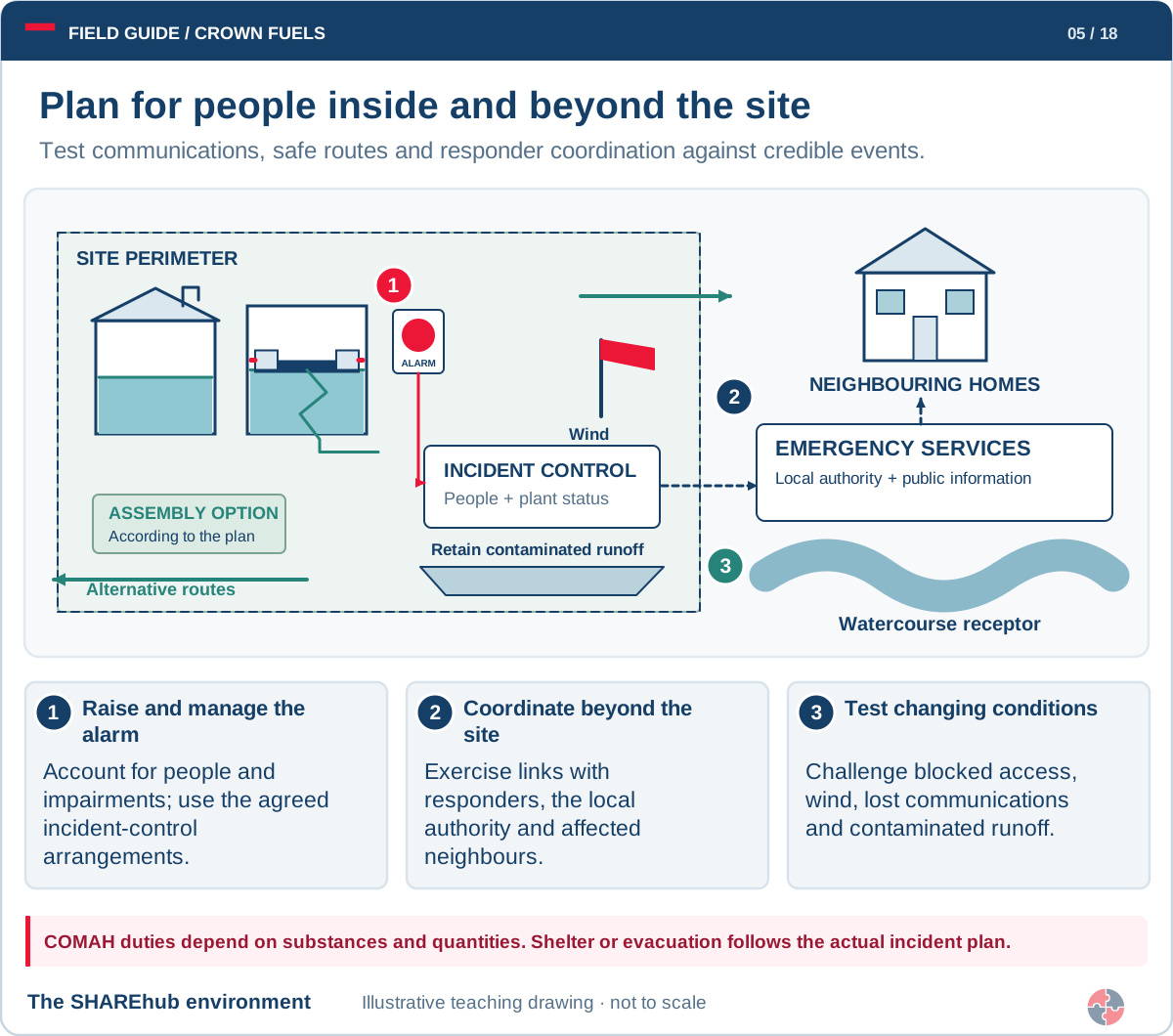
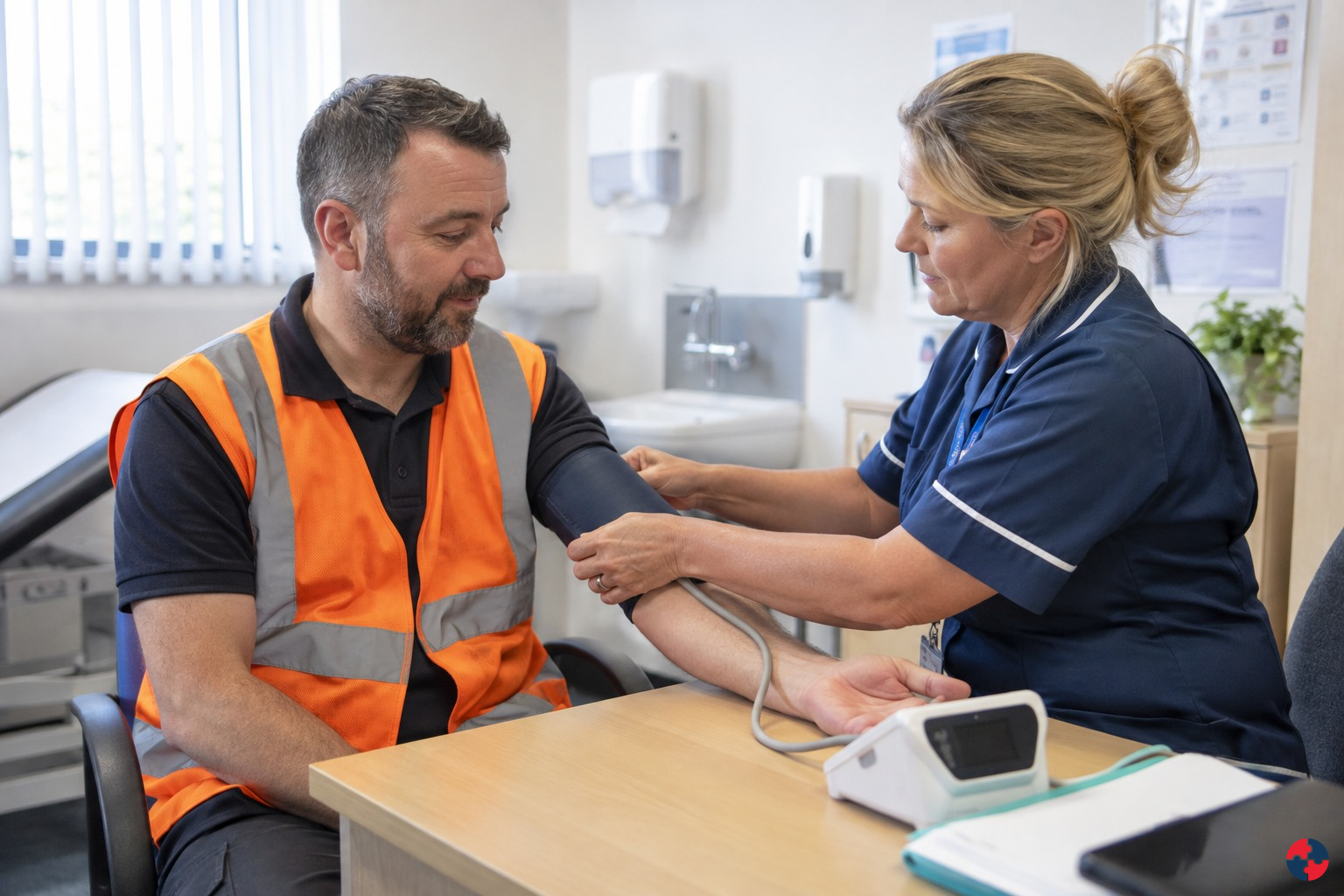

 Recognise the fuel. Read the extinguisher. Protect your escape.