
Crown Fuels and process safety / Utilities, firewater and fire-protection availability
Crown Fuels and process safety · SH-FUEL-08Utilities, firewater and fire-protection availability
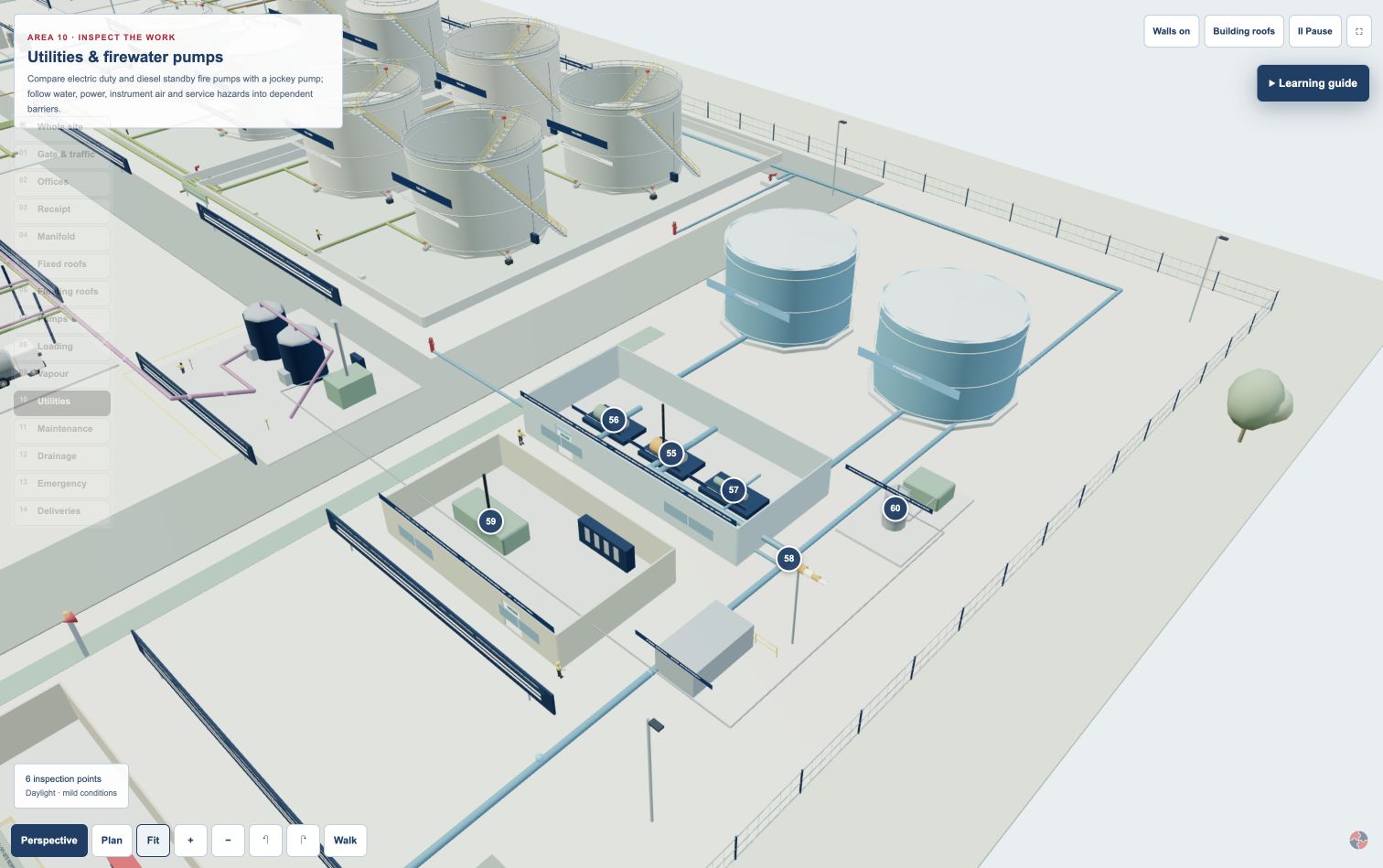
Free online training · Approximate learning time: 110–170 minutes · Self-paced
Prove delivery to the user, recognise common causes and control impaired protection
Full public teaching and readers are free without an account. A free learner account is required for saved LMS progress and recorded assessment. Completion and any course-completion certificate depend on the configured LMS conditions.
Who this course is for
Terminal operators, supervisors, maintenance planners and emergency coordinators who rely on utilities and fire protection.
Investigate fictional fire-pump, ring-main and foam evidence to decide whether protection is actually available to its users. Compare static pressure with delivered duty, trace shared failure paths and control maintenance impairments. A separate non-operating steam example develops energy-control awareness without implying that Crown Fuels operates a steam plant.
Terminal utilities and fire protection; steam case is hypothetical and firewater/foam duty cannot be inferred from a model or product label.
Learning outcomes
- Explain why an engine start, normal ring-main pressure or foam label cannot prove the complete assessed protection duty.
- Trace water, energy, control and delivery dependencies and identify common causes and affected users during isolation.
- Specify an authorised impairment and evidence-based restoration decision, including safe utility work and contaminated-runoff arrangements.
Course outline
Understand utility and protection duties
- Define what each utility must deliver and to whomDistinguish a live service from an available protective function.
- A starting pump and static pressure do not prove fire demandInterpret diesel, electric and jockey-pump evidence at the correct scope.
Verify firewater supplies and pumps
- Make every affected user visible during an impairmentCoordinate ring-main isolation with operations, permits and response.
- Control utility energy and verify the actual extinguishing mediumKeep steam-work and fire-agent decisions tied to their own evidence.
- Diesel standby: prove delivered emergency dutyA standby label promises a function; source-to-user test evidence shows whether the function is available.
- Two pumps: examine independence and common causesAsk what can fail together, not just how many items are installed. Independence belongs to a complete safety function.
Manage common causes and impairments
- Jockey pressure: distinguish a static condition from fire-demand deliveryA normal condition at low demand does not prove capacity under emergency demand. Identify the duty behind every indicator.
- An isolated fire-main section is a live protection impairmentA protection impairment follows the function it removes, not the location of the maintenance work.
Control utility energy and agent suitability
- Steam and condensate: a separate inert teaching caseSteam maintenance begins with controlled energy and verified internal conditions, not a touch test or an exploratory line break.
- Fire protection: prove product, system and medium compatibilityChanging an emergency resource is a safety-critical change: preserve the required duty and manage environmental consequences together.
Decide whether protection is available
- A loading decision during three utility impairmentsIntegrate complete-duty evidence, shared dependencies and restoration control.
- Turn the learning into a verified workplace actionChoose a bounded action, owner, task-specific evidence and escalation trigger within your role.
Activities, model practice and assessment
Work through 4 required applied activities and 3 model-practice pauses, with explanatory feedback and independent lesson decisions. Complete 6 distinct model mission sequences across those pauses. Use the actual fictional Crown Fuels model or its equivalent accessible route to complete the required decision sequences; launching the model alone does not complete practice.
The 20-question assessment requires at least 80% plus every designated critical safety answer. Complete the required activities, practice and lesson checks. Points and badges cannot offset a critical safety error.
Use the LMS for confirmed save/resume and recorded results. Any certificate follows its configured passed-completion and grade conditions.
Open the public interactive practice copy; public practice is separate from the LMS record.
Sources and learning provenance
Original fictional cases are paired with public SHAREhub teaching and structured topic records. Use the applicable jurisdiction and primary guidance for live work.
- HSE: active and passive fire protection
- HSE: introduction to pressure equipment
- HSE: safe isolation of plant and equipment, HSG253
- HSE: safety-report technical assessment criteria
- HSE: control systems
Topic sections, source identities and versions
| Public topic | Chunk and version | Jurisdiction and sources |
|---|---|---|
| utilities-and-process-services · criticality-table | utilities-and-process-services--criticality-table 3.5 | Great Britain, Northern Ireland source-hse_util, source-hse_inert, source-hse_comah_criteria, source-hse_controls |
| active-fire-protection · firewater | active-fire-protection--firewater 20261016-letter-review-1 | Great Britain, Northern Ireland source-afp-technical |
| active-fire-protection · impairment | active-fire-protection--impairment 20261016-letter-review-1 | Great Britain, Northern Ireland source-afp-technical, source-gb-comah, source-ni-comah |
| utilities-and-process-services · pressure-release-control | utilities-and-process-services--pressure-release-control 3.5 | Great Britain, Northern Ireland source-hse_pressure, source-hse_isolation, source-ni_pressure, source-hse-ppe, source-ni_mgmt |
| utilities-and-process-services · protective-utility-control | utilities-and-process-services--protective-utility-control 3.5 | Great Britain, Northern Ireland source-hse_util, source-hse_controls, source-hse_comah_criteria, source-hse-ppe, source-ni_mgmt, source-hse_reliability_of_utilities, source-hse_control_systems_technical_measures, source-hse_comah_technical_assessment_criteria, source-hse_managing_risk_using_ppe, source-ni_legal_route, source-hse_safe_isolation_of_plant_and_equipment, source-hse_maintenance_of_work_equipment, source-hse_permit_to_work_systems, source-hse_work_on_electrical_equipment, source-hseni_electrical_safety, source-hse_pressure_systems_safety_regulations, source-pressure_systems_safety_regulations_ni_2004 |
| active-fire-protection · foam | active-fire-protection--foam 20261016-letter-review-1 | Great Britain, Northern Ireland source-hsg176, source-eh70 |
| active-fire-protection · testing | active-fire-protection--testing 20261016-letter-review-1 | Great Britain, Northern Ireland source-afp-technical |
Course SH-FUEL-08 · version 2026.10.20.1. .
Questions about this course
Is this training free?
Full public teaching and readers are free without an account. A free learner account is required for saved LMS progress and recorded assessment. Completion and any course-completion certificate depend on the configured LMS conditions.
How long should I allow?
Approximately 110–170 minutes, including teaching, lesson checks, required activities, model or accessible practice and one assessment attempt. Individual pace, review and retries vary. Save and resume in the LMS.
Can I learn without a 3D-capable browser?
Yes. The complete HTML reader provides the teaching. Required model practice has an equivalent accessible decision route in the interactive course. Use the LMS route for recorded learning.
What is required to pass?
Complete the required learning, activities, practice and lesson decisions. The 20-question final assessment requires at least 80% plus every designated critical safety answer. Points cannot compensate for a critical safety error. Follow the feedback before retrying.
Does this authorise fuel operations?
Terminal utilities and fire protection; steam case is hypothetical and firewater/foam duty cannot be inferred from a model or product label. This independent course does not award a NEBOSH qualification or replace competent task assessment, practical training or site authorisation.