
Care home safety / Cleaning, laundry and skin protection
Care home safety · SH-CARE-06Cleaning, laundry and skin protection
Free online training · Approximate learning time: 100–170 minutes · Self-paced
Break contamination routes and prevent chemical exposure, skin damage and handling injuries.
Full public teaching and readers are free without an account. A free learner account is required for saved LMS progress and recorded assessment. Completion and any course-completion certificate depend on the configured LMS conditions.
Who this course is for
Housekeeping, laundry, care staff, cleaning supervisors and facilities teams.
Break contamination routes and prevent chemical exposure, skin damage and handling injuries. Work through person-centred teaching, original cases and independent decisions before the model-linked practice. Preserve dignity, individual choice and the applicable lawful care process.
Care-home safety awareness with a Great Britain workplace baseline. CQC, DHSC and cited residential-care examples apply to England where stated; confirm the relevant national regime. This course does not confer clinical, medicines, lifting, restraint, maintenance or emergency-response competence or authorisation.
Learning outcomes
- Separate clean and used linen through the complete handling route.
- Recognise dangerous chemical mixing, mislabelling and exposure.
- Choose effective skin and manual-handling controls and verify they are usable.
Course outline
Understand the person and activity
- Follow the route, not just the clean-looking surfaceApply follow the route, not just the clean-looking surface to the current person and task.
- Design the cleaning task to prevent exposureApply design the cleaning task to prevent exposure to the current person and task.
Choose suitable controls and support
- Mixing cleaners can create a new exposurePrevent incompatible contact and avoid improvised neutralisation.
- A drinks bottle is not chemical identificationKeep unknown products out of use and accessible resident areas.
Verify information and role boundaries
- Skin protection starts with reducing exposureMake hygiene and worker health compatible.
- A linen trolley needs a suitable load and routeReduce pushing risk without defeating infection separation.
- Keep the linen flow from used to cleanCheck the entire linen journey, not only the washing cycle; interfaces and shortages often create the exposure route.
- Incompatible cleaning chemicals can create a gas emergencyPrevent the wrong combination before pouring starts, and keep emergency actions simple enough to use under pressure.
- Never put cleaning products in drinks containersPackaging is a safety control: use the right container, reliable identity and secure storage before considering user behaviour.
Practise the care-home decisions
- Protect skin while maintaining effective hygieneStaff health is part of reliable care. Make early reporting and task redesign routine rather than waiting for severe disease.
- Make the loaded trolley manageable and visibleAssess pushing and pulling with the actual load and route; wheels do not automatically remove manual-handling risk.
Defend the complete readiness plan
- The busy laundry handoverKeep chemical, contamination and handling controls working together.
- Take a verified action into the workplaceConnect one actual task to an owner, evidence and a clear release or escalation decision.
Activities, model practice and assessment
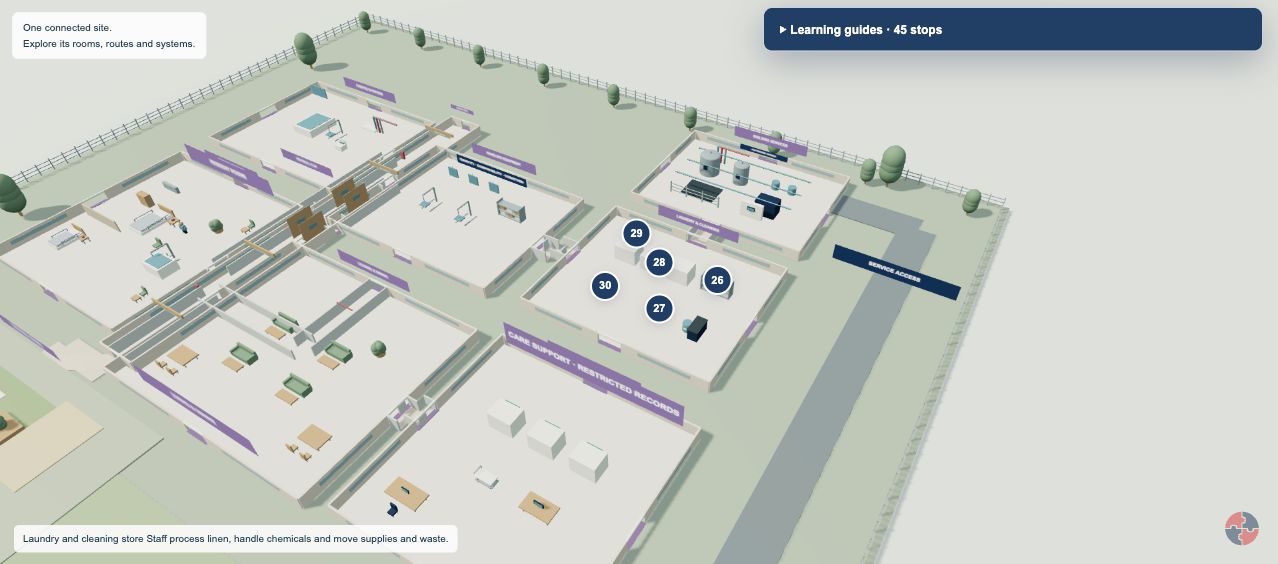
Work through 5 required applied activities and 3 model-practice pauses, with explanatory feedback and independent lesson decisions. Complete 5 distinct model mission sequences across those pauses. Use the actual fictional residential care home model or its equivalent accessible route to complete the required decision sequences; launching the model alone does not complete practice.
The 20-question assessment requires at least 80% plus every designated critical safety answer. Complete the required activities, practice and lesson checks. Points and badges cannot offset a critical safety error.
Use the LMS for confirmed save/resume and recorded results. Any certificate follows its configured passed-completion and grade conditions.
Open the public interactive practice copy; public practice is separate from the LMS record.
Sources and learning provenance
Original fictional cases are paired with public SHAREhub teaching and structured topic records. Use the applicable jurisdiction and primary guidance for live work.
- UKHSA · Linen processing in England adult social care
- DHSC · Infection prevention in England adult social care
- HSE · COSHH in cleaning
- HSE · Skin protection at work
Topic sections, source identities and versions
| Public topic | Chunk and version | Jurisdiction and sources |
|---|---|---|
| hand-hygiene-and-infection-prevention · transmission | hand-hygiene-and-infection-prevention--transmission | Great Britain, Northern Ireland source-hse-infections, source-nhs-hands |
| skin-health · control-hierarchy | skin-health--control-hierarchy | Great Britain skin-health--hierarchy, an-sk-s6, share-hierarchy-iosh |
| chemical-compatibility-and-inadvertent-mixing · emergency | chemical-compatibility-and-inadvertent-mixing--emergency 20261016-letter-review-1 | Great Britain source-mix-hse-waste, source-mix-hse-fire |
| chemical-compatibility-and-inadvertent-mixing · assessment | chemical-compatibility-and-inadvertent-mixing--assessment 20261016-letter-review-1 | Great Britain, Northern Ireland source-mix-hse-waste, source-mix-hse-sds, source-mix-hse-comah, source-mix-hseni-coshh |
| skin-health · decision-tool | skin-health--decision-tool | Great Britain an-sk-s6, skin-health--hsg262, skin-health--nhs-anaphylaxis |
| manual-handling · technical-model | manual-handling--technical-model 2.0 | Great Britain, Northern Ireland hse-l23, hse-manual, hseni-manual |
| hand-hygiene-and-infection-prevention · meaning | hand-hygiene-and-infection-prevention--meaning | Great Britain, Northern Ireland source-hse-infections, source-hse-welfare, source-hseni-welfare |
| chemical-compatibility-and-inadvertent-mixing · barriers | chemical-compatibility-and-inadvertent-mixing--barriers 20261016-letter-review-1 | Great Britain, Northern Ireland source-mix-hse-waste, source-mix-hse-sds, source-mix-hse-comah, source-mix-hseni-coshh |
| coshh-control-measures-and-health-surveillance · reach-clp | coshh-control-measures-and-health-surveillance--reach-clp 20261016-letter-review-1 | Great Britain, Northern Ireland source-coshh-hse-reach, source-coshh-hse-clp, source-coshh-ni-reach, source-coshh-hse-assess, source-coshh-ni-coshh |
| skin-health · glove-selection | skin-health--glove-selection | Great Britain skin-health--gloves, skin-health--engineering-gloves |
| manual-handling · evidence-pack | manual-handling--evidence-pack 2.0 | Great Britain, Northern Ireland hse-l23, hse-mac |
| hazard-identification-and-risk-assessment-foundations · risk-process | hazard-identification-and-risk-assessment-foundations--risk-process | Great Britain, Northern Ireland source-hse-risk, source-hseni-risk |
Course SH-CARE-06 · version 2026.10.20.2. .
Questions about this course
Is this training free?
Full public teaching and readers are free without an account. A free learner account is required for saved LMS progress and recorded assessment. Completion and any course-completion certificate depend on the configured LMS conditions.
How long should I allow?
Approximately 100–170 minutes, including teaching, lesson checks, required activities, model or accessible practice and one assessment attempt. Individual pace, review and retries vary. Save and resume in the LMS.
Can I learn without a 3D-capable browser?
Yes. The complete HTML reader provides the teaching. Required model practice has an equivalent accessible decision route in the interactive course. Use the LMS route for recorded learning.
What is required to pass?
Complete the required learning, activities, practice and lesson decisions. The 20-question final assessment requires at least 80% plus every designated critical safety answer. Points cannot compensate for a critical safety error. Follow the feedback before retrying.
Does this authorise care operations?
Care-home safety awareness with a Great Britain workplace baseline. CQC, DHSC and cited residential-care examples apply to England where stated; confirm the relevant national regime. This course does not confer clinical, medicines, lifting, restraint, maintenance or emergency-response competence or authorisation. This independent course does not award an external qualification or replace competent task assessment, practical training or site authorisation.
Which manual handling assessments will you learn to use?
TILEO helps you review the wider task; MAC supports appropriate lifting, carrying and team handling of inanimate loads; RAPP supports appropriate pushing and pulling.
These aids support the activity assessment. Repetitive upper-limb work may need ART; variable or complex tasks may need other HSE tools or a fuller competent assessment. Mechanical lifting, stored energy, equipment safety and health decisions retain their separate controls. A low factor score, a downloaded report or completion of this course does not approve the work.
This additional teaching takes about 2–5 minutes, in addition to the course estimate. Optional reading and workplace assessment take additional time.
Learn how to select the method, use separate reports for mixed tasks, add a company logo and keep editable Word or PDF records. After a saved pass, the course offers a direct route to the assessment tools. Workplace assessment and practical competence remain separate from course completion.