
Care home safety / Safer assisted bathing and bathroom transfers
Care home safety · SH-CARE-03Safer assisted bathing and bathroom transfers
Free online training · Approximate learning time: 100–160 minutes · Self-paced
Connect scald prevention, slip control, equipment condition and changing mobility.
Full public teaching and readers are free without an account. A free learner account is required for saved LMS progress and recorded assessment. Completion and any course-completion certificate depend on the configured LMS conditions.
Who this course is for
Care staff, senior carers, care planners and bathroom-equipment/premises teams.
Connect scald prevention, slip control, equipment condition and changing mobility. Work through person-centred teaching, original cases and independent decisions before the model-linked practice. Preserve dignity, individual choice and the applicable lawful care process.
Care-home safety awareness with a Great Britain workplace baseline. CQC, DHSC and cited residential-care examples apply to England where stated; confirm the relevant national regime. This course does not confer clinical, medicines, lifting, restraint, maintenance or emergency-response competence or authorisation.
Learning outcomes
- Recognise when bathing or transfer arrangements no longer match current needs.
- Distinguish outlet-temperature protection from water-system hygiene controls.
- Verify the person, surface, equipment, staffing and agreed plan before proceeding.
Course outline
Understand the person and activity
- Prepare the whole activity before the person is exposedApply prepare the whole activity before the person is exposed to the current person and task.
- Keep scald prevention and water hygiene connectedApply keep scald prevention and water hygiene connected to the current person and task.
Choose suitable controls and support
- A comfortable touch test is not bathing verificationKeep outlet protection and the individual bathing procedure effective.
- Changed mobility changes the transfer planPause safely when the person’s current ability no longer matches.
Verify information and role boundaries
- A shower chair is a whole support systemWithdraw damage without inventing a repair.
- Drying and return are part of the bathing taskPrevent the wet-floor pathway without abandoning the person.
- Control bathing temperature at the point of useCheck the final exposure and the upstream system together; resolving one hazard must not create another.
- Restore stable footing before an assisted transferCheck environmental conditions before handling starts; cleaning, maintenance and care teams need one coordinated plan.
- A change in mobility triggers a new transfer decisionUse changed needs, near misses and repeated difficulty as review triggers before the next movement takes place.
Practise the care-home decisions
- Defective shower seating needs controlled replacementQuarantine needs to be physical and communicated. A defect label should lead to a verified outcome and a suitable continuity plan.
- A fluctuating shower needs a reliable engineering correctionVerify controls across realistic operating conditions, including other demands on shared building systems.
Defend the complete readiness plan
- The bathroom change of planPreserve dignity while resolving equipment, water and transfer gaps.
- Take a verified action into the workplaceConnect one actual task to an owner, evidence and a clear release or escalation decision.
Activities, model practice and assessment
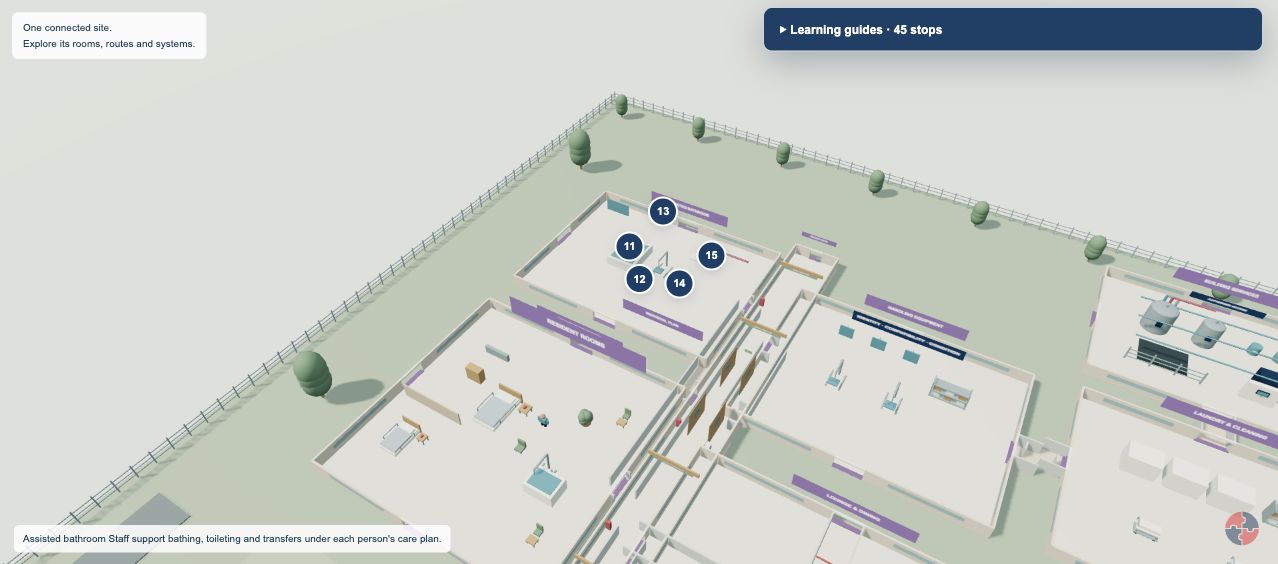
Work through 5 required applied activities and 3 model-practice pauses, with explanatory feedback and independent lesson decisions. Complete 5 distinct model mission sequences across those pauses. Use the actual fictional residential care home model or its equivalent accessible route to complete the required decision sequences; launching the model alone does not complete practice.
The 20-question assessment requires at least 80% plus every designated critical safety answer. Complete the required activities, practice and lesson checks. Points and badges cannot offset a critical safety error.
Use the LMS for confirmed save/resume and recorded results. Any certificate follows its configured passed-completion and grade conditions.
Open the public interactive practice copy; public practice is separate from the LMS record.
Sources and learning provenance
Original fictional cases are paired with public SHAREhub teaching and structured topic records. Use the applicable jurisdiction and primary guidance for live work.
- HSE · Scalding and burning
- HSE · Moving and handling equipment in care
- HSE · Hot and cold water systems
- CQC · Consent in England
Topic sections, source identities and versions
| Public topic | Chunk and version | Jurisdiction and sources |
|---|---|---|
| manual-handling · sector-examples | manual-handling--sector-examples 2.0 | Great Britain, Northern Ireland hse-manual, hseni-manual |
| hazard-identification-and-risk-assessment-foundations · hierarchy-applied | hazard-identification-and-risk-assessment-foundations--hierarchy-applied | Great Britain, Northern Ireland source-hse-risk, source-hseni-risk, share-hierarchy-hse |
| hazard-identification-and-risk-assessment-foundations · barriers | hazard-identification-and-risk-assessment-foundations--barriers | Great Britain, Northern Ireland source-hse-risk, source-hseni-risk, source-hse-hsg254 |
| manual-handling · technical-model | manual-handling--technical-model 2.0 | Great Britain, Northern Ireland hse-l23, hse-manual, hseni-manual |
| hazard-identification-and-risk-assessment-foundations · warning-signs | hazard-identification-and-risk-assessment-foundations--warning-signs | Great Britain, Northern Ireland source-hse-risk, source-hseni-risk |
| slips-and-trips · technical-model | slips-and-trips--technical-model | Great Britain slips-and-trips--hsemodel |
| legionella-management · temperature | legionella-management--temperature 2026-10-02-additive-1 | Great Britain, Northern Ireland legionella-management-src-04, legionella-management-src-03 |
| slips-and-trips · signs-and-cones | slips-and-trips--signs-and-cones | Great Britain slips-and-trips--retail |
| maintenance-inspection-and-testing-of-work-equipment-and-machinery · defects | maintenance-inspection-and-testing-of-work-equipment-and-machinery--defects 2.0 | Great Britain, Northern Ireland hse-maint, hse-loler-exam, m-review-pssr |
| maintenance-inspection-and-testing-of-work-equipment-and-machinery · functional-testing | maintenance-inspection-and-testing-of-work-equipment-and-machinery--functional-testing 2.0 | Great Britain, Northern Ireland hse-l22, hse-maint |
| hazard-identification-and-risk-assessment-foundations · risk-process | hazard-identification-and-risk-assessment-foundations--risk-process | Great Britain, Northern Ireland source-hse-risk, source-hseni-risk |
Course SH-CARE-03 · version 2026.10.20.2. .
Questions about this course
Is this training free?
Full public teaching and readers are free without an account. A free learner account is required for saved LMS progress and recorded assessment. Completion and any course-completion certificate depend on the configured LMS conditions.
How long should I allow?
Approximately 100–160 minutes, including teaching, lesson checks, required activities, model or accessible practice and one assessment attempt. Individual pace, review and retries vary. Save and resume in the LMS.
Can I learn without a 3D-capable browser?
Yes. The complete HTML reader provides the teaching. Required model practice has an equivalent accessible decision route in the interactive course. Use the LMS route for recorded learning.
What is required to pass?
Complete the required learning, activities, practice and lesson decisions. The 20-question final assessment requires at least 80% plus every designated critical safety answer. Points cannot compensate for a critical safety error. Follow the feedback before retrying.
Does this authorise care operations?
Care-home safety awareness with a Great Britain workplace baseline. CQC, DHSC and cited residential-care examples apply to England where stated; confirm the relevant national regime. This course does not confer clinical, medicines, lifting, restraint, maintenance or emergency-response competence or authorisation. This independent course does not award an external qualification or replace competent task assessment, practical training or site authorisation.
Which manual handling assessments will you learn to use?
TILEO helps you review the wider task; MAC supports appropriate lifting, carrying and team handling of inanimate loads; RAPP supports appropriate pushing and pulling.
Moving a person needs an individual, person-centred assessment, care plan, suitable equipment and competent assistance. These object-handling MAC and RAPP calculators do not assess a resident's transfer or select a hoist, sling or staffing level. TILEO can organise general task questions but does not replace the individual's care assessment. Use the tools only for appropriate inanimate-load activities such as supplies or linen trolleys, alongside the course's care-specific arrangements.
This additional teaching takes about 2–5 minutes, in addition to the course estimate. Optional reading and workplace assessment take additional time.
Learn how to select the method, use separate reports for mixed tasks, add a company logo and keep editable Word or PDF records. After a saved pass, the course offers a direct route to the assessment tools. Workplace assessment and practical competence remain separate from course completion.