
Aerospace manufacturing safety / Aerospace site access and oversize traffic
Aerospace manufacturing safety · SH-AERO-01Aerospace site access and oversize traffic
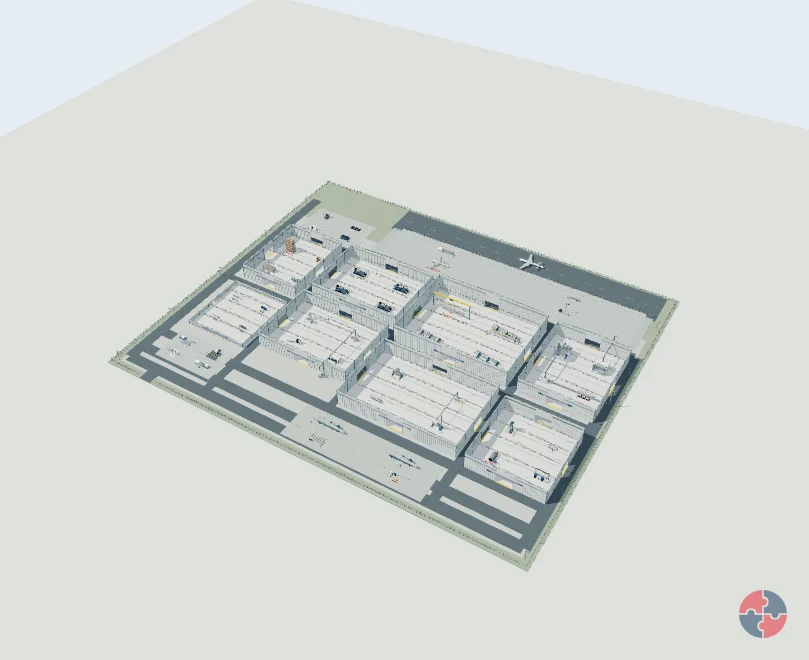
Free online training · Approximate learning time: 120–190 minutes · Self-paced
Connect protected pedestrian journeys with long-component movement planning.
Full public teaching and readers are free without an account. A free learner account is required for saved LMS progress and recorded assessment. Completion and any course-completion certificate depend on the configured LMS conditions.
Who this course is for
Gatehouse, logistics, dispatch, visitor-facing teams and supervisors.
Follow a long component through a busy factory entrance and dispatch road. Connect visibility, accessible routes, driver understanding and the real swept path rather than relying on isolated warning signs.
Awareness in an original fictional aerospace manufacturing and airport-interface site. GB occupational guidance has separate NI routes; environmental duties depend on the UK nation and permit. This course does not confer engineering, aircraft maintenance, product-release, lifting, rescue, driving or airside authorisation.
Learning outcomes
- Trace protected visitor, driver and staff journeys.
- Recognise how a changed load or route invalidates earlier assumptions.
- Coordinate reversing and dispatch with controlled access and stop communication.
- Give a handover that preserves restrictions until verified.
Course outline
Map complete journeys
- Trace the complete person-and-load journeyAssess the whole route, including the approaches and the destination, before accepting an isolated crossing control.
- Match the road to the oversize componentConsider the carried component, vehicle behaviour and route profile as one movement system.
Assess the current load and route
- Keep the accessible pedestrian route usableTreat obstruction of a protected route as a change requiring a safe alternative before people arrive.
- Brief a movement that can actually be stoppedGive visiting drivers a route, safe waiting arrangement and reliable stop communication before reversing begins.
Coordinate arrivals and reversing
- Plan the shift-change exception before dispatchCoordinate an oversize move with the real pedestrian peak and keep temporary arrangements under control.
- Reopen the route with evidence and a named ownerCarry restrictions across handovers until the actual route and movement conditions have been verified.
- Obstructed zebra crossing sightlineHold conflicting movements when the crossing cannot be seen or protected.
- Speed humps and vehicle stabilityStop the movement if stability or clearance across the hump is uncertain.
- Pedestrian gate and accessible routeDo not direct a person into vehicle space because the protected route is blocked.
Manage shift-change exceptions
- Delivery driver briefing and reversingStop reversing when a person enters the area or communication is lost.
- Oversize wing transporter and swept pathStop when any part of the loaded movement cannot remain within its controlled clearance.
- Crossing protection during shift changeHold the vehicle whenever the crossing or pedestrian diversion is uncontrolled.
Verify and hand over
- Coordinate a delayed wing dispatch through a changing siteSeparate immediate protection, movement planning and evidence-based reopening in a combined traffic case.
- Take a verified action into the workplaceConnect one actual task to an owner, evidence and a clear release or escalation decision.
Activities, model practice and assessment
Work through 5 required applied activities and 3 model-practice pauses, with explanatory feedback and independent lesson decisions. Complete 6 distinct model mission sequences across those pauses. Use the actual fictional aerospace manufacturing model or its equivalent accessible route to complete the required decision sequences; launching the model alone does not complete practice.
The 20-question assessment requires at least 80% plus every designated critical safety answer. Complete the required activities, practice and lesson checks. Points and badges cannot offset a critical safety error.
Use the LMS for confirmed save/resume and recorded results. Any certificate follows its configured passed-completion and grade conditions.
Open the public interactive practice copy; public practice is separate from the LMS record.
Sources and learning provenance
Original fictional cases are paired with public SHAREhub teaching and structured topic records. Use the applicable jurisdiction and primary guidance for live work.
- HSE: workplace transport site layout
- HSE: storage and handling of metal stock, HSG246
- CAA: CAP642 Airside Safety Management
Topic sections, source identities and versions
| Public topic | Chunk and version | Jurisdiction and sources |
|---|---|---|
| workplace-transport-and-work-related-driving · technical-model | workplace-transport-and-work-related-driving--technical-model 4.1 | Great Britain, Northern Ireland source-hse_safeplace, source-hse_transport, source-hse_reversing, source-hse_loading |
| workplace-transport-and-work-related-driving · failure-modes | workplace-transport-and-work-related-driving--failure-modes 4.1 | Great Britain, Northern Ireland source-hse_reversing, source-hse_safeplace, source-hse_transport |
| safe-workplace-design-welfare-and-working-environment · technical-model | safe-workplace-design-welfare-and-working-environment--technical-model 2.1 | safe-workplace-design-welfare-and-working-environment--welfare, safe-workplace-design-welfare-and-working-environment--constructionwelfare, safe-workplace-design-welfare-and-working-environment--drivers |
| workplace-transport-and-work-related-driving · role-actions | workplace-transport-and-work-related-driving--role-actions 4.1 | Great Britain, Northern Ireland source-hse_safedriver, source-hse_safeplace, source-hse_reversing, source-hse_road |
| workplace-transport-and-work-related-driving · assurance | workplace-transport-and-work-related-driving--assurance 4.1 | Great Britain, Northern Ireland source-hse_transport, source-ni_transport |
| safe-workplace-design-welfare-and-working-environment · assurance | safe-workplace-design-welfare-and-working-environment--assurance 2.1 | safe-workplace-design-welfare-and-working-environment--welfare |
Course SH-AERO-01 · version 2026.10.20.2. .
Questions about this course
Is this training free?
Full public teaching and readers are free without an account. A free learner account is required for saved LMS progress and recorded assessment. Completion and any course-completion certificate depend on the configured LMS conditions.
How long should I allow?
Approximately 120–190 minutes, including teaching, lesson checks, required activities, model or accessible practice and one assessment attempt. Individual pace, review and retries vary. Save and resume in the LMS.
Can I learn without a 3D-capable browser?
Yes. The complete HTML reader provides the teaching. Required model practice has an equivalent accessible decision route in the interactive course. Use the LMS route for recorded learning.
What is required to pass?
Complete the required learning, activities, practice and lesson decisions. The 20-question final assessment requires at least 80% plus every designated critical safety answer. Points cannot compensate for a critical safety error. Follow the feedback before retrying.
Does this authorise aerospace operations?
Awareness in an original fictional aerospace manufacturing and airport-interface site. GB occupational guidance has separate NI routes; environmental duties depend on the UK nation and permit. This course does not confer engineering, aircraft maintenance, product-release, lifting, rescue, driving or airside authorisation. This independent course does not award an external qualification or replace competent task assessment, practical training or site authorisation.