Focused awareness learning based on SHAREhub pages. Apply the actual workplace arrangements and your role; completion is not practical competence or permission for specialist work.
This reader supplies the complete teaching. Use the interactive LMS course for assessed activities, saved progress and completion.
LESSON 1
Separate the roles
Fire classes and fire extinguishersFire classes · agent types · dangerous mismatches
Recognise the fuel. Read the extinguisher. Protect your escape.
People and escape first. Raise the alarm, follow the site’s evacuation plan and arrange the emergency call to 999. Only consider a small fire in its earliest stage if you are trained, authorised, have the correct equipment and a clear escape behind you. Smoke, spreading fire, uncertainty or an unsafe approach mean withdraw. Never delay escape to fetch an extinguisher.
UK awareness reference for common and specialist portable extinguisher families. Actual ratings, exclusions and manufacturer instructions govern each unit. Reading this guide is not practical training or permission to fight a fire. Fixed systems, hose reels and specialist industrial firefighting require their own assessed arrangements.
Marshals and wardens: helping the planned evacuation does not automatically make you an authorised firefighter.
Fire classes: fuel, examples and the important distinction
Class
Fuel and examples
What matters
AClass A
Solid materials
Wood, paper, textiles and many solid plastics.
Usually forms an ember or char bed. Cooling matters; check the marked A rating.
BClass B
Flammable liquids
Petrol, solvents, diesel when burning, and liquefiable solids such as wax.
Fuel can spread across a surface. An unsuitable jet can spread burning liquid; solvent compatibility matters.
CClass C
Flammable gases
Propane, butane or methane.
Not a routine employee firefighting task. Knocking down flame while gas continues to escape can create an explosive cloud. Fuel isolation requires safe, competent action under the emergency plan.
DClass D
Combustible metals
Magnesium, sodium or metallic lithium.
Needs a metal-specific specialist agent. Ordinary ABC powder is not Class D powder.
FClass F
Cooking oils and fats
Hot oil in a fryer or pan.
Very hot oil can reignite. Water can produce violent steam expansion and eject burning oil.
LClass L
Lithium-ion batteries
A lithium-ion tool, e-bike or vehicle battery in thermal runaway.
Class L is included in BS ISO 3941:2026. Toxic or flammable gas, heat propagation and reignition need specialist planning. This is different from a metallic-lithium Class D fire.
Electrical equipment: Energised electrical equipment is an additional hazard, not a UK fire class called E. Do not import US Class C electrical or Class K cooking labels into this UK guide. Isolation, only where safe and authorised, does not remove the burning fuel or stored battery energy. Use the unit’s explicit electrical suitability and limitations.
Class L is the 2026 addition to the classification standard. Existing extinguisher labels and product test claims vary; a new class name does not certify every battery product.
Compare the classes · including lithium-ion batteries
Typical = usual application for the labelled family. If rated / unit limits = confirm the actual label and manufacturer conditions. No = not a normal selection for that hazard; specialist engineered arrangements are separate. This table cannot authorise firefighting.
* Electrical is an additional hazard, not a fire class. Gas-fire and battery-fire response require the assessed specialist plan. Scroll the table sideways on a narrow screen.
Typical portable-agent applications: always confirm the actual unit
Agent family
A · solids
B · liquids
C · gases
D · metals
Electrical*
F · cooking oil
L · Li-ion
Water
Typical
No
No
No
Unit limits
No
No
Water spray / water with additives
Typical
If rated
No
No
Unit limits
No
No
Foam
Typical
Typical
No
No
Unit limits
No
No
Water mist
Typical
If rated
No
No
Unit limits
If rated
Specialist plan
ABC dry powder
Typical
Typical
Specialist plan
No
Unit limits
No
No
BC dry powder
No
Typical
Specialist plan
No
Unit limits
No
No
Class D specialist powder
No
No
No
Exact metal
No
No
No
Carbon dioxide (CO₂)
No
Typical
No
No
Unit limits
No
No
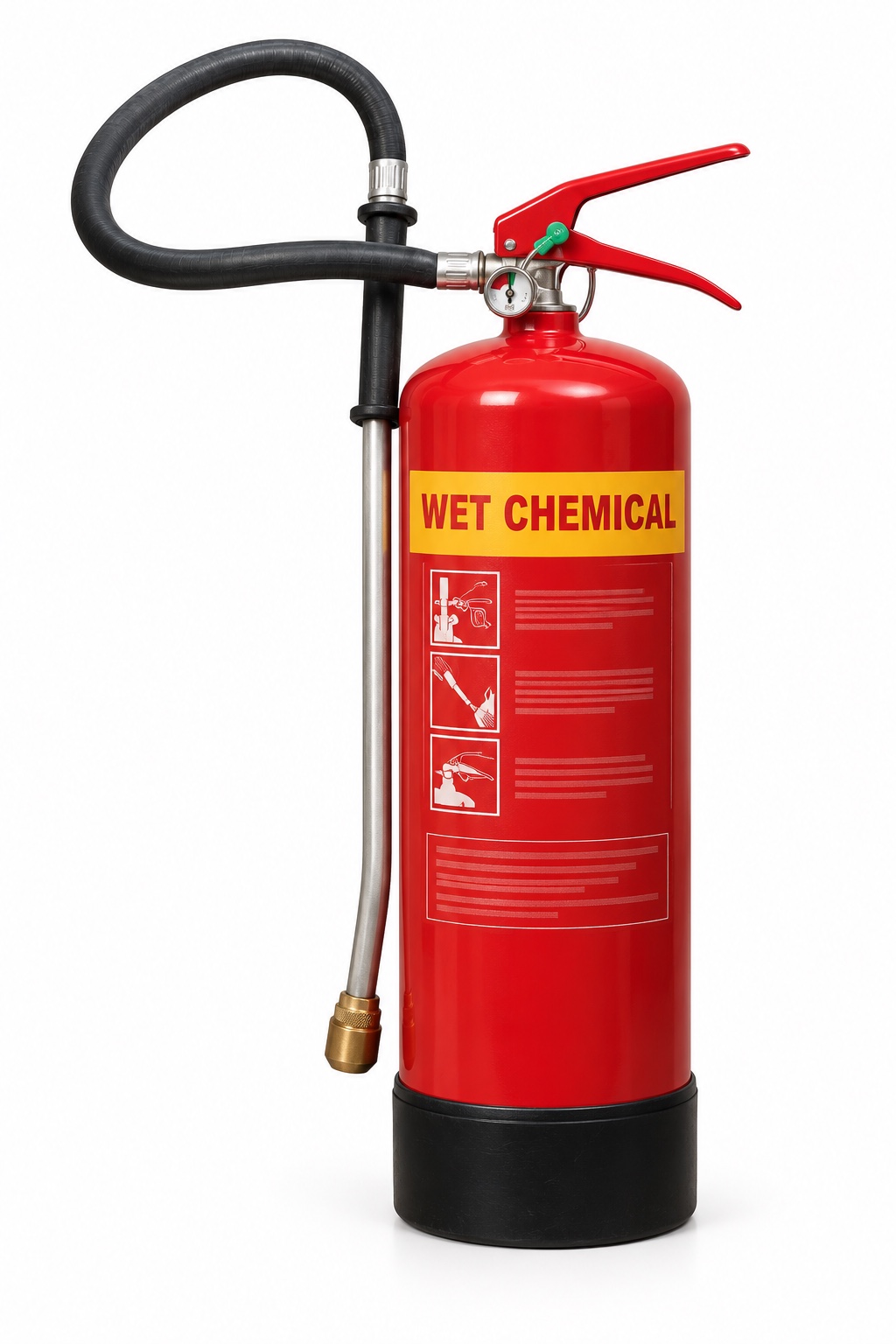
Wet chemical
If rated
If rated
No
No
Unit limits
Typical
No
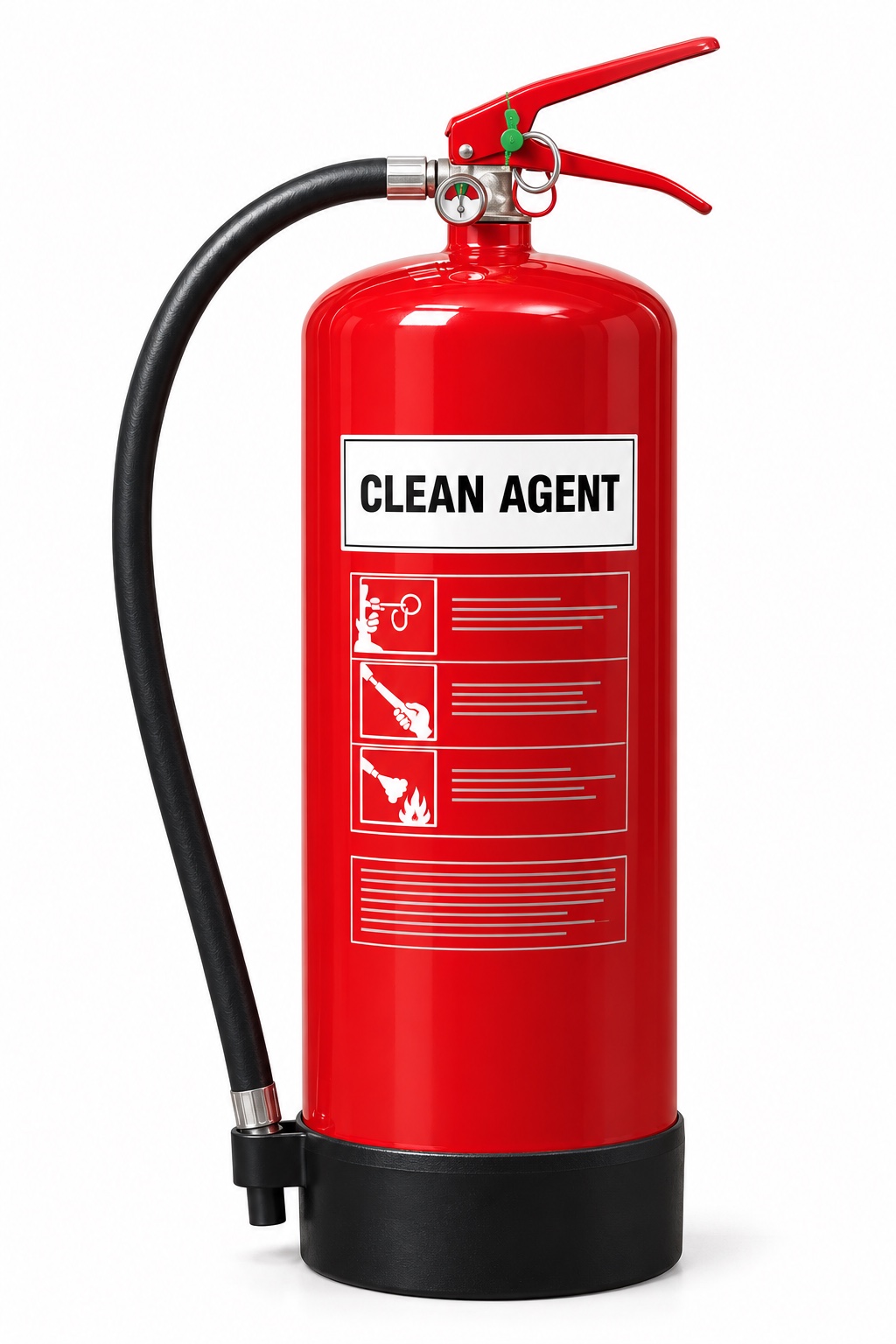
Clean agent / vaporising liquid
Unit rating
Unit rating
No
No
Unit limits
No
No
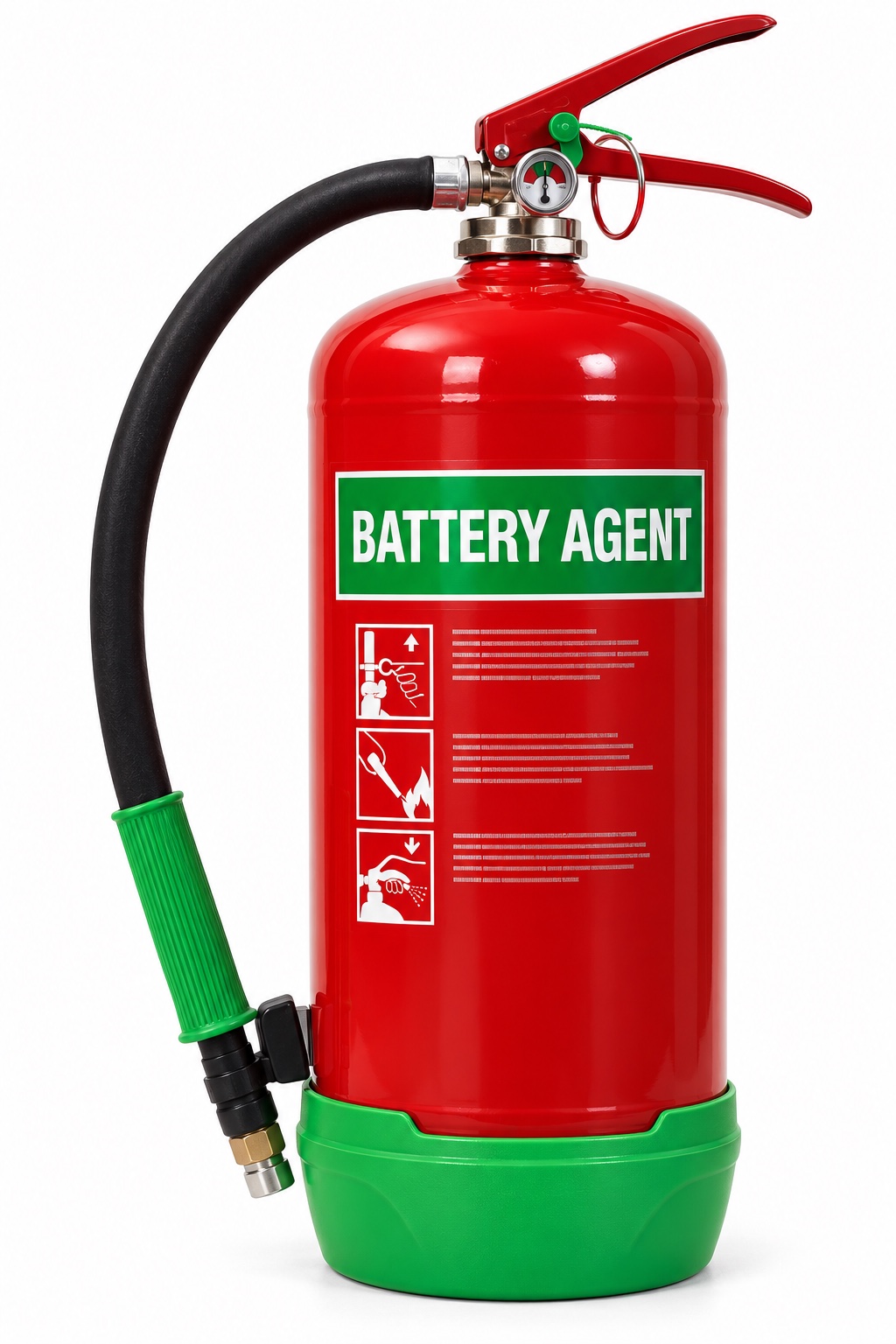
Battery-specific suppression products
If rated
No
No
No
Unit limits
No
Specified battery
Extinguisher types: uses and dangers
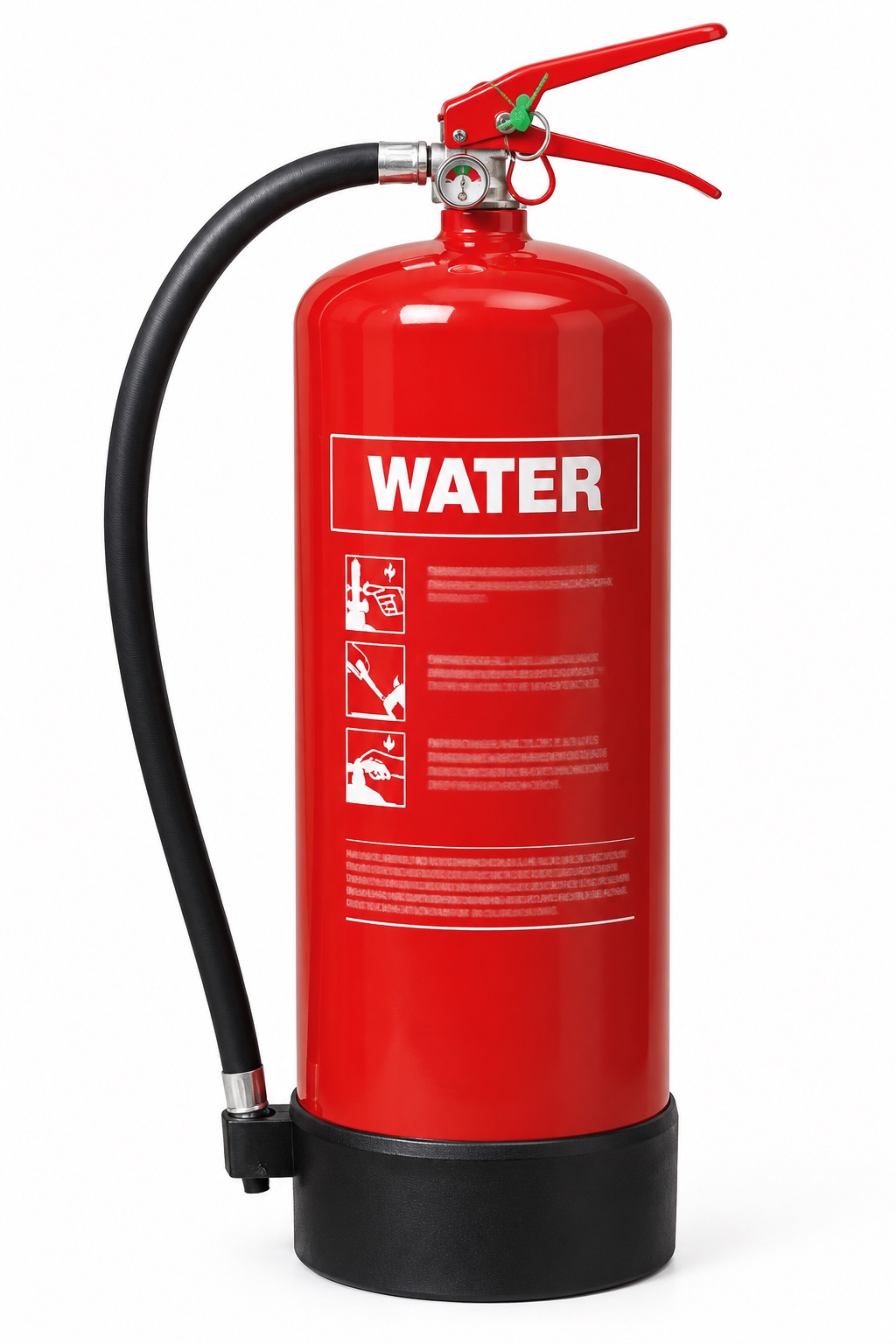
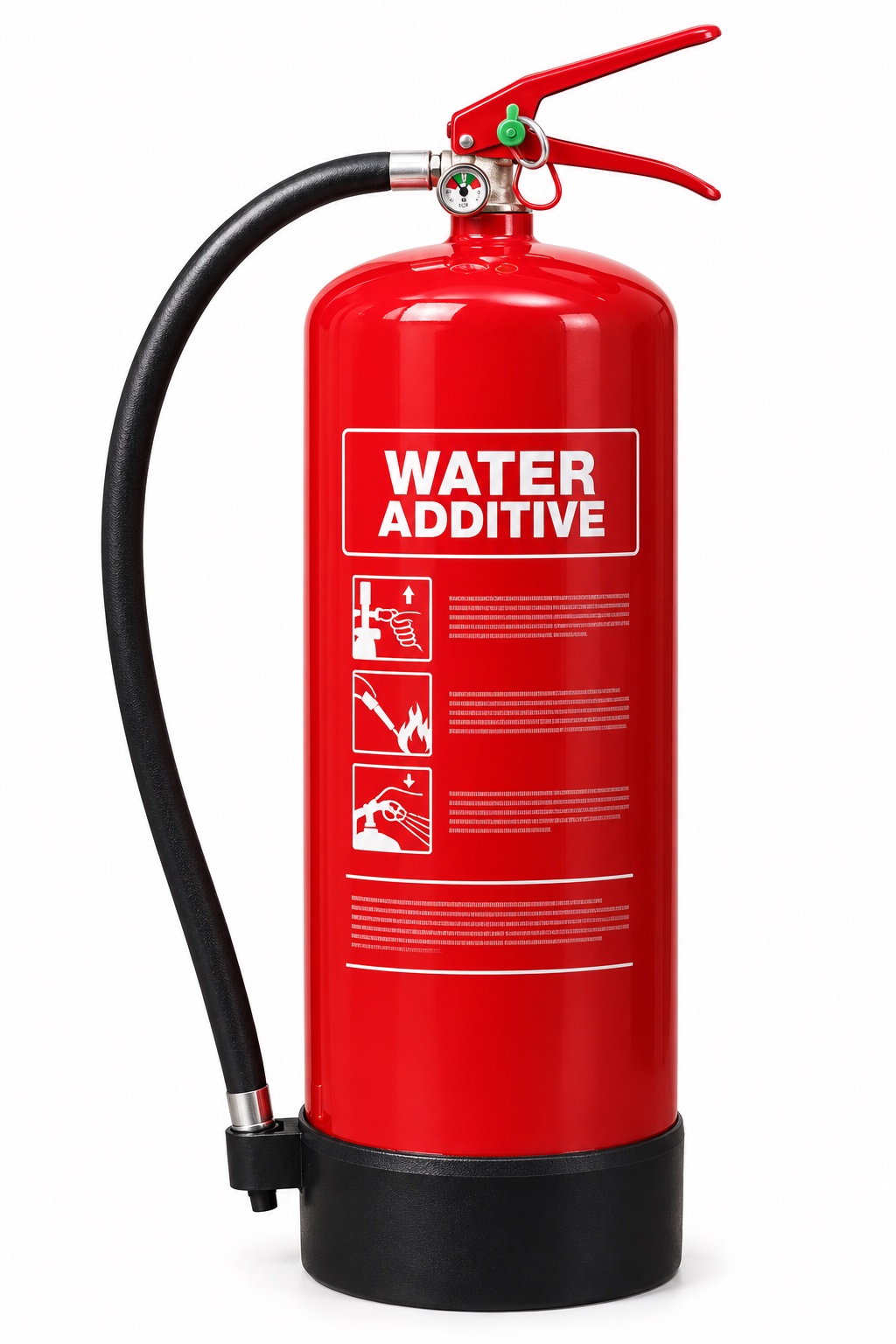
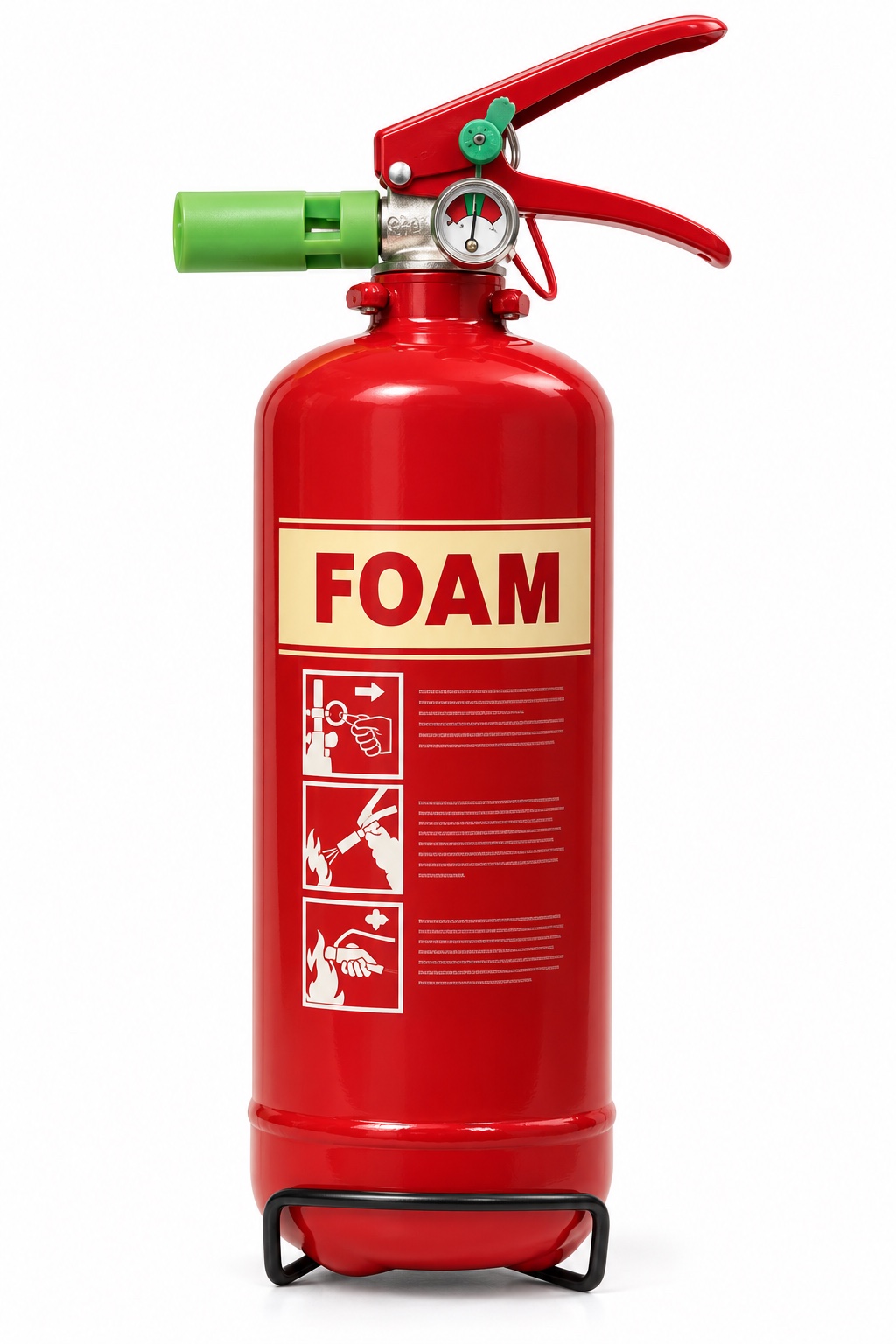
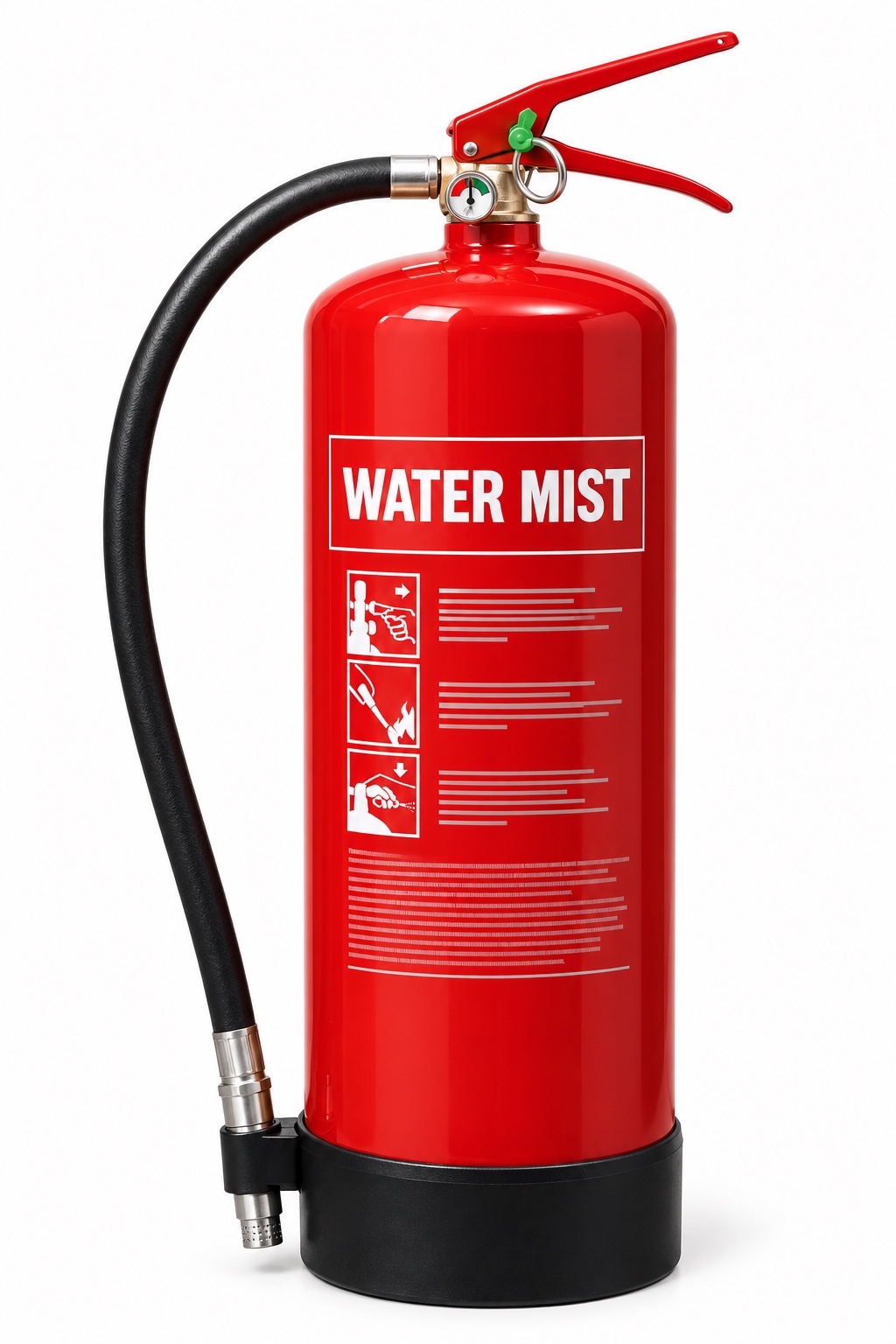
These are typical applications, not universal permissions. Check the label on the actual unit. Images are photorealistic teaching illustrations inspired by the referenced equipment; they are not photographs or certified product labels. Use Inspect the parts to explore the hardware. Band, nozzle and label details vary.
Common and specialist portable extinguisher families
Type and recognition
Typical rating and use
Wrong use: what can go wrong?
Parts in text
Cylinder
The pressure vessel holds the agent and propellant as designed. Report corrosion, dents or other damage. Do not open, refill or repair it as an awareness check.
Agent name and colour marking
Read the actual agent name, fire ratings, electrical warnings and instructions. Colour is a recognition aid; it does not prove suitability. The illustration is not an operating label.
Fixed carrying handle
The lower fixed handle supports the unit. It is different from the upper operating lever. The exact grip and operation belong in practical instruction for the model.
Operating / squeeze lever
The upper lever operates the discharge valve when the safety device is released. Do not squeeze or discharge a unit to test it during a routine visual check.
Safety pin and pull ring
The pin mechanically prevents accidental operation. A pin or ring that is missing, distorted or insecure needs reporting; its presence does not prove the unit is serviceable.
Tamper indicator / snap-lock seal
The breakable indicator or snap-lock seal shows possible disturbance. Designs can use a separate pin-retaining strap or a pin-mounted indicator. It is different from the mechanical safety pin and is not a theft lock. Report it if broken or missing.
Pressure gauge
On this stored-pressure example the gauge indicates pressure, not the mass of agent remaining. A pointer in the marked range does not prove the cylinder is full or the unit has passed its service checks.
Hose, nozzle or applicator
The flexible hose ends in the model’s discharge nozzle. The clip is for stowage; a hose being clipped in place is not a service check. Do not block, detach or test-discharge it during a visual inspection.
Base / protective boot
The boot protects the base on this example. Other models have a different foot arrangement or no separate boot. Check the approved mounting and access rather than guessing from the picture.
WaterRed / WATER marking
Normally A
Cools burning solid material such as paper, wood or fabric.
Check the limitation
Ordinary water is unsuitable for live electrical equipment, flammable-liquid pools, cooking oil and reactive metals: shock, spreading fuel or violent reaction can result.
Parts in text
Cylinder
The pressure vessel holds the agent and propellant as designed. Report corrosion, dents or other damage. Do not open, refill or repair it as an awareness check.
Agent name and colour marking
Read the actual agent name, fire ratings, electrical warnings and instructions. Colour is a recognition aid; it does not prove suitability. The illustration is not an operating label.
Fixed carrying handle
The lower fixed handle supports the unit. It is different from the upper operating lever. The exact grip and operation belong in practical instruction for the model.
Operating / squeeze lever
The upper lever operates the discharge valve when the safety device is released. Do not squeeze or discharge a unit to test it during a routine visual check.
Safety pin and pull ring
The pin mechanically prevents accidental operation. A pin or ring that is missing, distorted or insecure needs reporting; its presence does not prove the unit is serviceable.
Tamper indicator / snap-lock seal
The breakable indicator or snap-lock seal shows possible disturbance. Designs can use a separate pin-retaining strap or a pin-mounted indicator. It is different from the mechanical safety pin and is not a theft lock. Report it if broken or missing.
Pressure gauge
On this stored-pressure example the gauge indicates pressure, not the mass of agent remaining. A pointer in the marked range does not prove the cylinder is full or the unit has passed its service checks.
Hose, nozzle or applicator
The flexible hose ends in the model’s discharge nozzle. The clip is for stowage; a hose being clipped in place is not a service check. Do not block, detach or test-discharge it during a visual inspection.
Base / protective boot
The boot protects the base on this example. Other models have a different foot arrangement or no separate boot. Check the approved mounting and access rather than guessing from the picture.
Water spray / water with additivesUsually red; read the agent name
A; B only if explicitly rated
Improved wetting or spray performance can help on the hazards stated on that model’s label.
Check the limitation
An additive does not make every water extinguisher safe for electricity, oils or reactive chemicals. Check the specific exclusions.
Parts in text
Cylinder
The pressure vessel holds the agent and propellant as designed. Report corrosion, dents or other damage. Do not open, refill or repair it as an awareness check.
Agent name and colour marking
Read the actual agent name, fire ratings, electrical warnings and instructions. Colour is a recognition aid; it does not prove suitability. The illustration is not an operating label.
Fixed carrying handle
The lower fixed handle supports the unit. It is different from the upper operating lever. The exact grip and operation belong in practical instruction for the model.
Operating / squeeze lever
The upper lever operates the discharge valve when the safety device is released. Do not squeeze or discharge a unit to test it during a routine visual check.
Safety pin and pull ring
The pin mechanically prevents accidental operation. A pin or ring that is missing, distorted or insecure needs reporting; its presence does not prove the unit is serviceable.
Tamper indicator / snap-lock seal
The breakable indicator or snap-lock seal shows possible disturbance. Designs can use a separate pin-retaining strap or a pin-mounted indicator. It is different from the mechanical safety pin and is not a theft lock. Report it if broken or missing.
Pressure gauge
On this stored-pressure example the gauge indicates pressure, not the mass of agent remaining. A pointer in the marked range does not prove the cylinder is full or the unit has passed its service checks.
Direct spray nozzle
This compact foam example has a nozzle attached directly to the valve. Larger units may have a hose. Recognise the actual discharge arrangement and use only the approved agent and instructions.
Base / protective boot
The boot protects the base on this example. Other models have a different foot arrangement or no separate boot. Check the approved mounting and access rather than guessing from the picture.
FoamCream panel / FOAM
Commonly A and B
Cools and forms a surface blanket on suitable liquid fires. The agent must suit the actual fuel; some alcohols need alcohol-resistant foam.
Check the limitation
Ordinary foam is not a general answer for live electricity, cooking oil or metal fires. Unsuitable foam may break down on a solvent; a jet can spread fuel. Free-flowing fuel needs specialist response.
Parts in text
Cylinder
The pressure vessel holds the agent and propellant as designed. Report corrosion, dents or other damage. Do not open, refill or repair it as an awareness check.
Agent name and colour marking
Read the actual agent name, fire ratings, electrical warnings and instructions. Colour is a recognition aid; it does not prove suitability. The illustration is not an operating label.
Fixed carrying handle
The lower fixed handle supports the unit. It is different from the upper operating lever. The exact grip and operation belong in practical instruction for the model.
Operating / squeeze lever
The upper lever operates the discharge valve when the safety device is released. Do not squeeze or discharge a unit to test it during a routine visual check.
Safety pin and pull ring
The pin mechanically prevents accidental operation. A pin or ring that is missing, distorted or insecure needs reporting; its presence does not prove the unit is serviceable.
Tamper indicator / snap-lock seal
The breakable indicator or snap-lock seal shows possible disturbance. Designs can use a separate pin-retaining strap or a pin-mounted indicator. It is different from the mechanical safety pin and is not a theft lock. Report it if broken or missing.
Pressure gauge
On this stored-pressure example the gauge indicates pressure, not the mass of agent remaining. A pointer in the marked range does not prove the cylinder is full or the unit has passed its service checks.
Fine-mist nozzle
The specially designed nozzle creates the intended fine spray. It is not an ordinary water jet. Nozzle appearance alone does not establish any tested electrical suitability.
Base / protective boot
The boot protects the base on this example. Other models have a different foot arrangement or no separate boot. Check the approved mounting and access rather than guessing from the picture.
Water mistManufacturer marking varies
Model-specific; commonly A, some F
Fine droplets absorb heat. Some products have additional ratings or tested electrical suitability, with stated voltage and distance conditions.
Check the limitation
‘Mist’ is not universal approval. Use only the classes and electrical conditions actually declared for that model; do not assume it covers metals, liquids or batteries.
Parts in text
Cylinder
The pressure vessel holds the agent and propellant as designed. Report corrosion, dents or other damage. Do not open, refill or repair it as an awareness check.
Agent name and colour marking
Read the actual agent name, fire ratings, electrical warnings and instructions. Colour is a recognition aid; it does not prove suitability. The illustration is not an operating label.
Fixed carrying handle
The lower fixed handle supports the unit. It is different from the upper operating lever. The exact grip and operation belong in practical instruction for the model.
Operating / squeeze lever
The upper lever operates the discharge valve when the safety device is released. Do not squeeze or discharge a unit to test it during a routine visual check.
Safety pin and pull ring
The pin mechanically prevents accidental operation. A pin or ring that is missing, distorted or insecure needs reporting; its presence does not prove the unit is serviceable.
Tamper indicator / snap-lock seal
The breakable indicator or snap-lock seal shows possible disturbance. Designs can use a separate pin-retaining strap or a pin-mounted indicator. It is different from the mechanical safety pin and is not a theft lock. Report it if broken or missing.
Pressure gauge
On this stored-pressure example the gauge indicates pressure, not the mass of agent remaining. A pointer in the marked range does not prove the cylinder is full or the unit has passed its service checks.
Hose, nozzle or applicator
The flexible hose ends in the model’s discharge nozzle. The clip is for stowage; a hose being clipped in place is not a service check. Do not block, detach or test-discharge it during a visual inspection.
Base / protective boot
The boot protects the base on this example. Other models have a different foot arrangement or no separate boot. Check the approved mounting and access rather than guessing from the picture.
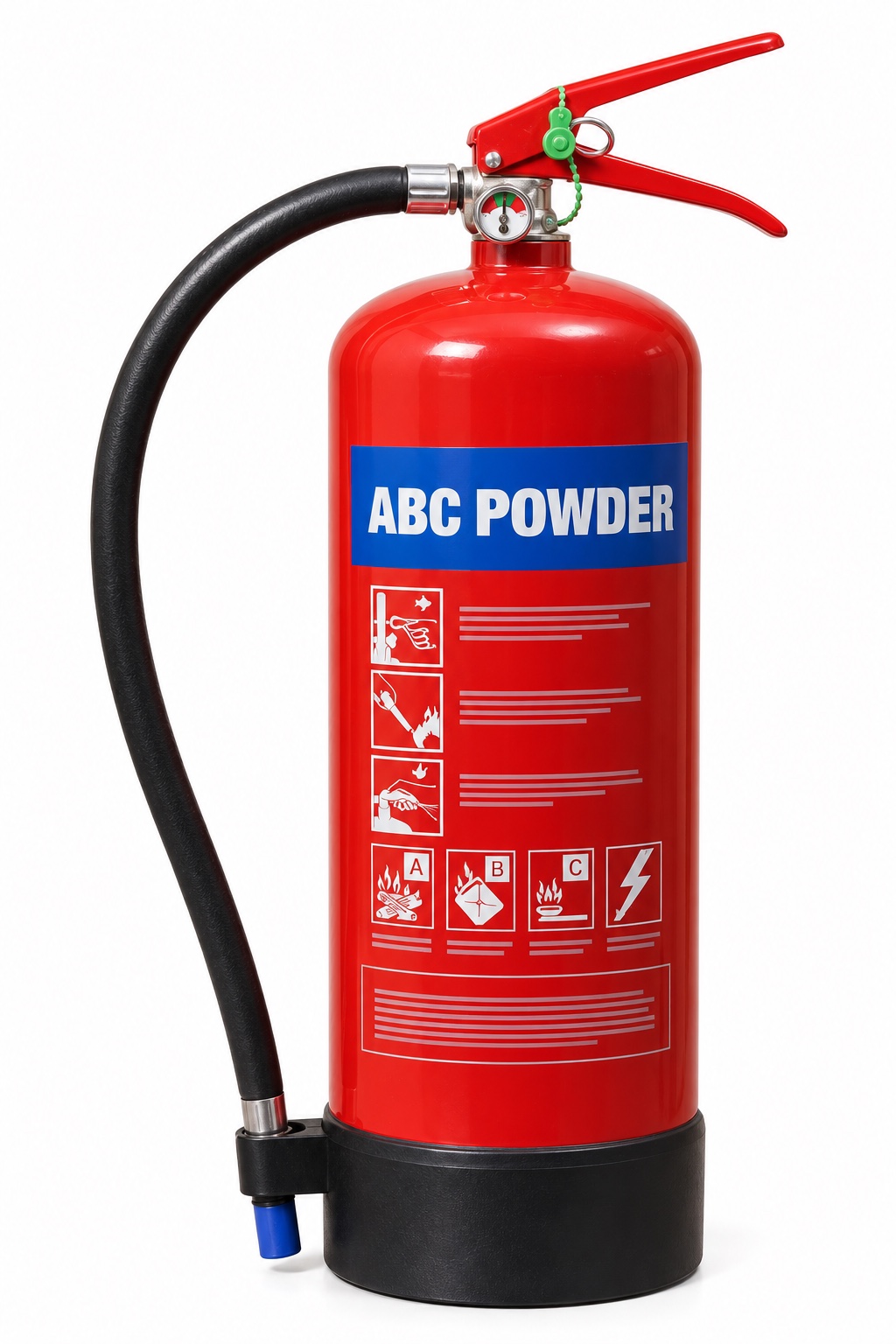
ABC dry powderBlue panel / ABC POWDER
A, B and C if marked
Interrupts flame chemistry; multipurpose powder also acts on Class A material. A C marking does not authorise tackling a gas leak.
Check the limitation
Powder can obscure escape and impair breathing; it is not generally recommended indoors. Limited cooling allows reignition. It is not metal-specific D powder or a substitute for F-rated cooking-oil equipment.
Parts in text
Cylinder
The pressure vessel holds the agent and propellant as designed. Report corrosion, dents or other damage. Do not open, refill or repair it as an awareness check.
Agent name and colour marking
Read the actual agent name, fire ratings, electrical warnings and instructions. Colour is a recognition aid; it does not prove suitability. The illustration is not an operating label.
Fixed carrying handle
The lower fixed handle supports the unit. It is different from the upper operating lever. The exact grip and operation belong in practical instruction for the model.
Operating / squeeze lever
The upper lever operates the discharge valve when the safety device is released. Do not squeeze or discharge a unit to test it during a routine visual check.
Safety pin and pull ring
The pin mechanically prevents accidental operation. A pin or ring that is missing, distorted or insecure needs reporting; its presence does not prove the unit is serviceable.
Tamper indicator / snap-lock seal
The breakable indicator or snap-lock seal shows possible disturbance. Designs can use a separate pin-retaining strap or a pin-mounted indicator. It is different from the mechanical safety pin and is not a theft lock. Report it if broken or missing.
Pressure gauge
On this stored-pressure example the gauge indicates pressure, not the mass of agent remaining. A pointer in the marked range does not prove the cylinder is full or the unit has passed its service checks.
Hose, nozzle or applicator
The flexible hose ends in the model’s discharge nozzle. The clip is for stowage; a hose being clipped in place is not a service check. Do not block, detach or test-discharge it during a visual inspection.
Base / protective boot
The boot protects the base on this example. Other models have a different foot arrangement or no separate boot. Check the approved mounting and access rather than guessing from the picture.
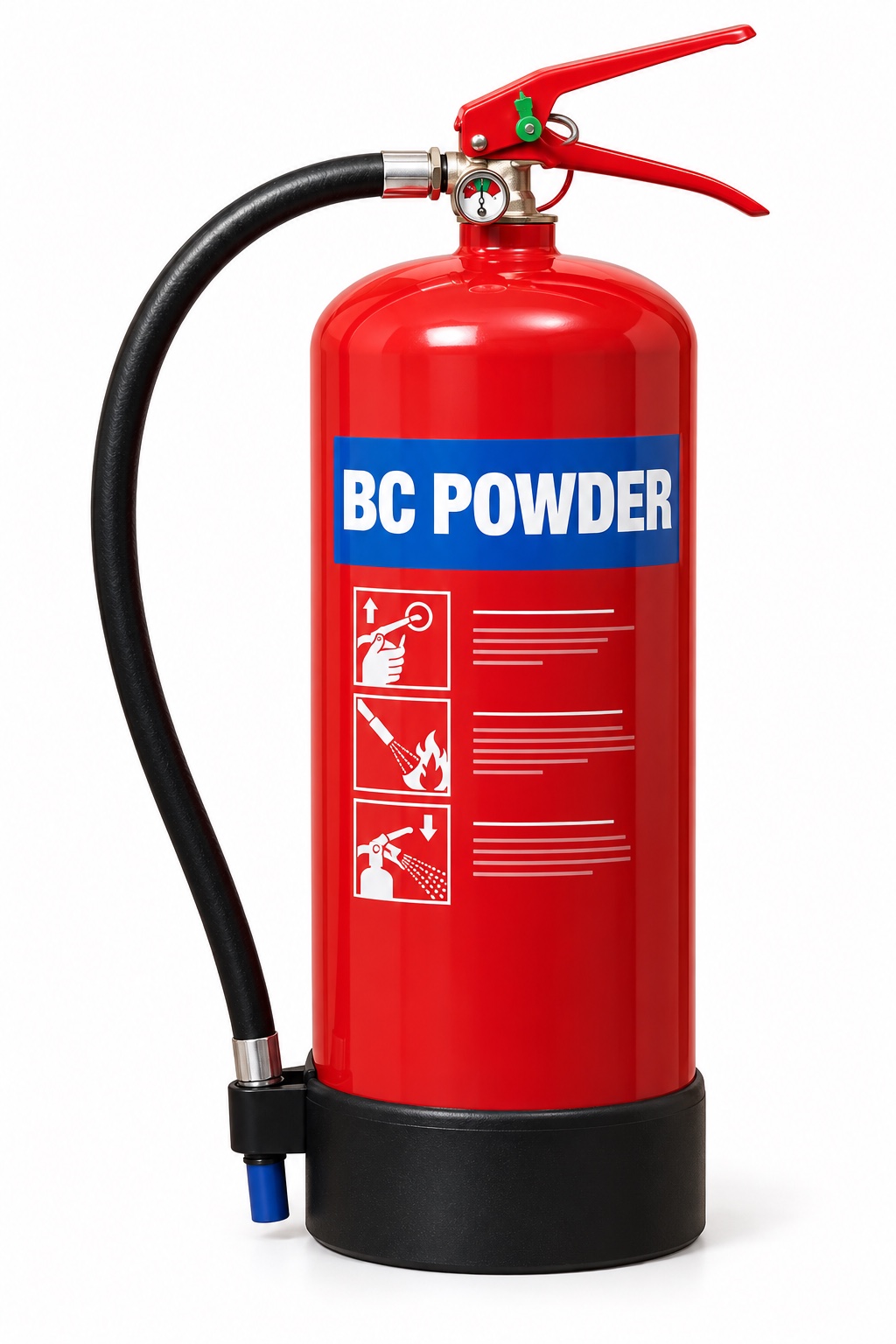
BC dry powderBlue panel / BC POWDER
B and C if marked; not A
Selected for particular liquid or gas hazards under the assessed plan. Electrical use must follow the actual unit’s instructions.
Check the limitation
Do not assume all blue powder extinguishers protect wood or paper. It has the visibility, breathing and reignition limitations of powder; it does not provide Class D or F protection.
Parts in text
Cylinder
The pressure vessel holds the agent and propellant as designed. Report corrosion, dents or other damage. Do not open, refill or repair it as an awareness check.
Agent name and colour marking
Read the actual agent name, fire ratings, electrical warnings and instructions. Colour is a recognition aid; it does not prove suitability. The illustration is not an operating label.
Fixed carrying handle
The lower fixed handle supports the unit. It is different from the upper operating lever. The exact grip and operation belong in practical instruction for the model.
Operating / squeeze lever
The upper lever operates the discharge valve when the safety device is released. Do not squeeze or discharge a unit to test it during a routine visual check.
Safety pin and pull ring
The pin mechanically prevents accidental operation. A pin or ring that is missing, distorted or insecure needs reporting; its presence does not prove the unit is serviceable.
Tamper indicator / snap-lock seal
The breakable indicator or snap-lock seal shows possible disturbance. Designs can use a separate pin-retaining strap or a pin-mounted indicator. It is different from the mechanical safety pin and is not a theft lock. Report it if broken or missing.
Pressure gauge
On this stored-pressure example the gauge indicates pressure, not the mass of agent remaining. A pointer in the marked range does not prove the cylinder is full or the unit has passed its service checks.
Specialist low-velocity applicator
The specialist applicator places the compatible metal-fire agent without unnecessarily disturbing burning material. Both agent and application method must suit the specific metal; this is not an ABC powder nozzle.
Base / protective boot
The boot protects the base on this example. Other models have a different foot arrangement or no separate boot. Check the approved mounting and access rather than guessing from the picture.
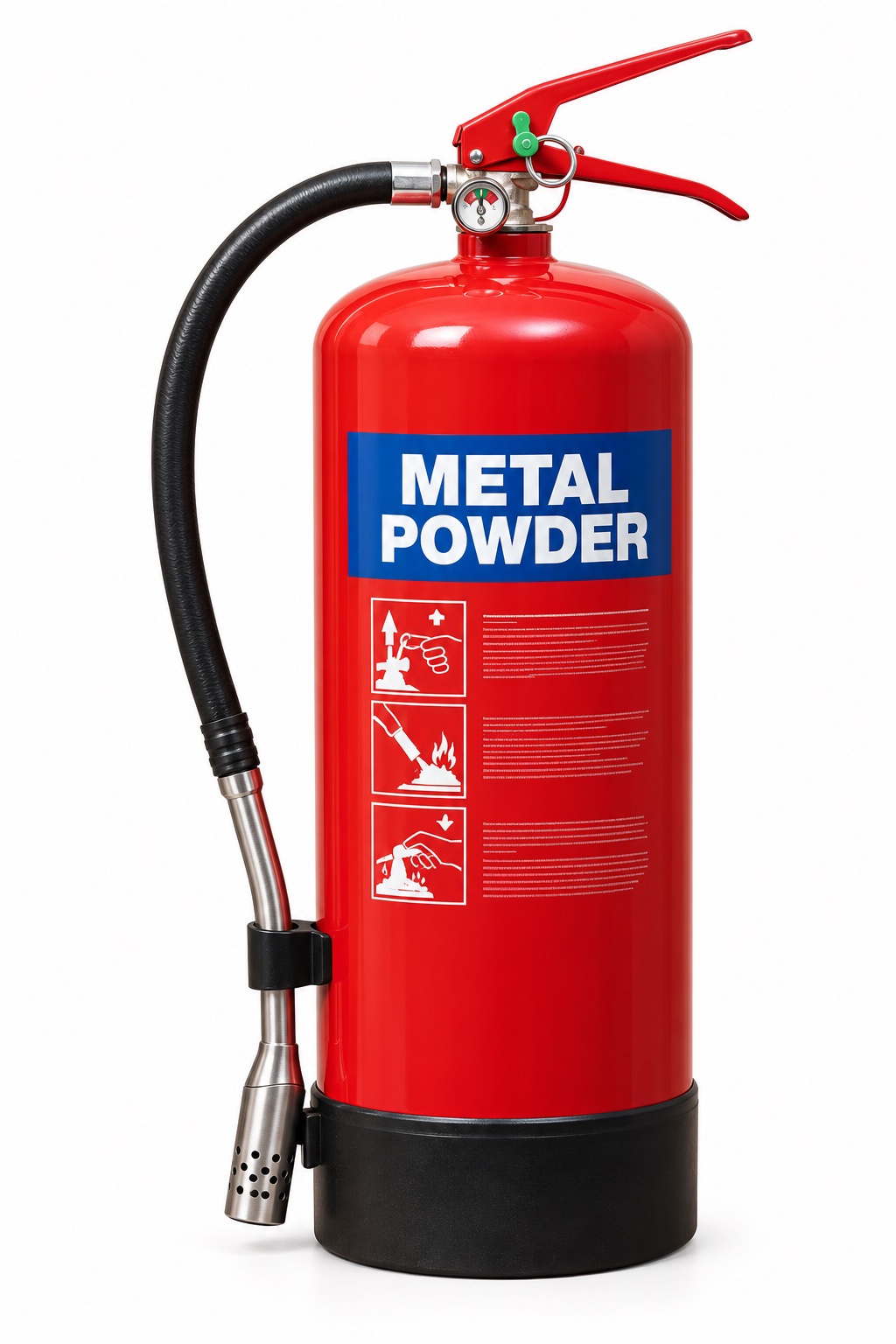
Class D specialist powderSpecific metal and agent named on label
D, for the specified metal
A specialist powder can isolate or absorb heat from a compatible burning metal. Selection requires knowledge of the metal and its form.
Check the limitation
The wrong powder can fail or react. Water, foam and CO₂ can be dangerous on certain burning metals. A powder suitable for magnesium is not automatically suitable for metallic lithium.
Parts in text
Cylinder
The narrow steel cylinder contains carbon dioxide under pressure. There is normally no pressure gauge on this portable type; service assessment includes the appropriate mass and integrity checks by competent personnel.
Agent name and colour marking
Read the actual agent name, fire ratings, electrical warnings and instructions. Colour is a recognition aid; it does not prove suitability. The illustration is not an operating label.
Fixed carrying handle
The lower fixed handle supports the unit. It is different from the upper operating lever. The exact grip and operation belong in practical instruction for the model.
Operating / squeeze lever
The upper lever operates the discharge valve when the safety device is released. Do not squeeze or discharge a unit to test it during a routine visual check.
Safety pin and pull ring
The pin mechanically prevents accidental operation. A pin or ring that is missing, distorted or insecure needs reporting; its presence does not prove the unit is serviceable.
Tamper indicator / snap-lock seal
The breakable indicator or snap-lock seal shows possible disturbance. Designs can use a separate pin-retaining strap or a pin-mounted indicator. It is different from the mechanical safety pin and is not a theft lock. Report it if broken or missing.
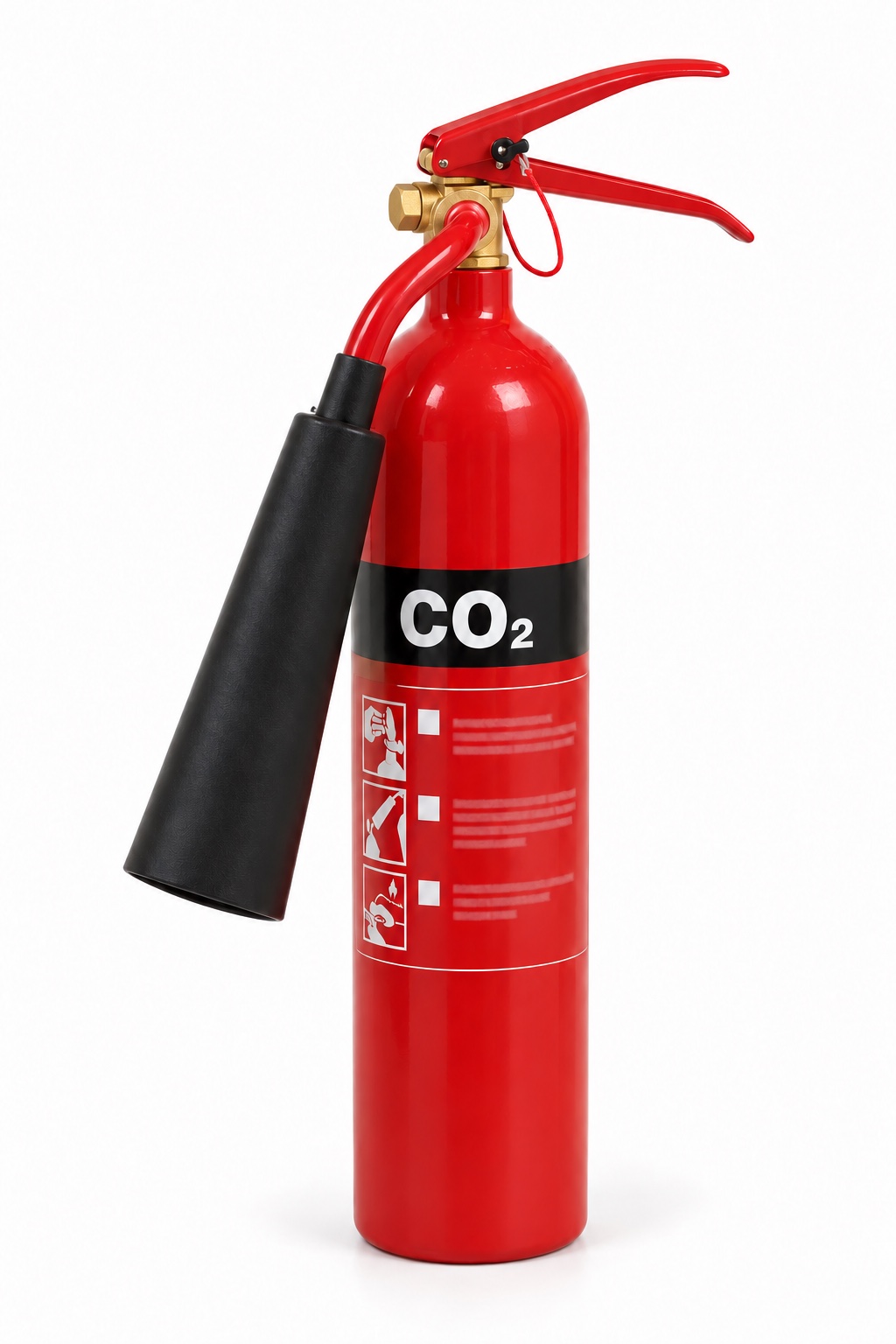
Horn and designated insulated grip
The flared horn directs the CO₂ discharge. Discharge parts can become extremely cold. Only the parts identified by the manufacturer as safe to hold should be gripped; not every horn is frost-free.
Displaces the atmosphere around a small flame and leaves no powder residue. Often selected around electrical equipment.
Check the limitation
Poor cooling means reignition is possible. CO₂ can create a dangerous atmosphere in enclosed spaces; discharge can cause frostbite. Hold only the designated insulated parts. Not a cooking-oil or metal-fire substitute.
Parts in text
Cylinder
The pressure vessel holds the agent and propellant as designed. Report corrosion, dents or other damage. Do not open, refill or repair it as an awareness check.
Agent name and colour marking
Read the actual agent name, fire ratings, electrical warnings and instructions. Colour is a recognition aid; it does not prove suitability. The illustration is not an operating label.
Fixed carrying handle
The lower fixed handle supports the unit. It is different from the upper operating lever. The exact grip and operation belong in practical instruction for the model.
Operating / squeeze lever
The upper lever operates the discharge valve when the safety device is released. Do not squeeze or discharge a unit to test it during a routine visual check.
Safety pin and pull ring
The pin mechanically prevents accidental operation. A pin or ring that is missing, distorted or insecure needs reporting; its presence does not prove the unit is serviceable.
Tamper indicator / snap-lock seal
The breakable indicator or snap-lock seal shows possible disturbance. Designs can use a separate pin-retaining strap or a pin-mounted indicator. It is different from the mechanical safety pin and is not a theft lock. Report it if broken or missing.
Pressure gauge
On this stored-pressure example the gauge indicates pressure, not the mass of agent remaining. A pointer in the marked range does not prove the cylinder is full or the unit has passed its service checks.
Hose, lance and spray applicator
The hose feeds the long lance and purpose-designed applicator. It helps distinguish this kitchen-fire unit from an ordinary short-nozzle extinguisher. Use requires model-specific practical training.
Base / protective boot
The boot protects the base on this example. Other models have a different foot arrangement or no separate boot. Check the approved mounting and access rather than guessing from the picture.
Wet chemicalYellow panel / WET CHEMICAL
F; often A if marked
Cools cooking oil and creates a protective surface layer through reaction with the fat. Use only within the actual unit’s rating and instructions.
Check the limitation
Do not mistake it for a general liquid-fire or electrical extinguisher. Incorrect application or moving the fryer can splash hot oil; apparent flame-out does not establish safe temperature.
Parts in text
Cylinder
The pressure vessel holds the agent and propellant as designed. Report corrosion, dents or other damage. Do not open, refill or repair it as an awareness check.
Agent name and colour marking
Read the actual agent name, fire ratings, electrical warnings and instructions. Colour is a recognition aid; it does not prove suitability. The illustration is not an operating label.
Fixed carrying handle
The lower fixed handle supports the unit. It is different from the upper operating lever. The exact grip and operation belong in practical instruction for the model.
Operating / squeeze lever
The upper lever operates the discharge valve when the safety device is released. Do not squeeze or discharge a unit to test it during a routine visual check.
Safety pin and pull ring
The pin mechanically prevents accidental operation. A pin or ring that is missing, distorted or insecure needs reporting; its presence does not prove the unit is serviceable.
Tamper indicator / snap-lock seal
The breakable indicator or snap-lock seal shows possible disturbance. Designs can use a separate pin-retaining strap or a pin-mounted indicator. It is different from the mechanical safety pin and is not a theft lock. Report it if broken or missing.
Pressure gauge
On this stored-pressure example the gauge indicates pressure, not the mass of agent remaining. A pointer in the marked range does not prove the cylinder is full or the unit has passed its service checks.
Hose, nozzle or applicator
The flexible hose ends in the model’s discharge nozzle. The clip is for stowage; a hose being clipped in place is not a service check. Do not block, detach or test-discharge it during a visual inspection.
Base / protective boot
The boot protects the base on this example. Other models have a different foot arrangement or no separate boot. Check the approved mounting and access rather than guessing from the picture.
Clean agent / vaporising liquidRead the agent; no universal colour shortcut
Product- and jurisdiction-specific
Specialist low-residue agents may protect sensitive equipment. Confirm the UK-approved application and the manufacturer’s limits.
Check the limitation
Low residue does not mean safe to breathe. Do not copy a US A:B:C rating as UK gas-fire approval. Legacy halon is restricted to permitted critical uses and applicable deadlines.
Parts in text
Cylinder
The pressure vessel holds the agent and propellant as designed. Report corrosion, dents or other damage. Do not open, refill or repair it as an awareness check.
Agent name and colour marking
This generic illustration has a green agent area and boot inspired by the supplied product. Green is not a universal Class L identification code. Read the real product name, chemistry, battery limits and instructions.
Fixed carrying handle
The lower fixed handle supports the unit. It is different from the upper operating lever. The exact grip and operation belong in practical instruction for the model.
Operating / squeeze lever
The upper lever operates the discharge valve when the safety device is released. Do not squeeze or discharge a unit to test it during a routine visual check.
Safety pin and pull ring
The pin mechanically prevents accidental operation. A pin or ring that is missing, distorted or insecure needs reporting; its presence does not prove the unit is serviceable.
Tamper indicator / snap-lock seal
The breakable indicator or snap-lock seal shows possible disturbance. Designs can use a separate pin-retaining strap or a pin-mounted indicator. It is different from the mechanical safety pin and is not a theft lock. Report it if broken or missing.
Pressure gauge
On this stored-pressure example the gauge indicates pressure, not the mass of agent remaining. A pointer in the marked range does not prove the cylinder is full or the unit has passed its service checks.
Hose, grip and applicator
The illustrated hose has a coloured ribbed grip and a small application tip. This shows the hardware family, not a tested battery capability. Follow the instructions for the actual agent and generation.
Base / protective boot
The boot protects the base on this example. Other models have a different foot arrangement or no separate boot. Check the approved mounting and access rather than guessing from the picture.
Battery-specific suppression productsNamed formulation and tested application
Check independent scope and instructions
Some products use water-based cooling or specialist media such as aqueous vermiculite for specified battery scenarios. Selection depends on chemistry, capacity and location.
Check the limitation
A ‘lithium’ label is not proof it will stop thermal runaway in a large pack. Flame suppression may not prevent reignition or gas release. Do not approach, carry or submerge a failing battery as a learner exercise.
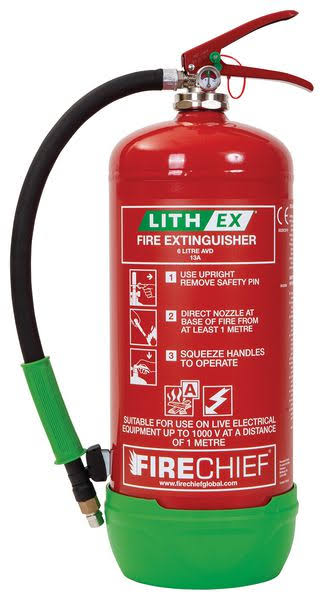
Lithium-ion product example · Firechief 6 L Lith-Ex
A named product example helps connect the generic table to an actual unit. Confirm the exact product before using its claims.
Agent and intended application
The linked Seton example uses aqueous vermiculite dispersion (AVD) for specified lithium-ion battery fire applications. Water content cools; the dispersed mineral helps form a barrier. This is not generic Class D metal-fire powder.
Read the actual rating
Seton lists a 6 L product with a 13A rating. That A rating describes its solid-material test performance; it does not, by itself, certify a universal Class L battery capability.
Match the exact model and generation
The manufacturer’s current 6 L G2 page identifies FLE6X and different discharge details from the retailer’s older listing. Do not mix their time, range or pressure values. Match the delivered label, product sheet and manual.
Check the battery scope
Confirm the allowed battery chemistry, energy capacity, state and scenario with the current manufacturer information and competent fire assessment. A large EV or energy-storage pack cannot be treated as a small-device fire.
Electrical conditions are product-specific
The supplied product label includes a voltage and minimum-distance condition. Do not transfer that condition to another battery extinguisher or infer that it makes an unsafe electrical approach acceptable.
After the flame disappears
Heat, off-gas and reignition can remain. Follow the planned withdrawal, exclusion and fire-service response; do not pick up, submerge or return a failed battery to charging.
Read the agent, fire-class letters, performance rating, electrical warnings, operating instructions and service condition. Numbers such as 13A or 55B describe standardised test performance, not a safe room size or permission to tackle that amount of fire. Colour is a clue; the actual label and assessed plan decide suitability.
What about a fire blanket?
A fire blanket is separate equipment, not an extinguisher type. It may be specified for a small contained cooking fire, but safe approach and the manufacturer’s limits still matter. Never carry a burning pan, improvise a cover or put yourself between fire and your exit.
Spot the dangerous assumption
Pause at each question, then open the explanation. These are unscored learning prompts alongside the course assessment.
A pan of cooking oil is burning. Would ordinary water help?
No. Rapid steam production can throw burning oil across the room. Raise the alarm and follow the kitchen emergency plan; never move the pan. Only a trained, authorised person should consider the specified F-rated equipment with a safe escape.
There is a C on the powder extinguisher. Should I put out the leaking gas flame?
Not as a routine response. Unburnt gas may continue escaping and form an explosive cloud. Withdraw, alarm and report the supply involved. Any safe isolation and specialist firefighting must follow the assessed emergency arrangements.
The flame around a battery has disappeared. Is the incident over?
No. Internal heat, flammable or toxic off-gas and reignition can remain. Keep clear, prevent access and tell the fire and rescue service what battery is involved. Flame-out is not permission to handle it or restart charging.
Both extinguishers have blue panels. Are the powders interchangeable?
No. Read ABC, BC or the exact Class D metal specification. Colour identifies a family; it does not establish the correct agent, rating or safe application.
A CO₂ extinguisher leaves no mess. Is it ideal in a small unventilated room?
No. A dangerous CO₂ concentration can incapacitate a person, while the fire and smoke already threaten escape. Do not enter an unsafe room. The fire plan and competent equipment selection must account for the space.
A water-mist product claims electrical suitability. Can I use any water extinguisher on a live cabinet?
No. Any tested electrical claim belongs to that particular model, with its own voltage and distance limits. It does not apply to ordinary water or another mist product, and it does not make an unsafe approach acceptable.
Source guidance and scope
UK learning context. Consult the applicable national fire guidance and your premises’ assessed plan. Manufacturer examples explain product variation; they are not product recommendations. Guidance checked 24 October 2026.
Explain what all workers and appointed wardens need to know.
Existing SHAREhub photographic illustration. The written fictional case supplies the condition and decision evidence.
Separate the roles
All workers need to recognise the alarm, know the relevant escape routes and respond without waiting for a warden to collect them. They should understand reporting, assembly and assistance arrangements. New starters and people arriving after a drill need appropriate induction before they work without that information.
Wardens have additional defined duties, which may include prevention checks, directing people, a safe check of an allocated area and reporting to the incident lead. The role must match the premises plan, not a generic badge or job title. Managers remain responsible for credible staffing, equipment, routes and training. Clear separation avoids both gaps and unrealistic expectations: appointing a warden does not transfer every fire-safety duty or make an otherwise unusable escape route acceptable.
Applied case
The leisure venue tells new cleaners they can wait for the day-shift warden during an alarm. Their work actually begins after that warden has left the site.
A title needs a task
Marshal and warden titles vary. The useful evidence is the assigned area, safe actions, reporting point, cover and withdrawal limits in the actual premises plan.
Test your decision
What should induction establish?
That only wardens need to recognise an alarm.
The cleaners’ own immediate alarm response and usable routes, with realistic support cover.
That an absent warden will collect them.
Compare the explanation
The cleaners’ own immediate alarm response and usable routes, with realistic support cover.
All workers need an actionable response; an appointed role is additional support.
Distinguish a safe allocated check from dangerous searching.
Photorealistic illustrative UK workplace scene. Review checks: Changed conditions: Racking, stock, absence or changed occupants can undermine the agreed evacuation plan. Possible consequence: People may miss the warning, misunderstand their role or be unable to use the escape route. Control failure: A briefing alone leaves physical route defects, assistance gaps or unavailable role cover unresolved.
Keep checks within safe limits
A safe sweep is a check of a defined area on the way out, where the local plan permits it and conditions remain safe. It is not a search through smoke or a reason to delay escape. Wardens need a clear trigger to withdraw and report an area that could not be checked.
Do not enter a deteriorating area, investigate the fire or return for property to complete a checklist. Report known observations, missing-person information and uncertainty from safety. First-response firefighting, where assigned, is a separate assessed and trained role with suitable equipment and a protected escape; it is not an automatic warden duty. If the allocated duties cannot be performed safely with the actual route and staffing, change the arrangements rather than praise unsafe determination.
Applied case
A warden reaches smoke at a changing-room corridor. The printed sweep sheet includes rooms beyond it, and they worry that an incomplete tick box will be treated as failure.
Unchecked is useful information
An honest report that an area could not safely be checked is operational information. A tick obtained through danger is neither a sound control nor reliable assurance.
Test your decision
What should the warden do?
Withdraw safely and report the unchecked area and known information.
Enter smoke until every allocated room is ticked.
Re-enter later without incident-lead authority.
Compare the explanation
Withdraw safely and report the unchecked area and known information.
A safe withdrawal and accurate uncertainty report are proper performance of a bounded role.
Existing SHAREhub 2D teaching schematic. Use alongside the explanation and fictional case in this lesson.
Plan cover for actual occupancy
Coverage depends on shifts, absence, locations and duties, not just the number of names on a notice. Check evenings, weekends, breaks, holidays, public events and periods with fewer staff. A warden working elsewhere cannot automatically support an occupied area at the relevant time.
Include cleaners, contractors, agency workers, visitors and people affected by temporary changes. Language and familiarity may affect how information is understood. Managers should ask people to explain their response and sample the current route rather than infer understanding from a completion percentage. Arrange suitable deputies and escalation when required cover is unavailable. If the plan depends on assistance, confirm the helpers and backup in the actual shift. Coverage is a working arrangement, not an expectation that an absent person remains available.
Applied case
The venue reports nearly complete training, but the only unbriefed workers are evening contractors. The appointed helpers for that period are usually assigned to another building.
Look inside the percentage
A high training total can hide one entirely uncovered shift or contractor team. Segment the evidence by people, place and time before claiming effective coverage.
Test your decision
What is the meaningful coverage test?
The overall percentage without considering who is missing.
The total number of badges purchased.
Whether the people actually present understand the plan and required roles have usable cover.
Compare the explanation
Whether the people actually present understand the plan and required roles have usable cover.
A small numerical gap can contain the group most exposed to a particular failure.
Recognise when an old route lesson stops being enough.
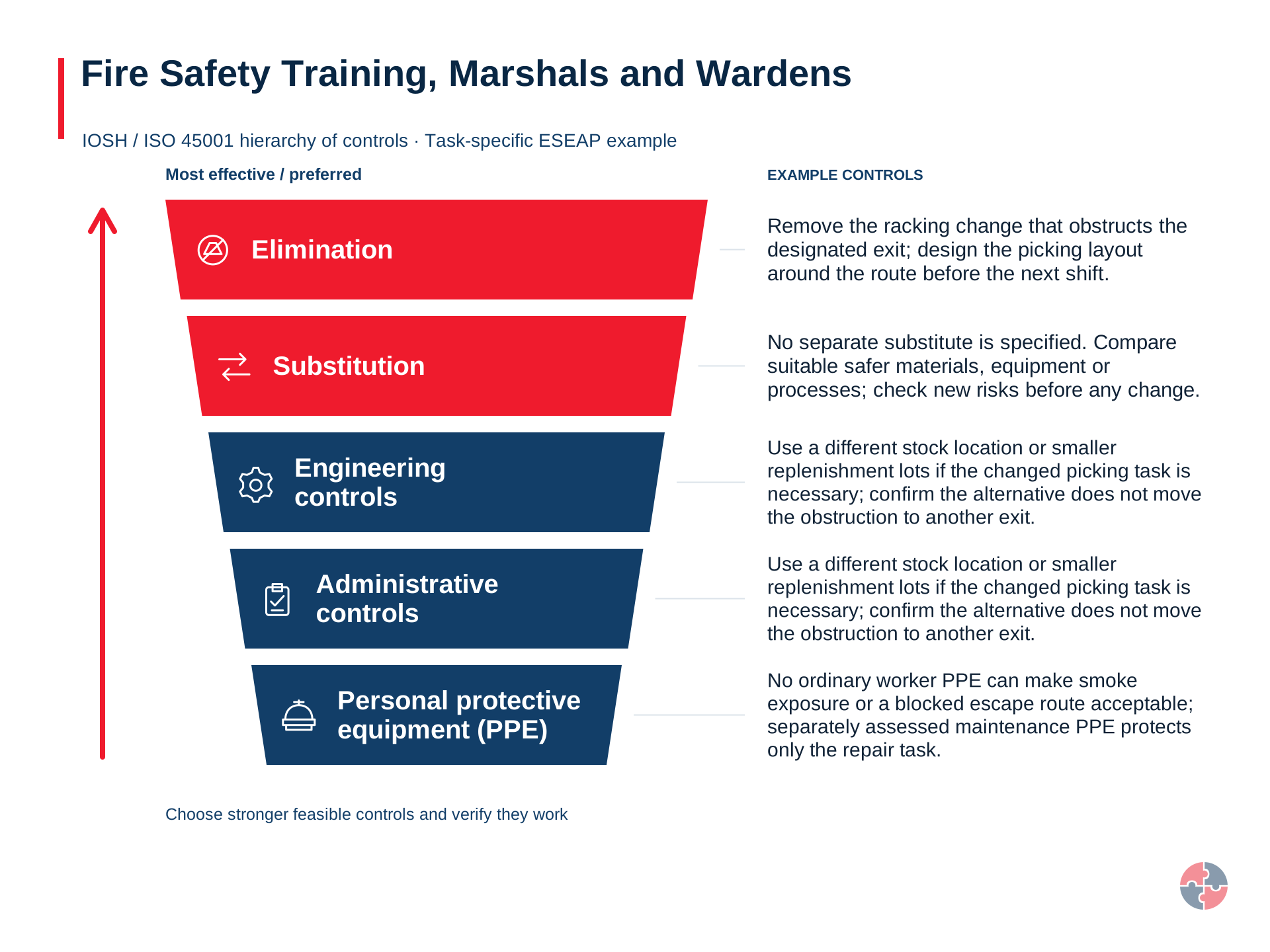
Photorealistic illustrative UK workplace scene. Review checks: Elimination: Remove the racking change that obstructs the designated exit; design the picking layout around the route before the next shift. Substitution: No separate substitute is specified. Compare suitable safer materials, equipment or processes; check new risks before any change. Engineering controls: Keep stock in the assessed location and quantities, brief workers, visitors, wardens and assistants, rehearse representative shifts and resolve drill findings before closure. Administrative controls: Keep stock in the assessed location and quantities, brief workers, visitors, wardens and assistants, rehearse representative shifts and resolve drill findings before closure. PPE: No ordinary worker PPE can make smoke exposure or a blocked escape route acceptable; separately assessed maintenance PPE protects only the repair task.
Rebrief when the premises change
A changed layout, occupancy, warning system or escape route can make previous instruction incomplete. Before accepting the change, identify the affected workers, wardens, contractors and assistance arrangements. A route drawn on an updated plan still needs to be usable and understood in the work area.
Brief the actual change and check its practical effect: signs, doors, storage, assembly information and allocated checks. Temporary works need temporary arrangements that remain controlled until restoration. Do not allow a new layout to inherit approval from an unrelated earlier drill. Where the design or fire strategy is uncertain, obtain competent review; wardens should not invent a different strategy themselves. Use feedback from those working the area to reveal confusing directions or duties that cannot realistically be performed.
Applied case
The changing-room exit moves behind a new partition. Day staff receive an email, but night cleaners still follow the old arrows and the warden sweep map remains unchanged.
Changed conditions reopen learning
A previous drill proves something about its conditions. A different route or shift needs a focused check of the changed response rather than automatic carry-over of the old result.
Test your decision
What needs updating together?
Only the day-shift email list.
The physical route, local information, affected people’s understanding and relevant role duties.
Only the date printed on the old attendance sheet.
Compare the explanation
The physical route, local information, affected people’s understanding and relevant role duties.
A change affects both the premises and the people expected to use its arrangements.
Existing SHAREhub photographic illustration. The written fictional case supplies the condition and decision evidence.
Test the system safely
A useful drill observes alarm recognition, response, route choice, assistance, accountability and re-entry control. Fast assembly alone can conceal an unheard alarm, an unanswered refuge call or visitors left without direction. Record what happened and what remains uncertain, then assign corrective actions.
Vary relevant conditions over time, including an absent helper or an unavailable normal route, but represent these safely through briefing or a tabletop condition. Keep real emergency exits usable. Agree participation and assistance with the person; do not create an avoidable lifting or carrying risk to make an exercise realistic. Stop an unsafe exercise. The test should reveal whether the plan works without creating a new emergency, and a targeted repeat should check whether an important correction actually resolved the weakness.
Applied case
A proposed exercise physically locks a real exit to test initiative. The organiser intends to record assembly time but not assistance calls or contractor response.
Observe the missing link
A drill can be fast and incomplete. Record warning, movement, assistance, reporting and access control so a favourable time does not hide a failed part of the plan.
Test your decision
What is the sounder exercise design?
Represent the route problem safely while observing the full response and keeping real escape available.
Lock more doors to make the exercise demanding.
Judge success only by the fastest person’s time.
Compare the explanation
Represent the route problem safely while observing the full response and keeping real escape available.
Exercises test a system safely; realism does not justify creating a genuine escape hazard.
Use role evidence without claiming practical qualification.
Photorealistic illustrative UK workplace scene. Review checks: Situation: A layout-change example shows why fire training must follow changes in routes, stock and people. Decision: At fictional Fenwick Warehouse, the operations manager halts use of the obstructed loading-bay exit as soon as a route walk finds new racking and stock across it. Follow through: The facilities lead removes the obstruction, checks door operation, signs and alarm coverage, and updates the fire risk assessment and plan.
Close findings through real correction
Warden assurance joins appointments, role-specific training, shift cover, checks and drill findings. Sample what people can explain and do within their safe role. Attendance shows exposure to information; it does not establish practical ability or that the premises arrangements work.
Give findings a responsible owner and follow-up. A missing evening deputy needs usable cover, not just an amended spreadsheet. An unsafe sweep expectation needs revised duties and communication, not pressure to complete it faster. Keep unresolved limits visible to managers. The optional exercise compares a fictional changed route and evening roster against the allocated duties. It produces questions for competent premises review and a safe drill brief, rather than a real appointment, approval, practical warden certificate or instruction to enter danger.
Applied case
The venue updates the deputy list after a drill, but the named person has not accepted the duty or learned the changed route. The action is marked complete.
Evidence follows the duty
Check that the appointed person is present, understands the defined task and can perform it safely. A name or attendance entry alone does not demonstrate that combination.
Test your decision
What evidence is still needed?
Only proof that the spreadsheet was edited.
A badge issued to someone who is not present.
Confirmed usable cover, understood duties and a check of the corrected arrangement.
Compare the explanation
Confirmed usable cover, understood duties and a check of the corrected arrangement.
Verify the function of the action in the actual shift, not merely its administrative change.
Study a completed fictional industrial construction and commissioning plan. Compare its warning, roles, accountability, responder access, rescue limits and recovery decisions with the learning above. It includes a new fictional site schematic, a worked exercise and separate blank recording annexes.
Use this as a teaching example when developing arrangements for your own premises. The fictional layout and role identifiers are not live emergency instructions.

 Recognise the fuel. Read the extinguisher. Protect your escape.