Focused awareness learning based on SHAREhub pages. Apply the actual workplace arrangements and your role; completion is not practical competence or permission for specialist work.
This reader supplies the complete teaching. Use the interactive LMS course for assessed activities, saved progress and completion.
A worker stands beside a separate anatomical overview of the heart, lungs, muscles and nerves. These normal tissues introduce the injury lesson; no electrical current path is shown.
Locate the heart, muscles and nerves as different living tissues. Follow the lesson’s isolation and competence boundaries before any intervention.
educational illustration · healthy anatomy; enlarged details and teaching colours.
Existing SHAREhub photographic illustration. The written fictional case supplies the condition and decision evidence.
Trace more than a shock
Electric shock occurs when current passes through the body. Burns can arise through contact or an electrical arc; a fault can also release heat and start a fire. A person startled or disabled by a shock may fall from a ladder or into machinery. People nearby can therefore be affected without being the first person touching equipment.
Identify the source, possible contact or fault route, exposed people and protection. Moisture, damage, available energy, contact duration and the surrounding task can change the outcome. Do not use voltage alone as a declaration of safety. The purpose of awareness is to recognise when a task needs to stop and competent help is required, rather than calculate a supposedly harmless exposure or attempt electrical work.
Applied case
A cleaner proposes using the damaged machine on a step to reach a high surface. The discussion considers only whether a small shock would hurt their hand.
Follow the consequence
The same defect can have different consequences on a floor, ladder or near moving equipment. Describe the task and people exposed rather than label electricity a generic hazard.
Test your decision
What further consequence belongs in the assessment?
A shock or startle could cause a fall, alongside electrical burns or fire.
Only damage to the plug matters because the task is brief.
A small machine cannot create an electrical injury.
Compare the explanation
A shock or startle could cause a fall, alongside electrical burns or fire.
Consider the surrounding task and secondary harm as well as the initial contact.
Recognise visible defects and the limits of a test label.
Photorealistic illustrative UK workplace scene. Review checks: Source / exposure: Frequency should be based on equipment type, environment, use, movement, damage history and user competence. Possible consequence: The most important shift for learners is this: there is no legal requirement for every portable appliance to be tested every year. Control failure: The legal requirement is maintenance to prevent danger.
Check before connecting
Before use, look for visible damage such as a cracked plug, crushed lead, exposed inner cores, damaged casing, heat marks or an unsuitable connection. Look at the whole accessible lead and the environment, not merely the label. Report suspect equipment and keep it out of use through the workplace defect arrangement.
Do not patch a damaged cable with tape, open electrical parts or repeatedly reset protection to finish a job. Users need a clear route for tagging, segregating and reporting defects so the next person cannot unknowingly use the item. The appropriate competent person decides repair, inspection or testing and the evidence for return. A label records a past check; it cannot establish what happened when a vehicle crushed the cable yesterday.
Applied case
The cleaner finds flattened insulation where a trolley crossed the lead. A colleague points to a recent test label and suggests covering the mark with tape.
A label has a date
An inspection can describe an item at one time. Damage after that check needs a new response; a future inspection date does not authorise continued defective use.
Test your decision
What is the appropriate user response?
Use it because the label has not expired.
Tape the lead and treat that as a verified repair.
Keep the suspect item out of use and report it for competent attention.
Compare the explanation
Keep the suspect item out of use and report it for competent attention.
Current visible damage takes priority over reassurance from a past label; do not improvise electrical repairs.
Recognise why a dry-room arrangement may fail in damp work.
Existing SHAREhub 2D teaching schematic. Use alongside the explanation and fictional case in this lesson.
Match equipment to the environment
Wet hands, clothing, floors and equipment can increase electrical risk. Water can damage equipment and make current through the body more likely. Leads exposed to traffic, rough handling or washdown may deteriorate quickly. An appliance suitable for a dry room is not automatically suitable for a damp loading area.
Plan the task and suitable supply, equipment and cable protection before connecting. The responsible assessment may require different equipment, a different method or postponement. Protective devices can reduce certain risks but do not make damaged equipment or live-part contact acceptable. Do not improvise with an indoor extension lead in water. If conditions differ from the agreed arrangement, stop the affected use and ask the responsible person to resolve suitability rather than rely on careful handling.
Applied case
A dry office extension is offered for the cleaner outside in rain. The supervisor says its protective device means the location and cable condition no longer matter.
A protective layer has limits
An RCD can reduce some electrical risks. It does not make exposure to live parts acceptable or establish that equipment is suitable for water, impact or rough use.
Test your decision
What should happen before use?
Keep the plug wrapped in a cloth as the complete solution.
Resolve suitable equipment, supply and protection for the actual wet conditions.
Accept any equipment if a protective device is present.
Compare the explanation
Resolve suitable equipment, supply and protection for the actual wet conditions.
Protection is part of a suitable system; it does not cancel environmental or damage risks.
Distinguish checks, inspection and testing from an annual sticker routine.
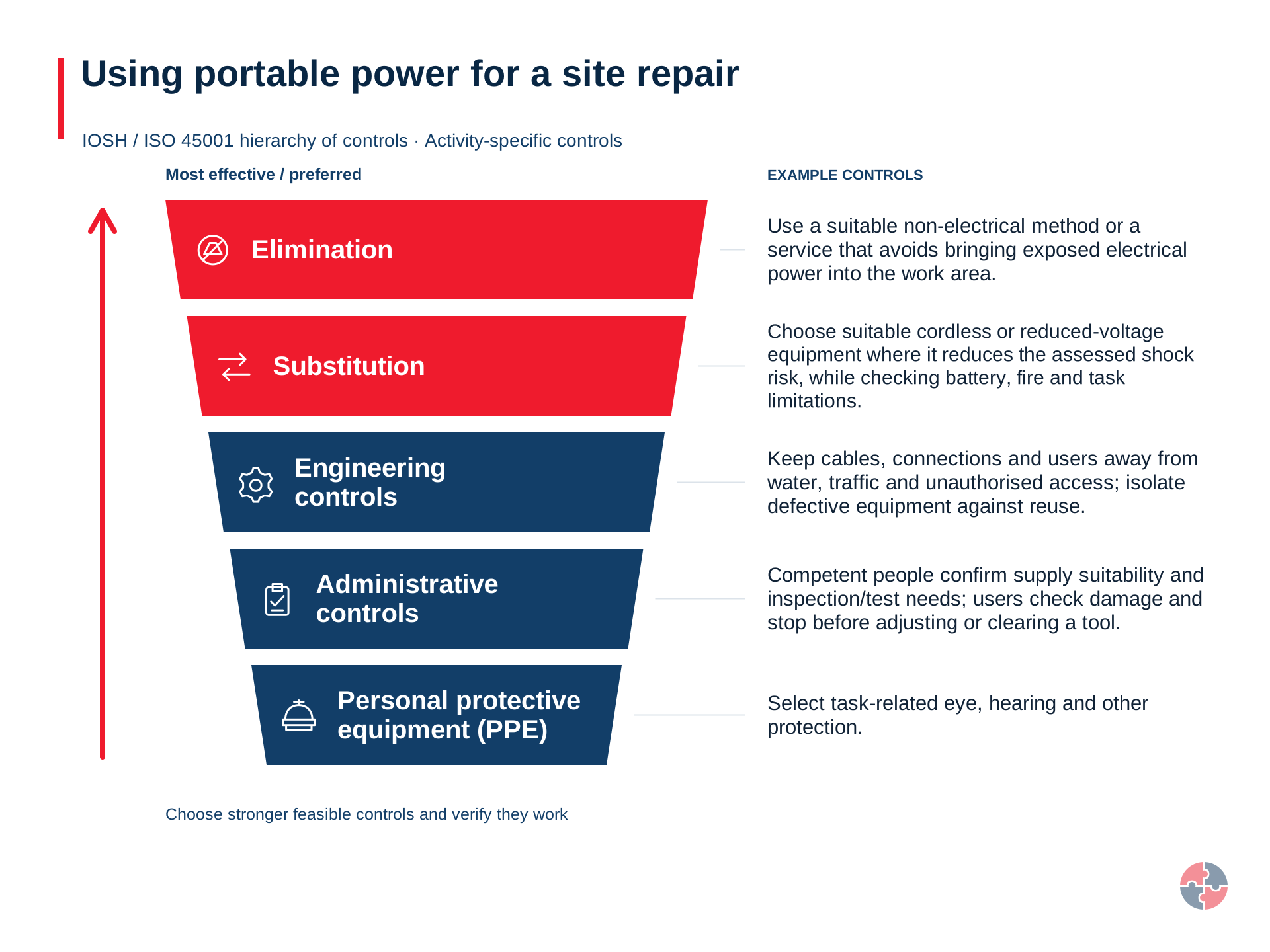
Photorealistic illustrative UK workplace scene. Review checks: Eliminate: Eliminate: the project lead first asks whether the cutting can be completed off-site or by a pre-cut component. Reduce: Substitute and reduce: if cutting remains, assess a suitable lower-voltage or battery tool for the material, runtime and environment. Isolate: Isolate and engineer: route leads away from traffic and water, protect connectors and use supply protection selected by a competent electrical person. Control: Control, PPE and Discipline: brief users on checks, keep a defect route and authorise repairs and testing to people with the required competence.
Use a maintenance system
Portable equipment maintenance combines user checks, formal visual inspection and combined inspection and testing where justified. These layers answer different questions. A user may notice obvious damage; a competent inspection examines condition more deliberately; testing may find faults that looking alone cannot establish. None substitutes for suitable equipment and controlled use.
Choose the programme from equipment type, movement, damage potential, environment and defect history. A heavily used tool in harsh conditions differs from a rarely moved office monitor. There is no universal annual test rule for every item. Recurring crushed cables may need better routing, storage or procurement rather than merely another label. Keep a defect route and a controlled return-to-use decision, with the relevant evidence available to the responsible person.
Applied case
The maintenance list gives every appliance the same annual date. The cleaner’s lead has been damaged repeatedly, but nobody reviews its route through the loading area.
Different checks, shared purpose
Inspection and testing help identify deterioration within their scope. A good programme joins them to safe selection, storage, reporting and controlled return rather than treating testing as the whole system.
Test your decision
What improvement addresses the pattern?
Review the risk-based maintenance programme and why cables keep being damaged.
Test every item on the same date and ignore use conditions.
Remove user checks because a contractor performs tests.
Compare the explanation
Review the risk-based maintenance programme and why cables keep being damaged.
Maintenance should respond to actual use and defects rather than preserve an unexamined calendar.
Recognise electrical and fire concerns around batteries and chargers.
Existing SHAREhub photographic illustration. The written fictional case supplies the condition and decision evidence.
Control charging as work
Cordless equipment removes some trailing leads but introduces batteries, chargers and charging locations. Use compatible equipment and the manufacturer’s instructions within the workplace arrangement. Protect batteries and leads from impact, heat and moisture. Keep charging from compromising escape routes or bringing an ignition source into combustible storage.
Report damage, abnormal heat, swelling, leakage or smoke. A cool damaged battery needing a planned competent disposal route differs from one actively overheating or smoking. For an active failure, keep people away and use the site emergency response; an ordinary user should not carry it through the building to a storage box. Review who controls charging locations, damaged equipment and unattended periods. Buying a cordless replacement is useful only when its new risks are managed too.
Applied case
The replacement cleaner’s battery is smoking beside packaging. A worker suggests carrying it through reception to the ordinary damaged-equipment cupboard before raising any alarm.
Cordless changes the interface
Removing a long lead can help, yet the battery, charger and charging space remain parts of the assessment. A substitution changes risks rather than erasing them.
Test your decision
What response fits an active failure?
Move it by hand because cordless equipment has no electrical risk.
Finish charging so it can be inspected when full.
Keep people away and follow the site emergency response rather than carry it through occupied areas.
Compare the explanation
Keep people away and follow the site emergency response rather than carry it through occupied areas.
An active battery failure needs the emergency arrangement, not ordinary defect transport.
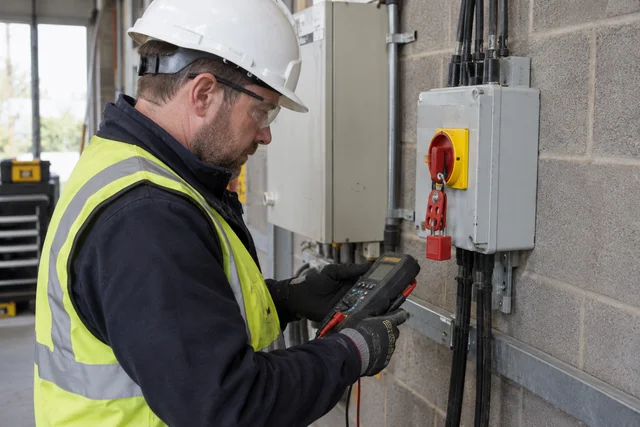
Recognise service hazards, uncertain isolation and competent-work boundaries.
Photorealistic illustrative UK workplace scene. Review checks: Setting: the site team excavates near a buried electrical service at a live client site. Act: Compare drawings with field scan and mark a controlled route; select a non-intrusive alternative where feasible. Hold / review: A conflicting drawing, ambiguous locator signal or exposed unknown service stops the job.
Know when ordinary awareness ends
Hidden cables, buried services and overhead lines can turn drilling, excavation, deliveries or lifting into high-consequence electrical work. Drawings may be incomplete and a visible switch does not establish every energy source is safe. Stored energy or another supply can remain. Do not improvise detection, isolation, testing or repair from this course.
Respect planned service controls and exclusions. Stop the affected activity when a service route is uncertain or unexpected material appears, and obtain competent resolution before a revised method proceeds. Do not touch an electrically endangered casualty or equipment while a live source may remain; use the emergency plan and specialist help without creating another casualty. The optional exercise identifies source, exposure route, defect response and the evidence a responsible competent person would need, without authorising any electrical task.
Applied case
A shelf installer encounters an uncertain cable route where drilling is planned. The supervisor proposes using the drawing alone because the nearest wall switch is off.
Off is not proof of isolation
A control switch or stopped machine is not evidence that every supply and stored energy source is safely controlled. Electrical isolation and proving dead require competent arrangements.
Test your decision
What is the appropriate decision?
Drill carefully to discover the route.
Hold the affected drilling until competent service identification and a suitable method resolve the uncertainty.
Treat the nearby switch as proof every hidden supply is dead.
Compare the explanation
Hold the affected drilling until competent service identification and a suitable method resolve the uncertainty.
Awareness identifies the hold point; competent task-specific control must resolve the electrical status.

 View full detail ↗