Buried services and excavation: planning before breaking ground
Approximately 51–78 minutes
Workplace awareness and prevention. Specialist competence, statutory examinations and work authorisation require separate evidence. Check the relevant UK nation and actual workplace arrangements. Completion does not establish practical competence, authorise hazardous work or award an external qualification.
Read the complete core teaching here. Use the interactive course for required activities, saved assessment and conditional completion.
Plan beyond the drawing
Plan beyond the drawing
Identify information needed before excavation
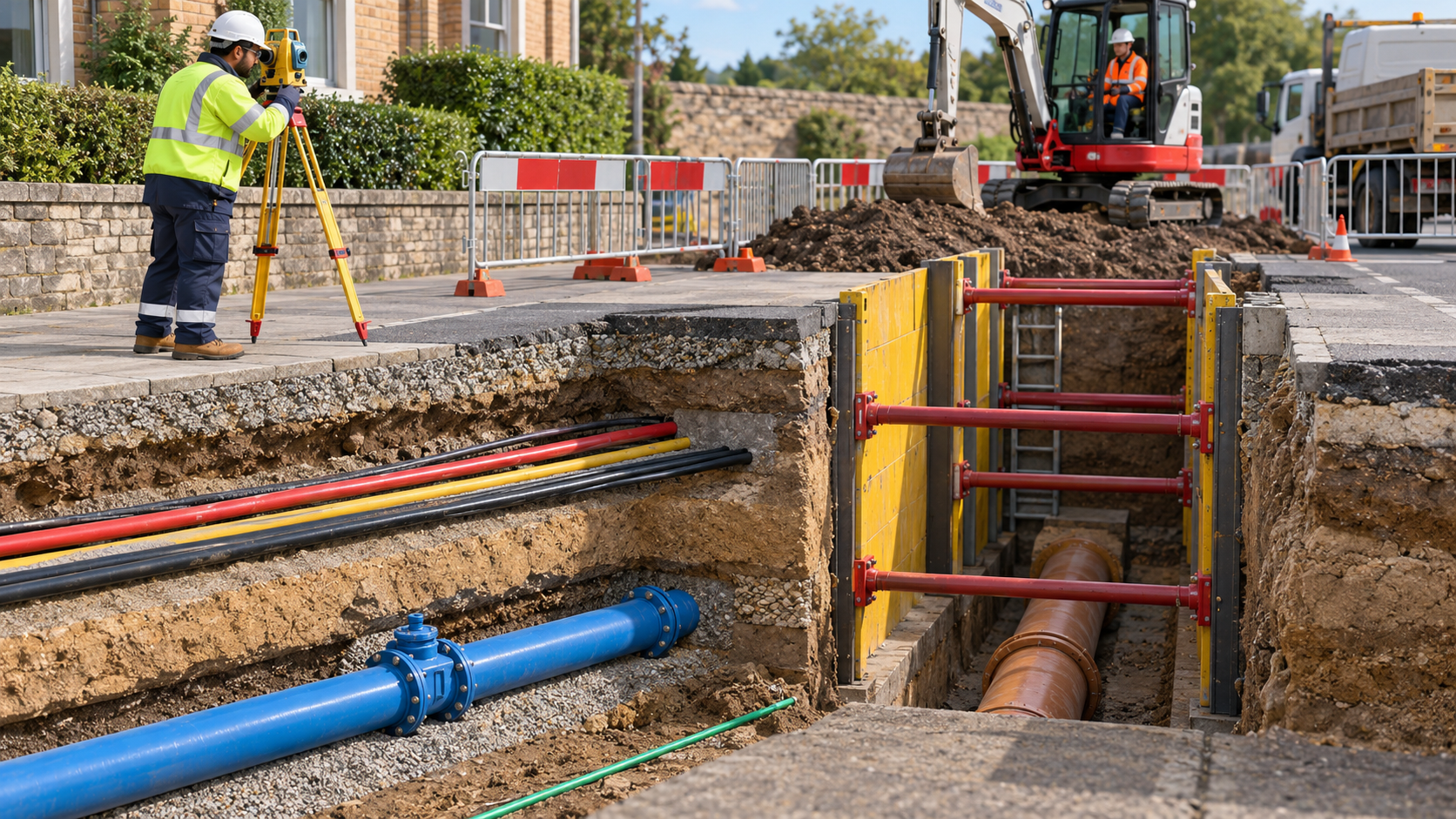
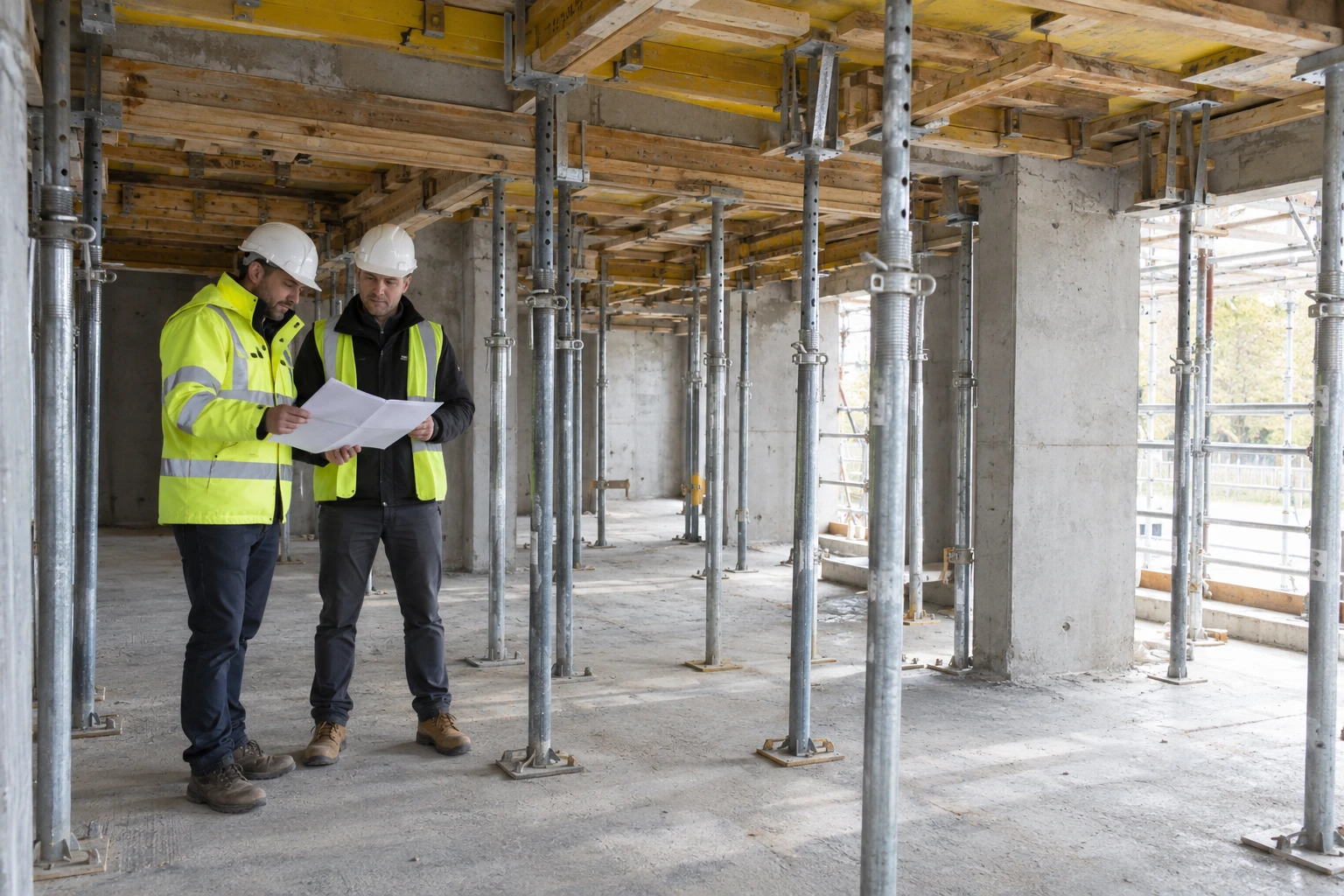
Professional teaching illustration. Read the written scenario for the facts; the image is not evidence of a real workplace.
Buried cables, gas, water and other services may not match old plans exactly. Ground stability, adjacent structures, access and water also matter. Obtain current information for the exact work area and competent advice before choosing the method.
What are buried services and utility strike prevention?
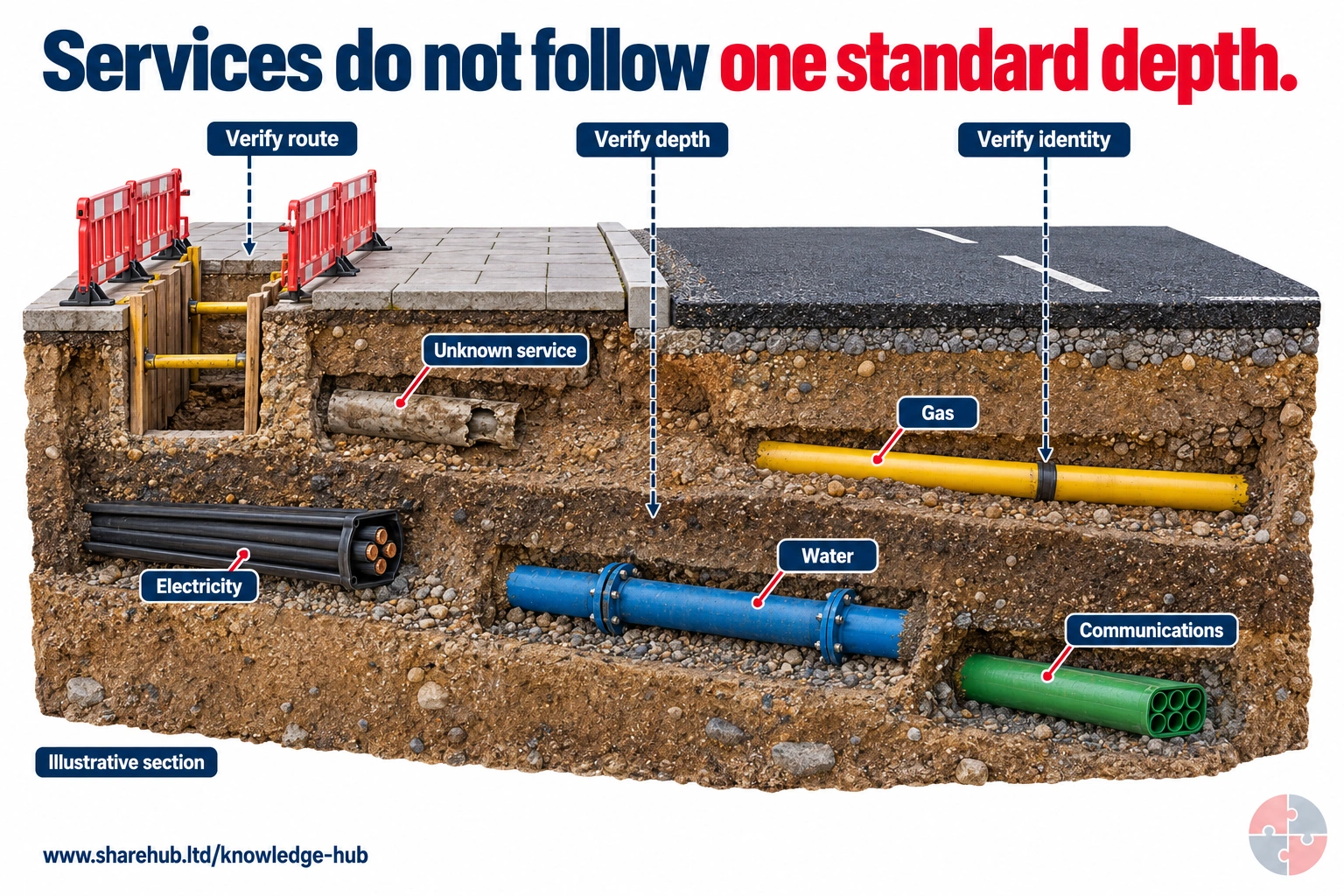
Buried services are underground utility and process assets that can be damaged when the ground is penetrated, and utility strike prevention is the system used to avoid that damage. See HSE HSG47 avoiding danger from underground services The term includes electricity cables, gas mains and services, water mains, sewers, drains, telecommunications cables, fibre ducts, street-lighting cables, traffic-signal cables, district heating lines, fuel lines, chemical pipelines, process drains, private estate services, earthing systems, chambers, valves, joints and associated equipment. The most dangerous feature of buried services is that they are hidden.
Workers may see a clear patch of ground and assume it is safe, but below the surface there may be multiple services at different depths, in unexpected directions, with poor records or abandoned-looking assets that are still live. Buried-services management is therefore a system of uncertainty reduction. It does not ask one person to guess. It uses records, surveys, locating equipment, visible site clues, trial holes, controlled excavation, supervision, communication and emergency planning to reduce the chance of a strike. Electricity. Low-voltage, high-voltage, street lighting, site supplies and private cables.
Contact can cause electrocution, severe burns, arc flash, fire and power loss. Gas. Mains, services, valves, governors and private pipework. Damage can cause gas escape, fire, explosion and evacuation. Water. Potable mains, fire mains, process water and pressurised systems. Damage can cause flooding, high-pressure injury, undermining and service loss. Sewers and drains. Foul sewers, storm drains, interceptors and process drainage. Damage can cause contamination, infection risk, flooding and confined-space hazards. Telecoms and fibre. Copper, fibre, ducts, cabinets and network chambers. Damage can disrupt communications, emergency services and business continuity.
Major hazard pipelines. Fuel, oil, gas, chemical or other hazardous-substance pipelines. Damage can create fire, explosion, toxic exposure or environmental harm.
Fictional workplace decision
Fictional case — An old drawing shows no buried service in the planned cut. A locator gives an unexplained indication at the same location, and the team is asked to choose which record permits digging.
Compare the reasoning
Treat the drawing and unexplained locator indication as complementary evidence whose conflict needs competent resolution. Neither is convenient permission to dig. Keep the uncertain ground disturbance on hold, establish the information limits and obtain the necessary investigation and revised safe method before the responsible person releases that defined stage.
Existing SHAREhub photographic illustration. The fictional case supplies the task and decision evidence.
Buried cables, gas, water and other services may not match old plans exactly. Ground stability, adjacent structures, access and water also matter. Obtain current information for the exact work area and competent advice before choosing the method.
What is excavation safety in practical terms?
Excavation planning is the evidence-led decision to dig, avoid digging or change the method before people and plant are exposed. Source basis: HSE excavations guidance · HSE HSG47 avoiding danger from underground services · HSENI CDM 2016 guidance. Source basis: HSE excavations guidance · HSE HSG47 avoiding danger from underground services · HSENI CDM 2016 guidance. Excavation includes trenches, pits, basements, foundations, drainage runs, utility connections, trial holes, shafts, cofferdams, caissons and temporary ground openings. The work may be small and short-term, but the hazards can be severe if the excavation collapses, strikes a cable, damages a gas main, undermines a wall or fills with water.
See HSE excavations guidance. The safest excavation is often the one avoided or reduced at design stage. Trenchless techniques, different routing, prefabrication, changed sequence or design coordination can remove or reduce the need for people to enter an excavation. Where excavation is necessary, the management system should define who provides information, who verifies services, who designs support, who authorises work, who inspects, who supervises and what happens when conditions change.
Fictional workplace decision
Fictional case — An old drawing shows no buried service in the planned cut. A locator gives an unexplained indication at the same location, and the team is asked to choose which record permits digging.
Compare the reasoning
Treat the drawing and unexplained locator indication as complementary evidence whose conflict needs competent resolution. Neither is convenient permission to dig. Keep the uncertain ground disturbance on hold, establish the information limits and obtain the necessary investigation and revised safe method before the responsible person releases that defined stage.
Existing SHAREhub photographic illustration. The fictional case supplies the task and decision evidence.
Buried cables, gas, water and other services may not match old plans exactly. Ground stability, adjacent structures, access and water also matter. Obtain current information for the exact work area and competent advice before choosing the method.
What harm can buried service strikes cause?
Buried-service strikes can injure people immediately and create wider fire, explosion, environmental and public-safety consequences. See HSE HSG47 avoiding danger from underground services Electricity strikes are often misunderstood. The injury is not only a conventional electric shock; the explosive effect of arcing current can cause deep burns to hands, face and body, ignite clothing and throw hot metal or debris. A cable can be penetrated by a sharp tool, crushed by plant, damaged by a breaker or weakened by abrasion and fail later. Gas strikes can produce a leak that travels into ducts, chambers, buildings or excavations before ignition.
Water and sewer strikes may appear less dramatic, but pressurised water can injure workers, flood trenches, undermine support, contaminate ground and create drowning or infection risks. Fibre and telecoms damage may not injure the person holding the tool, but it can disrupt emergency communications, hospitals, businesses and transport systems. The biggest lesson for supervisors is that the hazard depends on the service, pressure, voltage, substance, work method, depth, surrounding ground, confined spaces, weather and whether other services are nearby. A single excavator bucket can damage gas and electricity together, creating escalation that was not visible in the task description.
Electricity cable. Penetration, crushing, abrasion, breaker strike or unsupported exposed cable. Electrocution, arc-flash burns, fire, explosion and power outage. Gas pipe. Mechanical impact, scraping, joint damage, bending or delayed leak from weakened pipe. Gas escape, asphyxiation, fire, explosion and evacuation. Water main. Impact, pipe fracture, joint failure or undermining. High-pressure jet injury, flooding, trench collapse and public supply loss. Sewer or drain. Breaking pipe, collapse, contamination or cross-connection. Pathogen exposure, pollution, odour, flooding and confined-space risk. Telecoms/fibre. Cutting, pulling, crushing duct or damaging chambers. Service outage, loss of emergency communications and business disruption.
Hazardous pipeline. Impact, excavation too close, ground movement or inadequate consultation. Toxic release, fire, explosion, pollution and major incident potential.
Fictional workplace decision
Fictional case — An old drawing shows no buried service in the planned cut. A locator gives an unexplained indication at the same location, and the team is asked to choose which record permits digging.
Compare the reasoning
Treat the drawing and unexplained locator indication as complementary evidence whose conflict needs competent resolution. Neither is convenient permission to dig. Keep the uncertain ground disturbance on hold, establish the information limits and obtain the necessary investigation and revised safe method before the responsible person releases that defined stage.
Detailed SHAREhub teaching diagram, used with its source explanation. It cannot establish actual site conditions or diagnose a person.
A safe approach combines planning, locating and identifying services, and an appropriate excavation method. Detection equipment needs competent use and has limitations. Keep people outside collapse and plant hazards; a permit or scan result alone does not prove safe ground.
How should excavation work be planned before digging starts?
Before release, verify service records and site detection, ground and water assumptions, temporary works design, access and plant arrangements, competent inspection and rescue needs; record who can stop the work. Planning should start with information gathering. Clients and designers should provide relevant information on ground conditions, existing services, underground structures, watercourses, previous site use and adjacent structures. Contractors should verify this information rather than assuming plans are complete. A pre-dig release is conditional. Record the design assumptions, source of each buried-service plan, locator limitations, trial-hole locations, temporary works reviewer, plant route, competent inspector and rescue contact.
If a contractor changes the route or depth, the information and authority must be revisited before the cut continues. The method should be selected before plant arrives. Decide whether trenchless methods are practicable, whether workers need to enter, what support is required, how services will be located, how public and traffic interfaces will be controlled and what inspections are required.
Fictional workplace decision
Fictional case — An old drawing shows no buried service in the planned cut. A locator gives an unexplained indication at the same location, and the team is asked to choose which record permits digging.
Compare the reasoning
Treat the drawing and unexplained locator indication as complementary evidence whose conflict needs competent resolution. Neither is convenient permission to dig. Keep the uncertain ground disturbance on hold, establish the information limits and obtain the necessary investigation and revised safe method before the responsible person releases that defined stage.
How should work be planned before excavation starts?
Locate and work safely
Recognise uncertainty and stop points
Professional teaching illustration. Read the written scenario for the facts; the image is not evidence of a real workplace.
A safe approach combines planning, locating and identifying services, and an appropriate excavation method. Detection equipment needs competent use and has limitations. Keep people outside collapse and plant hazards; a permit or scan result alone does not prove safe ground.
How should work be planned before excavation starts?
Planning should identify what might be underground, who owns it, how reliable the information is and how the work will avoid damage. See HSE HSG47 avoiding danger from underground services Planning must start with the task: excavation, post installation, trenching, piling, moling, drilling, site investigation, demolition, resurfacing, landscaping or breaking concrete. Each method has a different strike mechanism. A post rammer can pierce a cable, a breaker can damage a shallow service, a piling rig can hit deep assets, and trenchless work can intersect services away from the launch pit.
The client should provide pre-construction information where CDM applies. That includes known underground services, site surveys, as-built records, previous investigations, private services and constraints. The contractor should not accept vague statements such as 'services to be confirmed on site' without a clear plan for confirmation. Planning should also include service isolation where possible, emergency contacts, exclusion zones, traffic and pedestrian management, ground conditions, excavation support, confined-space risk, contaminated land, water ingress, night work, public interface and how changes will be authorised. Utility searches. Identifies known service owners and indicative routes.
Responses, plans and correspondence. Private services. Private estates often contain unrecorded lighting, drainage, power or process lines. Estate drawings, interviews and site survey. Work method. Different tools create different strike risks. Method statement and plant/tool selection. Isolation feasibility. Dead or isolated services reduce consequence. Isolation certificate or utility confirmation. Emergency plan. People need immediate actions before a strike occurs. Emergency contacts, briefing and site plan. Competence. Poor interpretation of scans or drawings can be as dangerous as no survey. Training, assessment and supervision record.
Fictional workplace decision
Fictional case — An old drawing shows no buried service in the planned cut. A locator gives an unexplained indication at the same location, and the team is asked to choose which record permits digging.
Compare the reasoning
Treat the drawing and unexplained locator indication as complementary evidence whose conflict needs competent resolution. Neither is convenient permission to dig. Keep the uncertain ground disturbance on hold, establish the information limits and obtain the necessary investigation and revised safe method before the responsible person releases that defined stage.
What must be confirmed before anyone enters an excavation?
Locate and work safely
Recognise uncertainty and stop points
Existing SHAREhub photographic illustration. The fictional case supplies the task and decision evidence.
A safe approach combines planning, locating and identifying services, and an appropriate excavation method. Detection equipment needs competent use and has limitations. Keep people outside collapse and plant hazards; a permit or scan result alone does not prove safe ground.
What must be confirmed before anyone enters an excavation?
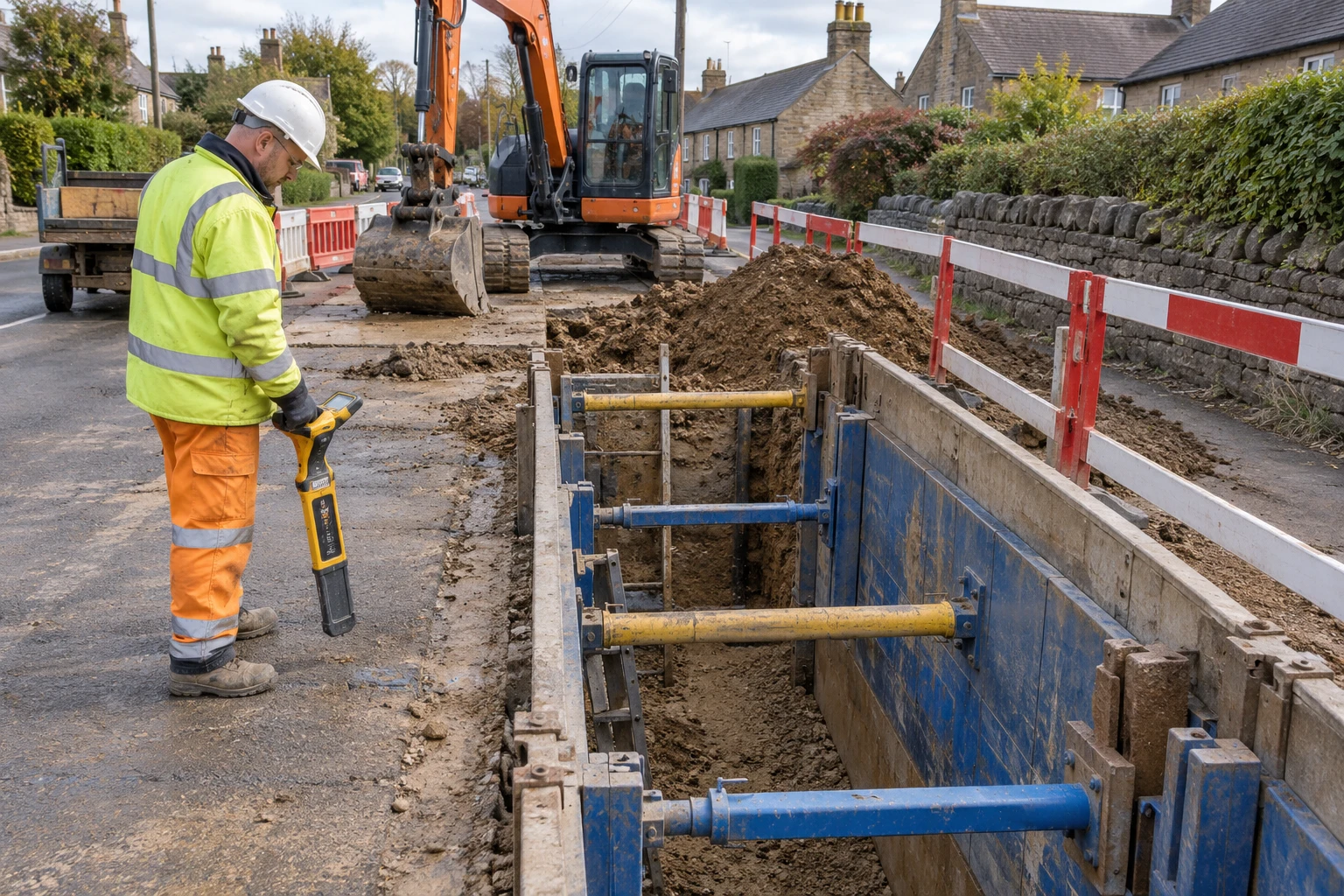
Confirm the excavation is stable through suitable support or safe battering, buried services are identified and controlled, entry and edges are protected, and a competent inspection has found it safe. Stop for changed ground, water, plant loading or an unexpected service. CAT means cable avoidance tool and Genny means signal generator; they help locate buried services but do not replace plans and safe exposure. RAMS means risk assessment and method statement. SHEQ means safety, health, environment and quality; it describes a management function, not a substitute for the competent workface decision.
A utility trench crosses a road with incomplete service plans. The contractor obtains updated information, scans and marks the route, exposes services by a safe method, installs designed support and controls traffic and access. A newly found cable stops mechanical digging until its owner and a competent lead agree the revised method.
Fictional workplace decision
Fictional case — An old drawing shows no buried service in the planned cut. A locator gives an unexplained indication at the same location, and the team is asked to choose which record permits digging.
Compare the reasoning
Treat the drawing and unexplained locator indication as complementary evidence whose conflict needs competent resolution. Neither is convenient permission to dig. Keep the uncertain ground disturbance on hold, establish the information limits and obtain the necessary investigation and revised safe method before the responsible person releases that defined stage.
Existing SHAREhub photographic illustration. The fictional case supplies the task and decision evidence.
Stop if an unexpected service, ground movement or other uncertainty appears. Reassess with the responsible people before continuing. A suspected strike needs the site emergency procedure and relevant emergency help, without approaching exposed electrical or gas hazards.
What should workers do if a buried service is damaged?
Workers should stop work, keep people away, raise the alarm and follow the service-specific emergency plan. See HSE HSG47 avoiding danger from underground services Emergency actions must be briefed before work starts because a strike is not the moment to invent the response. The right action depends on the service: electricity, gas, water, sewer, telecoms or hazardous pipeline. Workers should know who calls the service owner, who controls the area, who stops plant, who prevents re-entry and who reports the incident. With suspected live electrical damage, people should avoid touching equipment, exposed cable or anyone in contact with electricity until it is safe.
With gas, ignition sources should be controlled, people moved away and emergency services or the gas emergency number contacted. With water or sewer damage, the risks include trench flooding, undermining, contamination and confined-space atmospheres. Near misses matter. A scraped duct, cracked pipe, unexpected service or minor cable damage can become a delayed failure if left unreported. Electricity. Stop work, keep clear, prevent contact, isolate if competent route exists and contact the network owner/emergency services. Damaged cables can arc, re-energise or remain live. Gas. Stop work, remove ignition sources if safe, evacuate, call emergency gas response and prevent re-entry.
Gas can travel and ignite away from the strike point. Water. Stop work, leave excavation if flooding or instability develops and contact the service owner. Flooding can collapse ground or trap workers. Sewer/drain. Stop work, avoid contact, consider contamination and confined-space risk. Sewage can expose workers to pathogens and toxic atmospheres. Telecoms/fibre. Stop work and contact service owner. Service damage can disrupt emergency communications and critical systems. Hazardous pipeline. Stop work, evacuate according to the pipeline emergency plan and contact the operator immediately. Contents may be flammable, toxic, pressurised or environmentally harmful.
Fictional workplace decision
Fictional case — An old drawing shows no buried service in the planned cut. A locator gives an unexplained indication at the same location, and the team is asked to choose which record permits digging.
Compare the reasoning
Treat the drawing and unexplained locator indication as complementary evidence whose conflict needs competent resolution. Neither is convenient permission to dig. Keep the uncertain ground disturbance on hold, establish the information limits and obtain the necessary investigation and revised safe method before the responsible person releases that defined stage.
Use this route before digging; use Excavations for the open trench
Respond to change
Coordinate service and ground controls
Existing SHAREhub photographic illustration. The fictional case supplies the task and decision evidence.
Stop if an unexpected service, ground movement or other uncertainty appears. Reassess with the responsible people before continuing. A suspected strike needs the site emergency procedure and relevant emergency help, without approaching exposed electrical or gas hazards.
Use this route before digging; use Excavations for the open trench
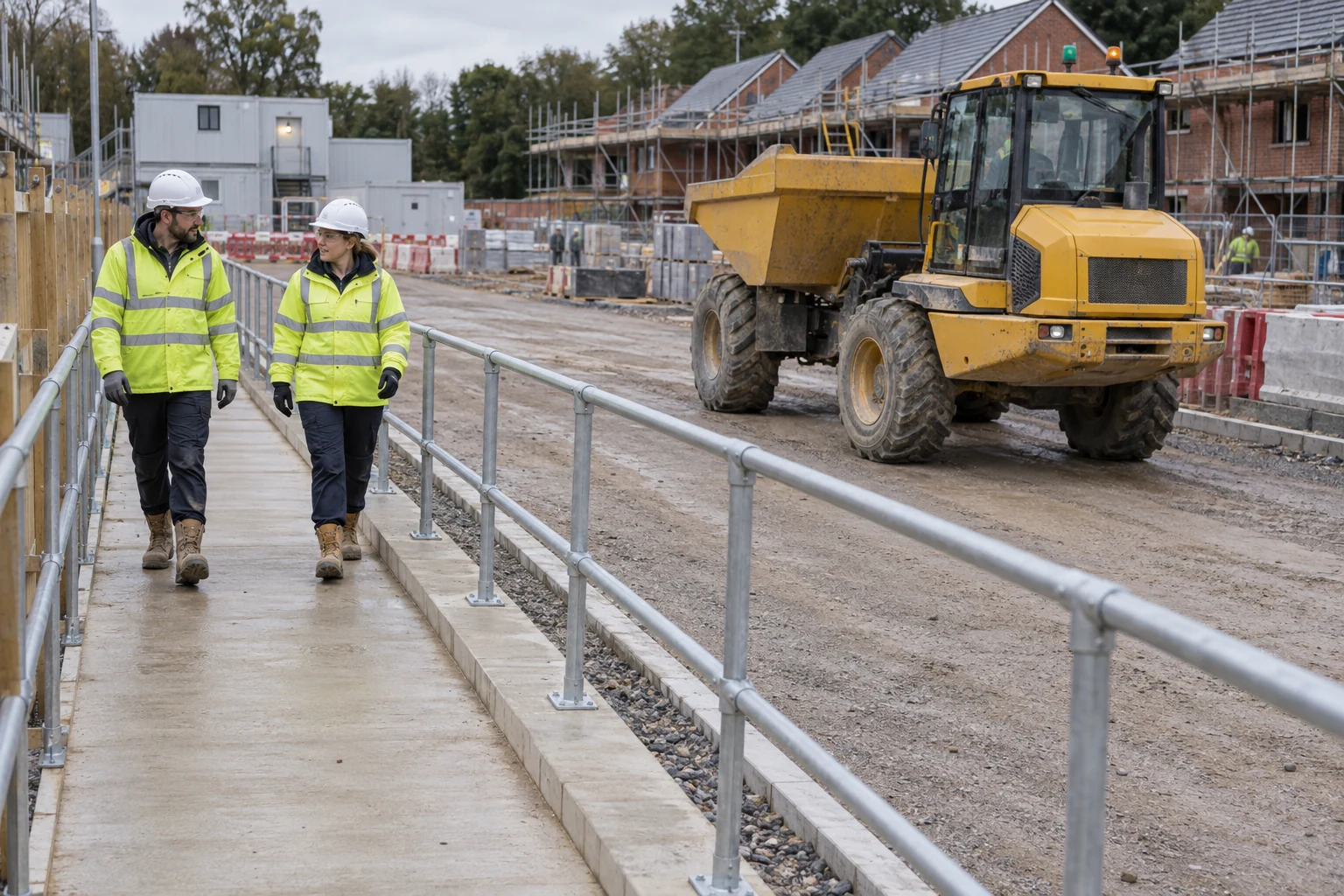
The pre-dig supervisor obtains current information from the client and service owners and asks the competent locator to resolve conflicting evidence. The temporary-works or support designer confirms the support and sequence where design is needed. The responsible site manager releases the defined stage only after the approved method, service controls, competent checks and briefing are in place. A permit, drawing or locator result alone cannot authorise digging. Unexpected ground, water, a service or a changed load reopens the decision. Keep the existing full planning and worked examples; use the open-trench companion for current workface inspection.
Content amended 19 October 2026 by the SHARE Knowledge Hub editorial team. This records an editorial content change; the existing technical-review and approval status still applies.
Fictional workplace decision
Fictional case — An old drawing shows no buried service in the planned cut. A locator gives an unexplained indication at the same location, and the team is asked to choose which record permits digging.
Compare the reasoning
Treat the drawing and unexplained locator indication as complementary evidence whose conflict needs competent resolution. Neither is convenient permission to dig. Keep the uncertain ground disturbance on hold, establish the information limits and obtain the necessary investigation and revised safe method before the responsible person releases that defined stage.
When do plans and scans still leave the location uncertain?
Respond to change
Coordinate service and ground controls
Professional teaching illustration. Read the written scenario for the facts; the image is not evidence of a real workplace.
Stop if an unexpected service, ground movement or other uncertainty appears. Reassess with the responsible people before continuing. A suspected strike needs the site emergency procedure and relevant emergency help, without approaching exposed electrical or gas hazards.
When do plans and scans still leave the location uncertain?
Plans indicate possible routes but are not proof of the exact position, depth or presence of private services. A trained person should use a suitable locator in appropriate modes, mark the interpretation, repeat scans as ground is opened and use trial holes or other suitable confirmation before intrusive plant work. Plastic or non-conductive services and congested ground may not be detected. See HSE HSG47 avoiding danger from underground services If the plan, site clues and locator disagree, or a signal cannot be explained, stop the relevant excavation.
Ask the asset owner or competent surveyor for better information and redesign or expose carefully; do not guess a depth from a colour chart or an old drawing.
Fictional workplace decision
Fictional case — An old drawing shows no buried service in the planned cut. A locator gives an unexplained indication at the same location, and the team is asked to choose which record permits digging.
Compare the reasoning
Treat the drawing and unexplained locator indication as complementary evidence whose conflict needs competent resolution. Neither is convenient permission to dig. Keep the uncertain ground disturbance on hold, establish the information limits and obtain the necessary investigation and revised safe method before the responsible person releases that defined stage.