Abrasive wheels and angle grinders: hazard awareness
Approximately 46–71 minutes
Workplace awareness and prevention. Specialist competence, statutory examinations and work authorisation require separate evidence. Check the relevant UK nation and actual workplace arrangements. Completion does not establish practical competence, authorise hazardous work or award an external qualification.
Read the complete core teaching here. Use the interactive course for required activities, saved assessment and conditional completion.
Understand the failure routes
Understand the failure routes
Recognise equipment and wheel incompatibility
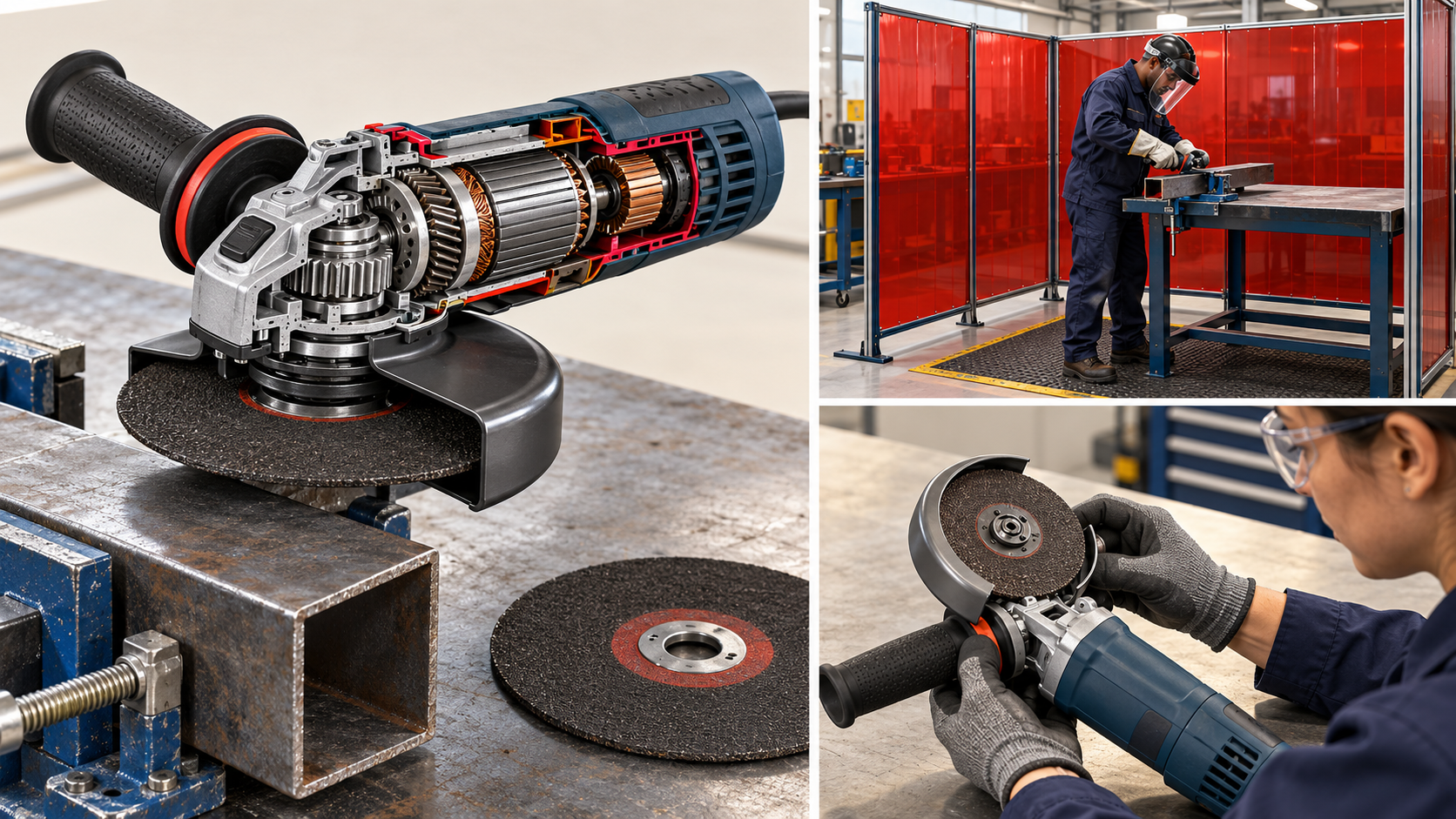
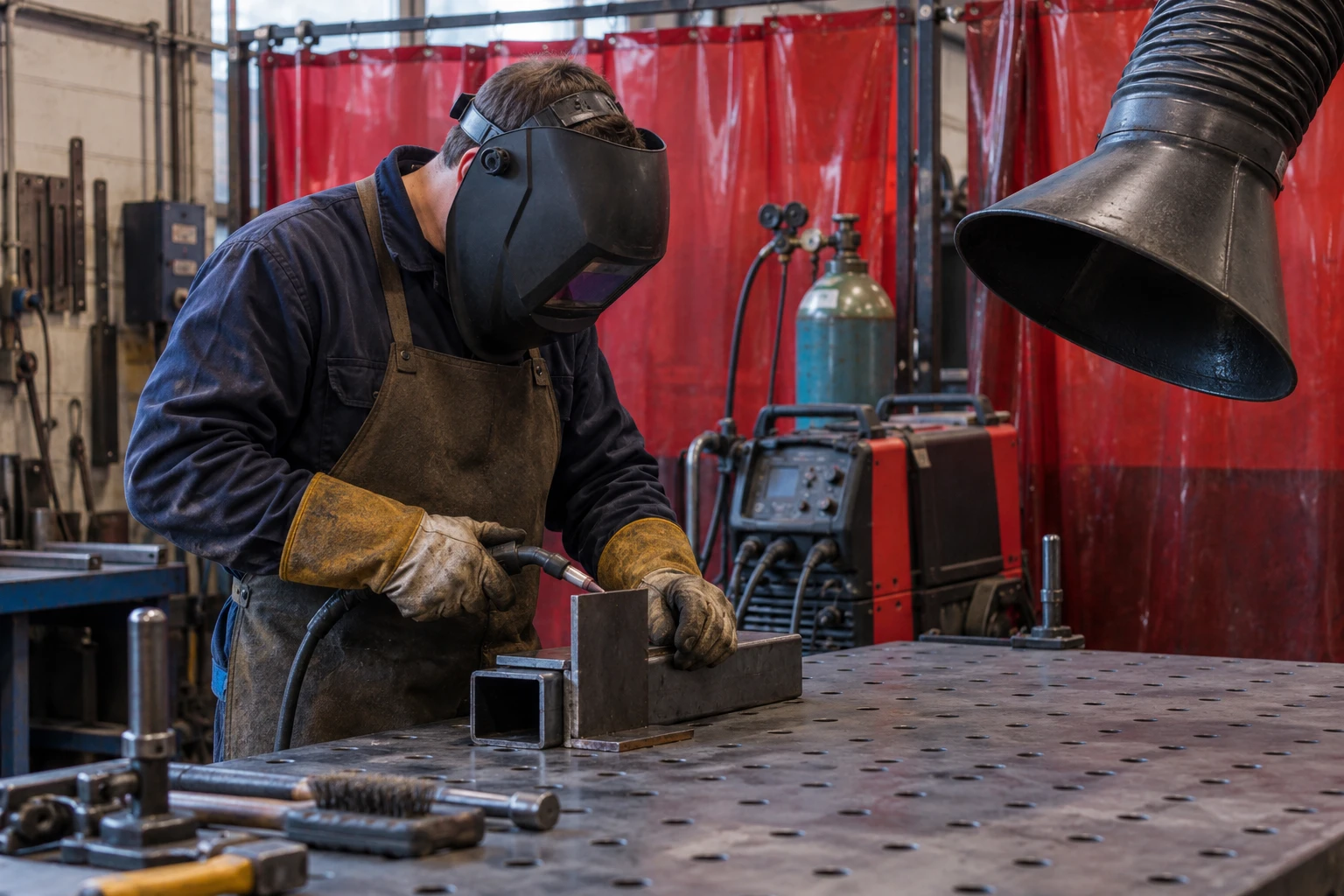
Professional teaching illustration. Read the written scenario for the facts; the image is not evidence of a real workplace.
A wheel can burst or kick back, while sparks, fragments, dust, noise and vibration expose the user and nearby people. Assess the material, work position and environment. A different cutting method may remove hazards that PPE cannot control.
How do abrasive wheels cause harm?
Abrasive wheels cause harm through high-energy failure, direct contact, ejected material, inhalation exposure, fire, noise and vibration. The most dramatic failure is wheel burst, where a damaged, oversped or wrongly mounted wheel breaks apart and ejects fragments. The quieter failures are just as important: dry cutting concrete can expose workers to respirable crystalline silica (RCS), repeated grinder use can contribute to hand-arm vibration syndrome (HAVS), and sparks from grinding can start fires in waste, insulation, vapour or hidden cavities. Good assessment should treat short-term safety and long-term health together.
A job can look controlled because nobody is cut, while still being poorly controlled because dust is visible, masks do not fit, noise is unmanaged or workers are accumulating vibration exposure. The best pages, procedures and toolbox talks make those less visible risks easy to understand. Warning signs must trigger a decision before injury occurs. This table links the route of harm to an observable condition and a stop or escalation point; the following table retains the fuller mechanism and control explanation. The existing mechanism table below explains the wider prevention package; the stop points above are prompts for a competent task-specific decision, not a complete safe system.
Fictional workplace decision
Fictional case — The workshop proposes using a wheel whose maximum speed is lower than the grinder marking. The fitter says that a matching spindle hole settles the decision.
Compare the reasoning
Keep the proposed combination out of use while a competent person resolves the specification conflict. Matching the spindle hole establishes only one aspect of fit; it does not establish safe speed, wheel suitability or correct mounting. Record the conflicting markings and the evidence required before an authorised selection is made.
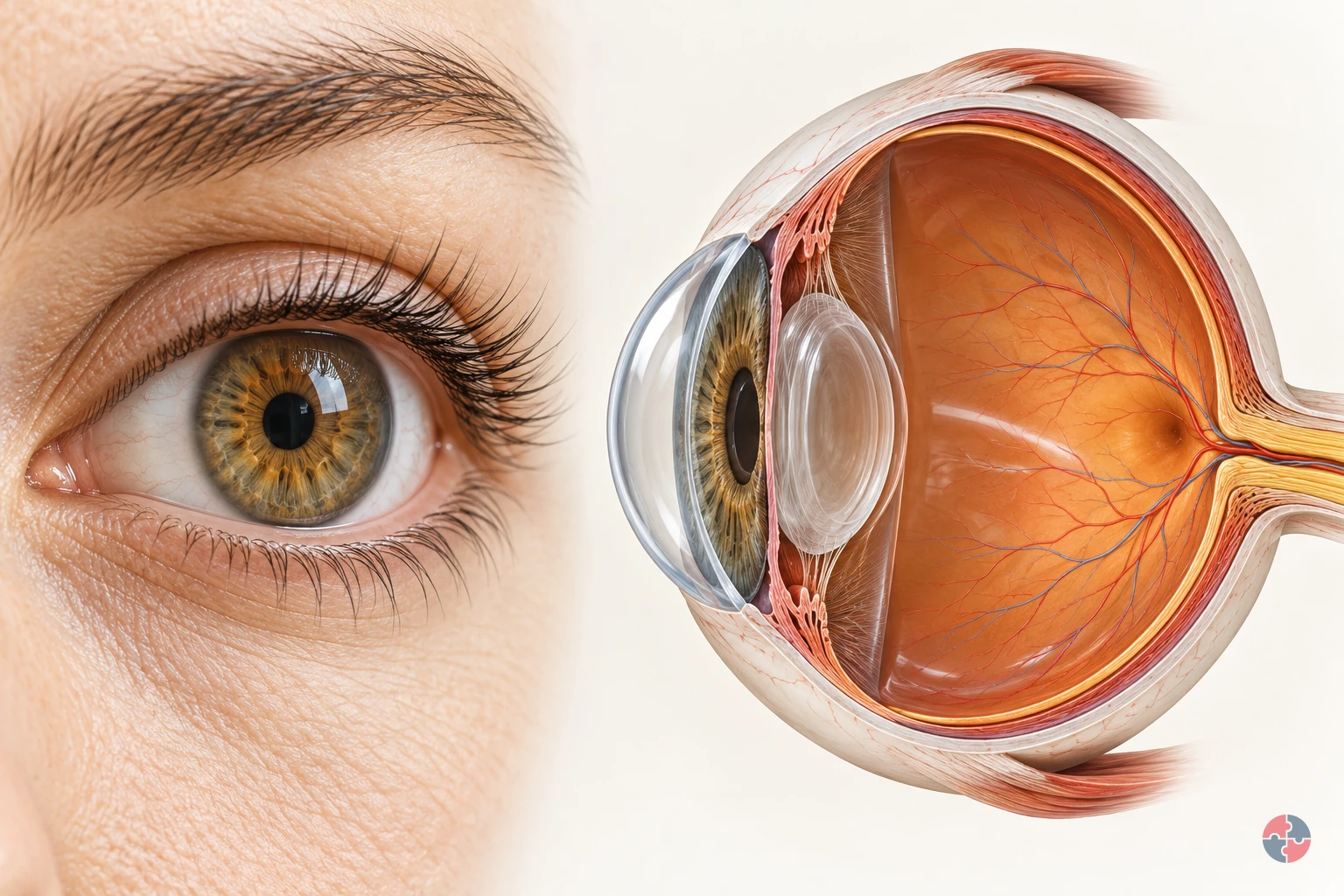
Compare the visible eye with its enlarged side cutaway. Locate the clear front, lens and inner rear lining before following light and visual signals.
Distinguish the protective eye surface from the internal visual pathway. What task-specific protection or workstation change does this lesson require?
educational illustration · healthy anatomy; enlarged details and teaching colours.View full detail ↗Whole hand and enlarged finger
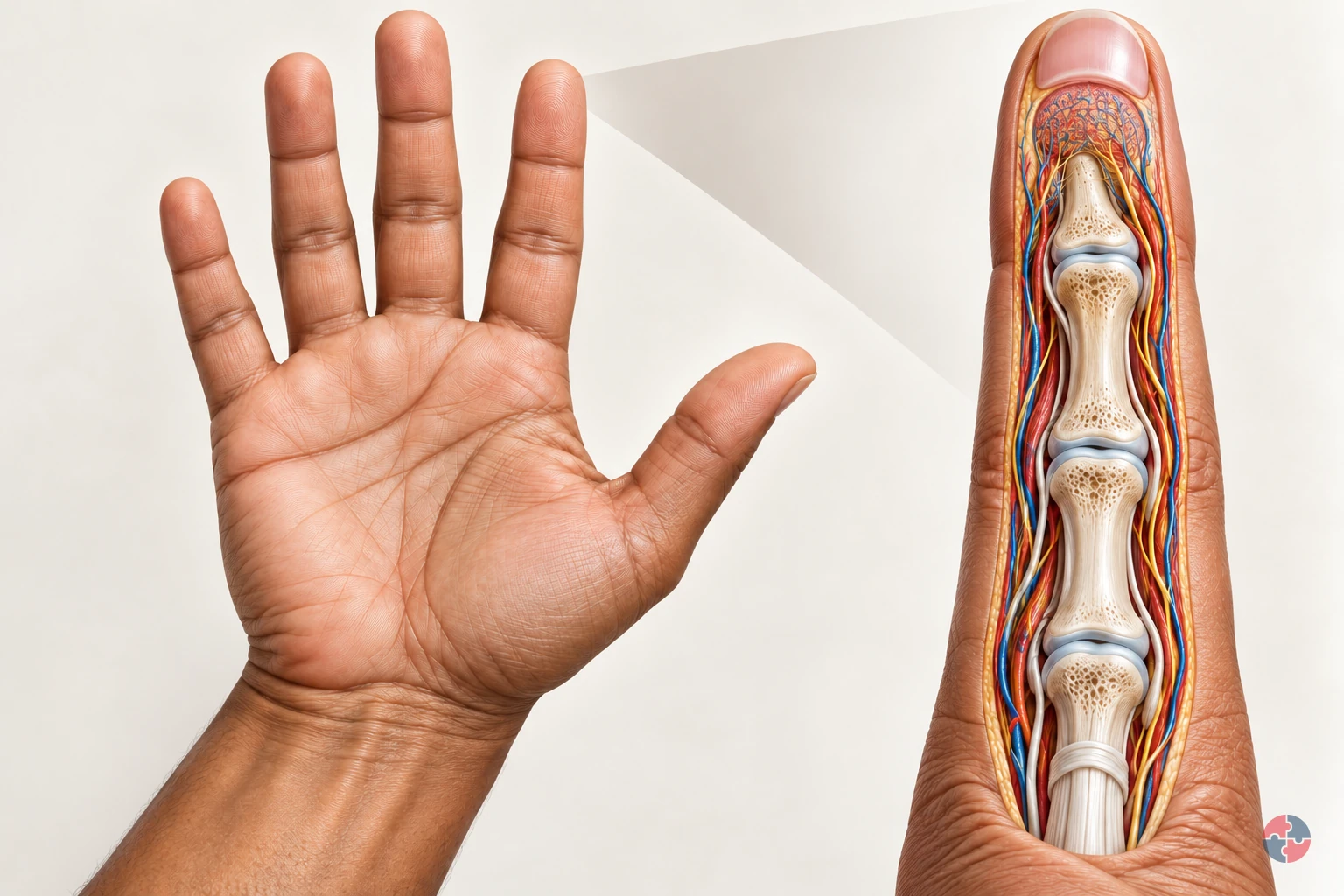
Locate the index finger in the whole hand. The separate cutaway enlarges skin, bones, vessels and nerves; colours distinguish the structures.
Keep circulation, sensation and movement distinct. Which tool or work-method change would reduce the exposure described here?
educational illustration · healthy anatomy; enlarged details and teaching colours.
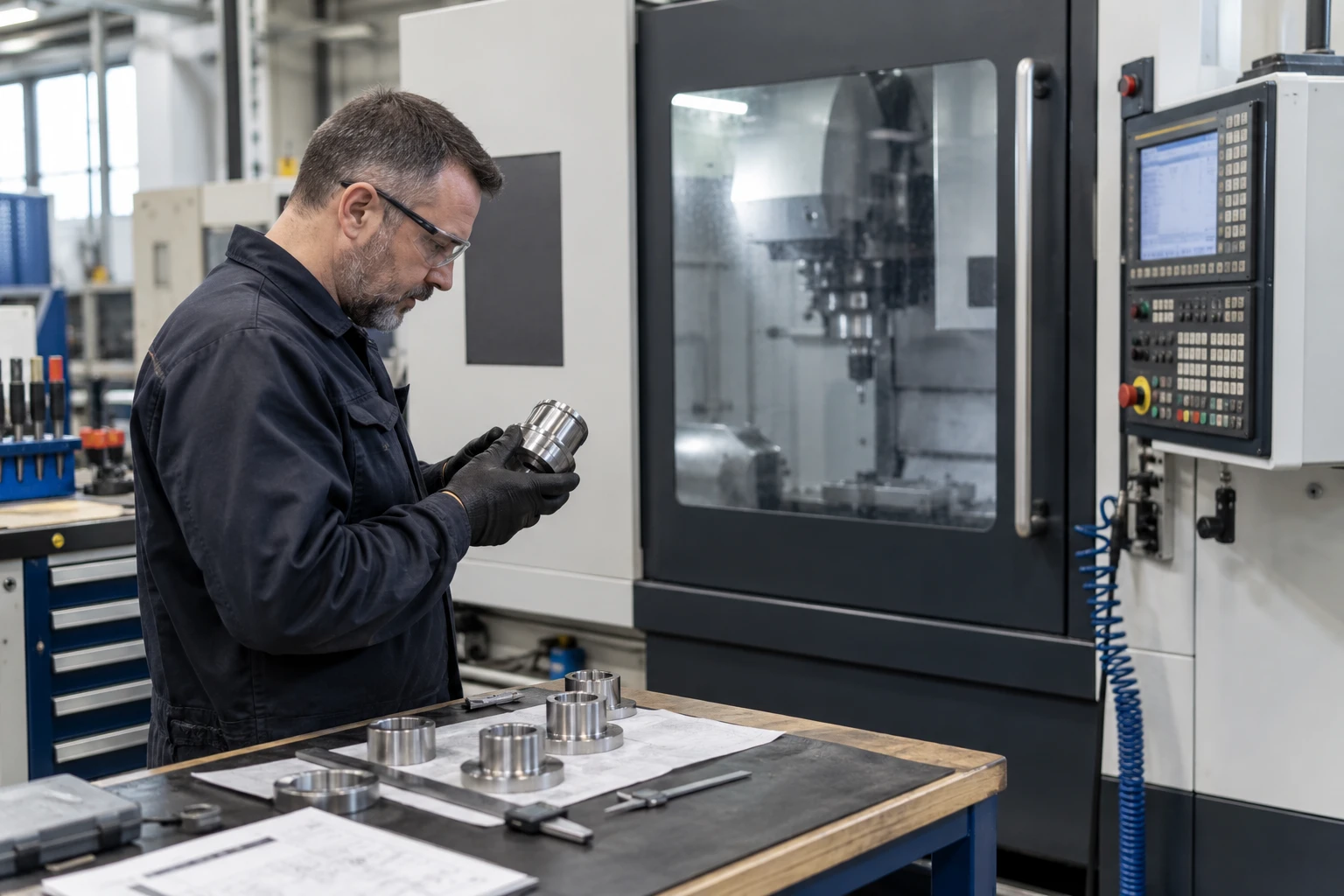
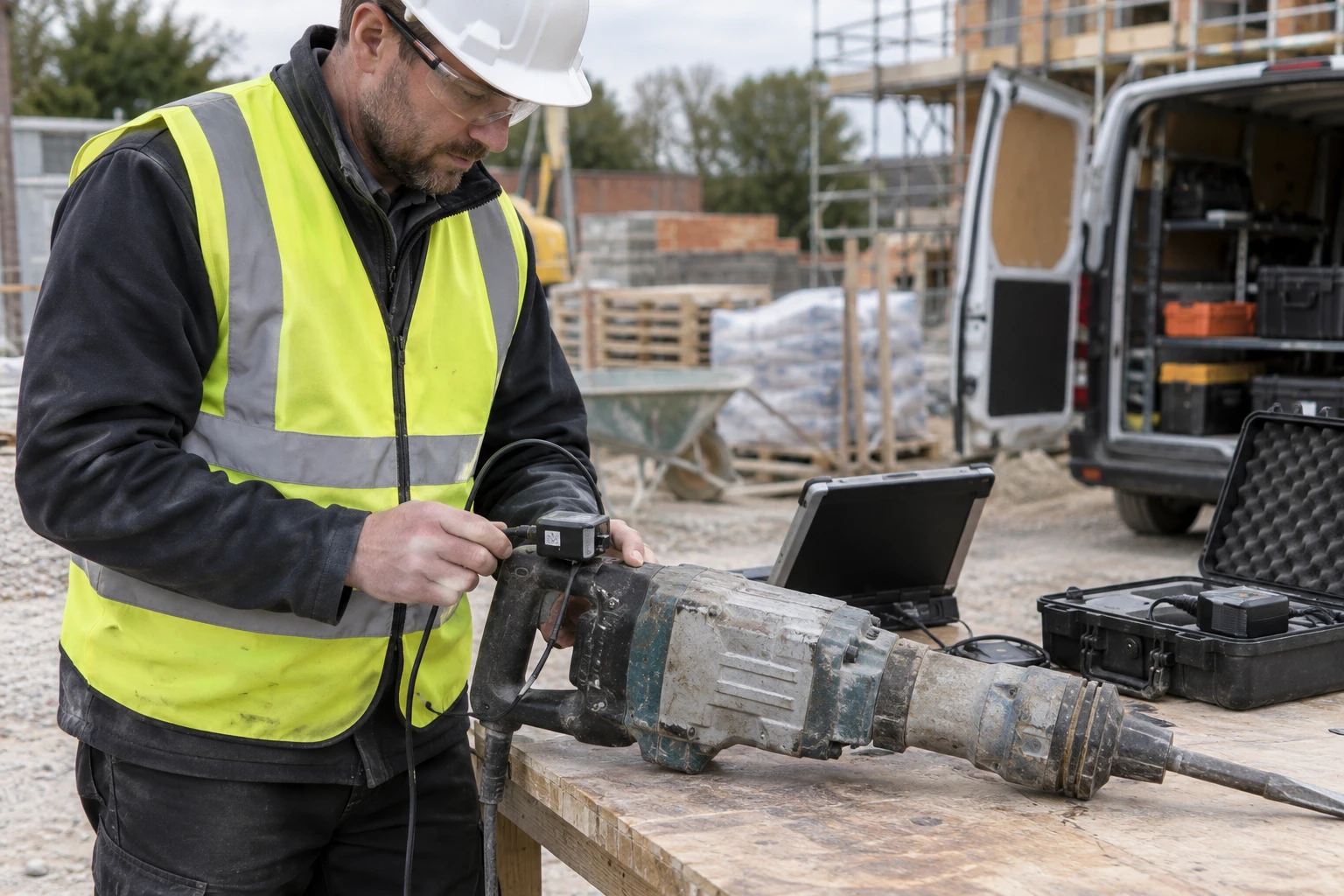
Existing SHAREhub photographic illustration. The fictional case supplies the task and decision evidence.
A wheel can burst or kick back, while sparks, fragments, dust, noise and vibration expose the user and nearby people. Assess the material, work position and environment. A different cutting method may remove hazards that PPE cannot control.
What hazards do hand-held tools create?
Hand-held tools can create injury, ill-health and fire risks through stored energy, motion, sharpness, heat, electricity and generated substances. A good tool risk assessment does not stop at the obvious cutting edge. It considers what the tool can eject, what it can produce, how the user holds it, what happens if it jams, what energy remains after switching off and what happens when the workpiece moves. Health hazards need equal attention. A task may have no immediate accident but still expose the user to HAVS, noise-induced hearing loss, silica dust, wood dust, metal fume or awkward-force musculoskeletal injury.
Fictional workplace decision
Fictional case — The workshop proposes using a wheel whose maximum speed is lower than the grinder marking. The fitter says that a matching spindle hole settles the decision.
Compare the reasoning
Keep the proposed combination out of use while a competent person resolves the specification conflict. Matching the spindle hole establishes only one aspect of fit; it does not establish safe speed, wheel suitability or correct mounting. Record the conflicting markings and the evidence required before an authorised selection is made.
What training and competence are needed for abrasive wheels?
Understand the failure routes
Recognise equipment and wheel incompatibility
Existing SHAREhub photographic illustration. The fictional case supplies the task and decision evidence.
A wheel can burst or kick back, while sparks, fragments, dust, noise and vibration expose the user and nearby people. Assess the material, work position and environment. A different cutting method may remove hazards that PPE cannot control.
What training and competence are needed for abrasive wheels?
Abrasive wheel competence should be practical, role-specific and refreshed when equipment, work methods or performance evidence changes. PUWER requires adequate training, but it does not automatically require every operator to hold an external course certificate. HSE explains that competent in-house training can be adequate where it is delivered to the necessary standard by a competent person. The required depth depends on the task, equipment, risk, existing knowledge and supervision. General awareness can be delivered through short briefings or computer-based learning for people who work near abrasive wheel activity.
That alone is not enough for a person who uses or mounts wheels. Operators need task-specific instruction and supervised practice with the actual tool types they use. People who mount wheels should be practically assessed because speed matching, wheel inspection, guard adjustment, mounting and test running cannot be proved by attendance alone. Supervisors and managers need a different layer of competence. They should understand the legal duties, what good control looks like on site, how to review contractor method statements, how to challenge unsafe set-ups, and how to respond when an audit finds repeated defects.
Training should be supported by supervision, not left as a certificate in a file. Keep the record proportionate: identify the actual task, the demonstrated skill, who assessed it and the scope of authorisation. Reassess when the equipment, material, method or observed performance changes; no universal external certificate or fixed renewal period is implied.
Fictional workplace decision
Fictional case — The workshop proposes using a wheel whose maximum speed is lower than the grinder marking. The fitter says that a matching spindle hole settles the decision.
Compare the reasoning
Keep the proposed combination out of use while a competent person resolves the specification conflict. Matching the spindle hole establishes only one aspect of fit; it does not establish safe speed, wheel suitability or correct mounting. Record the conflicting markings and the evidence required before an authorised selection is made.
Existing SHAREhub photographic illustration. The fictional case supplies the task and decision evidence.
Wheel type, maximum speed, dimensions, guard and tool must be compatible with manufacturer instructions. Damaged or uncertain equipment must be removed from use. Secure work and protect others; do not remove guards or improvise an unsuitable disc.
How can the ISO 45001 hierarchy of controls reduce risks while grinding welds on steel components?
Before changing a blade, bit or disc, clearing a jam, cleaning or adjusting: stop the tool; disconnect, remove or secure its energy supply by the manufacturer’s method; control pressure, run-down and other stored energy; prevent restart; then intervene. Reassemble and check competently before use. An unplugging rule alone cannot cover battery, pneumatic, hydraulic, fuel or cartridge tools. Gloves chosen for handling sharp material while isolated may create entanglement at exposed rotating parts during operation. Follow the manufacturer and task assessment; keep hands clear of moving parts.
Expected cutting/grinding sparks still need assessed shielding, combustibles control and an approved location. Never introduce an ignition source into an unsuitable atmosphere. Pressure tools need secure compatible hoses and a verified depressurised state before disconnection. Suspected high-pressure fluid injection needs immediate professional medical treatment even if the wound looks minor; tell clinicians the mechanism and fluid if known. Cartridge/nail tools need controlled firing direction, exclusion and the manufacturer’s misfire procedure. HSE: Maintenance of work equipment · HSE: Hydraulic injection injury safety alert Tool risks should be controlled through elimination, safer methods, suitable tools, guarding, maintenance, training, supervision and PPE.
Source basis: Official task guidance: www.hse.gov.uk · HSE PUWER overview · HSENI PUWER NI. Source basis: HSE hand-arm vibration controls · HSE PUWER overview · HSENI PUWER NI · HSE hierarchy of control. The hierarchy matters because many tool injuries are the result of accepting a poor method too early. If a hole can be cast in, a component pre-cut, a task mechanised or a lower-energy tool used, the risk can be removed or reduced before a worker is exposed. Controls should be specific. 'Use PPE' is not enough.
The assessment should identify eye/face protection, hearing protection, respiratory protection, gloves, footwear, clothing and exclusion controls that match the tool and task. Choose the activity that matches the work. Each has its own controls, verification and stop/restart decisions; ERICPD and ISO 45001 are alternative views of that same activity. A worker drills an identified metal bracket at a workshop bench; prevent workpiece rotation, entanglement and swarf contact. The hierarchy of controls in ISO 45001:2018 comes under Clause 8.1.2 (Eliminating hazards and reducing OH&S risks), which is located within Clause 8 ("Operation").
ESEAP: Elimination, Substitution, Engineering controls, Administrative controls and PPE. Control order: HSE hierarchy of controls and IOSH hierarchy of control guidance. A fabricator removes excess weld material with a hand-held grinder; assess vibration alongside wheel, dust, noise and fire hazards. The hierarchy of controls in ISO 45001:2018 comes under Clause 8.1.2 (Eliminating hazards and reducing OH&S risks), which is located within Clause 8 ("Operation"). HSE places removal and engineering ahead of PPE. HSE hierarchy of control.
Fictional workplace decision
Fictional case — The workshop proposes using a wheel whose maximum speed is lower than the grinder marking. The fitter says that a matching spindle hole settles the decision.
Compare the reasoning
Keep the proposed combination out of use while a competent person resolves the specification conflict. Matching the spindle hole establishes only one aspect of fit; it does not establish safe speed, wheel suitability or correct mounting. Record the conflicting markings and the evidence required before an authorised selection is made.
How can the hierarchy of controls reduce abrasive-wheel risks during cutting and grinding?
Check suitability and condition
Identify a task-specific control plan
Professional teaching illustration. Read the written scenario for the facts; the image is not evidence of a real workplace.
Wheel type, maximum speed, dimensions, guard and tool must be compatible with manufacturer instructions. Damaged or uncertain equipment must be removed from use. Secure work and protect others; do not remove guards or improvise an unsuitable disc.
How can the hierarchy of controls reduce abrasive-wheel risks during cutting and grinding?
Reduce abrasive-wheel risk by choosing a safer method first, then matching equipment and physical safeguards to the task before relying on procedures and PPE.
Choose the activity first, compare ERICPD with IOSH / ISO 45001 hierarchy of controls, then select a control level. The two examples address different tasks: steel cutting emphasises wheel failure, kickback, sparks and fire; concrete kerb cutting adds silica-dust, water and slurry controls.
Concrete-kerb route: confirm the material, wheel and machine, work support, boundary and assessed dust controls before proceeding. Complete both parts of the concrete-kerb workflow; failed required suppression or extraction returns the cut to hold.
The linked task overviews include diagrams and checks. Choose the full workflow that matches the material and equipment.
Choose the activity
Known, non-load-bearing mild steel cut with a compatible guarded angle grinder in a segregated workshop or site bay. Read the full steel-cutting workflow.
ERICPD is a planning crossmap. Its prompts do not add a sixth rung or rank Isolate above engineering. Discipline verifies and sustains every control level.
The hierarchy of controls in ISO 45001:2018 comes under Clause 8.1.2 (Eliminating hazards and reducing OH&S risks), which is located within Clause 8 ("Operation") .
ESEAP: Elimination, Substitution, Engineering controls, Administrative controls and PPE. Control order: HSE hierarchy of controls and IOSH hierarchy of control guidance .
Identified concrete kerb cut at a segregated outdoor station, with effective source dust control, suitable RPE and planned slurry handling. Read the full concrete-kerb workflow.
Unknown materials and coatings: stop until asbestos information, lead content, hazardous coatings, metal composition and contamination are understood. Grinding aluminium or magnesium and collecting mixed combustible metal dust can introduce serious fire or explosion hazards; the extraction and cleaning method must be designed for the actual dust, not assumed suitable because it is already available.
The sector examples show what changes with the task and who may be exposed. They are planning examples, not approved methods; the steel-cutting workflow and concrete-kerb workflow remain the detailed task routes.
Fictional case — The workshop proposes using a wheel whose maximum speed is lower than the grinder marking. The fitter says that a matching spindle hole settles the decision.
Compare the reasoning
Keep the proposed combination out of use while a competent person resolves the specification conflict. Matching the spindle hole establishes only one aspect of fit; it does not establish safe speed, wheel suitability or correct mounting. Record the conflicting markings and the evidence required before an authorised selection is made.
How should the selected controls be checked in practice?
Check suitability and condition
Identify a task-specific control plan
Existing SHAREhub photographic illustration. The fictional case supplies the task and decision evidence.
Wheel type, maximum speed, dimensions, guard and tool must be compatible with manufacturer instructions. Damaged or uncertain equipment must be removed from use. Secure work and protect others; do not remove guards or improvise an unsuitable disc.
How should the selected controls be checked in practice?
ERICPD is used here as a planning mnemonic. The linked HSE five-level hierarchy is the official source for the order and relative reliability of controls; the two labels are not identical. Start with task redesign and substitution, then engineered separation before procedures and personal protection; verify each control under real conditions. For a steel bracket cut with a hand-held grinder, the credible harms are fragment strike, dust and noise exposure, and ignition where flammable vapour may be present. First ask whether the bracket can arrive pre-cut.
If site cutting remains necessary, a competent supervisor checks the location, material and tool before selecting a guarded, captured method. A flammable atmosphere is a hold point for a separate dangerous-substances decision, not a reason to rely on goggles. HSE hierarchy of control; HSE hierarchy of control. ERICPD is a six-stage planning aid; the HSE five-level order separates substitution, engineering and administration. Isolate is usually engineered separation, while ERICPD Control may contain both physical and administrative measures. Discipline sustains the chosen controls and is not an additional permission to expose people.
Choose an activity to compare its ERICPD and ISO 45001 controls.
Fictional workplace decision
Fictional case — The workshop proposes using a wheel whose maximum speed is lower than the grinder marking. The fitter says that a matching spindle hole settles the decision.
Compare the reasoning
Keep the proposed combination out of use while a competent person resolves the specification conflict. Matching the spindle hole establishes only one aspect of fit; it does not establish safe speed, wheel suitability or correct mounting. Record the conflicting markings and the evidence required before an authorised selection is made.
Existing SHAREhub photographic illustration. The fictional case supplies the task and decision evidence.
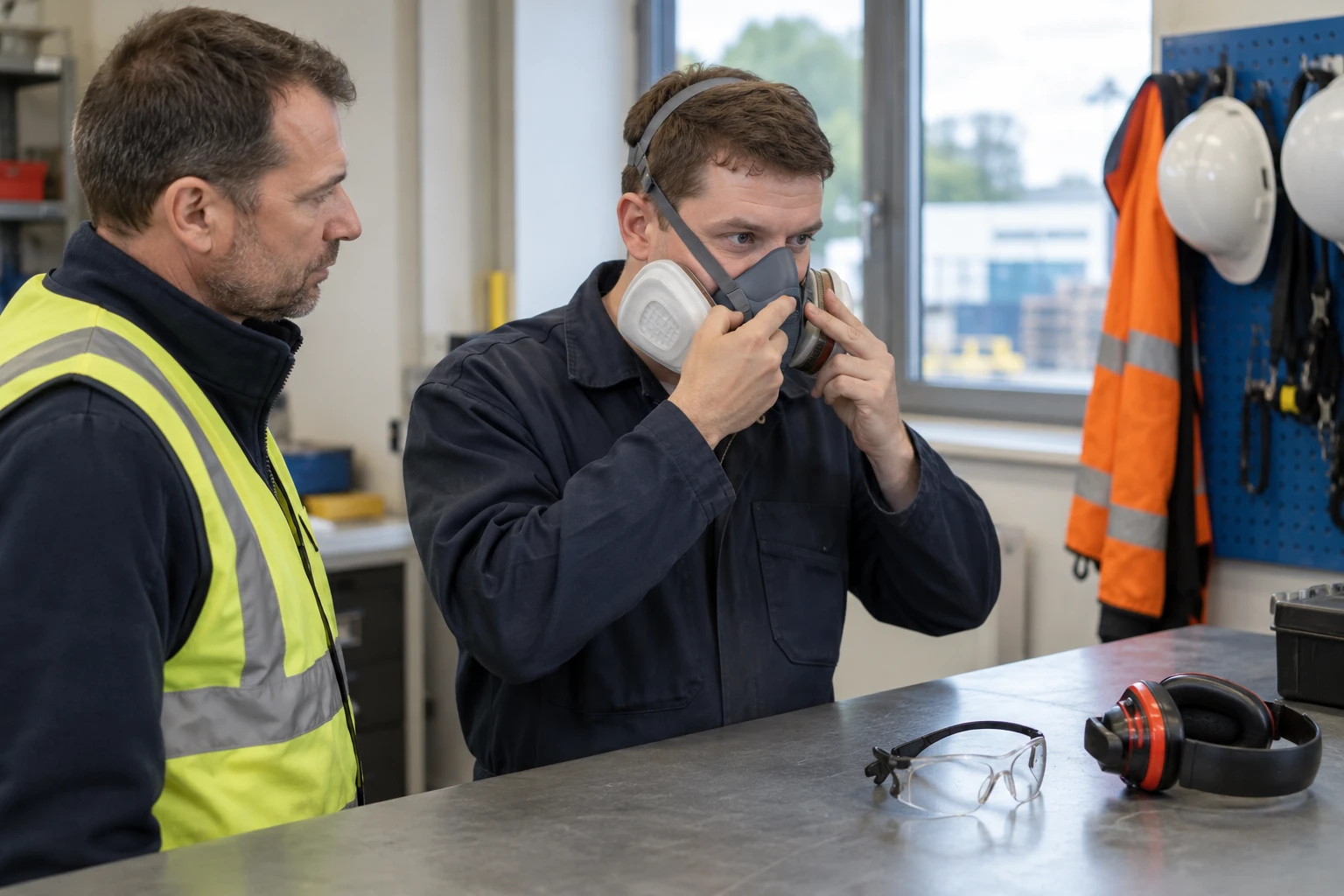
Mounting and operating equipment require task-specific instruction, supervised practice and assessment. The session should use isolated equipment or images to identify problems. It does not authorise a novice to mount a wheel or operate a grinder.
What should happen when an abrasive-wheel incident or control failure occurs?
Stop the equipment, protect people, summon the right emergency response and preserve the evidence; do not restart or discard failed components until an authorised review says it is safe.
Do not improvise the reporting decision: the employer or person in control should assess notification and recordkeeping duties for the actual outcome and jurisdiction. A near miss still needs investigation when the same failure could have caused serious harm.
Fictional case — The workshop proposes using a wheel whose maximum speed is lower than the grinder marking. The fitter says that a matching spindle hole settles the decision.
Compare the reasoning
Keep the proposed combination out of use while a competent person resolves the specification conflict. Matching the spindle hole establishes only one aspect of fit; it does not establish safe speed, wheel suitability or correct mounting. Record the conflicting markings and the evidence required before an authorised selection is made.
What does a safe cutting decision look like before, during and after use?
Build real competence
Know the limits of awareness training
Existing SHAREhub photographic illustration. The fictional case supplies the task and decision evidence.
Mounting and operating equipment require task-specific instruction, supervised practice and assessment. The session should use isolated equipment or images to identify problems. It does not authorise a novice to mount a wheel or operate a grinder.
What does a safe cutting decision look like before, during and after use?
Release the task only after the location, tool, accessory and exposure controls are proved; stop on a change and close the hand-back. Before cutting a steel bracket, the supervisor asks whether a pre-cut item can be supplied and checks the material, location, nearby people, concealed services and flammable-vapour possibility. The user presents the specified guarded tool, rated disc, secure workholding and any needed extraction; the supervisor sees the setup and records the release. A flammable atmosphere or unknown service is a separate hold point for a competent assessment of the location and method.
During the first cut, the user watches for kickback, disc damage, visible dust and changed access. Any guard defect, new vapour indication, failed capture or bystander entry stops work; the tool is isolated and quarantined where defective. After cutting, the user checks for hot material and ignition risk, cleans without resuspending dust, returns the tool, and records defects and actual trigger time for the exposure review. The supervisor signs the hand-back only when barriers and area are restored. HSE PUWER overview; HSE HAV control and tool selection; HSENI PUWER NI.HSE DSEAR guidance
Fictional workplace decision
Fictional case — The workshop proposes using a wheel whose maximum speed is lower than the grinder marking. The fitter says that a matching spindle hole settles the decision.
Compare the reasoning
Keep the proposed combination out of use while a competent person resolves the specification conflict. Matching the spindle hole establishes only one aspect of fit; it does not establish safe speed, wheel suitability or correct mounting. Record the conflicting markings and the evidence required before an authorised selection is made.
Which three pieces of evidence should you check before fitting an abrasive wheel?
Build real competence
Know the limits of awareness training
Professional teaching illustration. Read the written scenario for the facts; the image is not evidence of a real workplace.
Mounting and operating equipment require task-specific instruction, supervised practice and assessment. The session should use isolated equipment or images to identify problems. It does not authorise a novice to mount a wheel or operate a grinder.
Which three pieces of evidence should you check before fitting an abrasive wheel?
Before fitting an abrasive wheel, compare the actual wheel information, machine plate and manufacturer instructions while the equipment is safely isolated. Read the actual wheel information, machine plate and instructions while the equipment is safely isolated. This enlarged evidence guide shows which fields to compare; it is not a universal wheel label or a mounting instruction. Agreement on speed alone does not release the work. A competent person must establish the full wheel–machine–task match and follow the manufacturer’s fitting and use instructions. Guidance: HSE safety in the use of abrasive wheels · HSE using cut-off saws.
Fictional workplace decision
Fictional case — The workshop proposes using a wheel whose maximum speed is lower than the grinder marking. The fitter says that a matching spindle hole settles the decision.
Compare the reasoning
Keep the proposed combination out of use while a competent person resolves the specification conflict. Matching the spindle hole establishes only one aspect of fit; it does not establish safe speed, wheel suitability or correct mounting. Record the conflicting markings and the evidence required before an authorised selection is made.