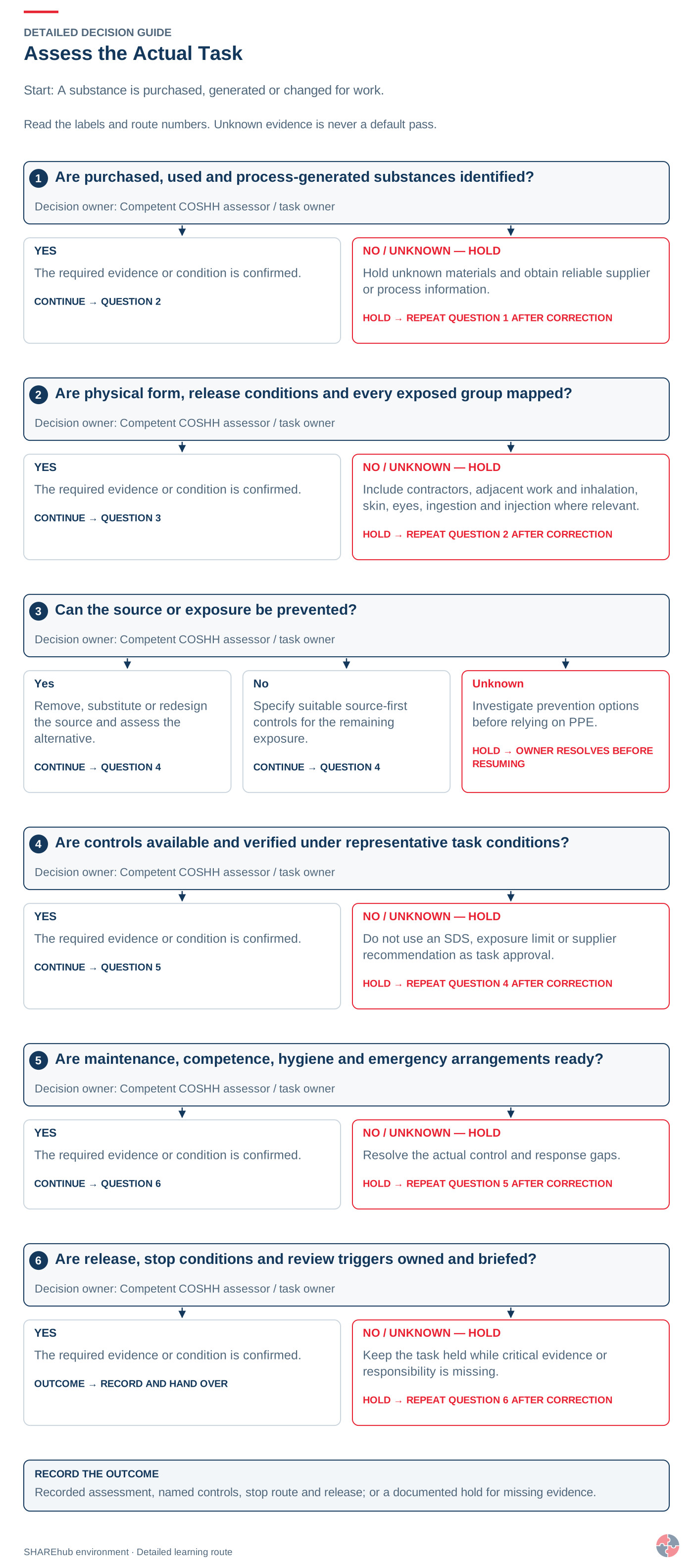
Full public teaching and readers are free without an account. A free learner account is required for saved LMS progress and recorded assessment. Completion and any course-completion certificate depend on the configured LMS conditions. Full course outline and access routes.
Lesson 1
Keep vehicle exhaust out of the occupied cabin
Trace the source, air path and worker exposure before choosing a gatehouse control.
Teaching graphic from the linked SHAREhub source section.
Keep vehicle exhaust out of the occupied cabin
An air inlet can connect an outdoor source to an indoor worker. At the fictional gatehouse, vehicles queue and idle beside the open intake. Exhaust may enter the occupied cabin even when the attendant is not standing beside an engine. A window, fan or pleasant indoor temperature is not evidence that air quality is adequate. The model does not measure contaminant concentration, and a person becoming accustomed to a smell does not establish control.
Map the source, route and people over the real working day. Vehicle type, engine condition, queue length, wind, inlet position and the attendant's hours can all influence exposure. Ask what changes during peak arrival or when the main gate is closed. The task assessment should cover generated exhaust as well as purchased chemicals. Do not use a nearby outdoor reading or a quiet-shift observation as proof of the full occupied exposure.
Compare prevention with dilution. Avoiding unnecessary idling and redesigning the queue away from occupied air intakes can reduce contamination before it reaches the cabin. Suitable ventilation needs competent design for the actual layout; moving a fan without review may draw pollution towards the worker or transfer it elsewhere. Traffic changes must preserve pedestrian separation, visibility and emergency access. Closing every window permanently is not a complete answer if it creates heat or disables the intended ventilation.
If fumes enter or a required control fails, follow the agreed stop, relocation or restriction arrangements and report the observation. Obtain appropriate assistance for symptoms rather than diagnosing their cause at the desk. Verify the revised layout in representative arrival conditions through suitable competent checks and worker feedback. For the exercise, record where engines waited, how air could enter, who was affected and what evidence is missing. A sign requesting no idling supports a usable design; it cannot substitute for one.
How should a COSHH health-risk assessment be carried out?
A COSHH assessment should identify hazardous substances, assess exposure, decide controls, record findings, implement actions and review effectiveness.
Start by creating a substance and process inventory. Include what is bought, what is generated and what appears during cleaning, maintenance, waste handling and emergencies. Then observe the task. The person doing the work often knows where dust escapes, where splashes occur and where the written procedure is unrealistic.
The assessment should be task-based. A single product may need different assessments for brushing, spraying, decanting, heating, cleaning and waste handling. Similarly, a single dust hazard may need different controls for cutting, drilling, sweeping, bag emptying and filter changing.
The output should be a usable control plan. It should state what controls are required before work, during work and after work; who checks them; what training is required; what records are kept; and what triggers review.
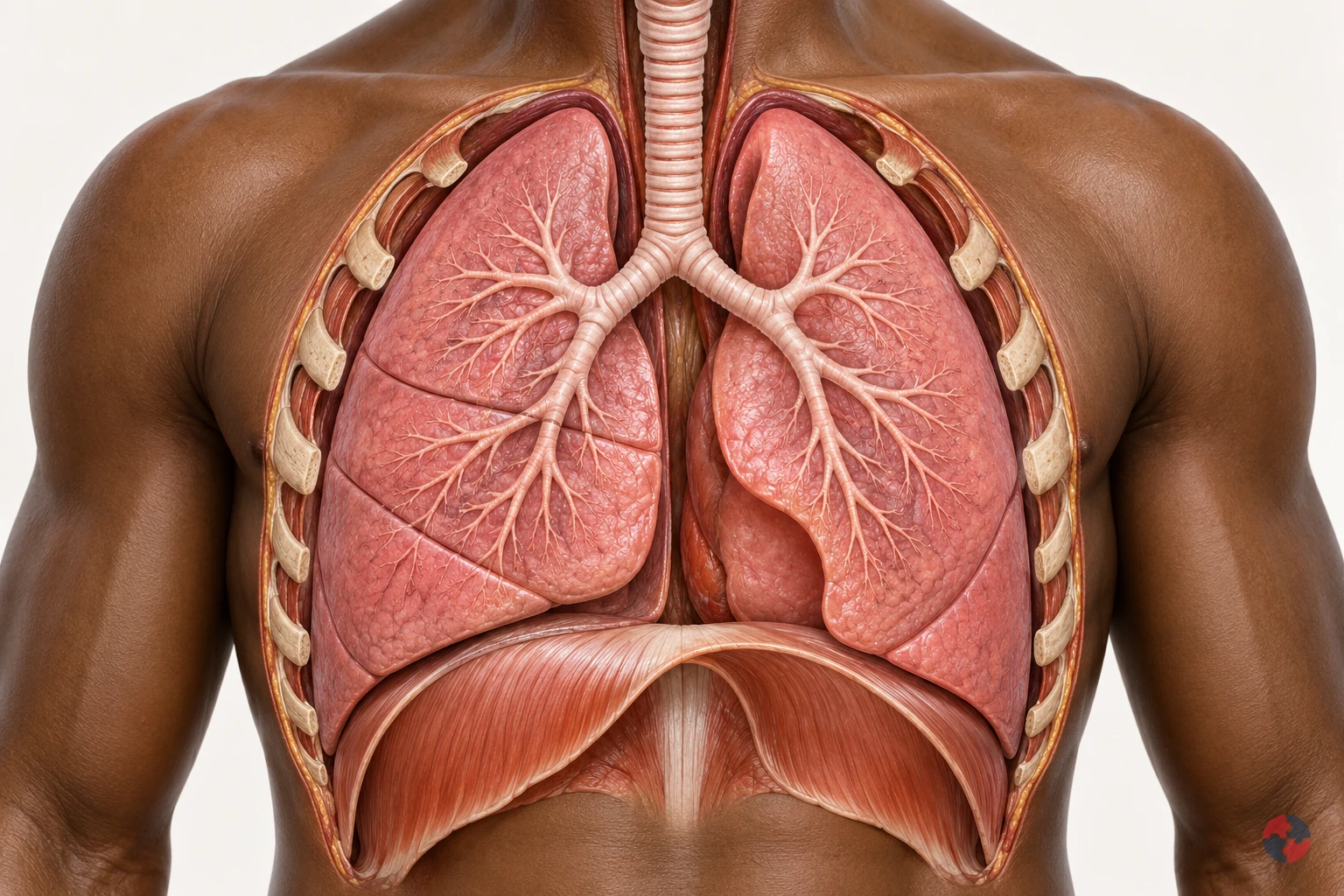
Locate the lungs, branching airways and diaphragm below them. The cutaway reveals structures normally hidden by the chest wall.
Trace the source-to-breathing-zone route in this lesson. Which change would prevent the contaminant reaching the person?
educational illustration · healthy anatomy; enlarged details and teaching colours.
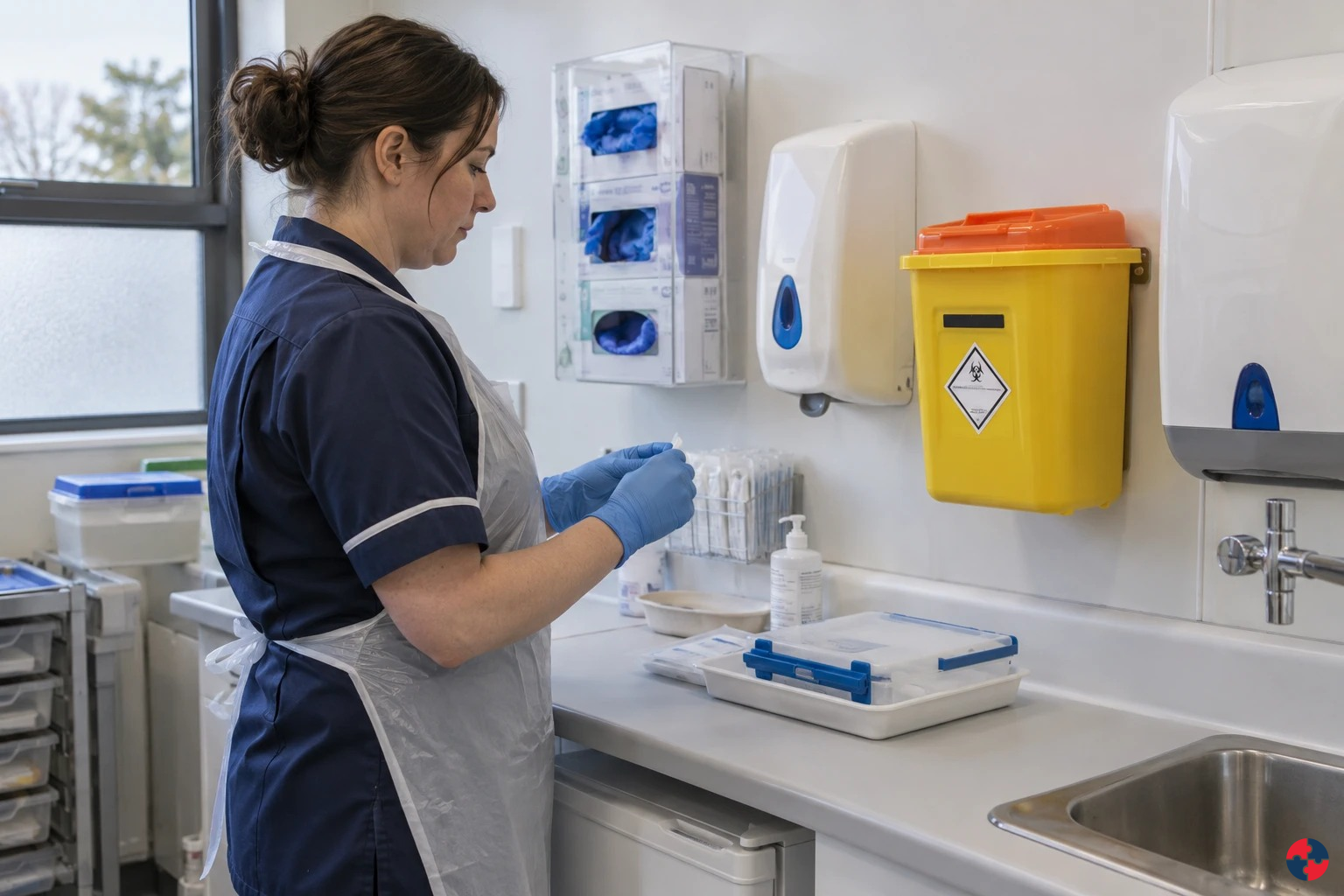
Photorealistic illustrative UK workplace scene. Review checks: Setting: A care worker is punctured by a used needle during disposal. Act: Use safer sharps and a point-of-use container before the task; train staff in a clear post-exposure route and avoid recapping. Hold / review: Do not delay clinical advice while trying to identify the source, and do not let an untrained person handle the contaminated device.
A dusty load is an acceptance and exposure question
Tipping and sorting can release dust and airborne biological material from organic contamination. A cloud can expose the tipping worker, a sorter or somebody passing through the area. Some harmful material may not be visible, while visible dust does not identify a particular microorganism. Do not diagnose infection or decide that a load is harmless from smell, colour or a model picture. Use reliable waste information and a suitable task assessment.
In the fictional tipping floor, a load differs from its description and releases dusty material. Stop or restrict the affected handling through the site procedure and protect nearby people. Obtain the authorised acceptance decision rather than blending the load into the ordinary stream. Staff must not open or disturb suspect material simply to improve its identification. A decision that the site may accept a waste and a decision that the chosen process controls exposure are related but separate.
Prevention can involve suitable acceptance checks, containment, reducing unnecessary disturbance and separation of people from releases. Appropriate capture, ventilation or enclosed equipment must suit the material and process. Wet suppression can help some tasks but may introduce run-off, chemical or slip problems; it is not a universal method. Respiratory protection, where needed, must be selected and managed through the assessed arrangement. A generic mask cannot justify proceeding with an unidentified load or a failed source control.
Verification needs representative work and the right evidence: confirmed acceptance information, effective containment or capture, safe cleaning and an understandable failure response. Competent exposure assessment may be needed; a photograph of a clear room after tipping is not a measurement of the earlier release. Workers should report symptoms promptly and receive appropriate qualified advice. Record facts, controls and uncertainty without attaching a medical label or invented concentration. The exercise closes only when the relevant owner can explain why the actual handling method is suitable.
How can biological agents enter or affect the body?
Biological agents can enter through breathing, swallowing, broken skin, mucous membranes, sharps injuries, bites or contaminated water droplets.
Routes of entry are practical because they determine controls. If the route is inhalation, ventilation, containment, aerosol control and respiratory protection may matter. If the route is injection, sharps prevention and post-exposure response become critical.
Some tasks involve several routes at once. Cleaning a contaminated shower can involve aerosol inhalation, splash to eyes and hand contamination. Handling waste can involve cuts, puncture wounds, skin contamination and hand-to-mouth transfer.
Controls should be selected route by route rather than relying on a single generic hygiene message.
Inhalation. Aerosols, droplets, dusts, spores or fumes are breathed in. Ventilation, enclosure, aerosol reduction and RPE where needed.
Ingestion. Contaminated hands, food, drink or smoking transfer agents. Handwashing, welfare and no eating in contaminated areas.
Injection. Needlestick, sharps injury, bite or puncture. Safer sharps, containers, bite controls and response.
Skin contact. Broken skin contacts contaminated material. Gloves, skin care, covering cuts and washing.
Mucous membranes. Splash to eyes, nose or mouth. Eye/face protection and splash control.
Water aerosol. Contaminated droplets from showers, spa pools or cooling systems. Water-system control and aerosol management.
Applied case
A load releases a dusty cloud and does not match the gatehouse description; a worker offers to tip it into other waste to dilute it.
Decision and explanation
Keep the affected load controlled while authorised acceptance and suitable exposure controls are established.
Unknown acceptance and exposure cannot be resolved by mixing or sensory judgement. Obtain reliable identity and effective task controls.
Lesson 3
Do not turn a concealed sharp into a hand search
Prevent puncture and arrange prompt appropriate support after an exposure.
Photorealistic illustrative UK workplace scene. Review checks: Setting: A care worker is punctured by a used needle during disposal. Act: Use safer sharps and a point-of-use container before the task; train staff in a clear post-exposure route and avoid recapping. Hold / review: Do not delay clinical advice while trying to identify the source, and do not let an untrained person handle the contaminated device.
Do not turn a concealed sharp into a hand search
A sharp can injure through the packaging that appears to contain it. Squeezing a bag, reaching blindly into a container or pressing waste down by hand can bring a hidden point into skin. A used needle may also create a blood-borne-virus exposure if contaminated, but a worker cannot determine the infection status from appearance. Not every puncture transmits infection; that uncertainty is a reason for appropriate assessment, not for delaying a report.
At the fictional public bay, a point protrudes from a bag an attendant is about to compress. Stop the hand contact and follow the site's sharps procedure, keeping others clear and obtaining authorised handling. Do not rummage for the needle, recap it or carry it by hand to the office. Suitable tools, containers and trained arrangements must already be available where the task requires them. Gloves may reduce some injury risks but do not make blind hand searching safe.
If an injury or suspected exposure occurs, stop and follow the immediate exposure and first-aid procedure, reporting promptly and obtaining urgent appropriate clinical assessment. Do not wait for the end of the shift or privately decide that a small injury is low risk. This lesson does not provide post-exposure treatment advice or vaccination recommendations. Avoid another person's exposure while seeking information; nobody should handle a suspect needle to photograph its tip or collect it without the required arrangement.
Supervisors need usable reporting, access to help and a method for recording facts without broadcasting confidential health details. Review the waste route, public instructions, handling method and availability of equipment so the same opportunity is not repeated. Verify the corrected arrangement by safe observation and controlled checks, never by planting an unprotected sharp in waste. The exercise report should state the observed point, task, protective action and support requested. It should not claim that a named infection has been acquired or that any universal glove guarantees protection.
How should sharps and blood-borne virus risks be controlled?
Sharps and blood-borne virus risks should be controlled by avoiding sharps where possible, using safer devices, safe disposal and rapid exposure response.
Sharps injuries can transmit blood-borne viruses such as hepatitis B, hepatitis C and HIV where the source is infected. The risk depends on the device, injury depth, blood volume, source status and speed of response.
The strongest control is to avoid unnecessary sharps. Where sharps are needed, safer sharps, immediate disposal into suitable containers, no recapping, good lighting, stable work position and training are essential.
After a sharps injury, the response should be immediate: first aid, reporting, occupational health or clinical assessment, source-risk assessment where appropriate, and investigation of how the injury occurred.
Avoidance. Use needle-free or safer systems where possible. Procurement and risk assessment.
Use. Do not recap; handle one sharp at a time with clear workspace. Procedure, training and observation.
Disposal. Use suitable sharps containers at point of use. Container checks and waste records.
Vaccination. Offer hepatitis B vaccination where risk assessment supports it. Confidential vaccination programme records.
Exposure response. First aid, reporting and clinical/occupational health assessment. Sharps injury log and referral route.
Learning. Investigate causes and improve work design. Action close-out and trend review.
Applied case
An attendant finds a sharp point in a bag and proposes squeezing the other side to locate it before disposal.
Decision and explanation
Stop hand searching, protect the area and arrange the authorised sharps process; obtain prompt clinical assessment after any injury.
Avoid further contact and use the planned trained route. Gloves do not make blind searching or recapping a safe solution.
Lesson 4
Keep contamination out of the meal area
Make the clean/dirty boundary and welfare access work in real conditions.
Teaching graphic from the linked SHAREhub source section.
Keep contamination out of the meal area
Contamination can move from waste to gloves, clothing, door handles and food without a visible spill. Eating, drinking or smoking with contaminated hands can create an ingestion route. A clean meal table loses its purpose if dirty gloves and workwear are placed on it. The fictional welfare building is therefore part of exposure control, not an unrelated comfort extra. Personal hygiene depends on suitable facilities and a practical work sequence as well as information.
Follow the worker from the sorting floor to a break. Provide the assessed changing, storage and handwashing arrangement so dirty items do not cross into food areas. Gloves do not replace cleaning hands through the required method. Wipes or hand rubs cannot be assumed to remove every contaminant encountered in waste work; the facilities and method must suit the exposure. Staff should not take contaminated clothing home outside the site's authorised laundering or handling arrangement.
The entrance route also matters. Rainwater and tracked residues coat the fictional ramp, while a cone leaves only a narrow slippery path. Restrict the affected route and provide a suitable alternative while contamination and its source are corrected. Check drainage, cleaning, floor condition and suitable matting as part of the solution. A warning does not remove the contaminant, and a rug that curls or obstructs the door creates another hazard. The alternative route must still preserve clean/dirty separation and emergency access.
Verification should cover busy breaks, bad weather and the return to work: functioning washing supplies, adequate space, usable storage, effective cleaning and a safe entrance. Ask staff where the arrangement encourages shortcuts and correct the cause. For the exercise, map one contamination route and one fall route, then explain the physical and organisational measures that interrupt each. Do not close the action because a new poster exists. Observe whether people can use the facilities as intended without crossing the same dirty surface or carrying contaminated workwear into the eating space.
How can the ISO 45001 hierarchy of controls remove slip and trip hazards from workplace routes?
Control classification: Classify the mechanism separately from its upkeep: physical floor repair, drainage, barriers, protected routes, compartmentation, fire doors and suitable disposal facilities are physical measures where specified. Cleaning schedules, inspections, policies, funding, supervision and verification are administrative arrangements maintaining them. A verbal instruction is not a physical barrier. Read this correction with the source table. Retained overview and stage artwork requires the matching classification update.
Remove or reduce the hazard before relying on procedures or personal protection.
For slips and trips, assess the actual task and first look for a way to remove the hazard. Where that is not possible, consider a safer substitute, engineered separation and then clear work procedures. PPE protects against remaining exposure; it does not make an uncontrolled task safe. HSE hierarchy of controls
The selected measures need a named owner, a usable stop point and a check that they still work when the task or conditions change. In Northern Ireland, verify the separate legal route and site instructions.
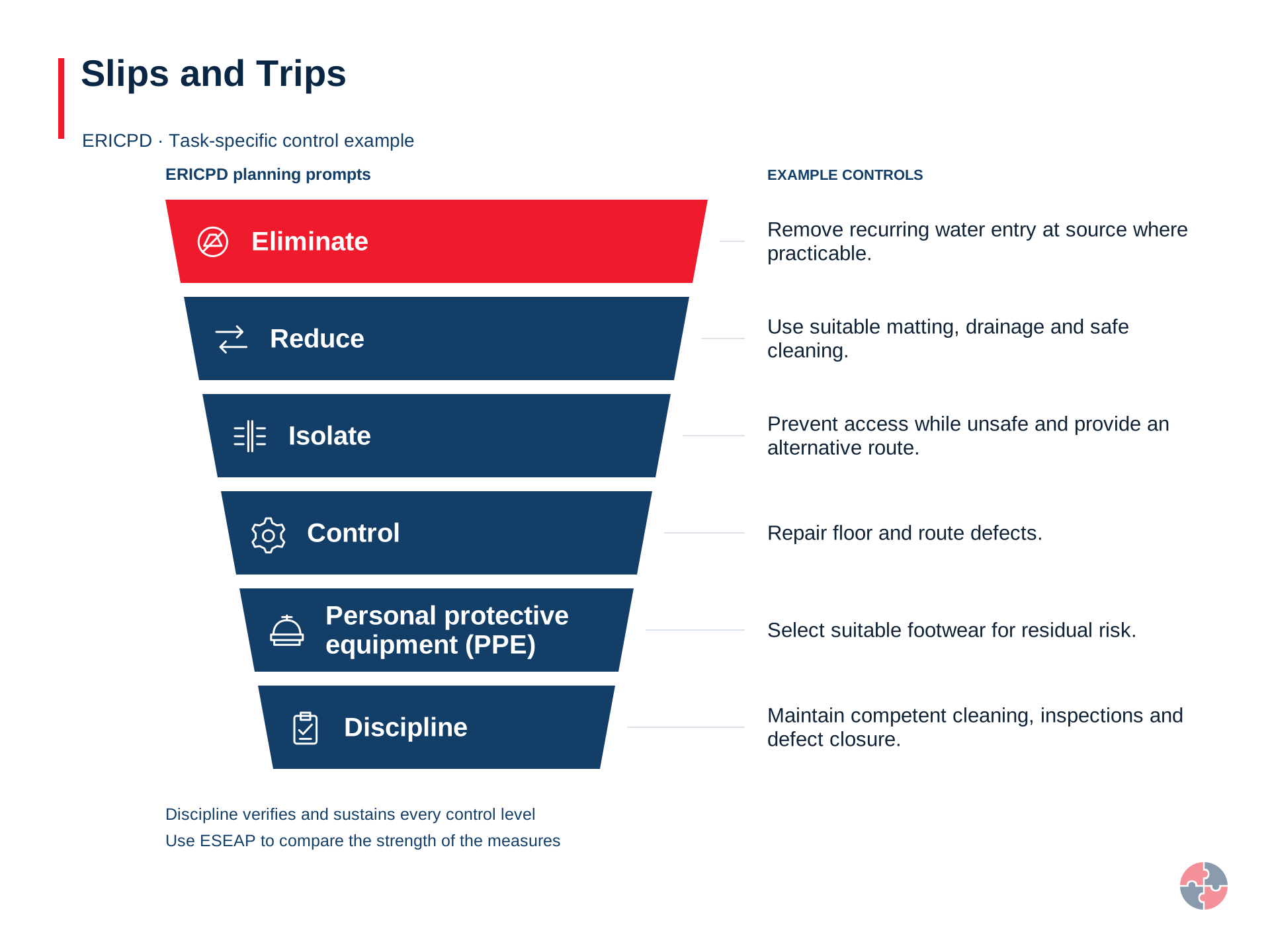
For the wet entrance, eliminate recurring water entry at source where practicable. Reduce contamination with suitable matting, drainage and a cleaning method that leaves the route safe; physically prevent access while unsafe and provide an alternative. Repair floor and route defects, then select footwear for residual risk and sustain checks. ERICPD (Eliminate, Reduce, Isolate, Control, PPE, Discipline) is a teaching prompt; Discipline means competent cleaning, supervision and defect closure. HSE slip and trip factors; HSE barriers and cleaning.
How can the ERICPD hierarchy of controls remove slip and trip hazards from workplace routes?
ERICPD is a planning crossmap. Its prompts do not add a sixth rung or rank Isolate above engineering. Discipline verifies and sustains every control level.
Worked activity: Wet leisure-centre entrance
Activity and exposure
Wet entrance at a public leisure centre during heavy rain.
Before work
Wet leaves and rainwater carried through an entrance onto a smooth floor; no mat change or drainage response.
During the activity
Close or physically separate the wet route, give a safe alternative, remove contamination and inspect matting and drainage.
Hold or stop
Do not reopen while the floor remains wet or the alternate route creates another hazard.
Hand-back and release
Repair the recurrent water source, choose suitable matting/flooring, brief cleaners and reopen after a dry-floor check.
Evidence to retain
Record weather trigger, barrier time, floor condition, repair owner, worker feedback and repeat incidents.
How can the ISO 45001 hierarchy of controls remove slip and trip hazards from workplace routes?
The hierarchy of controls in ISO 45001:2018 comes under Clause 8.1.2 (Eliminating hazards and reducing OH&S risks), which is located within Clause 8 ("Operation").
ESEAP mapping crosswalk: these are retained ERICPD source rows, mapped to the five ESEAP levels. Read the control-classification correction for mixed physical and administrative measures; six source rows do not mean six ESEAP levels.
Five-level control stage(s)
Topic-specific example
Source and full task context
Elimination
Remove recurring water entry at source where practicable.
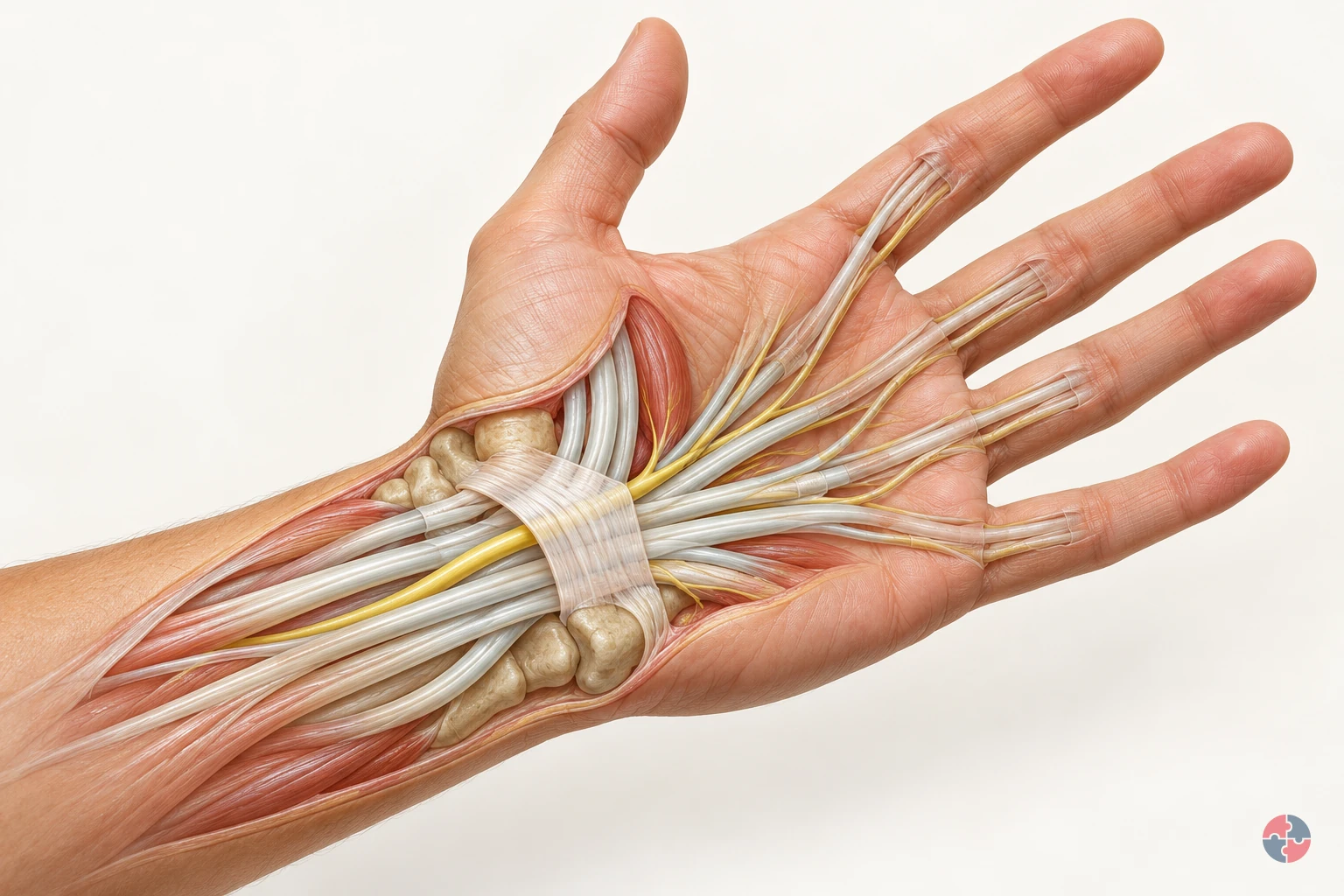
The palm-side cutaway reveals tendons, a nerve and the band across the wrist. The enlarged detail helps distinguish the structures discussed in this lesson.
Locate the tendons and nerve at the wrist. Which force, repetition, reach or recovery demand should the task assessment examine?
educational illustration · healthy anatomy; enlarged details and teaching colours.
Teaching graphic from the linked SHAREhub source section.
Bring sorting within reach instead of teaching the stretch
Repeated stretching across a sorting belt can load shoulders, arms and back even when each item seems light. Belt pace, reach distance, grip, posture, material shape and recovery affect the exposure. A workstation that fits one person may force another into a prolonged awkward posture. The real assessment needs both routine conditions and difficult batches. A low weight or a training signature cannot clear the whole repetitive task.
Observe the task with workers, including replenishment, rejects, cleaning and stoppages. Ask whether the layout permits safe working with the range of people and items. Suitable redesign can bring the useful pick area closer, improve height and orientation, support material or reduce force and unnecessary repetition. Any change near the belt needs competent review of guarding, emergency controls and access. Moving a platform or guard informally to improve reach may create trapping or fall risks.
Compare rotation between different exposures with rotation between identical stretches. A timetable only reduces the relevant load if the new work genuinely changes it and permits recovery. Changing pace or break arrangements may support the redesigned task, but should not be used to excuse avoidable force or a permanently unreachable pick area. Workers should not follow material into a dangerous machine zone to maintain output; deal with a missed or suspect item through the specified safe process.
Early discomfort, tingling or difficulty deserves reporting and appropriate support without waiting for a formal diagnosis. Protect the worker and review the task; do not prove a problem by asking them to repeat the harmful movement. Verification should use representative safe operation, worker feedback and follow-up of the actual physical demands. Record what changed, how it reduced reach or force, and which remaining issue has an owner. The learning exercise produces a redesign proposal and hold condition, not permission to modify a conveyor or bypass a guard.
How can the ISO 45001 hierarchy of controls avoid hazardous manual handling and reduce remaining strain?
Avoid hazardous manual handling where reasonably practicable, assess what remains and reduce the injury risk. Training and gloves support the chosen method; they cannot make an unsuitable repetitive lift safe.
Illustrative decision: warehouse workers repeatedly lift stock from floor-level pallets to dispatch benches. The manager and workers examine the whole supply-to-dispatch task, including reaching, twisting, pushing, load stability and differing individual capability.
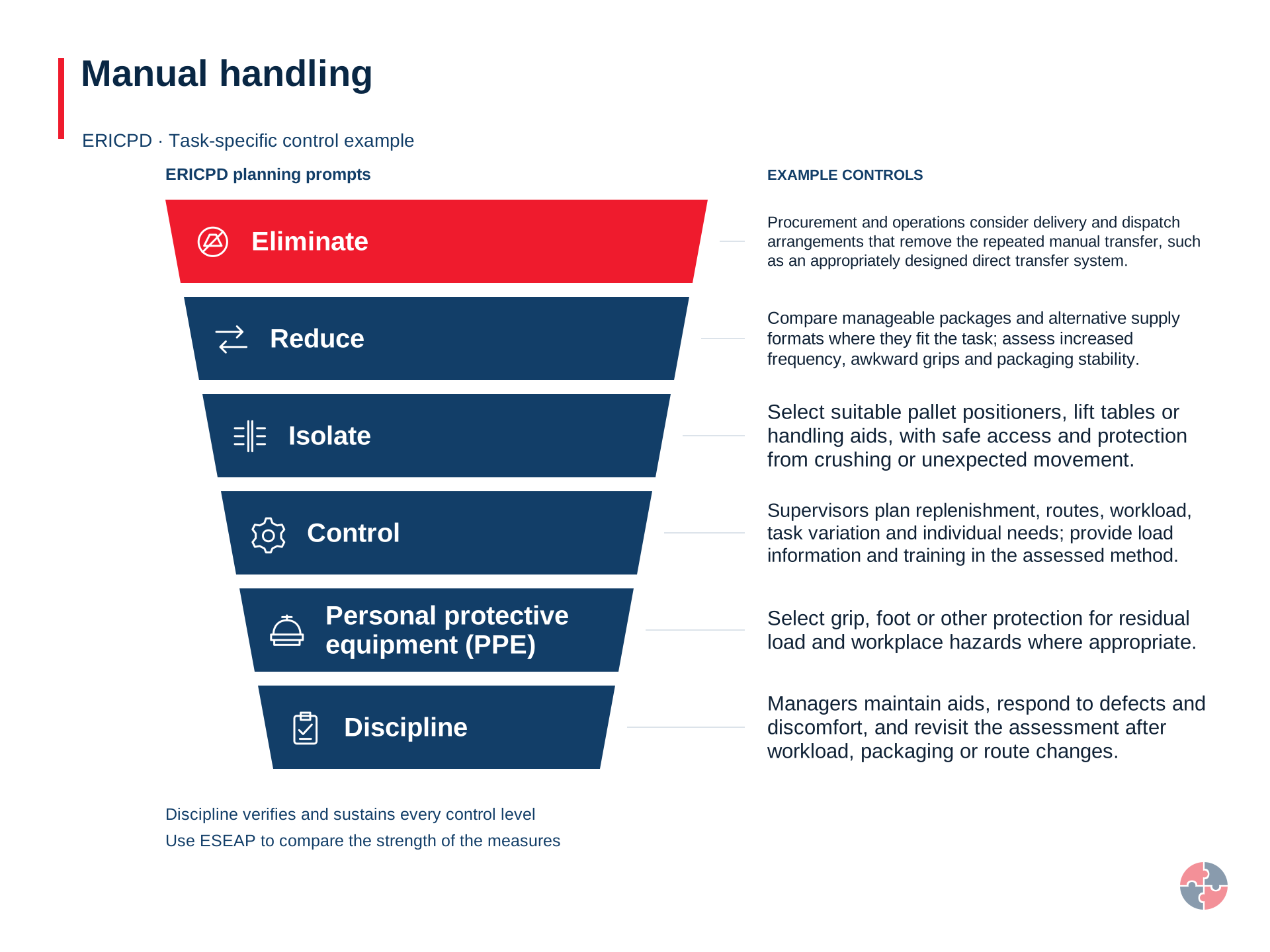
ERICPD means Eliminate, Reduce (including substitution), Isolate, Control, PPE and Discipline. The five-level hierarchy groups measures as elimination, substitution, engineering controls, administrative controls and PPE. They overlap: isolation is usually an engineering measure; control can include engineered and administrative measures. Discipline means maintaining and checking the controls, supervising the method and learning from defects, rather than blaming someone or accepting weaker protection.
How can the ERICPD hierarchy of controls avoid hazardous manual handling and reduce remaining strain?
ERICPD is a planning crossmap. Its prompts do not add a sixth rung or rank Isolate above engineering. Discipline verifies and sustains every control level.
Worked activity: Task application for Manual handling
Activity and release context
ERICPD means Eliminate, Reduce (including substitution), Isolate, Control, PPE and Discipline. The five-level hierarchy groups measures as elimination, substitution, engineering controls, administrative controls and PPE. They overlap: isolation is usually an engineering measure; control can include engineered and administrative measures. Discipline means maintaining and checking the controls, supervising the method and learning from defects, rather than blaming someone or accepting weaker protection.
Procurement and operations consider delivery and dispatch arrangements that remove the repeated manual transfer, such as an appropriately designed direct transfer system.
Observe the complete flow, including replenishment and breakdown recovery. A machine that shifts the lifting burden to another worker has not eliminated the hazardous operation.
Reduce / substitution when replacing a hazard; otherwise engineering or administrative risk reduction
Compare manageable packages and alternative supply formats where they fit the task; assess increased frequency, awkward grips and packaging stability.
Record the total task exposure and worker feedback. No package weight is a universal safe limit; more smaller lifts can still create substantial risk.
Isolate / engineering
Select suitable pallet positioners, lift tables or handling aids, with safe access and protection from crushing or unexpected movement. Design reach and destination heights around the actual task.
Check load capacity, stability, condition, use and the real movement forces. An unsuitable aid or unresolved crush point prevents release of that method.
Control / administrative
Supervisors plan replenishment, routes, workload, task variation and individual needs; provide load information and training in the assessed method.
Watch work at realistic pace and include unusual loads and damaged pallets. A team lift or rotation is not an automatic solution; difficult handling returns to assessment.
PPE / PPE
Select grip, foot or other protection for residual load and workplace hazards where appropriate. Check it does not worsen handling.
Verify fit and condition. Gloves or supportive clothing do not remove musculoskeletal loading or establish a safe lift.
Discipline / sustained engineering and administrative controls
Managers maintain aids, respond to defects and discomfort, and revisit the assessment after workload, packaging or route changes.
Retain task observations and corrective actions. A failed aid or new unstable load requires a safe alternative or pause rather than routine manual workaround.
How can the ISO 45001 hierarchy of controls avoid hazardous manual handling and reduce remaining strain?
The hierarchy of controls in ISO 45001:2018 comes under Clause 8.1.2 (Eliminating hazards and reducing OH&S risks), which is located within Clause 8 ("Operation").
Worked activity: Task application for Manual handling
Activity and release context
ERICPD means Eliminate, Reduce (including substitution), Isolate, Control, PPE and Discipline. The five-level hierarchy groups measures as elimination, substitution, engineering controls, administrative controls and PPE. They overlap: isolation is usually an engineering measure; control can include engineered and administrative measures. Discipline means maintaining and checking the controls, supervising the method and learning from defects, rather than blaming someone or accepting weaker protection.
Procurement and operations consider delivery and dispatch arrangements that remove the repeated manual transfer, such as an appropriately designed direct transfer system.
Observe the complete flow, including replenishment and breakdown recovery. A machine that shifts the lifting burden to another worker has not eliminated the hazardous operation.
Reduce / substitution when replacing a hazard; otherwise engineering or administrative risk reduction
Compare manageable packages and alternative supply formats where they fit the task; assess increased frequency, awkward grips and packaging stability.
Record the total task exposure and worker feedback. No package weight is a universal safe limit; more smaller lifts can still create substantial risk.
Isolate / engineering
Select suitable pallet positioners, lift tables or handling aids, with safe access and protection from crushing or unexpected movement. Design reach and destination heights around the actual task.
Check load capacity, stability, condition, use and the real movement forces. An unsuitable aid or unresolved crush point prevents release of that method.
Control / administrative
Supervisors plan replenishment, routes, workload, task variation and individual needs; provide load information and training in the assessed method.
Watch work at realistic pace and include unusual loads and damaged pallets. A team lift or rotation is not an automatic solution; difficult handling returns to assessment.
PPE / PPE
Select grip, foot or other protection for residual load and workplace hazards where appropriate. Check it does not worsen handling.
Verify fit and condition. Gloves or supportive clothing do not remove musculoskeletal loading or establish a safe lift.
Discipline / sustained engineering and administrative controls
Managers maintain aids, respond to defects and discomfort, and revisit the assessment after workload, packaging or route changes.
Retain task observations and corrective actions. A failed aid or new unstable load requires a safe alternative or pause rather than routine manual workaround.
The comparison is an original illustrative application of the general HSE hierarchy, not a machine-specific method, permit or design approval. The employer must choose measures for the actual work and jurisdiction. Apply the separate Northern Ireland legal route where relevant; the local assessment and competent technical decision govern release.
The same overreach continues after workers rotate between two identical sorting stations, and one person reports tingling.
Decision and explanation
Task fit, reach, force, pace and genuine exposure variation, with appropriate symptom support and machine-safety review.
Effective redesign reduces exposure without defeating machine protection; a rotation label alone may leave the same physical demand.
Use the appropriate manual handling assessment
This additional teaching takes about 2–5 minutes, in addition to the course estimate. Optional reading and workplace assessment take additional time.
Start by asking whether the hazardous handling can be removed or redesigned. Where handling remains, observe the whole operation with the people who do it and choose an assessment that fits the work.
These aids support the activity assessment. Repetitive upper-limb work may need ART; variable or complex tasks may need other HSE tools or a fuller competent assessment. Mechanical lifting, stored energy, equipment safety and health decisions retain their separate controls. A low factor score, a downloaded report or completion of this course does not approve the work.
TILEO: Task, Individual, Load, Environment and Other factors. MAC: Manual Handling Assessment Charts for appropriate lifting, carrying and team handling. RAPP: Risk Assessment of Pushing and Pulling for appropriate manual pushing and pulling.
Read the portable guide to understand selection, limitations, the mixed-task example and company-branded Word/PDF records. Your existing course checks and completion requirements remain separate.
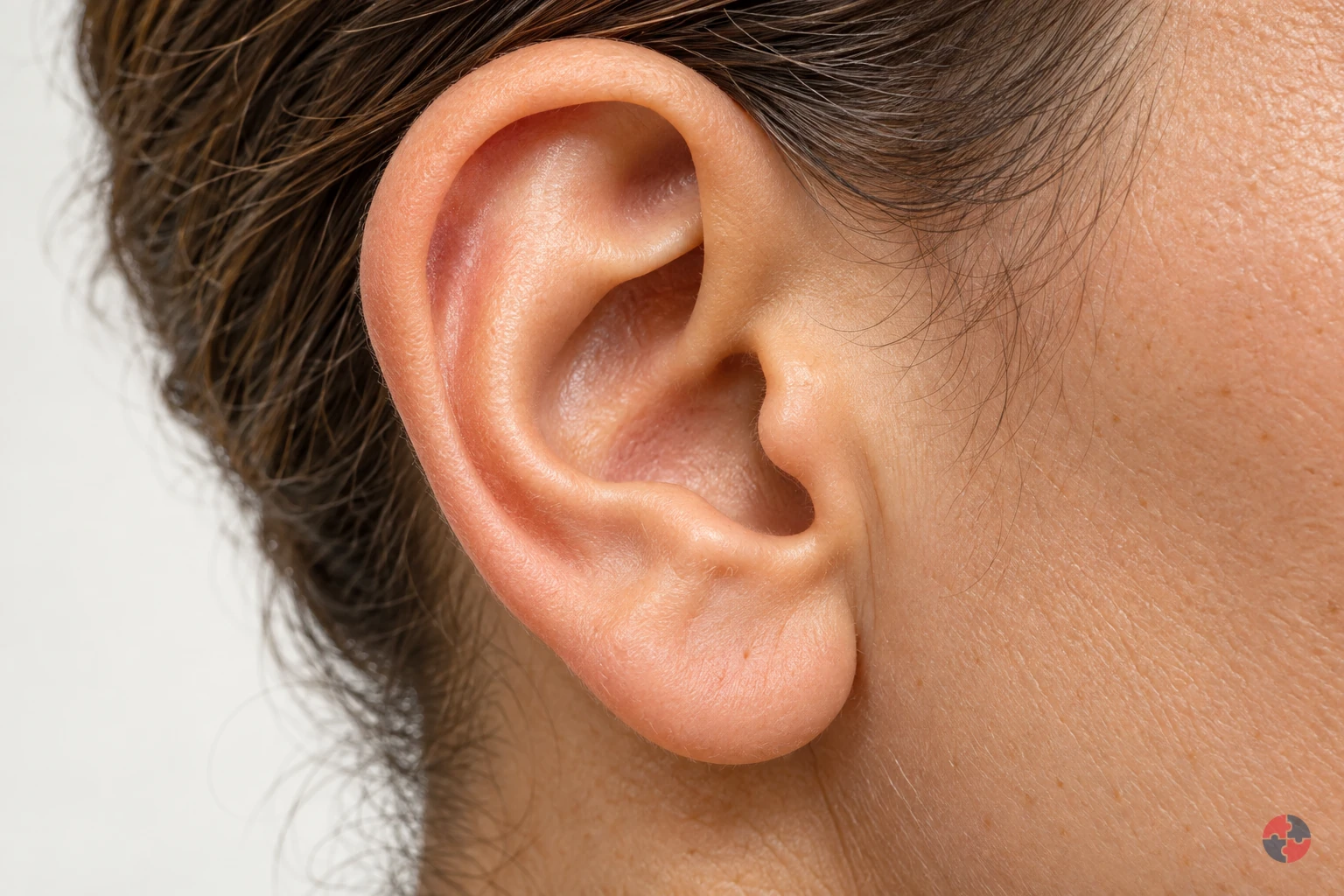
Locate the visible outer ear before considering the hearing pathway and the lesson’s noise-control decisions.
Locate the outer ear, then connect the lesson to the hearing pathway. What would reduce noise exposure at source?
educational illustration · healthy anatomy; enlarged details and teaching colours.View full detail ↗Skin and cooling
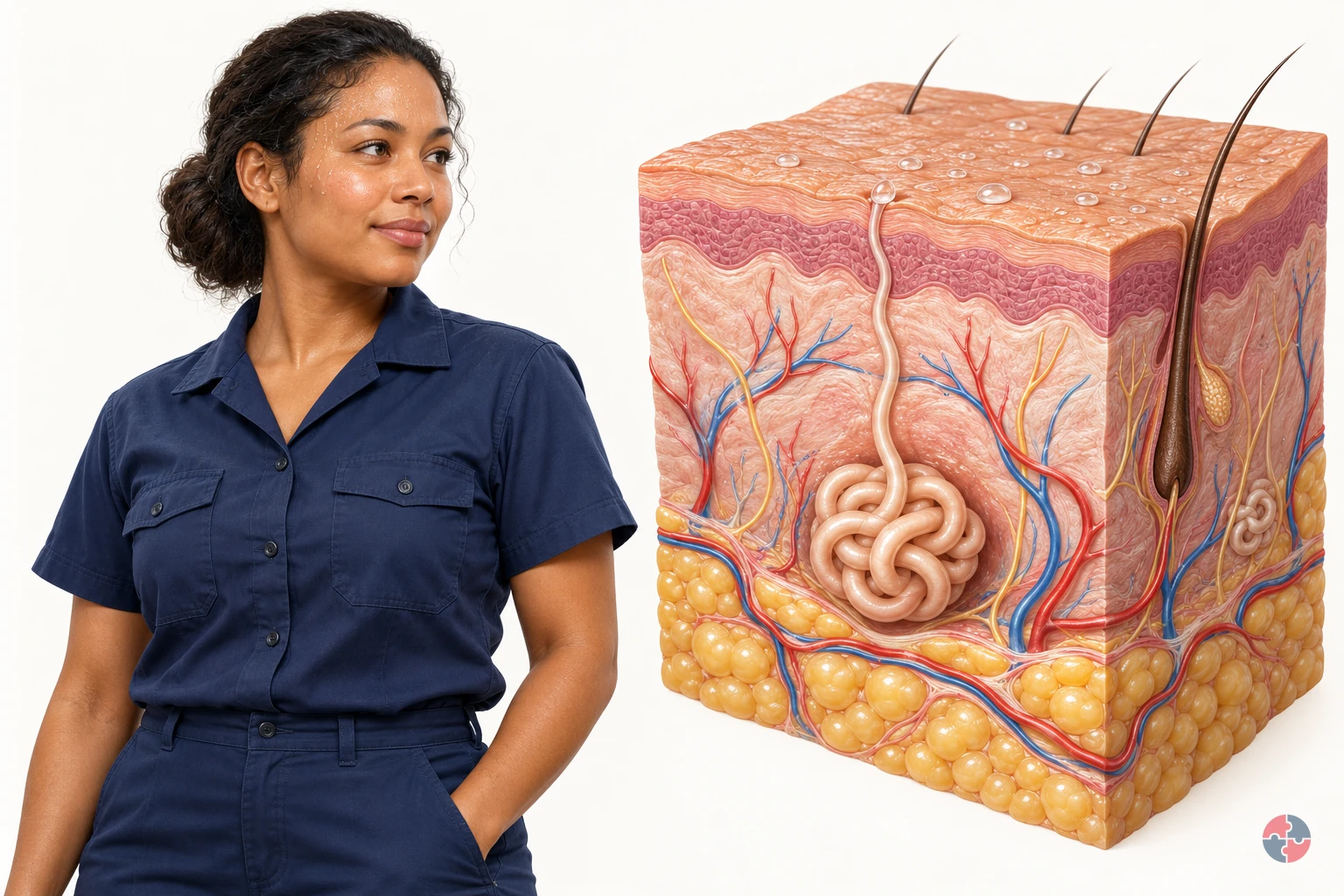
A worker and a separate enlarged skin section introduce sweating and the skin’s blood supply. Connect these structures to the work and environment described in the lesson.
Locate the sweat gland and skin vessels in the enlarged view. How should conditions, workload, clothing and recovery be managed together?
educational illustration · healthy anatomy; enlarged details and teaching colours.
Photorealistic illustrative UK workplace scene. Review checks: Situation: A fictional press shop measures the installed line at load, calculates day and peak exposure, then verifies an enclosure and hearing programme. Decision: Before: old measurements cover one press but the new schedule doubles stroke frequency. Follow through: During: the assessor samples press cycles and positions; the engineer tests enclosure seals, and the supervisor logs time near the machine.
Control noise and cabin heat without losing other protections
The sorting cabin may protect people from weather while holding heat and noise around them. Glass impact, machinery and ventilation can affect hearing and communication; workload, radiant heat, humidity and clothing can affect heat strain. A person feeling dizzy in a noisy cabin needs prompt protection and appropriate support, not a demand to finish the belt. The model provides no measured noise dose or body temperature, and workers should not diagnose the illness themselves.
Noise control begins with considering removal, quieter methods, maintenance, reduced impact, enclosure or separation where suitable. A representative assessment covers actual tasks, durations and changing operating conditions, including relevant peaks. A single quiet reading or a person's tolerance is not adequate evidence. Hearing protection supports the assessed residual controls and must remain compatible with warning recognition and communication. Do not remove it casually whenever somebody wants to speak across the cabin.
Heat control may require changing the source, ventilation, work rate, exposure pattern and usable recovery. A fan that draws dusty tipping air into the cabin could exchange one problem for another, so competent design must coordinate air quality and temperature. Water and breaks must be accessible in real work with suitable relief cover. Workers should not discard essential protective equipment or open a protective enclosure independently. If symptoms or a required control fails, use the agreed safe stop and assistance route.
For the fictional exercise, compare a plan that simply buys ear defenders and water bottles with one that investigates impact noise, cabin ventilation, workload and communication. The second can produce relevant evidence but still needs verification under representative conditions. Check whether people can hear the specified warnings, use recovery and perform the task with the required protection. Appropriate health advice governs individual needs, while management remains responsible for preventing exposure. A health check or training badge does not replace correcting an impaired source control.
How is a defensible exposure estimate built?
Map tasks and variation, use reliable representative data, calculate full-shift exposure and document uncertainty and review triggers.
Sample normal and foreseeable worst operating modes, not only the quietest shift. Record meter type, calibration, location, duration and workers. Supplier sound-power or emission information cannot be copied straight into personal exposure; verify installed use. Weekly exposure can help where days vary, but assess a peak separately. If the estimate straddles an action value, improve the data and use protective controls while resolving uncertainty. Sources: HSE noise risk assessment, HSE L108 noise guidance (third edition, 2021).
So far as practicable, assess interactions between noise and ototoxic substances used at work, and between noise and vibration, as required by regulation 5(3)(c) in both jurisdictions. Record relevant chemical/process co-exposures and vibration, link the COSHH/vibration assessments and seek competent technical or occupational-health advice where needed. Do not infer causation from a worker’s medication list or place personal medical details in a noise survey.
Weekly averaging requires marked variation, a reasoned recorded justification and worker consultation; it must not increase risk or conceal a peak. See the companion calculator’s weekly-suitability explanation and L108 paragraphs 28–29 rather than assuming every variable day qualifies.
Applied case
Glass noise masks speech and a sorter reports dizziness; opening a door would draw tipping dust into the cabin.
Decision and explanation
Protect the affected worker and obtain a coordinated review of noise, ventilation, exposure and usable recovery.
Controls must work together. Do not solve one exposure by introducing another or delay support for symptoms.
Lesson 7
Exhaust entering the gatehouse
Odour masking changes perception, while source reduction and appropriate clean-air provision address exposure.
Teaching graphic from the linked SHAREhub source section.
Understand the activity and how harm develops
The gatehouse is an occupied workplace beside an idling queue. Exhaust can travel through its window or ventilation intake. Diesel exhaust contains a mixture of gases and particles; a room may look clear while exposure remains a concern. Headache or irritation warrants investigation, but absence of symptoms is not proof of adequate control.
Follow the airflow and the queue rather than blaming the attendant for opening a window. A change in wind, cold-weather idling or an extra generator can alter exposure. Reduce emissions at source and locate vehicles away from occupied air intakes. Ventilation design should provide suitable clean air; closing a window alone may leave inadequate ventilation or excessive heat.
Recognise the evidence boundary
Question
Case evidence
What is observed?
An idling queue sits beside the open gatehouse air inlet.
How can harm occur?
Exhaust could enter the cabin and harm workers breathing it.
What information is needed?
Check queuing duration, air-intake position and the exposure assessment.
Protect, manage and verify
Purpose
Practical application
Immediate protection
Reduce idling and reposition queues or ventilation in the assessed arrangement.
Accountable work arrangement
Avoid unnecessary idling and move queuing and engine-running work away from occupied air intakes. Assess ventilation and separation with competent input; maintain engines and any designed extraction. Include winter queuing and abnormal delays in the exposure assessment and response arrangements.
Release verification
Verify the revised layout prevents exhaust entering occupied space.
Apply this at work
At the next inspection, look for the same failure pathway beyond gatehouse air. Check air-intake positions, queue records and representative exposure evidence after the layout changes. Recheck after changes in waste, staffing, weather, equipment or layout.
How should a COSHH health-risk assessment be carried out?
A COSHH assessment should identify hazardous substances, assess exposure, decide controls, record findings, implement actions and review effectiveness.
Start by creating a substance and process inventory. Include what is bought, what is generated and what appears during cleaning, maintenance, waste handling and emergencies. Then observe the task. The person doing the work often knows where dust escapes, where splashes occur and where the written procedure is unrealistic.
The assessment should be task-based. A single product may need different assessments for brushing, spraying, decanting, heating, cleaning and waste handling. Similarly, a single dust hazard may need different controls for cutting, drilling, sweeping, bag emptying and filter changing.
The output should be a usable control plan. It should state what controls are required before work, during work and after work; who checks them; what training is required; what records are kept; and what triggers review.
An idling queue sits beside the open gatehouse air inlet. The following options are fictional decisions for this inspection point.
Decision and explanation
Stop unnecessary idling, relocate the queue and review clean-air provision.
Odour masking changes perception, while source reduction and appropriate clean-air provision address exposure. Verify the arrangement before work resumes. Closing a window may leave heat or ventilation problems and does not prove the source is controlled. Air freshener conceals an odour while harmful gases or particles may remain.
Lesson 8
Concealed needle in a waste bag
Changing gloves does not make blind hand contact safe; prevent contact and use the established handling route.
Photorealistic illustrative UK workplace scene. Review checks: Setting: A care worker is punctured by a used needle during disposal. Act: Use safer sharps and a point-of-use container before the task; train staff in a clear post-exposure route and avoid recapping. Hold / review: Do not delay clinical advice while trying to identify the source, and do not let an untrained person handle the contaminated device.
Understand the activity and how harm develops
A waste bag can conceal needles, blades and contaminated fragments. Squeezing it to identify the contents places the hand directly in the puncture path. A small puncture can be medically important even when bleeding is slight, because the object’s contamination is unknown. Gloves can reduce some contact risks, but they cannot guarantee prevention of a needle injury.
Keep hands out of suspect bags and use the site’s authorised sharps arrangements, including appropriate tools and a suitable sharps container handled by trained staff. After a puncture, follow first-aid instructions and obtain urgent clinical advice; do not delay care while investigating the source. Assess the actual waste task under applicable general duties rather than assuming every discarded sharp is a healthcare instrument.
Recognise the evidence boundary
Question
Case evidence
What is observed?
A sharp point protrudes from a bag an attendant is about to squeeze.
How can harm occur?
A needle could puncture skin and transmit infection.
What information is needed?
Check the sharps procedure and access to suitable tools and containers.
Protect, manage and verify
Purpose
Practical application
Immediate protection
Do not hand-sort suspect bags; arrange authorised sharps handling.
Accountable work arrangement
Prevent hand compression or hand sorting of opaque waste bags and improve source segregation. Provide suitable retrieval equipment and secure sharps containers at the authorised handling point. Keep others clear; report finds and arrange prompt first aid and urgent clinical advice after injury.
Release verification
Confirm safe disposal and prompt medical escalation after any injury.
Apply this at work
At the next inspection, look for the same failure pathway beyond concealed waste. Check container availability, safe closure and the staff member’s knowledge of the urgent referral route. Recheck after changes in waste, staffing, weather, equipment or layout.
How can biological agents enter or affect the body?
Biological agents can enter through breathing, swallowing, broken skin, mucous membranes, sharps injuries, bites or contaminated water droplets.
Routes of entry are practical because they determine controls. If the route is inhalation, ventilation, containment, aerosol control and respiratory protection may matter. If the route is injection, sharps prevention and post-exposure response become critical.
Some tasks involve several routes at once. Cleaning a contaminated shower can involve aerosol inhalation, splash to eyes and hand contamination. Handling waste can involve cuts, puncture wounds, skin contamination and hand-to-mouth transfer.
Controls should be selected route by route rather than relying on a single generic hygiene message.
Inhalation. Aerosols, droplets, dusts, spores or fumes are breathed in. Ventilation, enclosure, aerosol reduction and RPE where needed.
Ingestion. Contaminated hands, food, drink or smoking transfer agents. Handwashing, welfare and no eating in contaminated areas.
Injection. Needlestick, sharps injury, bite or puncture. Safer sharps, containers, bite controls and response.
Skin contact. Broken skin contacts contaminated material. Gloves, skin care, covering cuts and washing.
Mucous membranes. Splash to eyes, nose or mouth. Eye/face protection and splash control.
Water aerosol. Contaminated droplets from showers, spa pools or cooling systems. Water-system control and aerosol management.
Applied case
A sharp point protrudes from a bag an attendant is about to squeeze. The following options are fictional decisions for this inspection point.
Decision and explanation
Leave it undisturbed, protect the area and arrange authorised sharps handling.
Reaching into concealed waste puts the hand directly into an unpredictable puncture path. Changing gloves does not make blind hand contact safe; prevent contact and use the established handling route. Verify the arrangement before work resumes. Thicker gloves cannot guarantee protection from needles and do not justify squeezing another part of the bag.
Lesson 9
Organic contamination creating airborne exposure
Fast processing increases disturbance and spreads uncertainty; acceptance and exposure controls need establishing first.
Photorealistic illustrative UK workplace scene. Review checks: Setting: A care worker is punctured by a used needle during disposal. Act: Use safer sharps and a point-of-use container before the task; train staff in a clear post-exposure route and avoid recapping. Hold / review: Do not delay clinical advice while trying to identify the source, and do not let an untrained person handle the contaminated device.
Understand the activity and how harm develops
Organic contamination arriving on a dry-recyclables tipping floor can introduce a different exposure profile from the intended material stream. Tipping and loader disturbance can release dust and biological particles into the air. Workers may also transfer contamination from hands to the mouth. The model’s cloud is a teaching cue; it cannot identify an organism or quantify exposure.
Confirm what the load contains and whether it is accepted before it enters the process. Containment, suitable ventilation and less disturbing handling should be selected through a task-specific assessment. Avoid dry sweeping or compressed-air cleanup that spreads material. Where RPE is required, selection, fit where relevant, maintenance and training must support effective source controls. Reassess after a change in waste stream or handling method.
Recognise the evidence boundary
Question
Case evidence
What is observed?
A contaminated load releases dusty material as it is tipped.
How can harm occur?
Dust or bioaerosols could harm workers breathing the cloud.
What information is needed?
Check waste identity, acceptance status and exposure controls.
Protect, manage and verify
Purpose
Practical application
Immediate protection
Isolate the suspect load and use assessed containment and handling.
Accountable work arrangement
Prevent unapproved contaminated material entering the dry-recyclables process. Use assessed containment, ventilation and cleaning methods that limit airborne release. Isolate suspect loads for an authorised decision and maintain clean-dirty hygiene boundaries.
Release verification
Confirm authorised acceptance and effective exposure controls before processing.
Apply this at work
At the next inspection, look for the same failure pathway beyond tip floor exposure. Review acceptance evidence and representative exposure controls during tipping and cleanup, including filter maintenance. Recheck after changes in waste, staffing, weather, equipment or layout.
How can biological agents enter or affect the body?
Biological agents can enter through breathing, swallowing, broken skin, mucous membranes, sharps injuries, bites or contaminated water droplets.
Routes of entry are practical because they determine controls. If the route is inhalation, ventilation, containment, aerosol control and respiratory protection may matter. If the route is injection, sharps prevention and post-exposure response become critical.
Some tasks involve several routes at once. Cleaning a contaminated shower can involve aerosol inhalation, splash to eyes and hand contamination. Handling waste can involve cuts, puncture wounds, skin contamination and hand-to-mouth transfer.
Controls should be selected route by route rather than relying on a single generic hygiene message.
Inhalation. Aerosols, droplets, dusts, spores or fumes are breathed in. Ventilation, enclosure, aerosol reduction and RPE where needed.
Ingestion. Contaminated hands, food, drink or smoking transfer agents. Handwashing, welfare and no eating in contaminated areas.
Injection. Needlestick, sharps injury, bite or puncture. Safer sharps, containers, bite controls and response.
Skin contact. Broken skin contacts contaminated material. Gloves, skin care, covering cuts and washing.
Mucous membranes. Splash to eyes, nose or mouth. Eye/face protection and splash control.
Water aerosol. Contaminated droplets from showers, spa pools or cooling systems. Water-system control and aerosol management.
Applied case
A contaminated load releases dusty material as it is tipped. The following options are fictional decisions for this inspection point.
Decision and explanation
Isolate it and obtain the authorised acceptance and exposure-control decision.
Fast processing increases disturbance and spreads uncertainty; acceptance and exposure controls need establishing first. Verify the arrangement before work resumes. Processing faster can increase dust release and spread contamination throughout the line. Breath-holding is unreliable and cannot protect workers through a task or replace source controls.
Lesson 10
Repetitive overreaching at sorting stations
Comfort advice alone does not redesign exposure, and removing a guard creates a separate severe hazard.
Photorealistic illustrative UK workplace scene. Review checks: Find: Heavy boxes are picked from the floor and twisted into a cage. Change: Raise the pick position, reorient the cage and repair the threshold. Verify: Maintain cage wheels and observe handling during a realistic peak.
Understand the activity and how harm develops
A sorting workstation can create hundreds of reaches per shift. Reaching across a wide moving belt combines shoulder elevation, trunk bending, repeated grip and time pressure. The effects build over time, so a worker may report discomfort long before an obvious injury. Rotating between equally demanding stations can simply move the same exposure around.
Assess the task with the people doing it: reach distance, presentation of material, belt speed, task frequency, work height and recovery time. Redesign the workstation and material flow first. Adjustments must remain compatible with guarding and emergency controls. Rotation and breaks can support the design where they actually change the exposure. Encourage early symptom reporting without penalties for production loss.
Recognise the evidence boundary
Question
Case evidence
What is observed?
A sorter repeatedly stretches across the moving belt to reach material.
How can harm occur?
Repetition and awkward posture could cause musculoskeletal injury.
What information is needed?
Assess reach distance, work pace and workstation adjustment.
Protect, manage and verify
Purpose
Practical application
Immediate protection
Redesign the workstation and task to reduce reach and repetition.
Accountable work arrangement
Reduce avoidable manual picking and repetitive handling through process or material-presentation changes. Adjust workstation height, reach and conveyor presentation without opening access to dangerous parts. Set a sustainable pace, meaningful recovery periods and prompt access to occupational-health advice.
Release verification
Check the revised setup with workers during representative sorting.
Apply this at work
At the next inspection, look for the same failure pathway beyond sorting reach. Observe representative work after adjustment and ask workers whether reach and discomfort have reduced. Recheck after changes in waste, staffing, weather, equipment or layout.
What is the difference between TILE, TILEO and TILEE?
TILE, TILEO and TILEE are practical prompts that help assess the whole handling situation rather than focusing only on load weight.
TILE is the core prompt: Task, Individual, Load and Environment. It reflects the main risk factors HSE expects employers to consider when assessing manual handling. TILEO adds Other factors, such as work organisation, time pressure, communication, PPE, fatigue, team handling, handling aids and recovery. TILEE is used by some organisations as a further extension; the final E should be defined in the organisation's standard, most usefully as Equipment, Ergonomics or Existing controls. Sources: HSE L23 Manual handling guidance on regulations; HSE manual handling at work
The important point is not which acronym is used, but whether the assessment identifies the real risk factors and produces better work design. A TILE/TILEO/TILEE assessment should lead to avoiding the handling where possible, reducing load and reach, improving equipment, changing routes and heights, reducing repetition, supporting individuals and reviewing the work after change. Sources: HSE L23 Manual handling guidance on regulations; HSE manual handling at work
A sorter repeatedly stretches across the moving belt to reach material. The following options are fictional decisions for this inspection point.
Decision and explanation
Redesign reach and material presentation, then check the task with the worker.
Removing the guard exchanges an ergonomic problem for dangerous machinery access. Comfort advice alone does not redesign exposure, and removing a guard creates a separate severe hazard. Verify the arrangement before work resumes. Stretching exercises do not remove the repeated far reach or excessive pace causing the exposure.
Lesson 11
High noise during glass sorting
Assessment must represent actual work; an empty quiet line and issued PPE do not demonstrate effective control.
Photorealistic illustrative UK workplace scene. Review checks: Situation: A fictional press shop measures the installed line at load, calculates day and peak exposure, then verifies an enclosure and hearing programme. Decision: Before: old measurements cover one press but the new schedule doubles stroke frequency. Follow through: During: the assessor samples press cycles and positions; the engineer tests enclosure seals, and the supervisor logs time near the machine.
Understand the activity and how harm develops
Glass striking chutes and containers can generate repeated impact noise. Reflective cabin surfaces and other machines add to the worker’s exposure across the shift. Difficulty speaking is a useful warning cue, but it does not calculate a daily or weekly exposure. Hearing damage may develop gradually and become permanent before the worker notices it.
Establish a representative assessment covering tasks, durations and impact events, then prioritise quieter handling, reduced drop heights, suitable damping or acoustic engineering. Check changes do not compromise cleaning, fire protection or machine access controls. Hearing protection and health surveillance are applied where required, with suitable selection and communication arrangements. An ear-defender rating on a box is not proof that exposure is adequately controlled at the ear.
Recognise the evidence boundary
Question
Case evidence
What is observed?
Glass impacts make conversation difficult inside the sorting cabin.
How can harm occur?
Repeated noise exposure could damage hearing.
What information is needed?
Request a representative noise assessment and source-control checks.
Protect, manage and verify
Purpose
Practical application
Immediate protection
Reduce impact noise and apply the assessed exposure and protection controls.
Accountable work arrangement
Avoid unnecessary glass impacts and select quieter handling processes or equipment. Use suitable impact damping, enclosure or acoustic treatment with maintained performance. Apply the assessed hearing-protection arrangements, training and health surveillance where required.
Release verification
Confirm performance of source controls and required hearing conservation.
Apply this at work
At the next inspection, look for the same failure pathway beyond glass noise. Compare representative exposure evidence before and after source controls and check protectors are suitable and used correctly. Recheck after changes in waste, staffing, weather, equipment or layout.
How is a defensible exposure estimate built?
Map tasks and variation, use reliable representative data, calculate full-shift exposure and document uncertainty and review triggers.
Sample normal and foreseeable worst operating modes, not only the quietest shift. Record meter type, calibration, location, duration and workers. Supplier sound-power or emission information cannot be copied straight into personal exposure; verify installed use. Weekly exposure can help where days vary, but assess a peak separately. If the estimate straddles an action value, improve the data and use protective controls while resolving uncertainty. Sources: HSE noise risk assessment, HSE L108 noise guidance (third edition, 2021).
So far as practicable, assess interactions between noise and ototoxic substances used at work, and between noise and vibration, as required by regulation 5(3)(c) in both jurisdictions. Record relevant chemical/process co-exposures and vibration, link the COSHH/vibration assessments and seek competent technical or occupational-health advice where needed. Do not infer causation from a worker’s medication list or place personal medical details in a noise survey.
Weekly averaging requires marked variation, a reasoned recorded justification and worker consultation; it must not increase risk or conceal a peak. See the companion calculator’s weekly-suitability explanation and L108 paragraphs 28–29 rather than assuming every variable day qualifies.
Applied case
Glass impacts make conversation difficult inside the sorting cabin. The following options are fictional decisions for this inspection point.
Decision and explanation
Assess representative exposure and implement effective source controls with required hearing conservation.
Issuing protectors does not establish suitable selection, fit, use or effective source control. An empty conveyor excludes the impact events and may seriously understate the real exposure. Assessment must represent actual work; an empty quiet line and issued PPE do not demonstrate effective control. Verify the arrangement before work resumes.
Lesson 12
Heat stress in an enclosed cabin
Symptoms require protection and aid; production pressure or defeated guarding cannot be the response.
Photorealistic illustrative UK workplace scene. Review checks: Hot task: Assess radiant load, humidity, work rate and the cooling limits of required PPE. Cold task: Move work to temperate space where feasible, or isolate refrigeration and verify the environment. Stock removal alone is not enough. Recovery and change: Provide suitable recovery and escape; stop and reassess when conditions or essential controls change.
Understand the activity and how harm develops
An enclosed sorting cabin can accumulate heat from sunlight, machinery and people. Air temperature alone does not describe the strain: humidity, air movement, radiant heat, workload and clothing all contribute. Dizziness, headache or unusual fatigue need a prompt response. The model cannot establish a safe operating temperature for every person or task.
Protect an affected worker and follow first-aid and clinical escalation arrangements, including urgent emergency help for suspected heatstroke or serious deterioration. Review ventilation, shading, work intensity, recovery in a suitable cooler place and access to drinking water. Consider individual vulnerability through appropriate confidential arrangements. A fan or water bottle may help under the assessed plan but cannot by itself correct every heat-stress situation.
Recognise the evidence boundary
Question
Case evidence
What is observed?
Sorters report dizziness as heat builds inside the occupied cabin.
How can harm occur?
Heat and workload could cause serious heat illness.
What information is needed?
Check symptoms, ventilation, workload and the heat-risk plan.
Protect, manage and verify
Purpose
Practical application
Immediate protection
Stop affected work and provide aid while improving assessed conditions.
Accountable work arrangement
Reduce avoidable heat gain and heavy work during the hottest conditions where practicable. Provide suitable ventilation, shading or cooling for the actual cabin and work. Stop affected work, obtain aid and apply assessed work-rest and hydration arrangements.
Release verification
Confirm wellbeing support and effective heat controls before resuming.
Apply this at work
At the next inspection, look for the same failure pathway beyond sorting cabin. Check symptoms and representative conditions with workers before resuming; verify cooling and recovery arrangements work. Recheck after changes in waste, staffing, weather, equipment or layout.
What are practical thermal stop triggers?
Thermal work should stop or change when symptoms, control failure or environmental change makes the plan unsafe.
Stop triggers are useful because heat and cold impairment can affect judgement. Workers may not recognise deterioration in themselves.
Briefings should make it acceptable to pause work for dizziness, shivering, numbness, failed ventilation, lack of water, soaked clothing, broken heating or unexpected weather. Provide first aid for symptoms; confusion or poor coordination during hot work, or confusion, slurred speech or slow breathing after cold exposure, means call 999 immediately before any task review.
Trigger
Immediate action
Review
Dizziness, confusion or collapse
Stop, give first aid and stay with the person. Confusion, poor coordination or collapse in heat: call 999 immediately; do not wait 30 minutes.
Care first; account for crew, then investigate heat controls before restart.
Shivering, numbness or poor dexterity
Move to shelter, remove wet clothing and get first aid. Suspected frostbite needs medical help; confusion, slurred speech or slow breathing after cold exposure: call 999 now.
Do not wait for a thermometer; review cold controls only after care is underway.
PPE being removed unsafely
Stop and reassess heat/PPE compatibility.
PPE and task redesign.
Ventilation/cooling failure
Pause heat-generating work.
Engineering repair.
No water or warm recovery area
Stop until welfare is restored.
Welfare assurance.
Weather shift
Re-brief and revise controls.
Dynamic review.
Applied case
Sorters report dizziness as heat builds inside the occupied cabin. The following options are fictional decisions for this inspection point.
Decision and explanation
Stop their work, move to a suitable safe place and obtain aid under the heat-response plan.
Symptoms require protection and aid; production pressure or defeated guarding cannot be the response. Verify the arrangement before work resumes. Water is one control; symptoms still require action and cannot be dismissed to complete a shift. An open guard creates a severe machine hazard and is not a suitable ventilation solution.
Lesson 13
Contamination transferred into eating areas
The exposure route is contamination to hands or food; the welfare boundary and cleaning need restoring.
Photorealistic illustrative UK workplace scene. Review checks: Setting: A care worker is punctured by a used needle during disposal. Act: Use safer sharps and a point-of-use container before the task; train staff in a clear post-exposure route and avoid recapping. Hold / review: Do not delay clinical advice while trying to identify the source, and do not let an untrained person handle the contaminated device.
Understand the activity and how harm develops
Waste-handling gloves and dirty clothing can carry contamination onto tables, food and drink. Eating or touching the mouth then creates an ingestion route. A welfare building does not remain clean simply because it is separate from the tipping floor; the way workers enter, change and wash determines the boundary.
Provide usable handwashing and drying facilities, appropriate workwear storage and a clean place for meals. Arrange work so people have time and permission to use them. Gloves need safe removal and should stay out of eating areas. Cleaning should address high-contact surfaces without mixing contaminated equipment into food areas. Training is more credible when the facilities and shift arrangements make the intended hygiene routine possible.
Recognise the evidence boundary
Question
Case evidence
What is observed?
Waste-handling gloves and dirty clothing are placed on the meal table.
How can harm occur?
Contamination could reach food and cause illness.
What information is needed?
Check clean-dirty boundaries and available handwashing facilities.
Protect, manage and verify
Purpose
Practical application
Immediate protection
Separate workwear, wash hands and keep food in clean welfare areas.
Accountable work arrangement
Keep waste and contaminated work equipment out of food and drink areas. Provide suitable washing, drying and separated clean-dirty clothing or equipment storage. Remove contaminated PPE appropriately and wash hands before eating, drinking or touching the face.
Release verification
Confirm facilities, cleaning and the staff hygiene routine are effective.
Apply this at work
At the next inspection, look for the same failure pathway beyond clean welfare. Check facilities during the shift and observe the actual route from waste work to a meal break. Recheck after changes in waste, staffing, weather, equipment or layout.
How can biological agents enter or affect the body?
Biological agents can enter through breathing, swallowing, broken skin, mucous membranes, sharps injuries, bites or contaminated water droplets.
Routes of entry are practical because they determine controls. If the route is inhalation, ventilation, containment, aerosol control and respiratory protection may matter. If the route is injection, sharps prevention and post-exposure response become critical.
Some tasks involve several routes at once. Cleaning a contaminated shower can involve aerosol inhalation, splash to eyes and hand contamination. Handling waste can involve cuts, puncture wounds, skin contamination and hand-to-mouth transfer.
Controls should be selected route by route rather than relying on a single generic hygiene message.
Inhalation. Aerosols, droplets, dusts, spores or fumes are breathed in. Ventilation, enclosure, aerosol reduction and RPE where needed.
Ingestion. Contaminated hands, food, drink or smoking transfer agents. Handwashing, welfare and no eating in contaminated areas.
Injection. Needlestick, sharps injury, bite or puncture. Safer sharps, containers, bite controls and response.
Skin contact. Broken skin contacts contaminated material. Gloves, skin care, covering cuts and washing.
Mucous membranes. Splash to eyes, nose or mouth. Eye/face protection and splash control.
Water aerosol. Contaminated droplets from showers, spa pools or cooling systems. Water-system control and aerosol management.
Applied case
Waste-handling gloves and dirty clothing are placed on the meal table. The following options are fictional decisions for this inspection point.
Decision and explanation
Remove contamination through the cleaning procedure and restore the clean-dirty hygiene boundary.
Turning gloves inside out on the table still leaves contaminated equipment in the eating area. Perfume changes smell and does not remove contamination from hands, food or surfaces. The exposure route is contamination to hands or food; the welfare boundary and cleaning need restoring. Verify the arrangement before work resumes.
Lesson 14
Slippery welfare access route
A warning alone does not restore friction or prevent people from encountering the contamination.
Teaching graphic from the linked SHAREhub source section.
Understand the activity and how harm develops
Rainwater and waste residues on a ramp can reduce friction where people change direction or step through a doorway. A worker carrying food or wearing wet footwear may not see the contamination. The handrail can help some users but does not make a contaminated surface suitable for normal access.
Deal with the source as well as the immediate patch: drainage, shelter, matting, surface condition and tracked material all matter. Restrict access or provide a suitable alternative while cleaning. Choose a method that does not leave another slippery film and check the route before reopening. Include wet weather, darkness and the transition between outdoor footwear and welfare in routine inspection.
Recognise the evidence boundary
Question
Case evidence
What is observed?
Rainwater and tracked residues coat the welfare entrance ramp.
How can harm occur?
Someone could slip and fall while entering the building.
What information is needed?
Check drainage, matting and the cleaning response.
Protect, manage and verify
Purpose
Practical application
Immediate protection
Restrict the affected route while removing contamination and correcting its source.
Accountable work arrangement
Prevent water and waste residues reaching the entrance through drainage and route design. Maintain a suitable surface, effective matting, lighting and handrails as appropriate. Restrict the affected route during cleanup and monitor recurring contamination in wet weather.
Release verification
Confirm the entrance is usable and contamination is monitored.
Apply this at work
At the next inspection, look for the same failure pathway beyond welfare access. Check the cleaned ramp and doorway under the actual conditions before reopening. Recheck after changes in waste, staffing, weather, equipment or layout.
How can the ISO 45001 hierarchy of controls remove slip and trip hazards from workplace routes?
Control classification: Classify the mechanism separately from its upkeep: physical floor repair, drainage, barriers, protected routes, compartmentation, fire doors and suitable disposal facilities are physical measures where specified. Cleaning schedules, inspections, policies, funding, supervision and verification are administrative arrangements maintaining them. A verbal instruction is not a physical barrier. Read this correction with the source table. Retained overview and stage artwork requires the matching classification update.
Remove or reduce the hazard before relying on procedures or personal protection.
For slips and trips, assess the actual task and first look for a way to remove the hazard. Where that is not possible, consider a safer substitute, engineered separation and then clear work procedures. PPE protects against remaining exposure; it does not make an uncontrolled task safe. HSE hierarchy of controls
The selected measures need a named owner, a usable stop point and a check that they still work when the task or conditions change. In Northern Ireland, verify the separate legal route and site instructions.
For the wet entrance, eliminate recurring water entry at source where practicable. Reduce contamination with suitable matting, drainage and a cleaning method that leaves the route safe; physically prevent access while unsafe and provide an alternative. Repair floor and route defects, then select footwear for residual risk and sustain checks. ERICPD (Eliminate, Reduce, Isolate, Control, PPE, Discipline) is a teaching prompt; Discipline means competent cleaning, supervision and defect closure. HSE slip and trip factors; HSE barriers and cleaning.
How can the ERICPD hierarchy of controls remove slip and trip hazards from workplace routes?
ERICPD is a planning crossmap. Its prompts do not add a sixth rung or rank Isolate above engineering. Discipline verifies and sustains every control level.
Worked activity: Wet leisure-centre entrance
Activity and exposure
Wet entrance at a public leisure centre during heavy rain.
Before work
Wet leaves and rainwater carried through an entrance onto a smooth floor; no mat change or drainage response.
During the activity
Close or physically separate the wet route, give a safe alternative, remove contamination and inspect matting and drainage.
Hold or stop
Do not reopen while the floor remains wet or the alternate route creates another hazard.
Hand-back and release
Repair the recurrent water source, choose suitable matting/flooring, brief cleaners and reopen after a dry-floor check.
Evidence to retain
Record weather trigger, barrier time, floor condition, repair owner, worker feedback and repeat incidents.
How can the ISO 45001 hierarchy of controls remove slip and trip hazards from workplace routes?
The hierarchy of controls in ISO 45001:2018 comes under Clause 8.1.2 (Eliminating hazards and reducing OH&S risks), which is located within Clause 8 ("Operation").
ESEAP mapping crosswalk: these are retained ERICPD source rows, mapped to the five ESEAP levels. Read the control-classification correction for mixed physical and administrative measures; six source rows do not mean six ESEAP levels.
Five-level control stage(s)
Topic-specific example
Source and full task context
Elimination
Remove recurring water entry at source where practicable.
Rainwater and tracked residues coat the welfare entrance ramp. The following options are fictional decisions for this inspection point.
Decision and explanation
Restrict access, remove contamination and correct or manage its source.
A warning alone does not restore friction or prevent people from encountering the contamination. Verify the arrangement before work resumes. A cone leaves users facing the same slippery surface if no effective restriction or alternative is provided. Walking faster can reduce stability and leaves the contamination unchanged.
Lesson 15
The busiest hour at the recovery site
Prioritise immediate protection and verify the complete healthy-work arrangement.
Photorealistic illustrative UK workplace scene. Review checks: Setting: A care worker is punctured by a used needle during disposal. Act: Use safer sharps and a point-of-use container before the task; train staff in a clear post-exposure route and avoid recapping. Hold / review: Do not delay clinical advice while trying to identify the source, and do not let an untrained person handle the contaminated device.
The busiest hour at the recovery site
The fictional yard receives an unusually busy morning queue. Engines idle beside the gatehouse inlet and the attendant reports fumes. A dusty load differs from the expected description but has reached the tipping floor. In the public area, a point protrudes from a bag an attendant is about to compress. Inside the sorting cabin, workers overreach, glass impact masks speech and a sorter reports dizziness. At the welfare entrance, rainwater and tracked residues coat the ramp, while dirty gloves have been left on a meal table. These are specified exercise facts rather than diagnoses or measurements inferred from images.
Start with immediate protection through the actual site procedures. Stop the blind hand contact and obtain the authorised sharps route. Give prompt appropriate assistance if any injury or exposure has occurred. Restrict the suspect load while acceptance and exposure questions are resolved; do not blend it into the ordinary stream. Protect the dizzy worker and pause the affected task safely. Review the occupied gatehouse condition and provide the agreed suitable restriction or alternative rather than asking the attendant to tolerate fumes. Maintain a safe welfare route so people can wash and recover without crossing another uncontrolled exposure.
Build a source-to-person map for each concern. Exhaust has an engine source and an inlet route; dust has a handling release and breathing path; a sharp can puncture; contamination can reach food by hands and workwear; repeated reaches and noisy hot work impose physical exposure. Different routes need different evidence. Gloves do not clear an unidentified load, a health-surveillance result does not measure extraction, and a cone does not remove a slippery residue. An instruction to be careful is useful only alongside a workable design and clear failure response.
Assign competent owners for queue and ventilation design, waste acceptance and source controls, sharps handling, workstation improvement, noise/heat assessment and welfare arrangements. The workers' observations should inform those reviews without requiring them to diagnose disease or supply their own exposure limits. Proposed controls must also be checked for conflicts: ventilation should not introduce tipping dust, an ergonomic change must not defeat a guard, and an alternative welfare path must not cross vehicle movements. Suitable personal protection supports the residual risks identified by the assessment.
For the exercise, write a fictional shift handover showing which tasks or areas remain restricted, what immediate actions were taken and the evidence needed for authorised release. Include actual usable facilities, representative control checks, safe worker involvement and prompt confidential health support. Verify changes during relevant busy and weather conditions without recreating the unsafe exposure. Report any remaining uncertainty rather than closing the action on a purchase receipt, attendance sheet or tidy final photograph. The course develops recognition and decision quality; it does not confer medical, waste-acceptance or equipment-modification authority.
How can biological agent exposure be controlled at work?
Biological agent exposure is controlled by preventing contact with the source, interrupting transmission and supporting susceptible people.
Control should follow the hierarchy, but biological hazards often need a bundle of controls: containment, hygiene, cleaning, ventilation, vaccination, waste management, PPE, training and rapid response.
The strongest controls remove or contain the source. For example, closed waste systems, engineered sharps safety, controlled water systems and restricted access are stronger than relying only on gloves or reminders.
Discipline remains important because hygiene and reporting depend on people. However, discipline works best when the workplace provides time, facilities, equipment and supervision to make the safe method realistic.
Eliminate. Remove the biological source or avoid the task. Use closed systems, outsource specialist handling or remove contaminated material safely. Not always possible in care, waste, water or animal work.
Reduce. Reduce exposure frequency, people exposed or contamination level. Limit access, reduce aerosol-generating tasks and minimise waste handling. Residual exposure may remain.
Isolate. Separate people from the source. Containment cabinets, segregated rooms, barriers and clean/dirty zones. Breaches occur during maintenance or cleaning.
Control. Use engineering, hygiene and procedural controls. Ventilation, disinfection, handwashing, sharps containers, water treatment and waste segregation. Needs maintenance and verification.
PPE. Protect against residual contact or inhalation. Gloves, eye protection, aprons, masks or RPE depending on route. Can fail through poor selection, removal or contamination.
Discipline. Use training, supervision, reporting and behaviour controls. Hand hygiene, vaccination uptake, incident reporting and exclusion rules. Relies on good culture and adequate facilities.
What should cleaning hand-back tell the next team?
Describe the remaining exposure routes when an area is handed back after contamination work. “Cleaned” can mean visible material was removed; it does not by itself establish that an infectious source has been stopped, the chosen treatment was suitable or later work will avoid aerosolising residue. Agree the intended next use and the evidence needed for that use before the contractor starts.
For an illustrative sewage leak in a service room, the site owner and competent contractor establish which surfaces, equipment and access routes are affected, stop the source safely and use an assessed containment and cleaning method. Hand-back identifies what was treated, any inaccessible or untreated area, waste removed, remaining restrictions and who will decide whether the next task can proceed. If a later contractor needs to open contaminated equipment or use a different cleaning method, assess that activity separately. Keep worker exposure and clinical follow-up information in the appropriate private process rather than including medical details in a general area handover.
Management proposes one poster campaign to address the queue, dusty load, sharp, cabin symptoms and welfare defects.
Decision and explanation
Retain relevant protective restrictions and resolve each exposure path with suitable physical controls, task arrangements and verification.
The distinct source, route and task failures require relevant evidence. Posters and PPE cannot alone establish safe conditions.
Lesson 16
Take a verified action into the workplace
Connect one actual task to an owner, evidence and a clear release or escalation decision.
Photorealistic illustrative UK workplace scene. Review checks: Setting: A care worker is punctured by a used needle during disposal. Act: Use safer sharps and a point-of-use container before the task; train staff in a clear post-exposure route and avoid recapping. Hold / review: Do not delay clinical advice while trying to identify the source, and do not let an untrained person handle the contaminated device.
Turn awareness into a practical question
Great Britain awareness for attendants, sorting staff and supervisors. Covers prevention, early reporting and protective decisions; no diagnosis, vaccination advice, exposure-limit calculation or sharps-recovery technique. Waste acceptance and treatment remain within actual site authorisations.
Choose one relevant operation from the course. Describe the person or environment at risk, the mechanism of harm and the exact condition that needs controlling. Separate an observation from a conclusion. A display, signature, badge or clean appearance answers only a limited question.
Use the included practice resources to prepare a fictional task brief, risk review or verification question. Decide which competent role owns the decision and which evidence must be available before work restarts or waste is released. Keep worker protection, public exclusion, waste acceptance and environmental decisions distinct where required.
At work, use your actual approved arrangements. Report uncertainty and preserve the relevant hold, restriction or safe state while it is resolved. Confirm that the action addressed the original harm route and check whether another shift, load, cleaning task or maintenance change could reintroduce it.
Course completion records awareness learning. It does not establish practical competence, certify a waste business, vary a permit, classify an unknown waste or authorise maintenance, chemical work or emergency entry.
How can biological agent exposure be controlled at work?
Biological agent exposure is controlled by preventing contact with the source, interrupting transmission and supporting susceptible people.
Control should follow the hierarchy, but biological hazards often need a bundle of controls: containment, hygiene, cleaning, ventilation, vaccination, waste management, PPE, training and rapid response.
The strongest controls remove or contain the source. For example, closed waste systems, engineered sharps safety, controlled water systems and restricted access are stronger than relying only on gloves or reminders.
Discipline remains important because hygiene and reporting depend on people. However, discipline works best when the workplace provides time, facilities, equipment and supervision to make the safe method realistic.
Eliminate. Remove the biological source or avoid the task. Use closed systems, outsource specialist handling or remove contaminated material safely. Not always possible in care, waste, water or animal work.
Reduce. Reduce exposure frequency, people exposed or contamination level. Limit access, reduce aerosol-generating tasks and minimise waste handling. Residual exposure may remain.
Isolate. Separate people from the source. Containment cabinets, segregated rooms, barriers and clean/dirty zones. Breaches occur during maintenance or cleaning.
Control. Use engineering, hygiene and procedural controls. Ventilation, disinfection, handwashing, sharps containers, water treatment and waste segregation. Needs maintenance and verification.
PPE. Protect against residual contact or inhalation. Gloves, eye protection, aprons, masks or RPE depending on route. Can fail through poor selection, removal or contamination.
Discipline. Use training, supervision, reporting and behaviour controls. Hand hygiene, vaccination uptake, incident reporting and exclusion rules. Relies on good culture and adequate facilities.
What should cleaning hand-back tell the next team?
Describe the remaining exposure routes when an area is handed back after contamination work. “Cleaned” can mean visible material was removed; it does not by itself establish that an infectious source has been stopped, the chosen treatment was suitable or later work will avoid aerosolising residue. Agree the intended next use and the evidence needed for that use before the contractor starts.
For an illustrative sewage leak in a service room, the site owner and competent contractor establish which surfaces, equipment and access routes are affected, stop the source safely and use an assessed containment and cleaning method. Hand-back identifies what was treated, any inaccessible or untreated area, waste removed, remaining restrictions and who will decide whether the next task can proceed. If a later contractor needs to open contaminated equipment or use a different cleaning method, assess that activity separately. Keep worker exposure and clinical follow-up information in the appropriate private process rather than including medical details in a general area handover.