Full public teaching and readers are free without an account. A free learner account is required for saved LMS progress and recorded assessment. Completion and any course-completion certificate depend on the configured LMS conditions. Full course outline and access routes.
Lesson 1
Name the mechanism before choosing the safeguard
Identify drawing-in, crushing and cutting exposures during normal work and foreseeable intervention.
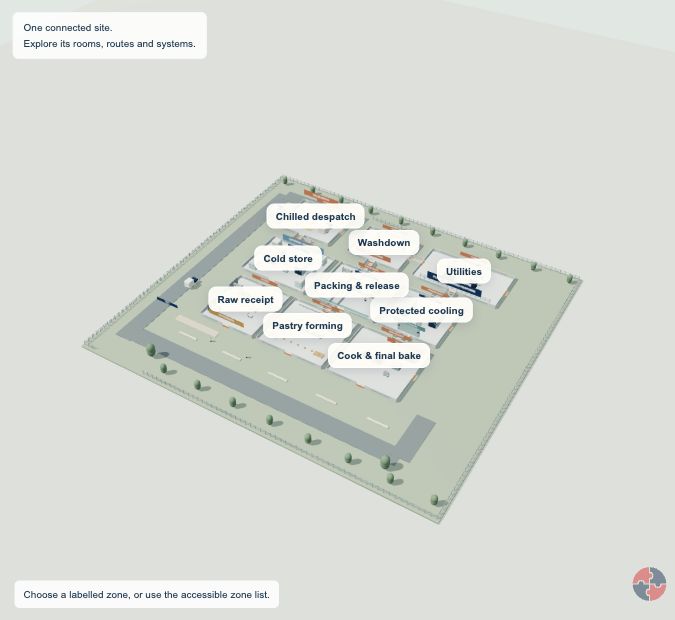
Actual whole-site SHAREsimulate pie factory model. This overview supplies layout context; inspect the lesson schematic and stated case for this zone.
Name the mechanism before choosing the safeguard
A moving machine can injure through several mechanisms. Rollers create an in-running nip where surfaces draw material and a hand into the gap. A mixer can entangle and crush against its bowl or tools. A depositor can trap a person between moving parts, while a thermoformer cutter can cause severe cutting injury. Naming the mechanism helps identify which access or movement must be prevented.
Look beyond steady production. Feeding, clearing a blockage, scraping, setting, cleaning and recovering film are foreseeable tasks. A line can appear well enclosed during its normal cycle yet expose a worker when a small interruption occurs. The risk assessment must consider those modes and the people involved, including cleaners and maintainers. Do not treat an intervention as unforeseeable merely because the production target discourages it.
In the fictional sheeter case, pastry folds at the rollers and an operator reaches towards it. The product problem invites a fast manual correction, but the nip does not distinguish a hand from dough. Prevent access to the moving hazard and use the approved clearing method. A warning sign, training reminder or protective glove cannot replace suitable safeguarding and a safe intervention arrangement.
Understand the boundary of your role. Operators should recognise unsafe access, stop use through the defined arrangements and report defects. Competent people select, assess and validate the required guarding and control functions for the actual machine and stopping behaviour. A course model cannot provide a guard dimension, safe distance or safety-system design. GB work-equipment duties and the separate NI route must be applied to the workplace concerned.
For practice, match each model cue to its mechanism and exposed task: sheeter nip, mixer tool, falling depositor and packaging cutter. Then identify whether the next decision concerns ordinary operation, cleaning access or maintenance release. Use a fictional risk-assessment sheet to explain the exposure and stronger control. The point is to prevent the dangerous access before someone improvises a reach into the machine.
Which mechanical mechanisms should you look for?
Look at the point of operation, drive and transmission parts, material paths, moving structures and unexpected movement. Trace where a hand, body or bystander could meet the hazard.
Roller nip, belt drive or rotating shaft catches clothing or a limb.
Can someone reach the nip from above, below, behind or through an opening?
Cutting, shearing or crushing
Blade, ram, closing gate or moving machine meets a person or fixed surface.
Where can the person be trapped during a cycle or unintended movement?
Ejection or impact
Tool fragment, chip, workpiece, stone or failed component leaves the machine.
Is the person protected from the full flight path and foreseeable failure?
Stored or residual energy
Coasting tool, pressure, spring, suspended part or charged circuit acts after stop.
What must be isolated, supported, cooled or dissipated before access?
Do not treat a visible emergency stop, guard or conformity mark as proof that every access and failure route has been controlled. Record the mechanism, task, credible event and exposed people before choosing measures.
Pastry folds at moving rollers and the operator considers pulling it flat by hand.
Decision and explanation
The in-running nip can draw in a hand; prevent access and follow the approved clearing arrangement.
The mechanism can cause severe harm regardless of the size of the product fault. Safeguarding and the approved intervention method must prevent exposure.
Lesson 2
An open guard is a question about the whole safety function
Recognise a defeated interlock and define competent restoration without unsafe testing.
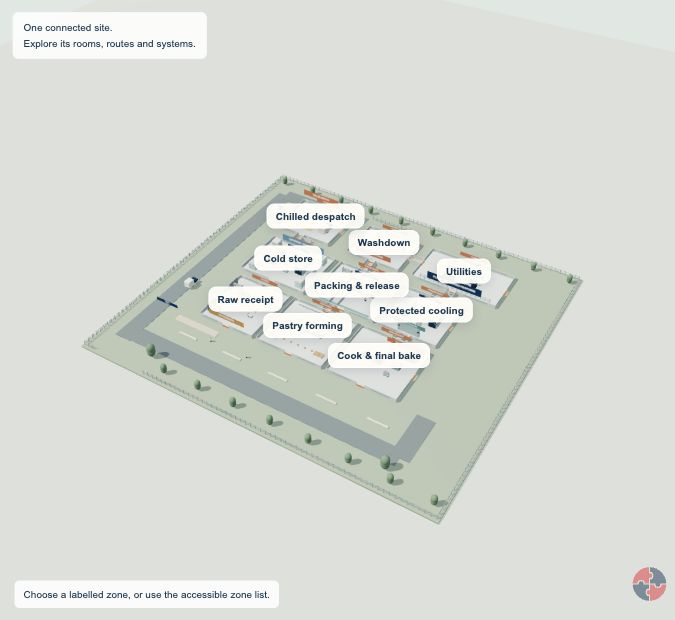
Actual whole-site SHAREsimulate pie factory model. This overview supplies layout context; inspect the lesson schematic and stated case for this zone.
An open guard is a question about the whole safety function
A guard and an interlock have related but distinct jobs. The physical guard restricts access; the safety-related control function must produce the required safe response when its conditions change. Run-down, stored movement, access geometry and restart behaviour can all matter. A green lamp or a stopped motor on one occasion does not establish that the complete arrangement remains effective.
The model shows a mixer operating while a scraper passes through a defeated interlocked guard. This is a clear stop-use condition under the defined safe arrangements. Prevent unintended restart and report the defect for authorised repair. Do not demonstrate the failure by placing a person or tool in the danger zone. Production pressure and a second person watching do not turn the bypass into suitable protection.
Investigate why the bypass occurred as well as its hardware. A difficult scraping task, unrealistic cleaning access or recurring product accumulation may make defeat predictable. Correcting only the switch while leaving the same task conflict can invite recurrence. Competent assessment should consider the machine, linked equipment and foreseeable access modes, with suitable changes controlled and verified before use.
After repair, the required checks need a defined function, safe test position, expected response, acceptance criteria and restoration. Consider whether motion is prevented or stopped as required and whether unintended restart is controlled. Only competent authorised people perform those checks by the approved method. An emergency-stop test is not a substitute for proving the relevant guard function, and an interlock is not automatically a secure isolation for maintenance.
Practise by sorting evidence into useful and insufficient: a defect report, a lamp photograph, a competent functional-test record and an explanation of the changed scraping method. State what each establishes. Release requires the restored protective arrangement and suitable operating/intervention method, not merely a signature saying that the mixer ran. The course does not grant authority to modify safety circuits or select replacement devices.
What must an interlocked guard achieve?
Opening the guard must cause the hazardous function it protects to stop or prevent it starting; closing the guard should not by itself restart the machine. If a person could reach dangerous movement before it stops, the design needs an effective way to keep access closed until the danger has ceased.
A door-position switch is one component, not proof of a complete safety function. The sensor, wiring, safety controller, output device, drive, brake and mechanical stopping performance all matter. Some hazards require a locking guard; some enclosures require an escape release and controls that stop a person being trapped. The competent designer determines those requirements for the actual machine and current applicable technical requirements. HSE L22 Safe use of work equipment.
An interlock may be defeated by an easy-to-remove actuator, loose alignment, a magnet, spare key, hidden fault or altered control logic. Repeated nuisance trips or bypasses show a design or work-system problem. Stop and investigate the incentive, including access, cleaning and production pressure, before choosing a tamper measure. HSE Introduction to machinery safety.
How should a safety function be tested?
Specify the function, safe test position, expected response, acceptance criteria and restoration before a competent person tests it.
For an interlock, confirm the guard state, stopped or prevented motion, run-down and restart behaviour for the real access route. A green indicator alone is not proof. Test from a protected position and record failures; do not put a person in danger to demonstrate the function. After repair or modification, consider the whole linked system, not only the replaced component. HSE L22 Safe use of work equipment and HSE maintenance of work equipment.
Applied case
The interlock has been repaired. The only proposed acceptance evidence is a photograph of its illuminated indicator.
Decision and explanation
The appropriate competent functional checks and confirmed safe operating/intervention arrangement.
The indicator does not prove the required safety response. Assess and test the function safely, including the real access and restart conditions.
Lesson 3
Stopped does not mean isolated from every energy source
Define the evidence needed before access to an electrically and pneumatically powered depositor.
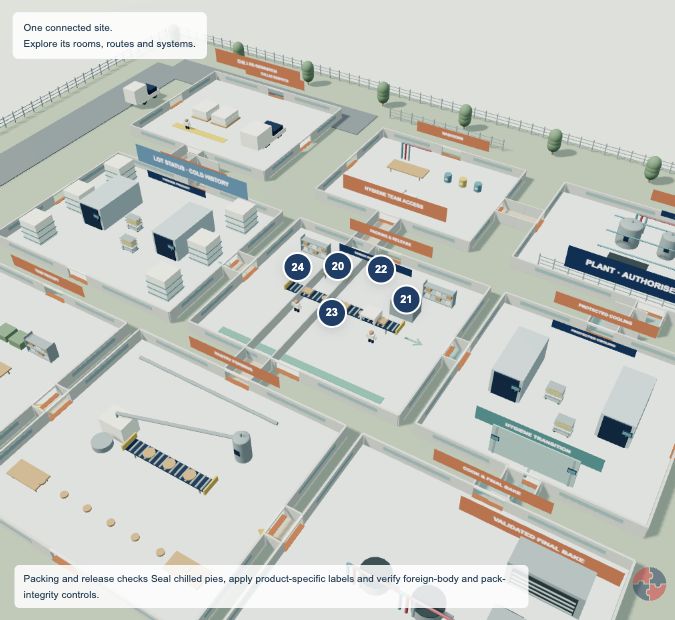
Actual whole-site SHAREsimulate pie factory model. This overview supplies layout context; inspect the lesson schematic and stated case for this zone.
Stopped does not mean isolated from every energy source
Pressing stop changes an operating command. It does not necessarily prevent a remote restart or remove stored pressure, gravity, spring force or hot product. The model depositor illustrates this distinction: its nozzle drops when a hose is disturbed although the production cycle is stopped. A person beneath or between parts can be crushed without the main motor starting again.
Start with the exact task and the exposure it creates. The competent isolation plan identifies the relevant sources, boundaries and methods for preventing reconnection, dissipating or restraining stored energy and verifying the required safe condition. Electrical, pneumatic, mechanical and product systems may interact. A generic lockout poster cannot identify every source on this particular machine or account for modifications.
The performing team needs current equipment information and a physical check that the arrangement matches the actual plant. Identify shared supplies, gravity-supported parts, accumulators and connected equipment where relevant. Verification must use the approved method from a safe position. Do not loosen a hose or move into the danger zone to discover whether energy remains; the investigation itself must be controlled.
Responsibilities matter when more than one person or shift is involved. The site system must preserve protection through changes in personnel, pauses and connected work. Do not remove another person's protection or assume that one worker leaving means everyone is clear. If the work scope changes, suspend and reassess the arrangement rather than extending a signature to a different exposure.
For practice, place four energy cards around the depositor and draw the boundary for the fictional cleaning task. Match each source to the evidence the authorised method would require, without prescribing a live valve or switch sequence. Finish with a handback statement identifying people, tools, restored safeguards and the controller of reinstatement. A completed course supports recognising gaps; it does not qualify the learner to perform live isolation or prove electrical dead.
Which energy sources must be identified?
A competent isolation plan looks beyond the obvious power switch.
Energy can be electrical, mechanical, hydraulic, pneumatic, chemical, thermal, gravitational, pressure, radiation or stored in springs, capacitors, accumulators, batteries, elevated loads and process inventory. Multi-energy systems are common in modern plant: a conveyor may have electrical drives, stored mechanical energy, pneumatic actuators, gravity hazards and automated controls. See HSG253 - The safe isolation of plant and equipment.
The isolation plan should be based on physical walkdown, drawings, operating knowledge, previous changes, site experience and challenge from the workers doing the task.
Energy source
How it can harm
Control example
Electrical
Shock, electrocution, arc flash or unexpected start.
Isolate, lock, prove dead and control back-feed.
Mechanical movement
Crushing, shearing, entanglement or amputation.
Block, pin, disengage and verify no movement.
Pressure
Injection, blast, projectile, release or burns.
Depressurise, drain, vent and verify.
Hydraulic/pneumatic
Unexpected actuator movement or stored pressure.
Isolate supply, bleed accumulators and secure parts.
Thermal
Burns from steam, hot product or cold cryogenic release.
Cool, drain, vent and wear suitable PPE.
Chemical/process inventory
Toxic, corrosive, flammable or asphyxiant release.
Clean, purge, gas test and use positive isolation where needed.
Gravity
Falling loads or drifting equipment.
Chock, prop, block or lower to safe position.
How should isolation be verified?
Verification proves the isolation is effective at the point of work, not just applied somewhere upstream.
Verification is the difference between a hopeful isolation and a controlled job. Electrical work needs proving dead; process work may need depressurisation, drain/vent checks, gas testing, sampling, pressure indication, bleed verification, flushing, purging or visual confirmation of blinds. See HSG253 - The safe isolation of plant and equipment.
Verification should be independent enough for the risk. A person should not simply trust the same label or drawing that could be wrong. Where consequences are high, independent verification and authoriser challenge are essential.
Hazard
Verification method
Common failure
Electrical energy
Test for dead with approved voltage indicator.
Tester not proved before/after or wrong circuit tested.
Pressure
Check gauges, vents, drains and bleed points.
Blocked gauge line gives false reading.
Flammable atmosphere
Gas test after purge and before line break.
Single test misses later vapour return.
Toxic/corrosive contents
Sample, drain, flush, isolate and PPE.
Dead leg or trapped pocket remains.
Mechanical movement
Try-start where safe, block and physical check.
Stored gravity/hydraulic energy not controlled.
Blind/spade
Visual check and blind list verification.
Wrong size/rating or wrong location.
Learning check: two apparent protections
A locked but wrongly identified isolator does not protect the work point. A correctly identified boundary still requires proof of every relevant energy/feed and each specified DBB barrier, with accepted evidence and a safe discharge destination. If identity or proof is missing, hold the intrusive work and use the roles/competence route. Do not turn this check into a generic valve-operating sequence or invent acceptance pressures.
Applied case
A depositor is stopped at its control panel. Stored air and the supported nozzle have not been addressed before cleaning access.
Decision and explanation
There is no authorised and verified safe state for all relevant energy and movement sources.
A stop command alone leaves restart and stored-energy hazards unresolved. Establish the task-specific secured and verified condition through competent authorised people.
Lesson 4
Pressure and heat remain hazards during jacket maintenance
Identify the task-specific isolation, pressure-system and reinstatement evidence for a steam jacket.
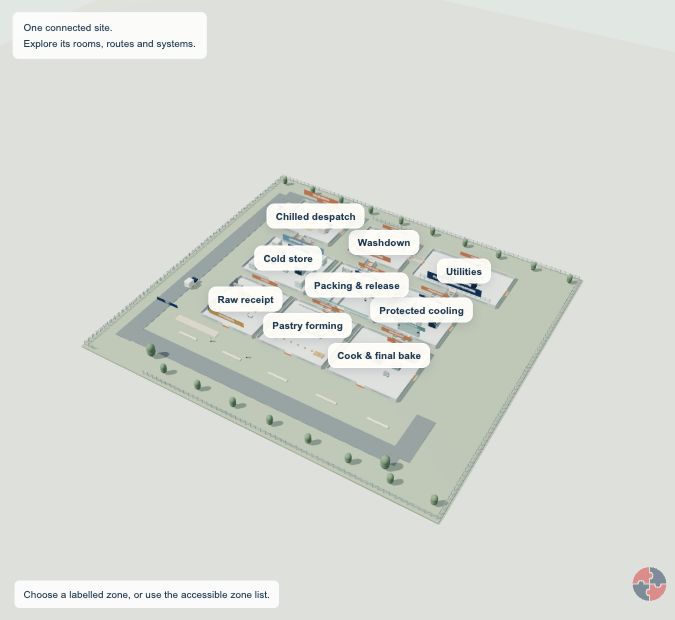
Actual whole-site SHAREsimulate pie factory model. This overview supplies layout context; inspect the lesson schematic and stated case for this zone.
Pressure and heat remain hazards during jacket maintenance
A steam jacket can expose a maintainer to stored pressure and hot material even when production has stopped. Opening a fitting can release steam or liquid violently, causing burns and impact injuries. The relevant boundary includes connected supply, trapped contents, temperature and the way pressure can return. A quiet pipe or an apparently stationary gauge cannot alone establish a safe condition for intrusive work.
The fictional case shows a worker preparing to loosen a fitting while pressure remains indicated. Keep the equipment out of use for the intervention and obtain the authorised maintenance arrangement. Competent people establish suitable isolation, depressurisation, cooling or other necessary controls and verify the task-specific safe state. This lesson is an evidence exercise, not a procedure for cracking a fitting to test whether it is safe.
Pressure-system assurance is related but separate. The responsible team determines whether the actual system is within the applicable GB or NI pressure-system requirements, its boundaries and any written scheme and examination needs. Where those requirements apply, evidence must be appropriate and current. A maintenance visit does not automatically replace examination, and a scheme document does not demonstrate that the examination or defect actions occurred.
Coordinate the work with food production and other users of connected services. A shared steam supply, a concurrent cleaning task or temporary pipework may change the assumptions. Communicate which equipment is unavailable and who controls the boundary. Reinstatement needs the appropriate repair, protection and system evidence, plus a separate assessment of any food-contact or hygiene implications introduced by maintenance.
For practice, sort the documents into different purposes: operating limits, isolation plan, safe-condition verification, maintenance record and applicable examination evidence. Identify what is missing rather than asking for a generic certificate. Write a fictional stop statement that names the fitting, indicated condition and responsible technical review. Safe handback must resolve the actual exposure and system readiness without inventing a pressure threshold, inspection interval or authority from this course.
What is a written scheme of examination?
For a qualifying pressure system, the user or owner must have a suitable written scheme before operation; a competent person draws it up or certifies it, and it identifies covered parts, examination methods, intervals and preparation for safe examination. Before first use of a qualifying system, the written scheme must be in place and the required examination undertaken; keep the system out of use until both are satisfied.
The scheme must cover protective devices and relevant vessels or pipework whose failure could cause danger, subject to the applicable legal text and competent scope decision. It is not a maintenance schedule, a generic certificate or proof that an examination has happened. See HSE L122 Safety of pressure systems.
Element
Decision
Evidence
Scope
Which vessels, pipelines, pipework and protective devices?
Identified boundary and exclusions.
Method and timing
How and when each part is examined?
Competent-person certified scheme.
Preparation
How is examination made safe?
Isolation, access and special measures.
Change
Does modified use require revision?
Scheme review and certification.
How does pressure-system examination work?
The system parts in the written scheme must be examined by a competent person in accordance with that scheme, with reports and actions that show whether continued use is safe.
The competent person needs suitable knowledge, resources, independence and authority for the actual system. Examination does not replace operator checks, maintenance, safe limits, protective devices or correct repair. Do not infer intervals from a generic boiler or compressor example.
Step
Evidence
Hold
Before
Current suitable written scheme and safe preparation.
Line breaking is the point where containment is opened and hidden assumptions are tested.
The first crack of a flange can release pressure, vapour, liquid, sludge, solids, steam, corrosive material, toxic gas or flammable atmosphere. Even a small residual quantity can injure a worker if it is hot, under pressure, toxic or reactive. See HSG253 - The safe isolation of plant and equipment.
Line breaking should therefore use a deliberate break plan: verify isolation, control drainage, position workers out of the line of fire, loosen bolts cautiously, use drip trays or containment, wear task-specific PPE, control ignition sources and stop if unexpected pressure or material appears.
Control point
Why it matters
Good evidence
Line contents known
Controls depend on substance.
SDS/process data and sampling where needed.
Pressure removed
Prevents violent release.
Vent/drain verification.
Worker position
Avoids line of fire.
Pre-job briefing and observation.
Containment
Controls spills and exposure.
Drip tray, bunding or drain isolation.
PPE/RPE
Protects against residual risk.
Task-specific PPE assessment.
Stop criteria
Controls unexpected release.
Briefed hold points.
Applied case
A contractor has a repair order but no verified safe condition for opening a steam-jacket fitting; pressure is still indicated.
Decision and explanation
Keep intrusive work held until the competent authorised isolation and safe-condition evidence are established.
A work order describes a task, not a safe pressure state. Opening equipment to discover its condition can create the harmful release.
Lesson 5
Film recovery needs a safe route past the cutter
Prevent unexpected movement during packaging recovery and maintain hygiene control afterwards.
Actual SHAREsimulate FOOD-Z05 model zone. The fictional case supplies the facts; the picture does not establish live plant or product conditions.
Film recovery needs a safe route past the cutter
A small film fault can bring a hand close to a severe cutting hazard. Thermoform, fill and seal equipment may include forming tools, cutters, conveyors, heaters and actuators with linked automatic movements. Pulling a strip free can change tension or release a jam, while a reset or remote command can initiate movement. The apparent size of the waste film does not define the injury risk.
The model shows a worker reaching towards a cutter while recovering trapped film. Use the defined stop, access and isolation arrangements before intervention. Keep other people from restarting or entering the affected area. Never rely on holding a guard switch closed, the absence of a current cycle or a colleague's promise to avoid the start button. The approved method must address all relevant energy and movement.
Investigate the fault without turning recovery into a repeated normal task beside the hazard. Material tracking, condition, setup or equipment defects may need competent attention. A tool that extends reach is not automatically a suitable replacement for protection; it can still contact moving parts or draw the user into the hazard. Any alternative method must be properly assessed for the actual machine.
The safe return includes more than freeing the film. Account for broken material, cutter components, tools and any packaging or food exposed during access. Restore guards and required functions through the competent checks, then complete the appropriate hygienic release. A successful empty machine cycle does not prove the food-contact area is ready, while a clean surface does not establish cutter safeguarding.
Practise using a sequence of cards: recognise the exposure, maintain the controlled stop, establish safe intervention, recover and inspect, restore safeguarding, complete hygiene checks and obtain authorised handback. Explain which evidence belongs to engineering and which belongs to food safety. Keep the learning exercise separate from live machine instructions. If the approved method cannot be followed or the cause remains uncertain, maintain the restriction and escalate rather than repeatedly improvising.
How can a jam, clean or repair be handled safely?
Plan the intervention before opening protection. Stop the machine, identify and isolate every relevant energy source, secure against reconnection, verify the safe condition, and prevent other people starting or entering while work continues. Use a separately engineered and authorised mode if movement is genuinely needed.
An interlock or emergency stop alone can leave electrical power, air pressure, hydraulic pressure, gravity or a coasting part available. The competent isolation plan covers linked conveyors and upstream equipment, stored loads, trapped pressure and each person working in the danger area. Do not reach in to pull material while a motor is merely stopped. HSE Maintenance of work equipment; HSE Guarding in quarries.
Intervention hold points
Stage
Decision or evidence
Before access
Identify machine, task, hazard and authorised workers; agree whether it can be done with guards in place or from outside the danger zone.
Secure
Stop, isolate and lock the applicable sources under the site procedure; each exposed worker retains personal control. Release or restrain stored energy by a competent method.
Verify
Check the intended safe state by the authorised method, including linked equipment and coasting. If the state is uncertain, hold work and escalate.
Perform and change
Use the approved tools and route. If the jam, access or energy state differs from the plan, stop, withdraw and revise the method.
Hand back
Account for people and tools; restore guards, remove locks only through the agreed process, function-check protection and authorise restart with affected operators informed.
How should a machinery hazard be controlled?
Remove the need for exposure first. Where dangerous parts remain, select suitable guarding or protective devices for every access state, then support these with isolation, procedures, information, training and supervision.
Design out a reach into the danger zone, move adjustment points outside an enclosure and choose a feeding method that keeps people clear. Use fixed enclosing guards where practicable. Where access is needed, a competent engineer selects and validates interlocked guards, guard locking or other protective devices for the hazard and stopping behaviour. A device that stops motion is not a physical barrier against ejected parts. See the Machinery control measures page for the detailed selection hierarchy.
Before intervention, use the machine-specific method to isolate all relevant energy, prevent reconnection and control residual energy. A stop command or open guard alone is not secure isolation. Do not bypass a safeguard because it interrupts production; investigate why the task and protection conflict. HSE L22 Safe use of work equipment and HSE Maintenance of work equipment support these distinctions.
Applied case
Trapped film has been removed, but a guard remains off and fragments may remain near open packs.
Decision and explanation
None yet: safeguarding restoration and the separate hygienic/product checks remain unresolved.
Removing the jam resolves only one condition. Worker protection, debris control and food readiness each need the appropriate evidence before restart.
Lesson 6
Engineering handback and hygienic release answer different questions
Reconcile the repaired machine, tools, residues, protective functions and product status.
Actual whole-site SHAREsimulate pie factory model. This overview supplies layout context; inspect the lesson schematic and stated case for this zone.
Engineering handback and hygienic release answer different questions
Engineering handback establishes that the repaired equipment is fit for the specified controlled use. Hygienic release establishes that the food environment and relevant product can safely return to their intended status. These decisions share information but neither substitutes for the other. A reliable return-to-service process makes both owners and their acceptance evidence clear before production resumes.
The model shows a tool part and engineering lubricant beside an open food-contact assembly. Identify and control the line and any exposed product while the uncertainty is assessed. Reconcile the maintenance scope, tools, parts, temporary materials and residues. Do not assume the missing item went home in a toolbox or that a lubricant is suitable merely because a service engineer used it near a food machine.
Mechanical restoration includes the correct assembly, guards, interlocks, connections and required functional checks. Consider linked equipment and the actual operating or cleaning modes affected by the work. The competent team should record defects, restrictions and test results rather than simply stating that the line runs. Unresolved safety-critical defects remain a restriction even when the food-contact surface has been cleaned.
Hygienic restoration uses the approved cleaning, inspection and verification arrangement for the actual intervention. Assess where debris, chemicals or handled parts could have reached product or packaging. Identify the relevant interval and lot scope, preserve hold status and obtain the responsible disposition. Do not grant the original product status solely because the machine has been washed or a new engineering signature has appeared.
For the exercise, build two release columns with one shared handover: engineering readiness and food/hygiene readiness. Place the tool reconciliation, protective-function result, cleaning evidence and product disposition in the appropriate columns. Ask the receiving operator to state what can run and which restrictions remain. A useful handback is specific enough to survive a shift change; it does not use a single tick to hide several unverified decisions.
How should a safety function be tested?
Specify the function, safe test position, expected response, acceptance criteria and restoration before a competent person tests it.
For an interlock, confirm the guard state, stopped or prevented motion, run-down and restart behaviour for the real access route. A green indicator alone is not proof. Test from a protected position and record failures; do not put a person in danger to demonstrate the function. After repair or modification, consider the whole linked system, not only the replaced component. HSE L22 Safe use of work equipment and HSE maintenance of work equipment.
What hazards does food safety control?
Food safety controls biological, chemical, physical and allergenic hazards that can make food unsafe.
The four hazard groups should be explained in human terms. Biological hazards can make people acutely ill. Chemical hazards can contaminate food through cleaning products, pest control chemicals or maintenance substances. Physical hazards can injure someone immediately. Allergens can cause severe reactions even when the premises look clean and well-run.
The strongest food safety cultures avoid blame-heavy shortcuts. If a fridge temperature is wrong, food has been left out, a supplier changes ingredients or staff are unsure about allergens, the system should make it normal to stop, segregate, check and record the decision.
How harm occursAllergic reaction or anaphylaxis where information or cross-contact fails.
Control focusAccurate information, separation, cleaning and staff communication.
Hazard typeProcess failure
ExamplesUndercooking, poor cooling, broken refrigeration or reheating failure.
How harm occursPathogens survive or multiply.
Control focusCritical limits, monitoring, corrective action and verification.
Specific official context: GOV.UK food hygiene for businesses; Government HACCP food safety management; Food Standards Scotland guidance; FSA government allergen guidance2026. Food examples require the actual food-business status, nation, food category and validated safe methods. Current government HACCP management guidance covers hazard identification, critical controls/limits, monitoring, corrective action, verification and records for food businesses; specialist meat-plant scope differs. FSA government allergen guidance updated 17 July 2026 applies England/Wales/NI; accurate ingredients, food-format labels, changes and cross-contact controls. GB assimilated law/NI movement or EU routes require actual product review.
Applied case
Guards are restored and engineering tests are satisfactory, but a missing tool part and exposed-product assessment remain unresolved.
Decision and explanation
Engineering evidence can be recorded, while the line/product remains controlled for the unresolved hygienic and foreign-body decisions.
The two forms of readiness are connected but distinct. Preserve satisfactory evidence and maintain the remaining restriction until the appropriate decision is justified.
Lesson 7
Mixer guard defeated during scraping
Explain the decision using the observed condition, the harm route and the evidence needed for release.
Actual whole-site SHAREsimulate pie factory model. This overview supplies layout context; inspect the lesson schematic and stated case for this zone.
Understand the activity and how harm develops
An open or defeated mixer guard can expose a hand to powered movement during scraping.
Provide a suitable method for normal scraping and secure isolation for any task needing access beyond the safeguards. Include unexpected restart and stored energy. Test the protective function under the authorised hand-back procedure.
Guarding protects normal operation. Cleaning, jam clearance and maintenance can need secure isolation of electrical, pneumatic, hydraulic, gravity or thermal energy. A stop button or defeated interlock leaves a different and potentially fatal exposure.
Recognise the evidence boundary
Question
Case evidence
What is observed?
The mixer runs while a scraper passes through a defeated interlocked guard.
How can harm occur?
Rotating tools can draw in a hand and cause crushing or amputation.
What information is needed?
Check the guard defect and the approved cleaning and isolation procedure.
Protect, manage and verify
Purpose
Practical application
Immediate protection
Stop use, prevent restart and obtain authorised repair without bypassing the safeguard.
Accountable work arrangement
The operator stops access and reports the condition. The authorised engineer and production supervisor verify protection and safe hand-back before release. If the described protection is absent, defective or cannot be verified, keep the affected activity restricted while the responsible person resolves it. Use the current inspection evidence; the title alone is not the verdict.
Release verification
Require competent safety checks and restored guarding before authorised restart.
Apply this at work
Explain the decision using the observed condition, the harm route and the evidence needed for release.
What must an interlocked guard achieve?
Opening the guard must cause the hazardous function it protects to stop or prevent it starting; closing the guard should not by itself restart the machine. If a person could reach dangerous movement before it stops, the design needs an effective way to keep access closed until the danger has ceased.
A door-position switch is one component, not proof of a complete safety function. The sensor, wiring, safety controller, output device, drive, brake and mechanical stopping performance all matter. Some hazards require a locking guard; some enclosures require an escape release and controls that stop a person being trapped. The competent designer determines those requirements for the actual machine and current applicable technical requirements. HSE L22 Safe use of work equipment.
An interlock may be defeated by an easy-to-remove actuator, loose alignment, a magnet, spare key, hidden fault or altered control logic. Repeated nuisance trips or bypasses show a design or work-system problem. Stop and investigate the incentive, including access, cleaning and production pressure, before choosing a tamper measure. HSE Introduction to machinery safety.
Applied case
The mixer runs while a scraper passes through a defeated interlocked guard. The next production or dispatch step is waiting for a decision.
Decision and explanation
Stop use, prevent restart and obtain authorised repair without bypassing the safeguard.
A person holding a control does not secure the equipment against unexpected movement. This retains control of the affected work or product while the required evidence is established. Require competent safety checks and restored guarding before authorised restart. Recording alone leaves this harm route active: Rotating tools can draw in a hand and cause crushing or amputation.
Lesson 8
Pastry sheeter in-running nip
Explain the decision using the observed condition, the harm route and the evidence needed for release.
Actual whole-site SHAREsimulate pie factory model. This overview supplies layout context; inspect the lesson schematic and stated case for this zone.
Understand the activity and how harm develops
A sheeter's rollers can draw fingers or clothing into the narrowing gap.
A nip can capture a person faster than they can withdraw. Keep normal feed and adjustment within the designed safeguards; clearing dough or a jam needs the authorised method and secure isolation when access exposes dangerous parts.
Guarding protects normal operation. Cleaning, jam clearance and maintenance can need secure isolation of electrical, pneumatic, hydraulic, gravity or thermal energy. A stop button or defeated interlock leaves a different and potentially fatal exposure.
Recognise the evidence boundary
Question
Case evidence
What is observed?
An operator reaches towards pastry at the moving sheeter rollers.
How can harm occur?
The in-running nip can trap fingers and pull the hand into the rollers.
What information is needed?
Check guarding, safe clearing arrangements and the actual approach to the nip.
Protect, manage and verify
Purpose
Practical application
Immediate protection
Prevent access to moving rollers and follow the approved isolated clearing method.
Accountable work arrangement
The operator stops access and reports the condition. The authorised engineer and production supervisor verify protection and safe hand-back before release. If the described protection is absent, defective or cannot be verified, keep the affected activity restricted while the responsible person resolves it. Use the current inspection evidence; the title alone is not the verdict.
Release verification
Verify safeguards and safe operation after any intervention before return to service.
Apply this at work
Explain the decision using the observed condition, the harm route and the evidence needed for release.
What makes a physical guard effective?
A guard must be strong, secure and positioned so a person cannot reach dangerous parts through, over, under or around it. It must not create a new trapping or sharp-edge hazard, and workers need a usable way to do the job without removing it.
A fixed guard normally requires a tool for removal and must be refitted before use. A movable guard may suit needed access but requires an appropriate safety function. Mesh aperture, height, reach distance, transparent-panel strength and fixings are engineering design choices; they cannot be chosen from one universal gap or panel thickness. A competent designer uses the applicable current technical requirements, machine instructions and actual body/access routes. HSE L22 Safe use of work equipment.
Poor visibility, awkward cleaning and long waits are reasons people defeat protection. During the design review, watch operators perform real tasks and redesign inconvenient steps without creating a shortcut to the hazard. A new opening, tool, product or worker group can invalidate an earlier reach assessment. HSE Introduction to machinery safety.
Applied case
An operator reaches towards pastry at the moving sheeter rollers. The next production or dispatch step is waiting for a decision.
Decision and explanation
Prevent access to moving rollers and follow the approved isolated clearing method.
Recording alone leaves this harm route active: The in-running nip can trap fingers and pull the hand into the rollers. This retains control of the affected work or product while the required evidence is established. Verify safeguards and safe operation after any intervention before return to service. Slow speed still allows drawing-in and does not create a safe hand position.
Lesson 9
Depositor moves on trapped pneumatic energy
Explain the decision using the observed condition, the harm route and the evidence needed for release.
Actual whole-site SHAREsimulate pie factory model. This overview supplies layout context; inspect the lesson schematic and stated case for this zone.
Understand the activity and how harm develops
A depositor can move on trapped compressed air after its electrical supply is switched off.
Identify actuators, accumulators, gravity movement and pressure held by valves. Use the specified secure isolation, discharge and safe-state verification before access; do not loosen a hose to discover whether pressure remains.
A control valve, a stopped motor or a zero indication can fail to establish safe isolation. Identify connections, trapped pressure, gravity, electrical and other energy, secure the isolations and verify the work boundary. Intrusive work needs the task-specific authorised method.
Recognise the evidence boundary
Question
Case evidence
What is observed?
The stopped depositor nozzle drops when a hose is disturbed during cleaning.
How can harm occur?
Stored air pressure or gravity can move parts and crush the cleaner.
What information is needed?
Identify electrical, pneumatic, gravity and product energy in the isolation procedure.
Protect, manage and verify
Purpose
Practical application
Immediate protection
Use authorised isolation, dissipate or restrain stored energy and prevent restart.
Accountable work arrangement
The authorised isolating authority and work controller reconcile plant, documents and actual isolation; the competent worker confirms the safe work boundary before exposure. If the described protection is absent, defective or cannot be verified, keep the affected activity restricted while the responsible person resolves it. Use the current inspection evidence; the title alone is not the verdict.
Release verification
A competent person verifies the safe state before access and controlled handback afterwards.
Apply this at work
Explain the decision using the observed condition, the harm route and the evidence needed for release.
How should isolation be verified?
Verification proves the isolation is effective at the point of work, not just applied somewhere upstream.
Verification is the difference between a hopeful isolation and a controlled job. Electrical work needs proving dead; process work may need depressurisation, drain/vent checks, gas testing, sampling, pressure indication, bleed verification, flushing, purging or visual confirmation of blinds. See HSG253 - The safe isolation of plant and equipment.
Verification should be independent enough for the risk. A person should not simply trust the same label or drawing that could be wrong. Where consequences are high, independent verification and authoriser challenge are essential.
Hazard
Verification method
Common failure
Electrical energy
Test for dead with approved voltage indicator.
Tester not proved before/after or wrong circuit tested.
Pressure
Check gauges, vents, drains and bleed points.
Blocked gauge line gives false reading.
Flammable atmosphere
Gas test after purge and before line break.
Single test misses later vapour return.
Toxic/corrosive contents
Sample, drain, flush, isolate and PPE.
Dead leg or trapped pocket remains.
Mechanical movement
Try-start where safe, block and physical check.
Stored gravity/hydraulic energy not controlled.
Blind/spade
Visual check and blind list verification.
Wrong size/rating or wrong location.
Learning check: two apparent protections
A locked but wrongly identified isolator does not protect the work point. A correctly identified boundary still requires proof of every relevant energy/feed and each specified DBB barrier, with accepted evidence and a safe discharge destination. If identity or proof is missing, hold the intrusive work and use the roles/competence route. Do not turn this check into a generic valve-operating sequence or invent acceptance pressures.
Applied case
The stopped depositor nozzle drops when a hose is disturbed during cleaning. The next production or dispatch step is waiting for a decision.
Decision and explanation
Use authorised isolation, dissipate or restrain stored energy and prevent restart.
Recording alone leaves this harm route active: Stored air pressure or gravity can move parts and crush the cleaner. The check itself can release energy unpredictably and injure the worker. This retains control of the affected work or product while the required evidence is established. A competent person verifies the safe state before access and controlled handback afterwards.
Lesson 10
Steam-jacket maintenance releases pressure
Explain the decision using the observed condition, the harm route and the evidence needed for release.
Actual whole-site SHAREsimulate pie factory model. This overview supplies layout context; inspect the lesson schematic and stated case for this zone.
Understand the activity and how harm develops
Steam or hot water trapped in a kettle jacket can cause severe injury when maintenance opens it.
Follow all steam, condensate and heated-product connections. Cooling and depressurisation need verification by the authorised method; a cool outer surface or one gauge reading cannot establish every trapped space is safe.
A stopped compressor or closed valve may leave pressure trapped in a receiver, hose or actuator. Identify all energy sources, use the authorised isolation and release method, and verify the safe state before access. Inspection does not replace safe operating limits and maintenance.
Recognise the evidence boundary
Question
Case evidence
What is observed?
A maintenance worker loosens a fitting on a jacket that still shows pressure.
How can harm occur?
Pressurised steam or hot liquid can cause burns and violent release.
What information is needed?
Check the permit, pressure-system information and verified isolation and depressurisation status.
Protect, manage and verify
Purpose
Practical application
Immediate protection
Keep the jacket out of service until authorised personnel establish safe maintenance conditions.
Accountable work arrangement
The authorised engineer and pressure-system dutyholder resolve the safe state and examination requirements; operators keep outside the affected work. If the described protection is absent, defective or cannot be verified, keep the affected activity restricted while the responsible person resolves it. Use the current inspection evidence; the title alone is not the verdict.
Release verification
Confirm the required pressure-system and maintenance checks before reinstatement.
Apply this at work
Explain the decision using the observed condition, the harm route and the evidence needed for release.
How are pressure systems operated and maintained?
Operate within established safe limits using effective protective devices, competent people, clear instructions and a whole-system maintenance plan; isolate and depressurise safely before intervention.
Pressure-system examination and maintenance are different. Include corrosion, leakage, alarms, relief devices, connections, pipework, environment, change and operator handover. A pressure indication of zero at one point is not proof that all stored energy is controlled.
Start and run. Control: Limits, protection and competent operation.; Stop: Unreliable reading or excursion.
Maintain. Control: Isolation, depressurisation, verification and safe access.; Stop: Trapped pressure or unknown connection.
What happens after pressure-system repair or modification?
Hold the affected system, assess the change against design and safe limits, update the written scheme when required, obtain competent examination where the scheme or law requires it, and release only after controlled testing and named acceptance.
Repairs, replacement components, changed fluids and operating conditions can alter the pressure boundary. A maintenance completion or leak test alone is not statutory examination or authority to operate.
Repair or replacement. Check: Material, design, protective devices and required examination.; Release condition: Competent evidence accepted.
Changed duty. Check: Safe limits, scheme scope and instructions.; Release condition: Updated and approved basis.
What should happen after a pressure release or alarm?
Move people clear, raise the alarm, follow the site emergency plan and keep the system isolated from further operation; do not approach a leak, adjust a relief device or reopen a vessel until the hazard and safe state are established by authorised people.
Treat vessel, line and connected process as potentially energised. Investigate cause and affected scope, protect others, obtain any required competent examination and controlled test, then require named operating acceptance.
Leak or unusual sound. Immediate action: Withdraw and warn.; Restart barrier: No approach until assessed.
Relief device operates. Immediate action: Escalate and preserve evidence.; Restart barrier: No reset-only return.
Rupture or injury. Immediate action: Emergency response and exclusion.; Restart barrier: Investigation and competent release.
A maintenance worker loosens a fitting on a jacket that still shows pressure. The next production or dispatch step is waiting for a decision.
Decision and explanation
Keep the jacket out of service until authorised personnel establish safe maintenance conditions.
Opening containment turns an uncertain state into a potential release onto the worker. Recording alone leaves this harm route active: Pressurised steam or hot liquid can cause burns and violent release. This retains control of the affected work or product while the required evidence is established. Confirm the required pressure-system and maintenance checks before reinstatement.
Lesson 11
Thermoformer cutter access during film recovery
Explain the decision using the observed condition, the harm route and the evidence needed for release.
Actual SHAREsimulate FOOD-Z05 model zone. The fictional case supplies the facts; the picture does not establish live plant or product conditions.
Understand the activity and how harm develops
Recovering jammed film can expose a worker to the thermoformer's cutter or other moving parts.
Normal film threading and recovery must follow the designed safe method. Access beyond safeguards needs the relevant isolation, including heat, pressure and unexpected motion, and a controlled check before restart.
Guarding protects normal operation. Cleaning, jam clearance and maintenance can need secure isolation of electrical, pneumatic, hydraulic, gravity or thermal energy. A stop button or defeated interlock leaves a different and potentially fatal exposure.
Recognise the evidence boundary
Question
Case evidence
What is observed?
A worker reaches towards a cutter while pulling trapped packaging film.
How can harm occur?
Unexpected cutter movement can cause severe cuts or amputation.
What information is needed?
Check cutter safeguards, all relevant energy sources and approved recovery access.
Protect, manage and verify
Purpose
Practical application
Immediate protection
Stop and isolate through the authorised method before clearing the film.
Accountable work arrangement
The operator stops access and reports the condition. The authorised engineer and production supervisor verify protection and safe hand-back before release. If the described protection is absent, defective or cannot be verified, keep the affected activity restricted while the responsible person resolves it. Use the current inspection evidence; the title alone is not the verdict.
Release verification
Verify restored safeguards and separate hygiene release before restarting packing.
Apply this at work
Explain the decision using the observed condition, the harm route and the evidence needed for release.
How can a jam, clean or repair be handled safely?
Plan the intervention before opening protection. Stop the machine, identify and isolate every relevant energy source, secure against reconnection, verify the safe condition, and prevent other people starting or entering while work continues. Use a separately engineered and authorised mode if movement is genuinely needed.
An interlock or emergency stop alone can leave electrical power, air pressure, hydraulic pressure, gravity or a coasting part available. The competent isolation plan covers linked conveyors and upstream equipment, stored loads, trapped pressure and each person working in the danger area. Do not reach in to pull material while a motor is merely stopped. HSE Maintenance of work equipment; HSE Guarding in quarries.
Intervention hold points
Stage
Decision or evidence
Before access
Identify machine, task, hazard and authorised workers; agree whether it can be done with guards in place or from outside the danger zone.
Secure
Stop, isolate and lock the applicable sources under the site procedure; each exposed worker retains personal control. Release or restrain stored energy by a competent method.
Verify
Check the intended safe state by the authorised method, including linked equipment and coasting. If the state is uncertain, hold work and escalate.
Perform and change
Use the approved tools and route. If the jam, access or energy state differs from the plan, stop, withdraw and revise the method.
Hand back
Account for people and tools; restore guards, remove locks only through the agreed process, function-check protection and authorise restart with affected operators informed.
Applied case
A worker reaches towards a cutter while pulling trapped packaging film. The next production or dispatch step is waiting for a decision.
Decision and explanation
Stop and isolate through the authorised method before clearing the film.
Defeating the safeguard creates the dangerous access it was intended to prevent. Recording alone leaves this harm route active: Unexpected cutter movement can cause severe cuts or amputation. This retains control of the affected work or product while the required evidence is established. Verify restored safeguards and separate hygiene release before restarting packing.
Lesson 12
Engineering handback leaves contamination in the line
Explain the decision using the observed condition, the harm route and the evidence needed for release.
Actual whole-site SHAREsimulate pie factory model. This overview supplies layout context; inspect the lesson schematic and stated case for this zone.
Understand the activity and how harm develops
An engineering repair can leave fragments, tools, lubricant or an unsafe guard condition in the food line.
Engineering and food-safety hand-back are connected checks with different evidence. Reconcile parts, tools, cleaning, protective functions and any product exposed during the work before authorised release. A running machine does not demonstrate a hygienically acceptable machine.
Records, displays and field conditions must describe the same situation. Include unfinished work, isolations, abnormal conditions and the next decision, then provide time for questions. A signature does not demonstrate shared understanding.
Recognise the evidence boundary
Question
Case evidence
What is observed?
A tool part and engineering lubricant remain near an open food-contact assembly.
How can harm occur?
Foreign material or unsuitable residue can contaminate food.
What information is needed?
Reconcile tools, parts, maintenance scope and required cleaning evidence.
Protect, manage and verify
Purpose
Practical application
Immediate protection
Keep the line held until mechanical handback and hygienic restoration are separately completed.
Accountable work arrangement
The outgoing and incoming authorised people reconcile the actual state; the supervisor resolves contradictions before work or operation continues. If the described protection is absent, defective or cannot be verified, keep the affected activity restricted while the responsible person resolves it. Use the current inspection evidence; the title alone is not the verdict.
Release verification
Verify guard restoration, tool accounting and authorised food-hygiene release.
Apply this at work
Explain the decision using the observed condition, the harm route and the evidence needed for release.
How should handover quality be checked?
Quality should be sampled through observation, record review and incoming-person understanding.
A signed handover sheet does not prove understanding. Assurance should watch the handover, ask incoming people what they understood and compare the message with live plant or task status. See HSE shift handover for the relevant source and scope.
Where remote or digital handover is used, the standard should still require two-way communication and cross-checking of safety-critical information.
A tool part and engineering lubricant remain near an open food-contact assembly. The next production or dispatch step is waiting for a decision.
Decision and explanation
Keep the line held until mechanical handback and hygienic restoration are separately completed.
This retains control of the affected work or product while the required evidence is established. Verify guard restoration, tool accounting and authorised food-hygiene release. Mechanical motion is only one aspect of the required safe and hygienic hand-back. Recording alone leaves this harm route active: Foreign material or unsuitable residue can contaminate food.
Lesson 13
The engineer is finished, but the line is not handed back
Integrate safe intervention, protective functions and hygienic/product readiness before restart.
Actual whole-site SHAREsimulate pie factory model. This overview supplies layout context; inspect the lesson schematic and stated case for this zone.
The engineer is finished, but the line is not handed back
The fictional pie line has stopped after a film jam. A contractor has cleared the thermoformer and replaced a small part. Elsewhere, the depositor remains unavailable for cleaning because its stored-air and supported-part conditions were not verified. The maintenance sheet says work complete, but the packing guard test has not been recorded and one tool component is missing. Open product was present during part of the intervention.
Begin with the actual state rather than the signature. Maintain the affected restrictions and establish who controls each machine and work boundary. Prevent unintended restart and keep people clear of exposed danger zones. The scope includes ordinary operation, recovery, cleaning and connected work; do not assume that a stopped conveyor or finished repair order proves that all those modes are ready for use.
For the depositor, identify the electrical, pneumatic, gravity and other relevant energy sources through the competent task-specific plan. Confirm how reconnection and residual movement are controlled and how the required safe state is verified. Do not use a hose disconnection or a person standing under the nozzle as a diagnostic test. The proper outcome remains no access until the approved arrangement is established.
For the thermoformer, reconcile the repair, component identity and reassembly. Competent people must complete the applicable checks of the restored protective arrangement, using a safe test method and defined acceptance criteria. Consider the real access route, linked movement and restart behaviour. A successful production cycle does not demonstrate the guard function; an emergency-stop response does not automatically prove every other protective function.
Investigate the missing tool component without putting people or product at additional risk. Account for tools, parts and temporary materials against the work scope and locations. Protect the relevant product and contact equipment while the responsible team determines the exposure interval. Do not send food through the line to locate the fragment or assume that a detector can recover an unassessed foreign-body problem. Any recovery proposal requires suitability and authority.
Complete the separate hygienic restoration. Check the approved cleaning and verification evidence for residues and disturbed areas, including any lubricant used near open food-contact assemblies. Restore identified product status only through the authorised assessment. Where pressure or steam equipment was involved, the controller also needs the task-specific and applicable system assurance evidence; a generic maintenance signature cannot replace it.
Your handback should show two explicit readiness decisions and their owners: engineering safe operation and food/hygiene/product release. List any remaining restrictions and the evidence required to remove them. Brief the receiving operator using the equipment and lot identities, then confirm understanding before authorised reinstatement. This exercise develops evidence-based challenge; it does not teach a live isolation sequence, confer maintenance competence or create an operating permit.
How is a safety-related control function proved effective?
Define what the safeguard must prevent, then have a competent person design, validate, test, maintain and control changes to the whole safety function. Performance and test methods depend on the assessed machine and risk; this page does not assign a performance level, stopping distance or test interval.
The specification should cover hazardous motion, access, stopping and reset behaviour, foreseeable faults, stored energy and loss or restoration of power. Check actual stopping behaviour and all accessible sides before hand-back. The HSE L22 PUWER guidance supports the safeguarding decision. Any private technical standard needs an authorised copy and a competent, machine-specific clause review before its content is used here.
How should handover and handback be controlled?
Isolation risk increases during shift change, job pause, recommissioning and return to service.
Handover must explain what is isolated, what is open, what is drained, what is blinded, which locks are applied, what work is incomplete and what must not be operated. Incoming teams should not inherit assumptions without walking down critical isolations where risk justifies it. See HSG253 - The safe isolation of plant and equipment.
Handback is not just removing locks. It includes checking tools and people are clear, blinds and spades are removed or correctly positioned, drains and vents are closed, guards are replaced, leak testing is complete, alarms/interlocks are restored, overrides are removed and the system is safe for restart.
Shift handover — Status misunderstood. Written and verbal isolation handover.
Job suspended — Plant condition changes while work paused. Suspend permit and secure open systems.
Reinstatement — Blind, lock or drain left in wrong state. Reinstatement checklist and second check.
Leak test — Containment not proven. Controlled pressurisation and inspection.
Restart — People or tools remain in danger zone. Final sweep and authorisation.
What food safety records should a business keep?
Records should prove that significant food safety controls are being completed, checked and corrected when they fail.
Food records should be quick to complete but meaningful. They should show the control, the result, the person checking it and the action taken when the result is outside the expected standard. Records that show perfect ticks every day but no defects, no corrective action and no manager review may be weaker than they look.
For higher-risk catering, records should also help managers identify patterns: repeated fridge failures, poor probe calibration, missed cleaning, supplier problems, complaints, allergen queries or staff training gaps.
Food safety evidence register
Record
What it proves
Review trigger
RecordFood safety management system
What it provesHazards, controls, monitoring and corrective actions are defined.
Review triggerMenu, process, supplier or premises change.
RecordTemperature records
What it provesCritical storage, cooking, cooling and hot-holding controls are checked.
Review triggerOut-of-range reading or equipment fault.
RecordCleaning schedule
What it provesCleaning tasks are allocated and verified.
Review triggerFailed inspection, pest activity or complaint.
RecordTraining matrix
What it provesFood handlers and supervisors are competent for their role.
Review triggerNew starter, role change or incident.
RecordAllergen matrix
What it provesAllergen information is current and communicated.
Review triggerSupplier, recipe or menu change.
RecordMaintenance records
What it provesEquipment affecting food safety is kept reliable.
Review triggerRepeated defect or breakdown.
RecordIncident and complaint log
What it provesLearning is captured and actioned.
Review triggerIllness complaint, allergen near miss or enforcement feedback.
Specific official context: GOV.UK food hygiene for businesses; Government HACCP food safety management; Food Standards Scotland guidance; FSA government allergen guidance2026. Food examples require the actual food-business status, nation, food category and validated safe methods. Current government HACCP management guidance covers hazard identification, critical controls/limits, monitoring, corrective action, verification and records for food businesses; specialist meat-plant scope differs. FSA government allergen guidance updated 17 July 2026 applies England/Wales/NI; accurate ingredients, food-format labels, changes and cross-contact controls. GB assimilated law/NI movement or EU routes require actual product review.
Applied case
Film is removed and a part replaced, but the guard function, tool reconciliation, exposed-product assessment and depositor safe state remain incomplete.
Decision and explanation
Keep the identified restrictions until competent engineering and authorised hygiene/product decisions are separately supported.
Repair completion is an input, not the complete release. Resolve each protection, residual-energy, foreign-body and product question through its appropriate owner.
Lesson 14
Take a verified action into the workplace
Connect one actual task to an owner, evidence and a clear release or escalation decision.
Actual whole-site SHAREsimulate pie factory model. This overview supplies layout context; inspect the lesson schematic and stated case for this zone.
Turn awareness into a practical question
Machinery and maintenance decision awareness for the fictional FOOD environment. No live isolation, electrical proving, pressure-system work, guard design or technical validation instruction is supplied. Apply separate GB/NI duties and competent site-specific methods.
Choose one relevant operation from the course. Describe the person or product at risk, the mechanism of harm and the exact condition that needs controlling. Separate an observation from a conclusion. A display, signature, badge or clean appearance answers only a limited question.
Use the included practice resources to prepare a fictional task brief, risk review or verification question. Decide which competent role owns the decision and which evidence must be available before work or product is released. Keep food disposition and worker protection as distinct decisions where both apply.
At work, use your actual approved arrangements. Report uncertainty and preserve the relevant hold, restriction or safe state while it is resolved. Confirm that the action addressed the original harm route and check whether another shift, product, cleaning task or maintenance change could reintroduce it.
Course completion records awareness learning. It does not establish practical competence, certify a food business, validate a recipe, extend shelf life or authorise maintenance, chemical work or emergency entry.
How is a safety-related control function proved effective?
Define what the safeguard must prevent, then have a competent person design, validate, test, maintain and control changes to the whole safety function. Performance and test methods depend on the assessed machine and risk; this page does not assign a performance level, stopping distance or test interval.
The specification should cover hazardous motion, access, stopping and reset behaviour, foreseeable faults, stored energy and loss or restoration of power. Check actual stopping behaviour and all accessible sides before hand-back. The HSE L22 PUWER guidance supports the safeguarding decision. Any private technical standard needs an authorised copy and a competent, machine-specific clause review before its content is used here.
How should handover and handback be controlled?
Isolation risk increases during shift change, job pause, recommissioning and return to service.
Handover must explain what is isolated, what is open, what is drained, what is blinded, which locks are applied, what work is incomplete and what must not be operated. Incoming teams should not inherit assumptions without walking down critical isolations where risk justifies it. See HSG253 - The safe isolation of plant and equipment.
Handback is not just removing locks. It includes checking tools and people are clear, blinds and spades are removed or correctly positioned, drains and vents are closed, guards are replaced, leak testing is complete, alarms/interlocks are restored, overrides are removed and the system is safe for restart.
Shift handover — Status misunderstood. Written and verbal isolation handover.
Job suspended — Plant condition changes while work paused. Suspend permit and secure open systems.
Reinstatement — Blind, lock or drain left in wrong state. Reinstatement checklist and second check.
Leak test — Containment not proven. Controlled pressurisation and inspection.
Restart — People or tools remain in danger zone. Final sweep and authorisation.
What food safety records should a business keep?
Records should prove that significant food safety controls are being completed, checked and corrected when they fail.
Food records should be quick to complete but meaningful. They should show the control, the result, the person checking it and the action taken when the result is outside the expected standard. Records that show perfect ticks every day but no defects, no corrective action and no manager review may be weaker than they look.
For higher-risk catering, records should also help managers identify patterns: repeated fridge failures, poor probe calibration, missed cleaning, supplier problems, complaints, allergen queries or staff training gaps.
Food safety evidence register
Record
What it proves
Review trigger
RecordFood safety management system
What it provesHazards, controls, monitoring and corrective actions are defined.
Review triggerMenu, process, supplier or premises change.
RecordTemperature records
What it provesCritical storage, cooking, cooling and hot-holding controls are checked.
Review triggerOut-of-range reading or equipment fault.
RecordCleaning schedule
What it provesCleaning tasks are allocated and verified.
Review triggerFailed inspection, pest activity or complaint.
RecordTraining matrix
What it provesFood handlers and supervisors are competent for their role.
Review triggerNew starter, role change or incident.
RecordAllergen matrix
What it provesAllergen information is current and communicated.
Review triggerSupplier, recipe or menu change.
RecordMaintenance records
What it provesEquipment affecting food safety is kept reliable.
Review triggerRepeated defect or breakdown.
RecordIncident and complaint log
What it provesLearning is captured and actioned.
Review triggerIllness complaint, allergen near miss or enforcement feedback.
Specific official context: GOV.UK food hygiene for businesses; Government HACCP food safety management; Food Standards Scotland guidance; FSA government allergen guidance2026. Food examples require the actual food-business status, nation, food category and validated safe methods. Current government HACCP management guidance covers hazard identification, critical controls/limits, monitoring, corrective action, verification and records for food businesses; specialist meat-plant scope differs. FSA government allergen guidance updated 17 July 2026 applies England/Wales/NI; accurate ingredients, food-format labels, changes and cross-contact controls. GB assimilated law/NI movement or EU routes require actual product review.
Applied case
The shift action log says “training completed, issue closed”. It records no condition check, product disposition or task owner.
Decision and explanation
The accountable person verifies the task-specific control and records the justified decision.
Learning supports the decision; evidence that the relevant control works is needed before the responsible person closes the action.